
As the global macroeconomic situation changes, especially the reduction of inflationary pressure and the potential shift in central bank policies, Bitcoin prices and the entire cryptocurrency market are welcoming new opportunities. The current signs of slowing inflation and the market's expectations of future monetary policy easing may have a long-term positive impact on Bitcoin and other digital assets. By deeply analyzing market data and economic trends, we can more clearly see the far-reaching impact of these changes on the crypto market.
The profound impact of the macroeconomic environment on cryptocurrencies
Inflation and monetary policy are two important factors that determine the trend of global financial markets, and the cryptocurrency market is particularly sensitive to these variables. Currently, major economies around the world, especially the United States, are in a stage where inflation growth is gradually slowing down. According to important indicators such as personal consumption expenditures (PCE), price pressures have eased, which provides more policy space for the Federal Reserve and other central banks. In particular, after the Federal Reserve has raised interest rates continuously, the market expects the policy to turn to easing, and there may even be the possibility of a rate cut.
The reduction of inflationary pressure can not only alleviate the negative impact of monetary tightening, but also may drive up the prices of risky assets. History shows that when monetary policy is loose, investors are more inclined to invest their funds in high-risk, high-return asset classes, and cryptocurrencies, especially Bitcoin, are often seen as an important choice among these risky assets. The reason is that Bitcoin is not only the leader among digital assets, but also has anti-inflation characteristics, which makes it more popular when macroeconomic uncertainty increases.
The current inflation data and monetary policy changes have begun to have a profound impact on the cryptocurrency market. As the price growth slows down, market funds begin to flow to assets with greater growth potential, and Bitcoin, as a hedging tool and emerging asset class, naturally attracts the attention of a large number of investors.
Technical analysis of Bitcoin price and future trends
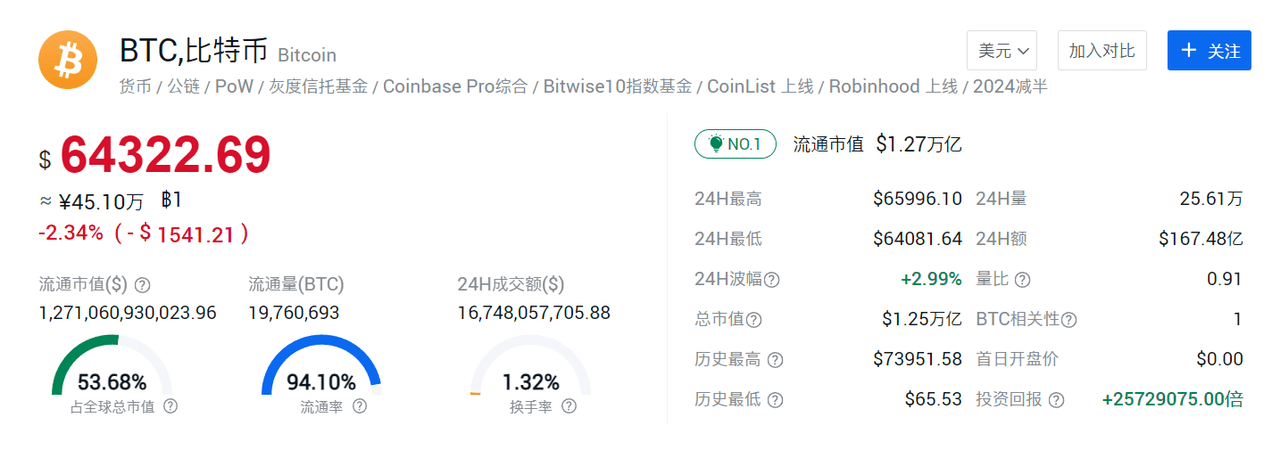
From a technical analysis perspective, Bitcoin prices are fluctuating around key resistance levels, and the short-term trend of the market may depend on whether it can effectively break through the key psychological barrier of $66,000. Currently, Bitcoin prices are close to its 200-day moving average (MA), a key technical indicator widely regarded as the dividing line between long and short markets. If Bitcoin can effectively stand above $64,000 and further hit the resistance level of $66,000, it will open a new round of upward channel.
However, breaking through this resistance level will require significant financial support, especially in spot trading volume and futures open interest (open interest), which will need to see significant growth. Once funds come in and push the price above the current resistance area, the market may attract more bulls to enter the market, accelerating the price towards the all-time high of $70,000.
In addition, the current bull market expectations are also supported by global liquidity. With the reduction of the deposit reserve ratio by the People's Bank of China and the possible loose monetary policy adopted by the Federal Reserve, the liquidity of the cryptocurrency market will increase significantly. This means that more funds will flow into high-risk assets in the global market, and Bitcoin, as digital gold, will become one of the first choices for capital hedging and value-added.
Cryptocurrency Investment and Changing Market Sentiment
The market sentiment of cryptocurrency investors is changing. After several rounds of macroeconomic policy fluctuations, investors' focus has gradually shifted from defensive strategies to offensive strategies. Especially in the context of easing inflationary pressure and monetary policy shift, more investors are beginning to re-examine investment opportunities in crypto assets such as Bitcoin. Data shows that as risk appetite recovers, institutional investors' participation in the cryptocurrency market has gradually increased, which provides a stable foundation for the long-term rise in Bitcoin prices.
It is worth noting that although Bitcoin is highly volatile, its value storage function as a digital asset is being recognized by more and more investors. In particular, those investors who are concerned about inflation risks and currency depreciation are viewing Bitcoin as a tool to hedge against the uncertainty of the traditional financial system. This trend is similar to the role of gold as a safe-haven asset, so Bitcoin is called "digital gold."
Future development prospects of blockchain projects
In addition to Bitcoin, the entire blockchain project ecosystem is also expected to benefit from this wave of macroeconomic shifts. As more investors enter the crypto market, the application scenarios of blockchain technology are expanding. From decentralized finance (DeFi) to non-fungible tokens (NFT), the diversification and innovation of blockchain projects continue to drive the development of the entire industry.
In the future, as more institutional capital and mainstream investors enter the market, blockchain projects will not only be limited to the financial sector, but will also expand to a wider range of economic activities. Innovative smart contract platforms, the development of new digital assets, and the popularity of decentralized applications will make blockchain an indispensable part of the global economy. This trend will continue to increase the overall value of cryptocurrencies and further boost market interest in cryptocurrency investment.
Conclusion: Long-term prospects for Bitcoin and the cryptocurrency market
In general, with the gradual easing of inflation and the shift in global monetary policy, the future of Bitcoin and the cryptocurrency market is full of potential. Once the key technical resistance level is broken, Bitcoin is expected to usher in a new round of rising prices. At the same time, the improvement of the macroeconomic environment and the increase in global liquidity will continue to drive investors to allocate funds to the cryptocurrency market, thereby opening a new round of bull market cycle.
Cryptocurrency investors should pay close attention to economic data in the coming months, especially inflation indicators and the Fed's policy trends. This will provide them with important market signals to help them seize opportunities and obtain potential high returns in this global financial transformation. At the same time, the continued innovation and development of blockchain projects will also provide investors with more diversified investment options, making the cryptocurrency market an important part of the future global financial system.


