

#stonbassadors
stonbassadors
198 views
17 Discussing
Hot
Latest

·
--
STON.fi is one of the leading ecosystems in DeFi
STON.fi keeps building and rewarding the community.
July was another strong month for the STONbassadors program, with 12,554 STON distributed to 481 rewarded ambassadors.
The community also delivered impressive reach across multiple platforms, while the review and reward process became faster and more efficient.
Looking ahead, long-form YouTube content, quality Medium articles, and meaningful engagement with official STON.fi posts remain key opportunities for ambassadors.
Keep creating. Keep educating. Keep building with STON.fi.
#Stonfi #TON #DEFİ #STONbassadors
STON.fi is one of the leading ecosystems in DeFi
STON.fi keeps building and rewarding the community.
July was another strong month for the STONbassadors program, with 12,554 STON distributed to 481 rewarded ambassadors.
The community also delivered impressive reach across multiple platforms, while the review and reward process became faster and more efficient.
Looking ahead, long-form YouTube content, quality Medium articles, and meaningful engagement with official STON.fi posts remain key opportunities for ambassadors.
Keep creating. Keep educating. Keep building with STON.fi.
#Stonfi #TON #DEFİ #STONbassadors
STON.fi keeps building and rewarding the community.
July was another strong month for the STONbassadors program, with 12,554 STON distributed to 481 rewarded ambassadors.
The community also delivered impressive reach across multiple platforms, while the review and reward process became faster and more efficient.
Looking ahead, long-form YouTube content, quality Medium articles, and meaningful engagement with official STON.fi posts remain key opportunities for ambassadors.
Keep creating. Keep educating. Keep building with STON.fi.
#Stonfi #TON #DEFİ #STONbassadors
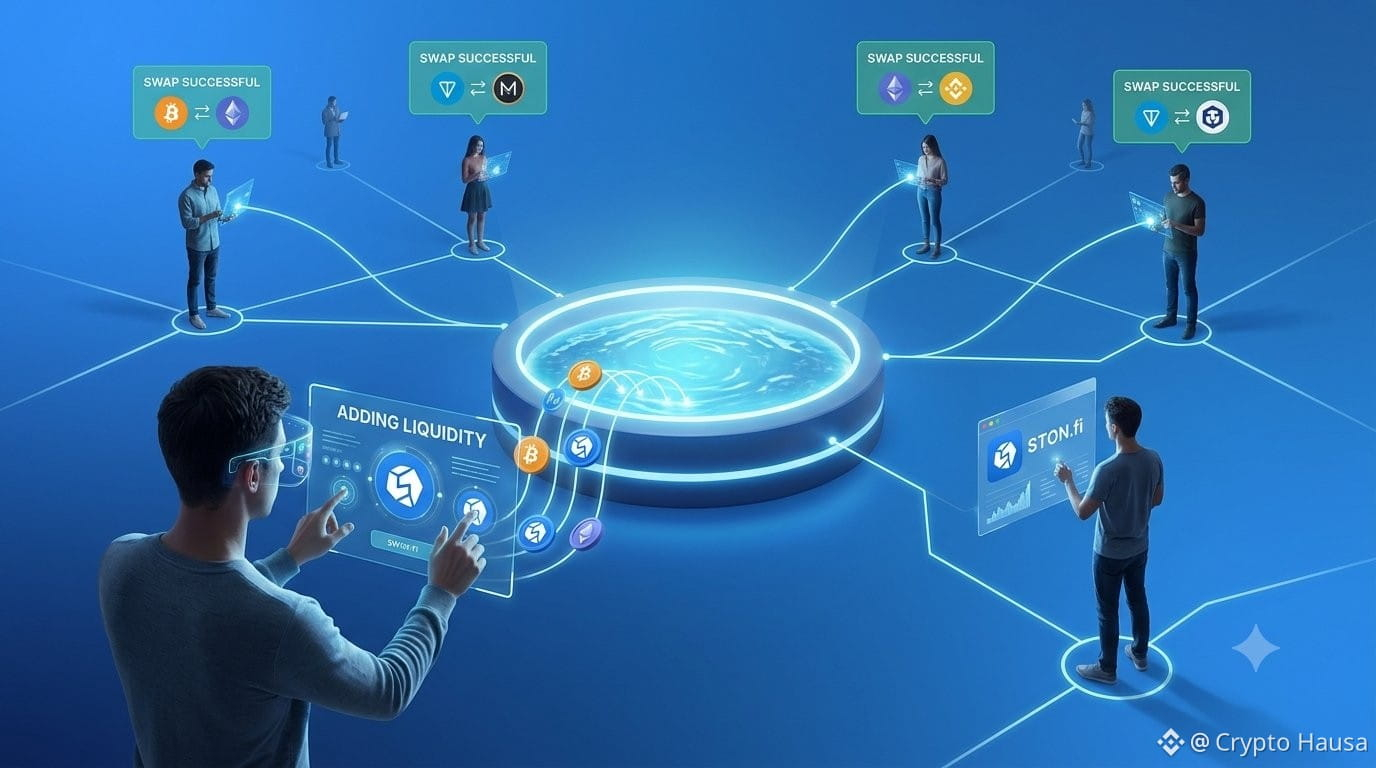
73

·
--
Article
How to Swap USDT from TON to TRON Using STON.fiMoving USDT between blockchains can be complicated if you don't know which tools to use. You may need to use a centralized exchange, wait for deposits and withdrawals, or find a reliable cross-chain solution.
With @stonfi you can swap USDT from the TON blockchain to the TRON blockchain using its cross-chain feature.
In this guide, I'll explain how to swap USDT from TON to TRON (TRC-20), step by step, including how to connect your wallet, select tokens, and enter your receiving address.
Why Swap USDT from TON to TRON?
USDT exists on different blockchains, and each version follows the token standards of its network.
TON USDT: A Jetton token on the TON blockchain.
TRON USDT: A TRC-20 token on the TRON blockchain.
Although both represent USDT, they operate on different networks. You cannot send TON-based USDT directly to a TRON address using a regular transfer.
This is where STON.fi's cross-chain feature comes in. Powered by Omniston, it helps users find routes for swapping tokens across supported blockchains.
What You Need Before Starting
Before you begin, make sure you have:
A TON wallet such as Tonkeeper with USDT.
A small amount of TON to cover network fees.
A TRON wallet address that can receive TRC-20 USDT. TRON addresses typically start with the letter T.
Access to the STON.fi app.
Step-by-StepS Guide
Step 1: Open STON.fi and Select Cross-chain Mode
Open the STON.fi app and navigate to the Swap section.
You will see two options: TON and Cross-chain (beta).
Select Cross-chain to access the cross-chain swap interface.
Step 2: Connect Your TON Wallet
Connect your TON wallet to STON.fi.
If your wallet is not already connected, tap the Wallets button and select your preferred TON wallet, such as Tonkeeper.
Approve the connection request in your wallet.
Once connected, your wallet address should appear at the top of the screen.
Step 3: Choose the Token You Are Sending
Tap the top token field and select the TON network.
Choose USDT as the token you want to send.
Step 4: Choose the Token You Want to Receive
Tap the bottom token field and select the TRON network.
Choose USDT as the receiving token
This ensures that you are swapping TON-based USDT for TRON-based USDT.
Step 5: Enter Your Receiving Address
Enable the Receive to custom address option.
Paste your TRON wallet address into the field.
Check the address carefully before proceeding. A valid TRON address typically starts with T.
This tep is important because the receiving address determines where your USDT will be sent.
Step 6: Enter the Amount and Review the Quote
Enter the amount of USDT you want to swap.
STON.fi will display the estimated amount you will receive, along with the applicable fees and exchange rate.
Review the details carefully before proceeding.
Step 7: Confirm the Swap
Once you are satisfied with the quote, tap the swap button.
Approve the transaction through your connected TON wallet.
Make sure you understand the transaction details before confirming.
Step 8: Wait for Completion
After confirming the transaction, wait for the cross-chain swap to finish.
The time required depends on the route and network conditions.
Once completed, the USDT should arrive at the TRON address you provided.
Helpful Tips for a Smooth Experience
Start with a small test amount if you are using the feature for the first time.
Double-check your receiving address before confirming the swap.
Keep enough TON in your wallet to cover network fees.
Make sure your receiving wallet supports TRC-20 USDT.
Review the estimated amount and fees before approving the transaction.
Common Questions
Is swapping USDT from TON to TRON safe?
Always verify the transaction details, use the official STON.fi app, and understand the risks associated with cross-chain transactions. No cross-chain service is completely risk-free.
Do I need to connect a TRON wallet?
You may be able to use the custom address option to receive USDT without connecting a TRON wallet directly. You still need a valid TRON address that you control or are authorized to use.
How long does the swap takes
The time depends on the route and network conditions. Check the estimated completion time displayed by the app before confirming.
Final Thoughts
Swapping USDT from TON to TRON doesn't have to be complicated.
With STON.fi's cross-chain feature, users can select their tokens, provide a receiving address, review the quote, and confirm the transaction.
The most important things are to verify your receiving address, check the fees, and understand the transaction before approving it.
#Stonbassadors #Cross-chain
How to Swap USDT from TON to TRON Using STON.fi
Moving USDT between blockchains can be complicated if you don't know which tools to use. You may need to use a centralized exchange, wait for deposits and withdrawals, or find a reliable cross-chain solution.
With @STONfi DEX you can swap USDT from the TON blockchain to the TRON blockchain using its cross-chain feature.
In this guide, I'll explain how to swap USDT from TON to TRON (TRC-20), step by step, including how to connect your wallet, select tokens, and enter your receiving address.
Why Swap USDT from TON to TRON?
USDT exists on different blockchains, and each version follows the token standards of its network.
TON USDT: A Jetton token on the TON blockchain.
TRON USDT: A TRC-20 token on the TRON blockchain.
Although both represent USDT, they operate on different networks. You cannot send TON-based USDT directly to a TRON address using a regular transfer.
This is where STON.fi's cross-chain feature comes in. Powered by Omniston, it helps users find routes for swapping tokens across supported blockchains.
What You Need Before Starting
Before you begin, make sure you have:
A TON wallet such as Tonkeeper with USDT.
A small amount of TON to cover network fees.
A TRON wallet address that can receive TRC-20 USDT. TRON addresses typically start with the letter T.
Access to the STON.fi app.
Step-by-StepS Guide
Step 1: Open STON.fi and Select Cross-chain Mode
Open the STON.fi app and navigate to the Swap section.
You will see two options: TON and Cross-chain (beta).
Select Cross-chain to access the cross-chain swap interface.
Step 2: Connect Your TON Wallet
Connect your TON wallet to STON.fi.
If your wallet is not already connected, tap the Wallets button and select your preferred TON wallet, such as Tonkeeper.
Approve the connection request in your wallet.
Once connected, your wallet address should appear at the top of the screen.
Step 3: Choose the Token You Are Sending
Tap the top token field and select the TON network.
Choose USDT as the token you want to send.
Step 4: Choose the Token You Want to Receive
Tap the bottom token field and select the TRON network.
Choose USDT as the receiving token
This ensures that you are swapping TON-based USDT for TRON-based USDT.
Step 5: Enter Your Receiving Address
Enable the Receive to custom address option.
Paste your TRON wallet address into the field.
Check the address carefully before proceeding. A valid TRON address typically starts with T.
This tep is important because the receiving address determines where your USDT will be sent.
Step 6: Enter the Amount and Review the Quote
Enter the amount of USDT you want to swap.
STON.fi will display the estimated amount you will receive, along with the applicable fees and exchange rate.
Review the details carefully before proceeding.
Step 7: Confirm the Swap
Once you are satisfied with the quote, tap the swap button.
Approve the transaction through your connected TON wallet.
Make sure you understand the transaction details before confirming.
Step 8: Wait for Completion
After confirming the transaction, wait for the cross-chain swap to finish.
The time required depends on the route and network conditions.
Once completed, the USDT should arrive at the TRON address you provided.
Helpful Tips for a Smooth Experience
Start with a small test amount if you are using the feature for the first time.
Double-check your receiving address before confirming the swap.
Keep enough TON in your wallet to cover network fees.
Make sure your receiving wallet supports TRC-20 USDT.
Review the estimated amount and fees before approving the transaction.
Common Questions
Is swapping USDT from TON to TRON safe?
Always verify the transaction details, use the official STON.fi app, and understand the risks associated with cross-chain transactions. No cross-chain service is completely risk-free.
Do I need to connect a TRON wallet?
You may be able to use the custom address option to receive USDT without connecting a TRON wallet directly. You still need a valid TRON address that you control or are authorized to use.
How long does the swap takes
The time depends on the route and network conditions. Check the estimated completion time displayed by the app before confirming.
Final Thoughts
Swapping USDT from TON to TRON doesn't have to be complicated.
With STON.fi's cross-chain feature, users can select their tokens, provide a receiving address, review the quote, and confirm the transaction.
The most important things are to verify your receiving address, check the fees, and understand the transaction before approving it.
#Stonbassadors #Cross-chain
With @STONfi DEX you can swap USDT from the TON blockchain to the TRON blockchain using its cross-chain feature.
In this guide, I'll explain how to swap USDT from TON to TRON (TRC-20), step by step, including how to connect your wallet, select tokens, and enter your receiving address.
Why Swap USDT from TON to TRON?
USDT exists on different blockchains, and each version follows the token standards of its network.
TON USDT: A Jetton token on the TON blockchain.
TRON USDT: A TRC-20 token on the TRON blockchain.
Although both represent USDT, they operate on different networks. You cannot send TON-based USDT directly to a TRON address using a regular transfer.
This is where STON.fi's cross-chain feature comes in. Powered by Omniston, it helps users find routes for swapping tokens across supported blockchains.
What You Need Before Starting
Before you begin, make sure you have:
A TON wallet such as Tonkeeper with USDT.
A small amount of TON to cover network fees.
A TRON wallet address that can receive TRC-20 USDT. TRON addresses typically start with the letter T.
Access to the STON.fi app.
Step-by-StepS Guide
Step 1: Open STON.fi and Select Cross-chain Mode
Open the STON.fi app and navigate to the Swap section.
You will see two options: TON and Cross-chain (beta).
Select Cross-chain to access the cross-chain swap interface.
Step 2: Connect Your TON Wallet
Connect your TON wallet to STON.fi.
If your wallet is not already connected, tap the Wallets button and select your preferred TON wallet, such as Tonkeeper.
Approve the connection request in your wallet.
Once connected, your wallet address should appear at the top of the screen.
Step 3: Choose the Token You Are Sending
Tap the top token field and select the TON network.
Choose USDT as the token you want to send.
Step 4: Choose the Token You Want to Receive
Tap the bottom token field and select the TRON network.
Choose USDT as the receiving token
This ensures that you are swapping TON-based USDT for TRON-based USDT.
Step 5: Enter Your Receiving Address
Enable the Receive to custom address option.
Paste your TRON wallet address into the field.
Check the address carefully before proceeding. A valid TRON address typically starts with T.
This tep is important because the receiving address determines where your USDT will be sent.
Step 6: Enter the Amount and Review the Quote
Enter the amount of USDT you want to swap.
STON.fi will display the estimated amount you will receive, along with the applicable fees and exchange rate.
Review the details carefully before proceeding.
Step 7: Confirm the Swap
Once you are satisfied with the quote, tap the swap button.
Approve the transaction through your connected TON wallet.
Make sure you understand the transaction details before confirming.
Step 8: Wait for Completion
After confirming the transaction, wait for the cross-chain swap to finish.
The time required depends on the route and network conditions.
Once completed, the USDT should arrive at the TRON address you provided.
Helpful Tips for a Smooth Experience
Start with a small test amount if you are using the feature for the first time.
Double-check your receiving address before confirming the swap.
Keep enough TON in your wallet to cover network fees.
Make sure your receiving wallet supports TRC-20 USDT.
Review the estimated amount and fees before approving the transaction.
Common Questions
Is swapping USDT from TON to TRON safe?
Always verify the transaction details, use the official STON.fi app, and understand the risks associated with cross-chain transactions. No cross-chain service is completely risk-free.
Do I need to connect a TRON wallet?
You may be able to use the custom address option to receive USDT without connecting a TRON wallet directly. You still need a valid TRON address that you control or are authorized to use.
How long does the swap takes
The time depends on the route and network conditions. Check the estimated completion time displayed by the app before confirming.
Final Thoughts
Swapping USDT from TON to TRON doesn't have to be complicated.
With STON.fi's cross-chain feature, users can select their tokens, provide a receiving address, review the quote, and confirm the transaction.
The most important things are to verify your receiving address, check the fees, and understand the transaction before approving it.
#Stonbassadors #Cross-chain
1
58
·
--
Article
The Real Story Behind STON.fi’s 78% TON DEX ShareI’ve been spending time looking at TON DeFi data lately, and one number kept jumping out:
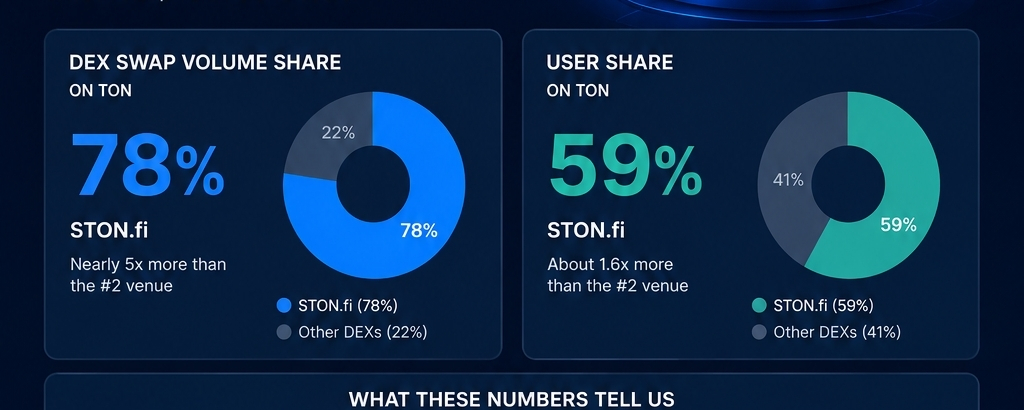
@stonfi is handling around 78% of TON DEX swap volume.
That’s nearly 5× more than the second-largest venue.
It also accounts for roughly 59% of users among comparable TON DEX protocols.
At first glance, those numbers look impressive.
But I wanted to understand something more important:
What do these numbers actually tell us?
And what don't they tell us?
What DEX Volume Actually Means
A DEX is simply a decentralized exchange where users can swap tokens without a centralized exchange sitting in the middle.
Volume is the total value of those swaps.
For example:
100 people each swap $1,000.
That's $100,000 in trading volume.
So when one protocol processes around 78% of TON DEX volume, it means a very large share of the actual swapping activity is happening through that protocol.
That's meaningful.
But here's the important part:
Volume alone doesn't tell the whole story.
Volume vs Users
This is where things get more interesting.
Volume tells you how much is being traded.
User share tells you how many people are using the protocol.
STON.fi's reported ~59% user share among comparable TON DEX protocols suggests that its activity isn't simply coming from a handful of large trades.
A significant portion of TON DEX users are also using STON.fi.
When you see both high volume and a large user base, it gives you a better picture of actual usage.
But there's another piece that matters just as much.
Liquidity Is the Part Many People Overlook.
Every swap needs liquidity.
Imagine you want to sell a large amount of one token for another.
If the available liquidity is low, your trade can experience slippage meaning you receive a worse price than expected.
And here's the problem:
Liquidity is fragmented.
It can be spread across:
Different liquidity pools
Different DEXs
Different protocols
Different blockchains
For users, that can mean checking multiple platforms or accepting less efficient execution.
This is one of the biggest practical challenges in DeFi.
Where Omniston Fits In
This is where STON.fi's Omniston becomes interesting.
Omniston is designed as a liquidity aggregation and cross-chain swap layer.
The basic idea is simple:
Instead of relying on one liquidity source, the infrastructure can connect to multiple sources and help find efficient routes for swaps.
Think of it like searching several shops before buying something.
You don't necessarily want to buy from the first shop you find.
You want to know what options are available.
In DeFi, that means looking beyond a single liquidity pool or DEX.
So the STON.fi story isn't only:
“It has a big DEX.”
There is also a broader infrastructure layer:
DEX → Liquidity → Aggregation → Cross-chain execution
That's an important distinction.
Why Cross-Chain Matters
Crypto isn't one blockchain anymore.
You can have USDT on Ethereum while the application you want to use is on TON.
Or you can have assets on TON while the liquidity you need is somewhere else.
Today, moving between ecosystems can still involve:
Bridge → wait → receive → swap → move again.
That's a lot of friction.
Cross-chain infrastructure is trying to make this process simpler by connecting liquidity and execution across different ecosystems.
The long-term idea is straightforward:
Users shouldn't always have to know where the liquidity is.
They should be able to access it.
So What Does the 78% Actually Tell Us?
The number is strong.
But for me, the bigger lesson is how to read DeFi data properly.
I wouldn't evaluate a DEX using volume alone.
I'd look at several things together:
Volume How much trading is happening?
Users How many people are actually using it?
Liquidity How much capital is available for swaps?
Execution How efficiently are trades being completed?
Aggregation Can liquidity from multiple sources be accessed?
Cross-chain capability Can users interact with liquidity across ecosystems?
When you put these pieces together, you get a much clearer picture.
The Bigger Picture
STON.fi's reported ~78% of TON DEX volume and ~59% user share show that it has become a major part of the current TON DeFi landscape.
But the question I find more interesting isn't:
"Who has the most volume today?”
It's:
“Who is building infrastructure that can handle liquidity as DeFi becomes more fragmented across chains?”
As more ecosystems grow, liquidity aggregation and cross-chain execution could become increasingly important.
That's why I think these numbers are worth watching.
Not just as a leaderboard.
But as a signal of how DeFi infrastructure is evolving.
78% is the headline.
Understanding what's behind it is the real insight.
What do you look at first when evaluating a DEX:
Volume, users, liquidity, or execution quality?
#SpaceXShortInterestFallsTo11% #Stonbassadors
The Real Story Behind STON.fi’s 78% TON DEX Share
I’ve been spending time looking at TON DeFi data lately, and one number kept jumping out:
@STONfi DEX is handling around 78% of TON DEX swap volume.
That’s nearly 5× more than the second-largest venue.
It also accounts for roughly 59% of users among comparable TON DEX protocols.
At first glance, those numbers look impressive.
But I wanted to understand something more important:
What do these numbers actually tell us?
And what don't they tell us?
What DEX Volume Actually Means
A DEX is simply a decentralized exchange where users can swap tokens without a centralized exchange sitting in the middle.
Volume is the total value of those swaps.
For example:
100 people each swap $1,000.
That's $100,000 in trading volume.
So when one protocol processes around 78% of TON DEX volume, it means a very large share of the actual swapping activity is happening through that protocol.
That's meaningful.
But here's the important part:
Volume alone doesn't tell the whole story.
Volume vs Users
This is where things get more interesting.
Volume tells you how much is being traded.
User share tells you how many people are using the protocol.
STON.fi's reported ~59% user share among comparable TON DEX protocols suggests that its activity isn't simply coming from a handful of large trades.
A significant portion of TON DEX users are also using STON.fi.
When you see both high volume and a large user base, it gives you a better picture of actual usage.
But there's another piece that matters just as much.
Liquidity Is the Part Many People Overlook.
Every swap needs liquidity.
Imagine you want to sell a large amount of one token for another.
If the available liquidity is low, your trade can experience slippage meaning you receive a worse price than expected.
And here's the problem:
Liquidity is fragmented.
It can be spread across:
Different liquidity pools
Different DEXs
Different protocols
Different blockchains
For users, that can mean checking multiple platforms or accepting less efficient execution.
This is one of the biggest practical challenges in DeFi.
Where Omniston Fits In
This is where STON.fi's Omniston becomes interesting.
Omniston is designed as a liquidity aggregation and cross-chain swap layer.
The basic idea is simple:
Instead of relying on one liquidity source, the infrastructure can connect to multiple sources and help find efficient routes for swaps.
Think of it like searching several shops before buying something.
You don't necessarily want to buy from the first shop you find.
You want to know what options are available.
In DeFi, that means looking beyond a single liquidity pool or DEX.
So the STON.fi story isn't only:
“It has a big DEX.”
There is also a broader infrastructure layer:
DEX → Liquidity → Aggregation → Cross-chain execution
That's an important distinction.
Why Cross-Chain Matters
Crypto isn't one blockchain anymore.
You can have USDT on Ethereum while the application you want to use is on TON.
Or you can have assets on TON while the liquidity you need is somewhere else.
Today, moving between ecosystems can still involve:
Bridge → wait → receive → swap → move again.
That's a lot of friction.
Cross-chain infrastructure is trying to make this process simpler by connecting liquidity and execution across different ecosystems.
The long-term idea is straightforward:
Users shouldn't always have to know where the liquidity is.
They should be able to access it.
So What Does the 78% Actually Tell Us?
The number is strong.
But for me, the bigger lesson is how to read DeFi data properly.
I wouldn't evaluate a DEX using volume alone.
I'd look at several things together:
Volume How much trading is happening?
Users How many people are actually using it?
Liquidity How much capital is available for swaps?
Execution How efficiently are trades being completed?
Aggregation Can liquidity from multiple sources be accessed?
Cross-chain capability Can users interact with liquidity across ecosystems?
When you put these pieces together, you get a much clearer picture.
The Bigger Picture
STON.fi's reported ~78% of TON DEX volume and ~59% user share show that it has become a major part of the current TON DeFi landscape.
But the question I find more interesting isn't:
"Who has the most volume today?”
It's:
“Who is building infrastructure that can handle liquidity as DeFi becomes more fragmented across chains?”
As more ecosystems grow, liquidity aggregation and cross-chain execution could become increasingly important.
That's why I think these numbers are worth watching.
Not just as a leaderboard.
But as a signal of how DeFi infrastructure is evolving.
78% is the headline.
Understanding what's behind it is the real insight.
What do you look at first when evaluating a DEX:
Volume, users, liquidity, or execution quality?
#SpaceXShortInterestFallsTo11% #Stonbassadors
@STONfi DEX is handling around 78% of TON DEX swap volume.
That’s nearly 5× more than the second-largest venue.
It also accounts for roughly 59% of users among comparable TON DEX protocols.
At first glance, those numbers look impressive.
But I wanted to understand something more important:
What do these numbers actually tell us?
And what don't they tell us?
What DEX Volume Actually Means
A DEX is simply a decentralized exchange where users can swap tokens without a centralized exchange sitting in the middle.
Volume is the total value of those swaps.
For example:
100 people each swap $1,000.
That's $100,000 in trading volume.
So when one protocol processes around 78% of TON DEX volume, it means a very large share of the actual swapping activity is happening through that protocol.
That's meaningful.
But here's the important part:
Volume alone doesn't tell the whole story.
Volume vs Users
This is where things get more interesting.
Volume tells you how much is being traded.
User share tells you how many people are using the protocol.
STON.fi's reported ~59% user share among comparable TON DEX protocols suggests that its activity isn't simply coming from a handful of large trades.
A significant portion of TON DEX users are also using STON.fi.
When you see both high volume and a large user base, it gives you a better picture of actual usage.
But there's another piece that matters just as much.
Liquidity Is the Part Many People Overlook.
Every swap needs liquidity.
Imagine you want to sell a large amount of one token for another.
If the available liquidity is low, your trade can experience slippage meaning you receive a worse price than expected.
And here's the problem:
Liquidity is fragmented.
It can be spread across:
Different liquidity pools
Different DEXs
Different protocols
Different blockchains
For users, that can mean checking multiple platforms or accepting less efficient execution.
This is one of the biggest practical challenges in DeFi.
Where Omniston Fits In
This is where STON.fi's Omniston becomes interesting.
Omniston is designed as a liquidity aggregation and cross-chain swap layer.
The basic idea is simple:
Instead of relying on one liquidity source, the infrastructure can connect to multiple sources and help find efficient routes for swaps.
Think of it like searching several shops before buying something.
You don't necessarily want to buy from the first shop you find.
You want to know what options are available.
In DeFi, that means looking beyond a single liquidity pool or DEX.
So the STON.fi story isn't only:
“It has a big DEX.”
There is also a broader infrastructure layer:
DEX → Liquidity → Aggregation → Cross-chain execution
That's an important distinction.
Why Cross-Chain Matters
Crypto isn't one blockchain anymore.
You can have USDT on Ethereum while the application you want to use is on TON.
Or you can have assets on TON while the liquidity you need is somewhere else.
Today, moving between ecosystems can still involve:
Bridge → wait → receive → swap → move again.
That's a lot of friction.
Cross-chain infrastructure is trying to make this process simpler by connecting liquidity and execution across different ecosystems.
The long-term idea is straightforward:
Users shouldn't always have to know where the liquidity is.
They should be able to access it.
So What Does the 78% Actually Tell Us?
The number is strong.
But for me, the bigger lesson is how to read DeFi data properly.
I wouldn't evaluate a DEX using volume alone.
I'd look at several things together:
Volume How much trading is happening?
Users How many people are actually using it?
Liquidity How much capital is available for swaps?
Execution How efficiently are trades being completed?
Aggregation Can liquidity from multiple sources be accessed?
Cross-chain capability Can users interact with liquidity across ecosystems?
When you put these pieces together, you get a much clearer picture.
The Bigger Picture
STON.fi's reported ~78% of TON DEX volume and ~59% user share show that it has become a major part of the current TON DeFi landscape.
But the question I find more interesting isn't:
"Who has the most volume today?”
It's:
“Who is building infrastructure that can handle liquidity as DeFi becomes more fragmented across chains?”
As more ecosystems grow, liquidity aggregation and cross-chain execution could become increasingly important.
That's why I think these numbers are worth watching.
Not just as a leaderboard.
But as a signal of how DeFi infrastructure is evolving.
78% is the headline.
Understanding what's behind it is the real insight.
What do you look at first when evaluating a DEX:
Volume, users, liquidity, or execution quality?
#SpaceXShortInterestFallsTo11% #Stonbassadors
1
1
80
·
--
Article
STON.fi Makes Cross Chain Swaps Simpler With Custom AddressesSTON.fi Makes Cross Chain Swaps Simpler With Custom Addresses
Cross chain swaps are becoming more convenient and STON.fi is taking another step toward making the experience simpler for users
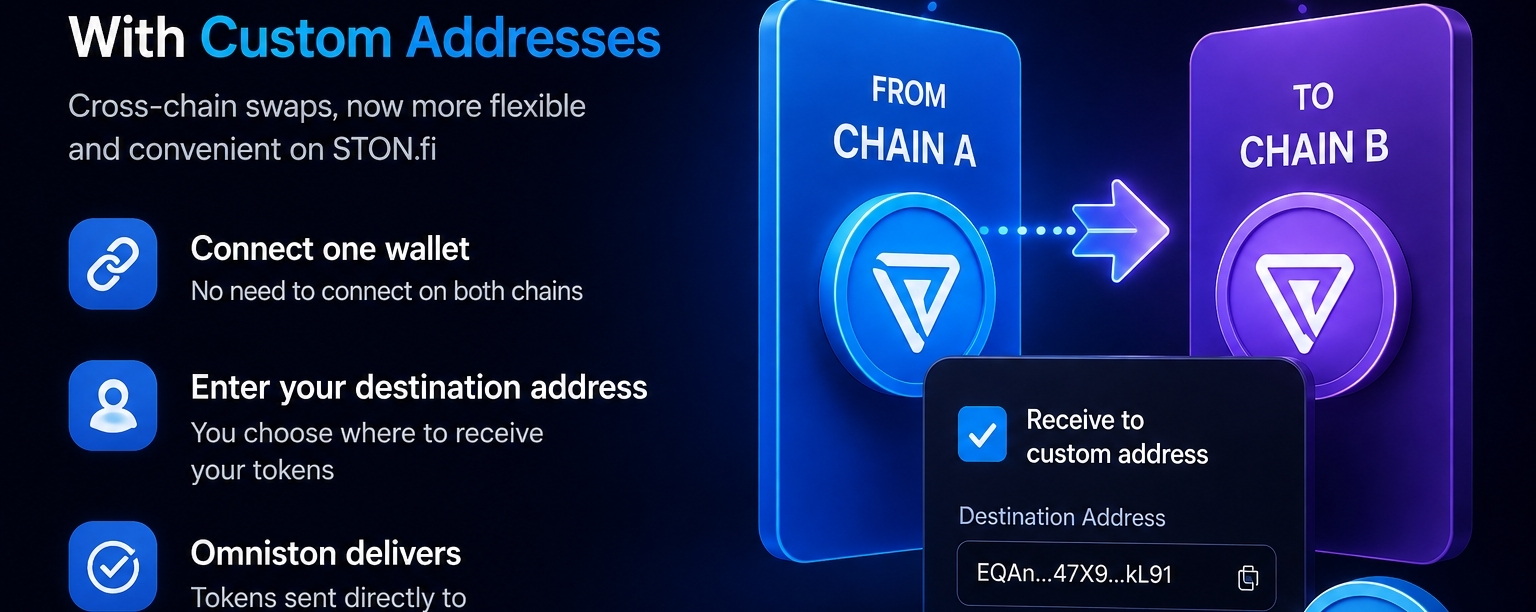
With the latest custom destination address feature users no longer need to connect wallets on both chains when making a cross chain swap through Omniston Instead you can connect only the wallet you are swapping from and provide the wallet address where you want to receive your tokens
The process is straightforward
First connect the wallet holding the tokens you want to swap Then turn on the Receive to custom address option and paste the destination wallet address Once the swap is completed Omniston will deliver the swapped tokens directly to the address you selected
This removes an unnecessary step from the traditional cross chain experience Users do not have to connect another wallet simply to receive their assets which can make the process faster cleaner and more flexible
The feature can also be useful when you want your swapped tokens to arrive at a different wallet address Whether you are moving assets between wallets or using a specific destination for your funds having control over the receiving address gives users more flexibility
How It Works
1. Connect the wallet you are swapping from
2. Select the tokens and chain you want to swap
3. Enable Receive to custom address
4. Enter the destination wallet address
5. Complete the swap
6. Your tokens are delivered directly to the selected address
What makes this update interesting is its focus on reducing friction rather than adding complexity Cross chain transactions can already involve multiple networks wallets and steps Allowing users to specify a receiving address helps make the experience more straightforward
For the STON.fi community this is another practical improvement that can make cross chain swapping easier for both experienced users and newcomers
Small improvements like this can have a big impact on the overall user experience As cross chain activity continues to grow flexibility simplicity and control over where assets are delivered will become increasingly important
STON.fi custom address functionality is a useful step in that direction making cross chain swaps more flexible while keeping the process simple
#TON #STONfi #stonbassadors #DeFi #CrossChain
STON.fi Makes Cross Chain Swaps Simpler With Custom Addresses
STON.fi Makes Cross Chain Swaps Simpler With Custom Addresses
Cross chain swaps are becoming more convenient and STON.fi is taking another step toward making the experience simpler for users
With the latest custom destination address feature users no longer need to connect wallets on both chains when making a cross chain swap through Omniston Instead you can connect only the wallet you are swapping from and provide the wallet address where you want to receive your tokens
The process is straightforward
First connect the wallet holding the tokens you want to swap Then turn on the Receive to custom address option and paste the destination wallet address Once the swap is completed Omniston will deliver the swapped tokens directly to the address you selected
This removes an unnecessary step from the traditional cross chain experience Users do not have to connect another wallet simply to receive their assets which can make the process faster cleaner and more flexible
The feature can also be useful when you want your swapped tokens to arrive at a different wallet address Whether you are moving assets between wallets or using a specific destination for your funds having control over the receiving address gives users more flexibility
How It Works
1. Connect the wallet you are swapping from
2. Select the tokens and chain you want to swap
3. Enable Receive to custom address
4. Enter the destination wallet address
5. Complete the swap
6. Your tokens are delivered directly to the selected address
What makes this update interesting is its focus on reducing friction rather than adding complexity Cross chain transactions can already involve multiple networks wallets and steps Allowing users to specify a receiving address helps make the experience more straightforward
For the STON.fi community this is another practical improvement that can make cross chain swapping easier for both experienced users and newcomers
Small improvements like this can have a big impact on the overall user experience As cross chain activity continues to grow flexibility simplicity and control over where assets are delivered will become increasingly important
STON.fi custom address functionality is a useful step in that direction making cross chain swaps more flexible while keeping the process simple
#TON #STONfi #stonbassadors #DeFi #CrossChain
Cross chain swaps are becoming more convenient and STON.fi is taking another step toward making the experience simpler for users
With the latest custom destination address feature users no longer need to connect wallets on both chains when making a cross chain swap through Omniston Instead you can connect only the wallet you are swapping from and provide the wallet address where you want to receive your tokens
The process is straightforward
First connect the wallet holding the tokens you want to swap Then turn on the Receive to custom address option and paste the destination wallet address Once the swap is completed Omniston will deliver the swapped tokens directly to the address you selected
This removes an unnecessary step from the traditional cross chain experience Users do not have to connect another wallet simply to receive their assets which can make the process faster cleaner and more flexible
The feature can also be useful when you want your swapped tokens to arrive at a different wallet address Whether you are moving assets between wallets or using a specific destination for your funds having control over the receiving address gives users more flexibility
How It Works
1. Connect the wallet you are swapping from
2. Select the tokens and chain you want to swap
3. Enable Receive to custom address
4. Enter the destination wallet address
5. Complete the swap
6. Your tokens are delivered directly to the selected address
What makes this update interesting is its focus on reducing friction rather than adding complexity Cross chain transactions can already involve multiple networks wallets and steps Allowing users to specify a receiving address helps make the experience more straightforward
For the STON.fi community this is another practical improvement that can make cross chain swapping easier for both experienced users and newcomers
Small improvements like this can have a big impact on the overall user experience As cross chain activity continues to grow flexibility simplicity and control over where assets are delivered will become increasingly important
STON.fi custom address functionality is a useful step in that direction making cross chain swaps more flexible while keeping the process simple
#TON #STONfi #stonbassadors #DeFi #CrossChain
69
·
--
Article
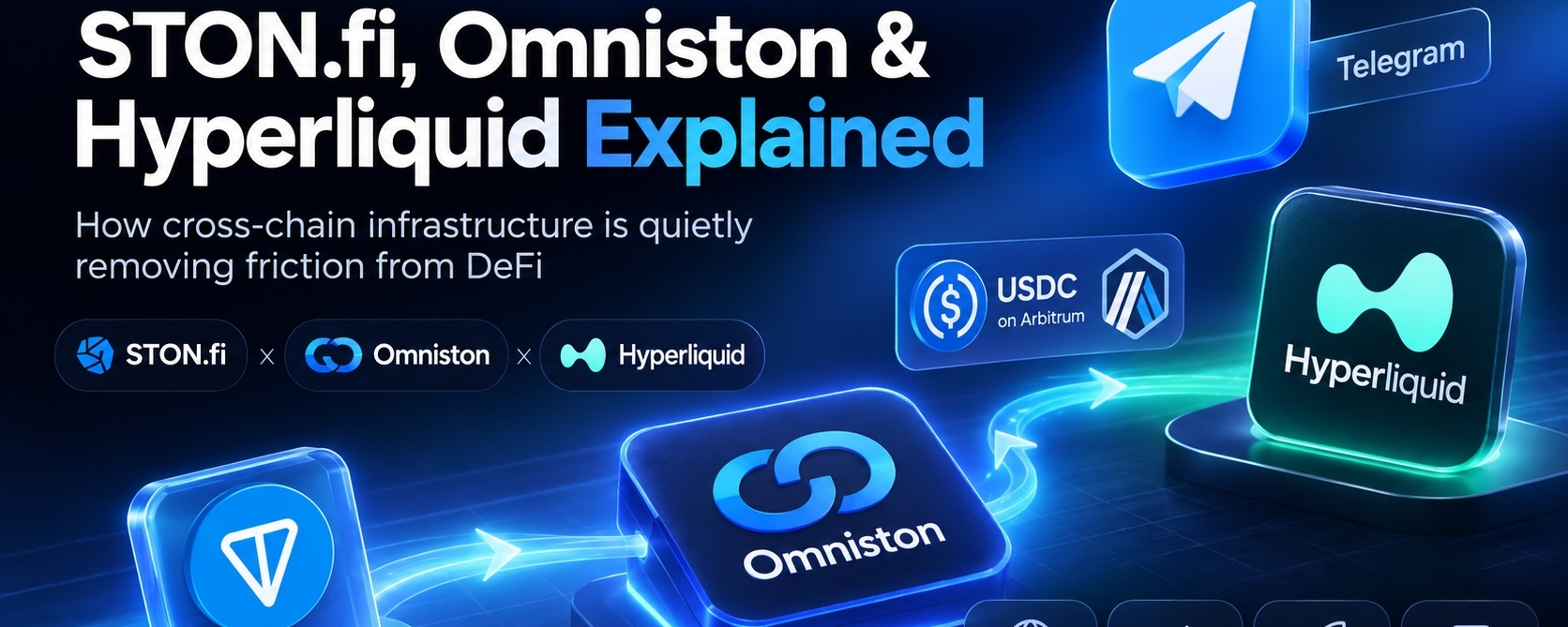
STON.fi, Omniston & Hyperliquid ExplainedHow cross-chain infrastructure is quietly removing friction from DeFi
If you’re new to cross-chain DeFi, this topic can feel complex at first. Once you see how the pieces connect, it becomes surprisingly straightforward.
TON. Omniston. Arbitrum. Hyperliquid. Telegram.
What does each one actually do? Let’s break it down clearly.
1. What Is @stonfi ?
STON.fi is a decentralized exchange ecosystem built on the TON blockchain. At its core, it lets users swap tokens and access decentralized liquidity without relying on a centralized exchange.
As crypto becomes increasingly multi-chain, users need a reliable way to move value between different blockchain ecosystems. That creates a practical challenge:
How do you connect liquidity across chains without forcing users through a complicated, multi-step process?
This is exactly where Omniston comes in.
2. What Is Omniston?
Think of Omniston as a cross-chain liquidity and routing layer.
Instead of forcing users to think:
> “I need to find a bridge, then another swap, then switch networks…”
the goal is closer to:
> “I have this asset → I want that asset → find the best available route.”
Omniston enables applications to access cross-chain liquidity and route swaps between different blockchain ecosystems. The complex infrastructure stays under the surface so the user experience remains clean.
That is what good infrastructure should do.
3. Why Cross-Chain Matters
Imagine you hold USDT on TON, but the application you want to use requires USDC on another network.
Your assets are on one chain. The application lives on another.
Without solid cross-chain infrastructure, a typical user might need to:
1. Find a suitable bridge
2. Move assets to the target network
3. Swap into the required token
4. Pay network fees
5. Reconnect their wallet
6. Deposit into the application
Experienced users treat this as normal. Newcomers often find it confusing and abandon the process.
Cross-chain infrastructure exists to reduce that friction.
4. Where Does Hyperliquid Fit In?
Hyperliquid is a blockchain-based trading ecosystem known for perpetual futures and spot markets.
Perpetual futures (commonly called “perps”) allow traders to speculate on an asset’s price without owning the underlying asset the same way they would in a spot trade. They can also use leverage.
Example: With 5× leverage, $100 of collateral can control a $500 position.
Important note: Leverage amplifies both potential returns and risk. A relatively small adverse price move can lead to significant losses or liquidation. Perps are not the same as simple token swaps.
5. What Does WenLong Do?
WenLong, a third-party application built by @lambospeak, brings Hyperliquid perpetual trading into Telegram.
Rather than forcing users to leave Telegram and manually navigate multiple apps, WenLong aims to deliver the trading experience directly inside the messenger.
There is still a technical hurdle: a user may start with assets on TON, while Hyperliquid deposits typically require assets on another network. Something needs to connect those ecosystems.
That is where Omniston fits into the flow.
6. The Cross-Chain Flow in Practice
A simplified version looks like this:
TON USDT
↓
Omniston
↓
USDC on Arbitrum
↓
Hyperliquid deposit
↓
Perpetual trading
From the user’s perspective, the experience feels much simpler. Behind the scenes, cross-chain infrastructure handles asset movement and routing.
When Web3 works well, users rarely notice the infrastructure. They simply notice that the application works.
7. Why This Matters for Builders
This is not only relevant for traders.
If you are building a:
- Telegram trading bot
- Web3 wallet
- DeFi application
- Payment app
- Cross-chain swap interface
- Multi-chain trading platform
…your users will likely hold assets across several networks.
Building every bridge, liquidity route, and cross-chain connection from scratch is complex and time-consuming. Infrastructure like Omniston gives builders a practical alternative: focus on the product experience while leveraging existing cross-chain routing.
The best infrastructure is often the kind users barely notice.
8. Why Telegram Matters
Telegram has become a major environment for crypto applications. Users already interact with wallets, bots, communities, trading tools, and mini-apps there.
Placing a trading experience directly inside Telegram removes another layer of friction.
The bigger picture looks like this:
- Telegram → User interface
- WenLong → Trading application
- Omniston → Cross-chain routing
- Hyperliquid → Trading infrastructure
Each component has a distinct role. When they work together, the user experiences them as a single flow.
9. The Bigger Problem: Fragmentation
This is the most important takeaway.
Crypto has many blockchains. That diversity drives innovation, but it also creates fragmentation.
Your liquidity might sit on TON.
Your preferred application might live on Arbitrum.
Another opportunity might exist on Base.
A different trading venue might operate elsewhere.
Users should not need to understand the architecture of every blockchain just to move capital. This is why interoperability and high-quality cross-chain infrastructure are becoming increasingly important.
10. What STON.fi Is Building Toward
This is why the Omniston side of the STON.fi ecosystem is interesting.
The conversation is no longer simply:
> “Where can I swap tokens?”
It is evolving into:
> “How can liquidity move between ecosystems in a way that feels simple?”
That is a much larger infrastructure problem. Solving it can benefit wallets, trading apps, DeFi protocols, Telegram applications, and other Web3 products.
Final Take
The WenLong example is a clear illustration of the bigger picture.
A user can start with an asset on TON, open a Telegram-based application, access a Hyperliquid trading experience, and rely on cross-chain infrastructure to connect the different ecosystems.
The technology underneath can be sophisticated.
The goal for the user should remain simple:
Choose what you want to do.
Let the infrastructure handle the complexity.
That is the promise of well-designed cross-chain DeFi and that is where STON.fi and Omniston become relevant.
Important Risk Disclaimer
WenLong is a third-party application that integrates STON.fi infrastructure. STON.fi does not operate, endorse, sponsor, or recommend third-party applications and is not responsible for their actions.
Perpetual futures involve significant risk, especially when leverage is used. Losses can occur quickly and positions can be liquidated.
Always do your own research, fully understand any application you interact with, and never risk funds you cannot afford to lose.
#Web3 #Stonbassadors
STON.fi, Omniston & Hyperliquid Explained
How cross-chain infrastructure is quietly removing friction from DeFi
If you’re new to cross-chain DeFi, this topic can feel complex at first. Once you see how the pieces connect, it becomes surprisingly straightforward.
TON. Omniston. Arbitrum. Hyperliquid. Telegram.
What does each one actually do? Let’s break it down clearly.
1. What Is @STONfi DEX ?
STON.fi is a decentralized exchange ecosystem built on the TON blockchain. At its core, it lets users swap tokens and access decentralized liquidity without relying on a centralized exchange.
As crypto becomes increasingly multi-chain, users need a reliable way to move value between different blockchain ecosystems. That creates a practical challenge:
How do you connect liquidity across chains without forcing users through a complicated, multi-step process?
This is exactly where Omniston comes in.
2. What Is Omniston?
Think of Omniston as a cross-chain liquidity and routing layer.
Instead of forcing users to think:
> “I need to find a bridge, then another swap, then switch networks…”
the goal is closer to:
> “I have this asset → I want that asset → find the best available route.”
Omniston enables applications to access cross-chain liquidity and route swaps between different blockchain ecosystems. The complex infrastructure stays under the surface so the user experience remains clean.
That is what good infrastructure should do.
3. Why Cross-Chain Matters
Imagine you hold USDT on TON, but the application you want to use requires USDC on another network.
Your assets are on one chain. The application lives on another.
Without solid cross-chain infrastructure, a typical user might need to:
1. Find a suitable bridge
2. Move assets to the target network
3. Swap into the required token
4. Pay network fees
5. Reconnect their wallet
6. Deposit into the application
Experienced users treat this as normal. Newcomers often find it confusing and abandon the process.
Cross-chain infrastructure exists to reduce that friction.
4. Where Does Hyperliquid Fit In?
Hyperliquid is a blockchain-based trading ecosystem known for perpetual futures and spot markets.
Perpetual futures (commonly called “perps”) allow traders to speculate on an asset’s price without owning the underlying asset the same way they would in a spot trade. They can also use leverage.
Example: With 5× leverage, $100 of collateral can control a $500 position.
Important note: Leverage amplifies both potential returns and risk. A relatively small adverse price move can lead to significant losses or liquidation. Perps are not the same as simple token swaps.
5. What Does WenLong Do?
WenLong, a third-party application built by @lambospeak, brings Hyperliquid perpetual trading into Telegram.
Rather than forcing users to leave Telegram and manually navigate multiple apps, WenLong aims to deliver the trading experience directly inside the messenger.
There is still a technical hurdle: a user may start with assets on TON, while Hyperliquid deposits typically require assets on another network. Something needs to connect those ecosystems.
That is where Omniston fits into the flow.
6. The Cross-Chain Flow in Practice
A simplified version looks like this:
TON USDT
↓
Omniston
↓
USDC on Arbitrum
↓
Hyperliquid deposit
↓
Perpetual trading
From the user’s perspective, the experience feels much simpler. Behind the scenes, cross-chain infrastructure handles asset movement and routing.
When Web3 works well, users rarely notice the infrastructure. They simply notice that the application works.
7. Why This Matters for Builders
This is not only relevant for traders.
If you are building a:
- Telegram trading bot
- Web3 wallet
- DeFi application
- Payment app
- Cross-chain swap interface
- Multi-chain trading platform
…your users will likely hold assets across several networks.
Building every bridge, liquidity route, and cross-chain connection from scratch is complex and time-consuming. Infrastructure like Omniston gives builders a practical alternative: focus on the product experience while leveraging existing cross-chain routing.
The best infrastructure is often the kind users barely notice.
8. Why Telegram Matters
Telegram has become a major environment for crypto applications. Users already interact with wallets, bots, communities, trading tools, and mini-apps there.
Placing a trading experience directly inside Telegram removes another layer of friction.
The bigger picture looks like this:
- Telegram → User interface
- WenLong → Trading application
- Omniston → Cross-chain routing
- Hyperliquid → Trading infrastructure
Each component has a distinct role. When they work together, the user experiences them as a single flow.
9. The Bigger Problem: Fragmentation
This is the most important takeaway.
Crypto has many blockchains. That diversity drives innovation, but it also creates fragmentation.
Your liquidity might sit on TON.
Your preferred application might live on Arbitrum.
Another opportunity might exist on Base.
A different trading venue might operate elsewhere.
Users should not need to understand the architecture of every blockchain just to move capital. This is why interoperability and high-quality cross-chain infrastructure are becoming increasingly important.
10. What STON.fi Is Building Toward
This is why the Omniston side of the STON.fi ecosystem is interesting.
The conversation is no longer simply:
> “Where can I swap tokens?”
It is evolving into:
> “How can liquidity move between ecosystems in a way that feels simple?”
That is a much larger infrastructure problem. Solving it can benefit wallets, trading apps, DeFi protocols, Telegram applications, and other Web3 products.
Final Take
The WenLong example is a clear illustration of the bigger picture.
A user can start with an asset on TON, open a Telegram-based application, access a Hyperliquid trading experience, and rely on cross-chain infrastructure to connect the different ecosystems.
The technology underneath can be sophisticated.
The goal for the user should remain simple:
Choose what you want to do.
Let the infrastructure handle the complexity.
That is the promise of well-designed cross-chain DeFi and that is where STON.fi and Omniston become relevant.
Important Risk Disclaimer
WenLong is a third-party application that integrates STON.fi infrastructure. STON.fi does not operate, endorse, sponsor, or recommend third-party applications and is not responsible for their actions.
Perpetual futures involve significant risk, especially when leverage is used. Losses can occur quickly and positions can be liquidated.
Always do your own research, fully understand any application you interact with, and never risk funds you cannot afford to lose.
#Web3 #Stonbassadors
If you’re new to cross-chain DeFi, this topic can feel complex at first. Once you see how the pieces connect, it becomes surprisingly straightforward.
TON. Omniston. Arbitrum. Hyperliquid. Telegram.
What does each one actually do? Let’s break it down clearly.
1. What Is @STONfi DEX ?
STON.fi is a decentralized exchange ecosystem built on the TON blockchain. At its core, it lets users swap tokens and access decentralized liquidity without relying on a centralized exchange.
As crypto becomes increasingly multi-chain, users need a reliable way to move value between different blockchain ecosystems. That creates a practical challenge:
How do you connect liquidity across chains without forcing users through a complicated, multi-step process?
This is exactly where Omniston comes in.
2. What Is Omniston?
Think of Omniston as a cross-chain liquidity and routing layer.
Instead of forcing users to think:
> “I need to find a bridge, then another swap, then switch networks…”
the goal is closer to:
> “I have this asset → I want that asset → find the best available route.”
Omniston enables applications to access cross-chain liquidity and route swaps between different blockchain ecosystems. The complex infrastructure stays under the surface so the user experience remains clean.
That is what good infrastructure should do.
3. Why Cross-Chain Matters
Imagine you hold USDT on TON, but the application you want to use requires USDC on another network.
Your assets are on one chain. The application lives on another.
Without solid cross-chain infrastructure, a typical user might need to:
1. Find a suitable bridge
2. Move assets to the target network
3. Swap into the required token
4. Pay network fees
5. Reconnect their wallet
6. Deposit into the application
Experienced users treat this as normal. Newcomers often find it confusing and abandon the process.
Cross-chain infrastructure exists to reduce that friction.
4. Where Does Hyperliquid Fit In?
Hyperliquid is a blockchain-based trading ecosystem known for perpetual futures and spot markets.
Perpetual futures (commonly called “perps”) allow traders to speculate on an asset’s price without owning the underlying asset the same way they would in a spot trade. They can also use leverage.
Example: With 5× leverage, $100 of collateral can control a $500 position.
Important note: Leverage amplifies both potential returns and risk. A relatively small adverse price move can lead to significant losses or liquidation. Perps are not the same as simple token swaps.
5. What Does WenLong Do?
WenLong, a third-party application built by @lambospeak, brings Hyperliquid perpetual trading into Telegram.
Rather than forcing users to leave Telegram and manually navigate multiple apps, WenLong aims to deliver the trading experience directly inside the messenger.
There is still a technical hurdle: a user may start with assets on TON, while Hyperliquid deposits typically require assets on another network. Something needs to connect those ecosystems.
That is where Omniston fits into the flow.
6. The Cross-Chain Flow in Practice
A simplified version looks like this:
TON USDT
↓
Omniston
↓
USDC on Arbitrum
↓
Hyperliquid deposit
↓
Perpetual trading
From the user’s perspective, the experience feels much simpler. Behind the scenes, cross-chain infrastructure handles asset movement and routing.
When Web3 works well, users rarely notice the infrastructure. They simply notice that the application works.
7. Why This Matters for Builders
This is not only relevant for traders.
If you are building a:
- Telegram trading bot
- Web3 wallet
- DeFi application
- Payment app
- Cross-chain swap interface
- Multi-chain trading platform
…your users will likely hold assets across several networks.
Building every bridge, liquidity route, and cross-chain connection from scratch is complex and time-consuming. Infrastructure like Omniston gives builders a practical alternative: focus on the product experience while leveraging existing cross-chain routing.
The best infrastructure is often the kind users barely notice.
8. Why Telegram Matters
Telegram has become a major environment for crypto applications. Users already interact with wallets, bots, communities, trading tools, and mini-apps there.
Placing a trading experience directly inside Telegram removes another layer of friction.
The bigger picture looks like this:
- Telegram → User interface
- WenLong → Trading application
- Omniston → Cross-chain routing
- Hyperliquid → Trading infrastructure
Each component has a distinct role. When they work together, the user experiences them as a single flow.
9. The Bigger Problem: Fragmentation
This is the most important takeaway.
Crypto has many blockchains. That diversity drives innovation, but it also creates fragmentation.
Your liquidity might sit on TON.
Your preferred application might live on Arbitrum.
Another opportunity might exist on Base.
A different trading venue might operate elsewhere.
Users should not need to understand the architecture of every blockchain just to move capital. This is why interoperability and high-quality cross-chain infrastructure are becoming increasingly important.
10. What STON.fi Is Building Toward
This is why the Omniston side of the STON.fi ecosystem is interesting.
The conversation is no longer simply:
> “Where can I swap tokens?”
It is evolving into:
> “How can liquidity move between ecosystems in a way that feels simple?”
That is a much larger infrastructure problem. Solving it can benefit wallets, trading apps, DeFi protocols, Telegram applications, and other Web3 products.
Final Take
The WenLong example is a clear illustration of the bigger picture.
A user can start with an asset on TON, open a Telegram-based application, access a Hyperliquid trading experience, and rely on cross-chain infrastructure to connect the different ecosystems.
The technology underneath can be sophisticated.
The goal for the user should remain simple:
Choose what you want to do.
Let the infrastructure handle the complexity.
That is the promise of well-designed cross-chain DeFi and that is where STON.fi and Omniston become relevant.
Important Risk Disclaimer
WenLong is a third-party application that integrates STON.fi infrastructure. STON.fi does not operate, endorse, sponsor, or recommend third-party applications and is not responsible for their actions.
Perpetual futures involve significant risk, especially when leverage is used. Losses can occur quickly and positions can be liquidated.
Always do your own research, fully understand any application you interact with, and never risk funds you cannot afford to lose.
#Web3 #Stonbassadors
1
91
·
--
Article
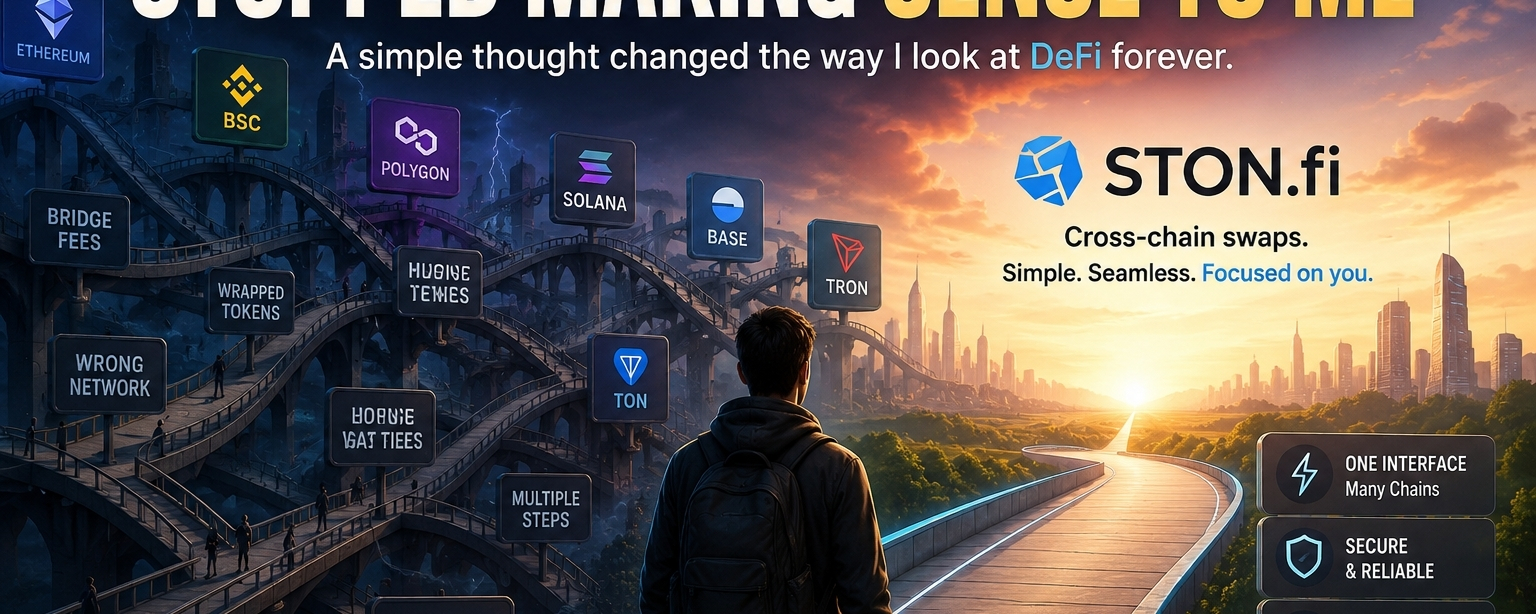
The Day Cross-Chain Stopped Making Sense to MeI used to think jumping between chains was just part of the game.
You learn the routine pretty quickly. Ethereum for some things, BNB Chain for others, TON when something interesting is happening there, Base, Solana, whatever. You open a few tabs, check gas prices, find a bridge, double-check the network, and hope you don’t send something to the wrong place. After a while it becomes automatic. You stop questioning it.
For a long time I just accepted it as normal.
Then one ordinary day I was moving some funds again and caught myself spending more time managing the process than actually doing anything with the money. Checking explorers. Waiting for confirmations. Making sure the token was the right version. Switching networks. Confirming the bridge route. It wasn’t even a large amount. It was just another transfer. And somewhere in the middle of it I thought, this is actually kind of stupid.
I don’t do this with almost anything else in my life.
When I send an email, I don’t care which server handles it.
When I watch a video, I don’t think about which network is carrying the data.
When I pay with a card, I don’t sit there wondering which system is processing the payment behind the scenes.
The technology just does its job quietly. I only notice it when something breaks.
Crypto is different. We still make people think about bridges, gas tokens, wrapped assets, and which chain they’re currently on just to complete something as basic as a swap. The industry has improved a lot on the technical side. Bridges are faster. Fees are lower in many places. Security has gotten better. But the experience itself still feels like work. You still have to manage the process.
It’s a bit like every blockchain is its own country. Each one has its own currency, its own rules, its own way of doing things. And as a user you’re constantly travelling between them. You exchange money at the border, pay fees, wait, fill out the digital equivalent of forms, and then finally arrive where you wanted to go. After a while it gets tiring, even if you’ve gotten used to it.
I don’t think most people enjoy that part. They just learn to live with it because that’s how things are set up.
That day changed how I look at products.
I used to evaluate cross-chain tools mainly by speed and cost. How fast can it move assets? How cheap is the transfer? Those things still matter, of course. But now I find myself asking a quieter question first: does this make me think less? Does it reduce the number of decisions I have to make, or does it just make each decision slightly faster?
The best products I’ve used in other areas of life don’t impress me by showing me how complex the system is. They impress me by making the complexity disappear so I can focus on what I actually wanted to do.
That’s one of the reasons I started paying more attention to @stonfi .
It wasn’t just that it offered cross-chain swaps. Plenty of projects do that now. What caught my interest was the direction. Instead of treating the bridge as the main feature and asking users to understand every step, the focus seemed to be on reducing how much the user has to think about the underlying process at all. Making the complicated parts less visible rather than celebrating them.
I still spend time in different ecosystems. I still move things around when I need to. But I’ve become less patient with tools that expect me to manage the infrastructure. The more time I spend in this space, the more I notice that most people don’t wake up wanting to interact with blockchains. They wake up wanting to swap a token, send money, earn some yield, or buy something without feeling like they’re doing admin work.
Maybe the real progress isn’t just better bridges or faster routes.
Maybe it’s when the whole process becomes quiet enough that we stop noticing it.
I’m not sure we’re fully there yet. But I pay more attention now to the projects that seem to be aiming in that direction.
#Web3 #Stonbassadors
The Day Cross-Chain Stopped Making Sense to Me
I used to think jumping between chains was just part of the game.
You learn the routine pretty quickly. Ethereum for some things, BNB Chain for others, TON when something interesting is happening there, Base, Solana, whatever. You open a few tabs, check gas prices, find a bridge, double-check the network, and hope you don’t send something to the wrong place. After a while it becomes automatic. You stop questioning it.
For a long time I just accepted it as normal.
Then one ordinary day I was moving some funds again and caught myself spending more time managing the process than actually doing anything with the money. Checking explorers. Waiting for confirmations. Making sure the token was the right version. Switching networks. Confirming the bridge route. It wasn’t even a large amount. It was just another transfer. And somewhere in the middle of it I thought, this is actually kind of stupid.
I don’t do this with almost anything else in my life.
When I send an email, I don’t care which server handles it.
When I watch a video, I don’t think about which network is carrying the data.
When I pay with a card, I don’t sit there wondering which system is processing the payment behind the scenes.
The technology just does its job quietly. I only notice it when something breaks.
Crypto is different. We still make people think about bridges, gas tokens, wrapped assets, and which chain they’re currently on just to complete something as basic as a swap. The industry has improved a lot on the technical side. Bridges are faster. Fees are lower in many places. Security has gotten better. But the experience itself still feels like work. You still have to manage the process.
It’s a bit like every blockchain is its own country. Each one has its own currency, its own rules, its own way of doing things. And as a user you’re constantly travelling between them. You exchange money at the border, pay fees, wait, fill out the digital equivalent of forms, and then finally arrive where you wanted to go. After a while it gets tiring, even if you’ve gotten used to it.
I don’t think most people enjoy that part. They just learn to live with it because that’s how things are set up.
That day changed how I look at products.
I used to evaluate cross-chain tools mainly by speed and cost. How fast can it move assets? How cheap is the transfer? Those things still matter, of course. But now I find myself asking a quieter question first: does this make me think less? Does it reduce the number of decisions I have to make, or does it just make each decision slightly faster?
The best products I’ve used in other areas of life don’t impress me by showing me how complex the system is. They impress me by making the complexity disappear so I can focus on what I actually wanted to do.
That’s one of the reasons I started paying more attention to @STONfi DEX .
It wasn’t just that it offered cross-chain swaps. Plenty of projects do that now. What caught my interest was the direction. Instead of treating the bridge as the main feature and asking users to understand every step, the focus seemed to be on reducing how much the user has to think about the underlying process at all. Making the complicated parts less visible rather than celebrating them.
I still spend time in different ecosystems. I still move things around when I need to. But I’ve become less patient with tools that expect me to manage the infrastructure. The more time I spend in this space, the more I notice that most people don’t wake up wanting to interact with blockchains. They wake up wanting to swap a token, send money, earn some yield, or buy something without feeling like they’re doing admin work.
Maybe the real progress isn’t just better bridges or faster routes.
Maybe it’s when the whole process becomes quiet enough that we stop noticing it.
I’m not sure we’re fully there yet. But I pay more attention now to the projects that seem to be aiming in that direction.
#Web3 #Stonbassadors
You learn the routine pretty quickly. Ethereum for some things, BNB Chain for others, TON when something interesting is happening there, Base, Solana, whatever. You open a few tabs, check gas prices, find a bridge, double-check the network, and hope you don’t send something to the wrong place. After a while it becomes automatic. You stop questioning it.
For a long time I just accepted it as normal.
Then one ordinary day I was moving some funds again and caught myself spending more time managing the process than actually doing anything with the money. Checking explorers. Waiting for confirmations. Making sure the token was the right version. Switching networks. Confirming the bridge route. It wasn’t even a large amount. It was just another transfer. And somewhere in the middle of it I thought, this is actually kind of stupid.
I don’t do this with almost anything else in my life.
When I send an email, I don’t care which server handles it.
When I watch a video, I don’t think about which network is carrying the data.
When I pay with a card, I don’t sit there wondering which system is processing the payment behind the scenes.
The technology just does its job quietly. I only notice it when something breaks.
Crypto is different. We still make people think about bridges, gas tokens, wrapped assets, and which chain they’re currently on just to complete something as basic as a swap. The industry has improved a lot on the technical side. Bridges are faster. Fees are lower in many places. Security has gotten better. But the experience itself still feels like work. You still have to manage the process.
It’s a bit like every blockchain is its own country. Each one has its own currency, its own rules, its own way of doing things. And as a user you’re constantly travelling between them. You exchange money at the border, pay fees, wait, fill out the digital equivalent of forms, and then finally arrive where you wanted to go. After a while it gets tiring, even if you’ve gotten used to it.
I don’t think most people enjoy that part. They just learn to live with it because that’s how things are set up.
That day changed how I look at products.
I used to evaluate cross-chain tools mainly by speed and cost. How fast can it move assets? How cheap is the transfer? Those things still matter, of course. But now I find myself asking a quieter question first: does this make me think less? Does it reduce the number of decisions I have to make, or does it just make each decision slightly faster?
The best products I’ve used in other areas of life don’t impress me by showing me how complex the system is. They impress me by making the complexity disappear so I can focus on what I actually wanted to do.
That’s one of the reasons I started paying more attention to @STONfi DEX .
It wasn’t just that it offered cross-chain swaps. Plenty of projects do that now. What caught my interest was the direction. Instead of treating the bridge as the main feature and asking users to understand every step, the focus seemed to be on reducing how much the user has to think about the underlying process at all. Making the complicated parts less visible rather than celebrating them.
I still spend time in different ecosystems. I still move things around when I need to. But I’ve become less patient with tools that expect me to manage the infrastructure. The more time I spend in this space, the more I notice that most people don’t wake up wanting to interact with blockchains. They wake up wanting to swap a token, send money, earn some yield, or buy something without feeling like they’re doing admin work.
Maybe the real progress isn’t just better bridges or faster routes.
Maybe it’s when the whole process becomes quiet enough that we stop noticing it.
I’m not sure we’re fully there yet. But I pay more attention now to the projects that seem to be aiming in that direction.
#Web3 #Stonbassadors
1
123
·
--
Article
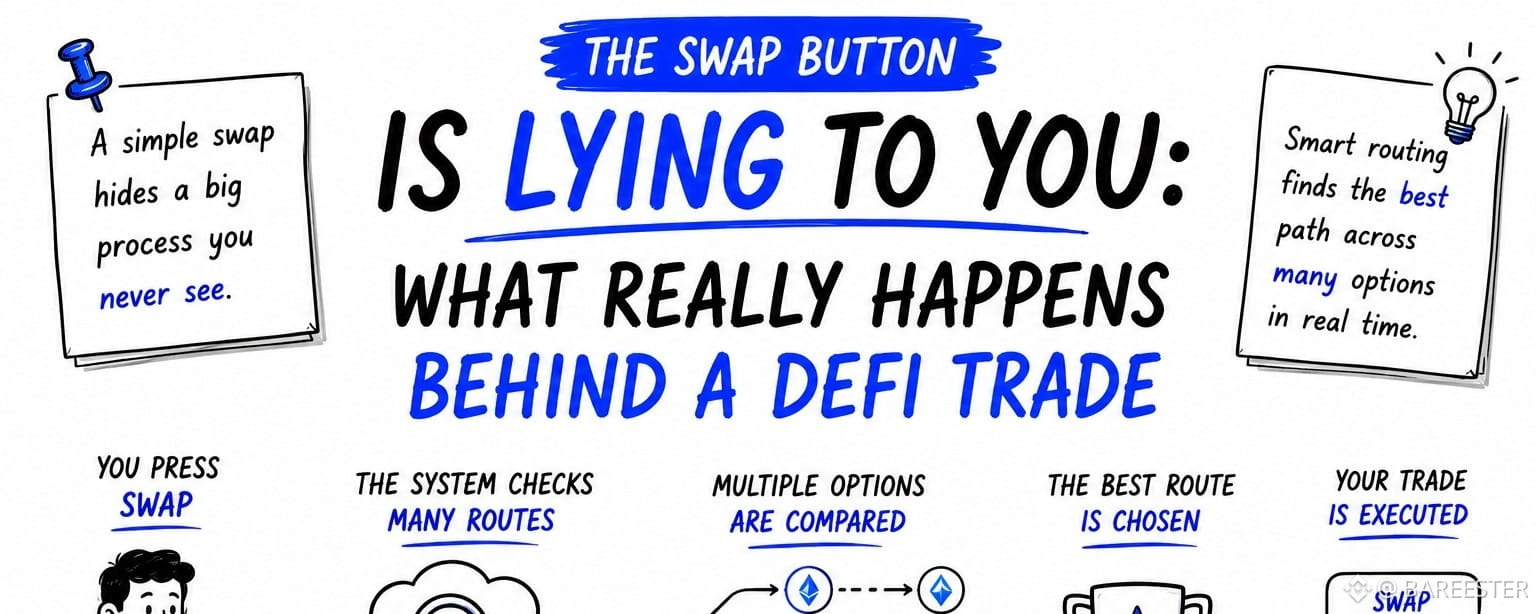
The Swap Button Is Lying to You: What Really Happens Behind a DeFi TradeA DeFi swap looks almost too easy.
You pick a token.
You type the amount.
You press Swap.
A few seconds later, it’s done.
But behind that simple button is a much bigger question:
How did the system decide where your trade should go?
Most people never ask this. Understanding the answer changes how you see decentralized exchanges.
There Is No Single Price in DeFi
Let’s say you want to swap USDT for TON.
You might think there is one clear market price.
There isn’t.
Liquidity (the money sitting in pools ready to trade) is spread across many places:
- Different DEXs
- Different pools
- Sometimes even different networks
One pool might have a lot of money and give a better rate.
Another might be cheaper for small trades.
A third route might go through two or three tokens and still end up better for you.
So the quote you see is not “the price of TON.”
It is the result of a routing decision the system choosing the best path it can find right now.
Why Fragmented Liquidity Is a Problem
Think of three shops selling the same phone case:
- Shop A sells it for $10
- Shop B sells it for $9.80
- Shop C sells it for $9.70
If you only go to Shop A, you never discover the better deals.
DeFi works the same way. Money is scattered across many protocols. Prices change every second. Checking every option by hand would take too long.
This is why liquidity aggregators and smart routing exist.
What an Aggregator Actually Does
An aggregator looks at many possible routes at once and tries to find a good one for your trade.
Instead of you asking:
“Which DEX should I use?”
You simply ask:
“How can I swap this?”
The system does the searching for you.
It does not always find the perfect trade. Markets move fast. Liquidity changes. Fees and network conditions change too.
But it removes the need for you to manually check every pool.
Where Omniston Comes In
In the @stonfi ecosystem, Omniston is the layer that handles this aggregation and routing.
You don’t have to know which pool or which path is being used.
You just use the app.
Behind the scenes, Omniston checks available routes and helps complete the swap.
The key idea is simple:
- The screen stays easy
- The complex work happens in the background
When infrastructure works well, most users never notice it. That is actually a good sign.
A Clear Example
You want to swap 1,000 USDT into TON.
Possible routes could be:
1. Direct path: USDT → TON
2. Two-step path: USDT → another token → TON
3. A path that uses liquidity from somewhere else
Which one is best depends on:
- How much you are swapping
- How much money is in each pool
- The fees
- How much the price will move because of your trade (price impact)
A good routing system compares these options automatically.
You just press Swap and never see the comparison.
Why This Matters More as More People Join DeFi
Early DeFi users liked jumping between different apps. They checked pools, watched slippage, and compared rates themselves.
Most new users do not want to do that.
Someone who just wants to swap $50 does not want a lesson in liquidity routing first. They want something that feels simple and safe.
The big challenge for Web3 is this:
How do we make things easy without hiding what is really happening?
Smart routing is one of the answers.
The Telegram Advantage
This becomes even more useful when the tools live inside Telegram or simple wallets.
People already spend time in these apps.
When swapping feels as natural as sending a message, more people can use DeFi.
But ease of use is not enough. Good systems still need:
- Clear fees
- Honest slippage information
- Reliable liquidity
- User control over transactions
- Strong security
Making DeFi simpler should never mean making users less informed.
The Real Lesson
The future of DEXs is not only about creating more pools.
It is about connecting the pools that already exist in a smarter way.
Fragmented liquidity is not always bad. Competition between protocols can help users. The hard part is making all that competition easy to use.
That is why aggregation matters.
You see one button.
Behind that button sits a network of routes, prices, and decisions.
The best DeFi tools do not make the technology vanish.
They make the complexity easier for normal people to live with.
Final Thought
Next time you press Swap, pause for a second.
Don’t only think about the token you are buying.
Ask yourself:
“Why did my trade take this particular route?”
When you start asking that question, you begin to understand DeFi at a deeper level.
And that is where real education starts.
#Web3 #Stonbassadors
The Swap Button Is Lying to You: What Really Happens Behind a DeFi Trade
A DeFi swap looks almost too easy.
You pick a token.
You type the amount.
You press Swap.
A few seconds later, it’s done.
But behind that simple button is a much bigger question:
How did the system decide where your trade should go?
Most people never ask this. Understanding the answer changes how you see decentralized exchanges.
There Is No Single Price in DeFi
Let’s say you want to swap USDT for TON.
You might think there is one clear market price.
There isn’t.
Liquidity (the money sitting in pools ready to trade) is spread across many places:
- Different DEXs
- Different pools
- Sometimes even different networks
One pool might have a lot of money and give a better rate.
Another might be cheaper for small trades.
A third route might go through two or three tokens and still end up better for you.
So the quote you see is not “the price of TON.”
It is the result of a routing decision the system choosing the best path it can find right now.
Why Fragmented Liquidity Is a Problem
Think of three shops selling the same phone case:
- Shop A sells it for $10
- Shop B sells it for $9.80
- Shop C sells it for $9.70
If you only go to Shop A, you never discover the better deals.
DeFi works the same way. Money is scattered across many protocols. Prices change every second. Checking every option by hand would take too long.
This is why liquidity aggregators and smart routing exist.
What an Aggregator Actually Does
An aggregator looks at many possible routes at once and tries to find a good one for your trade.
Instead of you asking:
“Which DEX should I use?”
You simply ask:
“How can I swap this?”
The system does the searching for you.
It does not always find the perfect trade. Markets move fast. Liquidity changes. Fees and network conditions change too.
But it removes the need for you to manually check every pool.
Where Omniston Comes In
In the @STONfi DEX ecosystem, Omniston is the layer that handles this aggregation and routing.
You don’t have to know which pool or which path is being used.
You just use the app.
Behind the scenes, Omniston checks available routes and helps complete the swap.
The key idea is simple:
- The screen stays easy
- The complex work happens in the background
When infrastructure works well, most users never notice it. That is actually a good sign.
A Clear Example
You want to swap 1,000 USDT into TON.
Possible routes could be:
1. Direct path: USDT → TON
2. Two-step path: USDT → another token → TON
3. A path that uses liquidity from somewhere else
Which one is best depends on:
- How much you are swapping
- How much money is in each pool
- The fees
- How much the price will move because of your trade (price impact)
A good routing system compares these options automatically.
You just press Swap and never see the comparison.
Why This Matters More as More People Join DeFi
Early DeFi users liked jumping between different apps. They checked pools, watched slippage, and compared rates themselves.
Most new users do not want to do that.
Someone who just wants to swap $50 does not want a lesson in liquidity routing first. They want something that feels simple and safe.
The big challenge for Web3 is this:
How do we make things easy without hiding what is really happening?
Smart routing is one of the answers.
The Telegram Advantage
This becomes even more useful when the tools live inside Telegram or simple wallets.
People already spend time in these apps.
When swapping feels as natural as sending a message, more people can use DeFi.
But ease of use is not enough. Good systems still need:
- Clear fees
- Honest slippage information
- Reliable liquidity
- User control over transactions
- Strong security
Making DeFi simpler should never mean making users less informed.
The Real Lesson
The future of DEXs is not only about creating more pools.
It is about connecting the pools that already exist in a smarter way.
Fragmented liquidity is not always bad. Competition between protocols can help users. The hard part is making all that competition easy to use.
That is why aggregation matters.
You see one button.
Behind that button sits a network of routes, prices, and decisions.
The best DeFi tools do not make the technology vanish.
They make the complexity easier for normal people to live with.
Final Thought
Next time you press Swap, pause for a second.
Don’t only think about the token you are buying.
Ask yourself:
“Why did my trade take this particular route?”
When you start asking that question, you begin to understand DeFi at a deeper level.
And that is where real education starts.
#Web3 #Stonbassadors
You pick a token.
You type the amount.
You press Swap.
A few seconds later, it’s done.
But behind that simple button is a much bigger question:
How did the system decide where your trade should go?
Most people never ask this. Understanding the answer changes how you see decentralized exchanges.
There Is No Single Price in DeFi
Let’s say you want to swap USDT for TON.
You might think there is one clear market price.
There isn’t.
Liquidity (the money sitting in pools ready to trade) is spread across many places:
- Different DEXs
- Different pools
- Sometimes even different networks
One pool might have a lot of money and give a better rate.
Another might be cheaper for small trades.
A third route might go through two or three tokens and still end up better for you.
So the quote you see is not “the price of TON.”
It is the result of a routing decision the system choosing the best path it can find right now.
Why Fragmented Liquidity Is a Problem
Think of three shops selling the same phone case:
- Shop A sells it for $10
- Shop B sells it for $9.80
- Shop C sells it for $9.70
If you only go to Shop A, you never discover the better deals.
DeFi works the same way. Money is scattered across many protocols. Prices change every second. Checking every option by hand would take too long.
This is why liquidity aggregators and smart routing exist.
What an Aggregator Actually Does
An aggregator looks at many possible routes at once and tries to find a good one for your trade.
Instead of you asking:
“Which DEX should I use?”
You simply ask:
“How can I swap this?”
The system does the searching for you.
It does not always find the perfect trade. Markets move fast. Liquidity changes. Fees and network conditions change too.
But it removes the need for you to manually check every pool.
Where Omniston Comes In
In the @STONfi DEX ecosystem, Omniston is the layer that handles this aggregation and routing.
You don’t have to know which pool or which path is being used.
You just use the app.
Behind the scenes, Omniston checks available routes and helps complete the swap.
The key idea is simple:
- The screen stays easy
- The complex work happens in the background
When infrastructure works well, most users never notice it. That is actually a good sign.
A Clear Example
You want to swap 1,000 USDT into TON.
Possible routes could be:
1. Direct path: USDT → TON
2. Two-step path: USDT → another token → TON
3. A path that uses liquidity from somewhere else
Which one is best depends on:
- How much you are swapping
- How much money is in each pool
- The fees
- How much the price will move because of your trade (price impact)
A good routing system compares these options automatically.
You just press Swap and never see the comparison.
Why This Matters More as More People Join DeFi
Early DeFi users liked jumping between different apps. They checked pools, watched slippage, and compared rates themselves.
Most new users do not want to do that.
Someone who just wants to swap $50 does not want a lesson in liquidity routing first. They want something that feels simple and safe.
The big challenge for Web3 is this:
How do we make things easy without hiding what is really happening?
Smart routing is one of the answers.
The Telegram Advantage
This becomes even more useful when the tools live inside Telegram or simple wallets.
People already spend time in these apps.
When swapping feels as natural as sending a message, more people can use DeFi.
But ease of use is not enough. Good systems still need:
- Clear fees
- Honest slippage information
- Reliable liquidity
- User control over transactions
- Strong security
Making DeFi simpler should never mean making users less informed.
The Real Lesson
The future of DEXs is not only about creating more pools.
It is about connecting the pools that already exist in a smarter way.
Fragmented liquidity is not always bad. Competition between protocols can help users. The hard part is making all that competition easy to use.
That is why aggregation matters.
You see one button.
Behind that button sits a network of routes, prices, and decisions.
The best DeFi tools do not make the technology vanish.
They make the complexity easier for normal people to live with.
Final Thought
Next time you press Swap, pause for a second.
Don’t only think about the token you are buying.
Ask yourself:
“Why did my trade take this particular route?”
When you start asking that question, you begin to understand DeFi at a deeper level.
And that is where real education starts.
#Web3 #Stonbassadors
1
92
·
--
Article
How to Get Your Share of 30,000 STORM a Day The Real WayI’ve seen plenty of big farming numbers in DeFi.
But when I noticed 30,000 STORM every day on the STORM/GRAM farm on @stonfi , I didn’t get excited.
I got curious.
Because the real question isn’t:
“How much STORM is being paid?”
It’s:
“What am I actually doing to earn it, and what am I risking?”
Here’s the simple breakdown.
What you’re actually doing
You’re not simply depositing STORM and collecting rewards.
You’re providing STORM + GRAM liquidity to the STORM/GRAM pool on STON.fi.
You provide liquidity → receive LP tokens → participate in the farm → earn a share of the STORM emissions.
The 30,000 STORM/day is the total farm reward, not 30,000 STORM for every user.
Your share depends on your eligible liquidity compared with the rest of the farm.
And here’s the part people often miss.
Because you're providing liquidity to a two-token pool, your position is exposed to the price movements of both STORM and GRAM.
If their prices move significantly relative to each other, you can experience impermanent loss.
So:
Earning STORM ≠ guaranteed profit.
Your real result depends on:
• STORM price
• GRAM price
• Trading fees
• Farming rewards
• Impermanent loss
• Changes to the reward rate
• Your entry and exit prices
The farm currently shows no LP-token lock-up, which gives liquidity providers more flexibility.
But flexibility doesn’t remove risk.
Before I would consider entering a farm like this, I’d check
1. Current TVL
2. Current STORM price
3. Live reward rate/APR
4. My percentage of the pool
5. STORM tokenomics and unlocks
6. What happens if STORM drops 30%
The 30,000 STORM/day headline definitely deserves attention.
But the number alone isn't enough to make a decision.
In DeFi, the reward is only half of the story.
The other half is understanding what you're risking to earn it.
Do your own research before providing liquidity.
#Web3 #Stonbassadors
How to Get Your Share of 30,000 STORM a Day The Real Way
I’ve seen plenty of big farming numbers in DeFi.
But when I noticed 30,000 STORM every day on the STORM/GRAM farm on @STONfi DEX , I didn’t get excited.
I got curious.
Because the real question isn’t:
“How much STORM is being paid?”
It’s:
“What am I actually doing to earn it, and what am I risking?”
Here’s the simple breakdown.
What you’re actually doing
You’re not simply depositing STORM and collecting rewards.
You’re providing STORM + GRAM liquidity to the STORM/GRAM pool on STON.fi.
You provide liquidity → receive LP tokens → participate in the farm → earn a share of the STORM emissions.
The 30,000 STORM/day is the total farm reward, not 30,000 STORM for every user.
Your share depends on your eligible liquidity compared with the rest of the farm.
And here’s the part people often miss.
Because you're providing liquidity to a two-token pool, your position is exposed to the price movements of both STORM and GRAM.
If their prices move significantly relative to each other, you can experience impermanent loss.
So:
Earning STORM ≠ guaranteed profit.
Your real result depends on:
• STORM price
• GRAM price
• Trading fees
• Farming rewards
• Impermanent loss
• Changes to the reward rate
• Your entry and exit prices
The farm currently shows no LP-token lock-up, which gives liquidity providers more flexibility.
But flexibility doesn’t remove risk.
Before I would consider entering a farm like this, I’d check
1. Current TVL
2. Current STORM price
3. Live reward rate/APR
4. My percentage of the pool
5. STORM tokenomics and unlocks
6. What happens if STORM drops 30%
The 30,000 STORM/day headline definitely deserves attention.
But the number alone isn't enough to make a decision.
In DeFi, the reward is only half of the story.
The other half is understanding what you're risking to earn it.
Do your own research before providing liquidity.
#Web3 #Stonbassadors
But when I noticed 30,000 STORM every day on the STORM/GRAM farm on @STONfi DEX , I didn’t get excited.
I got curious.
Because the real question isn’t:
“How much STORM is being paid?”
It’s:
“What am I actually doing to earn it, and what am I risking?”
Here’s the simple breakdown.
What you’re actually doing
You’re not simply depositing STORM and collecting rewards.
You’re providing STORM + GRAM liquidity to the STORM/GRAM pool on STON.fi.
You provide liquidity → receive LP tokens → participate in the farm → earn a share of the STORM emissions.
The 30,000 STORM/day is the total farm reward, not 30,000 STORM for every user.
Your share depends on your eligible liquidity compared with the rest of the farm.
And here’s the part people often miss.
Because you're providing liquidity to a two-token pool, your position is exposed to the price movements of both STORM and GRAM.
If their prices move significantly relative to each other, you can experience impermanent loss.
So:
Earning STORM ≠ guaranteed profit.
Your real result depends on:
• STORM price
• GRAM price
• Trading fees
• Farming rewards
• Impermanent loss
• Changes to the reward rate
• Your entry and exit prices
The farm currently shows no LP-token lock-up, which gives liquidity providers more flexibility.
But flexibility doesn’t remove risk.
Before I would consider entering a farm like this, I’d check
1. Current TVL
2. Current STORM price
3. Live reward rate/APR
4. My percentage of the pool
5. STORM tokenomics and unlocks
6. What happens if STORM drops 30%
The 30,000 STORM/day headline definitely deserves attention.
But the number alone isn't enough to make a decision.
In DeFi, the reward is only half of the story.
The other half is understanding what you're risking to earn it.
Do your own research before providing liquidity.
#Web3 #Stonbassadors
1
159
Log in to explore more content
Join global crypto users on Binance Square
⚡️ Get latest and useful information about crypto.
💬 Trusted by the world’s largest crypto exchange.
👍 Discover real insights from verified creators.
Email / Phone number
Trending Topics
1
#NFPWatch
10.6M views
18,006 Discussing
2
#BitcoinFundingRateTriplesTo10%
14,811 views
326 Discussing
3
#BitcoinSurpasses$86KUp2.99%
4,667 views
44 Discussing
4
#ZcashFalls21%FromSeptemberPeak
17,348 views
338 Discussing
5
#USSeptemberPayrollsAdd29KUnemploymentRises4.2%
10,551 views
168 Discussing
6
#XRPPostsFirstThreeGreenMonthsInQ3
16,808 views
373 Discussing
7
#BNBChainTokenizedStocksTop$1BAt30%Share
232 views
24 Discussing
8
#BitcoinRisesToward$85K
59,113 views
121 Discussing
9
#AmazonPlansToSell$8BNvidiaChips
6,134 views
80 Discussing
10
#NEARFallsToAround$4.70Down14%
41,152 views
106 Discussing