

#opengradient
opengradient
518,910 views
5,924 Discussing
Hot
Latest

OPG Breakout Unleashed! OpenGradient Bulls Target Major Highs!
Following a powerful rounding bottom accumulation phase, OPG/USDT has shattered local resistance barriers with clean, volume-backed momentum. With the major EMAs perfectly aligned and the SuperTrend holding a firm green floor, the bulls are in complete control of this recovery extension.
🎯 Entry Zone: 0.1390 – 0.1435 (Look to scale in near the 1H EMA(7) on minor intraday pullbacks rather than chasing the absolute high wick).
💰 Take Profit 1 (TP1): 0.1540 (Targeting a structural extension just past the recent local multi-day high).
💰 Take Profit 2 (TP2): 0.1650 (Next major psychological resistance pool and structural milestone).
⚠️ Stop Loss (SL): 0.1340 (Placed safely below the active green SuperTrend line and the 1H EMA(25) to protect your trading capital).
Trade with cold mechanical execution, systematically lock in your profits, and ride the trend with discipline!
#OpenGradient #OPGUSDT #CryptoSignals
{future}(OPGUSDT)
OPG Breakout Unleashed! OpenGradient Bulls Target Major Highs!
Following a powerful rounding bottom accumulation phase, OPG/USDT has shattered local resistance barriers with clean, volume-backed momentum. With the major EMAs perfectly aligned and the SuperTrend holding a firm green floor, the bulls are in complete control of this recovery extension.
🎯 Entry Zone: 0.1390 – 0.1435 (Look to scale in near the 1H EMA(7) on minor intraday pullbacks rather than chasing the absolute high wick).
💰 Take Profit 1 (TP1): 0.1540 (Targeting a structural extension just past the recent local multi-day high).
💰 Take Profit 2 (TP2): 0.1650 (Next major psychological resistance pool and structural milestone).
⚠️ Stop Loss (SL): 0.1340 (Placed safely below the active green SuperTrend line and the 1H EMA(25) to protect your trading capital).
Trade with cold mechanical execution, systematically lock in your profits, and ride the trend with discipline!
#OpenGradient #OPGUSDT #CryptoSignals
Following a powerful rounding bottom accumulation phase, OPG/USDT has shattered local resistance barriers with clean, volume-backed momentum. With the major EMAs perfectly aligned and the SuperTrend holding a firm green floor, the bulls are in complete control of this recovery extension.
🎯 Entry Zone: 0.1390 – 0.1435 (Look to scale in near the 1H EMA(7) on minor intraday pullbacks rather than chasing the absolute high wick).
💰 Take Profit 1 (TP1): 0.1540 (Targeting a structural extension just past the recent local multi-day high).
💰 Take Profit 2 (TP2): 0.1650 (Next major psychological resistance pool and structural milestone).
⚠️ Stop Loss (SL): 0.1340 (Placed safely below the active green SuperTrend line and the 1H EMA(25) to protect your trading capital).
Trade with cold mechanical execution, systematically lock in your profits, and ride the trend with discipline!
#OpenGradient #OPGUSDT #CryptoSignals
1
16

🔥 AI NEEDS TRUST NOT JUST INTELLIGENCE
Most AI projects are competing to create smarter and more powerful models.
@OpenGradient is focused on a much bigger challenge.
How can AI operate in a decentralized world where every output can be verified instead of blindly trusted?
The future of AI will not be defined only by intelligence. It will be defined by transparency accountability and verifiability.
With OpenGradient every prediction inference and decision can move closer to onchain verification creating a foundation for trustworthy AI systems.
As AI becomes a critical part of finance applications and digital infrastructure the demand for verifiable intelligence will continue to grow.
That is why I am watching @OpenGradient closely.
$OPG is not simply another AI token.
It represents a vision where decentralized AI can operate with trust transparency and accountability at scale.
#OPG #OpenGradient
{spot}(OPGUSDT)
#opg
$H
{future}(HUSDT)
$LAB
{future}(LABUSDT)
🔥 AI NEEDS TRUST NOT JUST INTELLIGENCE
Most AI projects are competing to create smarter and more powerful models.
@OpenGradient is focused on a much bigger challenge.
How can AI operate in a decentralized world where every output can be verified instead of blindly trusted?
The future of AI will not be defined only by intelligence. It will be defined by transparency accountability and verifiability.
With OpenGradient every prediction inference and decision can move closer to onchain verification creating a foundation for trustworthy AI systems.
As AI becomes a critical part of finance applications and digital infrastructure the demand for verifiable intelligence will continue to grow.
That is why I am watching @OpenGradient closely.
$OPG is not simply another AI token.
It represents a vision where decentralized AI can operate with trust transparency and accountability at scale.
#OPG #OpenGradient
#opg
$H
$LAB
Most AI projects are competing to create smarter and more powerful models.
@OpenGradient is focused on a much bigger challenge.
How can AI operate in a decentralized world where every output can be verified instead of blindly trusted?
The future of AI will not be defined only by intelligence. It will be defined by transparency accountability and verifiability.
With OpenGradient every prediction inference and decision can move closer to onchain verification creating a foundation for trustworthy AI systems.
As AI becomes a critical part of finance applications and digital infrastructure the demand for verifiable intelligence will continue to grow.
That is why I am watching @OpenGradient closely.
$OPG is not simply another AI token.
It represents a vision where decentralized AI can operate with trust transparency and accountability at scale.
#OPG #OpenGradient
#opg
$H
$LAB
1
1
12

·
--
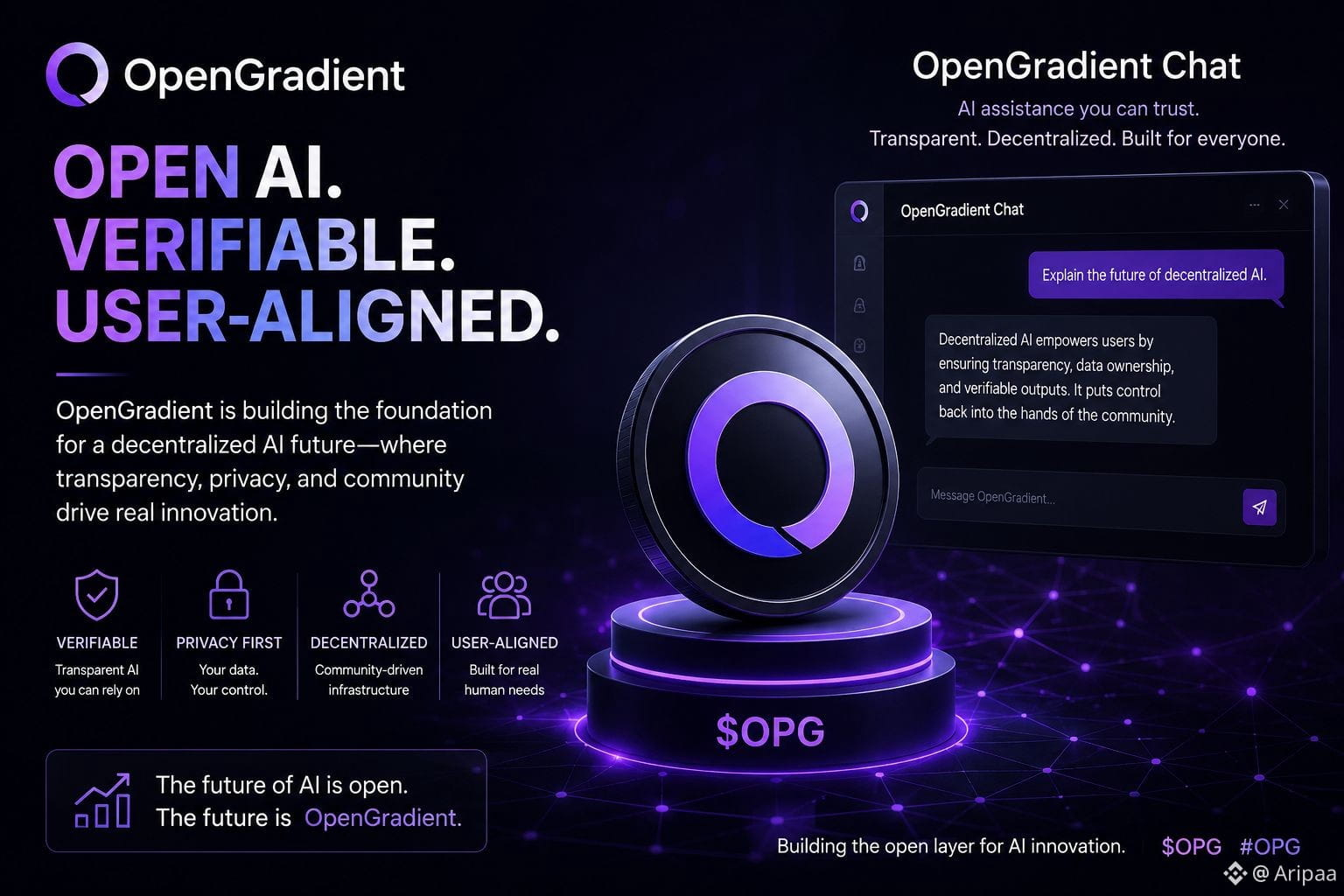
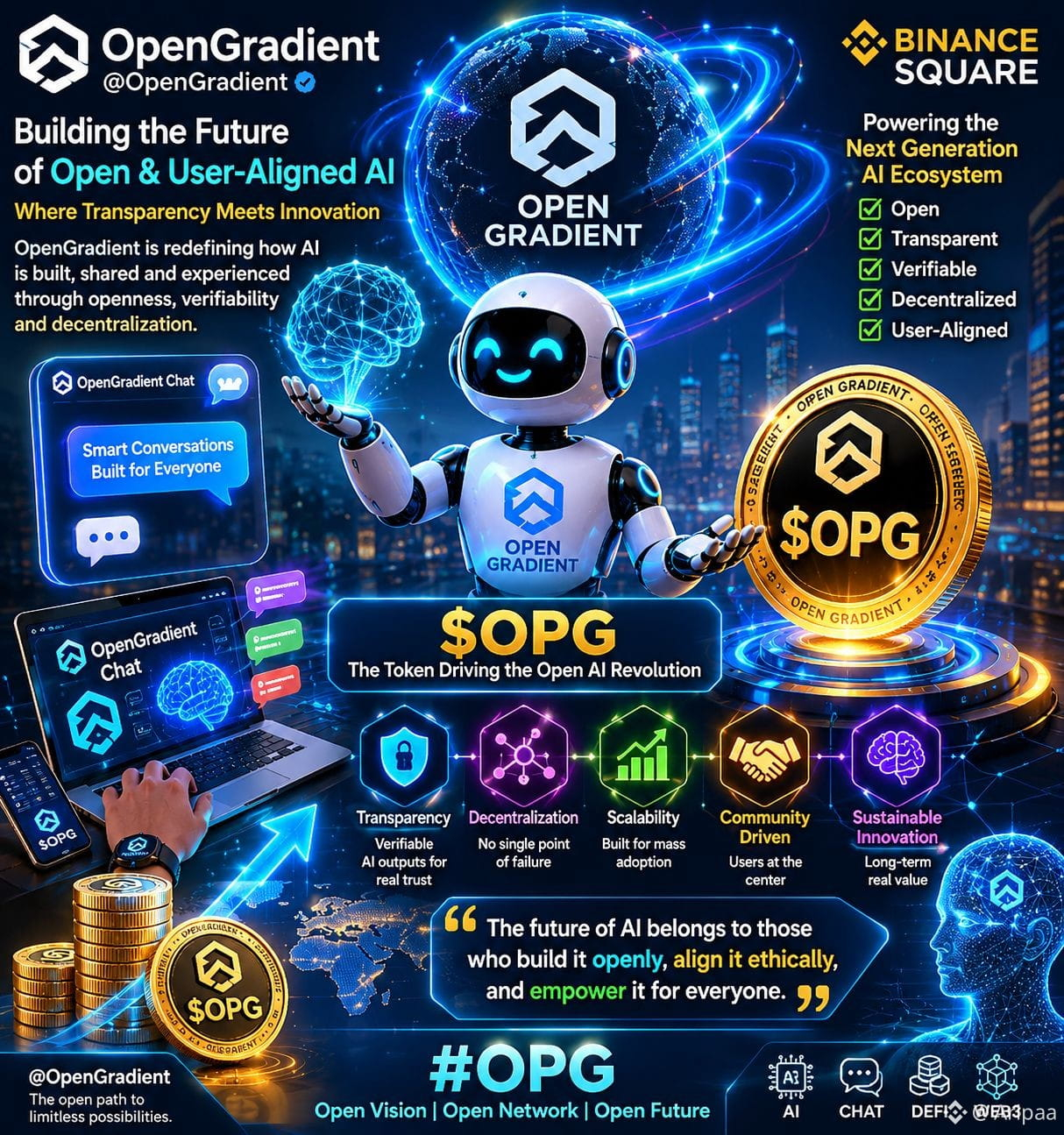
As AI continues to evolve, one of the biggest questions is not how powerful models can become, but how accessible, transparent, and verifiable they are for everyday users. This is why I’ve been paying close attention to @OpenGradient and the growing role of #OpenGradient Chat in the decentralized AI landscape.
Many AI platforms operate as black boxes, where users have little visibility into how outputs are generated or how data is handled. OpenGradient takes a different approach by focusing on openness, verifiability, and user alignment. This creates an environment where trust can be built through transparency rather than assumptions.
OpenGradient Chat demonstrates how AI can become more useful when users are given greater confidence in the systems they interact with. Instead of relying solely on centralized control, decentralized infrastructure can help create a more resilient and community-driven ecosystem. As adoption grows, this model could become increasingly important for developers, creators, researchers, and businesses seeking reliable AI tools.
The long-term opportunity for $OPG is not just about participating in the AI narrative. It is about supporting infrastructure that enables sustainable innovation while maintaining transparency and accountability. In a market filled with hype, projects that focus on real utility and verifiable outcomes may be the ones that create lasting value.
The future of AI may ultimately belong to platforms that balance performance, openness, and trust. OpenGradient is positioning itself at the intersection of these trends, making it a project worth following closely.
$OPG #OPG
#opg $OPG
As AI continues to evolve, one of the biggest questions is not how powerful models can become, but how accessible, transparent, and verifiable they are for everyday users. This is why I’ve been paying close attention to @OpenGradient and the growing role of #OpenGradient Chat in the decentralized AI landscape.
Many AI platforms operate as black boxes, where users have little visibility into how outputs are generated or how data is handled. OpenGradient takes a different approach by focusing on openness, verifiability, and user alignment. This creates an environment where trust can be built through transparency rather than assumptions.
OpenGradient Chat demonstrates how AI can become more useful when users are given greater confidence in the systems they interact with. Instead of relying solely on centralized control, decentralized infrastructure can help create a more resilient and community-driven ecosystem. As adoption grows, this model could become increasingly important for developers, creators, researchers, and businesses seeking reliable AI tools.
The long-term opportunity for $OPG is not just about participating in the AI narrative. It is about supporting infrastructure that enables sustainable innovation while maintaining transparency and accountability. In a market filled with hype, projects that focus on real utility and verifiable outcomes may be the ones that create lasting value.
The future of AI may ultimately belong to platforms that balance performance, openness, and trust. OpenGradient is positioning itself at the intersection of these trends, making it a project worth following closely.
$OPG #OPG
#opg $OPG
Many AI platforms operate as black boxes, where users have little visibility into how outputs are generated or how data is handled. OpenGradient takes a different approach by focusing on openness, verifiability, and user alignment. This creates an environment where trust can be built through transparency rather than assumptions.
OpenGradient Chat demonstrates how AI can become more useful when users are given greater confidence in the systems they interact with. Instead of relying solely on centralized control, decentralized infrastructure can help create a more resilient and community-driven ecosystem. As adoption grows, this model could become increasingly important for developers, creators, researchers, and businesses seeking reliable AI tools.
The long-term opportunity for $OPG is not just about participating in the AI narrative. It is about supporting infrastructure that enables sustainable innovation while maintaining transparency and accountability. In a market filled with hype, projects that focus on real utility and verifiable outcomes may be the ones that create lasting value.
The future of AI may ultimately belong to platforms that balance performance, openness, and trust. OpenGradient is positioning itself at the intersection of these trends, making it a project worth following closely.
$OPG #OPG
#opg $OPG
5
2
83

·
--
Everyone's obsessed with which chain is "fastest" but nobody's asking what actually happens after the transaction gets finalized.
That's where the real architecture debate lives.
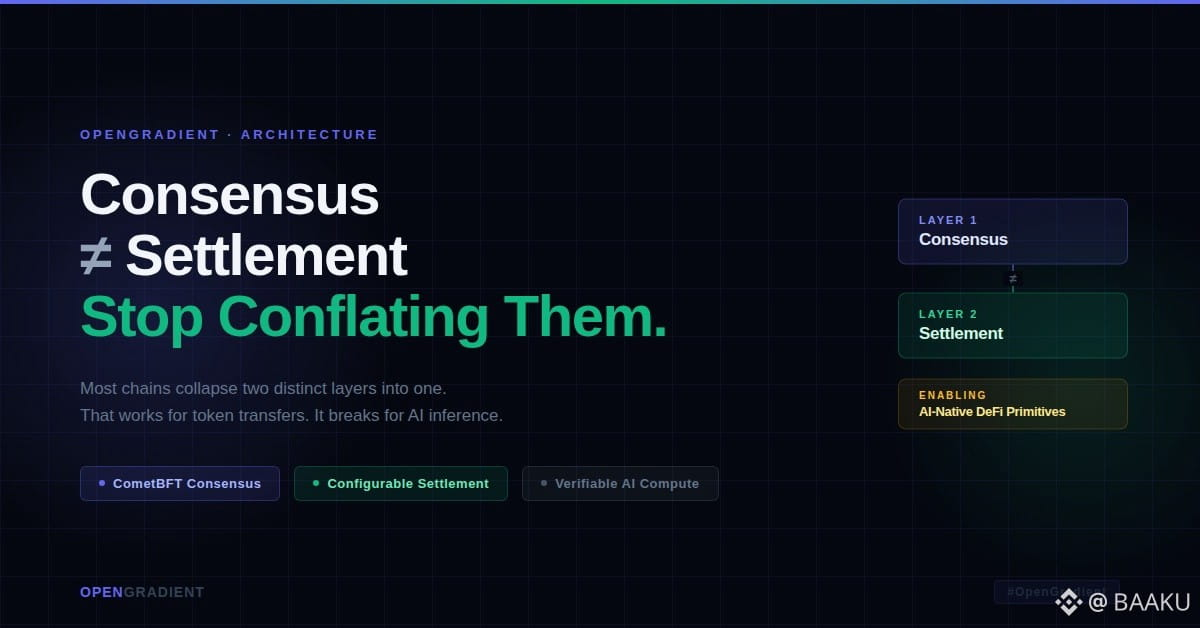
Most L1s treat consensus and settlement like they're the same thing. They're not. Consensus is nodes agreeing something happened. Settlement is the network actually committing to a state that downstream systems can trust and act on. Collapsing those two into one process feels clean until you're building something real on top of it.
The moment you need external systems — oracles, AI inference layers, cross-chain apps — to consume finalized state, you realize the gap matters enormously. A chain that finalizes fast but settles ambiguously is a liability disguised as a feature.
OpenGradient separates these. Consensus runs through CometBFT. Settlement operates as a distinct layer with configurable modes — you pick the settlement behavior that matches your use case. That design decision is quiet. Most people scroll past it. But if you're building AI-powered DeFi or on-chain inference pipelines, it changes what's actually possible.
Here's why: AI model outputs aren't static. They're probabilistic. They need a settlement layer that can handle verification of compute, not just token transfers. A monolithic consensus-settlement system was never designed for that. It was designed for "did wallet A send tokens to wallet B." Full stop.
The honest limitation? Separating consensus and settlement adds architectural complexity. More components means more surface area for failure. Any chain making this tradeoff is betting that the added expressiveness is worth the engineering overhead. That bet could absolutely be wrong depending on how the application layer evolves.
But collapsing them to stay simple also means you're permanently limited to what simple state transitions can express. And the next wave of on-chain primitives — verifiable AI inference, compute markets, model attestation — doesn't fit inside that box.
#OpenGradient #DeFi #Web3
#opg $OPG @OpenGradient
Everyone's obsessed with which chain is "fastest" but nobody's asking what actually happens after the transaction gets finalized.
That's where the real architecture debate lives.
Most L1s treat consensus and settlement like they're the same thing. They're not. Consensus is nodes agreeing something happened. Settlement is the network actually committing to a state that downstream systems can trust and act on. Collapsing those two into one process feels clean until you're building something real on top of it.
The moment you need external systems — oracles, AI inference layers, cross-chain apps — to consume finalized state, you realize the gap matters enormously. A chain that finalizes fast but settles ambiguously is a liability disguised as a feature.
OpenGradient separates these. Consensus runs through CometBFT. Settlement operates as a distinct layer with configurable modes — you pick the settlement behavior that matches your use case. That design decision is quiet. Most people scroll past it. But if you're building AI-powered DeFi or on-chain inference pipelines, it changes what's actually possible.
Here's why: AI model outputs aren't static. They're probabilistic. They need a settlement layer that can handle verification of compute, not just token transfers. A monolithic consensus-settlement system was never designed for that. It was designed for "did wallet A send tokens to wallet B." Full stop.
The honest limitation? Separating consensus and settlement adds architectural complexity. More components means more surface area for failure. Any chain making this tradeoff is betting that the added expressiveness is worth the engineering overhead. That bet could absolutely be wrong depending on how the application layer evolves.
But collapsing them to stay simple also means you're permanently limited to what simple state transitions can express. And the next wave of on-chain primitives — verifiable AI inference, compute markets, model attestation — doesn't fit inside that box.
#OpenGradient #DeFi #Web3
#opg $OPG @OpenGradient
That's where the real architecture debate lives.
Most L1s treat consensus and settlement like they're the same thing. They're not. Consensus is nodes agreeing something happened. Settlement is the network actually committing to a state that downstream systems can trust and act on. Collapsing those two into one process feels clean until you're building something real on top of it.
The moment you need external systems — oracles, AI inference layers, cross-chain apps — to consume finalized state, you realize the gap matters enormously. A chain that finalizes fast but settles ambiguously is a liability disguised as a feature.
OpenGradient separates these. Consensus runs through CometBFT. Settlement operates as a distinct layer with configurable modes — you pick the settlement behavior that matches your use case. That design decision is quiet. Most people scroll past it. But if you're building AI-powered DeFi or on-chain inference pipelines, it changes what's actually possible.
Here's why: AI model outputs aren't static. They're probabilistic. They need a settlement layer that can handle verification of compute, not just token transfers. A monolithic consensus-settlement system was never designed for that. It was designed for "did wallet A send tokens to wallet B." Full stop.
The honest limitation? Separating consensus and settlement adds architectural complexity. More components means more surface area for failure. Any chain making this tradeoff is betting that the added expressiveness is worth the engineering overhead. That bet could absolutely be wrong depending on how the application layer evolves.
But collapsing them to stay simple also means you're permanently limited to what simple state transitions can express. And the next wave of on-chain primitives — verifiable AI inference, compute markets, model attestation — doesn't fit inside that box.
#OpenGradient #DeFi #Web3
#opg $OPG @OpenGradient
1
1
105

·
--
The model invocation of OPG isn't just about "leaving it to the backend" and calling it done.
I've always had a bias against the whole AI on-chain thing:
As soon as I hear "the model will run for you," I've got my pause button ready.
Those three words "run for you" feel way too light.
Light enough to cover up a string of unanswered questions: Which version is running? In what environment is it running? Has the output been tampered with midway? Is the validator looking at the raw result or some second-hand packaging? #OPG
These aren't just technical cleanliness issues; they are the basic materials of trust.
Without these materials, AI on-chain turns from "trusting code" to "trusting some node you don't know."
This reminds me of the customs declaration for ocean freight.
A ship can sail fully automated, equipped with GPS, radar, and autopilot. But what's in the hold, where it was loaded, and whether any containers were switched mid-journey—these questions can't be answered by "autopilot." The customs declaration must be locked in before departure, and each port's customs checks against the same document. If the document can be changed on the fly, no matter how smart the ship is, it's still a black ship.
So when I look at @OpenGradient, I won't first ask how many models it supports or how high the TPS is. $OPG
I'll first look at how its HACA separates "setting sail" and "cargo inspection" into two distinct tasks.
Execution nodes are responsible for running the model, while verification nodes only handle checking the proof. More importantly, it gives developers an optional verification checklist: if you want mathematical certainty, go with ZKML; if you want hardware-level proof, use TEE; if you want low latency, go Vanilla. These three modes aren't just "whatever the backend picks"; they're verification levels chosen by the user before invoking.
This design doesn't sound as comfortable as "one-click AI invocation."
But it gives comfort to something more important: a sense of boundaries.
What the user hands over is an intention, and what the system returns is a verifiable customs declaration. Model version, input environment, output signature—all documented on-chain. It's not about "we trust the node won’t act maliciously," but rather "even if the node wants to act maliciously, it first has to pass this proof stage."
So my interest in #opengradient isn’t about "it makes AI invocation simpler."
What I care about is whether it has turned "hidden reasoning" into "verifiable records."
Computational power can be outsourced.
But every instance of reasoning should ideally be sealed with a stamp before docking. @OpenGradient $BTC $ETH
The model invocation of OPG isn't just about "leaving it to the backend" and calling it done.
I've always had a bias against the whole AI on-chain thing:
As soon as I hear "the model will run for you," I've got my pause button ready.
Those three words "run for you" feel way too light.
Light enough to cover up a string of unanswered questions: Which version is running? In what environment is it running? Has the output been tampered with midway? Is the validator looking at the raw result or some second-hand packaging? #OPG
These aren't just technical cleanliness issues; they are the basic materials of trust.
Without these materials, AI on-chain turns from "trusting code" to "trusting some node you don't know."
This reminds me of the customs declaration for ocean freight.
A ship can sail fully automated, equipped with GPS, radar, and autopilot. But what's in the hold, where it was loaded, and whether any containers were switched mid-journey—these questions can't be answered by "autopilot." The customs declaration must be locked in before departure, and each port's customs checks against the same document. If the document can be changed on the fly, no matter how smart the ship is, it's still a black ship.
So when I look at @OpenGradient, I won't first ask how many models it supports or how high the TPS is. $OPG
I'll first look at how its HACA separates "setting sail" and "cargo inspection" into two distinct tasks.
Execution nodes are responsible for running the model, while verification nodes only handle checking the proof. More importantly, it gives developers an optional verification checklist: if you want mathematical certainty, go with ZKML; if you want hardware-level proof, use TEE; if you want low latency, go Vanilla. These three modes aren't just "whatever the backend picks"; they're verification levels chosen by the user before invoking.
This design doesn't sound as comfortable as "one-click AI invocation."
But it gives comfort to something more important: a sense of boundaries.
What the user hands over is an intention, and what the system returns is a verifiable customs declaration. Model version, input environment, output signature—all documented on-chain. It's not about "we trust the node won’t act maliciously," but rather "even if the node wants to act maliciously, it first has to pass this proof stage."
So my interest in #opengradient isn’t about "it makes AI invocation simpler."
What I care about is whether it has turned "hidden reasoning" into "verifiable records."
Computational power can be outsourced.
But every instance of reasoning should ideally be sealed with a stamp before docking. @OpenGradient $BTC $ETH
I've always had a bias against the whole AI on-chain thing:
As soon as I hear "the model will run for you," I've got my pause button ready.
Those three words "run for you" feel way too light.
Light enough to cover up a string of unanswered questions: Which version is running? In what environment is it running? Has the output been tampered with midway? Is the validator looking at the raw result or some second-hand packaging? #OPG
These aren't just technical cleanliness issues; they are the basic materials of trust.
Without these materials, AI on-chain turns from "trusting code" to "trusting some node you don't know."
This reminds me of the customs declaration for ocean freight.
A ship can sail fully automated, equipped with GPS, radar, and autopilot. But what's in the hold, where it was loaded, and whether any containers were switched mid-journey—these questions can't be answered by "autopilot." The customs declaration must be locked in before departure, and each port's customs checks against the same document. If the document can be changed on the fly, no matter how smart the ship is, it's still a black ship.
So when I look at @OpenGradient, I won't first ask how many models it supports or how high the TPS is. $OPG
I'll first look at how its HACA separates "setting sail" and "cargo inspection" into two distinct tasks.
Execution nodes are responsible for running the model, while verification nodes only handle checking the proof. More importantly, it gives developers an optional verification checklist: if you want mathematical certainty, go with ZKML; if you want hardware-level proof, use TEE; if you want low latency, go Vanilla. These three modes aren't just "whatever the backend picks"; they're verification levels chosen by the user before invoking.
This design doesn't sound as comfortable as "one-click AI invocation."
But it gives comfort to something more important: a sense of boundaries.
What the user hands over is an intention, and what the system returns is a verifiable customs declaration. Model version, input environment, output signature—all documented on-chain. It's not about "we trust the node won’t act maliciously," but rather "even if the node wants to act maliciously, it first has to pass this proof stage."
So my interest in #opengradient isn’t about "it makes AI invocation simpler."
What I care about is whether it has turned "hidden reasoning" into "verifiable records."
Computational power can be outsourced.
But every instance of reasoning should ideally be sealed with a stamp before docking. @OpenGradient $BTC $ETH
358

·
--
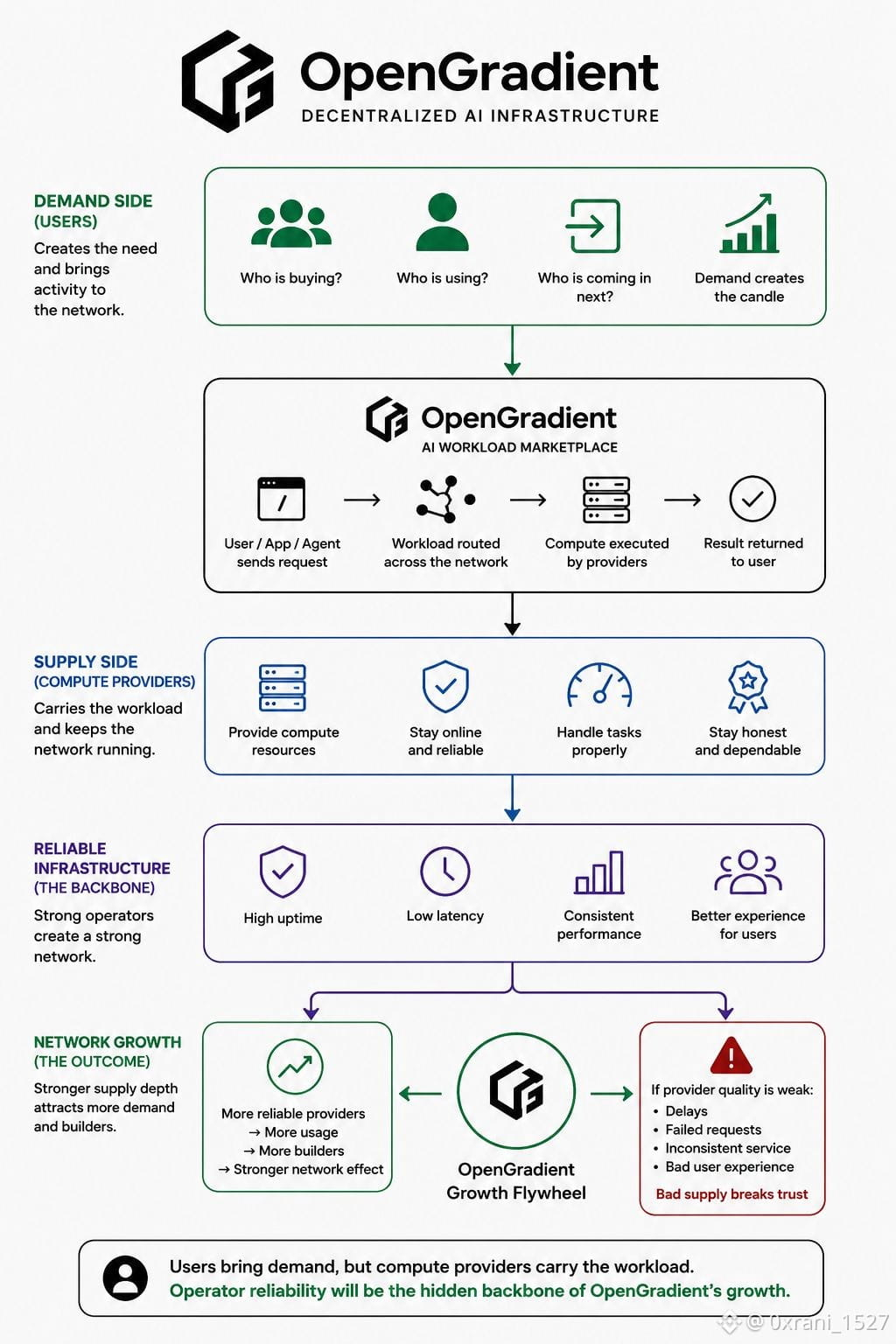
I have seen networks look strong from the user side, then struggle because the supply side was weak. Traders usually focus on demand first. Who is buying? Who is using? Who is coming in next? But every working system also needs reliable suppliers behind the screen.
That is how I think about OpenGradient’s compute side. AI infrastructure does not run on narrative alone. Models need machines. Requests need operators. Workloads need nodes that can stay online, handle tasks properly, and keep the experience from breaking when usage grows.
This is where decentralized AI becomes harder than it sounds. It is not only about letting people use AI. It is about building a network where compute providers have a real reason to stay honest, stay available, and keep serving useful work. In trader language, demand can create the candle, but supply depth keeps the market from falling apart.
The upside is clear. If OpenGradient can keep attracting reliable compute providers, the network becomes more useful for apps, agents, and builders. A stronger operator base can turn AI infrastructure from an idea into something people can actually depend on.
But the risk is also real. If provider quality is weak, users will feel it quickly through delays, failed requests, or inconsistent service. In infrastructure, bad supply shows up as bad user experience.
My view is simple: decentralized AI will not be judged only by how many people want to use it. It will also be judged by how many reliable operators can keep it running.
If users bring demand, but compute providers carry the workload, will operator reliability become the hidden backbone of OpenGradient’s growth?
@OpenGradient $OPG #OpenGradient #OPG
I have seen networks look strong from the user side, then struggle because the supply side was weak. Traders usually focus on demand first. Who is buying? Who is using? Who is coming in next? But every working system also needs reliable suppliers behind the screen.
That is how I think about OpenGradient’s compute side. AI infrastructure does not run on narrative alone. Models need machines. Requests need operators. Workloads need nodes that can stay online, handle tasks properly, and keep the experience from breaking when usage grows.
This is where decentralized AI becomes harder than it sounds. It is not only about letting people use AI. It is about building a network where compute providers have a real reason to stay honest, stay available, and keep serving useful work. In trader language, demand can create the candle, but supply depth keeps the market from falling apart.
The upside is clear. If OpenGradient can keep attracting reliable compute providers, the network becomes more useful for apps, agents, and builders. A stronger operator base can turn AI infrastructure from an idea into something people can actually depend on.
But the risk is also real. If provider quality is weak, users will feel it quickly through delays, failed requests, or inconsistent service. In infrastructure, bad supply shows up as bad user experience.
My view is simple: decentralized AI will not be judged only by how many people want to use it. It will also be judged by how many reliable operators can keep it running.
If users bring demand, but compute providers carry the workload, will operator reliability become the hidden backbone of OpenGradient’s growth?
@OpenGradient $OPG #OpenGradient #OPG
That is how I think about OpenGradient’s compute side. AI infrastructure does not run on narrative alone. Models need machines. Requests need operators. Workloads need nodes that can stay online, handle tasks properly, and keep the experience from breaking when usage grows.
This is where decentralized AI becomes harder than it sounds. It is not only about letting people use AI. It is about building a network where compute providers have a real reason to stay honest, stay available, and keep serving useful work. In trader language, demand can create the candle, but supply depth keeps the market from falling apart.
The upside is clear. If OpenGradient can keep attracting reliable compute providers, the network becomes more useful for apps, agents, and builders. A stronger operator base can turn AI infrastructure from an idea into something people can actually depend on.
But the risk is also real. If provider quality is weak, users will feel it quickly through delays, failed requests, or inconsistent service. In infrastructure, bad supply shows up as bad user experience.
My view is simple: decentralized AI will not be judged only by how many people want to use it. It will also be judged by how many reliable operators can keep it running.
If users bring demand, but compute providers carry the workload, will operator reliability become the hidden backbone of OpenGradient’s growth?
@OpenGradient $OPG #OpenGradient #OPG
4
2
153

·
--
I actually think the OpenGradient team is pretty sharp. They're willing to openly discuss the issue of administrative dependencies, which shows they're already thinking about how to solve it. A lot of folks get scared when they hear 'centralization', but early projects need a strong team to push through legal, technical directions, and ecosystem collaboration. The problem isn't whether there's a dependency, but whether there's a contingency plan. The author presents three dimensions: interference probability, degree of dependency, and recovery capability. The key focus is actually on recovery capability. As long as the team standardizes documentation, permissions, and operational processes in advance, even if there's staff turnover, new people can quickly get up to speed. Just look at the OPG token, it's up 4.96% right now, and the market seems pretty confident in this project. HEI has even skyrocketed by 65%, indicating that funds are pouring into the ecosystem related to OpenGradient. Long-term, I'm more optimistic about the 'faster recovery' option. It's unrealistic to completely eliminate dependencies, especially for new networks. But if you can design a system that allows key functions to transition smoothly within 48 hours, the risk is significantly reduced. If OpenGradient can solidify their recovery mechanism, the value of OPG will only become more stable. The voting results are in 23 hours, and I think reducing dependencies and achieving faster recovery aren't at odds; advancing both simultaneously is the optimal solution. #OPG #OpenGradient
I actually think the OpenGradient team is pretty sharp. They're willing to openly discuss the issue of administrative dependencies, which shows they're already thinking about how to solve it. A lot of folks get scared when they hear 'centralization', but early projects need a strong team to push through legal, technical directions, and ecosystem collaboration. The problem isn't whether there's a dependency, but whether there's a contingency plan. The author presents three dimensions: interference probability, degree of dependency, and recovery capability. The key focus is actually on recovery capability. As long as the team standardizes documentation, permissions, and operational processes in advance, even if there's staff turnover, new people can quickly get up to speed. Just look at the OPG token, it's up 4.96% right now, and the market seems pretty confident in this project. HEI has even skyrocketed by 65%, indicating that funds are pouring into the ecosystem related to OpenGradient. Long-term, I'm more optimistic about the 'faster recovery' option. It's unrealistic to completely eliminate dependencies, especially for new networks. But if you can design a system that allows key functions to transition smoothly within 48 hours, the risk is significantly reduced. If OpenGradient can solidify their recovery mechanism, the value of OPG will only become more stable. The voting results are in 23 hours, and I think reducing dependencies and achieving faster recovery aren't at odds; advancing both simultaneously is the optimal solution. #OPG #OpenGradient
65
·
--
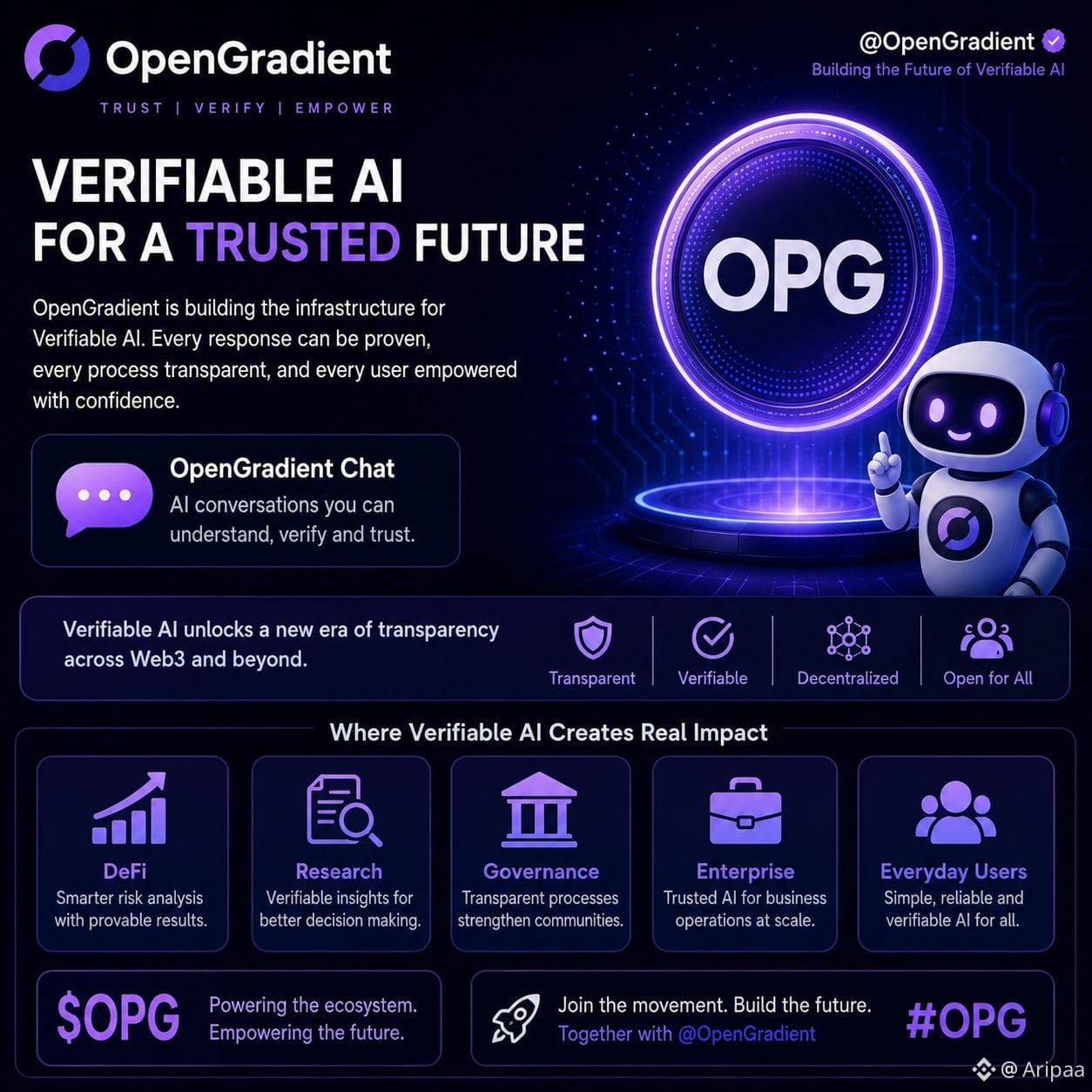
As AI becomes part of everyday decision-making, the biggest challenge is no longer just intelligence—it is trust. Powerful models are useful, but users also need confidence that every response is generated through a transparent and verifiable process. That is why I find @OpenGradient particularly interesting. Instead of asking the community to rely on blind trust, OpenGradient is building an ecosystem where AI outputs can be verified, creating a stronger foundation for developers, businesses, and everyday users.
#OpenGradient Chat represents this vision in a practical way. It combines the convenience of conversational AI with the principles of verifiable computation, helping users understand that trustworthy AI is possible without sacrificing usability. As decentralized technologies continue to evolve, projects that prioritize transparency may become the standard rather than the exception.
The long-term value of AI will depend on accountability just as much as performance. Verifiable AI can unlock new opportunities across DeFi, governance, research, and enterprise applications where confidence in AI-generated results truly matters. I believe @OpenGradient is taking meaningful steps toward that future, and it will be exciting to watch how the ecosystem grows alongside the adoption of $OPG.
#OPG $OPG
#opg $OPG
As AI becomes part of everyday decision-making, the biggest challenge is no longer just intelligence—it is trust. Powerful models are useful, but users also need confidence that every response is generated through a transparent and verifiable process. That is why I find @OpenGradient particularly interesting. Instead of asking the community to rely on blind trust, OpenGradient is building an ecosystem where AI outputs can be verified, creating a stronger foundation for developers, businesses, and everyday users.
#OpenGradient Chat represents this vision in a practical way. It combines the convenience of conversational AI with the principles of verifiable computation, helping users understand that trustworthy AI is possible without sacrificing usability. As decentralized technologies continue to evolve, projects that prioritize transparency may become the standard rather than the exception.
The long-term value of AI will depend on accountability just as much as performance. Verifiable AI can unlock new opportunities across DeFi, governance, research, and enterprise applications where confidence in AI-generated results truly matters. I believe @OpenGradient is taking meaningful steps toward that future, and it will be exciting to watch how the ecosystem grows alongside the adoption of $OPG .
#OPG $OPG
#opg $OPG
#OpenGradient Chat represents this vision in a practical way. It combines the convenience of conversational AI with the principles of verifiable computation, helping users understand that trustworthy AI is possible without sacrificing usability. As decentralized technologies continue to evolve, projects that prioritize transparency may become the standard rather than the exception.
The long-term value of AI will depend on accountability just as much as performance. Verifiable AI can unlock new opportunities across DeFi, governance, research, and enterprise applications where confidence in AI-generated results truly matters. I believe @OpenGradient is taking meaningful steps toward that future, and it will be exciting to watch how the ecosystem grows alongside the adoption of $OPG .
#OPG $OPG
#opg $OPG
10
2
116

OPG/USDT 4-Hour Market Analysis: Bears Maintain Control While Traders Watch for a ReboundOPG/USDT 4-Hour Market Analysis: Bears Maintain Control While Traders Watch for a Rebound
The OPG/USDT pair remains under strong bearish pressure on the 4-hour timeframe after a sharp decline from the recent swing high near 0.1828 USDT. The latest price action around 0.1300 USDT reflects continued selling momentum, with buyers struggling to regain control.
One of the clearest signs of the current trend is the position of the price below the 7 EMA, 25 EMA, and 99 EMA. This alignment indicates that both short-term and medium-term momentum favor the bears. Until the price reclaims these moving averages, the overall market structure is likely to remain bearish.
The most important support level is located around 0.1275 USDT, which has temporarily slowed the decline. If this level continues to hold, traders may see a short-term relief rally toward 0.1365–0.1380 USDT. A stronger recovery could extend to the 0.1490–0.1510 USDT resistance zone, where sellers may become active again.
On the downside, a decisive break below 0.1275 USDT could open the door to further losses toward 0.1230 USDT and potentially 0.1200 USDT. Therefore, this support zone is critical for determining the next directional move.
Momentum indicators suggest that selling pressure may be weakening. The KDJ oscillator is approaching oversold territory, increasing the probability of a short-term technical bounce. However, oversold conditions alone do not guarantee a trend reversal. Confirmation through higher highs and increased buying volume is still required.
Volume has also declined following the sharp sell-off, indicating that the market is waiting for fresh catalysts before making its next significant move. Traders should closely monitor volume during any breakout or breakdown, as stronger participation will likely confirm the direction.
For short-term traders, patience remains essential. Aggressive buying before confirmation carries higher risk while the broader trend remains bearish. Conservative traders may prefer to wait for a confirmed close above 0.1368 USDT before considering bullish positions.
Overall, the 4-hour outlook remains bearish, but the market is approaching an important support area where a technical rebound is possible. As long as the price stays below the major moving averages, sellers retain the advantage. Risk management and disciplined trade execution remain essential in the current market environment.
#opg
#open
#ai
#OpenGradient
OPG/USDT 4-Hour Market Analysis: Bears Maintain Control While Traders Watch for a Rebound
OPG/USDT 4-Hour Market Analysis: Bears Maintain Control While Traders Watch for a Rebound
The OPG/USDT pair remains under strong bearish pressure on the 4-hour timeframe after a sharp decline from the recent swing high near 0.1828 USDT. The latest price action around 0.1300 USDT reflects continued selling momentum, with buyers struggling to regain control.
One of the clearest signs of the current trend is the position of the price below the 7 EMA, 25 EMA, and 99 EMA. This alignment indicates that both short-term and medium-term momentum favor the bears. Until the price reclaims these moving averages, the overall market structure is likely to remain bearish.
The most important support level is located around 0.1275 USDT, which has temporarily slowed the decline. If this level continues to hold, traders may see a short-term relief rally toward 0.1365–0.1380 USDT. A stronger recovery could extend to the 0.1490–0.1510 USDT resistance zone, where sellers may become active again.
On the downside, a decisive break below 0.1275 USDT could open the door to further losses toward 0.1230 USDT and potentially 0.1200 USDT. Therefore, this support zone is critical for determining the next directional move.
Momentum indicators suggest that selling pressure may be weakening. The KDJ oscillator is approaching oversold territory, increasing the probability of a short-term technical bounce. However, oversold conditions alone do not guarantee a trend reversal. Confirmation through higher highs and increased buying volume is still required.
Volume has also declined following the sharp sell-off, indicating that the market is waiting for fresh catalysts before making its next significant move. Traders should closely monitor volume during any breakout or breakdown, as stronger participation will likely confirm the direction.
For short-term traders, patience remains essential. Aggressive buying before confirmation carries higher risk while the broader trend remains bearish. Conservative traders may prefer to wait for a confirmed close above 0.1368 USDT before considering bullish positions.
Overall, the 4-hour outlook remains bearish, but the market is approaching an important support area where a technical rebound is possible. As long as the price stays below the major moving averages, sellers retain the advantage. Risk management and disciplined trade execution remain essential in the current market environment.
#opg
#open
#ai
#OpenGradient
The OPG/USDT pair remains under strong bearish pressure on the 4-hour timeframe after a sharp decline from the recent swing high near 0.1828 USDT. The latest price action around 0.1300 USDT reflects continued selling momentum, with buyers struggling to regain control.
One of the clearest signs of the current trend is the position of the price below the 7 EMA, 25 EMA, and 99 EMA. This alignment indicates that both short-term and medium-term momentum favor the bears. Until the price reclaims these moving averages, the overall market structure is likely to remain bearish.
The most important support level is located around 0.1275 USDT, which has temporarily slowed the decline. If this level continues to hold, traders may see a short-term relief rally toward 0.1365–0.1380 USDT. A stronger recovery could extend to the 0.1490–0.1510 USDT resistance zone, where sellers may become active again.
On the downside, a decisive break below 0.1275 USDT could open the door to further losses toward 0.1230 USDT and potentially 0.1200 USDT. Therefore, this support zone is critical for determining the next directional move.
Momentum indicators suggest that selling pressure may be weakening. The KDJ oscillator is approaching oversold territory, increasing the probability of a short-term technical bounce. However, oversold conditions alone do not guarantee a trend reversal. Confirmation through higher highs and increased buying volume is still required.
Volume has also declined following the sharp sell-off, indicating that the market is waiting for fresh catalysts before making its next significant move. Traders should closely monitor volume during any breakout or breakdown, as stronger participation will likely confirm the direction.
For short-term traders, patience remains essential. Aggressive buying before confirmation carries higher risk while the broader trend remains bearish. Conservative traders may prefer to wait for a confirmed close above 0.1368 USDT before considering bullish positions.
Overall, the 4-hour outlook remains bearish, but the market is approaching an important support area where a technical rebound is possible. As long as the price stays below the major moving averages, sellers retain the advantage. Risk management and disciplined trade execution remain essential in the current market environment.
#opg
#open
#ai
#OpenGradient
8
3
96

·
--
Hey guys! When evaluating long-term crypto assets, looking past the hype and focusing on the actual tech infrastructure is key.
It is working on optimizing decentralized architectures, which is a massive narrative this season. High transaction efficiency and lower overhead are what developers actually need.
If you are trading or holding $OPG today, what’s your main thesis? Long-term hold or short-term swing? Let’s talk in the comments! 👇
#OpenGradient #OPG #CryptoCommunity #blockchain #trading
Hey guys! When evaluating long-term crypto assets, looking past the hype and focusing on the actual tech infrastructure is key.
It is working on optimizing decentralized architectures, which is a massive narrative this season. High transaction efficiency and lower overhead are what developers actually need.
If you are trading or holding $OPG today, what’s your main thesis? Long-term hold or short-term swing? Let’s talk in the comments! 👇
#OpenGradient #OPG #CryptoCommunity #blockchain #trading
It is working on optimizing decentralized architectures, which is a massive narrative this season. High transaction efficiency and lower overhead are what developers actually need.
If you are trading or holding $OPG today, what’s your main thesis? Long-term hold or short-term swing? Let’s talk in the comments! 👇
#OpenGradient #OPG #CryptoCommunity #blockchain #trading
4
1
79

·
--
#opg $OPG $BTC #OpenGradient I used to run AI trading strategies on-chain. The most painful part is the wall between inference and settlement. Every time the model generates a signal, it first has to be computed on a centralized server, then manually fed into the contract. When the market is wildly volatile, that delay feels like hitting a toll booth out of nowhere on a highway—miss a second, and your profit-loss ratio can collapse.
Last week, I integrated my risk-control model into @OpenGradient’s on-chain inference layer and found that it locks the model weights and verification logic inside a precompiled contract, wiping out the whole intermediate step of “off-chain compute, on-chain recognize.” After running for the past couple of days, the strategy’s response is clearly keeping up with the trading floor’s tempo. Inference and settlement land in the chain almost simultaneously—like switching from riding a bike to taking the high-speed train.
What lies behind this experience is an inference-verification integrated architecture. Based on the existing design, it compresses model execution and zero-knowledge proof into atomic operations: run the model inside a TEE environment, have the zkML synchronously generate credentials, then write them into the block state via the precompiled interface. A single ordinary call from the front end triggers the entire chain’s collective endorsement of the AI output. This cuts off the possibility of robots forging off-chain reports to contaminate the signal—what people often discuss as oracle manipulation. From the backtest bills starting yesterday, it indeed helped me block a man-in-the-middle attack targeting the model output. BTC
But every speed-up comes at a cost. In the traditional setup, the model and verification logic are held on a private server. Now with OpenGradient, although the inference framework is open-sourced, weight hosting is handled by a distributed node network. If extreme market conditions cause network partitioning, can ordinary traders complete local verification independently without relying on the node cluster? That’s still an open question. We enjoy the thrill of “inference equals settlement,” but in essence we hand the verification keys to the protocol. ETH
I’ll keep using it for now, since once the link is shortened, I can allocate more compute power to iterating on the strategy. But whether OpenGradient is a bridge that truly connects everything end-to-end—or just a floating bridge that makes people dependent—needs time to validate. Struggling between efficiency temptations and independent verification is, after all, the original proposition of on-chain AI. Keeping up the interrogation for inference transparency is the baseline for survival in the era of smart contracts.
#opg $OPG $BTC #OpenGradient I used to run AI trading strategies on-chain. The most painful part is the wall between inference and settlement. Every time the model generates a signal, it first has to be computed on a centralized server, then manually fed into the contract. When the market is wildly volatile, that delay feels like hitting a toll booth out of nowhere on a highway—miss a second, and your profit-loss ratio can collapse.
Last week, I integrated my risk-control model into @OpenGradient’s on-chain inference layer and found that it locks the model weights and verification logic inside a precompiled contract, wiping out the whole intermediate step of “off-chain compute, on-chain recognize.” After running for the past couple of days, the strategy’s response is clearly keeping up with the trading floor’s tempo. Inference and settlement land in the chain almost simultaneously—like switching from riding a bike to taking the high-speed train.
What lies behind this experience is an inference-verification integrated architecture. Based on the existing design, it compresses model execution and zero-knowledge proof into atomic operations: run the model inside a TEE environment, have the zkML synchronously generate credentials, then write them into the block state via the precompiled interface. A single ordinary call from the front end triggers the entire chain’s collective endorsement of the AI output. This cuts off the possibility of robots forging off-chain reports to contaminate the signal—what people often discuss as oracle manipulation. From the backtest bills starting yesterday, it indeed helped me block a man-in-the-middle attack targeting the model output. BTC
But every speed-up comes at a cost. In the traditional setup, the model and verification logic are held on a private server. Now with OpenGradient, although the inference framework is open-sourced, weight hosting is handled by a distributed node network. If extreme market conditions cause network partitioning, can ordinary traders complete local verification independently without relying on the node cluster? That’s still an open question. We enjoy the thrill of “inference equals settlement,” but in essence we hand the verification keys to the protocol. ETH
I’ll keep using it for now, since once the link is shortened, I can allocate more compute power to iterating on the strategy. But whether OpenGradient is a bridge that truly connects everything end-to-end—or just a floating bridge that makes people dependent—needs time to validate. Struggling between efficiency temptations and independent verification is, after all, the original proposition of on-chain AI. Keeping up the interrogation for inference transparency is the baseline for survival in the era of smart contracts.
Last week, I integrated my risk-control model into @OpenGradient’s on-chain inference layer and found that it locks the model weights and verification logic inside a precompiled contract, wiping out the whole intermediate step of “off-chain compute, on-chain recognize.” After running for the past couple of days, the strategy’s response is clearly keeping up with the trading floor’s tempo. Inference and settlement land in the chain almost simultaneously—like switching from riding a bike to taking the high-speed train.
What lies behind this experience is an inference-verification integrated architecture. Based on the existing design, it compresses model execution and zero-knowledge proof into atomic operations: run the model inside a TEE environment, have the zkML synchronously generate credentials, then write them into the block state via the precompiled interface. A single ordinary call from the front end triggers the entire chain’s collective endorsement of the AI output. This cuts off the possibility of robots forging off-chain reports to contaminate the signal—what people often discuss as oracle manipulation. From the backtest bills starting yesterday, it indeed helped me block a man-in-the-middle attack targeting the model output. BTC
But every speed-up comes at a cost. In the traditional setup, the model and verification logic are held on a private server. Now with OpenGradient, although the inference framework is open-sourced, weight hosting is handled by a distributed node network. If extreme market conditions cause network partitioning, can ordinary traders complete local verification independently without relying on the node cluster? That’s still an open question. We enjoy the thrill of “inference equals settlement,” but in essence we hand the verification keys to the protocol. ETH
I’ll keep using it for now, since once the link is shortened, I can allocate more compute power to iterating on the strategy. But whether OpenGradient is a bridge that truly connects everything end-to-end—or just a floating bridge that makes people dependent—needs time to validate. Struggling between efficiency temptations and independent verification is, after all, the original proposition of on-chain AI. Keeping up the interrogation for inference transparency is the baseline for survival in the era of smart contracts.
295

·
--
$OPG
#OpenGradient
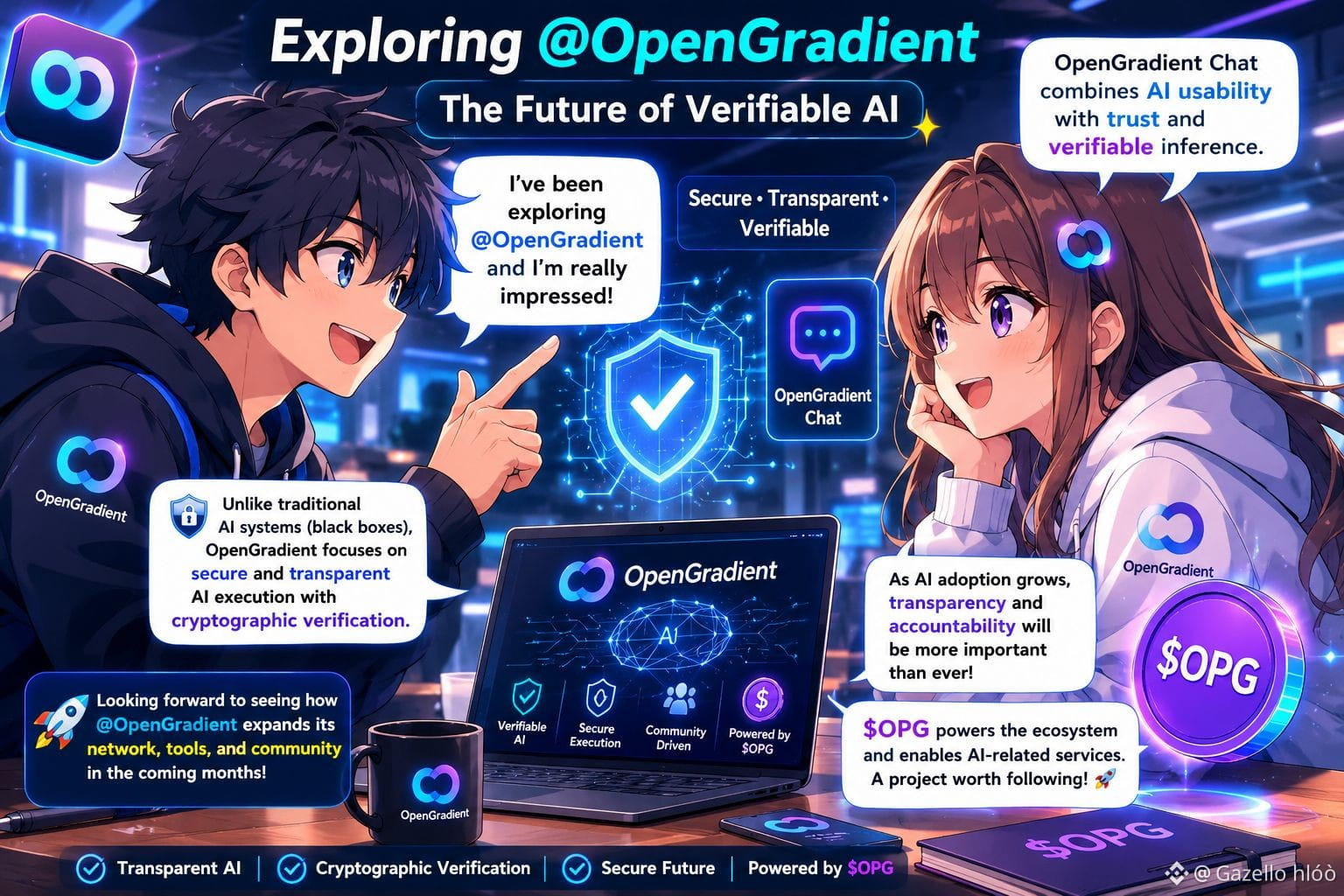
✨ Trust is becoming one of the most important factors in AI, and @OpenGradient is building with that in mind. By enabling verifiable AI execution and transparent inference, it offers a different approach from traditional black-box models. I'm excited to see how OpenGradient Chat and the $OPG ecosystem evolve as demand for trustworthy AI continues to grow.
$OPG
#OpenGradient
✨ Trust is becoming one of the most important factors in AI, and @OpenGradient is building with that in mind. By enabling verifiable AI execution and transparent inference, it offers a different approach from traditional black-box models. I'm excited to see how OpenGradient Chat and the $OPG ecosystem evolve as demand for trustworthy AI continues to grow.
#OpenGradient
✨ Trust is becoming one of the most important factors in AI, and @OpenGradient is building with that in mind. By enabling verifiable AI execution and transparent inference, it offers a different approach from traditional black-box models. I'm excited to see how OpenGradient Chat and the $OPG ecosystem evolve as demand for trustworthy AI continues to grow.
1
50

·
--
I've been diving into @OpenGradient and its new Chat platform, and the privacy-first approach honestly feels like a necessary evolution for AI 🤖.
With OpenGradient Chat, you can access frontier models like ChatGPT, Claude, and Gemini in a single interface, but the real breakthrough is that your prompts are encrypted on your device and your identity is stripped away via an OHTTP relay 🛡️. No more trading your most sensitive questions for answers.
This is the kind of infrastructure that bridges the gap between powerful AI and the trustless nature of Web3. If you haven't tried it yet, you can ask anything without worrying about your data being logged or used to train the next model 🔒.
What do you think—does verifiable privacy change how you interact with AI? 🤔
#OPG $OPG #OpenGradient
I've been diving into @OpenGradient and its new Chat platform, and the privacy-first approach honestly feels like a necessary evolution for AI 🤖.
With OpenGradient Chat, you can access frontier models like ChatGPT, Claude, and Gemini in a single interface, but the real breakthrough is that your prompts are encrypted on your device and your identity is stripped away via an OHTTP relay 🛡️. No more trading your most sensitive questions for answers.
This is the kind of infrastructure that bridges the gap between powerful AI and the trustless nature of Web3. If you haven't tried it yet, you can ask anything without worrying about your data being logged or used to train the next model 🔒.
What do you think—does verifiable privacy change how you interact with AI? 🤔
#OPG $OPG #OpenGradient
With OpenGradient Chat, you can access frontier models like ChatGPT, Claude, and Gemini in a single interface, but the real breakthrough is that your prompts are encrypted on your device and your identity is stripped away via an OHTTP relay 🛡️. No more trading your most sensitive questions for answers.
This is the kind of infrastructure that bridges the gap between powerful AI and the trustless nature of Web3. If you haven't tried it yet, you can ask anything without worrying about your data being logged or used to train the next model 🔒.
What do you think—does verifiable privacy change how you interact with AI? 🤔
#OPG $OPG #OpenGradient
89

·
--
🔥 OpenGradient ($OPG): Next-Gen Private AI!
The Web3 AI sector is shifting from hype to real utility. OpenGradient ($OPG) is leading this race on the Base network.
💡 Key Highlights:
• 150K+ Inferences: Private AI tasks executed successfully.
• TEE Enclaves: Hardware encryption keeps prompts 100% hidden.
• MemSync Feature: Users own, edit, or delete their AI memory anytime.
Traditional Web2 AI sells your data. OpenGradient ensures it stays user-owned with a fixed supply of 1 Billion tokens.
Bullish or Bearish? 👇
#OpenGradient #OPG #CryptoAi #BinanceSquare
🔥 OpenGradient ($OPG): Next-Gen Private AI!
The Web3 AI sector is shifting from hype to real utility. OpenGradient ($OPG) is leading this race on the Base network.
💡 Key Highlights:
• 150K+ Inferences: Private AI tasks executed successfully.
• TEE Enclaves: Hardware encryption keeps prompts 100% hidden.
• MemSync Feature: Users own, edit, or delete their AI memory anytime.
Traditional Web2 AI sells your data. OpenGradient ensures it stays user-owned with a fixed supply of 1 Billion tokens.
Bullish or Bearish? 👇
#OpenGradient #OPG #CryptoAi #BinanceSquare
The Web3 AI sector is shifting from hype to real utility. OpenGradient ($OPG) is leading this race on the Base network.
💡 Key Highlights:
• 150K+ Inferences: Private AI tasks executed successfully.
• TEE Enclaves: Hardware encryption keeps prompts 100% hidden.
• MemSync Feature: Users own, edit, or delete their AI memory anytime.
Traditional Web2 AI sells your data. OpenGradient ensures it stays user-owned with a fixed supply of 1 Billion tokens.
Bullish or Bearish? 👇
#OpenGradient #OPG #CryptoAi #BinanceSquare
1
102

·
--
Bullish
🧠 $OPG : When building infrastructure precedes market movement
In cryptocurrency markets, many focus on daily candles, while overlooking the fact that long-term value is built through technology before price.
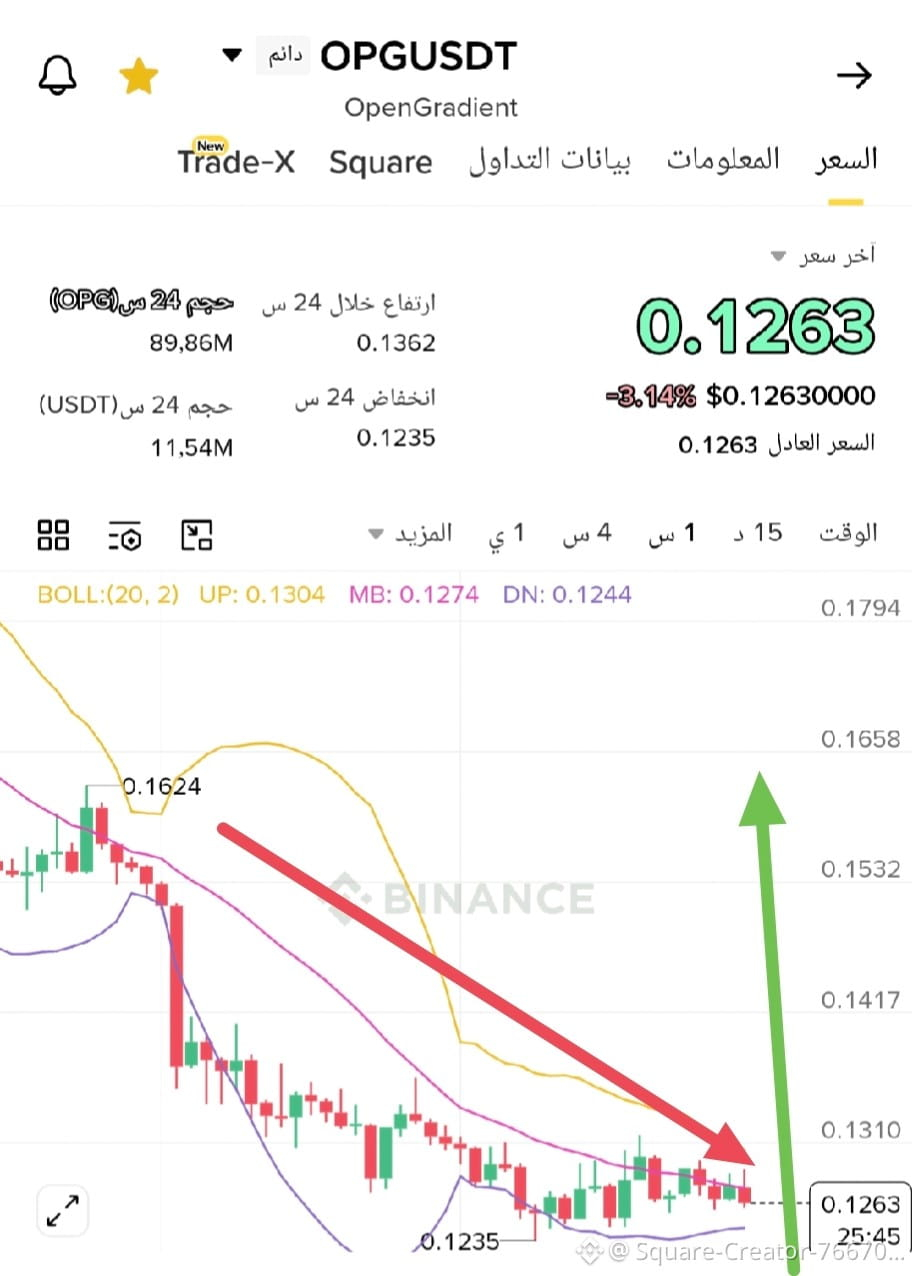
What we’re seeing now in OPG is a consolidation phase after a downtrend wave, where the price moves within a narrow range as selling pressure gradually declines. These stages often reflect a state of market anticipation, as traders wait for the signal that will determine the next direction.
But what sets OPG apart isn’t just price movement—it’s the project’s vision@OpenGradient . It focuses on building a decentralized AI Infrastructure aimed at providing an environment that supports the efficient and transparent development and deployment of AI models. This is a sector expected to play an increasingly important role in the future of technology.
Therefore, evaluating the project should not rely only on short-term price fluctuations, but also on how far it has progressed in building this infrastructure and its ability to deliver real solutions as the AI market evolves.
Volatility may continue in the short term, but it’s the projects that build a strong technical foundation that capture attention when the next wave begins.
⚠️ DYOR | NFA
#OPG
#OpenGradient
#ArtificialIntelligence
#Blockchain
#AI
🧠 $OPG : When building infrastructure precedes market movement
In cryptocurrency markets, many focus on daily candles, while overlooking the fact that long-term value is built through technology before price.
What we’re seeing now in OPG is a consolidation phase after a downtrend wave, where the price moves within a narrow range as selling pressure gradually declines. These stages often reflect a state of market anticipation, as traders wait for the signal that will determine the next direction.
But what sets OPG apart isn’t just price movement—it’s the project’s vision@OpenGradient . It focuses on building a decentralized AI Infrastructure aimed at providing an environment that supports the efficient and transparent development and deployment of AI models. This is a sector expected to play an increasingly important role in the future of technology.
Therefore, evaluating the project should not rely only on short-term price fluctuations, but also on how far it has progressed in building this infrastructure and its ability to deliver real solutions as the AI market evolves.
Volatility may continue in the short term, but it’s the projects that build a strong technical foundation that capture attention when the next wave begins.
⚠️ DYOR | NFA
#OPG
#OpenGradient
#ArtificialIntelligence
#Blockchain
#AI
In cryptocurrency markets, many focus on daily candles, while overlooking the fact that long-term value is built through technology before price.
What we’re seeing now in OPG is a consolidation phase after a downtrend wave, where the price moves within a narrow range as selling pressure gradually declines. These stages often reflect a state of market anticipation, as traders wait for the signal that will determine the next direction.
But what sets OPG apart isn’t just price movement—it’s the project’s vision@OpenGradient . It focuses on building a decentralized AI Infrastructure aimed at providing an environment that supports the efficient and transparent development and deployment of AI models. This is a sector expected to play an increasingly important role in the future of technology.
Therefore, evaluating the project should not rely only on short-term price fluctuations, but also on how far it has progressed in building this infrastructure and its ability to deliver real solutions as the AI market evolves.
Volatility may continue in the short term, but it’s the projects that build a strong technical foundation that capture attention when the next wave begins.
⚠️ DYOR | NFA
#OPG
#OpenGradient
#ArtificialIntelligence
#Blockchain
#AI
4
145

·
--
#opg $OPG Recently, I’ve found that the image generation feature of @OpenGradient is becoming increasingly practical. On chat.opengradient.ai, I can simply enter a creative description, and it calls the Gemini model to generate accompanying images. The results are absolutely comparable to mainstream tools, and everything is fully encrypted end-to-end—so there’s no need to worry about privacy leaks. Even more surprisingly, it can generate both text and images within the same conversation. For example, I can first ask it to write a piece of product copy, and then have it automatically create images based on that copy—smooth, seamless, and perfect for content creation.
Besides creative use cases, I also use it to solve everyday programming problems. The multi-model comparison feature is especially thoughtful. For the same bug, Llama and Mistral provide different solution approaches, helping me quickly identify the best option. The conversation context stays fluent as well—continuous follow-up questions won’t make it lose track or forget previous details.
The OPG token isn’t just a governance credential; in the future, it can also be used to offset API call fees. Staking users can also take part in network profit sharing. As the OpenGradient ecosystem keeps expanding (data markets, cross-chain inference, and more), the real value of OPG will become increasingly evident. I strongly recommend everyone to try it out—free trials are enough to experience the charm of decentralized AI. #OpenGradient
#opg $OPG Recently, I’ve found that the image generation feature of @OpenGradient is becoming increasingly practical. On chat.opengradient.ai, I can simply enter a creative description, and it calls the Gemini model to generate accompanying images. The results are absolutely comparable to mainstream tools, and everything is fully encrypted end-to-end—so there’s no need to worry about privacy leaks. Even more surprisingly, it can generate both text and images within the same conversation. For example, I can first ask it to write a piece of product copy, and then have it automatically create images based on that copy—smooth, seamless, and perfect for content creation.
Besides creative use cases, I also use it to solve everyday programming problems. The multi-model comparison feature is especially thoughtful. For the same bug, Llama and Mistral provide different solution approaches, helping me quickly identify the best option. The conversation context stays fluent as well—continuous follow-up questions won’t make it lose track or forget previous details.
The OPG token isn’t just a governance credential; in the future, it can also be used to offset API call fees. Staking users can also take part in network profit sharing. As the OpenGradient ecosystem keeps expanding (data markets, cross-chain inference, and more), the real value of OPG will become increasingly evident. I strongly recommend everyone to try it out—free trials are enough to experience the charm of decentralized AI. #OpenGradient
Besides creative use cases, I also use it to solve everyday programming problems. The multi-model comparison feature is especially thoughtful. For the same bug, Llama and Mistral provide different solution approaches, helping me quickly identify the best option. The conversation context stays fluent as well—continuous follow-up questions won’t make it lose track or forget previous details.
The OPG token isn’t just a governance credential; in the future, it can also be used to offset API call fees. Staking users can also take part in network profit sharing. As the OpenGradient ecosystem keeps expanding (data markets, cross-chain inference, and more), the real value of OPG will become increasingly evident. I strongly recommend everyone to try it out—free trials are enough to experience the charm of decentralized AI. #OpenGradient
3
74
·
--
It’s back to the weekend, and I spent time deeply testing the cross-device synchronization feature of OpenGradient Chat @OpenGradient . A conversation started on my computer can be seamlessly continued on my phone—this is especially useful for me since I’m often handling information on the go. I also found its logical reasoning capabilities particularly strong. Recently, I’ve been researching a complex DeFi arbitrage strategy: after feeding it multi-step logic inputs, it not only identifies loopholes, but also suggests optimization paths. The entire process is handled with encryption, so I’m not worried about the strategy being leaked. Even more surprising is its multilingual support. I tried mixing Chinese and English in my questions, and it understood and responded accurately, which is very helpful for international collaboration. Now I’ve put my everyday brainstorming and draft plans into OpenGradient. Its contextual memory lets me iterate on ideas again and again, and my efficiency has noticeably improved. Also, I’ve been interested in the $OPG staking and dividend mechanism that the community has been discussing lately. Token holders can not only participate in governance, but also share network transaction fees—its long-term value is worth paying attention to. In short, decentralized AI is changing the way I work. I strongly recommend that everyone try it for free at chat.opengradient.ai. #OPG #OpenGradient
It’s back to the weekend, and I spent time deeply testing the cross-device synchronization feature of OpenGradient Chat @OpenGradient . A conversation started on my computer can be seamlessly continued on my phone—this is especially useful for me since I’m often handling information on the go. I also found its logical reasoning capabilities particularly strong. Recently, I’ve been researching a complex DeFi arbitrage strategy: after feeding it multi-step logic inputs, it not only identifies loopholes, but also suggests optimization paths. The entire process is handled with encryption, so I’m not worried about the strategy being leaked. Even more surprising is its multilingual support. I tried mixing Chinese and English in my questions, and it understood and responded accurately, which is very helpful for international collaboration. Now I’ve put my everyday brainstorming and draft plans into OpenGradient. Its contextual memory lets me iterate on ideas again and again, and my efficiency has noticeably improved. Also, I’ve been interested in the $OPG staking and dividend mechanism that the community has been discussing lately. Token holders can not only participate in governance, but also share network transaction fees—its long-term value is worth paying attention to. In short, decentralized AI is changing the way I work. I strongly recommend that everyone try it for free at chat.opengradient.ai. #OPG #OpenGradient
2
1
92

·
--
Bearish
@OpenGradient
If you think centralized AI is secure, think again: OpenGradient just flipped the script on opaque models.
For too long, we have treated artificial intelligence like a black box, relying on blind trust in tech giants. OpenGradient is dismantling that setup by building a decentralized infrastructure network where AI inference is actually cryptographically verifiable.
At the core is their Hybrid AI Compute Architecture (HACA). This system splits the work into two smart phases. First, GPU nodes execute the model at standard speeds. Next, independent validators verify those computations on-chain.
Depending on the task, it scales its security. It uses hardware-enclave execution (TEEs) for regular apps to keep things fast, and Zero-Knowledge Machine Learning (ZKML) proofs for high-stakes financial data. You get absolute proof that the exact model you requested produced your output—zero compromises.
Right now, the broader market shows a disconnect. The native token is facing short-term price pressure, with OPG down at [-14.91%].
Yet, looking past the immediate noise reveals the real value. While old centralized layers force developers to accept hidden biases and security risks, OpenGradient provides a transparent, auditable infrastructure designed for the future of on-chain operations.
What are your thoughts on ZKML tech? 👇
#OpenGradient #OPG #DeAI #bearish
$OPG
{future}(OPGUSDT)
@OpenGradient
If you think centralized AI is secure, think again: OpenGradient just flipped the script on opaque models.
For too long, we have treated artificial intelligence like a black box, relying on blind trust in tech giants. OpenGradient is dismantling that setup by building a decentralized infrastructure network where AI inference is actually cryptographically verifiable.
At the core is their Hybrid AI Compute Architecture (HACA). This system splits the work into two smart phases. First, GPU nodes execute the model at standard speeds. Next, independent validators verify those computations on-chain.
Depending on the task, it scales its security. It uses hardware-enclave execution (TEEs) for regular apps to keep things fast, and Zero-Knowledge Machine Learning (ZKML) proofs for high-stakes financial data. You get absolute proof that the exact model you requested produced your output—zero compromises.
Right now, the broader market shows a disconnect. The native token is facing short-term price pressure, with OPG down at [-14.91%].
Yet, looking past the immediate noise reveals the real value. While old centralized layers force developers to accept hidden biases and security risks, OpenGradient provides a transparent, auditable infrastructure designed for the future of on-chain operations.
What are your thoughts on ZKML tech? 👇
#OpenGradient #OPG #DeAI #bearish
$OPG
If you think centralized AI is secure, think again: OpenGradient just flipped the script on opaque models.
For too long, we have treated artificial intelligence like a black box, relying on blind trust in tech giants. OpenGradient is dismantling that setup by building a decentralized infrastructure network where AI inference is actually cryptographically verifiable.
At the core is their Hybrid AI Compute Architecture (HACA). This system splits the work into two smart phases. First, GPU nodes execute the model at standard speeds. Next, independent validators verify those computations on-chain.
Depending on the task, it scales its security. It uses hardware-enclave execution (TEEs) for regular apps to keep things fast, and Zero-Knowledge Machine Learning (ZKML) proofs for high-stakes financial data. You get absolute proof that the exact model you requested produced your output—zero compromises.
Right now, the broader market shows a disconnect. The native token is facing short-term price pressure, with OPG down at [-14.91%].
Yet, looking past the immediate noise reveals the real value. While old centralized layers force developers to accept hidden biases and security risks, OpenGradient provides a transparent, auditable infrastructure designed for the future of on-chain operations.
What are your thoughts on ZKML tech? 👇
#OpenGradient #OPG #DeAI #bearish
$OPG
14
5
154

·
--
What makes someone valuable : their knowledge Or their ability to pass it on? @OpenGradient
For most of history, apprentices learned by watching. Not manuals. Not documentation. People. They copied habits, decisions, shortcuts, and mistakes until experience slowly became transferable. Which is probably why I've always found apprenticeships a little interesting. Knowledge isn't simply stored. It's inherited.
For some reason, that thought kept coming back while I was reading about @OpenGradient . At first, I assumed AI would mostly become smarter by learning more information. That seemed obvious. Better models should naturally produce better outcomes. At least that's what I thought.
But the more I thought about it, the less obvious that assumption felt. Because expertise isn't just facts. It's patterns. Preferences. Judgment. The small decisions people make without even realizing they're making them. Maybe that's why digital twins feel so interesting to me.
As AI agents become more capable, I'm starting to wonder whether the next step isn't building smarter systems, but building systems that can inherit experience. The more I learn about OpenGradient's approach to digital twins, the more I wonder whether intelligence becomes most useful when it starts feeling transferable. I'm not sure. But for some reason, apprentices kept coming to mind.
#OpenGradient #OPG #DigitalTwins #AIAgents #AIInfrastructure #verifiableAI $OPG $BAS $SYN
what makes expertise valuable ?
What makes someone valuable : their knowledge Or their ability to pass it on? @OpenGradient
For most of history, apprentices learned by watching. Not manuals. Not documentation. People. They copied habits, decisions, shortcuts, and mistakes until experience slowly became transferable. Which is probably why I've always found apprenticeships a little interesting. Knowledge isn't simply stored. It's inherited.
For some reason, that thought kept coming back while I was reading about @OpenGradient . At first, I assumed AI would mostly become smarter by learning more information. That seemed obvious. Better models should naturally produce better outcomes. At least that's what I thought.
But the more I thought about it, the less obvious that assumption felt. Because expertise isn't just facts. It's patterns. Preferences. Judgment. The small decisions people make without even realizing they're making them. Maybe that's why digital twins feel so interesting to me.
As AI agents become more capable, I'm starting to wonder whether the next step isn't building smarter systems, but building systems that can inherit experience. The more I learn about OpenGradient's approach to digital twins, the more I wonder whether intelligence becomes most useful when it starts feeling transferable. I'm not sure. But for some reason, apprentices kept coming to mind.
#OpenGradient #OPG #DigitalTwins #AIAgents #AIInfrastructure #verifiableAI $OPG $BAS $SYN
what makes expertise valuable ?
For most of history, apprentices learned by watching. Not manuals. Not documentation. People. They copied habits, decisions, shortcuts, and mistakes until experience slowly became transferable. Which is probably why I've always found apprenticeships a little interesting. Knowledge isn't simply stored. It's inherited.
For some reason, that thought kept coming back while I was reading about @OpenGradient . At first, I assumed AI would mostly become smarter by learning more information. That seemed obvious. Better models should naturally produce better outcomes. At least that's what I thought.
But the more I thought about it, the less obvious that assumption felt. Because expertise isn't just facts. It's patterns. Preferences. Judgment. The small decisions people make without even realizing they're making them. Maybe that's why digital twins feel so interesting to me.
As AI agents become more capable, I'm starting to wonder whether the next step isn't building smarter systems, but building systems that can inherit experience. The more I learn about OpenGradient's approach to digital twins, the more I wonder whether intelligence becomes most useful when it starts feeling transferable. I'm not sure. But for some reason, apprentices kept coming to mind.
#OpenGradient #OPG #DigitalTwins #AIAgents #AIInfrastructure #verifiableAI $OPG $BAS $SYN
what makes expertise valuable ?
Knowledge
50%
Experience
25%
Judgment
25%
The ability to teach others
0%
4 votes • Voting closed
40
12
1.4k

·
--
Bullish
Everyone wants greener AI.
But here's the question: Is the greenest energy mix always the best energy mix?
@OpenGradient and $OPG are operating in a world where AI demand can change in seconds. That means energy strategy isn't just about generating clean power—it's about delivering the right power at the right time.
A network powered by 100% renewables sounds impressive, but what happens during low-wind periods, unexpected demand spikes, or regional grid stress?
The future of AI infrastructure may belong to projects that can balance:
- Clean energy
- Reliable uptime
- Affordable compute
- Grid resilience
The winning formula isn't choosing one priority. It's finding the smartest balance between all four.
If you were designing OpenGradient's long-term energy strategy, what would you prioritize first?
A. Increase renewable energy share as fast as possible
B. Focus on stable 24/7 compute reliability
C. Minimize carbon emissions per AI workload
D. Diversify energy sources across multiple regions
Comment A, B, C, or D and tell us why.
There are no wrong answers—only different strategies.
$OPG #OPG #OpenGradient #CryptoAi
Everyone wants greener AI.
But here's the question: Is the greenest energy mix always the best energy mix?
@OpenGradient and $OPG are operating in a world where AI demand can change in seconds. That means energy strategy isn't just about generating clean power—it's about delivering the right power at the right time.
A network powered by 100% renewables sounds impressive, but what happens during low-wind periods, unexpected demand spikes, or regional grid stress?
The future of AI infrastructure may belong to projects that can balance:
- Clean energy
- Reliable uptime
- Affordable compute
- Grid resilience
The winning formula isn't choosing one priority. It's finding the smartest balance between all four.
If you were designing OpenGradient's long-term energy strategy, what would you prioritize first?
A. Increase renewable energy share as fast as possible
B. Focus on stable 24/7 compute reliability
C. Minimize carbon emissions per AI workload
D. Diversify energy sources across multiple regions
Comment A, B, C, or D and tell us why.
There are no wrong answers—only different strategies.
$OPG #OPG #OpenGradient #CryptoAi
But here's the question: Is the greenest energy mix always the best energy mix?
@OpenGradient and $OPG are operating in a world where AI demand can change in seconds. That means energy strategy isn't just about generating clean power—it's about delivering the right power at the right time.
A network powered by 100% renewables sounds impressive, but what happens during low-wind periods, unexpected demand spikes, or regional grid stress?
The future of AI infrastructure may belong to projects that can balance:
- Clean energy
- Reliable uptime
- Affordable compute
- Grid resilience
The winning formula isn't choosing one priority. It's finding the smartest balance between all four.
If you were designing OpenGradient's long-term energy strategy, what would you prioritize first?
A. Increase renewable energy share as fast as possible
B. Focus on stable 24/7 compute reliability
C. Minimize carbon emissions per AI workload
D. Diversify energy sources across multiple regions
Comment A, B, C, or D and tell us why.
There are no wrong answers—only different strategies.
$OPG #OPG #OpenGradient #CryptoAi
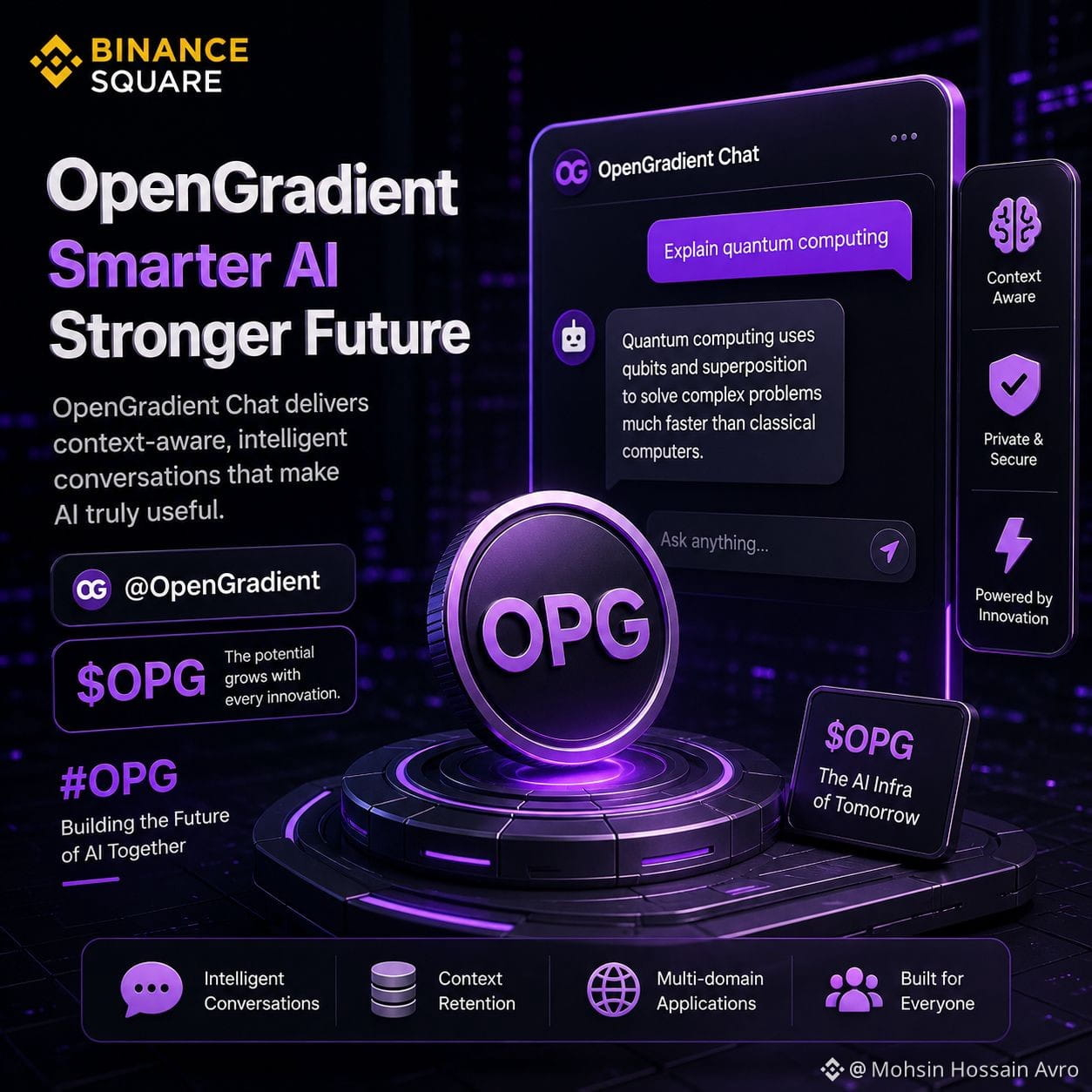
7
86
Log in to explore more content
Join global crypto users on Binance Square
⚡️ Get latest and useful information about crypto.
💬 Trusted by the world’s largest crypto exchange.
👍 Discover real insights from verified creators.
Email / Phone number
Trending Topics
1
#ZcashETFPostsFirstWeeklyOutflow$93.6M
85 views
27 Discussing
2
#GreekPoliceBustCryptoScamRingArrest17
585 views
94 Discussing
3
#BitcoinRejectedAt$87K
52,266 views
91 Discussing
4
#FedOctoberRateHikeOddsFallTo17%
28,890 views
497 Discussing
5
#NvidiaHitsRecordHighUp2.4%
11,819 views
332 Discussing
6
#CanaryFilesAmendedS1ForPEPEETF
6,224 views
229 Discussing
7
#USRussiaUkraineTalksReportedlyIncludeLukoilOilDeal
15,408 views
296 Discussing
8
#BitcoinParesGainsAfterRallyTo$86.5K
39,745 views
151 Discussing
9
#CerebrasSinksNearly20%OnReportNvidiaToPowerOpenAI
89,203 views
881 Discussing
10
#SECProposesCryptoCustodyRules
115,356 views
1,091 Discussing