
#opengradient
opengradient
518,339 views
5,916 Discussing
Hot
Latest

$OPG OPG BREAKDOWN INCOMING
is sitting near $0.1005 after a sharp 4.1% drop. Price is below the Supertrend at $0.1027, while $0.0983 is the key support. A reclaim of $0.1033 could trigger momentum back toward resistance.
#OPG #OpenGradient #Binance #Crypto
$GIGGLE
$RIVER
is sitting near $0.1005 after a sharp 4.1% drop. Price is below the Supertrend at $0.1027, while $0.0983 is the key support. A reclaim of $0.1033 could trigger momentum back toward resistance.
#OPG #OpenGradient #Binance #Crypto
$GIGGLE
$RIVER
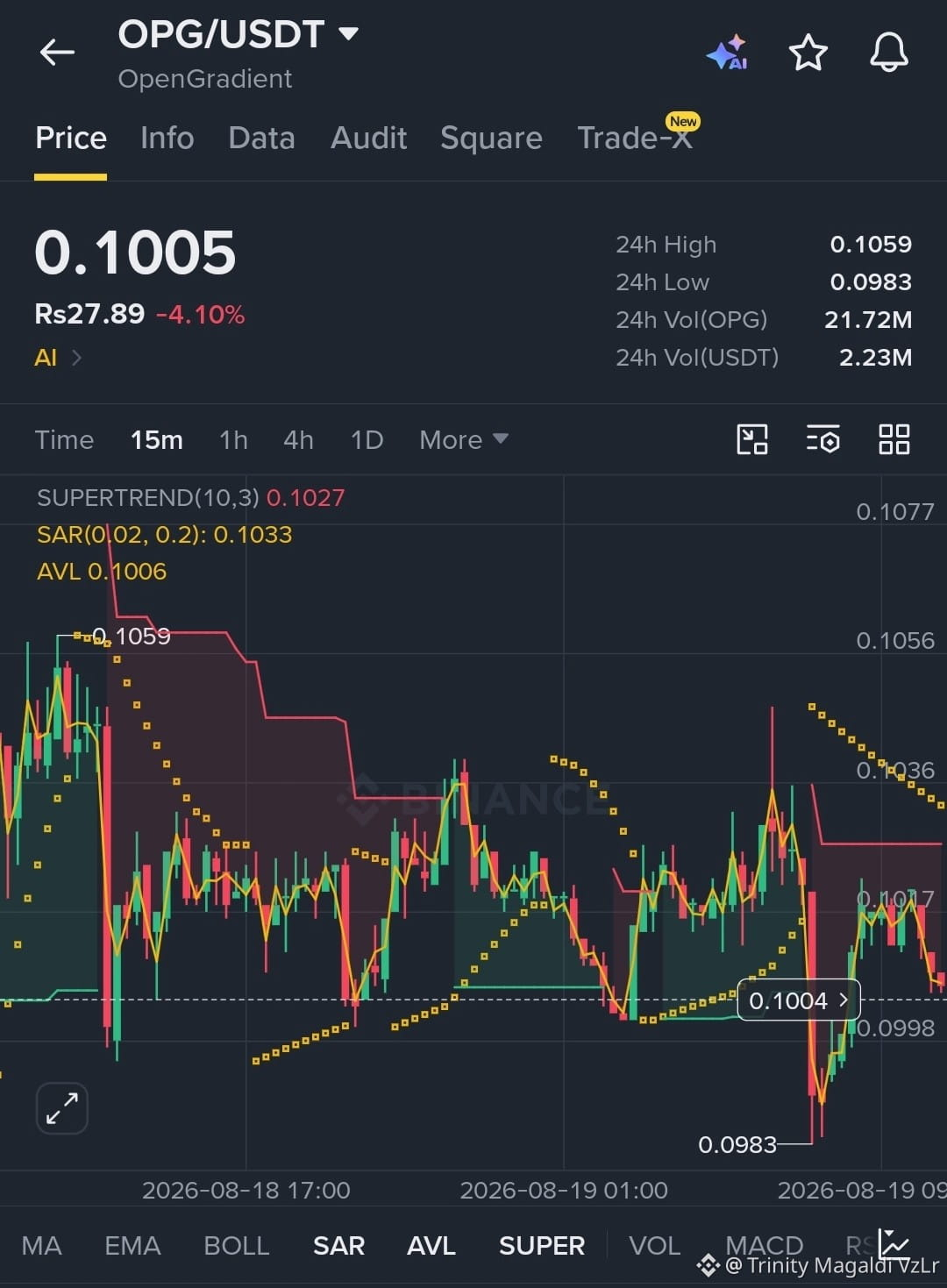

We see ever each the new token,s are may be on the duty of major pump,s on listed day,s but $OPG play different and chart show some liquidity grapper,s and there is no major pump but in last 4 day,s $OPG chart showing the big one is coming 🤔
What your oppinions ?
#Opengradient #DCA
What your oppinions ?
#Opengradient #DCA


📊 Quick analysis of OpenGradient coin ($OPG) 📉🔥
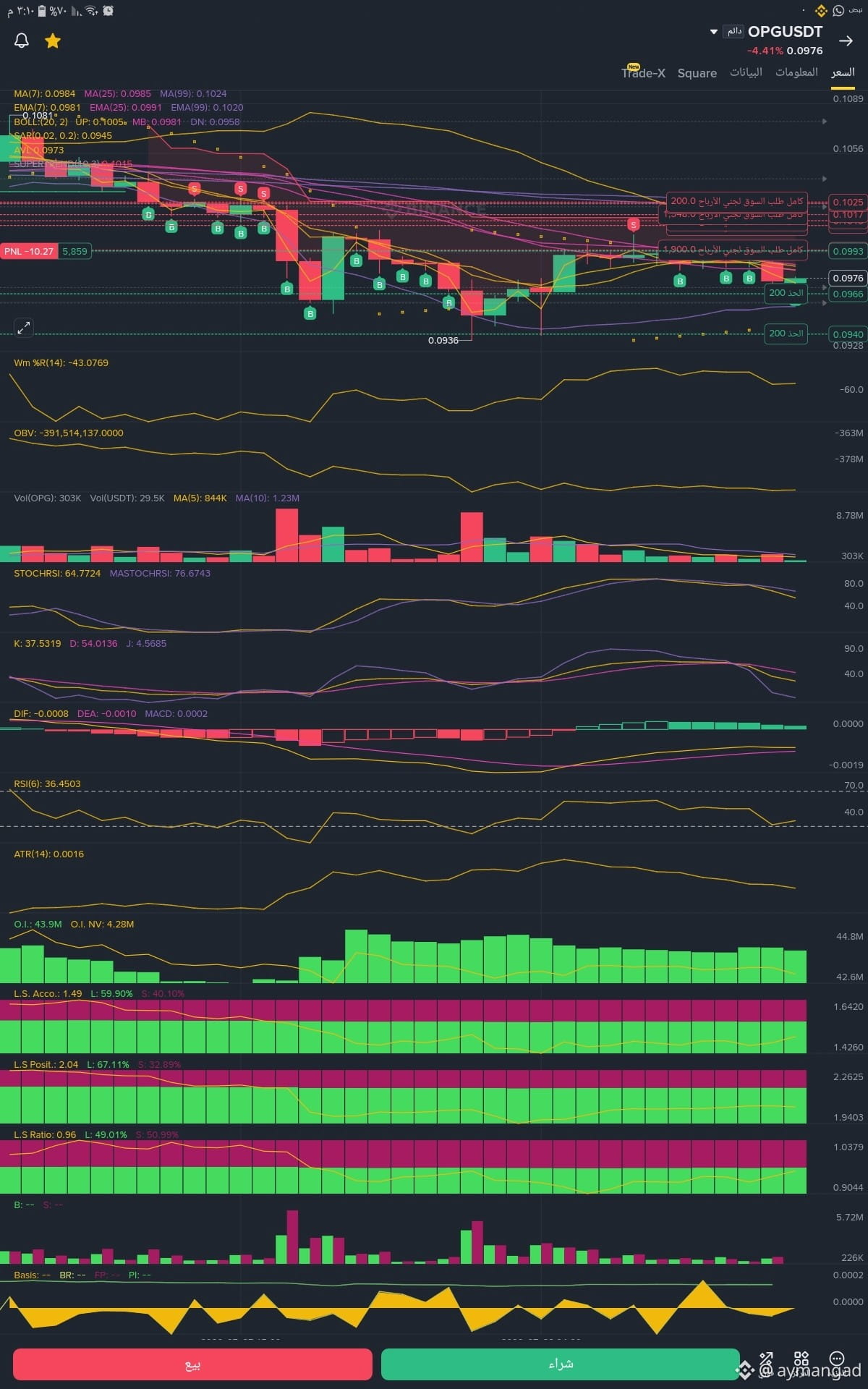
The OPG/USDT coin is currently facing short-term bearish pressure, with the price hovering around the 0.0976 levels, but the technical indicators have started approaching important rebound zones.
💡 Key technical points:
1️⃣ Oversold: the RSI(6) indicator has dropped to 36.45 levels, reflecting that selling pressure is nearing exhaustion and a corrective upward rebound (Pump) may occur.
2️⃣ Support test: the coin is now holding above its critical previous bottom at 0.0936, and maintaining it ensures a return to the upward trend.
🎯 Intraday trading levels:
- Immediate support: 0.0936
- First rebound target: 0.0985
- Second rebound target: 0.1017
⚠️ Stop loss (strict): 0.0925
💬 Share in the comments: Will the current support push the price to rebound, or will we see a drop to new highs? 👇
#OPGUSDT #OpenGradient #CryptoTrading #BinanceSquare
The OPG/USDT coin is currently facing short-term bearish pressure, with the price hovering around the 0.0976 levels, but the technical indicators have started approaching important rebound zones.
💡 Key technical points:
1️⃣ Oversold: the RSI(6) indicator has dropped to 36.45 levels, reflecting that selling pressure is nearing exhaustion and a corrective upward rebound (Pump) may occur.
2️⃣ Support test: the coin is now holding above its critical previous bottom at 0.0936, and maintaining it ensures a return to the upward trend.
🎯 Intraday trading levels:
- Immediate support: 0.0936
- First rebound target: 0.0985
- Second rebound target: 0.1017
⚠️ Stop loss (strict): 0.0925
💬 Share in the comments: Will the current support push the price to rebound, or will we see a drop to new highs? 👇
#OPGUSDT #OpenGradient #CryptoTrading #BinanceSquare


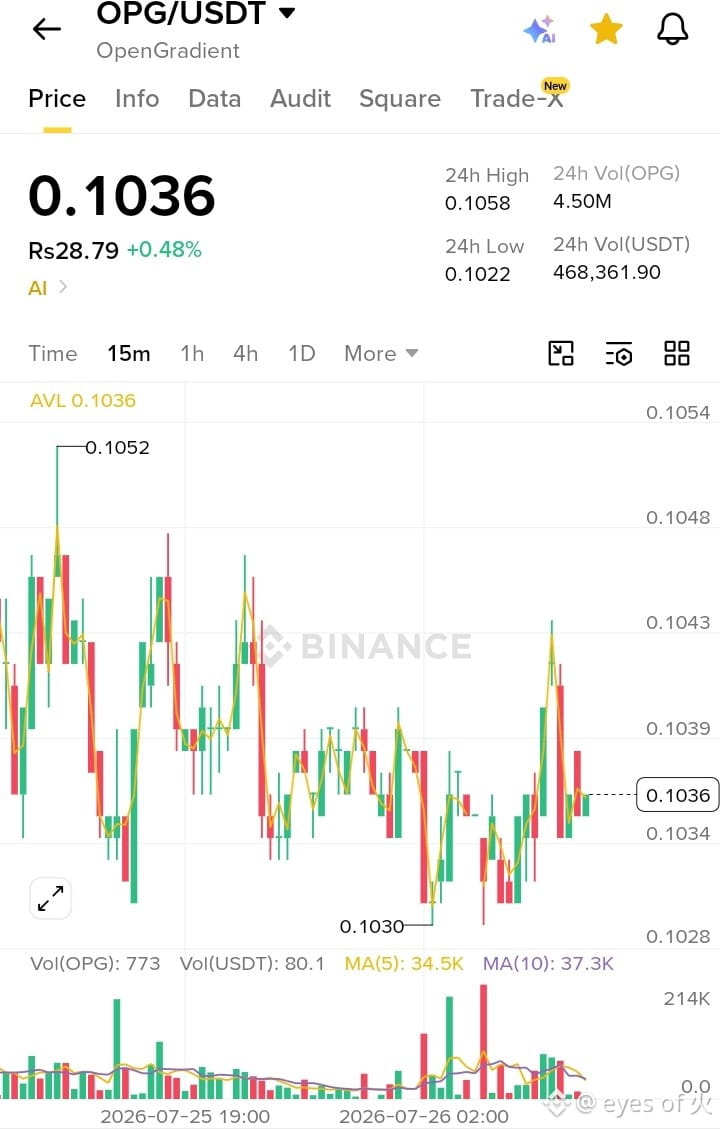
⚡ **$OPG /USDT Market Update & Technical Outlook** 📊
$OPG (OpenGradient) is trading within a consolidation range after holding above its local support level near **$0.1030** and facing resistance around **$0.1052**.
• **Current Price:** $0.1036 (+0.48%)
• **24h Volume:** 4.50M OPG (~$468.3K USDT)
• **Key Support Zone:** $0.1030 – $0.1022
• **Key Resistance:** $0.1043 – $0.1052
**Market Bias:** Neutral / Range-bound. Maintaining support above $0.1030 keeps the potential for another move toward the $0.1045+ resistance level. Manage risk appropriately!
#OPG #OpenGradient #BinanceSquare #CryptoAnalysis #TradingSignals $OPG
$OPG (OpenGradient) is trading within a consolidation range after holding above its local support level near **$0.1030** and facing resistance around **$0.1052**.
• **Current Price:** $0.1036 (+0.48%)
• **24h Volume:** 4.50M OPG (~$468.3K USDT)
• **Key Support Zone:** $0.1030 – $0.1022
• **Key Resistance:** $0.1043 – $0.1052
**Market Bias:** Neutral / Range-bound. Maintaining support above $0.1030 keeps the potential for another move toward the $0.1045+ resistance level. Manage risk appropriately!
#OPG #OpenGradient #BinanceSquare #CryptoAnalysis #TradingSignals $OPG

Verified
OpenGradient, a leading decentralized AI infrastructure network, has hit a major operational milestone by processing over 1 billion tokens and executing 317,000 tasks. Powered by its Hybrid AI Compute Architecture (HACA) on the Base network, the platform provides scalable, low-cost, and verifiable AI execution.
Recent Updates & Growth Catalysts:
Market Expansion: Following its successful TGE, OpenGradient expanded into South Korea by listing OPG/KRW trading pairs on Upbit, the region's top exchange.
Privacy-First AI: The network recently launched OpenGradient Chat, a highly secure generative AI assistant utilizing advanced hardware enclaves to completely decouple prompt data from user identities.
Tokenomics Structure: To support continuous Web3 developer incentives, 9.13 million OPG tokens are unlocked monthly out of a strict 1 billion total fixed supply.
#OpenGradient #OPG #Web3AI #CryptoNews #DeAI #BaseNetwork
Recent Updates & Growth Catalysts:
Market Expansion: Following its successful TGE, OpenGradient expanded into South Korea by listing OPG/KRW trading pairs on Upbit, the region's top exchange.
Privacy-First AI: The network recently launched OpenGradient Chat, a highly secure generative AI assistant utilizing advanced hardware enclaves to completely decouple prompt data from user identities.
Tokenomics Structure: To support continuous Web3 developer incentives, 9.13 million OPG tokens are unlocked monthly out of a strict 1 billion total fixed supply.
#OpenGradient #OPG #Web3AI #CryptoNews #DeAI #BaseNetwork

🚨 Could OpenGradient ($OPG ) Be the Next Big AI Crypto Gem? 🤖🚀
As AI continues to dominate the tech world, projects building the infrastructure behind decentralized AI are gaining serious attention.
#OpenGradient (OPG) isn't just another token—it's an AI infrastructure project designed to make AI more transparent, verifiable, and decentralized.
🔹 AI + Blockchain Narrative
🔹 Staking & Governance Utility
🔹 Supports Decentralized AI Applications
🔹 Strong Long-Term Potential if Adoption Grows
While OPG is still an early-stage project with higher risk, its real-world utility makes it one to keep on your watchlist.
👀 Are you bullish on AI coins this cycle, or are you still focused on BTC and ETH? Let me know below! 🚀$DEXE
#OPG #Web3 #AI
As AI continues to dominate the tech world, projects building the infrastructure behind decentralized AI are gaining serious attention.
#OpenGradient (OPG) isn't just another token—it's an AI infrastructure project designed to make AI more transparent, verifiable, and decentralized.
🔹 AI + Blockchain Narrative
🔹 Staking & Governance Utility
🔹 Supports Decentralized AI Applications
🔹 Strong Long-Term Potential if Adoption Grows
While OPG is still an early-stage project with higher risk, its real-world utility makes it one to keep on your watchlist.
👀 Are you bullish on AI coins this cycle, or are you still focused on BTC and ETH? Let me know below! 🚀$DEXE
#OPG #Web3 #AI


#opg $OPG
#OpenGradient Chat
Make it so that everyone has an AI assistant without uncontrolled oversight.
For Web3, financial, and medical institutions, we provide compliant, reliable AI computing power as a baseline level that supports the deployment of the next generation of on-chain autonomous agents.
Built on the token $OPG , we enable payment for computing power across the entire network, node incentives, and community governance; we are building a fully open intelligent infrastructure with no barriers to access, co-created by many parties, advancing global AI into a new era of decentralization, trust, and user sovereignty.
#OpenGradient Chat
Make it so that everyone has an AI assistant without uncontrolled oversight.
For Web3, financial, and medical institutions, we provide compliant, reliable AI computing power as a baseline level that supports the deployment of the next generation of on-chain autonomous agents.
Built on the token $OPG , we enable payment for computing power across the entire network, node incentives, and community governance; we are building a fully open intelligent infrastructure with no barriers to access, co-created by many parties, advancing global AI into a new era of decentralization, trust, and user sovereignty.

Is #OpenGradient (OPG) Worth Watching?
The AI narrative in crypto is growing, but hype alone is no longer enough. Projects now need to prove real utility, and that's why @OpenGradient (OPG) stands out to me.
Instead of focusing on consumer AI, $OPG is building decentralized infrastructure for AI models. If AI adoption keeps expanding, secure model hosting, verifiable inference, and scalable infrastructure could become increasingly valuable.
That said, technology alone won't determine success. Developer adoption, ecosystem growth, and consistent execution will matter far more than short-term excitement.
I see OPG as a project worth watching rather than blindly chasing. It has an interesting long-term narrative, but like any early-stage project, it still needs to prove itself through real adoption.
What's your view? Will strong technology, developer adoption, or market sentiment have the biggest impact on OPG's future?
The AI narrative in crypto is growing, but hype alone is no longer enough. Projects now need to prove real utility, and that's why @OpenGradient (OPG) stands out to me.
Instead of focusing on consumer AI, $OPG is building decentralized infrastructure for AI models. If AI adoption keeps expanding, secure model hosting, verifiable inference, and scalable infrastructure could become increasingly valuable.
That said, technology alone won't determine success. Developer adoption, ecosystem growth, and consistent execution will matter far more than short-term excitement.
I see OPG as a project worth watching rather than blindly chasing. It has an interesting long-term narrative, but like any early-stage project, it still needs to prove itself through real adoption.
What's your view? Will strong technology, developer adoption, or market sentiment have the biggest impact on OPG's future?


@OpenGradient
While reading through OpenGradient's architecture, one idea kept pulling my attention back: AI infrastructure isn't only about compute anymore. It's increasingly about coordination.
Most people focus on models, GPUs, or inference speed. But when AI workloads are distributed across different nodes, another challenge appears. How do you know the right model was used, the result wasn't altered, and the network made the best routing decision?
That's where OpenGradient's approach feels interesting. Instead of treating verification as an optional layer, it seems to be woven into the system itself through attestations, proofs, and transparent execution pathways.
The more I look into $OPG , the more I think the future AI stack may not be defined by who has the biggest models, but by who can make AI outputs trustworthy at scale.
Fast AI is valuable.
Verifiable AI could be essential.
#OPG
#OpenGradient
While reading through OpenGradient's architecture, one idea kept pulling my attention back: AI infrastructure isn't only about compute anymore. It's increasingly about coordination.
Most people focus on models, GPUs, or inference speed. But when AI workloads are distributed across different nodes, another challenge appears. How do you know the right model was used, the result wasn't altered, and the network made the best routing decision?
That's where OpenGradient's approach feels interesting. Instead of treating verification as an optional layer, it seems to be woven into the system itself through attestations, proofs, and transparent execution pathways.
The more I look into $OPG , the more I think the future AI stack may not be defined by who has the biggest models, but by who can make AI outputs trustworthy at scale.
Fast AI is valuable.
Verifiable AI could be essential.
#OPG
#OpenGradient

The more I research @OpenGradient ( $OPG ), the more I think the market may be overlooking what it's actually building.
Most AI projects compete to create smarter models.
OpenGradient is focused on something different: making AI outputs verifiable.
As AI becomes part of financial systems, autonomous agents, and critical infrastructure, trust becomes a real issue. Not because AI isn't useful, but because users need a way to verify results instead of simply accepting them.
That's where OPG caught my attention.
They are building the infrastructure that allows AI to perform and prove calculations, developing bridges between AI and on-chain considerations.
What I find exciting is that this is not some other "next chatbot" statement.
It's a bet on a future where AI needs accountability.
The AI race is getting crowded.
The trust layer for AI is still in its early days.
And historically, infrastructure projects solving fundamental problems have often been the ones that last the longest.
Still early, still researching, but OpenGradient is definitely one of the more interesting AI infrastructure projects on my watchlist.
#OpenGradient #OPG
#opg $OPG
Most AI projects compete to create smarter models.
OpenGradient is focused on something different: making AI outputs verifiable.
As AI becomes part of financial systems, autonomous agents, and critical infrastructure, trust becomes a real issue. Not because AI isn't useful, but because users need a way to verify results instead of simply accepting them.
That's where OPG caught my attention.
They are building the infrastructure that allows AI to perform and prove calculations, developing bridges between AI and on-chain considerations.
What I find exciting is that this is not some other "next chatbot" statement.
It's a bet on a future where AI needs accountability.
The AI race is getting crowded.
The trust layer for AI is still in its early days.
And historically, infrastructure projects solving fundamental problems have often been the ones that last the longest.
Still early, still researching, but OpenGradient is definitely one of the more interesting AI infrastructure projects on my watchlist.
#OpenGradient #OPG
#opg $OPG
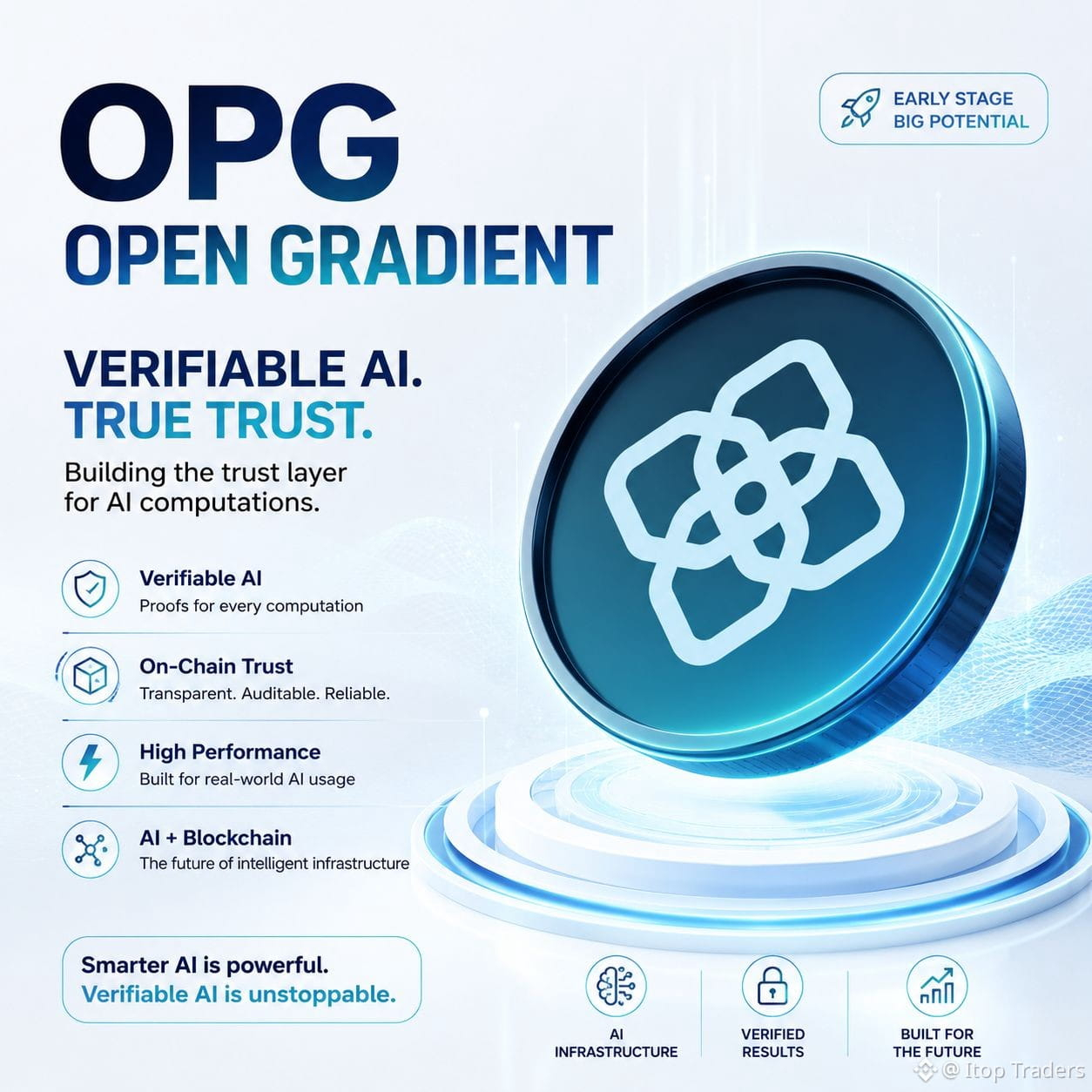

#opg $OPG To put it in plain language, OpenGradient is a decentralized infrastructure focused on verifiable on-chain AI inference. Its core goal is to solve the black-box problems of traditional centralized AI. Today’s mainstream AI computing power is highly concentrated, leading to issues such as results that cannot be traced, easy tampering, platform monopolies, and opaque user data. This project uses cryptographic verification and on-chain settlement mechanisms to make every AI computation auditable and remove the need to trust a single service provider.
It adopts a hybrid AI computing architecture, separating computation execution from result verification, balancing AI performance with the security and transparency of blockchain. It supports full-stack features such as model hosting, on-chain inference, and AI agent deployment. The ecosystem is centered on the OPG token, which is used for fees, node incentives, and governance rights, creating a closed-loop economic system.
As an NVIDIA-incubated project, it fills a gap in decentralized, verifiable AI infrastructure and is well suited for emerging areas such as AI agents and on-chain intelligent applications. The project is currently in the testnet stage and has strong technical feasibility, but it still faces challenges such as the efficiency of decentralized computing and ecosystem adoption. Overall, it is a promising track at the intersection of AI and blockchain.#OpenChat #OpenGradient
It adopts a hybrid AI computing architecture, separating computation execution from result verification, balancing AI performance with the security and transparency of blockchain. It supports full-stack features such as model hosting, on-chain inference, and AI agent deployment. The ecosystem is centered on the OPG token, which is used for fees, node incentives, and governance rights, creating a closed-loop economic system.
As an NVIDIA-incubated project, it fills a gap in decentralized, verifiable AI infrastructure and is well suited for emerging areas such as AI agents and on-chain intelligent applications. The project is currently in the testnet stage and has strong technical feasibility, but it still faces challenges such as the efficiency of decentralized computing and ecosystem adoption. Overall, it is a promising track at the intersection of AI and blockchain.#OpenChat #OpenGradient


I'm tired of "revolutionary AI" projects 🤖💤
Every week: Bigger model. Bigger funding. Bigger promises.
Same problems remain.
3 companies control the AI we actually use.
They change pricing? You're stuck 💰
They limit access? You're stuck 🔒
They shut down? Your problem, not theirs 💀
We call it innovation.
I call it renting the future 🏠
That's why @OpenGradient caught my eye 👀
Not because of flashy token.
Not because of 100x hopium.
Because they're fixing the foundation 🧱
Decentralized network where AI models get hosted, run, verified...
Without one company holding the kill switch ⚡
If AI becomes everyday life, infrastructure can't belong to 5 players.
We need systems anyone can build on.
Systems we can verify, not just trust ✅
Maybe big companies win anyway 🤷
But I'd rather study projects fixing foundations
Than another AI coin with countdown timer + fancy website ⏳
Hype is old.
Infrastructure is what lasts 💪
What matters more: model size or model ownership? 👇
$OPG
0.1581 -10.27% | $SOL 69.03 -0.6%
#OpenGradient #OPG #DePIN
Every week: Bigger model. Bigger funding. Bigger promises.
Same problems remain.
3 companies control the AI we actually use.
They change pricing? You're stuck 💰
They limit access? You're stuck 🔒
They shut down? Your problem, not theirs 💀
We call it innovation.
I call it renting the future 🏠
That's why @OpenGradient caught my eye 👀
Not because of flashy token.
Not because of 100x hopium.
Because they're fixing the foundation 🧱
Decentralized network where AI models get hosted, run, verified...
Without one company holding the kill switch ⚡
If AI becomes everyday life, infrastructure can't belong to 5 players.
We need systems anyone can build on.
Systems we can verify, not just trust ✅
Maybe big companies win anyway 🤷
But I'd rather study projects fixing foundations
Than another AI coin with countdown timer + fancy website ⏳
Hype is old.
Infrastructure is what lasts 💪
What matters more: model size or model ownership? 👇
$OPG
0.1581 -10.27% | $SOL 69.03 -0.6%
#OpenGradient #OPG #DePIN

#opg $OPG *1. What it is*
OpenGradient calls itself a _decentralized infrastructure network for AI_. Instead of being a standalone blockchain, it works as a specialized “AI coprocessor”. f2d0
The core idea: let apps, blockchains, and AI agents outsource heavy GPU work to a network of specialized nodes, then cryptographically prove the work was done correctly. f2d0
*2. The big problem it solves: “AI Black Box”*
With normal cloud AI like OpenAI or Google, you have to trust that:
1. They used the model they claimed
2. Your data wasn’t tampered with
3. The output is legit
OpenGradient fixes this by running every LLM inference inside a *Trusted Execution Environment TEE* and settling it on-chain. Every job returns a `transaction_hash` that proves:
- Which exact model was used
- What the exact input and output were
- That computation happened in a secure enclave fd7f148e
So you “trust math, not us, the host, or the network”. 91f9
*3. Key features*
- *Verifiable LLM Inference*: Drop-in replacement for OpenAI/Anthropic APIs with cryptographic attestation
- *Multi-Provider Access*: One API for OpenAI, Anthropic, Google, xAI models
- *TEE + Blockchain*: TEE execution + consensus verification before anything hits chain
- *Model Hub*: Permissionless registry with 2,000+ models from 100+ developers
- *Privacy-first Chat*: `chat.opengradient.ai` - same verifiable architecture for everyday use
- *Developer SDK*: `pip install opengradient` Python SDK + LangChain integration fd7fca67f2d0b4#OpenGradient
OpenGradient calls itself a _decentralized infrastructure network for AI_. Instead of being a standalone blockchain, it works as a specialized “AI coprocessor”. f2d0
The core idea: let apps, blockchains, and AI agents outsource heavy GPU work to a network of specialized nodes, then cryptographically prove the work was done correctly. f2d0
*2. The big problem it solves: “AI Black Box”*
With normal cloud AI like OpenAI or Google, you have to trust that:
1. They used the model they claimed
2. Your data wasn’t tampered with
3. The output is legit
OpenGradient fixes this by running every LLM inference inside a *Trusted Execution Environment TEE* and settling it on-chain. Every job returns a `transaction_hash` that proves:
- Which exact model was used
- What the exact input and output were
- That computation happened in a secure enclave fd7f148e
So you “trust math, not us, the host, or the network”. 91f9
*3. Key features*
- *Verifiable LLM Inference*: Drop-in replacement for OpenAI/Anthropic APIs with cryptographic attestation
- *Multi-Provider Access*: One API for OpenAI, Anthropic, Google, xAI models
- *TEE + Blockchain*: TEE execution + consensus verification before anything hits chain
- *Model Hub*: Permissionless registry with 2,000+ models from 100+ developers
- *Privacy-first Chat*: `chat.opengradient.ai` - same verifiable architecture for everyday use
- *Developer SDK*: `pip install opengradient` Python SDK + LangChain integration fd7fca67f2d0b4#OpenGradient

We need to stop treating decentralized node placement like a basic game of Risk.
Most people look at a global map of nodes and think, "Great, we have global coverage." But a recent latency test I ran on @OpenGradient proved just how deceptive a pretty map can be.
The scheduler did exactly what it was programmed to do: it routed a request to the absolute closest inference node geographically. On paper, it was a flawless decision. In reality, it was a disaster.
The local node didn’t have the specific model ready and had to start pulling it from scratch. Meanwhile, a "warm" node slightly further away was sitting completely idle, ready to go. Because of a blind spot in routing, the shortest physical distance turned into the slowest execution time.
This is the hidden trap. Decentralized AI routing isn't a geography problem; it’s a fluid coordination problem.If you're only measuring physical distance, you're ignoring real-time GPU capacity, queue bottlenecks, live model states, and failure correlations.
Worse, visual distribution is often an illusion. You can place two nodes in entirely different cities, but if they rely on the same cloud provider, the same underlying operator, or the same regional fiber backbone, they aren't independent. They represent a shared failure point waiting to happen.
The complexity goes even deeper when you realize that full nodes shouldn't even share the same footprint as inference nodes. Their priority is optimizing proof propagation, not user ping. Then you throw data nodes into the mix, where being close to the data source matters way more than being close to the end-user.
Traditional facility-location models can map these trade-offs, but the real wildcard is how the economic incentives will drive node deployment.
The next milestone for $OPG shouldn't be about spreading nodes randomly across a map. It’s about whether new infrastructure actually plugs these invisible latency gaps and cuts down the shared dependencies that users actually experience.
#OPG #OpenGradient #DeAI #Web3Infrastructure
Most people look at a global map of nodes and think, "Great, we have global coverage." But a recent latency test I ran on @OpenGradient proved just how deceptive a pretty map can be.
The scheduler did exactly what it was programmed to do: it routed a request to the absolute closest inference node geographically. On paper, it was a flawless decision. In reality, it was a disaster.
The local node didn’t have the specific model ready and had to start pulling it from scratch. Meanwhile, a "warm" node slightly further away was sitting completely idle, ready to go. Because of a blind spot in routing, the shortest physical distance turned into the slowest execution time.
This is the hidden trap. Decentralized AI routing isn't a geography problem; it’s a fluid coordination problem.If you're only measuring physical distance, you're ignoring real-time GPU capacity, queue bottlenecks, live model states, and failure correlations.
Worse, visual distribution is often an illusion. You can place two nodes in entirely different cities, but if they rely on the same cloud provider, the same underlying operator, or the same regional fiber backbone, they aren't independent. They represent a shared failure point waiting to happen.
The complexity goes even deeper when you realize that full nodes shouldn't even share the same footprint as inference nodes. Their priority is optimizing proof propagation, not user ping. Then you throw data nodes into the mix, where being close to the data source matters way more than being close to the end-user.
Traditional facility-location models can map these trade-offs, but the real wildcard is how the economic incentives will drive node deployment.
The next milestone for $OPG shouldn't be about spreading nodes randomly across a map. It’s about whether new infrastructure actually plugs these invisible latency gaps and cuts down the shared dependencies that users actually experience.
#OPG #OpenGradient #DeAI #Web3Infrastructure


Hey guys! When evaluating long-term crypto assets, looking past the hype and focusing on the actual tech infrastructure is key.
It is working on optimizing decentralized architectures, which is a massive narrative this season. High transaction efficiency and lower overhead are what developers actually need.
If you are trading or holding $OPG today, what’s your main thesis? Long-term hold or short-term swing? Let’s talk in the comments! 👇
#OpenGradient #OPG #CryptoCommunity #blockchain #trading
It is working on optimizing decentralized architectures, which is a massive narrative this season. High transaction efficiency and lower overhead are what developers actually need.
If you are trading or holding $OPG today, what’s your main thesis? Long-term hold or short-term swing? Let’s talk in the comments! 👇
#OpenGradient #OPG #CryptoCommunity #blockchain #trading

It’s back to the weekend, and I spent time deeply testing the cross-device synchronization feature of OpenGradient Chat @OpenGradient . A conversation started on my computer can be seamlessly continued on my phone—this is especially useful for me since I’m often handling information on the go. I also found its logical reasoning capabilities particularly strong. Recently, I’ve been researching a complex DeFi arbitrage strategy: after feeding it multi-step logic inputs, it not only identifies loopholes, but also suggests optimization paths. The entire process is handled with encryption, so I’m not worried about the strategy being leaked. Even more surprising is its multilingual support. I tried mixing Chinese and English in my questions, and it understood and responded accurately, which is very helpful for international collaboration. Now I’ve put my everyday brainstorming and draft plans into OpenGradient. Its contextual memory lets me iterate on ideas again and again, and my efficiency has noticeably improved. Also, I’ve been interested in the $OPG staking and dividend mechanism that the community has been discussing lately. Token holders can not only participate in governance, but also share network transaction fees—its long-term value is worth paying attention to. In short, decentralized AI is changing the way I work. I strongly recommend that everyone try it for free at chat.opengradient.ai. #OPG #OpenGradient

What makes someone valuable : their knowledge Or their ability to pass it on? @OpenGradient
For most of history, apprentices learned by watching. Not manuals. Not documentation. People. They copied habits, decisions, shortcuts, and mistakes until experience slowly became transferable. Which is probably why I've always found apprenticeships a little interesting. Knowledge isn't simply stored. It's inherited.
For some reason, that thought kept coming back while I was reading about @OpenGradient . At first, I assumed AI would mostly become smarter by learning more information. That seemed obvious. Better models should naturally produce better outcomes. At least that's what I thought.
But the more I thought about it, the less obvious that assumption felt. Because expertise isn't just facts. It's patterns. Preferences. Judgment. The small decisions people make without even realizing they're making them. Maybe that's why digital twins feel so interesting to me.
As AI agents become more capable, I'm starting to wonder whether the next step isn't building smarter systems, but building systems that can inherit experience. The more I learn about OpenGradient's approach to digital twins, the more I wonder whether intelligence becomes most useful when it starts feeling transferable. I'm not sure. But for some reason, apprentices kept coming to mind.
#OpenGradient #OPG #DigitalTwins #AIAgents #AIInfrastructure #verifiableAI $OPG $BAS $SYN
what makes expertise valuable ?
For most of history, apprentices learned by watching. Not manuals. Not documentation. People. They copied habits, decisions, shortcuts, and mistakes until experience slowly became transferable. Which is probably why I've always found apprenticeships a little interesting. Knowledge isn't simply stored. It's inherited.
For some reason, that thought kept coming back while I was reading about @OpenGradient . At first, I assumed AI would mostly become smarter by learning more information. That seemed obvious. Better models should naturally produce better outcomes. At least that's what I thought.
But the more I thought about it, the less obvious that assumption felt. Because expertise isn't just facts. It's patterns. Preferences. Judgment. The small decisions people make without even realizing they're making them. Maybe that's why digital twins feel so interesting to me.
As AI agents become more capable, I'm starting to wonder whether the next step isn't building smarter systems, but building systems that can inherit experience. The more I learn about OpenGradient's approach to digital twins, the more I wonder whether intelligence becomes most useful when it starts feeling transferable. I'm not sure. But for some reason, apprentices kept coming to mind.
#OpenGradient #OPG #DigitalTwins #AIAgents #AIInfrastructure #verifiableAI $OPG $BAS $SYN
what makes expertise valuable ?
Knowledge
50%
Experience
25%
Judgment
25%
The ability to teach others
0%
4 votes • Voting closed

@OpenGradient
If you think centralized AI is secure, think again: OpenGradient just flipped the script on opaque models.
For too long, we have treated artificial intelligence like a black box, relying on blind trust in tech giants. OpenGradient is dismantling that setup by building a decentralized infrastructure network where AI inference is actually cryptographically verifiable.
At the core is their Hybrid AI Compute Architecture (HACA). This system splits the work into two smart phases. First, GPU nodes execute the model at standard speeds. Next, independent validators verify those computations on-chain.
Depending on the task, it scales its security. It uses hardware-enclave execution (TEEs) for regular apps to keep things fast, and Zero-Knowledge Machine Learning (ZKML) proofs for high-stakes financial data. You get absolute proof that the exact model you requested produced your output—zero compromises.
Right now, the broader market shows a disconnect. The native token is facing short-term price pressure, with OPG down at [-14.91%].
Yet, looking past the immediate noise reveals the real value. While old centralized layers force developers to accept hidden biases and security risks, OpenGradient provides a transparent, auditable infrastructure designed for the future of on-chain operations.
What are your thoughts on ZKML tech? 👇
#OpenGradient #OPG #DeAI #bearish
$OPG
If you think centralized AI is secure, think again: OpenGradient just flipped the script on opaque models.
For too long, we have treated artificial intelligence like a black box, relying on blind trust in tech giants. OpenGradient is dismantling that setup by building a decentralized infrastructure network where AI inference is actually cryptographically verifiable.
At the core is their Hybrid AI Compute Architecture (HACA). This system splits the work into two smart phases. First, GPU nodes execute the model at standard speeds. Next, independent validators verify those computations on-chain.
Depending on the task, it scales its security. It uses hardware-enclave execution (TEEs) for regular apps to keep things fast, and Zero-Knowledge Machine Learning (ZKML) proofs for high-stakes financial data. You get absolute proof that the exact model you requested produced your output—zero compromises.
Right now, the broader market shows a disconnect. The native token is facing short-term price pressure, with OPG down at [-14.91%].
Yet, looking past the immediate noise reveals the real value. While old centralized layers force developers to accept hidden biases and security risks, OpenGradient provides a transparent, auditable infrastructure designed for the future of on-chain operations.
What are your thoughts on ZKML tech? 👇
#OpenGradient #OPG #DeAI #bearish
$OPG

$OPG
🚀 With the continued development of AI and blockchain projects, I believe some are worth closely following. Among them is $OPG , which catches my attention because of the focus of project @OpenGradient on integrating artificial intelligence with Web3 technologies. I’m also following the developments of $BTC and BNB, as they are among the most important assets in the cryptocurrency market.
🤔 What do you think about the future of OPG$? And do you believe AI projects will be the main driving force behind the next market cycle?
💬 Share your expectations and analysis—I’m interested in knowing the views of the Binance Square community.
#OPG
#OpenGradient #BinanceSquare
🚀 With the continued development of AI and blockchain projects, I believe some are worth closely following. Among them is $OPG , which catches my attention because of the focus of project @OpenGradient on integrating artificial intelligence with Web3 technologies. I’m also following the developments of $BTC and BNB, as they are among the most important assets in the cryptocurrency market.
🤔 What do you think about the future of OPG$? And do you believe AI projects will be the main driving force behind the next market cycle?
💬 Share your expectations and analysis—I’m interested in knowing the views of the Binance Square community.
#OPG
#OpenGradient #BinanceSquare
Log in to explore more content