
#crudeoil
crudeoil
419,829 views
2,835 Discussing
Hot
Latest

🛢️ Crude Surges Above $100 as Supply Risks Intensify
Oil markets are facing another sharp move higher as fresh attacks on Saudi Arabia and renewed threats around the Strait of Hormuz raise concerns over global crude supplies.
Brent crude climbed above $107 per barrel, while WTI moved above $102, with traders pricing in a higher geopolitical risk premium. Saudi Arabia’s East-West pipeline has also been shut after a drone attack, adding another layer of pressure to an already disrupted supply chain.
The key question now is whether these disruptions remain temporary—or develop into a broader supply shock that keeps crude above $100.
What do you think: can Brent push toward $110–$120 if tensions continue?
$TRUMP
{future}(TRUMPUSDT)
#CrudeOil #Geopolitics
🛢️ Crude Surges Above $100 as Supply Risks Intensify
Oil markets are facing another sharp move higher as fresh attacks on Saudi Arabia and renewed threats around the Strait of Hormuz raise concerns over global crude supplies.
Brent crude climbed above $107 per barrel, while WTI moved above $102, with traders pricing in a higher geopolitical risk premium. Saudi Arabia’s East-West pipeline has also been shut after a drone attack, adding another layer of pressure to an already disrupted supply chain.
The key question now is whether these disruptions remain temporary—or develop into a broader supply shock that keeps crude above $100.
What do you think: can Brent push toward $110–$120 if tensions continue?
$TRUMP
#CrudeOil #Geopolitics
Oil markets are facing another sharp move higher as fresh attacks on Saudi Arabia and renewed threats around the Strait of Hormuz raise concerns over global crude supplies.
Brent crude climbed above $107 per barrel, while WTI moved above $102, with traders pricing in a higher geopolitical risk premium. Saudi Arabia’s East-West pipeline has also been shut after a drone attack, adding another layer of pressure to an already disrupted supply chain.
The key question now is whether these disruptions remain temporary—or develop into a broader supply shock that keeps crude above $100.
What do you think: can Brent push toward $110–$120 if tensions continue?
$TRUMP
#CrudeOil #Geopolitics
464

According to the latest data released by the Baltic Exchange in London, daily charter rates for supertankers on benchmark global routes have surged past an unprecedented $1,000,000 per day. This historic spike in shipping costs comes as escalating military conflict involving Iran sharply curtails the number of vessels willing to transit the vital Strait of Hormuz.
The Strait of Hormuz remains the world's most critical energy chokepoint, handling roughly a fifth of global petroleum consumption. A million-dollar daily freight rate reflects extreme risk premiums and severe logistics paralysis, which threatens to disrupt physical crude flows far more aggressively than standard headline geopolitical tension would suggest.
Across traditional finance, soaring transportation costs and supply bottlenecks directly fuel renewed inflation pressures, pushing crude oil prices higher and complicating central bank easing timelines. Bond yields are vulnerable to renewed upside pressure, while defensive assets like gold and the US dollar attract immediate safe-haven inflows.
For crypto markets, an energy-driven inflationary shock creates immediate headwinds. Tighter liquidity conditions and broad risk-off sentiment could trigger short-term volatility for $BTC, although prolonged macro instability may eventually strengthen the narrative for decentralized, sovereign-neutral stores of value.
#CrudeOil #Geopolitics #MacroEconomics
According to the latest data released by the Baltic Exchange in London, daily charter rates for supertankers on benchmark global routes have surged past an unprecedented $1,000,000 per day. This historic spike in shipping costs comes as escalating military conflict involving Iran sharply curtails the number of vessels willing to transit the vital Strait of Hormuz.
The Strait of Hormuz remains the world's most critical energy chokepoint, handling roughly a fifth of global petroleum consumption. A million-dollar daily freight rate reflects extreme risk premiums and severe logistics paralysis, which threatens to disrupt physical crude flows far more aggressively than standard headline geopolitical tension would suggest.
Across traditional finance, soaring transportation costs and supply bottlenecks directly fuel renewed inflation pressures, pushing crude oil prices higher and complicating central bank easing timelines. Bond yields are vulnerable to renewed upside pressure, while defensive assets like gold and the US dollar attract immediate safe-haven inflows.
For crypto markets, an energy-driven inflationary shock creates immediate headwinds. Tighter liquidity conditions and broad risk-off sentiment could trigger short-term volatility for $BTC , although prolonged macro instability may eventually strengthen the narrative for decentralized, sovereign-neutral stores of value.
#CrudeOil #Geopolitics #MacroEconomics
The Strait of Hormuz remains the world's most critical energy chokepoint, handling roughly a fifth of global petroleum consumption. A million-dollar daily freight rate reflects extreme risk premiums and severe logistics paralysis, which threatens to disrupt physical crude flows far more aggressively than standard headline geopolitical tension would suggest.
Across traditional finance, soaring transportation costs and supply bottlenecks directly fuel renewed inflation pressures, pushing crude oil prices higher and complicating central bank easing timelines. Bond yields are vulnerable to renewed upside pressure, while defensive assets like gold and the US dollar attract immediate safe-haven inflows.
For crypto markets, an energy-driven inflationary shock creates immediate headwinds. Tighter liquidity conditions and broad risk-off sentiment could trigger short-term volatility for $BTC , although prolonged macro instability may eventually strengthen the narrative for decentralized, sovereign-neutral stores of value.
#CrudeOil #Geopolitics #MacroEconomics
14
Crude oil benchmarks witnessed an immediate pullback today, with WTI and Brent both dropping around $1.40 to trade at $98.749 and $104.29 per barrel, respectively. The sharp decline followed statements from Donald Trump claiming that Russia and Ukraine have agreed to halt strikes on each other's energy infrastructure.
This development is significant because energy supply risks have been a primary driver of the geopolitical risk premium baked into oil prices over recent months. A mutual de-escalation targeting vital refineries and transit hubs relieves critical bottlenecks, easing immediate supply crunch fears that markets had heavily priced in.
For broader financial markets, falling crude prices provide a welcomed disinflationary impulse. Lower energy costs directly alleviate headline inflation pressures, potentially softening bond yields and giving central banks more breathing room regarding restrictive monetary policy.
In the crypto sector, cooling energy prices and the resulting macroeconomic relief are net positives for risk assets like $BTC. Reduced geopolitical anxiety often encourages capital rotation back into high-beta markets, improving overall liquidity conditions across digital assets.
#CrudeOil #Geopolitics #EnergyMarkets
Crude oil benchmarks witnessed an immediate pullback today, with WTI and Brent both dropping around $1.40 to trade at $98.749 and $104.29 per barrel, respectively. The sharp decline followed statements from Donald Trump claiming that Russia and Ukraine have agreed to halt strikes on each other's energy infrastructure.
This development is significant because energy supply risks have been a primary driver of the geopolitical risk premium baked into oil prices over recent months. A mutual de-escalation targeting vital refineries and transit hubs relieves critical bottlenecks, easing immediate supply crunch fears that markets had heavily priced in.
For broader financial markets, falling crude prices provide a welcomed disinflationary impulse. Lower energy costs directly alleviate headline inflation pressures, potentially softening bond yields and giving central banks more breathing room regarding restrictive monetary policy.
In the crypto sector, cooling energy prices and the resulting macroeconomic relief are net positives for risk assets like $BTC . Reduced geopolitical anxiety often encourages capital rotation back into high-beta markets, improving overall liquidity conditions across digital assets.
#CrudeOil #Geopolitics #EnergyMarkets
This development is significant because energy supply risks have been a primary driver of the geopolitical risk premium baked into oil prices over recent months. A mutual de-escalation targeting vital refineries and transit hubs relieves critical bottlenecks, easing immediate supply crunch fears that markets had heavily priced in.
For broader financial markets, falling crude prices provide a welcomed disinflationary impulse. Lower energy costs directly alleviate headline inflation pressures, potentially softening bond yields and giving central banks more breathing room regarding restrictive monetary policy.
In the crypto sector, cooling energy prices and the resulting macroeconomic relief are net positives for risk assets like $BTC . Reduced geopolitical anxiety often encourages capital rotation back into high-beta markets, improving overall liquidity conditions across digital assets.
#CrudeOil #Geopolitics #EnergyMarkets
299


·
--
Bearish
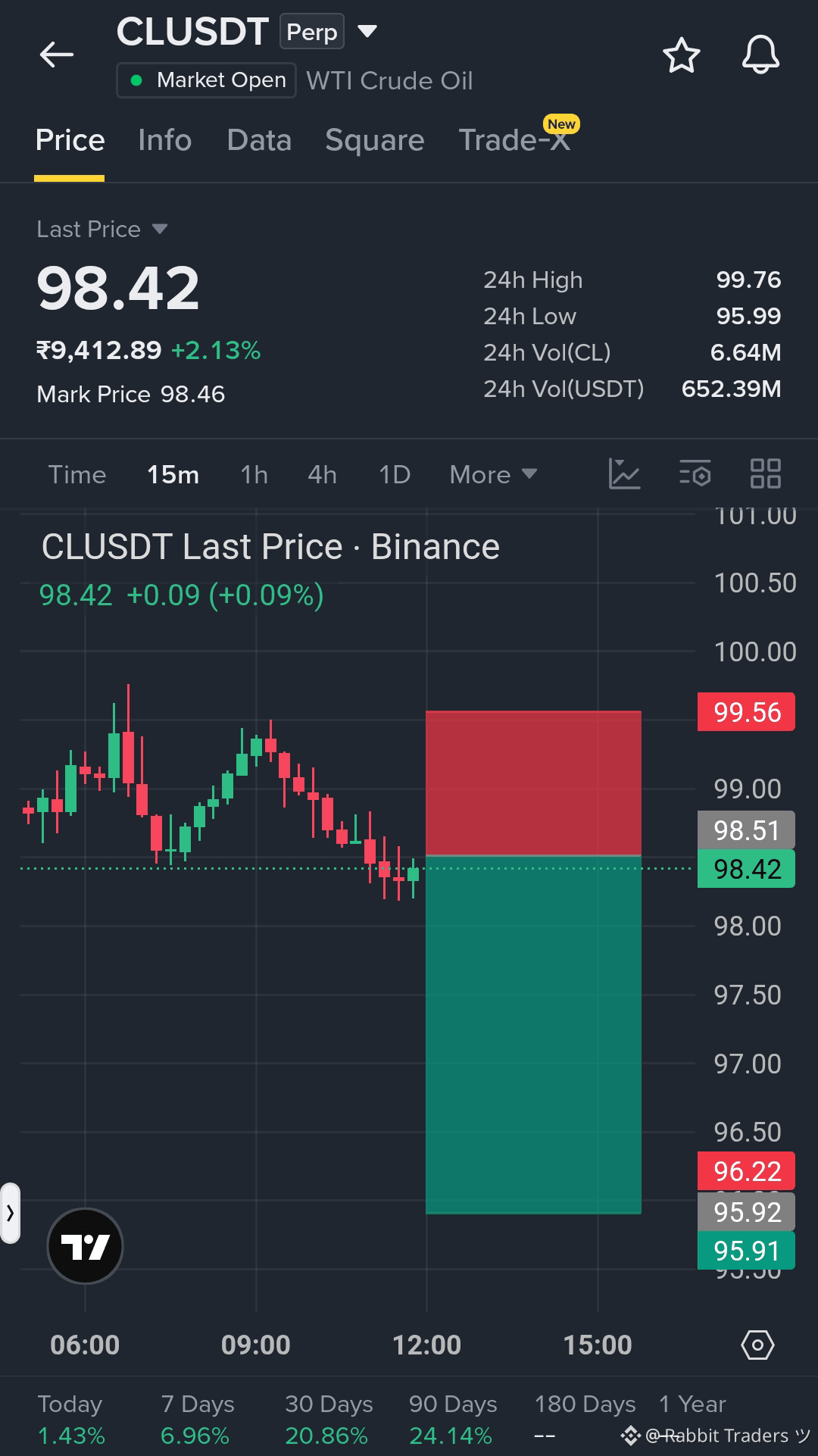
$CL / WTI Crude Oil Perp Short Setup 🔻
CLUSDT at 98.42, up +1.43% today but showing a clear rejection off the 24h high of 99.76.
📍 Entry: ~98.51
🛑 Stop Loss: 99.56
🎯 TP1: 96.85
🎯 TP2: 96.22
🎯 TP3: 95.91
Price has been making lower highs since the mid-session peak, losing the short-term uptrend structure. Zoom out though: 7D +6.96%, 30D +20.86%, 90D +24.14% this short is counter-trend on the bigger picture, so it reads more like a pullback play than a trend-following one.
⚠️ Not financial advice. Manage risk, respect your stop.
$CL #CrudeOil #WTI #short
{future}(CLUSDT)
$CL / WTI Crude Oil Perp Short Setup 🔻
CLUSDT at 98.42, up +1.43% today but showing a clear rejection off the 24h high of 99.76.
📍 Entry: ~98.51
🛑 Stop Loss: 99.56
🎯 TP1: 96.85
🎯 TP2: 96.22
🎯 TP3: 95.91
Price has been making lower highs since the mid-session peak, losing the short-term uptrend structure. Zoom out though: 7D +6.96%, 30D +20.86%, 90D +24.14% this short is counter-trend on the bigger picture, so it reads more like a pullback play than a trend-following one.
⚠️ Not financial advice. Manage risk, respect your stop.
$CL #CrudeOil #WTI #short
CLUSDT at 98.42, up +1.43% today but showing a clear rejection off the 24h high of 99.76.
📍 Entry: ~98.51
🛑 Stop Loss: 99.56
🎯 TP1: 96.85
🎯 TP2: 96.22
🎯 TP3: 95.91
Price has been making lower highs since the mid-session peak, losing the short-term uptrend structure. Zoom out though: 7D +6.96%, 30D +20.86%, 90D +24.14% this short is counter-trend on the bigger picture, so it reads more like a pullback play than a trend-following one.
⚠️ Not financial advice. Manage risk, respect your stop.
$CL #CrudeOil #WTI #short
147
Crude oil prices surged sharply during morning trading following escalating geopolitical tensions in the Middle East. Brent crude climbed 3% to reach $104.74 per barrel, while WTI jumped 2.8% to trade at $99.33 per barrel. The immediate catalyst was Saudi Arabia's precautionary shutdown of its critical East-West pipeline after an attack, coupled with the postponement of a key Gulf regional meeting.
This sudden supply disruption reignites acute market concerns over global energy security. With key transport infrastructure compromised in the world's leading oil-exporting region, the risk premium on crude is rapidly repricing higher, threatening to derail recent cooling trends in headline inflation metrics worldwide.
For broader financial markets, elevated oil prices present a renewed stagflationary headache. Persistent energy spikes directly feed into inflation expectations, likely forcing central banks to maintain restrictive interest rate policies for longer. This backdrop typically strengthens the US Dollar while exerting downward pressure on sovereign bonds and risk assets.
In the crypto sector, higher oil-driven macro uncertainty tends to tighten overall market liquidity. If inflationary pressures persist and delay anticipated rate cuts, institutional capital flows into risk-sensitive assets like $BTC may slow down, prompting traders to adopt a more defensive stance until geopolitical risks stabilize.
#CrudeOil #Geopolitics #EnergyMarkets
Crude oil prices surged sharply during morning trading following escalating geopolitical tensions in the Middle East. Brent crude climbed 3% to reach $104.74 per barrel, while WTI jumped 2.8% to trade at $99.33 per barrel. The immediate catalyst was Saudi Arabia's precautionary shutdown of its critical East-West pipeline after an attack, coupled with the postponement of a key Gulf regional meeting.
This sudden supply disruption reignites acute market concerns over global energy security. With key transport infrastructure compromised in the world's leading oil-exporting region, the risk premium on crude is rapidly repricing higher, threatening to derail recent cooling trends in headline inflation metrics worldwide.
For broader financial markets, elevated oil prices present a renewed stagflationary headache. Persistent energy spikes directly feed into inflation expectations, likely forcing central banks to maintain restrictive interest rate policies for longer. This backdrop typically strengthens the US Dollar while exerting downward pressure on sovereign bonds and risk assets.
In the crypto sector, higher oil-driven macro uncertainty tends to tighten overall market liquidity. If inflationary pressures persist and delay anticipated rate cuts, institutional capital flows into risk-sensitive assets like $BTC may slow down, prompting traders to adopt a more defensive stance until geopolitical risks stabilize.
#CrudeOil #Geopolitics #EnergyMarkets
This sudden supply disruption reignites acute market concerns over global energy security. With key transport infrastructure compromised in the world's leading oil-exporting region, the risk premium on crude is rapidly repricing higher, threatening to derail recent cooling trends in headline inflation metrics worldwide.
For broader financial markets, elevated oil prices present a renewed stagflationary headache. Persistent energy spikes directly feed into inflation expectations, likely forcing central banks to maintain restrictive interest rate policies for longer. This backdrop typically strengthens the US Dollar while exerting downward pressure on sovereign bonds and risk assets.
In the crypto sector, higher oil-driven macro uncertainty tends to tighten overall market liquidity. If inflationary pressures persist and delay anticipated rate cuts, institutional capital flows into risk-sensitive assets like $BTC may slow down, prompting traders to adopt a more defensive stance until geopolitical risks stabilize.
#CrudeOil #Geopolitics #EnergyMarkets
236

⚡ SAUDI PIPELINE SHUTDOWN SURGES $WTI CRUDE AS MIDDLE EAST SUPPLY CRISIS ESCALATES! 🚨
A targeted drone strike just forced Saudi Arabia to halt its critical 7M barrel-per-day East-West pipeline, instantly sparking a 3% surge in $WTI crude during Asian hours. 🌊 With tanker attacks raging near Hormuz and key diplomatic talks in Oman officially postponed, regional energy supply lines are facing severe geopolitical friction.
📊 Macro traders are already pricing in prolonged supply disruptions as global energy volatility ripples across risk assets. 💡 When systemic commodities squeeze, capital shifts rapidly to hedge macro tail-risk and inflation shocks. 💬 How are you positioning your portfolio as crude oil volatility spills into global markets? 👇
⚠️ Not financial advice. Always manage your risk. 🛡️
🏷️ #WTI #Macro #CrudeOil #MarketUpdate
⚡ 🦈
⚡ SAUDI PIPELINE SHUTDOWN SURGES $WTI CRUDE AS MIDDLE EAST SUPPLY CRISIS ESCALATES! 🚨
A targeted drone strike just forced Saudi Arabia to halt its critical 7M barrel-per-day East-West pipeline, instantly sparking a 3% surge in $WTI crude during Asian hours. 🌊 With tanker attacks raging near Hormuz and key diplomatic talks in Oman officially postponed, regional energy supply lines are facing severe geopolitical friction.
📊 Macro traders are already pricing in prolonged supply disruptions as global energy volatility ripples across risk assets. 💡 When systemic commodities squeeze, capital shifts rapidly to hedge macro tail-risk and inflation shocks. 💬 How are you positioning your portfolio as crude oil volatility spills into global markets? 👇
⚠️ Not financial advice. Always manage your risk. 🛡️
🏷️ #WTI #Macro #CrudeOil #MarketUpdate
⚡ 🦈
A targeted drone strike just forced Saudi Arabia to halt its critical 7M barrel-per-day East-West pipeline, instantly sparking a 3% surge in $WTI crude during Asian hours. 🌊 With tanker attacks raging near Hormuz and key diplomatic talks in Oman officially postponed, regional energy supply lines are facing severe geopolitical friction.
📊 Macro traders are already pricing in prolonged supply disruptions as global energy volatility ripples across risk assets. 💡 When systemic commodities squeeze, capital shifts rapidly to hedge macro tail-risk and inflation shocks. 💬 How are you positioning your portfolio as crude oil volatility spills into global markets? 👇
⚠️ Not financial advice. Always manage your risk. 🛡️
🏷️ #WTI #Macro #CrudeOil #MarketUpdate
⚡ 🦈
176

·
--
In his latest public remarks, former U.S. President Donald Trump said that both Russia and Ukraine have agreed not to attack each other’s energy infrastructure. After the news broke, the international crude oil market reacted swiftly: WTI and Brent both fell by about $1.4 in the short term, with prices hovering around $98.749 per barrel and $104.29 per barrel, respectively.
This development has drawn heightened market attention mainly because the Russia-Ukraine geopolitical situation has long been one of the biggest sources of uncertainty on the crude oil supply side. Previously, the market had widely priced in a relatively high geopolitical risk premium. If the two sides truly reach an unspoken understanding to pause attacks on energy facilities, it would mean that panic over possible short-term supply disruptions would cool down significantly.
From a broader macro-asset perspective, the rapid drop in oil prices helps ease persistently elevated inflation expectations, thereby reducing pressure on monetary policy faced by central banks in the U.S. and Europe. Softer commodity prices often also trigger temporary adjustments in Treasury yields and the U.S. dollar index, as overall risk-off sentiment in financial markets is undergoing a repricing.
For the crypto market, this is a mixed but overall neutral external signal. On the one hand, easing energy-inflation pressure is potentially positive for the macro liquidity environment. On the other hand, as risk-off sentiment fades, some short-term capital may return to weighing opportunities across different assets. For cryptocurrencies such as Bitcoin, further observation is needed to see whether liquidity can continue to follow through.⛽
#CrudeOil #Geopolitics #MacroEconomics
In his latest public remarks, former U.S. President Donald Trump said that both Russia and Ukraine have agreed not to attack each other’s energy infrastructure. After the news broke, the international crude oil market reacted swiftly: WTI and Brent both fell by about $1.4 in the short term, with prices hovering around $98.749 per barrel and $104.29 per barrel, respectively.
This development has drawn heightened market attention mainly because the Russia-Ukraine geopolitical situation has long been one of the biggest sources of uncertainty on the crude oil supply side. Previously, the market had widely priced in a relatively high geopolitical risk premium. If the two sides truly reach an unspoken understanding to pause attacks on energy facilities, it would mean that panic over possible short-term supply disruptions would cool down significantly.
From a broader macro-asset perspective, the rapid drop in oil prices helps ease persistently elevated inflation expectations, thereby reducing pressure on monetary policy faced by central banks in the U.S. and Europe. Softer commodity prices often also trigger temporary adjustments in Treasury yields and the U.S. dollar index, as overall risk-off sentiment in financial markets is undergoing a repricing.
For the crypto market, this is a mixed but overall neutral external signal. On the one hand, easing energy-inflation pressure is potentially positive for the macro liquidity environment. On the other hand, as risk-off sentiment fades, some short-term capital may return to weighing opportunities across different assets. For cryptocurrencies such as Bitcoin, further observation is needed to see whether liquidity can continue to follow through.⛽
#CrudeOil #Geopolitics #MacroEconomics
This development has drawn heightened market attention mainly because the Russia-Ukraine geopolitical situation has long been one of the biggest sources of uncertainty on the crude oil supply side. Previously, the market had widely priced in a relatively high geopolitical risk premium. If the two sides truly reach an unspoken understanding to pause attacks on energy facilities, it would mean that panic over possible short-term supply disruptions would cool down significantly.
From a broader macro-asset perspective, the rapid drop in oil prices helps ease persistently elevated inflation expectations, thereby reducing pressure on monetary policy faced by central banks in the U.S. and Europe. Softer commodity prices often also trigger temporary adjustments in Treasury yields and the U.S. dollar index, as overall risk-off sentiment in financial markets is undergoing a repricing.
For the crypto market, this is a mixed but overall neutral external signal. On the one hand, easing energy-inflation pressure is potentially positive for the macro liquidity environment. On the other hand, as risk-off sentiment fades, some short-term capital may return to weighing opportunities across different assets. For cryptocurrencies such as Bitcoin, further observation is needed to see whether liquidity can continue to follow through.⛽
#CrudeOil #Geopolitics #MacroEconomics
266

·
--
In his latest remarks, former U.S. President Donald Trump said that Russia and Ukraine have reached a temporary agreement to pause attacks targeting each other’s energy infrastructure. The move immediately triggered a wave of sell-offs across the global energy market, causing benchmark crude oil prices WTI and Brent to fall in tandem by 1.4 USD per barrel, down to 98.749 USD per barrel and 104.29 USD per barrel, respectively.
This information carries enormous significance in relieving a major bottleneck in the risk of disruptions to the global oil supply chain. Over the past period, concerns about strikes on oil refineries and gas pipelines have continuously kept geopolitical risk premiums at extraordinarily high levels, turning energy costs into a key burden that threatens to reignite inflationary pressure.
For traditional financial markets, the cooling of crude oil prices is a very positive signal. Lower energy prices help reduce expectations of consumer inflation (CPI), thereby easing pressure to keep interest rates high for an extended period from the U.S. Federal Reserve (Fed). This also cools government bond yields and supports the stock market’s recovery.
For the cryptocurrency market, easing macro pressure will create conditions for capital to return to riskier assets. When worries about inflation and tighter liquidity subside, $BTC along with leading crypto assets gain solid additional support to regain momentum in the short term.
#CrudeOil #Geopolitics #MacroEconomy
In his latest remarks, former U.S. President Donald Trump said that Russia and Ukraine have reached a temporary agreement to pause attacks targeting each other’s energy infrastructure. The move immediately triggered a wave of sell-offs across the global energy market, causing benchmark crude oil prices WTI and Brent to fall in tandem by 1.4 USD per barrel, down to 98.749 USD per barrel and 104.29 USD per barrel, respectively.
This information carries enormous significance in relieving a major bottleneck in the risk of disruptions to the global oil supply chain. Over the past period, concerns about strikes on oil refineries and gas pipelines have continuously kept geopolitical risk premiums at extraordinarily high levels, turning energy costs into a key burden that threatens to reignite inflationary pressure.
For traditional financial markets, the cooling of crude oil prices is a very positive signal. Lower energy prices help reduce expectations of consumer inflation (CPI), thereby easing pressure to keep interest rates high for an extended period from the U.S. Federal Reserve (Fed). This also cools government bond yields and supports the stock market’s recovery.
For the cryptocurrency market, easing macro pressure will create conditions for capital to return to riskier assets. When worries about inflation and tighter liquidity subside, $BTC along with leading crypto assets gain solid additional support to regain momentum in the short term.
#CrudeOil #Geopolitics #MacroEconomy
This information carries enormous significance in relieving a major bottleneck in the risk of disruptions to the global oil supply chain. Over the past period, concerns about strikes on oil refineries and gas pipelines have continuously kept geopolitical risk premiums at extraordinarily high levels, turning energy costs into a key burden that threatens to reignite inflationary pressure.
For traditional financial markets, the cooling of crude oil prices is a very positive signal. Lower energy prices help reduce expectations of consumer inflation (CPI), thereby easing pressure to keep interest rates high for an extended period from the U.S. Federal Reserve (Fed). This also cools government bond yields and supports the stock market’s recovery.
For the cryptocurrency market, easing macro pressure will create conditions for capital to return to riskier assets. When worries about inflation and tighter liquidity subside, $BTC along with leading crypto assets gain solid additional support to regain momentum in the short term.
#CrudeOil #Geopolitics #MacroEconomy
186
·
--
US Energy Secretary Jennifer Granholm has just issued an official announcement that Washington will begin replenishing the Strategic Petroleum Reserve (SPR) within the next few months. At the same time, spot WTI and Brent crude oil prices continue to hover around high levels of 99.47 USD per barrel and 105.14 USD per barrel, respectively, while Canada’s August CPI data unexpectedly showed a 0.1% drop versus a flat forecast of 0%.
The announcement of the US plan to rebuild the SPR creates a firm support floor for the global energy market, even as inflation indicators cool in certain countries such as Canada. With oil prices staying close to the 100 USD per barrel mark, concerns that core inflation pressures could re-emerge in the coming quarter become more evident—especially since strategic supply is no longer as plentifully released to the market as in earlier periods.
Traditional financial markets are reacting cautiously to the prospect that energy costs may prolong the period of monetary tightening. Pressure from selloffs in UK government bonds continues to build, pushing the 2-year yield up by 10 basis points to 4.918%, indicating that investors are still pricing in interest rates remaining high for longer than expected.
For the crypto market, pressure from global bond yields and the risk of energy-driven inflation could continue to suppress the flow of new liquidity into $BTC. However, if the CPI cooling trend spreads from Canada to other major economies, investor sentiment may stabilize soon ahead of the next interest-rate decisions. #MacroEconomy #CrudeOil #InflationWatch
US Energy Secretary Jennifer Granholm has just issued an official announcement that Washington will begin replenishing the Strategic Petroleum Reserve (SPR) within the next few months. At the same time, spot WTI and Brent crude oil prices continue to hover around high levels of 99.47 USD per barrel and 105.14 USD per barrel, respectively, while Canada’s August CPI data unexpectedly showed a 0.1% drop versus a flat forecast of 0%.
The announcement of the US plan to rebuild the SPR creates a firm support floor for the global energy market, even as inflation indicators cool in certain countries such as Canada. With oil prices staying close to the 100 USD per barrel mark, concerns that core inflation pressures could re-emerge in the coming quarter become more evident—especially since strategic supply is no longer as plentifully released to the market as in earlier periods.
Traditional financial markets are reacting cautiously to the prospect that energy costs may prolong the period of monetary tightening. Pressure from selloffs in UK government bonds continues to build, pushing the 2-year yield up by 10 basis points to 4.918%, indicating that investors are still pricing in interest rates remaining high for longer than expected.
For the crypto market, pressure from global bond yields and the risk of energy-driven inflation could continue to suppress the flow of new liquidity into $BTC . However, if the CPI cooling trend spreads from Canada to other major economies, investor sentiment may stabilize soon ahead of the next interest-rate decisions. #MacroEconomy #CrudeOil #InflationWatch
The announcement of the US plan to rebuild the SPR creates a firm support floor for the global energy market, even as inflation indicators cool in certain countries such as Canada. With oil prices staying close to the 100 USD per barrel mark, concerns that core inflation pressures could re-emerge in the coming quarter become more evident—especially since strategic supply is no longer as plentifully released to the market as in earlier periods.
Traditional financial markets are reacting cautiously to the prospect that energy costs may prolong the period of monetary tightening. Pressure from selloffs in UK government bonds continues to build, pushing the 2-year yield up by 10 basis points to 4.918%, indicating that investors are still pricing in interest rates remaining high for longer than expected.
For the crypto market, pressure from global bond yields and the risk of energy-driven inflation could continue to suppress the flow of new liquidity into $BTC . However, if the CPI cooling trend spreads from Canada to other major economies, investor sentiment may stabilize soon ahead of the next interest-rate decisions. #MacroEconomy #CrudeOil #InflationWatch
163

According to the Associated Press, citing two regional officials, a key 1,200-kilometer “east-west oil pipeline” in Saudi Arabia was attacked recently. It is expected that most operations will be suspended for repairs over the next three to five weeks, including fixing the main pumping station. The pipeline’s maximum daily throughput capacity is as high as 7 million barrels, serving as Saudi Arabia’s strategic lifeline for rerouting crude oil to the Red Sea while bypassing the Strait of Hormuz. Triggered by this sudden supply disruption, international oil prices surged sharply. WTI crude jumped more than 4% intraday and broke above the $100 level, reaching a multi-month high of $104.95 per barrel. Brent crude also rose in tandem, climbing 4.00% to $105.81 per barrel.
This substantial escalation in the geopolitical conflict has directly shattered expectations for supply-demand balance in the crude oil market. The pipeline was originally a key security “valve” for Saudi Arabia to address disruptions in shipping through the Strait of Hormuz. Now even the backup route has been damaged, meaning the vulnerability of crude oil exports from the Middle East has been amplified without limit. A multi-week repair cycle will block supplies of millions of barrels of crude oil each day worldwide, and concerns about a renewed bout of stagflation quickly overwhelmed the prior pessimistic outlook about slowing global demand.
Runaway energy prices pose a grave threat to the broader macro-financial environment. Oil prices returning to three digits would directly raise inflation expectations and significantly reduce the room for the Federal Reserve and other major global central banks to cut rates, potentially even forcing the tightening cycle to last longer. U.S. Treasury yields face upward pressure, while dollar liquidity tightens. At the same time, London Metal Exchange (LME) copper prices in commodities fell 1.8% to below $14,000 per metric ton, and spot gold also came under pressure, retreating to $4,275.85 per ounce. Market risk-aversion sentiment is gradually shifting toward deeper concerns about stagflation in the economy and tighter liquidity.
For the cryptocurrency market, the surge in oil prices causing an inflation rebound is far from good news. Against worsening expectations for macro liquidity and delayed rate-cut expectations from central banks, high-beta risk assets are likely to be hit first by valuation compression pressures. In the short term, funds may be more inclined to rotate back into cash and traditional hedging instruments; crypto assets, led by $BTC , could face risks of periodic liquidity pullbacks and heightened volatility. Investors should be alert to downward pressure arising from the spread of macro systemic risk.
#CrudeOil #Geopolitics #MacroEconomics
According to the Associated Press, citing two regional officials, a key 1,200-kilometer “east-west oil pipeline” in Saudi Arabia was attacked recently. It is expected that most operations will be suspended for repairs over the next three to five weeks, including fixing the main pumping station. The pipeline’s maximum daily throughput capacity is as high as 7 million barrels, serving as Saudi Arabia’s strategic lifeline for rerouting crude oil to the Red Sea while bypassing the Strait of Hormuz. Triggered by this sudden supply disruption, international oil prices surged sharply. WTI crude jumped more than 4% intraday and broke above the $100 level, reaching a multi-month high of $104.95 per barrel. Brent crude also rose in tandem, climbing 4.00% to $105.81 per barrel.
This substantial escalation in the geopolitical conflict has directly shattered expectations for supply-demand balance in the crude oil market. The pipeline was originally a key security “valve” for Saudi Arabia to address disruptions in shipping through the Strait of Hormuz. Now even the backup route has been damaged, meaning the vulnerability of crude oil exports from the Middle East has been amplified without limit. A multi-week repair cycle will block supplies of millions of barrels of crude oil each day worldwide, and concerns about a renewed bout of stagflation quickly overwhelmed the prior pessimistic outlook about slowing global demand.
Runaway energy prices pose a grave threat to the broader macro-financial environment. Oil prices returning to three digits would directly raise inflation expectations and significantly reduce the room for the Federal Reserve and other major global central banks to cut rates, potentially even forcing the tightening cycle to last longer. U.S. Treasury yields face upward pressure, while dollar liquidity tightens. At the same time, London Metal Exchange (LME) copper prices in commodities fell 1.8% to below $14,000 per metric ton, and spot gold also came under pressure, retreating to $4,275.85 per ounce. Market risk-aversion sentiment is gradually shifting toward deeper concerns about stagflation in the economy and tighter liquidity.
For the cryptocurrency market, the surge in oil prices causing an inflation rebound is far from good news. Against worsening expectations for macro liquidity and delayed rate-cut expectations from central banks, high-beta risk assets are likely to be hit first by valuation compression pressures. In the short term, funds may be more inclined to rotate back into cash and traditional hedging instruments; crypto assets, led by $BTC , could face risks of periodic liquidity pullbacks and heightened volatility. Investors should be alert to downward pressure arising from the spread of macro systemic risk.
#CrudeOil #Geopolitics #MacroEconomics
This substantial escalation in the geopolitical conflict has directly shattered expectations for supply-demand balance in the crude oil market. The pipeline was originally a key security “valve” for Saudi Arabia to address disruptions in shipping through the Strait of Hormuz. Now even the backup route has been damaged, meaning the vulnerability of crude oil exports from the Middle East has been amplified without limit. A multi-week repair cycle will block supplies of millions of barrels of crude oil each day worldwide, and concerns about a renewed bout of stagflation quickly overwhelmed the prior pessimistic outlook about slowing global demand.
Runaway energy prices pose a grave threat to the broader macro-financial environment. Oil prices returning to three digits would directly raise inflation expectations and significantly reduce the room for the Federal Reserve and other major global central banks to cut rates, potentially even forcing the tightening cycle to last longer. U.S. Treasury yields face upward pressure, while dollar liquidity tightens. At the same time, London Metal Exchange (LME) copper prices in commodities fell 1.8% to below $14,000 per metric ton, and spot gold also came under pressure, retreating to $4,275.85 per ounce. Market risk-aversion sentiment is gradually shifting toward deeper concerns about stagflation in the economy and tighter liquidity.
For the cryptocurrency market, the surge in oil prices causing an inflation rebound is far from good news. Against worsening expectations for macro liquidity and delayed rate-cut expectations from central banks, high-beta risk assets are likely to be hit first by valuation compression pressures. In the short term, funds may be more inclined to rotate back into cash and traditional hedging instruments; crypto assets, led by $BTC , could face risks of periodic liquidity pullbacks and heightened volatility. Investors should be alert to downward pressure arising from the spread of macro systemic risk.
#CrudeOil #Geopolitics #MacroEconomics
8
·
--
QatarEnergy has recently launched a crude oil spot tender, planning to sell Al-Shaheen, Qatar Marine Oil and Qatar Land Oil from Qatar’s ports on a free-on-board (FOB) basis. The shipment window is set for October and November. Trade sources say that around 500,000 barrels are already known to be included in the sales plan, but the tender’s overall supply scope has not yet been fully disclosed. Final bids are due next Tuesday. The shipment ports for this batch are located on the inner side of the Strait of Hormuz, a strategically crucial location.
Against the backdrop of ongoing geopolitical tensions in the Middle East that continue to raise concerns about energy corridors, every move along the Strait of Hormuz draws close attention from crude oil traders. Qatar’s timely progression of its routine fourth-quarter crude spot tender, as scheduled, to a certain extent reflects that the loading and export rhythm among major Middle East oil-producing countries remains stable for now. Market participants are closely watching the final level of premiums/discounts in this round of tender to gauge the true strength of Asian buyers’ demand for fourth-quarter spot crude.
From a broader macro perspective, expectations for crude oil supply and demand and the geopolitical risk premium are directly linked to global inflation expectations. If Middle East crude logistics and spot supply stay steady, oil price fluctuations are likely to remain within a relatively manageable range, thereby reducing pressure for a secondary rebound in inflation; otherwise, if supply chains are disrupted, energy price volatility could again throw global central banks’ rate-cut paths off track, which would in turn affect the U.S. dollar index and U.S. Treasury yields.
For the crypto market, the steady flow of Middle East energy helps maintain macroeconomic certainty. When commodity markets do not experience sharp swings, risk assets such as $BTC are more likely to move in line with their own liquidity rhythms. Investors are currently neutral and watching from the sidelines, waiting for next week’s spot tender results to see whether the energy market will bring any new marginal impact on overall risk-asset sentiment. #CrudeOil #QatarEnergy #EnergyMarket
QatarEnergy has recently launched a crude oil spot tender, planning to sell Al-Shaheen, Qatar Marine Oil and Qatar Land Oil from Qatar’s ports on a free-on-board (FOB) basis. The shipment window is set for October and November. Trade sources say that around 500,000 barrels are already known to be included in the sales plan, but the tender’s overall supply scope has not yet been fully disclosed. Final bids are due next Tuesday. The shipment ports for this batch are located on the inner side of the Strait of Hormuz, a strategically crucial location.
Against the backdrop of ongoing geopolitical tensions in the Middle East that continue to raise concerns about energy corridors, every move along the Strait of Hormuz draws close attention from crude oil traders. Qatar’s timely progression of its routine fourth-quarter crude spot tender, as scheduled, to a certain extent reflects that the loading and export rhythm among major Middle East oil-producing countries remains stable for now. Market participants are closely watching the final level of premiums/discounts in this round of tender to gauge the true strength of Asian buyers’ demand for fourth-quarter spot crude.
From a broader macro perspective, expectations for crude oil supply and demand and the geopolitical risk premium are directly linked to global inflation expectations. If Middle East crude logistics and spot supply stay steady, oil price fluctuations are likely to remain within a relatively manageable range, thereby reducing pressure for a secondary rebound in inflation; otherwise, if supply chains are disrupted, energy price volatility could again throw global central banks’ rate-cut paths off track, which would in turn affect the U.S. dollar index and U.S. Treasury yields.
For the crypto market, the steady flow of Middle East energy helps maintain macroeconomic certainty. When commodity markets do not experience sharp swings, risk assets such as $BTC are more likely to move in line with their own liquidity rhythms. Investors are currently neutral and watching from the sidelines, waiting for next week’s spot tender results to see whether the energy market will bring any new marginal impact on overall risk-asset sentiment. #CrudeOil #QatarEnergy #EnergyMarket
Against the backdrop of ongoing geopolitical tensions in the Middle East that continue to raise concerns about energy corridors, every move along the Strait of Hormuz draws close attention from crude oil traders. Qatar’s timely progression of its routine fourth-quarter crude spot tender, as scheduled, to a certain extent reflects that the loading and export rhythm among major Middle East oil-producing countries remains stable for now. Market participants are closely watching the final level of premiums/discounts in this round of tender to gauge the true strength of Asian buyers’ demand for fourth-quarter spot crude.
From a broader macro perspective, expectations for crude oil supply and demand and the geopolitical risk premium are directly linked to global inflation expectations. If Middle East crude logistics and spot supply stay steady, oil price fluctuations are likely to remain within a relatively manageable range, thereby reducing pressure for a secondary rebound in inflation; otherwise, if supply chains are disrupted, energy price volatility could again throw global central banks’ rate-cut paths off track, which would in turn affect the U.S. dollar index and U.S. Treasury yields.
For the crypto market, the steady flow of Middle East energy helps maintain macroeconomic certainty. When commodity markets do not experience sharp swings, risk assets such as $BTC are more likely to move in line with their own liquidity rhythms. Investors are currently neutral and watching from the sidelines, waiting for next week’s spot tender results to see whether the energy market will bring any new marginal impact on overall risk-asset sentiment. #CrudeOil #QatarEnergy #EnergyMarket
5
·
--
US Energy Secretary Jennifer Granholm recently said that the 7-day average volume of crude oil shipments through the Strait of Hormuz is increasing, and that this upward trend is expected to continue.
As one of the world’s most important energy routes, conditions in the Strait of Hormuz directly affect the Middle East situation and the global energy supply. The authorities’ release of signals indicating a rebound in crude oil shipment volumes, to some extent, reflects that the shipping cadence along this critical waterway is adjusting, adding a new dimension to prior expectations of a tightly constrained crude oil supply chain.
From a traditional macro perspective, changes in crude oil liquidity are directly linked to the direction of energy prices. If supply and transport remain smooth, it can help ease market concerns about a resurgence of secondary inflation, which in turn could trigger knock-on effects for the US Dollar Index, US Treasury yields, and overall expectations for macro liquidity—though developments in geopolitical games still need to be continuously monitored.
For the crypto market, energy costs and macro inflation expectations have long been indirect factors influencing the Federal Reserve’s policy path. Developments in the crude oil market often transmit through sentiment to risk assets, including $BTC . At present, liquidity is broadly in a wait-and-see mode, and the market direction still depends on the subsequent combined evolution of the macro environment.
#CrudeOil #Geopolitics #Energy
US Energy Secretary Jennifer Granholm recently said that the 7-day average volume of crude oil shipments through the Strait of Hormuz is increasing, and that this upward trend is expected to continue.
As one of the world’s most important energy routes, conditions in the Strait of Hormuz directly affect the Middle East situation and the global energy supply. The authorities’ release of signals indicating a rebound in crude oil shipment volumes, to some extent, reflects that the shipping cadence along this critical waterway is adjusting, adding a new dimension to prior expectations of a tightly constrained crude oil supply chain.
From a traditional macro perspective, changes in crude oil liquidity are directly linked to the direction of energy prices. If supply and transport remain smooth, it can help ease market concerns about a resurgence of secondary inflation, which in turn could trigger knock-on effects for the US Dollar Index, US Treasury yields, and overall expectations for macro liquidity—though developments in geopolitical games still need to be continuously monitored.
For the crypto market, energy costs and macro inflation expectations have long been indirect factors influencing the Federal Reserve’s policy path. Developments in the crude oil market often transmit through sentiment to risk assets, including $BTC . At present, liquidity is broadly in a wait-and-see mode, and the market direction still depends on the subsequent combined evolution of the macro environment.
#CrudeOil #Geopolitics #Energy
As one of the world’s most important energy routes, conditions in the Strait of Hormuz directly affect the Middle East situation and the global energy supply. The authorities’ release of signals indicating a rebound in crude oil shipment volumes, to some extent, reflects that the shipping cadence along this critical waterway is adjusting, adding a new dimension to prior expectations of a tightly constrained crude oil supply chain.
From a traditional macro perspective, changes in crude oil liquidity are directly linked to the direction of energy prices. If supply and transport remain smooth, it can help ease market concerns about a resurgence of secondary inflation, which in turn could trigger knock-on effects for the US Dollar Index, US Treasury yields, and overall expectations for macro liquidity—though developments in geopolitical games still need to be continuously monitored.
For the crypto market, energy costs and macro inflation expectations have long been indirect factors influencing the Federal Reserve’s policy path. Developments in the crude oil market often transmit through sentiment to risk assets, including $BTC . At present, liquidity is broadly in a wait-and-see mode, and the market direction still depends on the subsequent combined evolution of the macro environment.
#CrudeOil #Geopolitics #Energy
US Energy Secretary Jennifer Granholm recently said that the 7-day average crude oil shipping volume through the Strait of Hormuz is trending upward, and she expects this trend to continue. As a global energy chokepoint, the strait carries roughly one-fifth of the world’s oil consumption, and any disruption in traffic immediately affects the nerves of geopolitics and the macroeconomy.
From a macro perspective, the increase in shipping volume may appear to ease concerns about supply shortages, but at a deeper level it reflects the underlying strategic game surrounding the situation in the Middle East. Against the backdrop of ongoing friction in the region, a rebound in shipping intensity may prompt countries to accelerate the building of safety stock to guard against supply interruptions. This passive replenishment driven by risk aversion does not fundamentally eliminate the structural supply premium in the crude oil market.
For traditional financial markets, if oil prices remain sticky at high levels, they will directly lift inflation expectations and delay the pace of central bank rate cuts. Persistent pressure from energy costs could cause US Treasury yields to rebound again, supporting the US dollar index, which in turn would significantly weigh on valuations of US stocks and commodities. Concerns about stagflation may well return.
In the cryptocurrency market, risk assets such as $BTC are extremely sensitive to the tightening of global liquidity. Continued volatility in energy markets and sticky inflation expectations will further delay the arrival of a liquidity easing turning point. Investors should remain cautious; in a period marked by high macro uncertainty, they need to be alert to the risk of a second leg down in risk assets.
#CrudeOil #Geopolitics #EnergyMarket
US Energy Secretary Jennifer Granholm recently said that the 7-day average crude oil shipping volume through the Strait of Hormuz is trending upward, and she expects this trend to continue. As a global energy chokepoint, the strait carries roughly one-fifth of the world’s oil consumption, and any disruption in traffic immediately affects the nerves of geopolitics and the macroeconomy.
From a macro perspective, the increase in shipping volume may appear to ease concerns about supply shortages, but at a deeper level it reflects the underlying strategic game surrounding the situation in the Middle East. Against the backdrop of ongoing friction in the region, a rebound in shipping intensity may prompt countries to accelerate the building of safety stock to guard against supply interruptions. This passive replenishment driven by risk aversion does not fundamentally eliminate the structural supply premium in the crude oil market.
For traditional financial markets, if oil prices remain sticky at high levels, they will directly lift inflation expectations and delay the pace of central bank rate cuts. Persistent pressure from energy costs could cause US Treasury yields to rebound again, supporting the US dollar index, which in turn would significantly weigh on valuations of US stocks and commodities. Concerns about stagflation may well return.
In the cryptocurrency market, risk assets such as $BTC are extremely sensitive to the tightening of global liquidity. Continued volatility in energy markets and sticky inflation expectations will further delay the arrival of a liquidity easing turning point. Investors should remain cautious; in a period marked by high macro uncertainty, they need to be alert to the risk of a second leg down in risk assets.
#CrudeOil #Geopolitics #EnergyMarket
From a macro perspective, the increase in shipping volume may appear to ease concerns about supply shortages, but at a deeper level it reflects the underlying strategic game surrounding the situation in the Middle East. Against the backdrop of ongoing friction in the region, a rebound in shipping intensity may prompt countries to accelerate the building of safety stock to guard against supply interruptions. This passive replenishment driven by risk aversion does not fundamentally eliminate the structural supply premium in the crude oil market.
For traditional financial markets, if oil prices remain sticky at high levels, they will directly lift inflation expectations and delay the pace of central bank rate cuts. Persistent pressure from energy costs could cause US Treasury yields to rebound again, supporting the US dollar index, which in turn would significantly weigh on valuations of US stocks and commodities. Concerns about stagflation may well return.
In the cryptocurrency market, risk assets such as $BTC are extremely sensitive to the tightening of global liquidity. Continued volatility in energy markets and sticky inflation expectations will further delay the arrival of a liquidity easing turning point. Investors should remain cautious; in a period marked by high macro uncertainty, they need to be alert to the risk of a second leg down in risk assets.
#CrudeOil #Geopolitics #EnergyMarket
97
Against the backdrop of attacks on energy infrastructure in the Middle East and disruptions to shipping routes, international oil prices have surged sharply, directly weighing on the opening of major European stock indices across the board. As of the time of writing, the STOXX 50 in Europe is down 0.6%, Germany’s DAX is down 0.3%, France’s CAC 40 is down 0.4%, Italy’s FTSE MIB is down 0.5%, Spain’s IBEX is down 0.3%, while only the UK’s FTSE 100 is up slightly by 0.3%.
The surge in oil prices is not an isolated event; it has seriously undermined the market’s earlier optimistic consensus that inflation would gradually cool. With an energy supply shock layered on top of the recent hot inflation data from the United States, market expectations for the Federal Reserve to raise rates at its policy meeting this week have jumped to around 87%. For policymakers, the return of input-driven inflationary pressure implies that “higher for longer” will inevitably evolve into a more tightening policy path.
On the macro-liquidity front, elevated energy costs are lifting inflation expectations, forcing global major sovereign bond yields to rise again, while the U.S. dollar index is also being strongly supported. The dual pressure on both the stock and bond markets is accelerating the contraction of global liquidity. Meanwhile, valuation bubbles that had been supported by expectations of easier policy are now facing the risk of being relentlessly squeezed.
For high-risk assets such as cryptocurrencies, the deterioration in the macro-liquidity environment will be a material negative factor. Ahead of the Federal Reserve’s decision, risk-averse sentiment has risen markedly; risk appetite has been suppressed. The broader crypto market and $BTC face severe challenges from liquidity withdrawal and intensified short-term volatility. Investors should remain highly alert to downside risks stemming from policy tightening beyond expectations.
#CrudeOil #Inflation #FedRateDecision
Against the backdrop of attacks on energy infrastructure in the Middle East and disruptions to shipping routes, international oil prices have surged sharply, directly weighing on the opening of major European stock indices across the board. As of the time of writing, the STOXX 50 in Europe is down 0.6%, Germany’s DAX is down 0.3%, France’s CAC 40 is down 0.4%, Italy’s FTSE MIB is down 0.5%, Spain’s IBEX is down 0.3%, while only the UK’s FTSE 100 is up slightly by 0.3%.
The surge in oil prices is not an isolated event; it has seriously undermined the market’s earlier optimistic consensus that inflation would gradually cool. With an energy supply shock layered on top of the recent hot inflation data from the United States, market expectations for the Federal Reserve to raise rates at its policy meeting this week have jumped to around 87%. For policymakers, the return of input-driven inflationary pressure implies that “higher for longer” will inevitably evolve into a more tightening policy path.
On the macro-liquidity front, elevated energy costs are lifting inflation expectations, forcing global major sovereign bond yields to rise again, while the U.S. dollar index is also being strongly supported. The dual pressure on both the stock and bond markets is accelerating the contraction of global liquidity. Meanwhile, valuation bubbles that had been supported by expectations of easier policy are now facing the risk of being relentlessly squeezed.
For high-risk assets such as cryptocurrencies, the deterioration in the macro-liquidity environment will be a material negative factor. Ahead of the Federal Reserve’s decision, risk-averse sentiment has risen markedly; risk appetite has been suppressed. The broader crypto market and $BTC face severe challenges from liquidity withdrawal and intensified short-term volatility. Investors should remain highly alert to downside risks stemming from policy tightening beyond expectations.
#CrudeOil #Inflation #FedRateDecision
The surge in oil prices is not an isolated event; it has seriously undermined the market’s earlier optimistic consensus that inflation would gradually cool. With an energy supply shock layered on top of the recent hot inflation data from the United States, market expectations for the Federal Reserve to raise rates at its policy meeting this week have jumped to around 87%. For policymakers, the return of input-driven inflationary pressure implies that “higher for longer” will inevitably evolve into a more tightening policy path.
On the macro-liquidity front, elevated energy costs are lifting inflation expectations, forcing global major sovereign bond yields to rise again, while the U.S. dollar index is also being strongly supported. The dual pressure on both the stock and bond markets is accelerating the contraction of global liquidity. Meanwhile, valuation bubbles that had been supported by expectations of easier policy are now facing the risk of being relentlessly squeezed.
For high-risk assets such as cryptocurrencies, the deterioration in the macro-liquidity environment will be a material negative factor. Ahead of the Federal Reserve’s decision, risk-averse sentiment has risen markedly; risk appetite has been suppressed. The broader crypto market and $BTC face severe challenges from liquidity withdrawal and intensified short-term volatility. Investors should remain highly alert to downside risks stemming from policy tightening beyond expectations.
#CrudeOil #Inflation #FedRateDecision
56

Saudi Aramco has officially confirmed that, following an attack by an Iraqi drone, it has shut down the East–West key oil pipeline connecting inland oilfields to the Red Sea Yanbu port as a precaution. At least four refineries in Asia are currently urgently seeking an official clarification, but Saudi authorities have yet to disclose the extent of the damage and a restoration timetable. The renewed real-world impact of geopolitical conflict on the Middle East’s energy lifeline has once again drawn market attention.
From a technical and supply-chain perspective, the interruption of the Yanbu port pipeline further weakens route scheduling flexibility for Asian buyers. Against the backdrop of pressure already weighing on the Red Sea shipping lane, a localized disruption in energy supply may, in the short term, increase the risk premium for Brent crude. Crude prices have shown strong resilience against declines around key technical support levels, suggesting the possibility of forming a bottoming-up pattern.
For traditional financial markets, while oil-price spikes driven by rising geopolitical tensions may temporarily disturb inflation expectations, in terms of commodity liquidity circulation, as long as crude prices do not experience an uncontrolled, one-way surge, geopolitical risk may instead accelerate the shift of safe-haven capital into highly liquid assets. As the global energy basis gradually converges, overall risk appetite in global markets has not been materially damaged, and cross-market funds continue to actively look for structural long opportunities.
For the crypto market, short-term safe-haven shocks caused by geopolitical news are often excellent technical entry points for bargain buying. After core crypto assets such as $BTC digest macro geopolitical noise, the holder and trading-structure further consolidates, with funds moving from traditional safe-haven channels toward on-chain, high-certainty targets. As long as the macro liquidity backdrop remains loose, brief external disruptions instead provide ample momentum to break through resistance levels.⚡
#CrudeOil #Geopolitics #EnergySupply #CryptoMarket
Saudi Aramco has officially confirmed that, following an attack by an Iraqi drone, it has shut down the East–West key oil pipeline connecting inland oilfields to the Red Sea Yanbu port as a precaution. At least four refineries in Asia are currently urgently seeking an official clarification, but Saudi authorities have yet to disclose the extent of the damage and a restoration timetable. The renewed real-world impact of geopolitical conflict on the Middle East’s energy lifeline has once again drawn market attention.
From a technical and supply-chain perspective, the interruption of the Yanbu port pipeline further weakens route scheduling flexibility for Asian buyers. Against the backdrop of pressure already weighing on the Red Sea shipping lane, a localized disruption in energy supply may, in the short term, increase the risk premium for Brent crude. Crude prices have shown strong resilience against declines around key technical support levels, suggesting the possibility of forming a bottoming-up pattern.
For traditional financial markets, while oil-price spikes driven by rising geopolitical tensions may temporarily disturb inflation expectations, in terms of commodity liquidity circulation, as long as crude prices do not experience an uncontrolled, one-way surge, geopolitical risk may instead accelerate the shift of safe-haven capital into highly liquid assets. As the global energy basis gradually converges, overall risk appetite in global markets has not been materially damaged, and cross-market funds continue to actively look for structural long opportunities.
For the crypto market, short-term safe-haven shocks caused by geopolitical news are often excellent technical entry points for bargain buying. After core crypto assets such as $BTC digest macro geopolitical noise, the holder and trading-structure further consolidates, with funds moving from traditional safe-haven channels toward on-chain, high-certainty targets. As long as the macro liquidity backdrop remains loose, brief external disruptions instead provide ample momentum to break through resistance levels.⚡
#CrudeOil #Geopolitics #EnergySupply #CryptoMarket
From a technical and supply-chain perspective, the interruption of the Yanbu port pipeline further weakens route scheduling flexibility for Asian buyers. Against the backdrop of pressure already weighing on the Red Sea shipping lane, a localized disruption in energy supply may, in the short term, increase the risk premium for Brent crude. Crude prices have shown strong resilience against declines around key technical support levels, suggesting the possibility of forming a bottoming-up pattern.
For traditional financial markets, while oil-price spikes driven by rising geopolitical tensions may temporarily disturb inflation expectations, in terms of commodity liquidity circulation, as long as crude prices do not experience an uncontrolled, one-way surge, geopolitical risk may instead accelerate the shift of safe-haven capital into highly liquid assets. As the global energy basis gradually converges, overall risk appetite in global markets has not been materially damaged, and cross-market funds continue to actively look for structural long opportunities.
For the crypto market, short-term safe-haven shocks caused by geopolitical news are often excellent technical entry points for bargain buying. After core crypto assets such as $BTC digest macro geopolitical noise, the holder and trading-structure further consolidates, with funds moving from traditional safe-haven channels toward on-chain, high-certainty targets. As long as the macro liquidity backdrop remains loose, brief external disruptions instead provide ample momentum to break through resistance levels.⚡
#CrudeOil #Geopolitics #EnergySupply #CryptoMarket
116
·
--
Saudi Aramco has just announced a temporary shutdown of the East-West pipeline connecting domestic oil fields to the Red Sea following a drone attack launched from Iraq. This preventive measure has affected the Yanbu export port, putting major oil refineries in Asia in a state of waiting for confirmation information on delivery progress, after they have not yet received detailed feedback on the extent of the damage.
The incident is heightening serious concerns about global energy security amid the already heavy pressure on the vital shipping routes around the Middle East. According to Kpler, shutting down the East-West pipeline significantly reduces the flexibility of Asian importers, causing higher transportation costs and increased risks of supply disruptions, casting a shadow over expectations for regional economic recovery.
On international financial markets, escalating geopolitical tensions are triggering a risk-averse mindset. Crude oil prices may be at risk of rebounding sharply, directly putting pressure on the global inflation equation and the interest-rate-cutting path of central banks, while also providing support for traditional safe-haven assets such as the USD and gold.
For the crypto market, pressure from energy prices and macroeconomic instability may cause speculative capital flows to become more cautious in the short term. $BTC and other risk assets are likely to face bouts of liquidity volatility as investors prioritize capital preservation amid unpredictable variables from the Middle East. ⚠️
#CrudeOil #Geopolitics #MiddleEast #EnergyCrisis #MacroEconomy
Saudi Aramco has just announced a temporary shutdown of the East-West pipeline connecting domestic oil fields to the Red Sea following a drone attack launched from Iraq. This preventive measure has affected the Yanbu export port, putting major oil refineries in Asia in a state of waiting for confirmation information on delivery progress, after they have not yet received detailed feedback on the extent of the damage.
The incident is heightening serious concerns about global energy security amid the already heavy pressure on the vital shipping routes around the Middle East. According to Kpler, shutting down the East-West pipeline significantly reduces the flexibility of Asian importers, causing higher transportation costs and increased risks of supply disruptions, casting a shadow over expectations for regional economic recovery.
On international financial markets, escalating geopolitical tensions are triggering a risk-averse mindset. Crude oil prices may be at risk of rebounding sharply, directly putting pressure on the global inflation equation and the interest-rate-cutting path of central banks, while also providing support for traditional safe-haven assets such as the USD and gold.
For the crypto market, pressure from energy prices and macroeconomic instability may cause speculative capital flows to become more cautious in the short term. $BTC and other risk assets are likely to face bouts of liquidity volatility as investors prioritize capital preservation amid unpredictable variables from the Middle East. ⚠️
#CrudeOil #Geopolitics #MiddleEast #EnergyCrisis #MacroEconomy
The incident is heightening serious concerns about global energy security amid the already heavy pressure on the vital shipping routes around the Middle East. According to Kpler, shutting down the East-West pipeline significantly reduces the flexibility of Asian importers, causing higher transportation costs and increased risks of supply disruptions, casting a shadow over expectations for regional economic recovery.
On international financial markets, escalating geopolitical tensions are triggering a risk-averse mindset. Crude oil prices may be at risk of rebounding sharply, directly putting pressure on the global inflation equation and the interest-rate-cutting path of central banks, while also providing support for traditional safe-haven assets such as the USD and gold.
For the crypto market, pressure from energy prices and macroeconomic instability may cause speculative capital flows to become more cautious in the short term. $BTC and other risk assets are likely to face bouts of liquidity volatility as investors prioritize capital preservation amid unpredictable variables from the Middle East. ⚠️
#CrudeOil #Geopolitics #MiddleEast #EnergyCrisis #MacroEconomy
81
During the Asian early trading session, WTI and Brent crude oil prices both surged sharply by more than 3%, driven by a sudden and severe deterioration in Middle East geopolitical conditions. Last Thursday, a key oil pipeline in Saudi Arabia was forced to shut down after being hit by a drone attack from Iraq; Riyadh has not yet released details on the extent of damage or the expected restoration timeline. To make matters worse, a diplomatic coordination meeting for the Strait of Hormuz scheduled to take place in Oman on Monday was urgently postponed, and a UK maritime trade operations authority confirmed that another tanker was attacked, caught fire again on Sunday.
This pipeline has a daily throughput capacity of up to 7 million barrels and has long been a critical strategic route used to bypass the risks associated with the Strait of Hormuz. With the supply lifeline disrupted and diplomatic dialogue put on hold, the situation has directly shattered the market’s earlier optimistic expectation that the Middle East situation would remain locally manageable. The risk of supply-chain disruption has quickly shifted from a potential concern to a tangible shock, and the risk premium in the crude oil market is certain to rise significantly in the short term.
From the perspective of macro financial markets, the spike in oil prices will directly intensify global resistance to inflation and delay expectations for rate cuts by major central banks. A rebound in energy prices could also lead to renewed strength in U.S. Treasury yields and the U.S. dollar index, which would in turn put clear downward pressure on the valuations of global risk assets. Fears of imported inflation in commodity prices may once again loom over the market.
For high-risk assets such as cryptocurrencies, major coins like $BTC are likely to face a dual test in the short term: tighter liquidity and a heightened drive for risk aversion. With macro stagflation expectations and the geopolitical conflict still unclear, market funds often tend to flow toward traditional safe havens. Investors should remain highly alert to the pullback pressure caused by a sudden drop in risk appetite.📉
#CrudeOil #Geopolitics #EnergyCrisis
During the Asian early trading session, WTI and Brent crude oil prices both surged sharply by more than 3%, driven by a sudden and severe deterioration in Middle East geopolitical conditions. Last Thursday, a key oil pipeline in Saudi Arabia was forced to shut down after being hit by a drone attack from Iraq; Riyadh has not yet released details on the extent of damage or the expected restoration timeline. To make matters worse, a diplomatic coordination meeting for the Strait of Hormuz scheduled to take place in Oman on Monday was urgently postponed, and a UK maritime trade operations authority confirmed that another tanker was attacked, caught fire again on Sunday.
This pipeline has a daily throughput capacity of up to 7 million barrels and has long been a critical strategic route used to bypass the risks associated with the Strait of Hormuz. With the supply lifeline disrupted and diplomatic dialogue put on hold, the situation has directly shattered the market’s earlier optimistic expectation that the Middle East situation would remain locally manageable. The risk of supply-chain disruption has quickly shifted from a potential concern to a tangible shock, and the risk premium in the crude oil market is certain to rise significantly in the short term.
From the perspective of macro financial markets, the spike in oil prices will directly intensify global resistance to inflation and delay expectations for rate cuts by major central banks. A rebound in energy prices could also lead to renewed strength in U.S. Treasury yields and the U.S. dollar index, which would in turn put clear downward pressure on the valuations of global risk assets. Fears of imported inflation in commodity prices may once again loom over the market.
For high-risk assets such as cryptocurrencies, major coins like $BTC are likely to face a dual test in the short term: tighter liquidity and a heightened drive for risk aversion. With macro stagflation expectations and the geopolitical conflict still unclear, market funds often tend to flow toward traditional safe havens. Investors should remain highly alert to the pullback pressure caused by a sudden drop in risk appetite.📉
#CrudeOil #Geopolitics #EnergyCrisis
This pipeline has a daily throughput capacity of up to 7 million barrels and has long been a critical strategic route used to bypass the risks associated with the Strait of Hormuz. With the supply lifeline disrupted and diplomatic dialogue put on hold, the situation has directly shattered the market’s earlier optimistic expectation that the Middle East situation would remain locally manageable. The risk of supply-chain disruption has quickly shifted from a potential concern to a tangible shock, and the risk premium in the crude oil market is certain to rise significantly in the short term.
From the perspective of macro financial markets, the spike in oil prices will directly intensify global resistance to inflation and delay expectations for rate cuts by major central banks. A rebound in energy prices could also lead to renewed strength in U.S. Treasury yields and the U.S. dollar index, which would in turn put clear downward pressure on the valuations of global risk assets. Fears of imported inflation in commodity prices may once again loom over the market.
For high-risk assets such as cryptocurrencies, major coins like $BTC are likely to face a dual test in the short term: tighter liquidity and a heightened drive for risk aversion. With macro stagflation expectations and the geopolitical conflict still unclear, market funds often tend to flow toward traditional safe havens. Investors should remain highly alert to the pullback pressure caused by a sudden drop in risk appetite.📉
#CrudeOil #Geopolitics #EnergyCrisis
9
·
--
In early trading today, the international oil market saw a sudden and significant surge. Brent crude rose as much as 3% to $104.74 per barrel, while WTI crude also climbed in tandem, up 2.8% to $99.33. This bout of unusual movement was mainly driven by an unexpected turn of events in the Middle East’s geopolitical situation. After an attack incident, Saudi Arabia temporarily shut down its east-west oil pipeline for precautionary reasons, and the related scheduled meetings in the Gulf region were also announced to be postponed.
This east-west pipeline is a key artery that enables Saudi Arabia to route crude oil around the Strait of Hormuz. Its temporary shutdown directly prompted the market to reassess the stability of near-term oil supply. Previously, market participants generally expected the geopolitical premium to gradually ease. But this sudden incident broke the existing balance of supply and demand expectations, bringing the fragility of the energy supply chain back into the spotlight.
The rapid rebound in commodity prices quickly spilled over into traditional macro markets. Higher oil prices intensified concerns about a potential resurgence of inflation. U.S. Treasury yields and the U.S. dollar index fluctuated amid a complex interplay between safe-haven demand and tightening expectations. For macro assets, rising energy costs typically mean central banks face more complicated trade-offs along their rate-cut path, and overall risk appetite has somewhat narrowed in the short term.
For the crypto market, repeated shifts in expectations for macro liquidity often lead funds to stay on the sidelines. Inflation shocks triggered by a spike in oil prices may, in the near term, dampen the rebound momentum of risk assets, including $BTC . However, if the geopolitical situation continues to escalate, the contest between decentralized assets and safe-haven narratives could become even more intense. The outlook still depends on whether supply on the energy side can recover quickly.
#CrudeOil #MacroEconomy #Geopolitics
In early trading today, the international oil market saw a sudden and significant surge. Brent crude rose as much as 3% to $104.74 per barrel, while WTI crude also climbed in tandem, up 2.8% to $99.33. This bout of unusual movement was mainly driven by an unexpected turn of events in the Middle East’s geopolitical situation. After an attack incident, Saudi Arabia temporarily shut down its east-west oil pipeline for precautionary reasons, and the related scheduled meetings in the Gulf region were also announced to be postponed.
This east-west pipeline is a key artery that enables Saudi Arabia to route crude oil around the Strait of Hormuz. Its temporary shutdown directly prompted the market to reassess the stability of near-term oil supply. Previously, market participants generally expected the geopolitical premium to gradually ease. But this sudden incident broke the existing balance of supply and demand expectations, bringing the fragility of the energy supply chain back into the spotlight.
The rapid rebound in commodity prices quickly spilled over into traditional macro markets. Higher oil prices intensified concerns about a potential resurgence of inflation. U.S. Treasury yields and the U.S. dollar index fluctuated amid a complex interplay between safe-haven demand and tightening expectations. For macro assets, rising energy costs typically mean central banks face more complicated trade-offs along their rate-cut path, and overall risk appetite has somewhat narrowed in the short term.
For the crypto market, repeated shifts in expectations for macro liquidity often lead funds to stay on the sidelines. Inflation shocks triggered by a spike in oil prices may, in the near term, dampen the rebound momentum of risk assets, including $BTC . However, if the geopolitical situation continues to escalate, the contest between decentralized assets and safe-haven narratives could become even more intense. The outlook still depends on whether supply on the energy side can recover quickly.
#CrudeOil #MacroEconomy #Geopolitics
This east-west pipeline is a key artery that enables Saudi Arabia to route crude oil around the Strait of Hormuz. Its temporary shutdown directly prompted the market to reassess the stability of near-term oil supply. Previously, market participants generally expected the geopolitical premium to gradually ease. But this sudden incident broke the existing balance of supply and demand expectations, bringing the fragility of the energy supply chain back into the spotlight.
The rapid rebound in commodity prices quickly spilled over into traditional macro markets. Higher oil prices intensified concerns about a potential resurgence of inflation. U.S. Treasury yields and the U.S. dollar index fluctuated amid a complex interplay between safe-haven demand and tightening expectations. For macro assets, rising energy costs typically mean central banks face more complicated trade-offs along their rate-cut path, and overall risk appetite has somewhat narrowed in the short term.
For the crypto market, repeated shifts in expectations for macro liquidity often lead funds to stay on the sidelines. Inflation shocks triggered by a spike in oil prices may, in the near term, dampen the rebound momentum of risk assets, including $BTC . However, if the geopolitical situation continues to escalate, the contest between decentralized assets and safe-haven narratives could become even more intense. The outlook still depends on whether supply on the energy side can recover quickly.
#CrudeOil #MacroEconomy #Geopolitics
474
On Monday, the opening in bulk commodities diverged significantly from the U.S. stock index futures market. WTI crude oil jumped at the open, rising 1.5%, and quickly expanded its intraday gain to more than 2.00%. It is currently trading at $98.57 per barrel. Brent crude oil is also in strong territory, up 2% to above $103.77 per barrel. Driven by inflation expectations disrupted by a surge in energy costs, U.S. equity index futures were pressured and opened lower. Nasdaq futures fell 1% at the open, while S&P 500 index futures dropped 0.5%.
From a technical and macro outlook perspective, crude oil breaking through key resistance levels sparked an influx of short-term hedging and momentum-driven buying, intensifying the market’s pricing of tighter near-term supply conditions. Although high oil prices may lift production-cost expectations at the micro level, given that commodity spot/impulse rallies often show signs of a “pulse-like” top, the rapid rise in current prices often reflects the latter half of momentum release. Meanwhile, market pessimism about runaway inflation may be overly amplified in the short term.
In traditional financial markets, the U.S. dollar index and U.S. Treasury yields are expected to test overhead resistance levels. Equity assets face emotional sell-off pressure at the open. However, technical indicators show that pullbacks in S&P and Nasdaq futures are occurring near reasonable retracement zones within the prior long positioning structure and have not broken the broader upward channel. This short-term risk-off release may instead provide a more cost-effective dip-buying window for major funds.
For the crypto market, although macro sentiment is temporarily under pressure, $BTC and major tokens have shown clearly improved resilience to volatility after previously forming a base. As short-term energy-related risk pricing is gradually absorbed by the market, liquidity returning from a repaired risk appetite is likely to first lift crypto assets into a rebound. 📈
#CrudeOil #MacroEconomics #Nasdaq #CryptoMarket
On Monday, the opening in bulk commodities diverged significantly from the U.S. stock index futures market. WTI crude oil jumped at the open, rising 1.5%, and quickly expanded its intraday gain to more than 2.00%. It is currently trading at $98.57 per barrel. Brent crude oil is also in strong territory, up 2% to above $103.77 per barrel. Driven by inflation expectations disrupted by a surge in energy costs, U.S. equity index futures were pressured and opened lower. Nasdaq futures fell 1% at the open, while S&P 500 index futures dropped 0.5%.
From a technical and macro outlook perspective, crude oil breaking through key resistance levels sparked an influx of short-term hedging and momentum-driven buying, intensifying the market’s pricing of tighter near-term supply conditions. Although high oil prices may lift production-cost expectations at the micro level, given that commodity spot/impulse rallies often show signs of a “pulse-like” top, the rapid rise in current prices often reflects the latter half of momentum release. Meanwhile, market pessimism about runaway inflation may be overly amplified in the short term.
In traditional financial markets, the U.S. dollar index and U.S. Treasury yields are expected to test overhead resistance levels. Equity assets face emotional sell-off pressure at the open. However, technical indicators show that pullbacks in S&P and Nasdaq futures are occurring near reasonable retracement zones within the prior long positioning structure and have not broken the broader upward channel. This short-term risk-off release may instead provide a more cost-effective dip-buying window for major funds.
For the crypto market, although macro sentiment is temporarily under pressure, $BTC and major tokens have shown clearly improved resilience to volatility after previously forming a base. As short-term energy-related risk pricing is gradually absorbed by the market, liquidity returning from a repaired risk appetite is likely to first lift crypto assets into a rebound. 📈
#CrudeOil #MacroEconomics #Nasdaq #CryptoMarket
From a technical and macro outlook perspective, crude oil breaking through key resistance levels sparked an influx of short-term hedging and momentum-driven buying, intensifying the market’s pricing of tighter near-term supply conditions. Although high oil prices may lift production-cost expectations at the micro level, given that commodity spot/impulse rallies often show signs of a “pulse-like” top, the rapid rise in current prices often reflects the latter half of momentum release. Meanwhile, market pessimism about runaway inflation may be overly amplified in the short term.
In traditional financial markets, the U.S. dollar index and U.S. Treasury yields are expected to test overhead resistance levels. Equity assets face emotional sell-off pressure at the open. However, technical indicators show that pullbacks in S&P and Nasdaq futures are occurring near reasonable retracement zones within the prior long positioning structure and have not broken the broader upward channel. This short-term risk-off release may instead provide a more cost-effective dip-buying window for major funds.
For the crypto market, although macro sentiment is temporarily under pressure, $BTC and major tokens have shown clearly improved resilience to volatility after previously forming a base. As short-term energy-related risk pricing is gradually absorbed by the market, liquidity returning from a repaired risk appetite is likely to first lift crypto assets into a rebound. 📈
#CrudeOil #MacroEconomics #Nasdaq #CryptoMarket
365
·
--
The global financial market begins its second trading session with heavy pressure as energy prices surge strongly. WTI crude oil prices opened up 1.5% and quickly broke above 2%, trading around $98.57 per barrel (after hitting $98.12), while Brent crude also rose 2% to $103.77 per barrel. At the same time, Nasdaq futures contracts immediately fell 1% and the S&P 500 dropped 0.5% at the start of the session.
The renewed rally in oil prices adds extra concerns about a rebound in inflation, an underlying factor that has forced central banks to keep monetary policy tight for longer. The sharp rise in energy prices on the first day of the week has taken the trading world by surprise—especially as markets had been expecting price pressures to cool down further to make room for liquidity easing.
This volatility immediately activates the risk-off stance across the traditional financial markets. Capital tends to move out of risky assets such as tech stocks to seek safer channels like cash hoarding or USD flows, while pushing bond yields up and inflation expectations higher again—creating pressure for sharp declines across major stock indexes.
For the crypto market, the energy shock and global risk-aversion sentiment will be a big stress test for $BTC c as well as altcoins. If selling pressure on U.S. stocks continues to spread, inflows into the crypto market may be limited in the near term as investors prioritize risk management ahead of difficult-to-absorb macro volatility. 📊
#CrudeOil #Inflation #StockMarket
The global financial market begins its second trading session with heavy pressure as energy prices surge strongly. WTI crude oil prices opened up 1.5% and quickly broke above 2%, trading around $98.57 per barrel (after hitting $98.12), while Brent crude also rose 2% to $103.77 per barrel. At the same time, Nasdaq futures contracts immediately fell 1% and the S&P 500 dropped 0.5% at the start of the session.
The renewed rally in oil prices adds extra concerns about a rebound in inflation, an underlying factor that has forced central banks to keep monetary policy tight for longer. The sharp rise in energy prices on the first day of the week has taken the trading world by surprise—especially as markets had been expecting price pressures to cool down further to make room for liquidity easing.
This volatility immediately activates the risk-off stance across the traditional financial markets. Capital tends to move out of risky assets such as tech stocks to seek safer channels like cash hoarding or USD flows, while pushing bond yields up and inflation expectations higher again—creating pressure for sharp declines across major stock indexes.
For the crypto market, the energy shock and global risk-aversion sentiment will be a big stress test for $BTC c as well as altcoins. If selling pressure on U.S. stocks continues to spread, inflows into the crypto market may be limited in the near term as investors prioritize risk management ahead of difficult-to-absorb macro volatility. 📊
#CrudeOil #Inflation #StockMarket
The renewed rally in oil prices adds extra concerns about a rebound in inflation, an underlying factor that has forced central banks to keep monetary policy tight for longer. The sharp rise in energy prices on the first day of the week has taken the trading world by surprise—especially as markets had been expecting price pressures to cool down further to make room for liquidity easing.
This volatility immediately activates the risk-off stance across the traditional financial markets. Capital tends to move out of risky assets such as tech stocks to seek safer channels like cash hoarding or USD flows, while pushing bond yields up and inflation expectations higher again—creating pressure for sharp declines across major stock indexes.
For the crypto market, the energy shock and global risk-aversion sentiment will be a big stress test for $BTC c as well as altcoins. If selling pressure on U.S. stocks continues to spread, inflows into the crypto market may be limited in the near term as investors prioritize risk management ahead of difficult-to-absorb macro volatility. 📊
#CrudeOil #Inflation #StockMarket
284
Log in to explore more content
Join global crypto users on Binance Square
⚡️ Get latest and useful information about crypto.
💬 Trusted by the world’s largest crypto exchange.
👍 Discover real insights from verified creators.
Email / Phone number
Trending Topics
1
#BitcoinHoldsAbove$77000
2,734 views
101 Discussing
2
#FedHikeOddsRiseTo89%
11,133 views
397 Discussing
3
#BitcoinCrosses$78000
5,547 views
169 Discussing
4
#RLUSDSupplyHitsRecord$2.442B
171 views
12 Discussing
5
#AvalancheIntegratesIntoUAEPassDigitalVault
25,016 views
587 Discussing
6
#UKSeeksViewsOnTokenizingGold
17,190 views
411 Discussing
7
#AnthropicCEOCallsForAISlowdown
181,727 views
2,876 Discussing
8
#RevolutDataLeakReportedlyPostedAttackersThreatenDailyReleases
3,290 views
74 Discussing
9
#BrazilCentralBankRaisesVASPCapitalRequirements
23,858 views
608 Discussing
10
#BitcoinThirdSingleBlockReorgInFourWeeks
63,455 views
1,364 Discussing