

#bstockcis
bstockcis
2,507 views
82 Discussing
Hot
Latest

·
--
Bullish
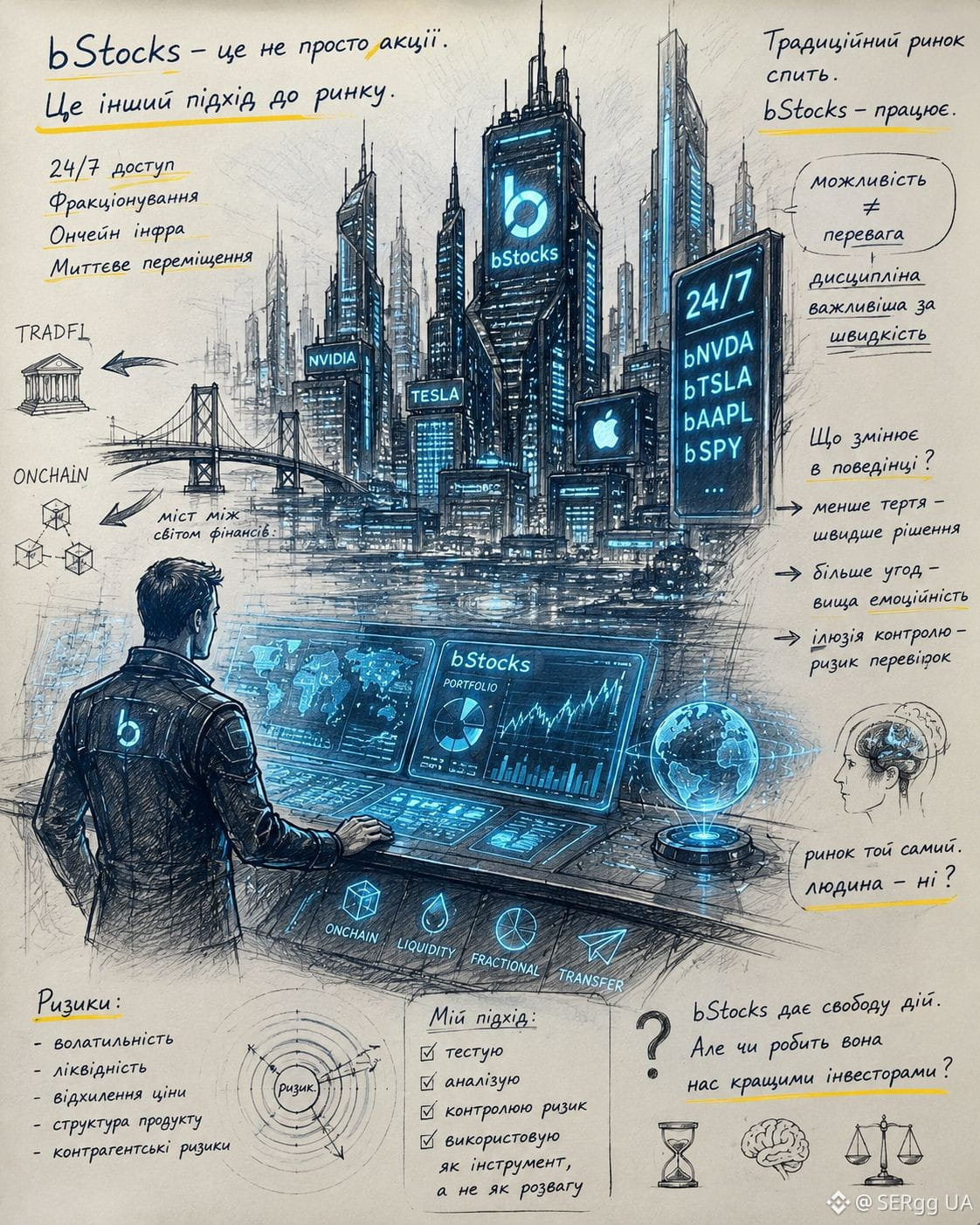
I’m testing #bStocks as a new way of interacting with the market.
What surprised me most was the market psychology 24/7 itself. When you can buy an asset in installments, quickly move it, and don’t have to wait for the opening of the traditional New York Stock Exchange, decisions are made completely differently.
But there’s a catch here. Less friction between desire and a deal isn’t always an advantage. Sometimes it simply means the person presses Buy or Sell faster.
For me, bStocks currently looks like a bridge between traditional assets and the on-chain environment. But the bridge doesn’t eliminate risks: volatility, liquidity, product structure, price deviations, and counterparty factors don’t go away.
So I’m looking not only at what can be bought.
I’m more interested in something else: does around-the-clock trading actually change the investor’s behavior? #bStockCis $SPCXB @Binance_Ukraine
I’m testing #bStocks as a new way of interacting with the market.
What surprised me most was the market psychology 24/7 itself. When you can buy an asset in installments, quickly move it, and don’t have to wait for the opening of the traditional New York Stock Exchange, decisions are made completely differently.
But there’s a catch here. Less friction between desire and a deal isn’t always an advantage. Sometimes it simply means the person presses Buy or Sell faster.
For me, bStocks currently looks like a bridge between traditional assets and the on-chain environment. But the bridge doesn’t eliminate risks: volatility, liquidity, product structure, price deviations, and counterparty factors don’t go away.
So I’m looking not only at what can be bought.
I’m more interested in something else: does around-the-clock trading actually change the investor’s behavior? #bStockCis $SPCXB @Binance_Ukraine
What surprised me most was the market psychology 24/7 itself. When you can buy an asset in installments, quickly move it, and don’t have to wait for the opening of the traditional New York Stock Exchange, decisions are made completely differently.
But there’s a catch here. Less friction between desire and a deal isn’t always an advantage. Sometimes it simply means the person presses Buy or Sell faster.
For me, bStocks currently looks like a bridge between traditional assets and the on-chain environment. But the bridge doesn’t eliminate risks: volatility, liquidity, product structure, price deviations, and counterparty factors don’t go away.
So I’m looking not only at what can be bought.
I’m more interested in something else: does around-the-clock trading actually change the investor’s behavior? #bStockCis $SPCXB @Binance_Ukraine
9
50

·
--
Recently converted $USDT into a tokenized S&P 500 index token — $SPCX. This is a great way to balance crypto assets with more stable instruments from the traditional stock market, without leaving the Binance ecosystem.
What do you think about the bStocks trend? Do you hold tokenized stocks in your portfolio, or do you prefer pure cryptocurrency only?
Share your thoughts in the comments! 👇
@BinanceCIS #bstockcis
Recently converted $USDT into a tokenized S&P 500 index token — $SPCX. This is a great way to balance crypto assets with more stable instruments from the traditional stock market, without leaving the Binance ecosystem.
What do you think about the bStocks trend? Do you hold tokenized stocks in your portfolio, or do you prefer pure cryptocurrency only?
Share your thoughts in the comments! 👇
@BinanceCIS #bstockcis
What do you think about the bStocks trend? Do you hold tokenized stocks in your portfolio, or do you prefer pure cryptocurrency only?
Share your thoughts in the comments! 👇
@BinanceCIS #bstockcis
2
81

#bstockscis I have one question that came up for me on bStocks.
Imagine: the US market is already closed. During the night, an important news item about NVIDIA drops, and $NVDAB starts moving actively.
But at that moment, a regular NVIDIA stock isn’t trading. So what exactly is the price of $NVDAB reflecting? 🤔
At first, I took it as just an advantage of trading 24/7. But then I looked at it differently.
While the main exchange is closed, bStocks participants still react to the news. In effect, a price is formed that reflects the market’s expectations even before the main session opens.
For example, if after an important news event $NVDAB rose by 4% overnight, that absolutely doesn’t guarantee that NVIDIA will open at +4%.
And that’s what I’d like to check.
I want to take a few such cases and compare:
overnight bStock move → the price of the underlying stock at the open.
Let’s see how often bStocks expectations match the reaction of the traditional market 👀
What do you think about the bStocks price when the main exchange is closed?
@BinanceCIS
#bStockCIS
Poll: “What is an overnight bStocks move for you?”
#bstockscis I have one question that came up for me on bStocks.
Imagine: the US market is already closed. During the night, an important news item about NVIDIA drops, and $NVDAB starts moving actively.
But at that moment, a regular NVIDIA stock isn’t trading. So what exactly is the price of $NVDAB reflecting? 🤔
At first, I took it as just an advantage of trading 24/7. But then I looked at it differently.
While the main exchange is closed, bStocks participants still react to the news. In effect, a price is formed that reflects the market’s expectations even before the main session opens.
For example, if after an important news event $NVDAB rose by 4% overnight, that absolutely doesn’t guarantee that NVIDIA will open at +4%.
And that’s what I’d like to check.
I want to take a few such cases and compare:
overnight bStock move → the price of the underlying stock at the open.
Let’s see how often bStocks expectations match the reaction of the traditional market 👀
What do you think about the bStocks price when the main exchange is closed?
@BinanceCIS
#bStockCIS
Poll: “What is an overnight bStocks move for you?”
Imagine: the US market is already closed. During the night, an important news item about NVIDIA drops, and $NVDAB starts moving actively.
But at that moment, a regular NVIDIA stock isn’t trading. So what exactly is the price of $NVDAB reflecting? 🤔
At first, I took it as just an advantage of trading 24/7. But then I looked at it differently.
While the main exchange is closed, bStocks participants still react to the news. In effect, a price is formed that reflects the market’s expectations even before the main session opens.
For example, if after an important news event $NVDAB rose by 4% overnight, that absolutely doesn’t guarantee that NVIDIA will open at +4%.
And that’s what I’d like to check.
I want to take a few such cases and compare:
overnight bStock move → the price of the underlying stock at the open.
Let’s see how often bStocks expectations match the reaction of the traditional market 👀
What do you think about the bStocks price when the main exchange is closed?
@BinanceCIS
#bStockCIS
Poll: “What is an overnight bStocks move for you?”
Очікування ринку
0%
Реакція на новини
0%
Просто поточна ціна
0%
Не задумувався
0%
0 votes • Voting closed
109
Verified
Article
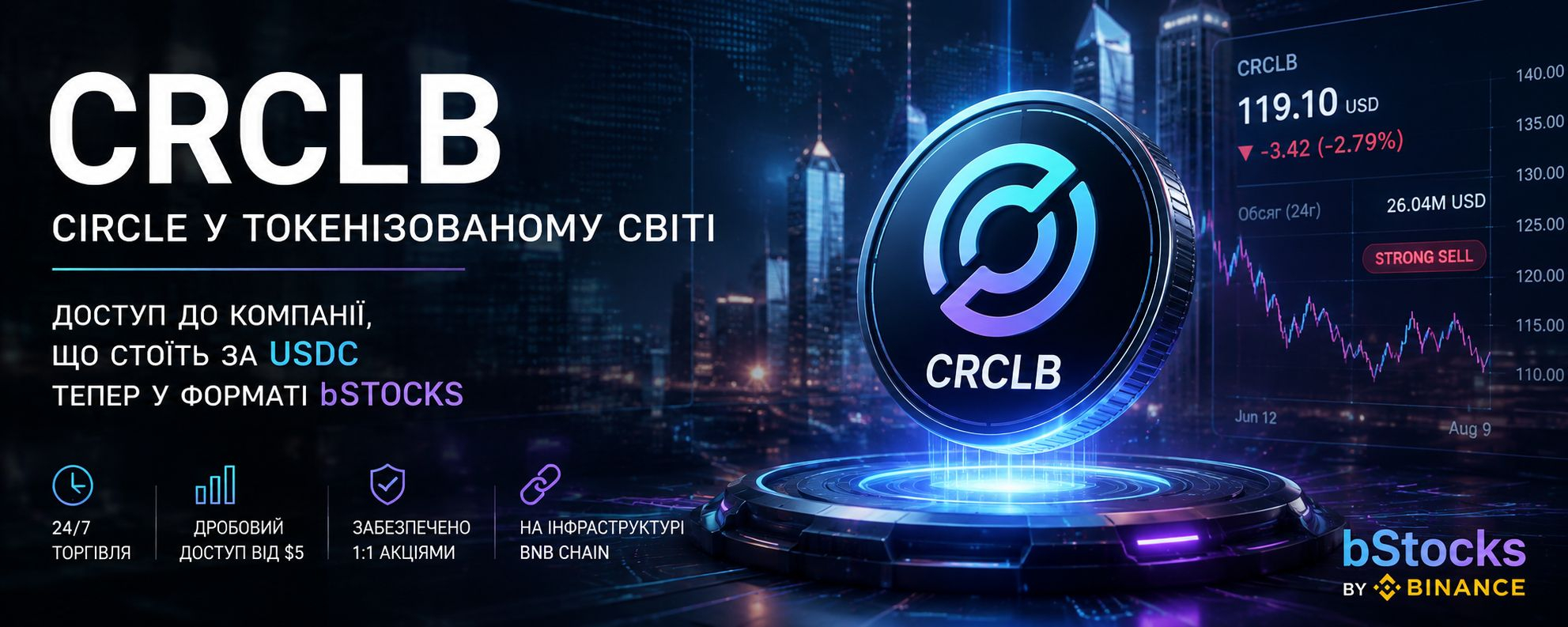
CRCLB: when crypto starts trading itselfI thought for a long time which of bStocks is most interesting to me right now.
NVIDIA? Logical.
SpaceX? Around it there is an entirely separate story.
But the more I look at $CRCLB , the more I understand: it’s Circle that shows me the most interesting paradox.
We receive a tokenized share of a company that itself builds infrastructure for digital money.
CRCLB: when crypto starts trading itself
I thought for a long time which of bStocks is most interesting to me right now.
NVIDIA? Logical.
SpaceX? Around it there is an entirely separate story.
But the more I look at $CRCLB , the more I understand: it’s Circle that shows me the most interesting paradox.
We receive a tokenized share of a company that itself builds infrastructure for digital money.
NVIDIA? Logical.
SpaceX? Around it there is an entirely separate story.
But the more I look at $CRCLB , the more I understand: it’s Circle that shows me the most interesting paradox.
We receive a tokenized share of a company that itself builds infrastructure for digital money.
2
1
14
124

·
--
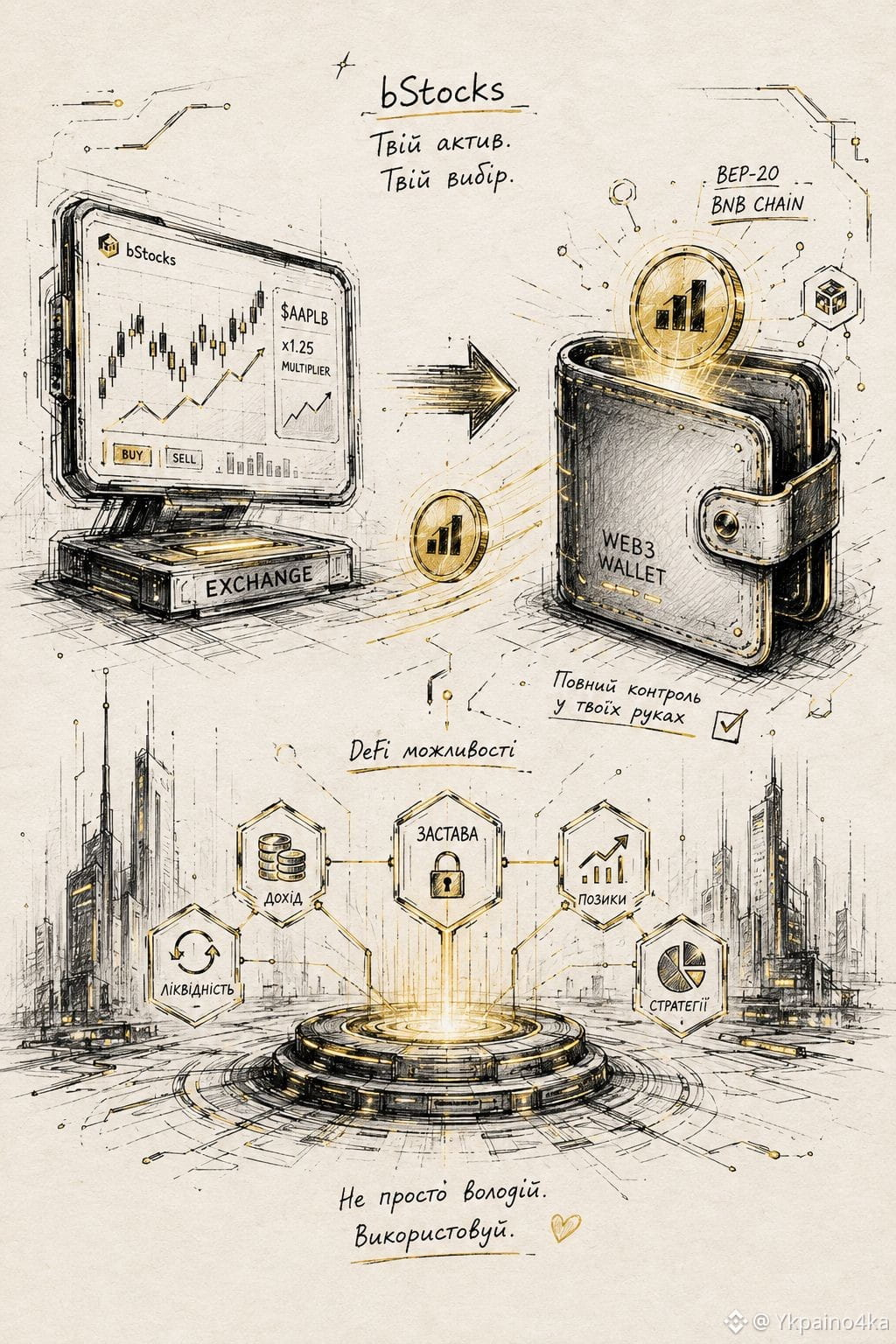
#bstockscis At first, I thought the difference was small: keeping bStocks on an exchange or transferring them to my own Web3 wallet.
But when I tried to do it myself, I started looking at everything a little differently.
I withdrew part of my $AAPLB to my personal wallet. And for me, it turned out to be more than just moving tokens.
As long as the asset remains on the exchange, I see it as my position within the platform. When it moves into my wallet, the feeling is different: I decide where it is and what to do with it next.
That’s where the main feature of #bStocks comes into play.
It’s a tokenized asset on BNB Smart Chain, so it can work not only within the exchange. It can be moved between compatible Web3 wallets, and in the future — used in various DeFi scenarios.
I’m especially interested in watching this transition.
We’re used to thinking about stocks as something you buy and just hold. And Web3 gradually adds a different logic: the asset isn’t only something you can keep, but something you can also use.
And that’s where I had a question.
What feels more like real ownership to you: seeing the asset in your exchange account, or having the ability to transfer it out yourself into your own wallet?
@BinanceCIS #bStockCis $NVDAB
#bstockscis At first, I thought the difference was small: keeping bStocks on an exchange or transferring them to my own Web3 wallet.
But when I tried to do it myself, I started looking at everything a little differently.
I withdrew part of my $AAPLB to my personal wallet. And for me, it turned out to be more than just moving tokens.
As long as the asset remains on the exchange, I see it as my position within the platform. When it moves into my wallet, the feeling is different: I decide where it is and what to do with it next.
That’s where the main feature of #bStocks comes into play.
It’s a tokenized asset on BNB Smart Chain, so it can work not only within the exchange. It can be moved between compatible Web3 wallets, and in the future — used in various DeFi scenarios.
I’m especially interested in watching this transition.
We’re used to thinking about stocks as something you buy and just hold. And Web3 gradually adds a different logic: the asset isn’t only something you can keep, but something you can also use.
And that’s where I had a question.
What feels more like real ownership to you: seeing the asset in your exchange account, or having the ability to transfer it out yourself into your own wallet?
@BinanceCIS #bStockCis $NVDAB
But when I tried to do it myself, I started looking at everything a little differently.
I withdrew part of my $AAPLB to my personal wallet. And for me, it turned out to be more than just moving tokens.
As long as the asset remains on the exchange, I see it as my position within the platform. When it moves into my wallet, the feeling is different: I decide where it is and what to do with it next.
That’s where the main feature of #bStocks comes into play.
It’s a tokenized asset on BNB Smart Chain, so it can work not only within the exchange. It can be moved between compatible Web3 wallets, and in the future — used in various DeFi scenarios.
I’m especially interested in watching this transition.
We’re used to thinking about stocks as something you buy and just hold. And Web3 gradually adds a different logic: the asset isn’t only something you can keep, but something you can also use.
And that’s where I had a question.
What feels more like real ownership to you: seeing the asset in your exchange account, or having the ability to transfer it out yourself into your own wallet?
@BinanceCIS #bStockCis $NVDAB
4
1
8
104
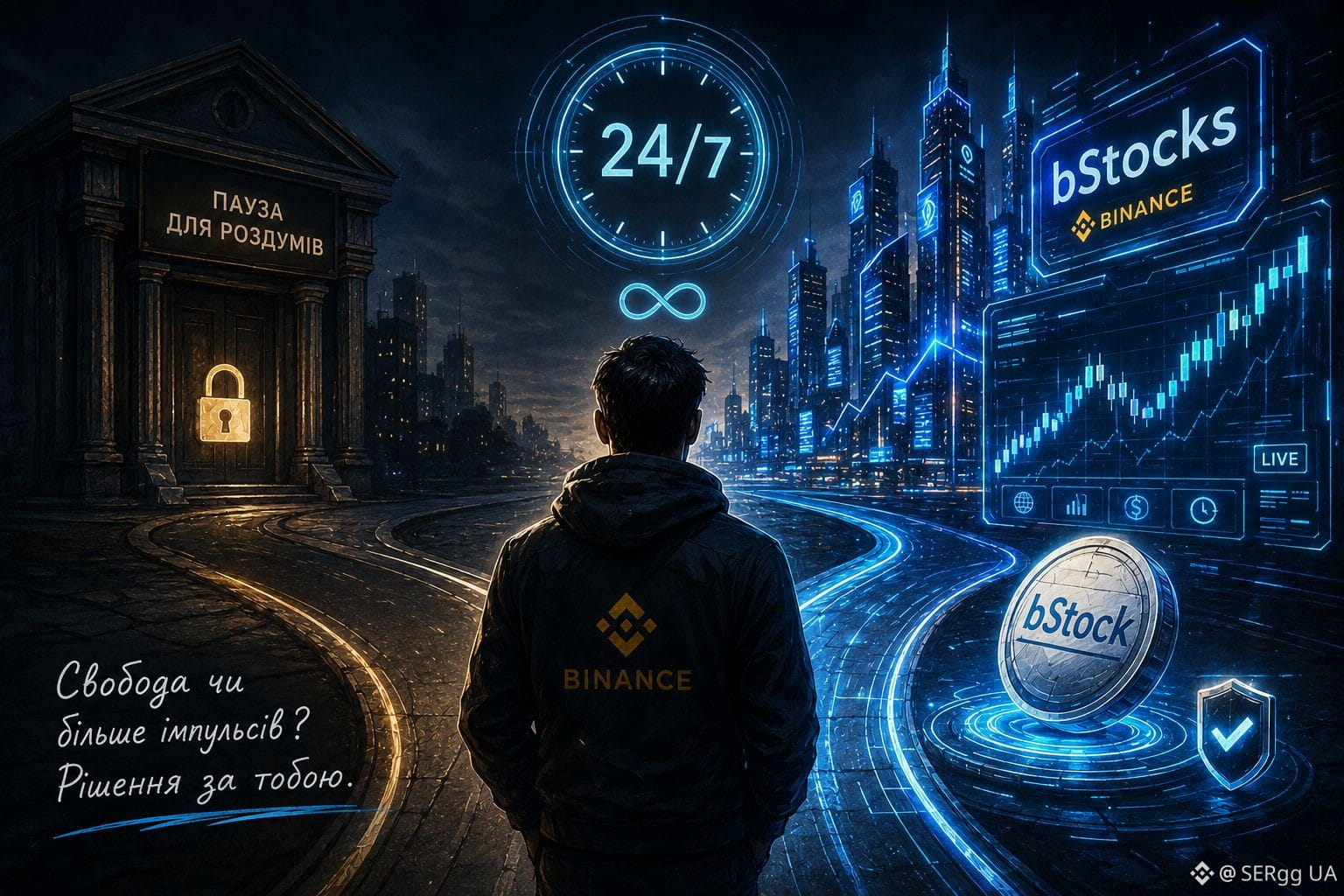
#bstockscis I thought for a long time that the main advantage of bStocks is simply the ability to trade stocks through crypto infrastructure.
But the more I look into it, the more I’m interested in something else.
A market without breaks is a bit like a car without a traffic light.
You can drive whenever you want. But that’s exactly why nobody tells you when you should stop. 🚦
In traditional trading, the exchange closing creates the pause.
You can cool down, review decisions, and not react to every move.
With bStocks, that boundary becomes much smaller. 24/7 is freedom, but freedom doesn’t always work in the trader’s favor.
And one more thing I wouldn’t ignore: bStock is a tokenized certificate backed by a share, not direct ownership of it.
So I would look not only at what the technology allows us to do.
I’m more interested in what it does with our habits. 📊
Do you think constant access to the market disciplines the trader, or on the contrary — encourages trading more often?
#bStockCis $SPCXB @BinanceCIS
#bstockscis I thought for a long time that the main advantage of bStocks is simply the ability to trade stocks through crypto infrastructure.
But the more I look into it, the more I’m interested in something else.
A market without breaks is a bit like a car without a traffic light.
You can drive whenever you want. But that’s exactly why nobody tells you when you should stop. 🚦
In traditional trading, the exchange closing creates the pause.
You can cool down, review decisions, and not react to every move.
With bStocks, that boundary becomes much smaller. 24/7 is freedom, but freedom doesn’t always work in the trader’s favor.
And one more thing I wouldn’t ignore: bStock is a tokenized certificate backed by a share, not direct ownership of it.
So I would look not only at what the technology allows us to do.
I’m more interested in what it does with our habits. 📊
Do you think constant access to the market disciplines the trader, or on the contrary — encourages trading more often?
#bStockCis $SPCXB @BinanceCIS
But the more I look into it, the more I’m interested in something else.
A market without breaks is a bit like a car without a traffic light.
You can drive whenever you want. But that’s exactly why nobody tells you when you should stop. 🚦
In traditional trading, the exchange closing creates the pause.
You can cool down, review decisions, and not react to every move.
With bStocks, that boundary becomes much smaller. 24/7 is freedom, but freedom doesn’t always work in the trader’s favor.
And one more thing I wouldn’t ignore: bStock is a tokenized certificate backed by a share, not direct ownership of it.
So I would look not only at what the technology allows us to do.
I’m more interested in what it does with our habits. 📊
Do you think constant access to the market disciplines the trader, or on the contrary — encourages trading more often?
#bStockCis $SPCXB @BinanceCIS
19
2
21
146
·
--
Bullish
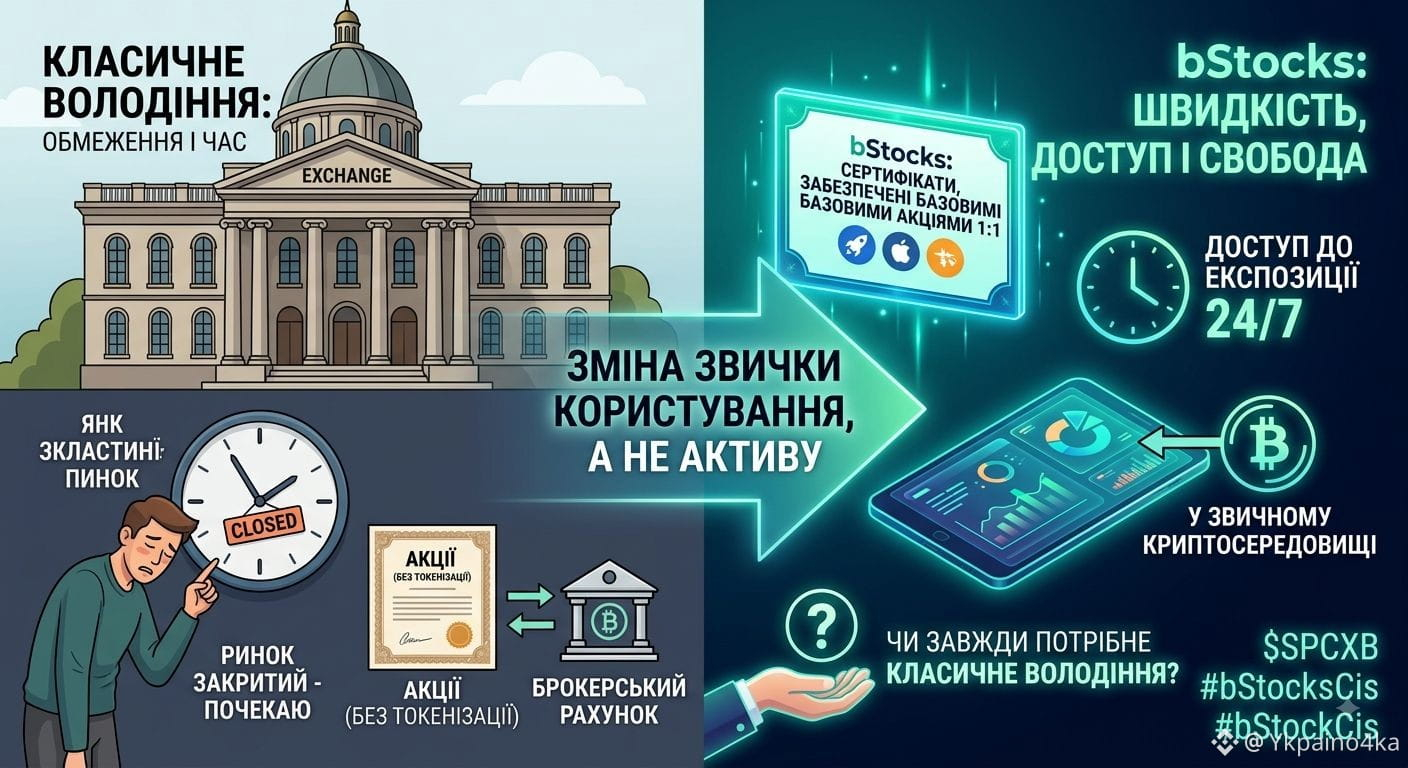
#bstockscis @BinanceCIS I didn’t understand the meaning of tokenized shares for a long time. If the token represents the same share, why change the form at all?
After testing bStocks, I started looking at it differently. Here, it’s not so much the asset itself that changes, but the behavior around it.
Instead of the thought “the market is closed right now — I’ll wait,” another one appears: access to exposure can be available 24/7. For me, it’s also important that everything happens in the familiar crypto environment, without a separate brokerage account.
But I wouldn’t call it direct ownership of shares. bStocks are certificates backed 1:1 by underlying shares, with no voting rights for shareholders.
And that’s where the most interesting question for me comes in: do we really always need the classic “ownership” if sometimes speed, access, and freedom of action are far more important?
Maybe the future of finance is changing not the asset, but the way people use it.
$SPCXB
#bStocksCis #bStockCis
#bstockscis @BinanceCIS I didn’t understand the meaning of tokenized shares for a long time. If the token represents the same share, why change the form at all?
After testing bStocks, I started looking at it differently. Here, it’s not so much the asset itself that changes, but the behavior around it.
Instead of the thought “the market is closed right now — I’ll wait,” another one appears: access to exposure can be available 24/7. For me, it’s also important that everything happens in the familiar crypto environment, without a separate brokerage account.
But I wouldn’t call it direct ownership of shares. bStocks are certificates backed 1:1 by underlying shares, with no voting rights for shareholders.
And that’s where the most interesting question for me comes in: do we really always need the classic “ownership” if sometimes speed, access, and freedom of action are far more important?
Maybe the future of finance is changing not the asset, but the way people use it.
$SPCXB
#bStocksCis #bStockCis
After testing bStocks, I started looking at it differently. Here, it’s not so much the asset itself that changes, but the behavior around it.
Instead of the thought “the market is closed right now — I’ll wait,” another one appears: access to exposure can be available 24/7. For me, it’s also important that everything happens in the familiar crypto environment, without a separate brokerage account.
But I wouldn’t call it direct ownership of shares. bStocks are certificates backed 1:1 by underlying shares, with no voting rights for shareholders.
And that’s where the most interesting question for me comes in: do we really always need the classic “ownership” if sometimes speed, access, and freedom of action are far more important?
Maybe the future of finance is changing not the asset, but the way people use it.
$SPCXB
#bStocksCis #bStockCis
2
5
155
Verified
#bstockscis @BinanceCIS I noticed something about bStocks that not many people talk about: it’s not the stock itself that changes, but the unit in which we approach it.
Previously, I perceived $100 as simply an amount in USDT. Now those same $100 can become part of a position in NVIDIA, Tesla, or another asset—without the need to buy a whole share. $TSLAB
And this is where fractional shares are more interesting than a pretty story about “access to Wall Street.”
A small capital amount stops looking like an obstacle. But at the same time, the perception of investing changes: I’m no longer thinking “can I buy a share?” but “what portion of a position do I want to get?”
That shift is important to me.
Tokenization is gradually moving stocks from the logic of “one unit of an asset” to the logic of “an exact share of exposure.”
And then an interesting question arises: if investors no longer need to adjust the amount to the share price, won’t the very mathematics of making investment decisions change as well? $SPCXB #bStockCis
#bStocksCis $NVDAB
#bstockscis @BinanceCIS I noticed something about bStocks that not many people talk about: it’s not the stock itself that changes, but the unit in which we approach it.
Previously, I perceived $100 as simply an amount in USDT. Now those same $100 can become part of a position in NVIDIA, Tesla, or another asset—without the need to buy a whole share. $TSLAB
And this is where fractional shares are more interesting than a pretty story about “access to Wall Street.”
A small capital amount stops looking like an obstacle. But at the same time, the perception of investing changes: I’m no longer thinking “can I buy a share?” but “what portion of a position do I want to get?”
That shift is important to me.
Tokenization is gradually moving stocks from the logic of “one unit of an asset” to the logic of “an exact share of exposure.”
And then an interesting question arises: if investors no longer need to adjust the amount to the share price, won’t the very mathematics of making investment decisions change as well? $SPCXB #bStockCis
#bStocksCis $NVDAB
Previously, I perceived $100 as simply an amount in USDT. Now those same $100 can become part of a position in NVIDIA, Tesla, or another asset—without the need to buy a whole share. $TSLAB
And this is where fractional shares are more interesting than a pretty story about “access to Wall Street.”
A small capital amount stops looking like an obstacle. But at the same time, the perception of investing changes: I’m no longer thinking “can I buy a share?” but “what portion of a position do I want to get?”
That shift is important to me.
Tokenization is gradually moving stocks from the logic of “one unit of an asset” to the logic of “an exact share of exposure.”
And then an interesting question arises: if investors no longer need to adjust the amount to the share price, won’t the very mathematics of making investment decisions change as well? $SPCXB #bStockCis
#bStocksCis $NVDAB

24
4
31
296
·
--
Verified
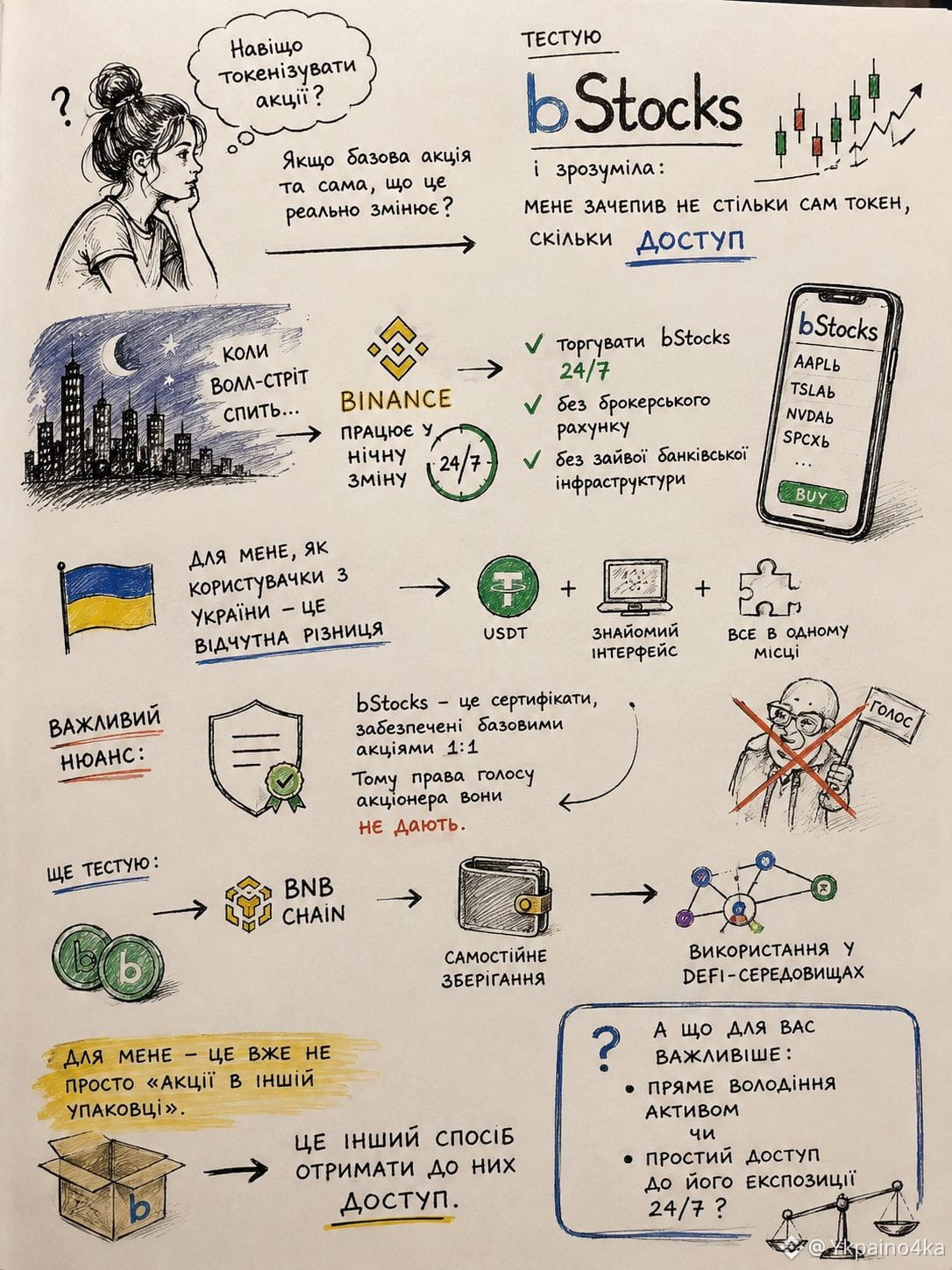
#bstockscis @BinanceCIS At first, I didn’t really understand why you need to tokenize stocks. If the underlying stock is the same, what does it actually change?
I started testing bStocks on myself—and what really caught my attention wasn’t the token itself, but access.
When Wall Street is asleep, Binance goes on the night shift. You can trade bStocks 24/7, without the usual brokerage account and separate banking infrastructure. For me, as a user in Ukraine, that makes a significant difference: USDT, a familiar interface, and everything in one place.
But it’s important not to confuse this with direct ownership of shares. bStocks are certificates backed by the underlying shares 1:1. So they don’t give voting rights.
Another thing I check especially carefully: the tokens work on the BNB Chain; you can store them yourself and use them in supported DeFi applications.
For me, it’s no longer just “stocks in another package,” but a change in the very way you can access them.
And what matters more to you: owning the asset directly, or having simpler, around-the-clock access to its exposure? $SPCXB
#bStocksCis #bStockCis
{spot}(SPCXBUSDT)
#bstockscis @BinanceCIS At first, I didn’t really understand why you need to tokenize stocks. If the underlying stock is the same, what does it actually change?
I started testing bStocks on myself—and what really caught my attention wasn’t the token itself, but access.
When Wall Street is asleep, Binance goes on the night shift. You can trade bStocks 24/7, without the usual brokerage account and separate banking infrastructure. For me, as a user in Ukraine, that makes a significant difference: USDT, a familiar interface, and everything in one place.
But it’s important not to confuse this with direct ownership of shares. bStocks are certificates backed by the underlying shares 1:1. So they don’t give voting rights.
Another thing I check especially carefully: the tokens work on the BNB Chain; you can store them yourself and use them in supported DeFi applications.
For me, it’s no longer just “stocks in another package,” but a change in the very way you can access them.
And what matters more to you: owning the asset directly, or having simpler, around-the-clock access to its exposure? $SPCXB
#bStocksCis #bStockCis
I started testing bStocks on myself—and what really caught my attention wasn’t the token itself, but access.
When Wall Street is asleep, Binance goes on the night shift. You can trade bStocks 24/7, without the usual brokerage account and separate banking infrastructure. For me, as a user in Ukraine, that makes a significant difference: USDT, a familiar interface, and everything in one place.
But it’s important not to confuse this with direct ownership of shares. bStocks are certificates backed by the underlying shares 1:1. So they don’t give voting rights.
Another thing I check especially carefully: the tokens work on the BNB Chain; you can store them yourself and use them in supported DeFi applications.
For me, it’s no longer just “stocks in another package,” but a change in the very way you can access them.
And what matters more to you: owning the asset directly, or having simpler, around-the-clock access to its exposure? $SPCXB
#bStocksCis #bStockCis
4
6
130

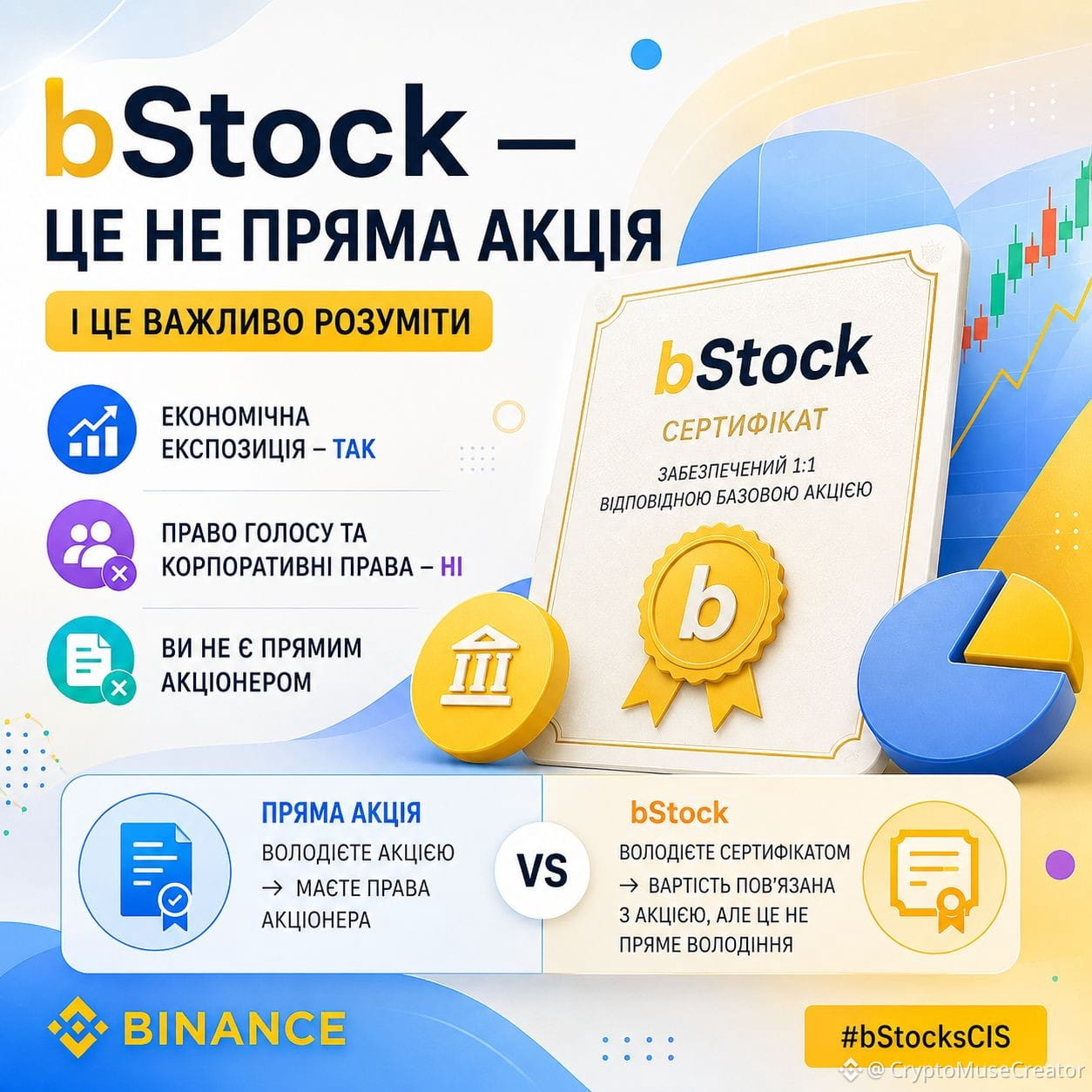
#bstockCIS 📜 bStock — it is not a direct stock. And it’s important to understand this
When you buy bStock, you may feel like you’ve simply bought a company’s share in a new form. But legally, the structure is different.
🔹 bStocks are structured as certificates backed 1:1 by the corresponding underlying share.
🔹 These certificates are issued by BTech Holdings, an affiliate of Binance.
🔹 Therefore, the owner of a bStock gets an economic exposure to the underlying share, but does not become its direct shareholder.
And here is an important difference:
❌ No voting rights at shareholders’ meetings.
❌ No standard corporate rights of a direct stock owner.
❌ You are not listed in the shareholder register as the direct owner of the underlying share.
Instead, the structure itself allows you to access the economic value of a specific share through the certificate.
💡 A simple example:
Imagine you want exposure to Company X’s share.
Direct stock:
you own the stock → you have the shareholder rights provided for that class of shares.
bStock:
you own a certificate → its value is linked to the underlying share, but the certificate itself does not make you a direct shareholder.
This is one of the key points to understand before buying bStocks.
@BinanceCIS #bStocksCIS
#bstockCIS 📜 bStock — it is not a direct stock. And it’s important to understand this
When you buy bStock, you may feel like you’ve simply bought a company’s share in a new form. But legally, the structure is different.
🔹 bStocks are structured as certificates backed 1:1 by the corresponding underlying share.
🔹 These certificates are issued by BTech Holdings, an affiliate of Binance.
🔹 Therefore, the owner of a bStock gets an economic exposure to the underlying share, but does not become its direct shareholder.
And here is an important difference:
❌ No voting rights at shareholders’ meetings.
❌ No standard corporate rights of a direct stock owner.
❌ You are not listed in the shareholder register as the direct owner of the underlying share.
Instead, the structure itself allows you to access the economic value of a specific share through the certificate.
💡 A simple example:
Imagine you want exposure to Company X’s share.
Direct stock:
you own the stock → you have the shareholder rights provided for that class of shares.
bStock:
you own a certificate → its value is linked to the underlying share, but the certificate itself does not make you a direct shareholder.
This is one of the key points to understand before buying bStocks.
@BinanceCIS #bStocksCIS
When you buy bStock, you may feel like you’ve simply bought a company’s share in a new form. But legally, the structure is different.
🔹 bStocks are structured as certificates backed 1:1 by the corresponding underlying share.
🔹 These certificates are issued by BTech Holdings, an affiliate of Binance.
🔹 Therefore, the owner of a bStock gets an economic exposure to the underlying share, but does not become its direct shareholder.
And here is an important difference:
❌ No voting rights at shareholders’ meetings.
❌ No standard corporate rights of a direct stock owner.
❌ You are not listed in the shareholder register as the direct owner of the underlying share.
Instead, the structure itself allows you to access the economic value of a specific share through the certificate.
💡 A simple example:
Imagine you want exposure to Company X’s share.
Direct stock:
you own the stock → you have the shareholder rights provided for that class of shares.
bStock:
you own a certificate → its value is linked to the underlying share, but the certificate itself does not make you a direct shareholder.
This is one of the key points to understand before buying bStocks.
@BinanceCIS #bStocksCIS
1
9
311

·
--
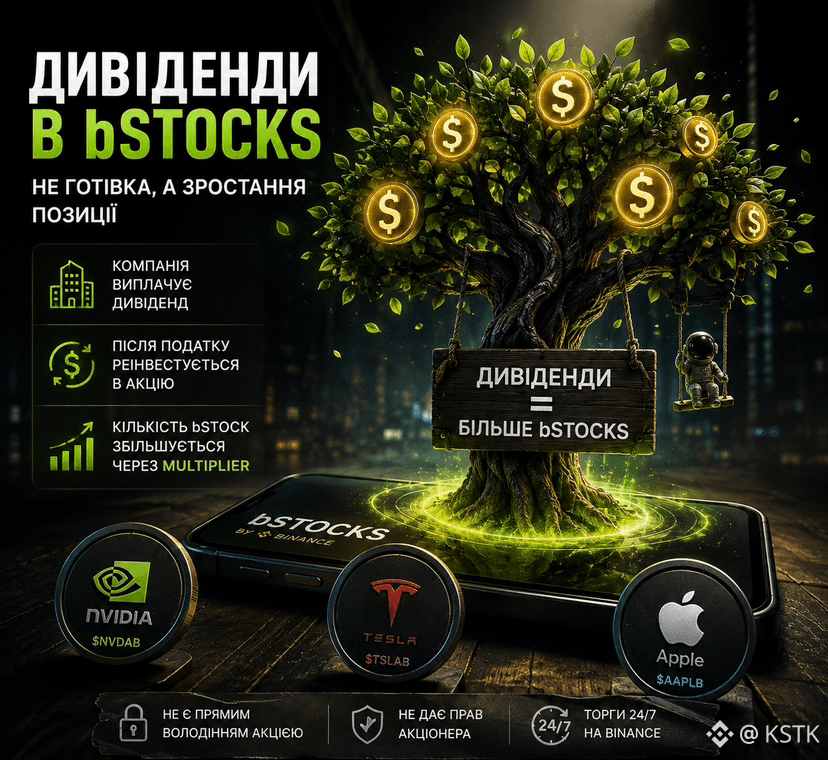
#bstockscis @BinanceCIS I thought that the dividend from a tokenized stock would simply drop into my USDT balance. Turns out—at bStocks the mechanics are completely different.
If the underlying company pays a dividend, the bStock holder doesn’t receive it as a separate cash payment. After tax is withheld, the net amount is automatically reinvested into the underlying stock, and the number of bStocks in the holder’s account increases proportionally via the Multiplier mechanism.
So, this conditional dividend works more like an automatic DRIP: instead of getting money into your balance, you receive a slightly larger position.
And honestly, this is more interesting to me than the whole “24/7” thing.
Because $NVDAB or any other bStock isn’t just a token trying to mirror the stock chart. The system has to translate not only price movements but also the underlying asset’s economic events into a tokenized format.
At the same time, there’s an important detail: a bStock doesn’t mean direct ownership of the stock and doesn’t grant the usual shareholder rights.
Now I’m curious about something else: how many people who trade bStocks even know about the Multiplier?
For example, I noticed it far from right away.
@BinanceCIS #bStockCIS
#bstockscis @BinanceCIS I thought that the dividend from a tokenized stock would simply drop into my USDT balance. Turns out—at bStocks the mechanics are completely different.
If the underlying company pays a dividend, the bStock holder doesn’t receive it as a separate cash payment. After tax is withheld, the net amount is automatically reinvested into the underlying stock, and the number of bStocks in the holder’s account increases proportionally via the Multiplier mechanism.
So, this conditional dividend works more like an automatic DRIP: instead of getting money into your balance, you receive a slightly larger position.
And honestly, this is more interesting to me than the whole “24/7” thing.
Because $NVDAB or any other bStock isn’t just a token trying to mirror the stock chart. The system has to translate not only price movements but also the underlying asset’s economic events into a tokenized format.
At the same time, there’s an important detail: a bStock doesn’t mean direct ownership of the stock and doesn’t grant the usual shareholder rights.
Now I’m curious about something else: how many people who trade bStocks even know about the Multiplier?
For example, I noticed it far from right away.
@BinanceCIS #bStockCIS
If the underlying company pays a dividend, the bStock holder doesn’t receive it as a separate cash payment. After tax is withheld, the net amount is automatically reinvested into the underlying stock, and the number of bStocks in the holder’s account increases proportionally via the Multiplier mechanism.
So, this conditional dividend works more like an automatic DRIP: instead of getting money into your balance, you receive a slightly larger position.
And honestly, this is more interesting to me than the whole “24/7” thing.
Because $NVDAB or any other bStock isn’t just a token trying to mirror the stock chart. The system has to translate not only price movements but also the underlying asset’s economic events into a tokenized format.
At the same time, there’s an important detail: a bStock doesn’t mean direct ownership of the stock and doesn’t grant the usual shareholder rights.
Now I’m curious about something else: how many people who trade bStocks even know about the Multiplier?
For example, I noticed it far from right away.
@BinanceCIS #bStockCIS
1
92

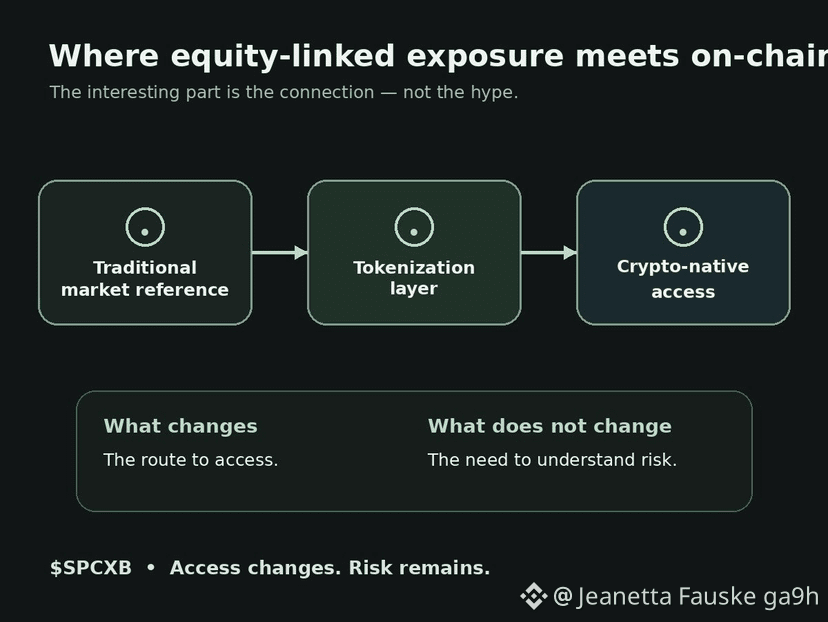
@BinanceCIS #bStockCIS Maybe the biggest innovation in tokenized equities isn’t the token.
It’s the change in access.
bStocks give crypto users another route to explore traditional market exposure through tools and interfaces that already feel familiar. That connection between two separate financial worlds is what interests me most.
$SPCXB is an early example of the shift. The product matters, but the new market structure around it may matter even more.
@BinanceCIS #bStockCIS Maybe the biggest innovation in tokenized equities isn’t the token.
It’s the change in access.
bStocks give crypto users another route to explore traditional market exposure through tools and interfaces that already feel familiar. That connection between two separate financial worlds is what interests me most.
$SPCXB is an early example of the shift. The product matters, but the new market structure around it may matter even more.
It’s the change in access.
bStocks give crypto users another route to explore traditional market exposure through tools and interfaces that already feel familiar. That connection between two separate financial worlds is what interests me most.
$SPCXB is an early example of the shift. The product matters, but the new market structure around it may matter even more.
1
109
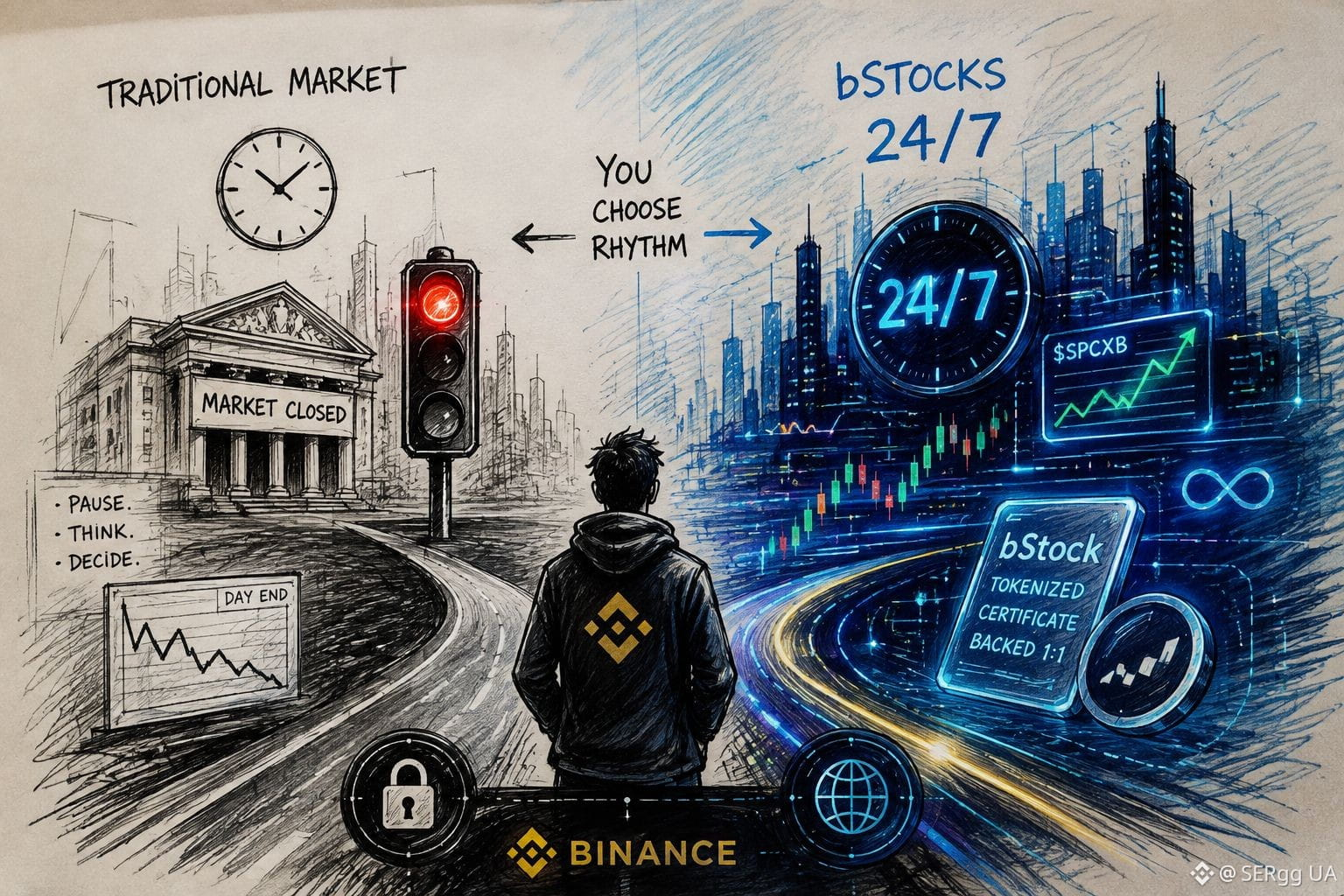
#bstockscis @BinanceCIS I noticed something strange in trading: the more opportunities you get, the harder it is to understand when to use them.
That’s why the bStocks model really caught my attention.
Earlier, I thought of 24/7 as a convenience. No need to wait for the exchange to open—you see a move, you react.
But a nonstop market changes psychology itself.
It’s like constantly keeping your hand on a door handle. You haven’t gone in anywhere yet, but you already feel like you can take the next step.
And here’s where the more interesting question arises.
If the opportunity to trade is always there, do we start confusing opportunity with necessity?
For me, that’s more important than the mere fact of technological novelty. Because a good tool doesn’t guarantee good decisions—it only makes them more accessible.
And one more thing: bStock is a tokenized certificate backed by the relevant asset, not just a “stock on the blockchain.”
So what actually changes with 24/7: the market or human behavior?
#bStockCis $SPCXB @BinanceCIS
#bstockscis @BinanceCIS I noticed something strange in trading: the more opportunities you get, the harder it is to understand when to use them.
That’s why the bStocks model really caught my attention.
Earlier, I thought of 24/7 as a convenience. No need to wait for the exchange to open—you see a move, you react.
But a nonstop market changes psychology itself.
It’s like constantly keeping your hand on a door handle. You haven’t gone in anywhere yet, but you already feel like you can take the next step.
And here’s where the more interesting question arises.
If the opportunity to trade is always there, do we start confusing opportunity with necessity?
For me, that’s more important than the mere fact of technological novelty. Because a good tool doesn’t guarantee good decisions—it only makes them more accessible.
And one more thing: bStock is a tokenized certificate backed by the relevant asset, not just a “stock on the blockchain.”
So what actually changes with 24/7: the market or human behavior?
#bStockCis $SPCXB @BinanceCIS
That’s why the bStocks model really caught my attention.
Earlier, I thought of 24/7 as a convenience. No need to wait for the exchange to open—you see a move, you react.
But a nonstop market changes psychology itself.
It’s like constantly keeping your hand on a door handle. You haven’t gone in anywhere yet, but you already feel like you can take the next step.
And here’s where the more interesting question arises.
If the opportunity to trade is always there, do we start confusing opportunity with necessity?
For me, that’s more important than the mere fact of technological novelty. Because a good tool doesn’t guarantee good decisions—it only makes them more accessible.
And one more thing: bStock is a tokenized certificate backed by the relevant asset, not just a “stock on the blockchain.”
So what actually changes with 24/7: the market or human behavior?
#bStockCis $SPCXB @BinanceCIS
24
2
24
211
·
--
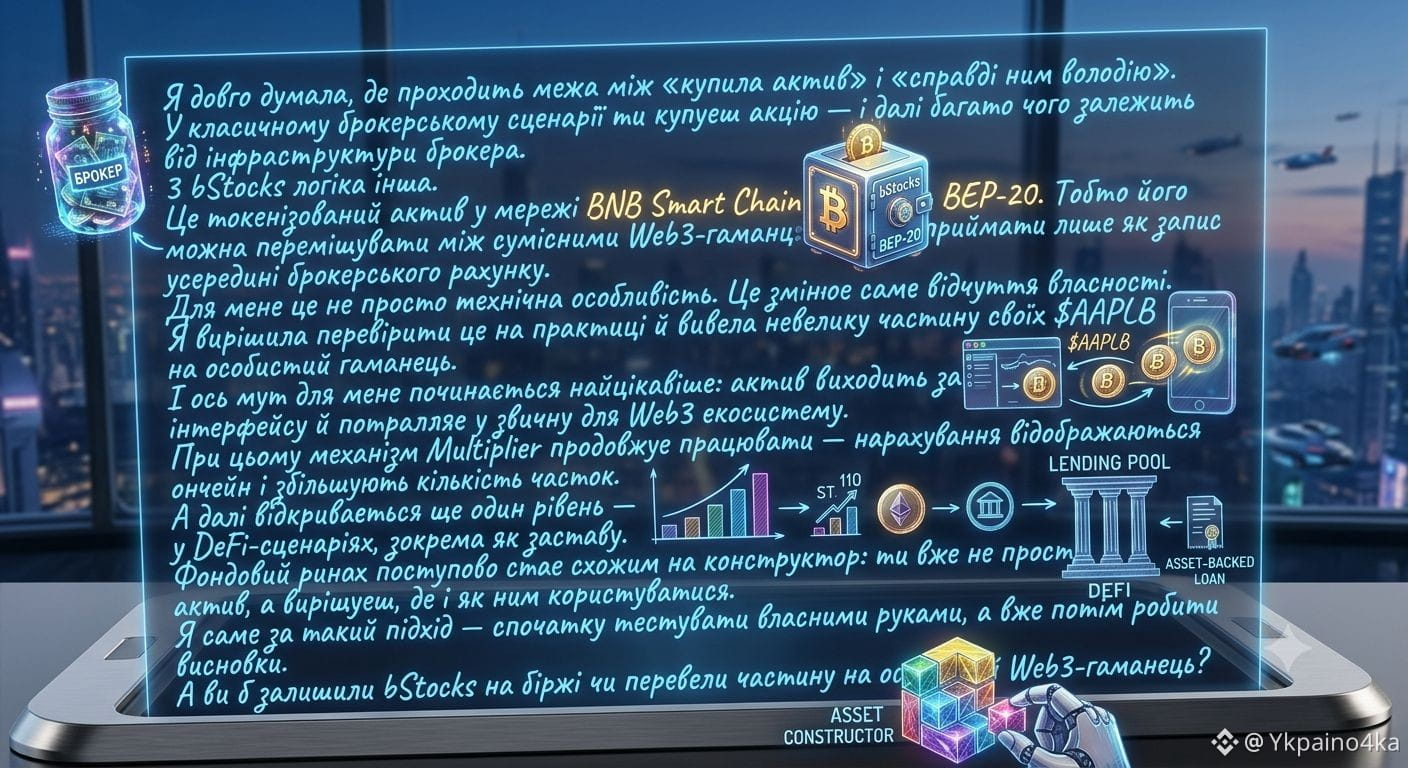
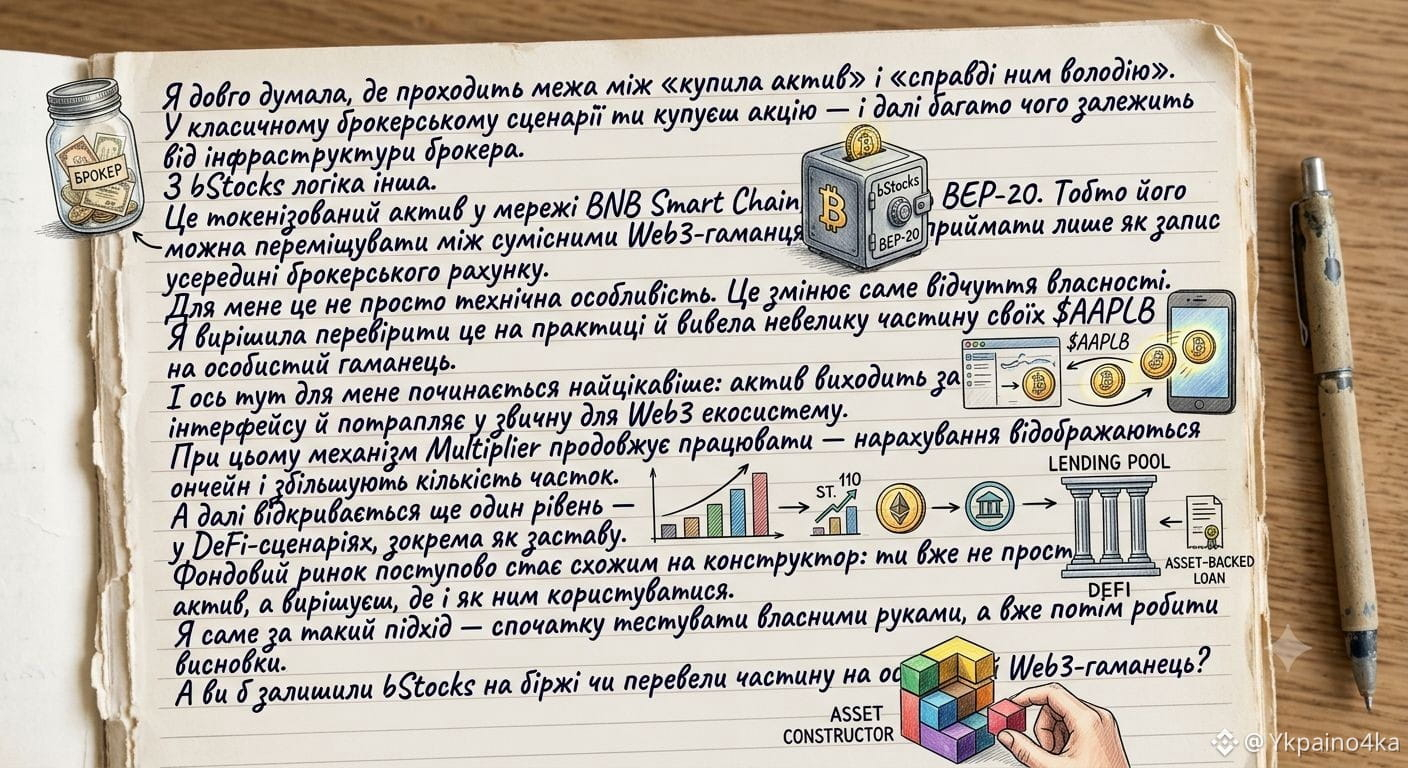
#bstockscis I thought for a long time... and here’s what I came up with.
In a classic brokerage scenario, you buy a stock—and then a lot depends on the broker’s infrastructure.
With bStocks, the logic is different.
It’s a tokenized asset on the BNB Smart Chain network, BEP-20 standard. That means it can be moved between compatible Web3 wallets, rather than being treated only as a record inside a brokerage account.
For me, this changes the very feeling of ownership.
I decided to test this in practice and moved a small portion of my $AAPLB to my personal wallet.
And that’s where things get most interesting for me: the asset leaves the exchange interface and enters the Web3 ecosystem you’re used to.
At the same time, the Multiplier mechanism keeps working—accruals are reflected on-chain and increase the number of shares.
And then another level opens up: the possibility of using such RWA assets in DeFi scenarios, in particular as collateral.
The stock market is gradually starting to look like a constructor: you’re no longer just buying an asset—you’re deciding where and how to use it.
That’s the approach I’m for—first testing it with my own hands, and only then drawing conclusions.
Would you keep your bStocks on the exchange or move part of them to your own Web3 wallet? @BinanceCIS #bStockCis
#bstockscis I thought for a long time... and here’s what I came up with.
In a classic brokerage scenario, you buy a stock—and then a lot depends on the broker’s infrastructure.
With bStocks, the logic is different.
It’s a tokenized asset on the BNB Smart Chain network, BEP-20 standard. That means it can be moved between compatible Web3 wallets, rather than being treated only as a record inside a brokerage account.
For me, this changes the very feeling of ownership.
I decided to test this in practice and moved a small portion of my $AAPLB to my personal wallet.
And that’s where things get most interesting for me: the asset leaves the exchange interface and enters the Web3 ecosystem you’re used to.
At the same time, the Multiplier mechanism keeps working—accruals are reflected on-chain and increase the number of shares.
And then another level opens up: the possibility of using such RWA assets in DeFi scenarios, in particular as collateral.
The stock market is gradually starting to look like a constructor: you’re no longer just buying an asset—you’re deciding where and how to use it.
That’s the approach I’m for—first testing it with my own hands, and only then drawing conclusions.
Would you keep your bStocks on the exchange or move part of them to your own Web3 wallet? @BinanceCIS #bStockCis
In a classic brokerage scenario, you buy a stock—and then a lot depends on the broker’s infrastructure.
With bStocks, the logic is different.
It’s a tokenized asset on the BNB Smart Chain network, BEP-20 standard. That means it can be moved between compatible Web3 wallets, rather than being treated only as a record inside a brokerage account.
For me, this changes the very feeling of ownership.
I decided to test this in practice and moved a small portion of my $AAPLB to my personal wallet.
And that’s where things get most interesting for me: the asset leaves the exchange interface and enters the Web3 ecosystem you’re used to.
At the same time, the Multiplier mechanism keeps working—accruals are reflected on-chain and increase the number of shares.
And then another level opens up: the possibility of using such RWA assets in DeFi scenarios, in particular as collateral.
The stock market is gradually starting to look like a constructor: you’re no longer just buying an asset—you’re deciding where and how to use it.
That’s the approach I’m for—first testing it with my own hands, and only then drawing conclusions.
Would you keep your bStocks on the exchange or move part of them to your own Web3 wallet? @BinanceCIS #bStockCis
2
5
151

·
--
Earlier you had to have 10 different apps for crypto and stocks, but now everything is in one place thanks to Binance Bstocks. It makes life so much easier when $NVDAB чи $AAPLB can be taken right here.
For details and announcements, see #BinanceCIS
Have you already tried tokenized stocks or do you prefer the classics?
#bStockCIS #bstockscis
Earlier you had to have 10 different apps for crypto and stocks, but now everything is in one place thanks to Binance Bstocks. It makes life so much easier when $NVDAB чи $AAPLB can be taken right here.
For details and announcements, see #BinanceCIS
Have you already tried tokenized stocks or do you prefer the classics?
#bStockCIS #bstockscis
For details and announcements, see #BinanceCIS
Have you already tried tokenized stocks or do you prefer the classics?
#bStockCIS #bstockscis

2
90

·
--
#bstockscis
📈 What I Like About the Binance bStocks Concept
Binance bStocks are more than just another way to follow the stock market. For example, $NVDAB provides exposure to NVIDIA’s stock performance through a familiar crypto environment.
bStocks can be traded 24/7, and each token is backed 1:1 by the corresponding underlying share. At the same time, it is important to understand that holding bStocks does not mean directly owning shares of the company.
What makes this format interesting to me is the ability to start with a small amount, access tokenized stocks through Binance, and potentially store supported assets in a compatible wallet.
Could tokenized stocks become a practical alternative to traditional brokers for crypto users?
@BinanceCIS #bStockCis
#bstockscis
📈 What I Like About the Binance bStocks Concept
Binance bStocks are more than just another way to follow the stock market. For example, $NVDAB provides exposure to NVIDIA’s stock performance through a familiar crypto environment.
bStocks can be traded 24/7, and each token is backed 1:1 by the corresponding underlying share. At the same time, it is important to understand that holding bStocks does not mean directly owning shares of the company.
What makes this format interesting to me is the ability to start with a small amount, access tokenized stocks through Binance, and potentially store supported assets in a compatible wallet.
Could tokenized stocks become a practical alternative to traditional brokers for crypto users?
@BinanceCIS #bStockCis
📈 What I Like About the Binance bStocks Concept
Binance bStocks are more than just another way to follow the stock market. For example, $NVDAB provides exposure to NVIDIA’s stock performance through a familiar crypto environment.
bStocks can be traded 24/7, and each token is backed 1:1 by the corresponding underlying share. At the same time, it is important to understand that holding bStocks does not mean directly owning shares of the company.
What makes this format interesting to me is the ability to start with a small amount, access tokenized stocks through Binance, and potentially store supported assets in a compatible wallet.
Could tokenized stocks become a practical alternative to traditional brokers for crypto users?
@BinanceCIS #bStockCis
58
·
--
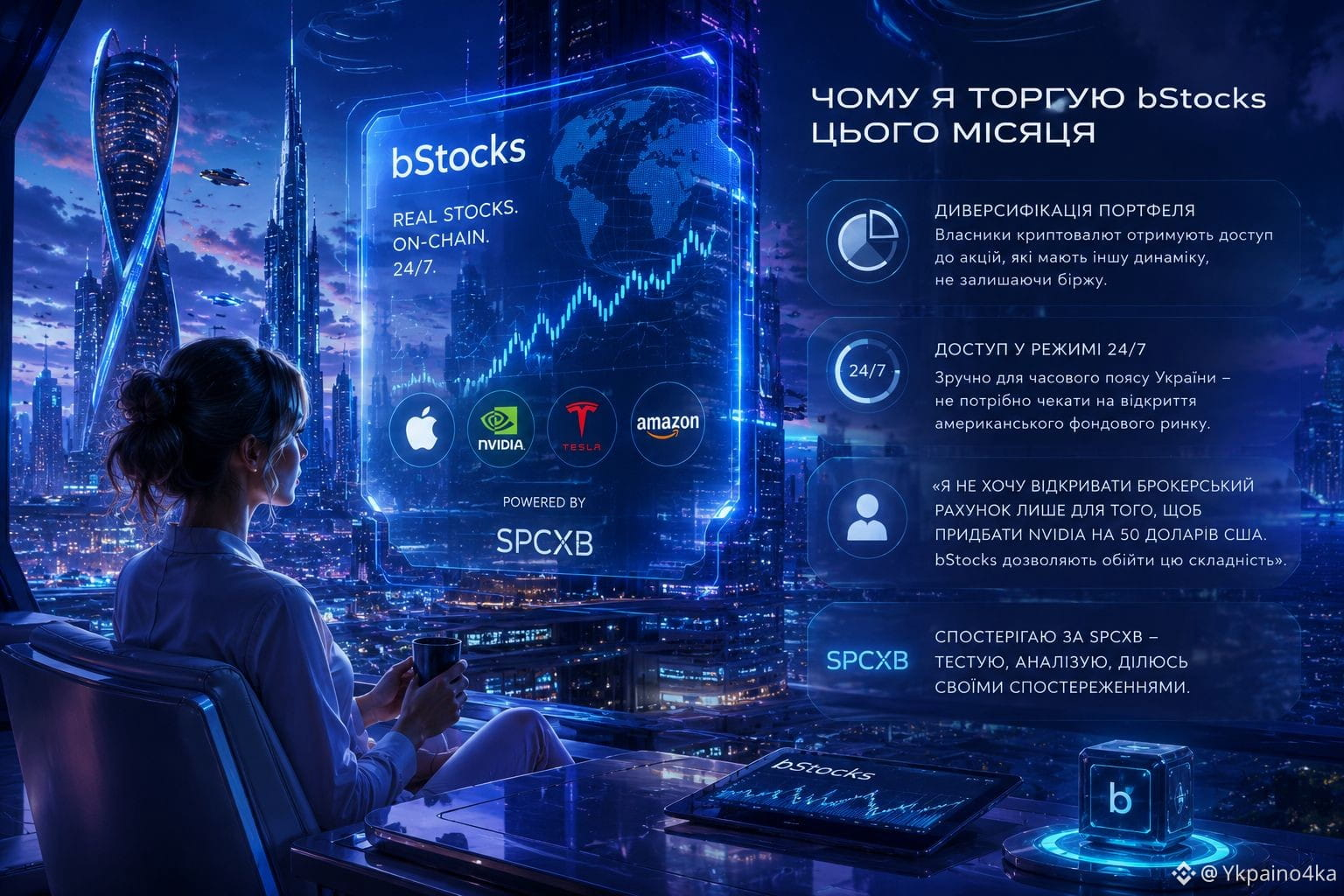
#bstockscis @BinanceCIS Lately, I’ve been catching myself thinking: why do I even need bStocks if I’m already working with crypto?
I’m testing this tool not for the sake of the very act of “buying stocks.” I’m interested in how a portfolio behaves when assets with different dynamics appear in it.
For me, there are two practical things here. First is diversification without needing to leave the crypto exchange. Second is 24/7 access. For Ukraine, that’s especially convenient: there’s no need to wait for the U.S. stock market to open.
For example, I don’t want to open a separate brokerage account just to buy NVIDIA for $50. That’s where bStocks look like a way to remove unnecessary complexity.
I also keep a close eye on spcxb—it's interesting to test how such tools change a typical investor’s behavior.
For me, this isn’t “a gift,” but rather a filter: what the portfolio actually needs, and what just seems convenient?
What do you value more—accessibility or the very opportunity to diversify?
#bStockCis $SPCXB
{spot}(SPCXBUSDT)
#bstockscis @BinanceCIS Lately, I’ve been catching myself thinking: why do I even need bStocks if I’m already working with crypto?
I’m testing this tool not for the sake of the very act of “buying stocks.” I’m interested in how a portfolio behaves when assets with different dynamics appear in it.
For me, there are two practical things here. First is diversification without needing to leave the crypto exchange. Second is 24/7 access. For Ukraine, that’s especially convenient: there’s no need to wait for the U.S. stock market to open.
For example, I don’t want to open a separate brokerage account just to buy NVIDIA for $50. That’s where bStocks look like a way to remove unnecessary complexity.
I also keep a close eye on spcxb—it's interesting to test how such tools change a typical investor’s behavior.
For me, this isn’t “a gift,” but rather a filter: what the portfolio actually needs, and what just seems convenient?
What do you value more—accessibility or the very opportunity to diversify?
#bStockCis $SPCXB
I’m testing this tool not for the sake of the very act of “buying stocks.” I’m interested in how a portfolio behaves when assets with different dynamics appear in it.
For me, there are two practical things here. First is diversification without needing to leave the crypto exchange. Second is 24/7 access. For Ukraine, that’s especially convenient: there’s no need to wait for the U.S. stock market to open.
For example, I don’t want to open a separate brokerage account just to buy NVIDIA for $50. That’s where bStocks look like a way to remove unnecessary complexity.
I also keep a close eye on spcxb—it's interesting to test how such tools change a typical investor’s behavior.
For me, this isn’t “a gift,” but rather a filter: what the portfolio actually needs, and what just seems convenient?
What do you value more—accessibility or the very opportunity to diversify?
#bStockCis $SPCXB
4
183

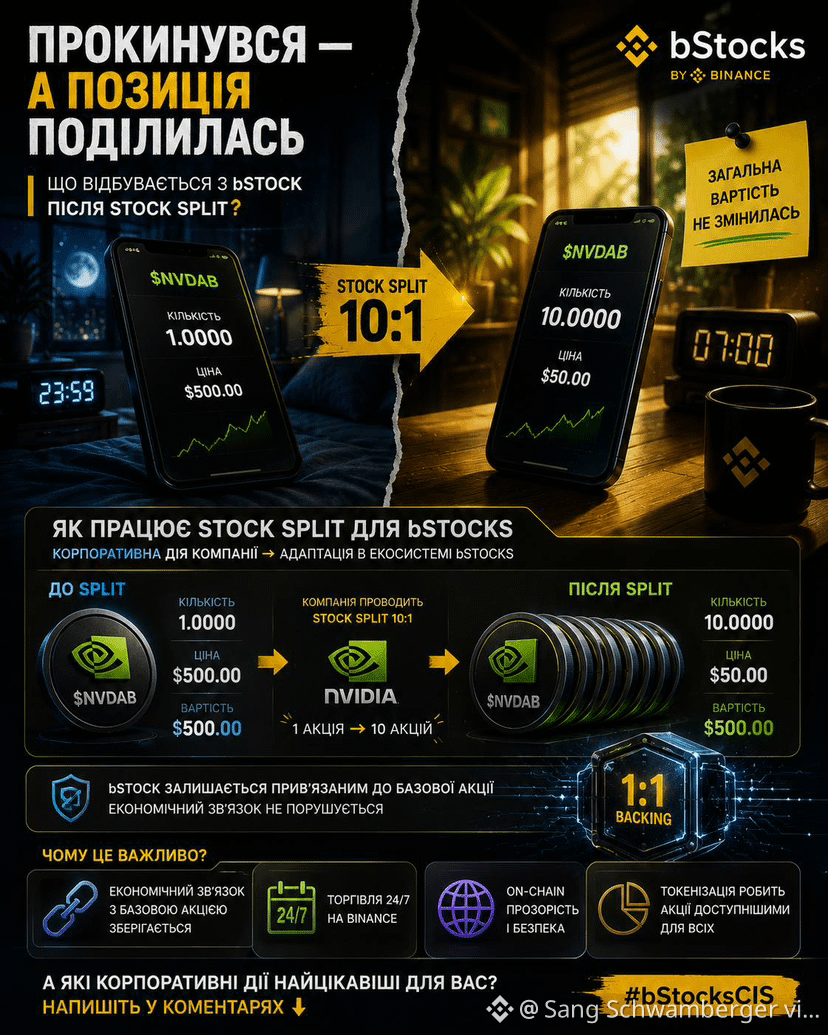
#bstockscis Imagine: you go to sleep with 1 token tied to a $500 share event, and the next day you see 10 tokens of roughly $50 each.
No extra money appeared. So what happened to bStock? 😅
That’s the question I asked myself when I started figuring out how tokenized assets handle a stock split.
With a regular stock it’s simple: a 10:1 split turns one share into ten, proportionally lowering the price. The total value of your position doesn’t change because of the split itself.
But bStock is a separate tokenized product connected to the underlying asset.
That’s why corporate actions affecting the underlying asset must also be reflected in bStocks, so the economic link to the underlying share is preserved.
And I think it’s precisely these kinds of moments that explain the concept of 1:1 backing better than the wording “backed by a share.”
$NVDAB can trade 24/7 and live on-chain, but behind the blockchain “shell” there’s still a real company with its corporate events.
That’s why I’m interested in bStocks: it’s not only 24/7 trading, but an attempt to carry over the logic of a traditional asset into an on-chain environment.
Next, we should look at a reverse split? 👀
@BinanceCIS #bStockCIS
#bstockscis Imagine: you go to sleep with 1 token tied to a $500 share event, and the next day you see 10 tokens of roughly $50 each.
No extra money appeared. So what happened to bStock? 😅
That’s the question I asked myself when I started figuring out how tokenized assets handle a stock split.
With a regular stock it’s simple: a 10:1 split turns one share into ten, proportionally lowering the price. The total value of your position doesn’t change because of the split itself.
But bStock is a separate tokenized product connected to the underlying asset.
That’s why corporate actions affecting the underlying asset must also be reflected in bStocks, so the economic link to the underlying share is preserved.
And I think it’s precisely these kinds of moments that explain the concept of 1:1 backing better than the wording “backed by a share.”
$NVDAB can trade 24/7 and live on-chain, but behind the blockchain “shell” there’s still a real company with its corporate events.
That’s why I’m interested in bStocks: it’s not only 24/7 trading, but an attempt to carry over the logic of a traditional asset into an on-chain environment.
Next, we should look at a reverse split? 👀
@BinanceCIS #bStockCIS
No extra money appeared. So what happened to bStock? 😅
That’s the question I asked myself when I started figuring out how tokenized assets handle a stock split.
With a regular stock it’s simple: a 10:1 split turns one share into ten, proportionally lowering the price. The total value of your position doesn’t change because of the split itself.
But bStock is a separate tokenized product connected to the underlying asset.
That’s why corporate actions affecting the underlying asset must also be reflected in bStocks, so the economic link to the underlying share is preserved.
And I think it’s precisely these kinds of moments that explain the concept of 1:1 backing better than the wording “backed by a share.”
$NVDAB can trade 24/7 and live on-chain, but behind the blockchain “shell” there’s still a real company with its corporate events.
That’s why I’m interested in bStocks: it’s not only 24/7 trading, but an attempt to carry over the logic of a traditional asset into an on-chain environment.
Next, we should look at a reverse split? 👀
@BinanceCIS #bStockCIS
102

·
--
#bstockscis
A shareholder at the price of a cup of coffee ☕📈
Back when you needed to buy even a single share of a promising railroad company or an oil giant like Rockefeller, you needed connections, a fortune, and a parchment certificate with a wax seal. 📜🏛️ Even today, the price of one lot from market-leading companies can be equal to a month’s rent for an apartment in the city center. 💸🏡
With bStocks, your entry threshold is just $5. 💵 You buy an exact fractional share of a real asset. 🍰 It’s like going to a restaurant and, instead of ordering a whole 10-kilogram cake, getting one perfect slice. And the best part: the percentage increase in the price of that “slice” brings exactly the same mathematical benefit as an investor portfolio from the front row in New York. 🎯✨
#bstockCIS @BinanceCIS
$NVDAB $SPCXB
#bstockscis
A shareholder at the price of a cup of coffee ☕📈
Back when you needed to buy even a single share of a promising railroad company or an oil giant like Rockefeller, you needed connections, a fortune, and a parchment certificate with a wax seal. 📜🏛️ Even today, the price of one lot from market-leading companies can be equal to a month’s rent for an apartment in the city center. 💸🏡
With bStocks, your entry threshold is just $5. 💵 You buy an exact fractional share of a real asset. 🍰 It’s like going to a restaurant and, instead of ordering a whole 10-kilogram cake, getting one perfect slice. And the best part: the percentage increase in the price of that “slice” brings exactly the same mathematical benefit as an investor portfolio from the front row in New York. 🎯✨
#bstockCIS @BinanceCIS
$NVDAB $SPCXB
A shareholder at the price of a cup of coffee ☕📈
Back when you needed to buy even a single share of a promising railroad company or an oil giant like Rockefeller, you needed connections, a fortune, and a parchment certificate with a wax seal. 📜🏛️ Even today, the price of one lot from market-leading companies can be equal to a month’s rent for an apartment in the city center. 💸🏡
With bStocks, your entry threshold is just $5. 💵 You buy an exact fractional share of a real asset. 🍰 It’s like going to a restaurant and, instead of ordering a whole 10-kilogram cake, getting one perfect slice. And the best part: the percentage increase in the price of that “slice” brings exactly the same mathematical benefit as an investor portfolio from the front row in New York. 🎯✨
#bstockCIS @BinanceCIS
$NVDAB $SPCXB
169

·
--
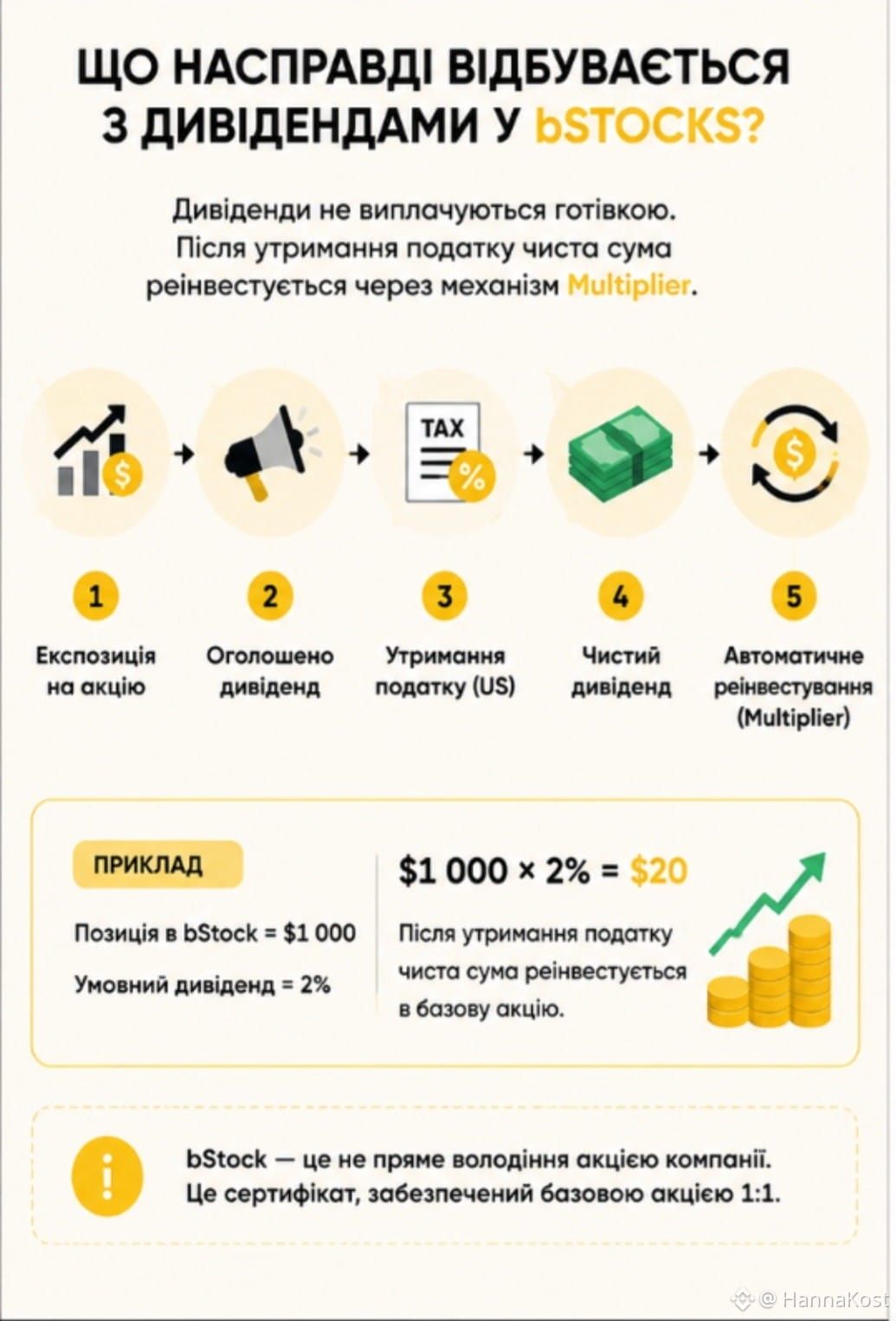
What actually happens to dividends in bStocks? 💰
There’s one aspect of bStocks that I wanted to look into in more detail: what happens to dividends?
At first, I thought it was pretty straightforward: if the underlying stock pays dividends, then maybe I simply receive the corresponding amount of money.
But with bStocks, the mechanism works differently.
According to Binance, dividends are not paid out in cash. After withholding the corresponding tax in the U.S., the net dividend amount is automatically reinvested into the underlying stock via the Multiplier mechanism.
Let’s break it down with a simple example.
Imagine I have $1,000 in a bStock, and the underlying company announces a hypothetical dividend of 2%.
Calculation:
$1,000 × 2% = $20
These $20 aren’t just credited to my balance as cash.
Instead, after the appropriate tax withholding, the net amount is reinvested into exposure to the underlying stock.
So the process looks like this:
Stock exposure
↓
Dividend declared
↓
Tax withheld
↓
Net dividend
↓
Automatic reinvestment
To me, this mechanism seems more interesting than simply getting a dividend added to the balance.
Because the way dividends work is built directly into the structure of the tokenized product.
#bstockCIS @BinanceCIS
What actually happens to dividends in bStocks? 💰
There’s one aspect of bStocks that I wanted to look into in more detail: what happens to dividends?
At first, I thought it was pretty straightforward: if the underlying stock pays dividends, then maybe I simply receive the corresponding amount of money.
But with bStocks, the mechanism works differently.
According to Binance, dividends are not paid out in cash. After withholding the corresponding tax in the U.S., the net dividend amount is automatically reinvested into the underlying stock via the Multiplier mechanism.
Let’s break it down with a simple example.
Imagine I have $1,000 in a bStock, and the underlying company announces a hypothetical dividend of 2%.
Calculation:
$1,000 × 2% = $20
These $20 aren’t just credited to my balance as cash.
Instead, after the appropriate tax withholding, the net amount is reinvested into exposure to the underlying stock.
So the process looks like this:
Stock exposure
↓
Dividend declared
↓
Tax withheld
↓
Net dividend
↓
Automatic reinvestment
To me, this mechanism seems more interesting than simply getting a dividend added to the balance.
Because the way dividends work is built directly into the structure of the tokenized product.
#bstockCIS @BinanceCIS
There’s one aspect of bStocks that I wanted to look into in more detail: what happens to dividends?
At first, I thought it was pretty straightforward: if the underlying stock pays dividends, then maybe I simply receive the corresponding amount of money.
But with bStocks, the mechanism works differently.
According to Binance, dividends are not paid out in cash. After withholding the corresponding tax in the U.S., the net dividend amount is automatically reinvested into the underlying stock via the Multiplier mechanism.
Let’s break it down with a simple example.
Imagine I have $1,000 in a bStock, and the underlying company announces a hypothetical dividend of 2%.
Calculation:
$1,000 × 2% = $20
These $20 aren’t just credited to my balance as cash.
Instead, after the appropriate tax withholding, the net amount is reinvested into exposure to the underlying stock.
So the process looks like this:
Stock exposure
↓
Dividend declared
↓
Tax withheld
↓
Net dividend
↓
Automatic reinvestment
To me, this mechanism seems more interesting than simply getting a dividend added to the balance.
Because the way dividends work is built directly into the structure of the tokenized product.
#bstockCIS @BinanceCIS
101
Log in to explore more content
Join global crypto users on Binance Square
⚡️ Get latest and useful information about crypto.
💬 Trusted by the world’s largest crypto exchange.
👍 Discover real insights from verified creators.
Email / Phone number
Trending Topics
1
#BitcoinSpotETFsNetInflow$191M
211 views
45 Discussing
2
#CFTCUpdatesGuidanceOnTokenizedAssets
6,150 views
355 Discussing
3
#BitgetSays$352MAffectedInHack
826 views
23 Discussing
4
#BinanceWillListHyperliquid(HYPE)
181,926 views
2,950 Discussing
5
#BrazilOrdersReportingOf$10KSelfCustodyTransfers
571 views
24 Discussing
6
#FedProposesRulesForBankIssuedStablecoins
7,413 views
293 Discussing
7
#OndoFinanceSoughtSaleAfterFoundersDeath
5,770 views
200 Discussing
8
#FedOctoberRateHikeOddsRiseTo69.7%
69,111 views
1,275 Discussing
9
#BitcoinFallsBelow$83,000
4,857 views
20 Discussing
10
#BitcoinFallsToAround$84,600ThisWeek
0 views
0 Discussing