
#tradingpsicologico
tradingpsicologico
4,293 views
13 Discussing
Hot
Latest

·
--
🍎 From Mammoth Barter to Bitcoin: The Evolution of Value (and the Danger of FOMO)
Have you ever stopped to think that money is, in reality, one of the greatest technologies our species has created?
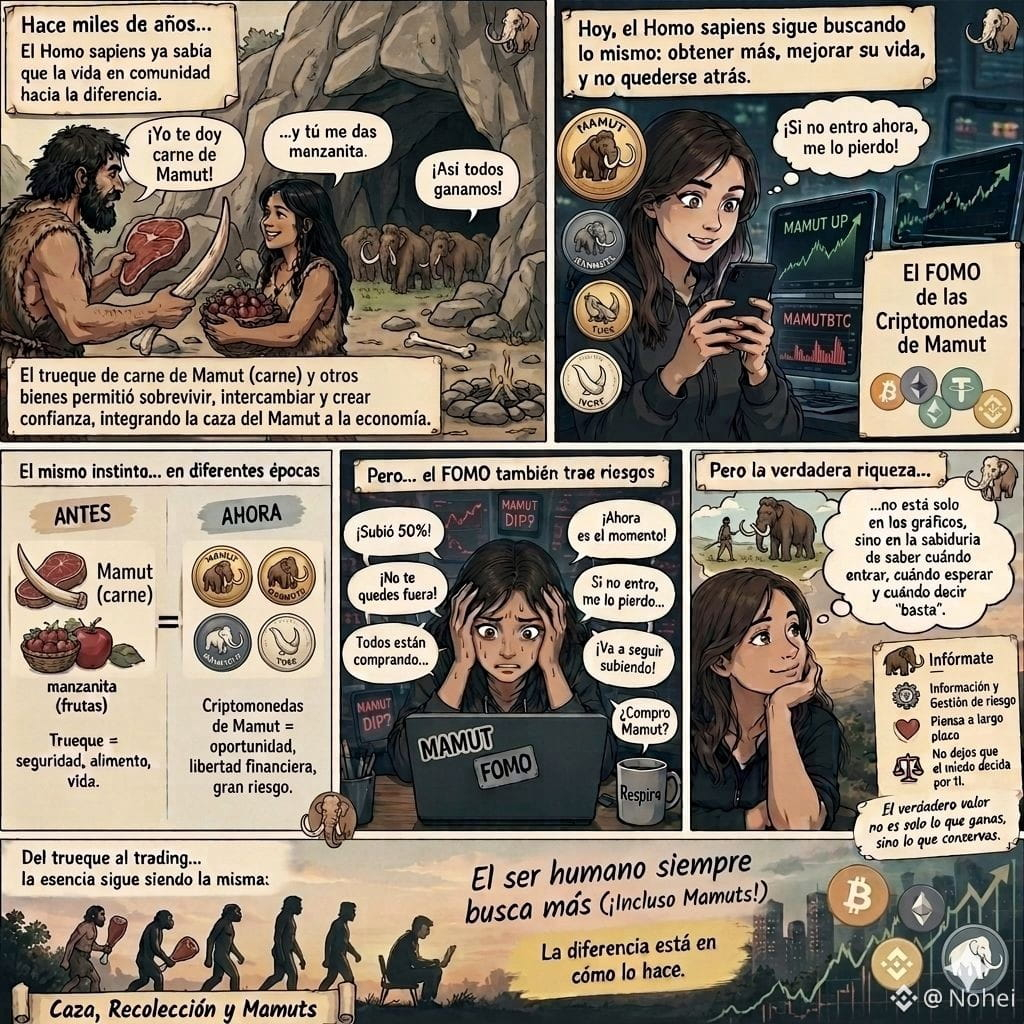
Our ancestors, Homo sapiens and the Cro-Magnon man, didn’t have screens, dollars, or digital wallets. In the middle of the Ice Age, value was in the physical and in survival. If your tribe managed to pull off the feat of hunting a giant mammoth, they would get priceless meat and hides that they would later trade with other groups for simpler resources, like wild apples. This primitive barter was our first financial system.
Over the centuries, humanity evolved and exchange became more complex. We went from bartering mammoths and apples to gold, then to banknotes backed by governments, and finally to digital assets.
🚀 The Crypto Revolution: The new evolutionary leap. Today, the cryptocurrencies $USDT /$USDC are the next step in this story. Banknotes lose value; now power lies in decentralization: we rely on secure networks built by the community and on transparent mathematical codes that nobody can manipulate.
🧠 The primitive brain versus today’s market: "FOMO—this is the real danger." Even though our financial technology has evolved over thousands of years, our brain still works like that of a Homo sapiens from the Stone Age.
When you see a token rise 50% in just a few hours, the same primitive alarm instinct kicks in—one our ancestor felt when they saw the whole tribe desperately running toward a limited resource before it ran out. In today’s trading, we call this wild, irrational urge FOMO (Fear Of Missing Out, or Fear of Missing Out).
#BinanceSquareTalks #CryptoEvolution #FOMO #Bitcoin #TradingPsicologico #Web3 #HomoSapiens #Write to Earn
🍎 From Mammoth Barter to Bitcoin: The Evolution of Value (and the Danger of FOMO)
Have you ever stopped to think that money is, in reality, one of the greatest technologies our species has created?
Our ancestors, Homo sapiens and the Cro-Magnon man, didn’t have screens, dollars, or digital wallets. In the middle of the Ice Age, value was in the physical and in survival. If your tribe managed to pull off the feat of hunting a giant mammoth, they would get priceless meat and hides that they would later trade with other groups for simpler resources, like wild apples. This primitive barter was our first financial system.
Over the centuries, humanity evolved and exchange became more complex. We went from bartering mammoths and apples to gold, then to banknotes backed by governments, and finally to digital assets.
🚀 The Crypto Revolution: The new evolutionary leap. Today, the cryptocurrencies $USDT /$USDC are the next step in this story. Banknotes lose value; now power lies in decentralization: we rely on secure networks built by the community and on transparent mathematical codes that nobody can manipulate.
🧠 The primitive brain versus today’s market: "FOMO—this is the real danger." Even though our financial technology has evolved over thousands of years, our brain still works like that of a Homo sapiens from the Stone Age.
When you see a token rise 50% in just a few hours, the same primitive alarm instinct kicks in—one our ancestor felt when they saw the whole tribe desperately running toward a limited resource before it ran out. In today’s trading, we call this wild, irrational urge FOMO (Fear Of Missing Out, or Fear of Missing Out).
#BinanceSquareTalks #CryptoEvolution #FOMO #Bitcoin #TradingPsicologico #Web3 #HomoSapiens #Write to Earn
Have you ever stopped to think that money is, in reality, one of the greatest technologies our species has created?
Our ancestors, Homo sapiens and the Cro-Magnon man, didn’t have screens, dollars, or digital wallets. In the middle of the Ice Age, value was in the physical and in survival. If your tribe managed to pull off the feat of hunting a giant mammoth, they would get priceless meat and hides that they would later trade with other groups for simpler resources, like wild apples. This primitive barter was our first financial system.
Over the centuries, humanity evolved and exchange became more complex. We went from bartering mammoths and apples to gold, then to banknotes backed by governments, and finally to digital assets.
🚀 The Crypto Revolution: The new evolutionary leap. Today, the cryptocurrencies $USDT /$USDC are the next step in this story. Banknotes lose value; now power lies in decentralization: we rely on secure networks built by the community and on transparent mathematical codes that nobody can manipulate.
🧠 The primitive brain versus today’s market: "FOMO—this is the real danger." Even though our financial technology has evolved over thousands of years, our brain still works like that of a Homo sapiens from the Stone Age.
When you see a token rise 50% in just a few hours, the same primitive alarm instinct kicks in—one our ancestor felt when they saw the whole tribe desperately running toward a limited resource before it ran out. In today’s trading, we call this wild, irrational urge FOMO (Fear Of Missing Out, or Fear of Missing Out).
#BinanceSquareTalks #CryptoEvolution #FOMO #Bitcoin #TradingPsicologico #Web3 #HomoSapiens #Write to Earn
479

·
--
🎓 Trader Mentoring
Session #004
How many times do you check the price after opening a trade?
Many traders believe that watching the chart every few seconds gives them more control. In reality, it usually has the opposite effect. Each small candle seems like a signal to enter, exit, or modify the plan, even if the initial analysis is still valid.
Constantly reviewing a trade can let fear and anxiety replace discipline.
The market moves due to normal fluctuations, but an impatient trader may interpret them as a threat and close a position too soon or open another without an objective reason.
A good practice is to define from the start at what times you’ll review your trade based on the timeframe you’re using. That way, your decisions will depend on your strategy—not on the emotions each price movement creates.
This is something we work on in detail in the personalized coaching sessions. We analyze your habits against the chart, identify behaviors that affect your performance, and design a routine tailored to your trading methodology. Many times, improving results doesn’t require a new strategy, but learning to execute the one you already have with greater discipline.
Now I want to know your experience.
How often do you review your open trades? Do you think that helps you, or on the contrary does it lead you to make impulsive decisions? Leave it in the comments. If there’s a topic you’d like to see in a future Trader Mentoring session, write it too. Your questions may become the next sessions in this series.
#NomadaCripto #TradingPsicologico #GestionEmocional #TradingDeFuturos #Disciplina
🎓 Trader Mentoring
Session #004
How many times do you check the price after opening a trade?
Many traders believe that watching the chart every few seconds gives them more control. In reality, it usually has the opposite effect. Each small candle seems like a signal to enter, exit, or modify the plan, even if the initial analysis is still valid.
Constantly reviewing a trade can let fear and anxiety replace discipline.
The market moves due to normal fluctuations, but an impatient trader may interpret them as a threat and close a position too soon or open another without an objective reason.
A good practice is to define from the start at what times you’ll review your trade based on the timeframe you’re using. That way, your decisions will depend on your strategy—not on the emotions each price movement creates.
This is something we work on in detail in the personalized coaching sessions. We analyze your habits against the chart, identify behaviors that affect your performance, and design a routine tailored to your trading methodology. Many times, improving results doesn’t require a new strategy, but learning to execute the one you already have with greater discipline.
Now I want to know your experience.
How often do you review your open trades? Do you think that helps you, or on the contrary does it lead you to make impulsive decisions? Leave it in the comments. If there’s a topic you’d like to see in a future Trader Mentoring session, write it too. Your questions may become the next sessions in this series.
#NomadaCripto #TradingPsicologico #GestionEmocional #TradingDeFuturos #Disciplina
Session #004
How many times do you check the price after opening a trade?
Many traders believe that watching the chart every few seconds gives them more control. In reality, it usually has the opposite effect. Each small candle seems like a signal to enter, exit, or modify the plan, even if the initial analysis is still valid.
Constantly reviewing a trade can let fear and anxiety replace discipline.
The market moves due to normal fluctuations, but an impatient trader may interpret them as a threat and close a position too soon or open another without an objective reason.
A good practice is to define from the start at what times you’ll review your trade based on the timeframe you’re using. That way, your decisions will depend on your strategy—not on the emotions each price movement creates.
This is something we work on in detail in the personalized coaching sessions. We analyze your habits against the chart, identify behaviors that affect your performance, and design a routine tailored to your trading methodology. Many times, improving results doesn’t require a new strategy, but learning to execute the one you already have with greater discipline.
Now I want to know your experience.
How often do you review your open trades? Do you think that helps you, or on the contrary does it lead you to make impulsive decisions? Leave it in the comments. If there’s a topic you’d like to see in a future Trader Mentoring session, write it too. Your questions may become the next sessions in this series.
#NomadaCripto #TradingPsicologico #GestionEmocional #TradingDeFuturos #Disciplina
1
554

·
--
Bearish
📉 My most recent liquidation and a streak that changed the course
This post is not to brag, it is to document and learn.
$PIPPIN $LUNA2 $TRUTH
Until November 29, everything was going quite well.
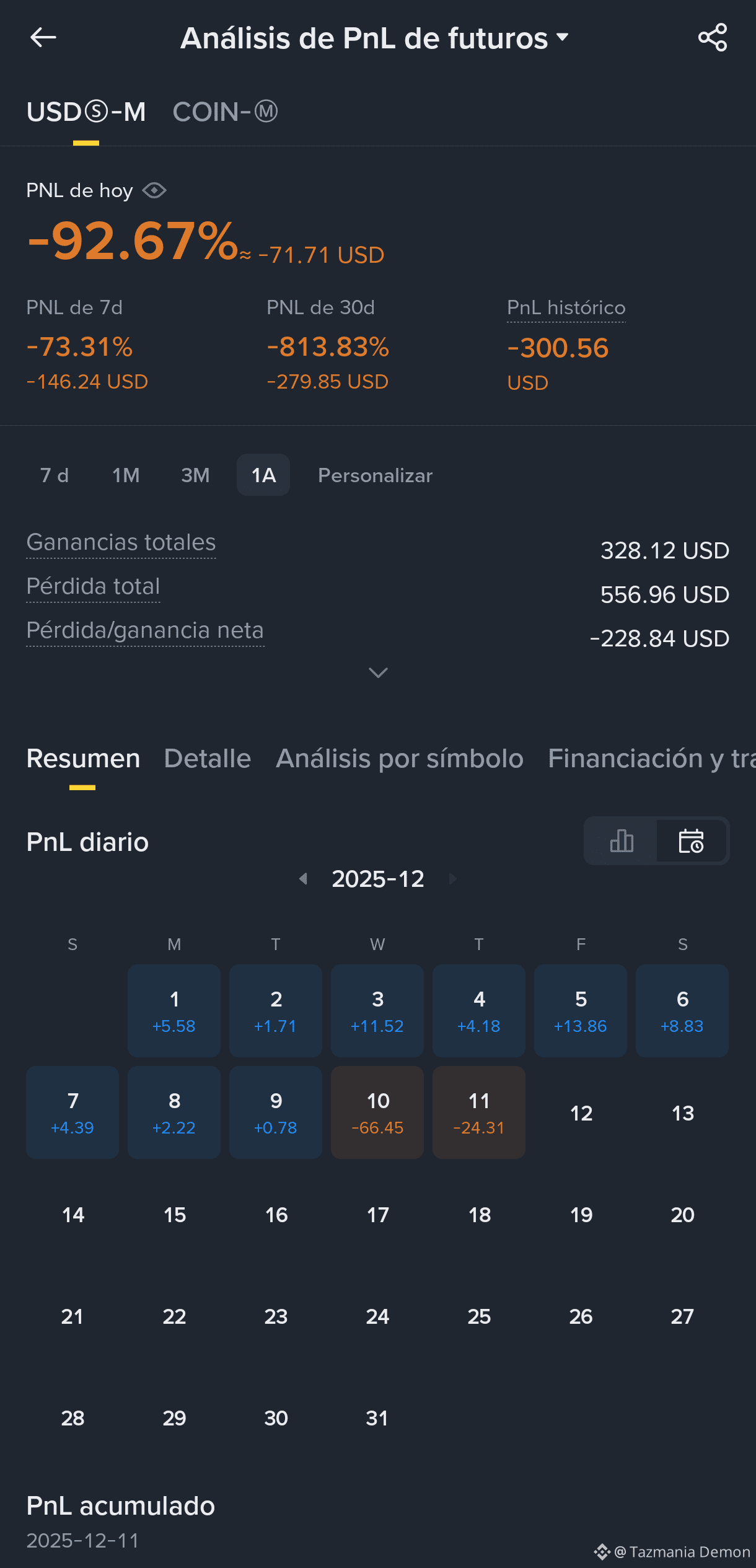
Overall PNL positive, around +90 USD, and in the month I only had one small red day. Everything seemed under control.
On November 30, everything changed.
I traded poorly, made silly mistakes, with accumulated fatigue, and had two large liquidations, which totaled nearly –280 USD.
One of them reached an absurd negative ROI of –1100%, something I fully acknowledge as a mistake for letting a bad position run uncontrolled; it had happened to me before, and it had recovered, but at that time I didn't have a liquidation price.
I decided to stop, take a breath, and recharge 115 USD to start December with a clear head.
The first few days worked, but since December 10, the market became extremely violent. Positive trades were no longer enough to offset the losses, and in seconds the price went straight to your SL or liquidation.
It only took one big initial loss (~30 USD) for everything to go downhill emotionally.
🧠 Moral
In futures, it's not just about technique.
It's about accepting the real risk, controlling frustration, and knowing when not to trade.
As they say in #TekaCueva :
> In futures, you should only trade with money you are already willing to lose.
Tomorrow will be another day, with more respect for risk and less ego in front of the market.
#FuturosCrypto #RiskManagement #tradingpsicologico
📉 My most recent liquidation and a streak that changed the course
This post is not to brag, it is to document and learn.
$PIPPIN $LUNA2 $TRUTH
Until November 29, everything was going quite well.
Overall PNL positive, around +90 USD, and in the month I only had one small red day. Everything seemed under control.
On November 30, everything changed.
I traded poorly, made silly mistakes, with accumulated fatigue, and had two large liquidations, which totaled nearly –280 USD.
One of them reached an absurd negative ROI of –1100%, something I fully acknowledge as a mistake for letting a bad position run uncontrolled; it had happened to me before, and it had recovered, but at that time I didn't have a liquidation price.
I decided to stop, take a breath, and recharge 115 USD to start December with a clear head.
The first few days worked, but since December 10, the market became extremely violent. Positive trades were no longer enough to offset the losses, and in seconds the price went straight to your SL or liquidation.
It only took one big initial loss (~30 USD) for everything to go downhill emotionally.
🧠 Moral
In futures, it's not just about technique.
It's about accepting the real risk, controlling frustration, and knowing when not to trade.
As they say in #TekaCueva :
> In futures, you should only trade with money you are already willing to lose.
Tomorrow will be another day, with more respect for risk and less ego in front of the market.
#FuturosCrypto #RiskManagement #tradingpsicologico
This post is not to brag, it is to document and learn.
$PIPPIN $LUNA2 $TRUTH
Until November 29, everything was going quite well.
Overall PNL positive, around +90 USD, and in the month I only had one small red day. Everything seemed under control.
On November 30, everything changed.
I traded poorly, made silly mistakes, with accumulated fatigue, and had two large liquidations, which totaled nearly –280 USD.
One of them reached an absurd negative ROI of –1100%, something I fully acknowledge as a mistake for letting a bad position run uncontrolled; it had happened to me before, and it had recovered, but at that time I didn't have a liquidation price.
I decided to stop, take a breath, and recharge 115 USD to start December with a clear head.
The first few days worked, but since December 10, the market became extremely violent. Positive trades were no longer enough to offset the losses, and in seconds the price went straight to your SL or liquidation.
It only took one big initial loss (~30 USD) for everything to go downhill emotionally.
🧠 Moral
In futures, it's not just about technique.
It's about accepting the real risk, controlling frustration, and knowing when not to trade.
As they say in #TekaCueva :
> In futures, you should only trade with money you are already willing to lose.
Tomorrow will be another day, with more respect for risk and less ego in front of the market.
#FuturosCrypto #RiskManagement #tradingpsicologico
8
3
9
4.6k

·
--

Article
Investing is not repeating the market but your memories投資不是重複市場而是重現你的記憶Investing is not about repeating the highs and lows of the market, but about reliving the peaks and ends that remain in your memory.
#psicologia
«The Law of the Peak-End: The Birth of an Idea That Changed How We Remember Pain»
In the 1970s, psychologists Daniel Kahneman and Donald Redelmeier conducted a very particular experiment in a hospital in Israel.
It wasn't about money, nor about stocks,
but rather about something much more uncomfortable: a colonoscopy.
Yes, that medical procedure that causes so much discomfort and pain.
Investing is not repeating the market but your memories投資不是重複市場而是重現你的記憶
Investing is not about repeating the highs and lows of the market, but about reliving the peaks and ends that remain in your memory.
#psicologia
«The Law of the Peak-End: The Birth of an Idea That Changed How We Remember Pain»
In the 1970s, psychologists Daniel Kahneman and Donald Redelmeier conducted a very particular experiment in a hospital in Israel.
It wasn't about money, nor about stocks,
but rather about something much more uncomfortable: a colonoscopy.
Yes, that medical procedure that causes so much discomfort and pain.
#psicologia
«The Law of the Peak-End: The Birth of an Idea That Changed How We Remember Pain»
In the 1970s, psychologists Daniel Kahneman and Donald Redelmeier conducted a very particular experiment in a hospital in Israel.
It wasn't about money, nor about stocks,
but rather about something much more uncomfortable: a colonoscopy.
Yes, that medical procedure that causes so much discomfort and pain.
3.7k
1.8k
256
3.7k
Market Structure
Price leaves clues...
but few know how to read them.
Hook:
Every movement has a structure:
— Highs and lows
— Breakouts
— Retracements
It's not chaos.
It's intention.
Most react to candlesticks.
The consistent ones read behavior.
That's the difference.
Closure:
If you don't understand the structure,
you're just guessing.
Suggested visual format:
Clear trend vs confusing market
CTA:
📊 Do you read structure... or just random candles?
$BTC
{spot}(BTCUSDT)
$ETH
{spot}(ETHUSDT)
$PAXG
{spot}(PAXGUSDT)
Hashtags:
#MarketStructure #PriceAction #SmartMoney #CryptoTrading #tradingpsicologico
Market Structure
Price leaves clues...
but few know how to read them.
Hook:
Every movement has a structure:
— Highs and lows
— Breakouts
— Retracements
It's not chaos.
It's intention.
Most react to candlesticks.
The consistent ones read behavior.
That's the difference.
Closure:
If you don't understand the structure,
you're just guessing.
Suggested visual format:
Clear trend vs confusing market
CTA:
📊 Do you read structure... or just random candles?
$BTC
$ETH
$PAXG
Hashtags:
#MarketStructure #PriceAction #SmartMoney #CryptoTrading #tradingpsicologico
Price leaves clues...
but few know how to read them.
Hook:
Every movement has a structure:
— Highs and lows
— Breakouts
— Retracements
It's not chaos.
It's intention.
Most react to candlesticks.
The consistent ones read behavior.
That's the difference.
Closure:
If you don't understand the structure,
you're just guessing.
Suggested visual format:
Clear trend vs confusing market
CTA:
📊 Do you read structure... or just random candles?
$BTC
$ETH
$PAXG
Hashtags:
#MarketStructure #PriceAction #SmartMoney #CryptoTrading #tradingpsicologico
1
107
Log in to explore more content
Join global crypto users on Binance Square
⚡️ Get latest and useful information about crypto.
💬 Trusted by the world’s largest crypto exchange.
👍 Discover real insights from verified creators.
Email / Phone number
Trending Topics
1
#FedRateWatch
759,000 views
3,604 Discussing
2
#BitcoinFalls4%
0 views
0 Discussing
3
#ArgentinaCommitsToOECDCryptoReportingBy2029
3,492 views
112 Discussing
4
#EthereumFallsBelow$2400
2,152 views
51 Discussing
5
#USDTLaunchesOnZamaPrivacyProtocol
979 views
48 Discussing
6
#USSenateBlocksClarityAct
15,372 views
275 Discussing
7
#BitcoinSlidesTo$76000
33,910 views
155 Discussing
8
#BitcoinReboundsTo$79K
66,539 views
426 Discussing
9
#StrategyMarketCapPassesFord
58,646 views
869 Discussing
10
#ClarityActOddsHalveOnPolymarket
97,109 views
795 Discussing