

#tradertraitor
tradertraitor
5,307 views
17 Discussing
Hot
Latest

·
--
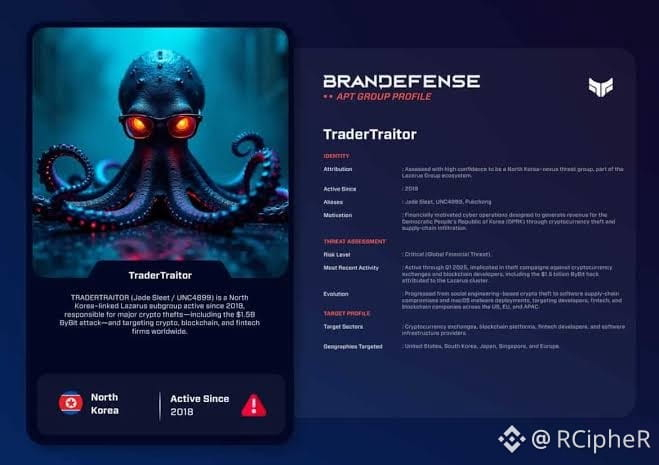
#TraderTraitor
is a sophisticated, state-sponsored North Korean cyber espionage and hacking group (often classified as a subgroup of the notorious Lazarus Group) that primarily targets blockchain, cryptocurrency, and web3 organizations to fund North Korea's state programs. [1, 2]
The group made massive international headlines following a jaw-dropping $6.3 billion crypto heist targeting Binance, which blockchain intelligence firms like TRM Labs officially tied to TraderTraitor.
$BNB
{future}(BNBUSDT)
#TraderTraitor
is a sophisticated, state-sponsored North Korean cyber espionage and hacking group (often classified as a subgroup of the notorious Lazarus Group) that primarily targets blockchain, cryptocurrency, and web3 organizations to fund North Korea's state programs. [1, 2]
The group made massive international headlines following a jaw-dropping $6.3 billion crypto heist targeting Binance, which blockchain intelligence firms like TRM Labs officially tied to TraderTraitor.
$BNB
1
105

·
--
Article
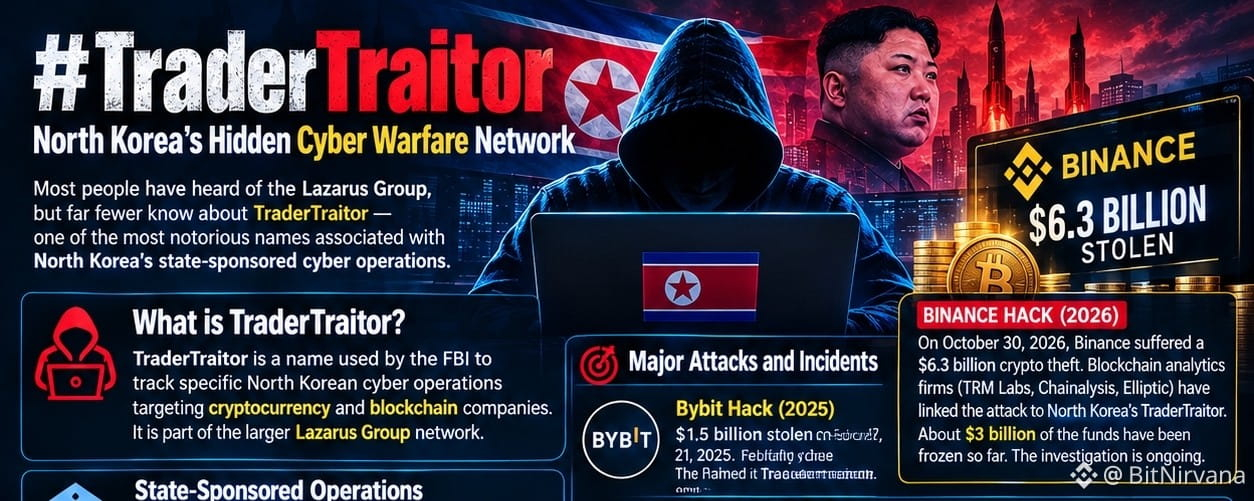
TraderTraitor: North Korea’s Hidden Cyber Warfare Network 🇰🇵Most people have heard of the Lazarus Group, but far fewer know about TraderTraitor — one of the most notorious names associated with North Korea’s state-sponsored cyber operations.
TraderTraitor is not an ordinary hacking group. It is a name used by the FBI to track specific North Korean cyber operations targeting cryptocurrency and blockchain companies.
Here is what makes this group so significant:
🔹 State-Sponsored Operations
The FBI, CISA, and U.S. Treasury have identified TraderTraitor as North Korean state-sponsored cyber activity. It is also associated with the broader Lazarus Group ecosystem.
🔹 Connections to North Korea’s Intelligence Agency
In September 2019, the U.S. Treasury identified Lazarus Group as a North Korean government-controlled entity connected to the Reconnaissance General Bureau (RGB), the country's primary intelligence agency.
🔹 The $1.5 Billion Bybit Hack
On February 21, 2025, Bybit suffered a massive cryptocurrency theft worth approximately $1.5 billion.
On February 26, 2025, the FBI officially attributed the attack to North Korea and referred to the specific malicious cyber activity as TraderTraitor.
🔹 The $308 Million DMM Bitcoin Theft
In May 2024, North Korean cyber actors associated with TraderTraitor stole approximately $308 million from Japan-based DMM Bitcoin.
Investigators revealed that the attackers used a fake LinkedIn recruiter identity and a malicious coding test to compromise an employee.
🔹 A Much Longer History
North Korean cyber operations have also been linked to several major incidents:
• 2016 Bangladesh Bank heist — approximately $81 million stolen, involving Lazarus Group and its associated financial cyber operations.
• 2014 Sony Pictures cyberattack — attributed to North Korea by the FBI and linked to Lazarus Group.
• 2022 Axie Infinity Ronin Bridge hack — approximately $620 million stolen, attributed to Lazarus Group by the FBI.
🔹 Where Does the Money Go?
According to the U.S. Treasury, North Korea uses illicit cyber operations and cryptocurrency theft to generate revenue for the regime, including funding its weapons of mass destruction and ballistic missile programs.
The exact amount of stolen money that reaches specific government programs is difficult to independently establish.
The Bigger Picture
TraderTraitor represents a growing challenge for the global cryptocurrency industry.
These operations do not always begin with sophisticated code. Sometimes, they start with a fake job offer, a LinkedIn message, or a seemingly harmless coding test.
The lesson is clear:
In crypto, the biggest security threat may not always be a smart contract vulnerability. Sometimes, it is the person you trust.
#TraderTraitor #LazarusGroup #NorthKorea #CyberSecurity #CryptoSecurity #Bybit #Blockchain #CyberWarfare
TraderTraitor: North Korea’s Hidden Cyber Warfare Network 🇰🇵
Most people have heard of the Lazarus Group, but far fewer know about TraderTraitor — one of the most notorious names associated with North Korea’s state-sponsored cyber operations.
TraderTraitor is not an ordinary hacking group. It is a name used by the FBI to track specific North Korean cyber operations targeting cryptocurrency and blockchain companies.
Here is what makes this group so significant:
🔹 State-Sponsored Operations
The FBI, CISA, and U.S. Treasury have identified TraderTraitor as North Korean state-sponsored cyber activity. It is also associated with the broader Lazarus Group ecosystem.
🔹 Connections to North Korea’s Intelligence Agency
In September 2019, the U.S. Treasury identified Lazarus Group as a North Korean government-controlled entity connected to the Reconnaissance General Bureau (RGB), the country's primary intelligence agency.
🔹 The $1.5 Billion Bybit Hack
On February 21, 2025, Bybit suffered a massive cryptocurrency theft worth approximately $1.5 billion.
On February 26, 2025, the FBI officially attributed the attack to North Korea and referred to the specific malicious cyber activity as TraderTraitor.
🔹 The $308 Million DMM Bitcoin Theft
In May 2024, North Korean cyber actors associated with TraderTraitor stole approximately $308 million from Japan-based DMM Bitcoin.
Investigators revealed that the attackers used a fake LinkedIn recruiter identity and a malicious coding test to compromise an employee.
🔹 A Much Longer History
North Korean cyber operations have also been linked to several major incidents:
• 2016 Bangladesh Bank heist — approximately $81 million stolen, involving Lazarus Group and its associated financial cyber operations.
• 2014 Sony Pictures cyberattack — attributed to North Korea by the FBI and linked to Lazarus Group.
• 2022 Axie Infinity Ronin Bridge hack — approximately $620 million stolen, attributed to Lazarus Group by the FBI.
🔹 Where Does the Money Go?
According to the U.S. Treasury, North Korea uses illicit cyber operations and cryptocurrency theft to generate revenue for the regime, including funding its weapons of mass destruction and ballistic missile programs.
The exact amount of stolen money that reaches specific government programs is difficult to independently establish.
The Bigger Picture
TraderTraitor represents a growing challenge for the global cryptocurrency industry.
These operations do not always begin with sophisticated code. Sometimes, they start with a fake job offer, a LinkedIn message, or a seemingly harmless coding test.
The lesson is clear:
In crypto, the biggest security threat may not always be a smart contract vulnerability. Sometimes, it is the person you trust.
#TraderTraitor #LazarusGroup #NorthKorea #CyberSecurity #CryptoSecurity #Bybit #Blockchain #CyberWarfare
1
172
Article
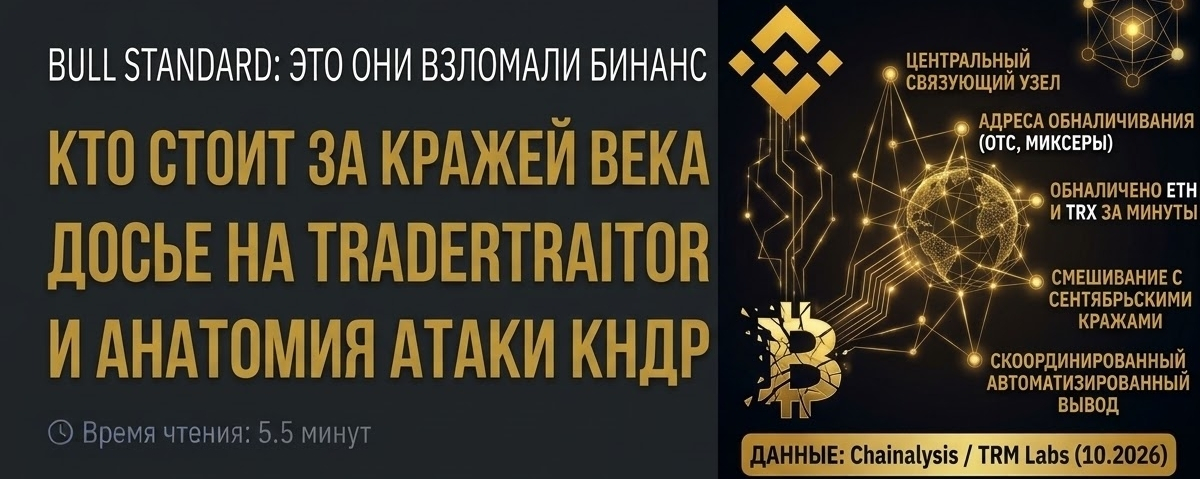
BULL STANDARD: THEY HACKED BINANCE — WHO IS BEHIND THE THEFT OF THE CENTURY AND THE ANATOMY OF THE ATTACK OF THE CENTURY
⏱ Reading time: 5.5 minutes
Date: October 31, 2026
Hello, colleagues!
Official investigations by leading analytical agencies (Chainalysis, TRM Labs, Elliptic) confirm what we have been saying from the very first minutes: the market did not face an ordinary bug, but a targeted operation by intelligence agencies that had been prepared over a long period.
1
1.1k

·
--
Put simply, this wasn’t a case of private keys being stolen—the signing system was used as an ATM. TRM Labs’ timeline: the attack began at 20:05 UTC on October 29. In 20 minutes, $6.36 billion was moved out of Binance wallets across 10 chains—more than four times the $1.5 billion stolen from Bybit. Binance’s preliminary investigation lines up: an operations engineer’s computer was hacked, and the attacker got into an internal service container and submitted withdrawal requests. No private key leak was found. The wildest part was on Ethereum: the attacker got Binance’s signing system to approve 50 EIP-7702 authorizations in one go, arranged sequentially so one was bound to hit. Binance 14 instantly became the attacker’s vacuum cleaner, sweeping up 167,464 $ETH and 1.615 billion USDT in a single transaction, leaving just 1 ETH behind. After the wallet was replenished, it was swept again. TRM and Chainalysis both point to North Korea’s TraderTraitor, though Binance hasn’t named anyone yet. The roughly $3 billion frozen was all in freezeable stablecoins: Tether froze $1.567 billion, and Circle froze over $800 million. The roughly $2.4 billion in unfreezable $BTC and $ETH is already gone. SAFU holds 15,000 $BTC worth about $1.2 billion—less than a fifth of the losses. The rest will have to be covered by Binance’s own reserves. This is just my personal opinion, for reference only. Once withdrawals resume, will you withdraw to self-custody right away, or keep your funds on Binance and bet it will make everyone whole? Pick a side in the comments.
#$1.5BInLeveragedCryptoBetsLiquidated #BinanceSecurityIncident #TraderTraitor #EIP7702
#$1.5BInLeveragedCryptoBetsLiquidated #BinanceSecurityIncident #TraderTraitor #EIP7702
Padfoot:
先别急着站队,63.6亿这种级别得核对官方公告和链上证据😂 吃瓜可以,别让假瓜把自己的钱包吓跑了。
1
2
1.3k

·
--
Bullish
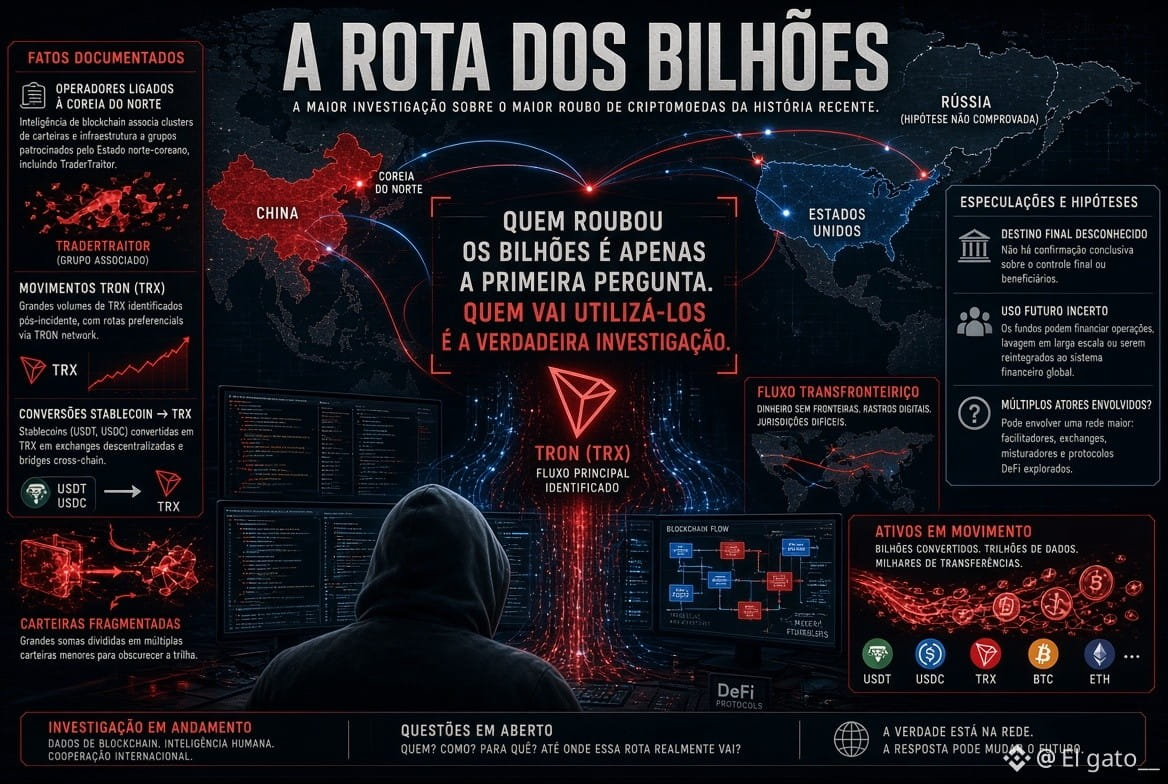
THE BILLION-DOLLAR ROUTE
The largest cryptocurrency heist in recent history is still being unraveled.
On October 29, 2026, approximately US$6.3 billion left Binance wallets within minutes. Blockchain intelligence firms linked the attack to operators connected to North Korea (the TraderTraitor group). A significant portion of the assets moved through the TRON network, with stablecoins (USDT/USDC) converted into TRX—a classic route for reducing the risk of funds being frozen.
The question that matters most isn’t just “who stole it.”
It’s: who will use these billions?
Who funds these operations?
Who carries out large-scale money laundering?
What is the final destination of the funds?
Russia appears in some investigative theories, but without confirmation. The documented facts point to North Korean operators and routes via TRON. Everything else is still speculation.
The truth is on the blockchain.
The answer could change the future.
What do you think?
Who really controls these funds now?
#BinanceHack #TRON #CryptoInvestigation #BlockchainForensics #TraderTraitor $TRX
34

·
--
The $6.3 billion Binance heist points to North Korean hackers
TRM Labs and Chainalysis named the North Korean hacking group TraderTraitor, with TRM expressing “high confidence.” ZachXBT found that the stolen Binance funds and the funds stolen from Bitget last month converged at the same address after passing through THORChain. The attackers also used 50 pre-signed authorizations and EIP-7702 to turn hot wallets into “coin sweepers,” making off with about $6.36 billion across 10 chains in 20 minutes.
But Binance has yet to name anyone, and its official line remains that a “laptop was compromised,” with no private keys leaked. Put simply, the laptop was just the entry point. The outrageous part is that the system allowed one device to empty 10 chains in half an hour. This is no longer just one exchange’s problem—it’s the whole industry paying tuition to state-sponsored hackers.
Reuters: By the end of 2025, North Korean hackers had stolen at least $6.75 billion. Add the $387 million stolen from Bitget in September, and the total is heading toward $13.5 billion. The $3 billion frozen is just a figure on paper; whether withdrawals resume on Sunday will be the real test.
#币安 #TraderTraitor #黑客 #BTC

158

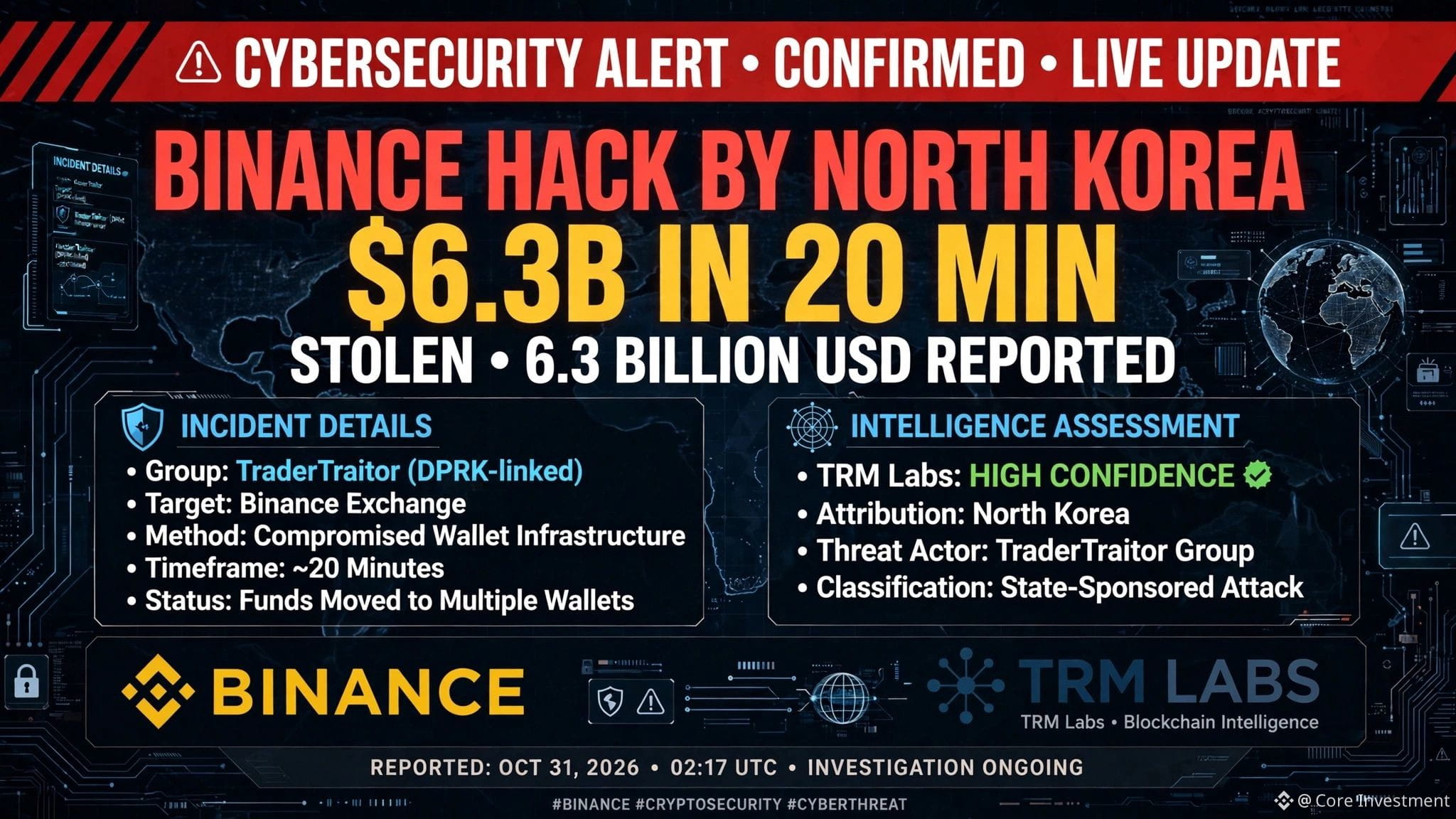
🚨 LATEST UPDATE 31/10: BINANCE CONFIRMS IT WAS HACKED BY A NORTH KOREAN GROUP!
- Binance official statement: Total losses are approximately $6.3 billion; $3 billion has been frozen
- TRM Labs says it is highly confident the hack was carried out by TraderTraitor, a group linked to North Korea
- The hack took place in just 20 minutes, starting at 20:05 UTC on 29/10
- Bitcoin fell to $77K, its lowest level in 6 weeks
- Binance expects to reopen withdrawals on Sunday morning
- Yi He: Binance will fully reimburse users; their funds are safe
This is the biggest hack in crypto history!
Have you been able to withdraw your money yet?
#BinanceHack #TraderTraitor #NorthKorea #BreakingNews
197

·
--
Analysts link the attack to the North Korean group TraderTraitor, which was also behind the $1.5 billion Bybit hack in 2025. ZachXBT writes that funds from the Binance and Bitget hacks were mixed through THORChain, keeping $RUNE in the spotlight. These are investigators’ theories, not final conclusions. But one conclusion is already clear: hackers are shifting from looking for bugs in code to attacking people and infrastructure. For $BTC holders, this is another reason to check their own security.
Do you store $BTC on an exchange or in a cold wallet? 👇
#TraderTraitor
Do you store $BTC on an exchange or in a cold wallet? 👇
#TraderTraitor
2
106

🚨 EXPOSED: Who Hacked Binance? 🚨
This was NOT a normal hacker! 👇
🔴 Hacker Name: TraderTraitor
🔴 Country: North Korea's Elite Government Hacking Unit
🔴 This group has already stolen $2 Billion+ in crypto before!
💻 How they hacked?
- Hacked a Binance DevOps Engineer's laptop
- Gained access to internal service container
- Stole $6.3 BILLION in just 20 MINUTES!
- $1.5B in Bitcoin + $900M in Ethereum
Binance said: "This was not a one-click attack, it was a highly complex process"
$3 Billion has been frozen so far, rest hacker is laundering via Uniswap & Aave.
If Binance can be hacked, are WE safe? 🤔
Comment your thoughts!
#BinanceHack #NorthKorea #TraderTraitor #CryptoHack #Binance

227

·
--
Binance was attacked by hackers in 29th October. Attackers drained about $6.3 billions from Binance Hot Wallets across 10 Blockchains in under half an hour, making it the largest digital asset theft recorded so far. It was four times the previous record Bybit hack of about $1.5 billions. Blockchains analytic firms TRM Labs and Chainalysis have attributed the theft with #TraderTraitor , a North Korea linked hacking outfit previously tied to major exchange and Defi exploits. It is said about $3 billions of stolen assets have already been frozen on-chain with help from Tether, Circle and other issuers.
The Announcement of the hack sparked the market-wide selloff yesterday. Bitcoin ($BTC ) briefly dropped toward the mid-$76,000 , while $BNB fell around 8% and other majors like $ETH also sold off. Total about $1.6 billions cryptos liquidated across derivated markets during last 24 hours.
Binance has publicly committed over $6.34 billions of its company fund and its #safu emergency reserve to cover all users losses. Binance CEO Richard Teng posted on X also explained about Hack and promised all hack losses will covered by Binance. Binance is reassessing the situation and meanwhile withdrawals are still suspended.
#News #Write2Earn


Binance News
·
--
Binance News Update | Richard Teng: Binance Will Cover All Hacked Losses With Company Funds, $6.34 Billion Reserved and $5 Billion Already Held in the Affected Tokens
Binance CEO Richard Teng said the exchange will cover all losses from its security incident with company funds, having reserved more than $6.34 billion, $5 billion of which is already held in the exact tokens affected, including USDC, USDT, BTC, ETH and BNB. In a video message to users posted on X on Friday, October 30, Teng said customer funds were not affected, and shared new details about how the attack was carried out.
“I want to be clear: we are committed to covering all hacked losses through our company funds,” Teng said. “Your assets are safe.”
Built for the Long Term
Teng said Binance can absorb a loss of this size immediately because of how it manages its own earnings. “Binance has always been built for the long term,” he said. “Most of what we earn from day-to-day operations is held in crypto assets. We have kept a lot of them in the company, and reinvested them — into the business, and into security. Because we believe in crypto, and in the long-term value of this industry.”
That is why most of the affected tokens are already covered, Teng said. Binance is buying the remaining amount through market and OTC channels, and “the good news is that we are recovering stolen assets for users.”
Customer Funds Were Not Affected
Teng addressed the question many users have been asking: how Binance can show their assets were not affected. “We never use any customer funds, so they are not impacted,” he said. “What was affected in this incident was Binance’s own hot wallet.”
Under Binance’s security setup, most user assets are held in cold wallets and moved to a hot wallet only when a user makes a withdrawal. Teng encouraged concerned users to check their account balances and contact customer service with any questions.
How the Attack Was Carried Out
Teng said the attack was complex and not carried out by one person. Binance’s first findings pointed to a compromised laptop, and further investigation has uncovered additional points of breach.
The attackers used EIP-7702, an Ethereum standard that lets a wallet delegate its execution to smart-contract code, to obtain on-chain execution approval over a Binance hot wallet. “That delegation did not pass through our normal approval controls,” Teng said. “That’s why we need to pause the withdrawal service to investigate, rebuild and retest the entire infrastructure system.”
The attackers also used a self-destruct mechanism that “destroyed tooling and traces as they went,” he said, making the investigation harder. Binance is working with law enforcement, blockchain intelligence firms, token issuers and other exchanges to trace and recover the stolen funds, and about $3 billion has already been frozen with partners’ help. “We will do everything within our power to ensure that these bad actors will be held accountable,” Teng said.
Withdrawals Expected Before Sunday
Binance is rebuilding its withdrawal service and will not switch it back on until it passes rigorous testing. “We are very hopeful that users will be able to withdraw prior to our Sunday deadline, which is on track to be within 40 hours,” Teng said.
At the same time, Binance is running a full security review across the company, covering “endpoints, cloud, key management, signing. Everything.”
Proof of Reserves by Monday
Once the remaining token purchases are complete, Binance will verify user assets through its Proof of Reserves. A full report is due by Monday, with an initial view possibly before then.
Teng thanked industry partners, law enforcement and, “most of all,” users for their patience. “We will weather this storm,” he said. “Thank you for the support, and stay safe.”

62

·
--
🚨 THE DARK SIDE OF CYBER WARFARE! 🇰🇵 🇰🇵 🇰🇵 🇰🇵 🇰🇵 🇰🇵 🇰🇵 🇰🇵 🇰🇵 🇰🇵
North Korea-linked hacking groups are drawing global attention in the cryptocurrency world.
The name TraderTraitor has been linked to cyber threats targeting the crypto industry.
Is this just cybercrime, or a much bigger geopolitical game? 🌍
🔐 Cybersecurity is no longer optional. Stay alert, protect your assets, and stay SAFU!
#Binance #NorthKorea #TraderTraitor #CyberSecurity #Crypto #Blockchain #SAFU🙏
#KOSPIFalls3.53%BackBelow6000

77
·
--
The same $6.3 billion theft: half can be frozen, the other half can’t. The dividing line is whether the currency has a master switch.
CoinDesk tracked those 18,270 $BTC: within minutes, they were split across 19 wallets—17 holding 1,000 each, and the remaining 832.5 and 437.7 in one wallet each. As of 04:23 UTC on October 30, not a single coin had moved. $BTC has no issuer, so nobody can freeze it with one click; the only option is to block it at the exchange’s door.
$USDT took a different route: Tether froze about $1.57 billion, Circle froze about $800 million, and Binance’s figures put the total frozen at about $3 billion. But frozen doesn’t mean recovered.
Chainalysis’ figures show that suspected North Korea-linked cases accounted for 89% of stolen funds this year, up from just 15% in 2021. Average losses per incident rose from $50.65 million to $185.65 million. Reuters added the industry’s response: Coinbase revamped its offline key system, and executives called for real-time, coordinated alerts. The conclusion is simple: it was the signing approval process that failed, not the blockchain itself. The Fear & Greed Index is at 30. Personal opinion only; for reference.
Where should the next line of defense be built: at issuers’ freeze switches, or at exchanges’ signing approval processes? Pick a side in the comments.
#BinanceHack #TraderTraitor #CryptoSecurity
The same $6.3 billion theft: half can be frozen, the other half can’t. The dividing line is whether the currency has a master switch.
CoinDesk tracked those 18,270 $BTC : within minutes, they were split across 19 wallets—17 holding 1,000 each, and the remaining 832.5 and 437.7 in one wallet each. As of 04:23 UTC on October 30, not a single coin had moved. $BTC has no issuer, so nobody can freeze it with one click; the only option is to block it at the exchange’s door.
$USDT took a different route: Tether froze about $1.57 billion, Circle froze about $800 million, and Binance’s figures put the total frozen at about $3 billion. But frozen doesn’t mean recovered.
Chainalysis’ figures show that suspected North Korea-linked cases accounted for 89% of stolen funds this year, up from just 15% in 2021. Average losses per incident rose from $50.65 million to $185.65 million. Reuters added the industry’s response: Coinbase revamped its offline key system, and executives called for real-time, coordinated alerts. The conclusion is simple: it was the signing approval process that failed, not the blockchain itself. The Fear & Greed Index is at 30. Personal opinion only; for reference.
Where should the next line of defense be built: at issuers’ freeze switches, or at exchanges’ signing approval processes? Pick a side in the comments.
#BinanceHack #TraderTraitor #CryptoSecurity

200
Log in to explore more content
Join global crypto users on Binance Square
⚡️ Get latest and useful information about crypto.
💬 Trusted by the world’s largest crypto exchange.
👍 Discover real insights from verified creators.
Email / Phone number
Trending Topics
1
#BinanceReports80%Recoveryof$6.3BillioninLossesfromHackIncident
20,825 views
190 Discussing
2
#HeYiSaysWithdrawalsExpectedtoResumeWithin42Hours
38,349 views
754 Discussing
3
#CZSaysCompensationIsinPlaceUsersAreProtected
44,678 views
616 Discussing
4
#RichardTengSaysBinanceWillCoverAllHackedLosseswithCompanyFunds
7,305 views
44 Discussing
5
#IntelHasItsWorstDaySince1974
7,711 views
234 Discussing
6
#TRMCambodianCasinosReceived$1.07BInCrypto
1,727 views
48 Discussing
7
#USDCCirculationFallsAbout800MInSevenDays
24,817 views
410 Discussing
8
#SuspectedNorthKoreaAttacksAccountForNearly89%OfCryptoHackLosses
8,772 views
76 Discussing
9
#OpenAICutsFundraisingTargetBy$10B
1,818 views
60 Discussing
10
#ASICHasReceivedNoPredictionMarketApplications
36,805 views
827 Discussing