

#thorchain
thorchain
679,098 views
1,113 Discussing
Hot
Latest

·
--
$RUNE — Bulls Are Back! Is Another Rally Coming?
RUNE is showing renewed buying interest, with bullish momentum building. Buyers are trying to take control, but the next resistance zone will be the real test.
📈 LONG SETUP
🟢 Entry: $0.665 – $0.685
🎯 TP1: $0.712
🎯 TP2: $0.738
🎯 TP3: $0.774
🛑 Stop Loss: $0.637
The key? Watch for buying volume and confirmation before entering.
Can RUNE break $0.712 and continue higher? 👀
Are you bullish on RUNE?
#RUNE #THORChain #CryptoTrading #Binance $RUNE $BTC
{future}(BTCUSDT)
{future}(RUNEUSDT)
{future}(COWUSDT)
$RUNE — Bulls Are Back! Is Another Rally Coming?
RUNE is showing renewed buying interest, with bullish momentum building. Buyers are trying to take control, but the next resistance zone will be the real test.
📈 LONG SETUP
🟢 Entry: $0.665 – $0.685
🎯 TP1: $0.712
🎯 TP2: $0.738
🎯 TP3: $0.774
🛑 Stop Loss: $0.637
The key? Watch for buying volume and confirmation before entering.
Can RUNE break $0.712 and continue higher? 👀
Are you bullish on RUNE?
#RUNE #THORChain #CryptoTrading #Binance $RUNE $BTC
1
500

·
--
$RUNE is worth watching for a bullish continuation.
The latest market snapshot shows:
• Price: $0.6416
• 24H performance: +2.82%
I am not chasing the current candle. I want confirmation from buyers first.
Entry: $0.64481–$0.64700
Stop Loss: $0.63514
TP1: $0.66093
TP2: $0.67060
Confirmation: 15m close above entry trigger with increasing volume.
Bias: LONG.
#RUNE #THORChain #cryptosignals
3
13
·
--
Bullish
$RUNE is showing serious strength!
While the broader market is under pressure, THORChain ($RUNE) is moving higher with strong buying volume.
📈 Current price: ~$0.66
🔥 24H change: +8.9%
My bullish watch:
- Support: $0.625
- Resistance: $0.738
- Bullish confirmation: Hold above $0.625 and maintain buying volume.
Can RUNE surprise the market with another leg up? 👀
I'm watching this one closely. What's your target?
#RUNE #THORChain #Crypto #Binance
{future}(RUNEUSDT)
$RUNE is showing serious strength!
While the broader market is under pressure, THORChain ($RUNE ) is moving higher with strong buying volume.
📈 Current price: ~$0.66
🔥 24H change: +8.9%
My bullish watch:
- Support: $0.625
- Resistance: $0.738
- Bullish confirmation: Hold above $0.625 and maintain buying volume.
Can RUNE surprise the market with another leg up? 👀
I'm watching this one closely. What's your target?
#RUNE #THORChain #Crypto #Binance
3
507

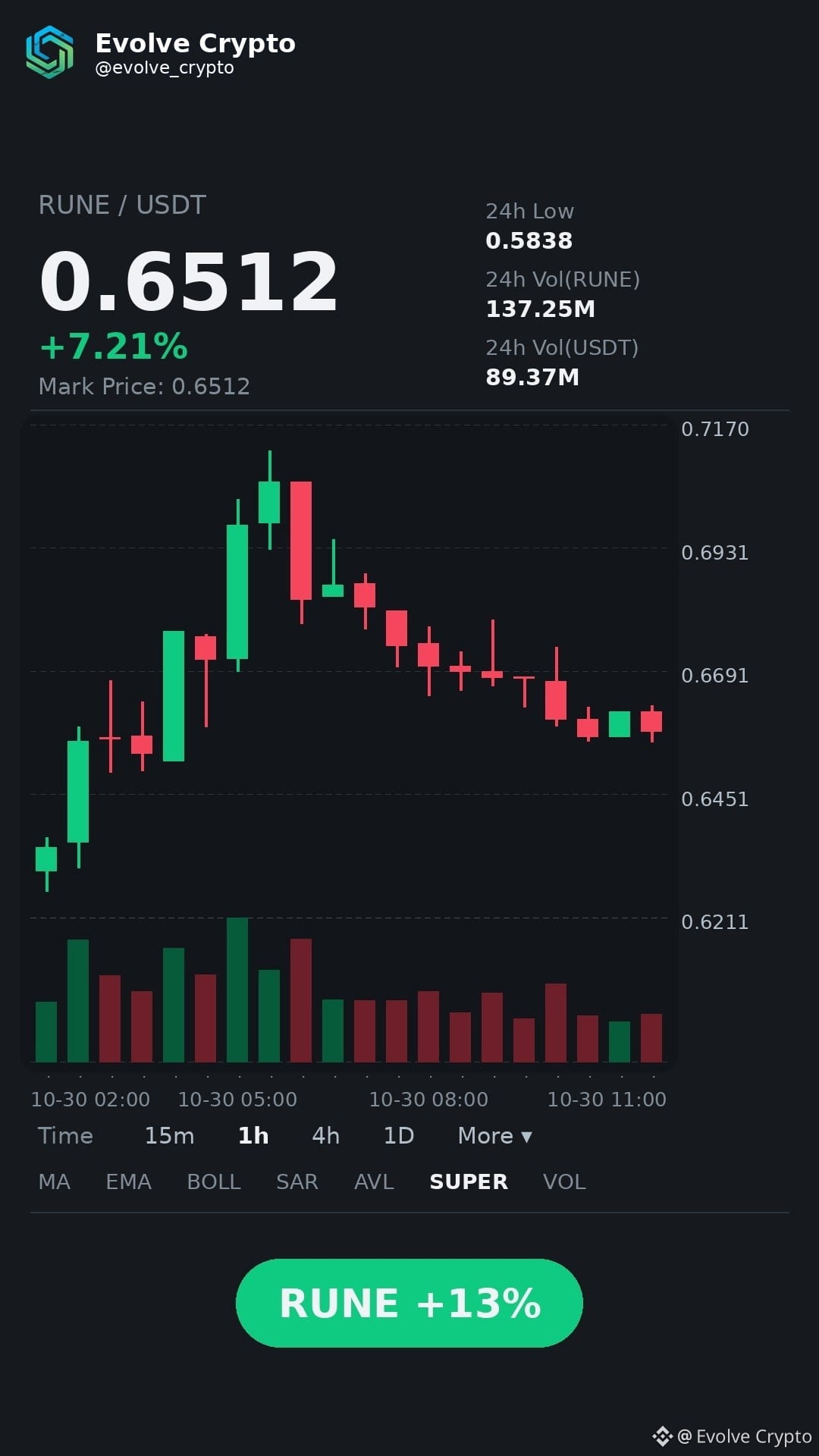
$RUNE I overlooked THORChain's swaps until today. 🔥 Up over 13% to $0.67 from a $0.59 low while the market fell on hack news. If you held through this red day, you earned it. Are you watching RUNE now?
#RUNE #THORChain #CryptoNews
DYOR
$RUNE I overlooked THORChain's swaps until today. 🔥 Up over 13% to $0.67 from a $0.59 low while the market fell on hack news. If you held through this red day, you earned it. Are you watching RUNE now?
#RUNE #THORChain #CryptoNews
DYOR
#RUNE #THORChain #CryptoNews
DYOR
203


·
--
⚡🔥 $RUNE JUMPS +16.50%! 🔥
$RUNE is gaining serious attention at $0.713, rising 16.50%! Bulls are stepping in as THORChain enters today's top gainers.
📈 Will this momentum continue, or will sellers take profits?
🔥 What do you think comes next?
#RUNE #THORChain #BinanceSquare #Crypto #Trading #dyor
⚡🔥 $RUNE JUMPS +16.50%! 🔥
$RUNE is gaining serious attention at $0.713, rising 16.50%! Bulls are stepping in as THORChain enters today's top gainers.
📈 Will this momentum continue, or will sellers take profits?
🔥 What do you think comes next?
#RUNE #THORChain #BinanceSquare #Crypto #Trading #dyor
$RUNE is gaining serious attention at $0.713, rising 16.50%! Bulls are stepping in as THORChain enters today's top gainers.
📈 Will this momentum continue, or will sellers take profits?
🔥 What do you think comes next?
#RUNE #THORChain #BinanceSquare #Crypto #Trading #dyor
286

·
--
🚨 RUNE surges 13% following Binance's $6.3B hack news. North Korean actors previously exploited THORChain to launder funds from Bybit and Bitget. This price action suggests renewed speculative interest despite ongoing security scrutiny.
Market implication: RUNE may test resistance if buying pressure absorbs the hack-related fear, but protocol-level risks remain elevated.
Will RUNE sustain this momentum or retreat on broader crypto market weakness? #THORChain
$RUNE #TradingSignal #CryptoAnalysis
Market implication: RUNE may test resistance if buying pressure absorbs the hack-related fear, but protocol-level risks remain elevated.
Will RUNE sustain this momentum or retreat on broader crypto market weakness? #THORChain
$RUNE #TradingSignal #CryptoAnalysis

2

·
--
🔥 TRADING INFRASTRUCTURE SPOTLIGHT!
THORChain ($RUNE ) works on cross-chain asset swaps, dYdX ($DYDX ) focuses on decentralized trading, and GMX ($GMX ) offers on-chain trading markets. Fees, liquidity, security, and token utility deserve a closer look.
#THORChain #dYdX #GMX #DeFiTrading #CryptoWatchlist
THORChain ($RUNE ) works on cross-chain asset swaps, dYdX ($DYDX ) focuses on decentralized trading, and GMX ($GMX ) offers on-chain trading markets. Fees, liquidity, security, and token utility deserve a closer look.
#THORChain #dYdX #GMX #DeFiTrading #CryptoWatchlist
1
5

The North Korean crew laundering funds got stalled—not by compliance, not by law enforcement, but by a 10 ETH bug.
Let’s walk through it: On October 31, Ethereum had a reorg and lost a block. That block contained a 10 ETH deposit that THORChain had already recorded, so the same deposit got refunded twice. The system spotted something was wrong and urgently paused; swaps on 12 of its 13 chains were halted. Chainalysis said this happened to stall a big chunk of the laundering of funds stolen from Binance.
Then two narratives took off on the timeline. One was “THORChain simply works—the protocol detected the problem and stopped itself.” The other was “A reorg works better than a compliance department.”
Enough hype.
First, this was an accident, not a defense. Refunding twice was itself an incident; it just happened to coincide with the hackers waiting in line. Second, The Defiant reported that swaps had stopped, but outbound signing was still enabled on most affected chains. Third, once it restarts, it’ll still be the same old route. The hackers can wait—what do you think they’re in such a hurry for?
The most ironic part is that the moment this supposedly decentralized cross-chain router actually stopped the bad actors was when it bugged out. This shouldn’t be held up as a win for THORChain. The question to ask is: once it restarts, what do the nodes plan to do when the same funds flow through again?
#THORChain #BinanceHack
Padfoot:
这顶多算洗衣机漏水,刚好让贼排队,不是抓贼成功😂 真正的考题是修好以后,还给不给这桶脏衣服开机。
1
4.8k

·
--
Article
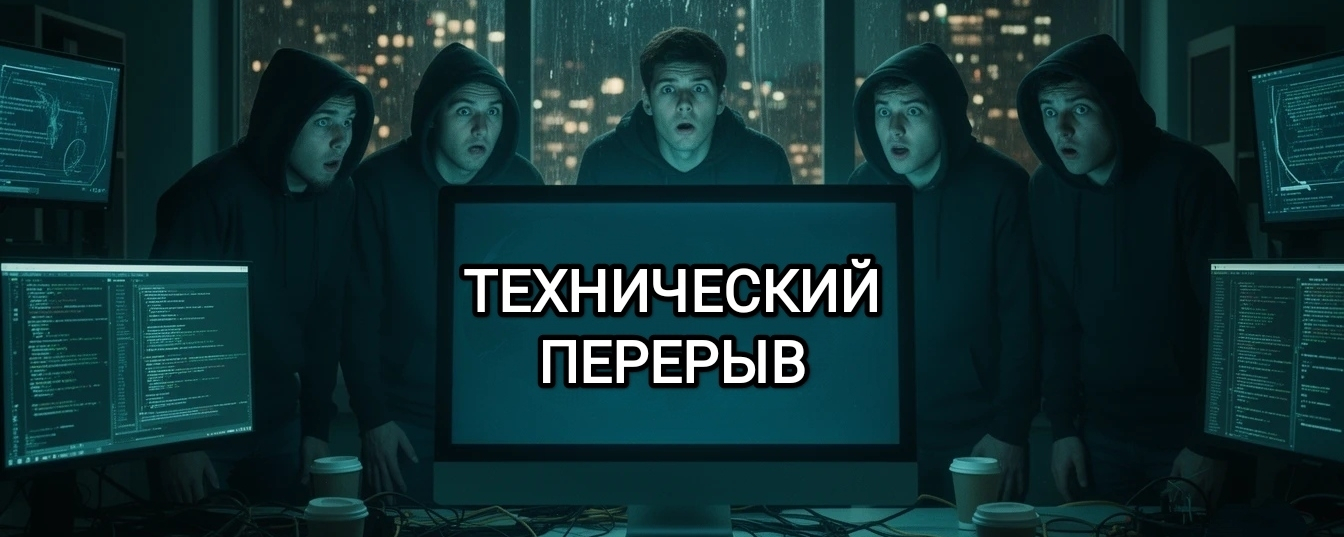
A Double Payout of 10 ETH, or How Hackers Ran Into a “Technical Break” SignHow an Ethereum bug accidentally screwed over North Korean hackers 🕵️♂️💥
Imagine an ATM that gives you money, then changes its mind, but just to be safe, gives it to you again. That’s roughly what happened with THORChain.
What happened. On the morning of October 31, Ethereum experienced a “chain reorganization,” or reorg. The network slightly rewrote its latest blocks, like an editor rebuilding the last few pages. In the process, THORChain got confused and returned the user’s 10 ETH twice.
A Double Payout of 10 ETH, or How Hackers Ran Into a “Technical Break” Sign
How an Ethereum bug accidentally screwed over North Korean hackers 🕵️♂️💥
Imagine an ATM that gives you money, then changes its mind, but just to be safe, gives it to you again. That’s roughly what happened with THORChain.
What happened. On the morning of October 31, Ethereum experienced a “chain reorganization,” or reorg. The network slightly rewrote its latest blocks, like an editor rebuilding the last few pages. In the process, THORChain got confused and returned the user’s 10 ETH twice.
Salvadore Olore:
К-Карма
4
4
2.2k

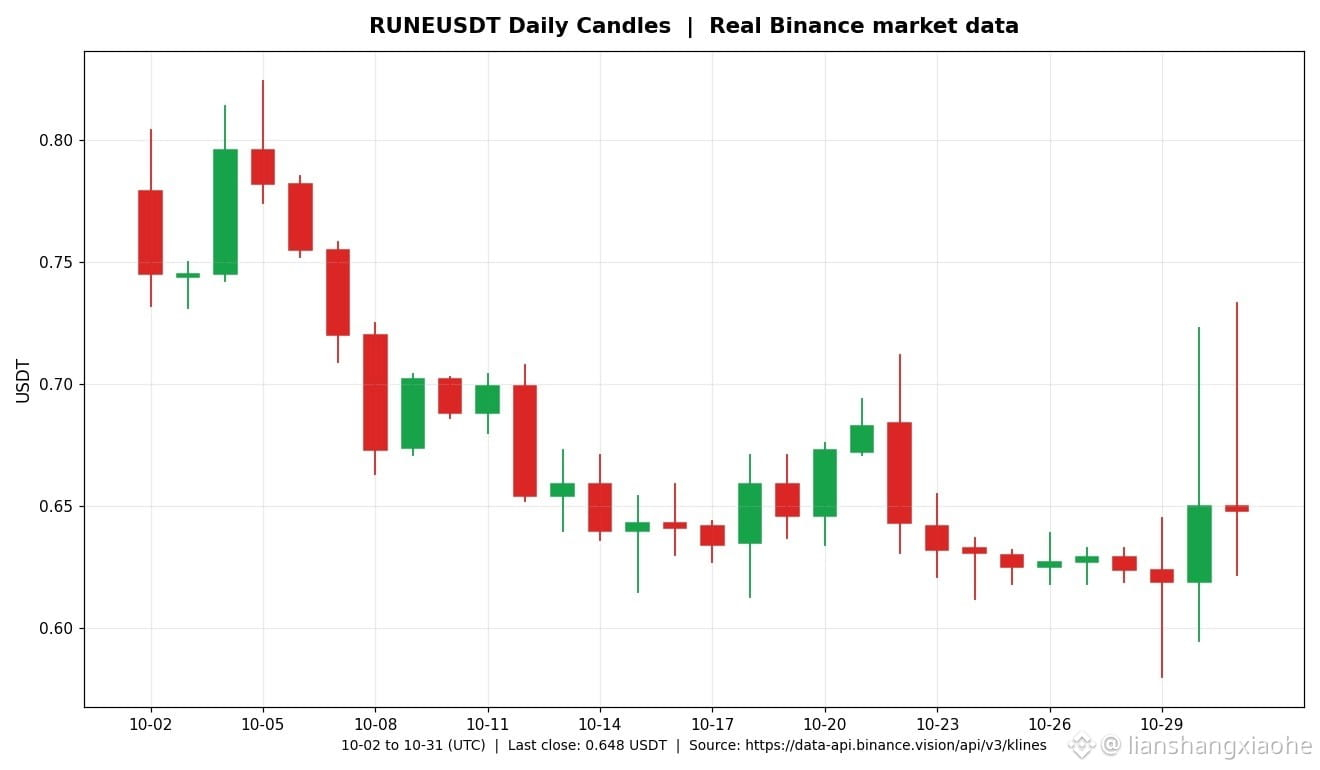
Hackers’ money is flowing through THORChain, and $RUNE is rising first—but don’t mistake this for cause and effect. On Friday, RUNE climbed from around $0.59 to about $0.67, up more than 13% on the day. Today, prices from multiple sources are still hovering around $0.65–$0.71, with 24-hour gains ranging from roughly +5% to +9% across trackers. The latest daily candle close on the 30-day chart was $0.648 (see chart). On-chain investigations are about more than price: ZachXBT says funds stolen from Binance and in the September Bitget hack both passed through THORChain and converged at the same Ethereum address. In an October 31 report, Elliptic tracked about $25 million moving through THORChain; the main Tron distribution wallet had sent about $93.5 million to around 150 wallets, at a pace of $3–7 million per hour—almost as if the laundering were automated. Ironically, THORChain previously rejected Bitget’s request to freeze an address, saying it had no mechanism to block individual swaps. Decentralization is a design choice, not a shield or a fig leaf. Funds flowing through it doesn’t mean its price deserves to rise; those who held yesterday got volatility, not certainty. #THORChain
Hackers’ money is flowing through THORChain, and $RUNE is rising first—but don’t mistake this for cause and effect. On Friday, RUNE climbed from around $0.59 to about $0.67, up more than 13% on the day. Today, prices from multiple sources are still hovering around $0.65–$0.71, with 24-hour gains ranging from roughly +5% to +9% across trackers. The latest daily candle close on the 30-day chart was $0.648 (see chart). On-chain investigations are about more than price: ZachXBT says funds stolen from Binance and in the September Bitget hack both passed through THORChain and converged at the same Ethereum address. In an October 31 report, Elliptic tracked about $25 million moving through THORChain; the main Tron distribution wallet had sent about $93.5 million to around 150 wallets, at a pace of $3–7 million per hour—almost as if the laundering were automated. Ironically, THORChain previously rejected Bitget’s request to freeze an address, saying it had no mechanism to block individual swaps. Decentralization is a design choice, not a shield or a fig leaf. Funds flowing through it doesn’t mean its price deserves to rise; those who held yesterday got volatility, not certainty. #THORChain
32

·
--
Most bridges are currently unavailable for people using THORChain to move assets across chains. Chainalysis says that after an Ethereum chain reorganization on October 31 Beijing time, THORChain issued duplicate refunds to a user who deposited 10 $ETH , triggering an emergency pause. Twelve of the 13 chains are still halted.
There’s some irony in a refund bug slowing down a money-laundering operation.
#THORChain #跨链桥 #On-chain security
There’s some irony in a refund bug slowing down a money-laundering operation.
#THORChain #跨链桥 #On-chain security
23

·
--
🚨 RUNE plunged 5.8% in 1 hour, with a 5-minute drop of 5.2%; trading volume surged to 40.7 times its usual level!
But here's the interesting part: it was down just 0.2% over 24H, while retail bullish sentiment surged to 17.0×; on X, there were only 3 mentions and 0 KOLs in the past 4 hours—the market is unusually quiet.
📊 What does this mean? The price is plunging, but retail traders are still bullish. More concerning, after $6.3 billion in stolen Binance funds was mixed through THORChain, RUNE once rose 13% against the trend, then was urgently suspended due to a chain reorganization. Those who chased the rally might not even have time to set a stop-loss.
My take: short-term outlook is bearish—absolutely don't blindly catch a falling knife! Until the chain reorganization and suspension status are clarified, any rebound looks more like an escape window. If selling pressure continues, beware of a long squeeze. The data still needs verification; don't mistake 17× bullish sentiment for capital inflows.
Do you think RUNE will rebound first to recover, or continue falling to test the lows? 👇 #RUNE #THORChain
2
·
--
🛰️ On October 31, Eastern Time, Chainalysis detected an Ethereum chain reorganization that caused the cross-chain protocol THORChain to accidentally issue a double refund to a user who deposited 10 ETH, triggering an emergency pause. 🔒 After the pause, swap functionality on most of THARChain’s cross-chain bridges was disabled for all users. Of the 13 chains involved, 12 remain paused, while most outbound signing remains enabled. The move unexpectedly delayed the laundering of some stolen Binance funds, including those linked to alleged North Korean launderers. ⚖️ It remains unclear when THORChain will fully resume operations, and what the long-term impact of this incident will be on cross-chain security overall.
This is not investment advice.
#ETH #THORChain #跨链安全 #BlockchainAnalysis
This is not investment advice.
#ETH #THORChain #跨链安全 #BlockchainAnalysis

1

·
--
Bullish
Important update for the THORChain network and its impact on the RUNE token ⚡
THORChain has announced the launch of its new newsletter and system updates to strengthen communication with the community and facilitate direct swaps between decentralized assets.
Impact on the RUNE token:
Boosting adoption and liquidity: Ongoing updates and increased user engagement with the ecosystem contribute to higher trading volumes and genuine demand for the RUNE token.
Fundamental growth: Improvements to monitoring and communication tools support investor confidence over the medium and long term, positively affecting price movements and supporting the token’s market value.
#THORChain #Rune #bullish $RUNE
{spot}(RUNEUSDT)
Important update for the THORChain network and its impact on the RUNE token ⚡
THORChain has announced the launch of its new newsletter and system updates to strengthen communication with the community and facilitate direct swaps between decentralized assets.
Impact on the RUNE token:
Boosting adoption and liquidity: Ongoing updates and increased user engagement with the ecosystem contribute to higher trading volumes and genuine demand for the RUNE token.
Fundamental growth: Improvements to monitoring and communication tools support investor confidence over the medium and long term, positively affecting price movements and supporting the token’s market value.
#THORChain #Rune #bullish $RUNE
1
6

Holding $BNB 164.7 USDT
THORChain’s RUNE token has surged 13% amid heightened tensions in the cryptocurrency market following confirmation of the massive hack of the Binance exchange.
With withdrawals halted and trust in major centralized exchanges temporarily shaken, users and trading volume often migrate en masse to decentralized protocols and native cross-chain exchanges—a model in which THORChain plays a central role.
Because these platforms do not require centralized intermediaries and enable decentralized asset swaps across different networks, they typically see increased demand and transaction volumes during crises when centralized platforms halt their operations.
#Binance #THORChain #Binancehacked #protocol #Rune $RUNE $BNB

50

·
--
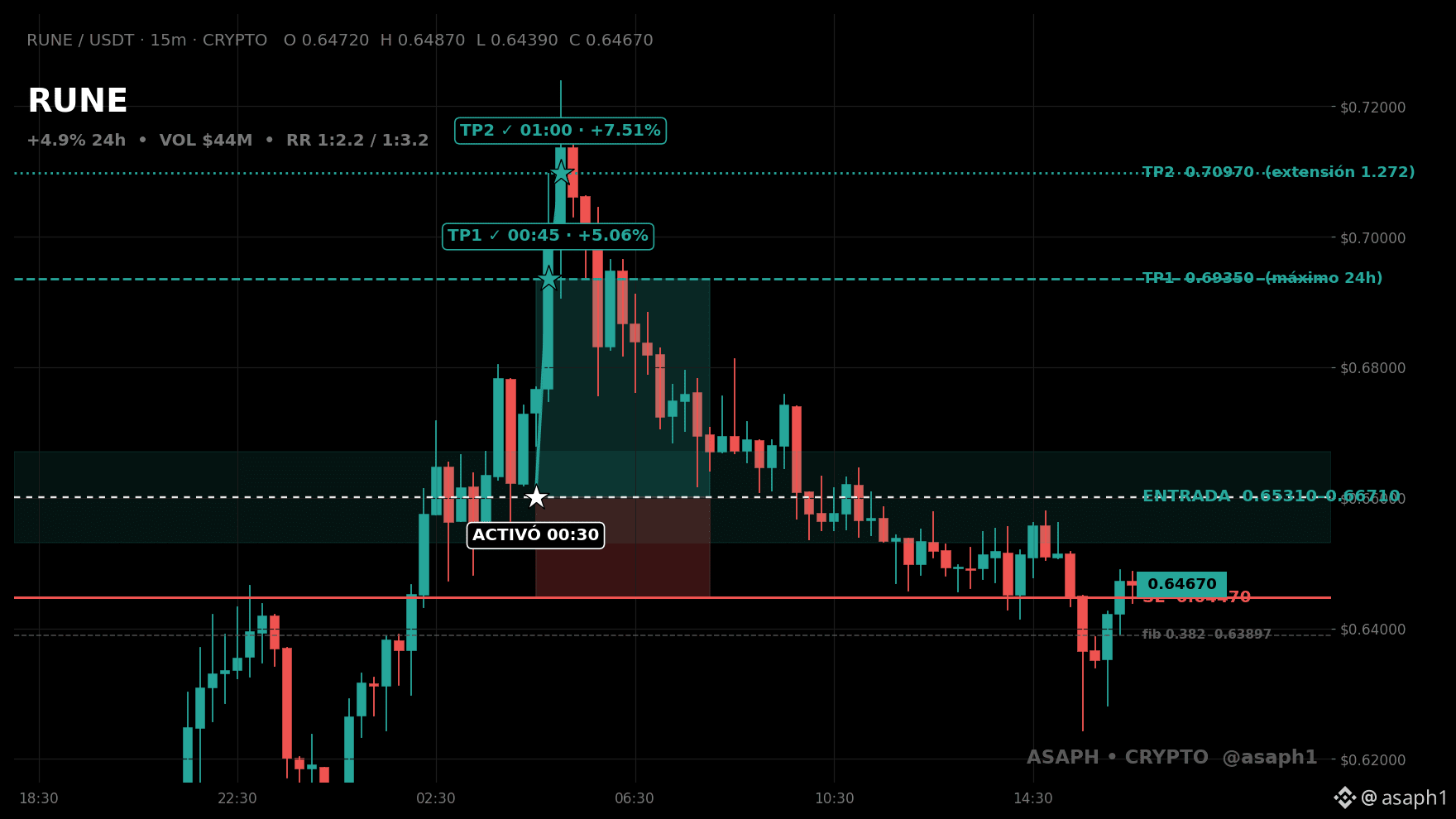
📈 $RUNE HIT TP1 AND TP2 ✅✅ — THE LONG GOT IN BEFORE THE HACK
RUNE got in early before the hack: the long entered at $0.6531–$0.6671, hit TP1 at $0.6935 (+5.1%) on the 00:45 candle, and continued to TP2 at $0.7097 (+7.5%) on the 01:00 candle, before the market understood the scale of the hit.
RUNE is now around $0.6467, back down after taking profits. A complete trade, with 100% gains locked in for anyone who held the long through TP2.
Did you take profits on the whole trade overnight, or did you see it in the morning? 👇
$RUNE
#Thorchain #DEX #Crypto
479

·
--
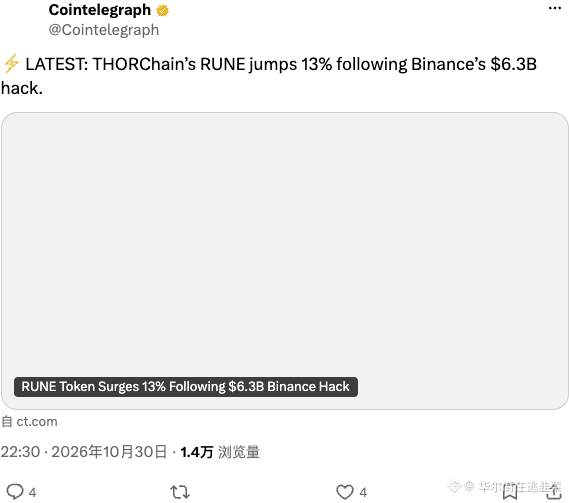
Binance got hacked for 6.3 billion, yet RUNE actually surged 13%—what a wild move 🤷. Some see this as a safe-haven signal for on-chain assets, while others think it’s simply a way to milk the exchanges. Whatever the case, on-chain assets are hard currency in times of crisis. Stop obsessing over the exchanges’ meager liquidity.
$RUNE #Thorchain #Binance
$RUNE #Thorchain #Binance
6

·
--
$RUNE Today, THORChain is once again one of the few bright spots in a sea of red. According to CoinCodex’s daily report for 10/30, THORChain rose about 11.92% over 24 hours, second only to $HYPE among the top 200. On the same day, total market capitalization fell from $2.67 trillion to $2.59 trillion, while trading volume increased by about 81%.
My take:
• Concerns about the security of centralized exchanges have brought the narrative around decentralized cross-chain swaps back into discussion
• A single-day gain doesn’t equal a trend; small-cap coins can be highly volatile in either direction
• I’ll be watching whether its trading volume holds up over the next few days, rather than focusing only on the price increase
Do you think this move is a narrative rotation or short-term traders’ sentiment?#THORChain #Altcoins
For informational purposes only; this is not investment advice.

$RUNE also shows positive momentum. 🟢
THORChain is trading around $0.637, with a 24-hour change of +2.08%. Its daily high was $0.645.
#Rune #THORChain #defi
{spot}(RUNEUSDT)
$RUNE also shows positive momentum. 🟢
THORChain is trading around $0.637, with a 24-hour change of +2.08%. Its daily high was $0.645.
#Rune #THORChain #defi
THORChain is trading around $0.637, with a 24-hour change of +2.08%. Its daily high was $0.645.
#Rune #THORChain #defi
2
163
On a day when the broader market was getting hammered, RUNE went against the trend and climbed about 11%: Binance spot data puts the current price at around $0.67, after rising from $0.58 to $0.68 intraday. 24-hour trading volume was about $13.6 million, and market cap was around $220 million. On the same day, BTC closed at $77,777, down 4.2%; 35 of the top 50 were down, with a median decline of 6.8%, and only 4 closed higher. Do the math: if you bought $10,000 worth around $0.61 yesterday, a rise to $0.67 would mean roughly $1,100 in unrealized gains—while others are panic-selling, coins moving against the trend never wait around. Don’t chase the rally or use leverage; an 11% gain can vanish in a day. $RUNE #逆势 #THORChain
On a day when the broader market was getting hammered, RUNE went against the trend and climbed about 11%: Binance spot data puts the current price at around $0.67, after rising from $0.58 to $0.68 intraday. 24-hour trading volume was about $13.6 million, and market cap was around $220 million. On the same day, BTC closed at $77,777, down 4.2%; 35 of the top 50 were down, with a median decline of 6.8%, and only 4 closed higher. Do the math: if you bought $10,000 worth around $0.61 yesterday, a rise to $0.67 would mean roughly $1,100 in unrealized gains—while others are panic-selling, coins moving against the trend never wait around. Don’t chase the rally or use leverage; an 11% gain can vanish in a day. $RUNE #逆势 #THORChain
168
Log in to explore more content
Join global crypto users on Binance Square
⚡️ Get latest and useful information about crypto.
💬 Trusted by the world’s largest crypto exchange.
👍 Discover real insights from verified creators.
Email / Phone number
Trending Topics
1
#BinanceSAFUFundTransferCompleted7499BTC
33,741 views
746 Discussing
2
#BinanceRecovery90% of stolen assets
128,953 views
166 Discussing
3
#YiHe:ProofOfReserves:10TokensAt100%Backing
132,470 views
724 Discussing
4
#BackedNotBroken:RichardTengSaysUsersBearNoLoss
38,536 views
444 Discussing
5
#CZSaysCompensationIsinPlaceUsersAreProtected
121,940 views
1,362 Discussing
6
#IntelHasItsWorstDaySince1974
45,611 views
690 Discussing
7
#TRMCambodianCasinosReceived$1.07BInCrypto
12,335 views
69 Discussing
8
#USDCCirculationFallsAbout800MInSevenDays
69,323 views
716 Discussing
9
#SuspectedNorthKoreaAttacksAccountForNearly89%OfCryptoHackLosses
14,509 views
97 Discussing
10
#OpenAICutsFundraisingTargetBy$10B
3,589 views
73 Discussing