
#spasex
spasex
2,223 views
8 Discussing
Hot
Latest

·
--
The combined wealth of China's top 36 billionaires barely equals that of Musk alone (around $830 billion). Why is the gap so big?
1. Market dimensions differ
- Chinese billionaires: Their base is China's 1.4 billion people market, focusing on internet, consumption, and manufacturing, which is all about 'existing competition'.
- Musk: Global market plus the new frontier of space. Tesla is a global carmaker, SpaceX monopolizes commercial space travel, and Starlink has worldwide coverage; it's all about 'expansion exploration'.
2. Different ceilings in their lanes
- Domestic top players: They change how people socialize, shop online, drink beverages, and use cars, which is about optimizing business efficiency, with a clear upper limit.
- Musk: Energy revolution, space colonization, AI—these are global necessities for the coming decades, without borders and no limits.
3. Differences in asset structure
- Chinese billionaires: Their wealth is concentrated in a single country/industry, heavily influenced by policies, cycles, and emotional fluctuations, making it prone to wild swings.
- Musk: Tesla + SpaceX + Starlink + AI, spanning cycles and industries, globalized, highly resilient to risks, and with greater growth potential.
My take:
- Don’t deny the gap: Musk is a product of an era-level 'tech + capital + risk' combination, hard to replicate; but the wealth scale and industry heights created by top billionaires in China and the U.S. are definitely not on the same level.
- Also, don’t mythologize Musk; Chinese billionaires are not incapable; it's just a different stage: they've built world-class enterprises in a developing country over decades, which is an impressive achievement; we just haven't reached the stage of 'defining the future outward'.
- What truly deserves attention is not just the money, but 'what they do': Musk invests massive wealth into civilization-level projects (space, energy, AI); Chinese billionaires are more focused on consumer needs and digital services. Different directions lead to naturally different landscapes.
In summary: The gap genuinely exists; it's not about 'who makes more money' but about 'where they make money and what they do with it'.
#马斯克的传奇人生 #特斯拉 #SpaseX
The combined wealth of China's top 36 billionaires barely equals that of Musk alone (around $830 billion). Why is the gap so big?
1. Market dimensions differ
- Chinese billionaires: Their base is China's 1.4 billion people market, focusing on internet, consumption, and manufacturing, which is all about 'existing competition'.
- Musk: Global market plus the new frontier of space. Tesla is a global carmaker, SpaceX monopolizes commercial space travel, and Starlink has worldwide coverage; it's all about 'expansion exploration'.
2. Different ceilings in their lanes
- Domestic top players: They change how people socialize, shop online, drink beverages, and use cars, which is about optimizing business efficiency, with a clear upper limit.
- Musk: Energy revolution, space colonization, AI—these are global necessities for the coming decades, without borders and no limits.
3. Differences in asset structure
- Chinese billionaires: Their wealth is concentrated in a single country/industry, heavily influenced by policies, cycles, and emotional fluctuations, making it prone to wild swings.
- Musk: Tesla + SpaceX + Starlink + AI, spanning cycles and industries, globalized, highly resilient to risks, and with greater growth potential.
My take:
- Don’t deny the gap: Musk is a product of an era-level 'tech + capital + risk' combination, hard to replicate; but the wealth scale and industry heights created by top billionaires in China and the U.S. are definitely not on the same level.
- Also, don’t mythologize Musk; Chinese billionaires are not incapable; it's just a different stage: they've built world-class enterprises in a developing country over decades, which is an impressive achievement; we just haven't reached the stage of 'defining the future outward'.
- What truly deserves attention is not just the money, but 'what they do': Musk invests massive wealth into civilization-level projects (space, energy, AI); Chinese billionaires are more focused on consumer needs and digital services. Different directions lead to naturally different landscapes.
In summary: The gap genuinely exists; it's not about 'who makes more money' but about 'where they make money and what they do with it'.
#马斯克的传奇人生 #特斯拉 #SpaseX
1. Market dimensions differ
- Chinese billionaires: Their base is China's 1.4 billion people market, focusing on internet, consumption, and manufacturing, which is all about 'existing competition'.
- Musk: Global market plus the new frontier of space. Tesla is a global carmaker, SpaceX monopolizes commercial space travel, and Starlink has worldwide coverage; it's all about 'expansion exploration'.
2. Different ceilings in their lanes
- Domestic top players: They change how people socialize, shop online, drink beverages, and use cars, which is about optimizing business efficiency, with a clear upper limit.
- Musk: Energy revolution, space colonization, AI—these are global necessities for the coming decades, without borders and no limits.
3. Differences in asset structure
- Chinese billionaires: Their wealth is concentrated in a single country/industry, heavily influenced by policies, cycles, and emotional fluctuations, making it prone to wild swings.
- Musk: Tesla + SpaceX + Starlink + AI, spanning cycles and industries, globalized, highly resilient to risks, and with greater growth potential.
My take:
- Don’t deny the gap: Musk is a product of an era-level 'tech + capital + risk' combination, hard to replicate; but the wealth scale and industry heights created by top billionaires in China and the U.S. are definitely not on the same level.
- Also, don’t mythologize Musk; Chinese billionaires are not incapable; it's just a different stage: they've built world-class enterprises in a developing country over decades, which is an impressive achievement; we just haven't reached the stage of 'defining the future outward'.
- What truly deserves attention is not just the money, but 'what they do': Musk invests massive wealth into civilization-level projects (space, energy, AI); Chinese billionaires are more focused on consumer needs and digital services. Different directions lead to naturally different landscapes.
In summary: The gap genuinely exists; it's not about 'who makes more money' but about 'where they make money and what they do with it'.
#马斯克的传奇人生 #特斯拉 #SpaseX
1
248

·
--
Bullish
$USSF United States Space Force (USSF, US Space Force) — the sixth branch of the United States Armed Forces, established on December 20, 2019. They are the space component of the U.S. Department of Defense and are responsible for organizing, training, and equipping space forces to protect the nation’s interests in outer space, as well as for providing space support to other branches of the armed forces.#USSF #spaseX #FOMC Protocol
$USSF United States Space Force (USSF, US Space Force) — the sixth branch of the United States Armed Forces, established on December 20, 2019. They are the space component of the U.S. Department of Defense and are responsible for organizing, training, and equipping space forces to protect the nation’s interests in outer space, as well as for providing space support to other branches of the armed forces.#USSF #spaseX #FOMC Protocol

1
716

·
--


Binance Academy
·
--
One account for crypto and stocks.
Diversification isn't just a crypto strategy, it's an investing principle.
Now you can trade over 7,000 U.S. stocks and ETFs directly from your Binance account. Fund with USDC, BNB, or USDT. Start at just $5 with zero commissions.
Before you dive in, take a few minutes to understand how it works
Diversification isn't just a crypto strategy, it's an investing principle.
Now you can trade over 7,000 U.S. stocks and ETFs directly from your Binance account. Fund with USDC, BNB, or USDT. Start at just $5 with zero commissions.
Before you dive in, take a few minutes to understand how it works
1
70

·
--
Bullish
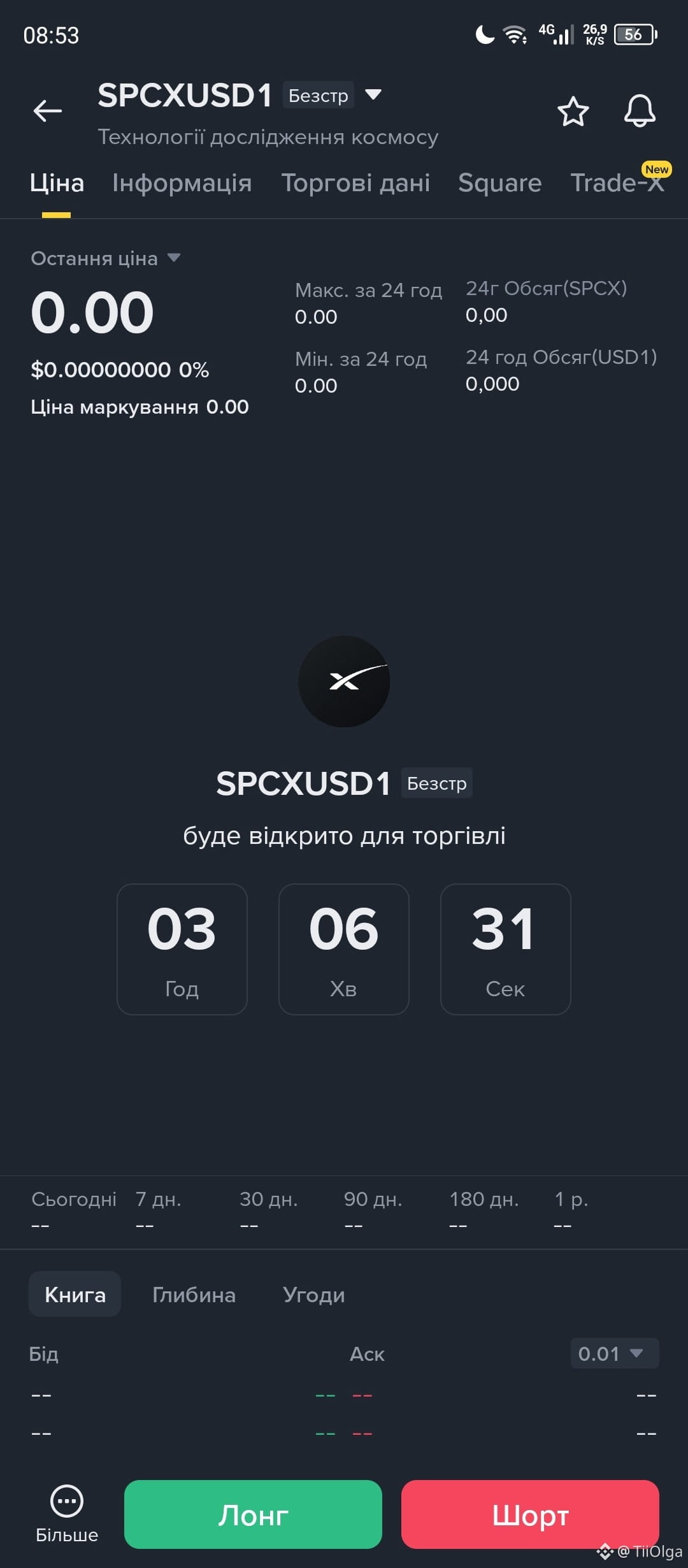
#SPASEX Long buy trade
Entry: 152
Stop loss: 146
Target: 204
Note: Entry with 1% of capital + max leverage 10x
Risk management is more important than profit$SPCXB
#SPASEX Long buy trade
Entry: 152
Stop loss: 146
Target: 204
Note: Entry with 1% of capital + max leverage 10x
Risk management is more important than profit$SPCXB
Entry: 152
Stop loss: 146
Target: 204
Note: Entry with 1% of capital + max leverage 10x
Risk management is more important than profit$SPCXB
77
Log in to explore more content
Join global crypto users on Binance Square
⚡️ Get latest and useful information about crypto.
💬 Trusted by the world’s largest crypto exchange.
👍 Discover real insights from verified creators.
Email / Phone number
Trending Topics
1
#USBankCompletesCrossBorderPaymentPilotOnStellar
8,324 views
282 Discussing
2
#NvidiaInTalksToInvestUpTo$10BInAnthropicIPO
482 views
27 Discussing
3
#EtherRalliesAsBearishBetsLiquidate
19,534 views
502 Discussing
4
#EthereumHits$2600FirstTimeInSevenMonths
2,887 views
62 Discussing
5
#OpticalCommsStocksRallyOver3%
21,185 views
295 Discussing
6
#USInflationHoldsAt3.4%InAugust
25,536 views
318 Discussing
7
#CircleProposes$400MTazapayAcquisition
1,662 views
34 Discussing
8
#CPIWatch
87.4M views
504,404 Discussing
9
#BitcoinReboundsAbove$79KAfterCPI
6,724 views
157 Discussing
10
#BNBTops730USDT
55,462 views
1,236 Discussing