
#sbet
sbet
10,545 views
58 Discussing
Hot
Latest

🚨 $SBET FUELS $ETH STAKING WITH 420 ETH – BULLS LOADING THE CANNON! 🐂
📊 That fresh 420 ETH injection into the staking pool isn’t just a flex – it’s a liquidity signal. Whales are stacking $ETH like it’s going out of style, and the bid pressure is building faster than a coiled spring. 💡 Volume on the chart is thinning out overhead resistance while momentum hints at a vertical move – classic pre-breakout compression.
🔥 The buy-side flow has been relentless; every dip gets scooped by these staking deposits. If you’re not positioned, you’re the exit liquidity. 💬 Are you stacking your longs now or chasing the move after the candle explodes? 👇
⚠️ Not financial advice. Always manage your risk. 🛡️
🏷️ #SBET #ETH #Staking #Bullish #Crypto
🐂 🚀
🚨 $SBET FUELS $ETH STAKING WITH 420 ETH – BULLS LOADING THE CANNON! 🐂
📊 That fresh 420 ETH injection into the staking pool isn’t just a flex – it’s a liquidity signal. Whales are stacking $ETH like it’s going out of style, and the bid pressure is building faster than a coiled spring. 💡 Volume on the chart is thinning out overhead resistance while momentum hints at a vertical move – classic pre-breakout compression.
🔥 The buy-side flow has been relentless; every dip gets scooped by these staking deposits. If you’re not positioned, you’re the exit liquidity. 💬 Are you stacking your longs now or chasing the move after the candle explodes? 👇
⚠️ Not financial advice. Always manage your risk. 🛡️
🏷️ #SBET #ETH #Staking #Bullish #Crypto
🐂 🚀
📊 That fresh 420 ETH injection into the staking pool isn’t just a flex – it’s a liquidity signal. Whales are stacking $ETH like it’s going out of style, and the bid pressure is building faster than a coiled spring. 💡 Volume on the chart is thinning out overhead resistance while momentum hints at a vertical move – classic pre-breakout compression.
🔥 The buy-side flow has been relentless; every dip gets scooped by these staking deposits. If you’re not positioned, you’re the exit liquidity. 💬 Are you stacking your longs now or chasing the move after the candle explodes? 👇
⚠️ Not financial advice. Always manage your risk. 🛡️
🏷️ #SBET #ETH #Staking #Bullish #Crypto
🐂 🚀
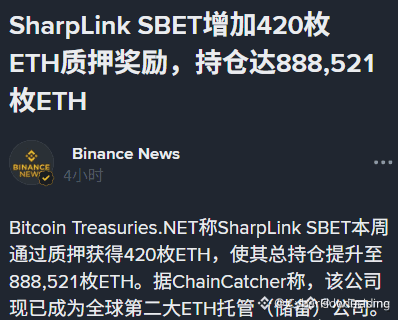
ETH-2.30%
SBETUS+0.07%
69


·
--
1、Background
One of today’s market focal points is that Sharplink’s SBET has been officially added to the Russell 2000 and Russell 3000 indexes. For traditional capital markets, such index adjustments are not just a “change of roster”—they also mean the company is entering a broader investable pool for more institutional investors. In particular, Russell-family indexes are tracked by a large number of index funds, quant funds, and passive allocation products; after inclusion, they typically bring higher visibility and potential inflows. Combined with the message’s positioning of Sharplink as the world’s second-largest Ethereum treasury company, this event also prompts the market to reassess the narrative value of the “crypto-asset reserve + public-company framework.” 📈
2、Core Analysis
From a trading-logic perspective, SBET’s addition to the Russell indexes first strengthens institutional expectations. Some funds passively buy index constituents as part of their allocations, which can improve stock liquidity and pricing efficiency. Second, Sharplink’s Ethereum treasury attribute leads some investors to view it not only as a typical growth stock, but also as an “ETH exposure substitute” in the U.S. stock market. When ETH prices strengthen, such companies often find it easier to earn an additional sentiment premium; conversely, if ETH volatility increases, the stock may amplify the reaction.
That said, the market should remain calm. Index inclusion does not necessarily mean fundamentals improve immediately, nor does it imply the stock can only go up. The increase in institutional demand usually takes time to transmit into actual holdings and trading structure. Meanwhile, Sharplink’s valuation logic may be affected by two factors: first, the progress of its own business; and second, the Ethereum price, on-chain ecosystem activity, and overall market risk appetite. If ETH underperforms expectations later on, SBET’s “treasury concept” may turn into a source of volatility. ⚠️
3、Potential Impact
For Sharplink, the biggest positive impact lies in an upgrade to its capital-market identity. After entering Russell 2000 and Russell 3000, the company is more likely to come within institutional research coverage, and it may also attract capital that prefers a regulated framework. For the crypto market, this dynamic sends a clear signal: traditional index systems are gradually accepting publicly listed companies with digital-asset attributes, which helps narrow the cognitive gap between traditional finance and crypto.
For the ETH narrative, this is also a slightly positive marginal signal. If more and more listed companies treat Ethereum as a treasury reserve or core asset exposure, ETH’s “asset-backed” positioning in capital markets will be further strengthened. However, in the short term, investors still need to differentiate between “event-driven” and “long-term value.” Index inclusion is more like a catalyst rather than a decisive fundamental driver. Overall, today’s news is favorable for Sharplink’s market attention and provides sentiment support for ETH-related themes, but the sustainability still depends on fund follow-through and the broader market environment. 🔍
#ETH #SBET #crypto
1、Background
One of today’s market focal points is that Sharplink’s SBET has been officially added to the Russell 2000 and Russell 3000 indexes. For traditional capital markets, such index adjustments are not just a “change of roster”—they also mean the company is entering a broader investable pool for more institutional investors. In particular, Russell-family indexes are tracked by a large number of index funds, quant funds, and passive allocation products; after inclusion, they typically bring higher visibility and potential inflows. Combined with the message’s positioning of Sharplink as the world’s second-largest Ethereum treasury company, this event also prompts the market to reassess the narrative value of the “crypto-asset reserve + public-company framework.” 📈
2、Core Analysis
From a trading-logic perspective, SBET’s addition to the Russell indexes first strengthens institutional expectations. Some funds passively buy index constituents as part of their allocations, which can improve stock liquidity and pricing efficiency. Second, Sharplink’s Ethereum treasury attribute leads some investors to view it not only as a typical growth stock, but also as an “ETH exposure substitute” in the U.S. stock market. When ETH prices strengthen, such companies often find it easier to earn an additional sentiment premium; conversely, if ETH volatility increases, the stock may amplify the reaction.
That said, the market should remain calm. Index inclusion does not necessarily mean fundamentals improve immediately, nor does it imply the stock can only go up. The increase in institutional demand usually takes time to transmit into actual holdings and trading structure. Meanwhile, Sharplink’s valuation logic may be affected by two factors: first, the progress of its own business; and second, the Ethereum price, on-chain ecosystem activity, and overall market risk appetite. If ETH underperforms expectations later on, SBET’s “treasury concept” may turn into a source of volatility. ⚠️
3、Potential Impact
For Sharplink, the biggest positive impact lies in an upgrade to its capital-market identity. After entering Russell 2000 and Russell 3000, the company is more likely to come within institutional research coverage, and it may also attract capital that prefers a regulated framework. For the crypto market, this dynamic sends a clear signal: traditional index systems are gradually accepting publicly listed companies with digital-asset attributes, which helps narrow the cognitive gap between traditional finance and crypto.
For the ETH narrative, this is also a slightly positive marginal signal. If more and more listed companies treat Ethereum as a treasury reserve or core asset exposure, ETH’s “asset-backed” positioning in capital markets will be further strengthened. However, in the short term, investors still need to differentiate between “event-driven” and “long-term value.” Index inclusion is more like a catalyst rather than a decisive fundamental driver. Overall, today’s news is favorable for Sharplink’s market attention and provides sentiment support for ETH-related themes, but the sustainability still depends on fund follow-through and the broader market environment. 🔍
#ETH #SBET #crypto
One of today’s market focal points is that Sharplink’s SBET has been officially added to the Russell 2000 and Russell 3000 indexes. For traditional capital markets, such index adjustments are not just a “change of roster”—they also mean the company is entering a broader investable pool for more institutional investors. In particular, Russell-family indexes are tracked by a large number of index funds, quant funds, and passive allocation products; after inclusion, they typically bring higher visibility and potential inflows. Combined with the message’s positioning of Sharplink as the world’s second-largest Ethereum treasury company, this event also prompts the market to reassess the narrative value of the “crypto-asset reserve + public-company framework.” 📈
2、Core Analysis
From a trading-logic perspective, SBET’s addition to the Russell indexes first strengthens institutional expectations. Some funds passively buy index constituents as part of their allocations, which can improve stock liquidity and pricing efficiency. Second, Sharplink’s Ethereum treasury attribute leads some investors to view it not only as a typical growth stock, but also as an “ETH exposure substitute” in the U.S. stock market. When ETH prices strengthen, such companies often find it easier to earn an additional sentiment premium; conversely, if ETH volatility increases, the stock may amplify the reaction.
That said, the market should remain calm. Index inclusion does not necessarily mean fundamentals improve immediately, nor does it imply the stock can only go up. The increase in institutional demand usually takes time to transmit into actual holdings and trading structure. Meanwhile, Sharplink’s valuation logic may be affected by two factors: first, the progress of its own business; and second, the Ethereum price, on-chain ecosystem activity, and overall market risk appetite. If ETH underperforms expectations later on, SBET’s “treasury concept” may turn into a source of volatility. ⚠️
3、Potential Impact
For Sharplink, the biggest positive impact lies in an upgrade to its capital-market identity. After entering Russell 2000 and Russell 3000, the company is more likely to come within institutional research coverage, and it may also attract capital that prefers a regulated framework. For the crypto market, this dynamic sends a clear signal: traditional index systems are gradually accepting publicly listed companies with digital-asset attributes, which helps narrow the cognitive gap between traditional finance and crypto.
For the ETH narrative, this is also a slightly positive marginal signal. If more and more listed companies treat Ethereum as a treasury reserve or core asset exposure, ETH’s “asset-backed” positioning in capital markets will be further strengthened. However, in the short term, investors still need to differentiate between “event-driven” and “long-term value.” Index inclusion is more like a catalyst rather than a decisive fundamental driver. Overall, today’s news is favorable for Sharplink’s market attention and provides sentiment support for ETH-related themes, but the sustainability still depends on fund follow-through and the broader market environment. 🔍
#ETH #SBET #crypto
ETH-2.30%
SBETUS+0.07%
189

🦈 $ETH TREASURY STACKS 889K COINS WHILE PAPER LOSSES SCARE WEAK HANDS 💥
Staggering revenue surge? Check. Aggressive ETH accumulation? Double check. Sharplink just posted Q2 revenue of $11.5M — a 16x jump year-over-year — driven entirely by its active ETH treasury strategy. 📊
But here's the twist: the company printed a $3.94B net loss, mostly non-cash unrealized accounting adjustments. 💡 Weak eyes see red ink; sharp eyes see an entity holding roughly 889,000 ETH worth ~$14B, repurchasing shares, and locking in another 10,000 ETH at ~$1,611 per coin. That's not a liability — that's a war chest.
Add a $75M offering, a $100M commitment to the Galaxy Onchain Yield Fund, and Russell index inclusion, and the picture sharpens: this is a corporate treasury converted into an ETH accumulation machine. 🌊
💬 When institutions stack ETH through public companies, does that change your conviction on the next cycle? 👇
⚠️ Not financial advice. Always manage your risk. 🛡️
🏷️ #ETH #SBET #Treasury #Institutional #Crypto
🦈 💎
🦈 $ETH TREASURY STACKS 889K COINS WHILE PAPER LOSSES SCARE WEAK HANDS 💥
Staggering revenue surge? Check. Aggressive ETH accumulation? Double check. Sharplink just posted Q2 revenue of $11.5M — a 16x jump year-over-year — driven entirely by its active ETH treasury strategy. 📊
But here's the twist: the company printed a $3.94B net loss, mostly non-cash unrealized accounting adjustments. 💡 Weak eyes see red ink; sharp eyes see an entity holding roughly 889,000 ETH worth ~$14B, repurchasing shares, and locking in another 10,000 ETH at ~$1,611 per coin. That's not a liability — that's a war chest.
Add a $75M offering, a $100M commitment to the Galaxy Onchain Yield Fund, and Russell index inclusion, and the picture sharpens: this is a corporate treasury converted into an ETH accumulation machine. 🌊
💬 When institutions stack ETH through public companies, does that change your conviction on the next cycle? 👇
⚠️ Not financial advice. Always manage your risk. 🛡️
🏷️ #ETH #SBET #Treasury #Institutional #Crypto
🦈 💎
Staggering revenue surge? Check. Aggressive ETH accumulation? Double check. Sharplink just posted Q2 revenue of $11.5M — a 16x jump year-over-year — driven entirely by its active ETH treasury strategy. 📊
But here's the twist: the company printed a $3.94B net loss, mostly non-cash unrealized accounting adjustments. 💡 Weak eyes see red ink; sharp eyes see an entity holding roughly 889,000 ETH worth ~$14B, repurchasing shares, and locking in another 10,000 ETH at ~$1,611 per coin. That's not a liability — that's a war chest.
Add a $75M offering, a $100M commitment to the Galaxy Onchain Yield Fund, and Russell index inclusion, and the picture sharpens: this is a corporate treasury converted into an ETH accumulation machine. 🌊
💬 When institutions stack ETH through public companies, does that change your conviction on the next cycle? 👇
⚠️ Not financial advice. Always manage your risk. 🛡️
🏷️ #ETH #SBET #Treasury #Institutional #Crypto
🦈 💎
11

·
--
💥 $BMNR $SBET $BTBT SURGING – ETHEREUM TREASURY CONCEPT STOCKS ARE FRONT-RUNNING THE NEXT WAVE! 🚀
Pre-market data just lit up. BitMine Immersion (+6.18%), SharpLink Gaming (+5.18%), and Bit Digital (+4.99%) all printing green ticks with coordinated volume. This isn't random noise – it's a sector-wide bid on Ethereum treasury exposure ahead of potential catalyst shifts. 📊
The pattern is clear: smart money is accumulating these names as proxy plays for ETH momentum. When three correlated stocks move in lockstep pre-market, the tape is telling you a thesis is being validated in real-time. 💡 Are you watching the next leg or already positioned in these names? 💬
⚠️ Not financial advice. Always manage your risk. 🛡️
🏷️ #BMNR #SBET #BTBT #Ethereum #PreMarket
🔍 🚀
💥 $BMNR $SBET $BTBT SURGING – ETHEREUM TREASURY CONCEPT STOCKS ARE FRONT-RUNNING THE NEXT WAVE! 🚀
Pre-market data just lit up. BitMine Immersion (+6.18%), SharpLink Gaming (+5.18%), and Bit Digital (+4.99%) all printing green ticks with coordinated volume. This isn't random noise – it's a sector-wide bid on Ethereum treasury exposure ahead of potential catalyst shifts. 📊
The pattern is clear: smart money is accumulating these names as proxy plays for ETH momentum. When three correlated stocks move in lockstep pre-market, the tape is telling you a thesis is being validated in real-time. 💡 Are you watching the next leg or already positioned in these names? 💬
⚠️ Not financial advice. Always manage your risk. 🛡️
🏷️ #BMNR #SBET #BTBT #Ethereum #PreMarket
🔍 🚀
Pre-market data just lit up. BitMine Immersion (+6.18%), SharpLink Gaming (+5.18%), and Bit Digital (+4.99%) all printing green ticks with coordinated volume. This isn't random noise – it's a sector-wide bid on Ethereum treasury exposure ahead of potential catalyst shifts. 📊
The pattern is clear: smart money is accumulating these names as proxy plays for ETH momentum. When three correlated stocks move in lockstep pre-market, the tape is telling you a thesis is being validated in real-time. 💡 Are you watching the next leg or already positioned in these names? 💬
⚠️ Not financial advice. Always manage your risk. 🛡️
🏷️ #BMNR #SBET #BTBT #Ethereum #PreMarket
🔍 🚀
52

·
--
🚨 $SBET WHALES ADDING 420 $ETH TO STAKING POOL – LIQUIDITY FUELING THE NEXT LEG UP 🦈💰
No specific price levels provided. Omit Trade Signal section.
📌 Institutional fingerprints are all over this move. Dumping 420 $ETH into the staking reward pool isn’t a random giveaway – it’s a liquidity injection designed to lock in long-term holders while reducing float. 🏦 Smart money is clearly accumulating $SBET alongside the ETH they’re deploying.
📊 The chart structure on the daily is compressing into a tight coil, with buy-side order blocks forming beneath current price. Each ETH addition increases the staking yield, attracting more capital and tightening supply. 🟢 Volume is rising quietly, suggesting accumulation before a breakout.
💬 When the pool grows faster than the price, who’s really selling here? 🤔
⚠️ Not financial advice. Always manage your risk. 🛡️
🏷️ #SBET #Ethereum #Crypto #Staking #WhaleAlert
🔥 🦈
🚨 $SBET WHALES ADDING 420 $ETH TO STAKING POOL – LIQUIDITY FUELING THE NEXT LEG UP 🦈💰
No specific price levels provided. Omit Trade Signal section.
📌 Institutional fingerprints are all over this move. Dumping 420 $ETH into the staking reward pool isn’t a random giveaway – it’s a liquidity injection designed to lock in long-term holders while reducing float. 🏦 Smart money is clearly accumulating $SBET alongside the ETH they’re deploying.
📊 The chart structure on the daily is compressing into a tight coil, with buy-side order blocks forming beneath current price. Each ETH addition increases the staking yield, attracting more capital and tightening supply. 🟢 Volume is rising quietly, suggesting accumulation before a breakout.
💬 When the pool grows faster than the price, who’s really selling here? 🤔
⚠️ Not financial advice. Always manage your risk. 🛡️
🏷️ #SBET #Ethereum #Crypto #Staking #WhaleAlert
🔥 🦈
No specific price levels provided. Omit Trade Signal section.
📌 Institutional fingerprints are all over this move. Dumping 420 $ETH into the staking reward pool isn’t a random giveaway – it’s a liquidity injection designed to lock in long-term holders while reducing float. 🏦 Smart money is clearly accumulating $SBET alongside the ETH they’re deploying.
📊 The chart structure on the daily is compressing into a tight coil, with buy-side order blocks forming beneath current price. Each ETH addition increases the staking yield, attracting more capital and tightening supply. 🟢 Volume is rising quietly, suggesting accumulation before a breakout.
💬 When the pool grows faster than the price, who’s really selling here? 🤔
⚠️ Not financial advice. Always manage your risk. 🛡️
🏷️ #SBET #Ethereum #Crypto #Staking #WhaleAlert
🔥 🦈
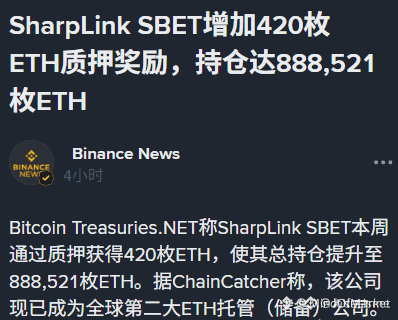
14

·
--
SharpLink keeps stocking up on ETH! Sweeps $62.4 million in three days
While the market is watching ETH fall below $1,600 and sighing, SharpLink quietly bought 29,196 ETH via OTC on Saturday (about $46.7 million) 📦
Over the past three days, it accumulated 39,196 ETH in total, pushing its total holdings to 868,699 ETH—already the world’s second-largest enterprise-grade Ethereum treasury 🏆
Most intriguing of all, the company has Joseph Lubin, an Ethereum co-founder, personally listed as chairman, and they put 100% of their ETH holdings into staking to earn yield 💰
The lower the market goes, the more they buy—what do you think of this contrarian move? 🤔
#SharpLink #SBET #ETH
#ETH #SBET
SharpLink keeps stocking up on ETH! Sweeps $62.4 million in three days
While the market is watching ETH fall below $1,600 and sighing, SharpLink quietly bought 29,196 ETH via OTC on Saturday (about $46.7 million) 📦
Over the past three days, it accumulated 39,196 ETH in total, pushing its total holdings to 868,699 ETH—already the world’s second-largest enterprise-grade Ethereum treasury 🏆
Most intriguing of all, the company has Joseph Lubin, an Ethereum co-founder, personally listed as chairman, and they put 100% of their ETH holdings into staking to earn yield 💰
The lower the market goes, the more they buy—what do you think of this contrarian move? 🤔
#SharpLink #SBET #ETH
#ETH #SBET
While the market is watching ETH fall below $1,600 and sighing, SharpLink quietly bought 29,196 ETH via OTC on Saturday (about $46.7 million) 📦
Over the past three days, it accumulated 39,196 ETH in total, pushing its total holdings to 868,699 ETH—already the world’s second-largest enterprise-grade Ethereum treasury 🏆
Most intriguing of all, the company has Joseph Lubin, an Ethereum co-founder, personally listed as chairman, and they put 100% of their ETH holdings into staking to earn yield 💰
The lower the market goes, the more they buy—what do you think of this contrarian move? 🤔
#SharpLink #SBET #ETH
#ETH #SBET
57

·
--
🟢 $BMNR $SBET $BTBT LEADING EARLY ETHEREUM TREASURY MOMENTUM! 🚀
Pre-market volume data reveals an institutional footprint across Ethereum treasury-linked equities. BMNR surged +6.18%, SBET +5.18%, and BTBT +4.99% — all printing consecutive higher lows on the 15-minute tape. 📊 This isn't random drift; it's liquidity absorption ahead of a potential structural breakout.
📌 Smart money is front-loading positions before the session open. The coordinated move suggests a larger catalyst is being priced in — likely tied to ETH's own price action. 🌊 Keep these tickers on radar for continuation patterns into the cash open. 💬 Are you tracking these early signals or waiting for confirmation on the daily close? 👇
⚠️ Not financial advice. Always manage your risk. 🛡️
🏷️ #BMNR #SBET #BTBT #EthereumTreasury #PremarketAlert
📈 💡
🟢 $BMNR $SBET $BTBT LEADING EARLY ETHEREUM TREASURY MOMENTUM! 🚀
Pre-market volume data reveals an institutional footprint across Ethereum treasury-linked equities. BMNR surged +6.18%, SBET +5.18%, and BTBT +4.99% — all printing consecutive higher lows on the 15-minute tape. 📊 This isn't random drift; it's liquidity absorption ahead of a potential structural breakout.
📌 Smart money is front-loading positions before the session open. The coordinated move suggests a larger catalyst is being priced in — likely tied to ETH's own price action. 🌊 Keep these tickers on radar for continuation patterns into the cash open. 💬 Are you tracking these early signals or waiting for confirmation on the daily close? 👇
⚠️ Not financial advice. Always manage your risk. 🛡️
🏷️ #BMNR #SBET #BTBT #EthereumTreasury #PremarketAlert
📈 💡
Pre-market volume data reveals an institutional footprint across Ethereum treasury-linked equities. BMNR surged +6.18%, SBET +5.18%, and BTBT +4.99% — all printing consecutive higher lows on the 15-minute tape. 📊 This isn't random drift; it's liquidity absorption ahead of a potential structural breakout.
📌 Smart money is front-loading positions before the session open. The coordinated move suggests a larger catalyst is being priced in — likely tied to ETH's own price action. 🌊 Keep these tickers on radar for continuation patterns into the cash open. 💬 Are you tracking these early signals or waiting for confirmation on the daily close? 👇
⚠️ Not financial advice. Always manage your risk. 🛡️
🏷️ #BMNR #SBET #BTBT #EthereumTreasury #PremarketAlert
📈 💡
31
Log in to explore more content
Join global crypto users on Binance Square
⚡️ Get latest and useful information about crypto.
💬 Trusted by the world’s largest crypto exchange.
👍 Discover real insights from verified creators.
Email / Phone number
Trending Topics
1
#USAugustPPIRisesLessThanExpected
41 views
36 Discussing
2
#SECApprovesNasdaqTexasCommodityTrustRule
1,457 views
112 Discussing
3
#ECBRaisesRatesSecondTimeTo2.5%
661 views
73 Discussing
4
#USContinuingJoblessClaims1.774M
4,239 views
169 Discussing
5
#USAugustPPIYoYRisesTo5.4%
4,065 views
127 Discussing
6
#AppleDebutsFoldablePhone
64,426 views
1,179 Discussing
7
#TSMCAugustRevenueUp53.3%YoY
16,807 views
446 Discussing
8
#IranSaysReadyToEscalateWarWithUS
22,935 views
444 Discussing
9
#EUExtendsCentralContactPointToCASPs
19,940 views
462 Discussing
10
#US10YTreasuryYieldHitsHighestSinceNov2023
46,060 views
691 Discussing