
#pepe
pepe
99.7M views
106,557 Discussing
Hot
Latest



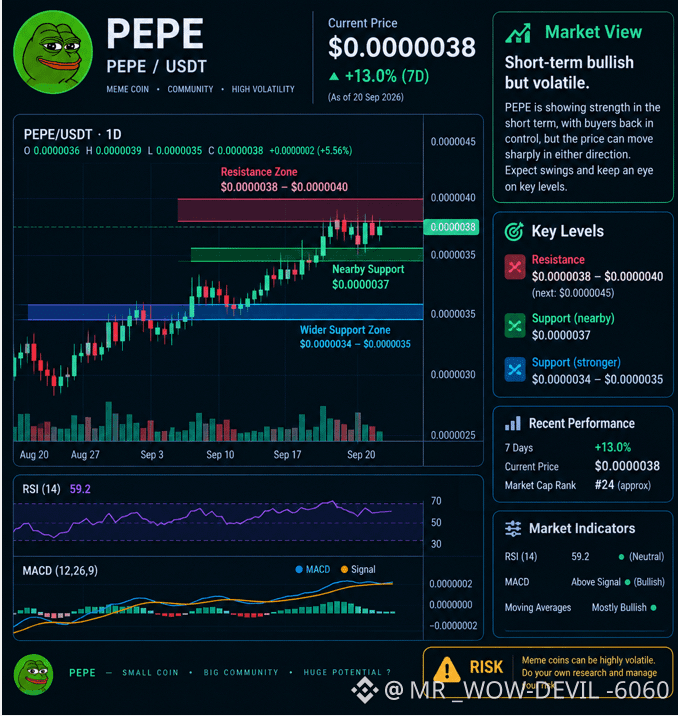
$PEPE Current price: around $0.0000038
7-day move: about +13%
Resistance: $0.0000038–$0.0000040
Support: around $0.0000037, with stronger support near $0.0000034–$0.0000035
Momentum: RSI is around 59, while the broader moving-average picture is relatively positive, although some shorter-term indicators remain mixed.
Short view: PEPE is showing short-term strength, but it remains a highly volatile meme coin. A break above the $0.0000040 area or a loss of $0.0000034–$0.0000035 would be important technical developments to watch.
{spot}(PEPEUSDT)
#PEPE #BOJRaisesRatesTo31YearHigh #BuffettStepsDownAsBerkshireChairman #XRPExchangeReservesHitSevenYearLow #HKCompletesFirstHKDStablecoinUseCase $PEPE
$PEPE Current price: around $0.0000038
7-day move: about +13%
Resistance: $0.0000038–$0.0000040
Support: around $0.0000037, with stronger support near $0.0000034–$0.0000035
Momentum: RSI is around 59, while the broader moving-average picture is relatively positive, although some shorter-term indicators remain mixed.
Short view: PEPE is showing short-term strength, but it remains a highly volatile meme coin. A break above the $0.0000040 area or a loss of $0.0000034–$0.0000035 would be important technical developments to watch.
#PEPE #BOJRaisesRatesTo31YearHigh #BuffettStepsDownAsBerkshireChairman #XRPExchangeReservesHitSevenYearLow #HKCompletesFirstHKDStablecoinUseCase $PEPE
7-day move: about +13%
Resistance: $0.0000038–$0.0000040
Support: around $0.0000037, with stronger support near $0.0000034–$0.0000035
Momentum: RSI is around 59, while the broader moving-average picture is relatively positive, although some shorter-term indicators remain mixed.
Short view: PEPE is showing short-term strength, but it remains a highly volatile meme coin. A break above the $0.0000040 area or a loss of $0.0000034–$0.0000035 would be important technical developments to watch.
#PEPE #BOJRaisesRatesTo31YearHigh #BuffettStepsDownAsBerkshireChairman #XRPExchangeReservesHitSevenYearLow #HKCompletesFirstHKDStablecoinUseCase $PEPE
1
327

·
--
Article
🐸 $PEPE Reclaims Key Structure: Is a Bullish Continuation Setting Up? 📈*$PEPE has swept liquidity, reclaimed its range, and the chart is starting to look constructive.** 🟢 But the smart approach is to understand *what* is happening, and *what still needs to be confirmed*, before making any move.
## 🔍 What's Happening?
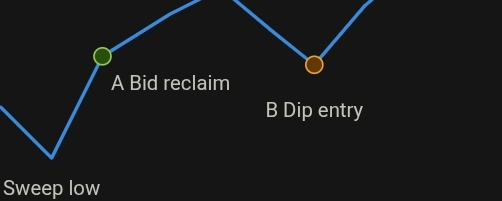
$PEPE recently made a **liquidity sweep beneath a local consolidation**, a quick dip below a recent low that grabs the stop orders sitting there. Price then **reclaimed the range**, moving back inside and above the level it lost. 🔄
In technical analysis, this pattern is often read as a structural shift: sellers pushed price lower, failed to hold it, and buyers stepped back in.
## 🧠 Key Concepts, Explained Simply
- 💧 **Liquidity sweep:** Many traders place stops below obvious lows. Price sometimes dips into that area to trigger those orders, then reverses.
- 🔁 **Range reclaim:** After the dip, price moves back above the broken level. This suggests the breakdown may have been a false move.
- 🧲 **Inefficiency zones:** Areas where price moved too fast and left gaps or imbalances. Price often revisits them, so traders treat them as potential targets overhead.
- 📊 **Volume profile:** Shows where most trading activity happened. Quiet, steady volume at a level can hint at accumulation, though it is not proof.
## 🐂 The Bullish Case
Here is why some traders like this structure:
1. ✅ A sweep of lows followed by a reclaim shows sellers failed to follow through
2. ✅ Inefficiency zones above may act like magnets for price
3. ✅ Quiet volume during consolidation can suggest buyers are absorbing supply
4. ✅ A reclaimed range gives a clear level to trade around
If buyers defend the reclaimed area, **upward continuation** becomes a reasonable scenario 🚀
## ⚖️ Two Ways to Approach It
**1️⃣ Bid the reclaim now** 🟢
- Pros: You enter early and don't miss a fast move
- Cons: Price may already be extended, and a failed reclaim could send it back down quickly
**2️⃣ Wait for a dip into lower demand** 🟡
- Pros: A better entry price and a tighter stop
- Cons: Price may never come back, and you could miss the move
Neither is "right." The better choice depends on your plan, your risk tolerance, and where your invalidation sits. 🎯
## 🔎 What to Verify Before Trading
Market commentary often makes strong claims, like "smart money is accumulating," that **cannot be confirmed from a chart alone**. Treat those as opinions, not facts. Before acting, check for yourself:
- 📍 Where exactly is the **reclaimed level**? Is price holding above it?
- 🕯️ Are candles **closing** above it, or just wicking through?
- 📈 Is volume rising on the way up, or fading?
- 🛑 Where is the **sweep low**? A close back below it would weaken the idea 🚫
- 🎯 Where are the next resistance levels or inefficiency zones?
If you can't name your entry, stop and target, **you don't have a trade yet**. You have an idea. 💡
## 🐸 Remember: $PEPE Is a Memecoin
Memecoins can move fast in both directions ⚡. They are highly sensitive to sentiment, social media attention, and sudden shifts in volume. A clean-looking setup can fail quickly, so position sizing matters more here than on larger, slower-moving assets. 📉
## 🛡️ Risk Management Reminders
1. 💵 Risk only 1–2% of your account per trade
2. 🛑 Set your stop loss **before** you enter
3. 📉 Never widen your stop once you're in
4. 🔒 Consider taking partial profits into strength
5. 🧘 Avoid FOMO, because a missed move is better than a forced trade
## 🏁 Final Thoughts
$PEPE has shown a **liquidity sweep and a range reclaim**, which is a constructive structural signal. But a signal is not a guarantee. 🚦 The real question is the one every trader must answer for themselves:
**💬 Are you bidding this reclaim, or waiting for one more dip into lower demand?**
Whatever you choose, have a plan, define your risk, and let the market confirm your idea. 🔥
> ⚠️ *Not financial advice. For educational purposes only. Crypto trading carries high risk, especially with memecoins, so always do your own research (DYOR) and manage your risk.*
**🏷️ :** #PEPE #Memecoin #SHİB #CryptoTrading #PriceAction
$PEPE
{spot}(PEPEUSDT)
🐸 $PEPE Reclaims Key Structure: Is a Bullish Continuation Setting Up? 📈
*$PEPE has swept liquidity, reclaimed its range, and the chart is starting to look constructive.** 🟢 But the smart approach is to understand *what* is happening, and *what still needs to be confirmed*, before making any move.
## 🔍 What's Happening?
$PEPE recently made a **liquidity sweep beneath a local consolidation**, a quick dip below a recent low that grabs the stop orders sitting there. Price then **reclaimed the range**, moving back inside and above the level it lost. 🔄
In technical analysis, this pattern is often read as a structural shift: sellers pushed price lower, failed to hold it, and buyers stepped back in.
## 🧠 Key Concepts, Explained Simply
- 💧 **Liquidity sweep:** Many traders place stops below obvious lows. Price sometimes dips into that area to trigger those orders, then reverses.
- 🔁 **Range reclaim:** After the dip, price moves back above the broken level. This suggests the breakdown may have been a false move.
- 🧲 **Inefficiency zones:** Areas where price moved too fast and left gaps or imbalances. Price often revisits them, so traders treat them as potential targets overhead.
- 📊 **Volume profile:** Shows where most trading activity happened. Quiet, steady volume at a level can hint at accumulation, though it is not proof.
## 🐂 The Bullish Case
Here is why some traders like this structure:
1. ✅ A sweep of lows followed by a reclaim shows sellers failed to follow through
2. ✅ Inefficiency zones above may act like magnets for price
3. ✅ Quiet volume during consolidation can suggest buyers are absorbing supply
4. ✅ A reclaimed range gives a clear level to trade around
If buyers defend the reclaimed area, **upward continuation** becomes a reasonable scenario 🚀
## ⚖️ Two Ways to Approach It
**1️⃣ Bid the reclaim now** 🟢
- Pros: You enter early and don't miss a fast move
- Cons: Price may already be extended, and a failed reclaim could send it back down quickly
**2️⃣ Wait for a dip into lower demand** 🟡
- Pros: A better entry price and a tighter stop
- Cons: Price may never come back, and you could miss the move
Neither is "right." The better choice depends on your plan, your risk tolerance, and where your invalidation sits. 🎯
## 🔎 What to Verify Before Trading
Market commentary often makes strong claims, like "smart money is accumulating," that **cannot be confirmed from a chart alone**. Treat those as opinions, not facts. Before acting, check for yourself:
- 📍 Where exactly is the **reclaimed level**? Is price holding above it?
- 🕯️ Are candles **closing** above it, or just wicking through?
- 📈 Is volume rising on the way up, or fading?
- 🛑 Where is the **sweep low**? A close back below it would weaken the idea 🚫
- 🎯 Where are the next resistance levels or inefficiency zones?
If you can't name your entry, stop and target, **you don't have a trade yet**. You have an idea. 💡
## 🐸 Remember: $PEPE Is a Memecoin
Memecoins can move fast in both directions ⚡. They are highly sensitive to sentiment, social media attention, and sudden shifts in volume. A clean-looking setup can fail quickly, so position sizing matters more here than on larger, slower-moving assets. 📉
## 🛡️ Risk Management Reminders
1. 💵 Risk only 1–2% of your account per trade
2. 🛑 Set your stop loss **before** you enter
3. 📉 Never widen your stop once you're in
4. 🔒 Consider taking partial profits into strength
5. 🧘 Avoid FOMO, because a missed move is better than a forced trade
## 🏁 Final Thoughts
$PEPE has shown a **liquidity sweep and a range reclaim**, which is a constructive structural signal. But a signal is not a guarantee. 🚦 The real question is the one every trader must answer for themselves:
**💬 Are you bidding this reclaim, or waiting for one more dip into lower demand?**
Whatever you choose, have a plan, define your risk, and let the market confirm your idea. 🔥
> ⚠️ *Not financial advice. For educational purposes only. Crypto trading carries high risk, especially with memecoins, so always do your own research (DYOR) and manage your risk.*
**🏷️ :** #PEPE #Memecoin #SHİB #CryptoTrading #PriceAction
$PEPE
## 🔍 What's Happening?
$PEPE recently made a **liquidity sweep beneath a local consolidation**, a quick dip below a recent low that grabs the stop orders sitting there. Price then **reclaimed the range**, moving back inside and above the level it lost. 🔄
In technical analysis, this pattern is often read as a structural shift: sellers pushed price lower, failed to hold it, and buyers stepped back in.
## 🧠 Key Concepts, Explained Simply
- 💧 **Liquidity sweep:** Many traders place stops below obvious lows. Price sometimes dips into that area to trigger those orders, then reverses.
- 🔁 **Range reclaim:** After the dip, price moves back above the broken level. This suggests the breakdown may have been a false move.
- 🧲 **Inefficiency zones:** Areas where price moved too fast and left gaps or imbalances. Price often revisits them, so traders treat them as potential targets overhead.
- 📊 **Volume profile:** Shows where most trading activity happened. Quiet, steady volume at a level can hint at accumulation, though it is not proof.
## 🐂 The Bullish Case
Here is why some traders like this structure:
1. ✅ A sweep of lows followed by a reclaim shows sellers failed to follow through
2. ✅ Inefficiency zones above may act like magnets for price
3. ✅ Quiet volume during consolidation can suggest buyers are absorbing supply
4. ✅ A reclaimed range gives a clear level to trade around
If buyers defend the reclaimed area, **upward continuation** becomes a reasonable scenario 🚀
## ⚖️ Two Ways to Approach It
**1️⃣ Bid the reclaim now** 🟢
- Pros: You enter early and don't miss a fast move
- Cons: Price may already be extended, and a failed reclaim could send it back down quickly
**2️⃣ Wait for a dip into lower demand** 🟡
- Pros: A better entry price and a tighter stop
- Cons: Price may never come back, and you could miss the move
Neither is "right." The better choice depends on your plan, your risk tolerance, and where your invalidation sits. 🎯
## 🔎 What to Verify Before Trading
Market commentary often makes strong claims, like "smart money is accumulating," that **cannot be confirmed from a chart alone**. Treat those as opinions, not facts. Before acting, check for yourself:
- 📍 Where exactly is the **reclaimed level**? Is price holding above it?
- 🕯️ Are candles **closing** above it, or just wicking through?
- 📈 Is volume rising on the way up, or fading?
- 🛑 Where is the **sweep low**? A close back below it would weaken the idea 🚫
- 🎯 Where are the next resistance levels or inefficiency zones?
If you can't name your entry, stop and target, **you don't have a trade yet**. You have an idea. 💡
## 🐸 Remember: $PEPE Is a Memecoin
Memecoins can move fast in both directions ⚡. They are highly sensitive to sentiment, social media attention, and sudden shifts in volume. A clean-looking setup can fail quickly, so position sizing matters more here than on larger, slower-moving assets. 📉
## 🛡️ Risk Management Reminders
1. 💵 Risk only 1–2% of your account per trade
2. 🛑 Set your stop loss **before** you enter
3. 📉 Never widen your stop once you're in
4. 🔒 Consider taking partial profits into strength
5. 🧘 Avoid FOMO, because a missed move is better than a forced trade
## 🏁 Final Thoughts
$PEPE has shown a **liquidity sweep and a range reclaim**, which is a constructive structural signal. But a signal is not a guarantee. 🚦 The real question is the one every trader must answer for themselves:
**💬 Are you bidding this reclaim, or waiting for one more dip into lower demand?**
Whatever you choose, have a plan, define your risk, and let the market confirm your idea. 🔥
> ⚠️ *Not financial advice. For educational purposes only. Crypto trading carries high risk, especially with memecoins, so always do your own research (DYOR) and manage your risk.*
**🏷️ :** #PEPE #Memecoin #SHİB #CryptoTrading #PriceAction
$PEPE
1
102

·
--
🐸 $PEPE ALERT: Bears Squeezing the Frog! 🔻
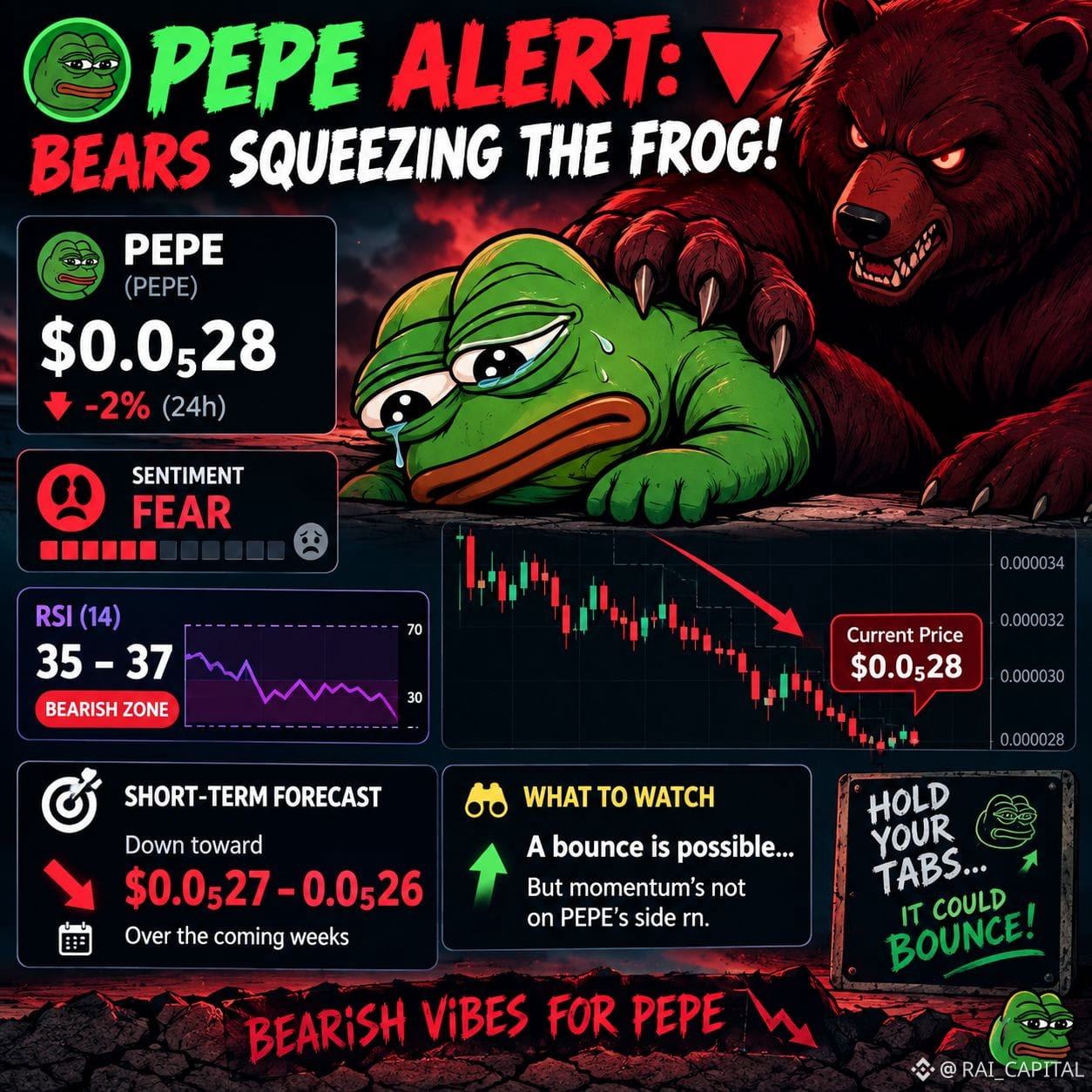
Trading near $0.0₅28, PEPE's stuck in a bearish RSI zone (~35-37) with fear dominating sentiment 😨. Short-term forecasts point lower toward $0.0₅27-26 over the coming weeks unless bulls step in fast. 📉 Watch for a bounce, but momentum's not on PEPE's side rn.
#pepe #PEPE #pepe⚡ #PEPE✈
{spot}(PEPEUSDT)
🐸 $PEPE ALERT: Bears Squeezing the Frog! 🔻
Trading near $0.0₅28, PEPE's stuck in a bearish RSI zone (~35-37) with fear dominating sentiment 😨. Short-term forecasts point lower toward $0.0₅27-26 over the coming weeks unless bulls step in fast. 📉 Watch for a bounce, but momentum's not on PEPE's side rn.
#pepe #PEPE #pepe⚡ #PEPE✈
Trading near $0.0₅28, PEPE's stuck in a bearish RSI zone (~35-37) with fear dominating sentiment 😨. Short-term forecasts point lower toward $0.0₅27-26 over the coming weeks unless bulls step in fast. 📉 Watch for a bounce, but momentum's not on PEPE's side rn.
#pepe #PEPE #pepe⚡ #PEPE✈
236

$PEPE Preparing for the Next Big Leap? 🚀The king of frog memes, Pepe Coin ($PEPE), is capturing the market's attention once again! Looking at the recent chart patterns, consolidation seems to be wrapping up, and trading volume is showing signs of whale accumulation.Why keep an eye on $PEPE right now?Massive Community Support: The Pepe army remains one of the most active and loyal communities in the entire crypto space, driving consistent social volume.High Liquidity & Velocity: Whenever the broader market enters a relief rally, $PEPE historically moves faster and harder than many large-cap altcoins.Strong Holder Base: Despite market fluctuations, long-term diamond hands continue to accumulate, reducing circulating supply on exchanges.Are you currently holding $PEPE, or are you waiting for a cleaner breakout before entering? Drop your price predictions in the comments below! 👇#PEPE #BinanceSquare #CryptoNews #Altcoins
$PEPE Preparing for the Next Big Leap? 🚀The king of frog memes, Pepe Coin ($PEPE ), is capturing the market's attention once again! Looking at the recent chart patterns, consolidation seems to be wrapping up, and trading volume is showing signs of whale accumulation.Why keep an eye on $PEPE right now?Massive Community Support: The Pepe army remains one of the most active and loyal communities in the entire crypto space, driving consistent social volume.High Liquidity & Velocity: Whenever the broader market enters a relief rally, $PEPE historically moves faster and harder than many large-cap altcoins.Strong Holder Base: Despite market fluctuations, long-term diamond hands continue to accumulate, reducing circulating supply on exchanges.Are you currently holding $PEPE , or are you waiting for a cleaner breakout before entering? Drop your price predictions in the comments below! 👇#PEPE #BinanceSquare #CryptoNews #Altcoins
104

·
--
Bullish
$PEPE ... Buyers Attempt a Fresh Push
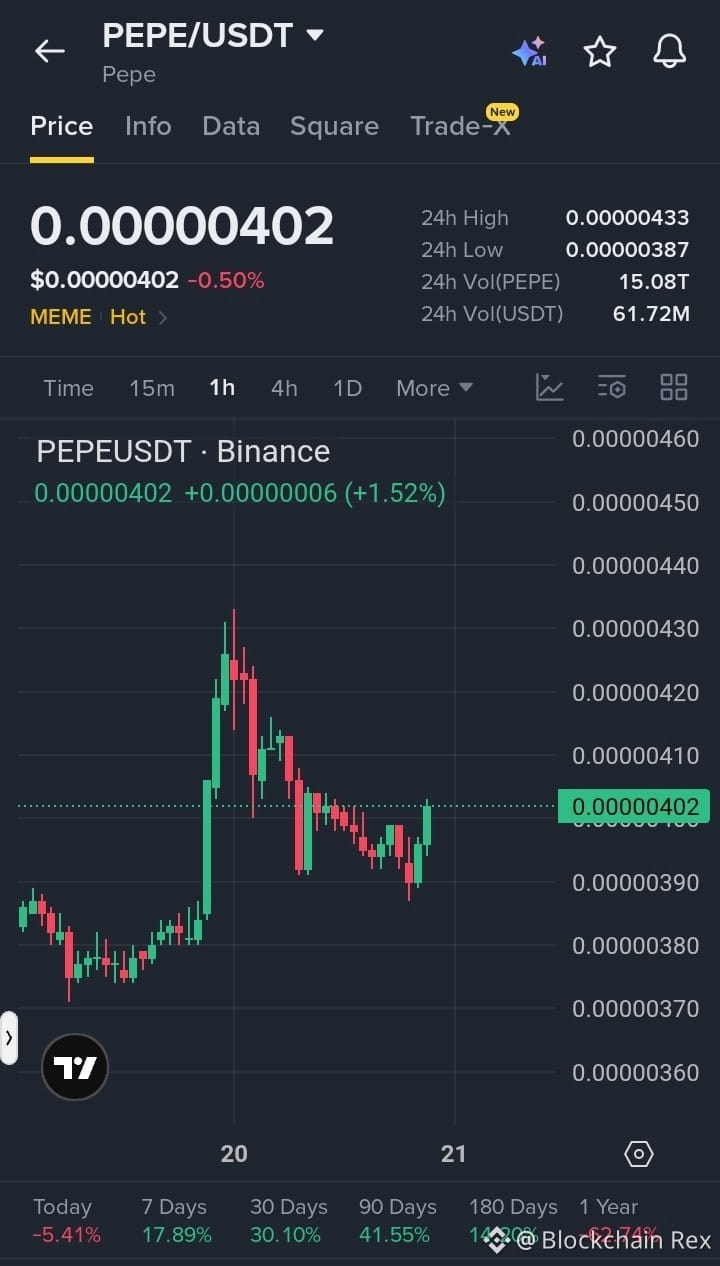
#PEPE is stabilizing around the $0.00000390 support area after the earlier pullback. The latest candles show buyers stepping back in, with price reclaiming $0.00000400 and opening room toward the nearby resistance levels.
Long Trade Setup
Entry: $0.00000400–$0.00000403
TP1: $0.00000408
TP2: $0.00000415
TP3: $0.00000422
SL: $0.00000390
Buy and Trade
{spot}(PEPEUSDT)
$ZEC
{future}(ZECUSDT)
$AKE
{future}(AKEUSDT)
$PEPE ... Buyers Attempt a Fresh Push
#PEPE is stabilizing around the $0.00000390 support area after the earlier pullback. The latest candles show buyers stepping back in, with price reclaiming $0.00000400 and opening room toward the nearby resistance levels.
Long Trade Setup
Entry: $0.00000400–$0.00000403
TP1: $0.00000408
TP2: $0.00000415
TP3: $0.00000422
SL: $0.00000390
Buy and Trade
$ZEC
$AKE
#PEPE is stabilizing around the $0.00000390 support area after the earlier pullback. The latest candles show buyers stepping back in, with price reclaiming $0.00000400 and opening room toward the nearby resistance levels.
Long Trade Setup
Entry: $0.00000400–$0.00000403
TP1: $0.00000408
TP2: $0.00000415
TP3: $0.00000422
SL: $0.00000390
Buy and Trade
$ZEC
$AKE
2
1.3k


·
--
Bullish
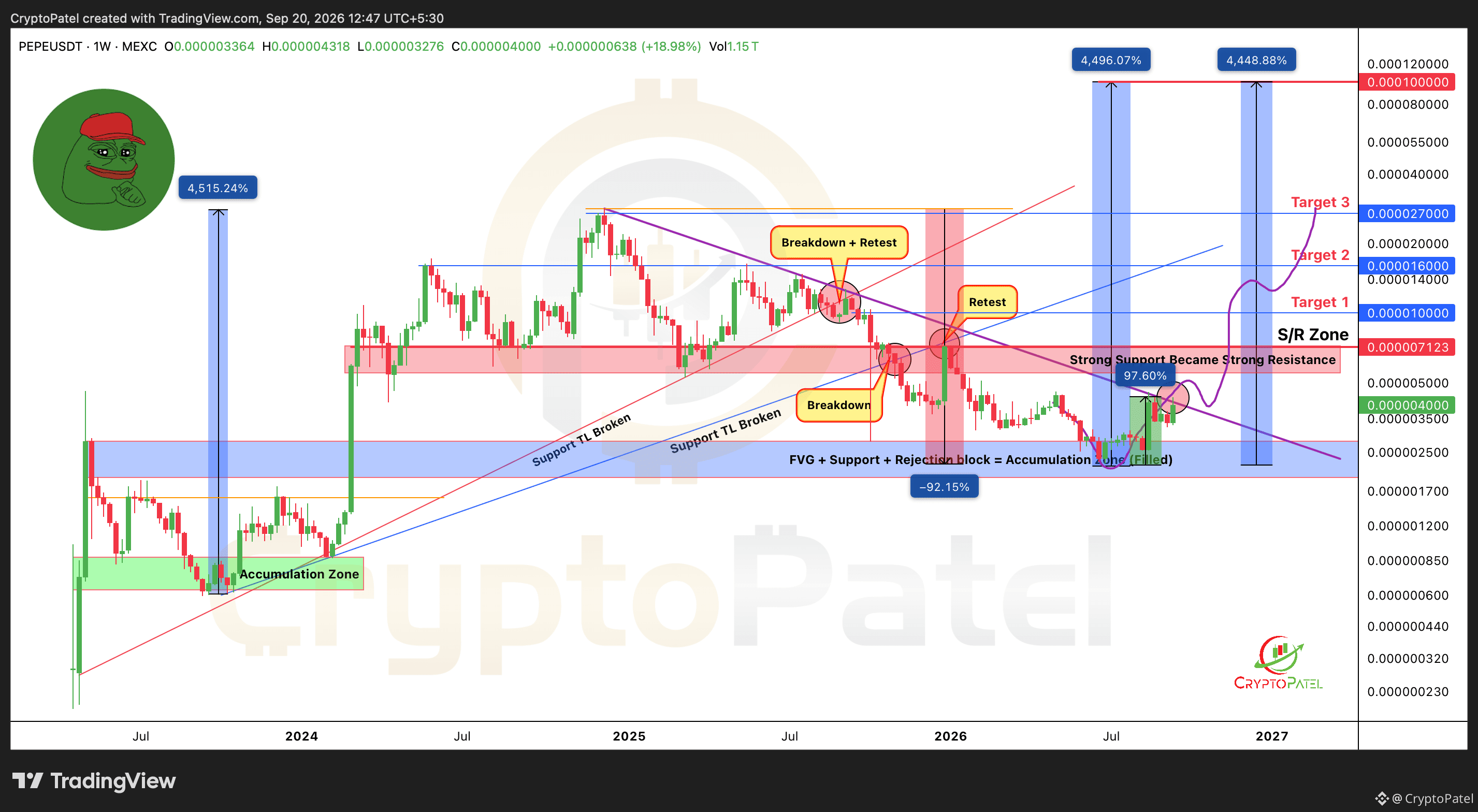
$PEPE : THE 92% CRASH MAY HAVE BUILT THE NEXT EXPANSION ZONE
#PEPE is already ~97% up from our HTF accumulation zone, where the current recovery began.
Now comes the critical test:
🔹 Accumulation Zone: $0.0000027-$0.0000020 Filled
🔹 Reclaim $0.000004583 → S/R flip
🔹 Break HTF downtrend → structural confirmation
🔹 Targets: $0.000010 → $0.000016 → $0.000027
🔹 HTF projection: ~$0.00010/$0.00020
The accumulation move is already underway. The next trigger is the breakout.
NFA. DYOR.
{spot}(PEPEUSDT)
$PEPE : THE 92% CRASH MAY HAVE BUILT THE NEXT EXPANSION ZONE
#PEPE is already ~97% up from our HTF accumulation zone, where the current recovery began.
Now comes the critical test:
🔹 Accumulation Zone: $0.0000027-$0.0000020 Filled
🔹 Reclaim $0.000004583 → S/R flip
🔹 Break HTF downtrend → structural confirmation
🔹 Targets: $0.000010 → $0.000016 → $0.000027
🔹 HTF projection: ~$0.00010/$0.00020
The accumulation move is already underway. The next trigger is the breakout.
NFA. DYOR.
#PEPE is already ~97% up from our HTF accumulation zone, where the current recovery began.
Now comes the critical test:
🔹 Accumulation Zone: $0.0000027-$0.0000020 Filled
🔹 Reclaim $0.000004583 → S/R flip
🔹 Break HTF downtrend → structural confirmation
🔹 Targets: $0.000010 → $0.000016 → $0.000027
🔹 HTF projection: ~$0.00010/$0.00020
The accumulation move is already underway. The next trigger is the breakout.
NFA. DYOR.
514

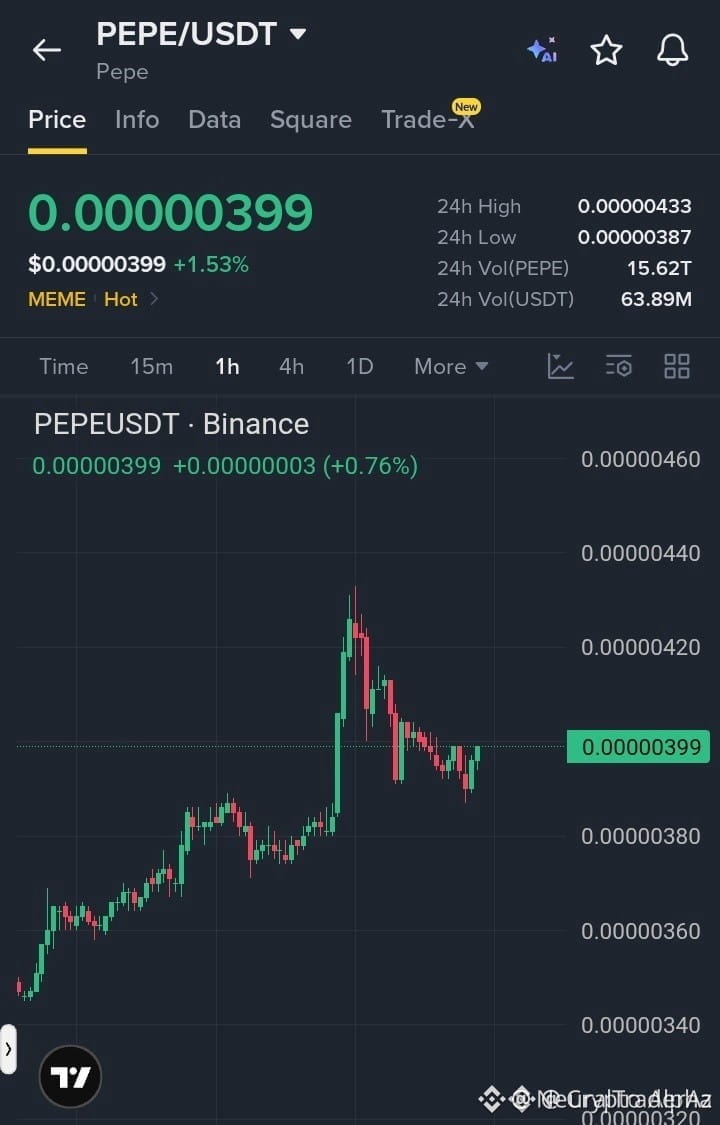
🦈 $PEPE HOLDS INSTITUTIONAL DEMAND ZONE AFTER LIQUIDITY RECLAIM! 🚀
Entry: 0.00000395 - 0.00000400 ⚡
Target: 0.00000408 - 0.00000428 🚀
Stop Loss: 0.00000388 ⚠️
📌 Smart money absorbed the recent pullback precisely at the high-volume consolidation block, confirming a structural higher low. 📊 Institutional order flow shows clear accumulation above support, signaling that sell-side liquidity has been fully swept.
💡 As buyers defend this structural pivot, price is positioning for an explosive impulse toward upper range inefficiencies. 💬 Are you front-running this expansion or waiting for a structural target sweep? 👇
⚠️ Not financial advice. Always manage your risk. 🛡️
🏷️ #PEPE #LongSetup #MarketStructure #Crypto
🎯 🦈
🦈 $PEPE HOLDS INSTITUTIONAL DEMAND ZONE AFTER LIQUIDITY RECLAIM! 🚀
Entry: 0.00000395 - 0.00000400 ⚡
Target: 0.00000408 - 0.00000428 🚀
Stop Loss: 0.00000388 ⚠️
📌 Smart money absorbed the recent pullback precisely at the high-volume consolidation block, confirming a structural higher low. 📊 Institutional order flow shows clear accumulation above support, signaling that sell-side liquidity has been fully swept.
💡 As buyers defend this structural pivot, price is positioning for an explosive impulse toward upper range inefficiencies. 💬 Are you front-running this expansion or waiting for a structural target sweep? 👇
⚠️ Not financial advice. Always manage your risk. 🛡️
🏷️ #PEPE #LongSetup #MarketStructure #Crypto
🎯 🦈
Entry: 0.00000395 - 0.00000400 ⚡
Target: 0.00000408 - 0.00000428 🚀
Stop Loss: 0.00000388 ⚠️
📌 Smart money absorbed the recent pullback precisely at the high-volume consolidation block, confirming a structural higher low. 📊 Institutional order flow shows clear accumulation above support, signaling that sell-side liquidity has been fully swept.
💡 As buyers defend this structural pivot, price is positioning for an explosive impulse toward upper range inefficiencies. 💬 Are you front-running this expansion or waiting for a structural target sweep? 👇
⚠️ Not financial advice. Always manage your risk. 🛡️
🏷️ #PEPE #LongSetup #MarketStructure #Crypto
🎯 🦈
1

·
--
🎭 🐸 PEPE Price Action + Meme-Coin Narrative
PEPE is back in focus as meme-coin momentum returns. 🔥
📊 Price Action: PEPE is trading around $0.000004, with recent data showing strong weekly momentum and elevated trading volume. CoinMarketCap reported PEPE up about 15% over 7 days, while 24-hour volume was around $539M.
🎯 Key Levels to Watch
🟢 Support: ~$0.00000380
🔴 Resistance: ~$0.00000420
📈 A sustained move above resistance with strong volume could signal continued momentum.
⚠️ A loss of support could bring a deeper pullback into focus.
🐸 Meme-Coin Narrative:
PEPE's recent move is happening alongside renewed strength across major meme coins such as DOGE, WIF and BONK. The current narrative is being driven largely by sector rotation, trading activity and social sentiment, rather than a single confirmed PEPE-specific catalyst.
My Take:
For PEPE, watch price + volume + meme-sector momentum together. A strong price move without sustained volume can be less convincing.
Do you think PEPE can break $0.00000420? 🐸👇
#PEPE #MemeCoin #crypto #altcoins $PEPE
{spot}(PEPEUSDT)
🎭 🐸 PEPE Price Action + Meme-Coin Narrative
PEPE is back in focus as meme-coin momentum returns. 🔥
📊 Price Action: PEPE is trading around $0.000004, with recent data showing strong weekly momentum and elevated trading volume. CoinMarketCap reported PEPE up about 15% over 7 days, while 24-hour volume was around $539M.
🎯 Key Levels to Watch
🟢 Support: ~$0.00000380
🔴 Resistance: ~$0.00000420
📈 A sustained move above resistance with strong volume could signal continued momentum.
⚠️ A loss of support could bring a deeper pullback into focus.
🐸 Meme-Coin Narrative:
PEPE's recent move is happening alongside renewed strength across major meme coins such as DOGE, WIF and BONK. The current narrative is being driven largely by sector rotation, trading activity and social sentiment, rather than a single confirmed PEPE-specific catalyst.
My Take:
For PEPE, watch price + volume + meme-sector momentum together. A strong price move without sustained volume can be less convincing.
Do you think PEPE can break $0.00000420? 🐸👇
#PEPE #MemeCoin #crypto #altcoins $PEPE
PEPE is back in focus as meme-coin momentum returns. 🔥
📊 Price Action: PEPE is trading around $0.000004, with recent data showing strong weekly momentum and elevated trading volume. CoinMarketCap reported PEPE up about 15% over 7 days, while 24-hour volume was around $539M.
🎯 Key Levels to Watch
🟢 Support: ~$0.00000380
🔴 Resistance: ~$0.00000420
📈 A sustained move above resistance with strong volume could signal continued momentum.
⚠️ A loss of support could bring a deeper pullback into focus.
🐸 Meme-Coin Narrative:
PEPE's recent move is happening alongside renewed strength across major meme coins such as DOGE, WIF and BONK. The current narrative is being driven largely by sector rotation, trading activity and social sentiment, rather than a single confirmed PEPE-specific catalyst.
My Take:
For PEPE, watch price + volume + meme-sector momentum together. A strong price move without sustained volume can be less convincing.
Do you think PEPE can break $0.00000420? 🐸👇
#PEPE #MemeCoin #crypto #altcoins $PEPE
61

·
--
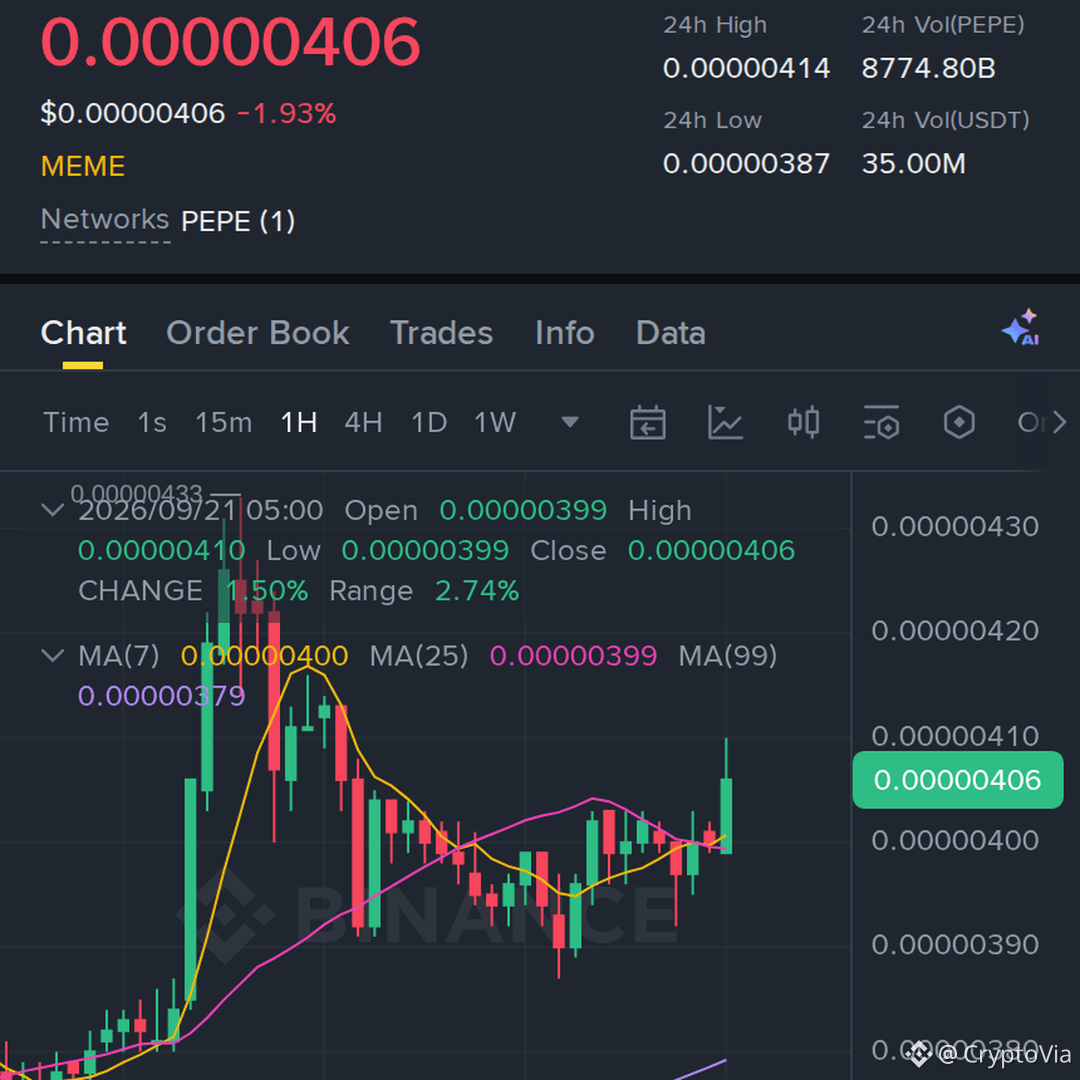
still tracking $PEPE, with leverage near 50x, is trying to build above the breakout instead of giving it back
Entry: 0.00000404–0.00000406 | Stop Loss: 0.00000385
TP1: 0.00000419 / TP2: 0.00000432 / TP3: 0.00000446
#PEPE #Crypto #Write2Earn #Binance
still tracking $PEPE , with leverage near 50x, is trying to build above the breakout instead of giving it back
Entry: 0.00000404–0.00000406 | Stop Loss: 0.00000385
TP1: 0.00000419 / TP2: 0.00000432 / TP3: 0.00000446
#PEPE #Crypto #Write2Earn #Binance
Entry: 0.00000404–0.00000406 | Stop Loss: 0.00000385
TP1: 0.00000419 / TP2: 0.00000432 / TP3: 0.00000446
#PEPE #Crypto #Write2Earn #Binance
62

🔥 $PEPE — HOT SEARCH → NEXT GAINER? 👀
$PEPE is climbing on Binance Hot Search as attention returns to the memecoin sector.
But what's behind the move?
🐸 WHY IS $PEPE GETTING ATTENTION?
📈 Memecoin Rotation Capital has been rotating back into major memecoins, with DOGE, WIF, BONK and PEPE all showing renewed activity.
📊 Volume Surge PEPE's recent 24H trading volume jumped significantly, reaching around $551M, showing that traders are becoming more active.
🔥 Strong Recent Momentum PEPE has been holding above the $0.00000380 area while buyers continue to defend the recent move.
🎯 KEY LEVEL TO WATCH
$0.00000420 is an important resistance area.
A breakout above this zone with strong volume could bring additional momentum.
If PEPE loses $0.00000380 and volume fades, a pullback toward the $0.00000350 area becomes a risk.
⚠️ Don't chase a vertical candle.
Hot Search → Next Gainer?
PEPE is definitely one to watch. 👀
DYOR — No FOMO.
#PEPE #PEPE #Binance #Crypto #Altcoins
{spot}(PEPEUSDT)
🔥 $PEPE — HOT SEARCH → NEXT GAINER? 👀
$PEPE is climbing on Binance Hot Search as attention returns to the memecoin sector.
But what's behind the move?
🐸 WHY IS $PEPE GETTING ATTENTION?
📈 Memecoin Rotation Capital has been rotating back into major memecoins, with DOGE, WIF, BONK and PEPE all showing renewed activity.
📊 Volume Surge PEPE's recent 24H trading volume jumped significantly, reaching around $551M, showing that traders are becoming more active.
🔥 Strong Recent Momentum PEPE has been holding above the $0.00000380 area while buyers continue to defend the recent move.
🎯 KEY LEVEL TO WATCH
$0.00000420 is an important resistance area.
A breakout above this zone with strong volume could bring additional momentum.
If PEPE loses $0.00000380 and volume fades, a pullback toward the $0.00000350 area becomes a risk.
⚠️ Don't chase a vertical candle.
Hot Search → Next Gainer?
PEPE is definitely one to watch. 👀
DYOR — No FOMO.
#PEPE #PEPE #Binance #Crypto #Altcoins
$PEPE is climbing on Binance Hot Search as attention returns to the memecoin sector.
But what's behind the move?
🐸 WHY IS $PEPE GETTING ATTENTION?
📈 Memecoin Rotation Capital has been rotating back into major memecoins, with DOGE, WIF, BONK and PEPE all showing renewed activity.
📊 Volume Surge PEPE's recent 24H trading volume jumped significantly, reaching around $551M, showing that traders are becoming more active.
🔥 Strong Recent Momentum PEPE has been holding above the $0.00000380 area while buyers continue to defend the recent move.
🎯 KEY LEVEL TO WATCH
$0.00000420 is an important resistance area.
A breakout above this zone with strong volume could bring additional momentum.
If PEPE loses $0.00000380 and volume fades, a pullback toward the $0.00000350 area becomes a risk.
⚠️ Don't chase a vertical candle.
Hot Search → Next Gainer?
PEPE is definitely one to watch. 👀
DYOR — No FOMO.
#PEPE #PEPE #Binance #Crypto #Altcoins
30

·
--
🚨 $PEPE RECLAIMS KEY STRUCTURE AS SMART MONEY ACCUMULATES FOR UPWARD CONTINUATION 🟢
$PEPE is demonstrating a clear structural shift after a textbook liquidity sweep beneath local consolidation. 🔍 Institutional order flow is flipping bullish as buyers systematically absorb supply, creating a prime environment for upward expansion.
With inefficiency zones overhead acting as magnets for price, this range reclaim signals aggressive smart money interest ahead of the next move. 📊 Volume profiles reflect quiet accumulation, giving this momentum solid structural backing. 💬 Are you bidding this range reclaim or waiting for one more dip into lower demand? 👇
⚠️ Not financial advice. Always manage your risk. 🛡️
🏷️ #PEPE #Crypto #Memecoins #MarketStructure
⚡ 🎯
🚨 $PEPE RECLAIMS KEY STRUCTURE AS SMART MONEY ACCUMULATES FOR UPWARD CONTINUATION 🟢
$PEPE is demonstrating a clear structural shift after a textbook liquidity sweep beneath local consolidation. 🔍 Institutional order flow is flipping bullish as buyers systematically absorb supply, creating a prime environment for upward expansion.
With inefficiency zones overhead acting as magnets for price, this range reclaim signals aggressive smart money interest ahead of the next move. 📊 Volume profiles reflect quiet accumulation, giving this momentum solid structural backing. 💬 Are you bidding this range reclaim or waiting for one more dip into lower demand? 👇
⚠️ Not financial advice. Always manage your risk. 🛡️
🏷️ #PEPE #Crypto #Memecoins #MarketStructure
⚡ 🎯
$PEPE is demonstrating a clear structural shift after a textbook liquidity sweep beneath local consolidation. 🔍 Institutional order flow is flipping bullish as buyers systematically absorb supply, creating a prime environment for upward expansion.
With inefficiency zones overhead acting as magnets for price, this range reclaim signals aggressive smart money interest ahead of the next move. 📊 Volume profiles reflect quiet accumulation, giving this momentum solid structural backing. 💬 Are you bidding this range reclaim or waiting for one more dip into lower demand? 👇
⚠️ Not financial advice. Always manage your risk. 🛡️
🏷️ #PEPE #Crypto #Memecoins #MarketStructure
⚡ 🎯

35

💥 $PEPE RECLAIMS MOMENTUM AS BUYERS STEP IN FOR THE NEXT EXPANSION LEG! 🚀
⚡ Momentum on $PEPE is rapidly shifting back in favor of the bulls as spot buyers absorb sell-side pressure along this structural base. 📊 Order flow shows accumulation tightening up, signaling that the market is priming for its next directional expansion.
💡 When meme liquidity rotates back into proven market leaders, volatility expands fast—and this current structure is showing clear signs of aggressive buyer control. 💬 Are you front-running this continuation push or waiting for confirmed breakout volume? 👇
⚠️ Not financial advice. Always manage your risk. 🛡️
🏷️ #PEPE #MemeCoins #Altcoins #Breakout #Crypto
🔥 🚀
💥 $PEPE RECLAIMS MOMENTUM AS BUYERS STEP IN FOR THE NEXT EXPANSION LEG! 🚀
⚡ Momentum on $PEPE is rapidly shifting back in favor of the bulls as spot buyers absorb sell-side pressure along this structural base. 📊 Order flow shows accumulation tightening up, signaling that the market is priming for its next directional expansion.
💡 When meme liquidity rotates back into proven market leaders, volatility expands fast—and this current structure is showing clear signs of aggressive buyer control. 💬 Are you front-running this continuation push or waiting for confirmed breakout volume? 👇
⚠️ Not financial advice. Always manage your risk. 🛡️
🏷️ #PEPE #MemeCoins #Altcoins #Breakout #Crypto
🔥 🚀
⚡ Momentum on $PEPE is rapidly shifting back in favor of the bulls as spot buyers absorb sell-side pressure along this structural base. 📊 Order flow shows accumulation tightening up, signaling that the market is priming for its next directional expansion.
💡 When meme liquidity rotates back into proven market leaders, volatility expands fast—and this current structure is showing clear signs of aggressive buyer control. 💬 Are you front-running this continuation push or waiting for confirmed breakout volume? 👇
⚠️ Not financial advice. Always manage your risk. 🛡️
🏷️ #PEPE #MemeCoins #Altcoins #Breakout #Crypto
🔥 🚀

26

·
--
Bullish
🐸🚀 $PEPE
{spot}(PEPEUSDT)
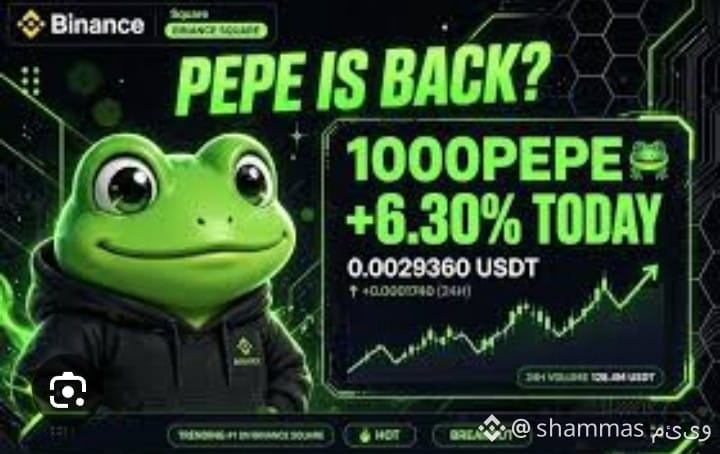
What’s Your 24-Hour Price Target❓ 📊🔥
$PEPE is back in focus as traders watch closely for its next move. 👀📈 Will PEPE continue pushing higher over the next 24 hours, or could we see a pullback❓ 📉
🎯 What price do you think $PEPE can reach in the next 24 hours?
💬 Drop your target below! 👇🐸🚀
#PEPE
#Crypto
#Memecoins
#BinanceSquare
🐸🚀 $PEPE
What’s Your 24-Hour Price Target❓ 📊🔥
$PEPE is back in focus as traders watch closely for its next move. 👀📈 Will PEPE continue pushing higher over the next 24 hours, or could we see a pullback❓ 📉
🎯 What price do you think $PEPE can reach in the next 24 hours?
💬 Drop your target below! 👇🐸🚀
#PEPE
#Crypto
#Memecoins
#BinanceSquare
What’s Your 24-Hour Price Target❓ 📊🔥
$PEPE is back in focus as traders watch closely for its next move. 👀📈 Will PEPE continue pushing higher over the next 24 hours, or could we see a pullback❓ 📉
🎯 What price do you think $PEPE can reach in the next 24 hours?
💬 Drop your target below! 👇🐸🚀
#PEPE
#Crypto
#Memecoins
#BinanceSquare
206 Atlas:
Predicting a 24-hour target is gambling, not trading. Focus on key support and resistance levels instead of guessing random numbers.
1
20
2.8k

{spot}(PEPEUSDT)
🚨 PEPE Holders & Meme Coin Investors: The 5-Year Culture & Community Blueprint! 🚀
Still thinking PEPE is just a temporary trend that will fade away? If yes, you are underestimating the unstoppable power of internet culture and global community backing!
Think about where digital culture, viral movements, and decentralized communities will be 5 years from now. If you panic-sell or get shaken out by short-term volatility, you might miss out on one of the most explosive community-driven runs in crypto history.#pepe #PEPE创历史新高 #PEPEATH
🚨 PEPE Holders & Meme Coin Investors: The 5-Year Culture & Community Blueprint! 🚀
Still thinking PEPE is just a temporary trend that will fade away? If yes, you are underestimating the unstoppable power of internet culture and global community backing!
Think about where digital culture, viral movements, and decentralized communities will be 5 years from now. If you panic-sell or get shaken out by short-term volatility, you might miss out on one of the most explosive community-driven runs in crypto history.#pepe #PEPE创历史新高 #PEPEATH
Still thinking PEPE is just a temporary trend that will fade away? If yes, you are underestimating the unstoppable power of internet culture and global community backing!
Think about where digital culture, viral movements, and decentralized communities will be 5 years from now. If you panic-sell or get shaken out by short-term volatility, you might miss out on one of the most explosive community-driven runs in crypto history.#pepe #PEPE创历史新高 #PEPEATH
97

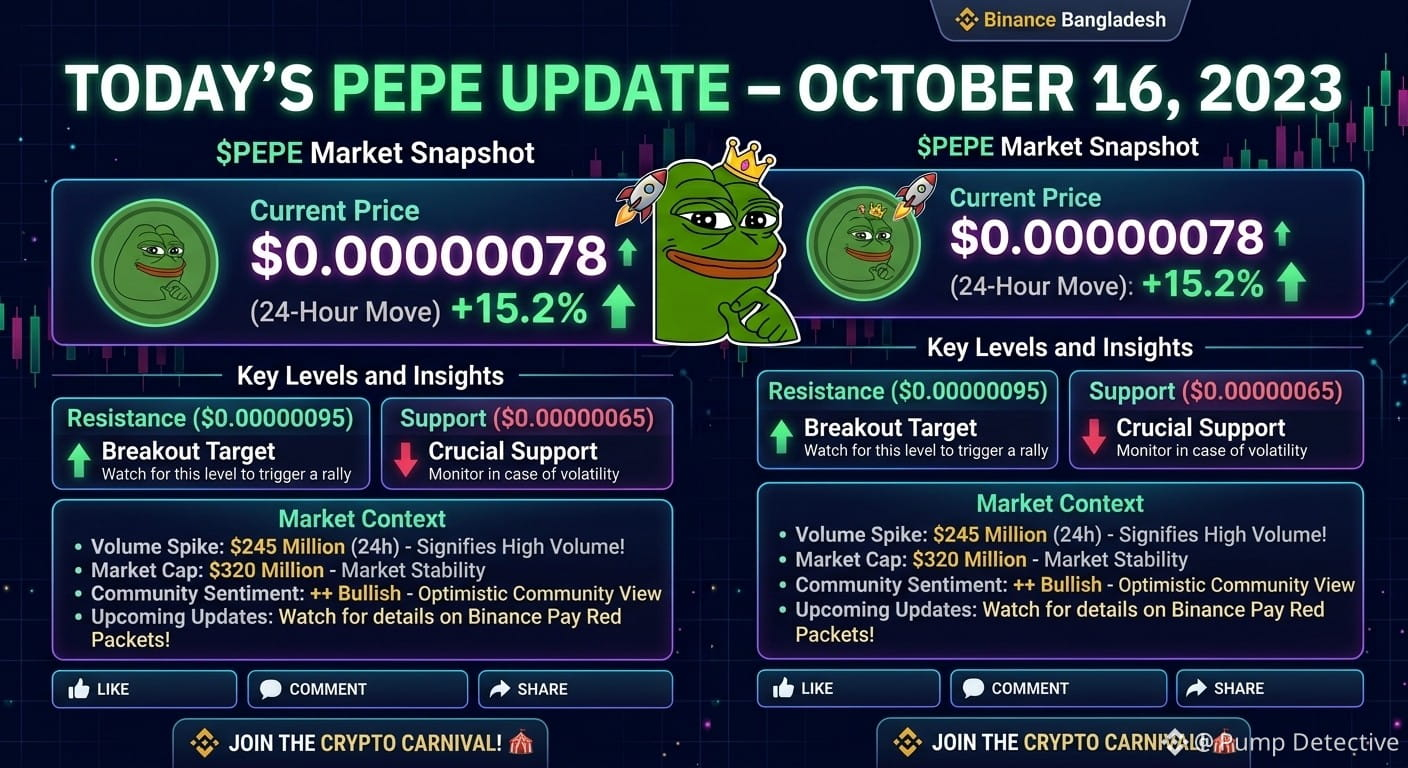
$PEPE - Binance Market Update 🚀
Current Price: $0.00000386
24h Change: +6.925% 📈
Key Levels to Watch 🎯
Pullback Target (1-Hour): $0.00000410
Breakout Resistance: $0.00000490 (Break above this could unlock a ~10% potential upside)
Major Resistance / Stop-Loss: $0.00000535
Market Sentiment
Following the recent rally, trading volume spiked significantly. Watch for a quick breakout before potential retracement back toward the $0.00000410 zone. Keep an eye out for upcoming Binance updates and announcements that could serve as key catalysts for the next leg up!$PEPE #pepe #hotcoins
Like ❤️ | Comment 💬 | Follow 🔔 | Share 🔄
$PEPE - Binance Market Update 🚀
Current Price: $0.00000386
24h Change: +6.925% 📈
Key Levels to Watch 🎯
Pullback Target (1-Hour): $0.00000410
Breakout Resistance: $0.00000490 (Break above this could unlock a ~10% potential upside)
Major Resistance / Stop-Loss: $0.00000535
Market Sentiment
Following the recent rally, trading volume spiked significantly. Watch for a quick breakout before potential retracement back toward the $0.00000410 zone. Keep an eye out for upcoming Binance updates and announcements that could serve as key catalysts for the next leg up!$PEPE #pepe #hotcoins
Like ❤️ | Comment 💬 | Follow 🔔 | Share 🔄
Current Price: $0.00000386
24h Change: +6.925% 📈
Key Levels to Watch 🎯
Pullback Target (1-Hour): $0.00000410
Breakout Resistance: $0.00000490 (Break above this could unlock a ~10% potential upside)
Major Resistance / Stop-Loss: $0.00000535
Market Sentiment
Following the recent rally, trading volume spiked significantly. Watch for a quick breakout before potential retracement back toward the $0.00000410 zone. Keep an eye out for upcoming Binance updates and announcements that could serve as key catalysts for the next leg up!$PEPE #pepe #hotcoins
Like ❤️ | Comment 💬 | Follow 🔔 | Share 🔄
2
364

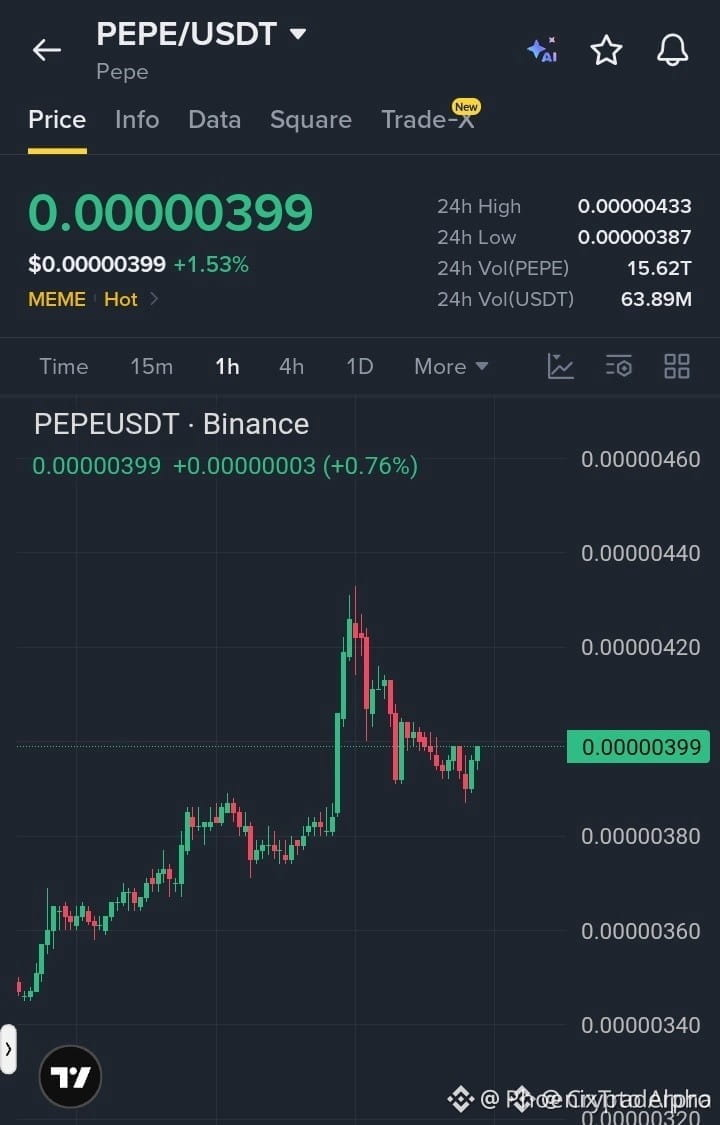
⚡ $PEPE HOLDS CRITICAL DEMAND ZONE AS BUYERS PREPARE THE NEXT BREAKOUT WAVE! 🐂
Entry: 0.00000395 - 0.00000400 ⚡
Target: 0.00000408 - 0.00000428 🚀
Stop Loss: 0.00000388 ⚠️
📌 After a violent breakout and calculated pullback, $PEPE is defending its key consolidation shelf with high-conviction order flow. Sellers failed to push lower, allowing aggressive buyers to reclaim control right above structural support. 📊
⚡ Momentum indicators are coiling tightly while volume builds for another expansion wave. Risk-to-reward on this structure favors early positioning before price squeezes past resistance. 💬 Are you bidding this support flip now or waiting for the breakout to trigger? 👇
⚠️ Not financial advice. Always manage your risk. 🛡️
🏷️ #PEPE #LongSetup #Breakout #Crypto
🔥 💎
⚡ $PEPE HOLDS CRITICAL DEMAND ZONE AS BUYERS PREPARE THE NEXT BREAKOUT WAVE! 🐂
Entry: 0.00000395 - 0.00000400 ⚡
Target: 0.00000408 - 0.00000428 🚀
Stop Loss: 0.00000388 ⚠️
📌 After a violent breakout and calculated pullback, $PEPE is defending its key consolidation shelf with high-conviction order flow. Sellers failed to push lower, allowing aggressive buyers to reclaim control right above structural support. 📊
⚡ Momentum indicators are coiling tightly while volume builds for another expansion wave. Risk-to-reward on this structure favors early positioning before price squeezes past resistance. 💬 Are you bidding this support flip now or waiting for the breakout to trigger? 👇
⚠️ Not financial advice. Always manage your risk. 🛡️
🏷️ #PEPE #LongSetup #Breakout #Crypto
🔥 💎
Entry: 0.00000395 - 0.00000400 ⚡
Target: 0.00000408 - 0.00000428 🚀
Stop Loss: 0.00000388 ⚠️
📌 After a violent breakout and calculated pullback, $PEPE is defending its key consolidation shelf with high-conviction order flow. Sellers failed to push lower, allowing aggressive buyers to reclaim control right above structural support. 📊
⚡ Momentum indicators are coiling tightly while volume builds for another expansion wave. Risk-to-reward on this structure favors early positioning before price squeezes past resistance. 💬 Are you bidding this support flip now or waiting for the breakout to trigger? 👇
⚠️ Not financial advice. Always manage your risk. 🛡️
🏷️ #PEPE #LongSetup #Breakout #Crypto
🔥 💎
28

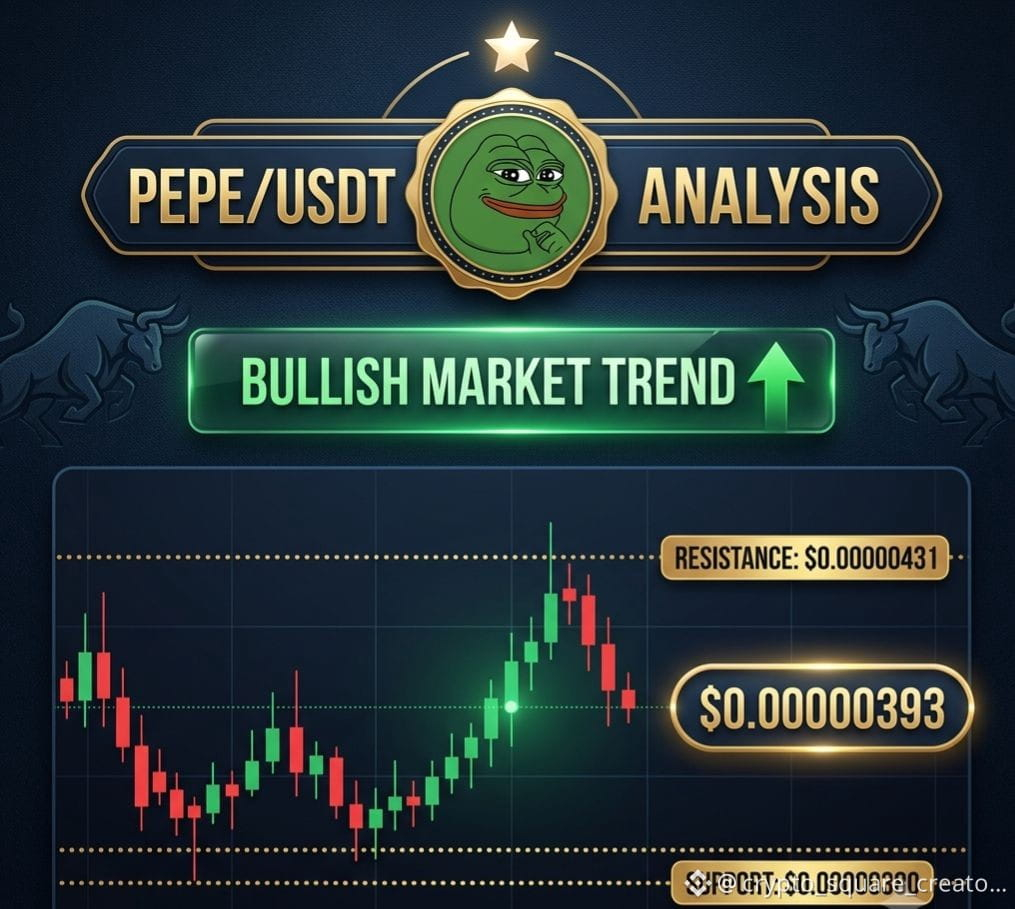
$PEPE 🐸 PEPE SURGES +15% THIS WEEK: Breakout Loading?
PEPE is showing fierce strength! 🚀 The iconic meme coin has gained over 15% in the last 7 days as high daily volume signals renewed market momentum.
Bulls are actively holding key levels, turning recent consolidation into a launchpad for further gains.
Key Levels to Watch:
Current Price: $0.00000393
Trend: Bullish
Key Support: $0.00000380
Key Resistance: $0.00000431
The Brief: PEPE’s upward momentum is driven by positive market sentiment and rapid capital rotation into leading high-beta meme assets.
Can PEPE smash through $0.00000431 and continue its rally? 👇 Share your thoughts below!
#PEPE #PepeCoin #CryptoAnalysis #Memecoins #BinanceSquare #CryptoNews
Not financial advice.$PEPE
{spot}(PEPEUSDT)
$PEPE 🐸 PEPE SURGES +15% THIS WEEK: Breakout Loading?
PEPE is showing fierce strength! 🚀 The iconic meme coin has gained over 15% in the last 7 days as high daily volume signals renewed market momentum.
Bulls are actively holding key levels, turning recent consolidation into a launchpad for further gains.
Key Levels to Watch:
Current Price: $0.00000393
Trend: Bullish
Key Support: $0.00000380
Key Resistance: $0.00000431
The Brief: PEPE’s upward momentum is driven by positive market sentiment and rapid capital rotation into leading high-beta meme assets.
Can PEPE smash through $0.00000431 and continue its rally? 👇 Share your thoughts below!
#PEPE #PepeCoin #CryptoAnalysis #Memecoins #BinanceSquare #CryptoNews
Not financial advice.$PEPE
PEPE is showing fierce strength! 🚀 The iconic meme coin has gained over 15% in the last 7 days as high daily volume signals renewed market momentum.
Bulls are actively holding key levels, turning recent consolidation into a launchpad for further gains.
Key Levels to Watch:
Current Price: $0.00000393
Trend: Bullish
Key Support: $0.00000380
Key Resistance: $0.00000431
The Brief: PEPE’s upward momentum is driven by positive market sentiment and rapid capital rotation into leading high-beta meme assets.
Can PEPE smash through $0.00000431 and continue its rally? 👇 Share your thoughts below!
#PEPE #PepeCoin #CryptoAnalysis #Memecoins #BinanceSquare #CryptoNews
Not financial advice.$PEPE
44

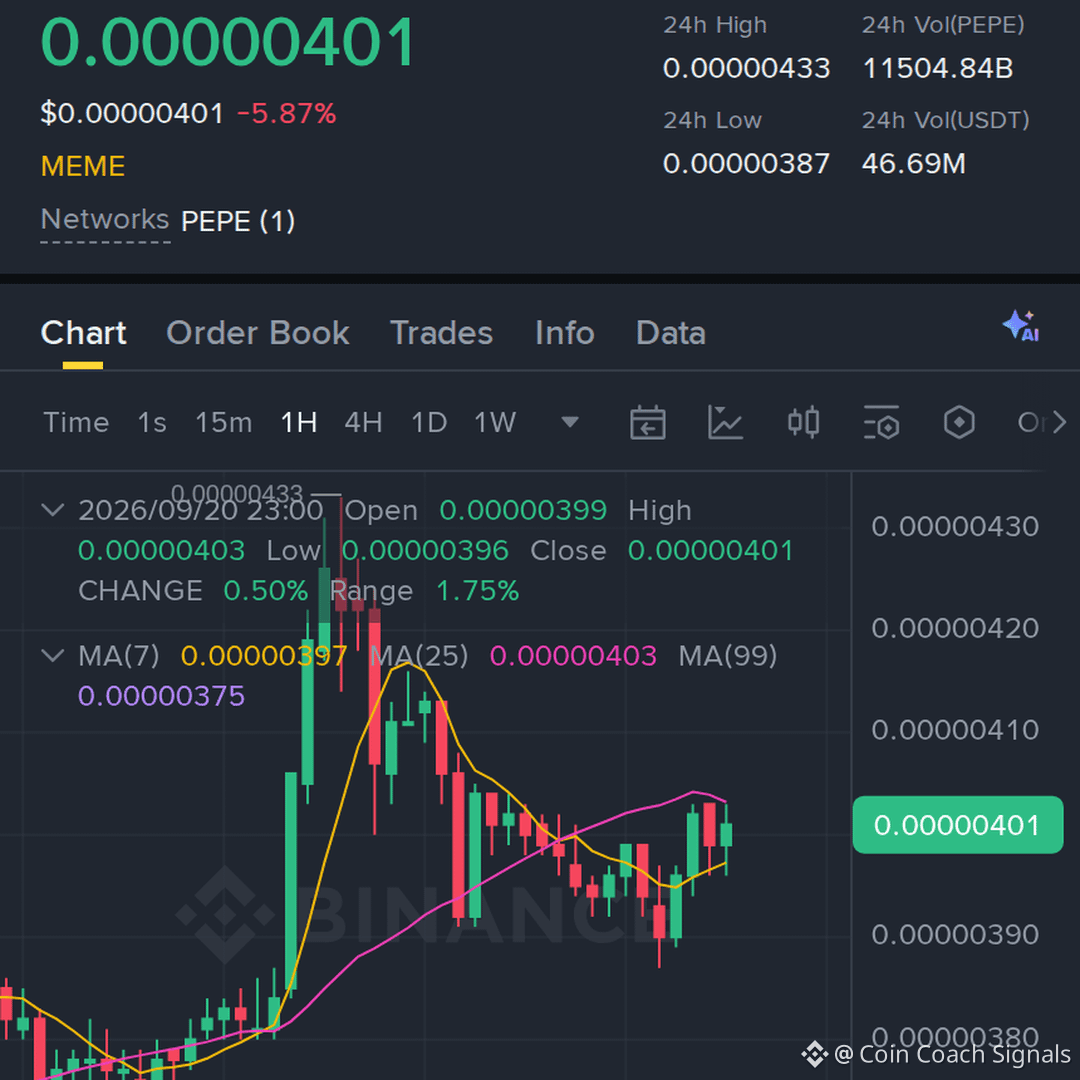
keeping watch here, $PEPE is finding buyers again around the pullback zone, with this one around 31x
Entry: 0.00000398–0.000004
TP1: 0.00000413 | TP2: 0.00000425 | TP3: 0.00000439
Stop Loss: 0.00000385
#PEPE #crypto #Write2Earn #binance
keeping watch here, $PEPE is finding buyers again around the pullback zone, with this one around 31x
Entry: 0.00000398–0.000004
TP1: 0.00000413 | TP2: 0.00000425 | TP3: 0.00000439
Stop Loss: 0.00000385
#PEPE #crypto #Write2Earn #binance
Entry: 0.00000398–0.000004
TP1: 0.00000413 | TP2: 0.00000425 | TP3: 0.00000439
Stop Loss: 0.00000385
#PEPE #crypto #Write2Earn #binance
97
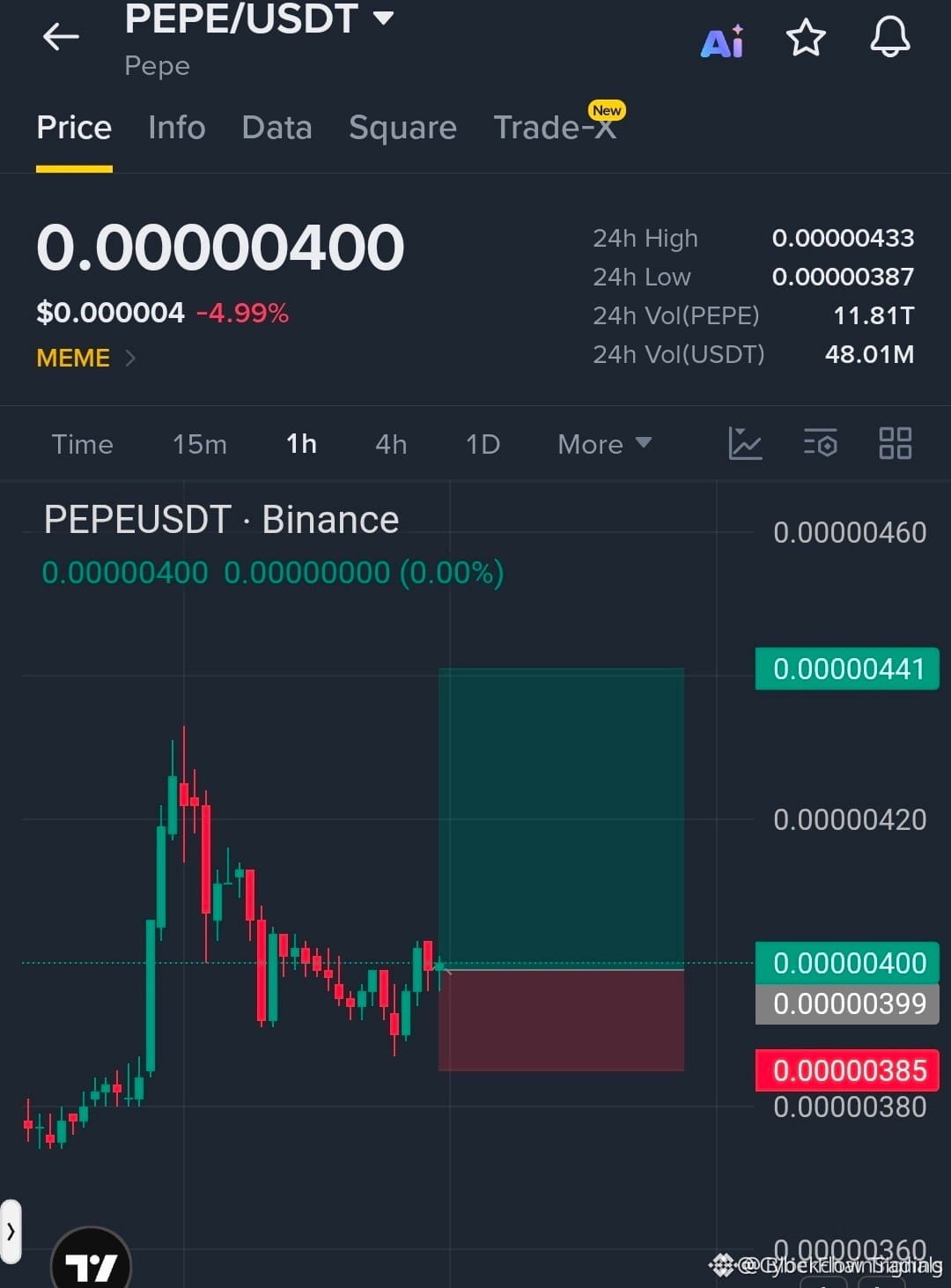
⚡ $PEPE BUILDS SOLID ACCUMULATION FLOOR BEFORE PREPARING FOR EXPLOSIVE LEGS HIGHER 💥
Entry: 0.00000399 - 0.00000401 ⚡
Target: 0.00000410 / 0.00000425 / 0.00000441 🚀
Stop Loss: 0.00000385 ⚠️
📌 Buyers are establishing a clean structural base right around the 0.00000400 handle, actively absorbing selling pressure with each retest. 📊 Order flow indicates clear supply exhaustion as bids stack up to flip this zone into launchpad support.
⚡ Defending the 0.00000399 level keeps the bullish market structure fully intact for momentum to expand into upper liquidity targets. 💬 Is this base foundation solid enough for your bid, or are you waiting for expansion volume? 👇
⚠️ Not financial advice. Always manage your risk. 🛡️
🏷️ #PEPE #LongSetup #Crypto #Breakout #Memecoin
🔥 💎
⚡ $PEPE BUILDS SOLID ACCUMULATION FLOOR BEFORE PREPARING FOR EXPLOSIVE LEGS HIGHER 💥
Entry: 0.00000399 - 0.00000401 ⚡
Target: 0.00000410 / 0.00000425 / 0.00000441 🚀
Stop Loss: 0.00000385 ⚠️
📌 Buyers are establishing a clean structural base right around the 0.00000400 handle, actively absorbing selling pressure with each retest. 📊 Order flow indicates clear supply exhaustion as bids stack up to flip this zone into launchpad support.
⚡ Defending the 0.00000399 level keeps the bullish market structure fully intact for momentum to expand into upper liquidity targets. 💬 Is this base foundation solid enough for your bid, or are you waiting for expansion volume? 👇
⚠️ Not financial advice. Always manage your risk. 🛡️
🏷️ #PEPE #LongSetup #Crypto #Breakout #Memecoin
🔥 💎
Entry: 0.00000399 - 0.00000401 ⚡
Target: 0.00000410 / 0.00000425 / 0.00000441 🚀
Stop Loss: 0.00000385 ⚠️
📌 Buyers are establishing a clean structural base right around the 0.00000400 handle, actively absorbing selling pressure with each retest. 📊 Order flow indicates clear supply exhaustion as bids stack up to flip this zone into launchpad support.
⚡ Defending the 0.00000399 level keeps the bullish market structure fully intact for momentum to expand into upper liquidity targets. 💬 Is this base foundation solid enough for your bid, or are you waiting for expansion volume? 👇
⚠️ Not financial advice. Always manage your risk. 🛡️
🏷️ #PEPE #LongSetup #Crypto #Breakout #Memecoin
🔥 💎
39
Log in to explore more content
Join global crypto users on Binance Square
⚡️ Get latest and useful information about crypto.
💬 Trusted by the world’s largest crypto exchange.
👍 Discover real insights from verified creators.
Email / Phone number
Trending Topics
1
#EthereumSurpasses$2700
781 views
44 Discussing
2
#CanaryFilesSecondAmendmentForStakedSEIETF
2,508 views
109 Discussing
3
#SaylorHintsStrategyBitcoinBuy
2.3M views
12,758 Discussing
4
#BOJRaisesRatesTo31YearHigh
285,118 views
3,484 Discussing
5
#BuffettStepsDownAsBerkshireChairman
140,149 views
1,897 Discussing
6
#XRPExchangeReservesHitSevenYearLow
154,169 views
1,659 Discussing
7
#HKCompletesFirstHKDStablecoinUseCase
167,578 views
2,007 Discussing
8
#VietnamPlansFirstCryptoLicensesIn2026
106,119 views
1,346 Discussing
9
#BTCBreaks80K
564,958 views
5,916 Discussing
10
#BitcoinMarketCapTopsTesla
141,602 views
1,461 Discussing