
#moneysupply
moneysupply
11,586 views
103 Discussing
Hot
Latest

·
--
According to the latest official macroeconomic data released by China, China’s broad money supply (M2) year-on-year growth rate fell to 7.5% in August, down further from the previous 7.7% and also slightly below the market’s general expectation of 7.6%.
Against this data backdrop, the slowdown in M2 growth directly reflects that overall liquidity conditions remain relatively cautious, and the momentum for credit expansion is comparatively moderate. Despite the earlier guidance from multiple easing policies, the pace of broad money expansion has not rebounded in any clearly stronger-than-expected way, indicating that demand for funds by the real economy is currently in a relatively steady transition phase.
Looking across traditional financial markets, the cooling in money supply growth has kept investors largely on hold regarding whether further policy support—such as additional reserve requirement ratio cuts (RRR) or interest rate cuts—will be introduced. In the near term, the exchange rate and bond yields remain in a volatile consolidation range. In the capital market, trading sentiment is fairly balanced, with participants more inclined to wait for clearer signs of a recovery in fundamentals.
For the crypto sector, liquidity changes in the world’s second-largest economy have long been one of the reference indicators for observing macro-driven shifts in capital preferences. While the modest slowdown in M2 may not have triggered a sharp one-way push affecting major assets such as $BTC in the short term, the overall tightness/looseness of the capital backdrop continues to influence the direction of offshore liquidity. Going forward, the ongoing bullish-bear debate will still need to be assessed in combination with the policy steps of the world’s major central banks.
#ChinaEconomy #MoneySupply #CryptoMacro
According to the latest official macroeconomic data released by China, China’s broad money supply (M2) year-on-year growth rate fell to 7.5% in August, down further from the previous 7.7% and also slightly below the market’s general expectation of 7.6%.
Against this data backdrop, the slowdown in M2 growth directly reflects that overall liquidity conditions remain relatively cautious, and the momentum for credit expansion is comparatively moderate. Despite the earlier guidance from multiple easing policies, the pace of broad money expansion has not rebounded in any clearly stronger-than-expected way, indicating that demand for funds by the real economy is currently in a relatively steady transition phase.
Looking across traditional financial markets, the cooling in money supply growth has kept investors largely on hold regarding whether further policy support—such as additional reserve requirement ratio cuts (RRR) or interest rate cuts—will be introduced. In the near term, the exchange rate and bond yields remain in a volatile consolidation range. In the capital market, trading sentiment is fairly balanced, with participants more inclined to wait for clearer signs of a recovery in fundamentals.
For the crypto sector, liquidity changes in the world’s second-largest economy have long been one of the reference indicators for observing macro-driven shifts in capital preferences. While the modest slowdown in M2 may not have triggered a sharp one-way push affecting major assets such as $BTC in the short term, the overall tightness/looseness of the capital backdrop continues to influence the direction of offshore liquidity. Going forward, the ongoing bullish-bear debate will still need to be assessed in combination with the policy steps of the world’s major central banks.
#ChinaEconomy #MoneySupply #CryptoMacro
Against this data backdrop, the slowdown in M2 growth directly reflects that overall liquidity conditions remain relatively cautious, and the momentum for credit expansion is comparatively moderate. Despite the earlier guidance from multiple easing policies, the pace of broad money expansion has not rebounded in any clearly stronger-than-expected way, indicating that demand for funds by the real economy is currently in a relatively steady transition phase.
Looking across traditional financial markets, the cooling in money supply growth has kept investors largely on hold regarding whether further policy support—such as additional reserve requirement ratio cuts (RRR) or interest rate cuts—will be introduced. In the near term, the exchange rate and bond yields remain in a volatile consolidation range. In the capital market, trading sentiment is fairly balanced, with participants more inclined to wait for clearer signs of a recovery in fundamentals.
For the crypto sector, liquidity changes in the world’s second-largest economy have long been one of the reference indicators for observing macro-driven shifts in capital preferences. While the modest slowdown in M2 may not have triggered a sharp one-way push affecting major assets such as $BTC in the short term, the overall tightness/looseness of the capital backdrop continues to influence the direction of offshore liquidity. Going forward, the ongoing bullish-bear debate will still need to be assessed in combination with the policy steps of the world’s major central banks.
#ChinaEconomy #MoneySupply #CryptoMacro
34

·
--
The People’s Bank of China (PBOC) has just released money supply growth data: M2 rose 7.5% in August year-on-year. This actual figure is below analysts’ forecast of 7.6% and continues to cool versus the 7.7% recorded in the previous month.
The data shows that the pace of liquidity expansion in the world’s second-largest economy is still under significant pressure as it tightens. Weaker borrowing demand from both the corporate sector and households reflects prolonged cautious sentiment, and also poses a major challenge to Beijing’s economic recovery goals in the second half of the year.
For global financial markets, the slowdown in China’s M2 reinforces expectations that the PBOC will need to roll out additional fiscal stimulus packages soon and loosen monetary policy more aggressively. This could put downward pressure on the Chinese yuan, while basic commodities markets face risks from less-than-optimistic consumption.
Specifically for the crypto market, the deceleration of domestic liquidity growth in China in the short term may limit inflows of new speculative capital. Even so, expectations of upcoming interest-rate cuts or liquidity injections from the PBOC remain potential catalysts to support $BTC and other risk assets when funds seek shelter channels.
#ChinaEconomy #MoneySupply #MacroEconomics
The People’s Bank of China (PBOC) has just released money supply growth data: M2 rose 7.5% in August year-on-year. This actual figure is below analysts’ forecast of 7.6% and continues to cool versus the 7.7% recorded in the previous month.
The data shows that the pace of liquidity expansion in the world’s second-largest economy is still under significant pressure as it tightens. Weaker borrowing demand from both the corporate sector and households reflects prolonged cautious sentiment, and also poses a major challenge to Beijing’s economic recovery goals in the second half of the year.
For global financial markets, the slowdown in China’s M2 reinforces expectations that the PBOC will need to roll out additional fiscal stimulus packages soon and loosen monetary policy more aggressively. This could put downward pressure on the Chinese yuan, while basic commodities markets face risks from less-than-optimistic consumption.
Specifically for the crypto market, the deceleration of domestic liquidity growth in China in the short term may limit inflows of new speculative capital. Even so, expectations of upcoming interest-rate cuts or liquidity injections from the PBOC remain potential catalysts to support $BTC and other risk assets when funds seek shelter channels.
#ChinaEconomy #MoneySupply #MacroEconomics
The data shows that the pace of liquidity expansion in the world’s second-largest economy is still under significant pressure as it tightens. Weaker borrowing demand from both the corporate sector and households reflects prolonged cautious sentiment, and also poses a major challenge to Beijing’s economic recovery goals in the second half of the year.
For global financial markets, the slowdown in China’s M2 reinforces expectations that the PBOC will need to roll out additional fiscal stimulus packages soon and loosen monetary policy more aggressively. This could put downward pressure on the Chinese yuan, while basic commodities markets face risks from less-than-optimistic consumption.
Specifically for the crypto market, the deceleration of domestic liquidity growth in China in the short term may limit inflows of new speculative capital. Even so, expectations of upcoming interest-rate cuts or liquidity injections from the PBOC remain potential catalysts to support $BTC and other risk assets when funds seek shelter channels.
#ChinaEconomy #MoneySupply #MacroEconomics
67

$NFP AND $POND SET TO BENEFIT FROM LIQUIDITY INFLUX 🔥
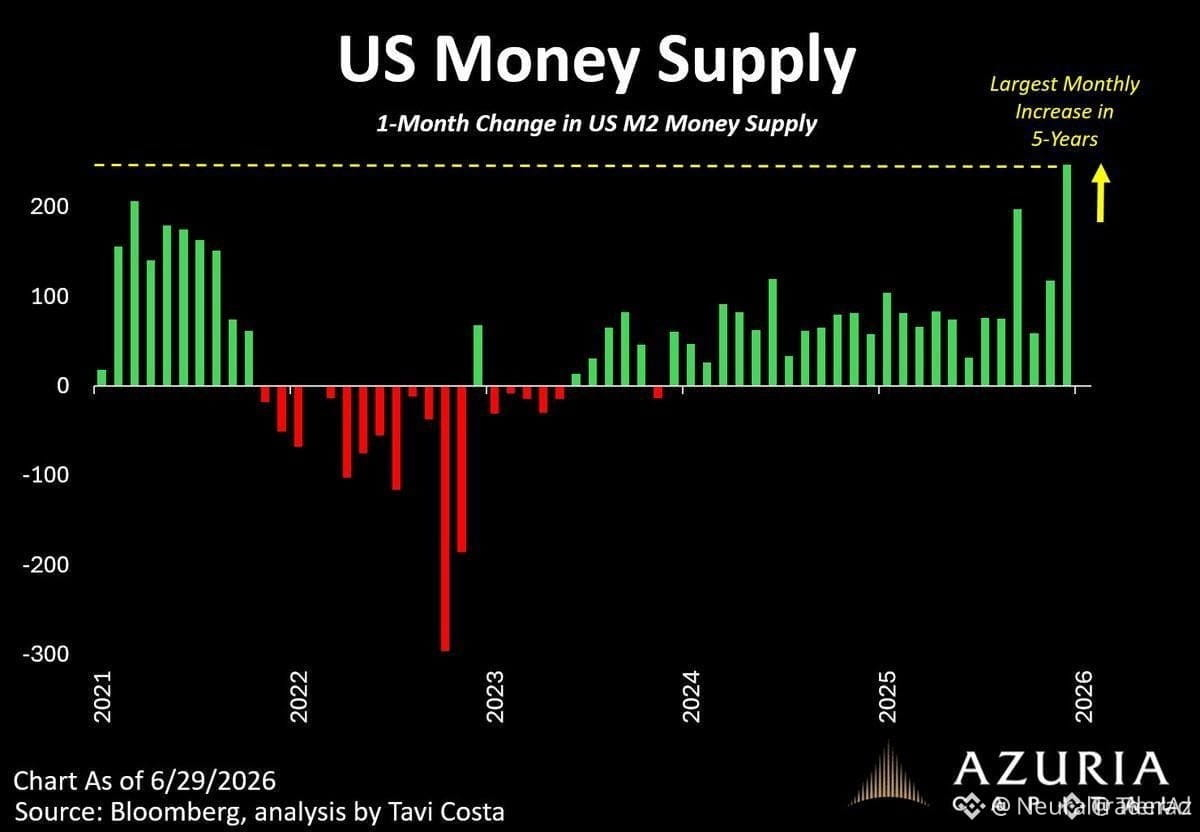
The US money supply is expanding at its fastest pace in five years—this typically flows into risk assets weeks later. The last time we saw this kind of velocity, $BTC rallied 40% in two months.
Two narratives are forming: liquidity-driven upside if inflation stays contained, or renewed macro headwinds if the Fed reverses course. Either way, structure suggests a volatility expansion is imminent for small caps like $NFP and $POND .
Where do you see the next liquidity pool forming?
Not financial advice. Always manage your risk.
#NFP #POND #MoneySupply #Liquidity #Crypto
🔥
$NFP AND $POND SET TO BENEFIT FROM LIQUIDITY INFLUX 🔥
The US money supply is expanding at its fastest pace in five years—this typically flows into risk assets weeks later. The last time we saw this kind of velocity, $BTC rallied 40% in two months.
Two narratives are forming: liquidity-driven upside if inflation stays contained, or renewed macro headwinds if the Fed reverses course. Either way, structure suggests a volatility expansion is imminent for small caps like $NFP and $POND .
Where do you see the next liquidity pool forming?
Not financial advice. Always manage your risk.
#NFP #POND #MoneySupply #Liquidity #Crypto
🔥
The US money supply is expanding at its fastest pace in five years—this typically flows into risk assets weeks later. The last time we saw this kind of velocity, $BTC rallied 40% in two months.
Two narratives are forming: liquidity-driven upside if inflation stays contained, or renewed macro headwinds if the Fed reverses course. Either way, structure suggests a volatility expansion is imminent for small caps like $NFP and $POND .
Where do you see the next liquidity pool forming?
Not financial advice. Always manage your risk.
#NFP #POND #MoneySupply #Liquidity #Crypto
🔥
292
Log in to explore more content
Join global crypto users on Binance Square
⚡️ Get latest and useful information about crypto.
💬 Trusted by the world’s largest crypto exchange.
👍 Discover real insights from verified creators.
Email / Phone number
Trending Topics
1
#FedRateWatch
831,466 views
3,933 Discussing
2
#BitcoinFalls4%
2,051 views
144 Discussing
3
#SKHynixInTalksToMakeMemoryChipsInUS
27 views
15 Discussing
4
#OpenAIDiscussesNewFundingAt$1.2TValuation
297 views
22 Discussing
5
#ArgentinaCommitsToOECDCryptoReportingBy2029
6,393 views
205 Discussing
6
#EthereumFallsBelow$2400
3,560 views
78 Discussing
7
#USDTLaunchesOnZamaPrivacyProtocol
2,671 views
116 Discussing
8
#USSenateBlocksClarityAct
25,589 views
362 Discussing
9
#BitcoinSlidesTo$76000
36,714 views
162 Discussing
10
#BitcoinReboundsTo$79K
67,743 views
437 Discussing