
#hkbillproposeshk
hkbillproposeshk
509 views
26 Discussing
Hot
Latest

everyone thinks the new hk bill is just more bullish news for crypto in asia, but actually it's drawing a line a lot of rwa traders are about to walk right over.
i've watched people ape tokenization plays off a headline and then sit through a slow bleed because they never checked what the bill actually says. that's how you lose money in a fear market, buying the narrative and never knowing when to get out.
hong kong wants to exclude tokenized deposits from the virtual assets definition. a bank can issue deposits on-chain and it stays a bank product, not a crypto product. $BTC and $ETH don't get that treatment. ngl this is a tradfi carve-out dressed up as a crypto headline, and with everyone already in extreme fear it's easy to see why people are grabbing at it like it's a catalyst.
if you were hoping hk would blur deposits and crypto into one big tokenization trade, this goes the other way. $USDT stays firmly in the virtual asset bucket while tokenized bank deposits get their own lane with different rules. two games, two winners. mixing them up is how bags get stuck.
anyone else actually reading the bill ser or are we just trading the headline again?
#HKBillProposesHK #HKBillWouldExcludeTokenizedDepositsFromVirtualAssets

110

·
--
Here's what happened when Hong Kong quietly proposed excluding tokenized deposits from virtual assets and most traders kept scrolling.
Plenty of people still treat every on-chain dollar as the same product. That habit is how you end up holding something with none of the protections you thought you had.
The bill would carve tokenized bank deposits out of Hong Kong's virtual asset definition entirely. A token that looks and trades like $USDT or $USDC could legally sit closer to a traditional deposit than to crypto under licensed virtual asset rules. Different issuer duties. Different custody. A different outcome if the structure fails. In a market already sitting in extreme fear, that is the kind of detail people skip until they need it.
This is a classification story, not a price story. Classification decides who you can actually recover from when something breaks. Two assets can look identical on-chain and leave you with completely different rights. $BTC doesn't change that. The wrapper does.
Where do you think this goes from here for tokenized products versus actual virtual assets?
#HKBillProposesHK #HKBillWouldExcludeTokenizedDepositsFromVirtualAssets
88
Have you noticed how the Hong Kong bill on tokenized deposits is being framed as a crypto crackdown when it is actually the opposite?
Traders keep getting wrecked by regulatory headlines they never fully read. You see the word exclude, dump $BTC, and only later realize the policy was never aimed at you.
Hong Kong is carving tokenized bank deposits out of the virtual asset definition. That is a case study, not a warning shot. A deposit that happens to live on a blockchain stays a bank product under this bill, not something lumped in with $ETH.
Banks stay banks. Crypto stays crypto. The crowd treating this as Hong Kong walking away from digital assets is reading a filing as a funeral.
This is what legal clarity looks like when a real financial center does it. Institutions can tokenize deposits without triggering VASP rules while the actual crypto market keeps its own regime. $USDT rails in Asia need that split more than they need another panic dump in extreme fear.
Where do you think this leaves Hong Kong as a crypto hub from here?
#HKBillWouldExcludeTokenizedDepositsFromVirtualAssets #HKBillProposesHK #BTCReboundsAbove
Have you noticed how the Hong Kong bill on tokenized deposits is being framed as a crypto crackdown when it is actually the opposite?
Traders keep getting wrecked by regulatory headlines they never fully read. You see the word exclude, dump $BTC , and only later realize the policy was never aimed at you.
Hong Kong is carving tokenized bank deposits out of the virtual asset definition. That is a case study, not a warning shot. A deposit that happens to live on a blockchain stays a bank product under this bill, not something lumped in with $ETH .
Banks stay banks. Crypto stays crypto. The crowd treating this as Hong Kong walking away from digital assets is reading a filing as a funeral.
This is what legal clarity looks like when a real financial center does it. Institutions can tokenize deposits without triggering VASP rules while the actual crypto market keeps its own regime. $USDT rails in Asia need that split more than they need another panic dump in extreme fear.
Where do you think this leaves Hong Kong as a crypto hub from here?
#HKBillWouldExcludeTokenizedDepositsFromVirtualAssets #HKBillProposesHK #BTCReboundsAbove
46
·
--
If you're still treating every tokenized asset like $BTC or $ETH, stop now.
This kind of mix-up has cost traders real money when regulations shift overnight and they don't know which holdings get hit or protected.
Hong Kong's latest bill would pull tokenized deposits out of the virtual assets definition entirely. They stay under banking rules instead of crypto ones. That's a big distinction in a market already sitting in extreme fear.
On one side, supporters say it gives banks room to tokenize without jumping through crypto licensing hoops, which could speed up real adoption. Critics worry it just creates two classes of similar looking tokens and leaves room for confusion or loopholes.
I land on the first camp. Tokenized deposits are claims on a bank, not permissionless speculation. Lumping them with $USDC or $ETH would freeze innovation in TradFi. This actually looks like a practical step, not a crackdown.
Do you see this as smart regulation or just more fragmentation for the space?
#HKBillWouldExcludeTokenizedDepositsFromVirtualAssets #HKBillProposesHK
If you're still treating every tokenized asset like $BTC or $ETH , stop now.
This kind of mix-up has cost traders real money when regulations shift overnight and they don't know which holdings get hit or protected.
Hong Kong's latest bill would pull tokenized deposits out of the virtual assets definition entirely. They stay under banking rules instead of crypto ones. That's a big distinction in a market already sitting in extreme fear.
On one side, supporters say it gives banks room to tokenize without jumping through crypto licensing hoops, which could speed up real adoption. Critics worry it just creates two classes of similar looking tokens and leaves room for confusion or loopholes.
I land on the first camp. Tokenized deposits are claims on a bank, not permissionless speculation. Lumping them with $USDC or $ETH would freeze innovation in TradFi. This actually looks like a practical step, not a crackdown.
Do you see this as smart regulation or just more fragmentation for the space?
#HKBillWouldExcludeTokenizedDepositsFromVirtualAssets #HKBillProposesHK
30

·
--
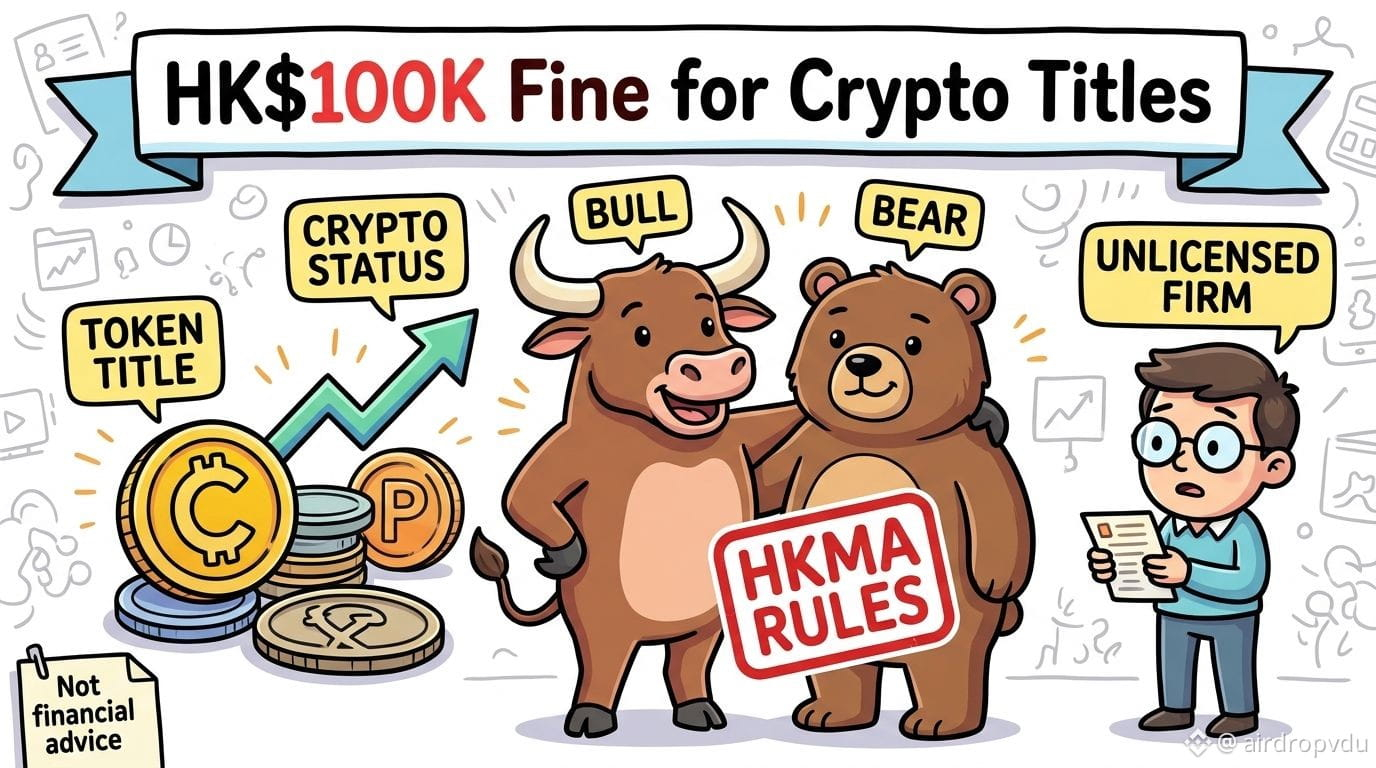
🚨 BREAKING: HK$100K FINE PROPOSED for unauthorized crypto titles
Hong Kong's new bill proposes a HK$100,000 fine for unauthorized crypto titles.
3,056 views across Square are already tracking the regulatory crackdown.
Will this clean up the market or push projects offshore?
Not financial advice. DYOR.
#HKBillProposesHK$100KFineForUnauthorizedCryptoTitles
Hong Kong's new bill proposes a HK$100,000 fine for unauthorized crypto titles.
3,056 views across Square are already tracking the regulatory crackdown.
Will this clean up the market or push projects offshore?
Not financial advice. DYOR.
#HKBillProposesHK$100KFineForUnauthorizedCryptoTitles
112

·
--
#HKBillProposesHK$100KFineForUnauthorizedCryptoTitles
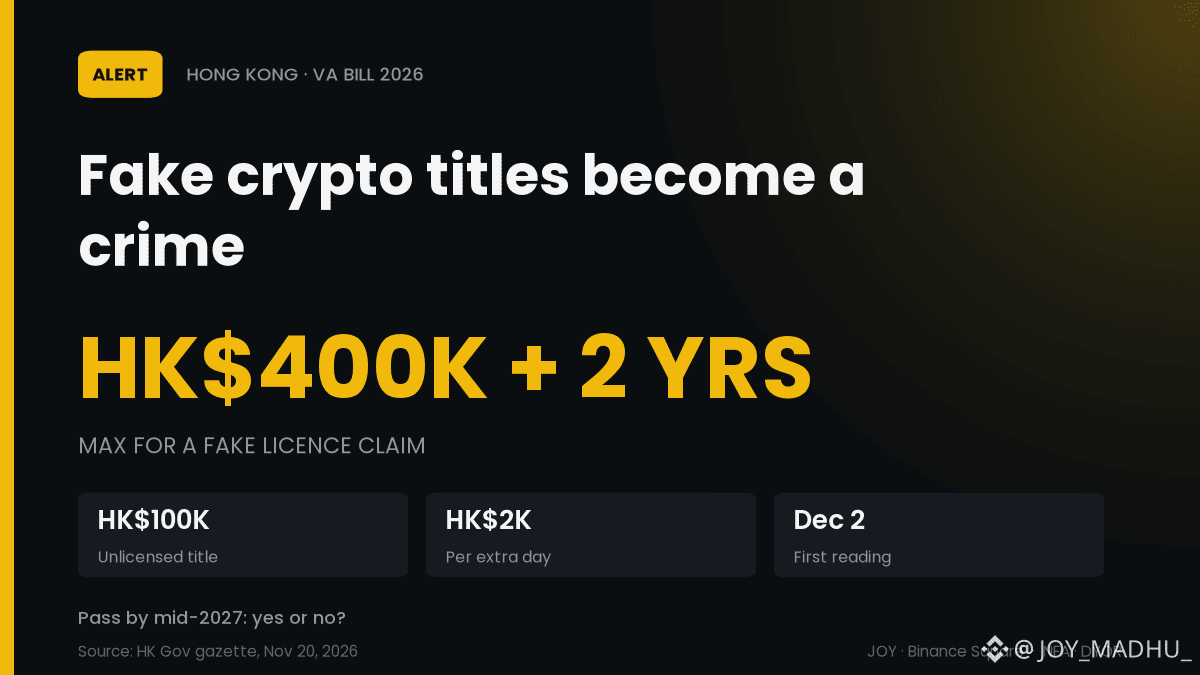
🚫 Fake "Crypto Dealer" Title in Hong Kong? HK$100K Fine
A bill gazetted Nov 20 makes fake crypto titles and fake licence claims a crime.
⚠️ Fake licence-applicant claim: up to HK$400K + 2 years' jail
📊 Unlicensed "crypto dealer" type titles: HK$100K + HK$2K a day
🏦 Dealing, advice, management, custody all need SFC licences
📅 First reading in LegCo on Dec 2; not law yet
My read: easier scam-spotting for users, real compliance costs for small advisers.
Will it pass LegCo by mid-2027, yes or no? 👇
#HongKong #CryptoRegulation #HKBillProposesHK$100KFineForUnauthorizedCryptoTitles
4
If you're still treating every on-chain product in Hong Kong as the same crypto trade, stop now.
That classification error is how traders lose money when the rules change faster than their positions. People pile in on FOMO then get surprised when a bill redraws the entire map.
Hong Kong's bill proposes excluding tokenized deposits from virtual assets altogether. One camp sees this as the mature move. Banks get to tokenize deposits without crypto-level licensing, which could actually bring more real-world assets on-chain. The other camp sees a two-tier system where $BTC and $ETH stay tightly regulated while tokenized HKD deposits skate by. In extreme fear, with $USDT still dominating stable flows, that split could pull cautious capital away from crypto and into bank-backed tokens.
I think the exclusion is correct. A deposit sitting on a blockchain is still a deposit. It is not $ETH and it should not be treated like one. Blurring those lines is what created the last round of ugly surprises.
Where do you think this leaves actual crypto in Hong Kong from here?
#HKBillProposesHK #HKBillWouldExcludeTokenizedDepositsFromVirtualAssets #CanBTCReboundAfterFallingBelow60K
77
·
--
Hong Kong is about to legally treat a tokenized bank deposit as something other than a virtual asset, even when it sits on the same chain as your $ETH.
Most traders still lump anything on-chain into one bucket, and that is how you get wrecked. You think you bought crypto exposure and instead you get bank credit risk plus a recovery process that has nothing to do with smart contracts.
The proposed bill would carve tokenized deposits out of Hong Kong's virtual asset rules. Looks like a footnote. It is not. You will have products that show up in the same wallet as $USDT but live on a bank's balance sheet. If that bank stumbles, you are a depositor, not a token holder with on-chain claims. Real virtual assets like $BTC stay under the existing licensing and custody overlay. Two things that look identical on a screen. Two totally different outcomes when stress hits.
This drops into a market already sitting in extreme fear. Regulatory forks like this are how people panic-sell names that have nothing to do with Hong Kong deposits, just because they saw token and bill in the same headline.
Where do you think this leaves tokenized deposits versus actual crypto from here?
#HKBillProposesHK #HKBillWouldExcludeTokenizedDepositsFromVirtualAssets
Hong Kong is about to legally treat a tokenized bank deposit as something other than a virtual asset, even when it sits on the same chain as your $ETH .
Most traders still lump anything on-chain into one bucket, and that is how you get wrecked. You think you bought crypto exposure and instead you get bank credit risk plus a recovery process that has nothing to do with smart contracts.
The proposed bill would carve tokenized deposits out of Hong Kong's virtual asset rules. Looks like a footnote. It is not. You will have products that show up in the same wallet as $USDT but live on a bank's balance sheet. If that bank stumbles, you are a depositor, not a token holder with on-chain claims. Real virtual assets like $BTC stay under the existing licensing and custody overlay. Two things that look identical on a screen. Two totally different outcomes when stress hits.
This drops into a market already sitting in extreme fear. Regulatory forks like this are how people panic-sell names that have nothing to do with Hong Kong deposits, just because they saw token and bill in the same headline.
Where do you think this leaves tokenized deposits versus actual crypto from here?
#HKBillProposesHK #HKBillWouldExcludeTokenizedDepositsFromVirtualAssets
89
Have you noticed how Hong Kong just drew a sharp line between real tokenized money and everything else crypto calls an asset?
Traders keep getting wrecked chasing RWA narratives without realizing a single bill can reclassify what even counts as a virtual asset. In this Extreme Fear market that kind of regulatory surprise is how people miss the real shift and lose money on the wrong tokens.
Hong Kong's move to exclude tokenized deposits from virtual assets is a textbook case of a jurisdiction protecting its banks while still looking crypto-friendly. Banks can tokenize deposits, keep them under traditional rules, and skip the heavy virtual asset regime that hits $USDT issuers and $ETH based protocols. The result is two tracks: one for actual money that stays in TradFi control, and one for speculative crypto that remains tightly regulated.
This is not the open tokenization revolution most people are pricing in. It is a controlled experiment. While $BTC sits in fear and everyone hunts the next pump, this bill shows governments want the efficiency of tokens without handing the rails to DeFi.
Where do you think this leaves the whole on-chain deposit narrative from here?
#HKBillWouldExcludeTokenizedDepositsFromVirtualAssets #HKBillProposesHK #CanBTCReboundAfterFallingBelow60K
89
·
--
If you're still treating tokenized deposits the same as any other crypto token, stop now.
This mix-up is costing traders because they cannot tell when an asset is actually backed by a bank versus when it is just another speculative play. In a market already sitting in extreme fear, that kind of mistake leads to missed exits and wrong entries.
Hong Kong is moving a bill that would exclude tokenized deposits from virtual assets. One side says this is smart, letting banks bring deposits on-chain without the full crypto regulatory load. Those tokens could function like a more trusted version of $USDT.
The other side claims it waters down crypto by giving TradFi a free pass while $BTC and $ETH stay under the microscope. I am with the first group. This looks like Hong Kong positioning itself to attract real money at a time when fear is this high.
It might actually help the whole space mature instead of staying in the wild west.
Does this regulatory split make you more bullish on tokenized assets or more cautious about $BTC from here?
#HKBillWouldExcludeTokenizedDepositsFromVirtualAssets #HKBillProposesHK #CanBTCReboundAfterFallingBelow60K
71

·
--
Article
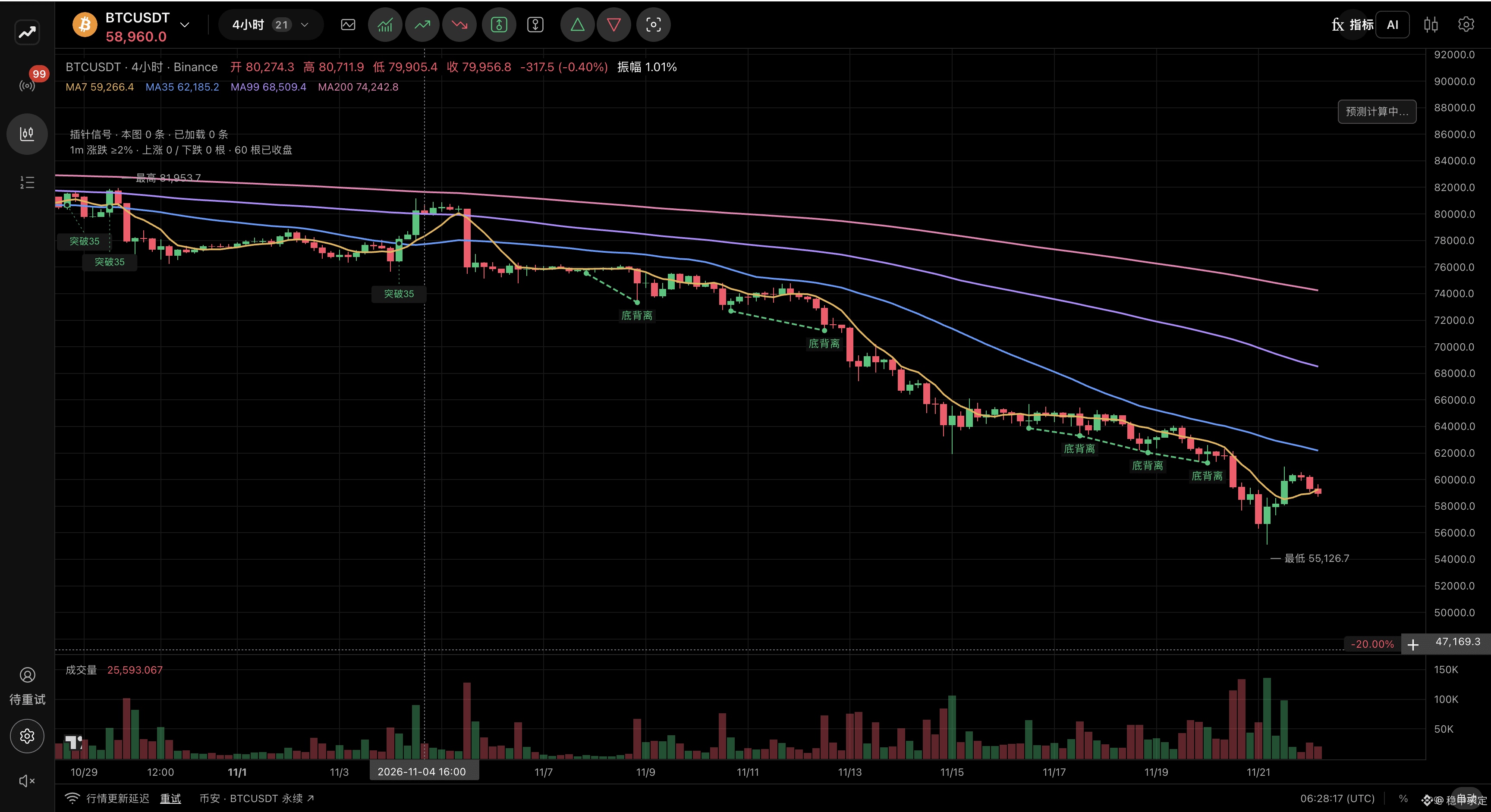
Hong Kong Bill Proposes Fines for “Fake Crypto Titles”: BTC Rebound Doesn’t Mean Regulatory Tailwinds Have Materialized# Hong Kong Bill Proposes Fines for “Fake Crypto Titles”: BTC Rebound Doesn’t Mean Regulatory Tailwinds Have Materialized
The #HKBillProposesHK$100KFineForUnauthorizedCryptoTitles topic on Binance Square’s current trending list shows 29 people discussing it. As of 14:26 Beijing time on November 22, what’s really worth paying attention to isn’t the word “fine,” but that Hong Kong is moving the compliance boundary for virtual asset services from “whether you have a license” to “whether you can describe yourself this way.”
The Hong Kong SAR Government announced the Virtual Asset Services Legislation (Amendment) Bill 2026 on November 20. The bill proposes bringing virtual asset trading, advisory, management, and custody services within the SFC’s licensing or registration regime. Banks and licensed stored value facility operators that provide related services in Hong Kong will also have to register with the SFC. The government has arranged for the bill to receive its first reading in the Legislative Council on December 2.
Hong Kong Bill Proposes Fines for “Fake Crypto Titles”: BTC Rebound Doesn’t Mean Regulatory Tailwinds Have Materialized
# Hong Kong Bill Proposes Fines for “Fake Crypto Titles”: BTC Rebound Doesn’t Mean Regulatory Tailwinds Have Materialized
The #HKBillProposesHK$100KFineForUnauthorizedCryptoTitles topic on Binance Square’s current trending list shows 29 people discussing it. As of 14:26 Beijing time on November 22, what’s really worth paying attention to isn’t the word “fine,” but that Hong Kong is moving the compliance boundary for virtual asset services from “whether you have a license” to “whether you can describe yourself this way.”
The Hong Kong SAR Government announced the Virtual Asset Services Legislation (Amendment) Bill 2026 on November 20. The bill proposes bringing virtual asset trading, advisory, management, and custody services within the SFC’s licensing or registration regime. Banks and licensed stored value facility operators that provide related services in Hong Kong will also have to register with the SFC. The government has arranged for the bill to receive its first reading in the Legislative Council on December 2.
205
Log in to explore more content
Join global crypto users on Binance Square
⚡️ Get latest and useful information about crypto.
💬 Trusted by the world’s largest crypto exchange.
👍 Discover real insights from verified creators.
Email / Phone number
Trending Topics
1
#Bitcoin'sReboundFadesBelow$60K
5,169 views
133 Discussing
2
#NVIDIAReinstatesJensenHuangasCEO
241,904 views
1,676 Discussing
3
#WillMarketsStageAThanksgivingReliefRally?
322,163 views
2,433 Discussing
4
#WillOctCorePCEShiftFedHikeExpectations?
113,673 views
1,178 Discussing
5
#EvolveAtBinanceBlockchainWeek
232,883 views
1,489 Discussing
6
#SouthKoreaBeginsCryptoProviderShareholderReviews
3,641 views
110 Discussing
7
#USAddsMegaspeedToEntityList
8,668 views
181 Discussing
8
#GrayscaleLaunches2xLeveragedZcashETF
5,827 views
121 Discussing
9
#StrategyValueFallsBelowItsBitcoinHoldings
4,558 views
127 Discussing
10
#CFTCRequiresAtLeast20%HaircutsOnBTCAndETHReserves
2,440 views
88 Discussing