
#etfflows
etfflows
77,791 views
881 Discussing
Hot
Latest

🏦 Bitcoin ETFs Keep Bleeding While Stock ETFs Soak Up the Dip
What happened: US spot Bitcoin ETFs had lost about $1.6B in net outflows in November through Nov 10, per SoSoValue. Over the same five sessions, all 17 of the top US ETFs by inflows were equity funds. Outflows had eased for three straight sessions, but no sustained return of demand has shown up.
Why it matters now: ETF demand was a key support for BTC. With equities taking the dip-buying flows, crypto lacks a big spot bid. That helps explain why leveraged longs were so exposed this week.
What to watch next:
• Monday's ETF flow print after the weekend crash
• Whether outflows accelerate, or dip buyers return near $62K–$65K
$BTC
#BitcoinETF #ETFFlows #Bitcoin #Institutional
91

$BTC US spot ETF flows have turned net negative almost daily since early November. 📊
Data points:
Latest daily net flow: about -185M
Total net assets: about 86.2B, down from the 110B area at the peak of this window
Cumulative net inflow: still 54.6B
What it means: the cumulative number shows institutional demand hasn’t unwound. The daily trend shows the marginal buyer has stepped back. Those are two different signals, and mixing them up is how traders get chopped.
What to watch: whether daily flows stabilize near zero or keep printing outflows. Persistent outflows usually mean less passive support under price, so volatility risk stays elevated.
Execution angle: in a market like this, a single large entry is the riskiest way to participate. Staged DCA entries with defined size per tranche handle uncertainty better than one big order. Backtest the spacing first.
See which strategy fits this market condition...
#BTC #ETFFlows #BinanceSquare
78

A fresh flow datapoint, not a price verdict: Farside Investors reported $185.4M in net U.S. spot-Bitcoin ETF outflows for Nov. 13. IBIT accounted for $143.5M and FBTC $41.9M; the other listed funds recorded zero. https://x.com/FarsideUK/status/2121464251562836324
TokenPost independently reported the same daily total and said the outflow streak reached seven consecutive trading sessions: https://www.tokenpost.com/news/investing/57209
ETF flows capture creations and redemptions, not why each holder moved. Even a multi-session streak does not establish what BTC does next. Which would you watch next: whether the streak breaks or how withdrawals are split across funds?
Conclusion: ETF flows are one demand indicator, not a BTC forecast. $BTC Official Binance Spot chart: https://www.binance.com/en/trade/BTC_USDT?type=spot. Check the chart for yourself, do your own research, and trade responsibly. #Bitcoin #BTC #ETFFlows #InstitutionalFlows

52

·
--
🚨 INSTITUTIONS ARE BLEEDING CAPITAL OUT OF $BTC WHILE TRADITIONAL STOCKS SURGE 📉
While traditional equities just vacuumed up thirty-seven billion in fresh capital, spot crypto vehicles took a heavy fourteen hundred million hit over five sessions. $BTC bore the brunt with over a billion walking out the door, showing that institutional desks are playing strict defense for now. 📊
True market momentum will only validate once a price bounce aligns with actual net inflows returning to spot funds. Until institutional bid volume confirms the move, every recovery attempt is simply testing seller absorption at local resistance. 💡
💬 Are you positioning ahead of the ETF flows or waiting for institutional confirmation to cross the tape? 👇
⚠️ Not financial advice. Always manage your risk. 🛡️
🏷️ #BTC #Crypto #MarketDynamics #ETFFlows
🔥 💎

9

·
--
#USCryptoETFsLose$1.48BInFiveDays
$1.48B left US crypto ETFs in 5 days. Rotation into stocks? 🔍
SoSoValue (Nov 4–10): all six spot crypto ETF groups saw outflows. Bitcoin funds lost $1.06B, Ethereum $326M, and SOL/XRP/HYPE/ZEC funds $89.4M combined, while 10 major US stock ETFs drew $37.5B.
Cross-check:
• Farside: BTC ETFs shed $1.44B over five straight sessions to Nov 11, led by IBIT
• BTC ETFs are about -$1.42B YTD, versus +$25.2B a year ago
• Altcoin ETFs still hold ~$1.75B net inflows in 2026
My take: sources use different windows, so figures differ but don't conflict. "Money moved to stocks" is an inference, not stock ETF inflows are routine and far larger. This looks like risk-off demand fading, with BTC near $69K.
Watch: whether daily BTC ETF flows turn positive and IBIT's outflow streak ends.
Cause or symptom of this dip? 👇
$BTC
{future}(BTCUSDT)
$ETH
{future}(ETHUSDT)
$IBIT.ETF
{etf_us}(IBIT.ETF)
#BitcoinETF #ETFFlows #CryptoMarket
#USCryptoETFsLose$1.48BInFiveDays
$1.48B left US crypto ETFs in 5 days. Rotation into stocks? 🔍
SoSoValue (Nov 4–10): all six spot crypto ETF groups saw outflows. Bitcoin funds lost $1.06B, Ethereum $326M, and SOL/XRP/HYPE/ZEC funds $89.4M combined, while 10 major US stock ETFs drew $37.5B.
Cross-check:
• Farside: BTC ETFs shed $1.44B over five straight sessions to Nov 11, led by IBIT
• BTC ETFs are about -$1.42B YTD, versus +$25.2B a year ago
• Altcoin ETFs still hold ~$1.75B net inflows in 2026
My take: sources use different windows, so figures differ but don't conflict. "Money moved to stocks" is an inference, not stock ETF inflows are routine and far larger. This looks like risk-off demand fading, with BTC near $69K.
Watch: whether daily BTC ETF flows turn positive and IBIT's outflow streak ends.
Cause or symptom of this dip? 👇
$BTC
$ETH
$IBIT.ETF
#BitcoinETF #ETFFlows #CryptoMarket

56

·
--
$BTC | US spot Bitcoin ETFs posted a US$47.7 million net outflow on 12 November 2026, led by BITB and ARKB, not IBIT or FBTC. On the desk I check which issuer moved before trusting a headline total. The smaller of the eleven tracked funds carry thin books, so two mid-tier redemptions can print net negative while IBIT sits flat. IBIT has pulled in over US$60 billion since its January 2024 launch against GBTC's roughly US$28 billion bled out, a rotation SatoshiMacro's flow tracker calls the largest in ETF history. My read: that US$47.7 million tells an AUD investor on Independent Reserve or CoinSpot far less than the same print from IBIT or FBTC, which correlate near 0.85. One day proves no trend.
https://satoshimacro.com/tools/crypto/etf-flows/daily-spot-etf-flows/?utm_source=binance_square&utm_medium=social&utm_campaign=autopilot_short-1
#SatoshiMacro #BitcoinETF #ETFFlows #Bitcoin
https://satoshimacro.com/tools/crypto/etf-flows/daily-spot-etf-flows/?utm_source=binance_square&utm_medium=social&utm_campaign=autopilot_short-1
#SatoshiMacro #BitcoinETF #ETFFlows #Bitcoin
79

·
--
Jane Street Nearly Quintuples Its Fidelity BTC ETF Holdings While Trimming IBIT: Institutions Reallocate Between Leading ETFs
Institutional capital is actively being reallocated among Bitcoin ETFs. According to Cointelegraph, market maker Jane Street nearly quintuplied its holdings of Fidelity’s Bitcoin ETF by the end of the third quarter, while reducing its position in BlackRock’s IBIT by 19% from the end of Q3.
The contrast between these increases and decreases is worth noting. At first glance, IBIT’s holdings may appear to have risen in value due to the share price increase, leading some to misread this as accumulation. But the actual number of shares held declined. Jane Street’s increased position in Fidelity and reduced position in IBIT reflect a redistribution of allocations among leading BTC ETFs by a major institution—not a simple overall increase or decrease in Bitcoin demand.
Why does this matter? Competition in the BTC ETF market is shifting from “growth through new inflows” to “a battle over existing assets.” The diversion of capital and competition for market share among leading products are becoming deeper signals behind ETF flows. A major portfolio adjustment by a single institution often indicates an active choice made after professional investors evaluate factors such as fees, liquidity, and market depth.
The data show that Jane Street cut its IBIT holdings by 19% in Q3, while increasing its Fidelity holdings nearly fivefold—a significant difference in scale. This suggests the adjustment was not a simple, like-for-like swap, but a clear rebalancing toward a larger position in Fidelity.
How might the market react? For IBIT, institutional selling could create short-term sentiment pressure. If the outflow of shares continues, it could affect the fund’s leading position among top products. But for the broader BTC market, this kind of “one door closes, another opens” reallocation is not necessarily a bearish signal.
There are counterarguments too: a single institutional portfolio adjustment does not necessarily indicate an industry-wide trend. The original report’s figures are also somewhat vague, and the data methodology is uncertain. It will be important to see whether subsequent holdings disclosures confirm this direction.
What should we watch next? If you’re following $IBIT, it may be more useful from a trading perspective to wait and see whether share outflows persist and whether trading volume and funding rates weaken in tandem, rather than reacting emotionally to a single quarter’s figures. More data points are needed to confirm the signal from institutional reallocation.
$IBIT #BitcoinETF #ETFFlows
The above is a summary of information and personal analysis, and does not constitute investment advice.
Follow me for ongoing coverage of key market developments and data.
43

·
--
Bullish
📉 $BTC
{future}(BTCUSDT)
ETF UPDATE
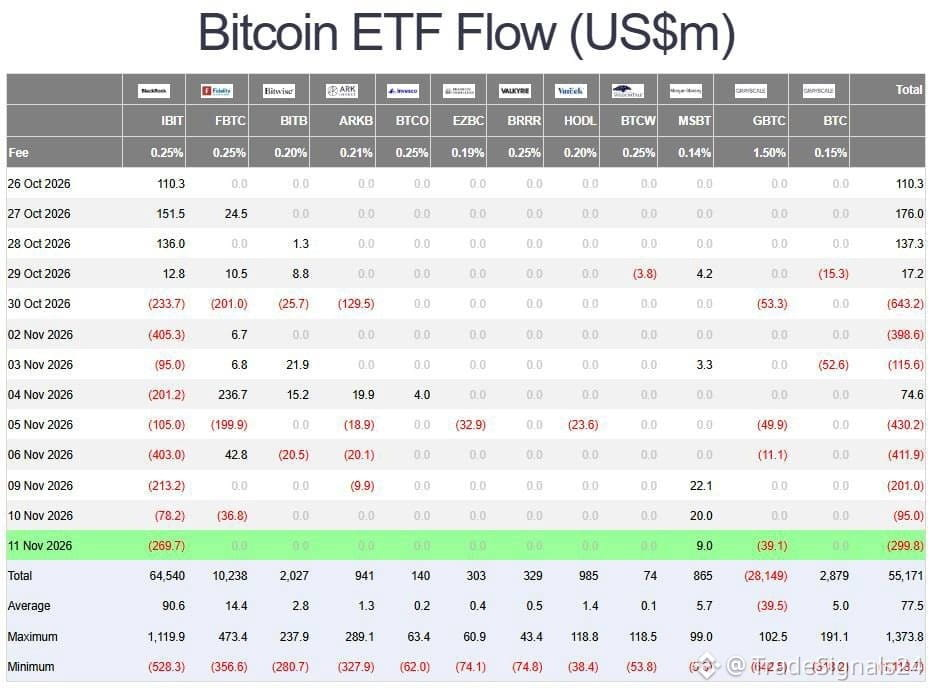
Spot Bitcoin ETFs saw $299.8M in net outflows on November 11.
🔻 BlackRock's IBIT: -$269.7M
🔻 Grayscale's GBTC: -$39.1M
🟢 Morgan Stanley's MSBT: +$9M
ETF outflows are still heavy.
#BTC #Bitcoin #BitcoinETF #ETFFlows
📉 $BTC
ETF UPDATE
Spot Bitcoin ETFs saw $299.8M in net outflows on November 11.
🔻 BlackRock's IBIT: -$269.7M
🔻 Grayscale's GBTC: -$39.1M
🟢 Morgan Stanley's MSBT: +$9M
ETF outflows are still heavy.
#BTC #Bitcoin #BitcoinETF #ETFFlows
ETF UPDATE
Spot Bitcoin ETFs saw $299.8M in net outflows on November 11.
🔻 BlackRock's IBIT: -$269.7M
🔻 Grayscale's GBTC: -$39.1M
🟢 Morgan Stanley's MSBT: +$9M
ETF outflows are still heavy.
#BTC #Bitcoin #BitcoinETF #ETFFlows
43
·
--
Jane Street Nearly 8x Its Fidelity Bitcoin ETF Holdings While Cutting IBIT, as Institutions Reallocate Between ETFs
Market maker Jane Street’s Q3 holdings disclosure offers a clear window into how institutions are shifting allocations between Bitcoin ETFs.
According to Cointelegraph, by the end of the third quarter, Jane Street had reduced its holdings of BlackRock’s Bitcoin ETF (IBIT) by 19%, while increasing its holdings of Fidelity’s Bitcoin ETF to nearly eight times their previous level. It’s worth noting that some of the decline in IBIT holdings may be due to the share price rising and increasing the value of each share, rather than being purely the result of selling. Still, the relative change in overall positions is worth watching.
Why this matters is that it reflects a market maker reallocating between similar assets, rather than simply money flowing in or out. As the largest Bitcoin ETF, changes in IBIT’s holdings are often seen as one indicator of institutional allocation preferences. Jane Street’s appearance on the lists of firms increasing Fidelity holdings and reducing IBIT holdings suggests that capital may be shifting from the leading product to other offerings.
The data show a contrast between the two figures: nearly eightfold growth on the Fidelity side and a 19% reduction on the IBIT side. But keep in mind that the decline in IBIT holdings does not necessarily mean net outflows—a rising share price can increase the market value of the holdings, creating the appearance of a reduction in the figures. Therefore, rebalancing by a single market maker is not enough to determine the overall direction of capital flows.
To assess how the market may react, it’s important to distinguish short-term sentiment from medium-term trends. A decline in IBIT holdings could signal pressure on its short-term fund flow data, but the actions of one market maker do not necessarily reflect the direction of net inflows or outflows across the entire Bitcoin ETF sector.
One counterpoint is that a single market maker’s rebalancing represents too small a sample, and price effects may have influenced the decline in IBIT holdings. Confirming a trend requires looking at full-week ETF net inflow and outflow data as a whole to avoid overinterpreting the figures.
What to watch next: from a trading perspective, it’s more important to wait for market confirmation. If you’re watching $IBIT, it’s more useful in the short term to look for corresponding changes in trading volume and funding rates than to draw conclusions based solely on one market maker’s holdings.
$IBIT #BitcoinETF #ETFFlows
The above is a compilation of information and personal analysis, and does not constitute investment advice.
Follow me for ongoing coverage of key market developments and data.
IBITETF-6.48%
3

·
--
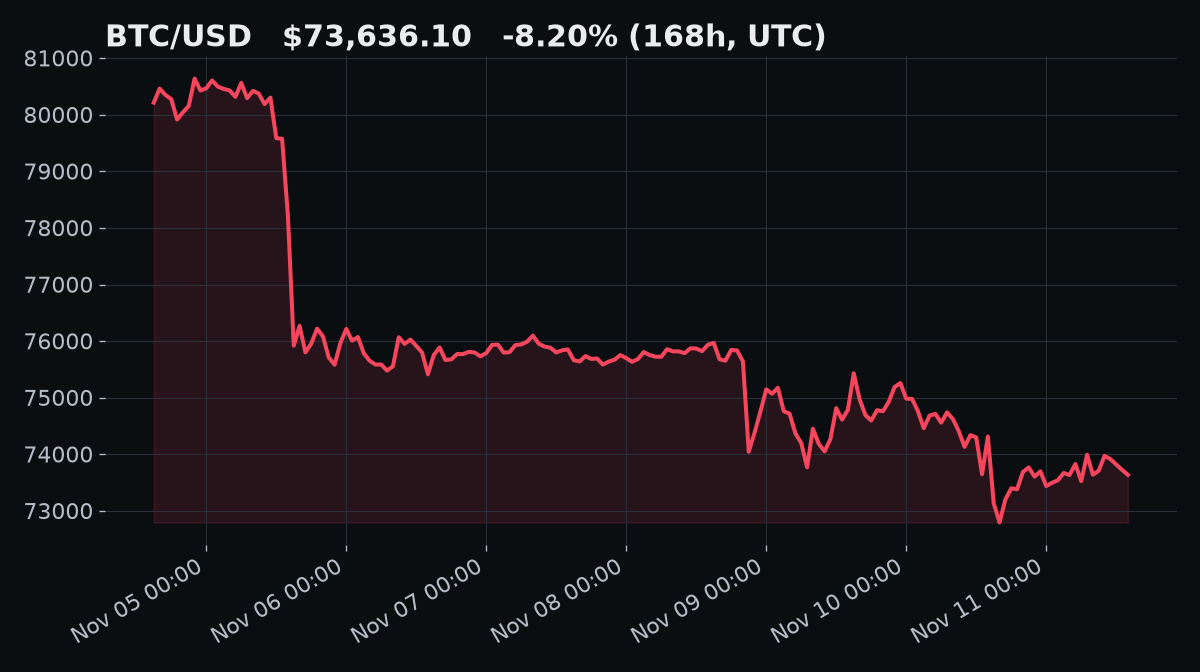
Bitcoin's sellers are tiring, but the buyers haven't shown up yet.
US spot ETF net outflows, daily (SoSoValue):
Thu: $430M
Fri: $412M
Mon: $201M
Tue: $95M, a fourth straight outflow day
Meanwhile (CryptoQuant): USDT supply is down $6.6B in 60 days, the biggest 60-day drop in its data since 2022, and the Coinbase Premium has been negative 30 days running.
$BTC sits at $73,636 after -8.2% over 7 days, right on the 200-day average (~$73,200). My read: slower selling stops the bleeding, but a recovery needs fresh stablecoin money. Reclaiming the 365-day average (~$76,400) would be the first sign. Not financial advice.
Disclosure: Write to Earn may pay me a commission on cashtag trades.
#Bitcoin #ETFFlows
1

🦈 INSTITUTIONAL CAPITAL EVAPORATES AS $BTC LEADS $103M ACROSS-THE-BOARD ETF WITHDRAWALS! 📉
Smart money is adjusting its risk parameters as spot vehicle redemptions peak, with $BTC taking the heavy blow of $95 million in net outflows. 📊
While total withdrawals hit $103.94 million across $BTC , $ETH , and $XRP , institutional footprint analysis shows this is routine portfolio rebalancing rather than a structural breakdown of trend support. 💡
Monitoring subsequent sessions will reveal if traditional market participants resume accumulation or extend distribution. 💬 Are you reading this single-session liquidity flush as a dip-buying window or a warning sign? 👇
⚠️ Not financial advice. Always manage your risk. 🛡️
🏷️ #BTC #ETFFlows #Crypto #MarketStructure
🦈 🌊

💠 ETH’s institutional picture — two fresh data points:
1️⃣ ETH ETFs: third consecutive day of outflows — total of 184.5M (CoinMarketCap)
2️⃣ BitMine (ETH treasury company): reported a fiscal 2026 net loss of 6.3B — impact of the ETH price slide (Cointelegraph)
Spot ETH is around 2,070, up 1% in 24 hours — the price is slightly in the green, but flows are still in exit mode.
This kind of divergence is common around bottoms: the price stabilizes first, and flows follow later. If ETH holds above 2,010, this divergence becomes meaningful. 📏
$ETH
#Ethereum #ETFFlows #CryptoMarkets
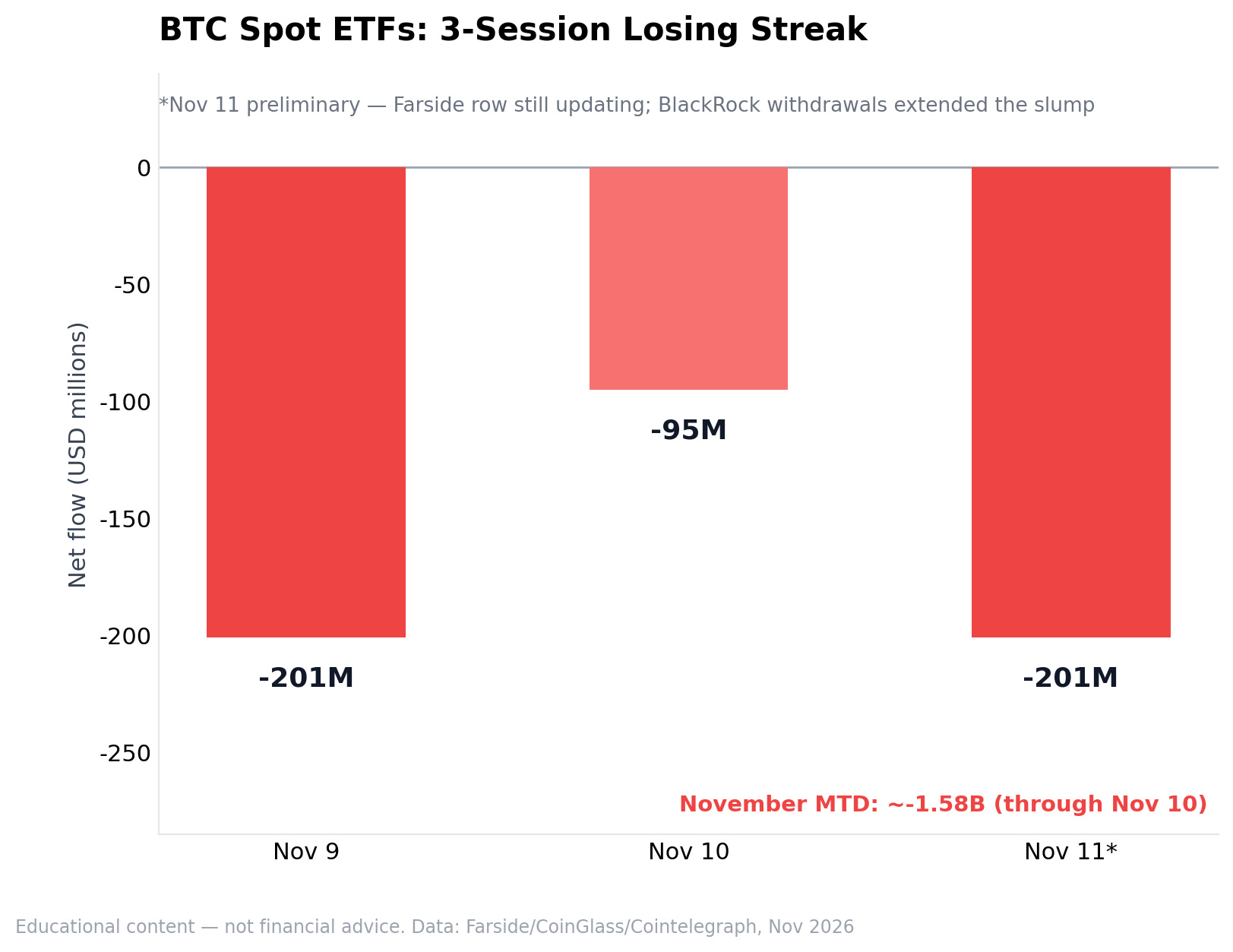
📊 Bitcoin ETFs’ losing streak has now reached 3 sessions.
Farside’s numbers:
1️⃣ Nov 9: -201M net outflow
2️⃣ Nov 10: -95M (completed row)
3️⃣ Nov 11: ~-201M (preliminary) — BlackRock withdrawals extended the slump
November month-to-date now stands at ~1.58B in outflows — the biggest supply pressure this month.
All three days at a glance in the chart. The directional message is clear: institutions aren’t yet becoming consistent buyers. 🧭
$BTC
#BitcoinETF #ETFFlows #CryptoMarkets
52
·
--
$ETH has three signals pointing different ways today. Here's how I read them:
1. Fund money is leaving. U.S. spot ether ETFs lost $184.6M on Monday (Farside Investors).
2. Options traders are leaning the other way. The most-traded ETH contract is the $2,600 call expiring Dec. 25, though puts still carry about an 11% skew premium over one week (CoinDesk).
3. Derivatives got hurt. ETH liquidations hit $505M in 24 hours, more than BTC's $318M (CoinGlass via Coin Edition).
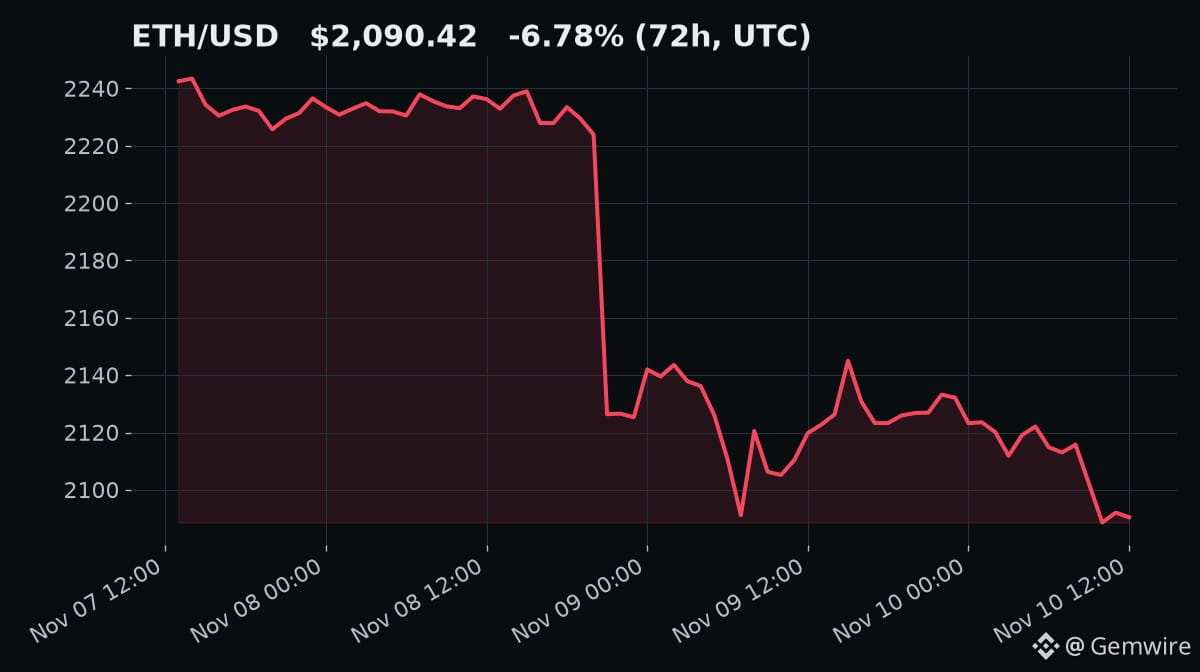
The chart shows ETH about 6.8% lower over 72 hours, near $2,090.
My take: ETF selling is a slow tide, while call buying is a bet on a bounce. Both can be true until the CPI print at 13:30 UTC shows which one is louder. Watch whether ETF outflows slow before price reclaims the recent range.
Which signal do you trust more, flows or options? Not financial advice.
Disclosure: Write to Earn may pay me a commission on cashtag trades.
#ETH #ETFFlows #CPI
2

·
--
Spot Bitcoin ETFs just had their worst week since June, and 2026 flows are now in the red.
• US spot BTC ETFs saw about $1.28B in net outflows last week, the most since late June
• Year-to-date 2026 flows flipped to roughly $914M in net outflows
• Four of five trading days were negative
Why it matters: ETF flows are a widely watched gauge of institutional demand, and that demand turned negative for the year.
Source: CoinDesk
Not financial advice.
💬 Is the ETF bid fading for good, or is this a pause before year-end?
$BTC #Bitcoin #BitcoinETF #ETFflows
62

The Heavy ETF Drain That’s Deepening Crypto Caution😕
U.S. spot Bitcoin ETFs recorded $1.28 billion in net outflows, adding to the pressure already weighing on digital assets. Crypto sentiment stayed firmly cautious, with the Fear & Greed Index slipping to 28 as traders continued to reduce risk.
In contrast, traditional markets showed selective strength. The Nasdaq 100 rose 1.35%, leading a mixed session for U.S. equities and highlighting a clear divergence between resilient large-cap tech and the ongoing outflow-driven weakness in Bitcoin-related products.
$BTC $QQQB $QQQ #CoinVahini #Bitcoin #ETFFlows #CryptoSentiment
7

·
--
Nearly $2 Billion Flees Bitcoin ETFs: Where Is the Pressure Coming From?The flow of institutional capital through Bitcoin ETFs is under significant pressure amid market volatility:
Net outflows: As of early November 2026, Bitcoin ETFs had recorded net outflows of around $1.84 billion year to date. During the three sessions from October 30 to November 3, amid the Binance hack, outflows surged to $1.16 billion, with BlackRock accounting for the bulk. A further $412 million flowed out on November 6, leaving total net assets at around $95.9 billion.
Nearly $2 Billion Flees Bitcoin ETFs: Where Is the Pressure Coming From?
The flow of institutional capital through Bitcoin ETFs is under significant pressure amid market volatility:
Net outflows: As of early November 2026, Bitcoin ETFs had recorded net outflows of around $1.84 billion year to date. During the three sessions from October 30 to November 3, amid the Binance hack, outflows surged to $1.16 billion, with BlackRock accounting for the bulk. A further $412 million flowed out on November 6, leaving total net assets at around $95.9 billion.
Net outflows: As of early November 2026, Bitcoin ETFs had recorded net outflows of around $1.84 billion year to date. During the three sessions from October 30 to November 3, amid the Binance hack, outflows surged to $1.16 billion, with BlackRock accounting for the bulk. A further $412 million flowed out on November 6, leaving total net assets at around $95.9 billion.
65
·
--
Saylor is teasing another buy while ETFs bleed.
Strategy's last filing (Nov 2): 811 $BTC for $65.5M.
Sunday's chart post hints at one more.
Meanwhile US spot Bitcoin ETFs lost $1.28B last week, the worst since late June (SoSoValue).
Takeaway: one big corporate buyer is leaning in as funds lean out. Small next to the outflows, but it shows who's still accumulating near $76K.
Does Strategy's buying matter more than ETF flows right now, or is it just noise?
Not financial advice.
#Bitcoin #Strategy #BTC #ETFFlows
5
·
--
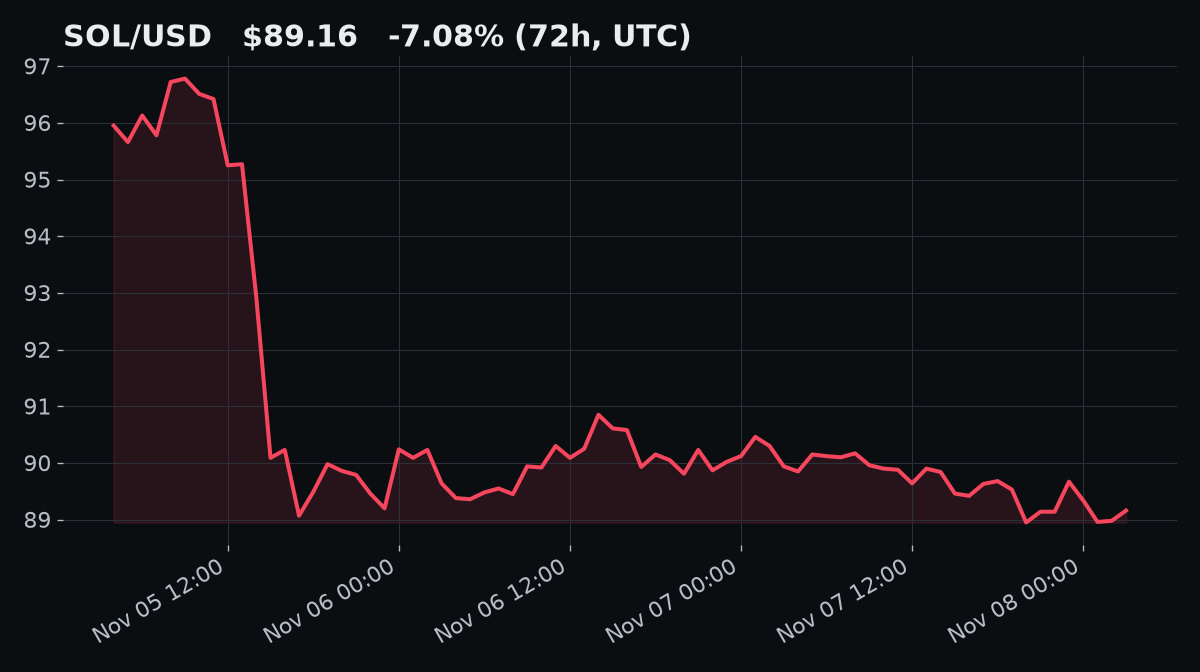
$SOL slipped under $90 and the ETF bid has vanished.
• US spot Solana ETFs: 12 straight sessions with no net inflows, ~$25M withdrawn in the latest one (KCEX News)
• SOL is -7.08% over 72h, now around $89
• RSI is rising while price makes lower lows: a bullish divergence, but unconfirmed
My take: divergence hints at seller exhaustion, yet without fresh spot demand it often just fades. Watch ETF flows turning positive and SOL reclaiming short-term moving averages.
Does $SOL hold $85 through next week, or do we see lower first?
Not financial advice.
#Solana #SOL #ETFFlows #Crypto
6
·
--
Ethereum ETFs just logged a sixth straight week of outflows. One whale is buying anyway.
• Spot ETH ETFs: $365.3M net out this week (The Block)
• Whale 0x4AB7 accumulated 13,100 ETH in one week (AiCoin)
• ETH trades near $2,232 after the Nov 5 sell-off
Institutions are trimming while a single large wallet adds. That split usually resolves when flows turn, so the next ETF print matters more than any one whale.
Who's right: the ETF sellers or the whale? Does $ETH hold $2,200 through Friday, yes or no?
Not financial advice.
#Ethereum #ETFFlows #CryptoNews $BTC
45
Log in to explore more content
Join global crypto users on Binance Square
⚡️ Get latest and useful information about crypto.
💬 Trusted by the world’s largest crypto exchange.
👍 Discover real insights from verified creators.
Email / Phone number
Trending Topics
1
#A Packed Week of Earnings and Data Tests Markets
17,493 views
162 Discussing
2
#AnthropicIPOTestsInvestorAppetiteForAI
13,351 views
334 Discussing
3
#HuangReportedlyConsidersReturnToNvidia
34,493 views
518 Discussing
4
#CryptoSelloffTriggersMultipleWhaleLiquidations
322,508 views
2,553 Discussing
5
#BitcoinSpotETFsPost$1.065BOutflowsForThirdStraightWeek
3,891 views
84 Discussing
6
#About64000BitcoinMiningMachinesReportedlyHijacked
29,290 views
351 Discussing
7
#USSpotXRPETFsSeeLargestWeeklyOutflowIn8Months
246,721 views
1,962 Discussing
8
#WillFOMCMinutesReinforceRateHikeExpectations?
93,627 views
999 Discussing
9
#BitcoinActiveSupplyInProfitDropsBelow45%
322,280 views
2,172 Discussing
10
#KavaSaysAbnormalActivityLimitedToKavaLend
212,650 views
1,221 Discussing