
#digibyte
digibyte
113,647 views
439 Discussing
Hot
Latest

$DGB join the hype!
DigiByte’s Global Time Lock Day (Global Time Lock Day) is scheduled for September 17, 2026.
What is Global Time Lock Day?
Main objective: The DigiByte community will lock DGB tokens for a specific period of time to mint the network’s native stablecoin, DigiDollar.
I’m confident in the coin, and I believe it should remain in the uptrend cycle by then. And you, what do you think about #Digibyte ?
DigiByte’s Global Time Lock Day (Global Time Lock Day) is scheduled for September 17, 2026.
What is Global Time Lock Day?
Main objective: The DigiByte community will lock DGB tokens for a specific period of time to mint the network’s native stablecoin, DigiDollar.
I’m confident in the coin, and I believe it should remain in the uptrend cycle by then. And you, what do you think about #Digibyte ?


$DGB | USD UPDATE!!! ✨
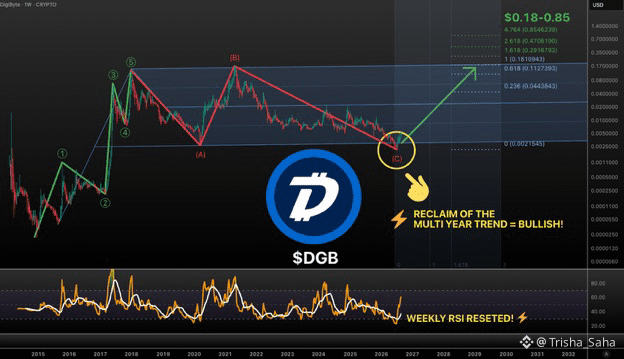
Swept the lows and reclaimed the multi-year trend!
Most likely direction is therefore up to test the upper trend at $018 🎯
If $DGB escapes to the upside the first impulse can hit up to $0.85 💪
This is strength
This is whales scooping up the dip
Are you still sidelined?
Not financial advice obviously
STAY TUNED!
#DIGIBYTE
Swept the lows and reclaimed the multi-year trend!
Most likely direction is therefore up to test the upper trend at $018 🎯
If $DGB escapes to the upside the first impulse can hit up to $0.85 💪
This is strength
This is whales scooping up the dip
Are you still sidelined?
Not financial advice obviously
STAY TUNED!
#DIGIBYTE

🚨 $DGB JUST BROKE OUT. NOW COMES THE TRAP.
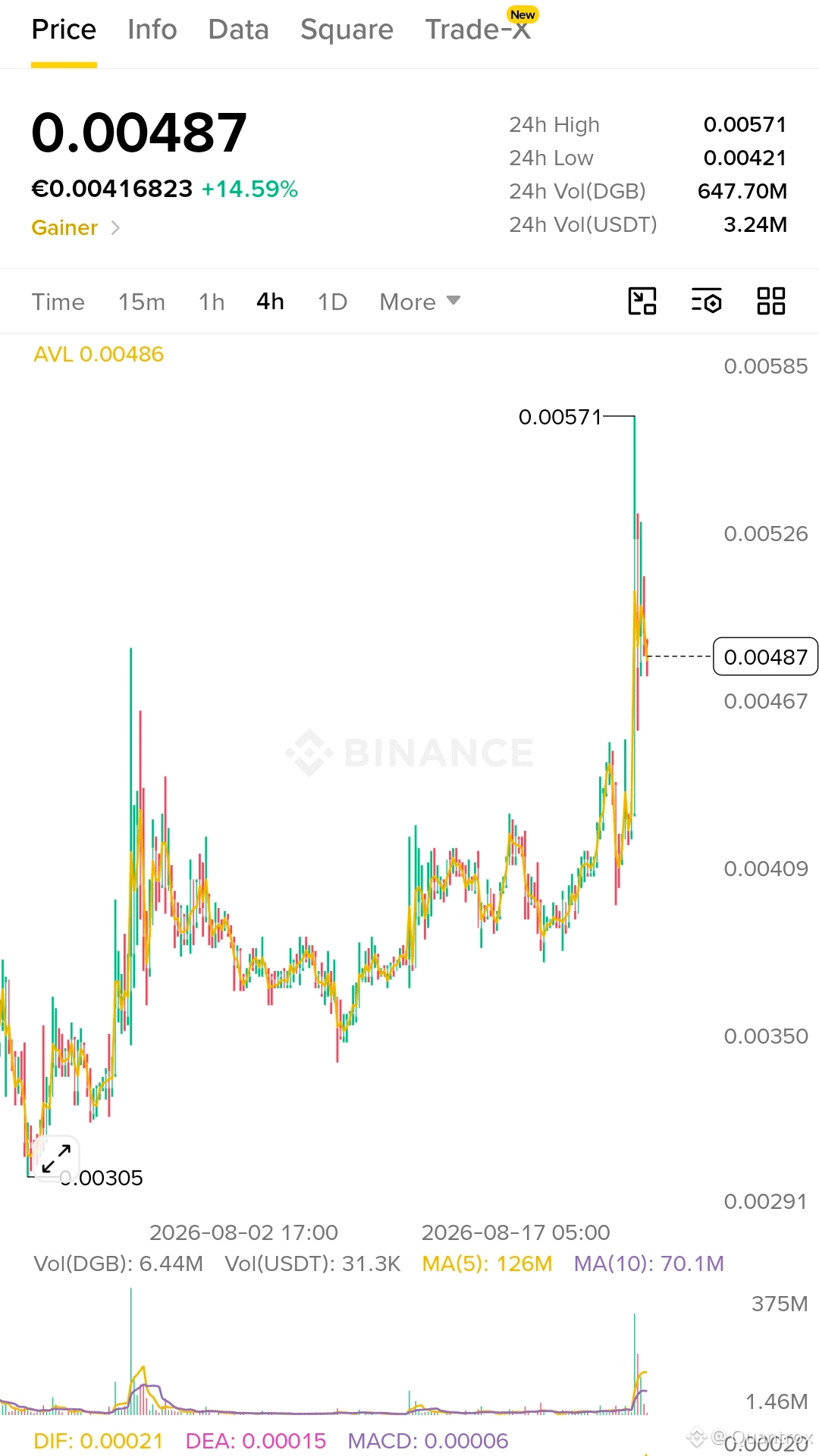
$DGB ripped 14%+ and tagged $0.00571 — new local highs. 🔥
But the next move matters more:
🔥 $0.00467 holds → $0.00571 gets tested
💀 $0.00467 breaks → $0.00409 becomes the reset zone
Momentum is still climbing.
Breakout… or the exit liquidity is loading? 👀
#DGB #DigiByte #Crypto
DYOR.
$DGB ripped 14%+ and tagged $0.00571 — new local highs. 🔥
But the next move matters more:
🔥 $0.00467 holds → $0.00571 gets tested
💀 $0.00467 breaks → $0.00409 becomes the reset zone
Momentum is still climbing.
Breakout… or the exit liquidity is loading? 👀
#DGB #DigiByte #Crypto
DYOR.

Verified
🔥 $DGB DigiByte: Old, But Still Technically Interesting
Most crypto traders know DigiByte as an “old coin.”
But age is exactly what makes DGB interesting.
🕐 Launched in January 2014
DigiByte has been running for 12+ years, built around a pure Proof-of-Work UTXO architecture. Its network uses 5 mining algorithms and targets 15-second blocks.
⚙️ The technical side matters:
• 15-second block time
• 5-algorithm PoW security
• SegWit + Bech32 support
• UTXO-based architecture
• 21B maximum DGB supply
• DigiAssets for on-chain assets
• Digi-ID for decentralized authentication
• Low-cost transactions designed for payments and applications
🚀 Use cases are broader than just payments
DigiByte can be used for: → Fast value transfers
→ Tokenized/on-chain assets through DigiAssets
→ Decentralized authentication with Digi-ID
→ Building applications on a UTXO-based blockchain
→ And now, the ecosystem has added DigiDollar, a native non-custodial stablecoin on mainnet.
⚠️ But here is the real issue:
Technology alone doesn't create adoption.
DigiByte's biggest challenge isn't whether the chain can process transactions.
It's whether the ecosystem can turn its long technical history into developers, users, liquidity and real-world applications.
That is the $DGB debate I find more interesting than simply asking:
“Can DGB pump?”
📌 My view:
DigiByte is a technically mature blockchain with a surprisingly long track record—but its future depends on whether its infrastructure can generate meaningful adoption.
Old ≠ dead.
But old ≠ automatically valuable either.
Would you use DigiByte today if adoption catches up with the technology? 👀
#DigiByte #DGB #Crypto #Altcoins #Blockchain
$HOOD
Most crypto traders know DigiByte as an “old coin.”
But age is exactly what makes DGB interesting.
🕐 Launched in January 2014
DigiByte has been running for 12+ years, built around a pure Proof-of-Work UTXO architecture. Its network uses 5 mining algorithms and targets 15-second blocks.
⚙️ The technical side matters:
• 15-second block time
• 5-algorithm PoW security
• SegWit + Bech32 support
• UTXO-based architecture
• 21B maximum DGB supply
• DigiAssets for on-chain assets
• Digi-ID for decentralized authentication
• Low-cost transactions designed for payments and applications
🚀 Use cases are broader than just payments
DigiByte can be used for: → Fast value transfers
→ Tokenized/on-chain assets through DigiAssets
→ Decentralized authentication with Digi-ID
→ Building applications on a UTXO-based blockchain
→ And now, the ecosystem has added DigiDollar, a native non-custodial stablecoin on mainnet.
⚠️ But here is the real issue:
Technology alone doesn't create adoption.
DigiByte's biggest challenge isn't whether the chain can process transactions.
It's whether the ecosystem can turn its long technical history into developers, users, liquidity and real-world applications.
That is the $DGB debate I find more interesting than simply asking:
“Can DGB pump?”
📌 My view:
DigiByte is a technically mature blockchain with a surprisingly long track record—but its future depends on whether its infrastructure can generate meaningful adoption.
Old ≠ dead.
But old ≠ automatically valuable either.
Would you use DigiByte today if adoption catches up with the technology? 👀
#DigiByte #DGB #Crypto #Altcoins #Blockchain
$HOOD

$DGB
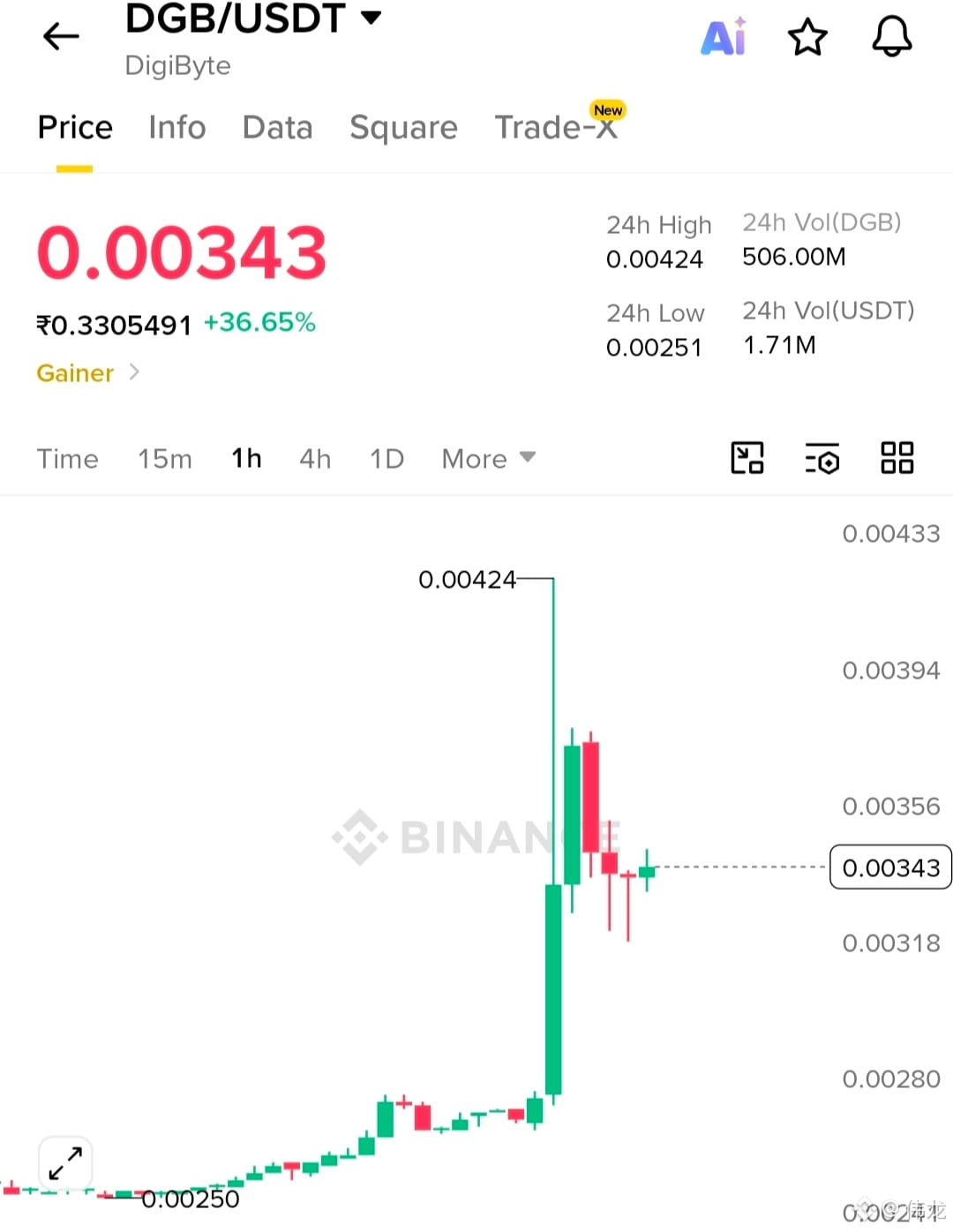
just woke up after months of silence. 👀
A 36% daily candle gets attention.
But what interests me more is that buyers are still defending the move after the initial spike.
If this consolidation holds, the next breakout could catch late sellers off guard.
I'm watching closely.
Who else has #DGB on their radar? 🚀
#DGB #DigiByte #Binance #Altcoins $AKE $BANK
just woke up after months of silence. 👀
A 36% daily candle gets attention.
But what interests me more is that buyers are still defending the move after the initial spike.
If this consolidation holds, the next breakout could catch late sellers off guard.
I'm watching closely.
Who else has #DGB on their radar? 🚀
#DGB #DigiByte #Binance #Altcoins $AKE $BANK


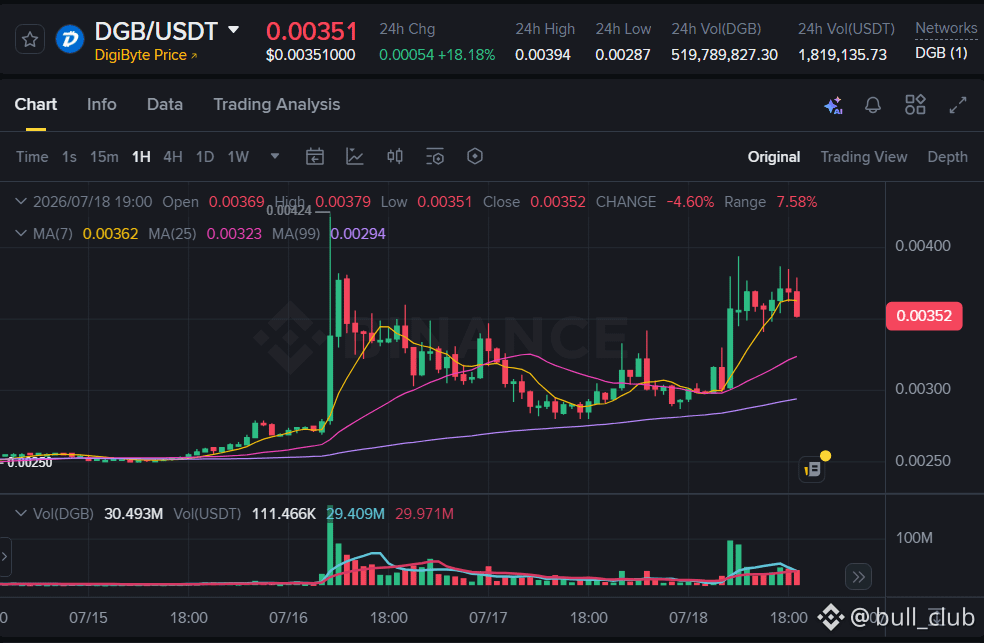
$DGB Breakout: +18% & Volume Explosion!
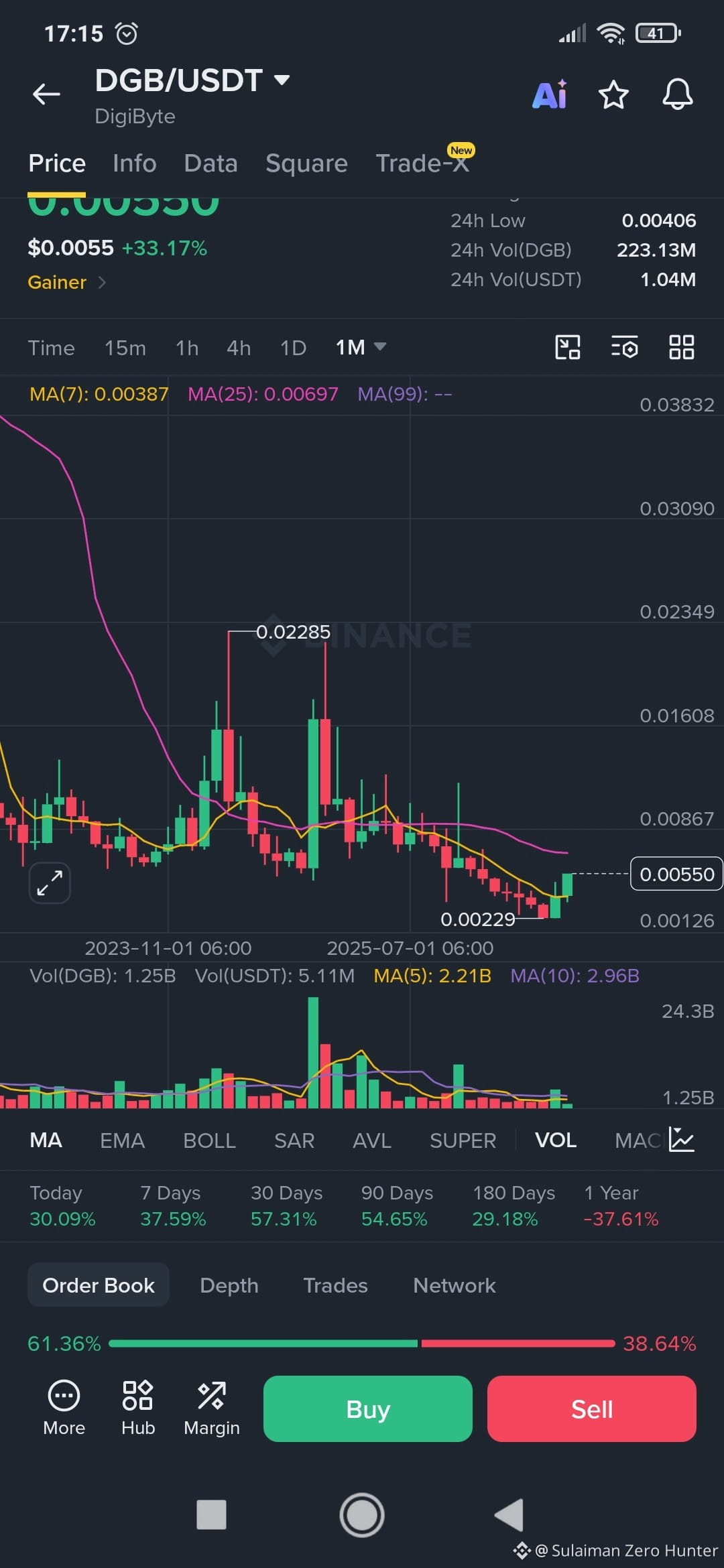
Fam, $DGB just exploded! Bounced from $0.00287 → spiked to $0.00394 with MASSIVE volume (519M tokens!). Now cooling at $0.00351!
Trade Plan:
🟢 Long dip: $0.00320–0.00330 | TP: $0.00394 / $0.00420 | SL: $0.00300
🔹 Long breakout: >$0.00395 | TP: $0.00424 / $0.00450 | SL: $0.00380
MAs stacked bullish (MA7 > MA25 > MA99). Strong uptrend intact! Don't chase!
FOMO or wait for dip? Drop below! 👇
Not financial advice. DYOR.
$DGB
#DGB #digibyte #crypto #trading
Fam, $DGB just exploded! Bounced from $0.00287 → spiked to $0.00394 with MASSIVE volume (519M tokens!). Now cooling at $0.00351!
Trade Plan:
🟢 Long dip: $0.00320–0.00330 | TP: $0.00394 / $0.00420 | SL: $0.00300
🔹 Long breakout: >$0.00395 | TP: $0.00424 / $0.00450 | SL: $0.00380
MAs stacked bullish (MA7 > MA25 > MA99). Strong uptrend intact! Don't chase!
FOMO or wait for dip? Drop below! 👇
Not financial advice. DYOR.
$DGB
#DGB #digibyte #crypto #trading


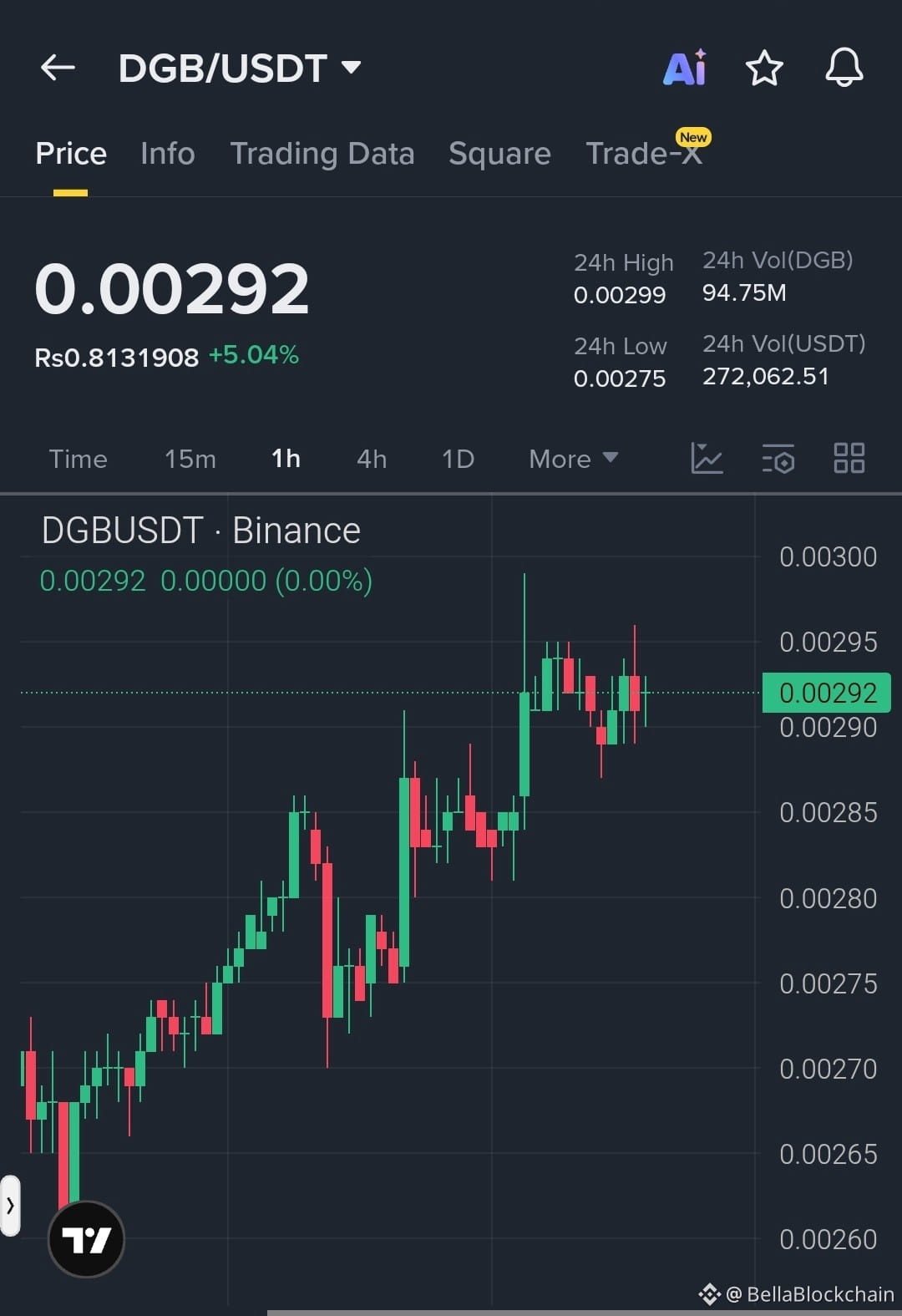
The hourly market structure shown in 1000013917.jpg demonstrates a strong bullish trend for $DGB , characterized by a series of higher highs and higher lows. The price recently surged into a consolidation range near the upper resistance level, establishing a solid baseline of support above previous local peaks. As buying pressure remains persistent and the asset holds its ground during this consolidation phase, a breakout above the immediate overhead liquidity could easily trigger a continuation toward higher technical objectives.
Target 1: 0.00310
Target 2: 0.00325
Target 3: 0.00340
#DGB #DigiByte #Altcoins
$DGB
Target 1: 0.00310
Target 2: 0.00325
Target 3: 0.00340
#DGB #DigiByte #Altcoins
$DGB

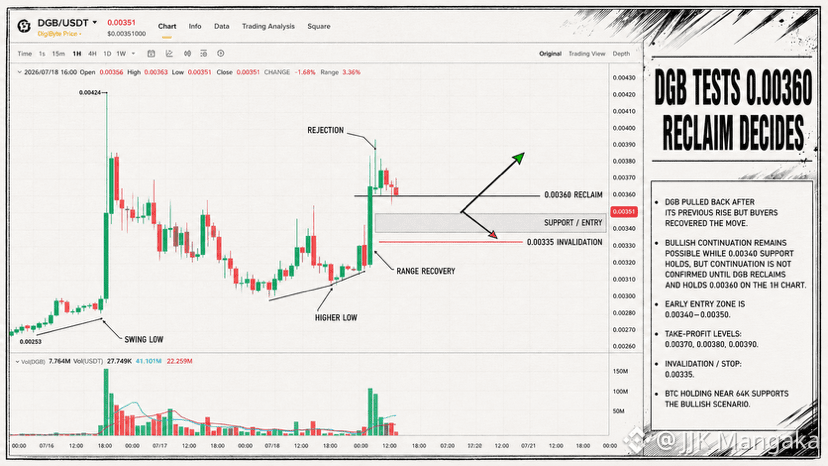
$DGB SHOULD HAVE TURNED BEARISH.
But sellers could not keep it down.
After the previous rise, $DGB should have lost its cursed energy by now. It dropped, sellers tried to bury it, then buyers pulled it straight back into the fight.
That tells me the movement may still have strength left, especially while BTC, the King of Curses, holds near $64K.
Still, 0.00360 is the gate. DGB already moved above it once but failed to hold, so I want a clear 1H reclaim before calling the continuation confirmed.
🟡 Entry Zone: 0.00340–0.00350
🎯 TP1: 0.00370
🎯 TP2: 0.00380
🎯 TP3: 0.00390
🛑 Stop Loss: 0.00335
Will DGB reclaim 0.00360, or is this rebound another trap?
By JJK Mangaka 🖋️
#DGB #digibyte #cryptotrading #BinanceSquare
But sellers could not keep it down.
After the previous rise, $DGB should have lost its cursed energy by now. It dropped, sellers tried to bury it, then buyers pulled it straight back into the fight.
That tells me the movement may still have strength left, especially while BTC, the King of Curses, holds near $64K.
Still, 0.00360 is the gate. DGB already moved above it once but failed to hold, so I want a clear 1H reclaim before calling the continuation confirmed.
🟡 Entry Zone: 0.00340–0.00350
🎯 TP1: 0.00370
🎯 TP2: 0.00380
🎯 TP3: 0.00390
🛑 Stop Loss: 0.00335
Will DGB reclaim 0.00360, or is this rebound another trap?
By JJK Mangaka 🖋️
#DGB #digibyte #cryptotrading #BinanceSquare

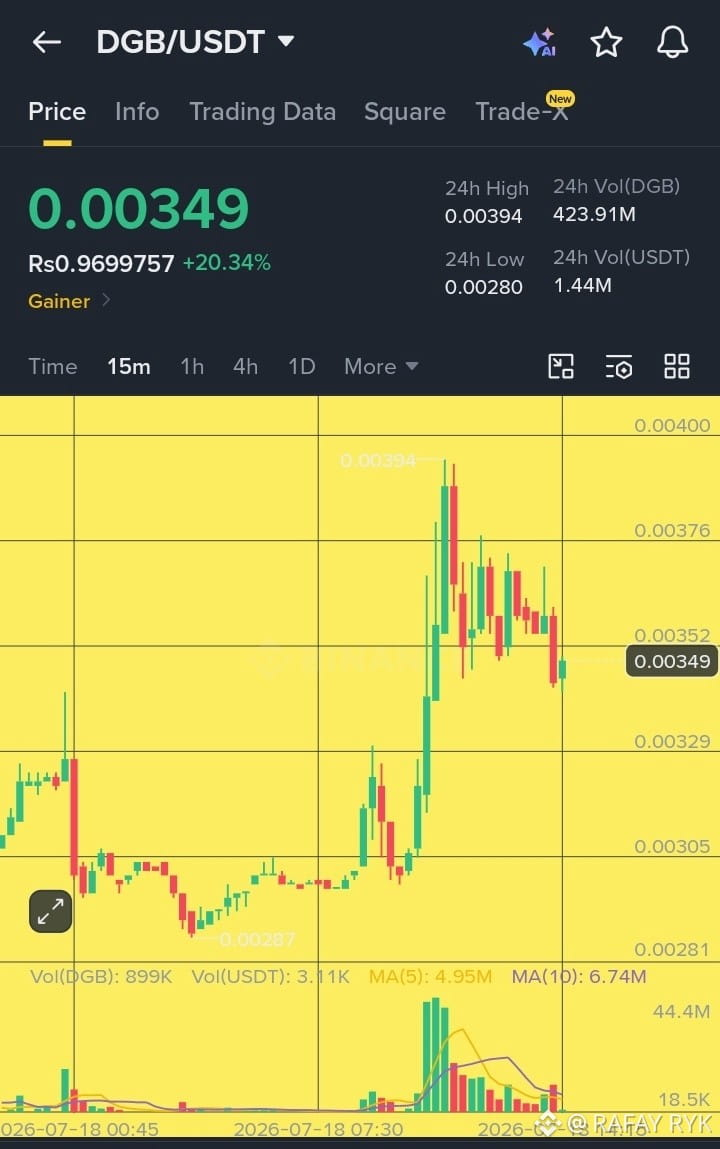
⚡ $DGB Market Update
$DGB is on fire, trading around $0.00349 after a +20.34% surge! Bulls are defending higher levels, and if momentum continues, another breakout could be on the horizon. Stay alert—volatility is back! 🚀
📍CP: $0.00349
🛑 SL: $0.00315
🎯 TP1: $0.00375
🎯 TP2: $0.00394
Momentum is building—trade with discipline and always manage your risk.
#DigiByte #AltcoinSeason #cryptotrading
$DGB is on fire, trading around $0.00349 after a +20.34% surge! Bulls are defending higher levels, and if momentum continues, another breakout could be on the horizon. Stay alert—volatility is back! 🚀
📍CP: $0.00349
🛑 SL: $0.00315
🎯 TP1: $0.00375
🎯 TP2: $0.00394
Momentum is building—trade with discipline and always manage your risk.
#DigiByte #AltcoinSeason #cryptotrading

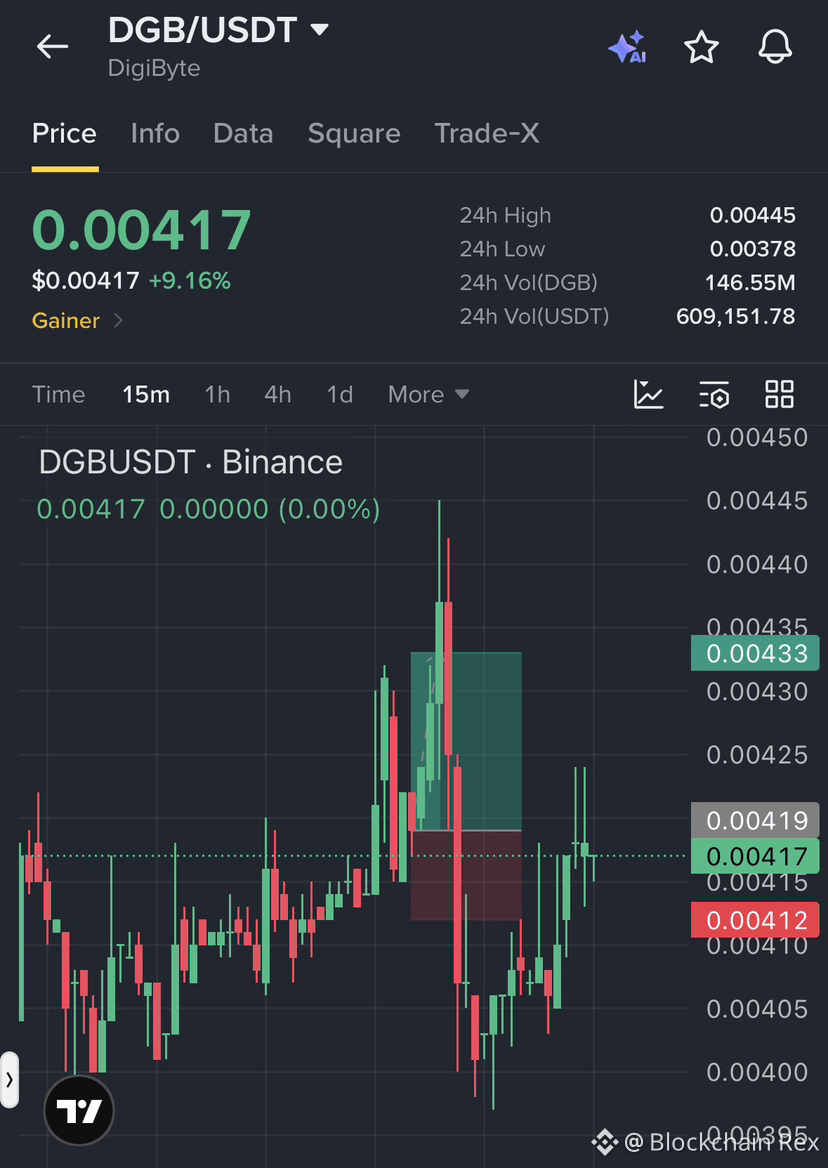

Is $DGB 's 12-year grindset about to ignite RIGHT NOW?
Analytical edge: @DigiByteCoin boasts 100% uptime, 5x PoW security, 15s blocks battle-tested L1 with DigiAssets, Digi-ID exploding via DocuChain/Chainquiry listings.
Community diamond hands through cycles; bull timing aligns as adoption surges.
#DigiByte #DGB $DGB
Analytical edge: @DigiByteCoin boasts 100% uptime, 5x PoW security, 15s blocks battle-tested L1 with DigiAssets, Digi-ID exploding via DocuChain/Chainquiry listings.
Community diamond hands through cycles; bull timing aligns as adoption surges.
#DigiByte #DGB $DGB


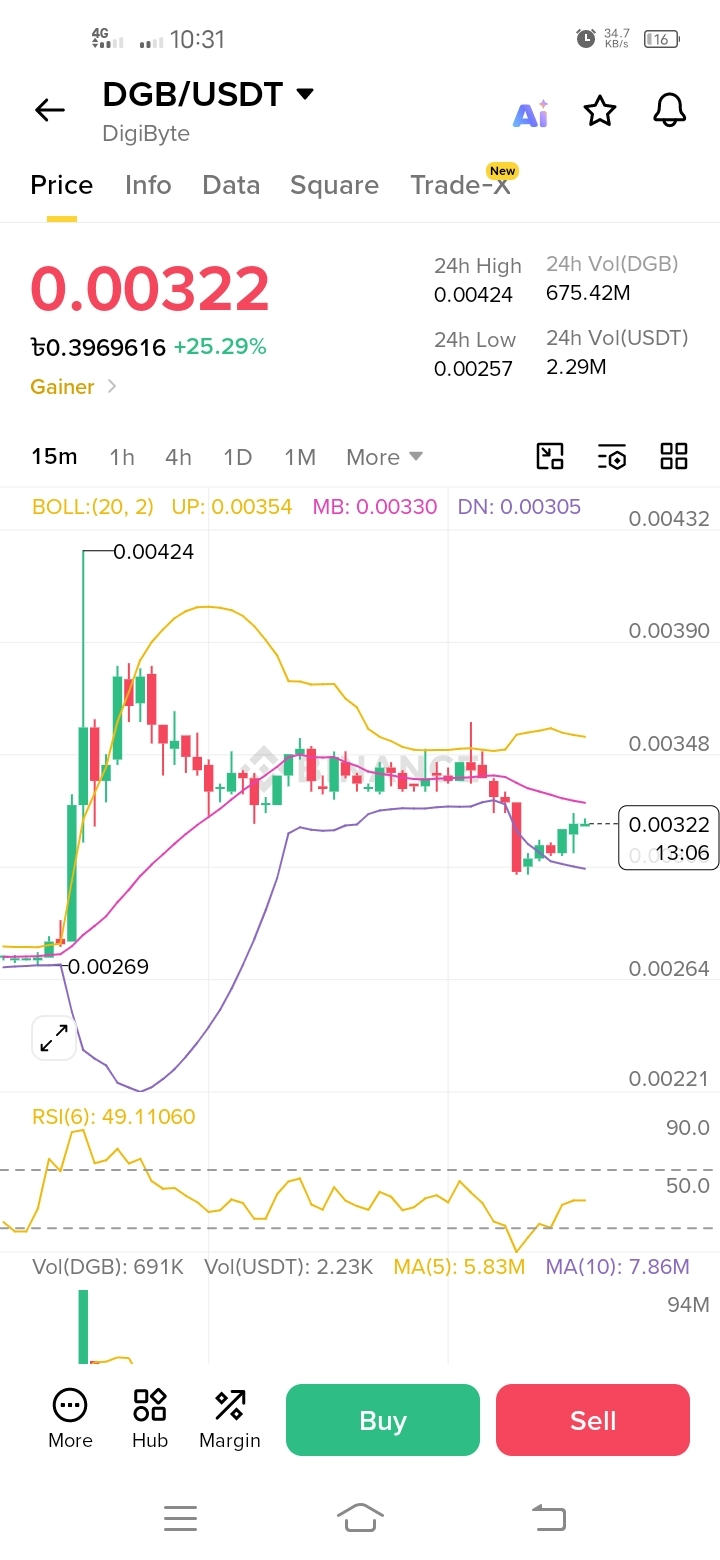
🚨 DGB/USDT Analysis: Will DigiByte Continue the Bullish Momentum? 🚨
$DGB is showing strong strength today, holding a solid +25% gain! After hitting a local high of 0.00424, the price faced a correction but found support near the Lower Bollinger Band (0.00305).
Currently, on the 15-minute chart, $dgb is attempting to break above the Middle Band (MB) at 0.00330. The RSI(6) has recovered from the oversold territory and is sitting neutral at 49, giving the price room to push upward if buying volume kicks in.
Here is a quick short-term setup for spot or low-leverage traders:
🔹 Direction: LONG 🟢
🔹 Entry Zone: 0.00315 - 0.00325
🔹 Target 1 (TP1): 0.00340
🔹 Target 2 (TP2): 0.00355 (Near Upper Bollinger Band)
🔹 Target 3 (TP3): 0.00390
🛑 Stop Loss (SL): 0.00295 (Below the lower band support)
💬 Are you riding this DGB pump, or waiting for a deeper retest? Let me know your trade setups in the comments! 👇$DGB
#DGB #digibyte #CryptoTrading #BinanceSquare #TechnicalAnalysis
$DGB is showing strong strength today, holding a solid +25% gain! After hitting a local high of 0.00424, the price faced a correction but found support near the Lower Bollinger Band (0.00305).
Currently, on the 15-minute chart, $dgb is attempting to break above the Middle Band (MB) at 0.00330. The RSI(6) has recovered from the oversold territory and is sitting neutral at 49, giving the price room to push upward if buying volume kicks in.
Here is a quick short-term setup for spot or low-leverage traders:
🔹 Direction: LONG 🟢
🔹 Entry Zone: 0.00315 - 0.00325
🔹 Target 1 (TP1): 0.00340
🔹 Target 2 (TP2): 0.00355 (Near Upper Bollinger Band)
🔹 Target 3 (TP3): 0.00390
🛑 Stop Loss (SL): 0.00295 (Below the lower band support)
💬 Are you riding this DGB pump, or waiting for a deeper retest? Let me know your trade setups in the comments! 👇$DGB
#DGB #digibyte #CryptoTrading #BinanceSquare #TechnicalAnalysis


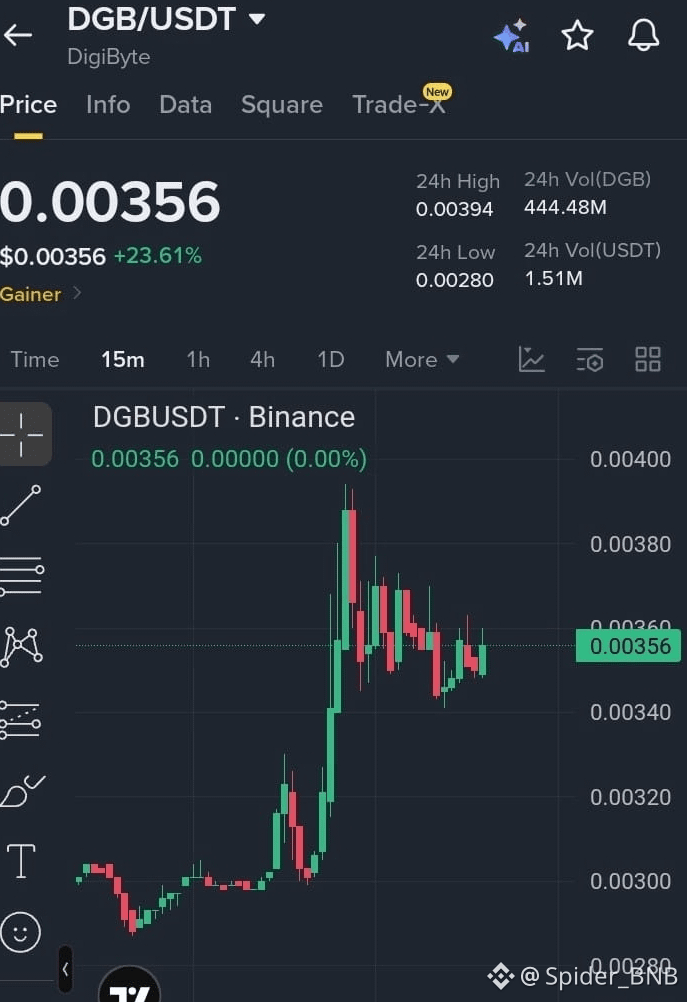
### 🚀 $DGB Massive Rally: Volatility Spike on the 15m Chart
**DigiByte ($DGB
)** is holding aggressive daily gains after executing a massive vertical breakout.
The 15-minute chart shows a powerful expansion followed by a healthy consolidation pattern as the market absorbs the sudden influx of buying volume.
### 📊 Key Numbers
* **Current Price:** **$0.00356** (**+23.61%**)
* **24h Range:** **$0.00280** – **$0.00394**
* **24h Volume:** **444.48M DGB** (~**$1.51M USDT**)
* **Category:** **Top Gainer**
### 🔍 Tactical Outlook
* **📈 Bull Target:** Bulls need to stabilize the price above the immediate **$0.00360** cluster to build momentum for a clean retest of the local 24-hour peak at **$0.00394**.
* **🛡️ Support Floor:** The previous breakout launch pad sits near **$0.00340**. Defending this level on short-term pullbacks keeps the immediate bullish structure fully intact.
**Tags:** #DGB #DigiByte #SPIDER_BNB
**DigiByte ($DGB
)** is holding aggressive daily gains after executing a massive vertical breakout.
The 15-minute chart shows a powerful expansion followed by a healthy consolidation pattern as the market absorbs the sudden influx of buying volume.
### 📊 Key Numbers
* **Current Price:** **$0.00356** (**+23.61%**)
* **24h Range:** **$0.00280** – **$0.00394**
* **24h Volume:** **444.48M DGB** (~**$1.51M USDT**)
* **Category:** **Top Gainer**
### 🔍 Tactical Outlook
* **📈 Bull Target:** Bulls need to stabilize the price above the immediate **$0.00360** cluster to build momentum for a clean retest of the local 24-hour peak at **$0.00394**.
* **🛡️ Support Floor:** The previous breakout launch pad sits near **$0.00340**. Defending this level on short-term pullbacks keeps the immediate bullish structure fully intact.
**Tags:** #DGB #DigiByte #SPIDER_BNB

🚨 $DGB is back in the spotlight!
DigiByte ($DGB ) surged over 24% after launching DigiDollar, its native stablecoin on mainnet.
🔥 Users can now mint a $1-pegged stablecoin by locking DGB as collateral, adding a new layer of utility to the ecosystem.
Increased utility often attracts more attention—but traders should stay cautious.
📊 With momentum indicators signaling overbought conditions, a short-term pullback or consolidation wouldn't be unusual after such a strong rally.
Is this the beginning of a long-term comeback for $DGB , or just a hype-driven pump? 👀
🚀 Bullish or Bearish? Share your thoughts below!
#DGB #DigiByte #Crypto #Altcoins👀🚀
DigiByte ($DGB ) surged over 24% after launching DigiDollar, its native stablecoin on mainnet.
🔥 Users can now mint a $1-pegged stablecoin by locking DGB as collateral, adding a new layer of utility to the ecosystem.
Increased utility often attracts more attention—but traders should stay cautious.
📊 With momentum indicators signaling overbought conditions, a short-term pullback or consolidation wouldn't be unusual after such a strong rally.
Is this the beginning of a long-term comeback for $DGB , or just a hype-driven pump? 👀
🚀 Bullish or Bearish? Share your thoughts below!
#DGB #DigiByte #Crypto #Altcoins👀🚀


$DGB Lightning-fast⚡🚀
While other networks lag, DGB processes blocks in 15 seconds. That’s 40 times faster than Bitcoin! At the same time, fees are pennies, and security is top-notch thanks to 5 mining algorithms.
An ideal candidate for everyday payments. The technology of the future is already here.
Want to learn more about awesome projects? Subscribe so you don’t miss out! 🔥
#DigiByte #DGB
While other networks lag, DGB processes blocks in 15 seconds. That’s 40 times faster than Bitcoin! At the same time, fees are pennies, and security is top-notch thanks to 5 mining algorithms.
An ideal candidate for everyday payments. The technology of the future is already here.
Want to learn more about awesome projects? Subscribe so you don’t miss out! 🔥
#DigiByte #DGB

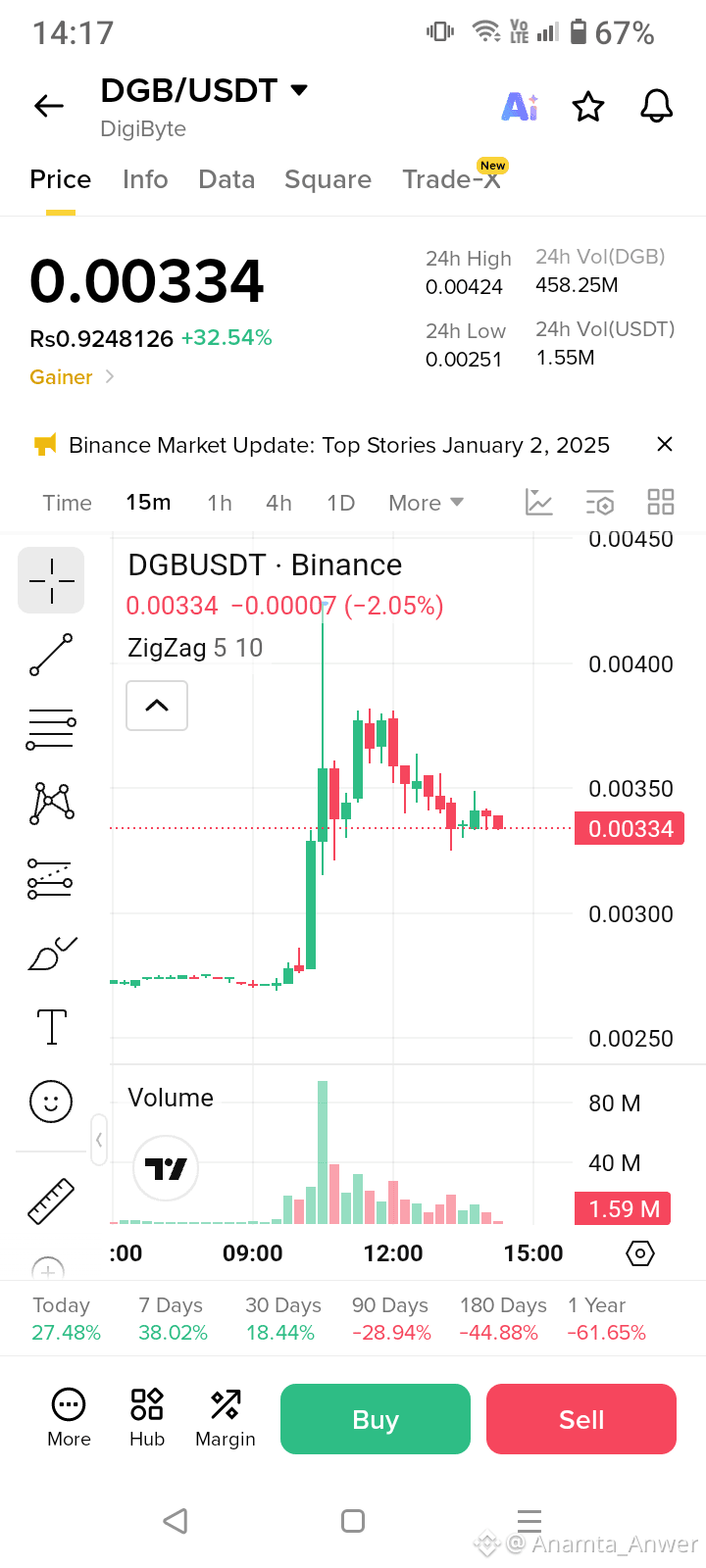
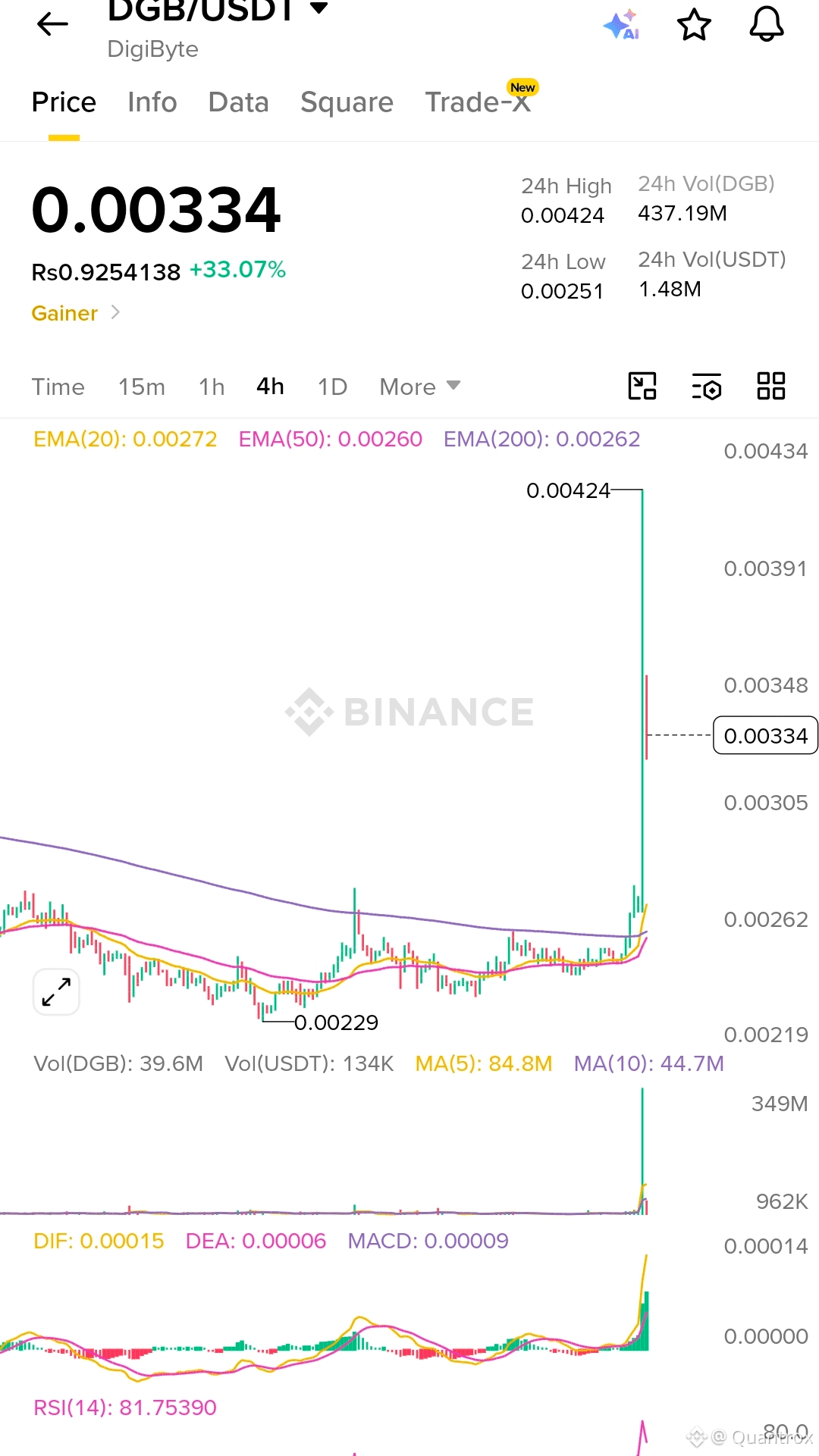
$DGB just did +33% on the thinnest liquidity I've seen today and I'm not touching it yet 🚫
Volume spike is real — 90% above average. But RSI at 81, only $1.48M USDT daily volume, and already retraced 21% from $0.00424.
One whale exit and this halves.
DigiByte has history of violent pumps and faster dumps.
The EMA cluster at $0.00262 is the only real support.
My trade plan:
Entry zone: $0.00262 – $0.00290 (EMA cluster retest only)
TP1: $0.00348
TP2: $0.00391
TP3: $0.00424
Stop Loss: $0.00235
Extreme caution. Minimum position size only.
#cryptotrading #DGB #DigiByte
DYOR. NFA.
Volume spike is real — 90% above average. But RSI at 81, only $1.48M USDT daily volume, and already retraced 21% from $0.00424.
One whale exit and this halves.
DigiByte has history of violent pumps and faster dumps.
The EMA cluster at $0.00262 is the only real support.
My trade plan:
Entry zone: $0.00262 – $0.00290 (EMA cluster retest only)
TP1: $0.00348
TP2: $0.00391
TP3: $0.00424
Stop Loss: $0.00235
Extreme caution. Minimum position size only.
#cryptotrading #DGB #DigiByte
DYOR. NFA.

ALERT 🚨 Strong bullish surge across $DGB (DIGIBYTE), $SNX (SYNTHEX), and $MITO (MITO). Order blocks reveal massive institutional demand, high volume confirms momentum. Rapid ecosystem expansion fuels adoption; liquidity pools deepen, investor sentiment turns positive. Innovation in cross chain bridges and synthetic assets propels growth. Buy the dip, hold for upside. #Digibyte #Synthetix #Mito

🚨 $DGB Explodes +5.9% with a Massive 3.4× Volume Spike! 📈🔥 Is This the Start of a Bigger Rally or a Bull Trap?
The sharp price surge and explosive volume suggest a combination of short covering and smart money accumulation. However, after such a fast move, chasing the pump could be risky—it may also be a liquidity grab designed to trap late buyers.
🎯 Bullish Setup: Watch for a healthy pullback into the 0.00333–0.00337 demand zone. If buyers defend this area with strong bullish confirmation (pin bar, hammer, bullish engulfing, or lower-timeframe reversal), it could offer an attractive long opportunity.
✅ Targets: 🎯 TP1: 0.00348 🎯 TP2: 0.00390 🚀 A strong breakout and hold above 0.00390 could open the door to 0.00424.
⚠️ Bearish Scenario: If price loses 0.00333–0.00337 with strong selling volume, it would increase the probability of a bull trap, making it safer to stay on the sidelines until a new setup forms.
💡 My Strategy: Patience wins. Let the market retrace, wait for confirmation, and only enter when buyers clearly regain control. Don't chase the pump—trade the confirmation.
#Crypto #DigiByte #Binance #CryptoTrading #Altcoins $DGB
The sharp price surge and explosive volume suggest a combination of short covering and smart money accumulation. However, after such a fast move, chasing the pump could be risky—it may also be a liquidity grab designed to trap late buyers.
🎯 Bullish Setup: Watch for a healthy pullback into the 0.00333–0.00337 demand zone. If buyers defend this area with strong bullish confirmation (pin bar, hammer, bullish engulfing, or lower-timeframe reversal), it could offer an attractive long opportunity.
✅ Targets: 🎯 TP1: 0.00348 🎯 TP2: 0.00390 🚀 A strong breakout and hold above 0.00390 could open the door to 0.00424.
⚠️ Bearish Scenario: If price loses 0.00333–0.00337 with strong selling volume, it would increase the probability of a bull trap, making it safer to stay on the sidelines until a new setup forms.
💡 My Strategy: Patience wins. Let the market retrace, wait for confirmation, and only enter when buyers clearly regain control. Don't chase the pump—trade the confirmation.
#Crypto #DigiByte #Binance #CryptoTrading #Altcoins $DGB
Log in to explore more content