

#chinasourcing
chinasourcing
142 views
5 Discussing
Hot
Latest

·
--
Article
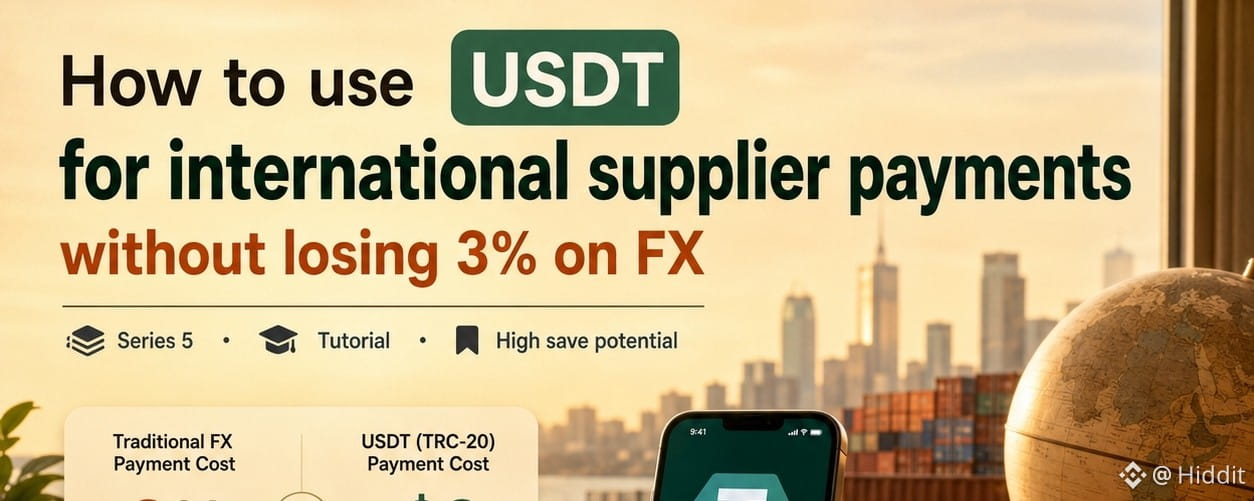
21/25: How to use USDT for international supplier payments without losing 3% on FXMost importers paying overseas suppliers are quietly losing 2–4% on every transaction.
Not to fees they can see. To FX spread, conversion timing, and correspondent banking costs they never fully audit.
Here's a practical guide to using USDT to eliminate most of that loss.
Step 1: Agree on USDT denomination upfront
Before the order is placed — not after. Price your purchase order in USDT, not USD or EUR, then convert. This removes the FX variable entirely. Both sides know exactly what they're exchanging.
Most Shenzhen and Guangzhou suppliers will agree to this if you ask directly. Many will prefer it.
Step 2: Choose the right network
TRC-20 (Tron network) for small to mid transactions — fees under $1, fast settlement.
ERC-20 (Ethereum) for larger amounts where you want the audit trail and wider wallet compatibility.
Never send on the wrong network. Funds are unrecoverable.
Step 3: Time your conversion wisely
If you're converting fiat to USDT: use a P2P platform or OTC desk rather than a spot exchange for amounts over $5,000. The spread difference is meaningful.
Check the USDT/USD peg stability before large transfers — rare but worth verifying.
Step 4: Document everything
Screenshot wallet addresses before sending. Confirm with supplier via a separate channel. Keep transaction hashes for every payment — these are your receipt, your proof, and your dispute evidence.
Step 5: Build the relationship before you need it
The suppliers who give you the best USDT terms are the ones you've paid reliably three times before. Start with smaller orders. Build the track record. The terms improve with trust.
What this saves you:
On a $50,000 order: 3% FX loss = $1,500 gone silently.
USDT settlement cost on TRC-20: under $2.
The math is not subtle.
📌 Save this and share with anyone sourcing from China.
#USDT #ChinaSourcing #CrossBorderPayments #CryptoForBusiness #ImportExport
21/25: How to use USDT for international supplier payments without losing 3% on FX
Most importers paying overseas suppliers are quietly losing 2–4% on every transaction.
Not to fees they can see. To FX spread, conversion timing, and correspondent banking costs they never fully audit.
Here's a practical guide to using USDT to eliminate most of that loss.
Step 1: Agree on USDT denomination upfront
Before the order is placed — not after. Price your purchase order in USDT, not USD or EUR, then convert. This removes the FX variable entirely. Both sides know exactly what they're exchanging.
Most Shenzhen and Guangzhou suppliers will agree to this if you ask directly. Many will prefer it.
Step 2: Choose the right network
TRC-20 (Tron network) for small to mid transactions — fees under $1, fast settlement.
ERC-20 (Ethereum) for larger amounts where you want the audit trail and wider wallet compatibility.
Never send on the wrong network. Funds are unrecoverable.
Step 3: Time your conversion wisely
If you're converting fiat to USDT: use a P2P platform or OTC desk rather than a spot exchange for amounts over $5,000. The spread difference is meaningful.
Check the USDT/USD peg stability before large transfers — rare but worth verifying.
Step 4: Document everything
Screenshot wallet addresses before sending. Confirm with supplier via a separate channel. Keep transaction hashes for every payment — these are your receipt, your proof, and your dispute evidence.
Step 5: Build the relationship before you need it
The suppliers who give you the best USDT terms are the ones you've paid reliably three times before. Start with smaller orders. Build the track record. The terms improve with trust.
What this saves you:
On a $50,000 order: 3% FX loss = $1,500 gone silently.
USDT settlement cost on TRC-20: under $2.
The math is not subtle.
📌 Save this and share with anyone sourcing from China.
#USDT #ChinaSourcing #CrossBorderPayments #CryptoForBusiness #ImportExport
Not to fees they can see. To FX spread, conversion timing, and correspondent banking costs they never fully audit.
Here's a practical guide to using USDT to eliminate most of that loss.
Step 1: Agree on USDT denomination upfront
Before the order is placed — not after. Price your purchase order in USDT, not USD or EUR, then convert. This removes the FX variable entirely. Both sides know exactly what they're exchanging.
Most Shenzhen and Guangzhou suppliers will agree to this if you ask directly. Many will prefer it.
Step 2: Choose the right network
TRC-20 (Tron network) for small to mid transactions — fees under $1, fast settlement.
ERC-20 (Ethereum) for larger amounts where you want the audit trail and wider wallet compatibility.
Never send on the wrong network. Funds are unrecoverable.
Step 3: Time your conversion wisely
If you're converting fiat to USDT: use a P2P platform or OTC desk rather than a spot exchange for amounts over $5,000. The spread difference is meaningful.
Check the USDT/USD peg stability before large transfers — rare but worth verifying.
Step 4: Document everything
Screenshot wallet addresses before sending. Confirm with supplier via a separate channel. Keep transaction hashes for every payment — these are your receipt, your proof, and your dispute evidence.
Step 5: Build the relationship before you need it
The suppliers who give you the best USDT terms are the ones you've paid reliably three times before. Start with smaller orders. Build the track record. The terms improve with trust.
What this saves you:
On a $50,000 order: 3% FX loss = $1,500 gone silently.
USDT settlement cost on TRC-20: under $2.
The math is not subtle.
📌 Save this and share with anyone sourcing from China.
#USDT #ChinaSourcing #CrossBorderPayments #CryptoForBusiness #ImportExport
93
·
--
Article
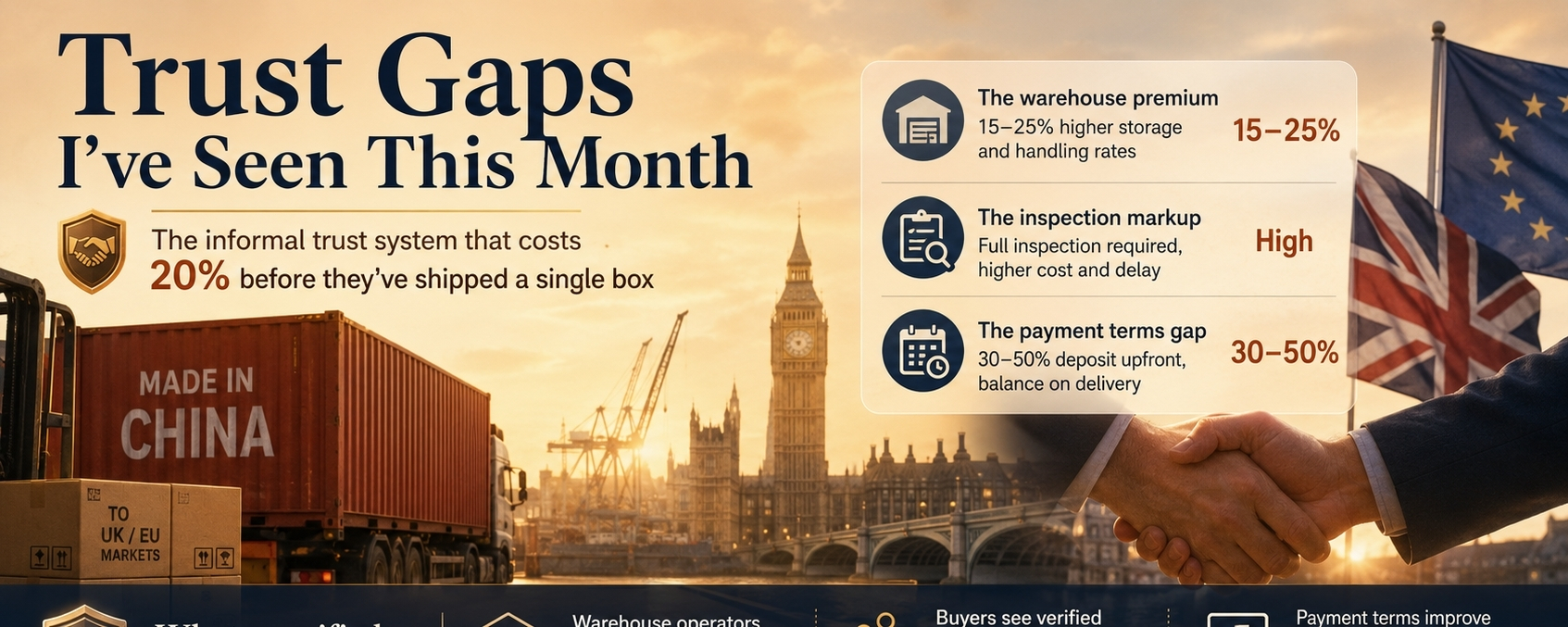
3/Round 2: Trust Gaps I've Seen This Month"The informal trust system that costs Chinese sellers 20% before they've shipped a single box"
Nobody tells you about the 20% tax.
It's not a tariff. It's not a fee.
It's the cost of being unknown in a market that runs on trust.
Chinese sellers expanding into UK and EU markets for the first time pay it silently — in unfavourable warehouse terms, higher inspection costs, slower payment releases, and deals that fall through because there's no track record to point to.
Here's what it looks like in practice.
The warehouse premium:
A new Chinese seller approaching a UK warehouse cold gets quoted 15–25% higher storage and handling rates than an established client. Not because their goods are more expensive to handle. Because the warehouse operator carries more risk with an unknown counterparty and prices accordingly. Trust — or its absence — has a price.
The inspection markup:
First-time buyers insist on full pre-shipment inspection for new suppliers. Experienced buyers with track-record suppliers often accept document verification only. The difference in cost and time is significant. New sellers pay the full inspection price — which is rational from the buyer's side, but creates a barrier that entrenches existing supplier relationships and makes new entry expensive.
The payment terms gap:
Established suppliers get net-30 or net-60. New suppliers get 30–50% deposit upfront, balance on delivery. The cash flow impact on a first-time exporter is enormous — and the risk is entirely on them.
What a verified trust layer changes:
→ Warehouse operators see a vetted counterparty, not an unknown — rates normalise
→ Buyers see verified supplier history, even without a personal relationship — inspection requirements adjust
→ Payment terms improve as the track record builds — on-chain, verifiable, portable across relationships
The 20% trust tax isn't inevitable. It's a symptom of missing infrastructure.
Building that infrastructure is the whole game.
🔁 Share this with any Chinese seller thinking about EU/UK expansion.
#ChinaSourcing #CrossBorderTrade #Web3Commerce #RWA #TrustInfrastructure
3/Round 2: Trust Gaps I've Seen This Month
"The informal trust system that costs Chinese sellers 20% before they've shipped a single box"
Nobody tells you about the 20% tax.
It's not a tariff. It's not a fee.
It's the cost of being unknown in a market that runs on trust.
Chinese sellers expanding into UK and EU markets for the first time pay it silently — in unfavourable warehouse terms, higher inspection costs, slower payment releases, and deals that fall through because there's no track record to point to.
Here's what it looks like in practice.
The warehouse premium:
A new Chinese seller approaching a UK warehouse cold gets quoted 15–25% higher storage and handling rates than an established client. Not because their goods are more expensive to handle. Because the warehouse operator carries more risk with an unknown counterparty and prices accordingly. Trust — or its absence — has a price.
The inspection markup:
First-time buyers insist on full pre-shipment inspection for new suppliers. Experienced buyers with track-record suppliers often accept document verification only. The difference in cost and time is significant. New sellers pay the full inspection price — which is rational from the buyer's side, but creates a barrier that entrenches existing supplier relationships and makes new entry expensive.
The payment terms gap:
Established suppliers get net-30 or net-60. New suppliers get 30–50% deposit upfront, balance on delivery. The cash flow impact on a first-time exporter is enormous — and the risk is entirely on them.
What a verified trust layer changes:
→ Warehouse operators see a vetted counterparty, not an unknown — rates normalise
→ Buyers see verified supplier history, even without a personal relationship — inspection requirements adjust
→ Payment terms improve as the track record builds — on-chain, verifiable, portable across relationships
The 20% trust tax isn't inevitable. It's a symptom of missing infrastructure.
Building that infrastructure is the whole game.
🔁 Share this with any Chinese seller thinking about EU/UK expansion.
#ChinaSourcing #CrossBorderTrade #Web3Commerce #RWA #TrustInfrastructure
Nobody tells you about the 20% tax.
It's not a tariff. It's not a fee.
It's the cost of being unknown in a market that runs on trust.
Chinese sellers expanding into UK and EU markets for the first time pay it silently — in unfavourable warehouse terms, higher inspection costs, slower payment releases, and deals that fall through because there's no track record to point to.
Here's what it looks like in practice.
The warehouse premium:
A new Chinese seller approaching a UK warehouse cold gets quoted 15–25% higher storage and handling rates than an established client. Not because their goods are more expensive to handle. Because the warehouse operator carries more risk with an unknown counterparty and prices accordingly. Trust — or its absence — has a price.
The inspection markup:
First-time buyers insist on full pre-shipment inspection for new suppliers. Experienced buyers with track-record suppliers often accept document verification only. The difference in cost and time is significant. New sellers pay the full inspection price — which is rational from the buyer's side, but creates a barrier that entrenches existing supplier relationships and makes new entry expensive.
The payment terms gap:
Established suppliers get net-30 or net-60. New suppliers get 30–50% deposit upfront, balance on delivery. The cash flow impact on a first-time exporter is enormous — and the risk is entirely on them.
What a verified trust layer changes:
→ Warehouse operators see a vetted counterparty, not an unknown — rates normalise
→ Buyers see verified supplier history, even without a personal relationship — inspection requirements adjust
→ Payment terms improve as the track record builds — on-chain, verifiable, portable across relationships
The 20% trust tax isn't inevitable. It's a symptom of missing infrastructure.
Building that infrastructure is the whole game.
🔁 Share this with any Chinese seller thinking about EU/UK expansion.
#ChinaSourcing #CrossBorderTrade #Web3Commerce #RWA #TrustInfrastructure
243
Log in to explore more content
Join global crypto users on Binance Square
⚡️ Get latest and useful information about crypto.
💬 Trusted by the world’s largest crypto exchange.
👍 Discover real insights from verified creators.
Email / Phone number
Trending Topics
1
#NFPWatch
10.5M views
17,774 Discussing
2
#BitcoinFundingRateTriplesTo10%
3,655 views
147 Discussing
3
#BitcoinSurpasses$86KUp2.99%
1,451 views
26 Discussing
4
#ZcashFalls21%FromSeptemberPeak
11,245 views
220 Discussing
5
#USSeptemberPayrollsAdd29KUnemploymentRises4.2%
2,246 views
81 Discussing
6
#XRPPostsFirstThreeGreenMonthsInQ3
12,499 views
288 Discussing
7
#BNBChainTokenizedStocksTop$1BAt30%Share
102 views
23 Discussing
8
#BitcoinRisesToward$85K
52,605 views
115 Discussing
9
#AmazonPlansToSell$8BNvidiaChips
5,851 views
78 Discussing
10
#NEARFallsToAround$4.70Down14%
39,806 views
102 Discussing