

#bitcoinslipsbelow
bitcoinslipsbelow
402 views
10 Discussing
Hot
Latest

·
--
#BitcoinSlipsBelow SELL SETUP WATCH
BTC is trading around the $83K area today, with recent weakness keeping downside risk in focus. Analysts are watching the $82K support zone closely; a decisive break could expose lower levels.
📉 SELL idea: Only consider a short if BTC confirms a breakdown below support.
🎯 Targets: $81K → $79K
🛑 Invalidation: Reclaim and hold above the breakdown zone
⚠️ Avoid high leverage; wait for candle confirmation.
Not financial advice — manage your risk.
##CryptoTrading #BinanceSquare #TradingTips #CryptoMarket
#BitcoinSlipsBelow SELL SETUP WATCH
BTC is trading around the $83K area today, with recent weakness keeping downside risk in focus. Analysts are watching the $82K support zone closely; a decisive break could expose lower levels.
📉 SELL idea: Only consider a short if BTC confirms a breakdown below support.
🎯 Targets: $81K → $79K
🛑 Invalidation: Reclaim and hold above the breakdown zone
⚠️ Avoid high leverage; wait for candle confirmation.
Not financial advice — manage your risk.
##CryptoTrading #BinanceSquare #TradingTips #CryptoMarket
BTC is trading around the $83K area today, with recent weakness keeping downside risk in focus. Analysts are watching the $82K support zone closely; a decisive break could expose lower levels.
📉 SELL idea: Only consider a short if BTC confirms a breakdown below support.
🎯 Targets: $81K → $79K
🛑 Invalidation: Reclaim and hold above the breakdown zone
⚠️ Avoid high leverage; wait for candle confirmation.
Not financial advice — manage your risk.
##CryptoTrading #BinanceSquare #TradingTips #CryptoMarket
bullish 🐂
Bears 🐻
18 hr(s) left
164

#BitcoinSlipsBelow $84000
Bitcoin has dropped below $84,000 as traders remain cautious ahead of key U.S. economic data. The $84,000 level is being closely watched by the market, while higher bond yields and weaker spot demand are putting pressure on BTC.
#BitcoinSlipsBelow $84000
#BitcoinSlipsBelow $84000
#BitcoinSlipsBelow $84000
Bitcoin has dropped below $84,000 as traders remain cautious ahead of key U.S. economic data. The $84,000 level is being closely watched by the market, while higher bond yields and weaker spot demand are putting pressure on BTC.
#BitcoinSlipsBelow $84000
#BitcoinSlipsBelow $84000
Bitcoin has dropped below $84,000 as traders remain cautious ahead of key U.S. economic data. The $84,000 level is being closely watched by the market, while higher bond yields and weaker spot demand are putting pressure on BTC.
#BitcoinSlipsBelow $84000
#BitcoinSlipsBelow $84000

1
28

·
--
BTC falls below $84,000 but stays on the hot list|After the PCE, the price has already recovered to 85,000|I don’t chase the first wave
My stance is to respect the rebound, but not treat the hot-list headline as real-time market pricing. At this moment, the rising topic on Binance Square still shows “#BitcoinSlipsBelow$84000.” This is the correct tag being discussed—it does not mean BTC is still trading below $84,000 right now. When I cross-check Binance’s public BTCUSDT quote, the latest price is around $85,636; the 24-hour range low is $82,900 and the high is $85,650. In other words, the hot-list record reflects an earlier slip below, while the order book reflects the subsequent recovery. News heat can lag; mixing the two most easily leads people to chase the wrong direction after data volatility.
The macro facts have been updated. The U.S. Bureau of Economic Analysis (BEA) reported its August data: the overall PCE price index rose 3.4% year over year and 0.3% month over month; core PCE rose 3.0% year over year and 0.2% month over month; and real personal consumption expenditures increased 0.6% month over month. I checked the BEA news text against the official PDF—the numbers match. Core readings don’t automatically mean “the Fed will cut rates immediately,” and real consumption shouldn’t be ignored. They influence rate expectations and USD outlook, which in turn affects valuations of risk assets like BTC. But the policy path still requires more data and confirmation from Fed meetings.
On the market reaction: Binance’s five-minute candles closed at about $83,940 at 20:25 Beijing time. During the 20:30 data release window, it closed at about $84,495, and at 21:05 it closed around $85,596. In terms of timing, yes, there is a rapid upward move—but that alone can’t prove that all buy orders were caused solely by the PCE, nor can it be said that the prior discussion about slipping below $84,000 is “faked.” What I care about is whether the intraday high near $85,650 can turn into new support, and whether the 24-hour opening price near $84,430 can hold. If price breaks the high and then falls back below $84,430, the short-term rebound continuation thesis gets overturned. If yields and the dollar surge at the same time, you also need to watch for a pattern where price rises first and then drops.
If I were trading myself, I wouldn’t enter at this moment. My direction is temporarily to wait for long-side confirmation; position size: 0%. Only if spot can effectively hold above $85,650 and then retest without breaking $85,200 would I consider a long with up to 3% of total capital (light position). The first target is $86,400; once hit, I’d cut the position by half. The remaining position would follow, but I wouldn’t add leverage. After entry, if it drops back below $84,900, I would stop out and fully close. If $84,430 is lost first, I cancel the entry plan and re-evaluate. If conditions aren’t triggered, then there’s no trade—no way to treat a paper plan as realized profit. Hot topics give you the entry point for discussion; what truly determines action is official data, order-book validation, and risk budgeting.
Source: Binance Square real-time hot list, the official U.S. BEA August PCE report, and Binance’s public BTCUSDT quote. #BitcoinSlipsBelow$84000 #BTC
The above is only my personal market observation and does not constitute investment advice.
BTC falls below $84,000 but stays on the hot list|After the PCE, the price has already recovered to 85,000|I don’t chase the first wave
My stance is to respect the rebound, but not treat the hot-list headline as real-time market pricing. At this moment, the rising topic on Binance Square still shows “#BitcoinSlipsBelow$84000.” This is the correct tag being discussed—it does not mean BTC is still trading below $84,000 right now. When I cross-check Binance’s public BTCUSDT quote, the latest price is around $85,636; the 24-hour range low is $82,900 and the high is $85,650. In other words, the hot-list record reflects an earlier slip below, while the order book reflects the subsequent recovery. News heat can lag; mixing the two most easily leads people to chase the wrong direction after data volatility.
The macro facts have been updated. The U.S. Bureau of Economic Analysis (BEA) reported its August data: the overall PCE price index rose 3.4% year over year and 0.3% month over month; core PCE rose 3.0% year over year and 0.2% month over month; and real personal consumption expenditures increased 0.6% month over month. I checked the BEA news text against the official PDF—the numbers match. Core readings don’t automatically mean “the Fed will cut rates immediately,” and real consumption shouldn’t be ignored. They influence rate expectations and USD outlook, which in turn affects valuations of risk assets like BTC. But the policy path still requires more data and confirmation from Fed meetings.
On the market reaction: Binance’s five-minute candles closed at about $83,940 at 20:25 Beijing time. During the 20:30 data release window, it closed at about $84,495, and at 21:05 it closed around $85,596. In terms of timing, yes, there is a rapid upward move—but that alone can’t prove that all buy orders were caused solely by the PCE, nor can it be said that the prior discussion about slipping below $84,000 is “faked.” What I care about is whether the intraday high near $85,650 can turn into new support, and whether the 24-hour opening price near $84,430 can hold. If price breaks the high and then falls back below $84,430, the short-term rebound continuation thesis gets overturned. If yields and the dollar surge at the same time, you also need to watch for a pattern where price rises first and then drops.
If I were trading myself, I wouldn’t enter at this moment. My direction is temporarily to wait for long-side confirmation; position size: 0%. Only if spot can effectively hold above $85,650 and then retest without breaking $85,200 would I consider a long with up to 3% of total capital (light position). The first target is $86,400; once hit, I’d cut the position by half. The remaining position would follow, but I wouldn’t add leverage. After entry, if it drops back below $84,900, I would stop out and fully close. If $84,430 is lost first, I cancel the entry plan and re-evaluate. If conditions aren’t triggered, then there’s no trade—no way to treat a paper plan as realized profit. Hot topics give you the entry point for discussion; what truly determines action is official data, order-book validation, and risk budgeting.
Source: Binance Square real-time hot list, the official U.S. BEA August PCE report, and Binance’s public BTCUSDT quote. #BitcoinSlipsBelow$84000 #BTC
The above is only my personal market observation and does not constitute investment advice.
My stance is to respect the rebound, but not treat the hot-list headline as real-time market pricing. At this moment, the rising topic on Binance Square still shows “#BitcoinSlipsBelow$84000.” This is the correct tag being discussed—it does not mean BTC is still trading below $84,000 right now. When I cross-check Binance’s public BTCUSDT quote, the latest price is around $85,636; the 24-hour range low is $82,900 and the high is $85,650. In other words, the hot-list record reflects an earlier slip below, while the order book reflects the subsequent recovery. News heat can lag; mixing the two most easily leads people to chase the wrong direction after data volatility.
The macro facts have been updated. The U.S. Bureau of Economic Analysis (BEA) reported its August data: the overall PCE price index rose 3.4% year over year and 0.3% month over month; core PCE rose 3.0% year over year and 0.2% month over month; and real personal consumption expenditures increased 0.6% month over month. I checked the BEA news text against the official PDF—the numbers match. Core readings don’t automatically mean “the Fed will cut rates immediately,” and real consumption shouldn’t be ignored. They influence rate expectations and USD outlook, which in turn affects valuations of risk assets like BTC. But the policy path still requires more data and confirmation from Fed meetings.
On the market reaction: Binance’s five-minute candles closed at about $83,940 at 20:25 Beijing time. During the 20:30 data release window, it closed at about $84,495, and at 21:05 it closed around $85,596. In terms of timing, yes, there is a rapid upward move—but that alone can’t prove that all buy orders were caused solely by the PCE, nor can it be said that the prior discussion about slipping below $84,000 is “faked.” What I care about is whether the intraday high near $85,650 can turn into new support, and whether the 24-hour opening price near $84,430 can hold. If price breaks the high and then falls back below $84,430, the short-term rebound continuation thesis gets overturned. If yields and the dollar surge at the same time, you also need to watch for a pattern where price rises first and then drops.
If I were trading myself, I wouldn’t enter at this moment. My direction is temporarily to wait for long-side confirmation; position size: 0%. Only if spot can effectively hold above $85,650 and then retest without breaking $85,200 would I consider a long with up to 3% of total capital (light position). The first target is $86,400; once hit, I’d cut the position by half. The remaining position would follow, but I wouldn’t add leverage. After entry, if it drops back below $84,900, I would stop out and fully close. If $84,430 is lost first, I cancel the entry plan and re-evaluate. If conditions aren’t triggered, then there’s no trade—no way to treat a paper plan as realized profit. Hot topics give you the entry point for discussion; what truly determines action is official data, order-book validation, and risk budgeting.
Source: Binance Square real-time hot list, the official U.S. BEA August PCE report, and Binance’s public BTCUSDT quote. #BitcoinSlipsBelow$84000 #BTC
The above is only my personal market observation and does not constitute investment advice.

80

·
--
According to the latest reports, the Bitcoin price has fallen below $84,000, hitting a recent low. This downturn is mainly driven by global macroeconomic uncertainty and regulatory pressure. The Federal Reserve’s continued rate hikes have strengthened the US dollar, putting pressure on risk assets such as Bitcoin. In addition, several European countries have tightened their cryptocurrency regulatory policies, which has intensified market concerns. However, it’s worth noting that technical analysis shows Bitcoin is still near a key support level, and institutional investors continue to add to their positions, indicating a long-term optimistic outlook. In my view, the current decline is part of a value-reversion process. Over the long term, Bitcoin still has investment value. Its decentralized and scarce characteristics are difficult to replace. Volatility in the short term is inevitable, but the long-term trend remains favorable. Investors should stay calm, focus on fundamentals rather than short-term price fluctuations. #BitcoinSlipsBelow$84000
$BTC #BTC
According to the latest reports, the Bitcoin price has fallen below $84,000, hitting a recent low. This downturn is mainly driven by global macroeconomic uncertainty and regulatory pressure. The Federal Reserve’s continued rate hikes have strengthened the US dollar, putting pressure on risk assets such as Bitcoin. In addition, several European countries have tightened their cryptocurrency regulatory policies, which has intensified market concerns. However, it’s worth noting that technical analysis shows Bitcoin is still near a key support level, and institutional investors continue to add to their positions, indicating a long-term optimistic outlook. In my view, the current decline is part of a value-reversion process. Over the long term, Bitcoin still has investment value. Its decentralized and scarce characteristics are difficult to replace. Volatility in the short term is inevitable, but the long-term trend remains favorable. Investors should stay calm, focus on fundamentals rather than short-term price fluctuations. #BitcoinSlipsBelow$84000
$BTC #BTC
$BTC #BTC
57


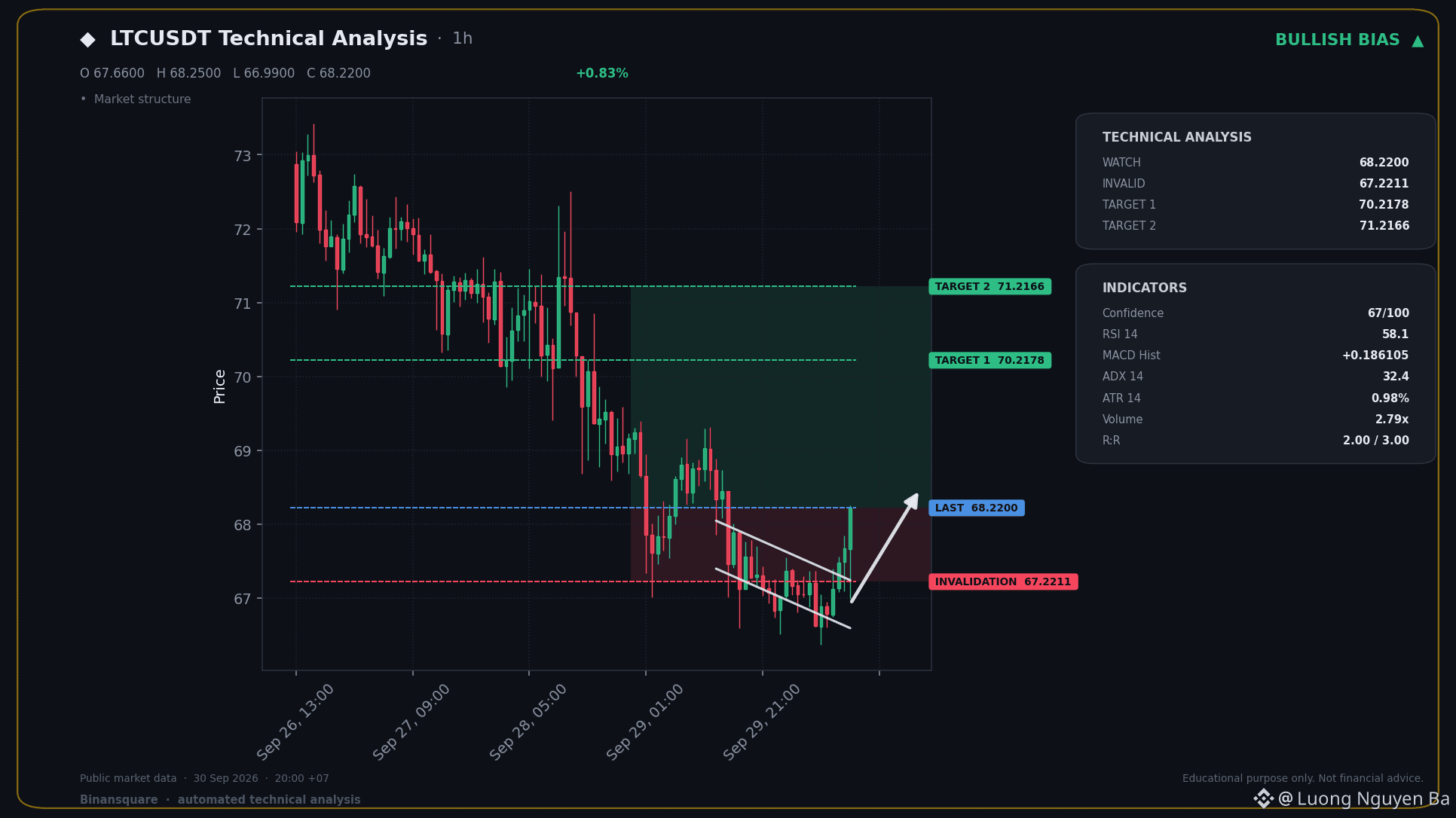
📈 BIG LONG NOW - LTCUSDT
📍 KEY LEVELS
Entry: 68.2200
🛑 SL: 67.2211
🎯 TP1: 70.2178
🎯 TP2: 71.2166
The trend is still strong with the EMAs showing an uptrend, and momentum is picking back up as the MACD just crossed bullish. RSI is in a good spot, not yet overbought.
This signal was generated automatically from technical indicators. It does not guarantee profit and is not investment advice. Always manage your own risk and DYOR.
$LTC
#AltcoinSeasonIndexHoldsAbove60For5Days #BitcoinSlipsBelow$84000
📈 BIG LONG NOW - LTCUSDT
📍 KEY LEVELS
Entry: 68.2200
🛑 SL: 67.2211
🎯 TP1: 70.2178
🎯 TP2: 71.2166
The trend is still strong with the EMAs showing an uptrend, and momentum is picking back up as the MACD just crossed bullish. RSI is in a good spot, not yet overbought.
This signal was generated automatically from technical indicators. It does not guarantee profit and is not investment advice. Always manage your own risk and DYOR.
$LTC
#AltcoinSeasonIndexHoldsAbove60For5Days #BitcoinSlipsBelow$84000
📍 KEY LEVELS
Entry: 68.2200
🛑 SL: 67.2211
🎯 TP1: 70.2178
🎯 TP2: 71.2166
The trend is still strong with the EMAs showing an uptrend, and momentum is picking back up as the MACD just crossed bullish. RSI is in a good spot, not yet overbought.
This signal was generated automatically from technical indicators. It does not guarantee profit and is not investment advice. Always manage your own risk and DYOR.
$LTC
#AltcoinSeasonIndexHoldsAbove60For5Days #BitcoinSlipsBelow$84000
1
540
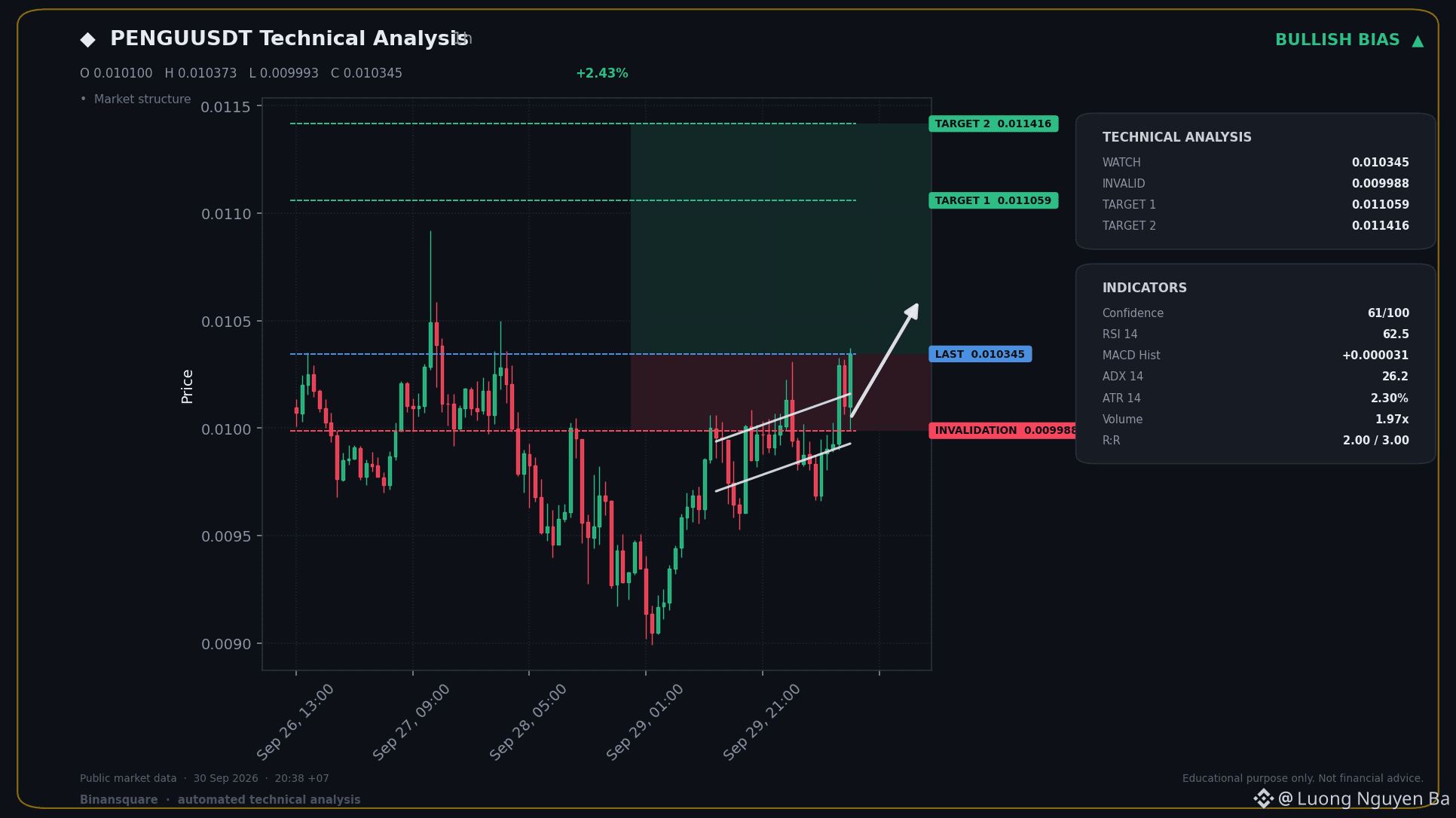
📈 BIG LONG NOW - PENGUUSDT
📍 KEY LEVELS
Entry: 0.010345
🛑 SL: 0.009988
🎯 TP1: 0.011059
🎯 TP2: 0.011416
The trend is clearly up with the EMAs, and momentum's picking up as the MACD is positive. RSI's in a good spot, showing we've still got room to run before hitting overbought.
This signal was generated automatically from technical indicators. It does not guarantee profit and is not investment advice. Always manage your own risk and DYOR.
$PENGU
#BitcoinSlipsBelow$84000 #KospiPostsWorstQuarterSince2020
📈 BIG LONG NOW - PENGUUSDT
📍 KEY LEVELS
Entry: 0.010345
🛑 SL: 0.009988
🎯 TP1: 0.011059
🎯 TP2: 0.011416
The trend is clearly up with the EMAs, and momentum's picking up as the MACD is positive. RSI's in a good spot, showing we've still got room to run before hitting overbought.
This signal was generated automatically from technical indicators. It does not guarantee profit and is not investment advice. Always manage your own risk and DYOR.
$PENGU
#BitcoinSlipsBelow$84000 #KospiPostsWorstQuarterSince2020
📍 KEY LEVELS
Entry: 0.010345
🛑 SL: 0.009988
🎯 TP1: 0.011059
🎯 TP2: 0.011416
The trend is clearly up with the EMAs, and momentum's picking up as the MACD is positive. RSI's in a good spot, showing we've still got room to run before hitting overbought.
This signal was generated automatically from technical indicators. It does not guarantee profit and is not investment advice. Always manage your own risk and DYOR.
$PENGU
#BitcoinSlipsBelow$84000 #KospiPostsWorstQuarterSince2020
2
601

·
--
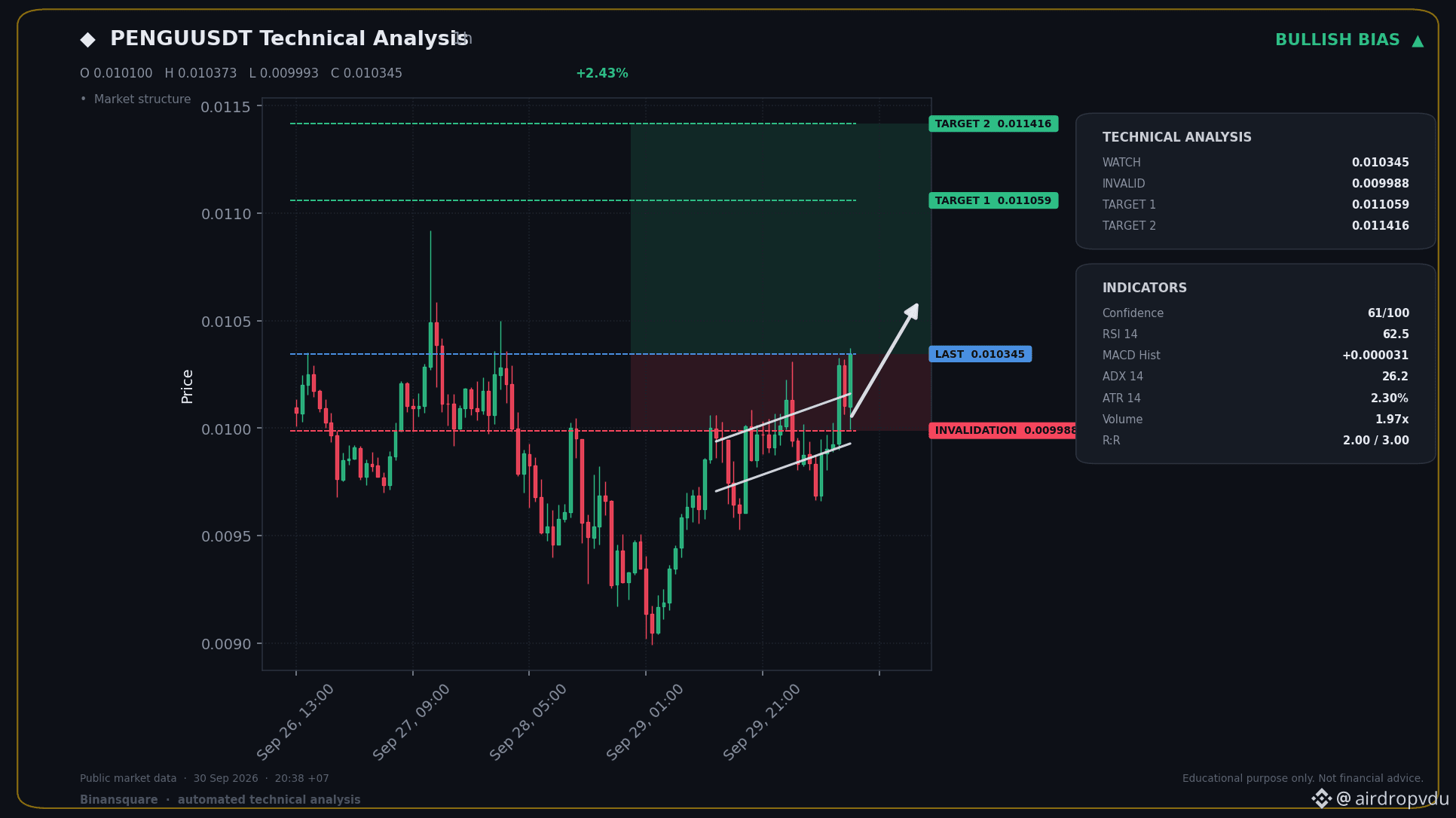
📈 BIG LONG NOW - PENGUUSDT
📍 KEY LEVELS
Entry: 0.010345
🛑 SL: 0.009988
🎯 TP1: 0.011059
🎯 TP2: 0.011416
The trend is clearly up with the EMAs, and momentum's picking up as the MACD is positive. RSI's in a good spot, showing we've still got room to run before hitting overbought.
This signal was generated automatically from technical indicators. It does not guarantee profit and is not investment advice. Always manage your own risk and DYOR.
$PENGU
#BitcoinSlipsBelow$84000 #KospiPostsWorstQuarterSince2020
📈 BIG LONG NOW - PENGUUSDT
📍 KEY LEVELS
Entry: 0.010345
🛑 SL: 0.009988
🎯 TP1: 0.011059
🎯 TP2: 0.011416
The trend is clearly up with the EMAs, and momentum's picking up as the MACD is positive. RSI's in a good spot, showing we've still got room to run before hitting overbought.
This signal was generated automatically from technical indicators. It does not guarantee profit and is not investment advice. Always manage your own risk and DYOR.
$PENGU
#BitcoinSlipsBelow$84000 #KospiPostsWorstQuarterSince2020
📍 KEY LEVELS
Entry: 0.010345
🛑 SL: 0.009988
🎯 TP1: 0.011059
🎯 TP2: 0.011416
The trend is clearly up with the EMAs, and momentum's picking up as the MACD is positive. RSI's in a good spot, showing we've still got room to run before hitting overbought.
This signal was generated automatically from technical indicators. It does not guarantee profit and is not investment advice. Always manage your own risk and DYOR.
$PENGU
#BitcoinSlipsBelow$84000 #KospiPostsWorstQuarterSince2020
1
30
·
--
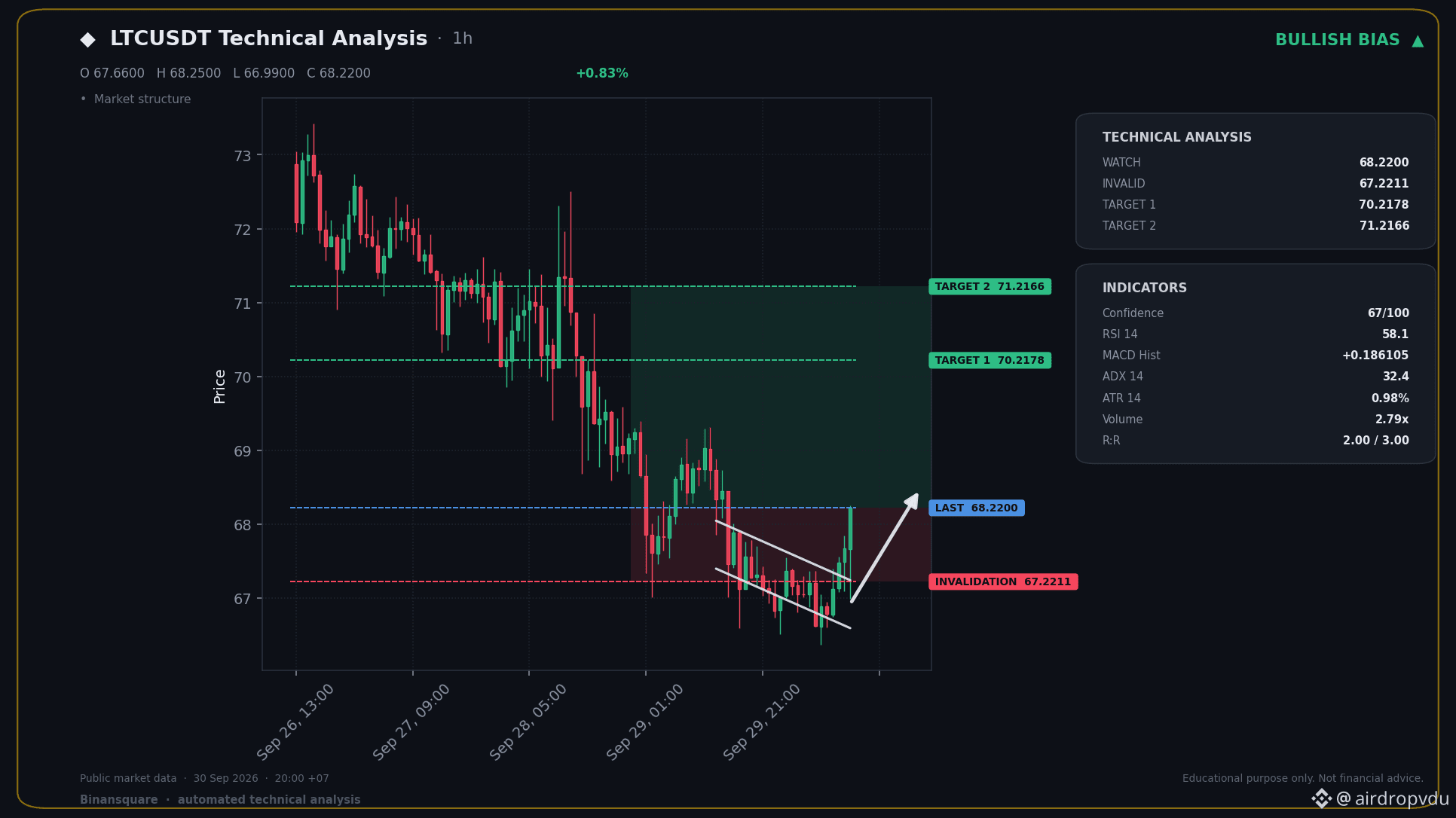
📈 BIG LONG NOW - LTCUSDT
📍 KEY LEVELS
Entry: 68.2200
🛑 SL: 67.2211
🎯 TP1: 70.2178
🎯 TP2: 71.2166
The trend is still strong with the EMAs showing an uptrend, and momentum is picking back up as the MACD just crossed bullish. RSI is in a good spot, not yet overbought.
This signal was generated automatically from technical indicators. It does not guarantee profit and is not investment advice. Always manage your own risk and DYOR.
$LTC
#AltcoinSeasonIndexHoldsAbove60For5Days #BitcoinSlipsBelow$84000
📈 BIG LONG NOW - LTCUSDT
📍 KEY LEVELS
Entry: 68.2200
🛑 SL: 67.2211
🎯 TP1: 70.2178
🎯 TP2: 71.2166
The trend is still strong with the EMAs showing an uptrend, and momentum is picking back up as the MACD just crossed bullish. RSI is in a good spot, not yet overbought.
This signal was generated automatically from technical indicators. It does not guarantee profit and is not investment advice. Always manage your own risk and DYOR.
$LTC
#AltcoinSeasonIndexHoldsAbove60For5Days #BitcoinSlipsBelow$84000
📍 KEY LEVELS
Entry: 68.2200
🛑 SL: 67.2211
🎯 TP1: 70.2178
🎯 TP2: 71.2166
The trend is still strong with the EMAs showing an uptrend, and momentum is picking back up as the MACD just crossed bullish. RSI is in a good spot, not yet overbought.
This signal was generated automatically from technical indicators. It does not guarantee profit and is not investment advice. Always manage your own risk and DYOR.
$LTC
#AltcoinSeasonIndexHoldsAbove60For5Days #BitcoinSlipsBelow$84000
1
31
Log in to explore more content
Join global crypto users on Binance Square
⚡️ Get latest and useful information about crypto.
💬 Trusted by the world’s largest crypto exchange.
👍 Discover real insights from verified creators.
Email / Phone number
Trending Topics
1
#BitcoinClears$85200
2,280 views
97 Discussing
2
#AltcoinSeasonIndexHoldsAbove60For5Days
16,326 views
641 Discussing
3
#USADPAdds90000JobsInSeptember
5,310 views
334 Discussing
4
#USCorePCEEasesTo3%InAugust
4,798 views
289 Discussing
5
#KospiPostsWorstQuarterSince2020
4,501 views
322 Discussing
6
#SECToClarifyOnChainFundraisingRules
12,124 views
498 Discussing
7
#UKFCAOpensCryptoFirmAuthorization
15,387 views
453 Discussing
8
#JapanMOFStudyGroupOnTokenizedGovtBonds
13,314 views
369 Discussing
9
#QNTRises287%
61,181 views
783 Discussing
10
#TrumpRejectsAIRulesForVoluntaryAudits
38,109 views
697 Discussing