

#bitget
bitget
1.4M views
2,740 Discussing
Hot
Latest

·
--
Bitget says it has restored its Protection Fund to more than $300 million after absorbing about $388 million from the Sept. 24 security incident. #Bitget #CryptoSecurity #CryptoNews #Blockchain #Cryptocurrency
https://cryptosnewss.com/cryptocurrency-news/bitget-restores-300m-protection-fund-after-388m-security-incident
Bitget says it has restored its Protection Fund to more than $300 million after absorbing about $388 million from the Sept. 24 security incident. #Bitget #CryptoSecurity #CryptoNews #Blockchain #Cryptocurrency
https://cryptosnewss.com/cryptocurrency-news/bitget-restores-300m-protection-fund-after-388m-security-incident
https://cryptosnewss.com/cryptocurrency-news/bitget-restores-300m-protection-fund-after-388m-security-incident
86

·
--
🚨 Bitget Hack: Stolen $ZEC Moves Into Zcash’s Ironwood
The Bitget attacker has continued moving stolen $ZEC into Zcash’s new Ironwood shielded pool.
🔹 Around 18,917 ZEC was stolen from Bitget
🔹 Blockchain researchers have confirmed thousands of ZEC have since entered Ironwood
🔹 Bitquery reported 3,259 ZEC had entered the pool by Sept. 30
🔹 Once funds enter the shielded pool, the public blockchain no longer reveals the sender, recipient or amount of subsequent transfers
🔎 The movement is still being monitored through on-chain analysis as investigators track funds entering and leaving the shielded system.
Source: Bitquery & CoinDesk
#ZEC #zcash #Bitget #crypto #Binance
🚨 Bitget Hack: Stolen $ZEC Moves Into Zcash’s Ironwood
The Bitget attacker has continued moving stolen $ZEC into Zcash’s new Ironwood shielded pool.
🔹 Around 18,917 ZEC was stolen from Bitget
🔹 Blockchain researchers have confirmed thousands of ZEC have since entered Ironwood
🔹 Bitquery reported 3,259 ZEC had entered the pool by Sept. 30
🔹 Once funds enter the shielded pool, the public blockchain no longer reveals the sender, recipient or amount of subsequent transfers
🔎 The movement is still being monitored through on-chain analysis as investigators track funds entering and leaving the shielded system.
Source: Bitquery & CoinDesk
#ZEC #zcash #Bitget #crypto #Binance
The Bitget attacker has continued moving stolen $ZEC into Zcash’s new Ironwood shielded pool.
🔹 Around 18,917 ZEC was stolen from Bitget
🔹 Blockchain researchers have confirmed thousands of ZEC have since entered Ironwood
🔹 Bitquery reported 3,259 ZEC had entered the pool by Sept. 30
🔹 Once funds enter the shielded pool, the public blockchain no longer reveals the sender, recipient or amount of subsequent transfers
🔎 The movement is still being monitored through on-chain analysis as investigators track funds entering and leaving the shielded system.
Source: Bitquery & CoinDesk
#ZEC #zcash #Bitget #crypto #Binance
335

·
--
📰 Bitget Replenishes Emergency Protection Fund to $300 Million Following Breach
Source : Bitpinas
description: Bitget restored its emergency Protection Fund to over $300 million five days ahead of schedule following a $388 million security incident.
Time : 2026-10-01 01:50:00
Credit : bitpinas
Link : https://bitpinas.com/business/bitget-replenishes-emergency-protection-fund/
#business #bitget #global_crypto_news #bitget_hack
$ONE $BTC $BGB
📰 Bitget Replenishes Emergency Protection Fund to $300 Million Following Breach
Source : Bitpinas
description: Bitget restored its emergency Protection Fund to over $300 million five days ahead of schedule following a $388 million security incident.
Time : 2026-10-01 01:50:00
Credit : bitpinas
Link : https://bitpinas.com/business/bitget-replenishes-emergency-protection-fund/
#business #bitget #global_crypto_news #bitget_hack
$ONE $BTC $BGB
Source : Bitpinas
description: Bitget restored its emergency Protection Fund to over $300 million five days ahead of schedule following a $388 million security incident.
Time : 2026-10-01 01:50:00
Credit : bitpinas
Link : https://bitpinas.com/business/bitget-replenishes-emergency-protection-fund/
#business #bitget #global_crypto_news #bitget_hack
$ONE $BTC $BGB
170

Article
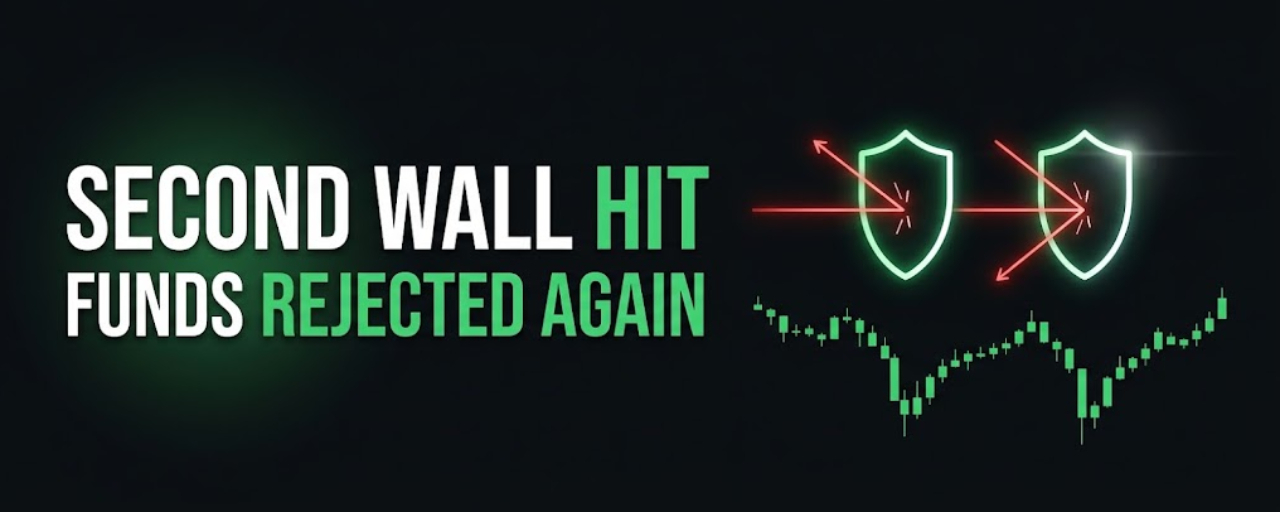
Bitget's Stolen Funds Just Hit a Second Wall: Chainflip Rejects the Laundering AttemptAfter THORChain faced scrutiny, the attacker tried a different route and got blocked again. Here's what changed, and what it means for the THORChain debate.
🧱 One rejection could be a fluke. Two, from two different protocols, starts to look like a pattern.
MistTrack reports that the Bitget attacker tried moving stolen funds through Chainflip, another cross-chain protocol, and the deposit was rejected. The broker returned the funds. The transfer never completed.
🔄 Here's why these matters alongside the THORChain story.
Remember the debate we covered earlier, whether a decentralized protocol can or should refuse known stolen funds? THORChain faced exactly that question after roughly 101.5 BTC and significant XRP from the Bitget hack moved through its network. Now, the attacker appears to have pivoted to a different protocol entirely and got blocked there too.
🧠 Here's what that pivot actually tells you.
If the attacker is trying multiple protocols rather than sticking with one, that suggests increasing difficulty finding a clean path to launder these funds. Security firms and protocols are actively watching flagged addresses in real time, and at least this attempt got caught before completing. That's meaningfully different from funds successfully moving through without friction.
MistTrack also noted something important, the funds weren't frozen, just rejected and returned. That's a subtle but real distinction. The protocol didn't claw back already-laundered funds, it simply declined to process a flagged deposit before the transaction went through. That's a lower bar than the "should protocols freeze funds after the fact" debate, but it's still a meaningful layer of defense.
✅ What this means for you
If you're following the THORChain story, this adds useful context, the broader ecosystem of cross-chain protocols isn't uniformly permissive. Some are actively rejecting known flagged transactions at the point of attempted entry, even if the debate about freezing already-moved funds remains unresolved.
If you're a Bitget user still waiting on your situation, this is incrementally good news, every successful block reduces how much of the stolen total the attacker can successfully launder and potentially cash out.
If you're trying to understand how crypto crime actually gets fought in practice, this is a good real-world example, it's rarely a single dramatic freeze, it's usually a series of smaller wins, a rejected deposit here, a flagged address there, that collectively make laundering harder over time.
🟢 Best case going forward
More protocols continue rejecting flagged transactions in real time, the attacker finds fewer and fewer viable paths to launder the stolen funds, and a larger portion of the total loss becomes effectively unusable to them.
🔴 Risk scenario
The attacker eventually finds a protocol or method without the same monitoring and successfully launders a meaningful portion of the remaining stolen funds despite these early blocks.
👀 Three things to watch
1️⃣ Further laundering attempts
Does the attacker try additional protocols, and do those also result in rejections?
2️⃣ Bitget's official incident report
Does the promised root-cause analysis get published with full technical detail on how the breach happened?
3️⃣ Total recovered or blocked funds
Does tracking data show a growing percentage of the stolen total being successfully stopped versus successfully laundered?
💡 The key takeaway
A single rejected transaction doesn't resolve a 387-million-dollar hack. But it is a genuinely encouraging data point, multiple protocols independently declining to process funds tied to a known breach suggests real monitoring infrastructure is working, even without a formal, coordinated freeze.
The question from the original THORChain debate, what does a decentralized protocol owe victims of theft, still doesn't have a clean answer. But this at least shows some parts of the ecosystem are choosing caution over neutrality when flagged funds show up at their door.
That is the part worth watching.
This post is for informational and educational purposes only and is not financial advice. Crypto markets are volatile. Always conduct your own research before making financial decisions.
#BinanceSquare #Bitget #CryptoSecurity #Chainflip #Crypto
{spot}(RUNEUSDT)
Bitget's Stolen Funds Just Hit a Second Wall: Chainflip Rejects the Laundering Attempt
After THORChain faced scrutiny, the attacker tried a different route and got blocked again. Here's what changed, and what it means for the THORChain debate.
🧱 One rejection could be a fluke. Two, from two different protocols, starts to look like a pattern.
MistTrack reports that the Bitget attacker tried moving stolen funds through Chainflip, another cross-chain protocol, and the deposit was rejected. The broker returned the funds. The transfer never completed.
🔄 Here's why these matters alongside the THORChain story.
Remember the debate we covered earlier, whether a decentralized protocol can or should refuse known stolen funds? THORChain faced exactly that question after roughly 101.5 BTC and significant XRP from the Bitget hack moved through its network. Now, the attacker appears to have pivoted to a different protocol entirely and got blocked there too.
🧠 Here's what that pivot actually tells you.
If the attacker is trying multiple protocols rather than sticking with one, that suggests increasing difficulty finding a clean path to launder these funds. Security firms and protocols are actively watching flagged addresses in real time, and at least this attempt got caught before completing. That's meaningfully different from funds successfully moving through without friction.
MistTrack also noted something important, the funds weren't frozen, just rejected and returned. That's a subtle but real distinction. The protocol didn't claw back already-laundered funds, it simply declined to process a flagged deposit before the transaction went through. That's a lower bar than the "should protocols freeze funds after the fact" debate, but it's still a meaningful layer of defense.
✅ What this means for you
If you're following the THORChain story, this adds useful context, the broader ecosystem of cross-chain protocols isn't uniformly permissive. Some are actively rejecting known flagged transactions at the point of attempted entry, even if the debate about freezing already-moved funds remains unresolved.
If you're a Bitget user still waiting on your situation, this is incrementally good news, every successful block reduces how much of the stolen total the attacker can successfully launder and potentially cash out.
If you're trying to understand how crypto crime actually gets fought in practice, this is a good real-world example, it's rarely a single dramatic freeze, it's usually a series of smaller wins, a rejected deposit here, a flagged address there, that collectively make laundering harder over time.
🟢 Best case going forward
More protocols continue rejecting flagged transactions in real time, the attacker finds fewer and fewer viable paths to launder the stolen funds, and a larger portion of the total loss becomes effectively unusable to them.
🔴 Risk scenario
The attacker eventually finds a protocol or method without the same monitoring and successfully launders a meaningful portion of the remaining stolen funds despite these early blocks.
👀 Three things to watch
1️⃣ Further laundering attempts
Does the attacker try additional protocols, and do those also result in rejections?
2️⃣ Bitget's official incident report
Does the promised root-cause analysis get published with full technical detail on how the breach happened?
3️⃣ Total recovered or blocked funds
Does tracking data show a growing percentage of the stolen total being successfully stopped versus successfully laundered?
💡 The key takeaway
A single rejected transaction doesn't resolve a 387-million-dollar hack. But it is a genuinely encouraging data point, multiple protocols independently declining to process funds tied to a known breach suggests real monitoring infrastructure is working, even without a formal, coordinated freeze.
The question from the original THORChain debate, what does a decentralized protocol owe victims of theft, still doesn't have a clean answer. But this at least shows some parts of the ecosystem are choosing caution over neutrality when flagged funds show up at their door.
That is the part worth watching.
This post is for informational and educational purposes only and is not financial advice. Crypto markets are volatile. Always conduct your own research before making financial decisions.
#BinanceSquare #Bitget #CryptoSecurity #Chainflip #Crypto
🧱 One rejection could be a fluke. Two, from two different protocols, starts to look like a pattern.
MistTrack reports that the Bitget attacker tried moving stolen funds through Chainflip, another cross-chain protocol, and the deposit was rejected. The broker returned the funds. The transfer never completed.
🔄 Here's why these matters alongside the THORChain story.
Remember the debate we covered earlier, whether a decentralized protocol can or should refuse known stolen funds? THORChain faced exactly that question after roughly 101.5 BTC and significant XRP from the Bitget hack moved through its network. Now, the attacker appears to have pivoted to a different protocol entirely and got blocked there too.
🧠 Here's what that pivot actually tells you.
If the attacker is trying multiple protocols rather than sticking with one, that suggests increasing difficulty finding a clean path to launder these funds. Security firms and protocols are actively watching flagged addresses in real time, and at least this attempt got caught before completing. That's meaningfully different from funds successfully moving through without friction.
MistTrack also noted something important, the funds weren't frozen, just rejected and returned. That's a subtle but real distinction. The protocol didn't claw back already-laundered funds, it simply declined to process a flagged deposit before the transaction went through. That's a lower bar than the "should protocols freeze funds after the fact" debate, but it's still a meaningful layer of defense.
✅ What this means for you
If you're following the THORChain story, this adds useful context, the broader ecosystem of cross-chain protocols isn't uniformly permissive. Some are actively rejecting known flagged transactions at the point of attempted entry, even if the debate about freezing already-moved funds remains unresolved.
If you're a Bitget user still waiting on your situation, this is incrementally good news, every successful block reduces how much of the stolen total the attacker can successfully launder and potentially cash out.
If you're trying to understand how crypto crime actually gets fought in practice, this is a good real-world example, it's rarely a single dramatic freeze, it's usually a series of smaller wins, a rejected deposit here, a flagged address there, that collectively make laundering harder over time.
🟢 Best case going forward
More protocols continue rejecting flagged transactions in real time, the attacker finds fewer and fewer viable paths to launder the stolen funds, and a larger portion of the total loss becomes effectively unusable to them.
🔴 Risk scenario
The attacker eventually finds a protocol or method without the same monitoring and successfully launders a meaningful portion of the remaining stolen funds despite these early blocks.
👀 Three things to watch
1️⃣ Further laundering attempts
Does the attacker try additional protocols, and do those also result in rejections?
2️⃣ Bitget's official incident report
Does the promised root-cause analysis get published with full technical detail on how the breach happened?
3️⃣ Total recovered or blocked funds
Does tracking data show a growing percentage of the stolen total being successfully stopped versus successfully laundered?
💡 The key takeaway
A single rejected transaction doesn't resolve a 387-million-dollar hack. But it is a genuinely encouraging data point, multiple protocols independently declining to process funds tied to a known breach suggests real monitoring infrastructure is working, even without a formal, coordinated freeze.
The question from the original THORChain debate, what does a decentralized protocol owe victims of theft, still doesn't have a clean answer. But this at least shows some parts of the ecosystem are choosing caution over neutrality when flagged funds show up at their door.
That is the part worth watching.
This post is for informational and educational purposes only and is not financial advice. Crypto markets are volatile. Always conduct your own research before making financial decisions.
#BinanceSquare #Bitget #CryptoSecurity #Chainflip #Crypto
1
1
190

·
--
Bullish
Bitget Security Breach Update
Bitget reportedly experienced a security breach that resulted in approximately $388 million in user-fund losses. CEO Gracy Chen said the platform’s Protection Fund had reached $309 million to help cover incident-related costs.
Withdrawals for $BTC , $ETH , and $USDT have reportedly resumed, while withdrawals for all remaining tokens are expected to be fully restored by Friday.
#Bitget #XRPHACKED #CryptoNewss #GracyChen #CryptoProtection
{spot}(BTCUSDT)
{spot}(ETHUSDT)
{spot}(BNBUSDT)
Bitget Security Breach Update
Bitget reportedly experienced a security breach that resulted in approximately $388 million in user-fund losses. CEO Gracy Chen said the platform’s Protection Fund had reached $309 million to help cover incident-related costs.
Withdrawals for $BTC , $ETH , and $USDT have reportedly resumed, while withdrawals for all remaining tokens are expected to be fully restored by Friday.
#Bitget #XRPHACKED #CryptoNewss #GracyChen #CryptoProtection
Bitget reportedly experienced a security breach that resulted in approximately $388 million in user-fund losses. CEO Gracy Chen said the platform’s Protection Fund had reached $309 million to help cover incident-related costs.
Withdrawals for $BTC , $ETH , and $USDT have reportedly resumed, while withdrawals for all remaining tokens are expected to be fully restored by Friday.
#Bitget #XRPHACKED #CryptoNewss #GracyChen #CryptoProtection
52

·
--
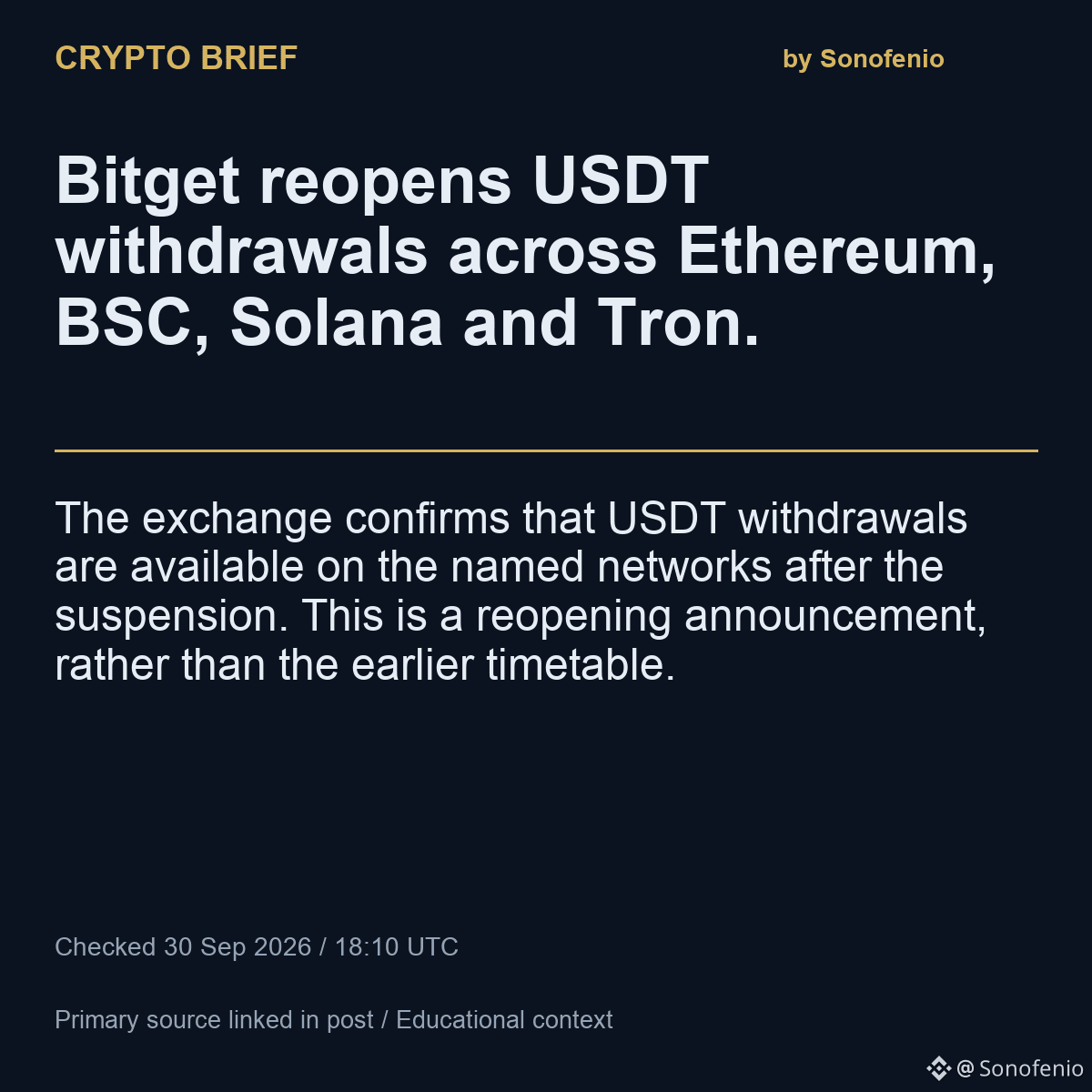
📰 Bitget reopens USDT withdrawals across Ethereum, BSC, Solana and Tron.
🔎 The exchange confirms that USDT withdrawals are available on the named networks after the suspension. This is a reopening announcement, rather than the earlier timetable.
💡 The route matters as much as the token: match the withdrawal network to the receiving wallet. This notice does not confirm that every other asset has reopened.
🔗 Source: https://www.bitget.com/support/articles/12560603896191
#USDT #Bitget #CryptoNews
📰 Bitget reopens USDT withdrawals across Ethereum, BSC, Solana and Tron.
🔎 The exchange confirms that USDT withdrawals are available on the named networks after the suspension. This is a reopening announcement, rather than the earlier timetable.
💡 The route matters as much as the token: match the withdrawal network to the receiving wallet. This notice does not confirm that every other asset has reopened.
🔗 Source: https://www.bitget.com/support/articles/12560603896191
#USDT #Bitget #CryptoNews
🔎 The exchange confirms that USDT withdrawals are available on the named networks after the suspension. This is a reopening announcement, rather than the earlier timetable.
💡 The route matters as much as the token: match the withdrawal network to the receiving wallet. This notice does not confirm that every other asset has reopened.
🔗 Source: https://www.bitget.com/support/articles/12560603896191
#USDT #Bitget #CryptoNews
91
·
--
🔷 Bitget is getting back to normal — but the real test is still ahead.
After the $388M breach, withdrawals are being restored and the Protection Fund has reached $309M.
But recovery ≠ resolution.
~$3.8M in stolen $ZEC was reportedly moved into Ironwood, showing that the fund-tracing process is still active.
The next signal to watch isn’t just withdrawals reopening.
It’s how much of the stolen funds can actually be recovered — and whether confidence fully returns.
#Bitget #CryptoSecurity #ZEC $ZEC
🔷 Bitget is getting back to normal — but the real test is still ahead.
After the $388M breach, withdrawals are being restored and the Protection Fund has reached $309M.
But recovery ≠ resolution.
~$3.8M in stolen $ZEC was reportedly moved into Ironwood, showing that the fund-tracing process is still active.
The next signal to watch isn’t just withdrawals reopening.
It’s how much of the stolen funds can actually be recovered — and whether confidence fully returns.
#Bitget #CryptoSecurity #ZEC $ZEC
After the $388M breach, withdrawals are being restored and the Protection Fund has reached $309M.
But recovery ≠ resolution.
~$3.8M in stolen $ZEC was reportedly moved into Ironwood, showing that the fund-tracing process is still active.
The next signal to watch isn’t just withdrawals reopening.
It’s how much of the stolen funds can actually be recovered — and whether confidence fully returns.
#Bitget #CryptoSecurity #ZEC $ZEC
1
225

·
--
Bearish
Bitget opened USDT withdrawals on September 30
SlowMist says the attacker was already inside on August 31, about a month before the theft
a zero-day in a third-party security product, the database password read straight out of it
the tool that drained the wallets forged risk-control parameters, built the withdrawal requests and ran them
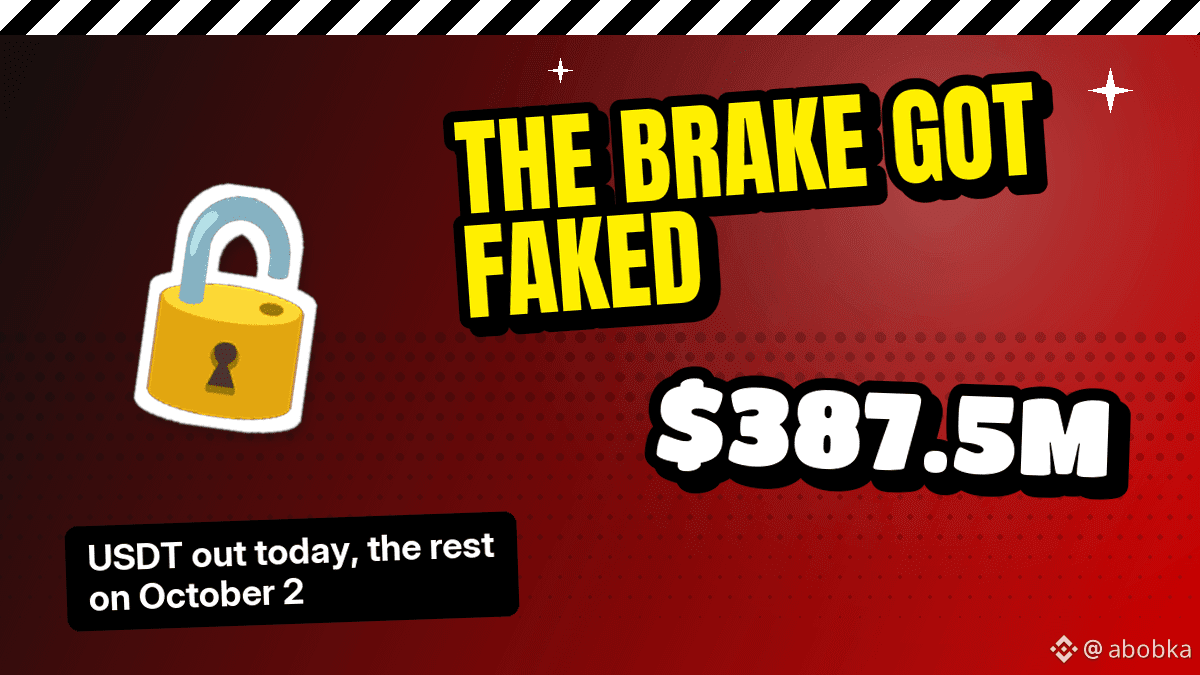
so the part built to say "no" was the part that got faked
🔸 USDT: Ethereum, BSC, Solana, Tron
🔸 other tokens, fiat, P2P: October 2, 08:00 UTC
the CEO herself says freezing isn't recovery. she's not optimistic, neither am I
last week I promised a report on my own balance there. it still hasn't left the exchange, and the next update on it lands here, so follow if you're in the same line
#Bitget #HackUpdate #BitgetHotWalletBreachTiedToThirdPartySecurityFlaw
Bitget opened USDT withdrawals on September 30
SlowMist says the attacker was already inside on August 31, about a month before the theft
a zero-day in a third-party security product, the database password read straight out of it
the tool that drained the wallets forged risk-control parameters, built the withdrawal requests and ran them
so the part built to say "no" was the part that got faked
🔸 USDT: Ethereum, BSC, Solana, Tron
🔸 other tokens, fiat, P2P: October 2, 08:00 UTC
the CEO herself says freezing isn't recovery. she's not optimistic, neither am I
last week I promised a report on my own balance there. it still hasn't left the exchange, and the next update on it lands here, so follow if you're in the same line
#Bitget #HackUpdate #BitgetHotWalletBreachTiedToThirdPartySecurityFlaw
SlowMist says the attacker was already inside on August 31, about a month before the theft
a zero-day in a third-party security product, the database password read straight out of it
the tool that drained the wallets forged risk-control parameters, built the withdrawal requests and ran them
so the part built to say "no" was the part that got faked
🔸 USDT: Ethereum, BSC, Solana, Tron
🔸 other tokens, fiat, P2P: October 2, 08:00 UTC
the CEO herself says freezing isn't recovery. she's not optimistic, neither am I
last week I promised a report on my own balance there. it still hasn't left the exchange, and the next update on it lands here, so follow if you're in the same line
#Bitget #HackUpdate #BitgetHotWalletBreachTiedToThirdPartySecurityFlaw
3
49

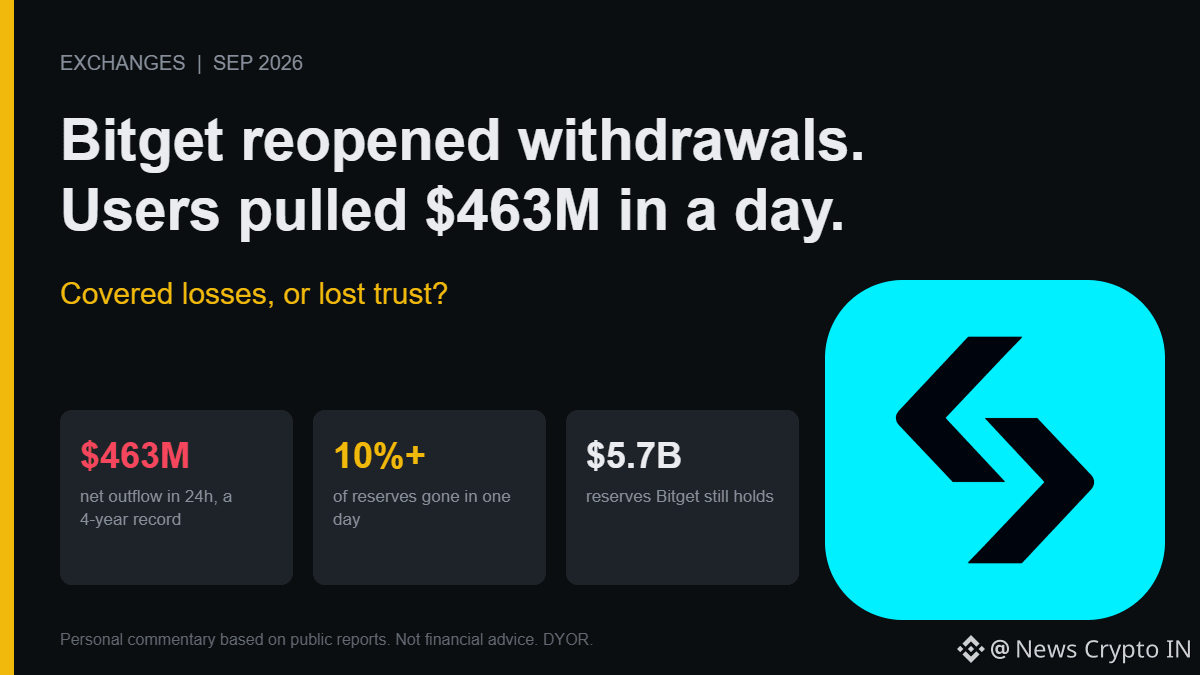
Bitget promised users they'd be made whole after the $387.5M hack. Then it reopened withdrawals, and users pulled $463M in 24 hours anyway.
That's the largest single-day outflow DefiLlama has recorded since it started tracking exchange proof-of-reserves four years ago. It's more than 10% of Bitget's reserves gone in one day. The exchange still holds about $5.7B, so this isn't insolvency, but it's a clear vote of no confidence.
Here's the part worth sitting with: the user losses were covered. Bitget's Protection Fund absorbed the hack. Nobody's balance was touched. And people left anyway, in greater numbers than the hack itself.
That's the real cost of a security breach. Not the stolen amount, but the trust. The Protection Fund has been drawn down and Bitget says it plans to top it back above $300M within seven days. Until then, the safety net that made users whole this time is thinner than it was a week ago.
Exchanges market insurance funds as "your money is safe here." The market just showed that users read a hack as a reason to leave, even when the fund works exactly as advertised.
If a fully covered hack still triggers a record run, what is an exchange insurance fund actually buying?
#Bitget #ProofOfReserves
Bitget promised users they'd be made whole after the $387.5M hack. Then it reopened withdrawals, and users pulled $463M in 24 hours anyway.
That's the largest single-day outflow DefiLlama has recorded since it started tracking exchange proof-of-reserves four years ago. It's more than 10% of Bitget's reserves gone in one day. The exchange still holds about $5.7B, so this isn't insolvency, but it's a clear vote of no confidence.
Here's the part worth sitting with: the user losses were covered. Bitget's Protection Fund absorbed the hack. Nobody's balance was touched. And people left anyway, in greater numbers than the hack itself.
That's the real cost of a security breach. Not the stolen amount, but the trust. The Protection Fund has been drawn down and Bitget says it plans to top it back above $300M within seven days. Until then, the safety net that made users whole this time is thinner than it was a week ago.
Exchanges market insurance funds as "your money is safe here." The market just showed that users read a hack as a reason to leave, even when the fund works exactly as advertised.
If a fully covered hack still triggers a record run, what is an exchange insurance fund actually buying?
#Bitget #ProofOfReserves
That's the largest single-day outflow DefiLlama has recorded since it started tracking exchange proof-of-reserves four years ago. It's more than 10% of Bitget's reserves gone in one day. The exchange still holds about $5.7B, so this isn't insolvency, but it's a clear vote of no confidence.
Here's the part worth sitting with: the user losses were covered. Bitget's Protection Fund absorbed the hack. Nobody's balance was touched. And people left anyway, in greater numbers than the hack itself.
That's the real cost of a security breach. Not the stolen amount, but the trust. The Protection Fund has been drawn down and Bitget says it plans to top it back above $300M within seven days. Until then, the safety net that made users whole this time is thinner than it was a week ago.
Exchanges market insurance funds as "your money is safe here." The market just showed that users read a hack as a reason to leave, even when the fund works exactly as advertised.
If a fully covered hack still triggers a record run, what is an exchange insurance fund actually buying?
#Bitget #ProofOfReserves
2
3.8k
·
--
🚨 $387.5M Stolen: The Real Test for Bitget Begins Now!
After suffering a massive $387.5M breach, Bitget responded fast: ✅ Fixed the attack vulnerability ✅ Cold wallets remained safe ✅ Covered losses with their $464M Protection Fund ✅ Phased restoration of withdrawals (BTC first)
The Big Question: Losing funds hurts a balance sheet, but losing trust hurts everything.
Can Bitget fully regain user trust and prevent capital flight as withdrawals resume? 👇
What’s your move? Are you keeping your funds on Bitget or withdrawing? Let us know below! 👇
$BTC
{spot}(BTCUSDT)
#Bitget #BTC #CryptoNews #BinanceSquar #CryptoSecurity
🚨 $387.5M Stolen: The Real Test for Bitget Begins Now!
After suffering a massive $387.5M breach, Bitget responded fast: ✅ Fixed the attack vulnerability ✅ Cold wallets remained safe ✅ Covered losses with their $464M Protection Fund ✅ Phased restoration of withdrawals (BTC first)
The Big Question: Losing funds hurts a balance sheet, but losing trust hurts everything.
Can Bitget fully regain user trust and prevent capital flight as withdrawals resume? 👇
What’s your move? Are you keeping your funds on Bitget or withdrawing? Let us know below! 👇
$BTC
#Bitget #BTC #CryptoNews #BinanceSquar #CryptoSecurity
After suffering a massive $387.5M breach, Bitget responded fast: ✅ Fixed the attack vulnerability ✅ Cold wallets remained safe ✅ Covered losses with their $464M Protection Fund ✅ Phased restoration of withdrawals (BTC first)
The Big Question: Losing funds hurts a balance sheet, but losing trust hurts everything.
Can Bitget fully regain user trust and prevent capital flight as withdrawals resume? 👇
What’s your move? Are you keeping your funds on Bitget or withdrawing? Let us know below! 👇
$BTC
#Bitget #BTC #CryptoNews #BinanceSquar #CryptoSecurity
44

·
--
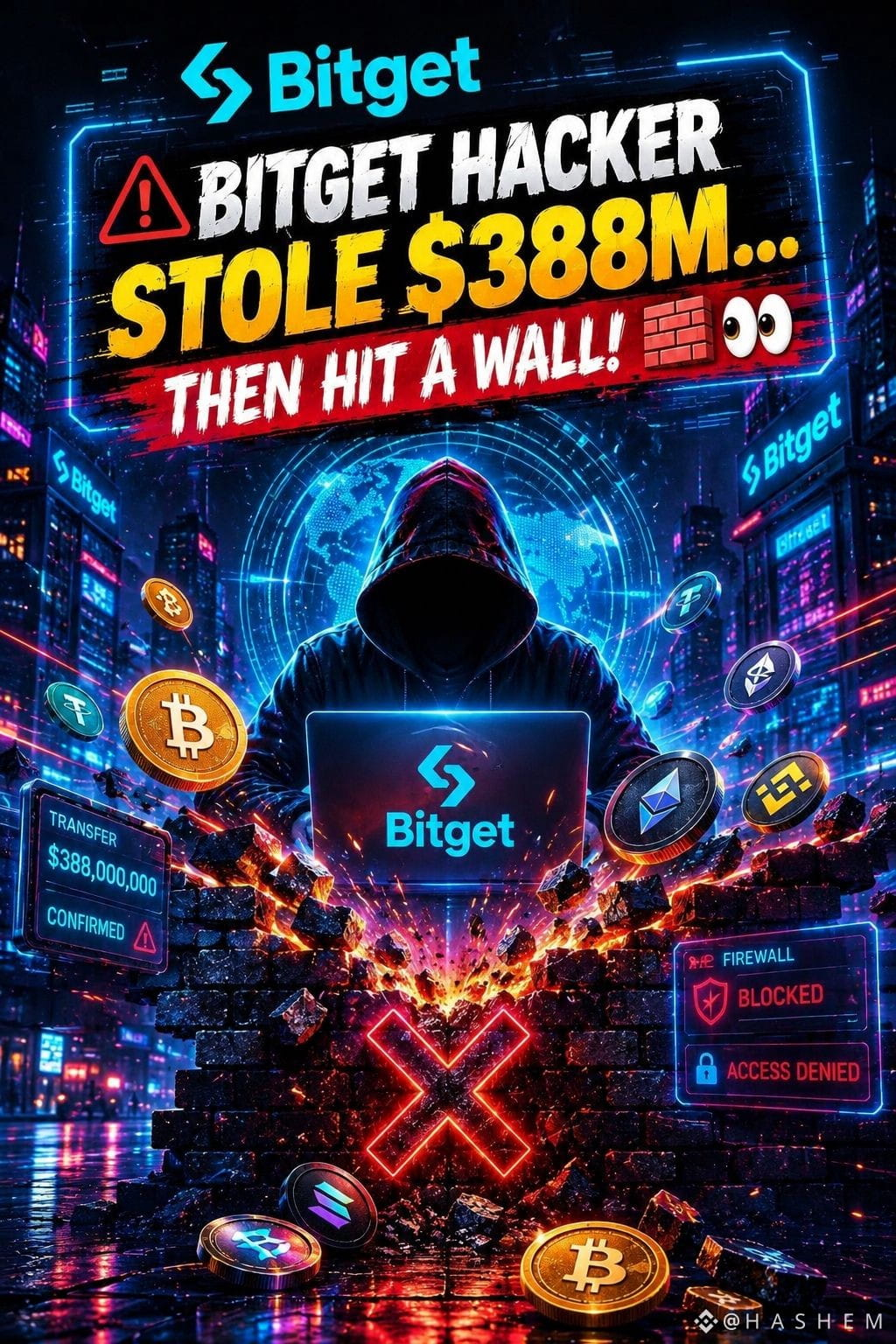
$BTC $SOL $BNB 🚨 $388M STOLEN… BUT THE MONEY ISN’T FREE TO MOVE. 🧱👀
The Bitget security incident reportedly saw around $387.5M moved to attacker-controlled wallets.
But now, the story is getting much more interesting. 👀
The hacker may control the wallets…
but controlling crypto is NOT the same as being able to cash it out.
🔎 On-chain investigators are tracking the funds.
🚫 Some movement attempts are reportedly being rejected.
🔒 Suspicious flows can face restrictions from crypto infrastructure providers.
👀 Every bridge, swap, deposit and transfer can leave another trace.
One notable attempt involving roughly 100 SOL through Chainflip was reportedly rejected by the broker, with the funds returned to the originating wallet.
That changes the narrative:
❌ Hack → Steal → Escape
➡️ Instead:
💰 Stolen Funds
↓
🔎 On-Chain Tracking
↓
🚨 Detection
↓
🚫 Rejections / Restrictions
↓
👀 Increasing Pressure
Bitget has said the incident affected approximately $387.5M, while recovery and investigation efforts continue. Withdrawals have also been restored in phases following the incident.
And here’s the bigger question:
Can stolen crypto really be moved freely when the entire ecosystem is watching the wallets? 👀
The hacker might hold the private keys…
But converting those assets into usable money is a completely different challenge.
Every transaction can create another trail.
Every bridge can become another checkpoint.
Every exchange or service can potentially become another barrier.
🔥 $388M stolen.
🔎 Wallets being tracked.
🚫 Movement attempts facing resistance.
🧱 The ecosystem is watching.
So what happens next?
Can the hacker successfully move the remaining funds — or will the stolen assets become increasingly difficult to realize? 👀
#Bitget #Crypto #Bitcoin #Ethereum #Solana #Blockchain #CryptoSecurity #Web3 #CryptoNews #OnChain
{spot}(BNBUSDT)
{spot}(SOLUSDT)
{spot}(ETHUSDT)
$BTC $SOL $BNB 🚨 $388M STOLEN… BUT THE MONEY ISN’T FREE TO MOVE. 🧱👀
The Bitget security incident reportedly saw around $387.5M moved to attacker-controlled wallets.
But now, the story is getting much more interesting. 👀
The hacker may control the wallets…
but controlling crypto is NOT the same as being able to cash it out.
🔎 On-chain investigators are tracking the funds.
🚫 Some movement attempts are reportedly being rejected.
🔒 Suspicious flows can face restrictions from crypto infrastructure providers.
👀 Every bridge, swap, deposit and transfer can leave another trace.
One notable attempt involving roughly 100 SOL through Chainflip was reportedly rejected by the broker, with the funds returned to the originating wallet.
That changes the narrative:
❌ Hack → Steal → Escape
➡️ Instead:
💰 Stolen Funds
↓
🔎 On-Chain Tracking
↓
🚨 Detection
↓
🚫 Rejections / Restrictions
↓
👀 Increasing Pressure
Bitget has said the incident affected approximately $387.5M, while recovery and investigation efforts continue. Withdrawals have also been restored in phases following the incident.
And here’s the bigger question:
Can stolen crypto really be moved freely when the entire ecosystem is watching the wallets? 👀
The hacker might hold the private keys…
But converting those assets into usable money is a completely different challenge.
Every transaction can create another trail.
Every bridge can become another checkpoint.
Every exchange or service can potentially become another barrier.
🔥 $388M stolen.
🔎 Wallets being tracked.
🚫 Movement attempts facing resistance.
🧱 The ecosystem is watching.
So what happens next?
Can the hacker successfully move the remaining funds — or will the stolen assets become increasingly difficult to realize? 👀
#Bitget #Crypto #Bitcoin #Ethereum #Solana #Blockchain #CryptoSecurity #Web3 #CryptoNews #OnChain
The Bitget security incident reportedly saw around $387.5M moved to attacker-controlled wallets.
But now, the story is getting much more interesting. 👀
The hacker may control the wallets…
but controlling crypto is NOT the same as being able to cash it out.
🔎 On-chain investigators are tracking the funds.
🚫 Some movement attempts are reportedly being rejected.
🔒 Suspicious flows can face restrictions from crypto infrastructure providers.
👀 Every bridge, swap, deposit and transfer can leave another trace.
One notable attempt involving roughly 100 SOL through Chainflip was reportedly rejected by the broker, with the funds returned to the originating wallet.
That changes the narrative:
❌ Hack → Steal → Escape
➡️ Instead:
💰 Stolen Funds
↓
🔎 On-Chain Tracking
↓
🚨 Detection
↓
🚫 Rejections / Restrictions
↓
👀 Increasing Pressure
Bitget has said the incident affected approximately $387.5M, while recovery and investigation efforts continue. Withdrawals have also been restored in phases following the incident.
And here’s the bigger question:
Can stolen crypto really be moved freely when the entire ecosystem is watching the wallets? 👀
The hacker might hold the private keys…
But converting those assets into usable money is a completely different challenge.
Every transaction can create another trail.
Every bridge can become another checkpoint.
Every exchange or service can potentially become another barrier.
🔥 $388M stolen.
🔎 Wallets being tracked.
🚫 Movement attempts facing resistance.
🧱 The ecosystem is watching.
So what happens next?
Can the hacker successfully move the remaining funds — or will the stolen assets become increasingly difficult to realize? 👀
#Bitget #Crypto #Bitcoin #Ethereum #Solana #Blockchain #CryptoSecurity #Web3 #CryptoNews #OnChain
120

·
--
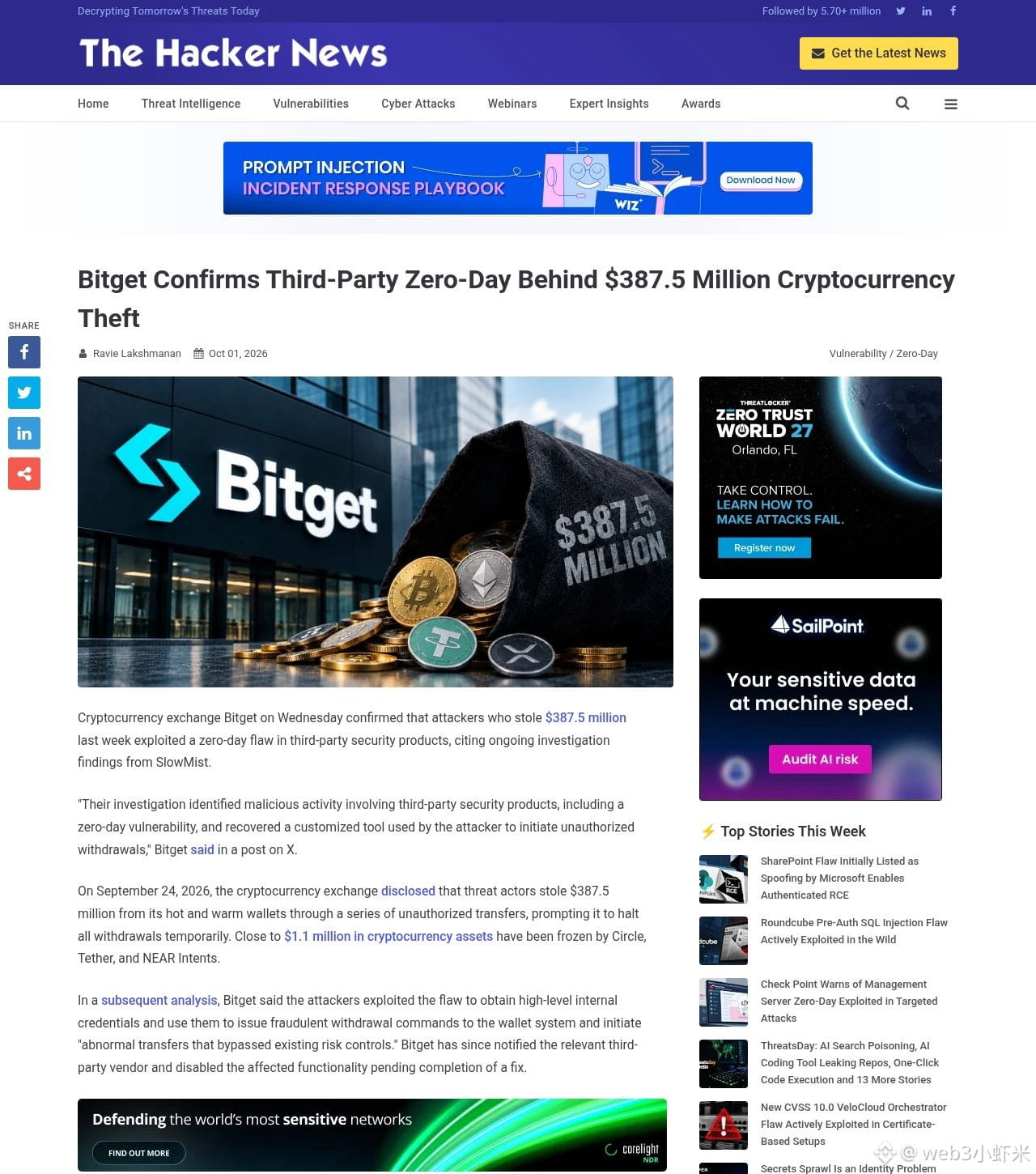
Hit The Hacker News: Bitget confirms approximately $387.5 million stolen; the investigation points to zero-day exploitation of two third-party security products—after attackers obtain high-privilege internal credentials, they use custom tools to forge risk-control parameters, bypassing the normal withdrawal process to move hot/warm wallet assets.
Reports from Mandiant and SlowMist say the earliest malicious activity dates back to August 31; on September 24, a large transfer was carried out. It affected around 11 chains, including Ethereum, XRPL, Zcash, and TRON. So far, Circle, Tether, NEAR Intents, and others have collectively frozen about $1.1 million, which is still relatively small compared with the overall amount.
Once the third-party security stack is breached, the exchange’s own hot-wallet process is likely to fall too—on the supply-chain front, things will probably get scrutinized even more going forward.
#Bitget #crypto security
Hit The Hacker News: Bitget confirms approximately $387.5 million stolen; the investigation points to zero-day exploitation of two third-party security products—after attackers obtain high-privilege internal credentials, they use custom tools to forge risk-control parameters, bypassing the normal withdrawal process to move hot/warm wallet assets.
Reports from Mandiant and SlowMist say the earliest malicious activity dates back to August 31; on September 24, a large transfer was carried out. It affected around 11 chains, including Ethereum, XRPL, Zcash, and TRON. So far, Circle, Tether, NEAR Intents, and others have collectively frozen about $1.1 million, which is still relatively small compared with the overall amount.
Once the third-party security stack is breached, the exchange’s own hot-wallet process is likely to fall too—on the supply-chain front, things will probably get scrutinized even more going forward.
#Bitget #crypto security
Reports from Mandiant and SlowMist say the earliest malicious activity dates back to August 31; on September 24, a large transfer was carried out. It affected around 11 chains, including Ethereum, XRPL, Zcash, and TRON. So far, Circle, Tether, NEAR Intents, and others have collectively frozen about $1.1 million, which is still relatively small compared with the overall amount.
Once the third-party security stack is breached, the exchange’s own hot-wallet process is likely to fall too—on the supply-chain front, things will probably get scrutinized even more going forward.
#Bitget #crypto security
1
605

$US
{future}(USUSDT)
$GTC
{future}(GTCUSDT)
$CT
{future}(CTUSDT)
🚨 Bitget hack reveals new details
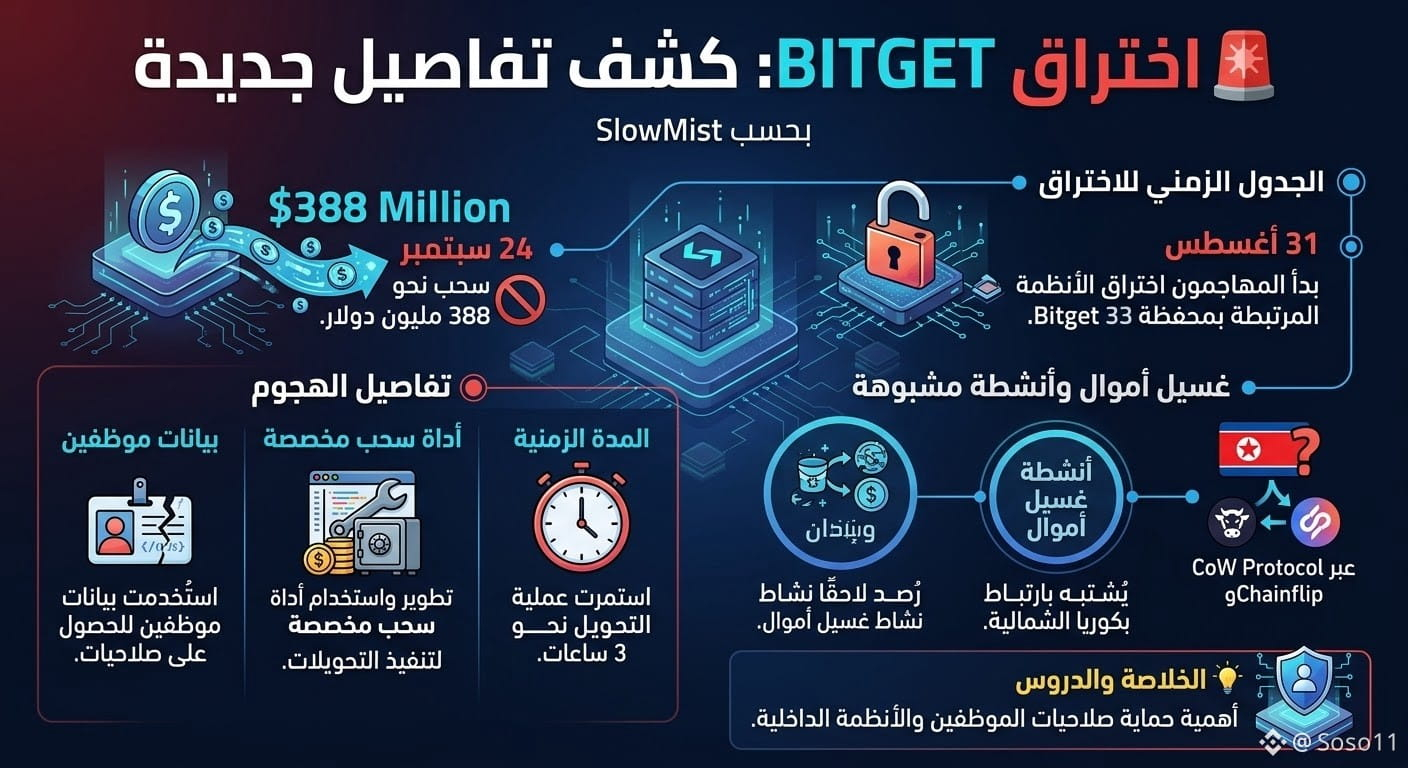
According to SlowMist, the attackers started infiltrating systems associated with the Bitget wallet on August 31, weeks before the withdrawal of nearly $388 million on September 24.
🔹 Employee credentials and a custom withdrawal tool were used
🔹 The transfer process lasted about 3 hours
🔹 Later, money-laundering activity suspected to be linked to North Korea was detected via CoW Protocol and Chainflip.
💡 The hack once again highlights the importance of protecting employee permissions and internal systems.
#Bitget
#Crypto
#Bitcoin
#Blockchain
#SlowMist
$US
$GTC
$CT
🚨 Bitget hack reveals new details
According to SlowMist, the attackers started infiltrating systems associated with the Bitget wallet on August 31, weeks before the withdrawal of nearly $388 million on September 24.
🔹 Employee credentials and a custom withdrawal tool were used
🔹 The transfer process lasted about 3 hours
🔹 Later, money-laundering activity suspected to be linked to North Korea was detected via CoW Protocol and Chainflip.
💡 The hack once again highlights the importance of protecting employee permissions and internal systems.
#Bitget
#Crypto
#Bitcoin
#Blockchain
#SlowMist
$GTC
$CT
🚨 Bitget hack reveals new details
According to SlowMist, the attackers started infiltrating systems associated with the Bitget wallet on August 31, weeks before the withdrawal of nearly $388 million on September 24.
🔹 Employee credentials and a custom withdrawal tool were used
🔹 The transfer process lasted about 3 hours
🔹 Later, money-laundering activity suspected to be linked to North Korea was detected via CoW Protocol and Chainflip.
💡 The hack once again highlights the importance of protecting employee permissions and internal systems.
#Bitget
#Crypto
#Bitcoin
#Blockchain
#SlowMist
379

🚨 Efforts to transfer stolen assets from the Bitget platform are turning toward privacy protocols
Reports indicate that the person involved in the Bitget platform hack incident is trying to conceal part of the stolen assets through privacy pools associated with the Zcash cryptocurrency, after attempts to move these funds via other exchange protocols were rejected. These steps are part of ongoing efforts to track the stolen assets.
━━━━━━━━━━━━━━
📊 Impact: 📈 High
🏷️ EXCHANGE
#Bitget #Security #Blockchain #Privacy #CryptoNews
📰 Source: decrypt.co
🚨 Efforts to transfer stolen assets from the Bitget platform are turning toward privacy protocols
Reports indicate that the person involved in the Bitget platform hack incident is trying to conceal part of the stolen assets through privacy pools associated with the Zcash cryptocurrency, after attempts to move these funds via other exchange protocols were rejected. These steps are part of ongoing efforts to track the stolen assets.
━━━━━━━━━━━━━━
📊 Impact: 📈 High
🏷️ EXCHANGE
#Bitget #Security #Blockchain #Privacy #CryptoNews
📰 Source: decrypt.co
Reports indicate that the person involved in the Bitget platform hack incident is trying to conceal part of the stolen assets through privacy pools associated with the Zcash cryptocurrency, after attempts to move these funds via other exchange protocols were rejected. These steps are part of ongoing efforts to track the stolen assets.
━━━━━━━━━━━━━━
📊 Impact: 📈 High
🏷️ EXCHANGE
#Bitget #Security #Blockchain #Privacy #CryptoNews
📰 Source: decrypt.co
6

·
--
Article
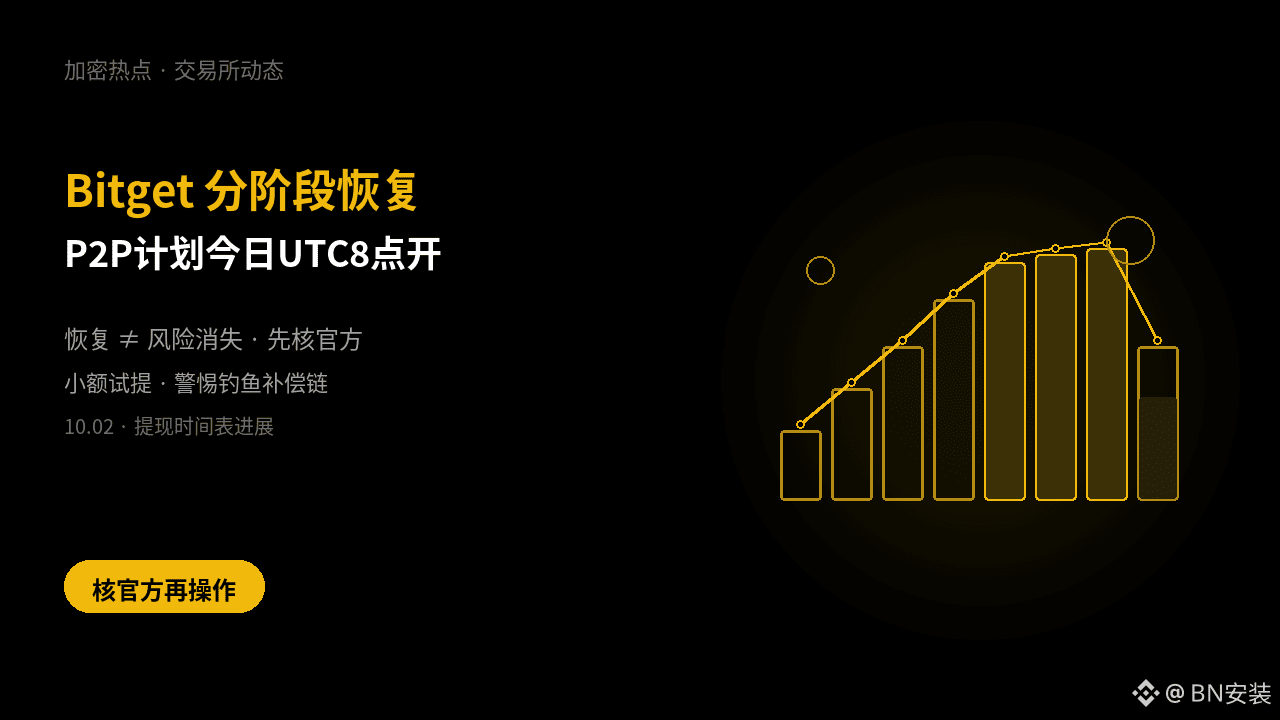
Bitget plans to resume P2P withdrawals on 10/2: restoration ≠ risk is goneAfter the Bitget security incident on Sept 24, withdrawals were restored in phases according to the official announcement; on Oct 2 at 08:00 UTC (about 16:00 Beijing time), other tokens, fiat, and P2P will be opened. The core message in one sentence only: withdrawals are proceeding according to the schedule ≠ the risk is gone—still verify with official sources, test with a small withdrawal first, and stay away from “compensation/unfreeze” phishing links.
[How to read the phased timetable—what step opens today]
According to Bitget’s official support page (published on 2026-09-26) UTC schedule: from Sept 28 at 08:00, BTC; from Sept 29 at 08:00, ETH and multiple EVM networks; from Sept 30 at 08:00, USDT (including Ethereum, BSC, Solana, Tron, etc.); from Oct 2 at 08:00, other tokens, fiat, and P2P. As of press time (around 12:00 noon Beijing time on Oct 2), BTC/ETH/USDT have already been advanced according to an earlier phase; the UTC 8:00 slot for today has not arrived yet—please rely on the platform’s actual withdrawable status and official channels, and do not turn the “plan” into “fully restored.”
Bitget plans to resume P2P withdrawals on 10/2: restoration ≠ risk is gone
After the Bitget security incident on Sept 24, withdrawals were restored in phases according to the official announcement; on Oct 2 at 08:00 UTC (about 16:00 Beijing time), other tokens, fiat, and P2P will be opened. The core message in one sentence only: withdrawals are proceeding according to the schedule ≠ the risk is gone—still verify with official sources, test with a small withdrawal first, and stay away from “compensation/unfreeze” phishing links.
[How to read the phased timetable—what step opens today]
According to Bitget’s official support page (published on 2026-09-26) UTC schedule: from Sept 28 at 08:00, BTC; from Sept 29 at 08:00, ETH and multiple EVM networks; from Sept 30 at 08:00, USDT (including Ethereum, BSC, Solana, Tron, etc.); from Oct 2 at 08:00, other tokens, fiat, and P2P. As of press time (around 12:00 noon Beijing time on Oct 2), BTC/ETH/USDT have already been advanced according to an earlier phase; the UTC 8:00 slot for today has not arrived yet—please rely on the platform’s actual withdrawable status and official channels, and do not turn the “plan” into “fully restored.”
[How to read the phased timetable—what step opens today]
According to Bitget’s official support page (published on 2026-09-26) UTC schedule: from Sept 28 at 08:00, BTC; from Sept 29 at 08:00, ETH and multiple EVM networks; from Sept 30 at 08:00, USDT (including Ethereum, BSC, Solana, Tron, etc.); from Oct 2 at 08:00, other tokens, fiat, and P2P. As of press time (around 12:00 noon Beijing time on Oct 2), BTC/ETH/USDT have already been advanced according to an earlier phase; the UTC 8:00 slot for today has not arrived yet—please rely on the platform’s actual withdrawable status and official channels, and do not turn the “plan” into “fully restored.”
453
🚨 Bitget platform confirms the stability of its operations after using the protection fund
Bitget platform CEO Gracy Chen stated that the company’s protection fund, which was established in 2022, absorbed the financial impact of a prior security incident that resulted in losses for users totaling $388 million. The platform also confirmed that its operations have gradually returned to normal, noting that the fund increased to $309 million.
━━━━━━━━━━━━━━
📊 Impact: 📈 High
🏷️ EXCHANGE
#Bitget #CryptoExchange #Security #Fund #Blockchain
📰 Source: cointelegraph.com
🚨 Bitget platform confirms the stability of its operations after using the protection fund
Bitget platform CEO Gracy Chen stated that the company’s protection fund, which was established in 2022, absorbed the financial impact of a prior security incident that resulted in losses for users totaling $388 million. The platform also confirmed that its operations have gradually returned to normal, noting that the fund increased to $309 million.
━━━━━━━━━━━━━━
📊 Impact: 📈 High
🏷️ EXCHANGE
#Bitget #CryptoExchange #Security #Fund #Blockchain
📰 Source: cointelegraph.com
Bitget platform CEO Gracy Chen stated that the company’s protection fund, which was established in 2022, absorbed the financial impact of a prior security incident that resulted in losses for users totaling $388 million. The platform also confirmed that its operations have gradually returned to normal, noting that the fund increased to $309 million.
━━━━━━━━━━━━━━
📊 Impact: 📈 High
🏷️ EXCHANGE
#Bitget #CryptoExchange #Security #Fund #Blockchain
📰 Source: cointelegraph.com
61
·
--
Risk management at exchanges is back at the center of the discussion following the recent security incident. Bitget has restored a $300 million backup fund after absorbing a $388 million gap, separating this cushion from users’ reserves while reopening withdrawals in a phased manner. 🛡️📉
This move is vital to restore operational trust on centralized platforms and mitigate the systemic liquidity risk. Keep a close watch on the evolution of refunds and public audits to confirm the stability of the affected assets. 📊🔍
Follow me for more rigorous analysis on security and markets. 🤝
#CryptoSecurity #Bitget #Exchange #RiskManagement $BNB
Risk management at exchanges is back at the center of the discussion following the recent security incident. Bitget has restored a $300 million backup fund after absorbing a $388 million gap, separating this cushion from users’ reserves while reopening withdrawals in a phased manner. 🛡️📉
This move is vital to restore operational trust on centralized platforms and mitigate the systemic liquidity risk. Keep a close watch on the evolution of refunds and public audits to confirm the stability of the affected assets. 📊🔍
Follow me for more rigorous analysis on security and markets. 🤝
#CryptoSecurity #Bitget #Exchange #RiskManagement $BNB
This move is vital to restore operational trust on centralized platforms and mitigate the systemic liquidity risk. Keep a close watch on the evolution of refunds and public audits to confirm the stability of the affected assets. 📊🔍
Follow me for more rigorous analysis on security and markets. 🤝
#CryptoSecurity #Bitget #Exchange #RiskManagement $BNB
43

Bitget’s follow-up after $387 million stolen: the gap isn’t private keys, but the “security products” themselvesThe biggest exchange theft case within 2026: on 10/1, the investigation has been confirmed. Key points have all been updated:
1. The breach is a zero-day vulnerability in a “third-party cybersecurity product” — this is a supply-chain attack.
The hackers didn’t steal private keys; instead, they breached two sets of third-party cybersecurity products used by Bitget (report code names Product A / B). After obtaining internal credentials with high privileges, they forged withdrawal instructions and directly bypassed risk controls. Even more concerning: the earliest intrusion can be traced back to 8/31, and it wasn’t carried out until early morning on 9/25 — they lay in wait for nearly a month, and even used tools custom-built for the withdrawal logic. The stolen funds were spread across 11 blockchain networks.
Bitget’s follow-up after $387 million stolen: the gap isn’t private keys, but the “security products” themselves
The biggest exchange theft case within 2026: on 10/1, the investigation has been confirmed. Key points have all been updated:
1. The breach is a zero-day vulnerability in a “third-party cybersecurity product” — this is a supply-chain attack.
The hackers didn’t steal private keys; instead, they breached two sets of third-party cybersecurity products used by Bitget (report code names Product A / B). After obtaining internal credentials with high privileges, they forged withdrawal instructions and directly bypassed risk controls. Even more concerning: the earliest intrusion can be traced back to 8/31, and it wasn’t carried out until early morning on 9/25 — they lay in wait for nearly a month, and even used tools custom-built for the withdrawal logic. The stolen funds were spread across 11 blockchain networks.
1. The breach is a zero-day vulnerability in a “third-party cybersecurity product” — this is a supply-chain attack.
The hackers didn’t steal private keys; instead, they breached two sets of third-party cybersecurity products used by Bitget (report code names Product A / B). After obtaining internal credentials with high privileges, they forged withdrawal instructions and directly bypassed risk controls. Even more concerning: the earliest intrusion can be traced back to 8/31, and it wasn’t carried out until early morning on 9/25 — they lay in wait for nearly a month, and even used tools custom-built for the withdrawal logic. The stolen funds were spread across 11 blockchain networks.
94

Hack Bitget $388M Pushes Hidden Losses Q3 Crypto Over $1T
- Hack Bitget caused $388M in damages
- Q3 crypto security losses totaled $1.26 billion
- September accounted for about $769 million
#BinanceSquare #CryptoNews #Bitget
$btc $eth
#vlikevn #Titanbot
Source: CoinTelegraph
Hack Bitget $388M Pushes Hidden Losses Q3 Crypto Over $1T
- Hack Bitget caused $388M in damages
- Q3 crypto security losses totaled $1.26 billion
- September accounted for about $769 million
#BinanceSquare #CryptoNews #Bitget
$btc $eth
#vlikevn #Titanbot
Source: CoinTelegraph
- Hack Bitget caused $388M in damages
- Q3 crypto security losses totaled $1.26 billion
- September accounted for about $769 million
#BinanceSquare #CryptoNews #Bitget
$btc $eth
#vlikevn #Titanbot
Source: CoinTelegraph
205

Bitget CEO Gracy Chen is “not very optimistic” about recovering the stolen funds. 📢
The exchange confirmed its $464 MILLION protection fund covers every user.
Trading and deposits never stopped.
Withdrawals resumed today.
#Bitget #BitgetExchange #Hack #FUND
Bitget CEO Gracy Chen is “not very optimistic” about recovering the stolen funds. 📢
The exchange confirmed its $464 MILLION protection fund covers every user.
Trading and deposits never stopped.
Withdrawals resumed today.
#Bitget #BitgetExchange #Hack #FUND
The exchange confirmed its $464 MILLION protection fund covers every user.
Trading and deposits never stopped.
Withdrawals resumed today.
#Bitget #BitgetExchange #Hack #FUND

296
Log in to explore more content
Join global crypto users on Binance Square
⚡️ Get latest and useful information about crypto.
💬 Trusted by the world’s largest crypto exchange.
👍 Discover real insights from verified creators.
Email / Phone number
Trending Topics
1
#BitcoinParesGainsAfterRallyTo$86.5K
2,508 views
43 Discussing
2
#CerebrasSinksNearly20%OnReportNvidiaToPowerOpenAI
10,190 views
163 Discussing
3
#SECProposesCryptoCustodyRules
33,314 views
317 Discussing
4
#SECApproves3xLongCryptoCommodityETPs
25,015 views
286 Discussing
5
#MASKHitsRecordMarketCapAbove$35M
0 views
19 Discussing
6
#G7PlansToReleaseUpTo100MBarrelsOilDiesel
24,880 views
308 Discussing
7
#ICBASuesOCCOverCryptoBankCharters
19,531 views
210 Discussing
8
#USStocksCloseHigherOnWeakJobsData
17,632 views
175 Discussing
9
#AnchorageReportedlyCuts17%Workforce
2,739 views
65 Discussing
10
#NFPWatch
11M views
19,687 Discussing