
#aliansarifx
aliansarifx
74,657 views
543 Discussing
Hot
Latest

Quoted content has been removed

·
--
Article
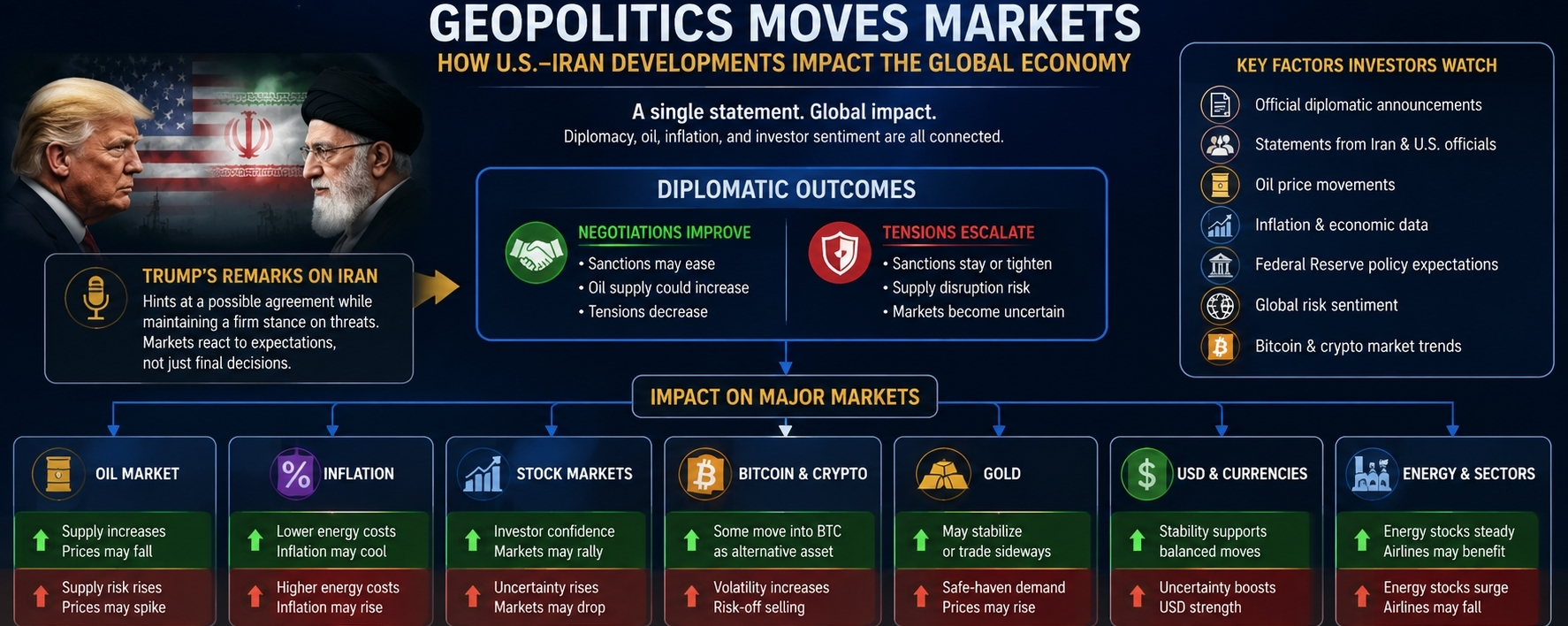
How Geopolitics Is Reshaping Global Markets: What Trump's Iran Comments Could Mean for Bitcoin, Oil,Global financial markets have entered an era where geopolitics can move prices just as quickly as economic data. A single speech from a political leader, a diplomatic meeting, or a military headline can trigger billions of dollars in trading activity within minutes. Whether you're investing in cryptocurrencies, stocks, commodities, or foreign exchange, understanding geopolitical events is no longer optional—it's becoming a core part of successful market analysis.
One of the latest developments attracting worldwide attention is recent comments from U.S. President Donald Trump regarding Iran. While no official agreement has been announced, his remarks have revived discussions about the possibility of renewed diplomatic engagement. That alone has been enough to capture the attention of institutional investors, hedge funds, and retail traders across the globe.
Why Trump's Remarks Matter
Markets rarely wait for final decisions. They react to expectations.
When a high-profile leader hints that negotiations could resume, investors immediately begin pricing in possible outcomes. Even before policies change, market participants ask:
- Could sanctions eventually be eased?
- Will energy supplies improve?
- Could inflation pressures decline?
- How will risk assets like Bitcoin respond?
- What does this mean for the global economy?
These expectations often influence prices long before official agreements are signed.
The U.S.–Iran Relationship and Global Markets
The relationship between the United States and Iran has influenced financial markets for decades. Every period of heightened tension has raised concerns over oil supply, regional stability, and global trade.
Whenever diplomacy appears possible, investors generally view it as a positive signal because lower geopolitical risk tends to improve confidence across financial markets.
However, experienced traders know that negotiations can be unpredictable. Optimism can disappear quickly if talks stall or political tensions rise again.
This uncertainty explains why investors remain cautious despite encouraging headlines.
Oil: The First Market to React
Oil is usually the first asset affected by developments involving Iran.
Iran possesses some of the world's largest oil reserves. If international relations improve over time and restrictions on Iranian exports are eased, global oil supply could increase. More supply generally helps stabilize or reduce energy prices, easing inflationary pressure for businesses and consumers.
Conversely, if diplomatic efforts fail or regional tensions escalate, concerns about supply disruptions could push crude oil prices higher.
Because energy costs influence transportation, manufacturing, and food production, movements in oil prices often ripple across the entire global economy.
Inflation and Central Bank Policy
Energy prices play a major role in inflation.
If oil becomes more expensive, inflation can remain elevated. Central banks, including the U.S. Federal Reserve, may then be forced to keep interest rates higher for longer.
Higher interest rates typically reduce liquidity in financial markets, making investors more cautious toward riskier assets such as cryptocurrencies and growth stocks.
On the other hand, if geopolitical stability helps lower energy prices, inflation may gradually cool, creating a more supportive environment for financial markets.
This is why investors often connect geopolitical headlines directly with future monetary policy expectations.
Bitcoin's Position in a Changing Global Economy
Bitcoin has evolved far beyond its early reputation as a speculative digital asset.
Today, institutional investors increasingly monitor Bitcoin alongside traditional macroeconomic indicators. Its reaction to geopolitical events depends largely on investor sentiment.
During periods of uncertainty, some investors view Bitcoin as an alternative asset outside the traditional financial system and increase their exposure.
Others choose to reduce risk altogether, selling cryptocurrencies in favor of cash, government bonds, or gold.
The result is often heightened short-term volatility.
However, long-term investors generally focus less on daily headlines and more on broader trends such as institutional adoption, regulatory developments, technological innovation, and liquidity conditions.
Gold vs. Bitcoin: Two Different Safe-Haven Narratives
Whenever geopolitical tensions rise, gold has historically been the preferred safe-haven asset.
Bitcoin, however, has introduced a new dynamic.
Some investors now consider Bitcoin "digital gold" because of its limited supply and decentralized nature. Others still view it primarily as a high-risk investment.
As a result, geopolitical crises do not always produce identical reactions in Bitcoin and gold.
Sometimes both assets rise together.
Sometimes gold strengthens while Bitcoin declines.
Market psychology ultimately determines which narrative dominates.
Stock Markets Could Face Increased Volatility
Geopolitical developments rarely affect only one market.
Several sectors often experience significant price movements, including:
- Global equity indices
- Energy companies
- Defense manufacturers
- Airline and travel companies
- Shipping and logistics firms
- Precious metals
- Currency markets
- Cryptocurrency exchanges
Each sector responds differently depending on whether markets anticipate stability or escalating conflict.
The Role of Algorithmic Trading
Modern financial markets operate at extraordinary speed.
Large institutions use sophisticated algorithms capable of analyzing headlines within seconds. These systems automatically buy or sell assets based on predefined rules.
As a result, prices often move before retail investors have fully understood the news.
This explains why sudden market swings can occur almost instantly following political announcements.
Why Long-Term Investors Avoid Emotional Decisions
One headline rarely changes the long-term direction of an economy or financial market.
Professional investors recognize that geopolitical events create noise alongside genuine opportunities.
Rather than reacting emotionally, they evaluate multiple factors together, including:
- Official diplomatic announcements
- Statements from both U.S. and Iranian officials
- Crude oil price movements
- Inflation data
- Federal Reserve policy expectations
- U.S. Dollar strength
- Bond yields
- Bitcoin market structure
- Global investor sentiment
- Institutional capital flows
Looking at the broader picture provides a more balanced perspective than focusing on a single headline.
What Could Happen Next?
Several scenarios remain possible.
If diplomatic discussions gain momentum, markets may respond positively through stronger investor confidence, more stable energy prices, and reduced geopolitical risk.
If negotiations break down or regional tensions intensify, volatility could return quickly across equities, commodities, currencies, and cryptocurrencies.
At this stage, markets are reacting more to expectations than confirmed policy changes.
That is why patience remains one of the most valuable qualities for investors.
The Bigger Picture
The modern financial system is more interconnected than ever before.
A political statement made in Washington can influence oil prices in the Middle East, stock markets in Europe, manufacturing costs in Asia, and Bitcoin trading around the world within minutes.
Technology has accelerated the speed at which information spreads, but it has also increased the speed at which emotions influence markets.
Successful investors understand that price movements are rarely driven by one factor alone. Politics, diplomacy, energy security, inflation, monetary policy, global liquidity, and investor psychology all interact to shape market behavior.
Final Thoughts
Donald Trump's recent comments regarding Iran have once again reminded investors how closely geopolitics and financial markets are connected. Although no formal agreement has been reached, the possibility of renewed diplomacy has already become a key discussion point across global markets.
For Bitcoin holders, stock investors, and commodity traders alike, the most effective approach is not to chase every headline but to focus on verified developments, sound risk management, and long-term market trends.
The coming weeks could bring greater clarity, but until then, disciplined analysis will likely prove far more valuable than speculation.
What are your thoughts?
Do you believe improving U.S.–Iran relations could reduce global market uncertainty and support Bitcoin and equities, or do you think geopolitical risks will continue to drive volatility across financial markets?
#AliAnsariFx #Bitcoin #Crypto #TRUMP #Iran
$TRUMP
$EPIC
{spot}(EPICUSDT)
$RE
{future}(REUSDT)
How Geopolitics Is Reshaping Global Markets: What Trump's Iran Comments Could Mean for Bitcoin, Oil,
Global financial markets have entered an era where geopolitics can move prices just as quickly as economic data. A single speech from a political leader, a diplomatic meeting, or a military headline can trigger billions of dollars in trading activity within minutes. Whether you're investing in cryptocurrencies, stocks, commodities, or foreign exchange, understanding geopolitical events is no longer optional—it's becoming a core part of successful market analysis.
One of the latest developments attracting worldwide attention is recent comments from U.S. President Donald Trump regarding Iran. While no official agreement has been announced, his remarks have revived discussions about the possibility of renewed diplomatic engagement. That alone has been enough to capture the attention of institutional investors, hedge funds, and retail traders across the globe.
Why Trump's Remarks Matter
Markets rarely wait for final decisions. They react to expectations.
When a high-profile leader hints that negotiations could resume, investors immediately begin pricing in possible outcomes. Even before policies change, market participants ask:
- Could sanctions eventually be eased?
- Will energy supplies improve?
- Could inflation pressures decline?
- How will risk assets like Bitcoin respond?
- What does this mean for the global economy?
These expectations often influence prices long before official agreements are signed.
The U.S.–Iran Relationship and Global Markets
The relationship between the United States and Iran has influenced financial markets for decades. Every period of heightened tension has raised concerns over oil supply, regional stability, and global trade.
Whenever diplomacy appears possible, investors generally view it as a positive signal because lower geopolitical risk tends to improve confidence across financial markets.
However, experienced traders know that negotiations can be unpredictable. Optimism can disappear quickly if talks stall or political tensions rise again.
This uncertainty explains why investors remain cautious despite encouraging headlines.
Oil: The First Market to React
Oil is usually the first asset affected by developments involving Iran.
Iran possesses some of the world's largest oil reserves. If international relations improve over time and restrictions on Iranian exports are eased, global oil supply could increase. More supply generally helps stabilize or reduce energy prices, easing inflationary pressure for businesses and consumers.
Conversely, if diplomatic efforts fail or regional tensions escalate, concerns about supply disruptions could push crude oil prices higher.
Because energy costs influence transportation, manufacturing, and food production, movements in oil prices often ripple across the entire global economy.
Inflation and Central Bank Policy
Energy prices play a major role in inflation.
If oil becomes more expensive, inflation can remain elevated. Central banks, including the U.S. Federal Reserve, may then be forced to keep interest rates higher for longer.
Higher interest rates typically reduce liquidity in financial markets, making investors more cautious toward riskier assets such as cryptocurrencies and growth stocks.
On the other hand, if geopolitical stability helps lower energy prices, inflation may gradually cool, creating a more supportive environment for financial markets.
This is why investors often connect geopolitical headlines directly with future monetary policy expectations.
Bitcoin's Position in a Changing Global Economy
Bitcoin has evolved far beyond its early reputation as a speculative digital asset.
Today, institutional investors increasingly monitor Bitcoin alongside traditional macroeconomic indicators. Its reaction to geopolitical events depends largely on investor sentiment.
During periods of uncertainty, some investors view Bitcoin as an alternative asset outside the traditional financial system and increase their exposure.
Others choose to reduce risk altogether, selling cryptocurrencies in favor of cash, government bonds, or gold.
The result is often heightened short-term volatility.
However, long-term investors generally focus less on daily headlines and more on broader trends such as institutional adoption, regulatory developments, technological innovation, and liquidity conditions.
Gold vs. Bitcoin: Two Different Safe-Haven Narratives
Whenever geopolitical tensions rise, gold has historically been the preferred safe-haven asset.
Bitcoin, however, has introduced a new dynamic.
Some investors now consider Bitcoin "digital gold" because of its limited supply and decentralized nature. Others still view it primarily as a high-risk investment.
As a result, geopolitical crises do not always produce identical reactions in Bitcoin and gold.
Sometimes both assets rise together.
Sometimes gold strengthens while Bitcoin declines.
Market psychology ultimately determines which narrative dominates.
Stock Markets Could Face Increased Volatility
Geopolitical developments rarely affect only one market.
Several sectors often experience significant price movements, including:
- Global equity indices
- Energy companies
- Defense manufacturers
- Airline and travel companies
- Shipping and logistics firms
- Precious metals
- Currency markets
- Cryptocurrency exchanges
Each sector responds differently depending on whether markets anticipate stability or escalating conflict.
The Role of Algorithmic Trading
Modern financial markets operate at extraordinary speed.
Large institutions use sophisticated algorithms capable of analyzing headlines within seconds. These systems automatically buy or sell assets based on predefined rules.
As a result, prices often move before retail investors have fully understood the news.
This explains why sudden market swings can occur almost instantly following political announcements.
Why Long-Term Investors Avoid Emotional Decisions
One headline rarely changes the long-term direction of an economy or financial market.
Professional investors recognize that geopolitical events create noise alongside genuine opportunities.
Rather than reacting emotionally, they evaluate multiple factors together, including:
- Official diplomatic announcements
- Statements from both U.S. and Iranian officials
- Crude oil price movements
- Inflation data
- Federal Reserve policy expectations
- U.S. Dollar strength
- Bond yields
- Bitcoin market structure
- Global investor sentiment
- Institutional capital flows
Looking at the broader picture provides a more balanced perspective than focusing on a single headline.
What Could Happen Next?
Several scenarios remain possible.
If diplomatic discussions gain momentum, markets may respond positively through stronger investor confidence, more stable energy prices, and reduced geopolitical risk.
If negotiations break down or regional tensions intensify, volatility could return quickly across equities, commodities, currencies, and cryptocurrencies.
At this stage, markets are reacting more to expectations than confirmed policy changes.
That is why patience remains one of the most valuable qualities for investors.
The Bigger Picture
The modern financial system is more interconnected than ever before.
A political statement made in Washington can influence oil prices in the Middle East, stock markets in Europe, manufacturing costs in Asia, and Bitcoin trading around the world within minutes.
Technology has accelerated the speed at which information spreads, but it has also increased the speed at which emotions influence markets.
Successful investors understand that price movements are rarely driven by one factor alone. Politics, diplomacy, energy security, inflation, monetary policy, global liquidity, and investor psychology all interact to shape market behavior.
Final Thoughts
Donald Trump's recent comments regarding Iran have once again reminded investors how closely geopolitics and financial markets are connected. Although no formal agreement has been reached, the possibility of renewed diplomacy has already become a key discussion point across global markets.
For Bitcoin holders, stock investors, and commodity traders alike, the most effective approach is not to chase every headline but to focus on verified developments, sound risk management, and long-term market trends.
The coming weeks could bring greater clarity, but until then, disciplined analysis will likely prove far more valuable than speculation.
What are your thoughts?
Do you believe improving U.S.–Iran relations could reduce global market uncertainty and support Bitcoin and equities, or do you think geopolitical risks will continue to drive volatility across financial markets?
#AliAnsariFx #Bitcoin #Crypto #TRUMP #Iran
$TRUMP
$EPIC
$RE
One of the latest developments attracting worldwide attention is recent comments from U.S. President Donald Trump regarding Iran. While no official agreement has been announced, his remarks have revived discussions about the possibility of renewed diplomatic engagement. That alone has been enough to capture the attention of institutional investors, hedge funds, and retail traders across the globe.
Why Trump's Remarks Matter
Markets rarely wait for final decisions. They react to expectations.
When a high-profile leader hints that negotiations could resume, investors immediately begin pricing in possible outcomes. Even before policies change, market participants ask:
- Could sanctions eventually be eased?
- Will energy supplies improve?
- Could inflation pressures decline?
- How will risk assets like Bitcoin respond?
- What does this mean for the global economy?
These expectations often influence prices long before official agreements are signed.
The U.S.–Iran Relationship and Global Markets
The relationship between the United States and Iran has influenced financial markets for decades. Every period of heightened tension has raised concerns over oil supply, regional stability, and global trade.
Whenever diplomacy appears possible, investors generally view it as a positive signal because lower geopolitical risk tends to improve confidence across financial markets.
However, experienced traders know that negotiations can be unpredictable. Optimism can disappear quickly if talks stall or political tensions rise again.
This uncertainty explains why investors remain cautious despite encouraging headlines.
Oil: The First Market to React
Oil is usually the first asset affected by developments involving Iran.
Iran possesses some of the world's largest oil reserves. If international relations improve over time and restrictions on Iranian exports are eased, global oil supply could increase. More supply generally helps stabilize or reduce energy prices, easing inflationary pressure for businesses and consumers.
Conversely, if diplomatic efforts fail or regional tensions escalate, concerns about supply disruptions could push crude oil prices higher.
Because energy costs influence transportation, manufacturing, and food production, movements in oil prices often ripple across the entire global economy.
Inflation and Central Bank Policy
Energy prices play a major role in inflation.
If oil becomes more expensive, inflation can remain elevated. Central banks, including the U.S. Federal Reserve, may then be forced to keep interest rates higher for longer.
Higher interest rates typically reduce liquidity in financial markets, making investors more cautious toward riskier assets such as cryptocurrencies and growth stocks.
On the other hand, if geopolitical stability helps lower energy prices, inflation may gradually cool, creating a more supportive environment for financial markets.
This is why investors often connect geopolitical headlines directly with future monetary policy expectations.
Bitcoin's Position in a Changing Global Economy
Bitcoin has evolved far beyond its early reputation as a speculative digital asset.
Today, institutional investors increasingly monitor Bitcoin alongside traditional macroeconomic indicators. Its reaction to geopolitical events depends largely on investor sentiment.
During periods of uncertainty, some investors view Bitcoin as an alternative asset outside the traditional financial system and increase their exposure.
Others choose to reduce risk altogether, selling cryptocurrencies in favor of cash, government bonds, or gold.
The result is often heightened short-term volatility.
However, long-term investors generally focus less on daily headlines and more on broader trends such as institutional adoption, regulatory developments, technological innovation, and liquidity conditions.
Gold vs. Bitcoin: Two Different Safe-Haven Narratives
Whenever geopolitical tensions rise, gold has historically been the preferred safe-haven asset.
Bitcoin, however, has introduced a new dynamic.
Some investors now consider Bitcoin "digital gold" because of its limited supply and decentralized nature. Others still view it primarily as a high-risk investment.
As a result, geopolitical crises do not always produce identical reactions in Bitcoin and gold.
Sometimes both assets rise together.
Sometimes gold strengthens while Bitcoin declines.
Market psychology ultimately determines which narrative dominates.
Stock Markets Could Face Increased Volatility
Geopolitical developments rarely affect only one market.
Several sectors often experience significant price movements, including:
- Global equity indices
- Energy companies
- Defense manufacturers
- Airline and travel companies
- Shipping and logistics firms
- Precious metals
- Currency markets
- Cryptocurrency exchanges
Each sector responds differently depending on whether markets anticipate stability or escalating conflict.
The Role of Algorithmic Trading
Modern financial markets operate at extraordinary speed.
Large institutions use sophisticated algorithms capable of analyzing headlines within seconds. These systems automatically buy or sell assets based on predefined rules.
As a result, prices often move before retail investors have fully understood the news.
This explains why sudden market swings can occur almost instantly following political announcements.
Why Long-Term Investors Avoid Emotional Decisions
One headline rarely changes the long-term direction of an economy or financial market.
Professional investors recognize that geopolitical events create noise alongside genuine opportunities.
Rather than reacting emotionally, they evaluate multiple factors together, including:
- Official diplomatic announcements
- Statements from both U.S. and Iranian officials
- Crude oil price movements
- Inflation data
- Federal Reserve policy expectations
- U.S. Dollar strength
- Bond yields
- Bitcoin market structure
- Global investor sentiment
- Institutional capital flows
Looking at the broader picture provides a more balanced perspective than focusing on a single headline.
What Could Happen Next?
Several scenarios remain possible.
If diplomatic discussions gain momentum, markets may respond positively through stronger investor confidence, more stable energy prices, and reduced geopolitical risk.
If negotiations break down or regional tensions intensify, volatility could return quickly across equities, commodities, currencies, and cryptocurrencies.
At this stage, markets are reacting more to expectations than confirmed policy changes.
That is why patience remains one of the most valuable qualities for investors.
The Bigger Picture
The modern financial system is more interconnected than ever before.
A political statement made in Washington can influence oil prices in the Middle East, stock markets in Europe, manufacturing costs in Asia, and Bitcoin trading around the world within minutes.
Technology has accelerated the speed at which information spreads, but it has also increased the speed at which emotions influence markets.
Successful investors understand that price movements are rarely driven by one factor alone. Politics, diplomacy, energy security, inflation, monetary policy, global liquidity, and investor psychology all interact to shape market behavior.
Final Thoughts
Donald Trump's recent comments regarding Iran have once again reminded investors how closely geopolitics and financial markets are connected. Although no formal agreement has been reached, the possibility of renewed diplomacy has already become a key discussion point across global markets.
For Bitcoin holders, stock investors, and commodity traders alike, the most effective approach is not to chase every headline but to focus on verified developments, sound risk management, and long-term market trends.
The coming weeks could bring greater clarity, but until then, disciplined analysis will likely prove far more valuable than speculation.
What are your thoughts?
Do you believe improving U.S.–Iran relations could reduce global market uncertainty and support Bitcoin and equities, or do you think geopolitical risks will continue to drive volatility across financial markets?
#AliAnsariFx #Bitcoin #Crypto #TRUMP #Iran
$TRUMP
$EPIC
$RE
1
380

·
--
It seems that the timeline for regulating cryptocurrency in the United States has become clearer now.
If this timeline continues, the market-structure bill could reach the President’s office before August.
That would be a major step for this industry.
$NVDAB $MSFTB $GOOGLB #AliAnsariFx #USGovernment
It seems that the timeline for regulating cryptocurrency in the United States has become clearer now.
If this timeline continues, the market-structure bill could reach the President’s office before August.
That would be a major step for this industry.
$NVDAB $MSFTB $GOOGLB #AliAnsariFx #USGovernment
If this timeline continues, the market-structure bill could reach the President’s office before August.
That would be a major step for this industry.
$NVDAB $MSFTB $GOOGLB #AliAnsariFx #USGovernment
2
151
Log in to explore more content
Join global crypto users on Binance Square
⚡️ Get latest and useful information about crypto.
💬 Trusted by the world’s largest crypto exchange.
👍 Discover real insights from verified creators.
Email / Phone number
Trending Topics
1
#NEARRisesNearly80%InAWeek
2,691 views
261 Discussing
2
#MultiversXPlansHardForkRecovery
3,695 views
278 Discussing
3
#CircleLaunchesInstitutionalBTCBackedBorrowing
6,283 views
422 Discussing
4
#BitcoinHits$85K
9,211 views
220 Discussing
5
#ZetaChainVotesToMigrateZETAToSolana
5,568 views
274 Discussing
6
#ECBStartsBlockchainEuroSettlement
16,598 views
553 Discussing
7
#SouthAfricaProposesCryptoExchangeControls
27,962 views
745 Discussing
8
#SolanaCutsTargetSlotTimeTo250ms
30,989 views
662 Discussing
9
#EthereumSurpasses$2700
21,764 views
220 Discussing
10
#CanaryFilesSecondAmendmentForStakedSEIETF
47,644 views
1,005 Discussing