
#aseanplus3toformcrossborderpaymentscryptoworkinggroup
aseanplus3toformcrossborderpaymentscryptoworkinggroup
Hot
Latest


·
--
China, Japan, South Korea and ASEAN to Form Working Group on Cross-Border Payments and Crypto RegulationChina, Japan, South Korea and ASEAN members have agreed to establish a working group on cross-border digital payments and digital asset regulation. According to Odaily, finance ministry and central bank deputies met in Kyoto, Japan, this week and agreed to establish an ASEAN+3 Macroeconomic Research Office (AMRO) cross-border digital payment project and a dedicated group to advance policy discussions, according to a joint statement released Thursday.
The decision follows a meeting in Uzbekistan in May this year, where the parties identified cross-border digital payments as a new area for cooperation and called for a specific cooperation mechanism by the end of 2026. Discussions will focus on connecting retail and wholesale payment systems and on a regulatory framework for stablecoins.
Finance ministers and central bank governors are expected to continue discussing the issues at their next meeting in Nagoya, Japan, in May 2027.
China, Japan, South Korea and ASEAN to Form Working Group on Cross-Border Payments and Crypto Regulation
China, Japan, South Korea and ASEAN members have agreed to establish a working group on cross-border digital payments and digital asset regulation. According to Odaily, finance ministry and central bank deputies met in Kyoto, Japan, this week and agreed to establish an ASEAN+3 Macroeconomic Research Office (AMRO) cross-border digital payment project and a dedicated group to advance policy discussions, according to a joint statement released Thursday.
The decision follows a meeting in Uzbekistan in May this year, where the parties identified cross-border digital payments as a new area for cooperation and called for a specific cooperation mechanism by the end of 2026. Discussions will focus on connecting retail and wholesale payment systems and on a regulatory framework for stablecoins.
Finance ministers and central bank governors are expected to continue discussing the issues at their next meeting in Nagoya, Japan, in May 2027.
Loyalty Rewarded:
ASEAN, China, Japan and South Korea forming a joint Working Group on X-border payments and Crypto Regulations is a positive development in the crypto market under extreme fear.
1
1
12
11.5k

·
--
#ASEANPlus3ToFormCrossBorderPaymentsCryptoWorkingGroup
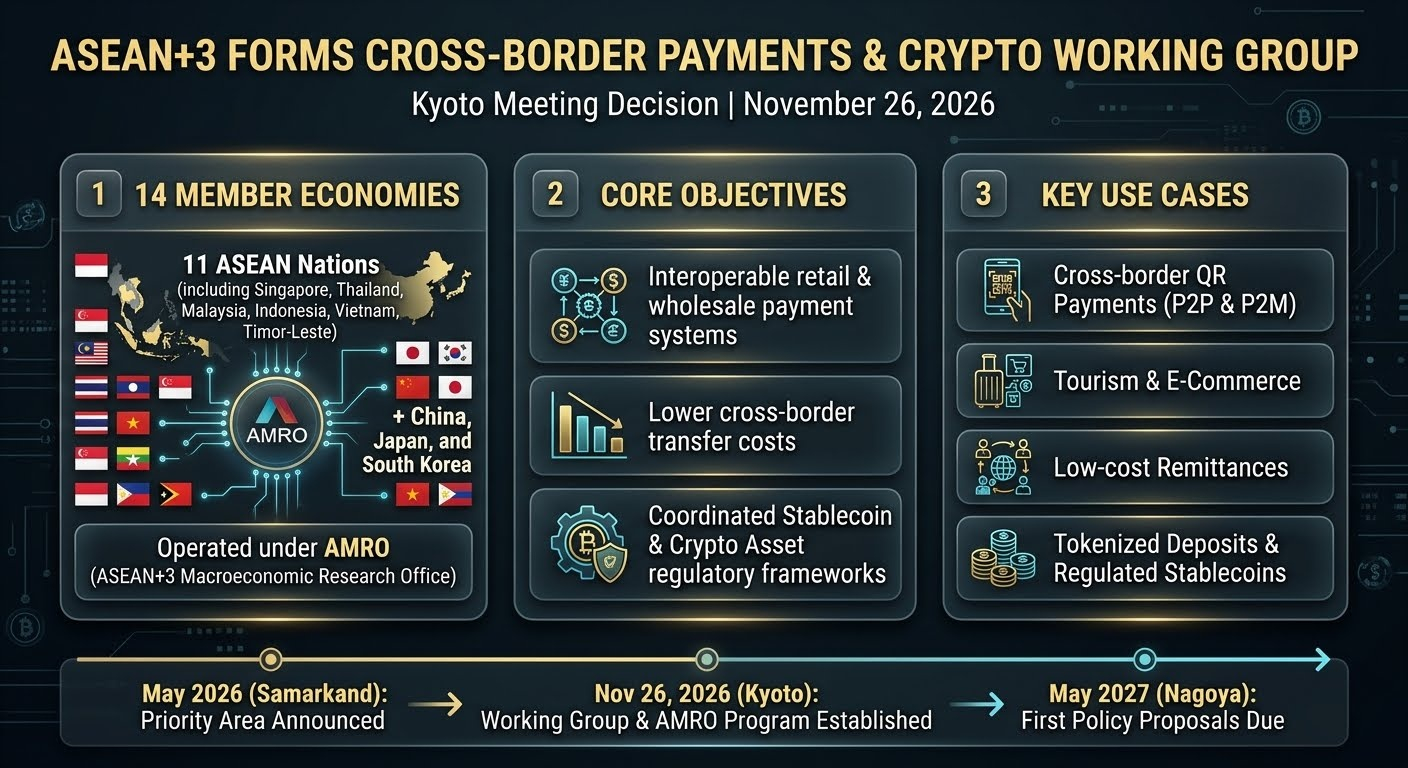
The ASEAN+3 bloc, comprising China, Japan, South Korea, and 11 ASEAN countries, has decided to establish a special working group to integrate cross-border digital payments and coordinate stablecoin/crypto regulations.
Key details of the decision made in Kyoto, Japan, on November 26, 2026:
Participants & Governance: 🤝 The process, involving 14 economies (11 ASEAN countries + China, Japan, and South Korea), will be conducted under the ASEAN+3 Macroeconomic Research Office (AMRO).Core Objective: 🎯 To reduce money transfer costs by integrating retail and corporate payment networks, and to establish a common legal framework for stablecoin and digital asset regulations.Focus Areas: 📲 Cross-border QR code payments, tourism/e-commerce spending, low-commission worker remittances, and tokenized deposits.Timeline: 🗓️ The group established in Kyoto will present its first concrete policy recommendations at the Finance Ministers and Central Bank Governors' meeting to be held in Nagoya, Japan, in May 2027.
$STBL $FLNC $OPG
{future}(OPGUSDT)
{future}(FLNCUSDT)
{future}(STBLUSDT)
#ASEANPlus3ToFormCrossBorderPaymentsCryptoWorkingGroup
The ASEAN+3 bloc, comprising China, Japan, South Korea, and 11 ASEAN countries, has decided to establish a special working group to integrate cross-border digital payments and coordinate stablecoin/crypto regulations.
Key details of the decision made in Kyoto, Japan, on November 26, 2026:
Participants & Governance: 🤝 The process, involving 14 economies (11 ASEAN countries + China, Japan, and South Korea), will be conducted under the ASEAN+3 Macroeconomic Research Office (AMRO).Core Objective: 🎯 To reduce money transfer costs by integrating retail and corporate payment networks, and to establish a common legal framework for stablecoin and digital asset regulations.Focus Areas: 📲 Cross-border QR code payments, tourism/e-commerce spending, low-commission worker remittances, and tokenized deposits.Timeline: 🗓️ The group established in Kyoto will present its first concrete policy recommendations at the Finance Ministers and Central Bank Governors' meeting to be held in Nagoya, Japan, in May 2027.
$STBL $FLNC $OPG
41

·
--
Bearish
#ASEANPlus3ToFormCrossBorderPaymentsCryptoWorkingGroup
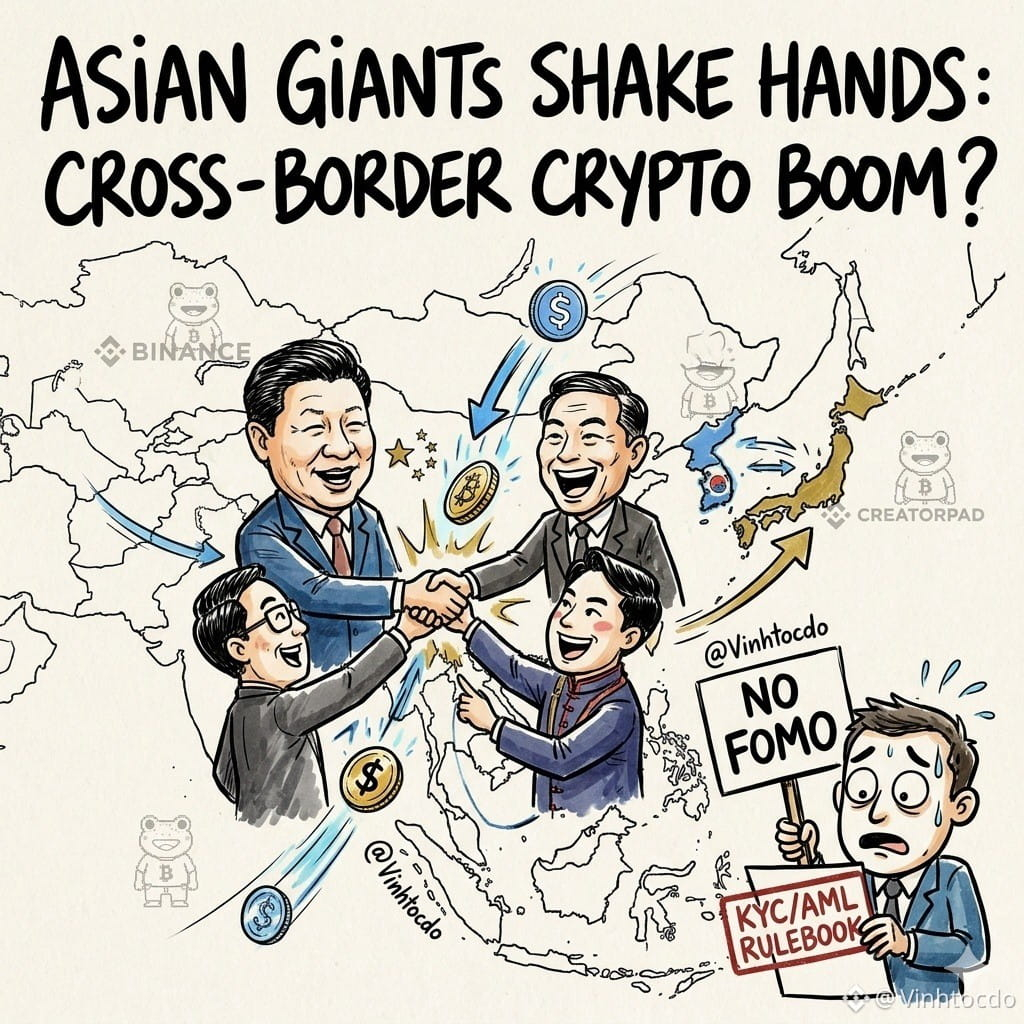
ASIAN GIANTS JOIN FORCES: IS DIGITAL MONEY ABOUT TO GO CROSS-BORDER?
Traders, get ready! China, Japan, South Korea, and ASEAN have just reached an agreement in Kyoto, Japan, officially establishing a working group on cross-border digital payments and a regulatory framework for cryptocurrencies, coordinated by AMRO.
What does this mean? Senior finance officials are working hard to connect retail and wholesale payment infrastructure, and especially to tighten the rules for stablecoins. The roadmap is clear: finalize the mechanism by the end of 2026 and hold more in-depth discussions in Nagoya in May 2027. This signals that digital money in Asia is about to enter an era of greater transparency and stronger legalization, with less of the “gray area” we’ve seen before.
What should traders do? Stay calm—don’t FOMO! Focus on projects working on cross-border payments, RWA infrastructure, and highly compliant stablecoins. Also, be prepared for stricter KYC/AML requirements across Asia.
This is not financial advice.
Click the trade button below to support me: $XRP
{spot}(XRPUSDT)
$XLM
{spot}(XLMUSDT)
$BULLA
{future}(BULLAUSDT)
#CryptoNews #Stablecoin #CrossBorderPayments #Web3 #AsianCrypto #VINHTOCDO
#ASEANPlus3ToFormCrossBorderPaymentsCryptoWorkingGroup
ASIAN GIANTS JOIN FORCES: IS DIGITAL MONEY ABOUT TO GO CROSS-BORDER?
Traders, get ready! China, Japan, South Korea, and ASEAN have just reached an agreement in Kyoto, Japan, officially establishing a working group on cross-border digital payments and a regulatory framework for cryptocurrencies, coordinated by AMRO.
What does this mean? Senior finance officials are working hard to connect retail and wholesale payment infrastructure, and especially to tighten the rules for stablecoins. The roadmap is clear: finalize the mechanism by the end of 2026 and hold more in-depth discussions in Nagoya in May 2027. This signals that digital money in Asia is about to enter an era of greater transparency and stronger legalization, with less of the “gray area” we’ve seen before.
What should traders do? Stay calm—don’t FOMO! Focus on projects working on cross-border payments, RWA infrastructure, and highly compliant stablecoins. Also, be prepared for stricter KYC/AML requirements across Asia.
This is not financial advice.
Click the trade button below to support me: $XRP
$XLM
$BULLA
#CryptoNews #Stablecoin #CrossBorderPayments #Web3 #AsianCrypto #VINHTOCDO
1
113

·
--

Article
South Korea Proposes New Crypto Rules: Could This Change the Altcoin Market? 👀🇰🇷 Korea Unveils a New Crypto Rulebook
South Korea's Financial Services Commission (FSC) proposed a sweeping digital asset bill on November 24. 📜 It could reshape how crypto projects raise money, list tokens and report risks.
The market is large. 👥 The FSC chairman put it at about 10 million users, with domestic exchanges holding 52.7 trillion won in assets as of November 19.
⚠️ This is still a draft. The National Assembly must pass it before it takes effect.
📋 Stricter Listing Disclosures
Before supporting a token, an exchange would have to file and publish a listing report. It would cover:
• 🏢 The token issuer
• 🪙 Token supply
• 🛠️ The project
• ⚠️ Key risks
⚡ Immediate Updates
Listing would not be a one-time check. Exchanges would have to disclose hacks, system failures and supply changes immediately. 🔔 False or missing material information could bring damages liability.
🚀 The ICO Comeback
South Korea has banned domestic initial coin offerings (ICOs) since September 2017. The bill would allow them again under conditions:
1. 📝 File a white paper with the FSC before approaching buyers.
2. 🔎 Explain the sellers, use of funds, token supply, project and risks.
3. ✏️ Correct the filing if the FSC finds important gaps.
4. ⏳ Start selling only after acceptance, publication and a waiting period.
The FSC's Korean release uses seven days as an example of that waiting period.
🛡️ Stronger Regulatory Powers
The proposal would widen enforcement against unfair trading:
• 🕵️ FSC investigations, fines and criminal penalties for disclosure violations
• 🧊 Account freezes and trading restrictions on substantial suspicion
• 🚫 Insider trading rules extended to tokens under listing review
• 💻 No-fault liability for customer losses from hacks and system failures
• 💰 Fines of up to 10% of revenue when a breached IT safety duty is followed by an incidents .
#CanMarketsReboundAfterThanksgiving? #EvolveAtBinanceBlockchainWeek #TudorInvestmentRaisesIBITHoldings98% #StellarAdds$80.4MTokenizedFundsInOneDay #ASEANPlus3ToFormCrossBorderPaymentsCryptoWorkingGroup
South Korea Proposes New Crypto Rules: Could This Change the Altcoin Market? 👀
🇰🇷 Korea Unveils a New Crypto Rulebook
South Korea's Financial Services Commission (FSC) proposed a sweeping digital asset bill on November 24. 📜 It could reshape how crypto projects raise money, list tokens and report risks.
The market is large. 👥 The FSC chairman put it at about 10 million users, with domestic exchanges holding 52.7 trillion won in assets as of November 19.
⚠️ This is still a draft. The National Assembly must pass it before it takes effect.
📋 Stricter Listing Disclosures
Before supporting a token, an exchange would have to file and publish a listing report. It would cover:
• 🏢 The token issuer
• 🪙 Token supply
• 🛠️ The project
• ⚠️ Key risks
⚡ Immediate Updates
Listing would not be a one-time check. Exchanges would have to disclose hacks, system failures and supply changes immediately. 🔔 False or missing material information could bring damages liability.
🚀 The ICO Comeback
South Korea has banned domestic initial coin offerings (ICOs) since September 2017. The bill would allow them again under conditions:
1. 📝 File a white paper with the FSC before approaching buyers.
2. 🔎 Explain the sellers, use of funds, token supply, project and risks.
3. ✏️ Correct the filing if the FSC finds important gaps.
4. ⏳ Start selling only after acceptance, publication and a waiting period.
The FSC's Korean release uses seven days as an example of that waiting period.
🛡️ Stronger Regulatory Powers
The proposal would widen enforcement against unfair trading:
• 🕵️ FSC investigations, fines and criminal penalties for disclosure violations
• 🧊 Account freezes and trading restrictions on substantial suspicion
• 🚫 Insider trading rules extended to tokens under listing review
• 💻 No-fault liability for customer losses from hacks and system failures
• 💰 Fines of up to 10% of revenue when a breached IT safety duty is followed by an incidents .
#CanMarketsReboundAfterThanksgiving? #EvolveAtBinanceBlockchainWeek #TudorInvestmentRaisesIBITHoldings98% #StellarAdds$80.4MTokenizedFundsInOneDay #ASEANPlus3ToFormCrossBorderPaymentsCryptoWorkingGroup
10

·
--
Fear is at 12, yet majors are quietly bouncing 2-3% today.
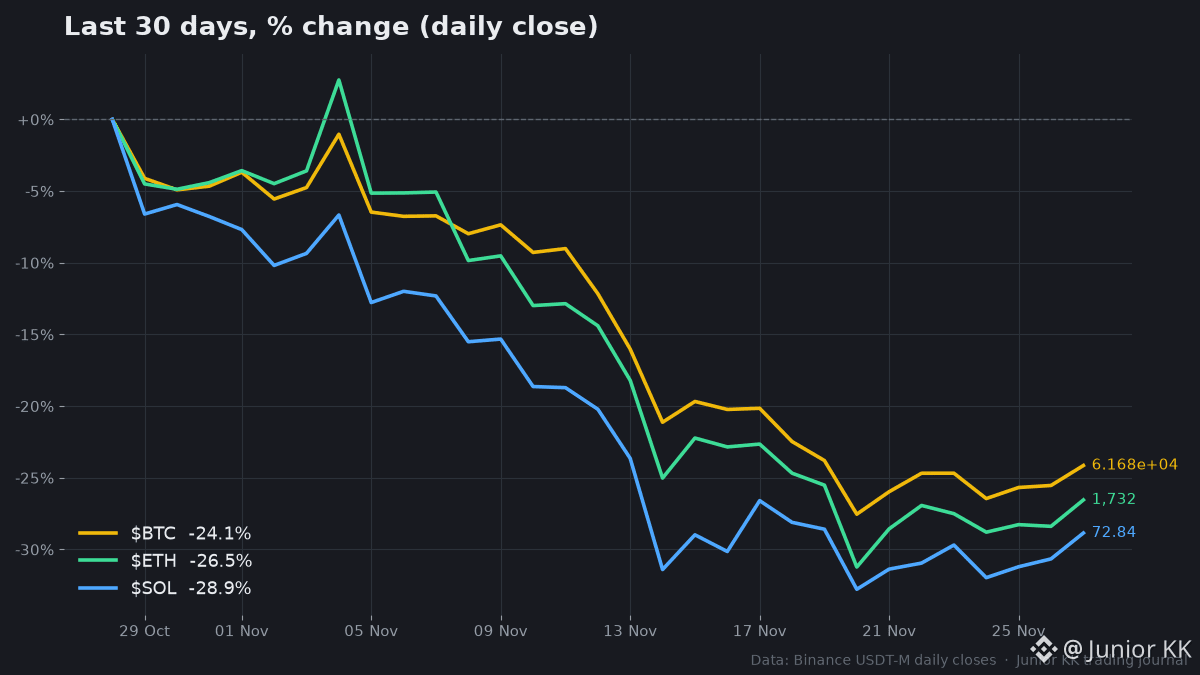
The headline #ASEANPlus3ToFormCrossBorderPaymentsCryptoWorkingGroup brings institutional adoption back into focus, but market momentum remains heavily weighed down. Looking at 30-day chart trends, top assets are still trading deep below key moving averages.
$BTC is holding around $61,725 (+1.95% 24h), yet sits -13.26% relative to its 50-day EMA with an oversold RSI of 32.7. $ETH (+2.80% 24h) and $SOL (+3.07% 24h) show similar relief bounces, but both remain more than 15% under their 50-day EMAs. Funding rates are essentially flat across exchanges, signaling very low leverage conviction despite the policy headlines.
Cross-border infrastructure updates are great for long-term narrative, but short-term price action is still fighting heavy overhead resistance.
Does policy news like this prompt you to accumulate, or are you waiting for structural trend breaks first?
Not financial advice. Check live charts before trading.
46
Log in to explore more content
Join global crypto users on Binance Square
⚡️ Get latest and useful information about crypto.
💬 Trusted by the world’s largest crypto exchange.
👍 Discover real insights from verified creators.
Email / Phone number
Trending Topics
1
#EvolveAtBinanceBlockchainWeek
931,988 views
11,615 Discussing
2
#Nasdaq100FiveDayAvgIntradayVolatilityHits3.8%
10,883 views
157 Discussing
3
#CanMarketsReboundAfterThanksgiving?
269,011 views
2,382 Discussing
4
#CouldSpaceX’sOrbitalDataCentersBoostAIChipDemand?
126,148 views
1,408 Discussing
5
#ZcashDevelopersUrgeZECMoveToIronwood
57,405 views
293 Discussing
6
#CorePCEBeatLiftsFedHikeOdds
344,312 views
1,856 Discussing
7
#ASEANPlus3ToFormCrossBorderPaymentsCryptoWorkingGroup
2,219 views
6 Discussing
8
#StellarAdds$80.4MTokenizedFundsInOneDay
4,783 views
19 Discussing
9
#TudorInvestmentRaisesIBITHoldings98%
5,470 views
54 Discussing
10
#TradFiForBeginners
1.2M views
6,472 Discussing