

#0xsignal
0xsignal
1,764 views
37 Discussing
Hot
Latest

·
--
Guys, everyone's treating this week like one giant ball of uncertainty.
I don't think that's accurate. 🧵
Let's look at the actual numbers instead of the vibes.
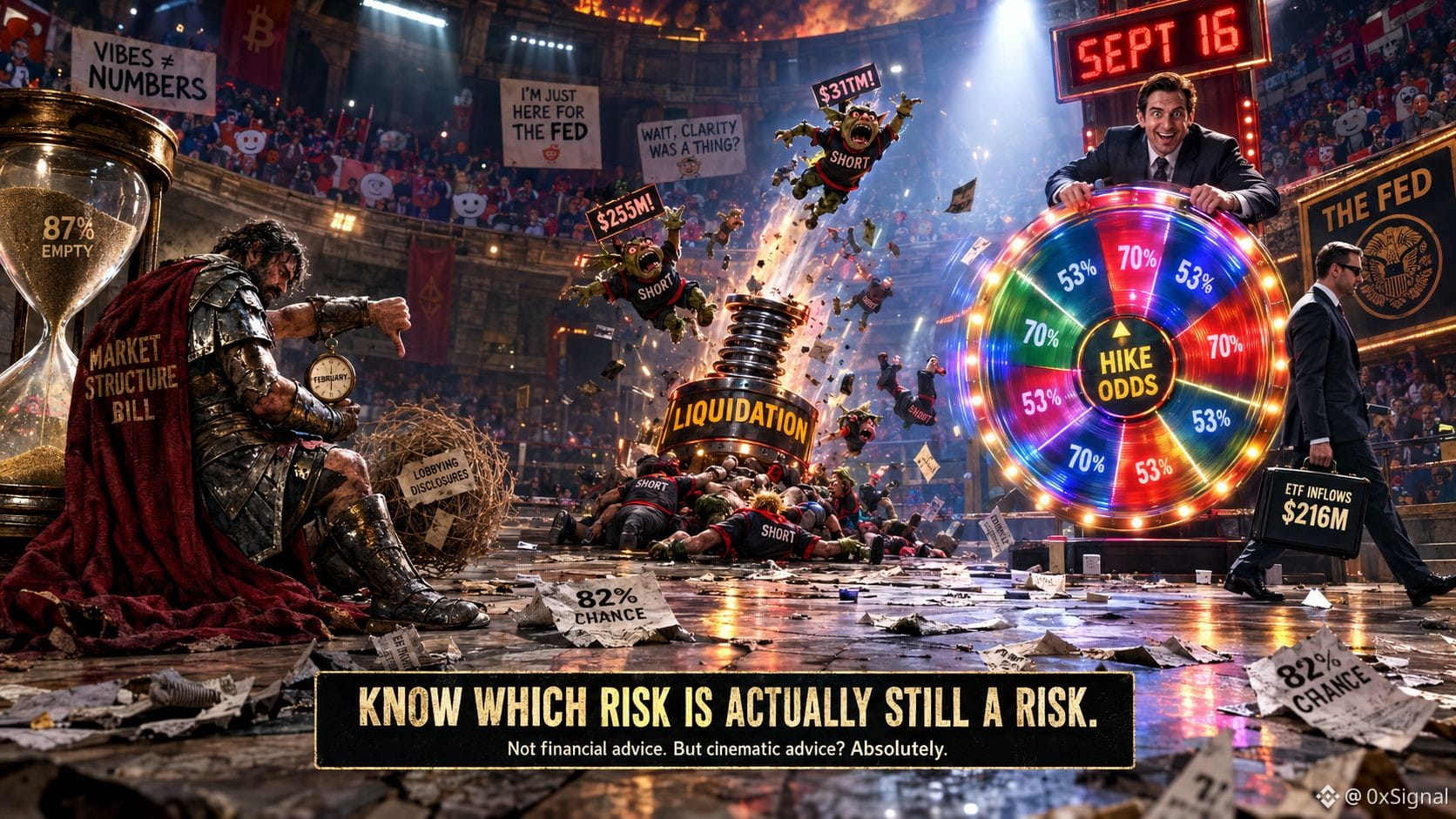
CLARITY Act — the crypto market-structure bill everyone's been waiting on — had an 82% chance of becoming law back in February.
Today? 13-16%.
That's not "uncertain." That's the market having already made up its mind.
Meanwhile the Fed decision on Sept 16 is doing the opposite.
Hike odds have swung 20+ points in a single week — anywhere from 53% to 70% depending on which venue you check.
That's genuinely live. Nobody's decided yet.
So here's the mix-up I'm seeing everywhere:
People are lumping "CLARITY vote" and "Fed decision" together as two unknowns in the same scary week.
They're not the same kind of unknown.
One's basically resolved in expectation. The other could still surprise.
Now stack that against what's actually driving ETH's move right now.
$255M+ in ETH shorts got liquidated Sept 11. Another $311M+ wave hit within 24 hours.
That's the price move — mostly short-covering, not fresh spot conviction.
Real money IS coming in too — ETH ETFs pulled $216M in a single day while BTC ETFs bled for a 4th straight day. That rotation is real.
But it's smaller than the leverage-driven swings we've already seen this week.
So the actual setup:
A mostly-leverage rally, sitting right under the one catalyst in this whole "scary week" that's still genuinely unresolved.
Not CLARITY. The Fed.
What would tell you I'm wrong: a hawkish surprise on the 16th gets absorbed calmly, no real give-back. That would mean the market's already looking past even the live risk — worth knowing either way.
What I'm watching: Fed odds into the 16th, and whether ETH open interest is quietly rebuilding after this week's squeeze.
Not a buy/sell call. Just — know which risk in the room is actually still a risk. DYOR.
Which one are you more focused on going into next week — the Fed, or the vote? 👇
#ETH #FOMC #CryptoRegulation #0xSignal #BinanceSquareFamily
Guys, everyone's treating this week like one giant ball of uncertainty.
I don't think that's accurate. 🧵
Let's look at the actual numbers instead of the vibes.
CLARITY Act — the crypto market-structure bill everyone's been waiting on — had an 82% chance of becoming law back in February.
Today? 13-16%.
That's not "uncertain." That's the market having already made up its mind.
Meanwhile the Fed decision on Sept 16 is doing the opposite.
Hike odds have swung 20+ points in a single week — anywhere from 53% to 70% depending on which venue you check.
That's genuinely live. Nobody's decided yet.
So here's the mix-up I'm seeing everywhere:
People are lumping "CLARITY vote" and "Fed decision" together as two unknowns in the same scary week.
They're not the same kind of unknown.
One's basically resolved in expectation. The other could still surprise.
Now stack that against what's actually driving ETH's move right now.
$255M+ in ETH shorts got liquidated Sept 11. Another $311M+ wave hit within 24 hours.
That's the price move — mostly short-covering, not fresh spot conviction.
Real money IS coming in too — ETH ETFs pulled $216M in a single day while BTC ETFs bled for a 4th straight day. That rotation is real.
But it's smaller than the leverage-driven swings we've already seen this week.
So the actual setup:
A mostly-leverage rally, sitting right under the one catalyst in this whole "scary week" that's still genuinely unresolved.
Not CLARITY. The Fed.
What would tell you I'm wrong: a hawkish surprise on the 16th gets absorbed calmly, no real give-back. That would mean the market's already looking past even the live risk — worth knowing either way.
What I'm watching: Fed odds into the 16th, and whether ETH open interest is quietly rebuilding after this week's squeeze.
Not a buy/sell call. Just — know which risk in the room is actually still a risk. DYOR.
Which one are you more focused on going into next week — the Fed, or the vote? 👇
#ETH #FOMC #CryptoRegulation #0xSignal #BinanceSquareFamily
I don't think that's accurate. 🧵
Let's look at the actual numbers instead of the vibes.
CLARITY Act — the crypto market-structure bill everyone's been waiting on — had an 82% chance of becoming law back in February.
Today? 13-16%.
That's not "uncertain." That's the market having already made up its mind.
Meanwhile the Fed decision on Sept 16 is doing the opposite.
Hike odds have swung 20+ points in a single week — anywhere from 53% to 70% depending on which venue you check.
That's genuinely live. Nobody's decided yet.
So here's the mix-up I'm seeing everywhere:
People are lumping "CLARITY vote" and "Fed decision" together as two unknowns in the same scary week.
They're not the same kind of unknown.
One's basically resolved in expectation. The other could still surprise.
Now stack that against what's actually driving ETH's move right now.
$255M+ in ETH shorts got liquidated Sept 11. Another $311M+ wave hit within 24 hours.
That's the price move — mostly short-covering, not fresh spot conviction.
Real money IS coming in too — ETH ETFs pulled $216M in a single day while BTC ETFs bled for a 4th straight day. That rotation is real.
But it's smaller than the leverage-driven swings we've already seen this week.
So the actual setup:
A mostly-leverage rally, sitting right under the one catalyst in this whole "scary week" that's still genuinely unresolved.
Not CLARITY. The Fed.
What would tell you I'm wrong: a hawkish surprise on the 16th gets absorbed calmly, no real give-back. That would mean the market's already looking past even the live risk — worth knowing either way.
What I'm watching: Fed odds into the 16th, and whether ETH open interest is quietly rebuilding after this week's squeeze.
Not a buy/sell call. Just — know which risk in the room is actually still a risk. DYOR.
Which one are you more focused on going into next week — the Fed, or the vote? 👇
#ETH #FOMC #CryptoRegulation #0xSignal #BinanceSquareFamily
2
160
·
--
Full breakdown of the $DASH thesis — the tech, the tokenomics, the risks, and what data we're watching next (shielded tx volume, active addresses, merchant count) — is in the report. What's your read: does DASH earn a seat next to ZEC/XMR, or is this a narrative rotation that fades? Drop your view below.
#DASH #0xSignal
Full breakdown of the $DASH thesis — the tech, the tokenomics, the risks, and what data we're watching next (shielded tx volume, active addresses, merchant count) — is in the report. What's your read: does DASH earn a seat next to ZEC/XMR, or is this a narrative rotation that fades? Drop your view below.
#DASH #0xSignal
#DASH #0xSignal
3
311
·
--
Three scenarios, no prediction attached:
🐂 Bull: shielded adoption grows, Android beta lands well, $DASH re-rates toward ZEC/XMR-style valuations.
⚖️ Base: hype fades once the conference cycle ends, market waits for real usage data before re-rating further.
🐻 Bear: adoption disappoints, regulation tightens, liquidity stays thin — price gives back the DashCon-era gains, back toward the $30-40 zone.
#DASH #0xSignal
Three scenarios, no prediction attached:
🐂 Bull: shielded adoption grows, Android beta lands well, $DASH re-rates toward ZEC/XMR-style valuations.
⚖️ Base: hype fades once the conference cycle ends, market waits for real usage data before re-rating further.
🐻 Bear: adoption disappoints, regulation tightens, liquidity stays thin — price gives back the DashCon-era gains, back toward the $30-40 zone.
#DASH #0xSignal
🐂 Bull: shielded adoption grows, Android beta lands well, $DASH re-rates toward ZEC/XMR-style valuations.
⚖️ Base: hype fades once the conference cycle ends, market waits for real usage data before re-rating further.
🐻 Bear: adoption disappoints, regulation tightens, liquidity stays thin — price gives back the DashCon-era gains, back toward the $30-40 zone.
#DASH #0xSignal
2
167
·
--
Partly True
Team/execution history: $DASH Core Group led by Ryan Taylor since 2017, ~40-person team. 10% treasury funding model gives it a native dev-funding mechanism most projects don't have. But Evolution took years longer than originally planned, and shielded features slipped multiple times before finally shipping in August. Track record: real, but slow.
#DASH #0xSignal
Team/execution history: $DASH Core Group led by Ryan Taylor since 2017, ~40-person team. 10% treasury funding model gives it a native dev-funding mechanism most projects don't have. But Evolution took years longer than originally planned, and shielded features slipped multiple times before finally shipping in August. Track record: real, but slow.
#DASH #0xSignal
#DASH #0xSignal
2
294
·
--
Regulatory reality check: $DASH carries an "Alleged SEC Securities" tag on major trackers, and has already been delisted from Bybit (DASH/USDT) and OKX (Jan 2026). Privacy coins broadly face tightening EU rules expected to phase in by 2027. This is a real, ongoing risk factor — not FUD.
#DASH #0xSignal
Regulatory reality check: $DASH carries an "Alleged SEC Securities" tag on major trackers, and has already been delisted from Bybit (DASH/USDT) and OKX (Jan 2026). Privacy coins broadly face tightening EU rules expected to phase in by 2027. This is a real, ongoing risk factor — not FUD.
#DASH #0xSignal
#DASH #0xSignal
3
229
·
--
Bullish
MID-CAPS are waking up again. The hunters are already watching. 🔥
🐸 THE ROTATION HUNTERS
$INJ → $6.60
$BICO → $0.0240
$ICP → $3.20
Real order books, real volume — mid-cap moves like this usually mean flow is rotating, not just retail chasing.
If this rotation holds, these can move FAST.
I don't chase the percentage everyone's screenshotting.
I hunt where the size is actually flowing before the crowd catches on.
NFA. Manage risk.
#INJ #BICO #ICP #Rotation #0xSignal
MID-CAPS are waking up again. The hunters are already watching. 🔥
🐸 THE ROTATION HUNTERS
$INJ → $6.60
$BICO → $0.0240
$ICP → $3.20
Real order books, real volume — mid-cap moves like this usually mean flow is rotating, not just retail chasing.
If this rotation holds, these can move FAST.
I don't chase the percentage everyone's screenshotting.
I hunt where the size is actually flowing before the crowd catches on.
NFA. Manage risk.
#INJ #BICO #ICP #Rotation #0xSignal
🐸 THE ROTATION HUNTERS
$INJ → $6.60
$BICO → $0.0240
$ICP → $3.20
Real order books, real volume — mid-cap moves like this usually mean flow is rotating, not just retail chasing.
If this rotation holds, these can move FAST.
I don't chase the percentage everyone's screenshotting.
I hunt where the size is actually flowing before the crowd catches on.
NFA. Manage risk.
#INJ #BICO #ICP #Rotation #0xSignal
2
620
·
--
Partly True
The catalyst: $DASH launched shielded transactions on Evolution mainnet (Aug 4, 2026) using Zcash's Orchard protocol + Halo 2 zk-SNARKs. This is a live mainnet deployment, not a roadmap promise. First time $DASH is competing directly in the privacy-coin category, not just as a payments coin with privacy as an add-on.
#DASH #0xSignal
The catalyst: $DASH launched shielded transactions on Evolution mainnet (Aug 4, 2026) using Zcash's Orchard protocol + Halo 2 zk-SNARKs. This is a live mainnet deployment, not a roadmap promise. First time $DASH is competing directly in the privacy-coin category, not just as a payments coin with privacy as an add-on.
#DASH #0xSignal
#DASH #0xSignal
2
108
·
--
$ZEC just changed the question.
A few days ago, the question was:
Can ZEC break $1,000?
Now it’s:
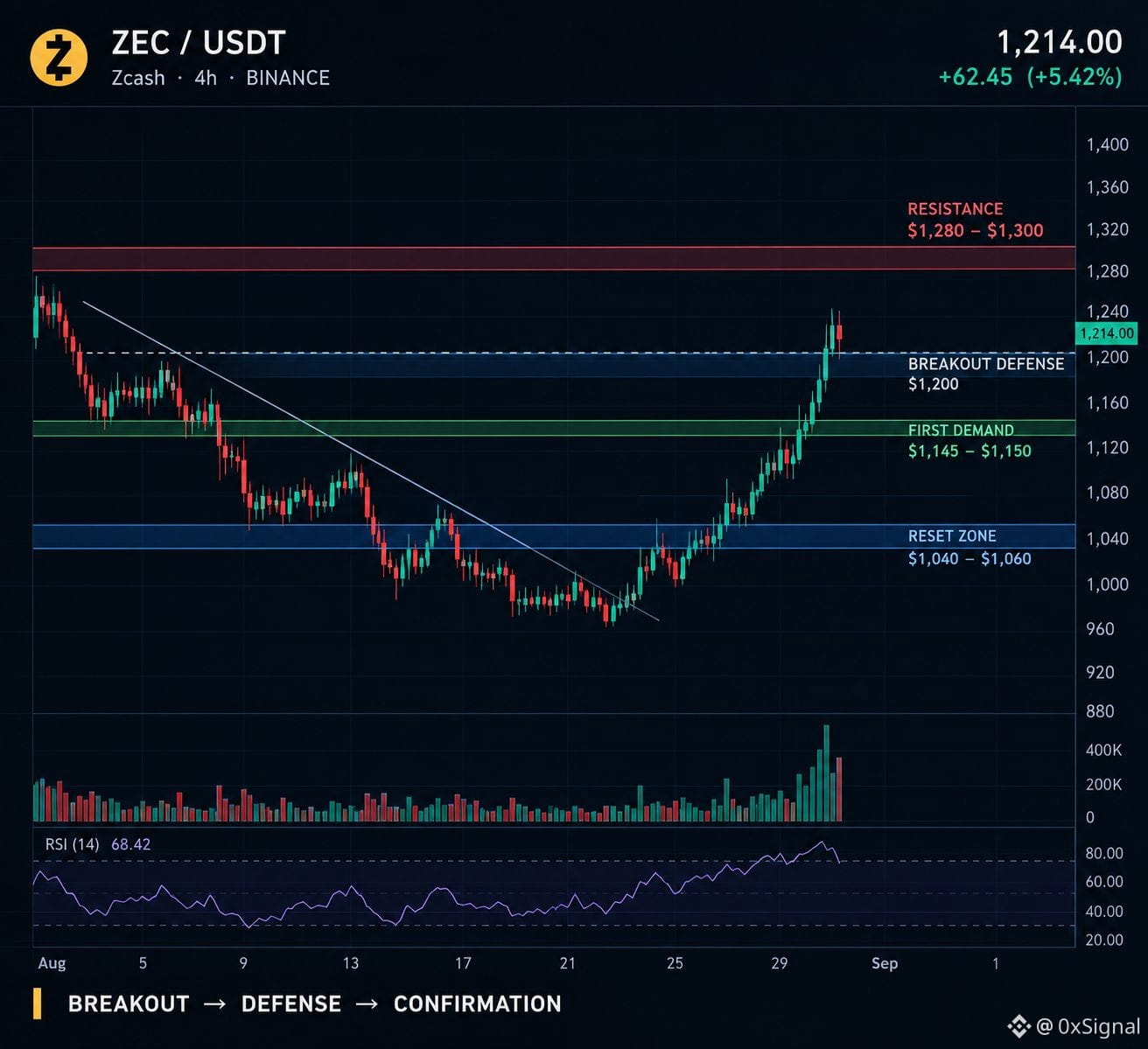
“Can buyers defend $1,200 after the breakout?”
ZEC is trading around $1,214 after a violent expansion, with today’s high near $1,234.
This isn’t a setup I want to chase blindly.
The important levels now:
$1,200 → breakout defense
$1,145–$1,150 → first demand
$1,040–$1,060 → deeper reset zone
$1,280–$1,300 → next major test
The interesting part?
ZEC’s rally is being supported by a much bigger narrative than pure momentum: the new Grayscale spot ETF has brought institutional access, while the recent move also triggered a major short squeeze.
So I’m not bearish on ZEC.
I’m watching how it reacts after the excitement disappears.
If $1,200 holds and buyers absorb the supply → continuation becomes interesting.
If $1,200 fails and $1,150 breaks → I’d rather wait for the reset than become exit liquidity.
The signal isn’t the pump.
The signal is what happens after the pump.
#ZEC #Zcash #crypto #Altcoins #0xSignal
$ZEC just changed the question.
A few days ago, the question was:
Can ZEC break $1,000?
Now it’s:
“Can buyers defend $1,200 after the breakout?”
ZEC is trading around $1,214 after a violent expansion, with today’s high near $1,234.
This isn’t a setup I want to chase blindly.
The important levels now:
$1,200 → breakout defense
$1,145–$1,150 → first demand
$1,040–$1,060 → deeper reset zone
$1,280–$1,300 → next major test
The interesting part?
ZEC’s rally is being supported by a much bigger narrative than pure momentum: the new Grayscale spot ETF has brought institutional access, while the recent move also triggered a major short squeeze.
So I’m not bearish on ZEC.
I’m watching how it reacts after the excitement disappears.
If $1,200 holds and buyers absorb the supply → continuation becomes interesting.
If $1,200 fails and $1,150 breaks → I’d rather wait for the reset than become exit liquidity.
The signal isn’t the pump.
The signal is what happens after the pump.
#ZEC #Zcash #crypto #Altcoins #0xSignal
A few days ago, the question was:
Can ZEC break $1,000?
Now it’s:
“Can buyers defend $1,200 after the breakout?”
ZEC is trading around $1,214 after a violent expansion, with today’s high near $1,234.
This isn’t a setup I want to chase blindly.
The important levels now:
$1,200 → breakout defense
$1,145–$1,150 → first demand
$1,040–$1,060 → deeper reset zone
$1,280–$1,300 → next major test
The interesting part?
ZEC’s rally is being supported by a much bigger narrative than pure momentum: the new Grayscale spot ETF has brought institutional access, while the recent move also triggered a major short squeeze.
So I’m not bearish on ZEC.
I’m watching how it reacts after the excitement disappears.
If $1,200 holds and buyers absorb the supply → continuation becomes interesting.
If $1,200 fails and $1,150 breaks → I’d rather wait for the reset than become exit liquidity.
The signal isn’t the pump.
The signal is what happens after the pump.
#ZEC #Zcash #crypto #Altcoins #0xSignal
1
22
·
--
BTC and ETH are climbing—but traders still aren't pricing a straight-line bull market.
Bitcoin and Ethereum both reached multi-month highs this week, but prediction-market positioning remained cautious on much higher targets.
That's fascinating.
Price is improving.
Sentiment is improving.
But conviction isn't fully there.
This creates a very different market from a euphoric top.
The catalyst stack is clear:
→ Fed expectations
→ ETF flows
→ macro data
→ geopolitical risk
The hidden risk is leverage.
If traders become convinced that every dip must be bought, a small macro shock can trigger forced selling.
Bull case: BTC holds the breakout and ETH follows with sustained volume.
Bear case: highs become distribution.
Don't confuse optimism with confirmation.
The best bull markets don't need you to chase them—they give you confirmation along the way.
#Bitcoin #Ethereum #CryptoMarket #0xSignal
$BTC $ETH $SOL
#bitcoinethereumhitmultimonthhighs
BTC and ETH are climbing—but traders still aren't pricing a straight-line bull market.
Bitcoin and Ethereum both reached multi-month highs this week, but prediction-market positioning remained cautious on much higher targets.
That's fascinating.
Price is improving.
Sentiment is improving.
But conviction isn't fully there.
This creates a very different market from a euphoric top.
The catalyst stack is clear:
→ Fed expectations
→ ETF flows
→ macro data
→ geopolitical risk
The hidden risk is leverage.
If traders become convinced that every dip must be bought, a small macro shock can trigger forced selling.
Bull case: BTC holds the breakout and ETH follows with sustained volume.
Bear case: highs become distribution.
Don't confuse optimism with confirmation.
The best bull markets don't need you to chase them—they give you confirmation along the way.
#Bitcoin #Ethereum #CryptoMarket #0xSignal
$BTC $ETH $SOL
#bitcoinethereumhitmultimonthhighs
Bitcoin and Ethereum both reached multi-month highs this week, but prediction-market positioning remained cautious on much higher targets.
That's fascinating.
Price is improving.
Sentiment is improving.
But conviction isn't fully there.
This creates a very different market from a euphoric top.
The catalyst stack is clear:
→ Fed expectations
→ ETF flows
→ macro data
→ geopolitical risk
The hidden risk is leverage.
If traders become convinced that every dip must be bought, a small macro shock can trigger forced selling.
Bull case: BTC holds the breakout and ETH follows with sustained volume.
Bear case: highs become distribution.
Don't confuse optimism with confirmation.
The best bull markets don't need you to chase them—they give you confirmation along the way.
#Bitcoin #Ethereum #CryptoMarket #0xSignal
$BTC $ETH $SOL
#bitcoinethereumhitmultimonthhighs
1
26
·
--
Verified
The U.S. jobs report just complicated the crypto bull case.
August payrolls increased by 162,000, far above the roughly 56,000 consensus cited in recent coverage, while unemployment stayed at 4.1%.
At first glance, that's bullish for the economy.
But crypto traders see another question:
Does stronger employment reduce pressure for easier Fed policy?
That's the market mechanic.
Strong growth → fewer recession fears.
But stronger labor demand → potentially less urgency for rate cuts.
That can strengthen yields and the dollar while pressuring high-beta assets.
Bull case for crypto: economy stays strong while inflation cools.
Bear case: strong data keeps monetary policy restrictive.
So don't read “good jobs” as automatically bullish for BTC.
In macro, good economic news can be bad liquidity news.
#JobsReport #Fed #Macro
#0xSignal
$RAY $ORCA $MET
#usaugustjobgrowthnearlytriplesforecast
The U.S. jobs report just complicated the crypto bull case.
August payrolls increased by 162,000, far above the roughly 56,000 consensus cited in recent coverage, while unemployment stayed at 4.1%.
At first glance, that's bullish for the economy.
But crypto traders see another question:
Does stronger employment reduce pressure for easier Fed policy?
That's the market mechanic.
Strong growth → fewer recession fears.
But stronger labor demand → potentially less urgency for rate cuts.
That can strengthen yields and the dollar while pressuring high-beta assets.
Bull case for crypto: economy stays strong while inflation cools.
Bear case: strong data keeps monetary policy restrictive.
So don't read “good jobs” as automatically bullish for BTC.
In macro, good economic news can be bad liquidity news.
#JobsReport #Fed #Macro
#0xSignal
$RAY $ORCA $MET
#usaugustjobgrowthnearlytriplesforecast
August payrolls increased by 162,000, far above the roughly 56,000 consensus cited in recent coverage, while unemployment stayed at 4.1%.
At first glance, that's bullish for the economy.
But crypto traders see another question:
Does stronger employment reduce pressure for easier Fed policy?
That's the market mechanic.
Strong growth → fewer recession fears.
But stronger labor demand → potentially less urgency for rate cuts.
That can strengthen yields and the dollar while pressuring high-beta assets.
Bull case for crypto: economy stays strong while inflation cools.
Bear case: strong data keeps monetary policy restrictive.
So don't read “good jobs” as automatically bullish for BTC.
In macro, good economic news can be bad liquidity news.
#JobsReport #Fed #Macro
#0xSignal
$RAY $ORCA $MET
#usaugustjobgrowthnearlytriplesforecast
2
142
·
--
$80K isn't the interesting part. The reaction after $80K is.
Bitcoin pushed back above $80,000 as rate expectations and institutional flows improved.
But traders have been burned before by round-number breakouts.
The question now:
Can BTC turn $80K from resistance into support?
That's where market mechanics matter.
If spot demand keeps absorbing supply and ETF flows remain strong, $80K can become a psychological floor.
If price repeatedly rejects above it while leverage builds, the breakout could become another liquidity trap.
My checklist:
→ Hold $80K
→ Strong spot volume
→ ETF inflows continue
→ Funding stays controlled
Bullish above confirmation. Defensive below it.
Don't FOMO because a number looks impressive.
A breakout isn't confirmed when price crosses resistance. It's confirmed when sellers fail to take it back.
#Bitcoin #BTC #CryptoMarket
$BTC $ETH $SOL
#BTCReaches$80000 #0xSignal
$80K isn't the interesting part. The reaction after $80K is.
Bitcoin pushed back above $80,000 as rate expectations and institutional flows improved.
But traders have been burned before by round-number breakouts.
The question now:
Can BTC turn $80K from resistance into support?
That's where market mechanics matter.
If spot demand keeps absorbing supply and ETF flows remain strong, $80K can become a psychological floor.
If price repeatedly rejects above it while leverage builds, the breakout could become another liquidity trap.
My checklist:
→ Hold $80K
→ Strong spot volume
→ ETF inflows continue
→ Funding stays controlled
Bullish above confirmation. Defensive below it.
Don't FOMO because a number looks impressive.
A breakout isn't confirmed when price crosses resistance. It's confirmed when sellers fail to take it back.
#Bitcoin #BTC #CryptoMarket
$BTC $ETH $SOL
#BTCReaches$80000 #0xSignal
Bitcoin pushed back above $80,000 as rate expectations and institutional flows improved.
But traders have been burned before by round-number breakouts.
The question now:
Can BTC turn $80K from resistance into support?
That's where market mechanics matter.
If spot demand keeps absorbing supply and ETF flows remain strong, $80K can become a psychological floor.
If price repeatedly rejects above it while leverage builds, the breakout could become another liquidity trap.
My checklist:
→ Hold $80K
→ Strong spot volume
→ ETF inflows continue
→ Funding stays controlled
Bullish above confirmation. Defensive below it.
Don't FOMO because a number looks impressive.
A breakout isn't confirmed when price crosses resistance. It's confirmed when sellers fail to take it back.
#Bitcoin #BTC #CryptoMarket
$BTC $ETH $SOL
#BTCReaches$80000 #0xSignal
2
84
·
--
Zcash just flipped Dogecoin. That says more about crypto psychology than people realize.
ZEC's market cap recently moved above DOGE, pushing Zcash into the top tier of crypto assets.
Why does this matter?
Because capital is suddenly rewarding a narrative that spent years outside the spotlight: privacy.
The move wasn't just organic buying. ZEC's breakout above $1,000 also triggered major short liquidations, adding forced buying pressure.
That's the hidden risk.
When price rises because spot demand + short covering feed each other, momentum can become extremely reflexive.
Bull case: ETF access + privacy narrative keeps attracting capital.
Bear case: crowded momentum unwinds violently.
Don't chase the green candle.
The real test is whether ZEC can hold its new status after the squeeze ends.
#Zcash #PrivacyCoins #Crypto #0xSignal
$ZEC $DOGE $EPIC
#zec'smarketcapsurpasseddoge
Zcash just flipped Dogecoin. That says more about crypto psychology than people realize.
ZEC's market cap recently moved above DOGE, pushing Zcash into the top tier of crypto assets.
Why does this matter?
Because capital is suddenly rewarding a narrative that spent years outside the spotlight: privacy.
The move wasn't just organic buying. ZEC's breakout above $1,000 also triggered major short liquidations, adding forced buying pressure.
That's the hidden risk.
When price rises because spot demand + short covering feed each other, momentum can become extremely reflexive.
Bull case: ETF access + privacy narrative keeps attracting capital.
Bear case: crowded momentum unwinds violently.
Don't chase the green candle.
The real test is whether ZEC can hold its new status after the squeeze ends.
#Zcash #PrivacyCoins #Crypto #0xSignal
$ZEC $DOGE $EPIC
#zec'smarketcapsurpasseddoge
ZEC's market cap recently moved above DOGE, pushing Zcash into the top tier of crypto assets.
Why does this matter?
Because capital is suddenly rewarding a narrative that spent years outside the spotlight: privacy.
The move wasn't just organic buying. ZEC's breakout above $1,000 also triggered major short liquidations, adding forced buying pressure.
That's the hidden risk.
When price rises because spot demand + short covering feed each other, momentum can become extremely reflexive.
Bull case: ETF access + privacy narrative keeps attracting capital.
Bear case: crowded momentum unwinds violently.
Don't chase the green candle.
The real test is whether ZEC can hold its new status after the squeeze ends.
#Zcash #PrivacyCoins #Crypto #0xSignal
$ZEC $DOGE $EPIC
#zec'smarketcapsurpasseddoge
1
297
·
--
Russia has ordered a 72-hour pause in strikes on Kyiv starting Sept. 6, while U.S. envoys are holding talks with Russia and Ukraine.
$BTC
{spot}(BTCUSDT)
The question isn't “Is the war over?”
It's: Does this reduce geopolitical risk enough for capital to rotate back into risk assets?
If tensions cool, oil and safe-haven demand could ease, while crypto may benefit from improving risk sentiment.
But here's the trap: a temporary pause isn't a peace deal.
Markets can front-run diplomacy faster than diplomacy can deliver.
Bull case: sustained de-escalation → stronger risk appetite.
Bear case: talks fail → volatility returns quickly.
Watch headlines, oil and BTC reaction together.
Don't buy peace headlines. Buy confirmation.
#RussiaUkraine #Geopolitics
#CryptoMarket
$ETH
{future}(ETHUSDT)
#russiaukraine72-hourceasefire #0xSignal
Russia has ordered a 72-hour pause in strikes on Kyiv starting Sept. 6, while U.S. envoys are holding talks with Russia and Ukraine.
$BTC
The question isn't “Is the war over?”
It's: Does this reduce geopolitical risk enough for capital to rotate back into risk assets?
If tensions cool, oil and safe-haven demand could ease, while crypto may benefit from improving risk sentiment.
But here's the trap: a temporary pause isn't a peace deal.
Markets can front-run diplomacy faster than diplomacy can deliver.
Bull case: sustained de-escalation → stronger risk appetite.
Bear case: talks fail → volatility returns quickly.
Watch headlines, oil and BTC reaction together.
Don't buy peace headlines. Buy confirmation.
#RussiaUkraine #Geopolitics
#CryptoMarket
$ETH
#russiaukraine72-hourceasefire #0xSignal
$BTC
The question isn't “Is the war over?”
It's: Does this reduce geopolitical risk enough for capital to rotate back into risk assets?
If tensions cool, oil and safe-haven demand could ease, while crypto may benefit from improving risk sentiment.
But here's the trap: a temporary pause isn't a peace deal.
Markets can front-run diplomacy faster than diplomacy can deliver.
Bull case: sustained de-escalation → stronger risk appetite.
Bear case: talks fail → volatility returns quickly.
Watch headlines, oil and BTC reaction together.
Don't buy peace headlines. Buy confirmation.
#RussiaUkraine #Geopolitics
#CryptoMarket
$ETH
#russiaukraine72-hourceasefire #0xSignal
1
84
Log in to explore more content
Join global crypto users on Binance Square
⚡️ Get latest and useful information about crypto.
💬 Trusted by the world’s largest crypto exchange.
👍 Discover real insights from verified creators.
Email / Phone number
Trending Topics
1
#DriftHackVictimsBeginClaims
50,004 views
619 Discussing
2
#SolanaTokenizedStockVolumeTops$4.4BInSeptember
6,716 views
71 Discussing
3
#BitcoinSpotETFsDraw$6.34BInflowsInQ3
21,030 views
183 Discussing
4
#EthereumValidatorExitQueueJumps392%
208,982 views
1,707 Discussing
5
#IMFApprovesElSalvador$138MWithBitcoinWaiver
20,293 views
112 Discussing
6
#SECHaltsCryptoETFReviewsAmidFundingLapse
333,965 views
2,449 Discussing
7
#ZcashETFPostsFirstWeeklyOutflow$93.6M
105,426 views
279 Discussing
8
#GreekPoliceBustCryptoScamRingArrest17
460,612 views
3,005 Discussing
9
#BitcoinRejectedAt$87K
241,820 views
351 Discussing
10
#FedOctoberRateHikeOddsFallTo17%
482,507 views
3,122 Discussing