

#006
006
379 views
7 Discussing
Hot
Latest

·
--
Article
No Interest on the Coin. A Separate Fund Is HSBC's Next Plan.IKOL Note #007
A coin for paying at more than 100,000 merchants. No interest for holding it. And HSBC's next step is a separate product: a money market fund share class that hasn't launched yet.
On October 23, HSBC launched RedCoin (RCHKD), a Hong Kong dollar stablecoin, on its PayMe app. In the coming days, more than 3.3 million PayMe users will be able to activate a wallet and use it to pay friends and shops. What the coin will never do, under Hong Kong law, is pay its holders interest. The coin, the launch rewards and the planned fund sit close together, but they are not the same thing.
【A coin built for paying】
[Documented] According to HSBC's release (Oct 23):
· RedCoin is "the bank's first stablecoin," denominated in Hong Kong dollars and issued by The Hongkong and Shanghai Banking Corporation under a stablecoin issuer licence granted by the HKMA in April.
· "In the coming days, over 3.3 million PayMe users will be able to activate a stablecoin wallet in-app" for peer-to-peer payments and payments "at more than 100,000 merchants through PayMe."
· "To celebrate the launch, exclusive PayMe transaction discounts, alongside RewardCash, will be offered."
· Later this year, HSBC plans to let customers "subscribe to tokenised investment products via HSBC RedCoin," including "a soon-to-be-launched share class of HSBC's long-running HKD money market fund."
【The rule: no interest at all】
[Documented] The HKMA's Guideline on Supervision of Licensed Stablecoin Issuers (August 2025) puts it under a heading that leaves little doubt: "Non-interest bearing."
「"Section 15 of Schedule 2 to the SO stipulates that a licensee must not pay, or permit to be paid, any interest in relation to the specified stablecoins it issues. A licensee should not pay interest or interest-like incentive in any form to specified stablecoin holders, save that a licensee may offer marketing incentives that do not amount to payment of interest." (para 2.6.1, p. 8)」
Interest is defined by how it arises from holding: any return represented to arise from holding the coins on the basis of "(i) the length of the period during which the holder holds" them, "(ii) the par value," or "(iii) the market value." Income from managing the reserve assets goes to the issuer, not to holders. (paras 2.5.3, 2.6.1, pp. 8–9) In the Guideline, "must" marks a statutory requirement and "should" the HKMA's expectation. (para 1.2)
[Analysis] The US rule in Note #005 bans issuers from paying interest or yield "solely" for holding, using or retaining a stablecoin, and much of the American fight is over that one word. Hong Kong's statute has no "solely." The HKMA then extends the ban to "interest-like" incentives, with one carve-out: marketing incentives that are not interest.
【So what are the launch rewards?】
[Documented] HSBC describes its launch offer in one sentence: "exclusive PayMe transaction discounts, alongside RewardCash." The release gives no further terms.
[Analysis] As described, the offer is tied to transactions and to the launch, not to how long or how much RedCoin someone holds, which are the tests the Guideline uses to define interest. Whether a particular offer stays on the "marketing incentive" side of the line is for the HKMA to judge, and its full terms are not in the release. What the rule does make clear is the direction: rewards for using the coin can exist; returns for holding it cannot.
【Returns live somewhere else】
[Documented] The fund route is a plan, not a product yet: HSBC says customers will be able to use RedCoin to subscribe to tokenized investment products, including the new money market fund share class, later this year.
[Analysis] Note #006 looked at the American version from the other side: SoFi keeps idle money in a tokenized deposit, which can pay interest, and converts it into a stablecoin when it's time to spend. HSBC's plan keeps the stablecoin as the payment tool and points to a fund as a place where money can earn. In both cases the coin itself pays nothing. And a fund is neither a deposit nor interest on the coin: it is an investment with its own terms and risks, and this share class has not launched.
【Before you use it】
· Redemption. The HKMA requires licensees to let holders redeem at par; valid requests must be honored "without charging an unreasonable fee" and, unless otherwise approved, processed "within one (1) business day." Reserves must be worth at least the coins outstanding at all times and kept separate from the issuer's own assets. (Guideline paras 2.2.1, 2.5.1, 3.3.1, 3.3.3) HSBC's release does not describe fees or the redemption path inside PayMe.
· The launch offer. One sentence is all that's public in the release.
· The fund. Timing, minimums, fees and risks are not yet published.
· Which chain. Not named.
· Uptake. 3.3 million is the number of PayMe users who can activate a wallet, not the number who hold RedCoin. We have no usage data.
Would payments alone give you a reason to keep a balance in this wallet? And what would you need to know before using the planned fund alongside it?
—————
Background: the HKMA granted Hong Kong's first two stablecoin issuer licences on April 10, 2026, to Anchorpoint Financial Limited and HSBC, effective that day, and reminded the public to acquire and use stablecoins "only through regulated channels." HSBC's licence number is FRS02; HSBC Digital Assets Custody holds RedCoin's safekeeping; staff pilots with nearly 100 users preceded launch. The Stablecoins Ordinance (Cap. 656) took effect on August 1, 2025.
Evidence: strong for what RedCoin is and how it can be used (HSBC's own release); strong for Hong Kong's no-interest rule and redemption standards (HKMA Guideline, quoting the Stablecoins Ordinance); the statute itself was read through the Guideline's citations, not directly. Nothing on usage, fees or the fund's terms. Not investment or legal advice; no view on the product.
Sources
1. HSBC, "HSBC RedCoin launches today" (Oct 23, 2026) — https://www.about.hsbc.com.hk/news-and-media/hsbc-redcoin-launches-today
2. HKMA, "Granting of stablecoin issuer licences" (Apr 10, 2026) — https://www.hkma.gov.hk/eng/news-and-media/press-releases/2026/04/20260410-4/
3. HKMA, Guideline on Supervision of Licensed Stablecoin Issuers (Aug 2025), paras 1.2, 2.2.1, 2.5.1, 2.5.3, 2.6.1, 3.3.1, 3.3.3 — https://www.hkma.gov.hk/media/eng/doc/key-functions/ifc/stablecoin-issuers/Guideline_on_supervision_of_licensed_stablecoin_issuers_eng.pdf
4. Hong Kong Government, Stablecoins Ordinance (Cap. 656) commencement (press release, Jun 6, 2025) — https://www.info.gov.hk/gia/general/202506/06/P2025060600275.htm
5. IKOL Notes #005 and #006 — https://x.com/2425247/status/2113155622208418105 · https://x.com/2425247/status/2113481960903549169
IKOL · AI-assisted research, human-edited. We label what is documented, reported and analyzed — and publish our corrections.
No Interest on the Coin. A Separate Fund Is HSBC's Next Plan.
IKOL Note #007
A coin for paying at more than 100,000 merchants. No interest for holding it. And HSBC's next step is a separate product: a money market fund share class that hasn't launched yet.
On October 23, HSBC launched RedCoin (RCHKD), a Hong Kong dollar stablecoin, on its PayMe app. In the coming days, more than 3.3 million PayMe users will be able to activate a wallet and use it to pay friends and shops. What the coin will never do, under Hong Kong law, is pay its holders interest. The coin, the launch rewards and the planned fund sit close together, but they are not the same thing.
【A coin built for paying】
[Documented] According to HSBC's release (Oct 23):
· RedCoin is "the bank's first stablecoin," denominated in Hong Kong dollars and issued by The Hongkong and Shanghai Banking Corporation under a stablecoin issuer licence granted by the HKMA in April.
· "In the coming days, over 3.3 million PayMe users will be able to activate a stablecoin wallet in-app" for peer-to-peer payments and payments "at more than 100,000 merchants through PayMe."
· "To celebrate the launch, exclusive PayMe transaction discounts, alongside RewardCash, will be offered."
· Later this year, HSBC plans to let customers "subscribe to tokenised investment products via HSBC RedCoin," including "a soon-to-be-launched share class of HSBC's long-running HKD money market fund."
【The rule: no interest at all】
[Documented] The HKMA's Guideline on Supervision of Licensed Stablecoin Issuers (August 2025) puts it under a heading that leaves little doubt: "Non-interest bearing."
「"Section 15 of Schedule 2 to the SO stipulates that a licensee must not pay, or permit to be paid, any interest in relation to the specified stablecoins it issues. A licensee should not pay interest or interest-like incentive in any form to specified stablecoin holders, save that a licensee may offer marketing incentives that do not amount to payment of interest." (para 2.6.1, p. 8)」
Interest is defined by how it arises from holding: any return represented to arise from holding the coins on the basis of "(i) the length of the period during which the holder holds" them, "(ii) the par value," or "(iii) the market value." Income from managing the reserve assets goes to the issuer, not to holders. (paras 2.5.3, 2.6.1, pp. 8–9) In the Guideline, "must" marks a statutory requirement and "should" the HKMA's expectation. (para 1.2)
[Analysis] The US rule in Note #005 bans issuers from paying interest or yield "solely" for holding, using or retaining a stablecoin, and much of the American fight is over that one word. Hong Kong's statute has no "solely." The HKMA then extends the ban to "interest-like" incentives, with one carve-out: marketing incentives that are not interest.
【So what are the launch rewards?】
[Documented] HSBC describes its launch offer in one sentence: "exclusive PayMe transaction discounts, alongside RewardCash." The release gives no further terms.
[Analysis] As described, the offer is tied to transactions and to the launch, not to how long or how much RedCoin someone holds, which are the tests the Guideline uses to define interest. Whether a particular offer stays on the "marketing incentive" side of the line is for the HKMA to judge, and its full terms are not in the release. What the rule does make clear is the direction: rewards for using the coin can exist; returns for holding it cannot.
【Returns live somewhere else】
[Documented] The fund route is a plan, not a product yet: HSBC says customers will be able to use RedCoin to subscribe to tokenized investment products, including the new money market fund share class, later this year.
[Analysis] Note #006 looked at the American version from the other side: SoFi keeps idle money in a tokenized deposit, which can pay interest, and converts it into a stablecoin when it's time to spend. HSBC's plan keeps the stablecoin as the payment tool and points to a fund as a place where money can earn. In both cases the coin itself pays nothing. And a fund is neither a deposit nor interest on the coin: it is an investment with its own terms and risks, and this share class has not launched.
【Before you use it】
· Redemption. The HKMA requires licensees to let holders redeem at par; valid requests must be honored "without charging an unreasonable fee" and, unless otherwise approved, processed "within one (1) business day." Reserves must be worth at least the coins outstanding at all times and kept separate from the issuer's own assets. (Guideline paras 2.2.1, 2.5.1, 3.3.1, 3.3.3) HSBC's release does not describe fees or the redemption path inside PayMe.
· The launch offer. One sentence is all that's public in the release.
· The fund. Timing, minimums, fees and risks are not yet published.
· Which chain. Not named.
· Uptake. 3.3 million is the number of PayMe users who can activate a wallet, not the number who hold RedCoin. We have no usage data.
Would payments alone give you a reason to keep a balance in this wallet? And what would you need to know before using the planned fund alongside it?
—————
Background: the HKMA granted Hong Kong's first two stablecoin issuer licences on April 10, 2026, to Anchorpoint Financial Limited and HSBC, effective that day, and reminded the public to acquire and use stablecoins "only through regulated channels." HSBC's licence number is FRS02; HSBC Digital Assets Custody holds RedCoin's safekeeping; staff pilots with nearly 100 users preceded launch. The Stablecoins Ordinance (Cap. 656) took effect on August 1, 2025.
Evidence: strong for what RedCoin is and how it can be used (HSBC's own release); strong for Hong Kong's no-interest rule and redemption standards (HKMA Guideline, quoting the Stablecoins Ordinance); the statute itself was read through the Guideline's citations, not directly. Nothing on usage, fees or the fund's terms. Not investment or legal advice; no view on the product.
Sources
1. HSBC, "HSBC RedCoin launches today" (Oct 23, 2026) — https://www.about.hsbc.com.hk/news-and-media/hsbc-redcoin-launches-today
2. HKMA, "Granting of stablecoin issuer licences" (Apr 10, 2026) — https://www.hkma.gov.hk/eng/news-and-media/press-releases/2026/04/20260410-4/
3. HKMA, Guideline on Supervision of Licensed Stablecoin Issuers (Aug 2025), paras 1.2, 2.2.1, 2.5.1, 2.5.3, 2.6.1, 3.3.1, 3.3.3 — https://www.hkma.gov.hk/media/eng/doc/key-functions/ifc/stablecoin-issuers/Guideline_on_supervision_of_licensed_stablecoin_issuers_eng.pdf
4. Hong Kong Government, Stablecoins Ordinance (Cap. 656) commencement (press release, Jun 6, 2025) — https://www.info.gov.hk/gia/general/202506/06/P2025060600275.htm
5. IKOL Notes #005 and #006 — https://x.com/2425247/status/2113155622208418105 · https://x.com/2425247/status/2113481960903549169
IKOL · AI-assisted research, human-edited. We label what is documented, reported and analyzed — and publish our corrections.
22
·
--
Article
Before It Becomes a Stablecoin: SoFi's 4.40% DepositIKOL Note #006 · Follow-up to Note #005: where the stablecoin yield line ends
Short answer: On October 22, SoFi Bank began rolling out SoFi Earn (SOFIE), a tokenized deposit paying a variable 4.40% APY, FDIC-insured up to applicable limits, that customers can convert one-for-one into SoFi's payment stablecoin, SoFiUSD. What lets it pay interest is not a new name but a different legal product: SOFIE is a bank deposit. The OCC's final GENIUS Act rule, published a day earlier and effective January 18, 2027, confirms that the Act's yield prohibition "does not apply to deposits," including deposits in tokenized form. SoFi's own account agreement draws the line at the conversion step: converting redeems the deposit, ends its deposit-insurance coverage, and issues a separate legal instrument.
【A choice before the trade】
[Analysis] Picture a hypothetical crypto user with cash set aside for a trade that hasn't happened yet. Where does that money wait? SoFi's answer: hold it as a bank deposit, and convert it into a stablecoin when you need to move it. The interesting question is what changes when you press "convert." It is not just the label on the dollar. It changes the legal claim you hold and the protections attached to it.
【What SoFi built】
[Documented] According to SoFi's release (Oct 22):
· SOFIE is "a tokenized deposit representing a deposit liability of SoFi Bank, N.A., Member FDIC," and is "not a payment stablecoin." Each SOFIE represents $1 on deposit at SoFi Bank.
· The 4.40% APY is "variable and subject to change at any time," current as of October 20; fees may reduce earnings. There is no minimum balance.
· Deposits are FDIC-insured up to $250,000 per depositor, per insured bank, for each account ownership category. SoFi's own disclosure: digital assets other than SOFIE are not FDIC insured.
· Members can convert SOFIE 1:1 into SoFiUSD, then buy crypto in the app or send SoFiUSD to "a supported external wallet over blockchain rails 24/7."
· Rollout to SoFi Crypto members runs "now through November."
[Documented] SoFi's tokenized deposit account agreement adds the legal structure. SOFIE "is a tokenized deposit of SoFi Bank" and is "separate from SoFiUSD (or SOFID), which is a payment stablecoin and is not a deposit." Any conversion between them "involves the redemption of one product and the separate issuance or acquisition of the other product." (Account Agreement, p. 1)
【Why the deposit can pay】
[Documented] The GENIUS Act bars a permitted stablecoin issuer from paying holders interest or yield solely for holding, using or retaining its payment stablecoin (see Note #005). A commenter asked the OCC whether that ban reaches interest on deposits, "including tokenized deposits." The OCC's answer in its final rule:
「"The OCC confirms that the GENIUS Act's yield prohibition does not apply to deposits." (p. 99)」
The Act's definition of payment stablecoin "explicitly excludes deposits, regardless of whether the deposit is recorded using distributed ledger technology," so the prohibition "does not extend to paying interest on deposits, including deposits in tokenized form." (p. 99; see also p. 27)
[Analysis] So this is not a workaround. A deposit is a different legal product from a payment stablecoin: a bank's liability to a depositor, insured up to applicable limits, rather than an issuer's obligation to redeem a stablecoin. The yield ban was written for the second. SoFi's launch makes that boundary visible in one app, with a conversion step between the two.
【The conversion step】
[Documented] SoFi CEO Anthony Noto, in the release: "We believe your money should keep working for you until the moment you need it."
[Documented] The account agreement spells out what happens at that moment. A conversion from SOFIE to SoFiUSD consists of redeeming the deposit, canceling the corresponding SOFIE, and separately issuing SoFiUSD. "The applicable amount ceases to be a deposit represented by SOFIE when the Redemption component is completed in the Bank Records. From that time, the amount is no longer eligible for FDIC deposit insurance as part of the Account." The SoFiUSD that results "is not the same legal instrument as the Redeemed SOFIE." (Account Agreement, pp. 18–19) SoFi says it will not convert SOFIE into SoFiUSD without the customer's instruction. (p. 20)
[Documented] The rate sheet sets the interest mechanics: interest accrues daily on the end-of-day balance, is compounded and credited monthly, and funds "earn interest through the day before withdrawal." Interest "is paid by SoFi Bank on the deposit balance. It is not a staking reward, blockchain reward, protocol reward, investment return, or payment from a third-party network." (Rate Sheet, effective Oct 20; Account Agreement, p. 25) The fee sheet lists a $0 fee for converting between SOFIE and SoFiUSD on SoFi's platform; third-party charges such as network fees, if any, are shown before the customer authorizes a transaction. (Fee Sheet, effective Oct 5)
[Analysis] So the conversion is not a relabeling. It is a redemption of one product and the issuance of another, with deposit insurance ending at a defined point in the bank's records. That is where the yield line sits in practice.
【What it could mean for deposits】
[Documented] Much of the fight over the OCC rule was about deposits. Commenters who wanted a broad yield ban warned that stablecoin rewards paid through partners could draw deposits out of banks, especially community banks; many cited estimates that deposits could fall by trillions of dollars. (OCC final rule, pp. 102, 111) The OCC stressed that any such estimate depends on assumptions, including how much the industry grows and where issuers hold their deposits. (p. 114)
[Reported] SoFi's release cites a Federal Reserve research estimate that about $64 billion, or 21.2% of the stablecoin market, sits in idle or inactive wallets.
[Documented] The research is a Kansas City Fed briefing by Franklin Noll (April 10, 2026). It estimates that about 21.2% of stablecoins were idle, using mostly November 2025 data. That is the author's estimate, adjusted from earlier estimates rather than a wallet count, and "idle" includes coins that are forgotten or lost. (Our arithmetic: 21.2% of the roughly $300 billion market at the time is about $64 billion.)
[Analysis] Because SOFIE cannot leave SoFi directly, the design keeps the deposit inside the bank until the customer converts or redeems it. It could keep some funds in bank deposits for longer before they are converted. That is a possible effect, not an observed reversal of deposit outflows; we have not reviewed adoption or funding-source data for SOFIE. And the idle estimate is not a pool any bank can simply capture: some of it is lost, and all of it is an estimate.
【What is not settled】
· Where SOFIE itself can go, later. For now, customers "may not directly send, transfer, withdraw, or deliver SOFIE" to an external wallet, another person, or another trading platform; value leaves as dollars or as SoFiUSD. SoFi may add such features but "does not promise that any future functionality will be offered." (Account Agreement, p. 14)
· Which chain. The agreement refers only to "the public distributed ledger designated by SoFi Bank" (p. 2); neither it nor the release names it.
· How long the rate lasts. The APY is variable and can change at any time.
· Who follows. SoFi calls SOFIE the "first and only" national-bank-issued tokenized deposit for consumers. Whether other banks offer the same choice is open.
· The rest of the rulebook. The OCC rule takes effect January 18, 2027. This note covers only what it says about deposits.
If you were holding cash for your next trade, would you keep it as a bank deposit and convert when needed? What would make you choose otherwise?
—————
Evidence: strong for what SOFIE is and what the OCC rule says about deposits (SoFi's own release; the OCC final rule at the cited pages); strong for the conversion, interest, fee and transfer terms (SoFi's account agreement, rate sheet and fee sheet); the idle-stablecoin figure is a single researcher's estimate; none on adoption or where the money comes from. Not investment or legal advice; no view on the rate or the product.
Sources
1. SoFi, "SoFi Launches SoFi Earn (SOFIE), the First and Only National Bank-Issued Tokenized Deposit for Consumers" (Oct 22, 2026) — https://www.sofi.com/newsroom/sofi-launches-sofi-earn-sofie-the-first-and-only-national-bank-issued-tokenized-deposit-for-consumers/
2. OCC, final rule implementing the GENIUS Act (Oct 21, 2026), pp. 27, 99, 102, 111, 114 — https://www.occ.gov/news-issuances/news-releases/2026/nr-occ-2026-92a.pdf
3. Federal Reserve Bank of Kansas City, Franklin Noll, "What Are Stablecoins Used for Today? Estimating the Distribution of Stablecoins" (Apr 10, 2026) — https://www.kansascityfed.org/research/payments-system-research-briefings/what-are-stablecoins-used-for-today-estimating-the-distribution-of-stablecoins/
4. SoFi Bank, Tokenized Deposit Account Agreement (pp. 1, 2, 14, 18–20, 25); Tokenized Deposit Rate Sheet (eff. Oct 20, 2026); Tokenized Deposit Fee Sheet (eff. Oct 5, 2026) — https://www.sofi.com/crypto/legal/tokenized-deposit-account-agreement/
5. IKOL Note #005 — https://x.com/2425247/status/2113155622208418105
IKOL · AI-assisted research, human-edited. We label what is documented, reported and analyzed — and publish our corrections.
Before It Becomes a Stablecoin: SoFi's 4.40% Deposit
IKOL Note #006 · Follow-up to Note #005: where the stablecoin yield line ends
Short answer: On October 22, SoFi Bank began rolling out SoFi Earn (SOFIE), a tokenized deposit paying a variable 4.40% APY, FDIC-insured up to applicable limits, that customers can convert one-for-one into SoFi's payment stablecoin, SoFiUSD. What lets it pay interest is not a new name but a different legal product: SOFIE is a bank deposit. The OCC's final GENIUS Act rule, published a day earlier and effective January 18, 2027, confirms that the Act's yield prohibition "does not apply to deposits," including deposits in tokenized form. SoFi's own account agreement draws the line at the conversion step: converting redeems the deposit, ends its deposit-insurance coverage, and issues a separate legal instrument.
【A choice before the trade】
[Analysis] Picture a hypothetical crypto user with cash set aside for a trade that hasn't happened yet. Where does that money wait? SoFi's answer: hold it as a bank deposit, and convert it into a stablecoin when you need to move it. The interesting question is what changes when you press "convert." It is not just the label on the dollar. It changes the legal claim you hold and the protections attached to it.
【What SoFi built】
[Documented] According to SoFi's release (Oct 22):
· SOFIE is "a tokenized deposit representing a deposit liability of SoFi Bank, N.A., Member FDIC," and is "not a payment stablecoin." Each SOFIE represents $1 on deposit at SoFi Bank.
· The 4.40% APY is "variable and subject to change at any time," current as of October 20; fees may reduce earnings. There is no minimum balance.
· Deposits are FDIC-insured up to $250,000 per depositor, per insured bank, for each account ownership category. SoFi's own disclosure: digital assets other than SOFIE are not FDIC insured.
· Members can convert SOFIE 1:1 into SoFiUSD, then buy crypto in the app or send SoFiUSD to "a supported external wallet over blockchain rails 24/7."
· Rollout to SoFi Crypto members runs "now through November."
[Documented] SoFi's tokenized deposit account agreement adds the legal structure. SOFIE "is a tokenized deposit of SoFi Bank" and is "separate from SoFiUSD (or SOFID), which is a payment stablecoin and is not a deposit." Any conversion between them "involves the redemption of one product and the separate issuance or acquisition of the other product." (Account Agreement, p. 1)
【Why the deposit can pay】
[Documented] The GENIUS Act bars a permitted stablecoin issuer from paying holders interest or yield solely for holding, using or retaining its payment stablecoin (see Note #005). A commenter asked the OCC whether that ban reaches interest on deposits, "including tokenized deposits." The OCC's answer in its final rule:
「"The OCC confirms that the GENIUS Act's yield prohibition does not apply to deposits." (p. 99)」
The Act's definition of payment stablecoin "explicitly excludes deposits, regardless of whether the deposit is recorded using distributed ledger technology," so the prohibition "does not extend to paying interest on deposits, including deposits in tokenized form." (p. 99; see also p. 27)
[Analysis] So this is not a workaround. A deposit is a different legal product from a payment stablecoin: a bank's liability to a depositor, insured up to applicable limits, rather than an issuer's obligation to redeem a stablecoin. The yield ban was written for the second. SoFi's launch makes that boundary visible in one app, with a conversion step between the two.
【The conversion step】
[Documented] SoFi CEO Anthony Noto, in the release: "We believe your money should keep working for you until the moment you need it."
[Documented] The account agreement spells out what happens at that moment. A conversion from SOFIE to SoFiUSD consists of redeeming the deposit, canceling the corresponding SOFIE, and separately issuing SoFiUSD. "The applicable amount ceases to be a deposit represented by SOFIE when the Redemption component is completed in the Bank Records. From that time, the amount is no longer eligible for FDIC deposit insurance as part of the Account." The SoFiUSD that results "is not the same legal instrument as the Redeemed SOFIE." (Account Agreement, pp. 18–19) SoFi says it will not convert SOFIE into SoFiUSD without the customer's instruction. (p. 20)
[Documented] The rate sheet sets the interest mechanics: interest accrues daily on the end-of-day balance, is compounded and credited monthly, and funds "earn interest through the day before withdrawal." Interest "is paid by SoFi Bank on the deposit balance. It is not a staking reward, blockchain reward, protocol reward, investment return, or payment from a third-party network." (Rate Sheet, effective Oct 20; Account Agreement, p. 25) The fee sheet lists a $0 fee for converting between SOFIE and SoFiUSD on SoFi's platform; third-party charges such as network fees, if any, are shown before the customer authorizes a transaction. (Fee Sheet, effective Oct 5)
[Analysis] So the conversion is not a relabeling. It is a redemption of one product and the issuance of another, with deposit insurance ending at a defined point in the bank's records. That is where the yield line sits in practice.
【What it could mean for deposits】
[Documented] Much of the fight over the OCC rule was about deposits. Commenters who wanted a broad yield ban warned that stablecoin rewards paid through partners could draw deposits out of banks, especially community banks; many cited estimates that deposits could fall by trillions of dollars. (OCC final rule, pp. 102, 111) The OCC stressed that any such estimate depends on assumptions, including how much the industry grows and where issuers hold their deposits. (p. 114)
[Reported] SoFi's release cites a Federal Reserve research estimate that about $64 billion, or 21.2% of the stablecoin market, sits in idle or inactive wallets.
[Documented] The research is a Kansas City Fed briefing by Franklin Noll (April 10, 2026). It estimates that about 21.2% of stablecoins were idle, using mostly November 2025 data. That is the author's estimate, adjusted from earlier estimates rather than a wallet count, and "idle" includes coins that are forgotten or lost. (Our arithmetic: 21.2% of the roughly $300 billion market at the time is about $64 billion.)
[Analysis] Because SOFIE cannot leave SoFi directly, the design keeps the deposit inside the bank until the customer converts or redeems it. It could keep some funds in bank deposits for longer before they are converted. That is a possible effect, not an observed reversal of deposit outflows; we have not reviewed adoption or funding-source data for SOFIE. And the idle estimate is not a pool any bank can simply capture: some of it is lost, and all of it is an estimate.
【What is not settled】
· Where SOFIE itself can go, later. For now, customers "may not directly send, transfer, withdraw, or deliver SOFIE" to an external wallet, another person, or another trading platform; value leaves as dollars or as SoFiUSD. SoFi may add such features but "does not promise that any future functionality will be offered." (Account Agreement, p. 14)
· Which chain. The agreement refers only to "the public distributed ledger designated by SoFi Bank" (p. 2); neither it nor the release names it.
· How long the rate lasts. The APY is variable and can change at any time.
· Who follows. SoFi calls SOFIE the "first and only" national-bank-issued tokenized deposit for consumers. Whether other banks offer the same choice is open.
· The rest of the rulebook. The OCC rule takes effect January 18, 2027. This note covers only what it says about deposits.
If you were holding cash for your next trade, would you keep it as a bank deposit and convert when needed? What would make you choose otherwise?
—————
Evidence: strong for what SOFIE is and what the OCC rule says about deposits (SoFi's own release; the OCC final rule at the cited pages); strong for the conversion, interest, fee and transfer terms (SoFi's account agreement, rate sheet and fee sheet); the idle-stablecoin figure is a single researcher's estimate; none on adoption or where the money comes from. Not investment or legal advice; no view on the rate or the product.
Sources
1. SoFi, "SoFi Launches SoFi Earn (SOFIE), the First and Only National Bank-Issued Tokenized Deposit for Consumers" (Oct 22, 2026) — https://www.sofi.com/newsroom/sofi-launches-sofi-earn-sofie-the-first-and-only-national-bank-issued-tokenized-deposit-for-consumers/
2. OCC, final rule implementing the GENIUS Act (Oct 21, 2026), pp. 27, 99, 102, 111, 114 — https://www.occ.gov/news-issuances/news-releases/2026/nr-occ-2026-92a.pdf
3. Federal Reserve Bank of Kansas City, Franklin Noll, "What Are Stablecoins Used for Today? Estimating the Distribution of Stablecoins" (Apr 10, 2026) — https://www.kansascityfed.org/research/payments-system-research-briefings/what-are-stablecoins-used-for-today-estimating-the-distribution-of-stablecoins/
4. SoFi Bank, Tokenized Deposit Account Agreement (pp. 1, 2, 14, 18–20, 25); Tokenized Deposit Rate Sheet (eff. Oct 20, 2026); Tokenized Deposit Fee Sheet (eff. Oct 5, 2026) — https://www.sofi.com/crypto/legal/tokenized-deposit-account-agreement/
5. IKOL Note #005 — https://x.com/2425247/status/2113155622208418105
IKOL · AI-assisted research, human-edited. We label what is documented, reported and analyzed — and publish our corrections.
13

·
--
【Structure Watch #006|$ZEC 4H】Higher highs, lower lows—the range is expanding
20:01 | Current price: 1,137; 24-hour change: +0.68%; trading volume: 1.821 billion U; intraday range: 1,048–1,191.
① Structure: Over the past 30 bars, highs have risen and lows have fallen, forming a broadening triangle. The range is 1,055–1,320, with a width of 25.1%. The current price is at the 31st percentile, in the lower half of the range. MA25 is at 1,160, above the current price. Its slope over the past 5 bars is +0.49%, so the moving average is still edging up slowly.
② Volume and price: Volume over the past 10 bars is 0.78 times that of the previous 30 bars—close to the earlier level, with neither a spike nor a drop. Four of the past 10 bars closed higher. Price has swung back and forth between the upper and lower bounds, but volume hasn’t followed suit, suggesting volatility has moved first in this expansion.
③ Confluence: The 1,156–1,160 area overhead is capped by both Fib 0.618 (1,156) and MA25 (1,160), so two sources converge there. Below, there is just one source in the 1,055–1,127 area, so its reliability should be discounted.
④ Fund flows: Funding rate: +0.0100%, with longs paying. Open interest changed by -1.02% over 7 4H bars, essentially unchanged. The long/short account ratio is 0.76, indicating a bearish tilt among accounts, yet price is still consolidating in the upper part of its range.
Areas to watch: 1,156–1,170 above; 1,055–1,127 below.
1H view: Over the past 12 hours, price has moved between 1,127 and 1,191. The latest close is at the 16th percentile, near the lower end of this range.
Invalidation: If a 4H candle closes above 1,170 or below 1,055, this assessment is invalidated.
The 1,156–1,160 area overhead is the one I’m watching most closely this time—the two sources converge right there. Does the MA25 you plotted differ from mine by a few points?
This is a record of market structure based on public data and does not constitute investment advice. You are responsible for your own gains and losses.
$ZEC
#技术分析 #合约交易 #Bitcoin
10

·
--
# Plaza Operations Journal #006: Trending topics are a tailwind, but they only fill the sails of ships carrying data
A little after four this afternoon, #韩国拟收紧金融网络安全规定 was gaining traction on the trending list—172 posts, 65,000 views, and still climbing. I scrolled through a bunch of them. Most just repeated the news: few numbers, lots of emotion. I decided to join in, but with a different approach: I turned verified figures into an infographic and posted it.
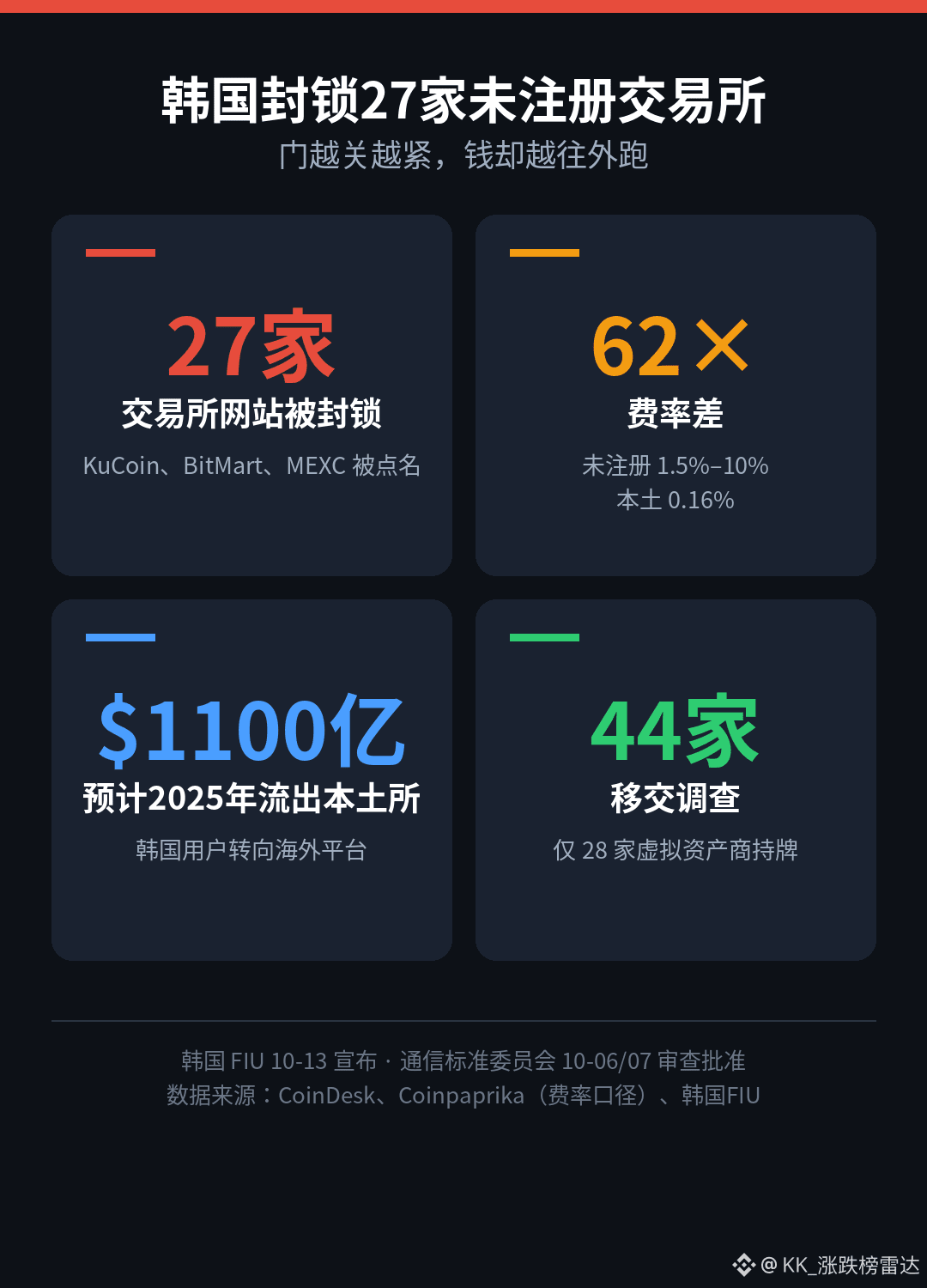
Every one of the four figures on the graphic was cross-checked: South Korea’s FIU named 27 unregistered exchange websites for blocking, including KuCoin, BitMart, and MEXC; these platforms charge fees of 1.5%–10%, compared with an average of 0.16% on domestic Korean won exchanges—a gap of up to 62 times. That fee difference is probably the main reason Korean users are moving their money overseas. CoinDesk estimates that about $110 billion will flow from South Korean exchanges to overseas platforms in 2025. Forty-four unregistered operators have been referred for investigation, while only 28 are licensed. The gates keep closing tighter, yet more money keeps flowing out—that’s the most thought-provoking part of the whole story.
What do the numbers tell us? I checked the results this evening: my post, “South Korea Plans to Tighten Financial Cybersecurity Rules,” got 6,791 views, making it my top post today. The second-place finisher, the morning brief, got 1,168—not even a fraction of that. Same day, same account, same writing style—but simply by combining “a trending topic + an easy-to-grasp graphic,” the post got almost six times the views.
Here’s today’s lesson: **Trending topics are a tailwind, but they only fill the sails of ships carrying data.** Posts that merely ride a trend without solid data will probably sink—readers scroll past them on the trending list without any reason to stop. An easy-to-grasp graphic solves that problem: the key points are clear in three seconds (27 sites blocked, a 62-fold fee gap, $110 billion flowing overseas), and the information density is high. Readers are more likely to stop, read to the end, and comment.
There’s also a timing lesson: follow up while the topic is hot. The topic grew from 86 posts in the afternoon to 172 in the evening. I posted at 16:29, right in the middle of that surge. Trending topics have a half-life of less than 12 hours. Spot it, verify it, make the graphic, post it—move fast. Wait until tomorrow and the topic will already be cold.
Honestly, since I started building this account, my “follow the trending list” strategy has gone through three stages. First, I just repeated the news, and the traffic was dismal. Then I added solid data, and things started to pick up. Today was stage three: putting the hard data into an easy-to-grasp graphic—and getting the most views on a single post since launching the account. The approach is right: pick the right topic, verify the data, make the graphic clear, and the traffic will come naturally.
I’ve also figured out the golden rules for graphics: use color blocks to catch the eye, make the main point clear in three seconds, and put one sentence in each box. Decoration always comes second to information. Readers might only glance at a post in their feed for 0.5 seconds. Big numbers catch their eye first; then they decide whether to look closer. Those 0.5 seconds are the dividing line between getting traffic and sinking without a trace.
Next up: make “trending topic + data card” my regular format. Every day, I’ll pick one topic from the trending list. If I can back it up with solid data, I’ll cover it and add an easy-to-grasp graphic; if I can’t, I’d rather not post. There are trending topics every day, but I’ll spend my time only on the ones I can explain with data.
Have you ever followed up on a trending topic? Did you catch the wave or flop? Let’s talk in the comments.
$BTC $ETH
232

·
--
#006
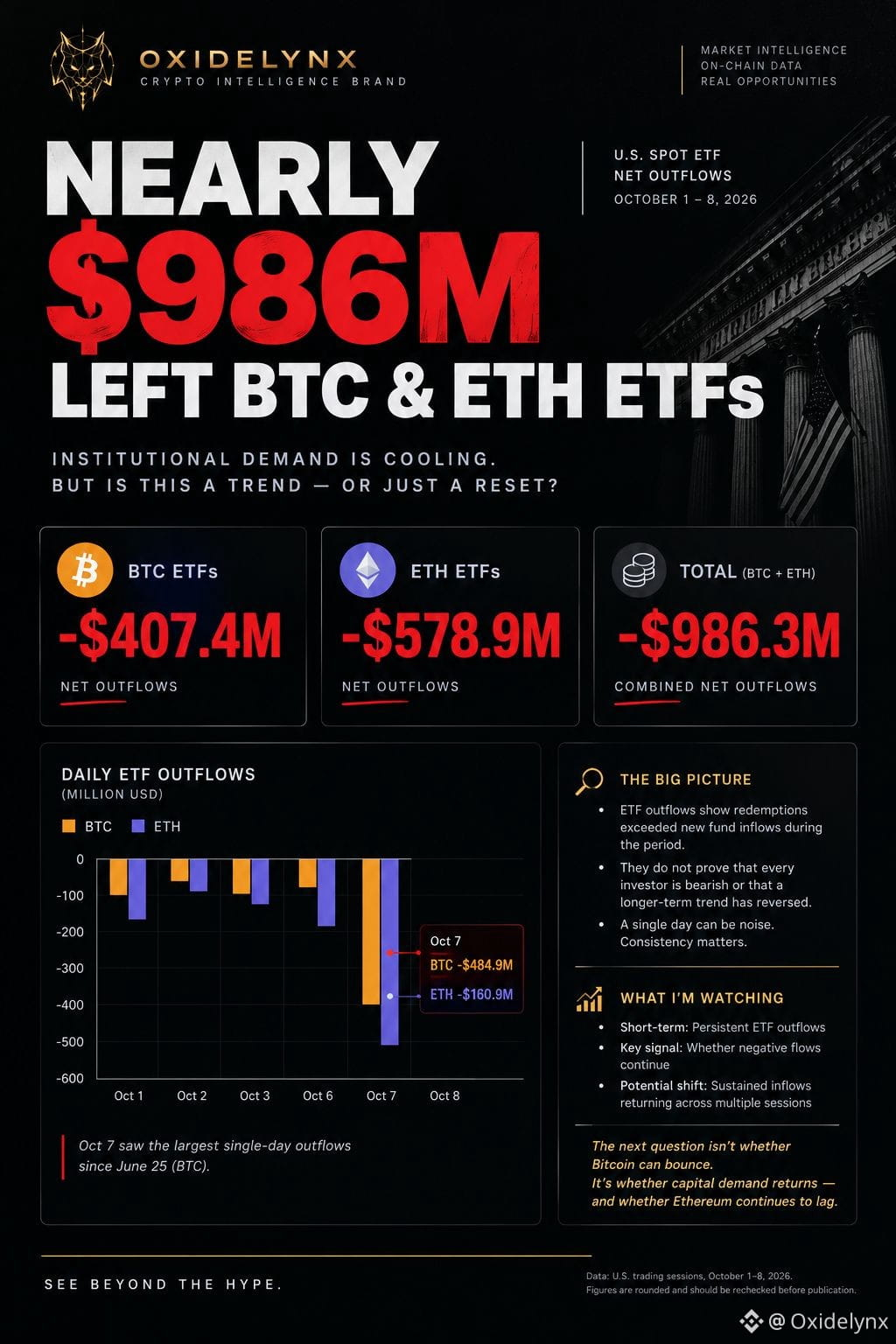
NEARLY $1 BILLION LEFT BTC & ETH ETFs
The crypto market is sending a signal worth watching. Between October 1 and October 8, U.S. spot ETFs recorded approximately:
🔴 BTC ETFs : $407.4M in net outflows
🔴 ETH ETFs : $578.9M in net outflows
That’s nearly $986M in combined net outflows in just a few trading sessions. But one detail stands out, Ethereum ETFs saw larger cumulative outflows than Bitcoin ETFs.
On October 7 alone, Bitcoin ETFs lost $484.9M — their biggest daily outflow since June 25. Ethereum ETFs lost another $160.9M that same day.
So, is institutional demand disappearing?
Not necessarily, ETF outflows show that redemptions exceeded new fund inflows during the period. They do not, by themselves, prove that every investor is bearish or that a longer-term trend has reversed.
🔎 WHAT I'M WATCHING
🔴 Short-term : Persistent ETF outflows
⚠️ Key signal : Whether negative flows continue
🟢 Potential shift : Sustained inflows returning across multiple sessions
One bad day can be noise. Repeated outflows across several sessions deserve closer attention.
The next question is not simply whether Bitcoin can bounce.
It’s whether capital demand returns and whether Ethereum continues to lag.
No panic. No blind bullishness. Just follow the flows.
SEE BEYOND THE HYPE.
#OXIDELYNX #Bitcoin #Ethereum #ETF
{spot}(ETHUSDT)
{spot}(BTCUSDT)
#006
NEARLY $1 BILLION LEFT BTC & ETH ETFs
The crypto market is sending a signal worth watching. Between October 1 and October 8, U.S. spot ETFs recorded approximately:
🔴 BTC ETFs : $407.4M in net outflows
🔴 ETH ETFs : $578.9M in net outflows
That’s nearly $986M in combined net outflows in just a few trading sessions. But one detail stands out, Ethereum ETFs saw larger cumulative outflows than Bitcoin ETFs.
On October 7 alone, Bitcoin ETFs lost $484.9M — their biggest daily outflow since June 25. Ethereum ETFs lost another $160.9M that same day.
So, is institutional demand disappearing?
Not necessarily, ETF outflows show that redemptions exceeded new fund inflows during the period. They do not, by themselves, prove that every investor is bearish or that a longer-term trend has reversed.
🔎 WHAT I'M WATCHING
🔴 Short-term : Persistent ETF outflows
⚠️ Key signal : Whether negative flows continue
🟢 Potential shift : Sustained inflows returning across multiple sessions
One bad day can be noise. Repeated outflows across several sessions deserve closer attention.
The next question is not simply whether Bitcoin can bounce.
It’s whether capital demand returns and whether Ethereum continues to lag.
No panic. No blind bullishness. Just follow the flows.
SEE BEYOND THE HYPE.
#OXIDELYNX #Bitcoin #Ethereum #ETF
114
Log in to explore more content
Join global crypto users on Binance Square
⚡️ Get latest and useful information about crypto.
💬 Trusted by the world’s largest crypto exchange.
👍 Discover real insights from verified creators.
Email / Phone number
Trending Topics
1
#BinanceReports80%Recoveryof$6.3BillioninLossesfromHackIncident
4,887 views
62 Discussing
2
#HeYiSaysWithdrawalsExpectedtoResumeWithin42Hours
7,154 views
172 Discussing
3
#CZSaysCompensationIsinPlaceUsersAreProtected
6,202 views
136 Discussing
4
#RichardTengSaysBinanceWillCoverAllHackedLosseswithCompanyFunds
41 views
5 Discussing
5
#TRMCambodianCasinosReceived$1.07BInCrypto
679 views
30 Discussing
6
#USDCCirculationFallsAbout800MInSevenDays
5,774 views
134 Discussing
7
#SuspectedNorthKoreaAttacksAccountForNearly89%OfCryptoHackLosses
6,217 views
68 Discussing
8
#OpenAICutsFundraisingTargetBy$10B
1,089 views
53 Discussing
9
#ASICHasReceivedNoPredictionMarketApplications
20,405 views
545 Discussing
10
#RecallAnnouncesLiquidationPlansToBurn35.86%OfSupply
554 views
22 Discussing