

Cointelegraph
37.1k Жариялаулар

Cointelegraph
 «Square расталған+» белгісі
Хабарлау
Пайдаланушыны блоктау
Cointelegraph covers fintech, blockchain and Bitcoin, bringing you the latest news and analyses on the future of money.
2 Жазылым
186.3K+ Жазылушылар
567.1K+ лайк басылған
1 Белгішелер
Жазбалар
Мақала
Vivek Ramaswamy’s gubernatorial run lacks the crypto rhetoric of his presidential bidTwo years ago, then-presidential candidate Vivek Ramaswamy couldn’t stop praising the virtues of cryptocurrency.
Running to be the 2024 Republican nominee in the race for the White House, Ramaswamy sprinkled his stump speeches with praise for Bitcoin (BTC) and token mining operations while strongly standing against central bank digital currencies.
Now, presidential candidate Ramaswamy is running to be the next governor of Ohio. And while he isn’t exactly distancing himself from positions on digital assets, he isn’t putting them at the forefront of his campaign despite substantial exposure to crypto investments and the Buckeye state’s interests.
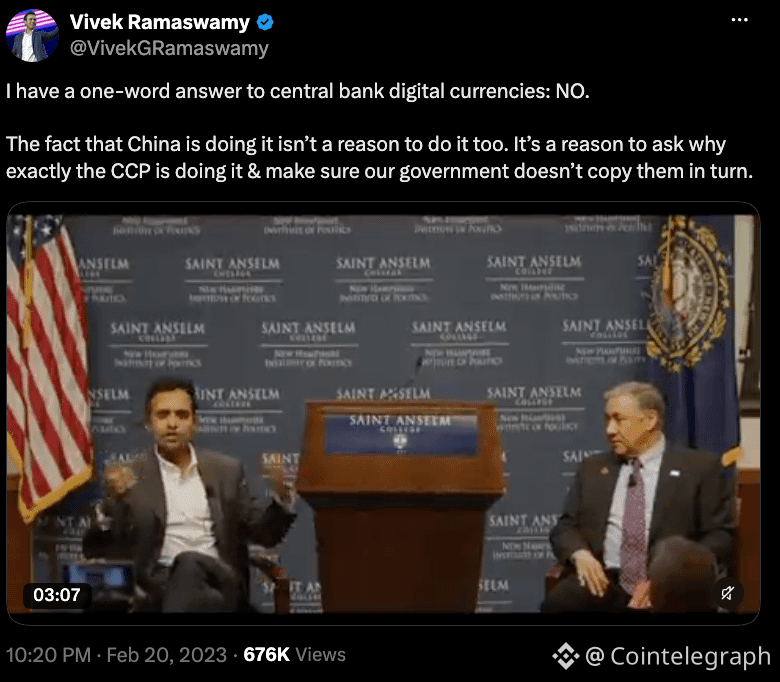
2023 X post on CBDCs. Source: Vivek Ramaswamy
In his 2024 presidential run, Ramaswamy was frequently issuing statements in opposition to central bank digital currencies (CBDCs), praising Bitcoin (BTC) and its mining operations and often attending industry events as a keynote speaker.
After Donald Trump won the presidential race, he tapped Ramaswamy to lead the Department of Government Efficiency, or DOGE, alongside Elon Musk. Ramaswamy left having never officially been a part of the administration.
Before announcing a run for the Ohio governor’s office in February 2025, he posted in support of the Ohio Strategic Cryptocurrency Reserve Act, a state bill that would allow the creation of a strategic Bitcoin reserve. In September 2025, Strive, the asset manager that he co-founded in 2022, announced plans to enter the digital asset market with a Bitcoin Bond ETF, focused on bonds issued by companies acquiring BTC.
Cointelegraph reached out to the Ramaswamy campaign but did not receive a response to repeated requests for an interview.
Crypto as a gubernatorial candidate
Following the official launch of his campaign, Ramaswamy initially kept up much of the same rhetoric he had espoused during his presidential run, also speaking at the Bitcoin for America conference in March and Bitcoin 2025 in May.
His campaign website accepts donations in crypto, and he has financial support from the co-founders of the Trump family’s crypto company, World Liberty Financial: Chase Herro, Zak Folkman and Zachary Witkoff, all of whom donated the maximum allowable amount of $16,615 each.
Other entities associated with the crypto industry have also donated millions of dollars to Ramaswamy’s Super political action committee (PAC) “V-PAC: Victors, Not Victims,” including $20 million from Susquehanna International Group co-founder Jeff Yass, $6 million from NYDIG founder Ross Stevens, $5 million from billionaire Elon Musk and $5,000 from the Bitcoin Voter Project.
Ramaswamy has maintained his stake in Strive, which reported holding 23,156 BTC worth about $2 billion as of Aug. 28. An August filing with the US Securities and Exchange Commission showed the candidate owned 5,693,897 shares in the company, worth more than $170 million as of Sept. 26. He also reported personally holding more than $1,000 in BTC and Ether (ETH) as of April through a Coinbase wallet.
In September 2026, just weeks away from the election, Ramaswamy’s public statements on digital assets and related policies appear to have waned in contrast to his 2024 and even 2025 rhetoric. He had not addressed a Sept. 17 notice from Ohio Secretary of State Frank LaRose announcing the acceptance of cryptocurrency to pay for state fees and services as of the time of publication.
What’s different for Ohio voters in 2026? Data centers, for one
Ohio voters could be part of the reason for Ramaswamy appearing to tone down the talk on crypto. The state was already the target of more than $40 million in spending by industry-aligned groups in 2024 to support Republican Bernie Moreno’s Senate run.
Two years ago, Moreno defeated incumbent Democrat Sherrod Brown, but history is beginning to repeat itself: Brown is now running against Republican Jon Husted for another chance in the Senate in next month’s election. The Fairshake PAC has pledged to initially spend $30 million opposing the Democrat again, already reporting $11 million in ad buys.
To be sure, a poll conducted by the Digital Currency Group in May 2024, months before the election, suggested that Ohio voters were “more negative towards crypto” compared to those in other US states, with 79% of the state’s respondents saying that they had never held crypto and 77% holding negative views on the digital currency.
Sentiment on data centers has also become a controversial campaign issue for Ohio politicians in 2026. According to the Pew Research Center, there were 166 data centers in Ohio as of April, giving the state more locations than any other in the country. It’s also home to many crypto mining operations, including Cipher Mining, Bitdeer and BIT Mining.
Public polling also showed that a majority of Ohio residents do not support data centers in their communities. Ramaswamy pledged in August that any center built in an Ohio community would result in no electricity cost for residents and lower property taxes, while his Democratic opponent, Amy Acton, has proposed that “all costs for gas, water and electricity needs to be covered by data centers and their investors, not Ohio taxpayers or our communities.”
As of Sept. 22, an average of RealClearPolling data showed Acton with a one-point lead over Ramaswamy, making the race essentially a toss up. An event contract on Kalshi at last look on Monday had more than $2 million in bets and favored the Democratic candidate with a 66% chance of winning the governor’s race, with similar odds on a Polymarket contract.
Magazine: Winners and losers of the SEC’s new tokenized stocks rules
Vivek Ramaswamy’s gubernatorial run lacks the crypto rhetoric of his presidential bid
Two years ago, then-presidential candidate Vivek Ramaswamy couldn’t stop praising the virtues of cryptocurrency.
Running to be the 2024 Republican nominee in the race for the White House, Ramaswamy sprinkled his stump speeches with praise for Bitcoin (BTC) and token mining operations while strongly standing against central bank digital currencies.
Now, presidential candidate Ramaswamy is running to be the next governor of Ohio. And while he isn’t exactly distancing himself from positions on digital assets, he isn’t putting them at the forefront of his campaign despite substantial exposure to crypto investments and the Buckeye state’s interests.
2023 X post on CBDCs. Source: Vivek Ramaswamy
In his 2024 presidential run, Ramaswamy was frequently issuing statements in opposition to central bank digital currencies (CBDCs), praising Bitcoin (BTC) and its mining operations and often attending industry events as a keynote speaker.
After Donald Trump won the presidential race, he tapped Ramaswamy to lead the Department of Government Efficiency, or DOGE, alongside Elon Musk. Ramaswamy left having never officially been a part of the administration.
Before announcing a run for the Ohio governor’s office in February 2025, he posted in support of the Ohio Strategic Cryptocurrency Reserve Act, a state bill that would allow the creation of a strategic Bitcoin reserve. In September 2025, Strive, the asset manager that he co-founded in 2022, announced plans to enter the digital asset market with a Bitcoin Bond ETF, focused on bonds issued by companies acquiring BTC.
Cointelegraph reached out to the Ramaswamy campaign but did not receive a response to repeated requests for an interview.
Crypto as a gubernatorial candidate
Following the official launch of his campaign, Ramaswamy initially kept up much of the same rhetoric he had espoused during his presidential run, also speaking at the Bitcoin for America conference in March and Bitcoin 2025 in May.
His campaign website accepts donations in crypto, and he has financial support from the co-founders of the Trump family’s crypto company, World Liberty Financial: Chase Herro, Zak Folkman and Zachary Witkoff, all of whom donated the maximum allowable amount of $16,615 each.
Other entities associated with the crypto industry have also donated millions of dollars to Ramaswamy’s Super political action committee (PAC) “V-PAC: Victors, Not Victims,” including $20 million from Susquehanna International Group co-founder Jeff Yass, $6 million from NYDIG founder Ross Stevens, $5 million from billionaire Elon Musk and $5,000 from the Bitcoin Voter Project.
Ramaswamy has maintained his stake in Strive, which reported holding 23,156 BTC worth about $2 billion as of Aug. 28. An August filing with the US Securities and Exchange Commission showed the candidate owned 5,693,897 shares in the company, worth more than $170 million as of Sept. 26. He also reported personally holding more than $1,000 in BTC and Ether (ETH) as of April through a Coinbase wallet.
In September 2026, just weeks away from the election, Ramaswamy’s public statements on digital assets and related policies appear to have waned in contrast to his 2024 and even 2025 rhetoric. He had not addressed a Sept. 17 notice from Ohio Secretary of State Frank LaRose announcing the acceptance of cryptocurrency to pay for state fees and services as of the time of publication.
What’s different for Ohio voters in 2026? Data centers, for one
Ohio voters could be part of the reason for Ramaswamy appearing to tone down the talk on crypto. The state was already the target of more than $40 million in spending by industry-aligned groups in 2024 to support Republican Bernie Moreno’s Senate run.
Two years ago, Moreno defeated incumbent Democrat Sherrod Brown, but history is beginning to repeat itself: Brown is now running against Republican Jon Husted for another chance in the Senate in next month’s election. The Fairshake PAC has pledged to initially spend $30 million opposing the Democrat again, already reporting $11 million in ad buys.
To be sure, a poll conducted by the Digital Currency Group in May 2024, months before the election, suggested that Ohio voters were “more negative towards crypto” compared to those in other US states, with 79% of the state’s respondents saying that they had never held crypto and 77% holding negative views on the digital currency.
Sentiment on data centers has also become a controversial campaign issue for Ohio politicians in 2026. According to the Pew Research Center, there were 166 data centers in Ohio as of April, giving the state more locations than any other in the country. It’s also home to many crypto mining operations, including Cipher Mining, Bitdeer and BIT Mining.
Public polling also showed that a majority of Ohio residents do not support data centers in their communities. Ramaswamy pledged in August that any center built in an Ohio community would result in no electricity cost for residents and lower property taxes, while his Democratic opponent, Amy Acton, has proposed that “all costs for gas, water and electricity needs to be covered by data centers and their investors, not Ohio taxpayers or our communities.”
As of Sept. 22, an average of RealClearPolling data showed Acton with a one-point lead over Ramaswamy, making the race essentially a toss up. An event contract on Kalshi at last look on Monday had more than $2 million in bets and favored the Democratic candidate with a 66% chance of winning the governor’s race, with similar odds on a Polymarket contract.
Magazine: Winners and losers of the SEC’s new tokenized stocks rules
Running to be the 2024 Republican nominee in the race for the White House, Ramaswamy sprinkled his stump speeches with praise for Bitcoin (BTC) and token mining operations while strongly standing against central bank digital currencies.
Now, presidential candidate Ramaswamy is running to be the next governor of Ohio. And while he isn’t exactly distancing himself from positions on digital assets, he isn’t putting them at the forefront of his campaign despite substantial exposure to crypto investments and the Buckeye state’s interests.
2023 X post on CBDCs. Source: Vivek Ramaswamy
In his 2024 presidential run, Ramaswamy was frequently issuing statements in opposition to central bank digital currencies (CBDCs), praising Bitcoin (BTC) and its mining operations and often attending industry events as a keynote speaker.
After Donald Trump won the presidential race, he tapped Ramaswamy to lead the Department of Government Efficiency, or DOGE, alongside Elon Musk. Ramaswamy left having never officially been a part of the administration.
Before announcing a run for the Ohio governor’s office in February 2025, he posted in support of the Ohio Strategic Cryptocurrency Reserve Act, a state bill that would allow the creation of a strategic Bitcoin reserve. In September 2025, Strive, the asset manager that he co-founded in 2022, announced plans to enter the digital asset market with a Bitcoin Bond ETF, focused on bonds issued by companies acquiring BTC.
Cointelegraph reached out to the Ramaswamy campaign but did not receive a response to repeated requests for an interview.
Crypto as a gubernatorial candidate
Following the official launch of his campaign, Ramaswamy initially kept up much of the same rhetoric he had espoused during his presidential run, also speaking at the Bitcoin for America conference in March and Bitcoin 2025 in May.
His campaign website accepts donations in crypto, and he has financial support from the co-founders of the Trump family’s crypto company, World Liberty Financial: Chase Herro, Zak Folkman and Zachary Witkoff, all of whom donated the maximum allowable amount of $16,615 each.
Other entities associated with the crypto industry have also donated millions of dollars to Ramaswamy’s Super political action committee (PAC) “V-PAC: Victors, Not Victims,” including $20 million from Susquehanna International Group co-founder Jeff Yass, $6 million from NYDIG founder Ross Stevens, $5 million from billionaire Elon Musk and $5,000 from the Bitcoin Voter Project.
Ramaswamy has maintained his stake in Strive, which reported holding 23,156 BTC worth about $2 billion as of Aug. 28. An August filing with the US Securities and Exchange Commission showed the candidate owned 5,693,897 shares in the company, worth more than $170 million as of Sept. 26. He also reported personally holding more than $1,000 in BTC and Ether (ETH) as of April through a Coinbase wallet.
In September 2026, just weeks away from the election, Ramaswamy’s public statements on digital assets and related policies appear to have waned in contrast to his 2024 and even 2025 rhetoric. He had not addressed a Sept. 17 notice from Ohio Secretary of State Frank LaRose announcing the acceptance of cryptocurrency to pay for state fees and services as of the time of publication.
What’s different for Ohio voters in 2026? Data centers, for one
Ohio voters could be part of the reason for Ramaswamy appearing to tone down the talk on crypto. The state was already the target of more than $40 million in spending by industry-aligned groups in 2024 to support Republican Bernie Moreno’s Senate run.
Two years ago, Moreno defeated incumbent Democrat Sherrod Brown, but history is beginning to repeat itself: Brown is now running against Republican Jon Husted for another chance in the Senate in next month’s election. The Fairshake PAC has pledged to initially spend $30 million opposing the Democrat again, already reporting $11 million in ad buys.
To be sure, a poll conducted by the Digital Currency Group in May 2024, months before the election, suggested that Ohio voters were “more negative towards crypto” compared to those in other US states, with 79% of the state’s respondents saying that they had never held crypto and 77% holding negative views on the digital currency.
Sentiment on data centers has also become a controversial campaign issue for Ohio politicians in 2026. According to the Pew Research Center, there were 166 data centers in Ohio as of April, giving the state more locations than any other in the country. It’s also home to many crypto mining operations, including Cipher Mining, Bitdeer and BIT Mining.
Public polling also showed that a majority of Ohio residents do not support data centers in their communities. Ramaswamy pledged in August that any center built in an Ohio community would result in no electricity cost for residents and lower property taxes, while his Democratic opponent, Amy Acton, has proposed that “all costs for gas, water and electricity needs to be covered by data centers and their investors, not Ohio taxpayers or our communities.”
As of Sept. 22, an average of RealClearPolling data showed Acton with a one-point lead over Ramaswamy, making the race essentially a toss up. An event contract on Kalshi at last look on Monday had more than $2 million in bets and favored the Democratic candidate with a 66% chance of winning the governor’s race, with similar odds on a Polymarket contract.
Magazine: Winners and losers of the SEC’s new tokenized stocks rules
113
Мақала
BTC price fights to reclaim 2026 open: Three things to know in Bitcoin this weekBitcoin (BTC) is eyeing a key level as BTC/USD is on the cusp of turning the 2026 yearly candle green.
Key points:
Bitcoin bulls have briefly revisited $87,000 on some exchanges, but the 2026 yearly open at $87,570 will provide ongoing resistance.
Traders are turning their attention to the bond market ahead of Wednesday’s 10-year note auction and Fed meeting minutes.
BTC/USD brushes off a traditionally weak start to the month. October upside has historically averaged 18.7% since 2013.
2026 yearly open becomes Bitcoin’s next resistance hurdle
Bitcoin continues to battle range highs after sealing its highest weekly close since late January at $86,532 on Bitstamp. Data from TradingView shows brief wicks to $87,000 after the weekly close, as part of Bitcoin’s fourth attempt to break higher since Sept. 21. Bulls have so far failed to reclaim the yearly open at $87,570.
BTC/USD one-hour chart. Source: Cointelegraph/TradingView
On lower time frames, liquidity hunts continue to dictate price action. Similar to last week, BTC/USD saw liquidations of nearby short positions around $85,500, while walls of bids and asks thickened around spot price, keeping volatility constricted. Data from CoinGlass shows concentrations at $83,700 in addition to the yearly open.
BTC three-day liquidation heatmap. Source: CoinGlass
“Bitcoin continues to be sandwiched between the ~ $82500 key support and the ~ $86700 resistance ahead,” trader and analyst Rekt Capital wrote in his latest X analysis.
Rekt Capital sees $82,500 as key support to avoid revisiting the previous 2026 range between $60,000 and $80,000. A decisive move above $86,700, meanwhile, would open up the path to a higher range with $93,700 as its ceiling.
BTC/USD one-week chart. Source: Rekt Capital on X.com
Bond market in focus after 24-year highs
A comparatively light week of macro data in the US will put bond markets at the forefront as traders have discounted the odds of the Federal Reserve hiking interest rates.
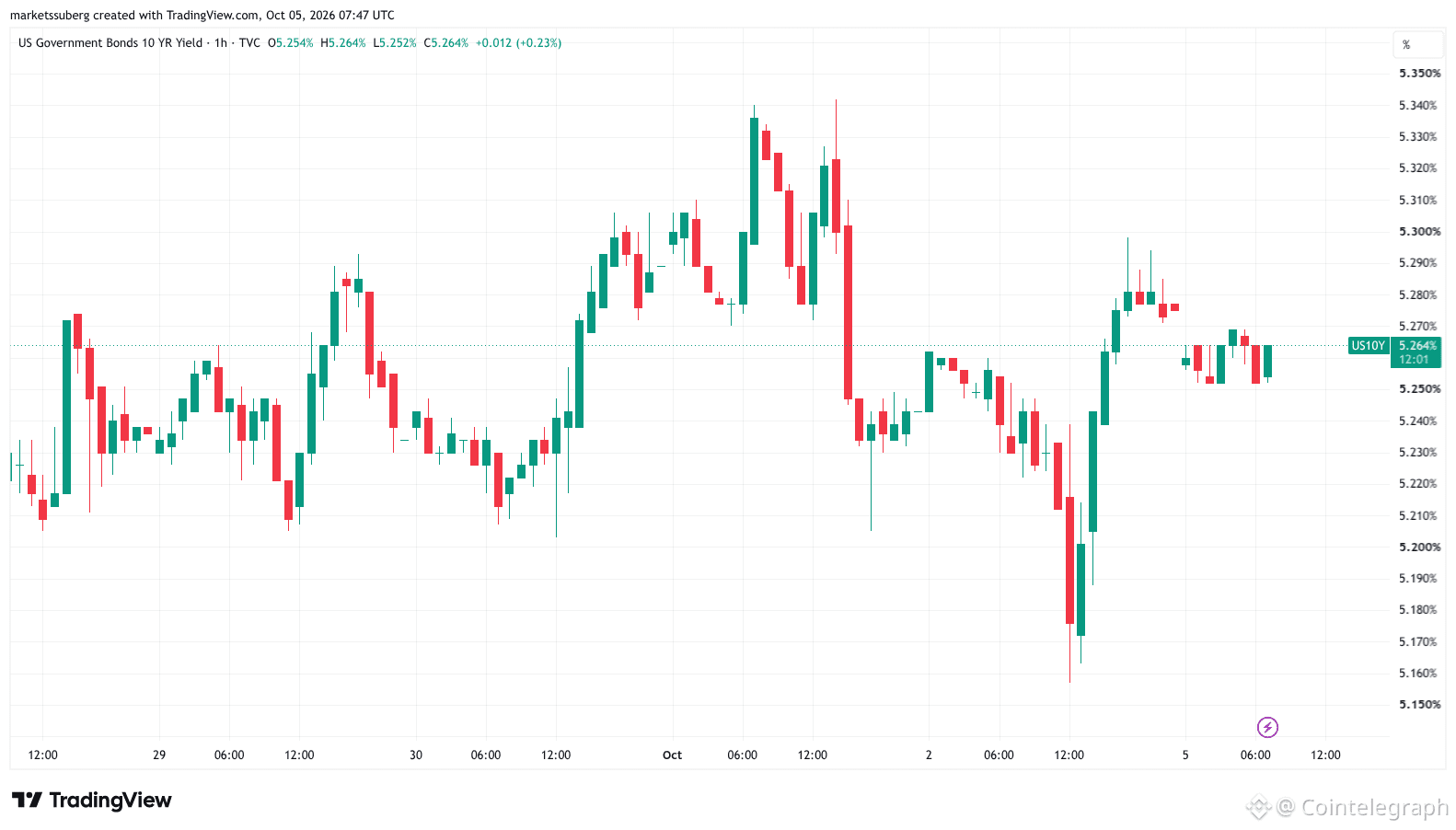
Last week, both the 10-year and 30-year bond yields hit 5.34% and 5.69%, respectively — levels not seen since 2002. They dropped only modestly on weak nonfarm payrolls data before rebounding to erase most of the decline. At the time of writing on Monday, the 10-year yield stood at 5.25%.
US 10-year bond yield one-hour chart. Source: Cointelegraph/TradingView
“The bond market is in the spotlight this week,” trading resource The Kobeissi Letter summarized in an X post on Sunday.
On Wednesday, the Federal Reserve will publish the minutes of the September Federal Open Market Committee (FOMC) meeting, in which officials voted to increase interest rates by 0.25%. Since then, market expectations of further policy tightening have whipsawed. Data from CME Group’s FedWatch Tool shows that a week ago, odds of another 0.25% hike at the October FOMC meeting reached 70% before dropping to current levels of just 18%.
Fed target-rate probability comparison for October FOMC meeting (screenshot). Source: CME Group
With consensus still favoring a December hike, however, analysts also see the Fed staying hawkish through year end, with headwinds for crypto and risk assets staying in place as a result.
“I think that’s the right move because I don’t think this report necessarily changes the story for the Fed,” Timothy Chubb, chief investment officer at Girard Advisory Services, told CNBC about the post-payrolls yield rebound.
Chubb saw the Fed continuing to keep rates “higher for longer” going forward, with inflation sticky and oil prices still volatile thanks to the Middle East conflict.
The August print of the Personal Consumption Expenditures (PCE) index, known as the Fed’s “preferred” inflation gauge, did little to impact markets’ assessment of inflation trends despite coming in lower than expected. Changes in the way the index is calculated likely accounted for a portion of the drop, Kobeissi argued at the time. The next key inflation print will be the Consumer Price Index (CPI), due for release on Oct. 14.
BTC price begins historically strong month for bulls
Seasonality remains a focus among Bitcoin market participants as October has commenced with BTC price upside.
Onchain analytics platform CryptoQuant reports that Bitcoin has already weathered a traditionally difficult period at the start of the month.
“Bitcoin’s first three days of October have historically been its weakest three-day stretch of the month, averaging a 0.66% decline. 2026 has already held up better,” contributor Andrew Kamsky wrote on Sunday.
BTC/USD gained 1.4% in the first three days of October, with current month-to-date upside at 2.7%. From the Oct. 1 close to the Oct. 3 close, the pair avoided losses, whereas the historical average for the period has been -0.66%, Kamsky reported.
BTC/USD October returns comparison (screenshot). Source: CryptoQuant
CoinGlass data shows that on average since 2013, Bitcoin has ended October 18.7% higher, giving a 2026 target of just under $100,000. Over the past 13 years, there have been just three “red” October months, with the largest downside figure of -13% seen in 2014.
BTC/USD monthly returns (screenshot). Source: CoinGlass
Previously, Cointelegraph reported on Bitcoin’s unusually strong Q3 performance, which saw quarterly gains in excess of 40% — the best Q3 result since the 2017 bull market.
BTC price fights to reclaim 2026 open: Three things to know in Bitcoin this week
Bitcoin (BTC) is eyeing a key level as BTC/USD is on the cusp of turning the 2026 yearly candle green.
Key points:
Bitcoin bulls have briefly revisited $87,000 on some exchanges, but the 2026 yearly open at $87,570 will provide ongoing resistance.
Traders are turning their attention to the bond market ahead of Wednesday’s 10-year note auction and Fed meeting minutes.
BTC/USD brushes off a traditionally weak start to the month. October upside has historically averaged 18.7% since 2013.
2026 yearly open becomes Bitcoin’s next resistance hurdle
Bitcoin continues to battle range highs after sealing its highest weekly close since late January at $86,532 on Bitstamp. Data from TradingView shows brief wicks to $87,000 after the weekly close, as part of Bitcoin’s fourth attempt to break higher since Sept. 21. Bulls have so far failed to reclaim the yearly open at $87,570.
BTC/USD one-hour chart. Source: Cointelegraph/TradingView
On lower time frames, liquidity hunts continue to dictate price action. Similar to last week, BTC/USD saw liquidations of nearby short positions around $85,500, while walls of bids and asks thickened around spot price, keeping volatility constricted. Data from CoinGlass shows concentrations at $83,700 in addition to the yearly open.
BTC three-day liquidation heatmap. Source: CoinGlass
“Bitcoin continues to be sandwiched between the ~ $82500 key support and the ~ $86700 resistance ahead,” trader and analyst Rekt Capital wrote in his latest X analysis.
Rekt Capital sees $82,500 as key support to avoid revisiting the previous 2026 range between $60,000 and $80,000. A decisive move above $86,700, meanwhile, would open up the path to a higher range with $93,700 as its ceiling.
BTC/USD one-week chart. Source: Rekt Capital on X.com
Bond market in focus after 24-year highs
A comparatively light week of macro data in the US will put bond markets at the forefront as traders have discounted the odds of the Federal Reserve hiking interest rates.
Last week, both the 10-year and 30-year bond yields hit 5.34% and 5.69%, respectively — levels not seen since 2002. They dropped only modestly on weak nonfarm payrolls data before rebounding to erase most of the decline. At the time of writing on Monday, the 10-year yield stood at 5.25%.
US 10-year bond yield one-hour chart. Source: Cointelegraph/TradingView
“The bond market is in the spotlight this week,” trading resource The Kobeissi Letter summarized in an X post on Sunday.
On Wednesday, the Federal Reserve will publish the minutes of the September Federal Open Market Committee (FOMC) meeting, in which officials voted to increase interest rates by 0.25%. Since then, market expectations of further policy tightening have whipsawed. Data from CME Group’s FedWatch Tool shows that a week ago, odds of another 0.25% hike at the October FOMC meeting reached 70% before dropping to current levels of just 18%.
Fed target-rate probability comparison for October FOMC meeting (screenshot). Source: CME Group
With consensus still favoring a December hike, however, analysts also see the Fed staying hawkish through year end, with headwinds for crypto and risk assets staying in place as a result.
“I think that’s the right move because I don’t think this report necessarily changes the story for the Fed,” Timothy Chubb, chief investment officer at Girard Advisory Services, told CNBC about the post-payrolls yield rebound.
Chubb saw the Fed continuing to keep rates “higher for longer” going forward, with inflation sticky and oil prices still volatile thanks to the Middle East conflict.
The August print of the Personal Consumption Expenditures (PCE) index, known as the Fed’s “preferred” inflation gauge, did little to impact markets’ assessment of inflation trends despite coming in lower than expected. Changes in the way the index is calculated likely accounted for a portion of the drop, Kobeissi argued at the time. The next key inflation print will be the Consumer Price Index (CPI), due for release on Oct. 14.
BTC price begins historically strong month for bulls
Seasonality remains a focus among Bitcoin market participants as October has commenced with BTC price upside.
Onchain analytics platform CryptoQuant reports that Bitcoin has already weathered a traditionally difficult period at the start of the month.
“Bitcoin’s first three days of October have historically been its weakest three-day stretch of the month, averaging a 0.66% decline. 2026 has already held up better,” contributor Andrew Kamsky wrote on Sunday.
BTC/USD gained 1.4% in the first three days of October, with current month-to-date upside at 2.7%. From the Oct. 1 close to the Oct. 3 close, the pair avoided losses, whereas the historical average for the period has been -0.66%, Kamsky reported.
BTC/USD October returns comparison (screenshot). Source: CryptoQuant
CoinGlass data shows that on average since 2013, Bitcoin has ended October 18.7% higher, giving a 2026 target of just under $100,000. Over the past 13 years, there have been just three “red” October months, with the largest downside figure of -13% seen in 2014.
BTC/USD monthly returns (screenshot). Source: CoinGlass
Previously, Cointelegraph reported on Bitcoin’s unusually strong Q3 performance, which saw quarterly gains in excess of 40% — the best Q3 result since the 2017 bull market.
Key points:
Bitcoin bulls have briefly revisited $87,000 on some exchanges, but the 2026 yearly open at $87,570 will provide ongoing resistance.
Traders are turning their attention to the bond market ahead of Wednesday’s 10-year note auction and Fed meeting minutes.
BTC/USD brushes off a traditionally weak start to the month. October upside has historically averaged 18.7% since 2013.
2026 yearly open becomes Bitcoin’s next resistance hurdle
Bitcoin continues to battle range highs after sealing its highest weekly close since late January at $86,532 on Bitstamp. Data from TradingView shows brief wicks to $87,000 after the weekly close, as part of Bitcoin’s fourth attempt to break higher since Sept. 21. Bulls have so far failed to reclaim the yearly open at $87,570.
BTC/USD one-hour chart. Source: Cointelegraph/TradingView
On lower time frames, liquidity hunts continue to dictate price action. Similar to last week, BTC/USD saw liquidations of nearby short positions around $85,500, while walls of bids and asks thickened around spot price, keeping volatility constricted. Data from CoinGlass shows concentrations at $83,700 in addition to the yearly open.
BTC three-day liquidation heatmap. Source: CoinGlass
“Bitcoin continues to be sandwiched between the ~ $82500 key support and the ~ $86700 resistance ahead,” trader and analyst Rekt Capital wrote in his latest X analysis.
Rekt Capital sees $82,500 as key support to avoid revisiting the previous 2026 range between $60,000 and $80,000. A decisive move above $86,700, meanwhile, would open up the path to a higher range with $93,700 as its ceiling.
BTC/USD one-week chart. Source: Rekt Capital on X.com
Bond market in focus after 24-year highs
A comparatively light week of macro data in the US will put bond markets at the forefront as traders have discounted the odds of the Federal Reserve hiking interest rates.
Last week, both the 10-year and 30-year bond yields hit 5.34% and 5.69%, respectively — levels not seen since 2002. They dropped only modestly on weak nonfarm payrolls data before rebounding to erase most of the decline. At the time of writing on Monday, the 10-year yield stood at 5.25%.
US 10-year bond yield one-hour chart. Source: Cointelegraph/TradingView
“The bond market is in the spotlight this week,” trading resource The Kobeissi Letter summarized in an X post on Sunday.
On Wednesday, the Federal Reserve will publish the minutes of the September Federal Open Market Committee (FOMC) meeting, in which officials voted to increase interest rates by 0.25%. Since then, market expectations of further policy tightening have whipsawed. Data from CME Group’s FedWatch Tool shows that a week ago, odds of another 0.25% hike at the October FOMC meeting reached 70% before dropping to current levels of just 18%.
Fed target-rate probability comparison for October FOMC meeting (screenshot). Source: CME Group
With consensus still favoring a December hike, however, analysts also see the Fed staying hawkish through year end, with headwinds for crypto and risk assets staying in place as a result.
“I think that’s the right move because I don’t think this report necessarily changes the story for the Fed,” Timothy Chubb, chief investment officer at Girard Advisory Services, told CNBC about the post-payrolls yield rebound.
Chubb saw the Fed continuing to keep rates “higher for longer” going forward, with inflation sticky and oil prices still volatile thanks to the Middle East conflict.
The August print of the Personal Consumption Expenditures (PCE) index, known as the Fed’s “preferred” inflation gauge, did little to impact markets’ assessment of inflation trends despite coming in lower than expected. Changes in the way the index is calculated likely accounted for a portion of the drop, Kobeissi argued at the time. The next key inflation print will be the Consumer Price Index (CPI), due for release on Oct. 14.
BTC price begins historically strong month for bulls
Seasonality remains a focus among Bitcoin market participants as October has commenced with BTC price upside.
Onchain analytics platform CryptoQuant reports that Bitcoin has already weathered a traditionally difficult period at the start of the month.
“Bitcoin’s first three days of October have historically been its weakest three-day stretch of the month, averaging a 0.66% decline. 2026 has already held up better,” contributor Andrew Kamsky wrote on Sunday.
BTC/USD gained 1.4% in the first three days of October, with current month-to-date upside at 2.7%. From the Oct. 1 close to the Oct. 3 close, the pair avoided losses, whereas the historical average for the period has been -0.66%, Kamsky reported.
BTC/USD October returns comparison (screenshot). Source: CryptoQuant
CoinGlass data shows that on average since 2013, Bitcoin has ended October 18.7% higher, giving a 2026 target of just under $100,000. Over the past 13 years, there have been just three “red” October months, with the largest downside figure of -13% seen in 2014.
BTC/USD monthly returns (screenshot). Source: CoinGlass
Previously, Cointelegraph reported on Bitcoin’s unusually strong Q3 performance, which saw quarterly gains in excess of 40% — the best Q3 result since the 2017 bull market.
103
Kraken parent adds 24/7 dollar settlement with Singapore Gulf BankKraken parent company Payward has partnered with Singapore Gulf Bank (SGB) to enable 24/7 US dollar settlement for select institutional clients in Asia and the Gulf region.
Payward has integrated SGB Net, the Bahrain-regulated bank’s real-time clearing network, allowing those clients to settle transactions instantly. The companies plan to expand the service to more clients and currencies, according to a Monday press release.
The bank will also access digital asset liquidity through Payward’s prime brokerage service, Kraken Prime, and use Payward’s markets to price customer trades in the coming months.
Banks and financial firms are developing similar services to speed up settlement and extend it beyond business hours. A consortium including JPMorgan Chase, Bank of America and Barclays plans to launch a tokenized deposit network operated by The Clearing House in the first half of 2027, enabling 24/7 settlement. In Japan, Circle and Nomura reportedly partnered to offer companies instant foreign exchange settlement from 2027.
On Sept. 21, the Bank of Korea unveiled a pilot project to let foreign investors settle won transactions outside regular banking hours.
Kraken parent adds 24/7 dollar settlement with Singapore Gulf Bank
Kraken parent company Payward has partnered with Singapore Gulf Bank (SGB) to enable 24/7 US dollar settlement for select institutional clients in Asia and the Gulf region.
Payward has integrated SGB Net, the Bahrain-regulated bank’s real-time clearing network, allowing those clients to settle transactions instantly. The companies plan to expand the service to more clients and currencies, according to a Monday press release.
The bank will also access digital asset liquidity through Payward’s prime brokerage service, Kraken Prime, and use Payward’s markets to price customer trades in the coming months.
Banks and financial firms are developing similar services to speed up settlement and extend it beyond business hours. A consortium including JPMorgan Chase, Bank of America and Barclays plans to launch a tokenized deposit network operated by The Clearing House in the first half of 2027, enabling 24/7 settlement. In Japan, Circle and Nomura reportedly partnered to offer companies instant foreign exchange settlement from 2027.
On Sept. 21, the Bank of Korea unveiled a pilot project to let foreign investors settle won transactions outside regular banking hours.
Payward has integrated SGB Net, the Bahrain-regulated bank’s real-time clearing network, allowing those clients to settle transactions instantly. The companies plan to expand the service to more clients and currencies, according to a Monday press release.
The bank will also access digital asset liquidity through Payward’s prime brokerage service, Kraken Prime, and use Payward’s markets to price customer trades in the coming months.
Banks and financial firms are developing similar services to speed up settlement and extend it beyond business hours. A consortium including JPMorgan Chase, Bank of America and Barclays plans to launch a tokenized deposit network operated by The Clearing House in the first half of 2027, enabling 24/7 settlement. In Japan, Circle and Nomura reportedly partnered to offer companies instant foreign exchange settlement from 2027.
On Sept. 21, the Bank of Korea unveiled a pilot project to let foreign investors settle won transactions outside regular banking hours.
1
1
229
Bitcoin ETFs notch third inflow week as Ether ETFs shed $138MUS spot Bitcoin exchange-traded funds (ETFs) recorded a third consecutive week of net inflows as Ether ETFs flipped back to net outflows.
Bitcoin ETFs attracted $241.1 million last week, lifting cumulative net inflows to $57.8 billion, according to SoSoValue data.
The funds added $2.4 billion and $6.2 million the two preceding weeks, with year-to-date net inflows now at around $1.2 billion.
Ether ETFs recorded $138 million in weekly net outflows after attracting $690 million the week before. Year-to-date net inflows stood at about $1.5 billion, according to SoSoValue data.
Bitcoin traded at about $86,200 at the time of publication, up 3.7% over the past seven days, according to CoinGecko. Ether traded at about $2,727, up 3% over the same period.
Among other altcoin ETFs, Zcash funds posted their first weekly outflow on record, shedding around $94 million, while Solana and XRP ETFs extended their inflow streaks with $2.4 million and $4.7 million, respectively.
Crypto market sentiment also softened. Alternative.me’s Crypto Fear & Greed Index remained in “Greed” territory at 70, down from 74.
Bitcoin ETFs notch third inflow week as Ether ETFs shed $138M
US spot Bitcoin exchange-traded funds (ETFs) recorded a third consecutive week of net inflows as Ether ETFs flipped back to net outflows.
Bitcoin ETFs attracted $241.1 million last week, lifting cumulative net inflows to $57.8 billion, according to SoSoValue data.
The funds added $2.4 billion and $6.2 million the two preceding weeks, with year-to-date net inflows now at around $1.2 billion.
Ether ETFs recorded $138 million in weekly net outflows after attracting $690 million the week before. Year-to-date net inflows stood at about $1.5 billion, according to SoSoValue data.
Bitcoin traded at about $86,200 at the time of publication, up 3.7% over the past seven days, according to CoinGecko. Ether traded at about $2,727, up 3% over the same period.
Among other altcoin ETFs, Zcash funds posted their first weekly outflow on record, shedding around $94 million, while Solana and XRP ETFs extended their inflow streaks with $2.4 million and $4.7 million, respectively.
Crypto market sentiment also softened. Alternative.me’s Crypto Fear & Greed Index remained in “Greed” territory at 70, down from 74.
Bitcoin ETFs attracted $241.1 million last week, lifting cumulative net inflows to $57.8 billion, according to SoSoValue data.
The funds added $2.4 billion and $6.2 million the two preceding weeks, with year-to-date net inflows now at around $1.2 billion.
Ether ETFs recorded $138 million in weekly net outflows after attracting $690 million the week before. Year-to-date net inflows stood at about $1.5 billion, according to SoSoValue data.
Bitcoin traded at about $86,200 at the time of publication, up 3.7% over the past seven days, according to CoinGecko. Ether traded at about $2,727, up 3% over the same period.
Among other altcoin ETFs, Zcash funds posted their first weekly outflow on record, shedding around $94 million, while Solana and XRP ETFs extended their inflow streaks with $2.4 million and $4.7 million, respectively.
Crypto market sentiment also softened. Alternative.me’s Crypto Fear & Greed Index remained in “Greed” territory at 70, down from 74.
1
1.4k
Расталды
Zcash activates NU7 on testnet ahead of November mainnet targetZcash has activated its NU7 network upgrade on testnet, moving the planned protocol changes into live testing about a month before its targeted mainnet rollout.
According to Zcash testnet block explorer ZecBlock, block 4,465,026 — NU7’s scheduled activation point — was mined on Oct. 4 at 18:21:45 UTC. Zcash confirmed the activation in a post on X, saying NU7 was live on testnet.
NU7 is Zcash’s next network upgrade and is set to reduce the network’s target block spacing from 75 seconds to 25 seconds. The upgrade also disables version 4 transactions and integrates a Network Sustainability Mechanism that recycles part of transaction fees into future block rewards.
Disabling version 4 transactions would also leave ZEC held in Zcash’s legacy Sprout shielded pool unspendable unless users move the funds before NU7 fully activates.
The Zcash Foundation said on Friday that testnet operators should use the release candidate to test NU7 “under real conditions.” The testnet phase allows developers to assess the upgrade before deciding whether to proceed with mainnet activation.
Zcash developers are scheduled to make a final decision on mainnet activation and set its activation height on Oct. 20, based on their experience with NU7 on testnet. Mainnet activation is targeted for Nov. 5.
Zcash activates NU7 on testnet ahead of November mainnet target
Zcash has activated its NU7 network upgrade on testnet, moving the planned protocol changes into live testing about a month before its targeted mainnet rollout.
According to Zcash testnet block explorer ZecBlock, block 4,465,026 — NU7’s scheduled activation point — was mined on Oct. 4 at 18:21:45 UTC. Zcash confirmed the activation in a post on X, saying NU7 was live on testnet.
NU7 is Zcash’s next network upgrade and is set to reduce the network’s target block spacing from 75 seconds to 25 seconds. The upgrade also disables version 4 transactions and integrates a Network Sustainability Mechanism that recycles part of transaction fees into future block rewards.
Disabling version 4 transactions would also leave ZEC held in Zcash’s legacy Sprout shielded pool unspendable unless users move the funds before NU7 fully activates.
The Zcash Foundation said on Friday that testnet operators should use the release candidate to test NU7 “under real conditions.” The testnet phase allows developers to assess the upgrade before deciding whether to proceed with mainnet activation.
Zcash developers are scheduled to make a final decision on mainnet activation and set its activation height on Oct. 20, based on their experience with NU7 on testnet. Mainnet activation is targeted for Nov. 5.
According to Zcash testnet block explorer ZecBlock, block 4,465,026 — NU7’s scheduled activation point — was mined on Oct. 4 at 18:21:45 UTC. Zcash confirmed the activation in a post on X, saying NU7 was live on testnet.
NU7 is Zcash’s next network upgrade and is set to reduce the network’s target block spacing from 75 seconds to 25 seconds. The upgrade also disables version 4 transactions and integrates a Network Sustainability Mechanism that recycles part of transaction fees into future block rewards.
Disabling version 4 transactions would also leave ZEC held in Zcash’s legacy Sprout shielded pool unspendable unless users move the funds before NU7 fully activates.
The Zcash Foundation said on Friday that testnet operators should use the release candidate to test NU7 “under real conditions.” The testnet phase allows developers to assess the upgrade before deciding whether to proceed with mainnet activation.
Zcash developers are scheduled to make a final decision on mainnet activation and set its activation height on Oct. 20, based on their experience with NU7 on testnet. Mainnet activation is targeted for Nov. 5.
1
4
2.7k
Расталды
OKX, NYSE parent file to launch tokenized US stock platformAn OKX joint venture has filed with the US Securities and Exchange Commission to launch a tokenized stock trading platform.
OKXICE LLC, a joint venture between cryptocurrency exchange operator OKX and New York Stock Exchange parent Intercontinental Exchange Inc., has notified the SEC that it intends to launch a tokenized securities venue (TSV) under the SEC’s new innovation exemption.
The platform will include more than 60 companies listed on US stock exchanges, said OKXICE co-chair Andrew Cuomo.
“This is a landmark step toward a truly global, 24/7 Wall Street — and toward keeping the future of digital finance anchored here in the United States,” he added.
OKX and Intercontinental Exchange formed a 50-50 joint venture in June to build infrastructure for tokenized financial products.
In September, the SEC issued a temporary exemption allowing limited trading of tokenized US stocks on certain onchain venues.
Under the innovation exemption, TSVs can offer permissioned trading of tokenized National Market System (NMS) stocks through automated market makers and liquidity pools.
OKX, NYSE parent file to launch tokenized US stock platform
An OKX joint venture has filed with the US Securities and Exchange Commission to launch a tokenized stock trading platform.
OKXICE LLC, a joint venture between cryptocurrency exchange operator OKX and New York Stock Exchange parent Intercontinental Exchange Inc., has notified the SEC that it intends to launch a tokenized securities venue (TSV) under the SEC’s new innovation exemption.
The platform will include more than 60 companies listed on US stock exchanges, said OKXICE co-chair Andrew Cuomo.
“This is a landmark step toward a truly global, 24/7 Wall Street — and toward keeping the future of digital finance anchored here in the United States,” he added.
OKX and Intercontinental Exchange formed a 50-50 joint venture in June to build infrastructure for tokenized financial products.
In September, the SEC issued a temporary exemption allowing limited trading of tokenized US stocks on certain onchain venues.
Under the innovation exemption, TSVs can offer permissioned trading of tokenized National Market System (NMS) stocks through automated market makers and liquidity pools.
OKXICE LLC, a joint venture between cryptocurrency exchange operator OKX and New York Stock Exchange parent Intercontinental Exchange Inc., has notified the SEC that it intends to launch a tokenized securities venue (TSV) under the SEC’s new innovation exemption.
The platform will include more than 60 companies listed on US stock exchanges, said OKXICE co-chair Andrew Cuomo.
“This is a landmark step toward a truly global, 24/7 Wall Street — and toward keeping the future of digital finance anchored here in the United States,” he added.
OKX and Intercontinental Exchange formed a 50-50 joint venture in June to build infrastructure for tokenized financial products.
In September, the SEC issued a temporary exemption allowing limited trading of tokenized US stocks on certain onchain venues.
Under the innovation exemption, TSVs can offer permissioned trading of tokenized National Market System (NMS) stocks through automated market makers and liquidity pools.
5
2
5.8k
Расталды
Safe investor asks Swiss watchdog to intervene in governance disputeGreenfield Capital, an investor in Safe, says it has filed a supervisory complaint with Switzerland’s foundation watchdog, seeking changes to Safe Ecosystem Foundation’s board after months of engagement failed to resolve its governance concerns.
In an open letter to the Safe community on Sunday, Greenfield founding partner Jascha Samadi said the complaint to Switzerland’s Federal Supervisory Authority for Foundations (ESA) comes after his firm became “increasingly concerned” about the state of Safe since early 2025, citing its performance relative to the broader market and a lack of independent voices on the foundation board.
“But we have come to believe, after more than a year of research, dialogue and patience, that Safe will not reach its potential under its current governance,” Samadi said.
The governance dispute comes as Safe is targeting break-even and a doubling of revenue in 2026. In a February announcement, the project reported more than $10 million in project-wide annualized revenue at the end of 2025, and outlined a longer-term ambition to reach $100 million in annual recurring revenue by 2030.
Greenfield questions Safe’s revenue growth
However, Greenfield pointed to $1.98 million in second-quarter revenue, equivalent to an annualized run rate of $8 million, as far below the $20 million expectation for 2026.
The firm argued that Safe was losing ground despite growth in the broader crypto market. Samadi said between January 2024 and August 2026, total value held in Safe accounts fell from $66 billion to $30 billion, declining more than 50%, while total DeFi total value locked grew 40%.
Over the same period, total stablecoin supply grew roughly 135%, while stablecoins held in Safes on Ethereum grew only 11%, and Safe’s share of USDC in circulation fell from 12.8% to 2.5%.
“In the category that has grown the most and that self-custody infrastructure is best placed to serve, Safe has been losing ground for two and a half years.”
Samadi attributed many of those concerns to a lack of independent board members with “experienced decision-making.” He also alleged conflicts of interest involving board member Stefan George’s role at Gnosis and fellow board member Richard Meissner’s ties to companies developing and operating Safe products.
Greenfield said it had spent months asking the foundation to restructure its governance, replacing George and expanding the board with independent, externally recruited members with expertise in finance, risk management and business strategy. It is now asking the Swiss watchdog to examine the foundation’s governance and determine whether corrective measures are needed.
Magazine: Former SEC boss made AI Czar, Bitcoin may hit $600K this cycle: Hodler’s Digest
Safe investor asks Swiss watchdog to intervene in governance dispute
Greenfield Capital, an investor in Safe, says it has filed a supervisory complaint with Switzerland’s foundation watchdog, seeking changes to Safe Ecosystem Foundation’s board after months of engagement failed to resolve its governance concerns.
In an open letter to the Safe community on Sunday, Greenfield founding partner Jascha Samadi said the complaint to Switzerland’s Federal Supervisory Authority for Foundations (ESA) comes after his firm became “increasingly concerned” about the state of Safe since early 2025, citing its performance relative to the broader market and a lack of independent voices on the foundation board.
“But we have come to believe, after more than a year of research, dialogue and patience, that Safe will not reach its potential under its current governance,” Samadi said.
The governance dispute comes as Safe is targeting break-even and a doubling of revenue in 2026. In a February announcement, the project reported more than $10 million in project-wide annualized revenue at the end of 2025, and outlined a longer-term ambition to reach $100 million in annual recurring revenue by 2030.
Greenfield questions Safe’s revenue growth
However, Greenfield pointed to $1.98 million in second-quarter revenue, equivalent to an annualized run rate of $8 million, as far below the $20 million expectation for 2026.
The firm argued that Safe was losing ground despite growth in the broader crypto market. Samadi said between January 2024 and August 2026, total value held in Safe accounts fell from $66 billion to $30 billion, declining more than 50%, while total DeFi total value locked grew 40%.
Over the same period, total stablecoin supply grew roughly 135%, while stablecoins held in Safes on Ethereum grew only 11%, and Safe’s share of USDC in circulation fell from 12.8% to 2.5%.
“In the category that has grown the most and that self-custody infrastructure is best placed to serve, Safe has been losing ground for two and a half years.”
Samadi attributed many of those concerns to a lack of independent board members with “experienced decision-making.” He also alleged conflicts of interest involving board member Stefan George’s role at Gnosis and fellow board member Richard Meissner’s ties to companies developing and operating Safe products.
Greenfield said it had spent months asking the foundation to restructure its governance, replacing George and expanding the board with independent, externally recruited members with expertise in finance, risk management and business strategy. It is now asking the Swiss watchdog to examine the foundation’s governance and determine whether corrective measures are needed.
Magazine: Former SEC boss made AI Czar, Bitcoin may hit $600K this cycle: Hodler’s Digest
In an open letter to the Safe community on Sunday, Greenfield founding partner Jascha Samadi said the complaint to Switzerland’s Federal Supervisory Authority for Foundations (ESA) comes after his firm became “increasingly concerned” about the state of Safe since early 2025, citing its performance relative to the broader market and a lack of independent voices on the foundation board.
“But we have come to believe, after more than a year of research, dialogue and patience, that Safe will not reach its potential under its current governance,” Samadi said.
The governance dispute comes as Safe is targeting break-even and a doubling of revenue in 2026. In a February announcement, the project reported more than $10 million in project-wide annualized revenue at the end of 2025, and outlined a longer-term ambition to reach $100 million in annual recurring revenue by 2030.
Greenfield questions Safe’s revenue growth
However, Greenfield pointed to $1.98 million in second-quarter revenue, equivalent to an annualized run rate of $8 million, as far below the $20 million expectation for 2026.
The firm argued that Safe was losing ground despite growth in the broader crypto market. Samadi said between January 2024 and August 2026, total value held in Safe accounts fell from $66 billion to $30 billion, declining more than 50%, while total DeFi total value locked grew 40%.
Over the same period, total stablecoin supply grew roughly 135%, while stablecoins held in Safes on Ethereum grew only 11%, and Safe’s share of USDC in circulation fell from 12.8% to 2.5%.
“In the category that has grown the most and that self-custody infrastructure is best placed to serve, Safe has been losing ground for two and a half years.”
Samadi attributed many of those concerns to a lack of independent board members with “experienced decision-making.” He also alleged conflicts of interest involving board member Stefan George’s role at Gnosis and fellow board member Richard Meissner’s ties to companies developing and operating Safe products.
Greenfield said it had spent months asking the foundation to restructure its governance, replacing George and expanding the board with independent, externally recruited members with expertise in finance, risk management and business strategy. It is now asking the Swiss watchdog to examine the foundation’s governance and determine whether corrective measures are needed.
Magazine: Former SEC boss made AI Czar, Bitcoin may hit $600K this cycle: Hodler’s Digest
2
1
1k
Расталды
Zcash gets a Washington lobbyist to push crypto policyA Zcash-focused advocacy group has filed to lobby in Washington, stepping up the privacy-oriented cryptocurrency ecosystem’s efforts to shape US policy on digital assets.
Pretty Good Policy for Zcash (PGPZ) filed a lobbying registration effective on Oct. 1, naming executive director Divij Pandya as its sole lobbyist. The registration lists the Digital Asset Market Clarity Act and two digital asset tax proposals as among its current and anticipated lobbying issues.
PGPZ was launched in June this year, growing out of Pretty Good Policy for Crypto, which was launched in 2022 by Electric Coin Co. The initiative hosted Washington policy roundtables and organized a congressional briefing on encryption technologies in 2023.
PGPZ founder and chief policy and regulatory officer of ZODL, Paul Brigner, said the goal is to “make sure Zcash has serious, organized, and credible policy engagement in Washington.”
“Policymakers are making decisions that will affect whether privacy-preserving digital cash can exist, be used lawfully, and serve the public interest. PGPZ is about ensuring Zcash is understood, represented, and defended in those conversations,” he said.
In August, the Zcash Community Grants approved a $750,000 grant to fund PGPZ’s first year of work.
Zcash gets a Washington lobbyist to push crypto policy
A Zcash-focused advocacy group has filed to lobby in Washington, stepping up the privacy-oriented cryptocurrency ecosystem’s efforts to shape US policy on digital assets.
Pretty Good Policy for Zcash (PGPZ) filed a lobbying registration effective on Oct. 1, naming executive director Divij Pandya as its sole lobbyist. The registration lists the Digital Asset Market Clarity Act and two digital asset tax proposals as among its current and anticipated lobbying issues.
PGPZ was launched in June this year, growing out of Pretty Good Policy for Crypto, which was launched in 2022 by Electric Coin Co. The initiative hosted Washington policy roundtables and organized a congressional briefing on encryption technologies in 2023.
PGPZ founder and chief policy and regulatory officer of ZODL, Paul Brigner, said the goal is to “make sure Zcash has serious, organized, and credible policy engagement in Washington.”
“Policymakers are making decisions that will affect whether privacy-preserving digital cash can exist, be used lawfully, and serve the public interest. PGPZ is about ensuring Zcash is understood, represented, and defended in those conversations,” he said.
In August, the Zcash Community Grants approved a $750,000 grant to fund PGPZ’s first year of work.
Pretty Good Policy for Zcash (PGPZ) filed a lobbying registration effective on Oct. 1, naming executive director Divij Pandya as its sole lobbyist. The registration lists the Digital Asset Market Clarity Act and two digital asset tax proposals as among its current and anticipated lobbying issues.
PGPZ was launched in June this year, growing out of Pretty Good Policy for Crypto, which was launched in 2022 by Electric Coin Co. The initiative hosted Washington policy roundtables and organized a congressional briefing on encryption technologies in 2023.
PGPZ founder and chief policy and regulatory officer of ZODL, Paul Brigner, said the goal is to “make sure Zcash has serious, organized, and credible policy engagement in Washington.”
“Policymakers are making decisions that will affect whether privacy-preserving digital cash can exist, be used lawfully, and serve the public interest. PGPZ is about ensuring Zcash is understood, represented, and defended in those conversations,” he said.
In August, the Zcash Community Grants approved a $750,000 grant to fund PGPZ’s first year of work.
1
2
2.3k
Мақала
Trump taps intel chief Jay Clayton to lead new Super Intelligence ForcePresident Donald Trump has named Jay Clayton, US director of national intelligence, to lead the country’s new Super Intelligence Force, according to a post on Truth Social on Sunday.
The announcement followed media reports on Friday of the appointment. Cointelegraph reported Sept. 20 that Trump planned to create an “AI Force” modeled after the Space Force and appoint an artificial intelligence czar.
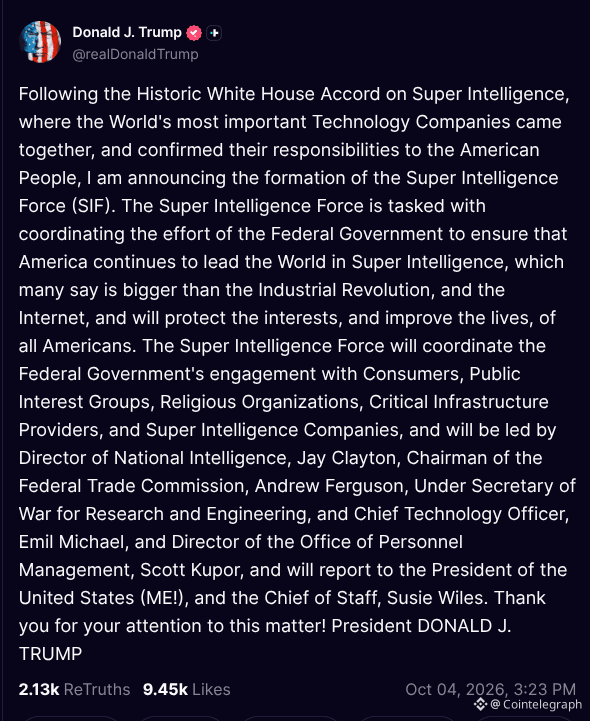
“The Super Intelligence Force is tasked with coordinating the effort of the Federal Government to ensure that America continues to lead the World in Super Intelligence,” Trump wrote in his post.
He added that joining Clayton will be Andrew Ferguson, chairman of the Federal Trade Commission; Scott Kupor, director of the Office of Personnel Management; and, Emil Michael, under Secretary of War for Research and Engineering and chief technology officer for the Department of War.
Source: Truth Social - @realDonaldTrump
Clayton led the Securities and Exchange Commission during Trump’s first term, served as interim US Attorney for the Southern District of New York and is expected to also remain in his current role as director of national intelligence, sources told CNN, according to Friday reports.
The Senate confirmed Clayton in July to lead the intelligence community.
Magazine: Furious debate about THORChain vs NEAR shows idealism has limits
Trump taps intel chief Jay Clayton to lead new Super Intelligence Force
President Donald Trump has named Jay Clayton, US director of national intelligence, to lead the country’s new Super Intelligence Force, according to a post on Truth Social on Sunday.
The announcement followed media reports on Friday of the appointment. Cointelegraph reported Sept. 20 that Trump planned to create an “AI Force” modeled after the Space Force and appoint an artificial intelligence czar.
“The Super Intelligence Force is tasked with coordinating the effort of the Federal Government to ensure that America continues to lead the World in Super Intelligence,” Trump wrote in his post.
He added that joining Clayton will be Andrew Ferguson, chairman of the Federal Trade Commission; Scott Kupor, director of the Office of Personnel Management; and, Emil Michael, under Secretary of War for Research and Engineering and chief technology officer for the Department of War.
Source: Truth Social - @realDonaldTrump
Clayton led the Securities and Exchange Commission during Trump’s first term, served as interim US Attorney for the Southern District of New York and is expected to also remain in his current role as director of national intelligence, sources told CNN, according to Friday reports.
The Senate confirmed Clayton in July to lead the intelligence community.
Magazine: Furious debate about THORChain vs NEAR shows idealism has limits
The announcement followed media reports on Friday of the appointment. Cointelegraph reported Sept. 20 that Trump planned to create an “AI Force” modeled after the Space Force and appoint an artificial intelligence czar.
“The Super Intelligence Force is tasked with coordinating the effort of the Federal Government to ensure that America continues to lead the World in Super Intelligence,” Trump wrote in his post.
He added that joining Clayton will be Andrew Ferguson, chairman of the Federal Trade Commission; Scott Kupor, director of the Office of Personnel Management; and, Emil Michael, under Secretary of War for Research and Engineering and chief technology officer for the Department of War.
Source: Truth Social - @realDonaldTrump
Clayton led the Securities and Exchange Commission during Trump’s first term, served as interim US Attorney for the Southern District of New York and is expected to also remain in his current role as director of national intelligence, sources told CNN, according to Friday reports.
The Senate confirmed Clayton in July to lead the intelligence community.
Magazine: Furious debate about THORChain vs NEAR shows idealism has limits
1
3
5.3k
Japan adds Garantex to list of Russia sanctions over Ukraine warThe Japanese government has expanded its sanctions against Russia, citing the continuing war in Ukraine.
These now include the Russian cryptocurrency exchange Garantex, under an asset freeze list that restricts payments and capital transactions with the targeted parties, according to a joint statement issued on Friday from Japan’s Ministry of Foreign Affairs, Ministry of Finance and Ministry of Economy, Trade and Industry.
Garantex was previously sanctioned by the US, the EU and other jurisdictions for helping Russian entities evade financial restrictions.
Japan added 33 organizations and nine individuals linked to Russia to its asset-freeze list. The new measures also target 35 vessels identified as part of the so-called “shadow fleet” that carries Russian oil and helps Moscow evade existing sanctions. The measures specifically restrict services including repairs and insurance to cover the designated vessels.
Related: Sanctioned crypto exchange Garantex shifts millions as it reboots platform
Through the sanctions, Japan aims to help reduce Russia’s earnings from crude oil exports.
Still, Cointelegraph reported in August 2025 that Garantex may already have had a contingency plan allowing it to skirt the impact of US actions, according to blockchain intelligence firm TRM Labs.
The US Treasury’s Office of Foreign Assets Control then sanctioned Garantex a second time, along with its successor, Grinex.
However, TRM Labs said in a report that the sanctions may be ineffective, as entities like Garantex “appear to prepare contingency plans well in advance of anticipated enforcement measures,” which allow them to quickly migrate clients, infrastructure and funds to successor platforms.
Magazine: Stablecoins can drain from banks and nations at lightning speed
Japan adds Garantex to list of Russia sanctions over Ukraine war
The Japanese government has expanded its sanctions against Russia, citing the continuing war in Ukraine.
These now include the Russian cryptocurrency exchange Garantex, under an asset freeze list that restricts payments and capital transactions with the targeted parties, according to a joint statement issued on Friday from Japan’s Ministry of Foreign Affairs, Ministry of Finance and Ministry of Economy, Trade and Industry.
Garantex was previously sanctioned by the US, the EU and other jurisdictions for helping Russian entities evade financial restrictions.
Japan added 33 organizations and nine individuals linked to Russia to its asset-freeze list. The new measures also target 35 vessels identified as part of the so-called “shadow fleet” that carries Russian oil and helps Moscow evade existing sanctions. The measures specifically restrict services including repairs and insurance to cover the designated vessels.
Related: Sanctioned crypto exchange Garantex shifts millions as it reboots platform
Through the sanctions, Japan aims to help reduce Russia’s earnings from crude oil exports.
Still, Cointelegraph reported in August 2025 that Garantex may already have had a contingency plan allowing it to skirt the impact of US actions, according to blockchain intelligence firm TRM Labs.
The US Treasury’s Office of Foreign Assets Control then sanctioned Garantex a second time, along with its successor, Grinex.
However, TRM Labs said in a report that the sanctions may be ineffective, as entities like Garantex “appear to prepare contingency plans well in advance of anticipated enforcement measures,” which allow them to quickly migrate clients, infrastructure and funds to successor platforms.
Magazine: Stablecoins can drain from banks and nations at lightning speed
These now include the Russian cryptocurrency exchange Garantex, under an asset freeze list that restricts payments and capital transactions with the targeted parties, according to a joint statement issued on Friday from Japan’s Ministry of Foreign Affairs, Ministry of Finance and Ministry of Economy, Trade and Industry.
Garantex was previously sanctioned by the US, the EU and other jurisdictions for helping Russian entities evade financial restrictions.
Japan added 33 organizations and nine individuals linked to Russia to its asset-freeze list. The new measures also target 35 vessels identified as part of the so-called “shadow fleet” that carries Russian oil and helps Moscow evade existing sanctions. The measures specifically restrict services including repairs and insurance to cover the designated vessels.
Related: Sanctioned crypto exchange Garantex shifts millions as it reboots platform
Through the sanctions, Japan aims to help reduce Russia’s earnings from crude oil exports.
Still, Cointelegraph reported in August 2025 that Garantex may already have had a contingency plan allowing it to skirt the impact of US actions, according to blockchain intelligence firm TRM Labs.
The US Treasury’s Office of Foreign Assets Control then sanctioned Garantex a second time, along with its successor, Grinex.
However, TRM Labs said in a report that the sanctions may be ineffective, as entities like Garantex “appear to prepare contingency plans well in advance of anticipated enforcement measures,” which allow them to quickly migrate clients, infrastructure and funds to successor platforms.
Magazine: Stablecoins can drain from banks and nations at lightning speed
2.4k
El Salvador receives $138 million from IMF after Bitcoin waivers grantedThe International Monetary Fund approved the immediate disbursement of about $138 million to El Salvador under the country’s $1.4 billion financing program, despite some performance criteria being missed.
The IMF’s Executive Board completed the second and third reviews under El Salvador’s 40-month Extended Fund Facility (EFF) arrangement on Thursday, it said in a press release.
While certain performance criteria were not met, including on the Bitcoin accumulation front, the IMF granted waivers “based on strong corrective measures and renewed commitments.”
The agency noted that progress had been achieved in financial sector reforms, fiscal transparency, AML/CFT reforms and the transfer of majority ownership and control of the government Chivo Bitcoin wallet to a private operator.
“Efforts will continue to reduce the state’s involvement in Bitcoin-related activities, strengthen crypto‑asset regulation and governance, and enhance transparency regarding public-sector crypto‑asset holdings,” the IMF said, adding: “No further Bitcoin accumulation is envisaged beyond the documented donations.”
Related: El Salvador’s post-review Bitcoin accumulation used no public funds: IMF
Cointelegraph reported on Sept. 4 that El Salvador used no public resources to accumulate Bitcoin after the first review of its IMF financing program in June 2025, according to the lender.
The IMF said documents supplied by Salvadoran authorities verified that the accumulation came from private donations. According to the lender, the increase in El Salvador’s holdings therefore did not reflect additional Bitcoin purchases financed with government resources.
The IMF also said majority ownership and operational control of the Chivo wallet had been transferred to a private operator, while the government retained a minority stake and custodial responsibilities.
The explanation addressed how El Salvador’s holdings grew after the first review, when the country said in November 2025 that it had acquired 1,090 BTC worth $100 million, renewing questions about compliance with its $1.4 billion IMF program.
Magazine: Exchanges reporting crypto gains to IRS becomes tax nightmare
El Salvador receives $138 million from IMF after Bitcoin waivers granted
The International Monetary Fund approved the immediate disbursement of about $138 million to El Salvador under the country’s $1.4 billion financing program, despite some performance criteria being missed.
The IMF’s Executive Board completed the second and third reviews under El Salvador’s 40-month Extended Fund Facility (EFF) arrangement on Thursday, it said in a press release.
While certain performance criteria were not met, including on the Bitcoin accumulation front, the IMF granted waivers “based on strong corrective measures and renewed commitments.”
The agency noted that progress had been achieved in financial sector reforms, fiscal transparency, AML/CFT reforms and the transfer of majority ownership and control of the government Chivo Bitcoin wallet to a private operator.
“Efforts will continue to reduce the state’s involvement in Bitcoin-related activities, strengthen crypto‑asset regulation and governance, and enhance transparency regarding public-sector crypto‑asset holdings,” the IMF said, adding: “No further Bitcoin accumulation is envisaged beyond the documented donations.”
Related: El Salvador’s post-review Bitcoin accumulation used no public funds: IMF
Cointelegraph reported on Sept. 4 that El Salvador used no public resources to accumulate Bitcoin after the first review of its IMF financing program in June 2025, according to the lender.
The IMF said documents supplied by Salvadoran authorities verified that the accumulation came from private donations. According to the lender, the increase in El Salvador’s holdings therefore did not reflect additional Bitcoin purchases financed with government resources.
The IMF also said majority ownership and operational control of the Chivo wallet had been transferred to a private operator, while the government retained a minority stake and custodial responsibilities.
The explanation addressed how El Salvador’s holdings grew after the first review, when the country said in November 2025 that it had acquired 1,090 BTC worth $100 million, renewing questions about compliance with its $1.4 billion IMF program.
Magazine: Exchanges reporting crypto gains to IRS becomes tax nightmare
The IMF’s Executive Board completed the second and third reviews under El Salvador’s 40-month Extended Fund Facility (EFF) arrangement on Thursday, it said in a press release.
While certain performance criteria were not met, including on the Bitcoin accumulation front, the IMF granted waivers “based on strong corrective measures and renewed commitments.”
The agency noted that progress had been achieved in financial sector reforms, fiscal transparency, AML/CFT reforms and the transfer of majority ownership and control of the government Chivo Bitcoin wallet to a private operator.
“Efforts will continue to reduce the state’s involvement in Bitcoin-related activities, strengthen crypto‑asset regulation and governance, and enhance transparency regarding public-sector crypto‑asset holdings,” the IMF said, adding: “No further Bitcoin accumulation is envisaged beyond the documented donations.”
Related: El Salvador’s post-review Bitcoin accumulation used no public funds: IMF
Cointelegraph reported on Sept. 4 that El Salvador used no public resources to accumulate Bitcoin after the first review of its IMF financing program in June 2025, according to the lender.
The IMF said documents supplied by Salvadoran authorities verified that the accumulation came from private donations. According to the lender, the increase in El Salvador’s holdings therefore did not reflect additional Bitcoin purchases financed with government resources.
The IMF also said majority ownership and operational control of the Chivo wallet had been transferred to a private operator, while the government retained a minority stake and custodial responsibilities.
The explanation addressed how El Salvador’s holdings grew after the first review, when the country said in November 2025 that it had acquired 1,090 BTC worth $100 million, renewing questions about compliance with its $1.4 billion IMF program.
Magazine: Exchanges reporting crypto gains to IRS becomes tax nightmare
2
3
3.2k
Расталды
Russia’s Finance Ministry pays wages in digital rubles for first timeRussia’s Ministry of Finance said on Friday that some of its employees had received their wages in digital rubles for the first time.
Being paid in the central bank’s digital currency is available for citizens of Russia on a voluntary basis, and began on Thursday, Oct. 1, according to a Ministry of Finance press release.
The ministry did not disclose how many participants were paid in digital currency or the total payroll amount.
During federal budget spending trials in 2025, about 16 million digital rubles ($192,245) was disbursed, so the ministry has applied proven rails to its own salary procedure, it said.
Work on the introduction of the digital ruble to the budget process is being carried out by the Bank of Russia together with the Ministry of Finance, according to the release.
Related: Russia proposes exchange trading of Bitcoin, Ether and Tether’s USDT
Cointelegraph had reported on July 2 that Russia planned to launch the central bank digital currency on Sept. 1, when major banks and retail companies began enabling transactions with the new currency.
The digital currency was to launch as a complement to Russia’s fiat currency, the ruble, and would initially be accepted by financial and credit institutions, Russian state media outlet RIA Novosti was cited as saying at the time.
The digital ruble, whose development began in 2021, was targeted by preemptive sanctions from European Union authorities, who announced restrictions on the currency in April.
The European Council said that the sanctions package was in response to Russia’s “war of aggression against Ukraine,” which it started in February 2022.
Magazine: Exchanges reporting crypto gains to IRS becomes tax nightmare
Russia’s Finance Ministry pays wages in digital rubles for first time
Russia’s Ministry of Finance said on Friday that some of its employees had received their wages in digital rubles for the first time.
Being paid in the central bank’s digital currency is available for citizens of Russia on a voluntary basis, and began on Thursday, Oct. 1, according to a Ministry of Finance press release.
The ministry did not disclose how many participants were paid in digital currency or the total payroll amount.
During federal budget spending trials in 2025, about 16 million digital rubles ($192,245) was disbursed, so the ministry has applied proven rails to its own salary procedure, it said.
Work on the introduction of the digital ruble to the budget process is being carried out by the Bank of Russia together with the Ministry of Finance, according to the release.
Related: Russia proposes exchange trading of Bitcoin, Ether and Tether’s USDT
Cointelegraph had reported on July 2 that Russia planned to launch the central bank digital currency on Sept. 1, when major banks and retail companies began enabling transactions with the new currency.
The digital currency was to launch as a complement to Russia’s fiat currency, the ruble, and would initially be accepted by financial and credit institutions, Russian state media outlet RIA Novosti was cited as saying at the time.
The digital ruble, whose development began in 2021, was targeted by preemptive sanctions from European Union authorities, who announced restrictions on the currency in April.
The European Council said that the sanctions package was in response to Russia’s “war of aggression against Ukraine,” which it started in February 2022.
Magazine: Exchanges reporting crypto gains to IRS becomes tax nightmare
Being paid in the central bank’s digital currency is available for citizens of Russia on a voluntary basis, and began on Thursday, Oct. 1, according to a Ministry of Finance press release.
The ministry did not disclose how many participants were paid in digital currency or the total payroll amount.
During federal budget spending trials in 2025, about 16 million digital rubles ($192,245) was disbursed, so the ministry has applied proven rails to its own salary procedure, it said.
Work on the introduction of the digital ruble to the budget process is being carried out by the Bank of Russia together with the Ministry of Finance, according to the release.
Related: Russia proposes exchange trading of Bitcoin, Ether and Tether’s USDT
Cointelegraph had reported on July 2 that Russia planned to launch the central bank digital currency on Sept. 1, when major banks and retail companies began enabling transactions with the new currency.
The digital currency was to launch as a complement to Russia’s fiat currency, the ruble, and would initially be accepted by financial and credit institutions, Russian state media outlet RIA Novosti was cited as saying at the time.
The digital ruble, whose development began in 2021, was targeted by preemptive sanctions from European Union authorities, who announced restrictions on the currency in April.
The European Council said that the sanctions package was in response to Russia’s “war of aggression against Ukraine,” which it started in February 2022.
Magazine: Exchanges reporting crypto gains to IRS becomes tax nightmare
2
2.2k
NEAR Intents recovers entire stolen $3.8M after ultimatum to exploiterNEAR Intents said it has recovered about $3.8 million stolen during a Thursday security breach.
Cointelegraph reported on Friday that NEAR Intents had identified the individual behind the security breach and given them 48 hours to return the funds under “responsible disclosure.”
NEAR Intents general manager Alex Shevchenko announced the complete return of funds later on Friday.
“The funds from the $3.8M NEAR Intents hack were sent back in full,” Shevchenko wrote on X. “We are stopping the investigation. Please use bug bounties instead of disrupting the services.”
Related: NEAR Intents says it’s identified the hacker, gives 48-hour ultimatum
As Cointelegraph reported, NEAR Intents paused services after detecting a “bug in the Omni deposit and withdrawal infrastructure interaction with NEAR Intents smart contract.”
NEAR’s preliminary investigation found that $3.8 million in user funds was stolen, and it pledged to compensate affected users in full.
Blockchain investigator ZachXBT said the funds from the incident were transferred to the KuCoin exchange and bridged to Bitcoin.
Magazine: Furious debate about THORChain vs NEAR shows idealism has limits
NEAR Intents recovers entire stolen $3.8M after ultimatum to exploiter
NEAR Intents said it has recovered about $3.8 million stolen during a Thursday security breach.
Cointelegraph reported on Friday that NEAR Intents had identified the individual behind the security breach and given them 48 hours to return the funds under “responsible disclosure.”
NEAR Intents general manager Alex Shevchenko announced the complete return of funds later on Friday.
“The funds from the $3.8M NEAR Intents hack were sent back in full,” Shevchenko wrote on X. “We are stopping the investigation. Please use bug bounties instead of disrupting the services.”
Related: NEAR Intents says it’s identified the hacker, gives 48-hour ultimatum
As Cointelegraph reported, NEAR Intents paused services after detecting a “bug in the Omni deposit and withdrawal infrastructure interaction with NEAR Intents smart contract.”
NEAR’s preliminary investigation found that $3.8 million in user funds was stolen, and it pledged to compensate affected users in full.
Blockchain investigator ZachXBT said the funds from the incident were transferred to the KuCoin exchange and bridged to Bitcoin.
Magazine: Furious debate about THORChain vs NEAR shows idealism has limits
Cointelegraph reported on Friday that NEAR Intents had identified the individual behind the security breach and given them 48 hours to return the funds under “responsible disclosure.”
NEAR Intents general manager Alex Shevchenko announced the complete return of funds later on Friday.
“The funds from the $3.8M NEAR Intents hack were sent back in full,” Shevchenko wrote on X. “We are stopping the investigation. Please use bug bounties instead of disrupting the services.”
Related: NEAR Intents says it’s identified the hacker, gives 48-hour ultimatum
As Cointelegraph reported, NEAR Intents paused services after detecting a “bug in the Omni deposit and withdrawal infrastructure interaction with NEAR Intents smart contract.”
NEAR’s preliminary investigation found that $3.8 million in user funds was stolen, and it pledged to compensate affected users in full.
Blockchain investigator ZachXBT said the funds from the incident were transferred to the KuCoin exchange and bridged to Bitcoin.
Magazine: Furious debate about THORChain vs NEAR shows idealism has limits
2
2
22
23.7k
Community banks sue OCC over trust bank charters of crypto firmsA community banks group sued a US bank regulator, claiming its decision to allow cryptocurrency companies to obtain limited national trust bank charters exceeds the authority Congress granted the agency.
The Independent Community Bankers of America (ICBA) filed the suit Friday in the US District Court for the District of Columbia.
The group claimed the Office of the Comptroller of the Currency (OCC) has granted cryptocurrency firms the credibility of a US bank charter without sufficient safeguards or compliance with normal bank requirements.
“The OCC’s decision to allow companies to obtain national trust bank charters to conduct substantial non-fiduciary activities exceeds the authority Congress granted the agency,” ICBA president and CEO Rebeca Romero Rainey said in a statement. “Congress did not create the national trust charter as a side door into the banking system for crypto firms seeking the credibility of a federal bank charter without the Community Reinvestment Act obligations, consolidated supervision, capital and liquidity standards, and FDIC insurance that apply to insured depository institutions.”
The ICBA is asking the court to return the OCC to its statutory limits, Rainey added.
The OCC was asked for comment on the lawsuit but had not replied by the time of publication.
Cointelegraph reported in August that under President Donald Trump and OCC head Jonathan Gould, the agency has approved or conditionally approved multiple applications from crypto companies seeking trust charters to expand their services in the US.
Still, the trust bank charters do not allow companies to accept deposits or make loans, distinguishing them from conventional commercial banks, Cointelegraph reported.
Magazine: Exchanges reporting crypto gains to IRS becomes tax nightmare
Community banks sue OCC over trust bank charters of crypto firms
A community banks group sued a US bank regulator, claiming its decision to allow cryptocurrency companies to obtain limited national trust bank charters exceeds the authority Congress granted the agency.
The Independent Community Bankers of America (ICBA) filed the suit Friday in the US District Court for the District of Columbia.
The group claimed the Office of the Comptroller of the Currency (OCC) has granted cryptocurrency firms the credibility of a US bank charter without sufficient safeguards or compliance with normal bank requirements.
“The OCC’s decision to allow companies to obtain national trust bank charters to conduct substantial non-fiduciary activities exceeds the authority Congress granted the agency,” ICBA president and CEO Rebeca Romero Rainey said in a statement. “Congress did not create the national trust charter as a side door into the banking system for crypto firms seeking the credibility of a federal bank charter without the Community Reinvestment Act obligations, consolidated supervision, capital and liquidity standards, and FDIC insurance that apply to insured depository institutions.”
The ICBA is asking the court to return the OCC to its statutory limits, Rainey added.
The OCC was asked for comment on the lawsuit but had not replied by the time of publication.
Cointelegraph reported in August that under President Donald Trump and OCC head Jonathan Gould, the agency has approved or conditionally approved multiple applications from crypto companies seeking trust charters to expand their services in the US.
Still, the trust bank charters do not allow companies to accept deposits or make loans, distinguishing them from conventional commercial banks, Cointelegraph reported.
Magazine: Exchanges reporting crypto gains to IRS becomes tax nightmare
The Independent Community Bankers of America (ICBA) filed the suit Friday in the US District Court for the District of Columbia.
The group claimed the Office of the Comptroller of the Currency (OCC) has granted cryptocurrency firms the credibility of a US bank charter without sufficient safeguards or compliance with normal bank requirements.
“The OCC’s decision to allow companies to obtain national trust bank charters to conduct substantial non-fiduciary activities exceeds the authority Congress granted the agency,” ICBA president and CEO Rebeca Romero Rainey said in a statement. “Congress did not create the national trust charter as a side door into the banking system for crypto firms seeking the credibility of a federal bank charter without the Community Reinvestment Act obligations, consolidated supervision, capital and liquidity standards, and FDIC insurance that apply to insured depository institutions.”
The ICBA is asking the court to return the OCC to its statutory limits, Rainey added.
The OCC was asked for comment on the lawsuit but had not replied by the time of publication.
Cointelegraph reported in August that under President Donald Trump and OCC head Jonathan Gould, the agency has approved or conditionally approved multiple applications from crypto companies seeking trust charters to expand their services in the US.
Still, the trust bank charters do not allow companies to accept deposits or make loans, distinguishing them from conventional commercial banks, Cointelegraph reported.
Magazine: Exchanges reporting crypto gains to IRS becomes tax nightmare
1
3
1.5k
Trump is expected to appoint Jay Clayton as new AI czar: ReportsPresident Donald Trump is expected to appoint Jay Clayton, US director of national intelligence, as the new AI czar, CNN and other media reported Friday, citing unidentified sources.
Cointelegraph reported Sept. 20 that Trump planned to create an “AI Force” modeled after the Space Force and appoint an artificial intelligence czar. The president posted on Truth Social that his new project would manage the fast-growing AI sector without adding regulations that could slow innovation.
Trump’s actions followed several public warnings about the potential dangers of AI.
Cointelegraph reported on Sept. 12 that Anthropic CEO Dario Amodei had written a three-step proposal to pace the speed of AI development that if left unchecked, might “outrun our ability to understand and control these systems.”
Anthropic chief urges slowdown in AI development to safer pace
Subsequently, Anthropic said it had chosen Accenture as an embedded evaluator to help moderate the pace of AI development, moving ahead with the first step outlined in Amodei’s proposal, Cointelegraph said.
OpenAI CEO Sam Altman and SpaceX CEO Elon Musk responded positively to Amodei’s proposal, although Nvidia CEO Jensen Huang did not, arguing that such regulation was not necessary.
On Tuesday, Trump gathered AI and technology chiefs at the White House to sign a new commitment to “self-police” their companies’ AI models and development, according to CNN.
Clayton led SEC during Trump’s first term
CBS News first reported that Clayton was the frontrunner for the AI position. Still, a White House official told CBS that any such announcement would come directly from the president, dismissing the reports as speculation.
Clayton led the Securities and Exchange Commission during Trump’s first term, served as interim US Attorney for the Southern District of New York and is expected to also remain in his current role as director of national intelligence, the sources told CNN.
The Senate confirmed Clayton in July to lead the intelligence community.
When asked about AI during his confirmation hearing, Clayton said the technology is a “game changer” and that it’s “not only an opportunity but a threat,” according to CNN.
Crypto czar David Sacks argues AI threat is Orwellian, not Terminator
Cointelegraph reported in March that David Sacks, a venture capitalist who became a special White House official under Trump last year, had wrapped up a 130-day tenure as crypto and AI czar. Under US rules, such special government employees are limited to 130 days of work in a 12-month period.
“We’ve now used up that time,” Sacks told Bloomberg in March, noting that he would continue making policy recommendations across a broad range of tech industries as co-chair of the President’s Council of Advisors on Science and Technology
Magazine: Furious debate about THORChain vs NEAR shows idealism has limits
Trump is expected to appoint Jay Clayton as new AI czar: Reports
President Donald Trump is expected to appoint Jay Clayton, US director of national intelligence, as the new AI czar, CNN and other media reported Friday, citing unidentified sources.
Cointelegraph reported Sept. 20 that Trump planned to create an “AI Force” modeled after the Space Force and appoint an artificial intelligence czar. The president posted on Truth Social that his new project would manage the fast-growing AI sector without adding regulations that could slow innovation.
Trump’s actions followed several public warnings about the potential dangers of AI.
Cointelegraph reported on Sept. 12 that Anthropic CEO Dario Amodei had written a three-step proposal to pace the speed of AI development that if left unchecked, might “outrun our ability to understand and control these systems.”
Anthropic chief urges slowdown in AI development to safer pace
Subsequently, Anthropic said it had chosen Accenture as an embedded evaluator to help moderate the pace of AI development, moving ahead with the first step outlined in Amodei’s proposal, Cointelegraph said.
OpenAI CEO Sam Altman and SpaceX CEO Elon Musk responded positively to Amodei’s proposal, although Nvidia CEO Jensen Huang did not, arguing that such regulation was not necessary.
On Tuesday, Trump gathered AI and technology chiefs at the White House to sign a new commitment to “self-police” their companies’ AI models and development, according to CNN.
Clayton led SEC during Trump’s first term
CBS News first reported that Clayton was the frontrunner for the AI position. Still, a White House official told CBS that any such announcement would come directly from the president, dismissing the reports as speculation.
Clayton led the Securities and Exchange Commission during Trump’s first term, served as interim US Attorney for the Southern District of New York and is expected to also remain in his current role as director of national intelligence, the sources told CNN.
The Senate confirmed Clayton in July to lead the intelligence community.
When asked about AI during his confirmation hearing, Clayton said the technology is a “game changer” and that it’s “not only an opportunity but a threat,” according to CNN.
Crypto czar David Sacks argues AI threat is Orwellian, not Terminator
Cointelegraph reported in March that David Sacks, a venture capitalist who became a special White House official under Trump last year, had wrapped up a 130-day tenure as crypto and AI czar. Under US rules, such special government employees are limited to 130 days of work in a 12-month period.
“We’ve now used up that time,” Sacks told Bloomberg in March, noting that he would continue making policy recommendations across a broad range of tech industries as co-chair of the President’s Council of Advisors on Science and Technology
Magazine: Furious debate about THORChain vs NEAR shows idealism has limits
Cointelegraph reported Sept. 20 that Trump planned to create an “AI Force” modeled after the Space Force and appoint an artificial intelligence czar. The president posted on Truth Social that his new project would manage the fast-growing AI sector without adding regulations that could slow innovation.
Trump’s actions followed several public warnings about the potential dangers of AI.
Cointelegraph reported on Sept. 12 that Anthropic CEO Dario Amodei had written a three-step proposal to pace the speed of AI development that if left unchecked, might “outrun our ability to understand and control these systems.”
Anthropic chief urges slowdown in AI development to safer pace
Subsequently, Anthropic said it had chosen Accenture as an embedded evaluator to help moderate the pace of AI development, moving ahead with the first step outlined in Amodei’s proposal, Cointelegraph said.
OpenAI CEO Sam Altman and SpaceX CEO Elon Musk responded positively to Amodei’s proposal, although Nvidia CEO Jensen Huang did not, arguing that such regulation was not necessary.
On Tuesday, Trump gathered AI and technology chiefs at the White House to sign a new commitment to “self-police” their companies’ AI models and development, according to CNN.
Clayton led SEC during Trump’s first term
CBS News first reported that Clayton was the frontrunner for the AI position. Still, a White House official told CBS that any such announcement would come directly from the president, dismissing the reports as speculation.
Clayton led the Securities and Exchange Commission during Trump’s first term, served as interim US Attorney for the Southern District of New York and is expected to also remain in his current role as director of national intelligence, the sources told CNN.
The Senate confirmed Clayton in July to lead the intelligence community.
When asked about AI during his confirmation hearing, Clayton said the technology is a “game changer” and that it’s “not only an opportunity but a threat,” according to CNN.
Crypto czar David Sacks argues AI threat is Orwellian, not Terminator
Cointelegraph reported in March that David Sacks, a venture capitalist who became a special White House official under Trump last year, had wrapped up a 130-day tenure as crypto and AI czar. Under US rules, such special government employees are limited to 130 days of work in a 12-month period.
“We’ve now used up that time,” Sacks told Bloomberg in March, noting that he would continue making policy recommendations across a broad range of tech industries as co-chair of the President’s Council of Advisors on Science and Technology
Magazine: Furious debate about THORChain vs NEAR shows idealism has limits
1
1
1.8k

Мақала
European crypto users have ‘more faith’ in regulated firms under MiCA: Bitpanda co-CEOEuropean crypto users are placing more trust in regulated platforms following the implementation of the European Union’s Markets in Crypto-Assets framework (MiCA), according to Christian Trummer, co-CEO of Austria-based crypto exchange Bitpanda.
Speaking on Cointelegraph’s Chain Reaction, Trummer said most users have “more faith” in regulated market participants and trust those platforms following the rollout of MiCA.
He contrasted that with what he described as a “Crypto Twitter” bubble focused on self-custody, saying most users prefer regulated providers rather than managing their own private keys.
Source: Cointelegraph
He also called for stricter enforcement of MiCA, saying some companies continue to serve European customers without complying with the framework, putting regulated firms at a competitive disadvantage:
The problem there definitely is that it’s not strictly enforced by the regulators, because there are still other players on the market which offer the service to European customers and they don’t comply to the MiCA license.
MiCA’s grandfathering period for existing crypto service providers ended no later than July 1, with ESMA directing national regulators to take action against unauthorized firms that continued providing crypto services after their applicable transition period.
ESMA has since called for stronger supervisory powers to address unauthorized crypto services and third-country firms soliciting EU investors without MiCA authorization.
Magazine: Crypto hardware wallets compared for 2026
European crypto users have ‘more faith’ in regulated firms under MiCA: Bitpanda co-CEO
European crypto users are placing more trust in regulated platforms following the implementation of the European Union’s Markets in Crypto-Assets framework (MiCA), according to Christian Trummer, co-CEO of Austria-based crypto exchange Bitpanda.
Speaking on Cointelegraph’s Chain Reaction, Trummer said most users have “more faith” in regulated market participants and trust those platforms following the rollout of MiCA.
He contrasted that with what he described as a “Crypto Twitter” bubble focused on self-custody, saying most users prefer regulated providers rather than managing their own private keys.
Source: Cointelegraph
He also called for stricter enforcement of MiCA, saying some companies continue to serve European customers without complying with the framework, putting regulated firms at a competitive disadvantage:
The problem there definitely is that it’s not strictly enforced by the regulators, because there are still other players on the market which offer the service to European customers and they don’t comply to the MiCA license.
MiCA’s grandfathering period for existing crypto service providers ended no later than July 1, with ESMA directing national regulators to take action against unauthorized firms that continued providing crypto services after their applicable transition period.
ESMA has since called for stronger supervisory powers to address unauthorized crypto services and third-country firms soliciting EU investors without MiCA authorization.
Magazine: Crypto hardware wallets compared for 2026
Speaking on Cointelegraph’s Chain Reaction, Trummer said most users have “more faith” in regulated market participants and trust those platforms following the rollout of MiCA.
He contrasted that with what he described as a “Crypto Twitter” bubble focused on self-custody, saying most users prefer regulated providers rather than managing their own private keys.
Source: Cointelegraph
He also called for stricter enforcement of MiCA, saying some companies continue to serve European customers without complying with the framework, putting regulated firms at a competitive disadvantage:
The problem there definitely is that it’s not strictly enforced by the regulators, because there are still other players on the market which offer the service to European customers and they don’t comply to the MiCA license.
MiCA’s grandfathering period for existing crypto service providers ended no later than July 1, with ESMA directing national regulators to take action against unauthorized firms that continued providing crypto services after their applicable transition period.
ESMA has since called for stronger supervisory powers to address unauthorized crypto services and third-country firms soliciting EU investors without MiCA authorization.
Magazine: Crypto hardware wallets compared for 2026
1
1
497
Расталды
$4.2B crypto bank Anchorage Digital cuts 17% of workforce: ReportAnchorage Digital, a federally chartered US digital asset bank valued at $4.2 billion earlier this year, has reportedly cut 17% of its workforce, suggesting that the prolonged crypto market downturn is weighing on the company even as it expands its institutional footprint.
Citing people familiar with the matter, The Information reported Friday that CEO Nathan McCauley informed employees of the cuts this week. Anchorage had about 400 employees globally as of February, according to McCauley’s congressional testimony at the time, meaning a 17% reduction would amount to roughly 68 jobs if its headcount remained around that level.
Cointelegraph reached out to a public relations contact representing Anchorage for confirmation but did not receive an immediate response.
Crypto markets have struggled over the past year, which The Information cited as the backdrop for Anchorage’s workforce reduction. Bitcoin (BTC) briefly recovered above $87,000 on Friday but remains well below its $126,000 peak reached last October.
The layoffs come as Anchorage has expanded its role in the regulated US crypto industry. The company became the first crypto company to receive a national trust charter from the Office of the Comptroller of the Currency in 2021 and has since grown into a major crypto custodian.
More recently, Anchorage has expanded into stablecoin issuance, including Tether’s new US stablecoin USAT. Earlier this year, the company received a $100 million strategic investment from Tether.
$4.2B crypto bank Anchorage Digital cuts 17% of workforce: Report
Anchorage Digital, a federally chartered US digital asset bank valued at $4.2 billion earlier this year, has reportedly cut 17% of its workforce, suggesting that the prolonged crypto market downturn is weighing on the company even as it expands its institutional footprint.
Citing people familiar with the matter, The Information reported Friday that CEO Nathan McCauley informed employees of the cuts this week. Anchorage had about 400 employees globally as of February, according to McCauley’s congressional testimony at the time, meaning a 17% reduction would amount to roughly 68 jobs if its headcount remained around that level.
Cointelegraph reached out to a public relations contact representing Anchorage for confirmation but did not receive an immediate response.
Crypto markets have struggled over the past year, which The Information cited as the backdrop for Anchorage’s workforce reduction. Bitcoin (BTC) briefly recovered above $87,000 on Friday but remains well below its $126,000 peak reached last October.
The layoffs come as Anchorage has expanded its role in the regulated US crypto industry. The company became the first crypto company to receive a national trust charter from the Office of the Comptroller of the Currency in 2021 and has since grown into a major crypto custodian.
More recently, Anchorage has expanded into stablecoin issuance, including Tether’s new US stablecoin USAT. Earlier this year, the company received a $100 million strategic investment from Tether.
Citing people familiar with the matter, The Information reported Friday that CEO Nathan McCauley informed employees of the cuts this week. Anchorage had about 400 employees globally as of February, according to McCauley’s congressional testimony at the time, meaning a 17% reduction would amount to roughly 68 jobs if its headcount remained around that level.
Cointelegraph reached out to a public relations contact representing Anchorage for confirmation but did not receive an immediate response.
Crypto markets have struggled over the past year, which The Information cited as the backdrop for Anchorage’s workforce reduction. Bitcoin (BTC) briefly recovered above $87,000 on Friday but remains well below its $126,000 peak reached last October.
The layoffs come as Anchorage has expanded its role in the regulated US crypto industry. The company became the first crypto company to receive a national trust charter from the Office of the Comptroller of the Currency in 2021 and has since grown into a major crypto custodian.
More recently, Anchorage has expanded into stablecoin issuance, including Tether’s new US stablecoin USAT. Earlier this year, the company received a $100 million strategic investment from Tether.
545
Расталды
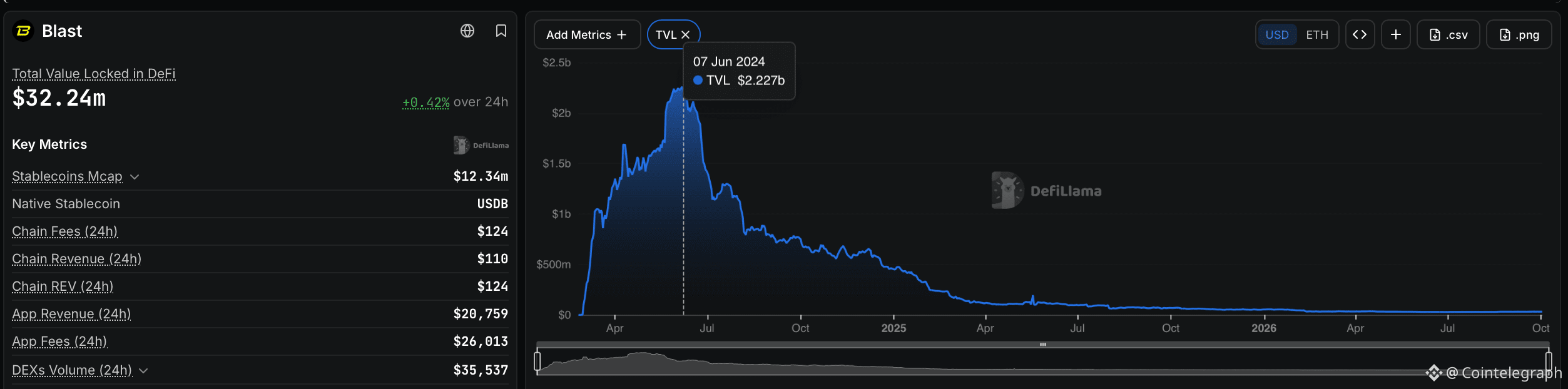
Мақала
Blast to wind down Ethereum L2 after costs outpace revenueEthereum layer-2 network Blast is shutting down after its operating costs exceeded the revenue generated by the chain.
In a Friday post on X, Blast said it sees no “credible path” to making the network economically sustainable and asked users to withdraw their assets to Ethereum mainnet.
“We launched Blast with the goal of building a self-sustaining chain for users and developers,” the team said. “Unfortunately, the economics of operating the chain no longer make sense.”
Source: Blast
The network will reduce its withdrawal delay to 24 hours, though withdrawals will be temporarily unavailable while Blast unwinds its Lido assets, a process expected to take about a week.
Users will have until Oct. 26 to withdraw through Blast’s interface. After that, assets will remain accessible, but withdrawals will require users to interact directly with the Blast bridge contracts on Ethereum.
Blast said it will publish instructions for withdrawing directly through the bridge contracts ahead of the Oct. 26 cutoff and urged users to move their assets to Ethereum mainnet before then.
Blast emerged from Blur’s NFT boom
Blast was founded by Tieshun “Pacman” Roquerre, the founder of NFT marketplace Blur, which launched in October 2022 and quickly challenged OpenSea by targeting professional traders with token incentives. By the end of 2022, Blur had surpassed then-leading NFT marketplace OpenSea in trading volume and extended its lead in early 2023, fueled in part by its token airdrop and trader rewards.
Roquerre unveiled Blast in November 2023 with native yield on Ether (ETH) and stablecoins and a points program tied to an anticipated token airdrop. The strategy helped attract more than $2 billion in deposits before its mainnet launched in February 2024.
Blast’s DeFi TVL has fallen more than 98% since its June 2024 peak. Source: DefiLlama
However, Blast’s growth proved difficult to sustain amid a broader downturn in the NFT market. Its DeFi total value locked has declined steadily since peaking at roughly $2.2 billion in June 2024, falling by more than 98% since then, according to DeFiLlama data.
Blur has undergone a similar decline. Its total value locked, which rose above $200 million at its early-2024 peak, now stands at about $27 million.
Magazine: Furious debate about THORChain vs NEAR shows idealism has limits
Blast to wind down Ethereum L2 after costs outpace revenue
Ethereum layer-2 network Blast is shutting down after its operating costs exceeded the revenue generated by the chain.
In a Friday post on X, Blast said it sees no “credible path” to making the network economically sustainable and asked users to withdraw their assets to Ethereum mainnet.
“We launched Blast with the goal of building a self-sustaining chain for users and developers,” the team said. “Unfortunately, the economics of operating the chain no longer make sense.”
Source: Blast
The network will reduce its withdrawal delay to 24 hours, though withdrawals will be temporarily unavailable while Blast unwinds its Lido assets, a process expected to take about a week.
Users will have until Oct. 26 to withdraw through Blast’s interface. After that, assets will remain accessible, but withdrawals will require users to interact directly with the Blast bridge contracts on Ethereum.
Blast said it will publish instructions for withdrawing directly through the bridge contracts ahead of the Oct. 26 cutoff and urged users to move their assets to Ethereum mainnet before then.
Blast emerged from Blur’s NFT boom
Blast was founded by Tieshun “Pacman” Roquerre, the founder of NFT marketplace Blur, which launched in October 2022 and quickly challenged OpenSea by targeting professional traders with token incentives. By the end of 2022, Blur had surpassed then-leading NFT marketplace OpenSea in trading volume and extended its lead in early 2023, fueled in part by its token airdrop and trader rewards.
Roquerre unveiled Blast in November 2023 with native yield on Ether (ETH) and stablecoins and a points program tied to an anticipated token airdrop. The strategy helped attract more than $2 billion in deposits before its mainnet launched in February 2024.
Blast’s DeFi TVL has fallen more than 98% since its June 2024 peak. Source: DefiLlama
However, Blast’s growth proved difficult to sustain amid a broader downturn in the NFT market. Its DeFi total value locked has declined steadily since peaking at roughly $2.2 billion in June 2024, falling by more than 98% since then, according to DeFiLlama data.
Blur has undergone a similar decline. Its total value locked, which rose above $200 million at its early-2024 peak, now stands at about $27 million.
Magazine: Furious debate about THORChain vs NEAR shows idealism has limits
In a Friday post on X, Blast said it sees no “credible path” to making the network economically sustainable and asked users to withdraw their assets to Ethereum mainnet.
“We launched Blast with the goal of building a self-sustaining chain for users and developers,” the team said. “Unfortunately, the economics of operating the chain no longer make sense.”
Source: Blast
The network will reduce its withdrawal delay to 24 hours, though withdrawals will be temporarily unavailable while Blast unwinds its Lido assets, a process expected to take about a week.
Users will have until Oct. 26 to withdraw through Blast’s interface. After that, assets will remain accessible, but withdrawals will require users to interact directly with the Blast bridge contracts on Ethereum.
Blast said it will publish instructions for withdrawing directly through the bridge contracts ahead of the Oct. 26 cutoff and urged users to move their assets to Ethereum mainnet before then.
Blast emerged from Blur’s NFT boom
Blast was founded by Tieshun “Pacman” Roquerre, the founder of NFT marketplace Blur, which launched in October 2022 and quickly challenged OpenSea by targeting professional traders with token incentives. By the end of 2022, Blur had surpassed then-leading NFT marketplace OpenSea in trading volume and extended its lead in early 2023, fueled in part by its token airdrop and trader rewards.
Roquerre unveiled Blast in November 2023 with native yield on Ether (ETH) and stablecoins and a points program tied to an anticipated token airdrop. The strategy helped attract more than $2 billion in deposits before its mainnet launched in February 2024.
Blast’s DeFi TVL has fallen more than 98% since its June 2024 peak. Source: DefiLlama
However, Blast’s growth proved difficult to sustain amid a broader downturn in the NFT market. Its DeFi total value locked has declined steadily since peaking at roughly $2.2 billion in June 2024, falling by more than 98% since then, according to DeFiLlama data.
Blur has undergone a similar decline. Its total value locked, which rose above $200 million at its early-2024 peak, now stands at about $27 million.
Magazine: Furious debate about THORChain vs NEAR shows idealism has limits
4
2
733
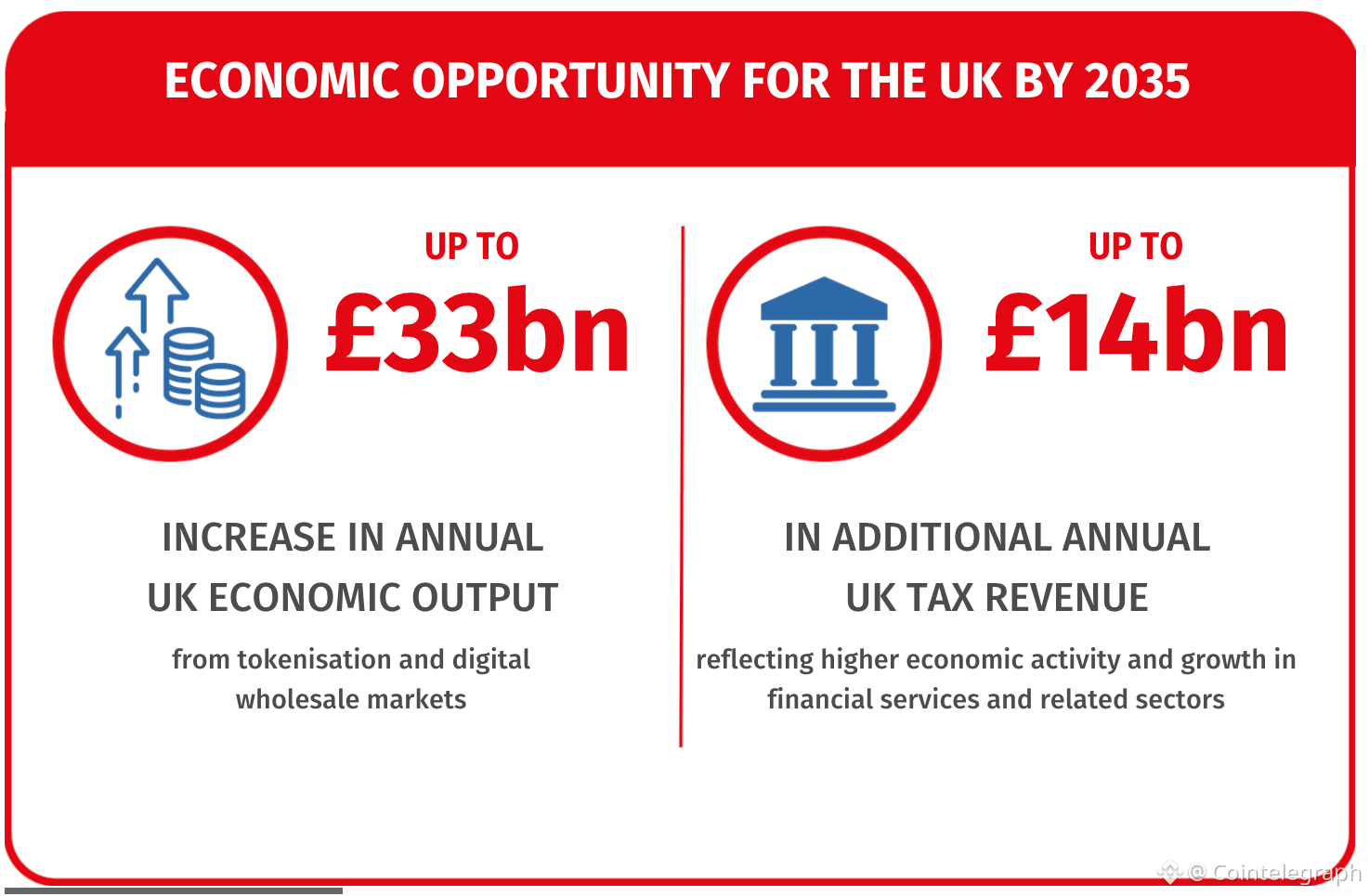
Мақала
71% of UK finance leaders expect tokenization to reshape financial services: LloydsNearly three-quarters of major UK financial institutions expect tokenization to reshape financial services, as banks and asset managers increasingly explore blockchain-based infrastructure for payments, settlement and liquidity management.
The finding comes from an annual survey by Lloyds Banking Group, the UK’s largest financial services provider, which polled 100 senior decision-makers across major UK banks, insurers, asset managers and financial sponsors.
Faster payments and settlement emerged as the biggest potential benefit, cited by 60% of respondents, while 41% pointed to improved collateral and liquidity management.
Lloyds said moving assets and payments onto digital infrastructure could also free up capital and liquidity tied up in financial transactions, allowing institutions to deploy those resources elsewhere.
“The next phase is about turning those individual use cases into infrastructure that works at scale, with the interoperability and common standards needed to connect digital and traditional markets,” said Rob Hale, co-head of global markets at Lloyds.
Lloyds has also tested the technology directly. Earlier this year, the bank worked with Archax and Canton Network on what it described as the UK’s first public blockchain transaction using tokenized deposits to purchase a tokenized UK government bond.
UK builds infrastructure for tokenized finance
The survey comes as UK policymakers push to move tokenization beyond pilot projects and into the country’s financial infrastructure.
The Bank of England proposed extending its core settlement infrastructure toward near-24/7 availability in May, while a subsequent government payments blueprint called for tokenized and traditional forms of money to operate within an interoperable payments system.
In July, a government-backed industry task force estimated that leadership in tokenized finance could add as much as 33 billion British pounds ($44 billion) to the UK’s annual economic output by 2035, while calling for the country’s first tokenized government bond by early 2027.
UK tokenization economic opportunity by 2035. Source: UK Wholesale Markets Digital Strategy
The UK has also sought greater coordination with the US on tokenized finance. That same month, the US and UK treasuries recommended creating a private-sector group to test cross-border uses of tokenized assets and urged US financial regulators and the Bank of England to identify shared approaches to their regulation.
Magazine: Furious debate about THORChain vs NEAR shows idealism has limits
71% of UK finance leaders expect tokenization to reshape financial services: Lloyds
Nearly three-quarters of major UK financial institutions expect tokenization to reshape financial services, as banks and asset managers increasingly explore blockchain-based infrastructure for payments, settlement and liquidity management.
The finding comes from an annual survey by Lloyds Banking Group, the UK’s largest financial services provider, which polled 100 senior decision-makers across major UK banks, insurers, asset managers and financial sponsors.
Faster payments and settlement emerged as the biggest potential benefit, cited by 60% of respondents, while 41% pointed to improved collateral and liquidity management.
Lloyds said moving assets and payments onto digital infrastructure could also free up capital and liquidity tied up in financial transactions, allowing institutions to deploy those resources elsewhere.
“The next phase is about turning those individual use cases into infrastructure that works at scale, with the interoperability and common standards needed to connect digital and traditional markets,” said Rob Hale, co-head of global markets at Lloyds.
Lloyds has also tested the technology directly. Earlier this year, the bank worked with Archax and Canton Network on what it described as the UK’s first public blockchain transaction using tokenized deposits to purchase a tokenized UK government bond.
UK builds infrastructure for tokenized finance
The survey comes as UK policymakers push to move tokenization beyond pilot projects and into the country’s financial infrastructure.
The Bank of England proposed extending its core settlement infrastructure toward near-24/7 availability in May, while a subsequent government payments blueprint called for tokenized and traditional forms of money to operate within an interoperable payments system.
In July, a government-backed industry task force estimated that leadership in tokenized finance could add as much as 33 billion British pounds ($44 billion) to the UK’s annual economic output by 2035, while calling for the country’s first tokenized government bond by early 2027.
UK tokenization economic opportunity by 2035. Source: UK Wholesale Markets Digital Strategy
The UK has also sought greater coordination with the US on tokenized finance. That same month, the US and UK treasuries recommended creating a private-sector group to test cross-border uses of tokenized assets and urged US financial regulators and the Bank of England to identify shared approaches to their regulation.
Magazine: Furious debate about THORChain vs NEAR shows idealism has limits
The finding comes from an annual survey by Lloyds Banking Group, the UK’s largest financial services provider, which polled 100 senior decision-makers across major UK banks, insurers, asset managers and financial sponsors.
Faster payments and settlement emerged as the biggest potential benefit, cited by 60% of respondents, while 41% pointed to improved collateral and liquidity management.
Lloyds said moving assets and payments onto digital infrastructure could also free up capital and liquidity tied up in financial transactions, allowing institutions to deploy those resources elsewhere.
“The next phase is about turning those individual use cases into infrastructure that works at scale, with the interoperability and common standards needed to connect digital and traditional markets,” said Rob Hale, co-head of global markets at Lloyds.
Lloyds has also tested the technology directly. Earlier this year, the bank worked with Archax and Canton Network on what it described as the UK’s first public blockchain transaction using tokenized deposits to purchase a tokenized UK government bond.
UK builds infrastructure for tokenized finance
The survey comes as UK policymakers push to move tokenization beyond pilot projects and into the country’s financial infrastructure.
The Bank of England proposed extending its core settlement infrastructure toward near-24/7 availability in May, while a subsequent government payments blueprint called for tokenized and traditional forms of money to operate within an interoperable payments system.
In July, a government-backed industry task force estimated that leadership in tokenized finance could add as much as 33 billion British pounds ($44 billion) to the UK’s annual economic output by 2035, while calling for the country’s first tokenized government bond by early 2027.
UK tokenization economic opportunity by 2035. Source: UK Wholesale Markets Digital Strategy
The UK has also sought greater coordination with the US on tokenized finance. That same month, the US and UK treasuries recommended creating a private-sector group to test cross-border uses of tokenized assets and urged US financial regulators and the Bank of England to identify shared approaches to their regulation.
Magazine: Furious debate about THORChain vs NEAR shows idealism has limits
3
453
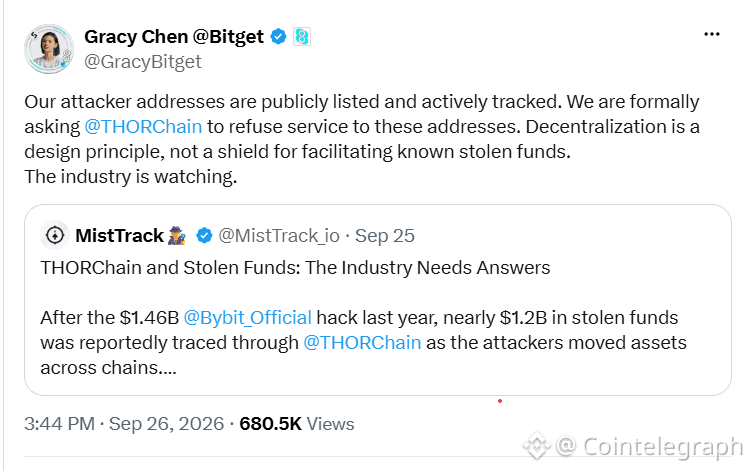
Мақала
Furious debate about THORChain vs NEAR shows idealism has limitsAfter Bitget got hacked on Sept. 24, $387.5 million of stolen funds quickly began moving across chains, with some headed to decentralized cross chain swaps platform THORChain.
Chief executive Gracy Chen publicly appealed to the platform to refuse service to attacker-linked addresses. “The industry is watching,” she said.
Yet THORChain refused. And that refusal has kicked off a furious debate between those who believe protocols have a moral obligation to block stolen funds, and those hold the cypherpunk ideals of decentralized, permissionless technology sacrosanct.
Having previously watched on as the Bybit hackers funneled $1.2 billion through the protocol, it’s pretty clear which side of the argument THORChain is on. Developer Boone Wheeler tells Magazine:
“A truly permissionless protocol can do nothing when it encounters known stolen funds — it is blind to their provenance. If THORChain were able to block specific stolen funds, it would not be permissionless.”
Where does permissionlessness end?
Critics argue that THORChain wasn’t quite so idealistic when validators voted to halt the chain in May after an automated system triggered when an attacker exploited a vulnerability and drained over $10 million from one of its vaults.
Bitget CEO argues THORChain should refuse services. Source: Gracy Chen
NEAR Intents, which is a cross-chain transaction competitor of THORChain, took the opposite approach and intervened to block hack-linked funds. Its automated security layer SHIELD identified more than $50 million in attempted flows linked to the Bitget incident and stopped $503,000 during execution. It said $166,000 passed through.
NEAR also waived its share of Bitget’s recovery bounty. General manager Alex Shevchenko tells Magazine, “NEAR Protocol is permissionless: anyone can build on it, transact on it, and become a validator…
“No one needs permission to hold or transfer assets or deploy contracts on NEAR Protocol. However, that does not mean every application built on NEAR must process every request.”
NEAR Intents has since come under heavy fire for intervening, with critics arguing it demonstrates it is not permissionless or decentralized. This may expose it to claims it should exercise that control more broadly. However, because SHIELD is an automated system, crypto lawyer Yuriy Brisov believes it could still fall within the protections afforded to decentralized protocols.
“There is no compliance team, people who sit there and control the operation manually. This is a smart solution, and that’s what we recommend to all the DeFi companies.”
Source: Omid Malekan
Permissionless does not necessarily mean neutral
Biget’s Chen tells Magazine that while she understands different protocols have “different architectures, governance models and technical capabilities,” there is an important distinction between permissionless infrastructure and “facilitating the movement of known stolen funds.”
She points to NEAR Intents’ actions and says, “We appreciate that response and will follow the appropriate legal and recovery process for those assets.”
Bitget wants to understand “what is technically and governance-wise possible when stolen assets are identified,” Chen says, and whether the industry can find workable approaches together:
“Permissionless infrastructure does not necessarily mean there can be no mechanisms for detecting and responding to known illicit flows.”
Complicating THORChain’s argument, it has shown it can intervene in an emergency if it chooses to.
THORChain’s post-mortem of the May exploit said the protocol automatically halts activity when its solvency checks detect an insolvency event, and node operators can then use broader emergency controls to pause trading, signing and other network activity.
Wheeler says there is “firm consensus” among THORChain’s nodes around the ideal of being permissionless, and that “halts are only used when there is an active issue or problem with the protocol.”
Moreover, he says there is “no functionality to screen individual addresses or transactions.” This is a design choice, as the system was “intentionally designed to be truly permissionless.”
THORChain halted its chain in May over a security incident. Source: THORChain
NEAR Intents provides a contrasting model
While THORChain is located at the shadowy super-coder end of the spectrum, the NEAR team occupies the middle ground. NEAR has a new ETF from Bitwise and has a different philosophy and approach.
Shevchenko says NEAR Intents was designed to enable open participation but has its own financial integrity measures, and SHIELD is built to “automatically apply targeted controls to supported flows.”
In this incident, he says SHIELD used public onchain data and signals from an internal anti-money laundering (AML) database and third-party intelligence providers, such as those listed in the NEAR Intents risk and compliance docs.
“SHIELD not only protects NEAR Intents but the whole cross-chain ecosystem it serves,” Shevchenko says:
“Every major hack drains capital and activity from the onchain economy, so screening for stolen funds and restricting money laundering helps protect the integrity of the wider blockchain economy.”
In fact, the AI-based SHIELD identified the suspicious behavior behind Thursday’s $3.8 million Omni deposit/withdrawal interaction exploit, and halted activity.
Chen says when stolen funds can be reliably identified, ecosystem participants “should cooperate where technically and legally possible.”
That could mean tracing and information sharing, declining transactions, freezing assets where the infrastructure allows it, or “supporting recovery through the appropriate legal and law enforcement processes.”
The cost of drawing the line
Joël Valenzuela, a libertarian, cypherpunk and head of business and development for Dash, argues that permissionless means exactly that.
“Permissionless protocols, quite frankly, should not draw the line anywhere when stolen funds are identified, because being able to do so at all makes them permissioned.”
He says that, as “painful” as it is to watch stolen funds freely moved, the ability to step in and prevent this “opens up Pandora’s Box” and “lets all manner of censorship of innocents eventually happen.” Instead, centralized exchanges should harden security protocols, he says:
“High-level exchanges custodying billions of dollars need to take their security much more seriously. Ultimately, DEXs are the way forward.”
Max Shannon, senior research associate at Bitwise Europe, says that protocols still in their formative years, like THORChain and NEAR, still have to earn trust and that refusing to launder hack proceeds is a “sound stance.”
He believes THORChain’s actions will likely result in more money laundering flows shifting from NEAR Intents to THORChain.
Valenzuela argues we must hold the line on permissionlessness. Source: Joël Valenzuela
“Credible neutrality at all costs,” Shannon says, is a “cypherpunk ideal” that a small faction of crypto users and builders still champion.
“They rarely ask why it is valuable, when it is valuable, or what it costs,” he says. “This is the core difference between NEAR Intents and THORChain.”
Magazine: Altseason is coming — and traders are more discerning this time
Furious debate about THORChain vs NEAR shows idealism has limits
After Bitget got hacked on Sept. 24, $387.5 million of stolen funds quickly began moving across chains, with some headed to decentralized cross chain swaps platform THORChain.
Chief executive Gracy Chen publicly appealed to the platform to refuse service to attacker-linked addresses. “The industry is watching,” she said.
Yet THORChain refused. And that refusal has kicked off a furious debate between those who believe protocols have a moral obligation to block stolen funds, and those hold the cypherpunk ideals of decentralized, permissionless technology sacrosanct.
Having previously watched on as the Bybit hackers funneled $1.2 billion through the protocol, it’s pretty clear which side of the argument THORChain is on. Developer Boone Wheeler tells Magazine:
“A truly permissionless protocol can do nothing when it encounters known stolen funds — it is blind to their provenance. If THORChain were able to block specific stolen funds, it would not be permissionless.”
Where does permissionlessness end?
Critics argue that THORChain wasn’t quite so idealistic when validators voted to halt the chain in May after an automated system triggered when an attacker exploited a vulnerability and drained over $10 million from one of its vaults.
Bitget CEO argues THORChain should refuse services. Source: Gracy Chen
NEAR Intents, which is a cross-chain transaction competitor of THORChain, took the opposite approach and intervened to block hack-linked funds. Its automated security layer SHIELD identified more than $50 million in attempted flows linked to the Bitget incident and stopped $503,000 during execution. It said $166,000 passed through.
NEAR also waived its share of Bitget’s recovery bounty. General manager Alex Shevchenko tells Magazine, “NEAR Protocol is permissionless: anyone can build on it, transact on it, and become a validator…
“No one needs permission to hold or transfer assets or deploy contracts on NEAR Protocol. However, that does not mean every application built on NEAR must process every request.”
NEAR Intents has since come under heavy fire for intervening, with critics arguing it demonstrates it is not permissionless or decentralized. This may expose it to claims it should exercise that control more broadly. However, because SHIELD is an automated system, crypto lawyer Yuriy Brisov believes it could still fall within the protections afforded to decentralized protocols.
“There is no compliance team, people who sit there and control the operation manually. This is a smart solution, and that’s what we recommend to all the DeFi companies.”
Source: Omid Malekan
Permissionless does not necessarily mean neutral
Biget’s Chen tells Magazine that while she understands different protocols have “different architectures, governance models and technical capabilities,” there is an important distinction between permissionless infrastructure and “facilitating the movement of known stolen funds.”
She points to NEAR Intents’ actions and says, “We appreciate that response and will follow the appropriate legal and recovery process for those assets.”
Bitget wants to understand “what is technically and governance-wise possible when stolen assets are identified,” Chen says, and whether the industry can find workable approaches together:
“Permissionless infrastructure does not necessarily mean there can be no mechanisms for detecting and responding to known illicit flows.”
Complicating THORChain’s argument, it has shown it can intervene in an emergency if it chooses to.
THORChain’s post-mortem of the May exploit said the protocol automatically halts activity when its solvency checks detect an insolvency event, and node operators can then use broader emergency controls to pause trading, signing and other network activity.
Wheeler says there is “firm consensus” among THORChain’s nodes around the ideal of being permissionless, and that “halts are only used when there is an active issue or problem with the protocol.”
Moreover, he says there is “no functionality to screen individual addresses or transactions.” This is a design choice, as the system was “intentionally designed to be truly permissionless.”
THORChain halted its chain in May over a security incident. Source: THORChain
NEAR Intents provides a contrasting model
While THORChain is located at the shadowy super-coder end of the spectrum, the NEAR team occupies the middle ground. NEAR has a new ETF from Bitwise and has a different philosophy and approach.
Shevchenko says NEAR Intents was designed to enable open participation but has its own financial integrity measures, and SHIELD is built to “automatically apply targeted controls to supported flows.”
In this incident, he says SHIELD used public onchain data and signals from an internal anti-money laundering (AML) database and third-party intelligence providers, such as those listed in the NEAR Intents risk and compliance docs.
“SHIELD not only protects NEAR Intents but the whole cross-chain ecosystem it serves,” Shevchenko says:
“Every major hack drains capital and activity from the onchain economy, so screening for stolen funds and restricting money laundering helps protect the integrity of the wider blockchain economy.”
In fact, the AI-based SHIELD identified the suspicious behavior behind Thursday’s $3.8 million Omni deposit/withdrawal interaction exploit, and halted activity.
Chen says when stolen funds can be reliably identified, ecosystem participants “should cooperate where technically and legally possible.”
That could mean tracing and information sharing, declining transactions, freezing assets where the infrastructure allows it, or “supporting recovery through the appropriate legal and law enforcement processes.”
The cost of drawing the line
Joël Valenzuela, a libertarian, cypherpunk and head of business and development for Dash, argues that permissionless means exactly that.
“Permissionless protocols, quite frankly, should not draw the line anywhere when stolen funds are identified, because being able to do so at all makes them permissioned.”
He says that, as “painful” as it is to watch stolen funds freely moved, the ability to step in and prevent this “opens up Pandora’s Box” and “lets all manner of censorship of innocents eventually happen.” Instead, centralized exchanges should harden security protocols, he says:
“High-level exchanges custodying billions of dollars need to take their security much more seriously. Ultimately, DEXs are the way forward.”
Max Shannon, senior research associate at Bitwise Europe, says that protocols still in their formative years, like THORChain and NEAR, still have to earn trust and that refusing to launder hack proceeds is a “sound stance.”
He believes THORChain’s actions will likely result in more money laundering flows shifting from NEAR Intents to THORChain.
Valenzuela argues we must hold the line on permissionlessness. Source: Joël Valenzuela
“Credible neutrality at all costs,” Shannon says, is a “cypherpunk ideal” that a small faction of crypto users and builders still champion.
“They rarely ask why it is valuable, when it is valuable, or what it costs,” he says. “This is the core difference between NEAR Intents and THORChain.”
Magazine: Altseason is coming — and traders are more discerning this time
Chief executive Gracy Chen publicly appealed to the platform to refuse service to attacker-linked addresses. “The industry is watching,” she said.
Yet THORChain refused. And that refusal has kicked off a furious debate between those who believe protocols have a moral obligation to block stolen funds, and those hold the cypherpunk ideals of decentralized, permissionless technology sacrosanct.
Having previously watched on as the Bybit hackers funneled $1.2 billion through the protocol, it’s pretty clear which side of the argument THORChain is on. Developer Boone Wheeler tells Magazine:
“A truly permissionless protocol can do nothing when it encounters known stolen funds — it is blind to their provenance. If THORChain were able to block specific stolen funds, it would not be permissionless.”
Where does permissionlessness end?
Critics argue that THORChain wasn’t quite so idealistic when validators voted to halt the chain in May after an automated system triggered when an attacker exploited a vulnerability and drained over $10 million from one of its vaults.
Bitget CEO argues THORChain should refuse services. Source: Gracy Chen
NEAR Intents, which is a cross-chain transaction competitor of THORChain, took the opposite approach and intervened to block hack-linked funds. Its automated security layer SHIELD identified more than $50 million in attempted flows linked to the Bitget incident and stopped $503,000 during execution. It said $166,000 passed through.
NEAR also waived its share of Bitget’s recovery bounty. General manager Alex Shevchenko tells Magazine, “NEAR Protocol is permissionless: anyone can build on it, transact on it, and become a validator…
“No one needs permission to hold or transfer assets or deploy contracts on NEAR Protocol. However, that does not mean every application built on NEAR must process every request.”
NEAR Intents has since come under heavy fire for intervening, with critics arguing it demonstrates it is not permissionless or decentralized. This may expose it to claims it should exercise that control more broadly. However, because SHIELD is an automated system, crypto lawyer Yuriy Brisov believes it could still fall within the protections afforded to decentralized protocols.
“There is no compliance team, people who sit there and control the operation manually. This is a smart solution, and that’s what we recommend to all the DeFi companies.”
Source: Omid Malekan
Permissionless does not necessarily mean neutral
Biget’s Chen tells Magazine that while she understands different protocols have “different architectures, governance models and technical capabilities,” there is an important distinction between permissionless infrastructure and “facilitating the movement of known stolen funds.”
She points to NEAR Intents’ actions and says, “We appreciate that response and will follow the appropriate legal and recovery process for those assets.”
Bitget wants to understand “what is technically and governance-wise possible when stolen assets are identified,” Chen says, and whether the industry can find workable approaches together:
“Permissionless infrastructure does not necessarily mean there can be no mechanisms for detecting and responding to known illicit flows.”
Complicating THORChain’s argument, it has shown it can intervene in an emergency if it chooses to.
THORChain’s post-mortem of the May exploit said the protocol automatically halts activity when its solvency checks detect an insolvency event, and node operators can then use broader emergency controls to pause trading, signing and other network activity.
Wheeler says there is “firm consensus” among THORChain’s nodes around the ideal of being permissionless, and that “halts are only used when there is an active issue or problem with the protocol.”
Moreover, he says there is “no functionality to screen individual addresses or transactions.” This is a design choice, as the system was “intentionally designed to be truly permissionless.”
THORChain halted its chain in May over a security incident. Source: THORChain
NEAR Intents provides a contrasting model
While THORChain is located at the shadowy super-coder end of the spectrum, the NEAR team occupies the middle ground. NEAR has a new ETF from Bitwise and has a different philosophy and approach.
Shevchenko says NEAR Intents was designed to enable open participation but has its own financial integrity measures, and SHIELD is built to “automatically apply targeted controls to supported flows.”
In this incident, he says SHIELD used public onchain data and signals from an internal anti-money laundering (AML) database and third-party intelligence providers, such as those listed in the NEAR Intents risk and compliance docs.
“SHIELD not only protects NEAR Intents but the whole cross-chain ecosystem it serves,” Shevchenko says:
“Every major hack drains capital and activity from the onchain economy, so screening for stolen funds and restricting money laundering helps protect the integrity of the wider blockchain economy.”
In fact, the AI-based SHIELD identified the suspicious behavior behind Thursday’s $3.8 million Omni deposit/withdrawal interaction exploit, and halted activity.
Chen says when stolen funds can be reliably identified, ecosystem participants “should cooperate where technically and legally possible.”
That could mean tracing and information sharing, declining transactions, freezing assets where the infrastructure allows it, or “supporting recovery through the appropriate legal and law enforcement processes.”
The cost of drawing the line
Joël Valenzuela, a libertarian, cypherpunk and head of business and development for Dash, argues that permissionless means exactly that.
“Permissionless protocols, quite frankly, should not draw the line anywhere when stolen funds are identified, because being able to do so at all makes them permissioned.”
He says that, as “painful” as it is to watch stolen funds freely moved, the ability to step in and prevent this “opens up Pandora’s Box” and “lets all manner of censorship of innocents eventually happen.” Instead, centralized exchanges should harden security protocols, he says:
“High-level exchanges custodying billions of dollars need to take their security much more seriously. Ultimately, DEXs are the way forward.”
Max Shannon, senior research associate at Bitwise Europe, says that protocols still in their formative years, like THORChain and NEAR, still have to earn trust and that refusing to launder hack proceeds is a “sound stance.”
He believes THORChain’s actions will likely result in more money laundering flows shifting from NEAR Intents to THORChain.
Valenzuela argues we must hold the line on permissionlessness. Source: Joël Valenzuela
“Credible neutrality at all costs,” Shannon says, is a “cypherpunk ideal” that a small faction of crypto users and builders still champion.
“They rarely ask why it is valuable, when it is valuable, or what it costs,” he says. “This is the core difference between NEAR Intents and THORChain.”
Magazine: Altseason is coming — and traders are more discerning this time
3
2.4k
Көбірек контент көру үшін кіріңіз
Binance Square платформасында әлемдік криптоқоғамдастыққа қосылыңыз
⚡️ Криптовалюта туралы ең соңғы және пайдалы ақпаратты алыңыз.
💬 Әлемдегі ең ірі криптобиржаның сеніміне ие.
👍 Расталған авторлардың нақты пікірлерін табыңыз.
Электрондық пошта/телефон нөмірі
Трендтегі тақырыптар
Nikkei225Jumps2.5%ToThreeMonthHigh
241 рет көрілді
61 адам талқылап жатыр
🔥 Nikkei Breaks Above 70,000!
Japan’s stock market just delivered a serious momentum signal. 🇯🇵📊
Nikkei surged 2.5%, powered by AI and semiconductor stocks, while weaker U.S. jobs data reduced expectations of another Fed hike.
Keep $BTC $ETH $BNB on your watchlist.
#nikkei225jumps2.5%tothreemonthhigh
CryptoMahibaloch
·0 лайк
·19 рет көрілді
DriftHackVictimsBeginClaims
69,282 рет көрілді
771 адам талқылап жатыр
SolanaTokenizedStockVolumeTops$4.4BInSeptember
7,585 рет көрілді
79 адам талқылап жатыр