

A few weeks ago I noticed something that seemed completely ordinary.
A new campaign opened, rewards were limited, and people rushed to check whether they qualified. The first questions weren’t about the protocol itself. They were about wallets, regions, snapshots, account history, and verification requirements.
I caught myself doing exactly the same thing.
Before looking at the mechanics behind the campaign, I was focused on one question Am I eligible?
That moment stayed with me because it reminded me how much of crypto isn’t just about moving assets anymore. It’s about proving that you belong to a certain group, meet certain conditions, or qualify for a specific action.
At first, I assumed the obvious solution was simply stronger identity systems. If platforms need to know who can participate, then better verification must naturally be the answer.
Then I spent some time exploring Newton.
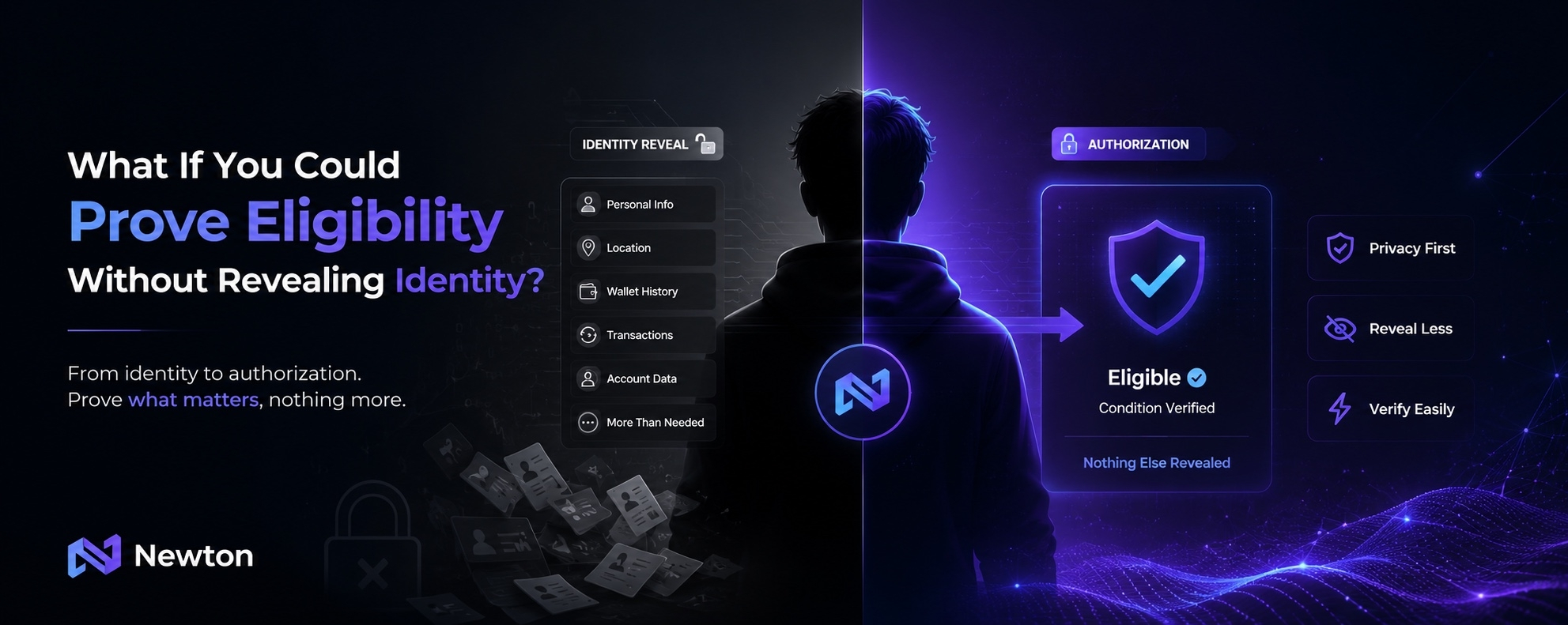
Interestingly, what stood out wasn’t another identity framework. It was the way the conversation shifted toward authorization instead of identity itself. Rather than asking users to reveal everything about themselves, the more interesting question became whether a system could verify that someone met a specific condition without exposing unrelated personal information.
That small shift changed how I looked at the problem.
Maybe the more interesting question isn’t how much information we can reveal.
Maybe it’s how little information is actually necessary.
I had a small experience that pushed this idea further.
I wanted to participate in a community event that required a wallet with previous on-chain activity. The requirement itself made sense. The organizers wanted genuine participants instead of automated accounts.
But while checking the requirements, I realized something felt strange.
To prove one simple fact that I qualified I was effectively exposing a much larger picture of my wallet history than anyone really needed.
It wasn’t a major problem, but it made me pause.
If someone only needs confirmation that I satisfy one condition, why should every other detail become visible as well?
That’s where my thinking quietly shifted.
For a long time, I treated identity as something binary. Either you reveal it or you hide it.
Now I’m not sure that’s the right way to think about it.
There may be a third option.
Instead of revealing who you are, perhaps you only need to prove what you’re authorized to do.
Those sound similar, but they lead to very different systems.
In many online environments today, proving eligibility often means sharing far more context than the actual decision requires. Age, residency, wallet history, transaction records, account ownership, previous interactions pieces of information accumulate because they’re convenient to request.
Yet the final decision usually depends on just one answer.
Eligible or not.
That contrast feels surprisingly easy to overlook.
Exploring Newton made me realize that authorization can be viewed as its own layer. The question becomes less about storing larger identities and more about generating reliable proofs that a required condition has already been met. In that model, users aren’t necessarily asked to reveal more they’re asked to reveal only what’s relevant to a specific action.
Crypto often celebrates transparency, and for good reason. Public verification has become one of blockchain’s defining strengths.
But transparency and disclosure aren’t necessarily identical ideas.
Sometimes verification doesn’t require complete visibility.
That’s the part I hadn’t fully appreciated before.
I also have one honest doubt.
Whenever privacy preserving authorization systems come up, I wonder whether they’ll introduce more complexity than they remove. If proving eligibility becomes difficult for ordinary users, adoption naturally becomes harder. Simplicity still matters.
So I don’t think every situation needs sophisticated cryptographic tools or new authorization models.