
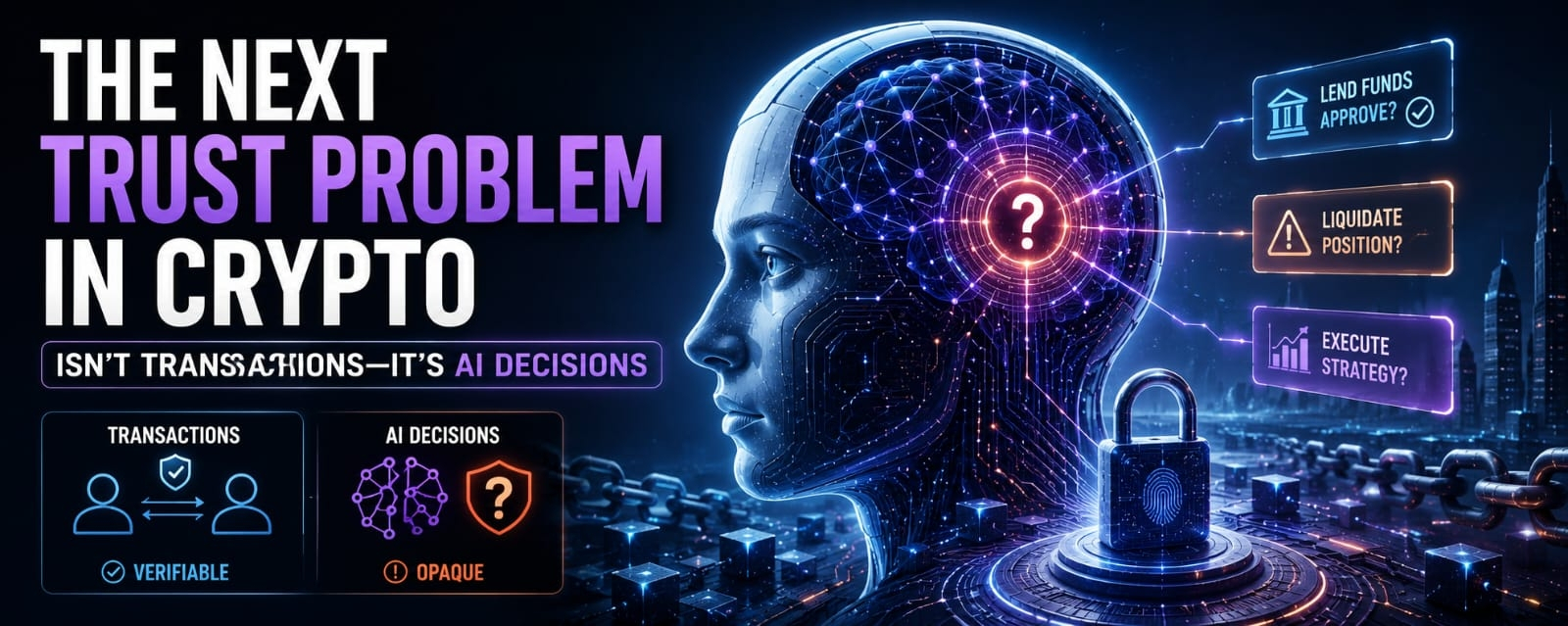
I didn't expect to find something more interesting than another AI trading narrative.
But the more I looked at Newton Protocol, the more I found myself thinking about a different question.
I don't think the biggest AI problem in crypto is making machines smarter.
I think the harder problem is figuring out whether I can trust those machines once I stop watching them.
That thought keeps coming back whenever I look at the direction both AI and blockchain are moving. AI is becoming increasingly capable of making decisions, while blockchains continue trying to build systems where people no longer have to trust one another. At first, these trends seem perfectly aligned. But the more I think about them, the more I feel they are solving different parts of the same puzzle.
Blockchain removes the need to trust transactions.
AI asks me to trust decisions.
Those are not the same thing.
Today, I can verify that a transaction happened on-chain. What I usually cannot verify is why an AI decided to make that transaction in the first place. If an automated strategy buys an asset, closes a position, reallocates capital, or changes its own behavior, I'm often left trusting whoever built the model instead of understanding what actually happened.
That feels like a step backward.
Crypto spent years trying to reduce reliance on trusted intermediaries, yet much of today's AI infrastructure quietly brings them back. The models live on private servers, the algorithms remain hidden, and users judge performance from dashboards or screenshots instead of verifiable execution.
I don't think this matters only for trading.
I think it becomes much more important once AI starts acting continuously instead of occasionally.
It isn't difficult to imagine a future where thousands of AI agents monitor markets every second, rebalance portfolios, search for arbitrage opportunities, manage treasury assets, or negotiate directly with other AI systems. At that point, humans won't be approving every decision manually.
We'll be delegating judgment.
And delegation always creates another question.
Who watches the decision-maker?
That's where I think projects like Newton Protocol become interesting—not because they promise better returns, but because they seem to start from a different assumption.
Instead of asking how AI can improve finance, I think Newton is asking how finance changes once AI becomes part of the infrastructure itself.
That feels like a more interesting question.
Newton Protocol describes itself as a secure rollup designed for AI-driven strategies, automated execution, and a marketplace where developers can publish AI-powered systems.
I don't immediately see this as another trading platform.
I see it as an attempt to rethink the environment where automated financial decisions actually happen.
General-purpose blockchains are remarkably flexible, but flexibility often comes with compromises. They were built to process transactions from anyone, not necessarily to coordinate continuous streams of AI-driven computation.
AI behaves differently.
It constantly evaluates information.
It adjusts probabilities.
It updates strategies.
It reacts to changing conditions.
It makes decisions repeatedly rather than occasionally.
Trying to fit those behavior patterns into infrastructure designed years before modern AI became practical may eventually create limitations.
I think Newton is trying to explore whether AI deserves infrastructure designed around its own operational needs instead of simply existing as another application running on existing chains.
Whether that's the right direction is something only time can answer.
The secure rollup concept is particularly interesting to me because it suggests that scaling isn't only about processing more transactions.
It might also be about organizing automated intelligence more efficiently while maintaining the security guarantees people expect from blockchain systems.
That distinction matters.
If AI becomes responsible for increasingly valuable assets, then execution itself becomes part of the trust model.
The marketplace idea also caught my attention, although perhaps not for the obvious reason.
At first glance, a marketplace for AI developers sounds straightforward. Developers publish strategies, users discover them, and everyone benefits.
But I don't think it's that simple.
The difficult part isn't publishing AI.
The difficult part is evaluating it.
Financial markets have always struggled to separate genuine skill from temporary success. A strategy can perform brilliantly during one market cycle and fail completely during another. Backtests can look impressive while hiding important assumptions. Historical performance often tells only part of the story.
AI doesn't eliminate those problems.
In some ways, it makes them even harder to detect.
If hundreds of developers begin publishing AI-powered strategies, users will eventually need ways to judge more than profitability.
I think they'll care about consistency.
Reliability.
Risk management.
Adaptability.
Those qualities are much harder to measure than returns.
I've started thinking that future AI marketplaces may compete less on intelligence and more on credibility.
The smartest model isn't always the one I would trust with capital.
Sometimes I would rather have predictable behavior than extraordinary performance.
Markets usually reward survival before brilliance.
That's another reason Newton feels interesting to me.
It seems less focused on making AI appear magical and more focused on building an environment where automated systems can actually operate at scale.
Of course, infrastructure projects rarely succeed because of architecture diagrams alone.
I've seen many technically impressive blockchain projects struggle because developers never arrived.
Infrastructure depends heavily on network effects.
Developers attract users.
Users attract more developers.
Without that cycle, even elegant engineering can remain underused.
Newton faces that same challenge.
A specialized rollup only becomes meaningful if builders decide it's worth building on.
A marketplace only becomes valuable if developers consistently contribute high-quality systems.
Technology creates possibilities.
Communities determine whether those possibilities become reality.
Another question I keep coming back to is openness.
AI has a natural tendency toward secrecy because the best models often become competitive advantages. Developers usually don't want to reveal everything they've built.
Blockchain, meanwhile, generally rewards transparency.
I think balancing those two incentives may become one of the defining infrastructure challenges for AI-powered finance.
Too much openness may discourage innovation.
Too much secrecy weakens trust.
Finding the middle ground won't be easy.
The more I think about Newton Protocol, the less I see it as a project about automated trading.
I see it as an experiment around accountability.
If autonomous systems eventually control meaningful amounts of capital, then I don't think faster execution will be enough.
I'll want stronger guarantees about how those systems behave.
I'll want infrastructure that treats machine decisions with the same seriousness that blockchains already treat financial transactions.
Whether Newton ultimately succeeds is impossible for me to predict.
Infrastructure is always difficult because adoption matters as much as technology.
But I do think the question it's exploring is becoming increasingly important.
For years, crypto focused on removing trust from transactions between people.
I think the next phase may involve building trust around decisions made by machines.
That feels like a much harder problem.
And if that problem really is coming, I suspect the projects that matter most won't necessarily be the ones building the smartest AI.
They'll be the ones helping me understand when that AI deserves my trust
@NewtonProtocol $NEWT #Newt #newt
