
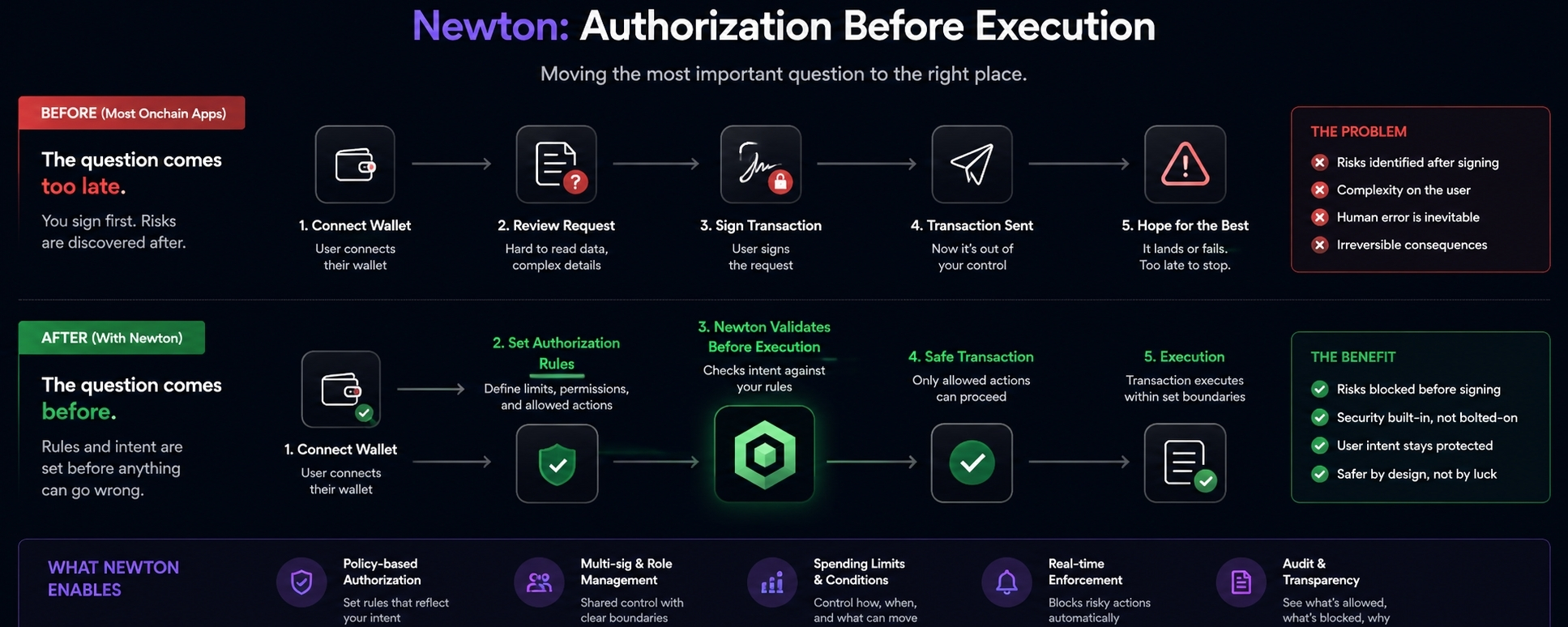
I’ve been watching crypto long enough to know that most projects lose me the moment they start sounding too certain about the future. Newton did not stand out to me because it promises another layer of security or because it uses language around authorization. What made me pause was something more practical: it is looking at the point before a transaction happens, when a user still has a chance to avoid a mistake instead of dealing with it afterward. In crypto, that small window matters more than people admit.
Most of us have become used to a strange routine. We connect a wallet, see a request, glance at the message, and sign because the action looks familiar or because we have done something similar before. Sometimes we read everything carefully. Most of the time, especially after spending enough time onchain, we do not. It is not because people are careless. It is because the system trains them to move fast. After enough transfers, approvals, swaps, and simple interactions, every transaction starts to feel normal. The dangerous ones often do not arrive with obvious warning signs.
That is where Newton feels worth paying attention to. It is not really trying to solve the problem by telling users to be more alert. Crypto has been repeating that advice for years: check every detail, understand every request, never sign something unfamiliar. That advice is reasonable, but it also assumes that every user can make the right call every time. Newton seems to begin from a more realistic place. People get tired. People move quickly. People do not always understand what they are approving, even when they are trying to be careful.
The project appears to focus on creating rules around what a wallet or account should be allowed to do before the transaction reaches the final signing stage. The idea is fairly simple when stripped of the technical language. Instead of asking someone to inspect every request in real time, the system could help define boundaries ahead of time. A wallet might limit how much can be moved in a certain situation. A shared account might require more than one person before funds can be transferred. A user might want to limit what a particular permission can do. These are ordinary expectations in many financial settings, yet onchain activity still leaves much of it to one final click.
I find that interesting because crypto often confuses control with responsibility. Giving someone full control of their assets sounds empowering, but it can also mean that one bad signature undoes months or years of careful decisions. The industry has treated that as part of the deal for too long. There is a difference between owning your assets and being expected to personally understand every technical detail behind every transaction. Most people do not want less control. They want fewer chances to make an irreversible mistake.
Newton seems to be exploring that gap between ownership and protection. It is not changing the fact that blockchains are open systems. It cannot stop every scam, every exploit, or every bad decision. But it may reduce the number of situations where a user only realizes something was wrong after the transaction has already gone through. That is a different kind of security from what many people are used to. It is less about reacting to danger and more about narrowing the paths where danger can happen in the first place.
Of course, the project also raises difficult questions. The moment you add rules around what users can do, you have to think about flexibility. What happens when a legitimate transaction does not fit the policy? What happens when the rules are set badly? What happens if someone needs quick access during an emergency? Security always carries this tension. The stronger the guardrails become, the more likely they are to slow down normal activity. Newton will have to find a balance between protecting users and making them feel trapped inside their own wallet.
Another question is whether people will actually use these controls before they need them. Most users do not set up security measures until after something goes wrong. They do not think about limits until they have experienced a close call. They do not separate risk until they understand how easily one wrong action can create a problem. That is not unique to crypto. It is just human behavior. Newton’s real challenge may not only be building the technology. It may be making safer behavior feel natural enough that people use it before they are forced to.
There is also the issue of complexity. Crypto already has too many tools that are technically useful but difficult to understand. Newton cannot become another system full of settings that only advanced users know how to configure. The more control it gives users, the more carefully it has to explain what that control actually means. Otherwise, people may end up trusting rules they do not understand in the same way they currently trust requests they barely read.
Still, I think Newton is looking at a real weakness in how onchain systems work today. Most security happens too late. By the time a wallet asks for confirmation, the user is already expected to understand the situation. The problem is that many people do not have enough information, enough time, or enough experience to make that decision with confidence. Newton is trying to move some of that responsibility earlier, into rules and boundaries that exist before the risky moment arrives.
I do not know whether Newton will become a standard part of how people interact with onchain systems. There are too many moving parts in crypto to make easy predictions. But I find the direction more thoughtful than simply telling users to be careful. The industry has spent years building faster ways to move value. Newton seems to be asking whether we should spend more time deciding what should be allowed to move in the first place. That question feels more important than it first appears.