
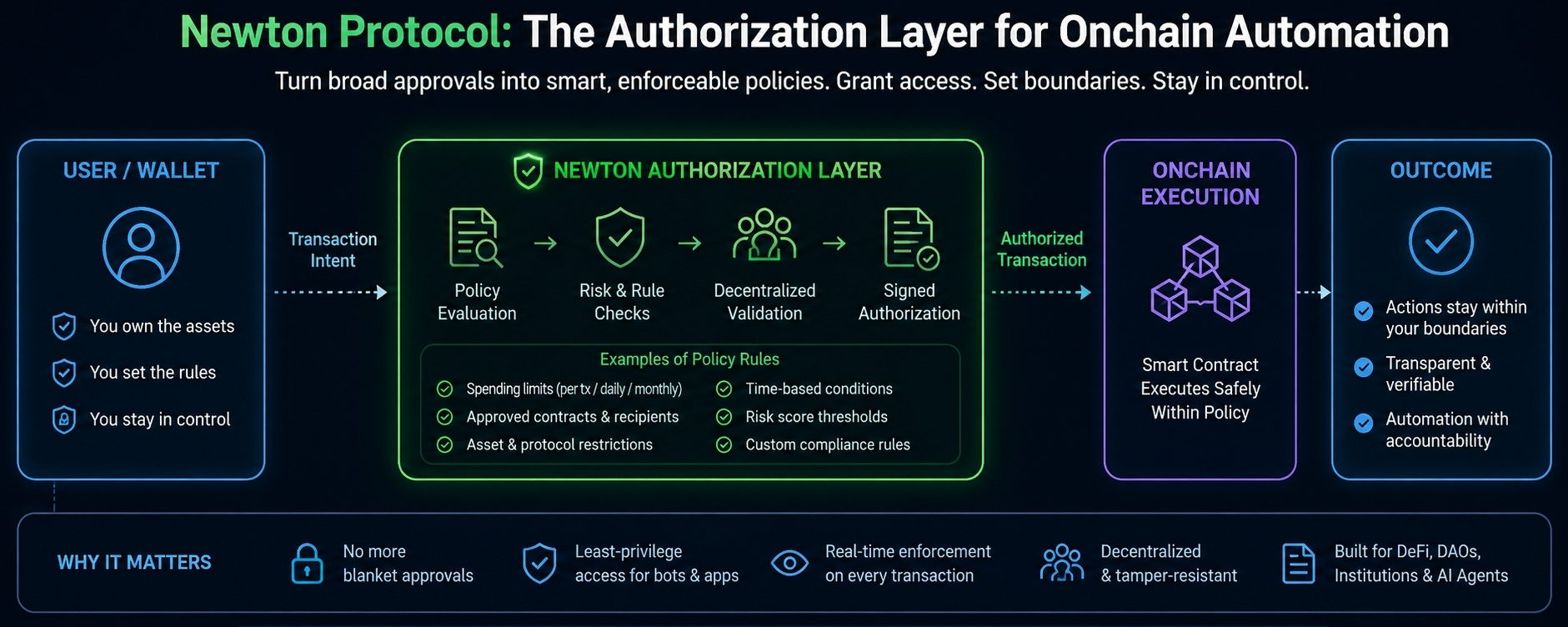
I’ve spent enough years around crypto to notice that the projects that stay with me are rarely the loudest ones. Newton Protocol caught my attention because it is looking at a problem that most of us have learned to ignore until it becomes painful: what exactly happens after we give a contract, bot, or automated system permission to act for us. In decentralized finance, that moment is usually reduced to a simple button press. Approve token spend. Connect wallet. Confirm access. It feels routine because we have repeated it so many times, but the reality underneath is not routine at all. We are often giving systems more freedom than we can comfortably explain, then trusting that the code, the team, and the market behave the way we expect.
That is the part of crypto I find myself thinking about more than ever. We have become very good at building systems that can move money automatically. We are less good at making those permissions understandable. A trading bot can rebalance a wallet, an automated strategy can shift capital, and an agent can execute a plan while the user is asleep. All of that sounds efficient until you stop and ask a basic question: what is that system actually allowed to do once it has access? Not what it says it will do. Not what a dashboard suggests. What it can do.
Newton Protocol is built around that difference. Rather than treating approval as a one-time blanket permission, it is trying to make authorization more specific and more conditional. The project is designed around programmable policies that can sit between a user’s intent and an onchain transaction. In practical terms, that means an action could be checked against certain rules before it goes through. A bot might be allowed to trade only within a certain limit. A wallet might be allowed to send funds only to approved destinations. A treasury might be restricted from moving assets unless a set of conditions is met. The goal is not to remove automation, but to make automation operate inside boundaries that are clearer than the usual approve-and-hope model.
I think that is why the project feels more relevant than many of the conversations around AI agents in crypto. A lot of the attention is focused on what agents will be able to do. They can monitor markets, execute trades, manage liquidity, respond to signals, and handle tasks users do not want to perform manually. That part is easy to imagine. The harder part is deciding how much authority those systems should have. An agent can be useful and still be dangerous if its permissions are too broad. It can follow a strategy exactly as intended and still cause damage if the market changes, the inputs are wrong, or the original assumptions no longer hold.
Newton Protocol seems to be approaching this from the more grounded side of the problem. Instead of asking users to simply trust an automated system, it gives more importance to the conditions under which that system can act. That sounds obvious, but crypto has not always treated it that way. Unlimited approvals became normal because they were convenient. Broad permissions became normal because they made things easier to use. Over time, users were trained to see a wallet popup as a minor obstacle rather than a serious financial decision. Newton Protocol is trying to bring some structure back into that process.
What makes the idea interesting is that it is not limited to one kind of user. A trader could use policies to limit how much a bot is allowed to move. A group managing shared funds could use them to control spending rules. A larger organization could set conditions around who can receive assets or when a transaction is valid. Even a simple wallet could use the same logic to prevent certain actions unless they match a predefined set of rules. The project is not solving every trust problem in crypto, but it is addressing a piece of infrastructure that becomes more important as more actions are delegated to software.
At the same time, I do not think policy-based authorization is automatically simple just because the idea sounds clean. Rules can become complicated quickly. The more detailed the policy, the more likely it is that someone has to understand how all the pieces interact. A limit that makes sense during normal market conditions might fail during a sudden crash. A rule based on external data depends on that data being accurate and available. A system that relies on multiple participants has to deal with disagreement, delays, incentives, and edge cases. None of that makes the project less interesting, but it does mean the real test will be in how it behaves under pressure, not how elegant the concept looks on paper.
I also think Newton Protocol has to solve a human problem, not only a technical one. Most people do not want to write complex policies for every action they take. They want to understand what they are approving without needing to think like a developer or a risk manager. The project will be more useful if it can make those permissions feel readable and practical. A user should be able to understand that a bot can trade only a limited amount, that a payment tool cannot send funds outside a chosen list, or that automated capital cannot move when certain risk conditions are triggered. The underlying infrastructure can be advanced, but the user experience cannot feel like another layer of complexity.
There is something quietly important about the problem Newton Protocol is trying to address. Crypto has always been built around self-custody and control, but in practice, many users trade some of that control away for convenience. They approve contracts they barely understand, use systems they do not monitor every day, and rely on automation because the ecosystem is too fast and too fragmented to manage manually. That tension is only going to grow as agents become more capable. The question is not whether people will delegate more actions to software. They probably will. The question is whether those delegations will come with real limits.
Newton Protocol does not remove the need for trust, and it does not make automated finance risk-free. No protocol can do that. But it is trying to make the boundaries of trust more visible. It is trying to move the conversation away from broad access and toward specific authority. That feels like a healthier direction for crypto, especially at a time when more systems are being asked to act independently with real assets.
I keep coming back to the fact that most risky actions in crypto do not look risky in the moment. They look like normal clicks. They look like a familiar approval screen, a harmless permission request, or a setting that promises to save time. Newton Protocol is interesting because it takes that ordinary moment seriously. It asks whether a user should have to hand over a blank check just to make automation useful. I do not know how widely the project will be adopted, and I do not think the answer is obvious yet. But I do think the question it is asking is one the industry can no longer avoid: when software acts for us, how do we make sure it stays within the limits we actually intended?