
I’ve spent enough years around crypto to become suspicious of anything that sounds too polished too early.
Usually when an industry suddenly becomes certain about the future, it means nobody has really lived through the consequences yet. I’ve watched people declare the death of banks, the death of gaming companies, the death of social media platforms, the death of entire economic systems because of one new protocol and a whitepaper with good branding.
Most of those predictions aged badly.
So now when I hear people confidently talking about AI ownership being “solved” through blockchain infrastructure, I instinctively slow down a little. Not because the problem isn’t real. The problem is very real. Honestly, it’s becoming impossible to ignore. I just don’t think human systems ever become as clean as technologists want them to.
That’s probably why OpenLedger stayed in the back of my mind longer than most projects do lately.
Not because I suddenly believed everything. I didn’t.
But something about it felt less performative.
Most crypto AI projects right now feel like they were designed backward. The token comes first, then the narrative, then eventually someone tries to find an actual use case underneath all of it. You can almost feel the desperation sometimes. Everyone wants to attach themselves to AI because the market rewards proximity to whatever feels inevitable.
I’ve seen this pattern too many times.
But the ownership issue around AI does feel different from the usual manufactured narratives. Mostly because there’s real tension underneath it. Real discomfort. Real uncertainty that nobody has figured out how to smooth over yet.
AI models are consuming enormous amounts of human work. Writing, art, conversations, research, code, archives, years of accumulated knowledge from people who never expected their work to become training material for machines. And now everyone is trying to figure out where the boundaries are supposed to be after the fact.
That’s the part that feels strange to me.
The internet spent twenty years normalizing extraction. Platforms collected behavior. Algorithms collected attention. Data got harvested constantly in ways most people barely understood. Nobody really stopped it because convenience always won.
Now AI arrives and suddenly people are asking who owns what.
And honestly, I understand why.
There’s something unsettling about watching human knowledge become raw material for systems that can generate economic value at enormous scale while the original contributors disappear into the background completely.
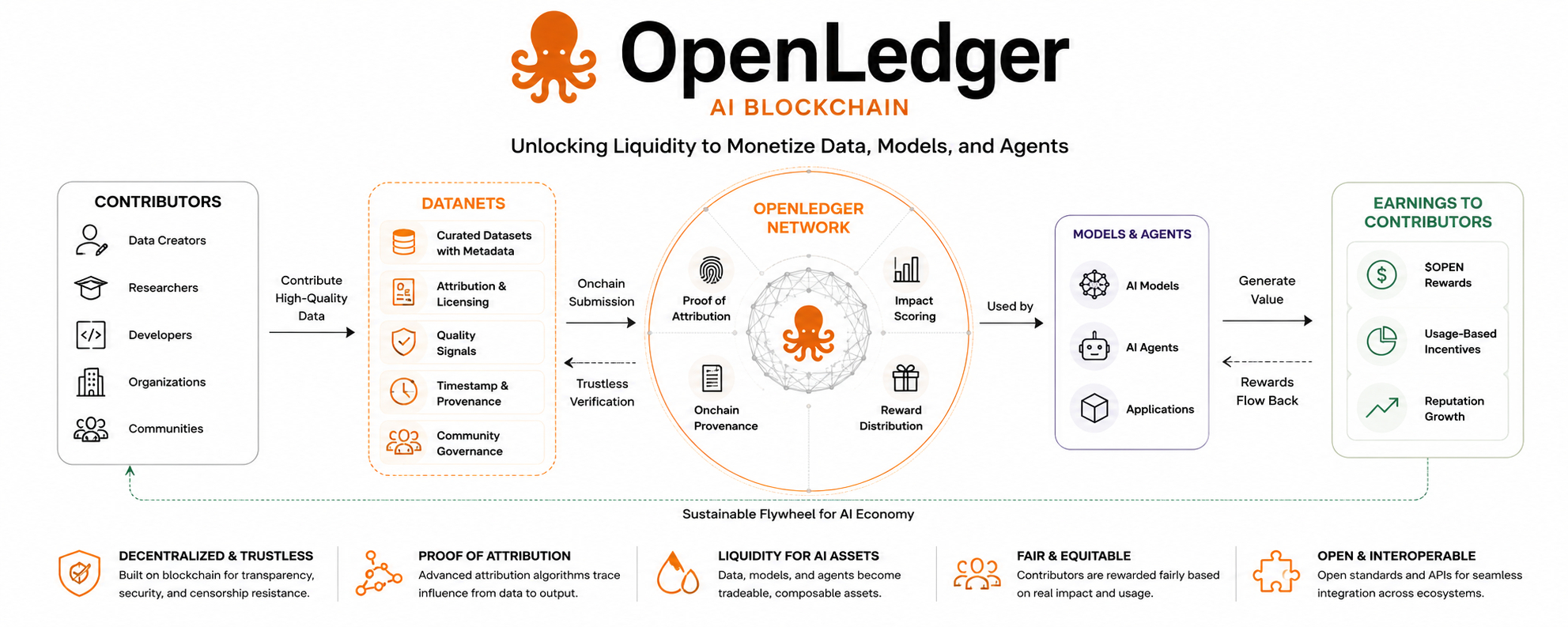
That’s where OpenLedger caught my attention a little. The idea that datasets, contributors, models, and outputs should remain connected somehow instead of becoming detached the moment training starts.
I’m careful even saying that because I don’t fully trust any system claiming it can perfectly track influence inside large AI models. That sounds unrealistic already. Human influence itself is messy. Ideas bleed into each other constantly. Creativity has never been fully traceable, even between people.
So when projects talk about attribution with too much certainty, I immediately become skeptical.
Still, I think there’s a meaningful difference between imperfect attribution and no attribution at all.
Right now most of the AI world operates almost like a black box economy. Data goes in. Models come out. Money flows upward. The original sources become invisible somewhere in the process.
OpenLedger seems to be trying to push against that invisibility.
Whether it works long term is another question entirely.
That’s the thing about crypto infrastructure people rarely admit openly: building the system is usually the easy part. The hard part is getting human behavior to cooperate with it consistently over time.
I’ve watched technically impressive projects collapse because nobody actually wanted the friction that came with transparency. People say they want decentralization until decentralization becomes slower, more expensive, less convenient, or harder to manipulate.
Then suddenly the old systems don’t look so bad anymore.
That’s why I don’t really buy into clean narratives anymore. Crypto cured me of that years ago.
Everything sounds revolutionary during the early phase. Then reality arrives. Incentives distort things. Speculation overwhelms utility. Governance becomes political. Power recentralizes in quieter ways.
And yet, despite all that cynicism I’ve built up over time, I keep coming back to this feeling that AI provenance is a real problem waiting for some kind of infrastructure response.
Not a perfect response. Probably not even a complete one.
Just something better than the current situation where nobody can explain where anything truly comes from anymore.
Lately the internet itself feels like it’s losing memory.
Content moves too fast. Context disappears almost instantly. Images get reposted without origin. Text gets scraped and remixed endlessly. AI-generated material blends together with human work until everything starts feeling detached from whoever made it.
Maybe that’s why attribution suddenly matters again.
Not only economically, but psychologically.
People want proof that human contribution still exists somewhere underneath the machine layer.
And honestly, I don’t think blockchain alone fixes that. I think crypto people sometimes overestimate how much technology can repair social trust. Most trust problems are human problems first.
But decentralized systems might still help preserve accountability in ways traditional platforms never really cared about.
At minimum, they create records that are harder to quietly erase.
That matters more than people think.
I’m not sitting here convinced OpenLedger becomes some massive foundational layer for AI. I’ve been in this market too long to speak that confidently about almost anything. I’ve watched too many “inevitable” projects disappear six months later.
But I do pay attention when something feels like it’s addressing an actual structural issue instead of inventing a temporary story for traders.
And the ownership problem around AI feels structural.
Because the uncomfortable reality is that AI companies need human knowledge constantly, but the current internet has almost no reliable system for preserving contribution once information gets absorbed into models.
That gap eventually becomes economic tension.
Then political tension.
Then legal tension.
And eventually infrastructure has to evolve around it somehow.
Maybe decentralized systems become part of that evolution. Maybe they don’t. Maybe the final solution ends up looking nothing like what crypto people currently imagine.
I’m honestly not sure yet.
But I do know this: the conversation around AI has changed. A year ago people only cared about capabilities. Faster models. Better outputs. More impressive demos.
Now people are quietly starting to care about where all of it came from.
That shift feels important to me.
And something about OpenLedger feels like it noticed that shift early, before most of the market fully processed where this conversation is heading.
Not in a dramatic way.
Just enough to make me keep watching.
