
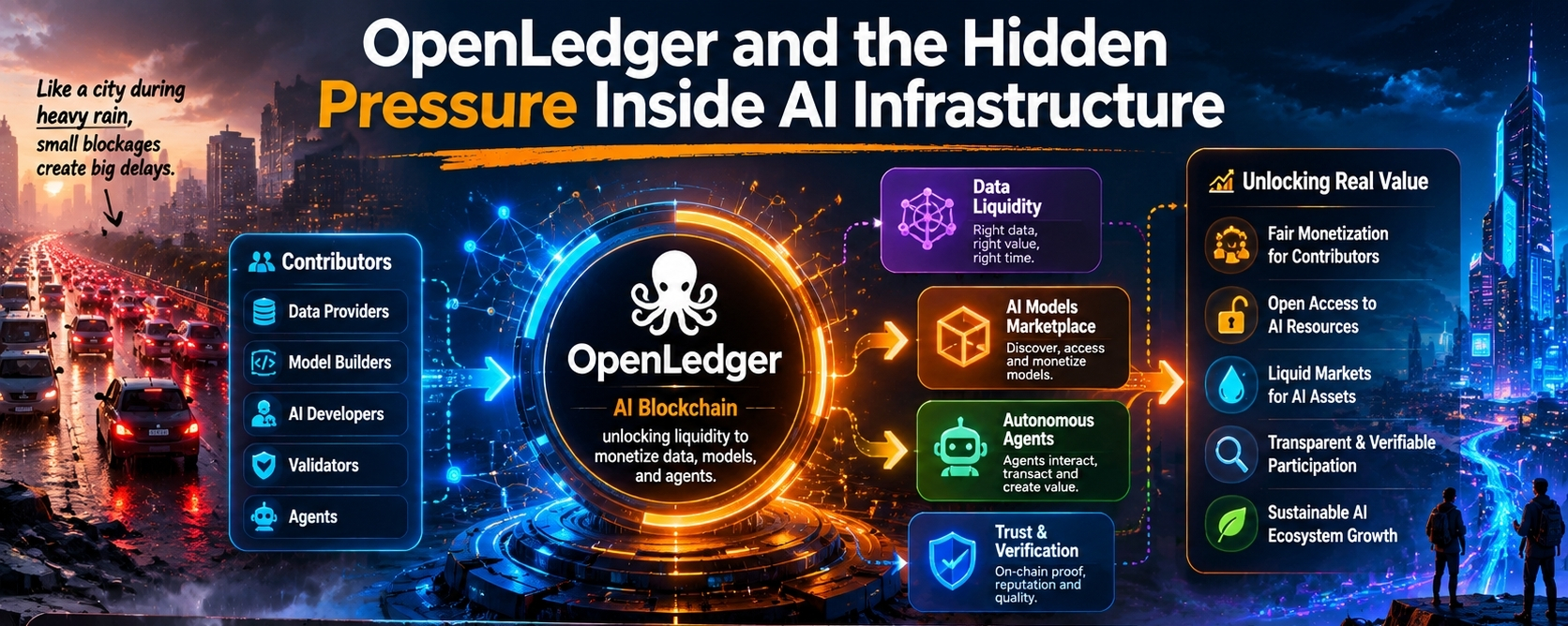

OpenLedgerA few days ago, I was sitting with a friend at a small tea stall near a busy road while rain slowly started building up across the city. At first, traffic looked normal. Cars moved, bikes squeezed through gaps, people kept rushing home like every other evening. But within twenty minutes, everything changed. One blocked lane created another delay somewhere else. Drivers stopped trusting the signals, people started taking shortcuts, and suddenly the whole system felt heavier than it should have been.That’s honestly how I’ve started looking at AI and crypto infrastructure lately, especially projects like OpenLedger.
Most systems look efficient when conditions are calm. Data moves smoothly, liquidity feels available, and users assume everything will keep working the same way tomorrow. But pressure changes behavior fast. Once demand increases or incentives stop aligning naturally, weaknesses appear almost immediately.OpenLedger stands out to me because it feels less focused on selling a perfect future and more focused on dealing with the messy reality underneath modern AI systems.
The project revolves around a simple but important idea: data, AI models, and autonomous agents shouldn’t stay trapped inside closed ecosystems where only a few companies control the flow of value. Instead, OpenLedger is trying to build an environment where those resources can move more openly, where contributors can actually monetize participation, and where AI infrastructure behaves more like a shared economic network than a private silo.That sounds exciting on paper, but the harder part is coordination.
I’ve noticed that many AI projects talk about decentralization as if it automatically solves trust problems. It doesn’t. Real systems become difficult once people, money, and pressure enter the picture. Contributors chase rewards. Liquidity shifts quickly. Governance slows down when fast decisions are needed most. Even useful participants lose patience if incentives stop feeling fair.OpenLedger seems increasingly aware of that reality.
Lately, the ecosystem has been leaning more into AI-native coordination — connecting data providers, models, and agents through shared infrastructure instead of isolated platforms. The focus feels less theoretical now and more operational. You can see the shift in how the project discusses liquidity, contribution systems, and AI interaction across the network.And honestly, that matters more than flashy narratives.Because AI infrastructure right now feels a lot like a city growing faster than its roads.
Everything works until too many people arrive at once. Then small inefficiencies become major bottlenecks. Data gets fragmented. Valuable contributors get buried under noise. Systems designed for ideal conditions suddenly struggle with real-world behavior.
I’ve watched this happen repeatedly across crypto markets too. During bullish periods, almost every protocol looks efficient because activity hides structural weakness. But stress reveals everything. Latency matters more. Trust matters more. Coordination matters more.That’s where OpenLedger becomes interesting.
Instead of treating AI as something external connected to blockchain later, the project seems to be building around the idea that AI agents, models, and data economies will eventually need their own coordination layer from the beginning. Not just ownership tracking, but actual economic flow between participants.Still, I don’t think this solves everything.
OpenLedger cannot guarantee high-quality data forever. It cannot stop bad incentives from appearing inside open systems. And it definitely cannot erase the advantage massive AI companies already have in computation, funding, and distribution power.That’s important to admit honestly because too many projects in this space still speak in absolutes.
Decentralization is not magic. Open systems still experience congestion, manipulation, governance friction, and uneven participation. Sometimes openness even creates new problems because anyone can enter the system, including low-quality actors chasing short-term rewards.Infrastructure always becomes harder once scale arrives.
That’s why I pay more attention to how projects behave under pressure rather than how they market themselves during calm periods. OpenLedger feels like a project trying to prepare for stress before the industry fully arrives there. The emphasis on liquidity, coordination, and AI interaction suggests the team understands that future AI economies will not fail because of lack of intelligence. They’ll fail because of weak coordination between participants.And honestly, that feels realistic to me.
The internet already struggles with trust, incentives, and information quality. AI will probably intensify those problems, not remove them. Systems capable of surviving long term will likely be the ones designed around imperfect human behavior instead of ideal assumptions.

That’s probably why OpenLedger keeps holding my attention.Not because it promises certainty, but because it seems built around a more honest understanding of how modern systems behave once pressure enters the room.