
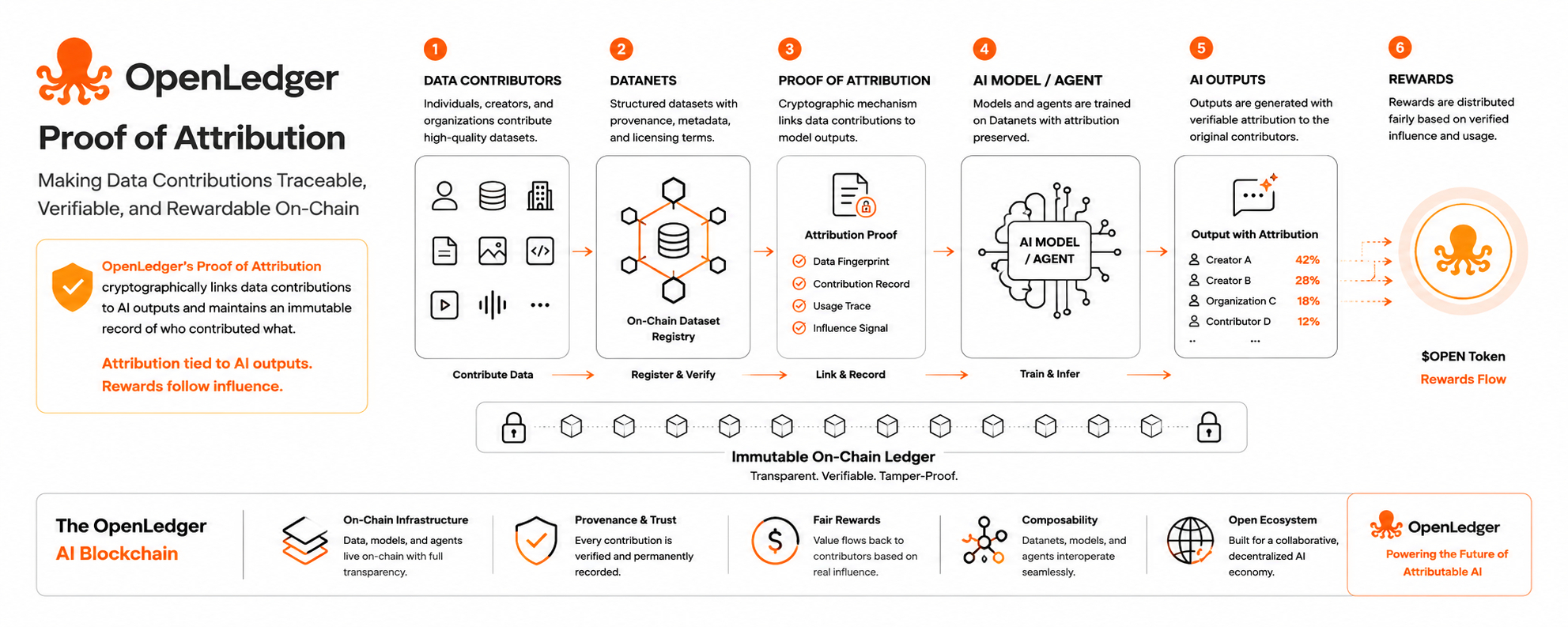
I keep circling back to OpenLedger’s Proof of Attribution because it is one of the few crypto ideas in this AI wave that does not feel completely recycled. The project says it is trying to make data contributions traceable, verifiable, and rewardable on-chain, with attribution tied to AI outputs instead of just being talked about in vague terms. That sounds simple when it is written cleanly in a paper, but it is not a simple problem at all. Still, I understand why people keep looking at it. The underlying complaint is real: people feed these systems, shape these systems, and usually disappear from the story the moment the model starts talking.
What I like, at least in theory, is that OpenLedger is not pretending attribution is just a branding exercise. Its materials describe Proof of Attribution as a cryptographic mechanism meant to link data contributions to model outputs and maintain an immutable record of who contributed what. The whitepaper also frames the whole thing as part of a broader AI blockchain where data, models, and agents live on-chain and where rewards are supposed to follow influence. That is a serious ambition. It is also the kind of ambition that tends to survive the first pitch deck and then meet reality the moment the system has to work outside a tidy demo.
I’ve seen this pattern before. A project finds a real problem, packages it into a neat sentence, and then the hard part gets quietly moved into the footnotes. Attribution is one of those problems. Research on training-data attribution keeps showing that the examples that influence a model are often not the ones that directly say the thing you think they say, which is exactly the sort of detail that makes the whole subject slippery. Other work on attribution methods says scaling to large language models is possible, but still difficult, and that fitting error, stability, and retrieval quality all matter. In other words, the idea is not fantasy, but it is not frictionless either.
That is where my skepticism kicks in. Crypto loves anything that sounds like clean accounting, but the world rarely gives clean inputs. Data gets copied, remixed, filtered, retrained, summarized, and passed through systems that are already layered with retrieval, prompting, fine-tuning, and agents. Once that happens, “who contributed what” stops being a neat question and starts becoming a judgment call. OpenLedger’s own design around Datanets and on-chain provenance suggests it understands this to some degree, because it leans toward structured datasets rather than pretending the whole internet can be counted like a spreadsheet. That is sensible. It is also a reminder that the useful version of this idea may be narrower than the grand version people want to sell.
The part that feels different to me is not the marketing language, but the direction of travel. There is a real shift happening in AI toward provenance, traceability, and source accountability, because the industry keeps running into the same questions about ownership, trust, and reward. OpenLedger is basically trying to sit right in that pressure point. I can respect that. I also know pressure points are where systems break first if the incentives are wrong. It is easy to say contributors will be paid fairly. It is much harder to make that true when the model is complex, the data is messy, and everyone has a reason to argue about attribution quality.
So I would not call Proof of Attribution a breakthrough yet, at least not in the way people usually mean it. A breakthrough would mean the problem has been pushed through the wall, and I am not convinced of that. What I see instead is something more interesting and more modest: a real attempt to make value legible in a place where value usually gets swallowed by the system. That is worth watching. But I’ve been around crypto long enough to know that “worth watching” is not the same as “works at scale.” A lot of ideas sound right right before they hit incentives, costs, and edge cases.
Maybe that is why this one stays in my head longer than most. It is not trying to promise magic. It is trying to solve an annoying, expensive, very human problem: who gets credit when intelligence is built from many small pieces of work that no one can easily see anymore. I’m not fully convinced yet. I don’t fully trust it. But I do think the question is real, and I think OpenLedger is pointing at one of the few places in crypto where the conversation still has some substance. Whether Proof of Attribution becomes infrastructure or just another elegant promise is still the thing I’m waiting to see.
