



there is something unsettling about the way modern ai systems talk about attribution. people describe it like an accounting problem, as if intelligence can be reverse-searched through vectors and gradients until every output suddenly reveals its origin. but that assumption starts collapsing the moment specialized models begin operating across massive distributed datasets, fragmented workflows, modular adapters, and asynchronous inference environments. the scale alone changes the meaning of attribution. and that part keeps bothering me.
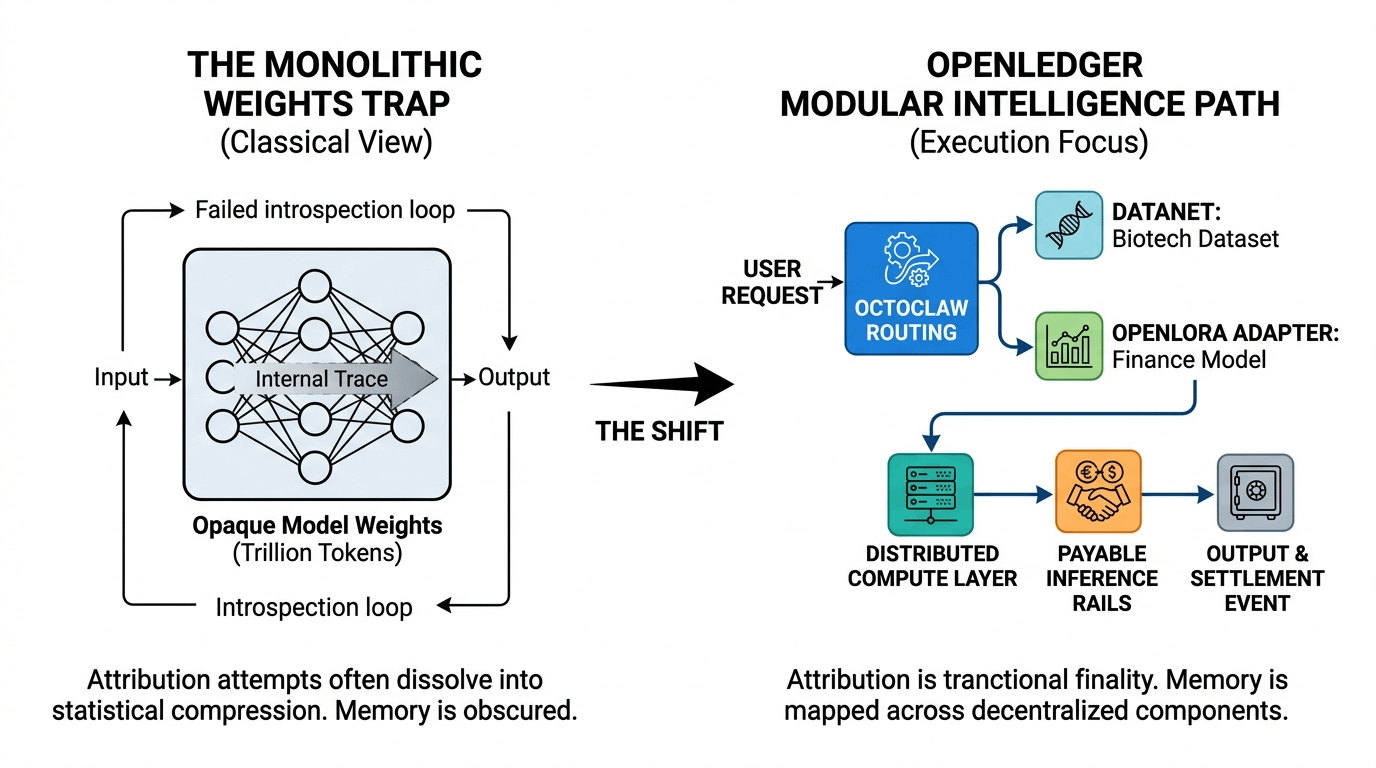
because once a model becomes large enough, attribution is no longer about discovering where an answer came from. it becomes a question about whether the system itself can still remember why it behaved the way it did.
that distinction feels small at first. it is not.
most infrastructure conversations around ai still behave as if intelligence is produced inside the model weights themselves. but inside the openledger ecosystem, the architecture quietly suggests something more uncomfortable. the model is not the center anymore. execution is. routing is. settlement is. the path an inference takes through adapters, permissions, compute layers, payable execution rails, datanets, and attribution systems becomes more important than the static existence of the model itself.
execution changes the meaning of everything.
a specialized model running through openlora does not behave like a monolithic intelligence. it behaves like temporary coordination. adapters appear and disappear. workflows mutate depending on context. octoclaw agents route requests differently based on economic logic, latency constraints, permissions, and available compute. the inference path itself becomes fluid. and when intelligence becomes fluid, attribution becomes unstable unless the infrastructure can preserve exact traces of influence without depending on hidden internal states.
this is where most traditional attribution systems quietly fail.
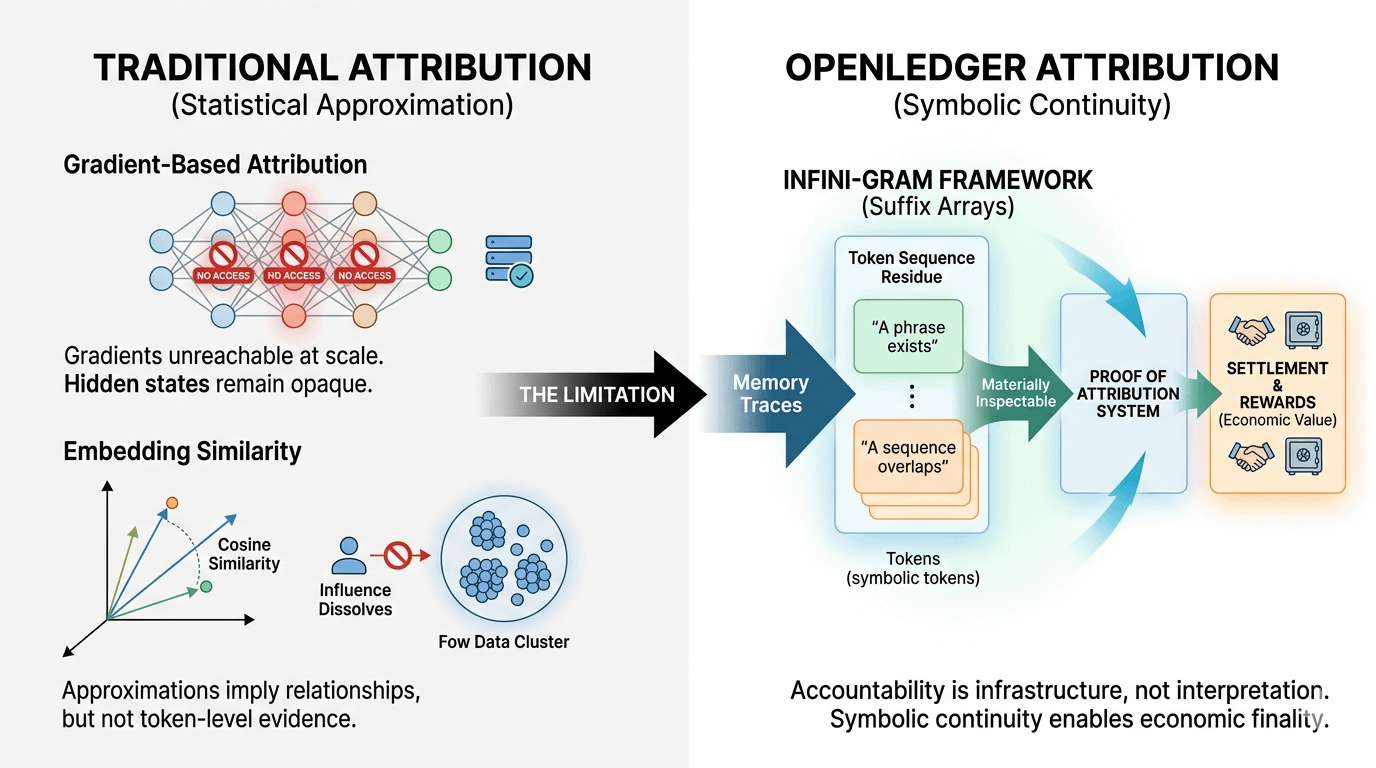
gradient-based attribution always sounded convincing in research papers because the models being studied still behaved like contained systems. influence functions, representational similarity metrics, embedding comparisons — they all assume the infrastructure can afford introspection. they assume gradients remain accessible. they assume storage remains manageable. they assume interpretability survives scale. none of those assumptions hold once models begin operating across trillion-token corpora while routing through modular inference ecosystems.
the hidden layer keeps trying to return.
people underestimate how fragile attribution becomes once inference is separated from training. a model accessed through api execution or routed across modular compute environments becomes partially opaque by design. the system knows the output happened, but the exact reason starts dissolving into statistical compression. embeddings can imply semantic similarity, but implication is not evidence. semantic resemblance is not token-level memory. and specialized models are unusually sensitive to this distinction because small fragments of domain-specific language often trigger disproportionately important outputs.
available is not the same as needed.
that sentence feels increasingly true across ai infrastructure.
the internet already contains infinite information, yet specialized systems keep emerging because raw availability does not create precision. the same thing happens with attribution. embedding-based methods can approximate influence at a conceptual level, but approximation becomes dangerous when attribution starts affecting settlement, ownership, licensing, provenance, or economic rewards inside decentralized ai ecosystems.
openledger seems to recognize this more clearly than most systems.
proof of attribution inside openledger does not feel designed merely for transparency theater. it feels designed because modular intelligence cannot economically function without reliable influence trails. once datanets begin supplying specialized datasets into modelfactory pipelines, once adapters are dynamically mounted through openlora, once inference execution becomes payable and routed through distributed compute layers, attribution stops being a side feature. it becomes settlement infrastructure.
and settlement infrastructure cannot survive ambiguity forever.
that is why the decision to adopt infini-gram feels more philosophical than technical.
on the surface, infini-gram is described as a suffix-array-based infinity-gram attribution framework. symbolically indexed. scalable. auditable. capable of preserving token-level fidelity without requiring backpropagation access into the model internals. but underneath the implementation details, the choice reveals a deeper belief about intelligence itself.
openledger seems to be operating under the assumption that memory matters more than abstraction.
that sounds almost backwards in an era obsessed with emergent reasoning and generalized intelligence. yet the infrastructure keeps pointing toward the same conclusion. if ai systems are going to participate in economic networks, coordinate agents, execute workflows, settle payments, and distribute attribution rewards, then the system must preserve exact traces of influence somewhere beneath the abstraction layers.
otherwise the architecture slowly loses accountability.
classical n-gram systems once looked primitive because they lacked semantic elegance. they were treated as statistical artifacts from an earlier era of language modeling. but infini-gram quietly transforms that limitation into strength. instead of forcing attribution through compressed embeddings or inaccessible gradients, the system preserves symbolic continuity directly across token sequences. suffix arrays allow massive-scale lookup structures capable of tracing exact overlaps and contextual relationships across enormous corpora without needing to reopen the neural machinery itself.
the system feels colder than people realize.
because symbolic attribution removes some of the comforting ambiguity modern ai systems hide behind. gradients are difficult to interpret, which gives organizations room to avoid precise accountability. but symbolic overlap creates sharper edges. it introduces traceability that behaves more like infrastructure than interpretation. a phrase exists or it does not. a sequence overlaps or it does not. the influence trail becomes materially inspectable.
that changes the economic psychology of ai systems.
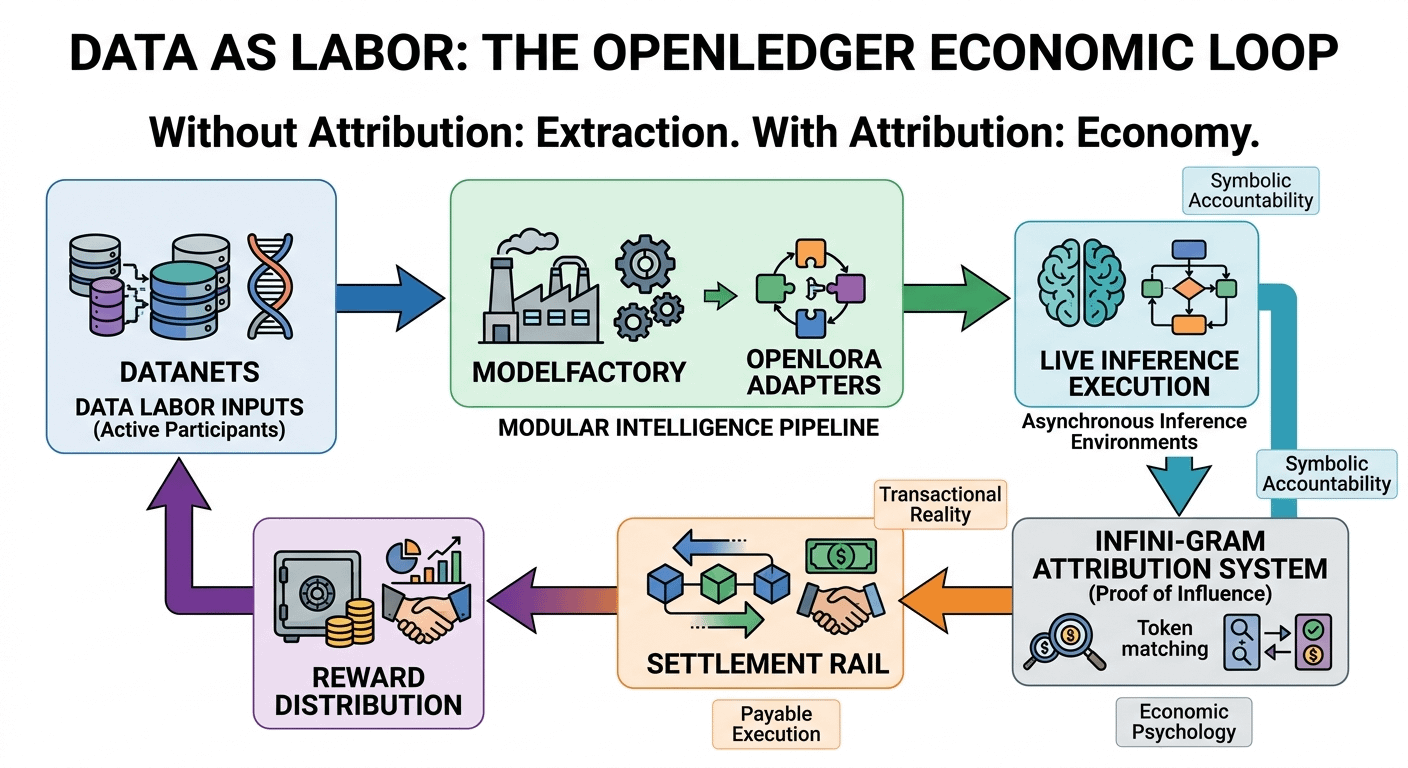
inside openledger, datanets are not merely repositories of information. they become active participants in inference economies. data providers are no longer abstract contributors buried beneath model weights. proof of attribution creates pathways where influence can theoretically connect back into settlement systems, vault structures, payable inference flows, and execution accounting. the architecture begins treating data less like fuel and more like labor.
and labor always changes the political structure of systems.
that is the hidden tension underneath modular intelligence.
people talk constantly about scaling models, but scaling coordination may be the harder problem. once thousands of specialized adapters, agents, datasets, and workflows interact simultaneously, the infrastructure must answer increasingly uncomfortable questions. which data shaped this inference path. which adapter altered the behavioral trajectory. which execution route generated value. which datanet contributed meaningful influence. which participant deserves compensation.
without attribution, modular intelligence collapses into extraction.
with attribution, it starts resembling an economy.
that difference matters because openledger is not building static ai products. it is building behavioral infrastructure. modelfactory does not simply train models; it operationalizes specialization. openlora does not simply host adapters; it turns temporary intelligence into portable execution layers. octoclaw does not merely orchestrate workflows; it coordinates decision paths across fragmented inference environments. the architecture keeps dissolving the boundaries between compute, behavior, ownership, and economics.
and once those boundaries dissolve, attribution becomes existential.
there is also something psychologically strange about infini-gram itself. modern ai culture became deeply obsessed with abstraction. everything moved toward embeddings because embeddings felt intelligent. dense vector spaces created the illusion that machines were evolving beyond symbolic systems into something more human-like. but symbolic structures never disappeared. they simply retreated beneath the surface.
the hidden layer keeps trying to return.
infini-gram almost feels like infrastructure remembering that language still leaves physical traces. not emotional traces. not conceptual approximations. actual sequential residue. token continuity. symbolic recurrence. the architecture refuses to fully surrender memory into statistical fog.
that refusal becomes increasingly important once agents begin autonomously coordinating workflows across open systems.
because agents do not simply produce outputs. they produce consequences.
a routed inference inside openledger may trigger settlement events, permissions changes, compute allocations, vault interactions through erc-4626 structures, or cross-environment execution through evm bridges. suddenly attribution is no longer academic research. it becomes part of transactional reality. and transactional systems cannot survive indefinitely on probabilistic explanations alone.
people keep imagining ai infrastructure as intelligence expansion. but sometimes it feels more like memory preservation under impossible scale.
that observation changes how the entire openledger ecosystem reads.
datanets stop looking like storage systems and start looking like collective memory markets. proof of attribution stops looking like analytics and starts looking like historical accounting. model routing stops looking like optimization and starts looking like behavioral governance. even payable inference begins feeling less like monetization and more like negotiation between fragments of distributed cognition.
the architecture becomes strangely human at that point.
because human systems also struggle with attribution. economies reward visible outputs while hiding invisible influence. institutions forget where ideas originated. labor disappears behind abstraction layers. memory fragments under scale. attribution becomes political long before it becomes technical.
ai systems are starting to inherit those same tensions.
and maybe that is why infini-gram feels important beyond its implementation details. it reintroduces the possibility that infrastructure itself can still remember exact influence without relying entirely on opaque representations. not perfectly. not completely. but enough to preserve continuity between data, behavior, execution, and settlement.
enough to stop modular intelligence from becoming historically anonymous.
that may end up mattering more than people realize.