

In the blockchain world, we’ve spent a decade obsessed with throughput. We’ve optimized consensus, perfected deterministic execution, and hardened immutability. But as we move toward a world of AI agents and Real-World Assets (RWAs), we are hitting a wall that raw TPS cannot climb.
The problem is simple yet devastating: Blockchains are world-class at verifying computation, but they are inherently blind to the truth of their inputs.
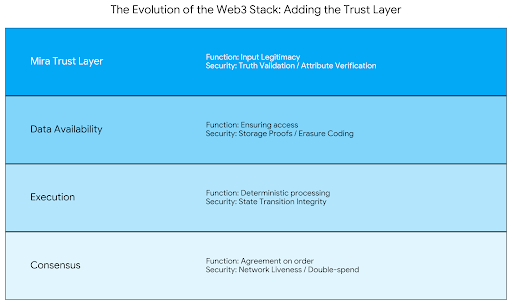
Deterministic execution does not equal deterministic truth. If an AI model provides a hallucinated trading signal or a corrupted API sends a signed payload, the blockchain will execute it faithfully—and incorrectly. This is where Mira Network intervenes, introducing a "Trust Layer" that sits between external chaos and on-chain state.
1. The Architectural Shift: From "Trust" to "Verify"
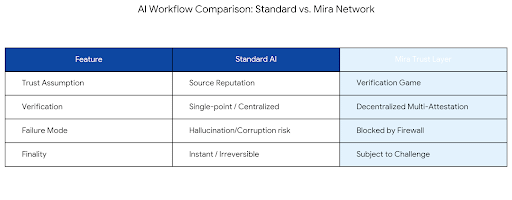
Conceptually, Mira acts as a programmable verification firewall. Instead of a smart contract blindly accepting external data, the data must survive a "validation game" before it ever touches the chain’s state.
2. The Mechanics of the Trust Layer
Mira doesn't just pass data; it passes context. When an external output (like an AI-generated inference) is produced, it is routed through independent Attestation Nodes.
Byzantine Fault Tolerance for Data
These nodes don't just relay information. They recompute, cross-check against constraints, and inspect metadata. This creates a layer of Byzantine Fault Tolerance (BFT) specifically for the data layer. The result isn't just an "Output"—it is an Output + Proof Bundle.
This bundle typically includes:
Multi-signature thresholds from diverse validators.
Cryptographic attestations (and potentially zk-proofs) of the computation.
Hardware-backed signatures (TEE) where high-integrity execution is required.
3. The Economic and Reputation Engine
Technical proofs are only half the battle; the other half is game theory. Mira extends cryptoeconomic security into the realm of truth.
Slashed Stakes: Validators must put skin in the game. Dishonest approvals result in immediate economic loss.
Dynamic Reputation: Unlike binary "yes/no" systems, Mira tracks historical accuracy, latency, and dispute outcomes. Future attestations are weighted, ensuring that mere wealth (stake) cannot overpower a history of reliability.
4. The AI Frontier: "Prove It, Don't Just Say It"
AI outputs are probabilistic by nature—two models may disagree on the same prompt. Mira’s architecture is uniquely suited for this "fuzzy" reality by enforcing:
Multi-model Consensus: Comparing outputs across different LLMs.
Constraint Validation: Ensuring AI outputs stay within predefined safety or logic bounds.
Anomaly Detection: Identifying outliers in validator behavior before they are finalized.
5. Formalizing Trust as an Infrastructure Primitive
As autonomous systems begin to dominate Web3, the attack surface is shifting. We are no longer just worried about 51% attacks on consensus; we are worried about Oracle manipulation, AI hallucinations, and cross-chain spoofing.
Mira Network isn't competing for speed. It is a fundamental play to formalize Trust as a Service. By treating verification as a programmable layer, Mira allows DeFi protocols, bridges, and AI agents to offload the most difficult part of their operation: deciding what is real.
Technical Takeaway
The future of the decentralized web isn't just about how fast we can process data—it’s about how accurately we can verify it. Mira Network moves us from a paradigm of "Trust the data source" to "Trust the verification game securing the data." In the age of AI, that shift is more important than raw TPS will ever be.
