
Yuuki Trading
3.4k Publications

Yuuki Trading
Signaler
Bloquer l’utilisateur
I’m Yuuki | Futures Signals | Market Structure | Risk First | Precision Execution | No FOMO | DM Marketing: @Yuuki_Fi
639 Suivis
2.2K+ Abonnés
13.0K+ J’aime
Publications
Tous
Citations
Vidéos
Direct
Voir la traduction
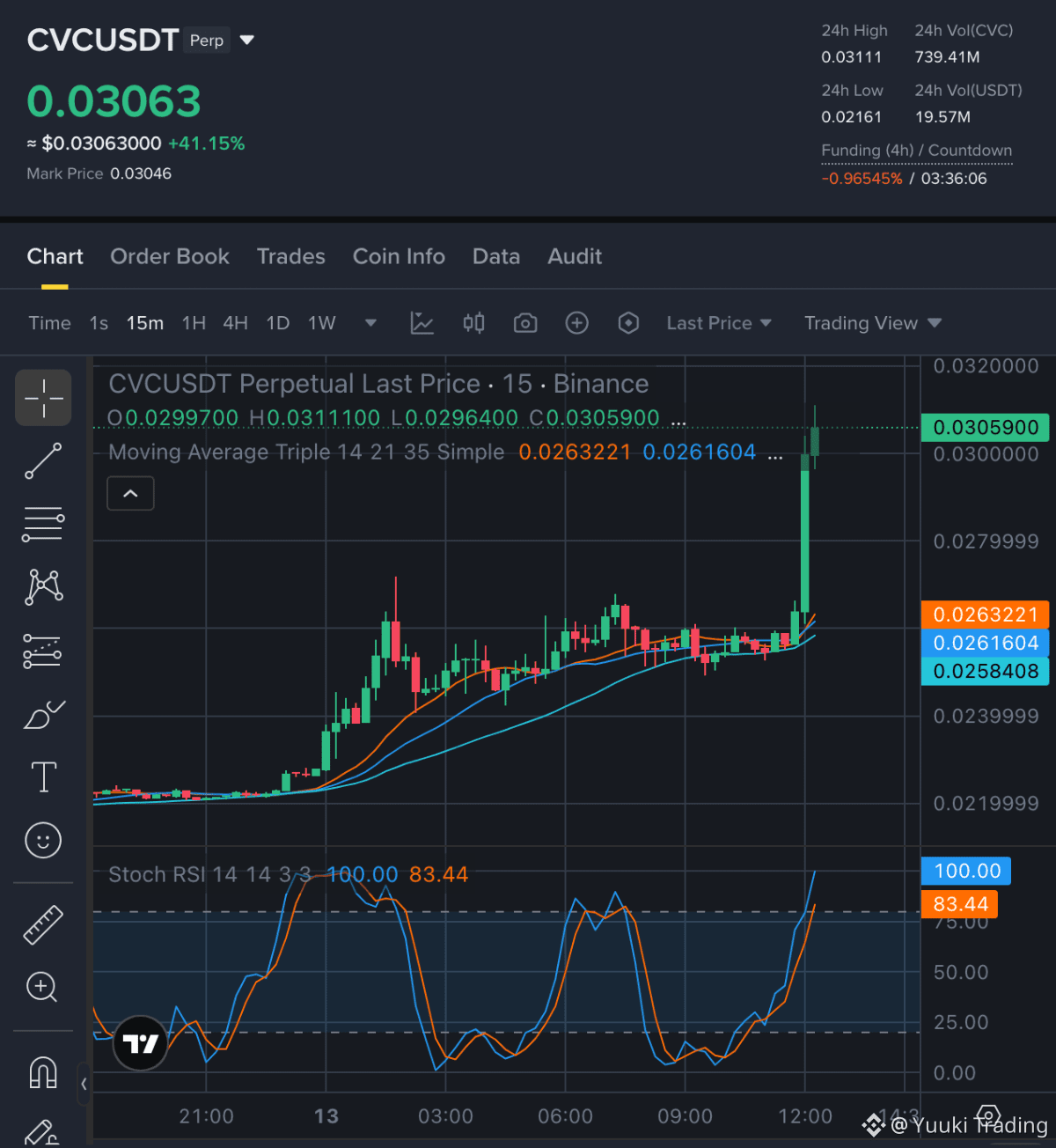
CVC — Buyers hold the 15m advantage after an impulsive breakout, while underwater shorts reinforce squeeze conditions despite stretched momentum.
CVC — LONG NOW
Entry Zone: 0.03064 — 0.03094
• TP1: 0.03221
• TP2: 0.03316
• TP3: 0.03458
Stop Loss: 0.0289
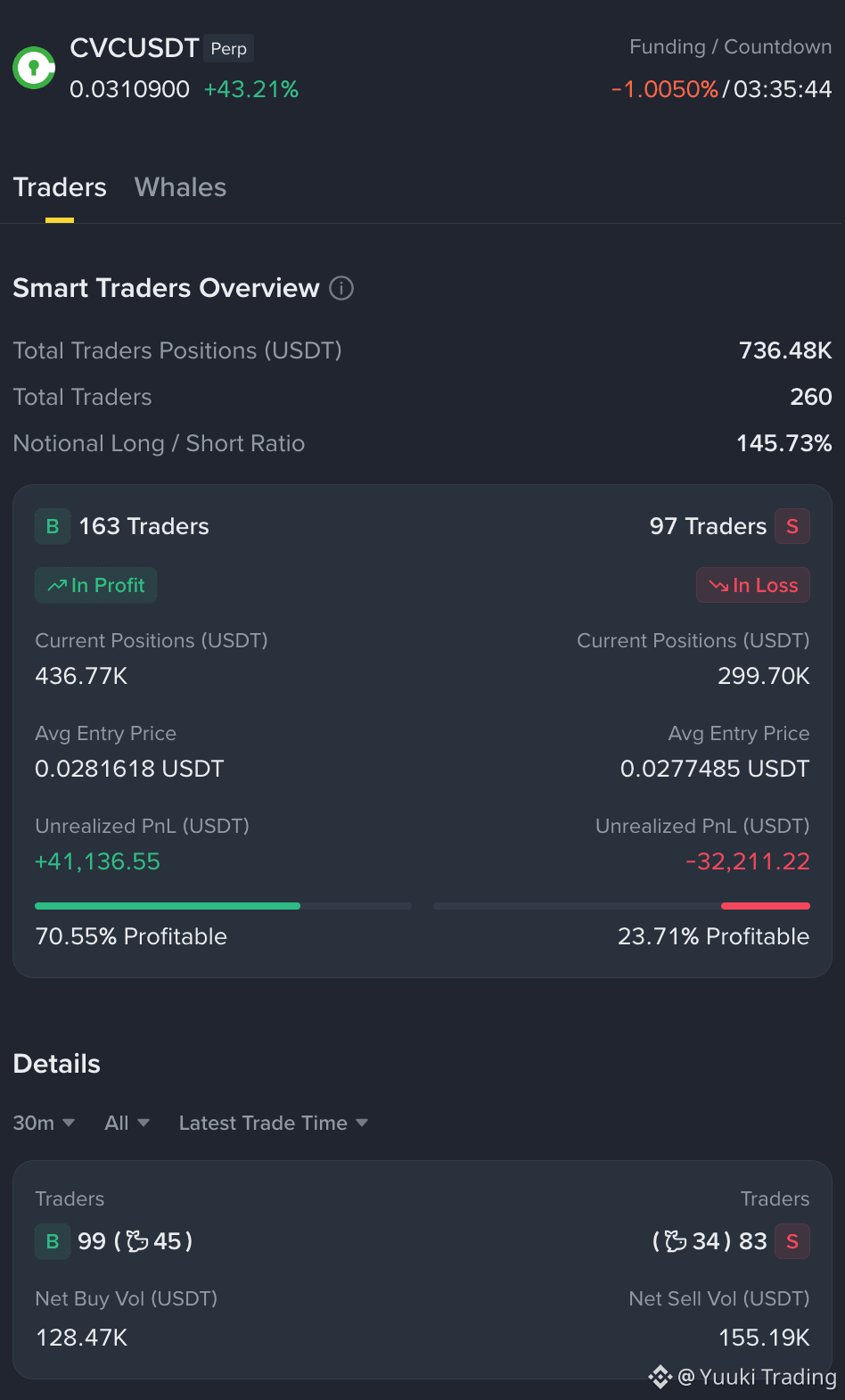
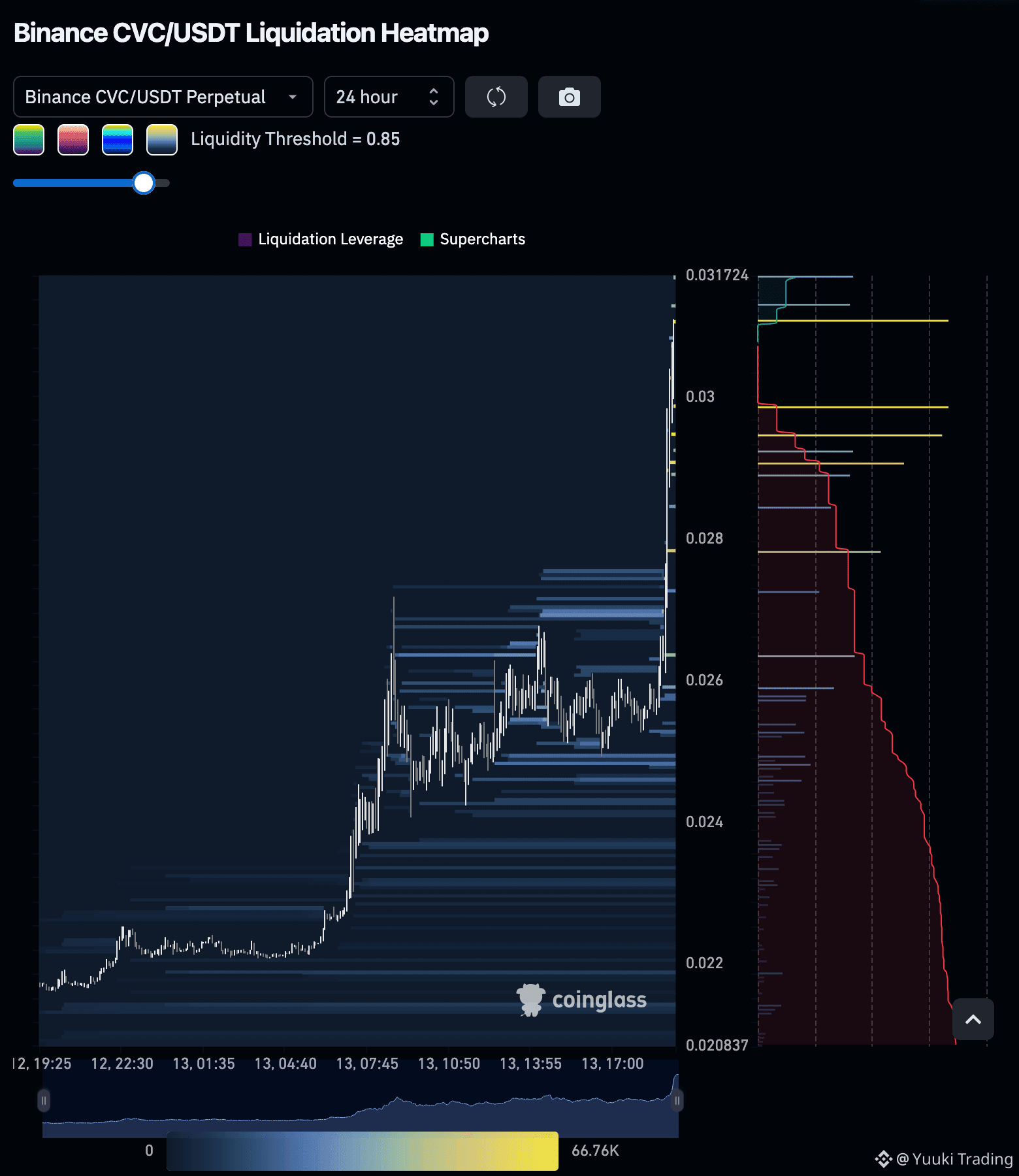
Price has broken sharply above rising moving averages on 15m, but overbought Stoch RSI warns against chasing. Smart Money favors longs, with 70.55% profitable versus 23.71% for shorts; upside liquidity remains visible, supporting continuation while preserving pullback risk.
Disclaimer: This is not financial advice. Always do your own research and take full responsibility for your trading decisions and assets (DYOR).
Trade $CVC here:
{future}(CVCUSDT)
CVC — Buyers hold the 15m advantage after an impulsive breakout, while underwater shorts reinforce squeeze conditions despite stretched momentum.
CVC — LONG NOW
Entry Zone: 0.03064 — 0.03094
• TP1: 0.03221
• TP2: 0.03316
• TP3: 0.03458
Stop Loss: 0.0289
Price has broken sharply above rising moving averages on 15m, but overbought Stoch RSI warns against chasing. Smart Money favors longs, with 70.55% profitable versus 23.71% for shorts; upside liquidity remains visible, supporting continuation while preserving pullback risk.
Disclaimer: This is not financial advice. Always do your own research and take full responsibility for your trading decisions and assets (DYOR).
Trade $CVC here:
CVC — LONG NOW
Entry Zone: 0.03064 — 0.03094
• TP1: 0.03221
• TP2: 0.03316
• TP3: 0.03458
Stop Loss: 0.0289
Price has broken sharply above rising moving averages on 15m, but overbought Stoch RSI warns against chasing. Smart Money favors longs, with 70.55% profitable versus 23.71% for shorts; upside liquidity remains visible, supporting continuation while preserving pullback risk.
Disclaimer: This is not financial advice. Always do your own research and take full responsibility for your trading decisions and assets (DYOR).
Trade $CVC here:
1
17
Voir la traduction
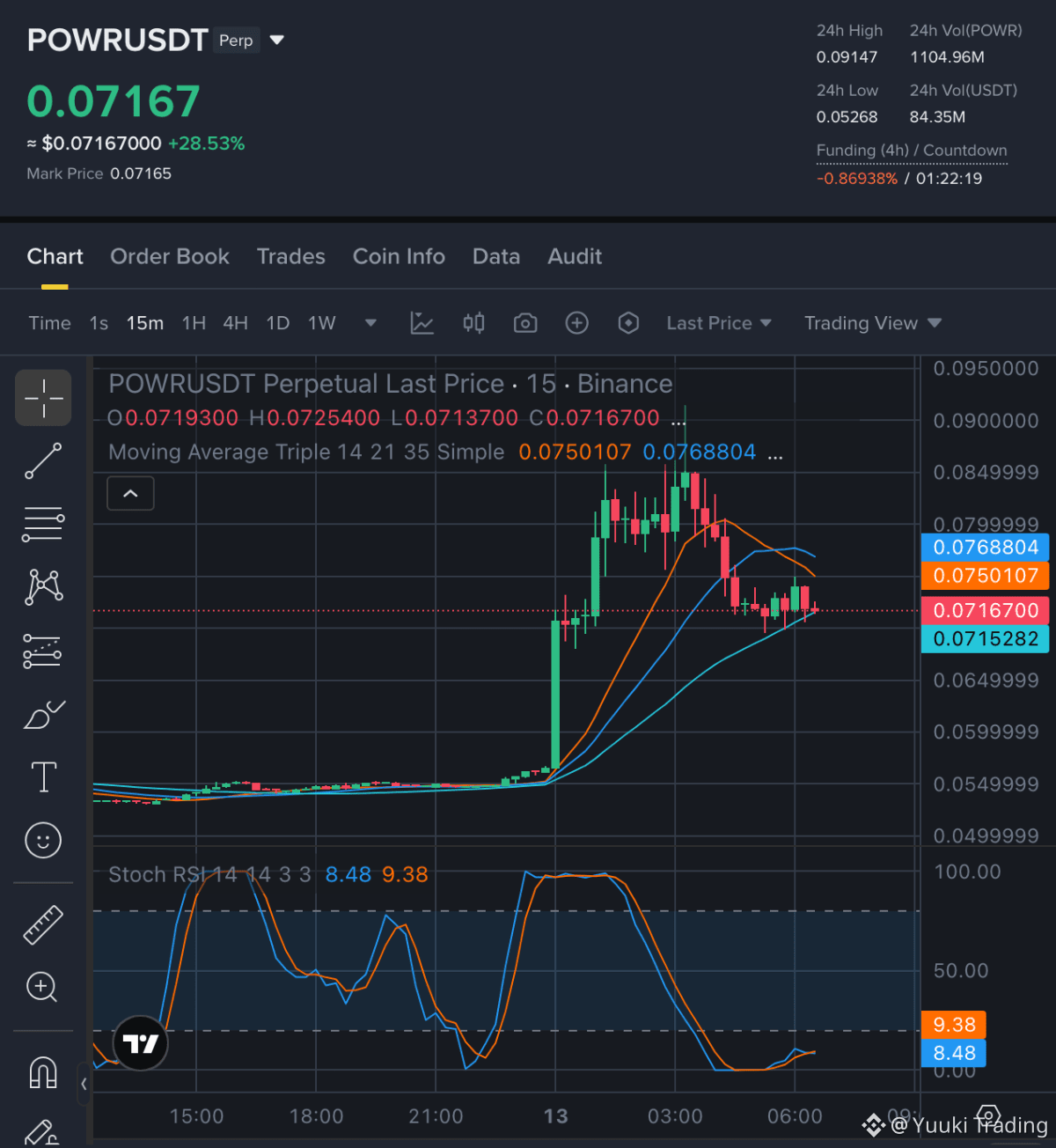
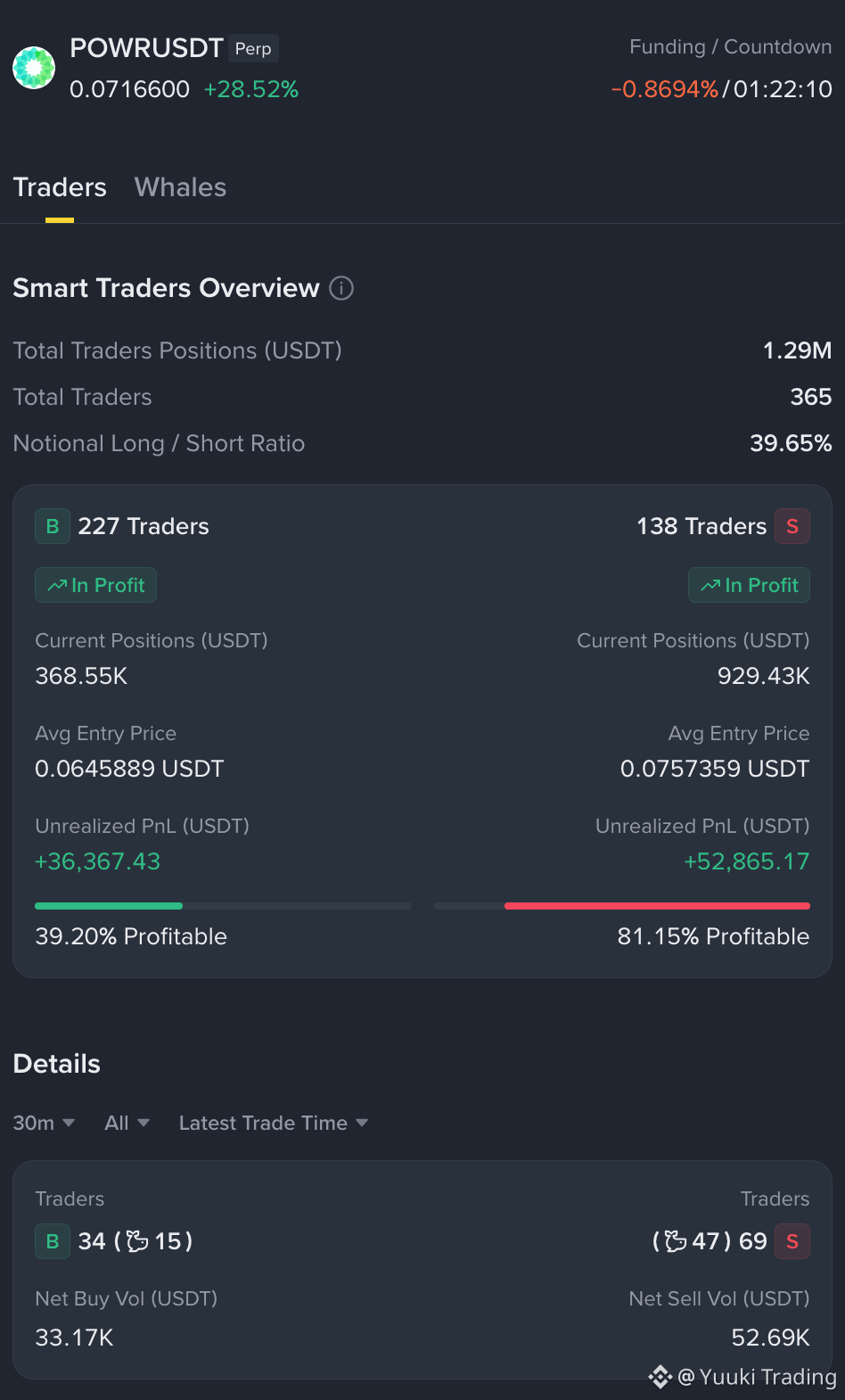
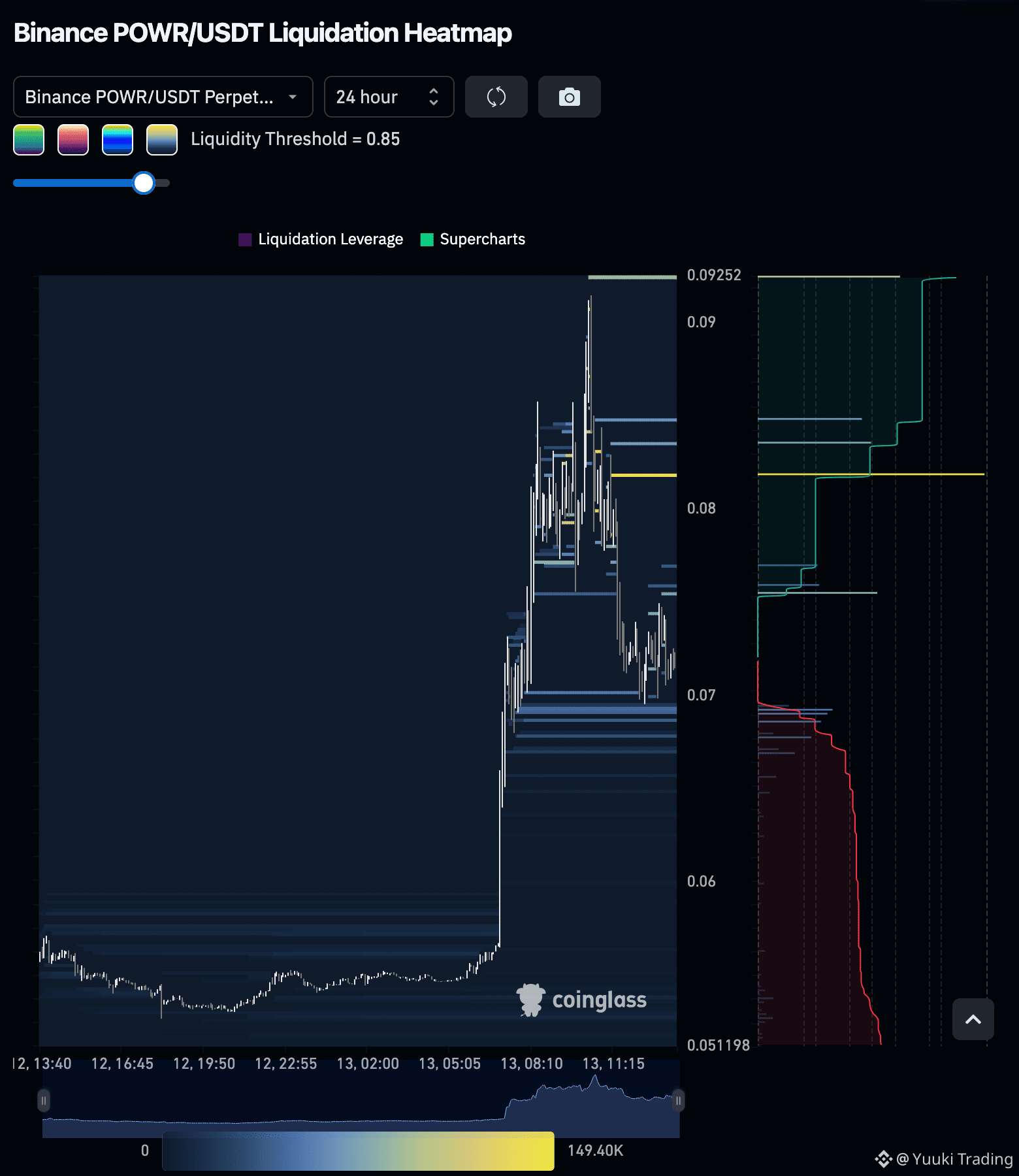
POWR — Buyers hold a tentative 15m retest advantage as oversold momentum stabilizes, although mixed Smart Money positioning tempers conviction.
POWR — LONG NOW
Entry Zone: 0.07119 — 0.07191
• TP1: 0.08013
• TP2: 0.08577
• TP3: 0.09443
Stop Loss: 0.06011
On 15m, price is compressing near the rising slow average after a sharp pullback, while oversold Stoch RSI turns higher. Smart Money remains mixed. Heavier upside liquidity favors the LONG bias, though profitable short exposure limits clean confirmation.
Disclaimer: This is not financial advice. Always do your own research and take full responsibility for your trading decisions and assets (DYOR).
Trade $POWR here:
{future}(POWRUSDT)
POWR — Buyers hold a tentative 15m retest advantage as oversold momentum stabilizes, although mixed Smart Money positioning tempers conviction.
POWR — LONG NOW
Entry Zone: 0.07119 — 0.07191
• TP1: 0.08013
• TP2: 0.08577
• TP3: 0.09443
Stop Loss: 0.06011
On 15m, price is compressing near the rising slow average after a sharp pullback, while oversold Stoch RSI turns higher. Smart Money remains mixed. Heavier upside liquidity favors the LONG bias, though profitable short exposure limits clean confirmation.
Disclaimer: This is not financial advice. Always do your own research and take full responsibility for your trading decisions and assets (DYOR).
Trade $POWR here:
POWR — LONG NOW
Entry Zone: 0.07119 — 0.07191
• TP1: 0.08013
• TP2: 0.08577
• TP3: 0.09443
Stop Loss: 0.06011
On 15m, price is compressing near the rising slow average after a sharp pullback, while oversold Stoch RSI turns higher. Smart Money remains mixed. Heavier upside liquidity favors the LONG bias, though profitable short exposure limits clean confirmation.
Disclaimer: This is not financial advice. Always do your own research and take full responsibility for your trading decisions and assets (DYOR).
Trade $POWR here:
1
194
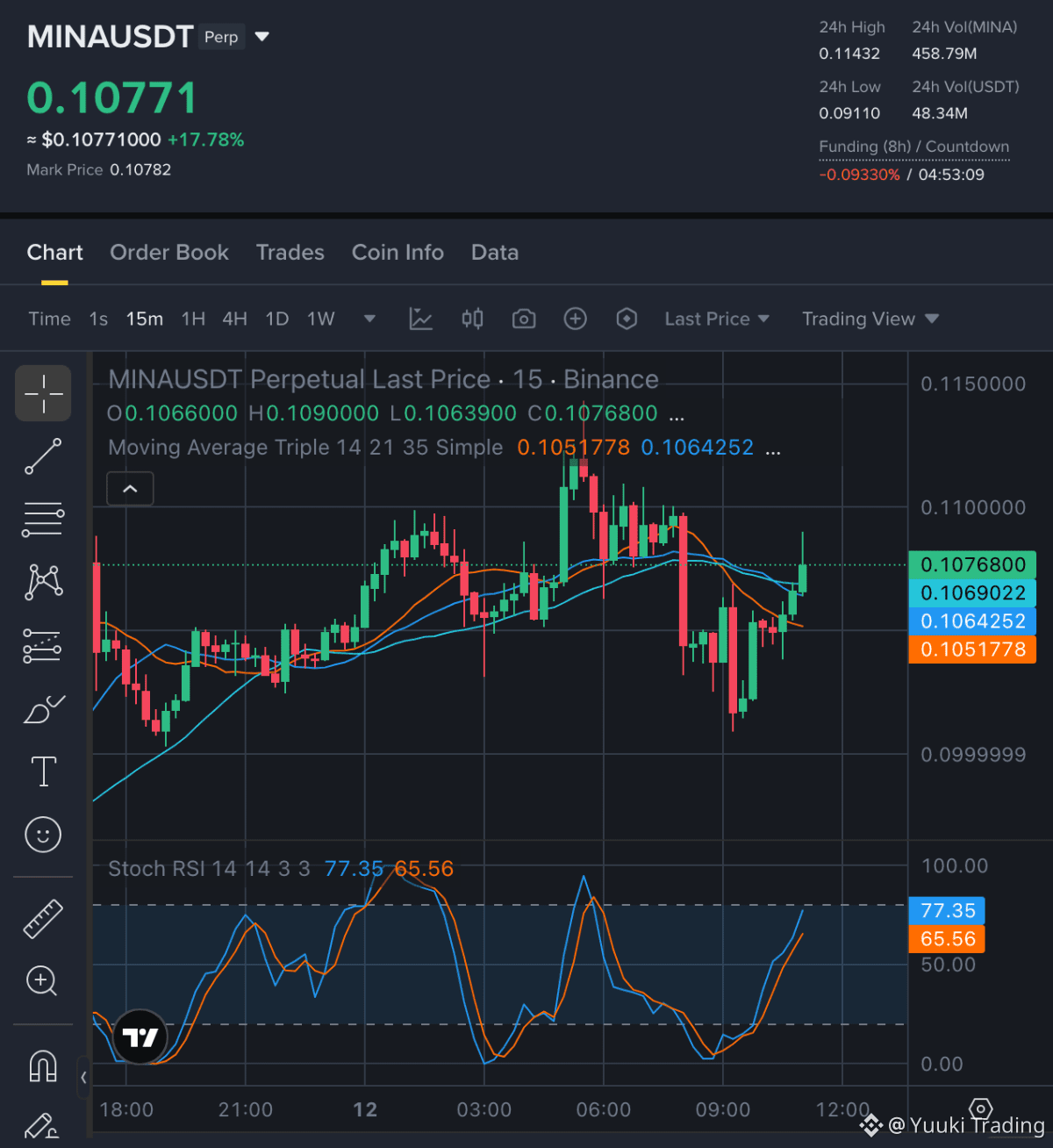
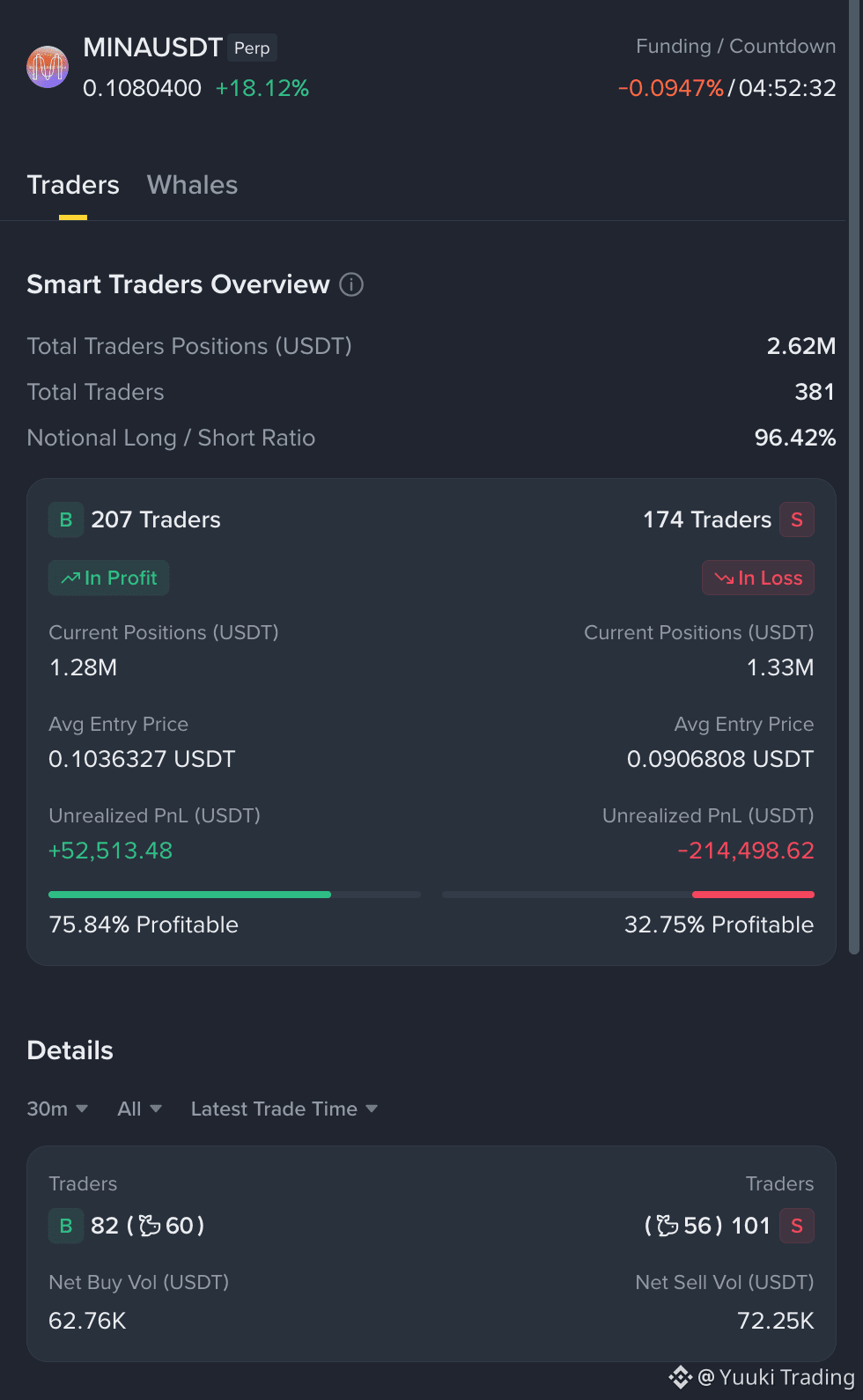
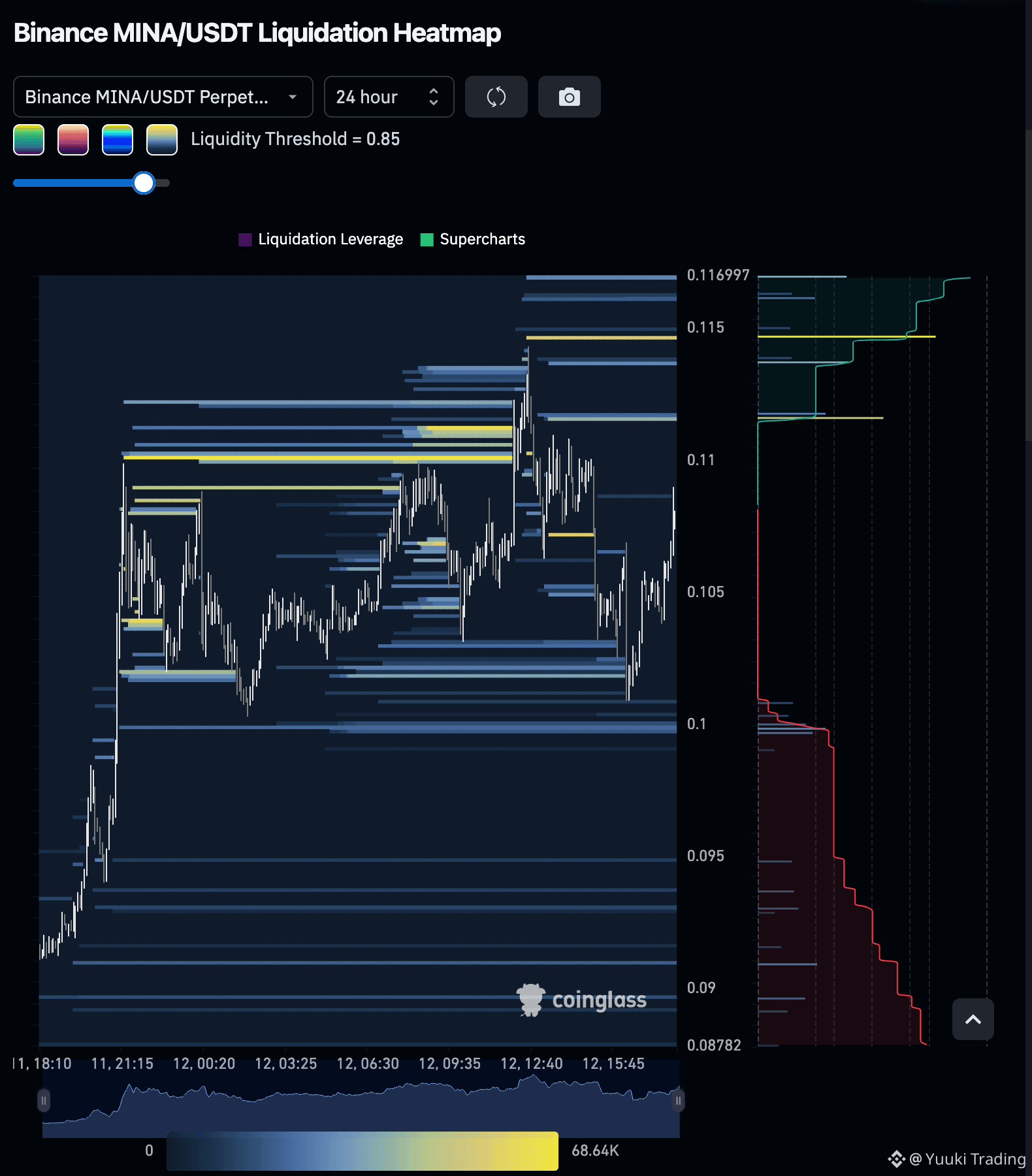
MINA — Les acheteurs conservent l’avantage de récupération sur 15m pendant que le prix reprend ses moyennes mobiles, tandis qu’une liquidité haussière plus importante soutient la poursuite.
MINA — LONG NOW
Zone d’entrée : 0.1071 — 0.10808
• TP1 : 0.11217
• TP2 : 0.11432
• TP3 : 0.1198
Stop Loss : 0.10149
Le rebond sur 15m a repris les trois moyennes mobiles, bien que la hausse du Stoch RSI augmente le risque de repli. Les Smart Money favorisent relativement les positions longues, avec 75,84 % de trades rentables contre 32,75 % pour les positions courtes ; une liquidité haussière plus importante maintient donc le biais long.
Avertissement : ceci ne constitue pas un conseil financier. Faites toujours vos propres recherches et assumez pleinement la responsabilité de vos décisions de trading et de vos actifs (DYOR).
Trade $MINA here :
{future}(MINAUSDT)
MINA — Les acheteurs conservent l’avantage de récupération sur 15m pendant que le prix reprend ses moyennes mobiles, tandis qu’une liquidité haussière plus importante soutient la poursuite.
MINA — LONG NOW
Zone d’entrée : 0.1071 — 0.10808
• TP1 : 0.11217
• TP2 : 0.11432
• TP3 : 0.1198
Stop Loss : 0.10149
Le rebond sur 15m a repris les trois moyennes mobiles, bien que la hausse du Stoch RSI augmente le risque de repli. Les Smart Money favorisent relativement les positions longues, avec 75,84 % de trades rentables contre 32,75 % pour les positions courtes ; une liquidité haussière plus importante maintient donc le biais long.
Avertissement : ceci ne constitue pas un conseil financier. Faites toujours vos propres recherches et assumez pleinement la responsabilité de vos décisions de trading et de vos actifs (DYOR).
Trade $MINA here :
MINA — LONG NOW
Zone d’entrée : 0.1071 — 0.10808
• TP1 : 0.11217
• TP2 : 0.11432
• TP3 : 0.1198
Stop Loss : 0.10149
Le rebond sur 15m a repris les trois moyennes mobiles, bien que la hausse du Stoch RSI augmente le risque de repli. Les Smart Money favorisent relativement les positions longues, avec 75,84 % de trades rentables contre 32,75 % pour les positions courtes ; une liquidité haussière plus importante maintient donc le biais long.
Avertissement : ceci ne constitue pas un conseil financier. Faites toujours vos propres recherches et assumez pleinement la responsabilité de vos décisions de trading et de vos actifs (DYOR).
Trade $MINA here :
2
192
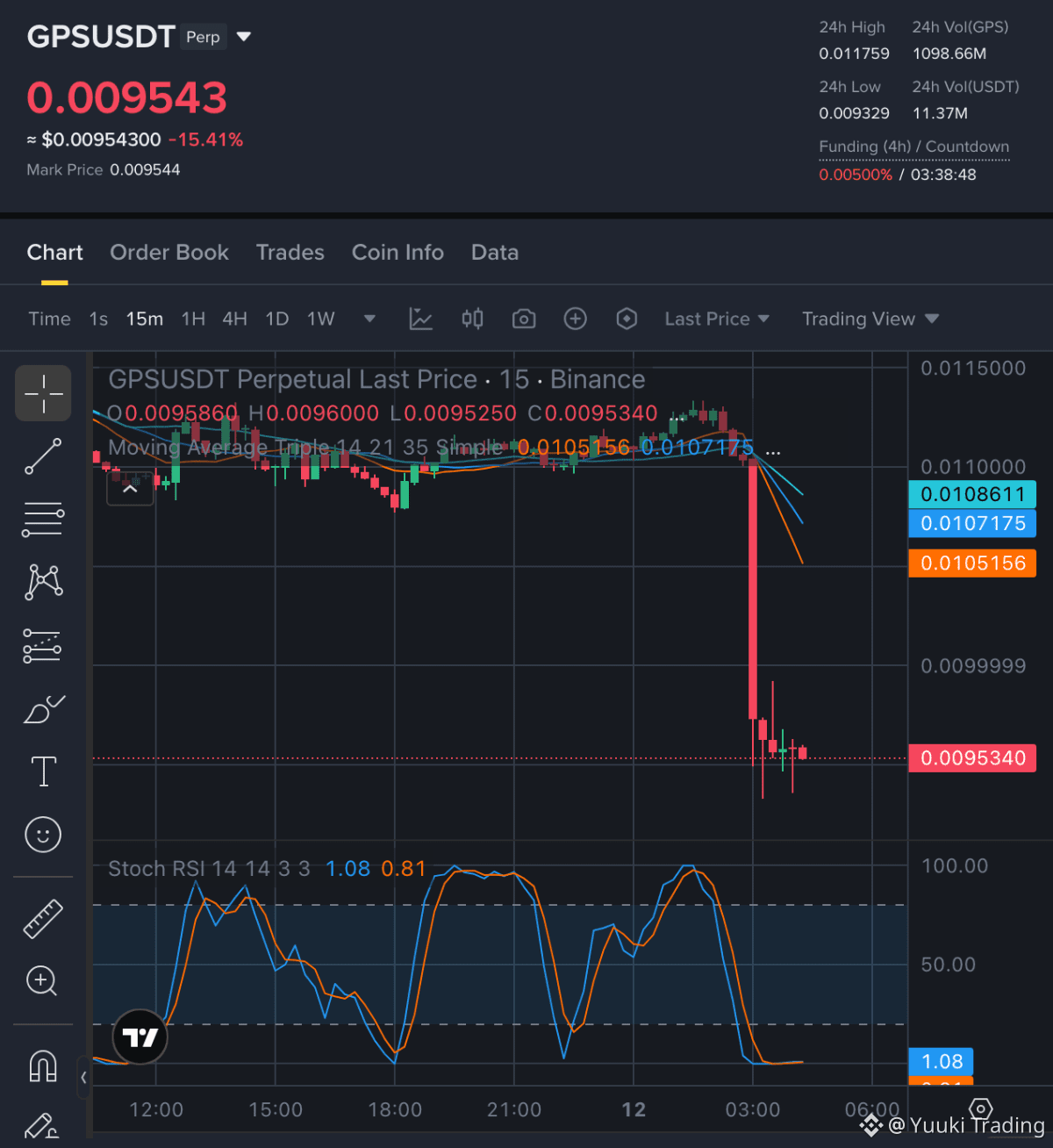
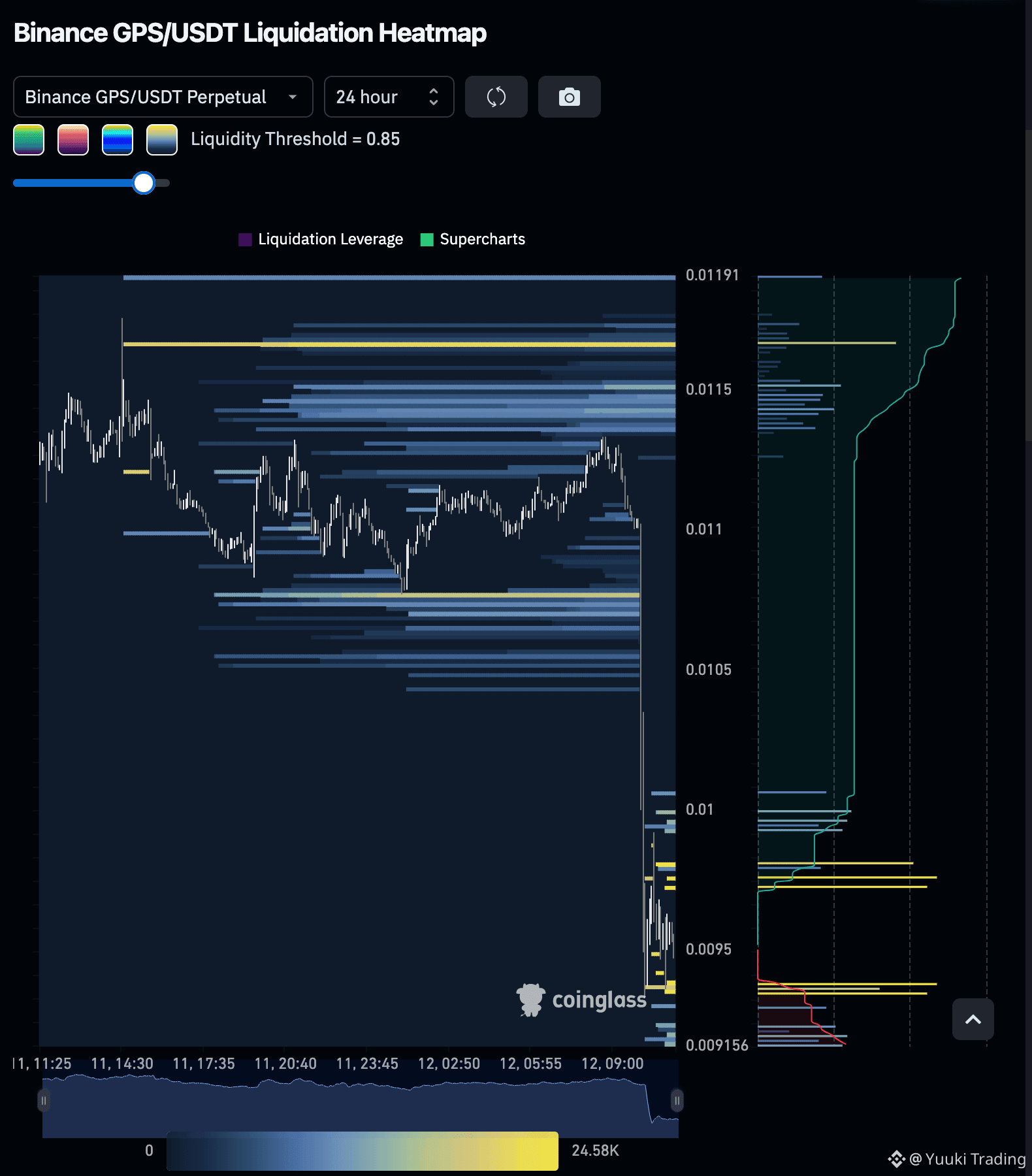
GPS — Les vendeurs conservent l’avantage de 15m après une rupture structurelle violente, tandis que la densité de liquidation au-dessus reste le principal défi pour la poursuite.
GPS — COURT MAINTENANT
Zone d’entrée : 0.009495 — 0.009591
• TP1 : 0.009069
• TP2 : 0.008752
• TP3 : 0.008278
Stop Loss : 0.010175
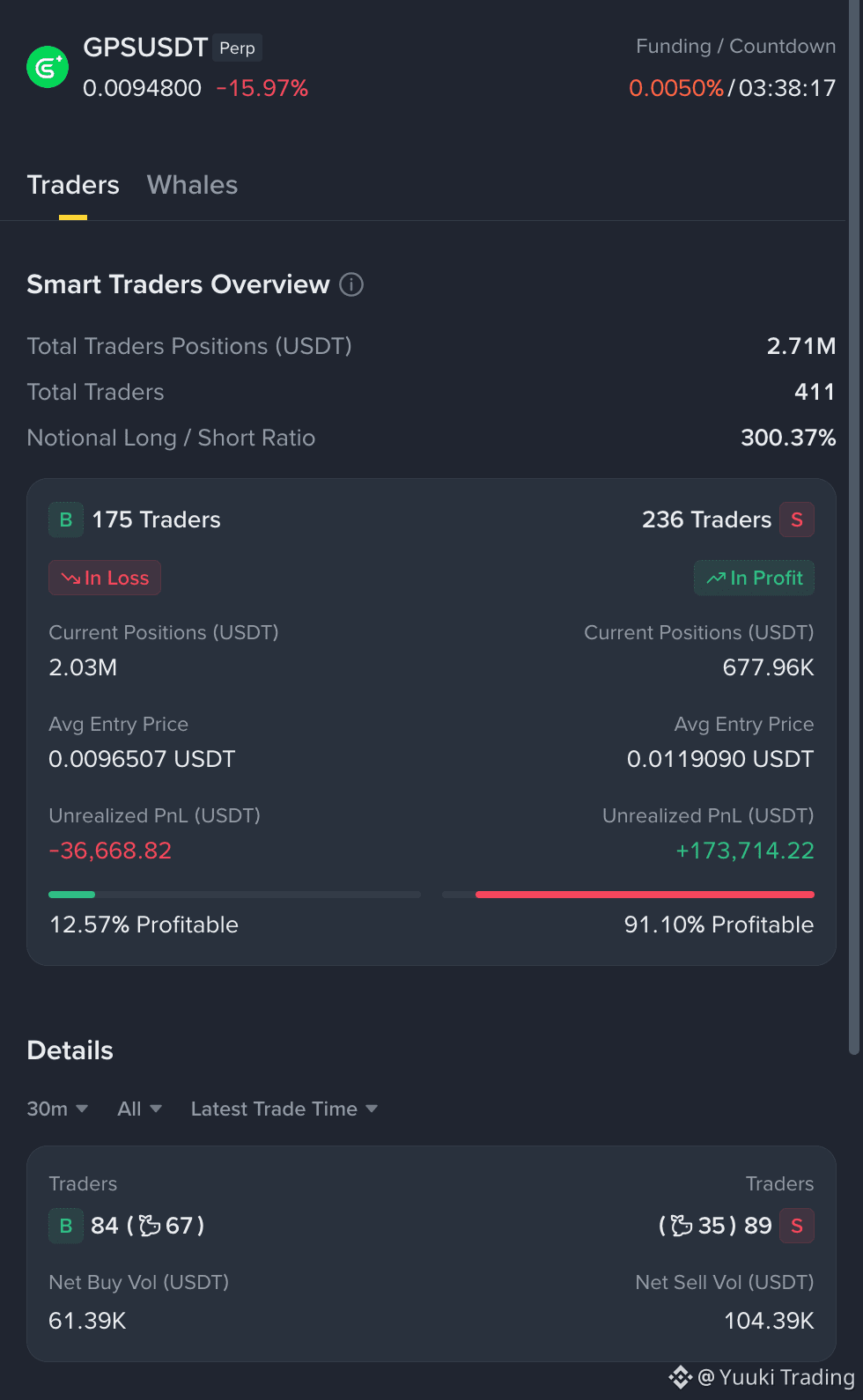
Le prix reste sous les moyennes en baisse après la cassure de 15m, bien que le Stoch RSI épinglé avertisse d’un rebond. Les Smart Money favorisent les vendeurs : 91,10 % des positions short sont rentables contre 12,57 % des positions longues. La liquidité côté downside soutient la continuation, mais la densité au-dessus augmente le risque d’un squeeze.
Avertissement : Ceci n’est pas un conseil financier. Faites toujours vos propres recherches et assumez l’entière responsabilité de vos décisions de trading et de vos actifs (DYOR).
Trade $GPS here :
{future}(GPSUSDT)
GPS — Les vendeurs conservent l’avantage de 15m après une rupture structurelle violente, tandis que la densité de liquidation au-dessus reste le principal défi pour la poursuite.
GPS — COURT MAINTENANT
Zone d’entrée : 0.009495 — 0.009591
• TP1 : 0.009069
• TP2 : 0.008752
• TP3 : 0.008278
Stop Loss : 0.010175
Le prix reste sous les moyennes en baisse après la cassure de 15m, bien que le Stoch RSI épinglé avertisse d’un rebond. Les Smart Money favorisent les vendeurs : 91,10 % des positions short sont rentables contre 12,57 % des positions longues. La liquidité côté downside soutient la continuation, mais la densité au-dessus augmente le risque d’un squeeze.
Avertissement : Ceci n’est pas un conseil financier. Faites toujours vos propres recherches et assumez l’entière responsabilité de vos décisions de trading et de vos actifs (DYOR).
Trade $GPS here :
GPS — COURT MAINTENANT
Zone d’entrée : 0.009495 — 0.009591
• TP1 : 0.009069
• TP2 : 0.008752
• TP3 : 0.008278
Stop Loss : 0.010175
Le prix reste sous les moyennes en baisse après la cassure de 15m, bien que le Stoch RSI épinglé avertisse d’un rebond. Les Smart Money favorisent les vendeurs : 91,10 % des positions short sont rentables contre 12,57 % des positions longues. La liquidité côté downside soutient la continuation, mais la densité au-dessus augmente le risque d’un squeeze.
Avertissement : Ceci n’est pas un conseil financier. Faites toujours vos propres recherches et assumez l’entière responsabilité de vos décisions de trading et de vos actifs (DYOR).
Trade $GPS here :
1
209
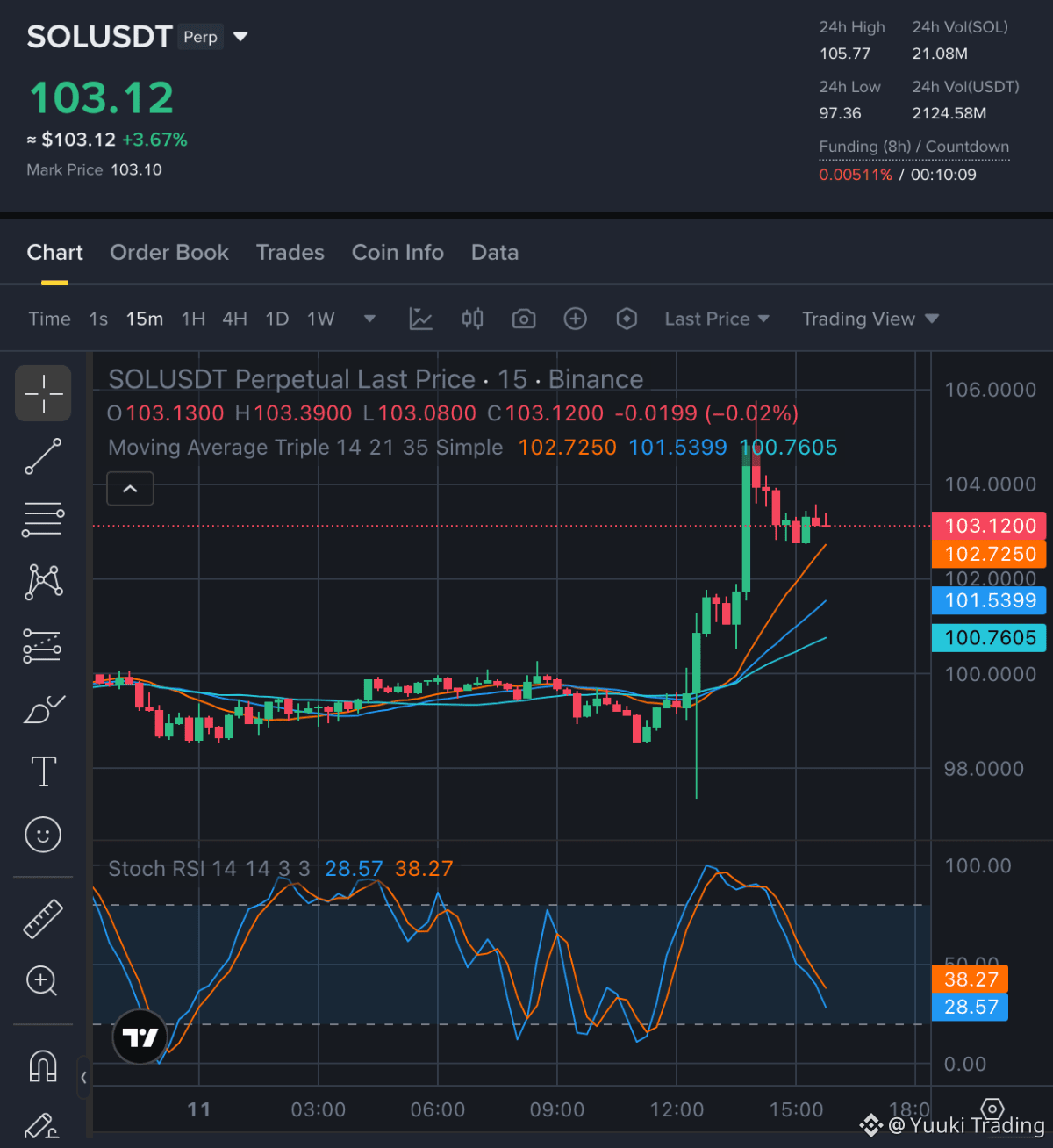
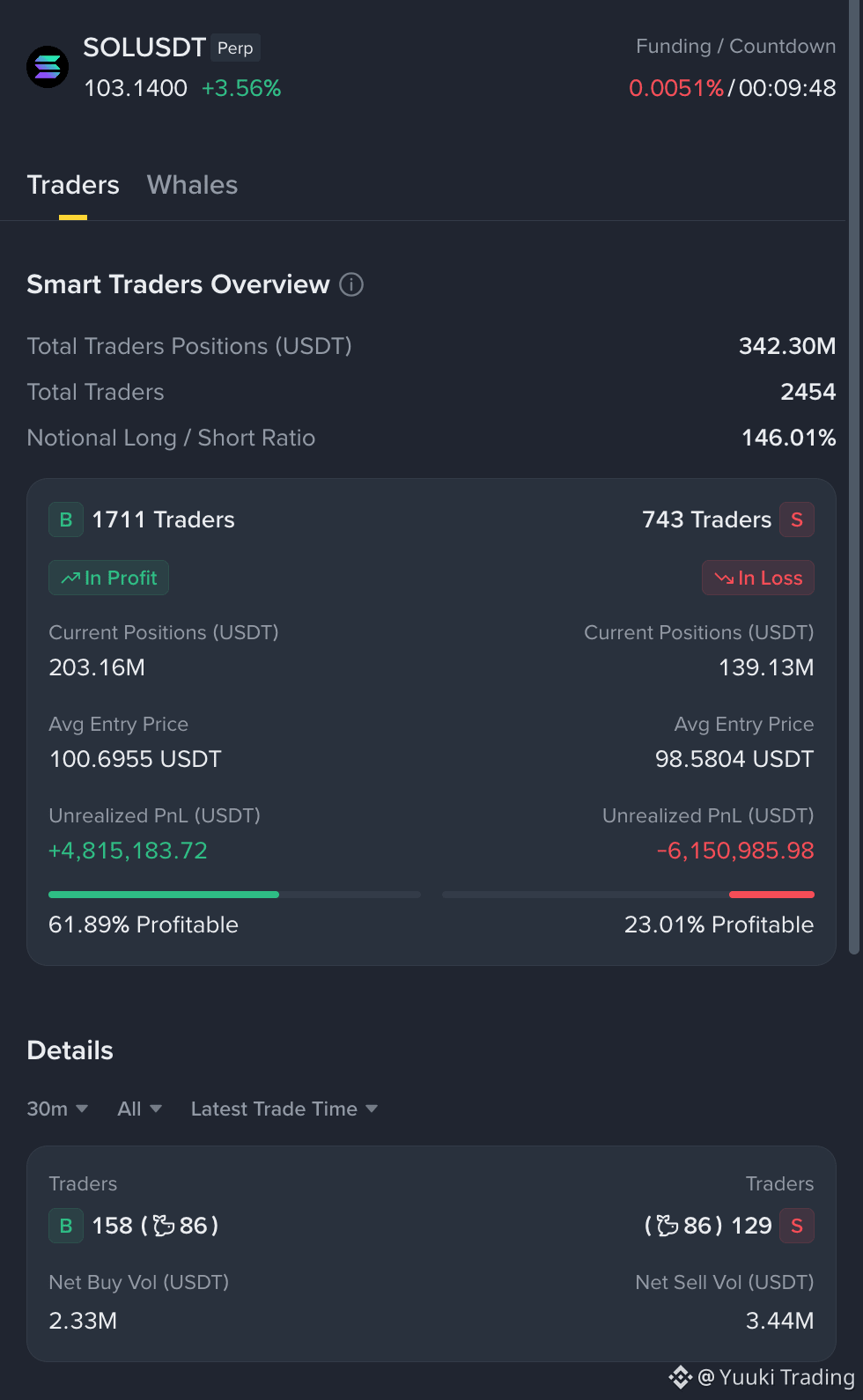
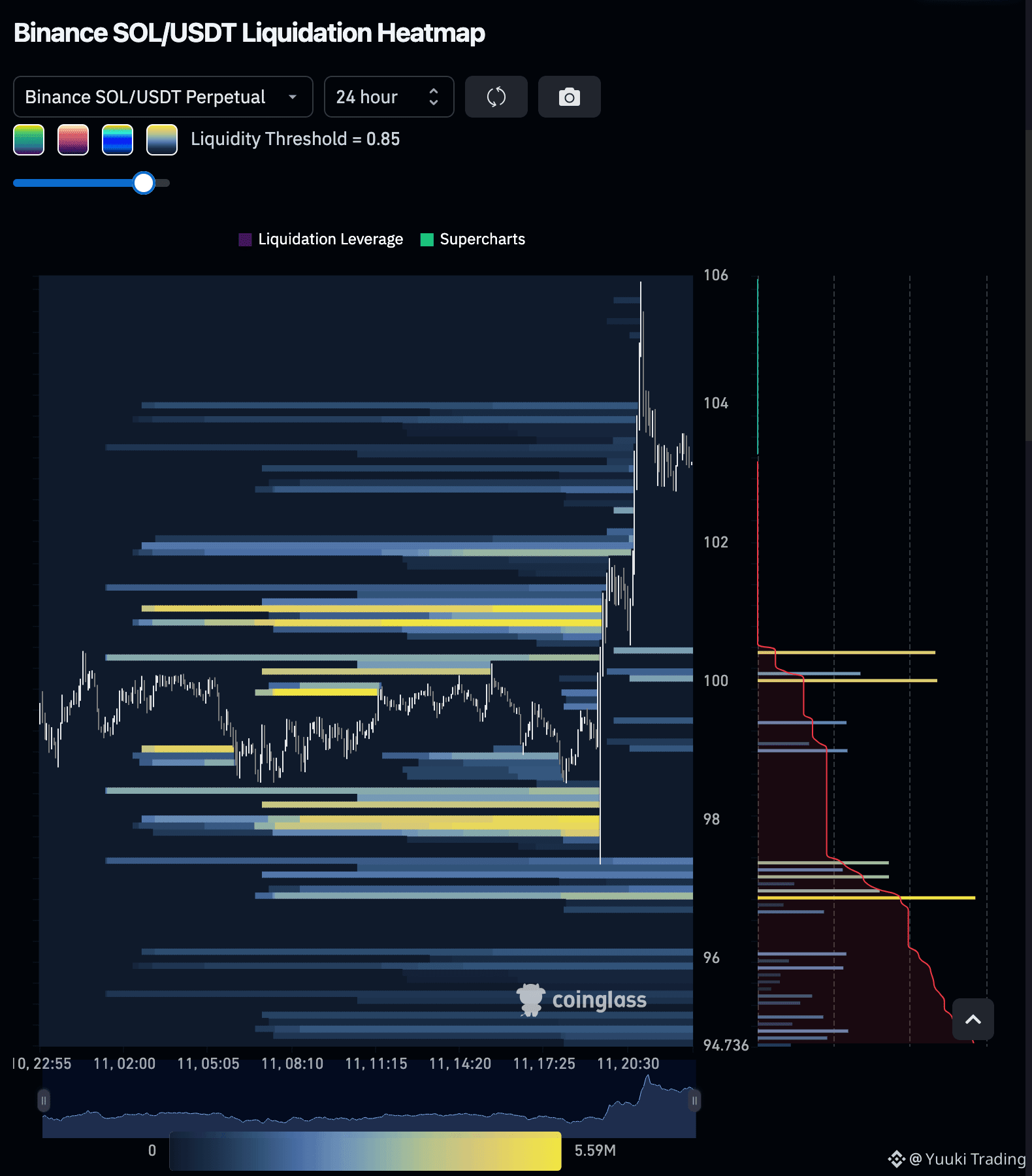
SOL — Les acheteurs conservent l’avantage des 15m après une cassure impulsive, avec une liquidité haussière à proximité soutenant la poursuite malgré des zones de repli visibles plus bas.
SOL — LONG MAINTENANT
Zone d’entrée : 102.82 — 103.34
• TP1 : 105.77
• TP2 : 106.61
• TP3 : 108.72
Stop Loss : 100.26
Le prix se maintient au-dessus de moyennes montantes après une expansion impulsive sur 15m, bien que le Stoch RSI refroidissant favorise une consolidation. Les « Smart Money » favorisent relativement davantage les longs rentables que les shorts perdants. La liquidité haussière soutient la poursuite, mais des poches plus denses en dessous préservent le risque de repli.
Avertissement : Ceci ne constitue pas un conseil financier. Faites toujours vos propres recherches et prenez l’entière responsabilité de vos décisions de trading et de vos actifs (DYOR).
Trade $SOL here:
{future}(SOLUSDT)
SOL — Les acheteurs conservent l’avantage des 15m après une cassure impulsive, avec une liquidité haussière à proximité soutenant la poursuite malgré des zones de repli visibles plus bas.
SOL — LONG MAINTENANT
Zone d’entrée : 102.82 — 103.34
• TP1 : 105.77
• TP2 : 106.61
• TP3 : 108.72
Stop Loss : 100.26
Le prix se maintient au-dessus de moyennes montantes après une expansion impulsive sur 15m, bien que le Stoch RSI refroidissant favorise une consolidation. Les « Smart Money » favorisent relativement davantage les longs rentables que les shorts perdants. La liquidité haussière soutient la poursuite, mais des poches plus denses en dessous préservent le risque de repli.
Avertissement : Ceci ne constitue pas un conseil financier. Faites toujours vos propres recherches et prenez l’entière responsabilité de vos décisions de trading et de vos actifs (DYOR).
Trade $SOL here:
SOL — LONG MAINTENANT
Zone d’entrée : 102.82 — 103.34
• TP1 : 105.77
• TP2 : 106.61
• TP3 : 108.72
Stop Loss : 100.26
Le prix se maintient au-dessus de moyennes montantes après une expansion impulsive sur 15m, bien que le Stoch RSI refroidissant favorise une consolidation. Les « Smart Money » favorisent relativement davantage les longs rentables que les shorts perdants. La liquidité haussière soutient la poursuite, mais des poches plus denses en dessous préservent le risque de repli.
Avertissement : Ceci ne constitue pas un conseil financier. Faites toujours vos propres recherches et prenez l’entière responsabilité de vos décisions de trading et de vos actifs (DYOR).
Trade $SOL here:
1
148
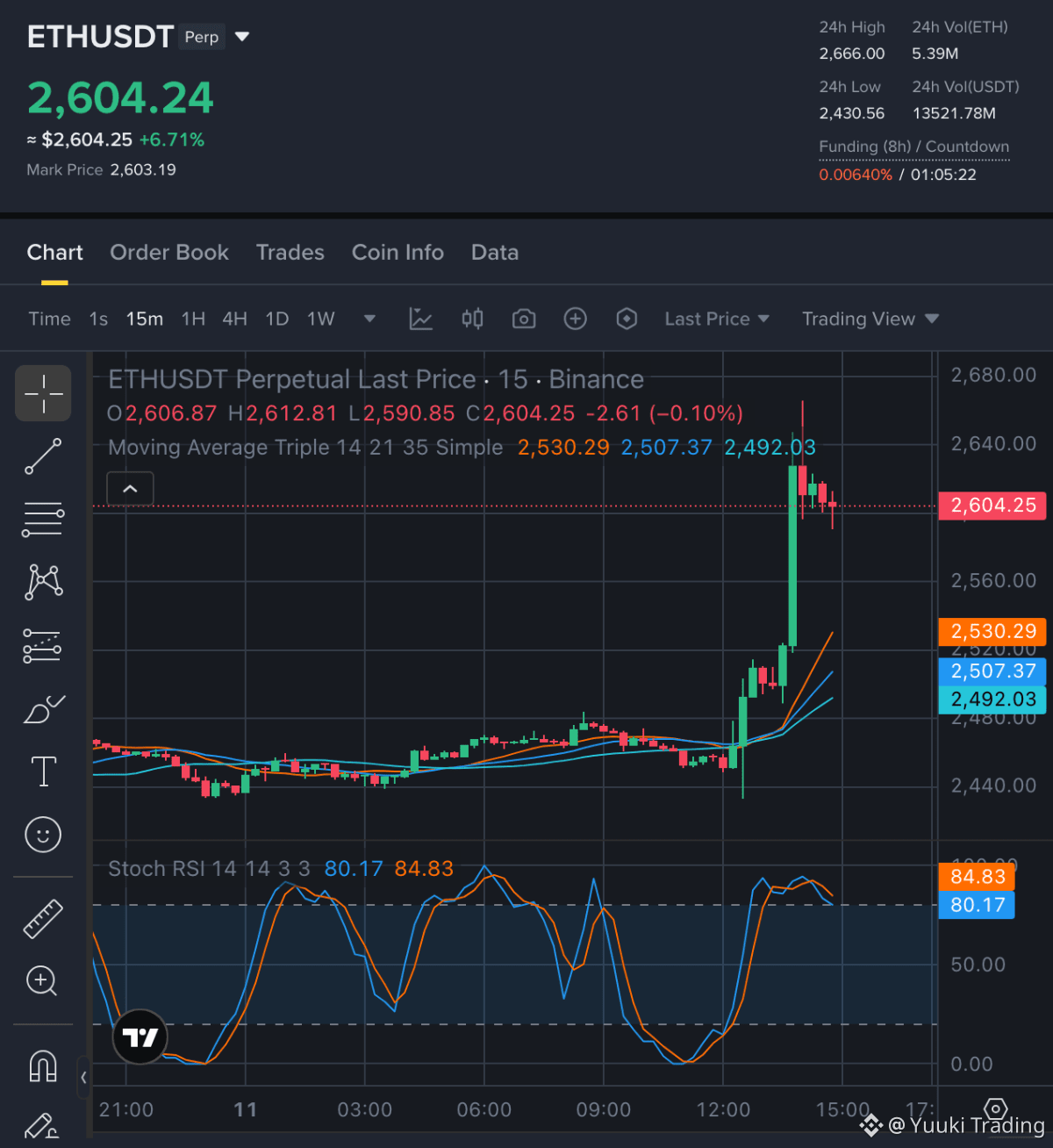
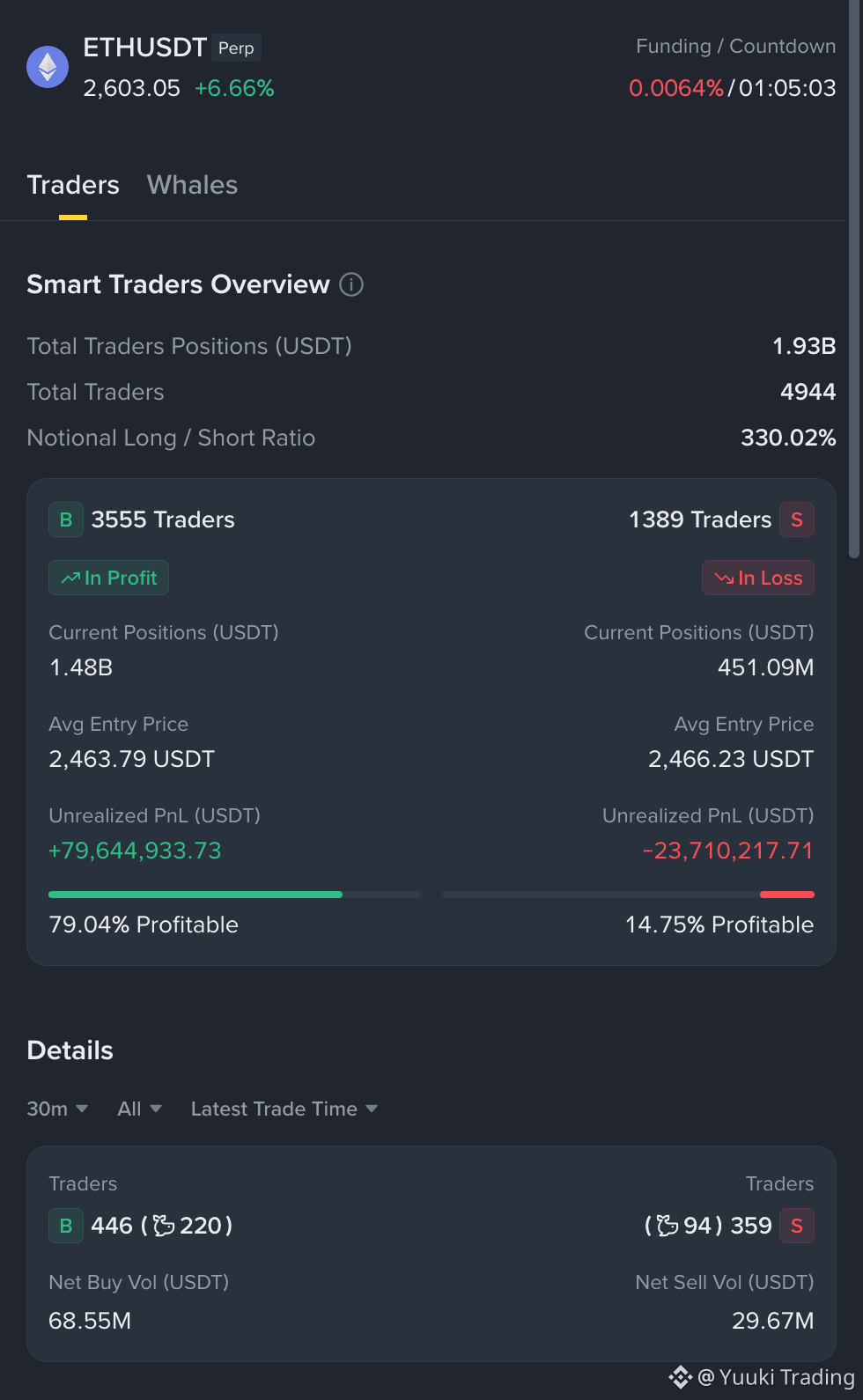
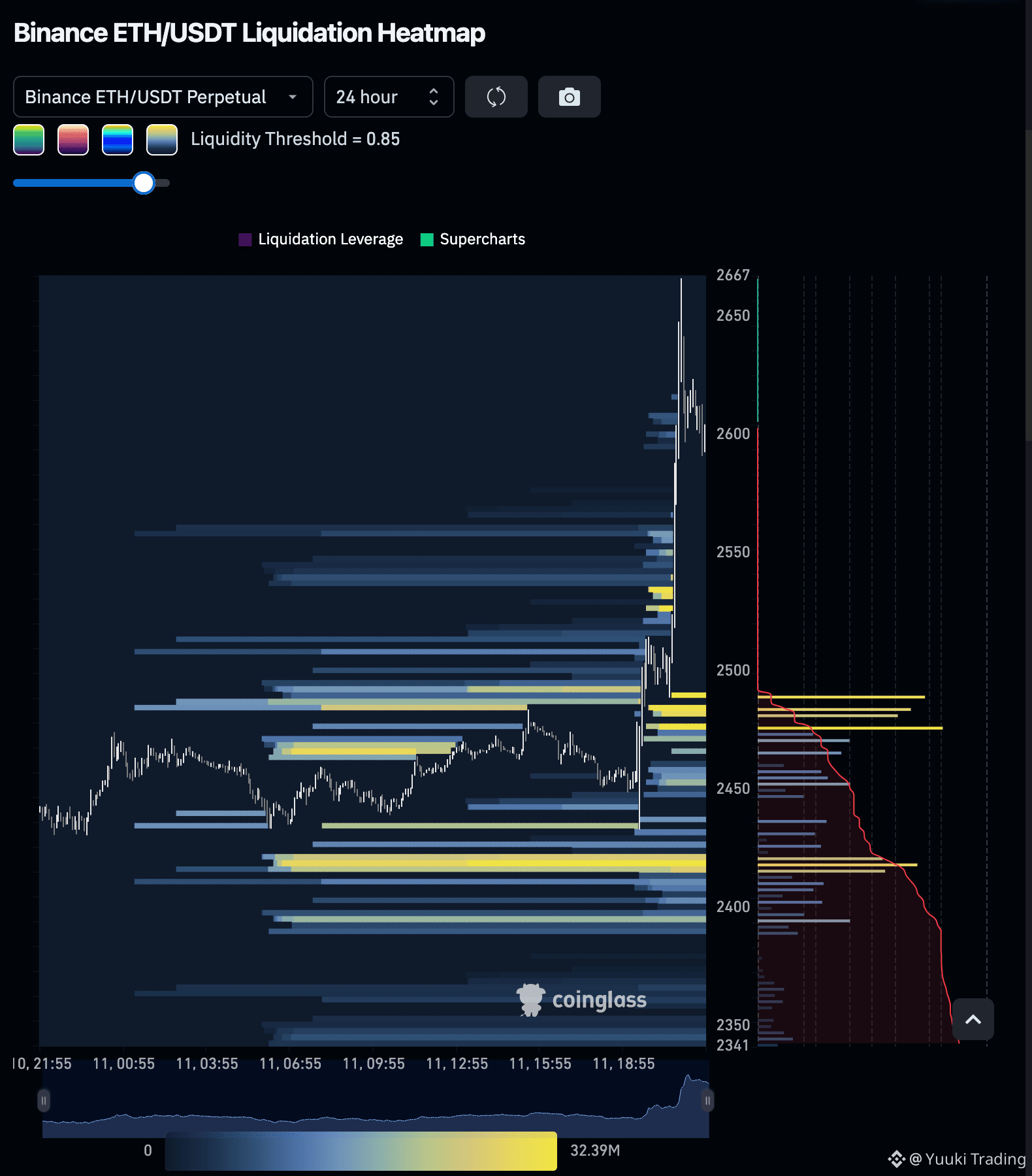
ETH — Les acheteurs conservent l’avantage en 15m après une cassure impulsive, bien que la liquidité concentrée sous le prix avertisse de ne pas poursuivre l’extension.
ETH — LONG NOW
Zone d’entrée : 2 596,24 — 2 609,10
• TP1 : 2 692,93
• TP2 : 2 753,10
• TP3 : 2 843,35
Stop Loss : 2 482,33
Le prix reste au-dessus des moyennes en hausse après l’impulsion sur 15m, bien que le refroidissement du momentum en surachat signale un risque de consolidation. La rentabilité des Smart Money favorise les positions longues, mais une liquidité plus lourde sous le prix crée un aimant à repli, rendant le Stop Loss essentiel.
Avertissement : Ceci n’est pas un conseil financier. Faites toujours vos propres recherches et assumez l’entière responsabilité de vos décisions de trading et de vos actifs (DYOR).
Trade $ETH here :
{future}(ETHUSDT)
ETH — Les acheteurs conservent l’avantage en 15m après une cassure impulsive, bien que la liquidité concentrée sous le prix avertisse de ne pas poursuivre l’extension.
ETH — LONG NOW
Zone d’entrée : 2 596,24 — 2 609,10
• TP1 : 2 692,93
• TP2 : 2 753,10
• TP3 : 2 843,35
Stop Loss : 2 482,33
Le prix reste au-dessus des moyennes en hausse après l’impulsion sur 15m, bien que le refroidissement du momentum en surachat signale un risque de consolidation. La rentabilité des Smart Money favorise les positions longues, mais une liquidité plus lourde sous le prix crée un aimant à repli, rendant le Stop Loss essentiel.
Avertissement : Ceci n’est pas un conseil financier. Faites toujours vos propres recherches et assumez l’entière responsabilité de vos décisions de trading et de vos actifs (DYOR).
Trade $ETH here :
ETH — LONG NOW
Zone d’entrée : 2 596,24 — 2 609,10
• TP1 : 2 692,93
• TP2 : 2 753,10
• TP3 : 2 843,35
Stop Loss : 2 482,33
Le prix reste au-dessus des moyennes en hausse après l’impulsion sur 15m, bien que le refroidissement du momentum en surachat signale un risque de consolidation. La rentabilité des Smart Money favorise les positions longues, mais une liquidité plus lourde sous le prix crée un aimant à repli, rendant le Stop Loss essentiel.
Avertissement : Ceci n’est pas un conseil financier. Faites toujours vos propres recherches et assumez l’entière responsabilité de vos décisions de trading et de vos actifs (DYOR).
Trade $ETH here :
1
507
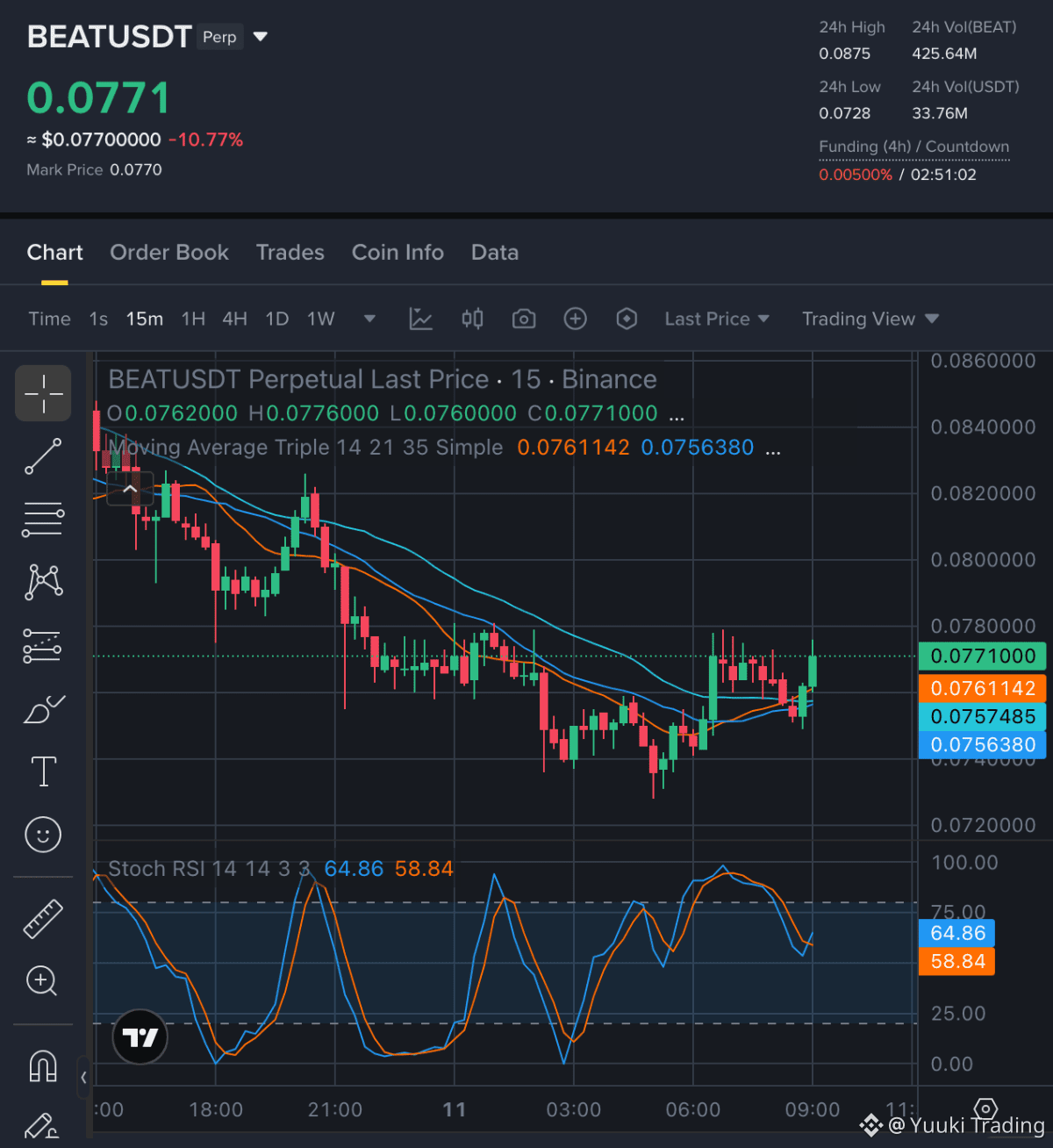
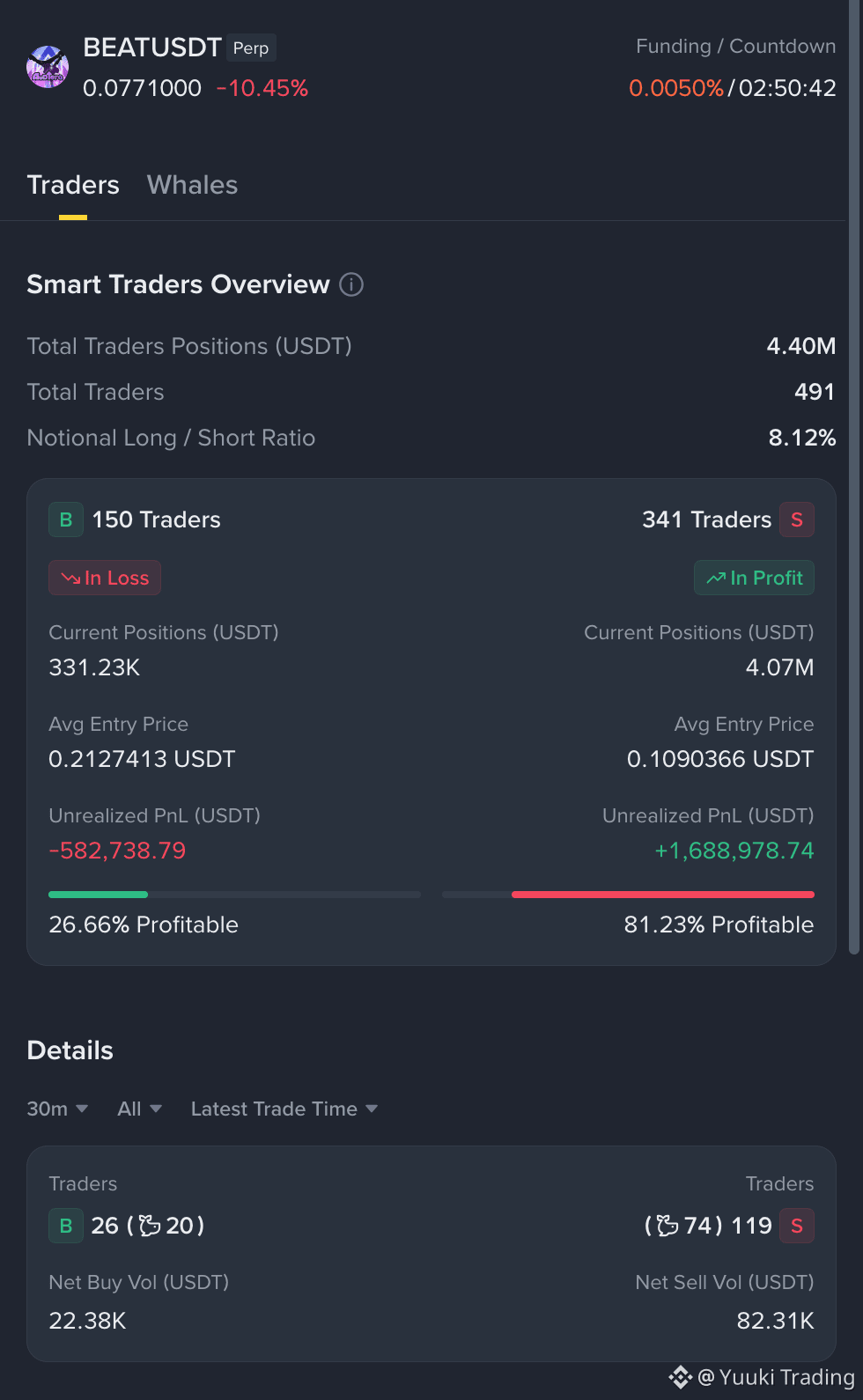
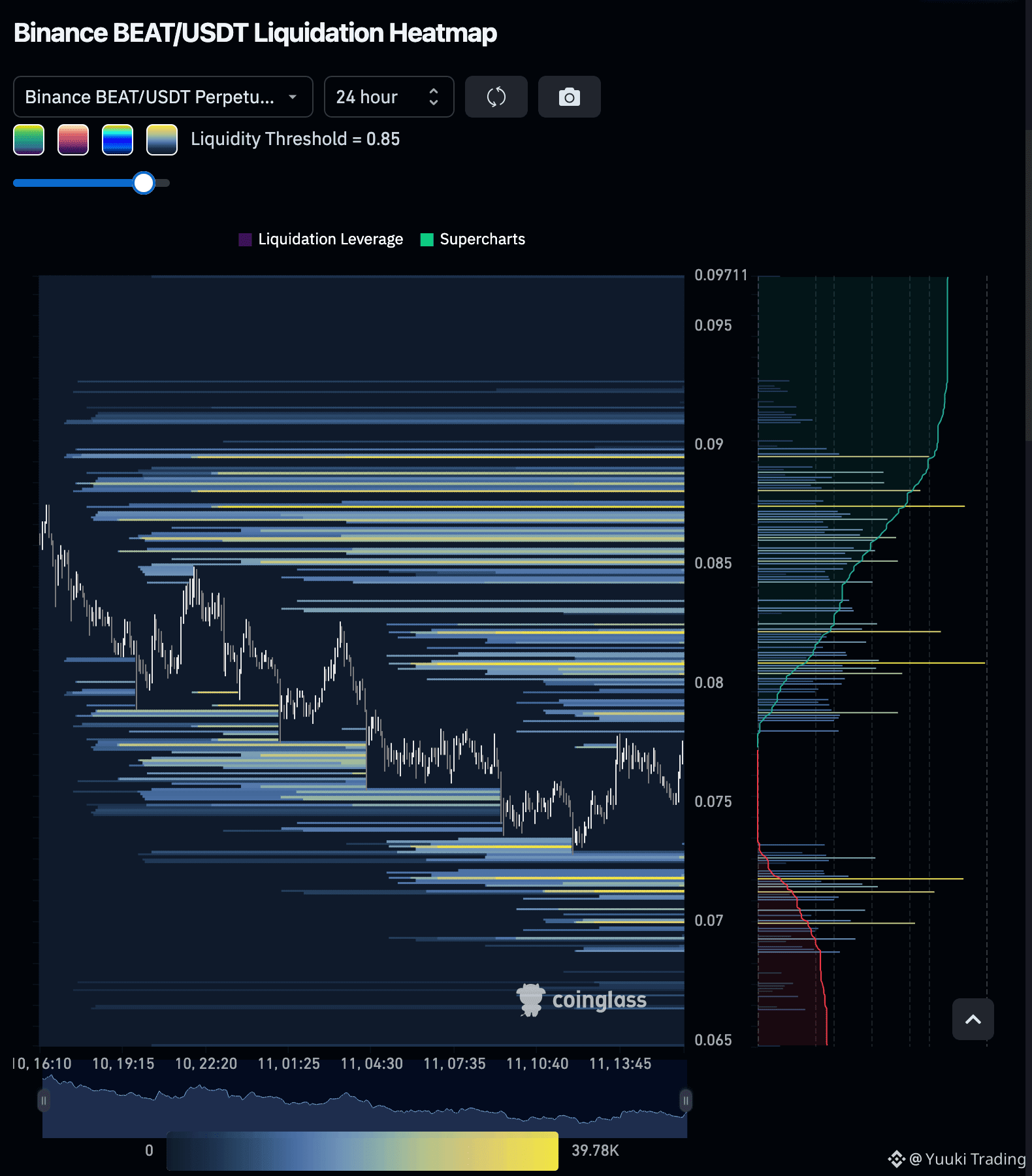
BEAT — Les acheteurs regagnent l’avantage des 15 min tandis que le prix remonte au-dessus du cluster de moyennes mobiles, tandis qu’une liquidité haussière plus dense compense le positionnement vendeur.
BEAT — LONG NOW
Zone d’entrée : 0.0768 — 0.0774
• TP1 : 0.0799
• TP2 : 0.0826
• TP3 : 0.0849
Stop Loss : 0.0733
Le rebond sur 15 min a de nouveau récupéré le cluster des moyennes mobiles, avec un Stoch RSI qui repart à la hausse plutôt que d’être épuisé. Les Smart Money semblent relativement privilégier des vendeurs rentables, affaiblissant la confirmation. Des bandes de liquidation haussière plus denses continuent d’offrir un aimant de poursuite, maintenant le biais LONG malgré le conflit de positionnement.
Avertissement : Ceci ne constitue pas un conseil financier. Faites toujours vos propres recherches et assumez pleinement la responsabilité de vos décisions de trading et de vos actifs (DYOR).
Trade $BEAT here :
{future}(BEATUSDT)
BEAT — Les acheteurs regagnent l’avantage des 15 min tandis que le prix remonte au-dessus du cluster de moyennes mobiles, tandis qu’une liquidité haussière plus dense compense le positionnement vendeur.
BEAT — LONG NOW
Zone d’entrée : 0.0768 — 0.0774
• TP1 : 0.0799
• TP2 : 0.0826
• TP3 : 0.0849
Stop Loss : 0.0733
Le rebond sur 15 min a de nouveau récupéré le cluster des moyennes mobiles, avec un Stoch RSI qui repart à la hausse plutôt que d’être épuisé. Les Smart Money semblent relativement privilégier des vendeurs rentables, affaiblissant la confirmation. Des bandes de liquidation haussière plus denses continuent d’offrir un aimant de poursuite, maintenant le biais LONG malgré le conflit de positionnement.
Avertissement : Ceci ne constitue pas un conseil financier. Faites toujours vos propres recherches et assumez pleinement la responsabilité de vos décisions de trading et de vos actifs (DYOR).
Trade $BEAT here :
BEAT — LONG NOW
Zone d’entrée : 0.0768 — 0.0774
• TP1 : 0.0799
• TP2 : 0.0826
• TP3 : 0.0849
Stop Loss : 0.0733
Le rebond sur 15 min a de nouveau récupéré le cluster des moyennes mobiles, avec un Stoch RSI qui repart à la hausse plutôt que d’être épuisé. Les Smart Money semblent relativement privilégier des vendeurs rentables, affaiblissant la confirmation. Des bandes de liquidation haussière plus denses continuent d’offrir un aimant de poursuite, maintenant le biais LONG malgré le conflit de positionnement.
Avertissement : Ceci ne constitue pas un conseil financier. Faites toujours vos propres recherches et assumez pleinement la responsabilité de vos décisions de trading et de vos actifs (DYOR).
Trade $BEAT here :
2
346
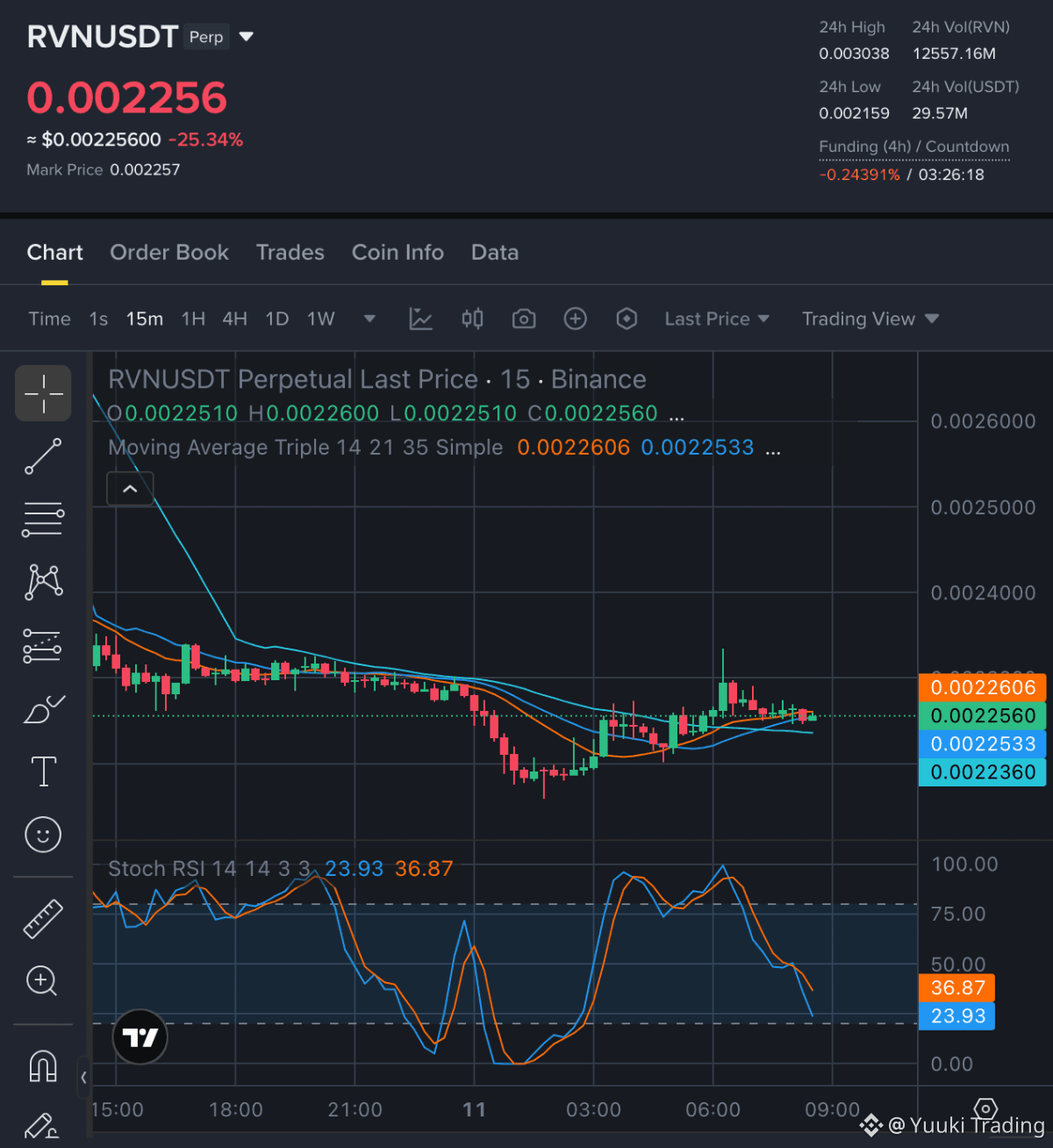
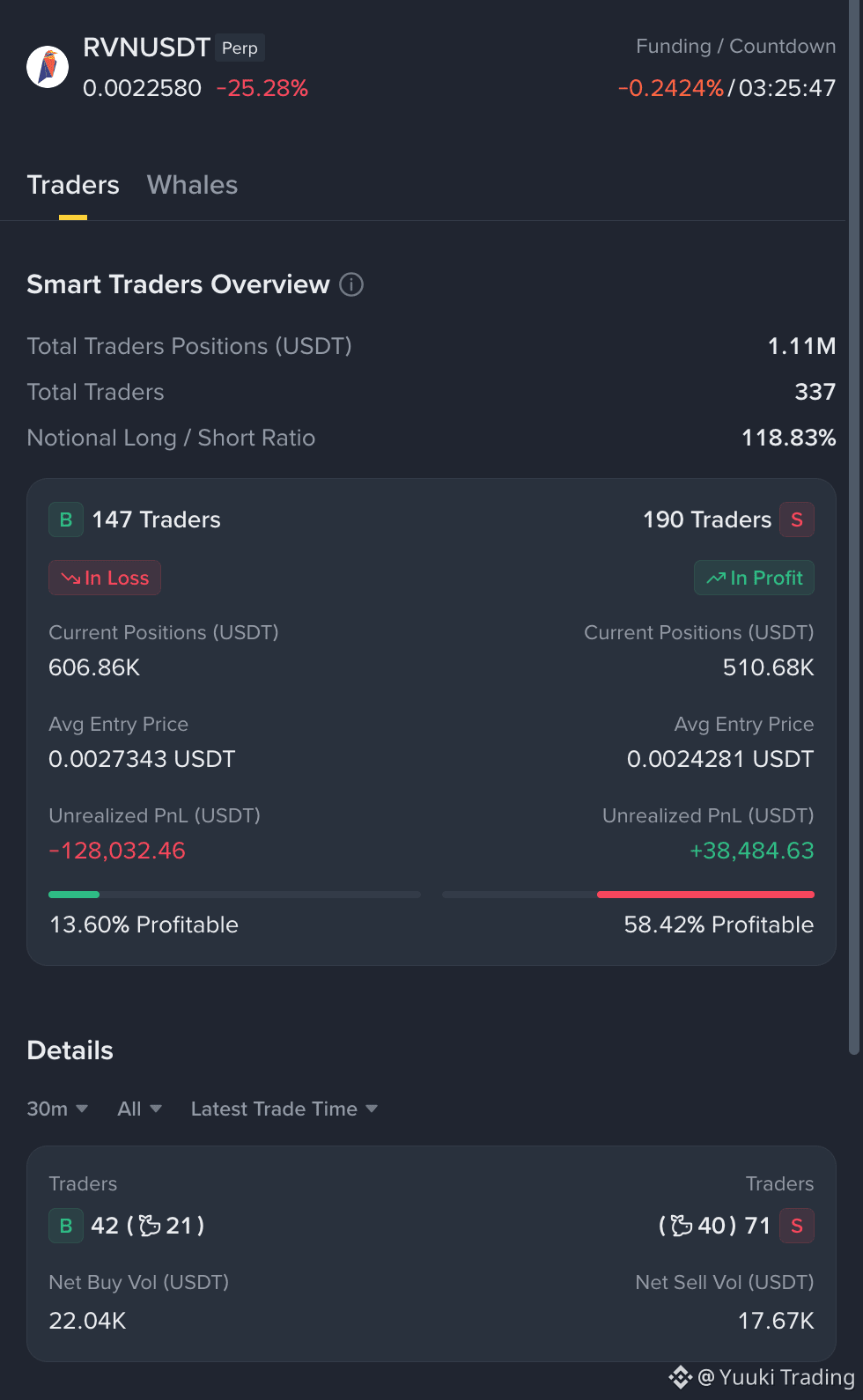
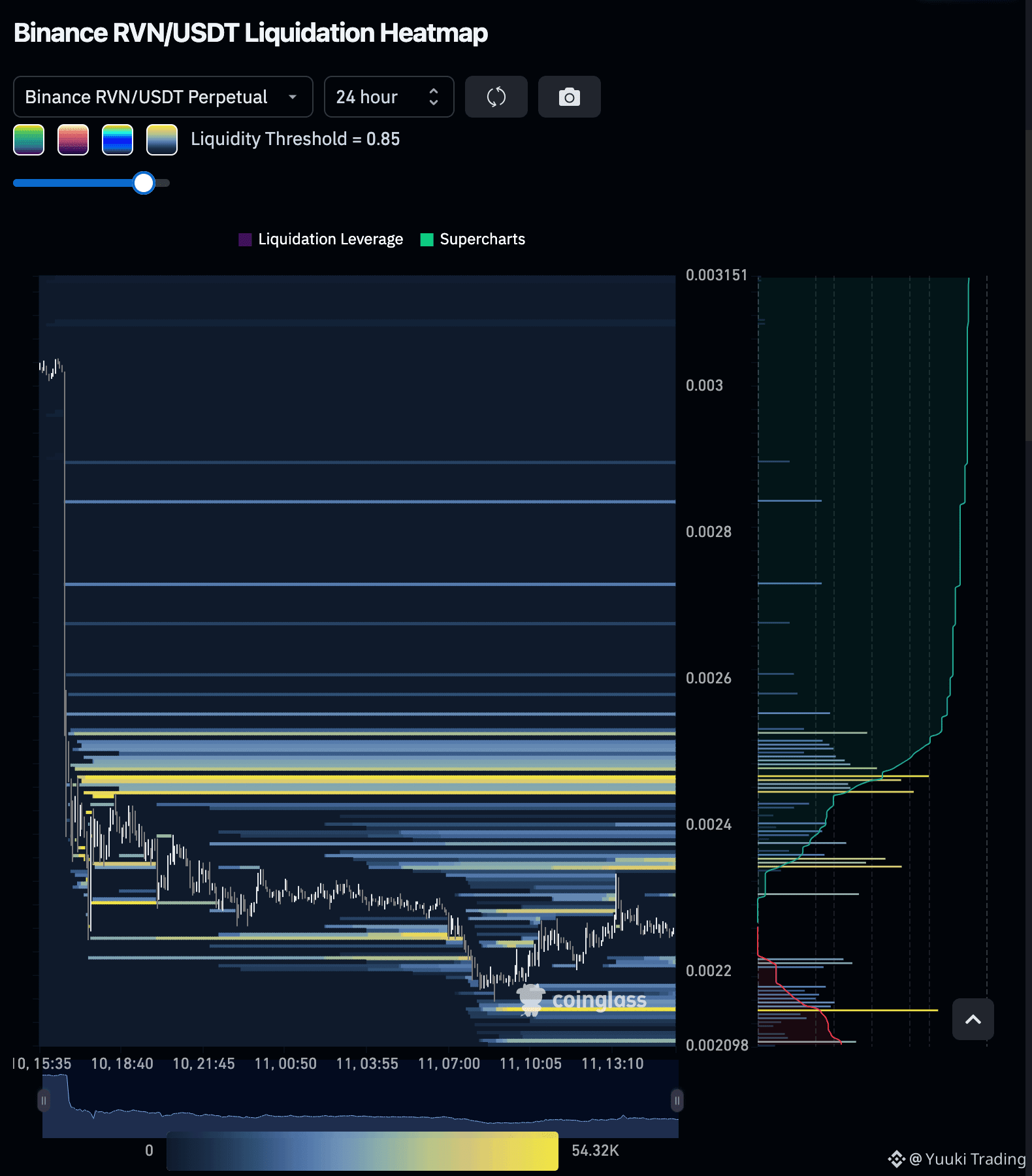
RVN — Les vendeurs conservent l’avantage des 15 m alors que le rebond marque le pas sous la moyenne la plus rapide, bien que la liquidité élevée au-dessus préserve le risque de squeeze.
RVN — SHORT MAINTENANT
Zone d’entrée : 0.002248 — 0.00226
• TP1 : 0.002202
• TP2 : 0.002159
• TP3 : 0.002098
Stop Loss : 0.002332
Sur 15 m, le Stoch RSI en baisse maintient le dernier rebond comme étant correctif plutôt que impulsif. Les Smart Money favorisent les vendeurs grâce à une meilleure rentabilité, tandis qu’une liquidité plus lourde au-dessus du prix augmente le risque de squeeze ; des bandes de baisse proches soutiennent encore le scénario short.
Avertissement : Ceci n’est pas un conseil financier. Faites toujours vos propres recherches et assumez l’entière responsabilité de vos décisions de trading et de vos actifs (DYOR).
Trade $RVN here :
{future}(RVNUSDT)
RVN — Les vendeurs conservent l’avantage des 15 m alors que le rebond marque le pas sous la moyenne la plus rapide, bien que la liquidité élevée au-dessus préserve le risque de squeeze.
RVN — SHORT MAINTENANT
Zone d’entrée : 0.002248 — 0.00226
• TP1 : 0.002202
• TP2 : 0.002159
• TP3 : 0.002098
Stop Loss : 0.002332
Sur 15 m, le Stoch RSI en baisse maintient le dernier rebond comme étant correctif plutôt que impulsif. Les Smart Money favorisent les vendeurs grâce à une meilleure rentabilité, tandis qu’une liquidité plus lourde au-dessus du prix augmente le risque de squeeze ; des bandes de baisse proches soutiennent encore le scénario short.
Avertissement : Ceci n’est pas un conseil financier. Faites toujours vos propres recherches et assumez l’entière responsabilité de vos décisions de trading et de vos actifs (DYOR).
Trade $RVN here :
RVN — SHORT MAINTENANT
Zone d’entrée : 0.002248 — 0.00226
• TP1 : 0.002202
• TP2 : 0.002159
• TP3 : 0.002098
Stop Loss : 0.002332
Sur 15 m, le Stoch RSI en baisse maintient le dernier rebond comme étant correctif plutôt que impulsif. Les Smart Money favorisent les vendeurs grâce à une meilleure rentabilité, tandis qu’une liquidité plus lourde au-dessus du prix augmente le risque de squeeze ; des bandes de baisse proches soutiennent encore le scénario short.
Avertissement : Ceci n’est pas un conseil financier. Faites toujours vos propres recherches et assumez l’entière responsabilité de vos décisions de trading et de vos actifs (DYOR).
Trade $RVN here :
1
132
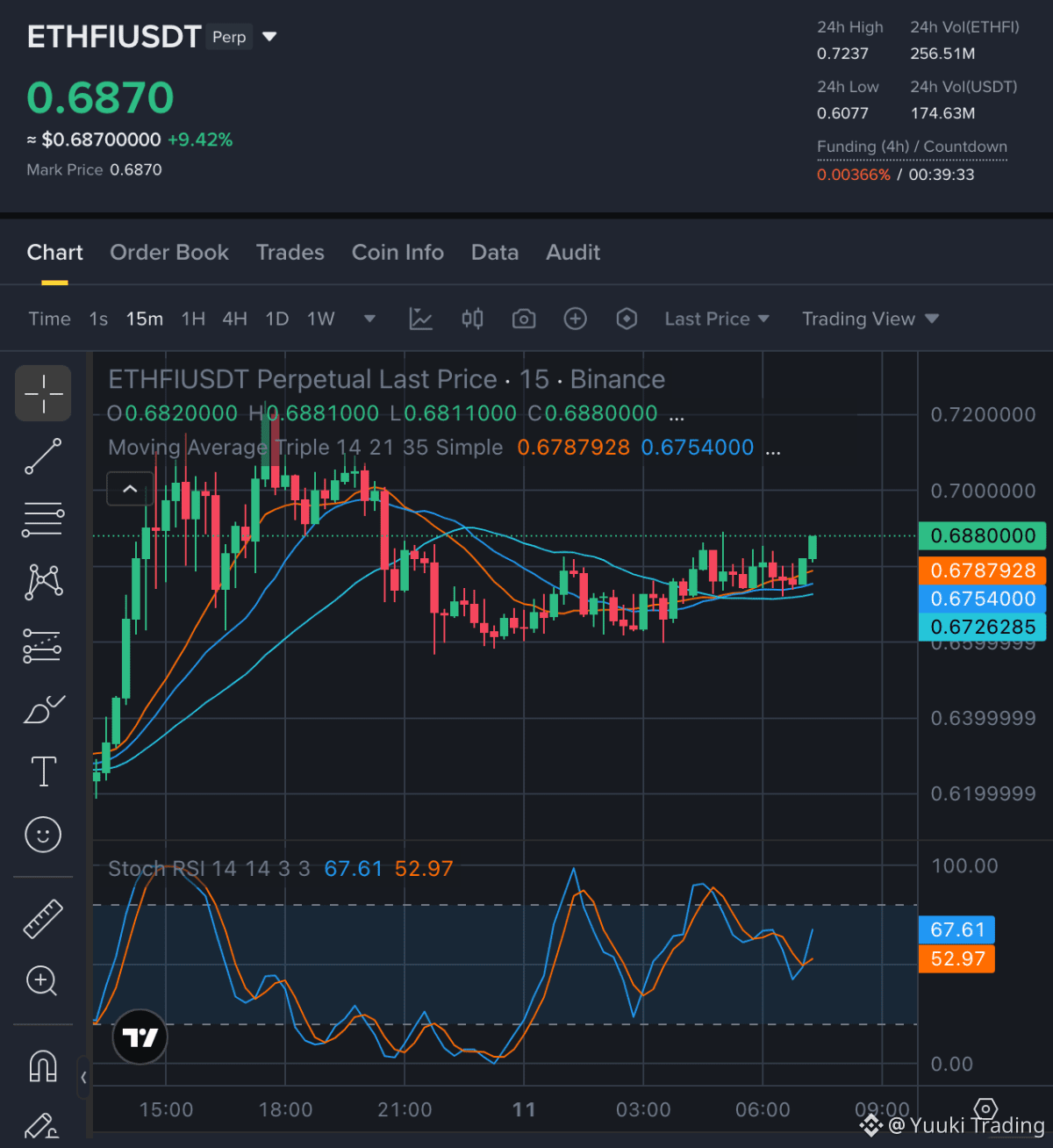
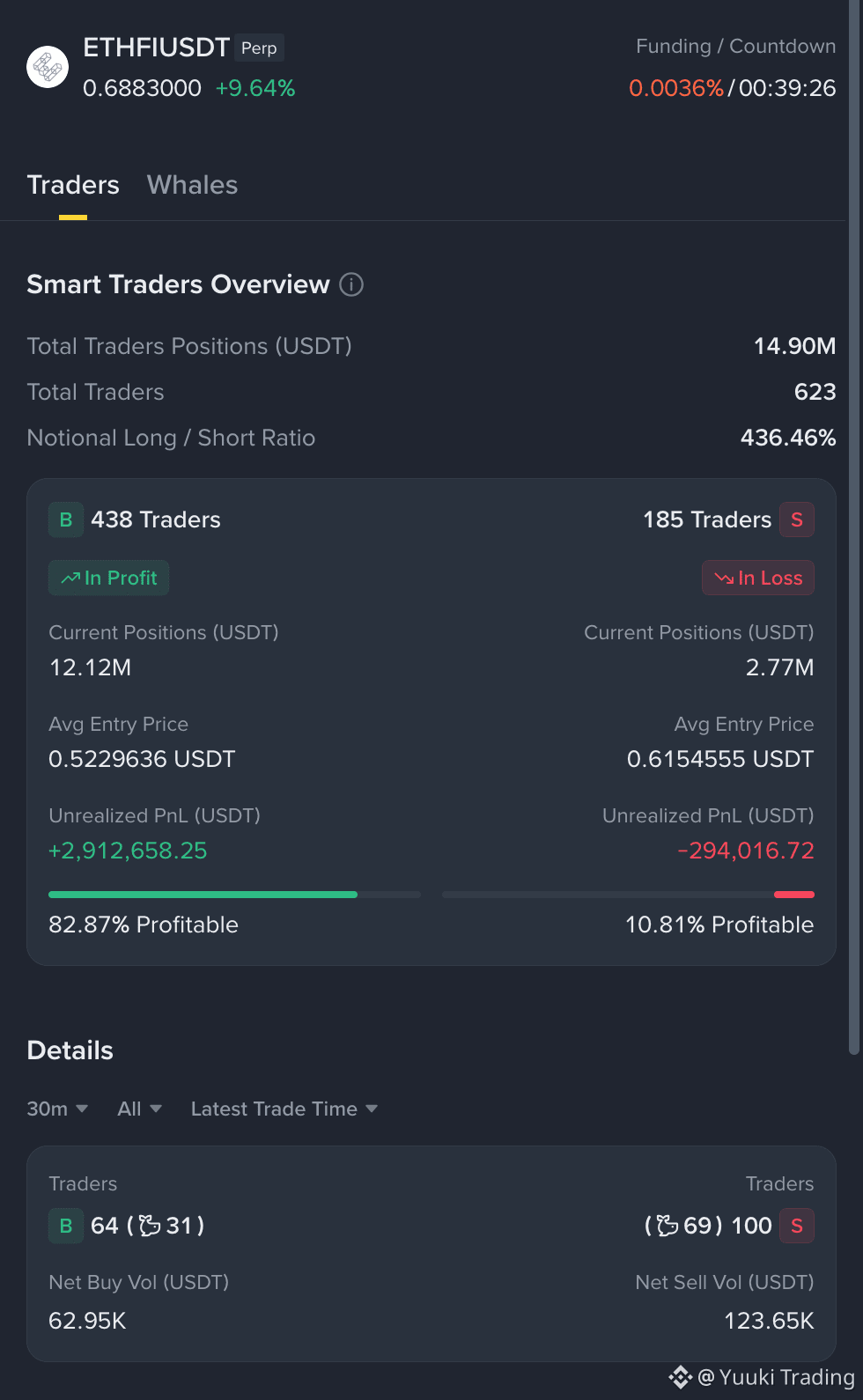
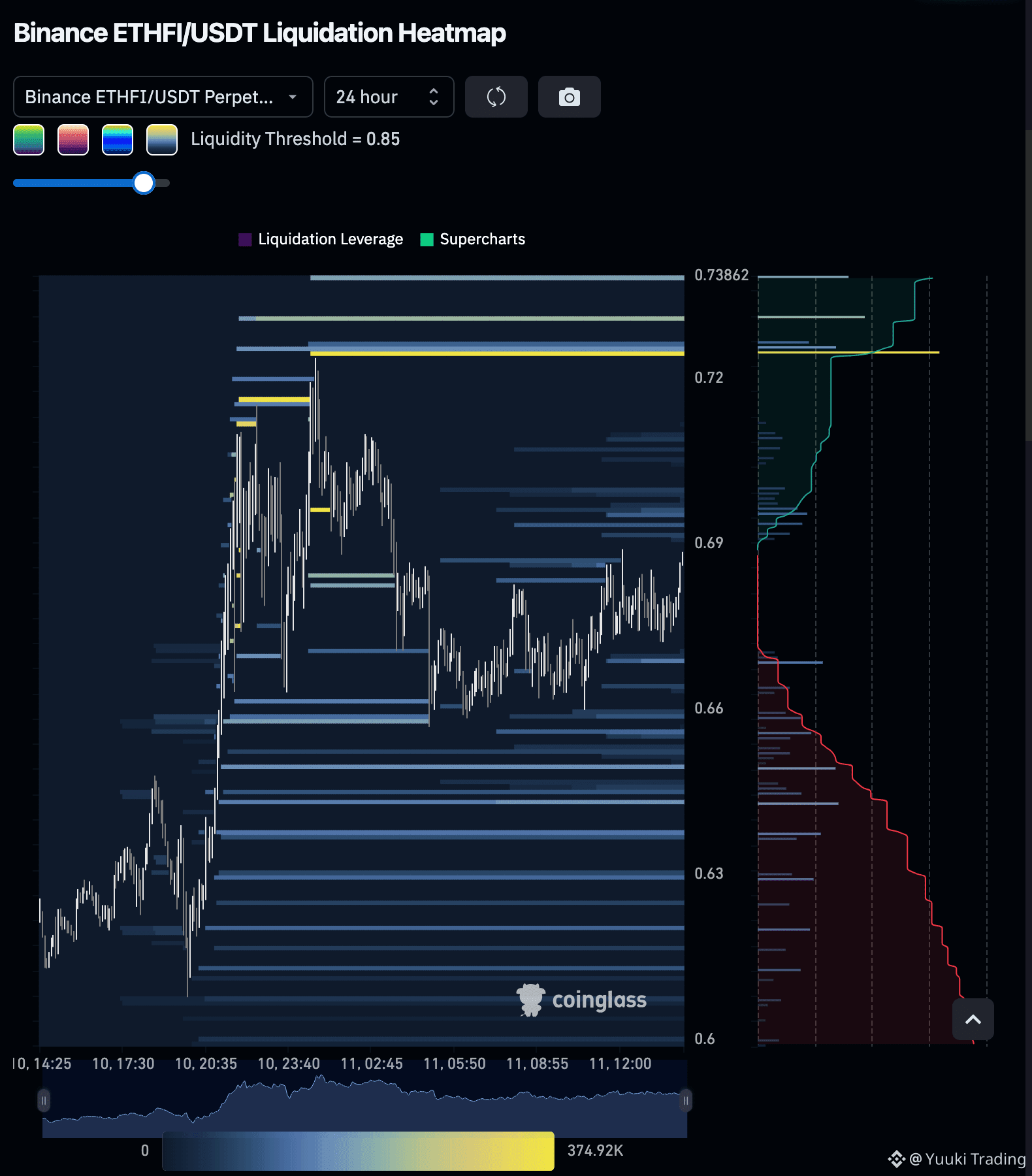
ETHFI — Les acheteurs conservent l’avantage des 15m alors que le prix repasse au-dessus de ses moyennes, bien que des positions longues fortement concentrées et rentables introduisent un risque de sur-accumulation.
ETHFI — LONG MAINTENANT
Zone d’entrée : 0.6845 — 0.6883
• TP1 : 0.7099
• TP2 : 0.7152
• TP3 : 0.7369
Stop Loss : 0.6611
Sur 15m, la hausse du prix et un rebond du Stoch RSI favorisent la poursuite. Le PnL positif des longs de Smart Money et une rentabilité supérieure soutiennent les acheteurs, tandis qu’une liquidité haussière plus importante agit comme un aimant ; les longs concentrés restent le principal risque de retournement.
Avertissement : ceci ne constitue pas un conseil financier. Faites toujours vos propres recherches et prenez l’entière responsabilité de vos décisions de trading et de vos actifs (DYOR).
Trade $ETHFI here:
{future}(ETHFIUSDT)
ETHFI — Les acheteurs conservent l’avantage des 15m alors que le prix repasse au-dessus de ses moyennes, bien que des positions longues fortement concentrées et rentables introduisent un risque de sur-accumulation.
ETHFI — LONG MAINTENANT
Zone d’entrée : 0.6845 — 0.6883
• TP1 : 0.7099
• TP2 : 0.7152
• TP3 : 0.7369
Stop Loss : 0.6611
Sur 15m, la hausse du prix et un rebond du Stoch RSI favorisent la poursuite. Le PnL positif des longs de Smart Money et une rentabilité supérieure soutiennent les acheteurs, tandis qu’une liquidité haussière plus importante agit comme un aimant ; les longs concentrés restent le principal risque de retournement.
Avertissement : ceci ne constitue pas un conseil financier. Faites toujours vos propres recherches et prenez l’entière responsabilité de vos décisions de trading et de vos actifs (DYOR).
Trade $ETHFI here:
ETHFI — LONG MAINTENANT
Zone d’entrée : 0.6845 — 0.6883
• TP1 : 0.7099
• TP2 : 0.7152
• TP3 : 0.7369
Stop Loss : 0.6611
Sur 15m, la hausse du prix et un rebond du Stoch RSI favorisent la poursuite. Le PnL positif des longs de Smart Money et une rentabilité supérieure soutiennent les acheteurs, tandis qu’une liquidité haussière plus importante agit comme un aimant ; les longs concentrés restent le principal risque de retournement.
Avertissement : ceci ne constitue pas un conseil financier. Faites toujours vos propres recherches et prenez l’entière responsabilité de vos décisions de trading et de vos actifs (DYOR).
Trade $ETHFI here:
2
588
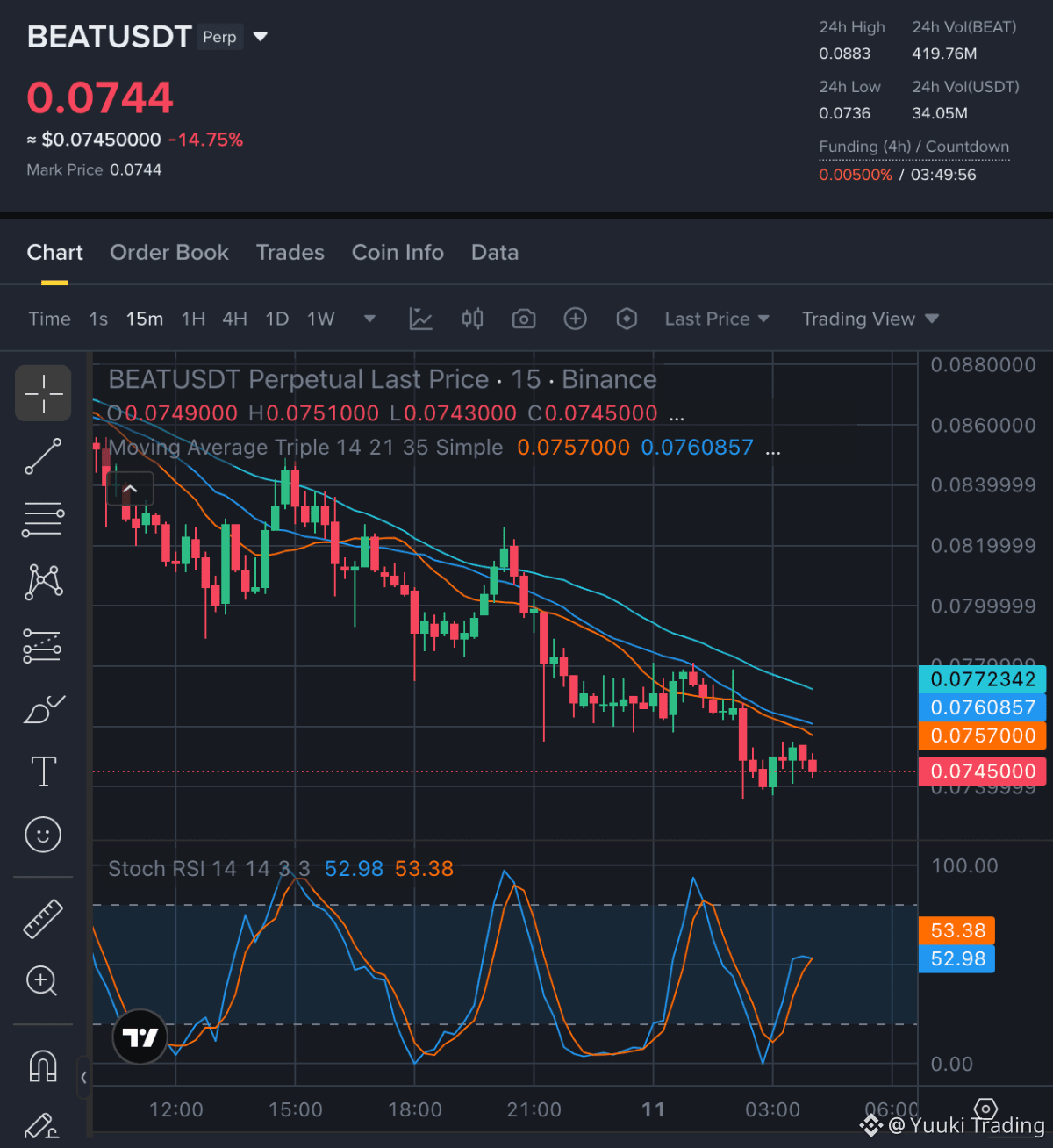
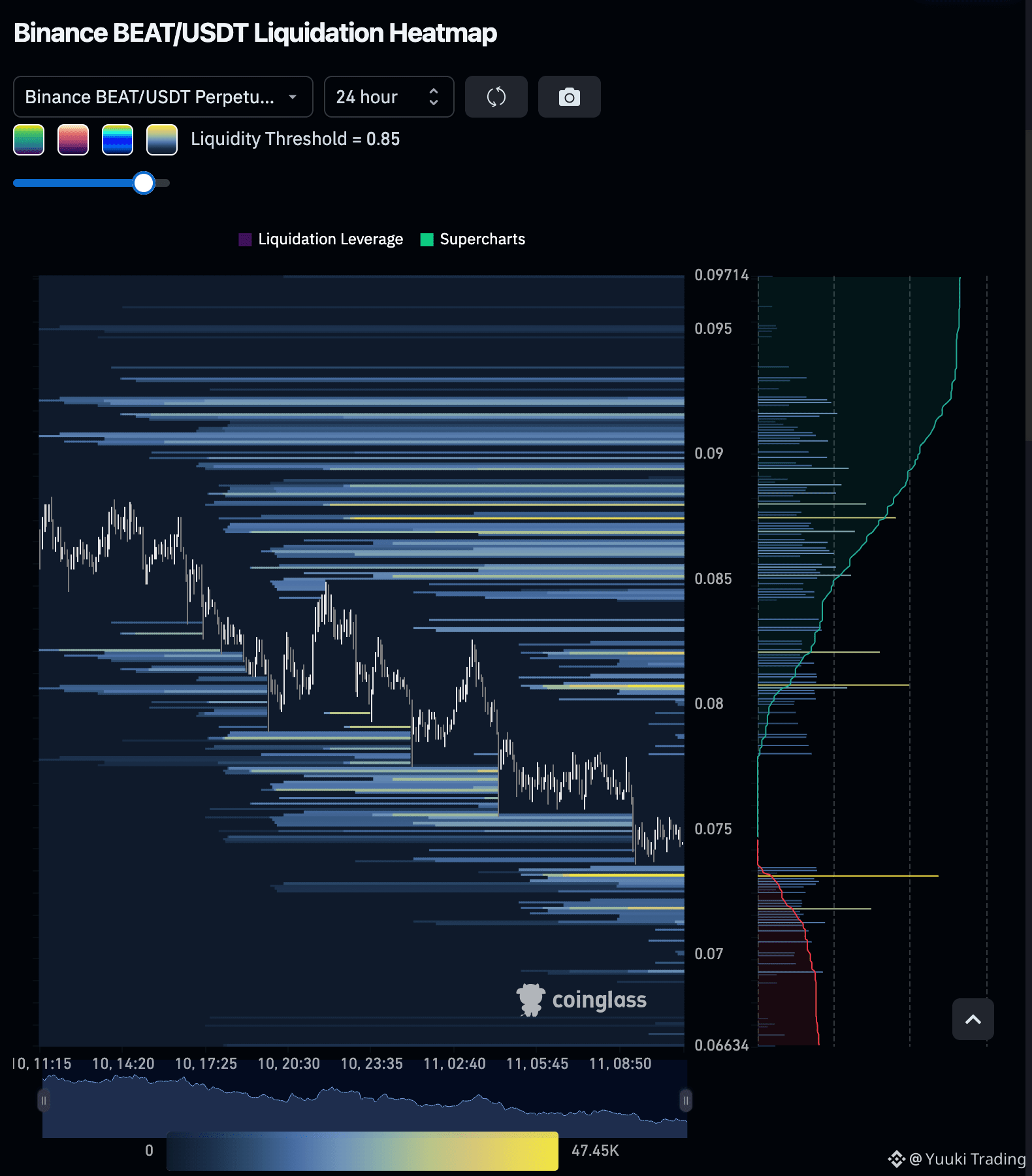
BEAT — Les vendeurs conservent l’avantage des 15m sous les moyennes baissières descendantes, la plus proche concentration de liquidité significative restant positionnée sous le marché.
BEAT — SHORT NOW
Zone d’entrée : 0.0742 — 0.0748
• TP1 : 0.0719
• TP2 : 0.0702
• TP3 : 0.0676
Stop Loss : 0.078
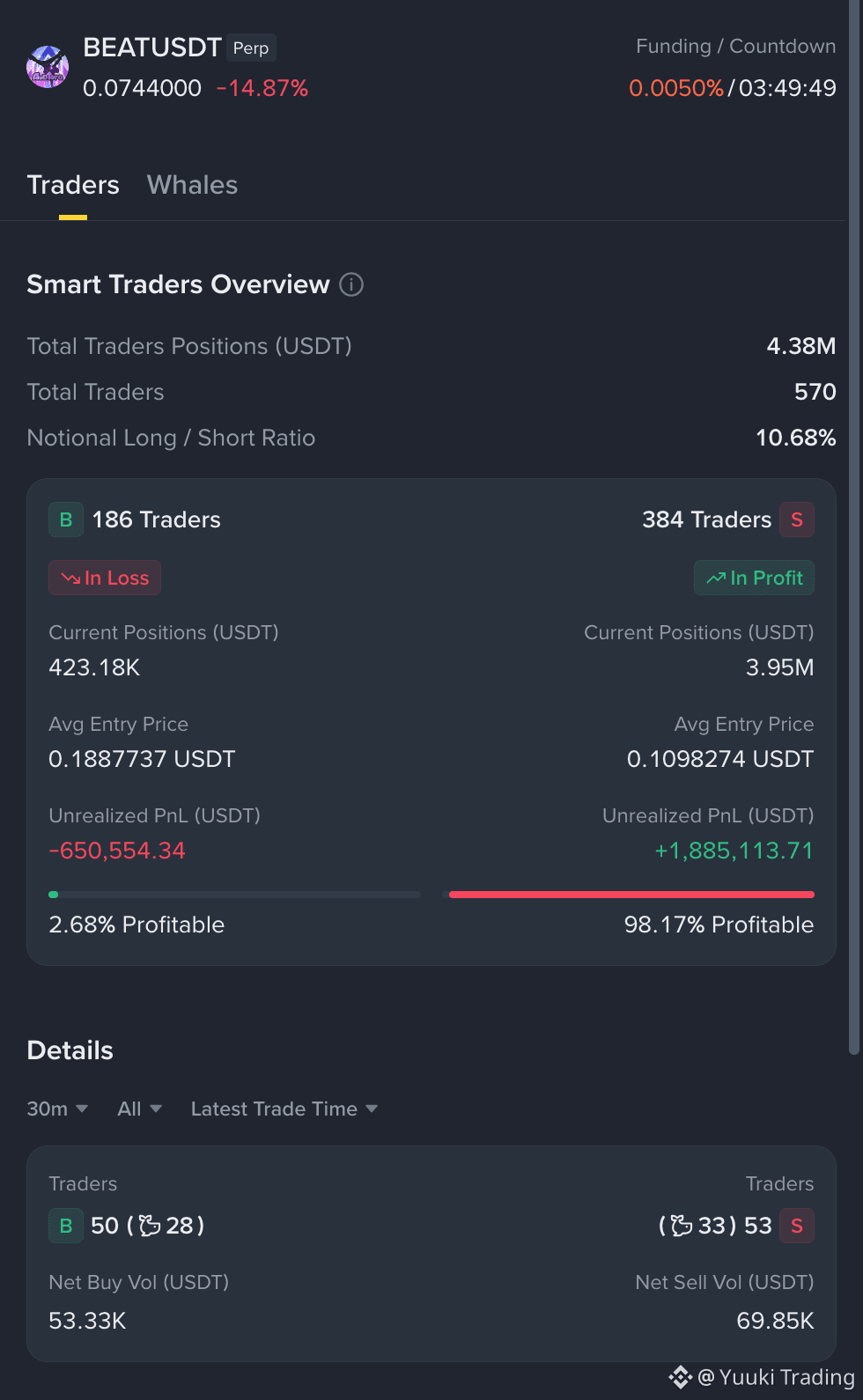
En 15m, les plus hauts baissiers persistent tandis que le Stoch RSI ne remonte que vers le neutre, maintenant le rebond à caractère correctif. Les Smart Money favorisent les vendeurs : 384 shorts contre 186 longs, avec un net avantage de rentabilité. La liquidité plus lourde au-dessus ajoute encore un risque de squeeze.
Avertissement : Ceci ne constitue pas un conseil financier. Faites toujours vos propres recherches et assumez l’entière responsabilité de vos décisions de trading et de vos actifs (DYOR).
Trade $BEAT here :
{future}(BEATUSDT)
BEAT — Les vendeurs conservent l’avantage des 15m sous les moyennes baissières descendantes, la plus proche concentration de liquidité significative restant positionnée sous le marché.
BEAT — SHORT NOW
Zone d’entrée : 0.0742 — 0.0748
• TP1 : 0.0719
• TP2 : 0.0702
• TP3 : 0.0676
Stop Loss : 0.078
En 15m, les plus hauts baissiers persistent tandis que le Stoch RSI ne remonte que vers le neutre, maintenant le rebond à caractère correctif. Les Smart Money favorisent les vendeurs : 384 shorts contre 186 longs, avec un net avantage de rentabilité. La liquidité plus lourde au-dessus ajoute encore un risque de squeeze.
Avertissement : Ceci ne constitue pas un conseil financier. Faites toujours vos propres recherches et assumez l’entière responsabilité de vos décisions de trading et de vos actifs (DYOR).
Trade $BEAT here :
BEAT — SHORT NOW
Zone d’entrée : 0.0742 — 0.0748
• TP1 : 0.0719
• TP2 : 0.0702
• TP3 : 0.0676
Stop Loss : 0.078
En 15m, les plus hauts baissiers persistent tandis que le Stoch RSI ne remonte que vers le neutre, maintenant le rebond à caractère correctif. Les Smart Money favorisent les vendeurs : 384 shorts contre 186 longs, avec un net avantage de rentabilité. La liquidité plus lourde au-dessus ajoute encore un risque de squeeze.
Avertissement : Ceci ne constitue pas un conseil financier. Faites toujours vos propres recherches et assumez l’entière responsabilité de vos décisions de trading et de vos actifs (DYOR).
Trade $BEAT here :
1
533
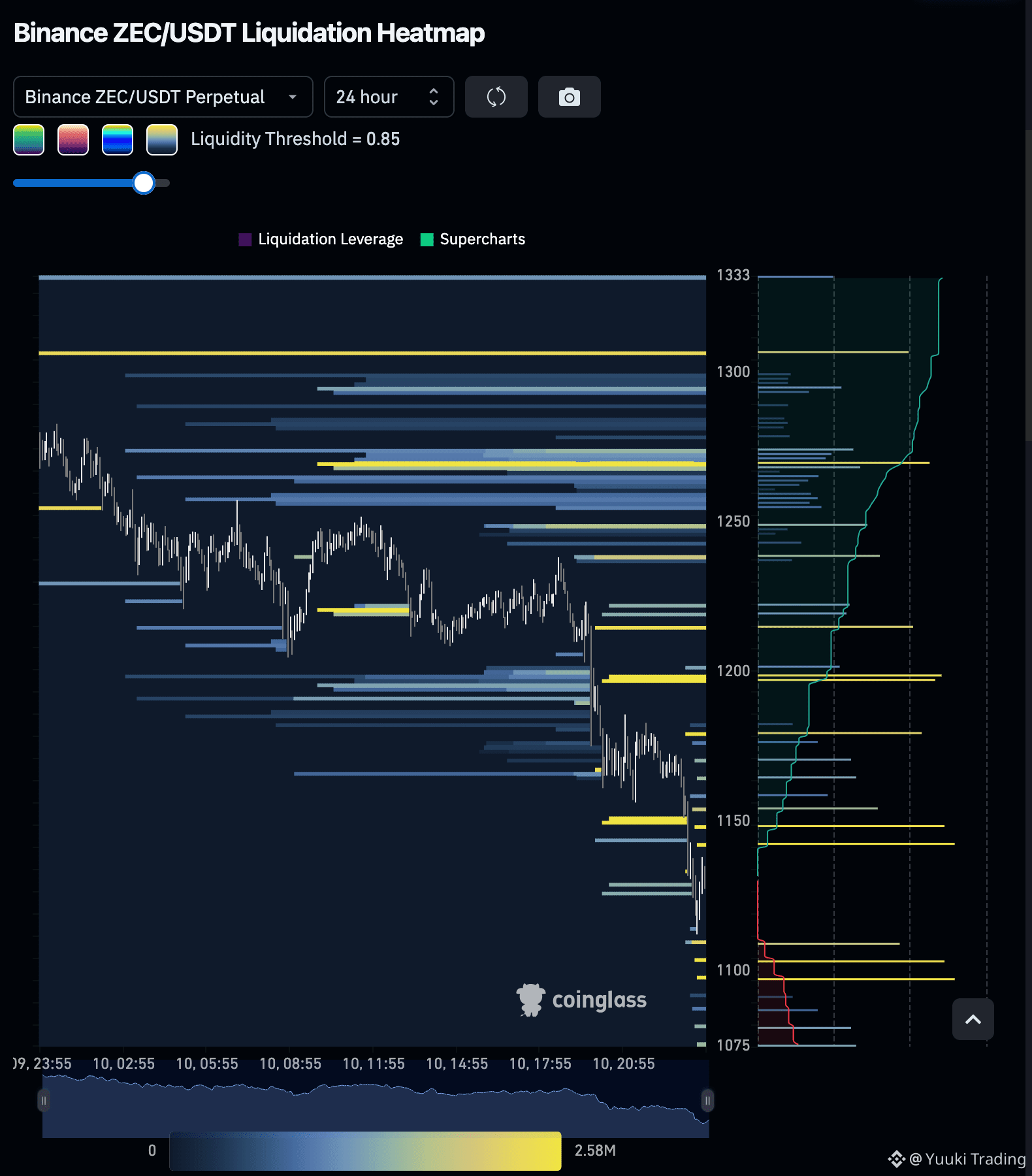
ZEC — Les vendeurs conservent l’avantage de 15 m alors que le prix s’étend sous toutes les moyennes mobiles visibles, tandis que des liquidations haussières plus lourdes et un Smart Money mitigé ajoutent un risque de squeeze.
ZEC - SHORT NOW
Zone d’entrée : 1,129.90 — 1,135.70
• TP1 : 1,093.00
• TP2 : 1,066.50
• TP3 : 1,026.60
Stop Loss : 1,185.90
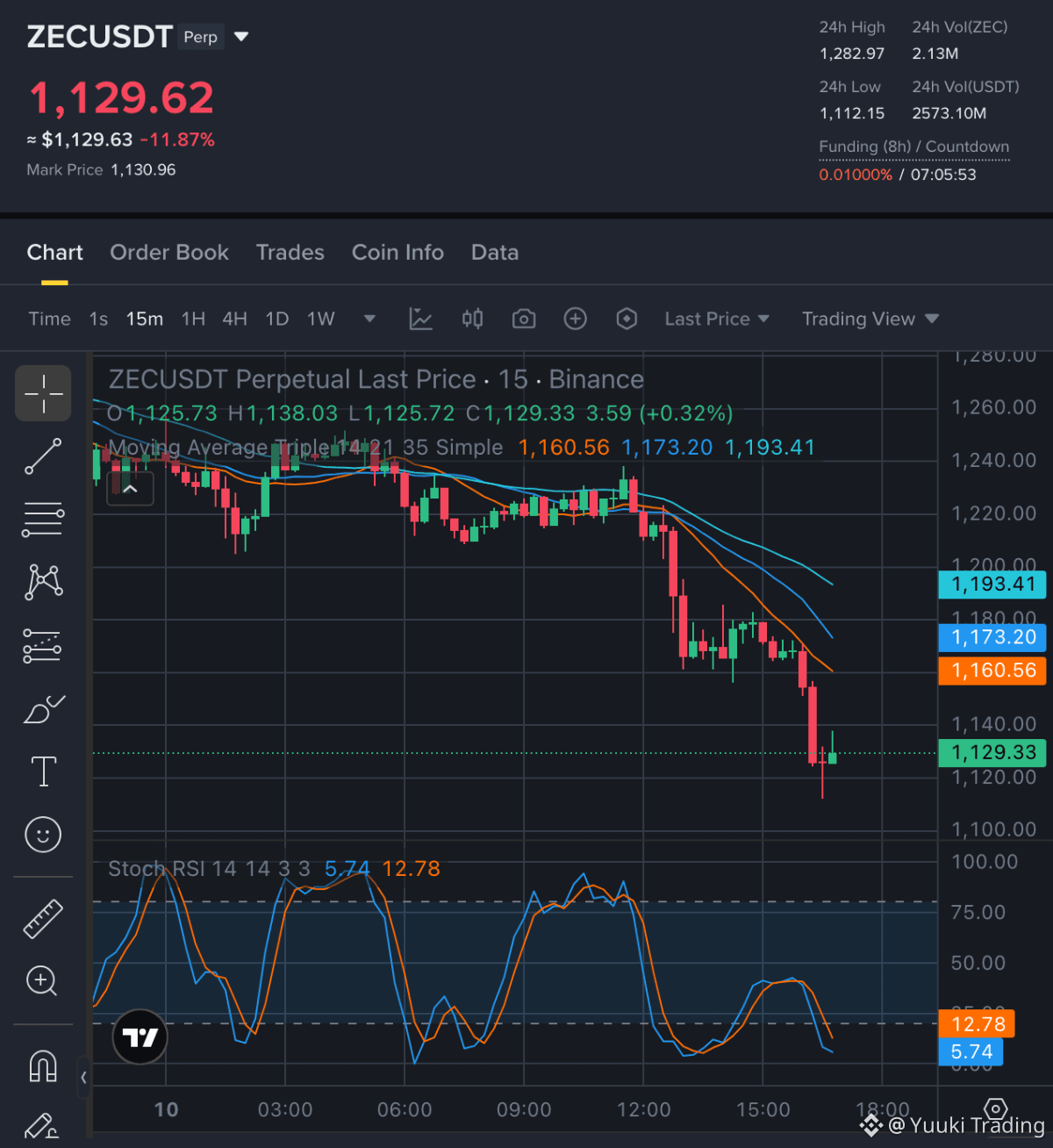
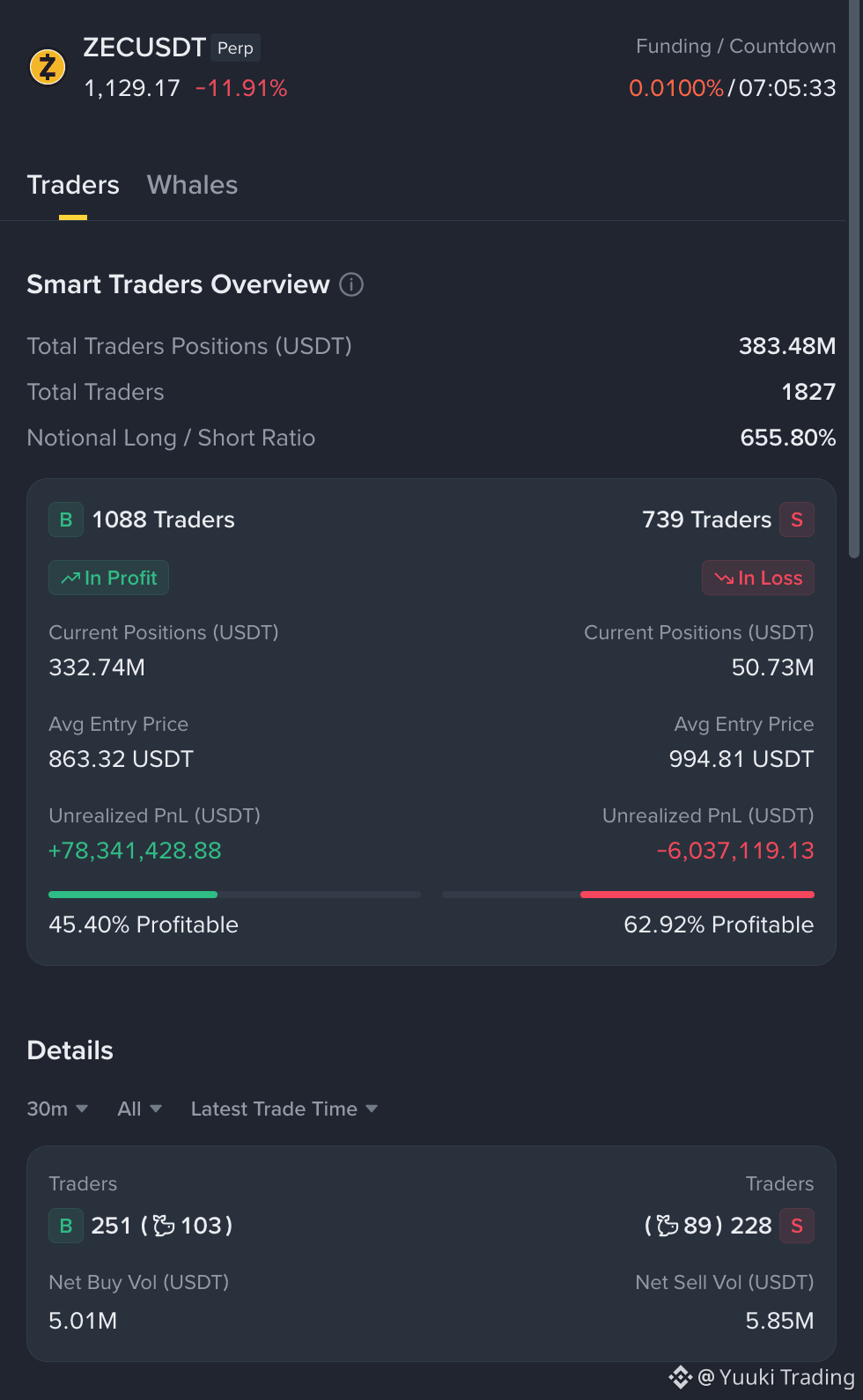
Le graphique en 15 m favorise encore une poursuite à la baisse : le dernier rebond semble correctif, le prix évoluant sous les moyennes mobiles et le Stoch RSI restant faible. Le Smart Money est mitigé, mais favorise relativement les vendeurs : les positions longues conservent une taille plus importante, tandis que les shorts affichent 62.92 % de trades rentables, et l’entrée moyenne des shorts se situe à 994.81 USDT. CoinGlass montre des liquidations plus denses au-dessus du prix qu’au-dessous ; ainsi, la tendance baissière reste valide, mais il faut respecter le risque de squeeze à la hausse.
Avertissement : Ceci n’est pas un conseil financier. Faites toujours vos propres recherches et prenez l’entière responsabilité de vos décisions de trading et de vos actifs (DYOR).
Trade $ZEC here:
{future}(ZECUSDT)
ZEC — Les vendeurs conservent l’avantage de 15 m alors que le prix s’étend sous toutes les moyennes mobiles visibles, tandis que des liquidations haussières plus lourdes et un Smart Money mitigé ajoutent un risque de squeeze.
ZEC - SHORT NOW
Zone d’entrée : 1,129.90 — 1,135.70
• TP1 : 1,093.00
• TP2 : 1,066.50
• TP3 : 1,026.60
Stop Loss : 1,185.90
Le graphique en 15 m favorise encore une poursuite à la baisse : le dernier rebond semble correctif, le prix évoluant sous les moyennes mobiles et le Stoch RSI restant faible. Le Smart Money est mitigé, mais favorise relativement les vendeurs : les positions longues conservent une taille plus importante, tandis que les shorts affichent 62.92 % de trades rentables, et l’entrée moyenne des shorts se situe à 994.81 USDT. CoinGlass montre des liquidations plus denses au-dessus du prix qu’au-dessous ; ainsi, la tendance baissière reste valide, mais il faut respecter le risque de squeeze à la hausse.
Avertissement : Ceci n’est pas un conseil financier. Faites toujours vos propres recherches et prenez l’entière responsabilité de vos décisions de trading et de vos actifs (DYOR).
Trade $ZEC here:
ZEC - SHORT NOW
Zone d’entrée : 1,129.90 — 1,135.70
• TP1 : 1,093.00
• TP2 : 1,066.50
• TP3 : 1,026.60
Stop Loss : 1,185.90
Le graphique en 15 m favorise encore une poursuite à la baisse : le dernier rebond semble correctif, le prix évoluant sous les moyennes mobiles et le Stoch RSI restant faible. Le Smart Money est mitigé, mais favorise relativement les vendeurs : les positions longues conservent une taille plus importante, tandis que les shorts affichent 62.92 % de trades rentables, et l’entrée moyenne des shorts se situe à 994.81 USDT. CoinGlass montre des liquidations plus denses au-dessus du prix qu’au-dessous ; ainsi, la tendance baissière reste valide, mais il faut respecter le risque de squeeze à la hausse.
Avertissement : Ceci n’est pas un conseil financier. Faites toujours vos propres recherches et prenez l’entière responsabilité de vos décisions de trading et de vos actifs (DYOR).
Trade $ZEC here:
3
73
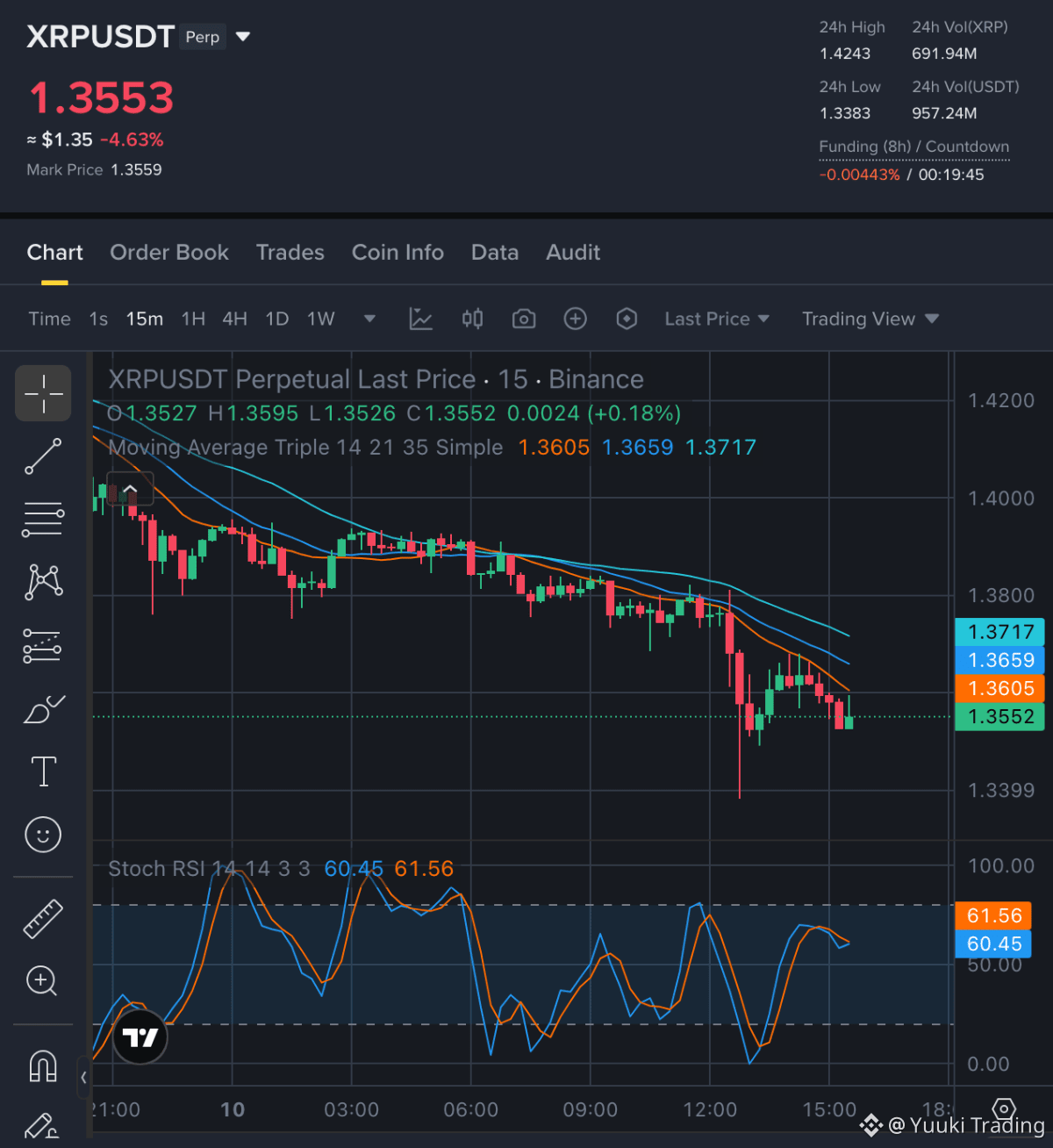
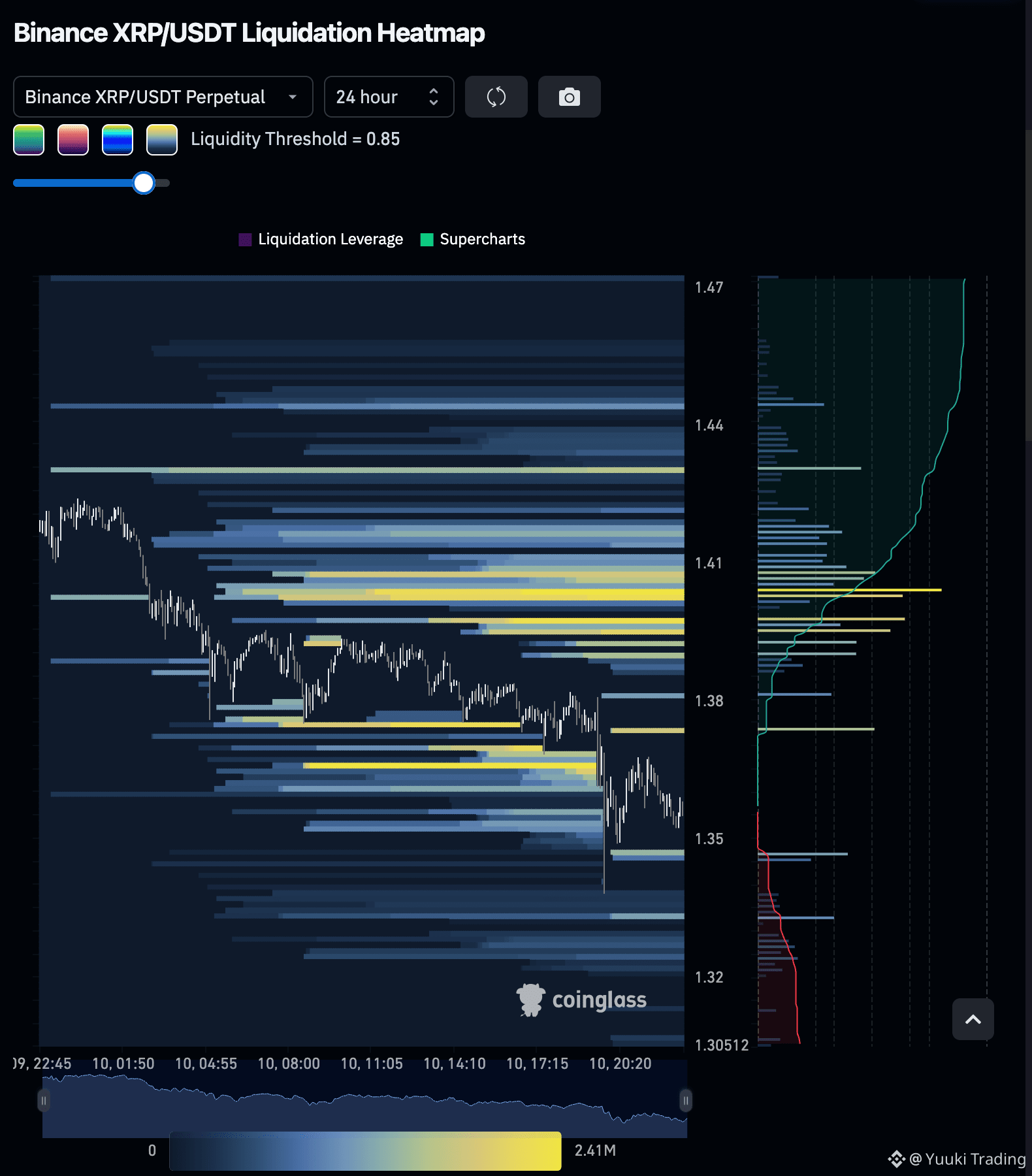
XRP — Les vendeurs conservent l’avantage de 15 min tandis que le prix reste sous les moyennes mobiles alignées, alors que des positions longues plus nombreuses laissent le placement fragile.
XRP - SHORT NOW
Zone d’entrée : 1.3564 — 1.3604
• TP1 : 1.3383
• TP2 : 1.3276
• TP3 : 1.3091
Stop Loss : 1.3831
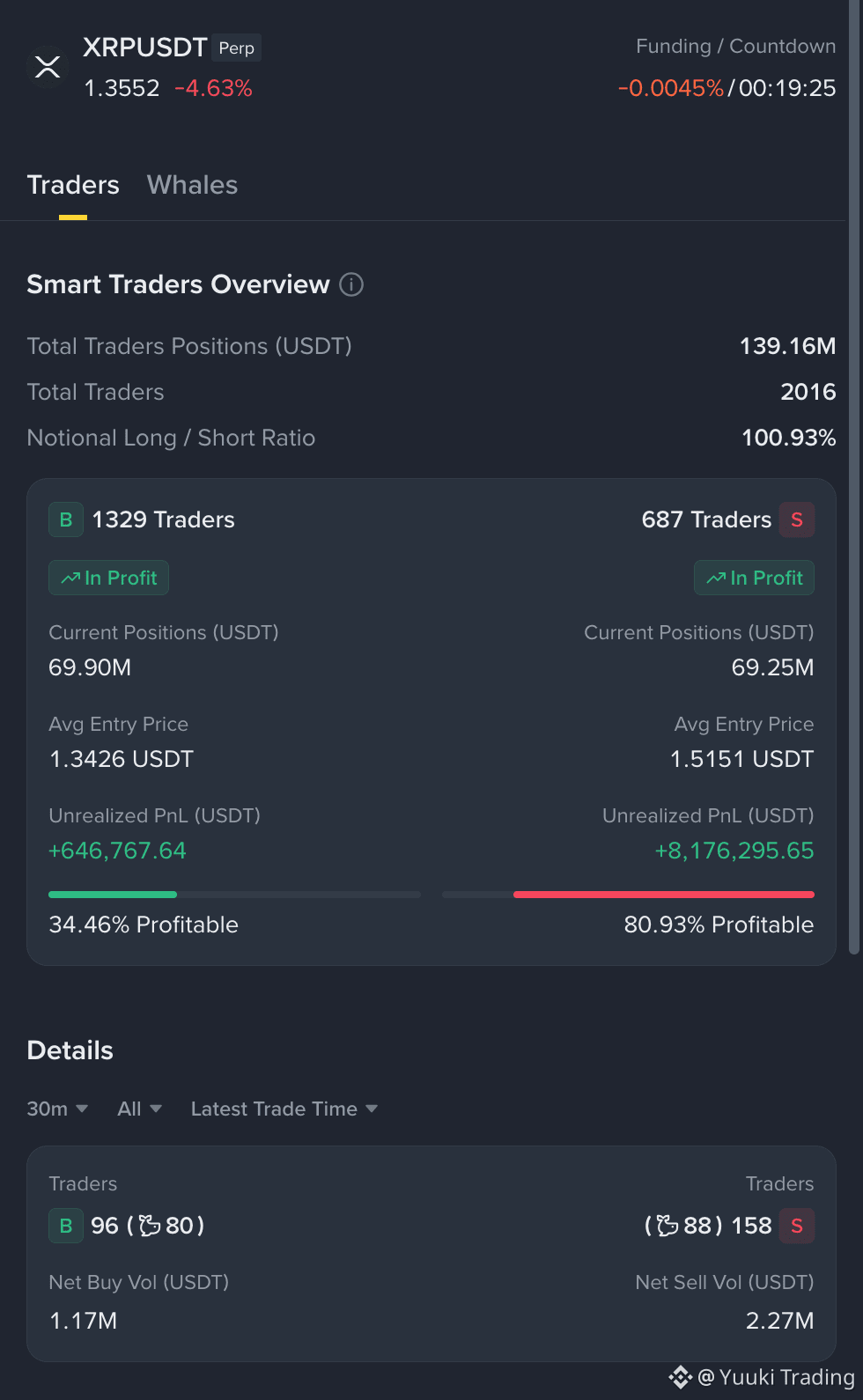
Le rebond en 15 min reste correctif, avec le dernier rebond incapable d’inverser la structure descendante. Les Smart Money sont mitigés mais favorisent relativement les vendeurs, avec 80,93 % des shorts rentables ; une liquidité plus dense au-dessus du prix augmente le risque de squeeze pour le biais short.
Avertissement : Ceci n’est pas un conseil financier. Faites toujours vos propres recherches et assumez pleinement la responsabilité de vos décisions de trading et de vos actifs (DYOR).
Trade $XRP here :
{future}(XRPUSDT)
XRP — Les vendeurs conservent l’avantage de 15 min tandis que le prix reste sous les moyennes mobiles alignées, alors que des positions longues plus nombreuses laissent le placement fragile.
XRP - SHORT NOW
Zone d’entrée : 1.3564 — 1.3604
• TP1 : 1.3383
• TP2 : 1.3276
• TP3 : 1.3091
Stop Loss : 1.3831
Le rebond en 15 min reste correctif, avec le dernier rebond incapable d’inverser la structure descendante. Les Smart Money sont mitigés mais favorisent relativement les vendeurs, avec 80,93 % des shorts rentables ; une liquidité plus dense au-dessus du prix augmente le risque de squeeze pour le biais short.
Avertissement : Ceci n’est pas un conseil financier. Faites toujours vos propres recherches et assumez pleinement la responsabilité de vos décisions de trading et de vos actifs (DYOR).
Trade $XRP here :
XRP - SHORT NOW
Zone d’entrée : 1.3564 — 1.3604
• TP1 : 1.3383
• TP2 : 1.3276
• TP3 : 1.3091
Stop Loss : 1.3831
Le rebond en 15 min reste correctif, avec le dernier rebond incapable d’inverser la structure descendante. Les Smart Money sont mitigés mais favorisent relativement les vendeurs, avec 80,93 % des shorts rentables ; une liquidité plus dense au-dessus du prix augmente le risque de squeeze pour le biais short.
Avertissement : Ceci n’est pas un conseil financier. Faites toujours vos propres recherches et assumez pleinement la responsabilité de vos décisions de trading et de vos actifs (DYOR).
Trade $XRP here :
1
69
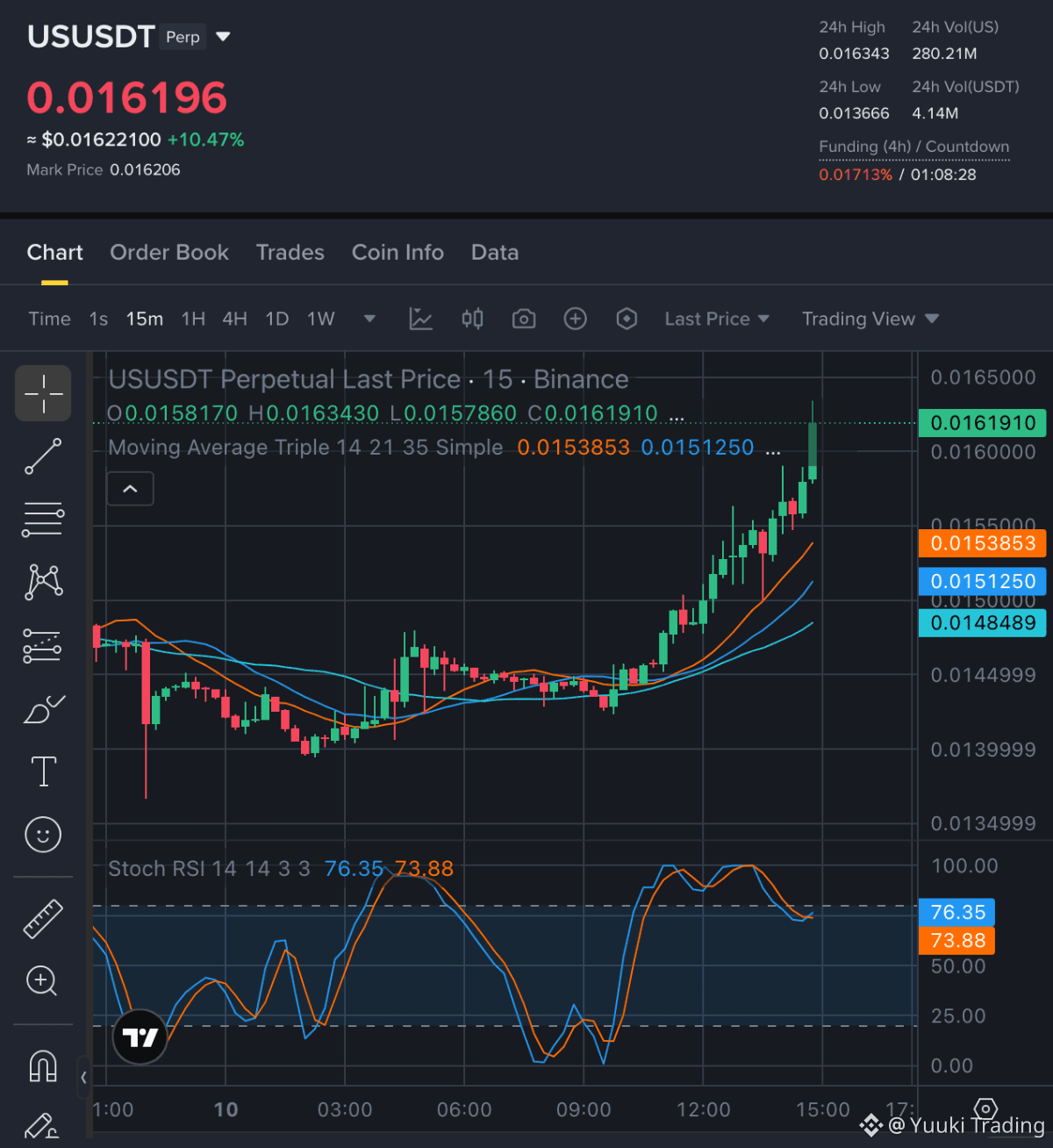
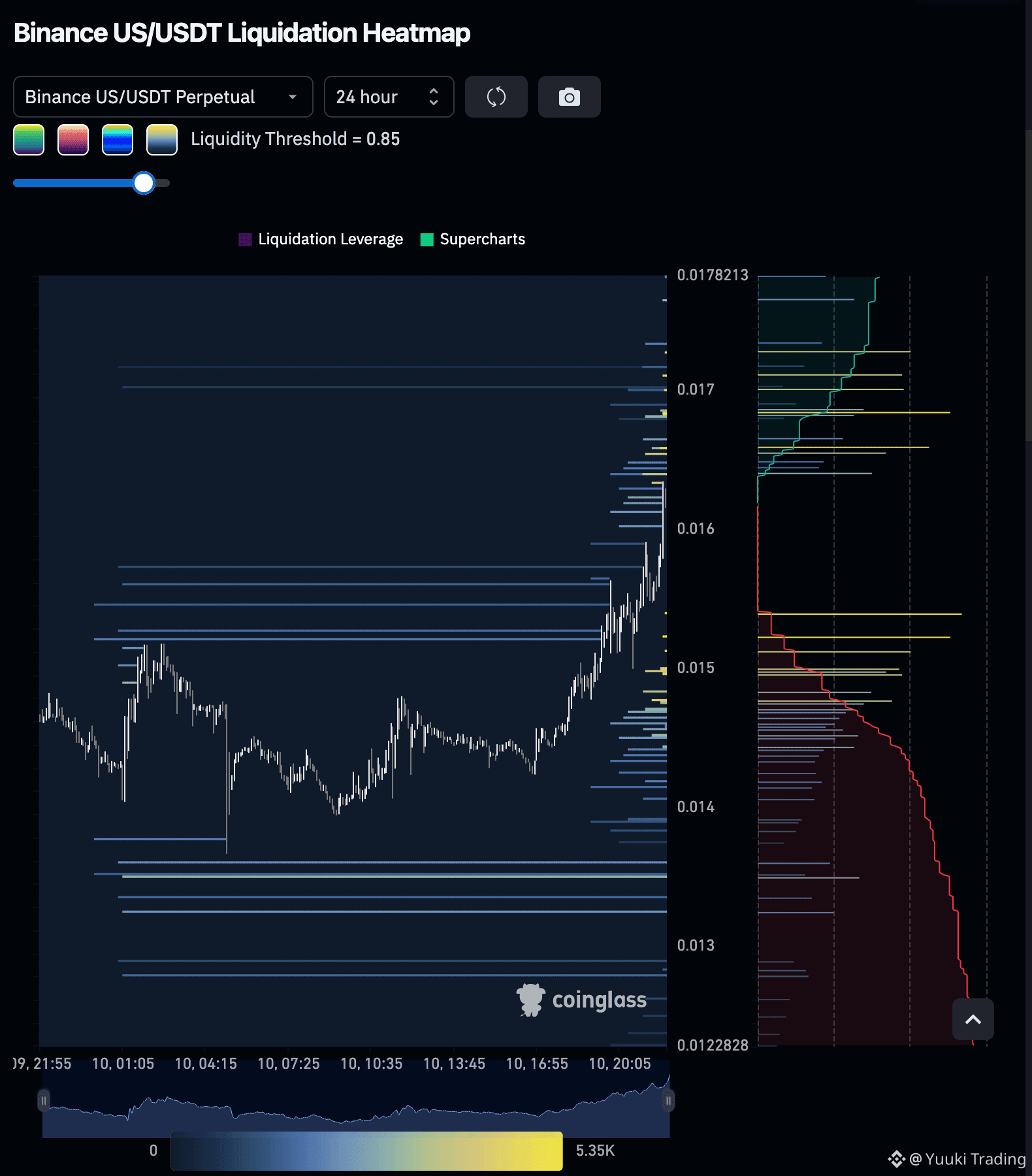
US — Les acheteurs contrôlent une avancée impulsive de 15m au-dessus de moyennes haussières, tandis qu’une liquidité haussière concentrée soutient la poursuite malgré une position fragile des Smart Money.
US - LONG NOW
Zone d’entrée : 0.016132 — 0.01626
• TP1 : 0.016775
• TP2 : 0.01716
• TP3 : 0.017739
Stop Loss : 0.015425
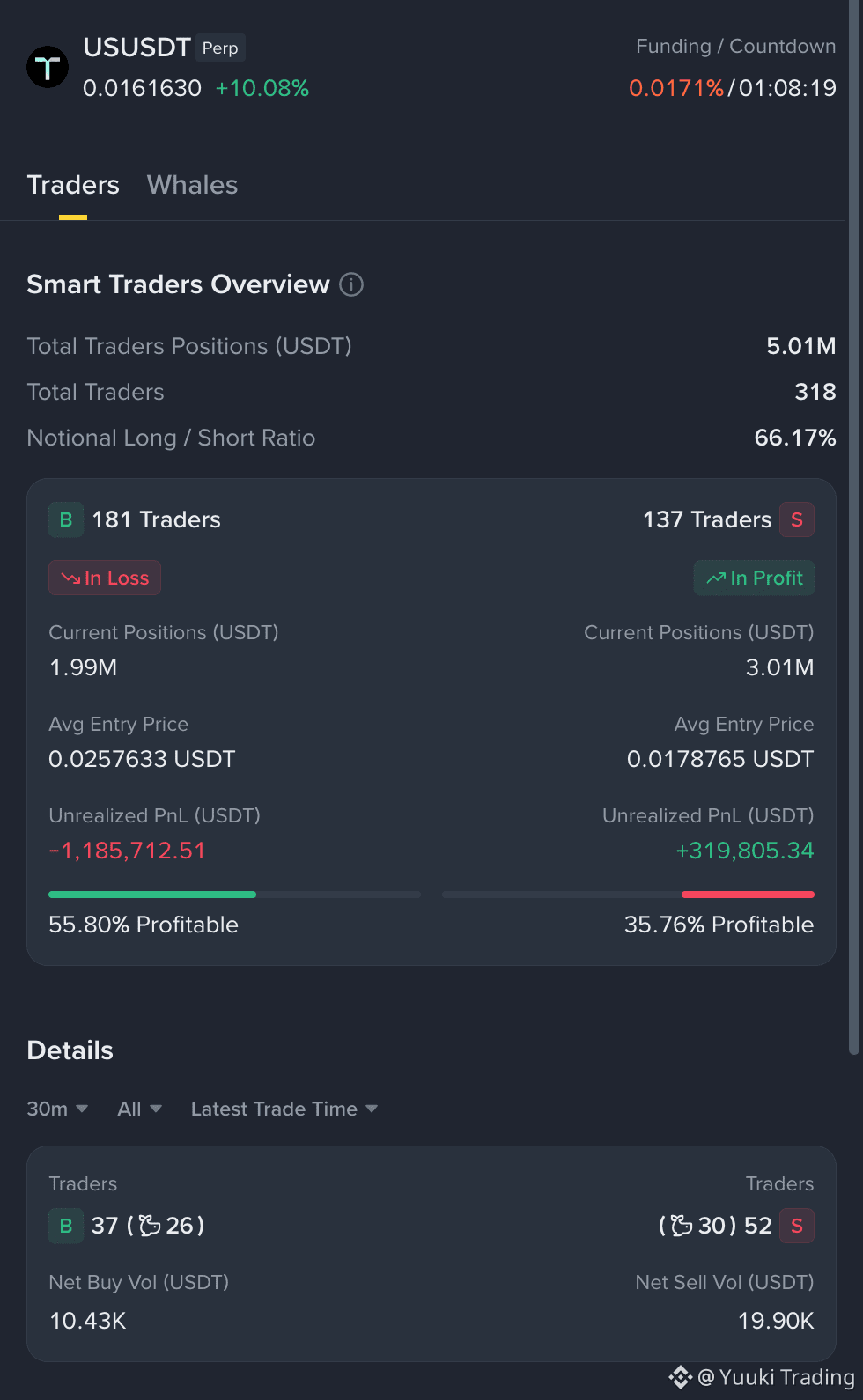
La structure en 15m est franchement haussière au-dessus de moyennes haussières, bien que le Stoch RSI élevé mette en garde contre la poursuite. Les Smart Money sont mitigées : des longs agrégés sont en pertes et les shorts sont rentables. La densité de liquidations à la hausse soutient la continuation, tandis qu’une liquidité plus faible laisse un risque de repli.
Avertissement : Ceci ne constitue pas un conseil financier. Faites toujours vos propres recherches et assumez l’entière responsabilité de vos décisions de trading et de vos actifs (DYOR).
Trade $US here :
{future}(USUSDT)
US — Les acheteurs contrôlent une avancée impulsive de 15m au-dessus de moyennes haussières, tandis qu’une liquidité haussière concentrée soutient la poursuite malgré une position fragile des Smart Money.
US - LONG NOW
Zone d’entrée : 0.016132 — 0.01626
• TP1 : 0.016775
• TP2 : 0.01716
• TP3 : 0.017739
Stop Loss : 0.015425
La structure en 15m est franchement haussière au-dessus de moyennes haussières, bien que le Stoch RSI élevé mette en garde contre la poursuite. Les Smart Money sont mitigées : des longs agrégés sont en pertes et les shorts sont rentables. La densité de liquidations à la hausse soutient la continuation, tandis qu’une liquidité plus faible laisse un risque de repli.
Avertissement : Ceci ne constitue pas un conseil financier. Faites toujours vos propres recherches et assumez l’entière responsabilité de vos décisions de trading et de vos actifs (DYOR).
Trade $US here :
US - LONG NOW
Zone d’entrée : 0.016132 — 0.01626
• TP1 : 0.016775
• TP2 : 0.01716
• TP3 : 0.017739
Stop Loss : 0.015425
La structure en 15m est franchement haussière au-dessus de moyennes haussières, bien que le Stoch RSI élevé mette en garde contre la poursuite. Les Smart Money sont mitigées : des longs agrégés sont en pertes et les shorts sont rentables. La densité de liquidations à la hausse soutient la continuation, tandis qu’une liquidité plus faible laisse un risque de repli.
Avertissement : Ceci ne constitue pas un conseil financier. Faites toujours vos propres recherches et assumez l’entière responsabilité de vos décisions de trading et de vos actifs (DYOR).
Trade $US here :
2
155
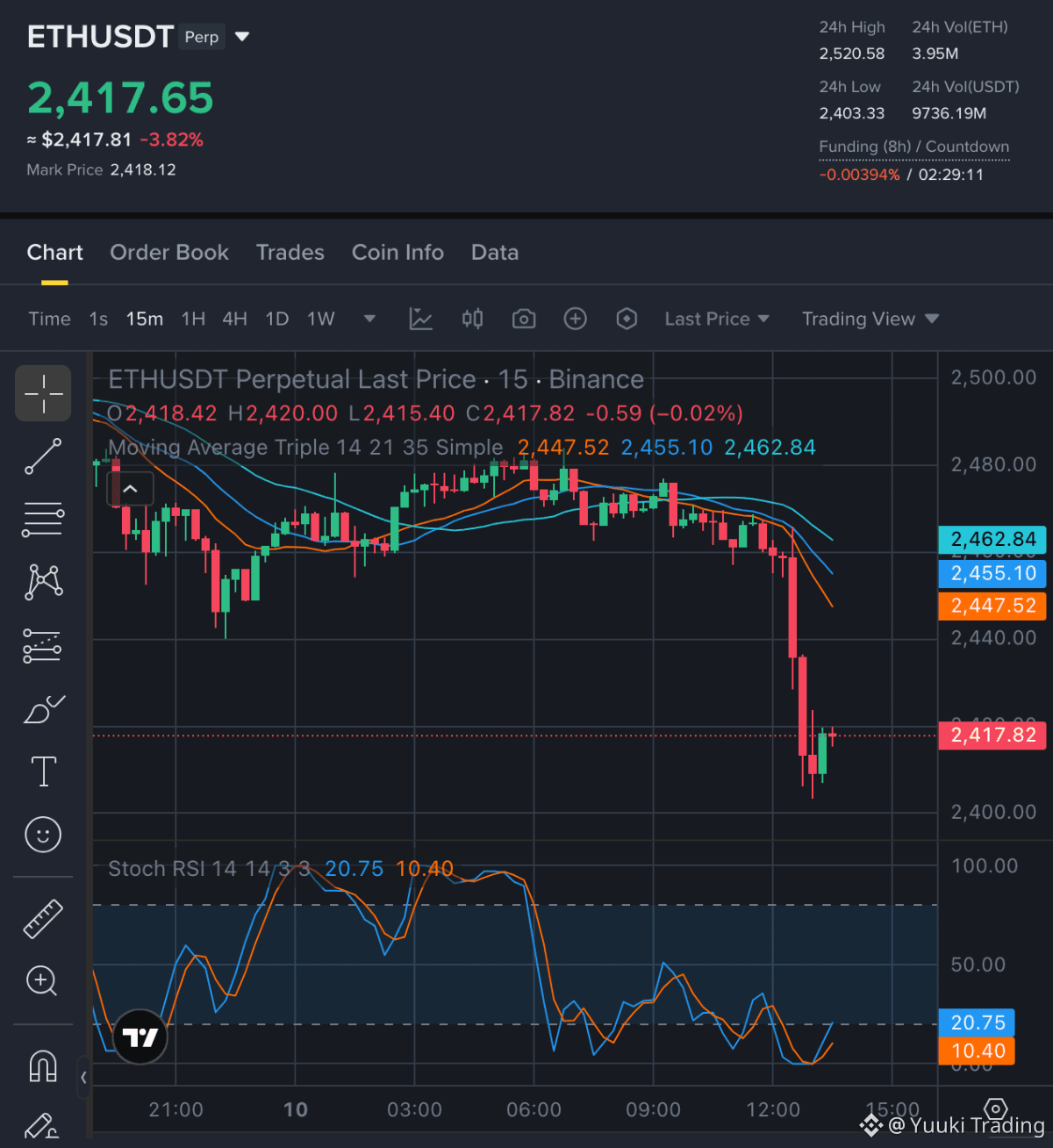
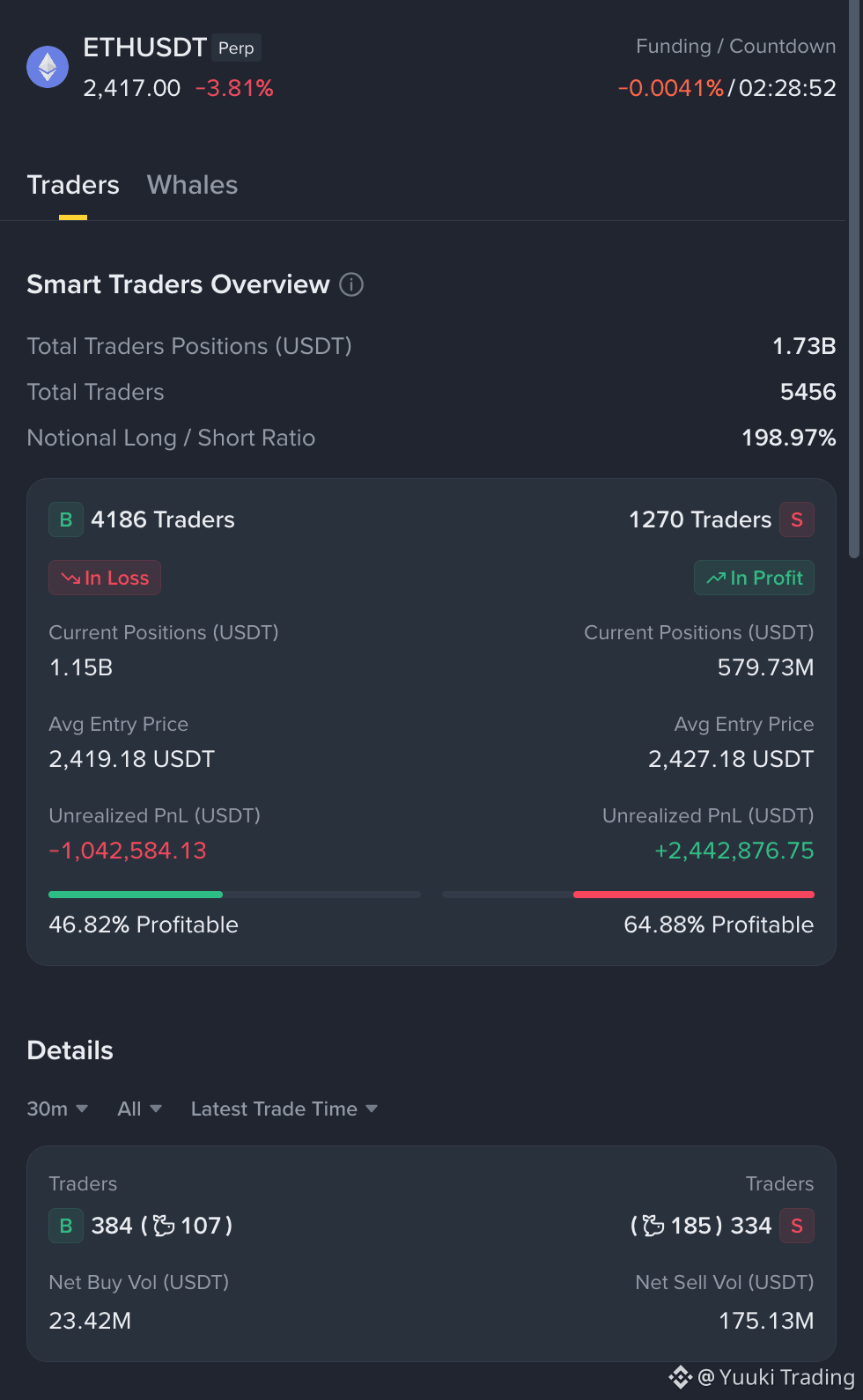
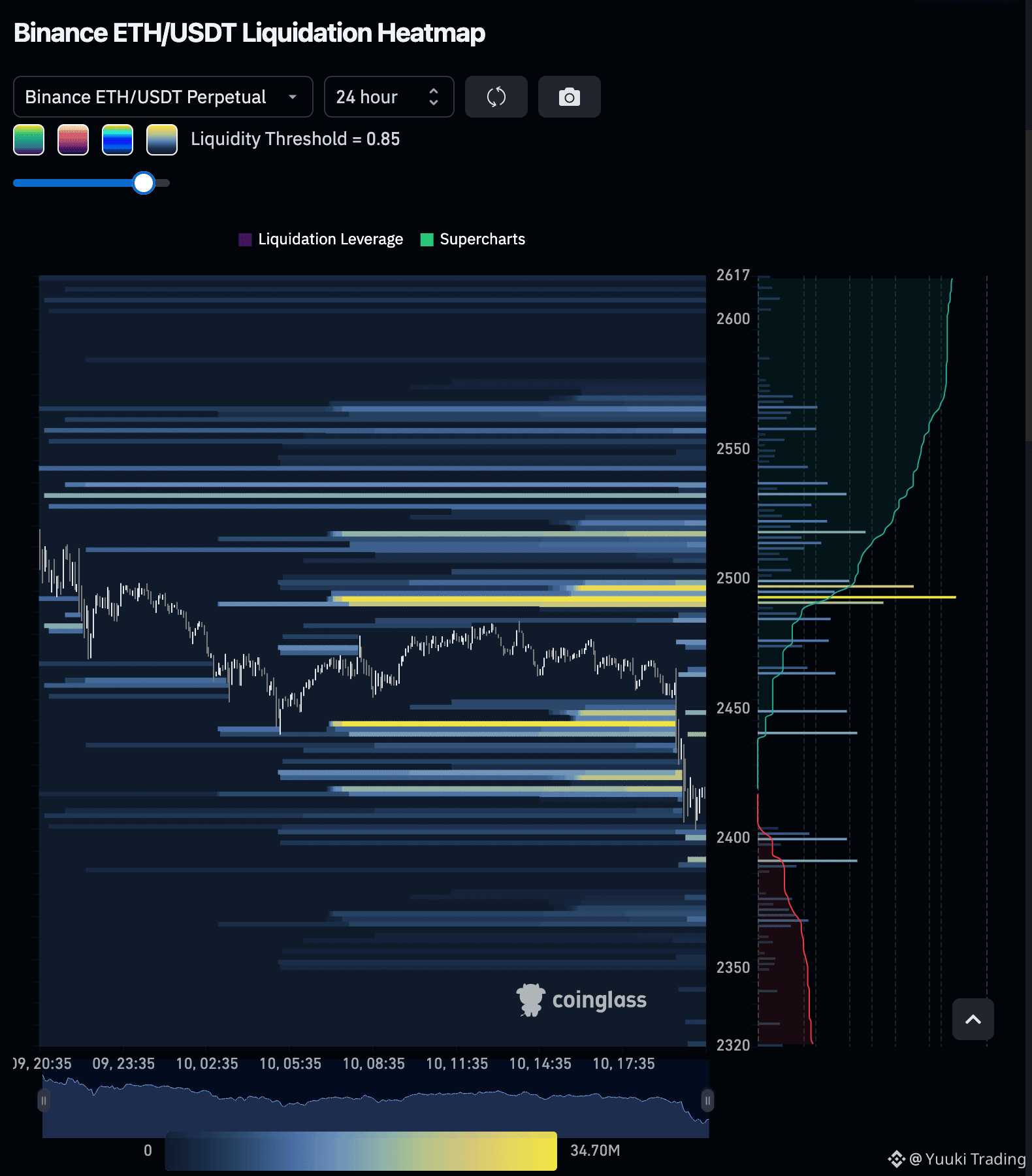
ETH — Les vendeurs conservent l’avantage sur 15m après une forte cassure baissière, bien que la liquidité haussière plus importante maintienne le risque de squeeze élevé.
ETH - SHORT NOW
Zone d’entrée : 2 416,24 — 2 421,08
• TP1 : 2 381,57
• TP2 : 2 356,84
• TP3 : 2 319,76
Stop Loss : 2 468,11
Le prix reste en dessous des trois moyennes mobiles, donc le dernier rebond après survente ressemble à un mouvement correctif. Les positions longues sont plus concentrées, mais elles sont en perte tandis que les shorts gardent l’avantage en rentabilité ; une liquidité haussière concentrée augmente le risque de squeeze sans toutefois remettre en cause le biais baissier.
Avertissement : Ceci ne constitue pas un conseil financier. Faites toujours vos propres recherches et assumez l’entière responsabilité de vos décisions de trading et de vos actifs (DYOR).
Trade $ETH here:
{future}(ETHUSDT)
ETH — Les vendeurs conservent l’avantage sur 15m après une forte cassure baissière, bien que la liquidité haussière plus importante maintienne le risque de squeeze élevé.
ETH - SHORT NOW
Zone d’entrée : 2 416,24 — 2 421,08
• TP1 : 2 381,57
• TP2 : 2 356,84
• TP3 : 2 319,76
Stop Loss : 2 468,11
Le prix reste en dessous des trois moyennes mobiles, donc le dernier rebond après survente ressemble à un mouvement correctif. Les positions longues sont plus concentrées, mais elles sont en perte tandis que les shorts gardent l’avantage en rentabilité ; une liquidité haussière concentrée augmente le risque de squeeze sans toutefois remettre en cause le biais baissier.
Avertissement : Ceci ne constitue pas un conseil financier. Faites toujours vos propres recherches et assumez l’entière responsabilité de vos décisions de trading et de vos actifs (DYOR).
Trade $ETH here:
ETH - SHORT NOW
Zone d’entrée : 2 416,24 — 2 421,08
• TP1 : 2 381,57
• TP2 : 2 356,84
• TP3 : 2 319,76
Stop Loss : 2 468,11
Le prix reste en dessous des trois moyennes mobiles, donc le dernier rebond après survente ressemble à un mouvement correctif. Les positions longues sont plus concentrées, mais elles sont en perte tandis que les shorts gardent l’avantage en rentabilité ; une liquidité haussière concentrée augmente le risque de squeeze sans toutefois remettre en cause le biais baissier.
Avertissement : Ceci ne constitue pas un conseil financier. Faites toujours vos propres recherches et assumez l’entière responsabilité de vos décisions de trading et de vos actifs (DYOR).
Trade $ETH here:
1
1
1k
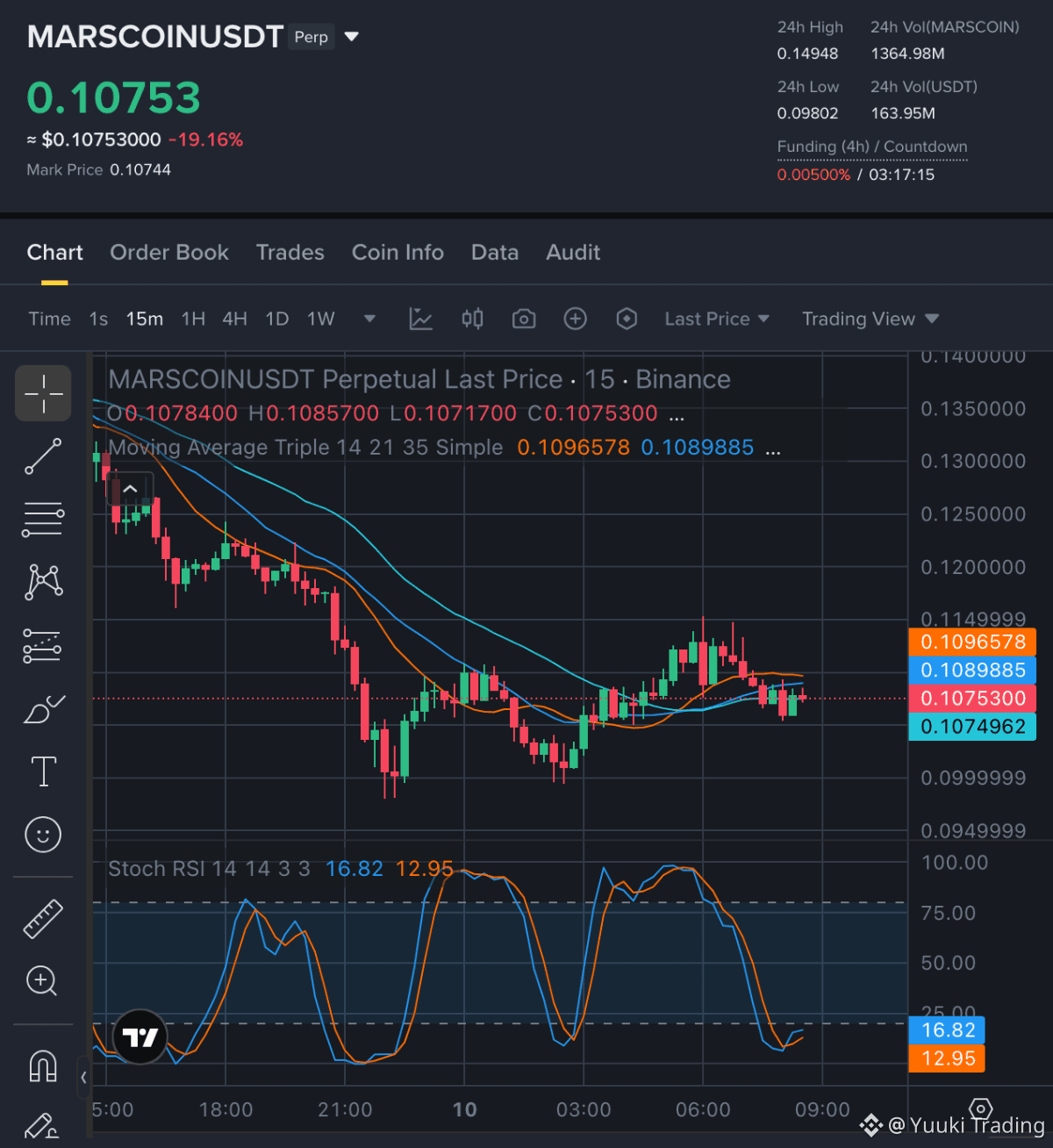
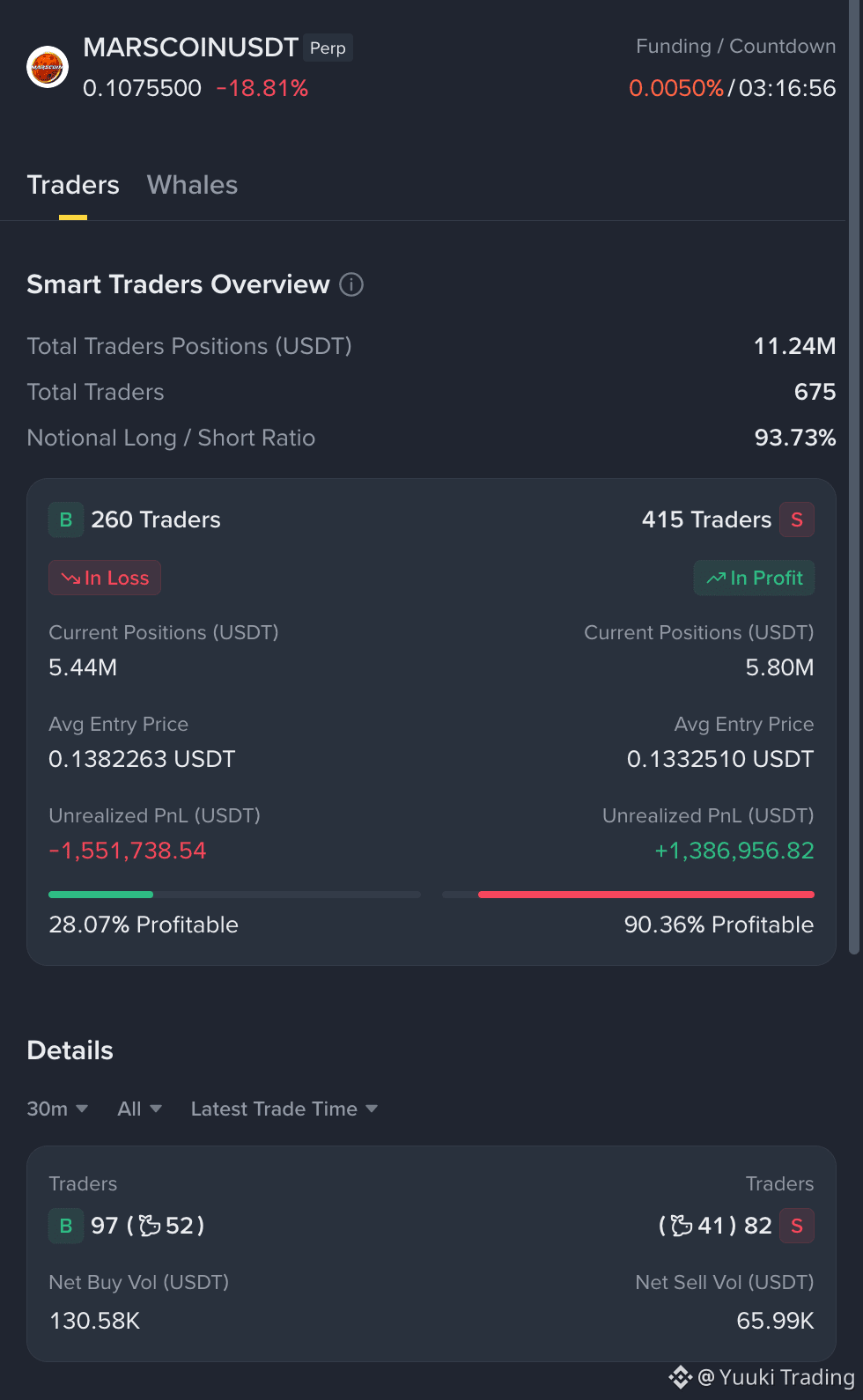
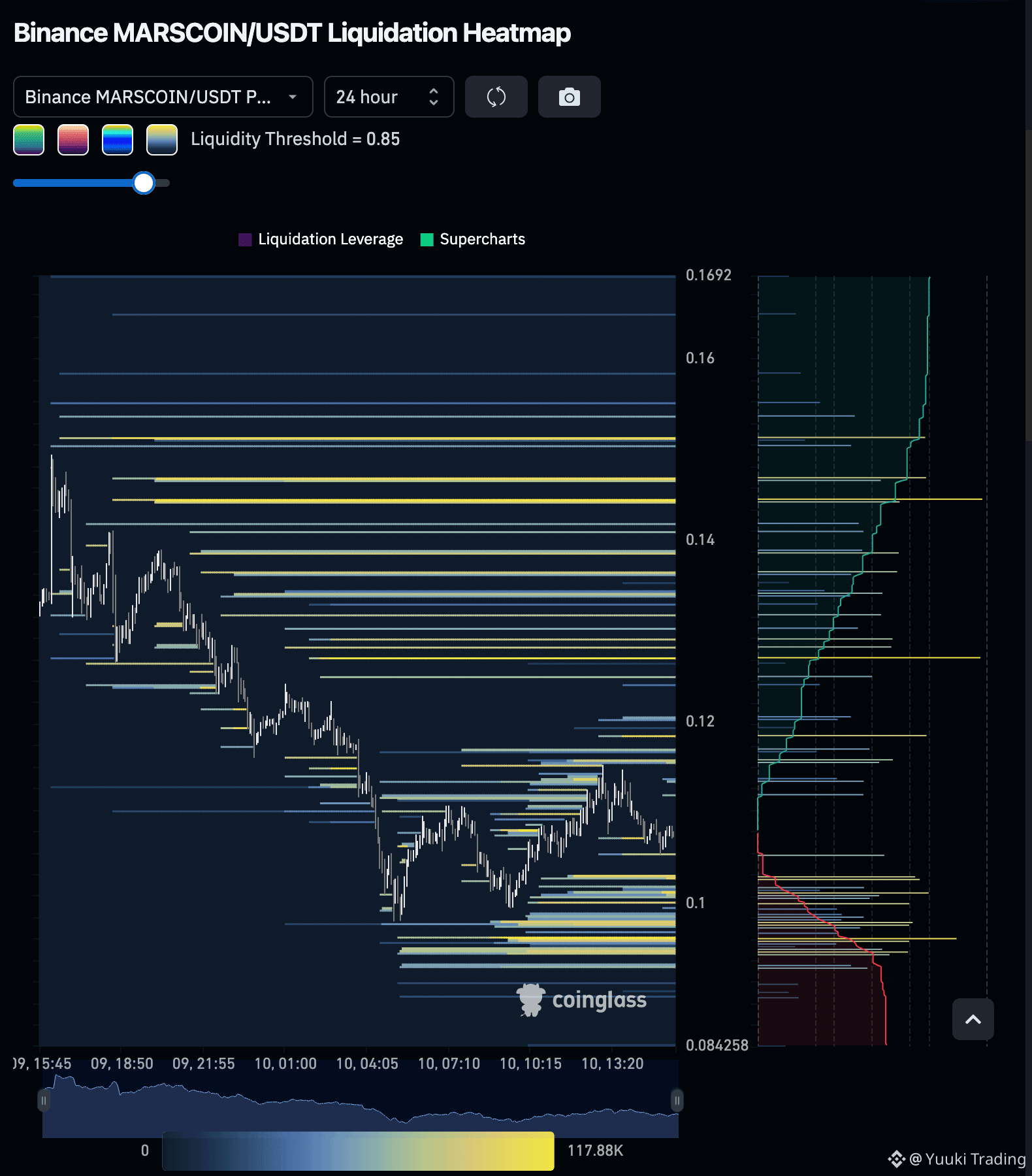
MARSCOIN — Les vendeurs conservent l’avantage de 15m alors que le rebond s’essouffle sous des moyennes plus rapides, tandis que Smart Money reste orienté vers les positions short.
MARSCOIN - SHORT MAINTENANT
Zone d’entrée : 0.10697 — 0.10805
• TP1 : 0.10574
• TP2 : 0.10255
• TP3 : 0.09947
Stop Loss : 0.11148
Le rebond en 15m s’est estompé sous les moyennes mobiles plus rapides, préservant la structure baissière plus large malgré le risque de rebond Stoch RSI survente. Smart Money favorise les vendeurs : 90,36 % des shorts sont rentables ; une liquidité plus dense à proximité, sous le prix, maintient la tendance short.
Avertissement : Ceci n’est pas un conseil financier. Faites toujours vos propres recherches et assumez l’entière responsabilité de vos décisions de trading et de vos actifs (DYOR).
Trade $MarsCoin here :
{future}(MARSCOINUSDT)
MARSCOIN — Les vendeurs conservent l’avantage de 15m alors que le rebond s’essouffle sous des moyennes plus rapides, tandis que Smart Money reste orienté vers les positions short.
MARSCOIN - SHORT MAINTENANT
Zone d’entrée : 0.10697 — 0.10805
• TP1 : 0.10574
• TP2 : 0.10255
• TP3 : 0.09947
Stop Loss : 0.11148
Le rebond en 15m s’est estompé sous les moyennes mobiles plus rapides, préservant la structure baissière plus large malgré le risque de rebond Stoch RSI survente. Smart Money favorise les vendeurs : 90,36 % des shorts sont rentables ; une liquidité plus dense à proximité, sous le prix, maintient la tendance short.
Avertissement : Ceci n’est pas un conseil financier. Faites toujours vos propres recherches et assumez l’entière responsabilité de vos décisions de trading et de vos actifs (DYOR).
Trade $MarsCoin here :
MARSCOIN - SHORT MAINTENANT
Zone d’entrée : 0.10697 — 0.10805
• TP1 : 0.10574
• TP2 : 0.10255
• TP3 : 0.09947
Stop Loss : 0.11148
Le rebond en 15m s’est estompé sous les moyennes mobiles plus rapides, préservant la structure baissière plus large malgré le risque de rebond Stoch RSI survente. Smart Money favorise les vendeurs : 90,36 % des shorts sont rentables ; une liquidité plus dense à proximité, sous le prix, maintient la tendance short.
Avertissement : Ceci n’est pas un conseil financier. Faites toujours vos propres recherches et assumez l’entière responsabilité de vos décisions de trading et de vos actifs (DYOR).
Trade $MarsCoin here :
1
325
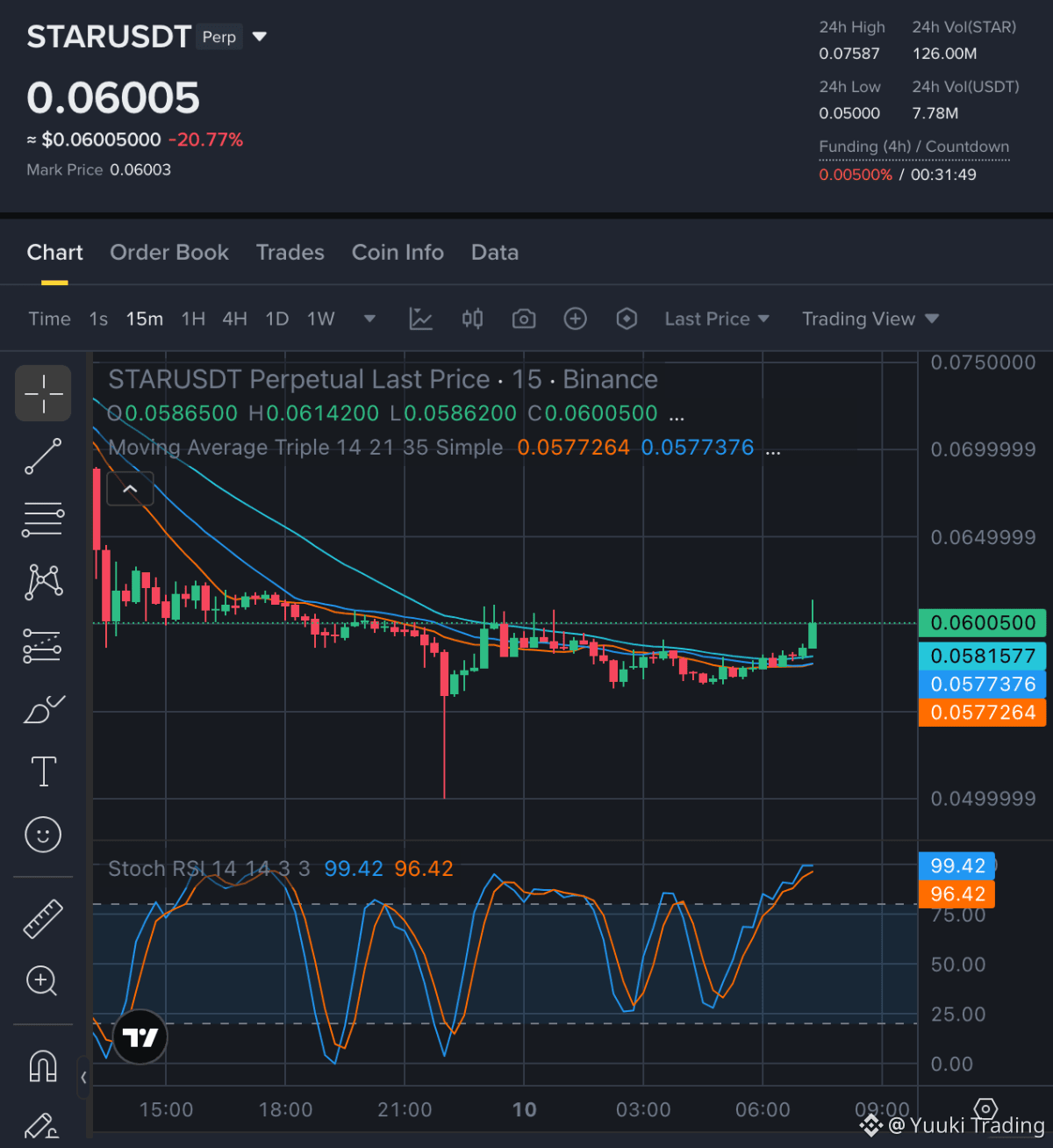
ÉTOILE — Les acheteurs STAR conservent l’avantage à court terme alors que le prix sur 15m franchit à la hausse des moyennes regroupées, tandis qu’une liquidité haussière plus importante renforce la reprise.
STAR - LONG MAINTENANT
Zone d’entrée : 0.05992 — 0.06026
• TP1 : 0.0619
• TP2 : 0.0625
• TP3 : 0.06403
Stop Loss : 0.05812
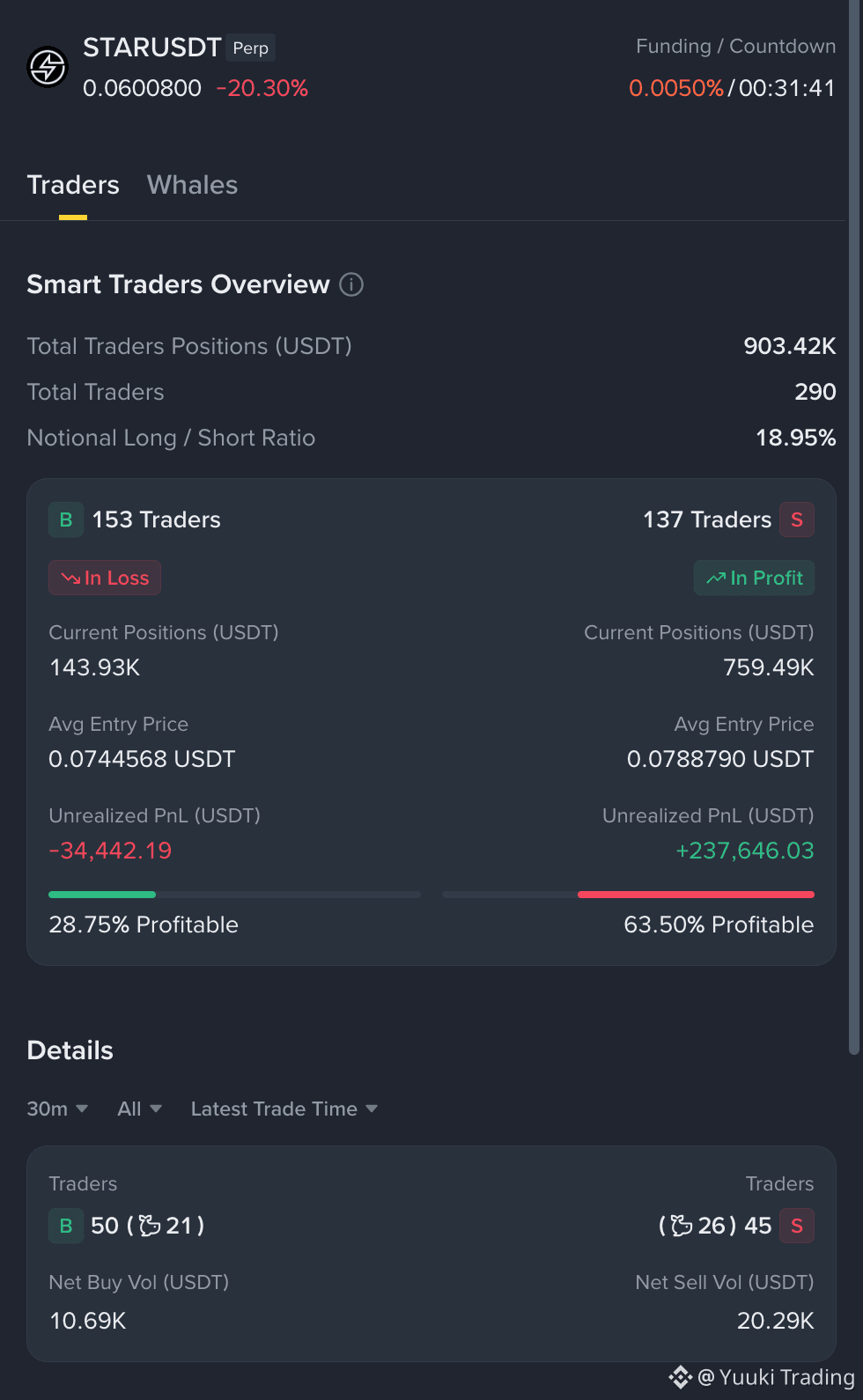
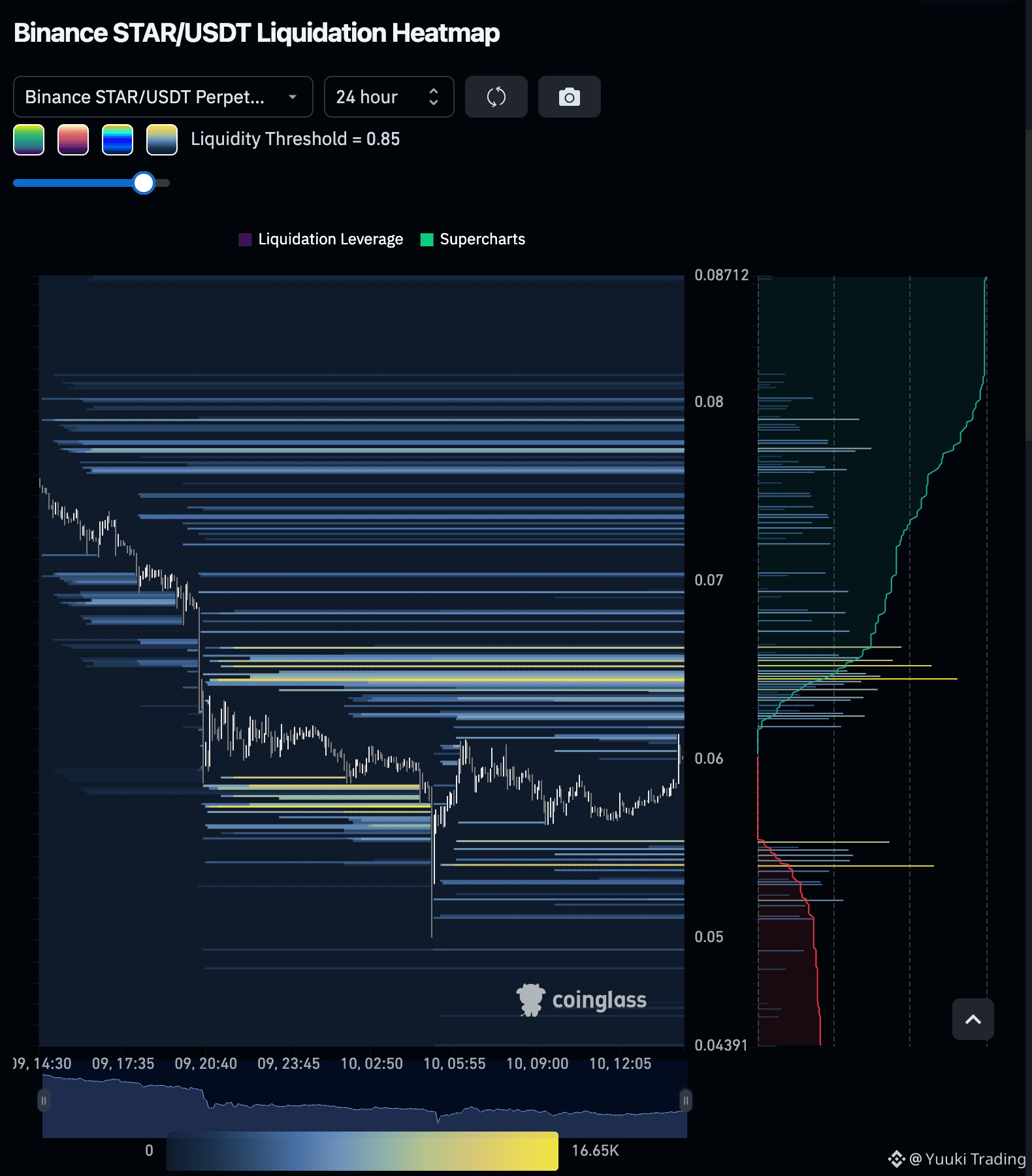
Le rebond sur 15m est impulsif, bien que le Stoch RSI en surachat augmente le risque d’essoufflement. La Smart Money est mitigée mais favorise relativement les vendeurs : les positions longues sont en perte et les shorts sont rentables. Une densité plus élevée de liquidations à la hausse soutient le biais LONG tout en ajoutant un risque de volatilité.
Avertissement : Ceci n’est pas un conseil financier. Faites toujours vos propres recherches et assumez l’entière responsabilité de vos décisions de trading et de vos actifs.
Trade $STAR here:
{future}(STARUSDT)
ÉTOILE — Les acheteurs STAR conservent l’avantage à court terme alors que le prix sur 15m franchit à la hausse des moyennes regroupées, tandis qu’une liquidité haussière plus importante renforce la reprise.
STAR - LONG MAINTENANT
Zone d’entrée : 0.05992 — 0.06026
• TP1 : 0.0619
• TP2 : 0.0625
• TP3 : 0.06403
Stop Loss : 0.05812
Le rebond sur 15m est impulsif, bien que le Stoch RSI en surachat augmente le risque d’essoufflement. La Smart Money est mitigée mais favorise relativement les vendeurs : les positions longues sont en perte et les shorts sont rentables. Une densité plus élevée de liquidations à la hausse soutient le biais LONG tout en ajoutant un risque de volatilité.
Avertissement : Ceci n’est pas un conseil financier. Faites toujours vos propres recherches et assumez l’entière responsabilité de vos décisions de trading et de vos actifs.
Trade $STAR here:
STAR - LONG MAINTENANT
Zone d’entrée : 0.05992 — 0.06026
• TP1 : 0.0619
• TP2 : 0.0625
• TP3 : 0.06403
Stop Loss : 0.05812
Le rebond sur 15m est impulsif, bien que le Stoch RSI en surachat augmente le risque d’essoufflement. La Smart Money est mitigée mais favorise relativement les vendeurs : les positions longues sont en perte et les shorts sont rentables. Une densité plus élevée de liquidations à la hausse soutient le biais LONG tout en ajoutant un risque de volatilité.
Avertissement : Ceci n’est pas un conseil financier. Faites toujours vos propres recherches et assumez l’entière responsabilité de vos décisions de trading et de vos actifs.
Trade $STAR here:
2
216
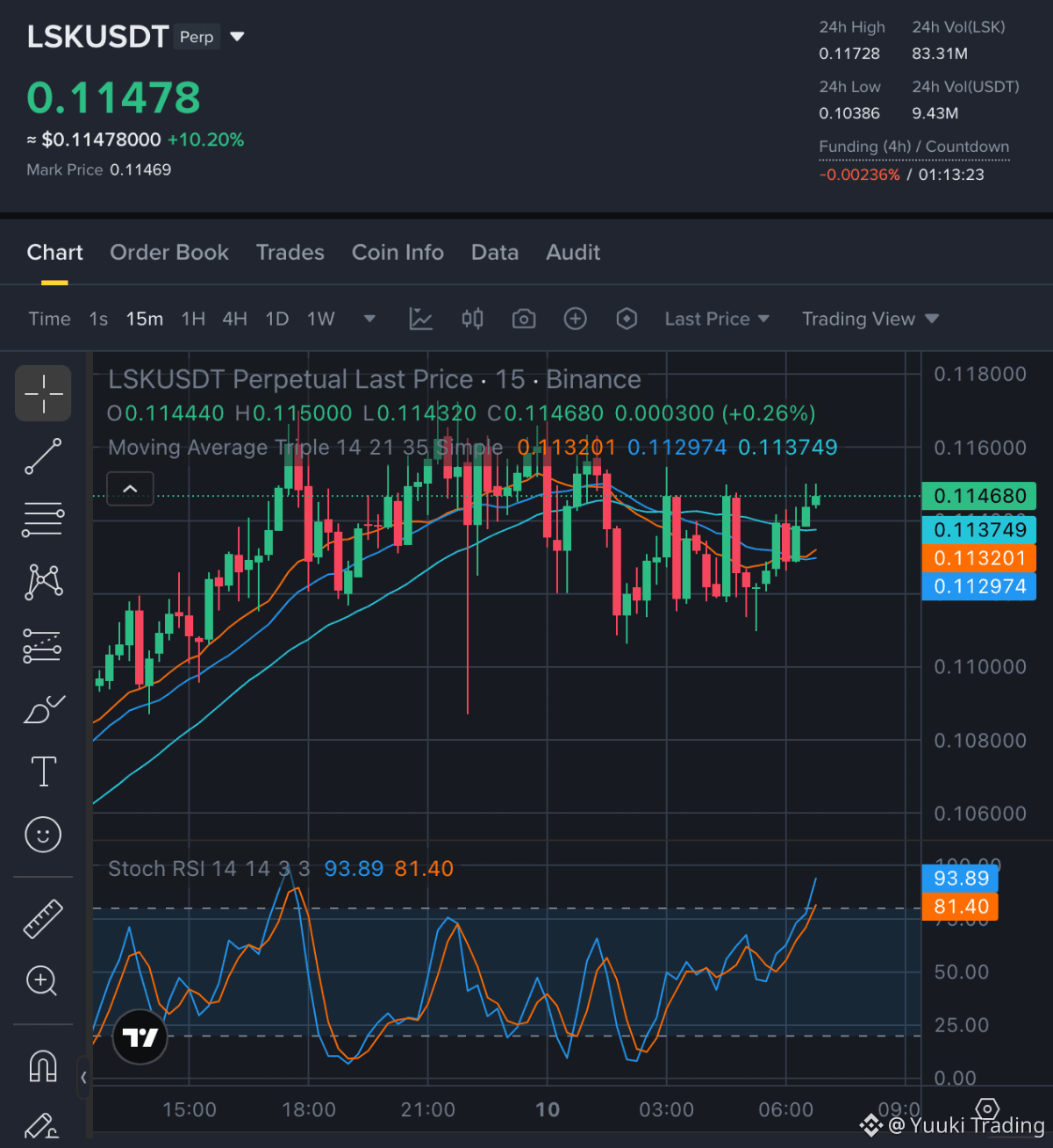
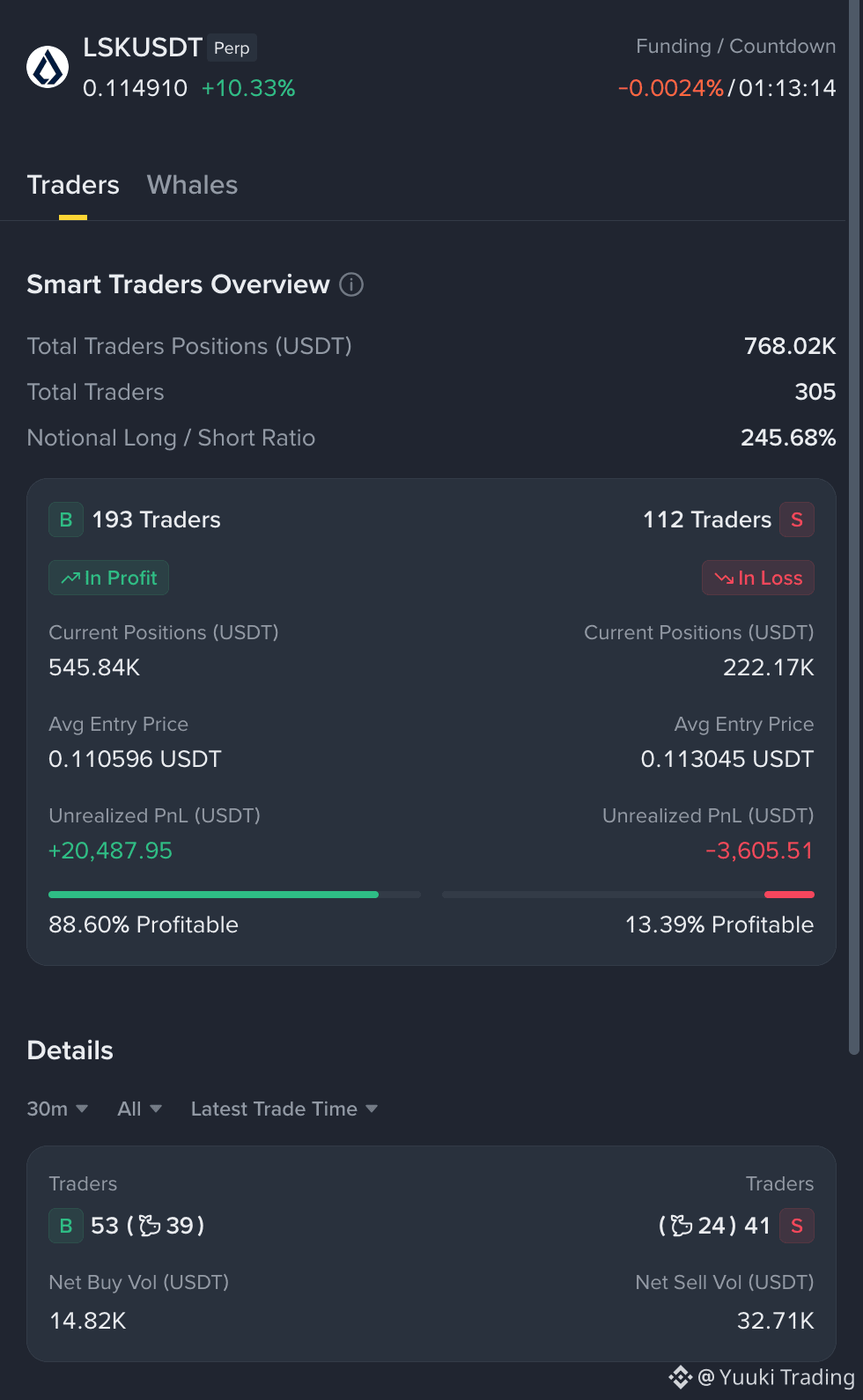
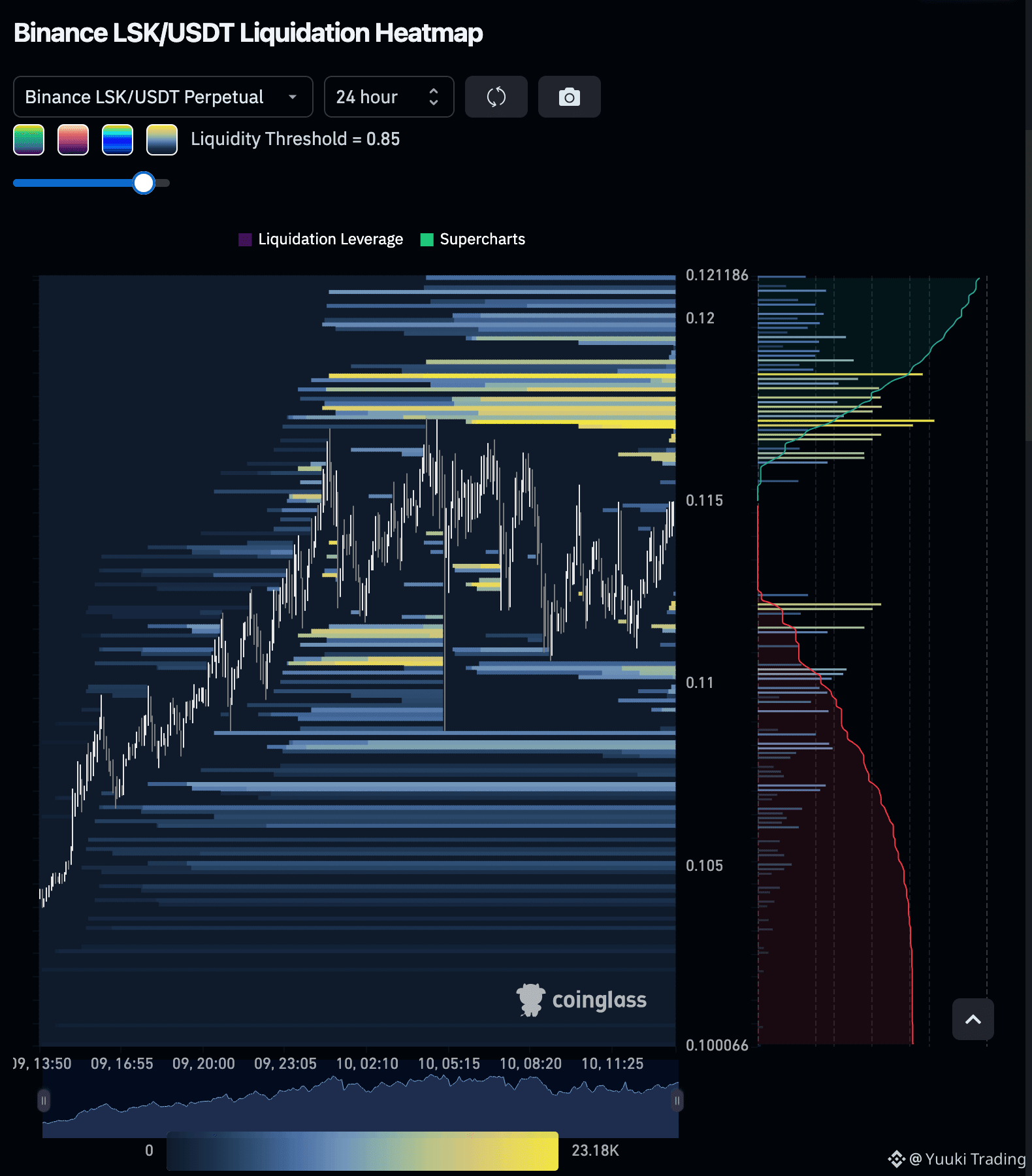
LSK — Les acheteurs de LSK conservent l’avantage sur 15m tandis que l’élan s’accélère, et que les longs de « Smart Money » rentables renforcent la reprise malgré le risque de surchauffe à court terme.
LSK - LONG MAINTENANT
Zone d’entrée : 0.11429 — 0.11499
• TP1 : 0.11728
• TP2 : 0.11966
• TP3 : 0.12268
Stop Loss : 0.11062
Le rebond sur 15m a repris les trois moyennes mobiles, bien que le Stoch RSI en surachat augmente le risque de poursuite. Les traders avisés privilégient les longs rentables tandis que les shorts restent globalement en dessous ; une liquidité dense au-dessus agit comme un aimant de continuation, mais laisse un risque de rejet élevé.
Avertissement : Ceci n’est pas un conseil financier. Faites toujours vos propres recherches et assumez l’entière responsabilité de vos décisions de trading et de vos actifs.
Trade $LSK here:
{future}(LSKUSDT)
LSK — Les acheteurs de LSK conservent l’avantage sur 15m tandis que l’élan s’accélère, et que les longs de « Smart Money » rentables renforcent la reprise malgré le risque de surchauffe à court terme.
LSK - LONG MAINTENANT
Zone d’entrée : 0.11429 — 0.11499
• TP1 : 0.11728
• TP2 : 0.11966
• TP3 : 0.12268
Stop Loss : 0.11062
Le rebond sur 15m a repris les trois moyennes mobiles, bien que le Stoch RSI en surachat augmente le risque de poursuite. Les traders avisés privilégient les longs rentables tandis que les shorts restent globalement en dessous ; une liquidité dense au-dessus agit comme un aimant de continuation, mais laisse un risque de rejet élevé.
Avertissement : Ceci n’est pas un conseil financier. Faites toujours vos propres recherches et assumez l’entière responsabilité de vos décisions de trading et de vos actifs.
Trade $LSK here:
LSK - LONG MAINTENANT
Zone d’entrée : 0.11429 — 0.11499
• TP1 : 0.11728
• TP2 : 0.11966
• TP3 : 0.12268
Stop Loss : 0.11062
Le rebond sur 15m a repris les trois moyennes mobiles, bien que le Stoch RSI en surachat augmente le risque de poursuite. Les traders avisés privilégient les longs rentables tandis que les shorts restent globalement en dessous ; une liquidité dense au-dessus agit comme un aimant de continuation, mais laisse un risque de rejet élevé.
Avertissement : Ceci n’est pas un conseil financier. Faites toujours vos propres recherches et assumez l’entière responsabilité de vos décisions de trading et de vos actifs.
Trade $LSK here:
2
239
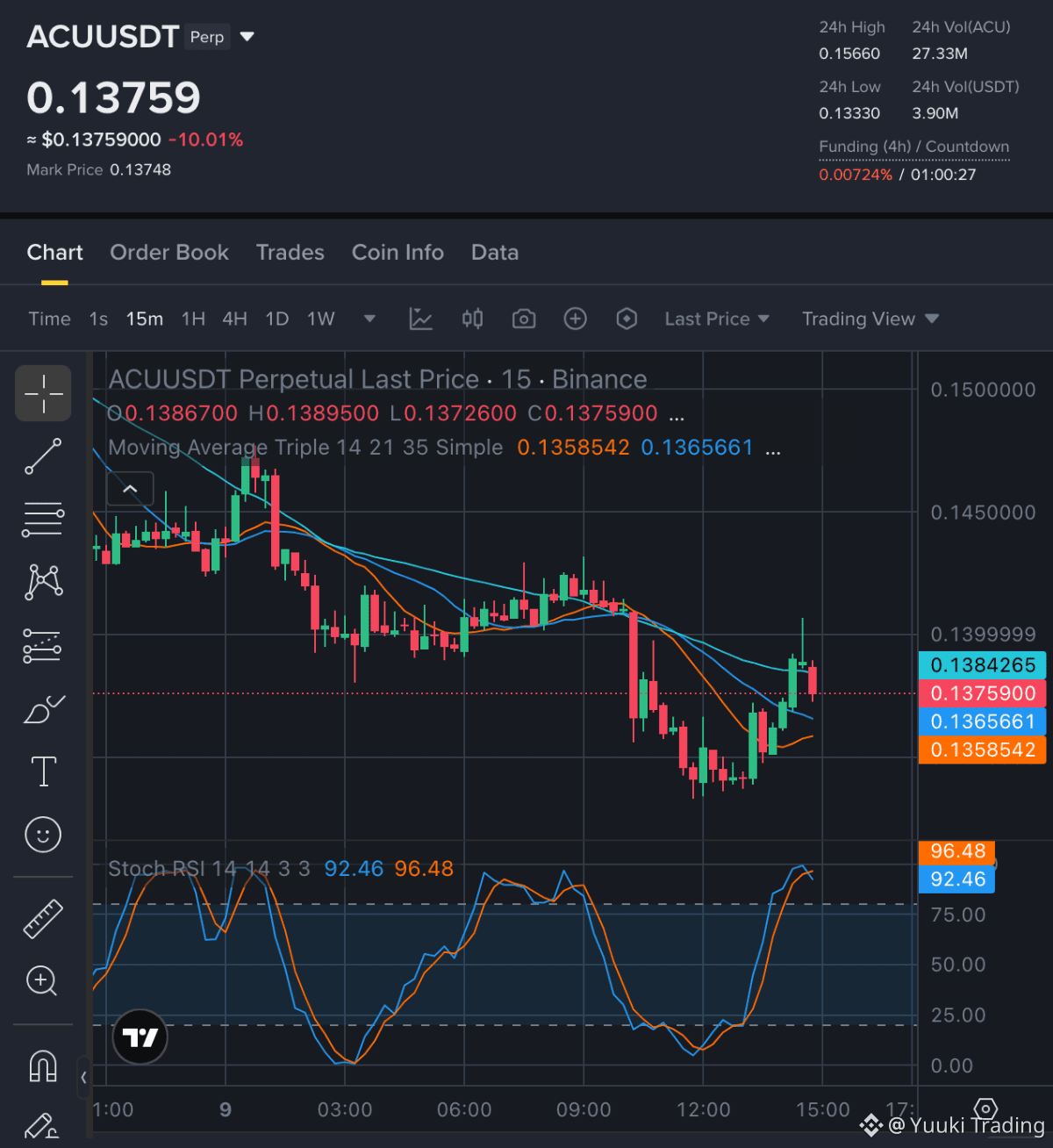
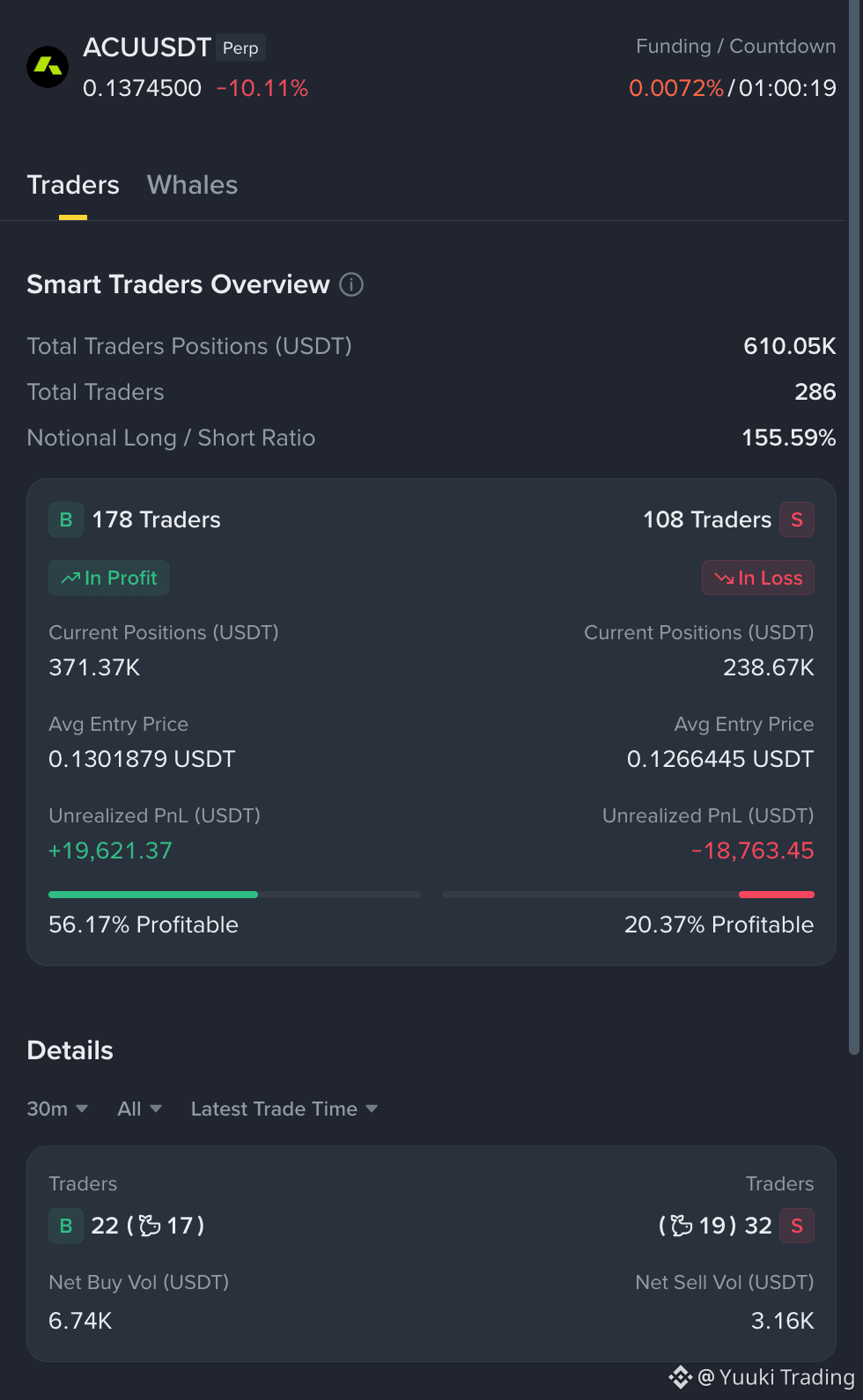
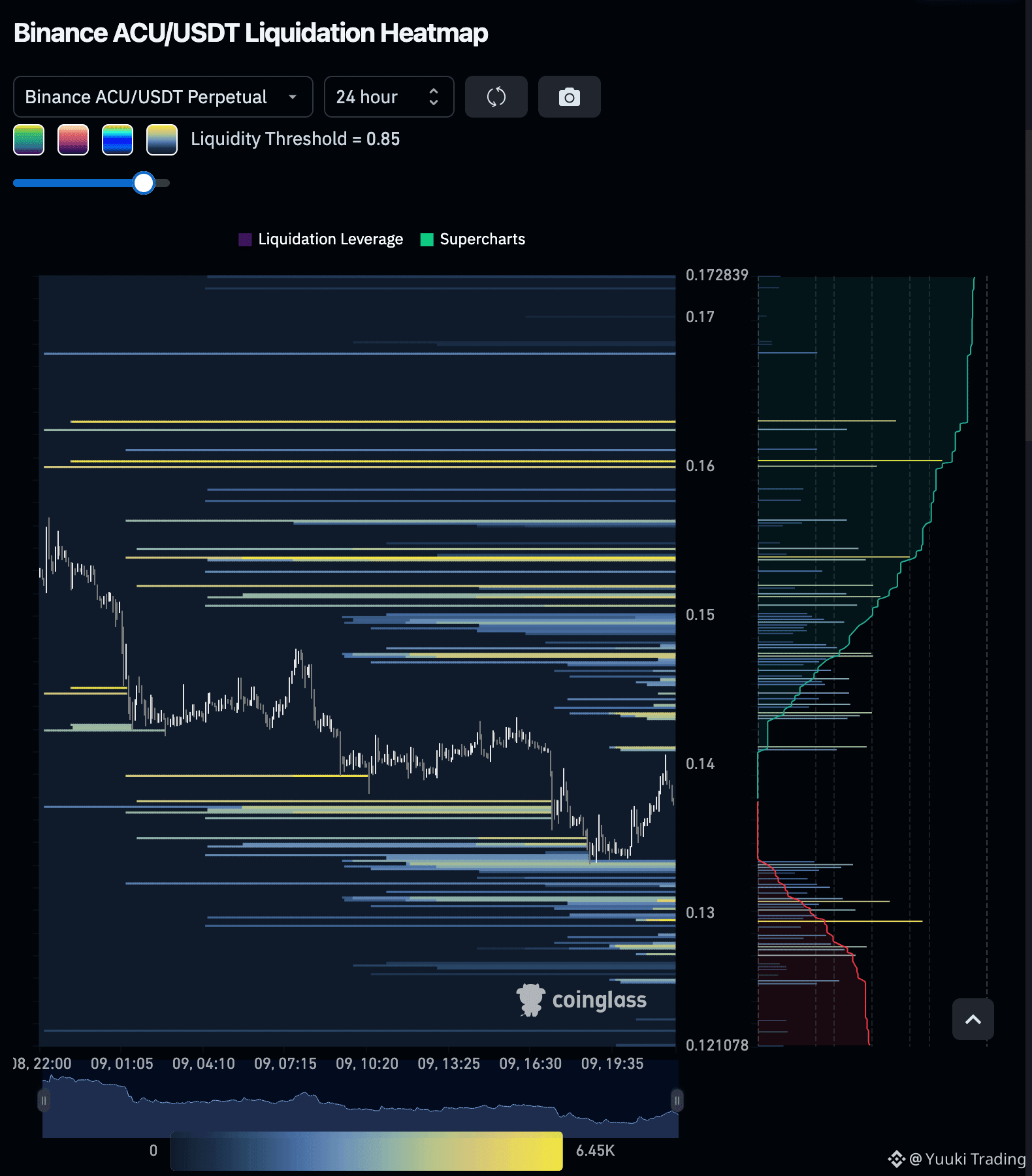
ACU — Les vendeurs d’ACU conservent l’avantage structurel des 15m malgré un rebond suracheté qui rencontre une résistance à la tendance, tandis que des positions longues de Smart Money rentables défient le short.
ACU - SHORT MAINTENANT
Zone d’entrée : 0.13723 — 0.13795
• TP1 : 0.1333
• TP2 : 0.13232
• TP3 : 0.12916
Stop Loss : 0.14181
Le rebond sur 15m est rejeté sous la moyenne mobile plus lente tandis que le Stoch RSI repart de la zone de surachat, maintenant la structure baissière intacte. Le Smart Money privilégie les acheteurs, ce qui affaiblit la confirmation, mais la liquidité à la baisse à proximité soutient le short tandis que des regroupements au-dessus préservent le risque de squeeze.
Avertissement : Ceci n’est pas un conseil financier. Faites toujours vos propres recherches et prenez l’entière responsabilité de vos décisions de trading et de vos actifs.
Trade $ACU here :
{future}(ACUUSDT)
ACU — Les vendeurs d’ACU conservent l’avantage structurel des 15m malgré un rebond suracheté qui rencontre une résistance à la tendance, tandis que des positions longues de Smart Money rentables défient le short.
ACU - SHORT MAINTENANT
Zone d’entrée : 0.13723 — 0.13795
• TP1 : 0.1333
• TP2 : 0.13232
• TP3 : 0.12916
Stop Loss : 0.14181
Le rebond sur 15m est rejeté sous la moyenne mobile plus lente tandis que le Stoch RSI repart de la zone de surachat, maintenant la structure baissière intacte. Le Smart Money privilégie les acheteurs, ce qui affaiblit la confirmation, mais la liquidité à la baisse à proximité soutient le short tandis que des regroupements au-dessus préservent le risque de squeeze.
Avertissement : Ceci n’est pas un conseil financier. Faites toujours vos propres recherches et prenez l’entière responsabilité de vos décisions de trading et de vos actifs.
Trade $ACU here :
ACU - SHORT MAINTENANT
Zone d’entrée : 0.13723 — 0.13795
• TP1 : 0.1333
• TP2 : 0.13232
• TP3 : 0.12916
Stop Loss : 0.14181
Le rebond sur 15m est rejeté sous la moyenne mobile plus lente tandis que le Stoch RSI repart de la zone de surachat, maintenant la structure baissière intacte. Le Smart Money privilégie les acheteurs, ce qui affaiblit la confirmation, mais la liquidité à la baisse à proximité soutient le short tandis que des regroupements au-dessus préservent le risque de squeeze.
Avertissement : Ceci n’est pas un conseil financier. Faites toujours vos propres recherches et prenez l’entière responsabilité de vos décisions de trading et de vos actifs.
Trade $ACU here :
2
82
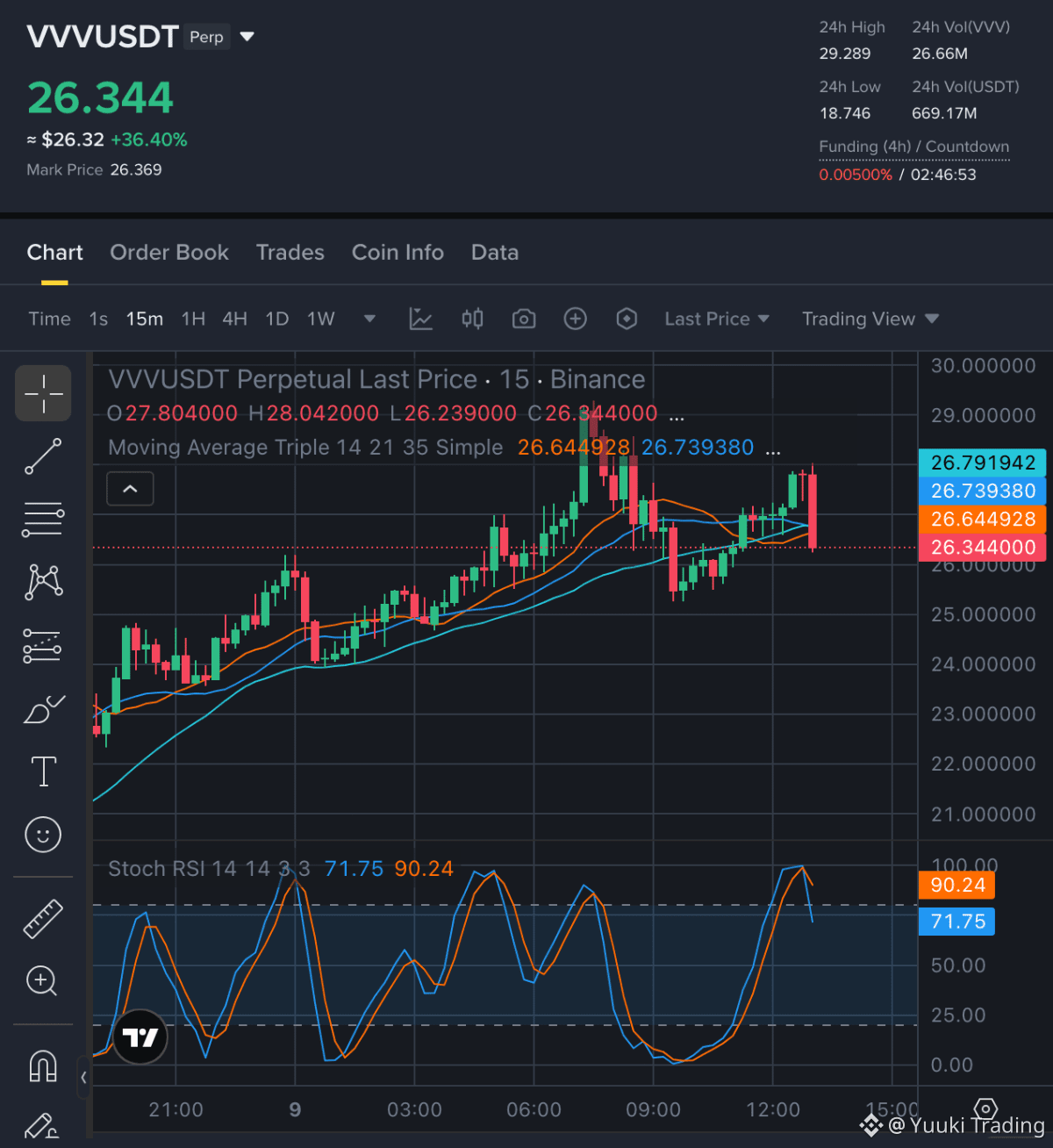
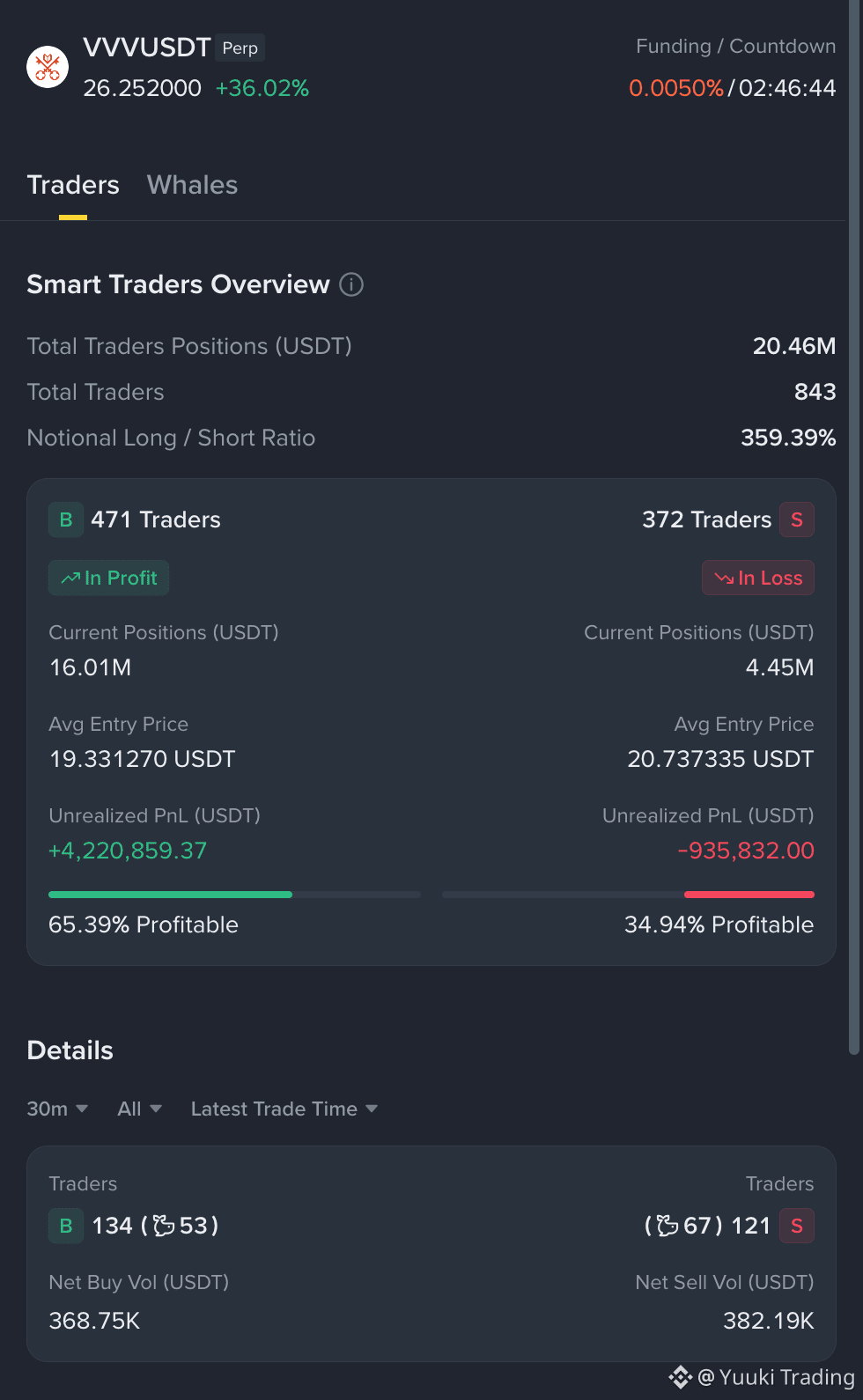
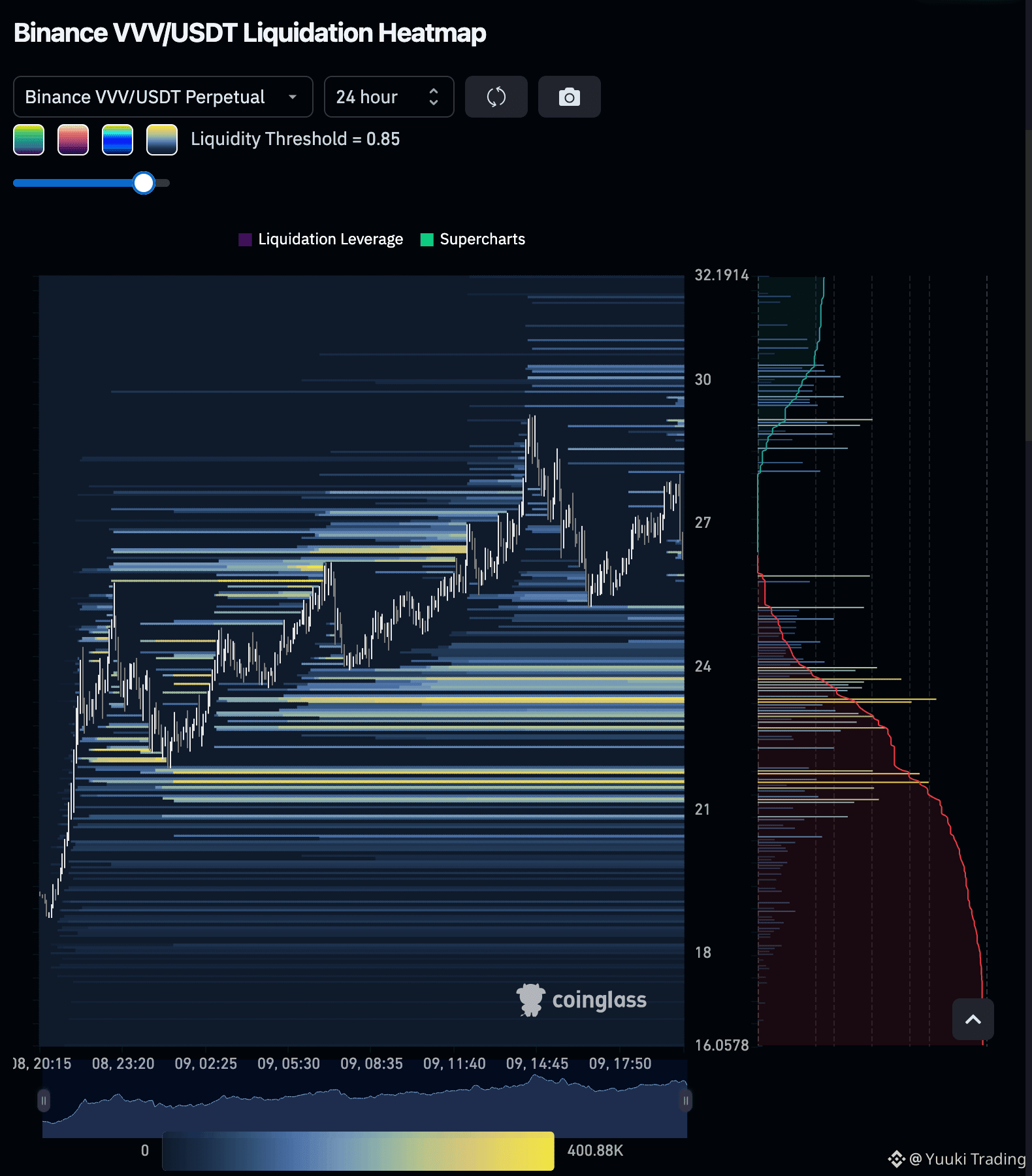
VVV — Les vendeurs prennent l’avantage à court terme après un rejet net de 15m provenant d’un momentum plus élevé, avec une liquidité baissière dense renforçant la trajectoire baissière.
VVV - COURT-CIRCUIT MAINTENANT
Zone d’entrée : 26.229 — 26.493
• TP1 : 25.254
• TP2 : 23.93
• TP3 : 22.923
Stop Loss : 28.08
Le rebond sur 15m a été rejeté sous le groupe des moyennes mobiles tandis que le Stoch RSI se retournait à la baisse depuis la zone de surachat, favorisant un nouvel affaiblissement. Les Smart Money privilégient des longs rentables, une confirmation qui s’affaiblit, mais une liquidité baissière plus lourde maintient la préférence pour le short, tandis que des poches de liquidité à la hausse préservent le risque de squeeze.
Avertissement : Ceci ne constitue pas un conseil financier. Faites toujours vos propres recherches et assumez l’entière responsabilité de vos décisions de trading et de vos actifs.
Trade $VVV here:
{future}(VVVUSDT)
VVV — Les vendeurs prennent l’avantage à court terme après un rejet net de 15m provenant d’un momentum plus élevé, avec une liquidité baissière dense renforçant la trajectoire baissière.
VVV - COURT-CIRCUIT MAINTENANT
Zone d’entrée : 26.229 — 26.493
• TP1 : 25.254
• TP2 : 23.93
• TP3 : 22.923
Stop Loss : 28.08
Le rebond sur 15m a été rejeté sous le groupe des moyennes mobiles tandis que le Stoch RSI se retournait à la baisse depuis la zone de surachat, favorisant un nouvel affaiblissement. Les Smart Money privilégient des longs rentables, une confirmation qui s’affaiblit, mais une liquidité baissière plus lourde maintient la préférence pour le short, tandis que des poches de liquidité à la hausse préservent le risque de squeeze.
Avertissement : Ceci ne constitue pas un conseil financier. Faites toujours vos propres recherches et assumez l’entière responsabilité de vos décisions de trading et de vos actifs.
Trade $VVV here:
VVV - COURT-CIRCUIT MAINTENANT
Zone d’entrée : 26.229 — 26.493
• TP1 : 25.254
• TP2 : 23.93
• TP3 : 22.923
Stop Loss : 28.08
Le rebond sur 15m a été rejeté sous le groupe des moyennes mobiles tandis que le Stoch RSI se retournait à la baisse depuis la zone de surachat, favorisant un nouvel affaiblissement. Les Smart Money privilégient des longs rentables, une confirmation qui s’affaiblit, mais une liquidité baissière plus lourde maintient la préférence pour le short, tandis que des poches de liquidité à la hausse préservent le risque de squeeze.
Avertissement : Ceci ne constitue pas un conseil financier. Faites toujours vos propres recherches et assumez l’entière responsabilité de vos décisions de trading et de vos actifs.
Trade $VVV here:
1
177
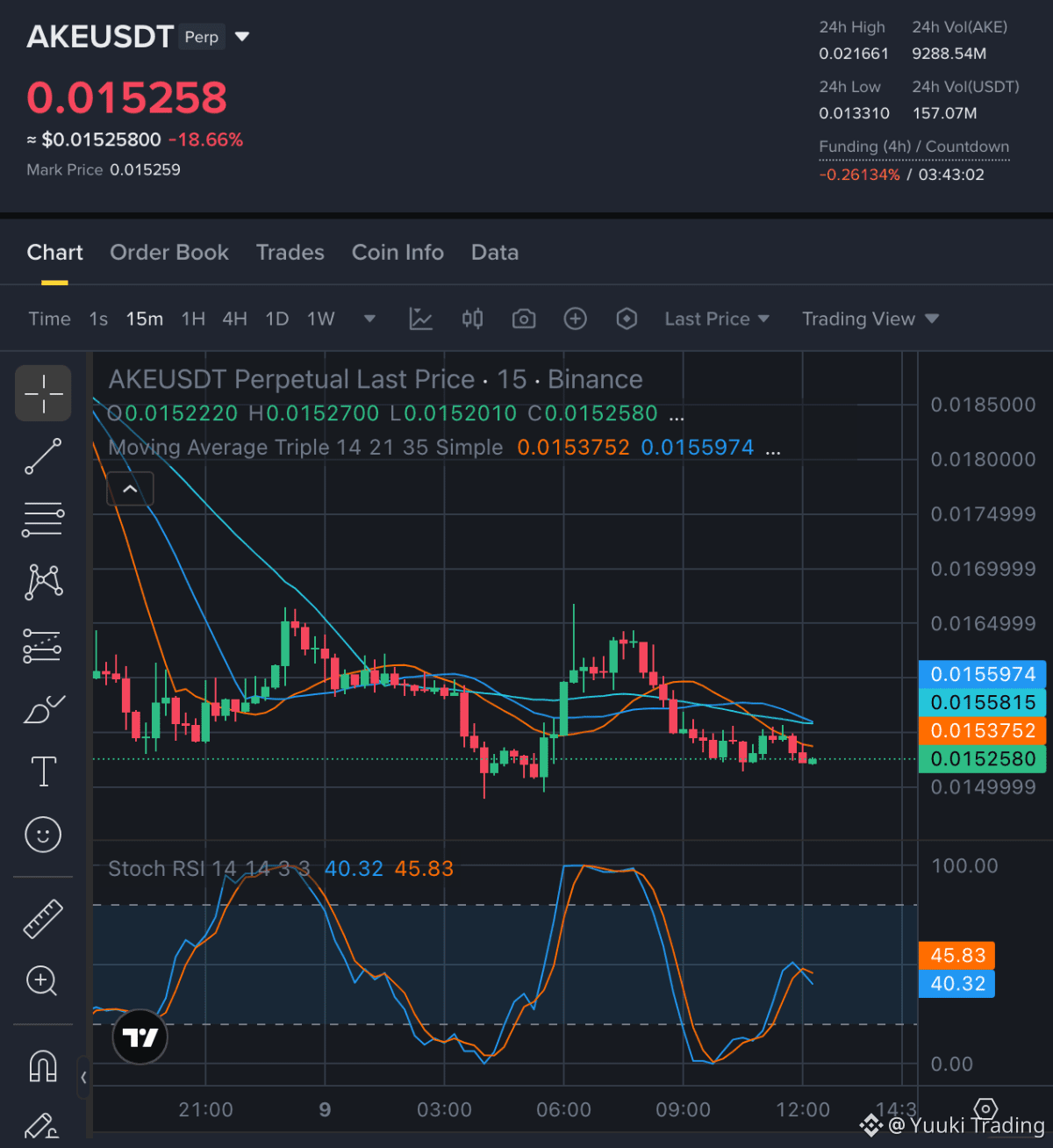
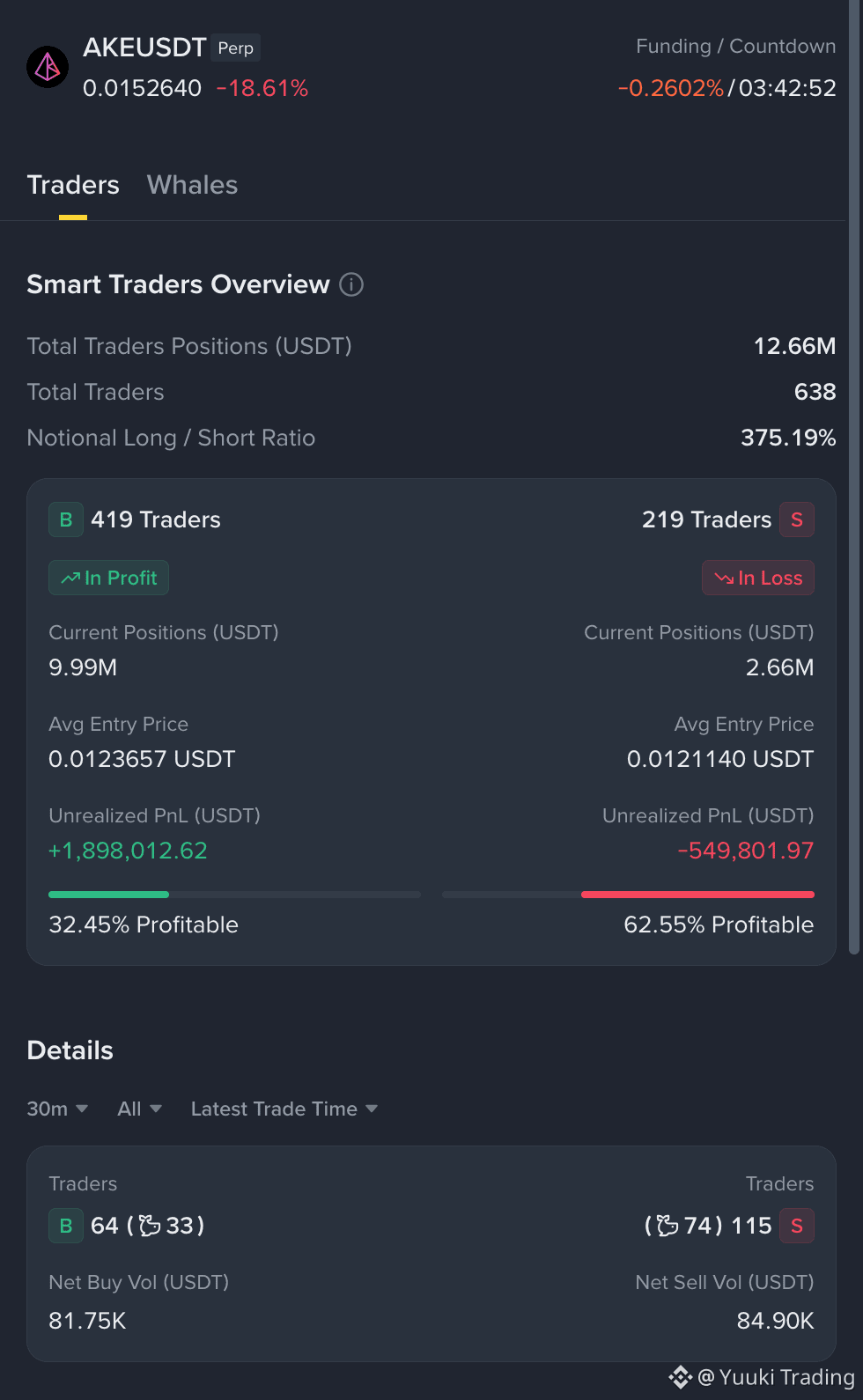
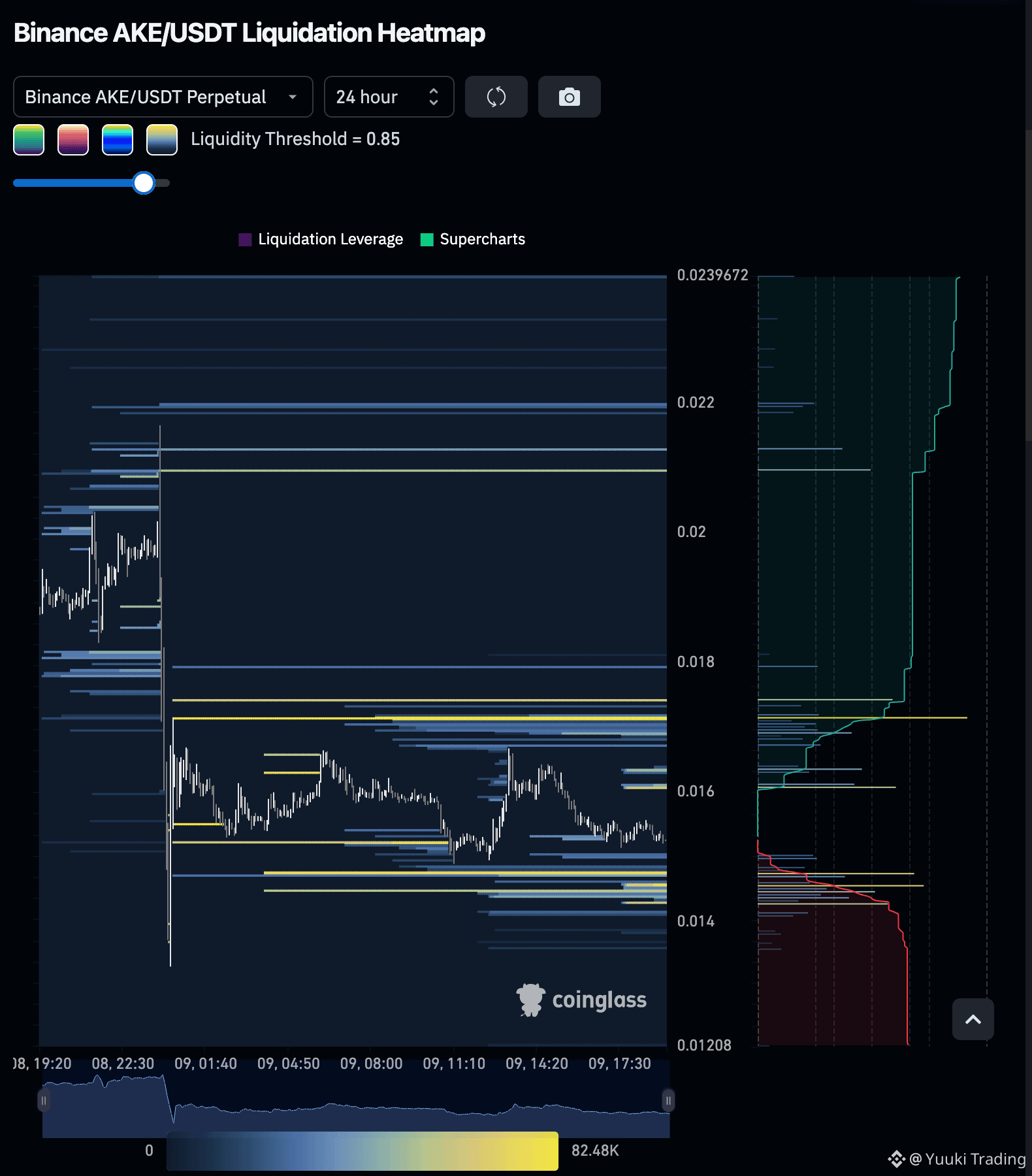
AKE — Les vendeurs AKE conservent l’avantage des 15 min tandis que le prix reste sous les moyennes clés, bien que des positions Smart Money mitigées limitent la confirmation directionnelle.
AKE - SHORT NOW
Zone d’entrée : 0.015215 — 0.015307
• TP1 : 0.014893
• TP2 : 0.014824
• TP3 : 0.014563
Stop Loss : 0.01561
Le prix reste sous les moyennes mobiles alors que le dernier rebond sur 15 min s’estompe, préservant une structure baissière. Le Smart Money est mitigé : exposition longue rentable mais shorts en perte. La liquidité à la baisse soutient la tendance short, tandis que des grappes à la hausse ajoutent un risque de squeeze.
Avertissement : Ceci ne constitue pas un conseil financier. Faites toujours vos propres recherches et assumez l’entière responsabilité de vos décisions de trading et de vos actifs.
Trade $AKE here :
{future}(AKEUSDT)
AKE — Les vendeurs AKE conservent l’avantage des 15 min tandis que le prix reste sous les moyennes clés, bien que des positions Smart Money mitigées limitent la confirmation directionnelle.
AKE - SHORT NOW
Zone d’entrée : 0.015215 — 0.015307
• TP1 : 0.014893
• TP2 : 0.014824
• TP3 : 0.014563
Stop Loss : 0.01561
Le prix reste sous les moyennes mobiles alors que le dernier rebond sur 15 min s’estompe, préservant une structure baissière. Le Smart Money est mitigé : exposition longue rentable mais shorts en perte. La liquidité à la baisse soutient la tendance short, tandis que des grappes à la hausse ajoutent un risque de squeeze.
Avertissement : Ceci ne constitue pas un conseil financier. Faites toujours vos propres recherches et assumez l’entière responsabilité de vos décisions de trading et de vos actifs.
Trade $AKE here :
AKE - SHORT NOW
Zone d’entrée : 0.015215 — 0.015307
• TP1 : 0.014893
• TP2 : 0.014824
• TP3 : 0.014563
Stop Loss : 0.01561
Le prix reste sous les moyennes mobiles alors que le dernier rebond sur 15 min s’estompe, préservant une structure baissière. Le Smart Money est mitigé : exposition longue rentable mais shorts en perte. La liquidité à la baisse soutient la tendance short, tandis que des grappes à la hausse ajoutent un risque de squeeze.
Avertissement : Ceci ne constitue pas un conseil financier. Faites toujours vos propres recherches et assumez l’entière responsabilité de vos décisions de trading et de vos actifs.
Trade $AKE here :
1
252
Connectez-vous pour découvrir plus de contenu
Rejoignez la communauté mondiale des adeptes de cryptomonnaies sur Binance Square
⚡️ Suviez les dernières informations importantes sur les cryptomonnaies.
💬 Jugé digne de confiance par la plus grande plateforme d’échange de cryptomonnaies au monde.
👍 Découvrez les connaissances que partagent les créateurs vérifiés.
Adresse e-mail/Nº de téléphone
Sujets d’actualité
SECReceivesGrayscaleLitecoinTrustETFFiling
65,807 vues
1,201 mentions
#secreceivesgrayscalelitecointrustetffiling
LA SEC DÉPOSE UN DOSSIER POUR UN ETF SPOT SUR LE LITECOIN EN GRAYSCALE : LTC VIENT D’ATTIRER ENCORE PLUS L’ATTENTION 🚨
Le marché avançait tranquillement quand une autre actualité sur le Litecoin a fait surface. Pour les traders qui observent de loin, c’est le genre de dépôt qui vous fait faire une pause et vous demander : l’accès institutionnel se rapproche-t-il ?
Le Grayscale Litecoin Trust a franchi une nouvelle étape vers une structure d’ETF, avec des dépôts récents liés à la transition proposée et au processus d’inscription sur le NYSE Arca. Le dossier de la SEC montre des démarches antérieures autour de la proposition de Grayscale concernant le Litecoin, tandis que les dernières activités de dépôt maintiennent l’histoire en vie.
Le point important, c’est qu’un dépôt n’est pas une approbation. Les investisseurs doivent distinguer les progrès réglementaires des attentes d’un lancement immédiat d’ETF.
Mon avis : l’histoire la plus marquante, c’est l’accessibilité. Une structure d’ETF pourrait potentiellement rendre l’exposition au LTC plus simple pour les investisseurs traditionnels qui préfèrent des produits de marché régulés plutôt que de détenir directement des crypto-monnaies.
Le Litecoin se négocie actuellement autour de 53,69 $ sur Binance, avec un mouvement modeste sur 24 heures. Cela rend l’évolution réglementaire plus intéressante que le simple fait de chercher une réaction de prix portée par un titre.
Le vrai test arrive ensuite : décisions réglementaires, demande du marché, liquidité, et la question de savoir si l’intérêt institutionnel suit réellement la paperasse.
Un dépôt peut ouvrir la porte, mais la demande décide de ce qui se passe une fois la porte ouverte.
❓Pensez-vous qu’un ETF sur le Litecoin de Grayscale pourrait changer de manière significative la demande institutionnelle pour le LTC ?
Avertissement : ceci est fourni uniquement à des fins d’information et ne constitue pas un conseil financier. Les actifs crypto sont volatils et les résultats réglementaires sont incertains.
#Litecoin #CryptoETF #GrowWithSAC $LTC $ETH $SOL
#SECReceivesGrayscaleLitecoinTrustETFFiling
Sienna Leo-你真棒-带我走
·2 mentions J’aime
·2.1k vues
ClarityActFacesProceduralVoteSept15
188,832 vues
2,107 mentions
US10YearTreasuryYieldNears5%
65,366 vues
1,160 mentions