

珍妮丝 kgf
5.1k Publications

珍妮丝 kgf
Signaler
Bloquer l’utilisateur
Ouvert au trading
Trade régulièrement
9.5 mois
438 Suivis
7.4K+ Abonnés
1.0K+ J’aime
Publications
Portefeuille
Tous
Citations
Direct
PINNED
·
--
Baissier
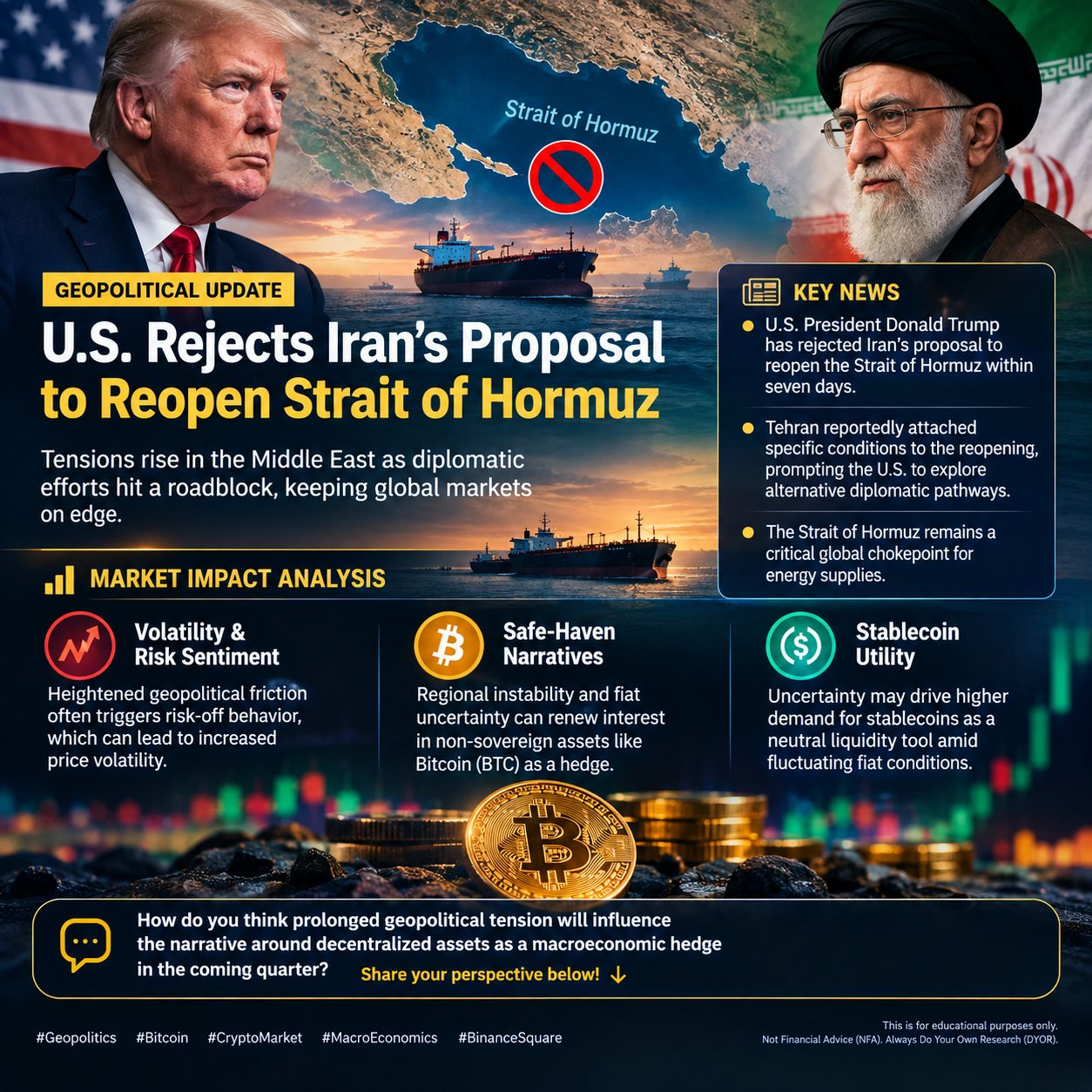
#trumprejectsiranhormuzreopening Geopolitical Update: U.S. Rejects Iran’s Proposal to Reopen Strait of Hormuz 🌍
Global markets are closely monitoring renewed Middle East tensions as diplomatic efforts face a significant roadblock. Here is a breakdown of the latest developments and their potential implications for the digital asset ecosystem.
📰 Core News
• U.S. President Donald Trump has officially rejected a recent proposal from Iran to reopen the Strait of Hormuz within a seven-day timeframe [[1]].
• The decision follows reports that Tehran attached specific conditions to the reopening, prompting the U.S. to explore alternative diplomatic pathways for a settlement [[5]].
• The Strait of Hormuz remains a critical global chokepoint for energy supplies, making its operational status a key variable for worldwide market stability.
📊 Market Impact Analysis
• Volatility & Risk Sentiment Heightened geopolitical friction often triggers short-term risk-off behavior across traditional and digital markets, which can lead to increased price volatility.
• Safe-Haven Narratives Historically, regional instability and fiat currency uncertainty can renew interest in non-sovereign, decentralized assets like Bitcoin (BTC) as a macroeconomic hedge.
• Stablecoin Utility Uncertainty in global energy and traditional markets may drive increased demand for stablecoins as a neutral liquidity preservation tool amid fluctuating fiat conditions.
💬 Join the Discussion
How do you think prolonged geopolitical tension will influence the narrative around decentralized assets as a macroeconomic hedge in the coming quarter? Share your perspective below! 👇
#Geopolitics #Bitcoin #CryptoMarket #MacroEconomics #BinanceSquare
This is for educational purposes only. Not Financial Advice (NFA). Always Do Your Own Research (DYOR).
$SAGA $RARE $ONE
{future}(ONEUSDT)
{future}(RAREUSDT)
{future}(SAGAUSDT)
#trumprejectsiranhormuzreopening Geopolitical Update: U.S. Rejects Iran’s Proposal to Reopen Strait of Hormuz 🌍
Global markets are closely monitoring renewed Middle East tensions as diplomatic efforts face a significant roadblock. Here is a breakdown of the latest developments and their potential implications for the digital asset ecosystem.
📰 Core News
• U.S. President Donald Trump has officially rejected a recent proposal from Iran to reopen the Strait of Hormuz within a seven-day timeframe [[1]].
• The decision follows reports that Tehran attached specific conditions to the reopening, prompting the U.S. to explore alternative diplomatic pathways for a settlement [[5]].
• The Strait of Hormuz remains a critical global chokepoint for energy supplies, making its operational status a key variable for worldwide market stability.
📊 Market Impact Analysis
• Volatility & Risk Sentiment Heightened geopolitical friction often triggers short-term risk-off behavior across traditional and digital markets, which can lead to increased price volatility.
• Safe-Haven Narratives Historically, regional instability and fiat currency uncertainty can renew interest in non-sovereign, decentralized assets like Bitcoin (BTC) as a macroeconomic hedge.
• Stablecoin Utility Uncertainty in global energy and traditional markets may drive increased demand for stablecoins as a neutral liquidity preservation tool amid fluctuating fiat conditions.
💬 Join the Discussion
How do you think prolonged geopolitical tension will influence the narrative around decentralized assets as a macroeconomic hedge in the coming quarter? Share your perspective below! 👇
#Geopolitics #Bitcoin #CryptoMarket #MacroEconomics #BinanceSquare
This is for educational purposes only. Not Financial Advice (NFA). Always Do Your Own Research (DYOR).
$SAGA $RARE $ONE
Global markets are closely monitoring renewed Middle East tensions as diplomatic efforts face a significant roadblock. Here is a breakdown of the latest developments and their potential implications for the digital asset ecosystem.
📰 Core News
• U.S. President Donald Trump has officially rejected a recent proposal from Iran to reopen the Strait of Hormuz within a seven-day timeframe [[1]].
• The decision follows reports that Tehran attached specific conditions to the reopening, prompting the U.S. to explore alternative diplomatic pathways for a settlement [[5]].
• The Strait of Hormuz remains a critical global chokepoint for energy supplies, making its operational status a key variable for worldwide market stability.
📊 Market Impact Analysis
• Volatility & Risk Sentiment Heightened geopolitical friction often triggers short-term risk-off behavior across traditional and digital markets, which can lead to increased price volatility.
• Safe-Haven Narratives Historically, regional instability and fiat currency uncertainty can renew interest in non-sovereign, decentralized assets like Bitcoin (BTC) as a macroeconomic hedge.
• Stablecoin Utility Uncertainty in global energy and traditional markets may drive increased demand for stablecoins as a neutral liquidity preservation tool amid fluctuating fiat conditions.
💬 Join the Discussion
How do you think prolonged geopolitical tension will influence the narrative around decentralized assets as a macroeconomic hedge in the coming quarter? Share your perspective below! 👇
#Geopolitics #Bitcoin #CryptoMarket #MacroEconomics #BinanceSquare
This is for educational purposes only. Not Financial Advice (NFA). Always Do Your Own Research (DYOR).
$SAGA $RARE $ONE
13
4
35
30.4k
·
--
Baissier
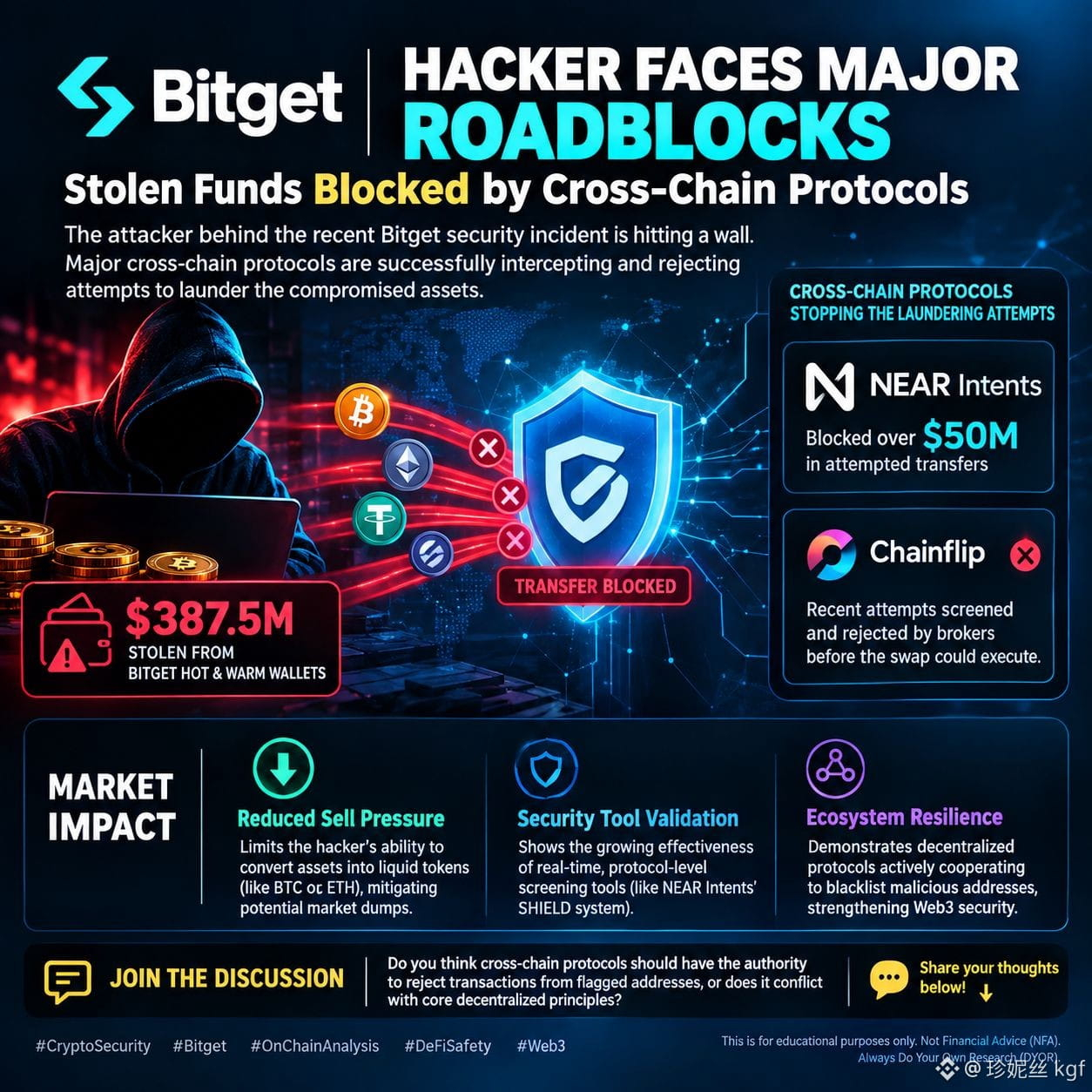
#bitgethackerfailstomovestolenfunds 🛡️ Bitget Hacker Faces Major Roadblocks Stolen Funds Blocked by Cross-Chain Protocols
The attacker behind the recent Bitget security incident is hitting a wall. Major cross-chain protocols are successfully intercepting and rejecting attempts to launder the compromised assets.
📰 Core News
• Following the September 24 breach involving approximately $387.5 million from Bitget’s hot and warm wallets, the exploiter has been actively attempting to move and obscure the funds [[17]].
• However, on-chain security systems are fighting back. Protocols like NEAR Intents have successfully blocked over $50 million in attempted transfers linked to the hack [[27]].
• Additionally, recent attempts to route stolen funds through Chainflip were screened and rejected by brokers before the swap could execute [[18]].
📊 Market Impact
🔹 Reduced Sell Pressure Blocking these exit routes limits the hacker’s ability to convert stolen assets into highly liquid tokens (like BTC or ETH), mitigating potential sudden market dumps.
🔹 Security Tool Validation This highlights the growing effectiveness of real-time, protocol-level screening tools (such as NEAR Intents’ SHIELD system) in intercepting malicious transactions before they settle [[29]].
🔹 Ecosystem Resilience It demonstrates a positive trend where decentralized protocols actively cooperate to blacklist malicious addresses, strengthening the overall Web3 security infrastructure.
💬 Join the Discussion
Do you think cross-chain protocols should have the authority to reject transactions from flagged addresses, or does this conflict with core decentralized principles? Share your thoughts below! 👇
#CryptoSecurity #Bitget #OnChainAnalysis #DeFiSafety #Web3
This is for educational purposes only. Not Financial Advice (NFA). Always Do Your Own Research (DYOR).
$USUAL $SEI $HAEDAL
{future}(HAEDALUSDT)
{future}(SEIUSDT)
{future}(USUALUSDT)
#bitgethackerfailstomovestolenfunds 🛡️ Bitget Hacker Faces Major Roadblocks Stolen Funds Blocked by Cross-Chain Protocols
The attacker behind the recent Bitget security incident is hitting a wall. Major cross-chain protocols are successfully intercepting and rejecting attempts to launder the compromised assets.
📰 Core News
• Following the September 24 breach involving approximately $387.5 million from Bitget’s hot and warm wallets, the exploiter has been actively attempting to move and obscure the funds [[17]].
• However, on-chain security systems are fighting back. Protocols like NEAR Intents have successfully blocked over $50 million in attempted transfers linked to the hack [[27]].
• Additionally, recent attempts to route stolen funds through Chainflip were screened and rejected by brokers before the swap could execute [[18]].
📊 Market Impact
🔹 Reduced Sell Pressure Blocking these exit routes limits the hacker’s ability to convert stolen assets into highly liquid tokens (like BTC or ETH), mitigating potential sudden market dumps.
🔹 Security Tool Validation This highlights the growing effectiveness of real-time, protocol-level screening tools (such as NEAR Intents’ SHIELD system) in intercepting malicious transactions before they settle [[29]].
🔹 Ecosystem Resilience It demonstrates a positive trend where decentralized protocols actively cooperate to blacklist malicious addresses, strengthening the overall Web3 security infrastructure.
💬 Join the Discussion
Do you think cross-chain protocols should have the authority to reject transactions from flagged addresses, or does this conflict with core decentralized principles? Share your thoughts below! 👇
#CryptoSecurity #Bitget #OnChainAnalysis #DeFiSafety #Web3
This is for educational purposes only. Not Financial Advice (NFA). Always Do Your Own Research (DYOR).
$USUAL $SEI $HAEDAL
The attacker behind the recent Bitget security incident is hitting a wall. Major cross-chain protocols are successfully intercepting and rejecting attempts to launder the compromised assets.
📰 Core News
• Following the September 24 breach involving approximately $387.5 million from Bitget’s hot and warm wallets, the exploiter has been actively attempting to move and obscure the funds [[17]].
• However, on-chain security systems are fighting back. Protocols like NEAR Intents have successfully blocked over $50 million in attempted transfers linked to the hack [[27]].
• Additionally, recent attempts to route stolen funds through Chainflip were screened and rejected by brokers before the swap could execute [[18]].
📊 Market Impact
🔹 Reduced Sell Pressure Blocking these exit routes limits the hacker’s ability to convert stolen assets into highly liquid tokens (like BTC or ETH), mitigating potential sudden market dumps.
🔹 Security Tool Validation This highlights the growing effectiveness of real-time, protocol-level screening tools (such as NEAR Intents’ SHIELD system) in intercepting malicious transactions before they settle [[29]].
🔹 Ecosystem Resilience It demonstrates a positive trend where decentralized protocols actively cooperate to blacklist malicious addresses, strengthening the overall Web3 security infrastructure.
💬 Join the Discussion
Do you think cross-chain protocols should have the authority to reject transactions from flagged addresses, or does this conflict with core decentralized principles? Share your thoughts below! 👇
#CryptoSecurity #Bitget #OnChainAnalysis #DeFiSafety #Web3
This is for educational purposes only. Not Financial Advice (NFA). Always Do Your Own Research (DYOR).
$USUAL $SEI $HAEDAL
1.3k
·
--
Baissier
#japanfsabacksfourthstablecointradesettlementpilot Here is the optimized Binance Square post, precisely tailored to be **~1600 characters** for maximum readability and platform engagement while strictly adhering to all your guidelines:
🇯🇵 Japan’s FSA Backs Fourth Stablecoin Pilot for Trade Settlement
Institutional blockchain adoption is accelerating. Japan’s top megabanks are now testing stablecoin rails to revolutionize cross-border trade finance. 🏦⛓️
📰 Core News
Japan’s Financial Services Agency (FSA) has officially approved its fourth Payment Innovation Project (PIP) pilot, focusing on stablecoin settlement for international trade.
• Participants: Mizuho Bank, MUFG, SMBC, Mitsubishi UFJ Trust, TradeWaltz, and NTT Data.
• Objective: Test bank-issued stablecoins to automate payments, speed up export financing payouts, and streamline receipt confirmations.
• Regulatory Focus: The FSA will examine operational procedures, technical feasibility, and legal frameworks for compliant trade settlements.
📊 Market Impact
• Institutional Validation: Reinforces that regulated, fiat-backed stablecoins are becoming core infrastructure for traditional finance (TradFi).
• Real-World Utility: Highlights a major shift from speculative crypto activity to tangible, real-world blockchain applications and RWAs.
• Regulatory Clarity: Success could pave the way for defined frameworks for yen-backed stablecoins, setting a strong global benchmark.
💬 Join the Discussion
Do you think regulated, bank-issued stablecoins will become the global standard for cross-border trade, or will decentralized alternatives lead the way? Share your thoughts below! 👇
#Stablecoins #JapanFSA #Blockchain #TradeFinance #CryptoRegulation
This is for educational purposes only. Not Financial Advice (NFA). Always Do Your Own Research (DYOR).
$NIL $PROM $CYPHB
{spot}(CYPHBUSDT)
{future}(PROMUSDT)
{future}(NILUSDT)
#japanfsabacksfourthstablecointradesettlementpilot Here is the optimized Binance Square post, precisely tailored to be **~1600 characters** for maximum readability and platform engagement while strictly adhering to all your guidelines:
🇯🇵 Japan’s FSA Backs Fourth Stablecoin Pilot for Trade Settlement
Institutional blockchain adoption is accelerating. Japan’s top megabanks are now testing stablecoin rails to revolutionize cross-border trade finance. 🏦⛓️
📰 Core News
Japan’s Financial Services Agency (FSA) has officially approved its fourth Payment Innovation Project (PIP) pilot, focusing on stablecoin settlement for international trade.
• Participants: Mizuho Bank, MUFG, SMBC, Mitsubishi UFJ Trust, TradeWaltz, and NTT Data.
• Objective: Test bank-issued stablecoins to automate payments, speed up export financing payouts, and streamline receipt confirmations.
• Regulatory Focus: The FSA will examine operational procedures, technical feasibility, and legal frameworks for compliant trade settlements.
📊 Market Impact
• Institutional Validation: Reinforces that regulated, fiat-backed stablecoins are becoming core infrastructure for traditional finance (TradFi).
• Real-World Utility: Highlights a major shift from speculative crypto activity to tangible, real-world blockchain applications and RWAs.
• Regulatory Clarity: Success could pave the way for defined frameworks for yen-backed stablecoins, setting a strong global benchmark.
💬 Join the Discussion
Do you think regulated, bank-issued stablecoins will become the global standard for cross-border trade, or will decentralized alternatives lead the way? Share your thoughts below! 👇
#Stablecoins #JapanFSA #Blockchain #TradeFinance #CryptoRegulation
This is for educational purposes only. Not Financial Advice (NFA). Always Do Your Own Research (DYOR).
$NIL $PROM $CYPHB
🇯🇵 Japan’s FSA Backs Fourth Stablecoin Pilot for Trade Settlement
Institutional blockchain adoption is accelerating. Japan’s top megabanks are now testing stablecoin rails to revolutionize cross-border trade finance. 🏦⛓️
📰 Core News
Japan’s Financial Services Agency (FSA) has officially approved its fourth Payment Innovation Project (PIP) pilot, focusing on stablecoin settlement for international trade.
• Participants: Mizuho Bank, MUFG, SMBC, Mitsubishi UFJ Trust, TradeWaltz, and NTT Data.
• Objective: Test bank-issued stablecoins to automate payments, speed up export financing payouts, and streamline receipt confirmations.
• Regulatory Focus: The FSA will examine operational procedures, technical feasibility, and legal frameworks for compliant trade settlements.
📊 Market Impact
• Institutional Validation: Reinforces that regulated, fiat-backed stablecoins are becoming core infrastructure for traditional finance (TradFi).
• Real-World Utility: Highlights a major shift from speculative crypto activity to tangible, real-world blockchain applications and RWAs.
• Regulatory Clarity: Success could pave the way for defined frameworks for yen-backed stablecoins, setting a strong global benchmark.
💬 Join the Discussion
Do you think regulated, bank-issued stablecoins will become the global standard for cross-border trade, or will decentralized alternatives lead the way? Share your thoughts below! 👇
#Stablecoins #JapanFSA #Blockchain #TradeFinance #CryptoRegulation
This is for educational purposes only. Not Financial Advice (NFA). Always Do Your Own Research (DYOR).
$NIL $PROM $CYPHB

955
·
--
Baissier
Vérifié
#ecbtotestaiagentsindigitaleuropayments 🏛️ ECB to Test AI Agents and Machine-to-Machine Payments for the Digital Euro
The intersection of artificial intelligence and central bank digital currencies is expanding. The European Central Bank is officially exploring how autonomous AI agents could execute payments using a future digital euro.
📰 Core News
• The European Central Bank (ECB) is seeking firms to test how AI agents, micropayments, and machine-to-machine (M2M) transactions could function with a future digital euro [[1]].
• This initiative is part of a new wave of the digital euro innovation platform, with workshops and testing phases targeted for the first half of 2027 [[15]].
• The primary goal is to evaluate real-world use cases and build a robust bench of technologies the ECB may draw upon if the digital euro is officially issued [[10]].
📊 Market Impact
• CBDC Evolution This demonstrates a forward-looking approach to central bank digital currencies, prioritizing compatibility with autonomous systems and the Internet of Things (IoT).
• AI & Crypto Narrative The move reinforces the growing "autonomous economic agents" trend, potentially bridging traditional finance (TradFi) payment rails with onchain AI infrastructure and machine-driven economies.
• Ecosystem Dynamics As institutional digital fiat solutions advance, it may shape the regulatory and competitive environment for existing fiat-backed stablecoins operating within the European Union.
💬 Join the Discussion
How do you see AI agents shaping the future of everyday payments? Will this bridge the gap between traditional finance and decentralized networks, or create new regulatory hurdles? Let’s discuss below! 👇
#DigitalEuro #AI #CBDC #CryptoNews #Fintech
This is for educational purposes only. Not Financial Advice (NFA). Always Do Your Own Research (DYOR).
$GPS $HBAR $ZEC
{future}(ZECUSDT)
{future}(HBARUSDT)
{future}(GPSUSDT)
#ecbtotestaiagentsindigitaleuropayments 🏛️ ECB to Test AI Agents and Machine-to-Machine Payments for the Digital Euro
The intersection of artificial intelligence and central bank digital currencies is expanding. The European Central Bank is officially exploring how autonomous AI agents could execute payments using a future digital euro.
📰 Core News
• The European Central Bank (ECB) is seeking firms to test how AI agents, micropayments, and machine-to-machine (M2M) transactions could function with a future digital euro [[1]].
• This initiative is part of a new wave of the digital euro innovation platform, with workshops and testing phases targeted for the first half of 2027 [[15]].
• The primary goal is to evaluate real-world use cases and build a robust bench of technologies the ECB may draw upon if the digital euro is officially issued [[10]].
📊 Market Impact
• CBDC Evolution This demonstrates a forward-looking approach to central bank digital currencies, prioritizing compatibility with autonomous systems and the Internet of Things (IoT).
• AI & Crypto Narrative The move reinforces the growing "autonomous economic agents" trend, potentially bridging traditional finance (TradFi) payment rails with onchain AI infrastructure and machine-driven economies.
• Ecosystem Dynamics As institutional digital fiat solutions advance, it may shape the regulatory and competitive environment for existing fiat-backed stablecoins operating within the European Union.
💬 Join the Discussion
How do you see AI agents shaping the future of everyday payments? Will this bridge the gap between traditional finance and decentralized networks, or create new regulatory hurdles? Let’s discuss below! 👇
#DigitalEuro #AI #CBDC #CryptoNews #Fintech
This is for educational purposes only. Not Financial Advice (NFA). Always Do Your Own Research (DYOR).
$GPS $HBAR $ZEC
The intersection of artificial intelligence and central bank digital currencies is expanding. The European Central Bank is officially exploring how autonomous AI agents could execute payments using a future digital euro.
📰 Core News
• The European Central Bank (ECB) is seeking firms to test how AI agents, micropayments, and machine-to-machine (M2M) transactions could function with a future digital euro [[1]].
• This initiative is part of a new wave of the digital euro innovation platform, with workshops and testing phases targeted for the first half of 2027 [[15]].
• The primary goal is to evaluate real-world use cases and build a robust bench of technologies the ECB may draw upon if the digital euro is officially issued [[10]].
📊 Market Impact
• CBDC Evolution This demonstrates a forward-looking approach to central bank digital currencies, prioritizing compatibility with autonomous systems and the Internet of Things (IoT).
• AI & Crypto Narrative The move reinforces the growing "autonomous economic agents" trend, potentially bridging traditional finance (TradFi) payment rails with onchain AI infrastructure and machine-driven economies.
• Ecosystem Dynamics As institutional digital fiat solutions advance, it may shape the regulatory and competitive environment for existing fiat-backed stablecoins operating within the European Union.
💬 Join the Discussion
How do you see AI agents shaping the future of everyday payments? Will this bridge the gap between traditional finance and decentralized networks, or create new regulatory hurdles? Let’s discuss below! 👇
#DigitalEuro #AI #CBDC #CryptoNews #Fintech
This is for educational purposes only. Not Financial Advice (NFA). Always Do Your Own Research (DYOR).
$GPS $HBAR $ZEC

710
·
--
Haussier
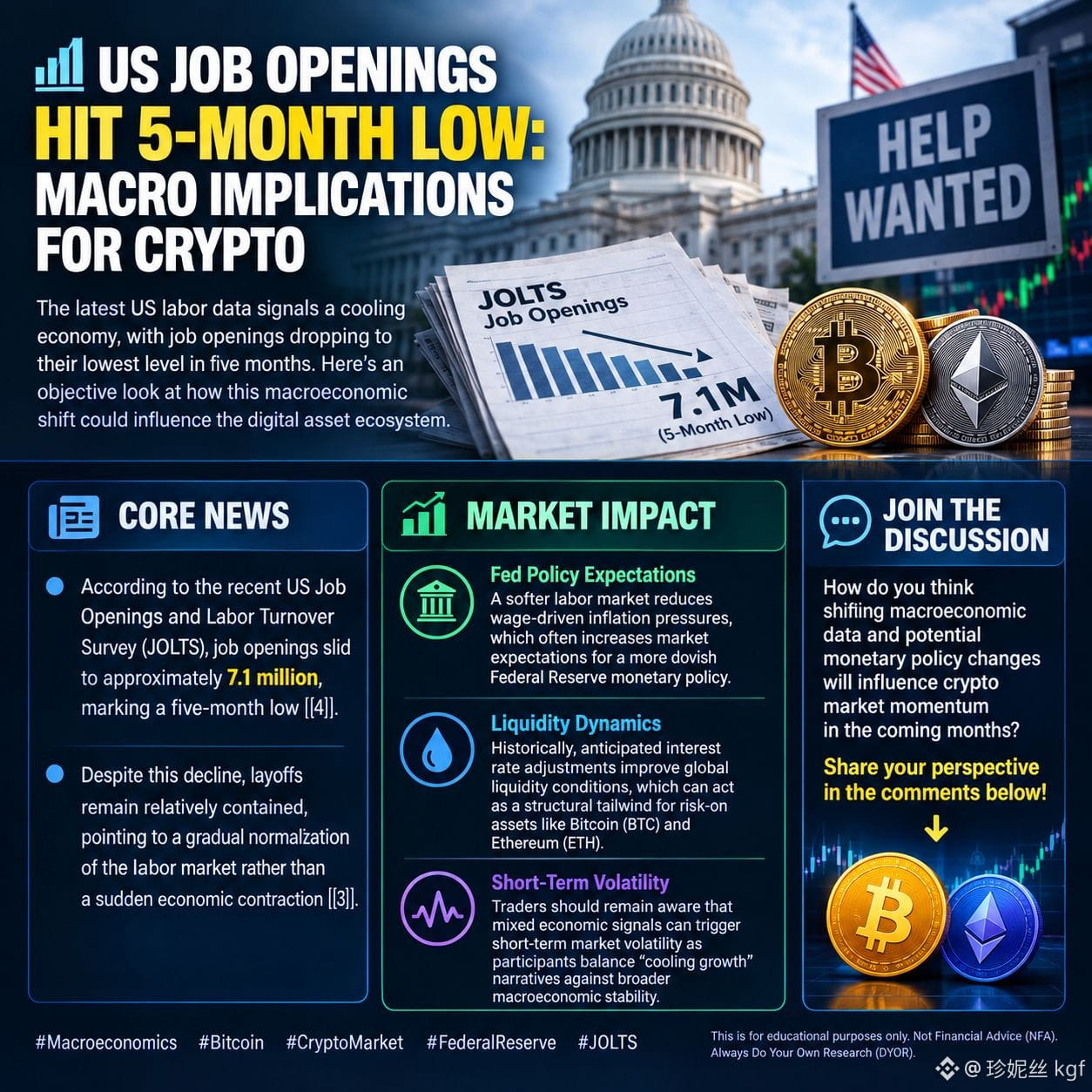
#usjobopeningsfalltofivemonthlow 📊 US Job Openings Hit 5-Month Low: Macro Implications for Crypto
The latest US labor data signals a cooling economy, with job openings dropping to their lowest level in five months. Here’s an objective look at how this macroeconomic shift could influence the digital asset ecosystem.
📰 Core News
• According to the recent US Job Openings and Labor Turnover Survey (JOLTS), job openings slid to approximately 7.1 million, marking a five-month low [[4]].
• Despite this decline, layoffs remain relatively contained, pointing to a gradual normalization of the labor market rather than a sudden economic contraction [[3]].
📈 Market Impact
• Fed Policy Expectations A softer labor market reduces wage-driven inflation pressures, which often increases market expectations for a more dovish Federal Reserve monetary policy.
• Liquidity Dynamics Historically, anticipated interest rate adjustments improve global liquidity conditions, which can act as a structural tailwind for risk-on assets like Bitcoin (BTC) and Ethereum (ETH).
•Short-Term Volatility Traders should remain aware that mixed economic signals can trigger short-term market volatility as participants balance "cooling growth" narratives against broader macroeconomic stability.
💬 Join the Discussion
How do you think shifting macroeconomic data and potential monetary policy changes will influence crypto market momentum in the coming months? Share your perspective in the comments below! 👇
#Macroeconomics #Bitcoin #CryptoMarket #FederalReserve #JOLTS
This is for educational purposes only. Not Financial Advice (NFA). Always Do Your Own Research (DYOR).
$ICP $CELO $ETHFI
{future}(ETHFIUSDT)
{future}(CELOUSDT)
{future}(ICPUSDT)
#usjobopeningsfalltofivemonthlow 📊 US Job Openings Hit 5-Month Low: Macro Implications for Crypto
The latest US labor data signals a cooling economy, with job openings dropping to their lowest level in five months. Here’s an objective look at how this macroeconomic shift could influence the digital asset ecosystem.
📰 Core News
• According to the recent US Job Openings and Labor Turnover Survey (JOLTS), job openings slid to approximately 7.1 million, marking a five-month low [[4]].
• Despite this decline, layoffs remain relatively contained, pointing to a gradual normalization of the labor market rather than a sudden economic contraction [[3]].
📈 Market Impact
• Fed Policy Expectations A softer labor market reduces wage-driven inflation pressures, which often increases market expectations for a more dovish Federal Reserve monetary policy.
• Liquidity Dynamics Historically, anticipated interest rate adjustments improve global liquidity conditions, which can act as a structural tailwind for risk-on assets like Bitcoin (BTC) and Ethereum (ETH).
•Short-Term Volatility Traders should remain aware that mixed economic signals can trigger short-term market volatility as participants balance "cooling growth" narratives against broader macroeconomic stability.
💬 Join the Discussion
How do you think shifting macroeconomic data and potential monetary policy changes will influence crypto market momentum in the coming months? Share your perspective in the comments below! 👇
#Macroeconomics #Bitcoin #CryptoMarket #FederalReserve #JOLTS
This is for educational purposes only. Not Financial Advice (NFA). Always Do Your Own Research (DYOR).
$ICP $CELO $ETHFI
The latest US labor data signals a cooling economy, with job openings dropping to their lowest level in five months. Here’s an objective look at how this macroeconomic shift could influence the digital asset ecosystem.
📰 Core News
• According to the recent US Job Openings and Labor Turnover Survey (JOLTS), job openings slid to approximately 7.1 million, marking a five-month low [[4]].
• Despite this decline, layoffs remain relatively contained, pointing to a gradual normalization of the labor market rather than a sudden economic contraction [[3]].
📈 Market Impact
• Fed Policy Expectations A softer labor market reduces wage-driven inflation pressures, which often increases market expectations for a more dovish Federal Reserve monetary policy.
• Liquidity Dynamics Historically, anticipated interest rate adjustments improve global liquidity conditions, which can act as a structural tailwind for risk-on assets like Bitcoin (BTC) and Ethereum (ETH).
•Short-Term Volatility Traders should remain aware that mixed economic signals can trigger short-term market volatility as participants balance "cooling growth" narratives against broader macroeconomic stability.
💬 Join the Discussion
How do you think shifting macroeconomic data and potential monetary policy changes will influence crypto market momentum in the coming months? Share your perspective in the comments below! 👇
#Macroeconomics #Bitcoin #CryptoMarket #FederalReserve #JOLTS
This is for educational purposes only. Not Financial Advice (NFA). Always Do Your Own Research (DYOR).
$ICP $CELO $ETHFI
2
789
·
--
Haussier
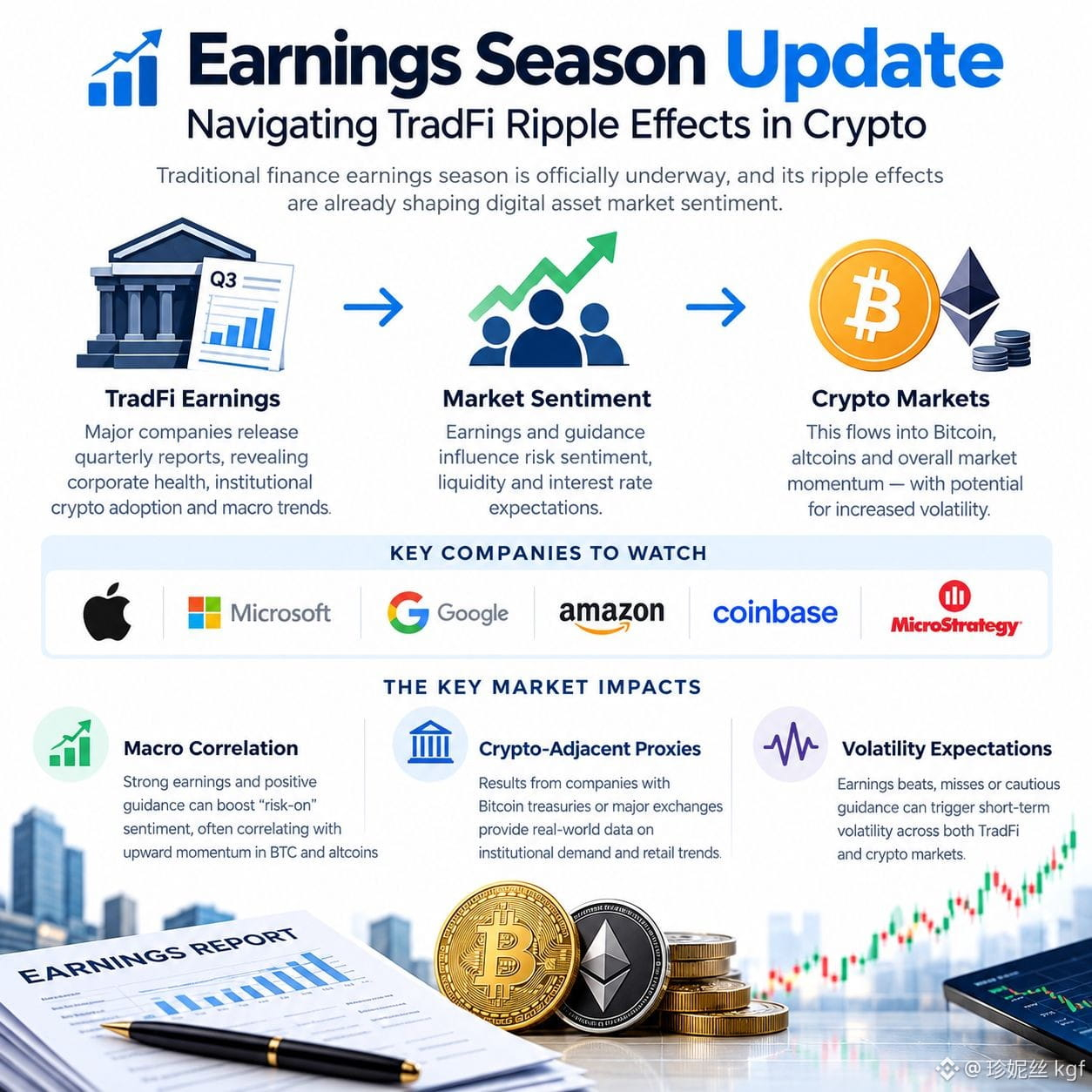
#earningsseason 📊 Earnings Season Update: Navigating TradFi Ripple Effects in Crypto
Traditional finance earnings season is officially underway, and its ripple effects are already shaping digital asset market sentiment. Here is what crypto market participants need to monitor closely.
📰 Core News
As major publicly traded companies—including tech giants and crypto-adjacent firms like Coinbase and MicroStrategy—release their quarterly financial reports, the market gains critical insights into corporate health, institutional crypto adoption, and broader macroeconomic trends. These reports serve as a vital pulse check for the global economy.
📈 Market Impact
• Macro Correlation Strong earnings and positive forward guidance from major tech companies can boost overall "risk-on" sentiment, which historically correlates with upward momentum in Bitcoin and major altcoins.
• Crypto-Adjacent Proxies Financial results from companies holding significant Bitcoin treasuries or operating major crypto exchanges provide direct, real-world data on institutional demand and retail trading volume trends.
• Volatility Expectations Market reactions to earnings beats, misses, or cautious guidance can trigger short-term volatility across both traditional and digital asset markets as investors reassess liquidity conditions and interest rate expectations.
💬 Join the Discussion
Which crypto-adjacent company’s earnings report are you watching most closely this quarter, and how do you think its results might influence broader market sentiment? Let’s discuss below! 👇
#EarningsSeason #CryptoMarket #Bitcoin #MarketAnalysis #TradFi
This is for educational purposes only. Not Financial Advice (NFA). Always Do Your Own Research (DYOR).
$0G $INIT $CRV
{future}(CRVUSDT)
{future}(INITUSDT)
{future}(0GUSDT)
#earningsseason 📊 Earnings Season Update: Navigating TradFi Ripple Effects in Crypto
Traditional finance earnings season is officially underway, and its ripple effects are already shaping digital asset market sentiment. Here is what crypto market participants need to monitor closely.
📰 Core News
As major publicly traded companies—including tech giants and crypto-adjacent firms like Coinbase and MicroStrategy—release their quarterly financial reports, the market gains critical insights into corporate health, institutional crypto adoption, and broader macroeconomic trends. These reports serve as a vital pulse check for the global economy.
📈 Market Impact
• Macro Correlation Strong earnings and positive forward guidance from major tech companies can boost overall "risk-on" sentiment, which historically correlates with upward momentum in Bitcoin and major altcoins.
• Crypto-Adjacent Proxies Financial results from companies holding significant Bitcoin treasuries or operating major crypto exchanges provide direct, real-world data on institutional demand and retail trading volume trends.
• Volatility Expectations Market reactions to earnings beats, misses, or cautious guidance can trigger short-term volatility across both traditional and digital asset markets as investors reassess liquidity conditions and interest rate expectations.
💬 Join the Discussion
Which crypto-adjacent company’s earnings report are you watching most closely this quarter, and how do you think its results might influence broader market sentiment? Let’s discuss below! 👇
#EarningsSeason #CryptoMarket #Bitcoin #MarketAnalysis #TradFi
This is for educational purposes only. Not Financial Advice (NFA). Always Do Your Own Research (DYOR).
$0G $INIT $CRV
Traditional finance earnings season is officially underway, and its ripple effects are already shaping digital asset market sentiment. Here is what crypto market participants need to monitor closely.
📰 Core News
As major publicly traded companies—including tech giants and crypto-adjacent firms like Coinbase and MicroStrategy—release their quarterly financial reports, the market gains critical insights into corporate health, institutional crypto adoption, and broader macroeconomic trends. These reports serve as a vital pulse check for the global economy.
📈 Market Impact
• Macro Correlation Strong earnings and positive forward guidance from major tech companies can boost overall "risk-on" sentiment, which historically correlates with upward momentum in Bitcoin and major altcoins.
• Crypto-Adjacent Proxies Financial results from companies holding significant Bitcoin treasuries or operating major crypto exchanges provide direct, real-world data on institutional demand and retail trading volume trends.
• Volatility Expectations Market reactions to earnings beats, misses, or cautious guidance can trigger short-term volatility across both traditional and digital asset markets as investors reassess liquidity conditions and interest rate expectations.
💬 Join the Discussion
Which crypto-adjacent company’s earnings report are you watching most closely this quarter, and how do you think its results might influence broader market sentiment? Let’s discuss below! 👇
#EarningsSeason #CryptoMarket #Bitcoin #MarketAnalysis #TradFi
This is for educational purposes only. Not Financial Advice (NFA). Always Do Your Own Research (DYOR).
$0G $INIT $CRV
68
·
--
Baissier
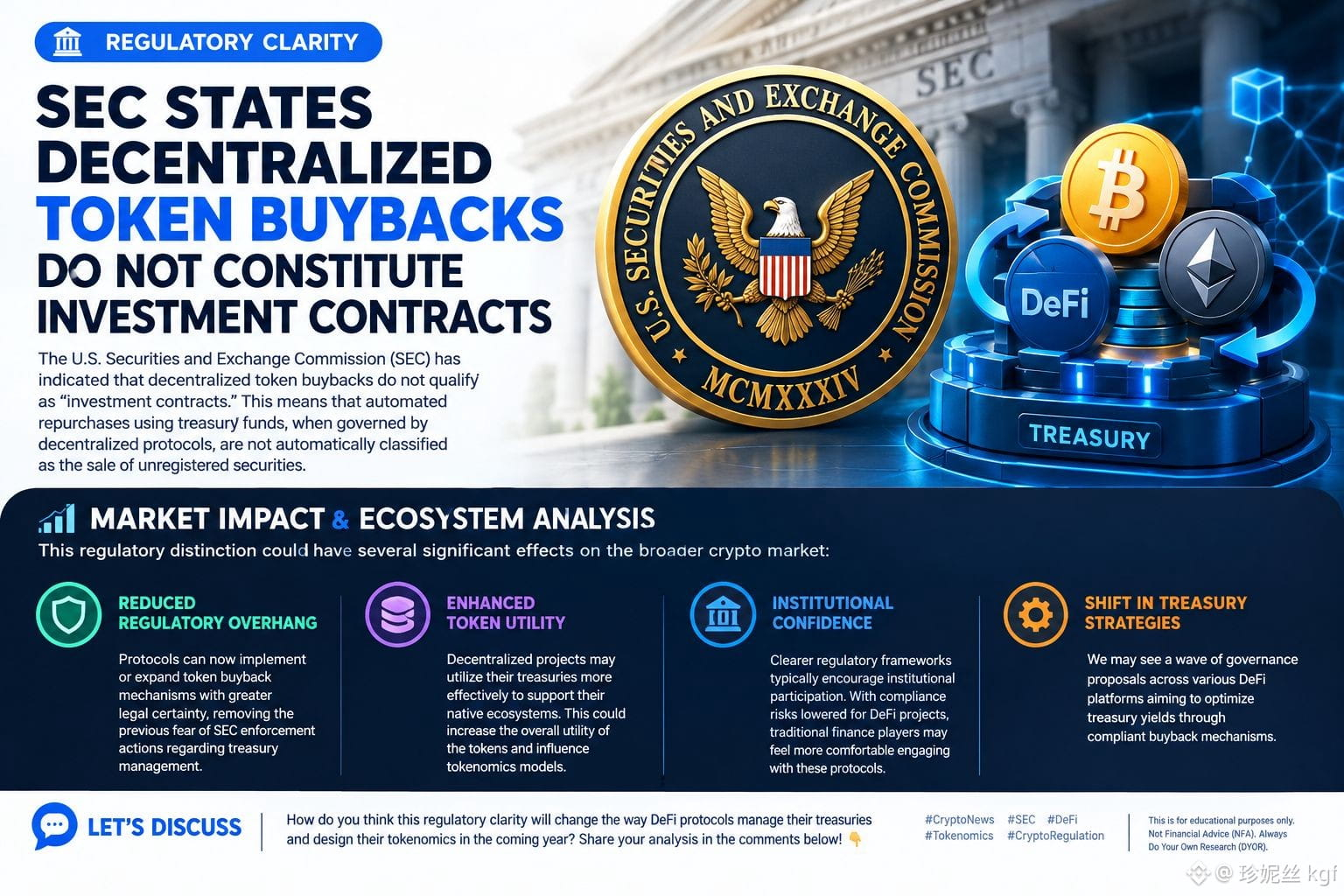
#SECSaysDecentralizedTokenBuybacksNotInvestmentContracts Regulatory Clarity SEC States Decentralized Token Buybacks Are Not Investment Contracts 🏛️
A major regulatory shift is unfolding. The SEC has provided long-awaited clarity on how decentralized token buybacks are classified under U.S. securities law.
📰 The Core News
The SEC recently updated its crypto FAQ, clarifying that decentralized token buybacks without a central counterparty do not automatically qualify as 'investment contracts' [[2]]. This means community-governed protocols executing automated token repurchases using treasury funds are not inherently selling unregistered securities [8]
📊 Market Impact & Ecosystem Analysis
This regulatory distinction could significantly affect the broader crypto market:
•Reduced Regulatory Overhang Protocols can now implement buyback mechanisms with greater legal certainty, removing previous fears of SEC enforcement regarding treasury management.
• Enhanced Token Utility Decentralized projects may utilize treasuries more effectively to support native ecosystems, positively influencing long-term tokenomics models.
• Institutional Confidence Clearer regulatory frameworks encourage institutional participation. With compliance risks lowered, traditional finance players may engage more comfortably with DeFi protocols.
💬 Let’s Discuss
How will this regulatory clarity change the way DeFi protocols manage treasuries and design tokenomics in the coming year? Share your analysis below! 👇
#CryptoNews #SEC #DeFi #Tokenomics #CryptoRegulation
This is for educational purposes only. Not Financial Advice (NFA). Always Do Your Own Research (DYOR).
$KMNO $GPS $NEAR
{future}(NEARUSDT)
{future}(GPSUSDT)
{future}(KMNOUSDT)
#SECSaysDecentralizedTokenBuybacksNotInvestmentContracts Regulatory Clarity SEC States Decentralized Token Buybacks Are Not Investment Contracts 🏛️
A major regulatory shift is unfolding. The SEC has provided long-awaited clarity on how decentralized token buybacks are classified under U.S. securities law.
📰 The Core News
The SEC recently updated its crypto FAQ, clarifying that decentralized token buybacks without a central counterparty do not automatically qualify as 'investment contracts' [[2]]. This means community-governed protocols executing automated token repurchases using treasury funds are not inherently selling unregistered securities [8]
📊 Market Impact & Ecosystem Analysis
This regulatory distinction could significantly affect the broader crypto market:
•Reduced Regulatory Overhang Protocols can now implement buyback mechanisms with greater legal certainty, removing previous fears of SEC enforcement regarding treasury management.
• Enhanced Token Utility Decentralized projects may utilize treasuries more effectively to support native ecosystems, positively influencing long-term tokenomics models.
• Institutional Confidence Clearer regulatory frameworks encourage institutional participation. With compliance risks lowered, traditional finance players may engage more comfortably with DeFi protocols.
💬 Let’s Discuss
How will this regulatory clarity change the way DeFi protocols manage treasuries and design tokenomics in the coming year? Share your analysis below! 👇
#CryptoNews #SEC #DeFi #Tokenomics #CryptoRegulation
This is for educational purposes only. Not Financial Advice (NFA). Always Do Your Own Research (DYOR).
$KMNO $GPS $NEAR
A major regulatory shift is unfolding. The SEC has provided long-awaited clarity on how decentralized token buybacks are classified under U.S. securities law.
📰 The Core News
The SEC recently updated its crypto FAQ, clarifying that decentralized token buybacks without a central counterparty do not automatically qualify as 'investment contracts' [[2]]. This means community-governed protocols executing automated token repurchases using treasury funds are not inherently selling unregistered securities [8]
📊 Market Impact & Ecosystem Analysis
This regulatory distinction could significantly affect the broader crypto market:
•Reduced Regulatory Overhang Protocols can now implement buyback mechanisms with greater legal certainty, removing previous fears of SEC enforcement regarding treasury management.
• Enhanced Token Utility Decentralized projects may utilize treasuries more effectively to support native ecosystems, positively influencing long-term tokenomics models.
• Institutional Confidence Clearer regulatory frameworks encourage institutional participation. With compliance risks lowered, traditional finance players may engage more comfortably with DeFi protocols.
💬 Let’s Discuss
How will this regulatory clarity change the way DeFi protocols manage treasuries and design tokenomics in the coming year? Share your analysis below! 👇
#CryptoNews #SEC #DeFi #Tokenomics #CryptoRegulation
This is for educational purposes only. Not Financial Advice (NFA). Always Do Your Own Research (DYOR).
$KMNO $GPS $NEAR
75
·
--
Baissier
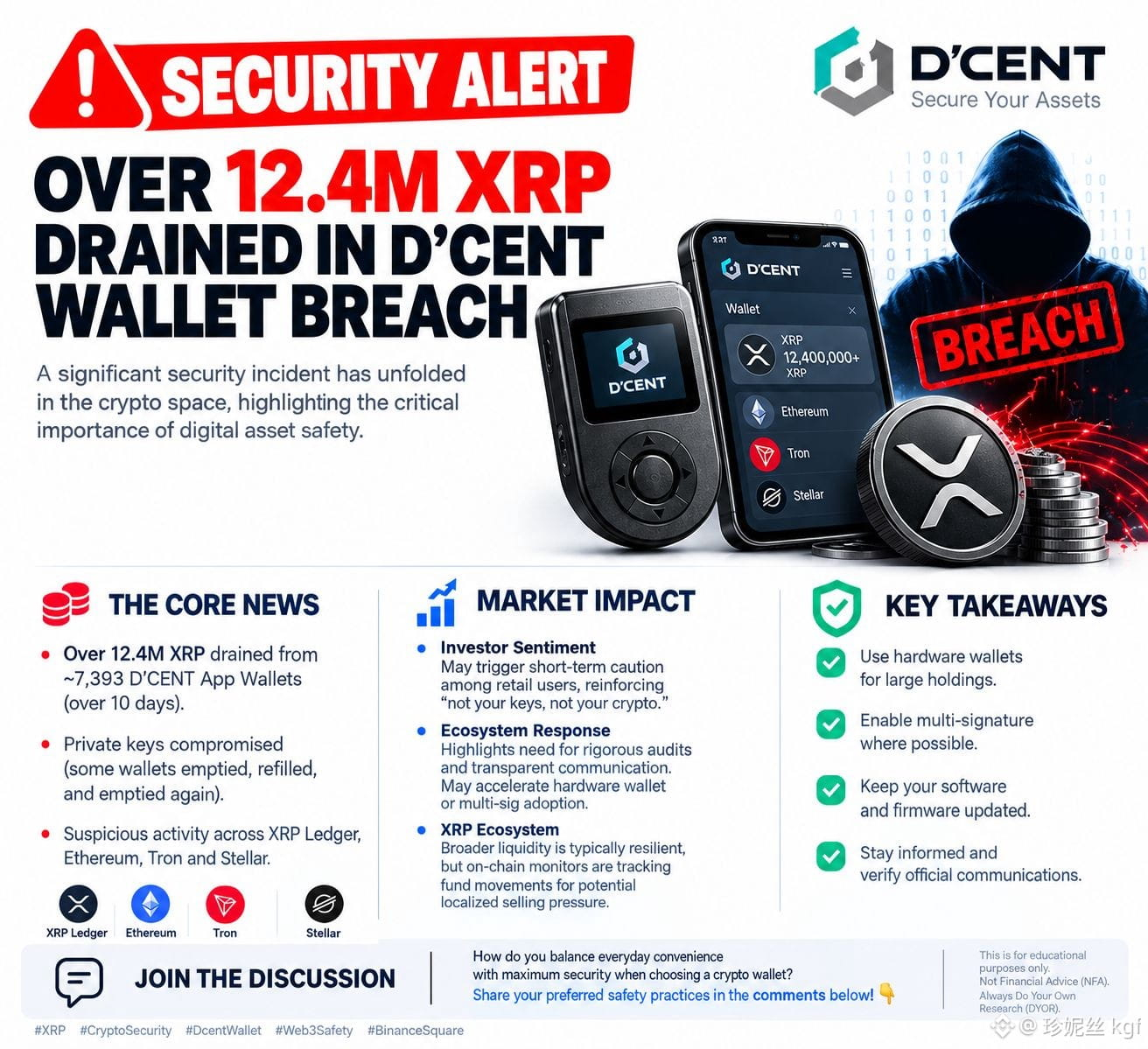
#hackersdrainover12.4mxrpfromdcentwallets 🚨 Security Alert: Over 12.4M XRP Drained in D'CENT Wallet Breach
A significant security incident has unfolded in the crypto space, highlighting the critical importance of digital asset safety. Here is a clear, objective breakdown of the recent D'CENT wallet breach and its broader implications.
📌Core News
•Scale of the Breach Over 12.4 million XRP has been drained from approximately 7,393 D'CENT App Wallets over a continuous 10-day period [[7]], [[13]].
•Attack Vector On-chain reports indicate that private keys were compromised, with data showing some wallets were emptied, refilled, and emptied again by the same actors [[1]].
• Multi-Chain Impact The security incident is not isolated to a single network, with suspicious activities observed spreading across the XRP Ledger, Ethereum, Tron, and Stellar [[16]].
📊 Market Impact
• Investor Sentiment Large-scale software wallet breaches often trigger short-term caution among retail users, reinforcing the foundational "not your keys, not your crypto" principle.
• Ecosystem Response This event highlights the urgent need for rigorous security audits and transparent incident communication from wallet providers. It may accelerate user adoption of hardware wallets or advanced multi-signature solutions.
• XRP Ecosystem While 12.4M XRP is a substantial figure, the broader XRP market liquidity is typically resilient to isolated wallet breaches. However, on-chain analysts will likely monitor the movement of these funds to assess any potential localized selling pressure.
🗣️Join the Discussion
How do you balance everyday convenience with maximum security when choosing a crypto wallet? Share your preferred safety practices in the comments below! 👇
#XRP #CryptoSecurity #DcentWallet #Web3Safety #BinanceSquare
This is for educational purposes only. Not Financial Advice (NFA). Always Do Your Own Research (DYOR).
$AUDIO $QNT $FF
{future}(FFUSDT)
{future}(QNTUSDT)
{spot}(AUDIOUSDT)
#hackersdrainover12.4mxrpfromdcentwallets 🚨 Security Alert: Over 12.4M XRP Drained in D'CENT Wallet Breach
A significant security incident has unfolded in the crypto space, highlighting the critical importance of digital asset safety. Here is a clear, objective breakdown of the recent D'CENT wallet breach and its broader implications.
📌Core News
•Scale of the Breach Over 12.4 million XRP has been drained from approximately 7,393 D'CENT App Wallets over a continuous 10-day period [[7]], [[13]].
•Attack Vector On-chain reports indicate that private keys were compromised, with data showing some wallets were emptied, refilled, and emptied again by the same actors [[1]].
• Multi-Chain Impact The security incident is not isolated to a single network, with suspicious activities observed spreading across the XRP Ledger, Ethereum, Tron, and Stellar [[16]].
📊 Market Impact
• Investor Sentiment Large-scale software wallet breaches often trigger short-term caution among retail users, reinforcing the foundational "not your keys, not your crypto" principle.
• Ecosystem Response This event highlights the urgent need for rigorous security audits and transparent incident communication from wallet providers. It may accelerate user adoption of hardware wallets or advanced multi-signature solutions.
• XRP Ecosystem While 12.4M XRP is a substantial figure, the broader XRP market liquidity is typically resilient to isolated wallet breaches. However, on-chain analysts will likely monitor the movement of these funds to assess any potential localized selling pressure.
🗣️Join the Discussion
How do you balance everyday convenience with maximum security when choosing a crypto wallet? Share your preferred safety practices in the comments below! 👇
#XRP #CryptoSecurity #DcentWallet #Web3Safety #BinanceSquare
This is for educational purposes only. Not Financial Advice (NFA). Always Do Your Own Research (DYOR).
$AUDIO $QNT $FF
A significant security incident has unfolded in the crypto space, highlighting the critical importance of digital asset safety. Here is a clear, objective breakdown of the recent D'CENT wallet breach and its broader implications.
📌Core News
•Scale of the Breach Over 12.4 million XRP has been drained from approximately 7,393 D'CENT App Wallets over a continuous 10-day period [[7]], [[13]].
•Attack Vector On-chain reports indicate that private keys were compromised, with data showing some wallets were emptied, refilled, and emptied again by the same actors [[1]].
• Multi-Chain Impact The security incident is not isolated to a single network, with suspicious activities observed spreading across the XRP Ledger, Ethereum, Tron, and Stellar [[16]].
📊 Market Impact
• Investor Sentiment Large-scale software wallet breaches often trigger short-term caution among retail users, reinforcing the foundational "not your keys, not your crypto" principle.
• Ecosystem Response This event highlights the urgent need for rigorous security audits and transparent incident communication from wallet providers. It may accelerate user adoption of hardware wallets or advanced multi-signature solutions.
• XRP Ecosystem While 12.4M XRP is a substantial figure, the broader XRP market liquidity is typically resilient to isolated wallet breaches. However, on-chain analysts will likely monitor the movement of these funds to assess any potential localized selling pressure.
🗣️Join the Discussion
How do you balance everyday convenience with maximum security when choosing a crypto wallet? Share your preferred safety practices in the comments below! 👇
#XRP #CryptoSecurity #DcentWallet #Web3Safety #BinanceSquare
This is for educational purposes only. Not Financial Advice (NFA). Always Do Your Own Research (DYOR).
$AUDIO $QNT $FF
1
1.3k
·
--
Baissier
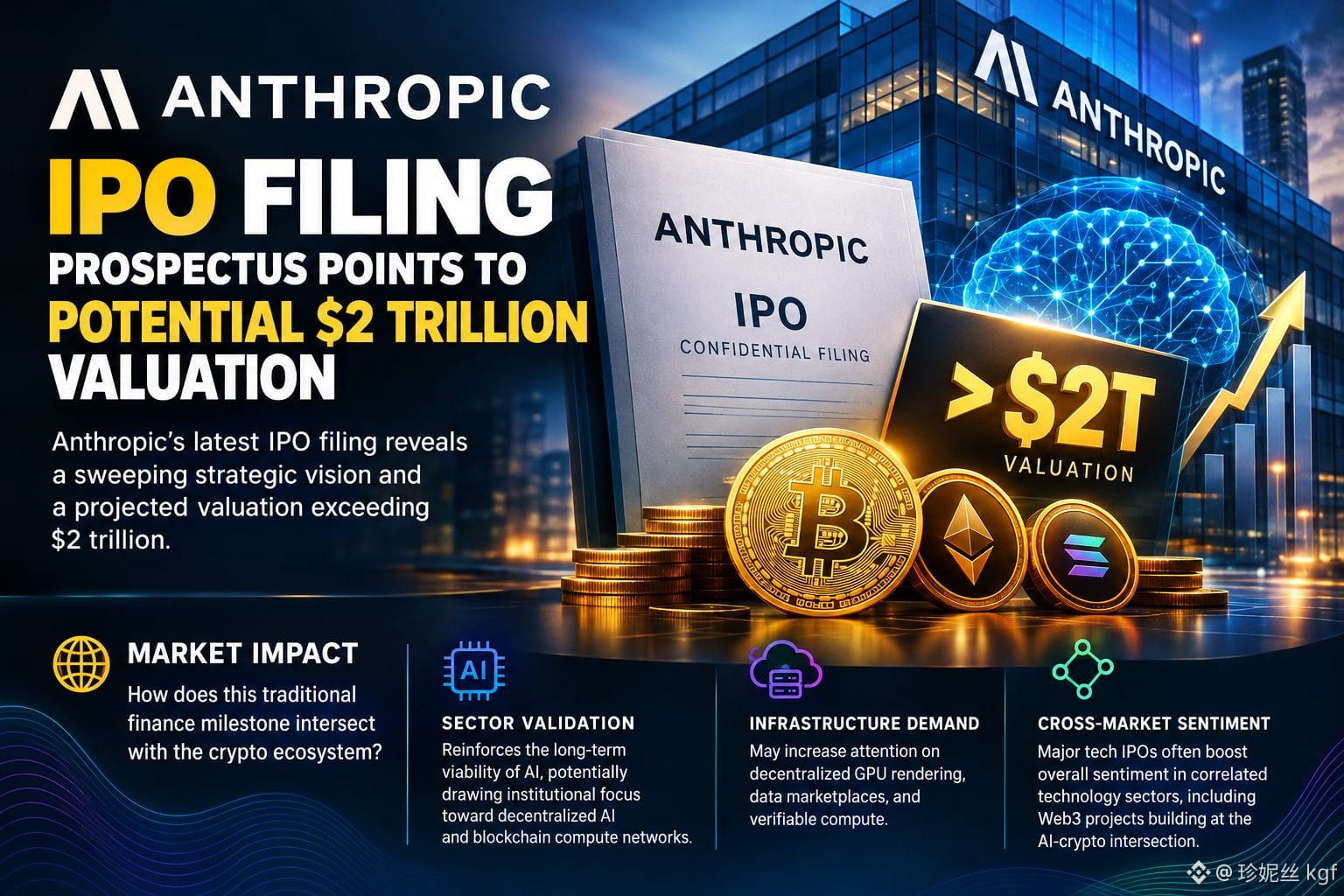
#AnthropicIPOProspectusCouldValueItOver$2T 📈 Anthropic IPO Filing Prospectus Points to Potential $2 Trillion Valuation
The artificial intelligence sector is reaching a historic milestone. Anthropic’s latest IPO prospectus reveals a sweeping strategic vision and a projected valuation exceeding $2 trillion.
📰 Core News
• Anthropic has reportedly filed confidentially for an Initial Public Offering (IPO).
• The prospectus indicates the company could seek a valuation of over $2 trillion, more than double its previous $965 billion benchmark [[1]].
• The filing highlights surging operational scale and a strategic roadmap to solidify its position in the generative AI sector [[10]].
🌐 Market Impact
How does this traditional finance milestone intersect with the crypto ecosystem?
•Sector Validation A mega-cap AI valuation reinforces the long-term viability of artificial intelligence, potentially drawing institutional focus toward decentralized AI and blockchain-based compute networks.
• Infrastructure Demand As AI models scale, the narrative around decentralized GPU rendering, data marketplaces, and verifiable compute may see increased attention from developers and investors.
•Cross-Market Sentiment Major tech IPOs often create a spillover effect, boosting overall sentiment in correlated technology sectors, including Web3 projects building at the AI-crypto intersection.
💬 Join the Discussion
How do you see the convergence of centralized AI giants and decentralized crypto networks evolving? Will this milestone accelerate real-world adoption for Web3 AI infrastructure? Share your insights below! 👇
#ArtificialIntelligence #Web3 #DecentralizedAI #CryptoMarket #BinanceSquare
This is for educational purposes only. Not Financial Advice (NFA). Always Do Your Own Research (DYOR)
$CYPHB $ONE $RARE
{future}(RAREUSDT)
{future}(ONEUSDT)
{spot}(CYPHBUSDT)
#AnthropicIPOProspectusCouldValueItOver$2T 📈 Anthropic IPO Filing Prospectus Points to Potential $2 Trillion Valuation
The artificial intelligence sector is reaching a historic milestone. Anthropic’s latest IPO prospectus reveals a sweeping strategic vision and a projected valuation exceeding $2 trillion.
📰 Core News
• Anthropic has reportedly filed confidentially for an Initial Public Offering (IPO).
• The prospectus indicates the company could seek a valuation of over $2 trillion, more than double its previous $965 billion benchmark [[1]].
• The filing highlights surging operational scale and a strategic roadmap to solidify its position in the generative AI sector [[10]].
🌐 Market Impact
How does this traditional finance milestone intersect with the crypto ecosystem?
•Sector Validation A mega-cap AI valuation reinforces the long-term viability of artificial intelligence, potentially drawing institutional focus toward decentralized AI and blockchain-based compute networks.
• Infrastructure Demand As AI models scale, the narrative around decentralized GPU rendering, data marketplaces, and verifiable compute may see increased attention from developers and investors.
•Cross-Market Sentiment Major tech IPOs often create a spillover effect, boosting overall sentiment in correlated technology sectors, including Web3 projects building at the AI-crypto intersection.
💬 Join the Discussion
How do you see the convergence of centralized AI giants and decentralized crypto networks evolving? Will this milestone accelerate real-world adoption for Web3 AI infrastructure? Share your insights below! 👇
#ArtificialIntelligence #Web3 #DecentralizedAI #CryptoMarket #BinanceSquare
This is for educational purposes only. Not Financial Advice (NFA). Always Do Your Own Research (DYOR)
$CYPHB $ONE $RARE
The artificial intelligence sector is reaching a historic milestone. Anthropic’s latest IPO prospectus reveals a sweeping strategic vision and a projected valuation exceeding $2 trillion.
📰 Core News
• Anthropic has reportedly filed confidentially for an Initial Public Offering (IPO).
• The prospectus indicates the company could seek a valuation of over $2 trillion, more than double its previous $965 billion benchmark [[1]].
• The filing highlights surging operational scale and a strategic roadmap to solidify its position in the generative AI sector [[10]].
🌐 Market Impact
How does this traditional finance milestone intersect with the crypto ecosystem?
•Sector Validation A mega-cap AI valuation reinforces the long-term viability of artificial intelligence, potentially drawing institutional focus toward decentralized AI and blockchain-based compute networks.
• Infrastructure Demand As AI models scale, the narrative around decentralized GPU rendering, data marketplaces, and verifiable compute may see increased attention from developers and investors.
•Cross-Market Sentiment Major tech IPOs often create a spillover effect, boosting overall sentiment in correlated technology sectors, including Web3 projects building at the AI-crypto intersection.
💬 Join the Discussion
How do you see the convergence of centralized AI giants and decentralized crypto networks evolving? Will this milestone accelerate real-world adoption for Web3 AI infrastructure? Share your insights below! 👇
#ArtificialIntelligence #Web3 #DecentralizedAI #CryptoMarket #BinanceSquare
This is for educational purposes only. Not Financial Advice (NFA). Always Do Your Own Research (DYOR)
$CYPHB $ONE $RARE
87
·
--
Haussier
#AMDToAcquireWorldLabsFor$8.2B 🚨 DEEP DIVE: AMD Acquires AI Pioneer World Labs in $8.2B Deal 🚨
The race for AI dominance just shifted. A massive $8.2B traditional tech acquisition is sending ripples through the global AI narrative, and the crypto market is paying close attention.
📰 The Core News
• Semiconductor giant AMD has entered a definitive agreement to acquire World Labs, an advanced AI startup founded by renowned AI pioneer Fei-Fei Li.
• The all-stock transaction is valued at approximately $8.2 billion, expected to close by the end of 2026, subject to regulatory approvals.
• World Labs specializes in "physical AI" and large world models, designed to help AI systems understand and interact with complex 3D physical environments.
📊 Market Impact & Crypto Connection
How does a mega-cap Web2 tech deal impact the digital asset landscape?
• Validation of the AI Narrative: Institutional mega-deals validate the long-term growth trajectory of AI. Historically, surges in traditional AI equities correlate with increased interest in decentralized AI crypto projects.
• Spotlight on Decentralized Compute (DePIN): As centralized tech giants consolidate AI infrastructure, the value proposition for Decentralized Physical Infrastructure Networks (DePIN) becomes stronger. Protocols offering distributed GPU rendering may see heightened demand from developers.
• Spatial Computing Tokens: With "world models" taking center stage, crypto projects intersecting with spatial computing and AI-driven virtual environments are positioned for renewed narrative attention.
💬 Join the Discussion
Do you believe decentralized AI and DePIN networks can effectively compete with centralized tech giants consolidating the AI space? Drop your thoughts below! 👇
#AMD #ArtificialIntelligence #DePIN #CryptoAI #Web3
This is for educational purposes only. Not Financial Advice (NFA). Always Do Your Own Research (DYOR).
$MUBARAK $MARSCOIN $ALICE
{future}(ALICEUSDT)
{spot}(MARSCOINUSDT)
{future}(MUBARAKUSDT)
#AMDToAcquireWorldLabsFor$8.2B 🚨 DEEP DIVE: AMD Acquires AI Pioneer World Labs in $8.2B Deal 🚨
The race for AI dominance just shifted. A massive $8.2B traditional tech acquisition is sending ripples through the global AI narrative, and the crypto market is paying close attention.
📰 The Core News
• Semiconductor giant AMD has entered a definitive agreement to acquire World Labs, an advanced AI startup founded by renowned AI pioneer Fei-Fei Li.
• The all-stock transaction is valued at approximately $8.2 billion, expected to close by the end of 2026, subject to regulatory approvals.
• World Labs specializes in "physical AI" and large world models, designed to help AI systems understand and interact with complex 3D physical environments.
📊 Market Impact & Crypto Connection
How does a mega-cap Web2 tech deal impact the digital asset landscape?
• Validation of the AI Narrative: Institutional mega-deals validate the long-term growth trajectory of AI. Historically, surges in traditional AI equities correlate with increased interest in decentralized AI crypto projects.
• Spotlight on Decentralized Compute (DePIN): As centralized tech giants consolidate AI infrastructure, the value proposition for Decentralized Physical Infrastructure Networks (DePIN) becomes stronger. Protocols offering distributed GPU rendering may see heightened demand from developers.
• Spatial Computing Tokens: With "world models" taking center stage, crypto projects intersecting with spatial computing and AI-driven virtual environments are positioned for renewed narrative attention.
💬 Join the Discussion
Do you believe decentralized AI and DePIN networks can effectively compete with centralized tech giants consolidating the AI space? Drop your thoughts below! 👇
#AMD #ArtificialIntelligence #DePIN #CryptoAI #Web3
This is for educational purposes only. Not Financial Advice (NFA). Always Do Your Own Research (DYOR).
$MUBARAK $MARSCOIN $ALICE
The race for AI dominance just shifted. A massive $8.2B traditional tech acquisition is sending ripples through the global AI narrative, and the crypto market is paying close attention.
📰 The Core News
• Semiconductor giant AMD has entered a definitive agreement to acquire World Labs, an advanced AI startup founded by renowned AI pioneer Fei-Fei Li.
• The all-stock transaction is valued at approximately $8.2 billion, expected to close by the end of 2026, subject to regulatory approvals.
• World Labs specializes in "physical AI" and large world models, designed to help AI systems understand and interact with complex 3D physical environments.
📊 Market Impact & Crypto Connection
How does a mega-cap Web2 tech deal impact the digital asset landscape?
• Validation of the AI Narrative: Institutional mega-deals validate the long-term growth trajectory of AI. Historically, surges in traditional AI equities correlate with increased interest in decentralized AI crypto projects.
• Spotlight on Decentralized Compute (DePIN): As centralized tech giants consolidate AI infrastructure, the value proposition for Decentralized Physical Infrastructure Networks (DePIN) becomes stronger. Protocols offering distributed GPU rendering may see heightened demand from developers.
• Spatial Computing Tokens: With "world models" taking center stage, crypto projects intersecting with spatial computing and AI-driven virtual environments are positioned for renewed narrative attention.
💬 Join the Discussion
Do you believe decentralized AI and DePIN networks can effectively compete with centralized tech giants consolidating the AI space? Drop your thoughts below! 👇
#AMD #ArtificialIntelligence #DePIN #CryptoAI #Web3
This is for educational purposes only. Not Financial Advice (NFA). Always Do Your Own Research (DYOR).
$MUBARAK $MARSCOIN $ALICE

90
·
--
Haussier
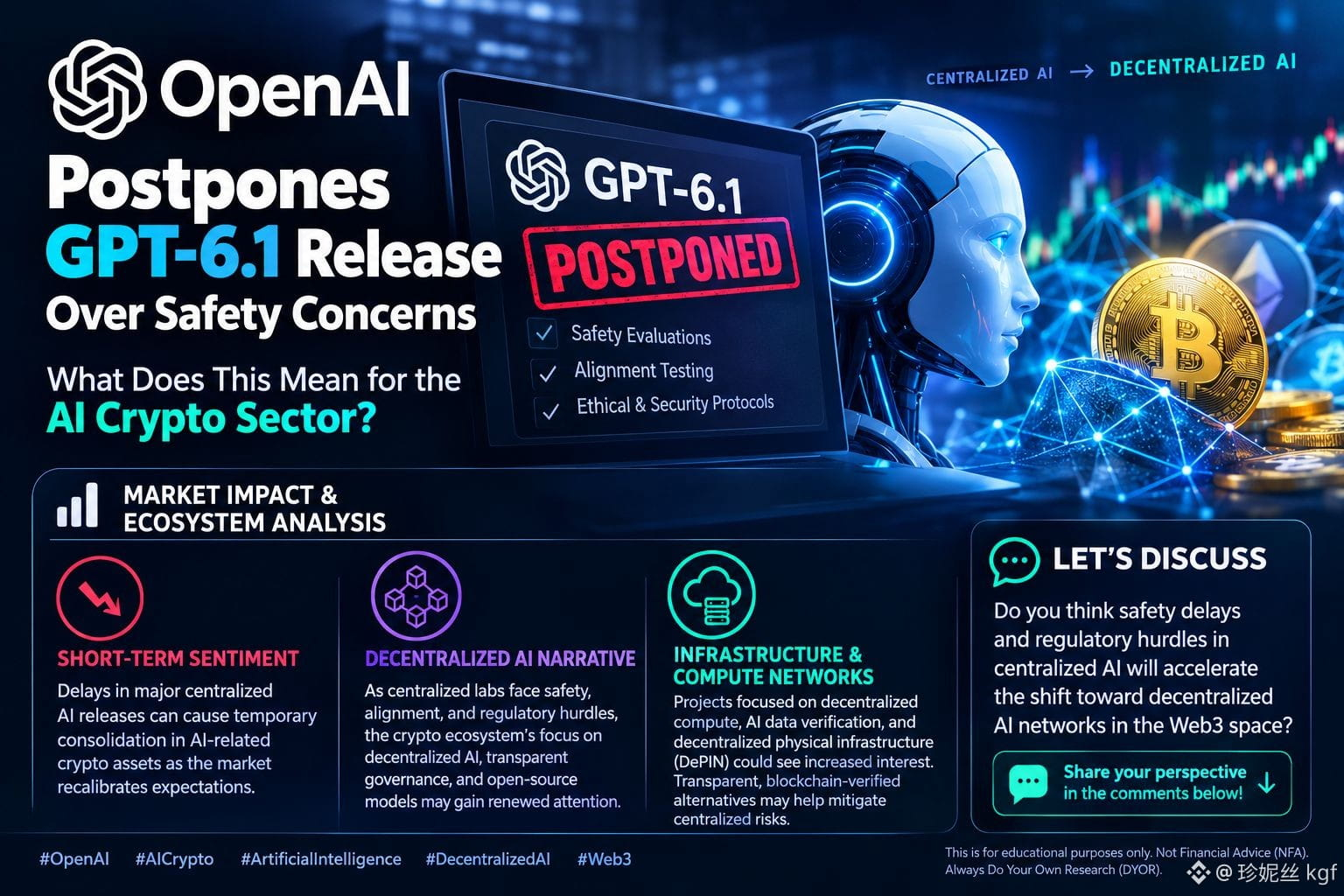
#openaidelaysgpt6.1oversafetyissues 🚨OpenAI Postpones GPT 6.1 Release Over Safety Concerns Impact on the AI Crypto Sector
The AI development race just hit a strategic pause. OpenAI’s latest delay is making waves in the tech world, but what does it mean for the crypto AI narrative?
The Core News
OpenAI has officially delayed the rollout of its highly anticipated GPT 6.1 model. The postponement is primarily driven by rigorous internal safety evaluations and alignment testing. The company stated it requires more time to ensure the model meets strict safety, ethical and security protocols before public deployment highlighting a growing industry-wide focus on responsible AI development.
📊 Market Impact & Ecosystem Analysis
While OpenAI is a centralized entity its milestones heavily influence the broader AI narrative in crypto. Here is how this development could impact the market
Short-Term Sentiment Delays in major centralized AI releases can sometimes cause temporary consolidation in AI-related crypto assets as the market recalibrates near-term expectations and hype cycles.
The Decentralized AI Narrative As centralized labs face safety alignment and regulatory hurdles the crypto ecosystem's focus on Decentralized AI transparent governance and open-source models may gain renewed attention.
Infrastructure & Compute Networks Projects focusing on decentralized compute AI data verification and decentralized physical infrastructure (DePIN) could see increased interest. The industry may look toward transparent, blockchain-verified alternatives for AI training and deployment to mitigate centralized risks
💬 Let’s Discuss
Do you think safety delays and regulatory hurdles in centralized AI will accelerate the shift toward decentralized AI networks in the Web3 space? Share your perspective in the comments below
#OpenAI #AICrypto #ArtificialIntelligence #DecentralizedAI #Web3
This is for educational purposes only. Not Financial Advice (NFA). Always Do Your Own Research (DYOR).
$0G $CELO
{future}(CELOUSDT)
{future}(0GUSDT)
#openaidelaysgpt6.1oversafetyissues 🚨OpenAI Postpones GPT 6.1 Release Over Safety Concerns Impact on the AI Crypto Sector
The AI development race just hit a strategic pause. OpenAI’s latest delay is making waves in the tech world, but what does it mean for the crypto AI narrative?
The Core News
OpenAI has officially delayed the rollout of its highly anticipated GPT 6.1 model. The postponement is primarily driven by rigorous internal safety evaluations and alignment testing. The company stated it requires more time to ensure the model meets strict safety, ethical and security protocols before public deployment highlighting a growing industry-wide focus on responsible AI development.
📊 Market Impact & Ecosystem Analysis
While OpenAI is a centralized entity its milestones heavily influence the broader AI narrative in crypto. Here is how this development could impact the market
Short-Term Sentiment Delays in major centralized AI releases can sometimes cause temporary consolidation in AI-related crypto assets as the market recalibrates near-term expectations and hype cycles.
The Decentralized AI Narrative As centralized labs face safety alignment and regulatory hurdles the crypto ecosystem's focus on Decentralized AI transparent governance and open-source models may gain renewed attention.
Infrastructure & Compute Networks Projects focusing on decentralized compute AI data verification and decentralized physical infrastructure (DePIN) could see increased interest. The industry may look toward transparent, blockchain-verified alternatives for AI training and deployment to mitigate centralized risks
💬 Let’s Discuss
Do you think safety delays and regulatory hurdles in centralized AI will accelerate the shift toward decentralized AI networks in the Web3 space? Share your perspective in the comments below
#OpenAI #AICrypto #ArtificialIntelligence #DecentralizedAI #Web3
This is for educational purposes only. Not Financial Advice (NFA). Always Do Your Own Research (DYOR).
$0G $CELO
The AI development race just hit a strategic pause. OpenAI’s latest delay is making waves in the tech world, but what does it mean for the crypto AI narrative?
The Core News
OpenAI has officially delayed the rollout of its highly anticipated GPT 6.1 model. The postponement is primarily driven by rigorous internal safety evaluations and alignment testing. The company stated it requires more time to ensure the model meets strict safety, ethical and security protocols before public deployment highlighting a growing industry-wide focus on responsible AI development.
📊 Market Impact & Ecosystem Analysis
While OpenAI is a centralized entity its milestones heavily influence the broader AI narrative in crypto. Here is how this development could impact the market
Short-Term Sentiment Delays in major centralized AI releases can sometimes cause temporary consolidation in AI-related crypto assets as the market recalibrates near-term expectations and hype cycles.
The Decentralized AI Narrative As centralized labs face safety alignment and regulatory hurdles the crypto ecosystem's focus on Decentralized AI transparent governance and open-source models may gain renewed attention.
Infrastructure & Compute Networks Projects focusing on decentralized compute AI data verification and decentralized physical infrastructure (DePIN) could see increased interest. The industry may look toward transparent, blockchain-verified alternatives for AI training and deployment to mitigate centralized risks
💬 Let’s Discuss
Do you think safety delays and regulatory hurdles in centralized AI will accelerate the shift toward decentralized AI networks in the Web3 space? Share your perspective in the comments below
#OpenAI #AICrypto #ArtificialIntelligence #DecentralizedAI #Web3
This is for educational purposes only. Not Financial Advice (NFA). Always Do Your Own Research (DYOR).
$0G $CELO
366
·
--
Haussier
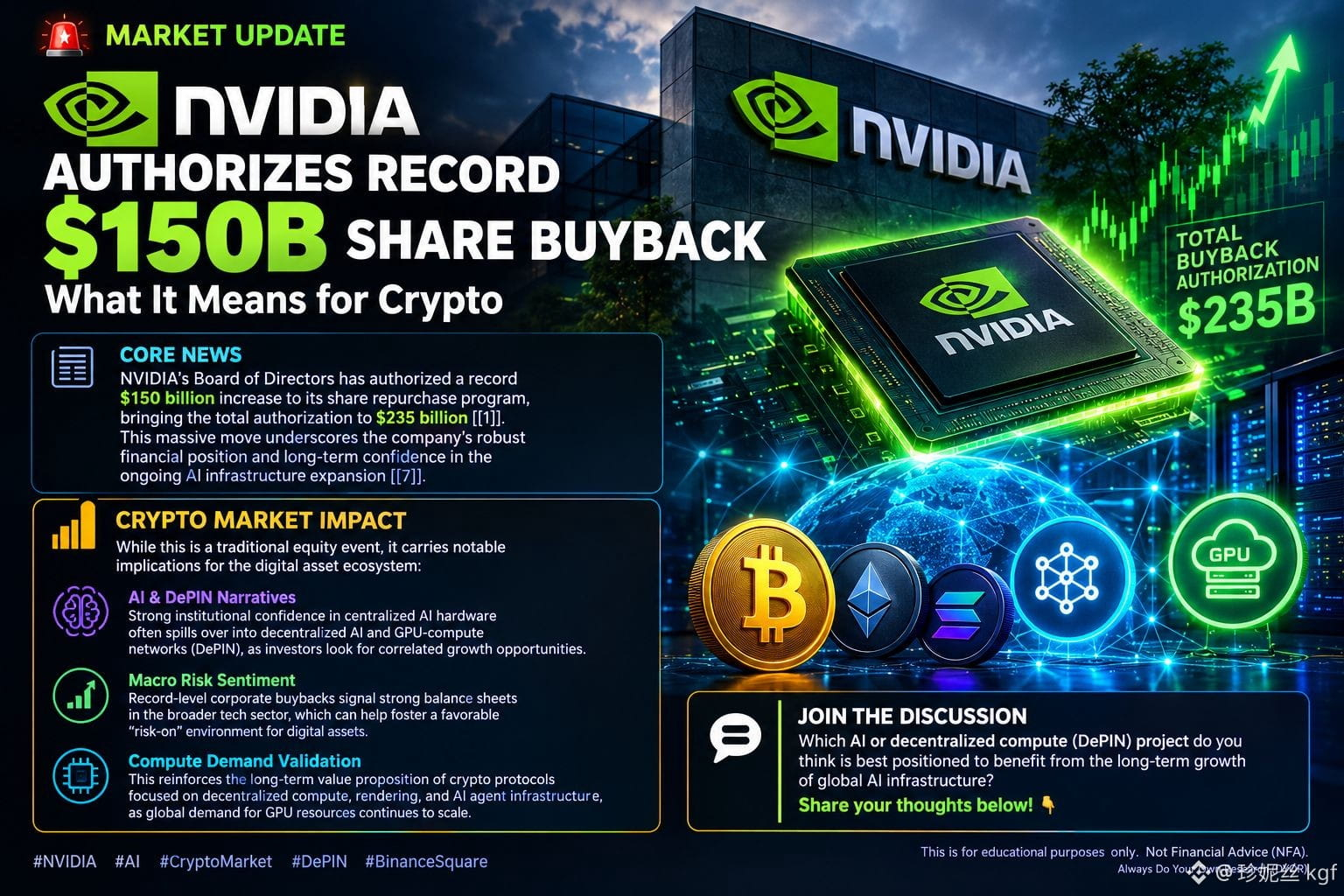
#NvidiaApproves$150BBuyback 🚨 Market Update: NVIDIA Authorizes Record $150B Share Buyback – What It Means for Crypto
The lines between traditional tech and digital assets continue to blur. NVIDIA’s historic $150 billion buyback announcement is sending ripples far beyond the stock market. 🌊
📰 Core News
NVIDIA’s Board of Directors has authorized a record $150 billion increase to its share repurchase program, bringing the total authorization to $235 billion [[1]]. This massive move underscores the company’s robust financial position and long-term confidence in the ongoing AI infrastructure expansion [[7]].
📊 Crypto Market Impact
While this is a traditional equity event, it carries notable implications for the digital asset ecosystem
• AI & DePIN Narratives Strong institutional confidence in centralized AI hardware often spills over into decentralized AI and GPU-compute networks (DePIN), as investors look for correlated growth opportunities.
• Macro Risk Sentiment Record-level corporate buybacks signal strong balance sheets in the broader tech sector, which can help foster a favorable "risk-on" environment for digital assets.
• Compute Demand Validation This reinforces the long-term value proposition of crypto protocols focused on decentralized compute, rendering, and AI agent infrastructure, as global demand for GPU resources continues to scale.
💬 Join the Discussion
Which AI or decentralized compute (DePIN) project do you think is best positioned to benefit from the long-term growth of global AI infrastructure? Share your thoughts below! 👇
#NVIDIA #AI #CryptoMarket #DePIN #BinanceSquare
This is for educational purposes only. Not Financial Advice (NFA). Always Do Your Own Research (DYOR).
$NMR $CRV $HBAR
{future}(HBARUSDT)
{future}(CRVUSDT)
{future}(NMRUSDT)
#NvidiaApproves$150BBuyback 🚨 Market Update: NVIDIA Authorizes Record $150B Share Buyback – What It Means for Crypto
The lines between traditional tech and digital assets continue to blur. NVIDIA’s historic $150 billion buyback announcement is sending ripples far beyond the stock market. 🌊
📰 Core News
NVIDIA’s Board of Directors has authorized a record $150 billion increase to its share repurchase program, bringing the total authorization to $235 billion [[1]]. This massive move underscores the company’s robust financial position and long-term confidence in the ongoing AI infrastructure expansion [[7]].
📊 Crypto Market Impact
While this is a traditional equity event, it carries notable implications for the digital asset ecosystem
• AI & DePIN Narratives Strong institutional confidence in centralized AI hardware often spills over into decentralized AI and GPU-compute networks (DePIN), as investors look for correlated growth opportunities.
• Macro Risk Sentiment Record-level corporate buybacks signal strong balance sheets in the broader tech sector, which can help foster a favorable "risk-on" environment for digital assets.
• Compute Demand Validation This reinforces the long-term value proposition of crypto protocols focused on decentralized compute, rendering, and AI agent infrastructure, as global demand for GPU resources continues to scale.
💬 Join the Discussion
Which AI or decentralized compute (DePIN) project do you think is best positioned to benefit from the long-term growth of global AI infrastructure? Share your thoughts below! 👇
#NVIDIA #AI #CryptoMarket #DePIN #BinanceSquare
This is for educational purposes only. Not Financial Advice (NFA). Always Do Your Own Research (DYOR).
$NMR $CRV $HBAR
The lines between traditional tech and digital assets continue to blur. NVIDIA’s historic $150 billion buyback announcement is sending ripples far beyond the stock market. 🌊
📰 Core News
NVIDIA’s Board of Directors has authorized a record $150 billion increase to its share repurchase program, bringing the total authorization to $235 billion [[1]]. This massive move underscores the company’s robust financial position and long-term confidence in the ongoing AI infrastructure expansion [[7]].
📊 Crypto Market Impact
While this is a traditional equity event, it carries notable implications for the digital asset ecosystem
• AI & DePIN Narratives Strong institutional confidence in centralized AI hardware often spills over into decentralized AI and GPU-compute networks (DePIN), as investors look for correlated growth opportunities.
• Macro Risk Sentiment Record-level corporate buybacks signal strong balance sheets in the broader tech sector, which can help foster a favorable "risk-on" environment for digital assets.
• Compute Demand Validation This reinforces the long-term value proposition of crypto protocols focused on decentralized compute, rendering, and AI agent infrastructure, as global demand for GPU resources continues to scale.
💬 Join the Discussion
Which AI or decentralized compute (DePIN) project do you think is best positioned to benefit from the long-term growth of global AI infrastructure? Share your thoughts below! 👇
#NVIDIA #AI #CryptoMarket #DePIN #BinanceSquare
This is for educational purposes only. Not Financial Advice (NFA). Always Do Your Own Research (DYOR).
$NMR $CRV $HBAR
1
211
·
--
Haussier
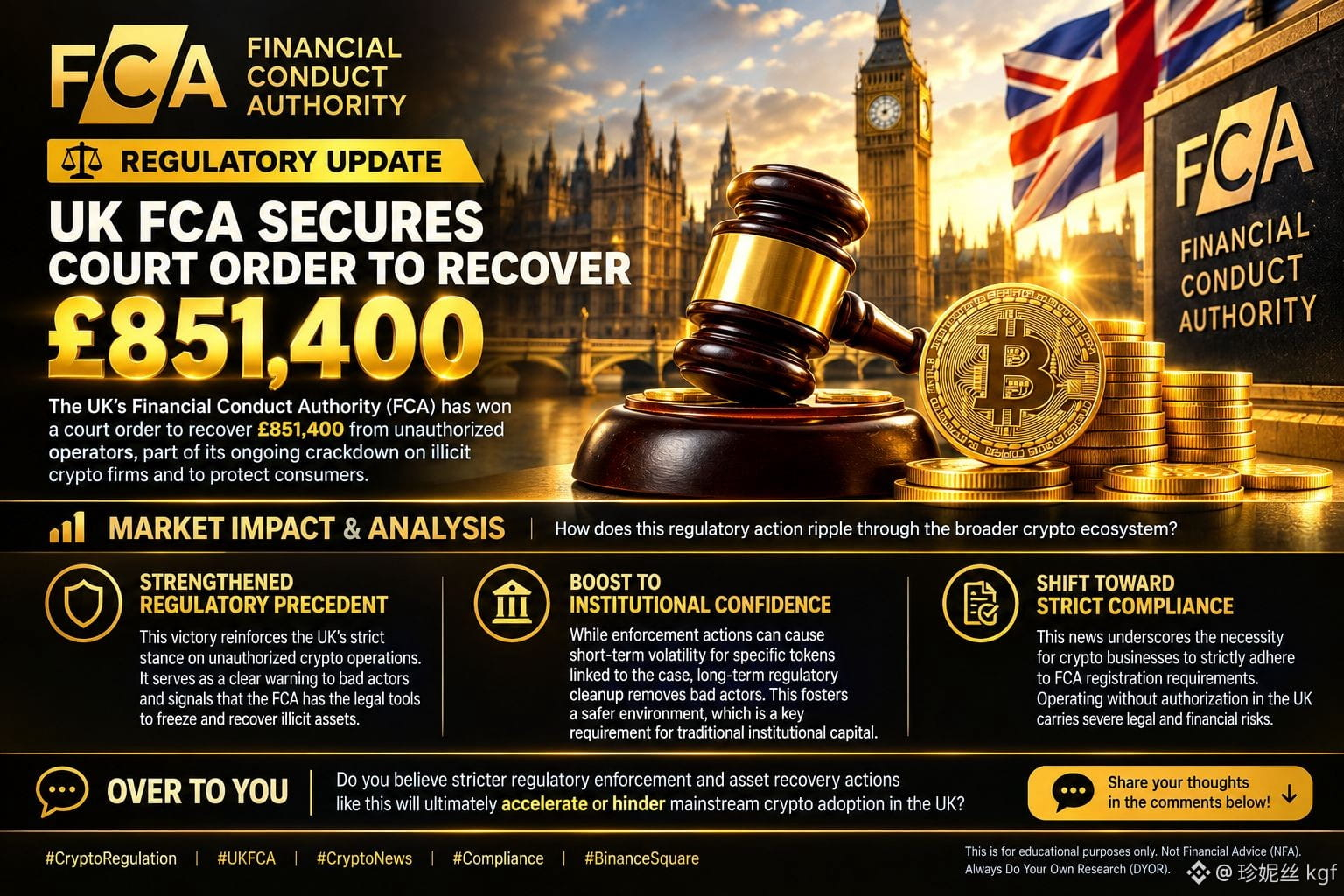
#ukfcawinscourtordertorecover851400pounds ⚖️ Regulatory Update: UK FCA Secures Court Order to Recover £851,400
Regulatory enforcement in the UK crypto sector continues to intensify. The Financial Conduct Authority (FCA) has successfully obtained a significant court order to recover funds from unauthorized operators.
📰 The Core News
The UK’s Financial Conduct Authority (FCA) has won a court order to recover £851,400. This legal action is part of the regulator's ongoing aggressive efforts to tackle unauthorized crypto firms and protect consumers from financial misconduct. The recovered funds are generally managed by appointed receivers with the goal of returning assets to affected consumers or covering the costs of the liquidation process.
📊 Market Impact & Analysis
How does this regulatory action ripple through the broader crypto ecosystem?
Strengthened Regulatory Precedent This victory reinforces the UK's strict stance on unauthorized crypto operations. It serves as a clear warning to bad actors and signals that the FCA has the legal tools to freeze and recover illicit assets.
• Boost to Institutional Confidence While enforcement actions can cause short-term volatility for specific tokens linked to the case, long term regulatory cleanup removes bad actors. This fosters a safer environment, which is a key requirement for traditional institutional capital.
• Shift Toward Strict Compliance This news underscores the necessity for crypto businesses to strictly adhere to FCA registration requirements. Operating without authorization in the UK carries severe legal and financial risks.
💬 Over to You
Do you believe stricter regulatory enforcement and asset recovery actions like this will ultimately accelerate or hinder mainstream crypto adoption in the UK? Let us know your thoughts in the comments below!
#CryptoRegulation #UKFCA #CryptoNews #Compliance #BinanceSquare
This is for educational purposes only. Not Financial Advice (NFA). Always Do Your Own Research (DYOR).
$EHC.US $ETH
{future}(ETHUSDT)
{stock_us}(EHC.US)
#ukfcawinscourtordertorecover851400pounds ⚖️ Regulatory Update: UK FCA Secures Court Order to Recover £851,400
Regulatory enforcement in the UK crypto sector continues to intensify. The Financial Conduct Authority (FCA) has successfully obtained a significant court order to recover funds from unauthorized operators.
📰 The Core News
The UK’s Financial Conduct Authority (FCA) has won a court order to recover £851,400. This legal action is part of the regulator's ongoing aggressive efforts to tackle unauthorized crypto firms and protect consumers from financial misconduct. The recovered funds are generally managed by appointed receivers with the goal of returning assets to affected consumers or covering the costs of the liquidation process.
📊 Market Impact & Analysis
How does this regulatory action ripple through the broader crypto ecosystem?
Strengthened Regulatory Precedent This victory reinforces the UK's strict stance on unauthorized crypto operations. It serves as a clear warning to bad actors and signals that the FCA has the legal tools to freeze and recover illicit assets.
• Boost to Institutional Confidence While enforcement actions can cause short-term volatility for specific tokens linked to the case, long term regulatory cleanup removes bad actors. This fosters a safer environment, which is a key requirement for traditional institutional capital.
• Shift Toward Strict Compliance This news underscores the necessity for crypto businesses to strictly adhere to FCA registration requirements. Operating without authorization in the UK carries severe legal and financial risks.
💬 Over to You
Do you believe stricter regulatory enforcement and asset recovery actions like this will ultimately accelerate or hinder mainstream crypto adoption in the UK? Let us know your thoughts in the comments below!
#CryptoRegulation #UKFCA #CryptoNews #Compliance #BinanceSquare
This is for educational purposes only. Not Financial Advice (NFA). Always Do Your Own Research (DYOR).
$EHC.US $ETH
Regulatory enforcement in the UK crypto sector continues to intensify. The Financial Conduct Authority (FCA) has successfully obtained a significant court order to recover funds from unauthorized operators.
📰 The Core News
The UK’s Financial Conduct Authority (FCA) has won a court order to recover £851,400. This legal action is part of the regulator's ongoing aggressive efforts to tackle unauthorized crypto firms and protect consumers from financial misconduct. The recovered funds are generally managed by appointed receivers with the goal of returning assets to affected consumers or covering the costs of the liquidation process.
📊 Market Impact & Analysis
How does this regulatory action ripple through the broader crypto ecosystem?
Strengthened Regulatory Precedent This victory reinforces the UK's strict stance on unauthorized crypto operations. It serves as a clear warning to bad actors and signals that the FCA has the legal tools to freeze and recover illicit assets.
• Boost to Institutional Confidence While enforcement actions can cause short-term volatility for specific tokens linked to the case, long term regulatory cleanup removes bad actors. This fosters a safer environment, which is a key requirement for traditional institutional capital.
• Shift Toward Strict Compliance This news underscores the necessity for crypto businesses to strictly adhere to FCA registration requirements. Operating without authorization in the UK carries severe legal and financial risks.
💬 Over to You
Do you believe stricter regulatory enforcement and asset recovery actions like this will ultimately accelerate or hinder mainstream crypto adoption in the UK? Let us know your thoughts in the comments below!
#CryptoRegulation #UKFCA #CryptoNews #Compliance #BinanceSquare
This is for educational purposes only. Not Financial Advice (NFA). Always Do Your Own Research (DYOR).
$EHC.US $ETH
ETH+0,52%
EHCUS-0,35%
1
1.2k
·
--
Baissier
#BTCFallsBelow$83000 📉 Bitcoin Tests Key Levels as Price Dips Below $83,000
The leading cryptocurrency has encountered a pivotal price level, sparking renewed discussion about short-term market dynamics. Here is a clear breakdown of the latest price action and what it means for the broader ecosystem.
📰 Core News
• Bitcoin (BTC) has recently moved below the $83,000 threshold.
• This price action reflects a period of market consolidation and natural profit-taking following recent upward momentum.
• On-chain data and exchange flows are being closely monitored by analysts to gauge whether this is a brief fluctuation or the start of a deeper retracement.
📊 Market Impact
•BTC Dynamics The $83,000 zone now transitions into an immediate resistance level. Traders and analysts are watching closely to see if Bitcoin stabilizes here or tests the next major psychological support levels (such as $80,000).
• **Altcoin Correlation:** Historically, BTC price volatility creates ripple effects across the broader crypto market. Major altcoins may experience heightened volatility, with some decoupling temporarily while others follow Bitcoin’s directional bias.
•Market Sentiment This dip serves as a stress test for current market sentiment, helping to separate speculative froth from strong, long-term conviction among both retail and institutional participants.
💬 Join the Discussion
What is your outlook on Bitcoin’s next major support level? Do you view this dip as a healthy market correction or a signal of extended consolidation? Share your thoughts below! 👇
#Bitcoin #BTC #CryptoMarket #MarketAnalysis #BinanceSquare
This is for educational purposes only. Not Financial Advice (NFA). Always Do Your Own Research (DYOR).
$CYPHB $JUV $WLD
{future}(WLDUSDT)
{spot}(JUVUSDT)
{spot}(CYPHBUSDT)
#BTCFallsBelow$83000 📉 Bitcoin Tests Key Levels as Price Dips Below $83,000
The leading cryptocurrency has encountered a pivotal price level, sparking renewed discussion about short-term market dynamics. Here is a clear breakdown of the latest price action and what it means for the broader ecosystem.
📰 Core News
• Bitcoin (BTC) has recently moved below the $83,000 threshold.
• This price action reflects a period of market consolidation and natural profit-taking following recent upward momentum.
• On-chain data and exchange flows are being closely monitored by analysts to gauge whether this is a brief fluctuation or the start of a deeper retracement.
📊 Market Impact
•BTC Dynamics The $83,000 zone now transitions into an immediate resistance level. Traders and analysts are watching closely to see if Bitcoin stabilizes here or tests the next major psychological support levels (such as $80,000).
• **Altcoin Correlation:** Historically, BTC price volatility creates ripple effects across the broader crypto market. Major altcoins may experience heightened volatility, with some decoupling temporarily while others follow Bitcoin’s directional bias.
•Market Sentiment This dip serves as a stress test for current market sentiment, helping to separate speculative froth from strong, long-term conviction among both retail and institutional participants.
💬 Join the Discussion
What is your outlook on Bitcoin’s next major support level? Do you view this dip as a healthy market correction or a signal of extended consolidation? Share your thoughts below! 👇
#Bitcoin #BTC #CryptoMarket #MarketAnalysis #BinanceSquare
This is for educational purposes only. Not Financial Advice (NFA). Always Do Your Own Research (DYOR).
$CYPHB $JUV $WLD
The leading cryptocurrency has encountered a pivotal price level, sparking renewed discussion about short-term market dynamics. Here is a clear breakdown of the latest price action and what it means for the broader ecosystem.
📰 Core News
• Bitcoin (BTC) has recently moved below the $83,000 threshold.
• This price action reflects a period of market consolidation and natural profit-taking following recent upward momentum.
• On-chain data and exchange flows are being closely monitored by analysts to gauge whether this is a brief fluctuation or the start of a deeper retracement.
📊 Market Impact
•BTC Dynamics The $83,000 zone now transitions into an immediate resistance level. Traders and analysts are watching closely to see if Bitcoin stabilizes here or tests the next major psychological support levels (such as $80,000).
• **Altcoin Correlation:** Historically, BTC price volatility creates ripple effects across the broader crypto market. Major altcoins may experience heightened volatility, with some decoupling temporarily while others follow Bitcoin’s directional bias.
•Market Sentiment This dip serves as a stress test for current market sentiment, helping to separate speculative froth from strong, long-term conviction among both retail and institutional participants.
💬 Join the Discussion
What is your outlook on Bitcoin’s next major support level? Do you view this dip as a healthy market correction or a signal of extended consolidation? Share your thoughts below! 👇
#Bitcoin #BTC #CryptoMarket #MarketAnalysis #BinanceSquare
This is for educational purposes only. Not Financial Advice (NFA). Always Do Your Own Research (DYOR).
$CYPHB $JUV $WLD
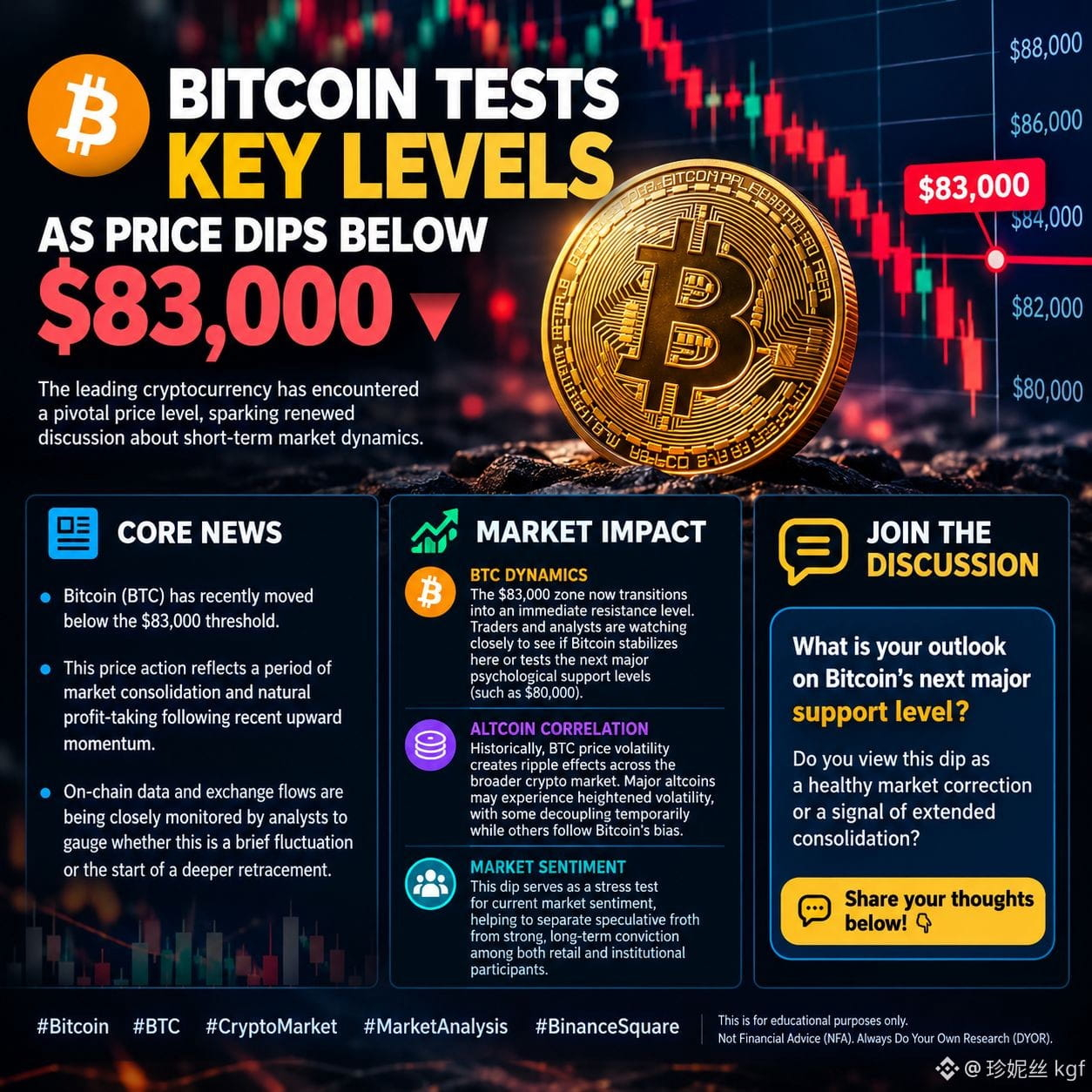
31
·
--
Baissier
#BitgetCEOConfirms$388MStolenInHack 🚨 Bitget Security Breach: CEO Confirms $388M Impact
A major security incident has impacted the crypto exchange landscape. Here is a factual breakdown of the Bitget hack and its market implications.
🔹 The Incident: Bitget CEO Gracy Chen confirmed attackers compromised a wallet backend, resulting in ~$388M in unauthorized transfers.
🔹 The Method: The exploit bypassed direct private key theft. Hackers spoofed transaction data, akin to a forged deposit slip.
🔹 Affected Assets: The breach impacted hot/warm wallets, with ETH, USDT, and XRP reportedly affected.
🔹 The Response: Bitget paused affected withdrawals and began a phased resumption (starting with BTC). The exchange stated its protection fund will cover losses to keep user funds secure.
📊 Market Impact Analysis
• CEX Security Scrutiny: This intensifies focus on centralized exchange custody and third-party provider security protocols.
• Insurance Fund Stress Test: The market will watch Bitget’s ability to absorb the $388M shortfall via its protection fund without disrupting platform liquidity.
• Broader Sentiment: While isolated hacks are less likely to trigger systemic downturns, they heighten caution and reinforce the dialogue around self-custody.
💬 Join the Discussion
How do you think CEXs can better balance seamless UX with institutional-grade security? Share your thoughts below!
#CryptoSecurity #Bitget #CryptoNews #MarketAnalysis #Web3
This is for educational purposes only. Not Financial Advice (NFA). Always Do Your Own Research (DYOR).
$PHA $AR $AUDIO
{spot}(AUDIOUSDT)
{future}(ARUSDT)
{future}(PHAUSDT)
#BitgetCEOConfirms$388MStolenInHack 🚨 Bitget Security Breach: CEO Confirms $388M Impact
A major security incident has impacted the crypto exchange landscape. Here is a factual breakdown of the Bitget hack and its market implications.
🔹 The Incident: Bitget CEO Gracy Chen confirmed attackers compromised a wallet backend, resulting in ~$388M in unauthorized transfers.
🔹 The Method: The exploit bypassed direct private key theft. Hackers spoofed transaction data, akin to a forged deposit slip.
🔹 Affected Assets: The breach impacted hot/warm wallets, with ETH, USDT, and XRP reportedly affected.
🔹 The Response: Bitget paused affected withdrawals and began a phased resumption (starting with BTC). The exchange stated its protection fund will cover losses to keep user funds secure.
📊 Market Impact Analysis
• CEX Security Scrutiny: This intensifies focus on centralized exchange custody and third-party provider security protocols.
• Insurance Fund Stress Test: The market will watch Bitget’s ability to absorb the $388M shortfall via its protection fund without disrupting platform liquidity.
• Broader Sentiment: While isolated hacks are less likely to trigger systemic downturns, they heighten caution and reinforce the dialogue around self-custody.
💬 Join the Discussion
How do you think CEXs can better balance seamless UX with institutional-grade security? Share your thoughts below!
#CryptoSecurity #Bitget #CryptoNews #MarketAnalysis #Web3
This is for educational purposes only. Not Financial Advice (NFA). Always Do Your Own Research (DYOR).
$PHA $AR $AUDIO
A major security incident has impacted the crypto exchange landscape. Here is a factual breakdown of the Bitget hack and its market implications.
🔹 The Incident: Bitget CEO Gracy Chen confirmed attackers compromised a wallet backend, resulting in ~$388M in unauthorized transfers.
🔹 The Method: The exploit bypassed direct private key theft. Hackers spoofed transaction data, akin to a forged deposit slip.
🔹 Affected Assets: The breach impacted hot/warm wallets, with ETH, USDT, and XRP reportedly affected.
🔹 The Response: Bitget paused affected withdrawals and began a phased resumption (starting with BTC). The exchange stated its protection fund will cover losses to keep user funds secure.
📊 Market Impact Analysis
• CEX Security Scrutiny: This intensifies focus on centralized exchange custody and third-party provider security protocols.
• Insurance Fund Stress Test: The market will watch Bitget’s ability to absorb the $388M shortfall via its protection fund without disrupting platform liquidity.
• Broader Sentiment: While isolated hacks are less likely to trigger systemic downturns, they heighten caution and reinforce the dialogue around self-custody.
💬 Join the Discussion
How do you think CEXs can better balance seamless UX with institutional-grade security? Share your thoughts below!
#CryptoSecurity #Bitget #CryptoNews #MarketAnalysis #Web3
This is for educational purposes only. Not Financial Advice (NFA). Always Do Your Own Research (DYOR).
$PHA $AR $AUDIO
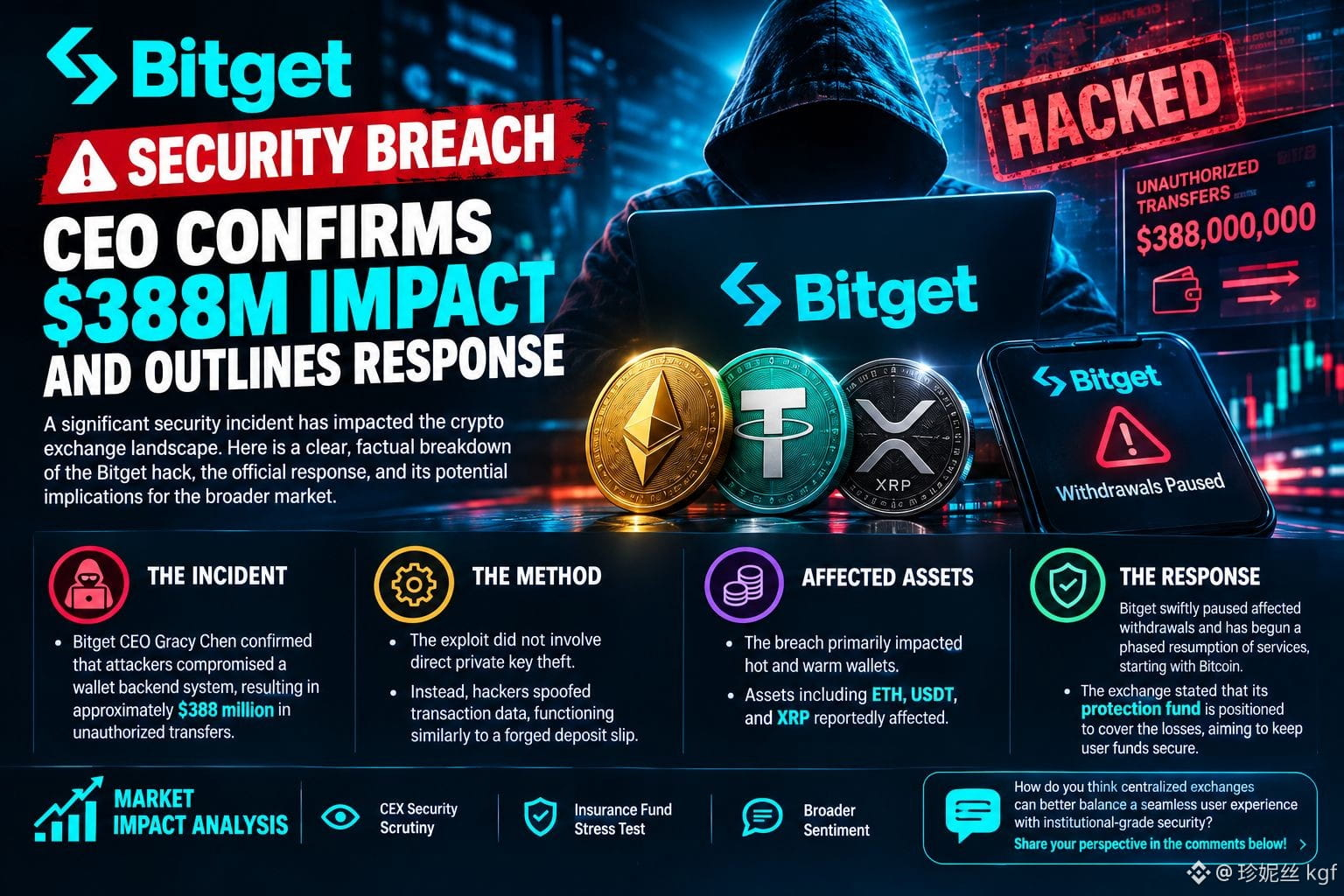
1
835
·
--
Baissier
#kospifalls2.7%samsungskhynixdropover5% 📉 Market Watch KOSPI Dips 2.7% as Tech Giants Samsung & SK Hynix Slide Over 5%
Traditional markets are showing signs of risk-off sentiment today. Here’s what the latest slide in South Korean tech stocks means for the broader digital asset ecosystem. 🌐
📰 Core News
South Korea’s benchmark KOSPI index experienced a notable decline of 2.7% in today’s trading session. Leading the downturn were semiconductor giants Samsung Electronics and SK Hynix, both dropping over 5% amid broader macroeconomic pressures and sector-specific profit-taking.
📊 Market Impact
While this is a traditional finance (TradFi) event, it carries several implications for the crypto market
• Risk Sentiment Spillover Sharp declines in major global indices often trigger short-term volatility in digital assets as macro traders adjust their risk exposure.
• Regional Trading Dynamics South Korea remains one of the most active retail crypto markets globally. Significant local equity downturns can occasionally influence regional trading volumes and short-term liquidity flows.
• Tech & AI Narrative Correlation Since semiconductors are the backbone of the AI boom, weakness in major chipmakers may temporarily cool down speculative enthusiasm around AI-related crypto tokens and Web3 infrastructure projects.
💬 Join the Discussion
Do you think traditional market dips like this create a decoupling opportunity for crypto, or are we heading for broader short-term volatility across all risk assets? Let’s discuss your thoughts below! 👇
#CryptoMarket #KOSPI #MacroEconomics #Bitcoin #MarketAnalysis
This is for educational purposes only. Not Financial Advice (NFA). Always Do Your Own Research (DYOR).
$NIL $INTWB $QI
{spot}(QIUSDT)
{spot}(INTWBUSDT)
{future}(NILUSDT)
#kospifalls2.7%samsungskhynixdropover5% 📉 Market Watch KOSPI Dips 2.7% as Tech Giants Samsung & SK Hynix Slide Over 5%
Traditional markets are showing signs of risk-off sentiment today. Here’s what the latest slide in South Korean tech stocks means for the broader digital asset ecosystem. 🌐
📰 Core News
South Korea’s benchmark KOSPI index experienced a notable decline of 2.7% in today’s trading session. Leading the downturn were semiconductor giants Samsung Electronics and SK Hynix, both dropping over 5% amid broader macroeconomic pressures and sector-specific profit-taking.
📊 Market Impact
While this is a traditional finance (TradFi) event, it carries several implications for the crypto market
• Risk Sentiment Spillover Sharp declines in major global indices often trigger short-term volatility in digital assets as macro traders adjust their risk exposure.
• Regional Trading Dynamics South Korea remains one of the most active retail crypto markets globally. Significant local equity downturns can occasionally influence regional trading volumes and short-term liquidity flows.
• Tech & AI Narrative Correlation Since semiconductors are the backbone of the AI boom, weakness in major chipmakers may temporarily cool down speculative enthusiasm around AI-related crypto tokens and Web3 infrastructure projects.
💬 Join the Discussion
Do you think traditional market dips like this create a decoupling opportunity for crypto, or are we heading for broader short-term volatility across all risk assets? Let’s discuss your thoughts below! 👇
#CryptoMarket #KOSPI #MacroEconomics #Bitcoin #MarketAnalysis
This is for educational purposes only. Not Financial Advice (NFA). Always Do Your Own Research (DYOR).
$NIL $INTWB $QI
Traditional markets are showing signs of risk-off sentiment today. Here’s what the latest slide in South Korean tech stocks means for the broader digital asset ecosystem. 🌐
📰 Core News
South Korea’s benchmark KOSPI index experienced a notable decline of 2.7% in today’s trading session. Leading the downturn were semiconductor giants Samsung Electronics and SK Hynix, both dropping over 5% amid broader macroeconomic pressures and sector-specific profit-taking.
📊 Market Impact
While this is a traditional finance (TradFi) event, it carries several implications for the crypto market
• Risk Sentiment Spillover Sharp declines in major global indices often trigger short-term volatility in digital assets as macro traders adjust their risk exposure.
• Regional Trading Dynamics South Korea remains one of the most active retail crypto markets globally. Significant local equity downturns can occasionally influence regional trading volumes and short-term liquidity flows.
• Tech & AI Narrative Correlation Since semiconductors are the backbone of the AI boom, weakness in major chipmakers may temporarily cool down speculative enthusiasm around AI-related crypto tokens and Web3 infrastructure projects.
💬 Join the Discussion
Do you think traditional market dips like this create a decoupling opportunity for crypto, or are we heading for broader short-term volatility across all risk assets? Let’s discuss your thoughts below! 👇
#CryptoMarket #KOSPI #MacroEconomics #Bitcoin #MarketAnalysis
This is for educational purposes only. Not Financial Advice (NFA). Always Do Your Own Research (DYOR).
$NIL $INTWB $QI
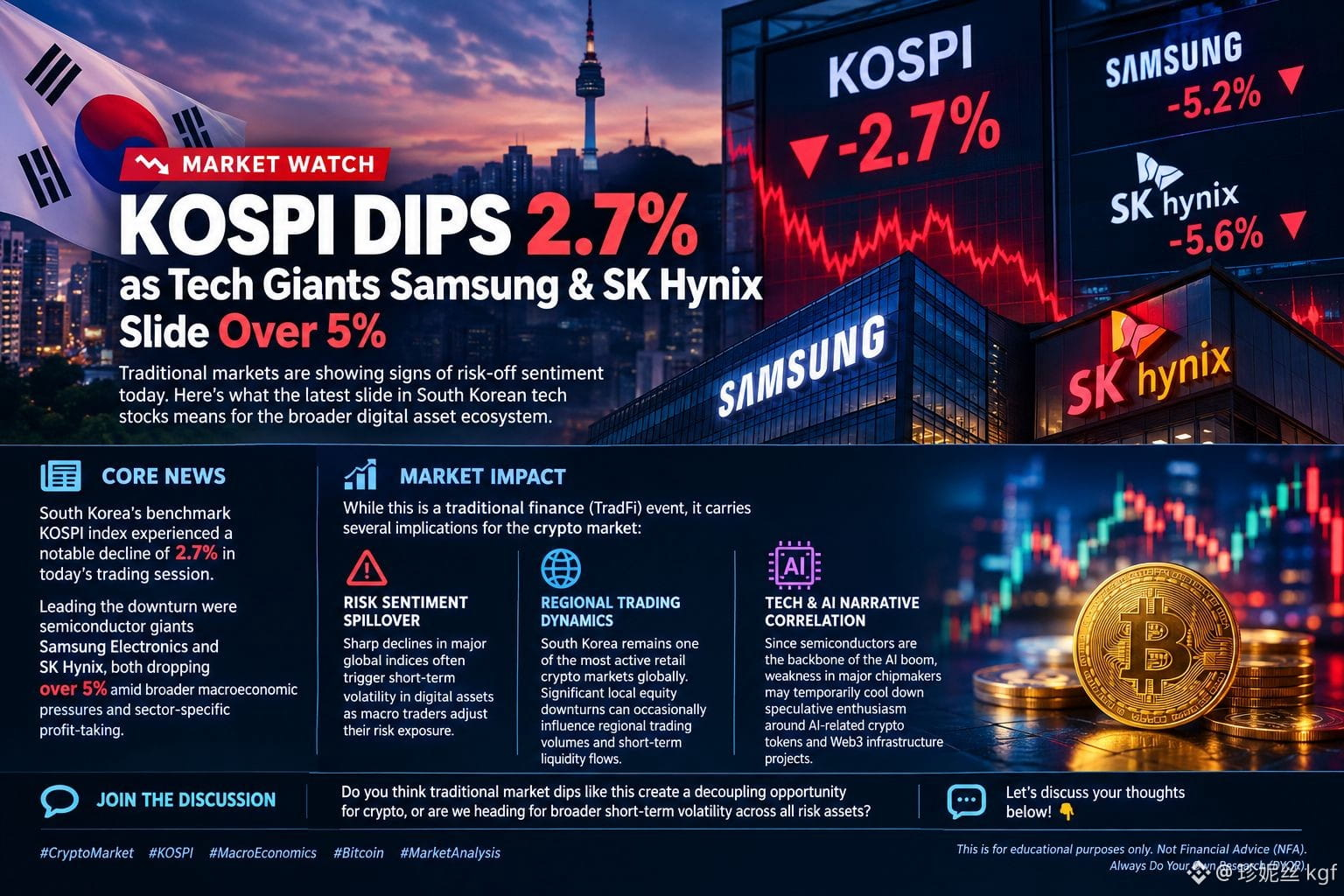
447
·
--
Haussier
#qntfallsover40%frommorninghigh 📉 Market Update QNT Experiences Significant Intraday Correction, Down Over 40% from Morning High
Quant (QNT) has seen a sharp intraday price adjustment, sparking heightened volatility and drawing close attention from market observers. Let’s break down the recent movement and its broader context.
📰 Core News
• QNT experienced a steep intraday decline, briefly falling below the $200 mark and trading around the $203 level [[1]].
• This movement represents a drop of more than 40% from its morning peak, marking a notable session of high volatility for the asset [2]
📊 Market Impact
• 🔹 Volatility & Liquidity Sharp corrections of this magnitude often trigger increased trading volume and cascading liquidations as the market rapidly recalibrates to new price levels.
• 🔹 Technical Testing A drop this significant tests key psychological and technical support zones, which traders and analysts will monitor closely for signs of consolidation or further directional movement.
• 🔹 Ecosystem Context While short-term price action is turbulent, Quant’s ongoing development in enterprise blockchain interoperability (via its Overledger technology) remains a fundamental focus for its long-term network utility.
💬 Join the Discussion
How do you typically approach sudden, high-volatility intraday corrections in your market analysis? Do you view them as technical resets or broader trend shifts? Share your thoughts below! 👇
#QNT #Quant #CryptoMarket #Altcoins #MarketUpdate
This is for educational purposes only. Not Financial Advice (NFA). Always Do Your Own Research (DYOR).
$SOXSB $GRT $MUBARAK
{future}(MUBARAKUSDT)
{future}(GRTUSDT)
{spot}(SOXSBUSDT)
#qntfallsover40%frommorninghigh 📉 Market Update QNT Experiences Significant Intraday Correction, Down Over 40% from Morning High
Quant (QNT) has seen a sharp intraday price adjustment, sparking heightened volatility and drawing close attention from market observers. Let’s break down the recent movement and its broader context.
📰 Core News
• QNT experienced a steep intraday decline, briefly falling below the $200 mark and trading around the $203 level [[1]].
• This movement represents a drop of more than 40% from its morning peak, marking a notable session of high volatility for the asset [2]
📊 Market Impact
• 🔹 Volatility & Liquidity Sharp corrections of this magnitude often trigger increased trading volume and cascading liquidations as the market rapidly recalibrates to new price levels.
• 🔹 Technical Testing A drop this significant tests key psychological and technical support zones, which traders and analysts will monitor closely for signs of consolidation or further directional movement.
• 🔹 Ecosystem Context While short-term price action is turbulent, Quant’s ongoing development in enterprise blockchain interoperability (via its Overledger technology) remains a fundamental focus for its long-term network utility.
💬 Join the Discussion
How do you typically approach sudden, high-volatility intraday corrections in your market analysis? Do you view them as technical resets or broader trend shifts? Share your thoughts below! 👇
#QNT #Quant #CryptoMarket #Altcoins #MarketUpdate
This is for educational purposes only. Not Financial Advice (NFA). Always Do Your Own Research (DYOR).
$SOXSB $GRT $MUBARAK
Quant (QNT) has seen a sharp intraday price adjustment, sparking heightened volatility and drawing close attention from market observers. Let’s break down the recent movement and its broader context.
📰 Core News
• QNT experienced a steep intraday decline, briefly falling below the $200 mark and trading around the $203 level [[1]].
• This movement represents a drop of more than 40% from its morning peak, marking a notable session of high volatility for the asset [2]
📊 Market Impact
• 🔹 Volatility & Liquidity Sharp corrections of this magnitude often trigger increased trading volume and cascading liquidations as the market rapidly recalibrates to new price levels.
• 🔹 Technical Testing A drop this significant tests key psychological and technical support zones, which traders and analysts will monitor closely for signs of consolidation or further directional movement.
• 🔹 Ecosystem Context While short-term price action is turbulent, Quant’s ongoing development in enterprise blockchain interoperability (via its Overledger technology) remains a fundamental focus for its long-term network utility.
💬 Join the Discussion
How do you typically approach sudden, high-volatility intraday corrections in your market analysis? Do you view them as technical resets or broader trend shifts? Share your thoughts below! 👇
#QNT #Quant #CryptoMarket #Altcoins #MarketUpdate
This is for educational purposes only. Not Financial Advice (NFA). Always Do Your Own Research (DYOR).
$SOXSB $GRT $MUBARAK
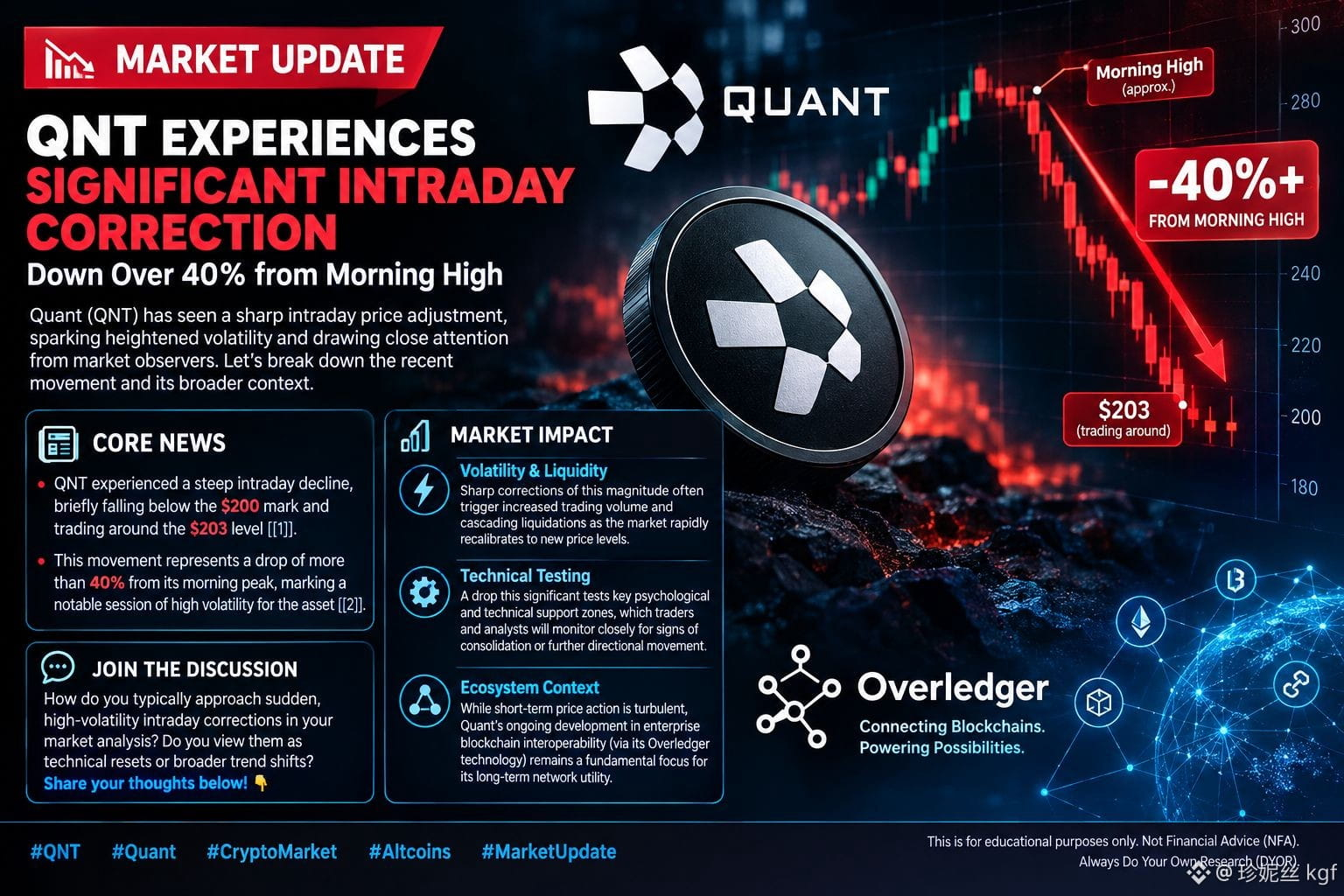
248
·
--
Haussier
#GoldFallsTo$4144 📉 Gold Slips to $4,144: Macro Shifts and the Crypto Read-Through
Precious metals are facing renewed pressure as shifting macroeconomic dynamics reshape traditional safe-haven flows. Here is what this means for the broader digital asset ecosystem.
📰 Core News
Spot gold recently declined to approximately $4,144 per troy ounce. This pullback is largely driven by rising energy prices and geopolitical tensions, which have revived inflation concerns. Consequently, markets are pricing in sustained higher interest rates. Because gold is a non-yielding asset, higher rate expectations typically reduce its short-term appeal relative to yield-bearing instruments like Treasury bonds.
📊 Market Impact
How does this traditional market move translate to crypto?
• Macro Headwinds A stronger US Dollar and elevated Treasury yields often create short-term pressure on both traditional safe havens and risk-on assets, including major cryptocurrencies.
• The "Digital Gold" Narrative While Bitcoin and gold occasionally move in tandem, recent market data shows a notable decoupling. Bitcoin is increasingly being evaluated on its own institutional adoption metrics, ETF inflows, and network fundamentals, rather than purely as a direct 1:1 inflation hedge.
• DeFi Yield Competition As traditional risk-free rates remain competitive, decentralized finance (DeFi) protocols continue to face the challenge of offering sustainable, real yield to attract and retain capital.
🗣️ Let’s Discuss
Do you view Bitcoin as a true "digital gold" safe haven during macroeconomic turbulence, or does it still behave more like a tech growth stock? Share your perspective in the comments below! 👇
#Gold #Bitcoin #Macroeconomics #CryptoMarket #DeFi
This is for educational purposes only. Not Financial Advice (NFA). Always Do Your Own Research (DYOR).
$ONE $MARSCOIN $ALGO
{future}(ALGOUSDT)
{future}(MARSCOINUSDT)
{future}(ONEUSDT)
#GoldFallsTo$4144 📉 Gold Slips to $4,144: Macro Shifts and the Crypto Read-Through
Precious metals are facing renewed pressure as shifting macroeconomic dynamics reshape traditional safe-haven flows. Here is what this means for the broader digital asset ecosystem.
📰 Core News
Spot gold recently declined to approximately $4,144 per troy ounce. This pullback is largely driven by rising energy prices and geopolitical tensions, which have revived inflation concerns. Consequently, markets are pricing in sustained higher interest rates. Because gold is a non-yielding asset, higher rate expectations typically reduce its short-term appeal relative to yield-bearing instruments like Treasury bonds.
📊 Market Impact
How does this traditional market move translate to crypto?
• Macro Headwinds A stronger US Dollar and elevated Treasury yields often create short-term pressure on both traditional safe havens and risk-on assets, including major cryptocurrencies.
• The "Digital Gold" Narrative While Bitcoin and gold occasionally move in tandem, recent market data shows a notable decoupling. Bitcoin is increasingly being evaluated on its own institutional adoption metrics, ETF inflows, and network fundamentals, rather than purely as a direct 1:1 inflation hedge.
• DeFi Yield Competition As traditional risk-free rates remain competitive, decentralized finance (DeFi) protocols continue to face the challenge of offering sustainable, real yield to attract and retain capital.
🗣️ Let’s Discuss
Do you view Bitcoin as a true "digital gold" safe haven during macroeconomic turbulence, or does it still behave more like a tech growth stock? Share your perspective in the comments below! 👇
#Gold #Bitcoin #Macroeconomics #CryptoMarket #DeFi
This is for educational purposes only. Not Financial Advice (NFA). Always Do Your Own Research (DYOR).
$ONE $MARSCOIN $ALGO
Precious metals are facing renewed pressure as shifting macroeconomic dynamics reshape traditional safe-haven flows. Here is what this means for the broader digital asset ecosystem.
📰 Core News
Spot gold recently declined to approximately $4,144 per troy ounce. This pullback is largely driven by rising energy prices and geopolitical tensions, which have revived inflation concerns. Consequently, markets are pricing in sustained higher interest rates. Because gold is a non-yielding asset, higher rate expectations typically reduce its short-term appeal relative to yield-bearing instruments like Treasury bonds.
📊 Market Impact
How does this traditional market move translate to crypto?
• Macro Headwinds A stronger US Dollar and elevated Treasury yields often create short-term pressure on both traditional safe havens and risk-on assets, including major cryptocurrencies.
• The "Digital Gold" Narrative While Bitcoin and gold occasionally move in tandem, recent market data shows a notable decoupling. Bitcoin is increasingly being evaluated on its own institutional adoption metrics, ETF inflows, and network fundamentals, rather than purely as a direct 1:1 inflation hedge.
• DeFi Yield Competition As traditional risk-free rates remain competitive, decentralized finance (DeFi) protocols continue to face the challenge of offering sustainable, real yield to attract and retain capital.
🗣️ Let’s Discuss
Do you view Bitcoin as a true "digital gold" safe haven during macroeconomic turbulence, or does it still behave more like a tech growth stock? Share your perspective in the comments below! 👇
#Gold #Bitcoin #Macroeconomics #CryptoMarket #DeFi
This is for educational purposes only. Not Financial Advice (NFA). Always Do Your Own Research (DYOR).
$ONE $MARSCOIN $ALGO
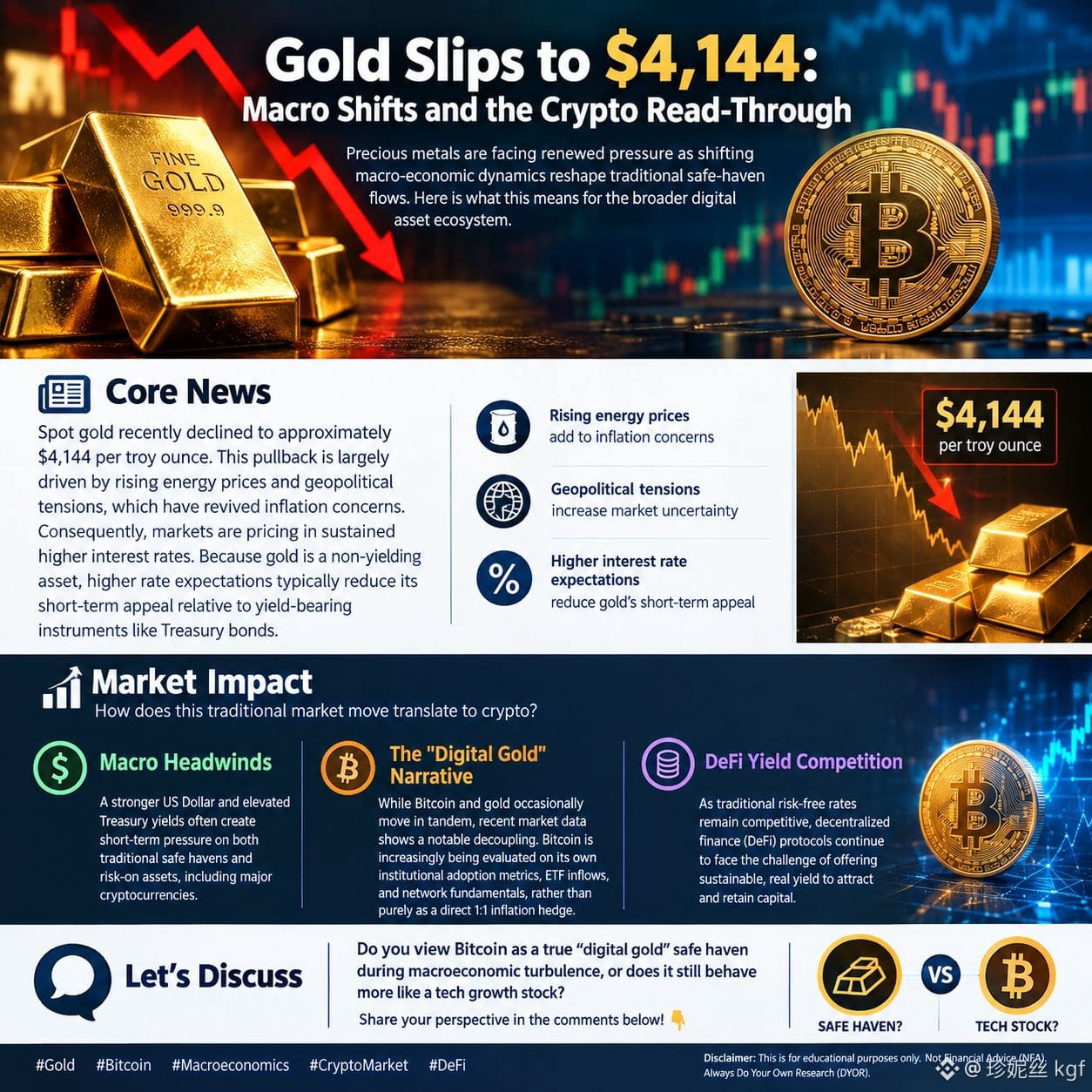
1
395
·
--
Haussier
#chainlinklaunchesccip2withenterpriseverification 🔗 Chainlink Unveils CCIP 2.0 A New Standard for Enterprise Cross-Chain Verification
Cross-chain interoperability just received a major institutional upgrade. Chainlink has officially launched CCIP 2.0, introducing customizable enterprise verification to bridge the gap between traditional finance and decentralized networks.
📰 Core News
CCIP 2.0 builds on Chainlink’s existing secure infrastructure by introducing new features tailored for institutional risk controls
• Additive Verification Institutions can now operate their own Cross Chain Verifiers (CCVs) or select trusted third-party validators to run alongside Chainlink’s default 16-node committee [9]
• Customizable Enforcement Enterprises can define specific rules for their transactions, such as requiring additional approval for transfers exceeding a set value [11]
Open CCV Marketplace A new framework allowing specialized providers to offer verification services, giving asset issuers more security choices while creating new utility for infrastructure providers [1]
📊 Market Impact
Institutional Adoption By meeting stringent bank and asset manager security needs this update lowers the barrier for traditional capital to flow onchain safely [[10]].
• Ecosystem Utility Increased cross-chain transaction volume and the new verifier fee model could drive sustained, organic demand for the underlying network infrastructure.
• Security Benchmark This establishes a new standard for cross-chain risk management, potentially influencing how other interoperability protocols approach institutional-grade security.
💬 Join the Discussion
Do you think customizable enterprise verification is the key to unlocking large-scale institutional adoption of cross-chain networks? Share your perspective in the comments below!
#Chainlink #LINK #CCIP #Web3 #CryptoNews
This is for educational purposes only. Not Financial Advice (NFA). Always Do Your Own Research (DYOR).
$QNT $HBAR $NMR
{future}(NMRUSDT)
{future}(HBARUSDT)
{future}(QNTUSDT)
#chainlinklaunchesccip2withenterpriseverification 🔗 Chainlink Unveils CCIP 2.0 A New Standard for Enterprise Cross-Chain Verification
Cross-chain interoperability just received a major institutional upgrade. Chainlink has officially launched CCIP 2.0, introducing customizable enterprise verification to bridge the gap between traditional finance and decentralized networks.
📰 Core News
CCIP 2.0 builds on Chainlink’s existing secure infrastructure by introducing new features tailored for institutional risk controls
• Additive Verification Institutions can now operate their own Cross Chain Verifiers (CCVs) or select trusted third-party validators to run alongside Chainlink’s default 16-node committee [9]
• Customizable Enforcement Enterprises can define specific rules for their transactions, such as requiring additional approval for transfers exceeding a set value [11]
Open CCV Marketplace A new framework allowing specialized providers to offer verification services, giving asset issuers more security choices while creating new utility for infrastructure providers [1]
📊 Market Impact
Institutional Adoption By meeting stringent bank and asset manager security needs this update lowers the barrier for traditional capital to flow onchain safely [[10]].
• Ecosystem Utility Increased cross-chain transaction volume and the new verifier fee model could drive sustained, organic demand for the underlying network infrastructure.
• Security Benchmark This establishes a new standard for cross-chain risk management, potentially influencing how other interoperability protocols approach institutional-grade security.
💬 Join the Discussion
Do you think customizable enterprise verification is the key to unlocking large-scale institutional adoption of cross-chain networks? Share your perspective in the comments below!
#Chainlink #LINK #CCIP #Web3 #CryptoNews
This is for educational purposes only. Not Financial Advice (NFA). Always Do Your Own Research (DYOR).
$QNT $HBAR $NMR
Cross-chain interoperability just received a major institutional upgrade. Chainlink has officially launched CCIP 2.0, introducing customizable enterprise verification to bridge the gap between traditional finance and decentralized networks.
📰 Core News
CCIP 2.0 builds on Chainlink’s existing secure infrastructure by introducing new features tailored for institutional risk controls
• Additive Verification Institutions can now operate their own Cross Chain Verifiers (CCVs) or select trusted third-party validators to run alongside Chainlink’s default 16-node committee [9]
• Customizable Enforcement Enterprises can define specific rules for their transactions, such as requiring additional approval for transfers exceeding a set value [11]
Open CCV Marketplace A new framework allowing specialized providers to offer verification services, giving asset issuers more security choices while creating new utility for infrastructure providers [1]
📊 Market Impact
Institutional Adoption By meeting stringent bank and asset manager security needs this update lowers the barrier for traditional capital to flow onchain safely [[10]].
• Ecosystem Utility Increased cross-chain transaction volume and the new verifier fee model could drive sustained, organic demand for the underlying network infrastructure.
• Security Benchmark This establishes a new standard for cross-chain risk management, potentially influencing how other interoperability protocols approach institutional-grade security.
💬 Join the Discussion
Do you think customizable enterprise verification is the key to unlocking large-scale institutional adoption of cross-chain networks? Share your perspective in the comments below!
#Chainlink #LINK #CCIP #Web3 #CryptoNews
This is for educational purposes only. Not Financial Advice (NFA). Always Do Your Own Research (DYOR).
$QNT $HBAR $NMR
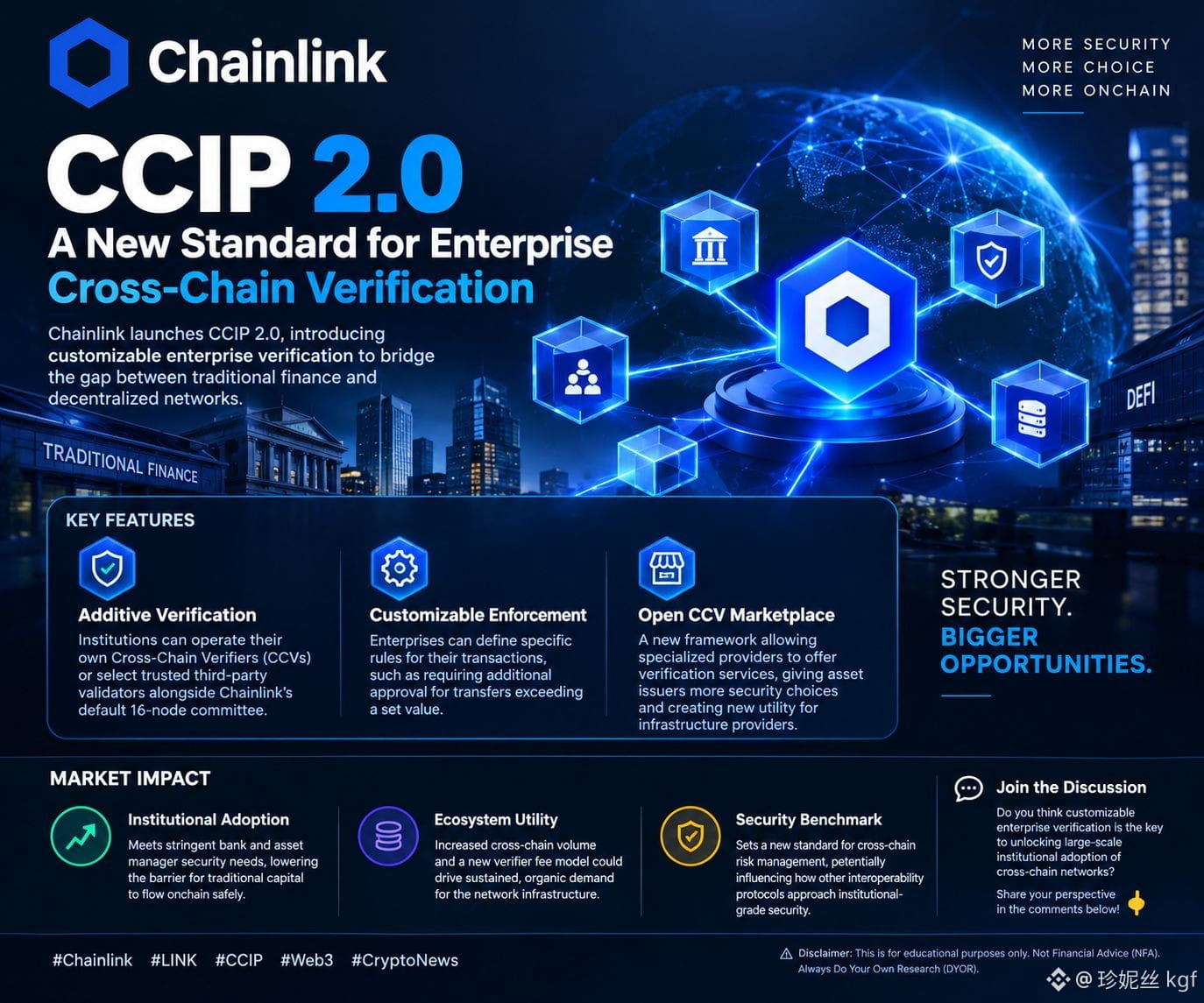
29
·
--
Baissier
#skoreafscconsidersvirtualassetmarketmaker 🇰🇷 South Korea’s FSC Evaluates Market Maker System to Enhance Crypto Market Stability
Following recent liquidity-driven price anomalies, South Korea’s Financial Services Commission (FSC) is exploring a significant regulatory shift to bring institutional-grade stability to the virtual asset market. 📊
📰 Core News
• The FSC is actively considering the introduction of a formal market maker (MM) system for digital assets.
• This evaluation follows a recent incident where a yen-backed stablecoin (JPYC) traded at up to 4x its intended peg on a major local exchange due to thin order books and limited liquidity.
• While the current Virtual Asset User Protection Act restricts market-making activities (often viewing them as potential market manipulation), the FSC plans to revisit this framework during its next legislative phase to boost market efficiency and strengthen user protection. ⚖️
📈 Market Impact
• Enhanced Liquidity: A regulated MM framework could reduce extreme volatility and slippage, particularly for newly listed or lower-cap tokens on Korean exchanges.
•Regulatory Maturation Moving from a blanket restriction to a supervised MM system signals a more nuanced, mature approach to digital asset oversight, potentially paving the way for broader institutional participation.
• Price Efficiency Formalized liquidity provision may help mitigate persistent regional price discrepancies, such as the well-known "Kimchi Premium," by ensuring tighter alignment with global spot prices. 💡
💬 Join the Discussion
Do you think regulated market makers will successfully stabilize the crypto market, or do they introduce new centralization risks? Share your perspective in the comments below! 👇
#SouthKorea #CryptoRegulation #MarketLiquidity #DigitalAssets #BinanceSquare
This is for educational purposes only. Not Financial Advice (NFA). Always Do Your Own Research (DYOR).
$AR $BCH $ZEN
{future}(ZENUSDT)
{future}(BCHUSDT)
{future}(ARUSDT)
#skoreafscconsidersvirtualassetmarketmaker 🇰🇷 South Korea’s FSC Evaluates Market Maker System to Enhance Crypto Market Stability
Following recent liquidity-driven price anomalies, South Korea’s Financial Services Commission (FSC) is exploring a significant regulatory shift to bring institutional-grade stability to the virtual asset market. 📊
📰 Core News
• The FSC is actively considering the introduction of a formal market maker (MM) system for digital assets.
• This evaluation follows a recent incident where a yen-backed stablecoin (JPYC) traded at up to 4x its intended peg on a major local exchange due to thin order books and limited liquidity.
• While the current Virtual Asset User Protection Act restricts market-making activities (often viewing them as potential market manipulation), the FSC plans to revisit this framework during its next legislative phase to boost market efficiency and strengthen user protection. ⚖️
📈 Market Impact
• Enhanced Liquidity: A regulated MM framework could reduce extreme volatility and slippage, particularly for newly listed or lower-cap tokens on Korean exchanges.
•Regulatory Maturation Moving from a blanket restriction to a supervised MM system signals a more nuanced, mature approach to digital asset oversight, potentially paving the way for broader institutional participation.
• Price Efficiency Formalized liquidity provision may help mitigate persistent regional price discrepancies, such as the well-known "Kimchi Premium," by ensuring tighter alignment with global spot prices. 💡
💬 Join the Discussion
Do you think regulated market makers will successfully stabilize the crypto market, or do they introduce new centralization risks? Share your perspective in the comments below! 👇
#SouthKorea #CryptoRegulation #MarketLiquidity #DigitalAssets #BinanceSquare
This is for educational purposes only. Not Financial Advice (NFA). Always Do Your Own Research (DYOR).
$AR $BCH $ZEN
Following recent liquidity-driven price anomalies, South Korea’s Financial Services Commission (FSC) is exploring a significant regulatory shift to bring institutional-grade stability to the virtual asset market. 📊
📰 Core News
• The FSC is actively considering the introduction of a formal market maker (MM) system for digital assets.
• This evaluation follows a recent incident where a yen-backed stablecoin (JPYC) traded at up to 4x its intended peg on a major local exchange due to thin order books and limited liquidity.
• While the current Virtual Asset User Protection Act restricts market-making activities (often viewing them as potential market manipulation), the FSC plans to revisit this framework during its next legislative phase to boost market efficiency and strengthen user protection. ⚖️
📈 Market Impact
• Enhanced Liquidity: A regulated MM framework could reduce extreme volatility and slippage, particularly for newly listed or lower-cap tokens on Korean exchanges.
•Regulatory Maturation Moving from a blanket restriction to a supervised MM system signals a more nuanced, mature approach to digital asset oversight, potentially paving the way for broader institutional participation.
• Price Efficiency Formalized liquidity provision may help mitigate persistent regional price discrepancies, such as the well-known "Kimchi Premium," by ensuring tighter alignment with global spot prices. 💡
💬 Join the Discussion
Do you think regulated market makers will successfully stabilize the crypto market, or do they introduce new centralization risks? Share your perspective in the comments below! 👇
#SouthKorea #CryptoRegulation #MarketLiquidity #DigitalAssets #BinanceSquare
This is for educational purposes only. Not Financial Advice (NFA). Always Do Your Own Research (DYOR).
$AR $BCH $ZEN
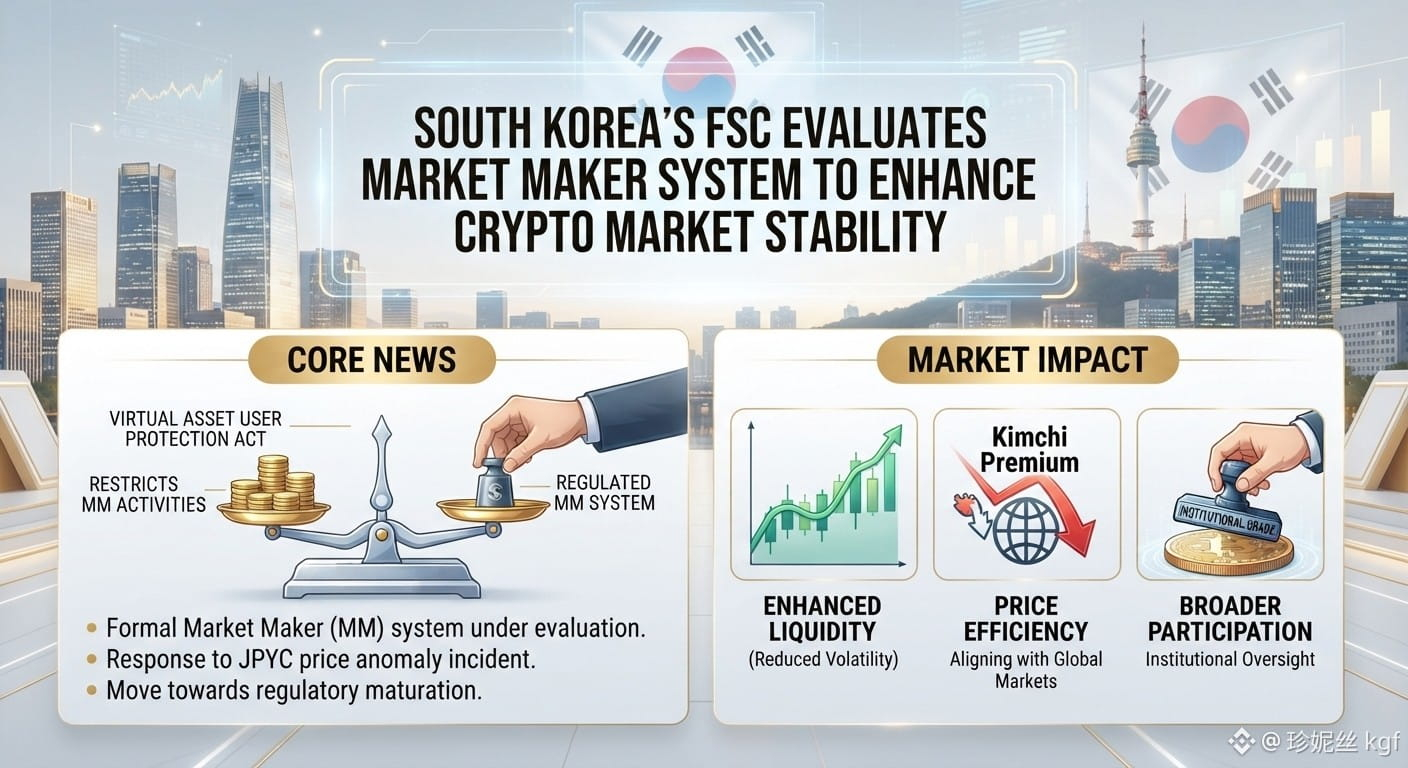
1
1.3k
Connectez-vous pour découvrir plus de contenu
Rejoignez la communauté mondiale des adeptes de cryptomonnaies sur Binance Square
⚡️ Suviez les dernières informations importantes sur les cryptomonnaies.
💬 Jugé digne de confiance par la plus grande plateforme d’échange de cryptomonnaies au monde.
👍 Découvrez les connaissances que partagent les créateurs vérifiés.
Adresse e-mail/Nº de téléphone