

Block_ONE 1
2k Publications

Block_ONE 1
Signaler
Bloquer l’utilisateur
Ouvert au trading
Trade régulièrement
1 an(s)
787 Suivis
17.9K+ Abonnés
4.9K+ J’aime
Publications
Portefeuille
Tous
Citations
Direct
·
--
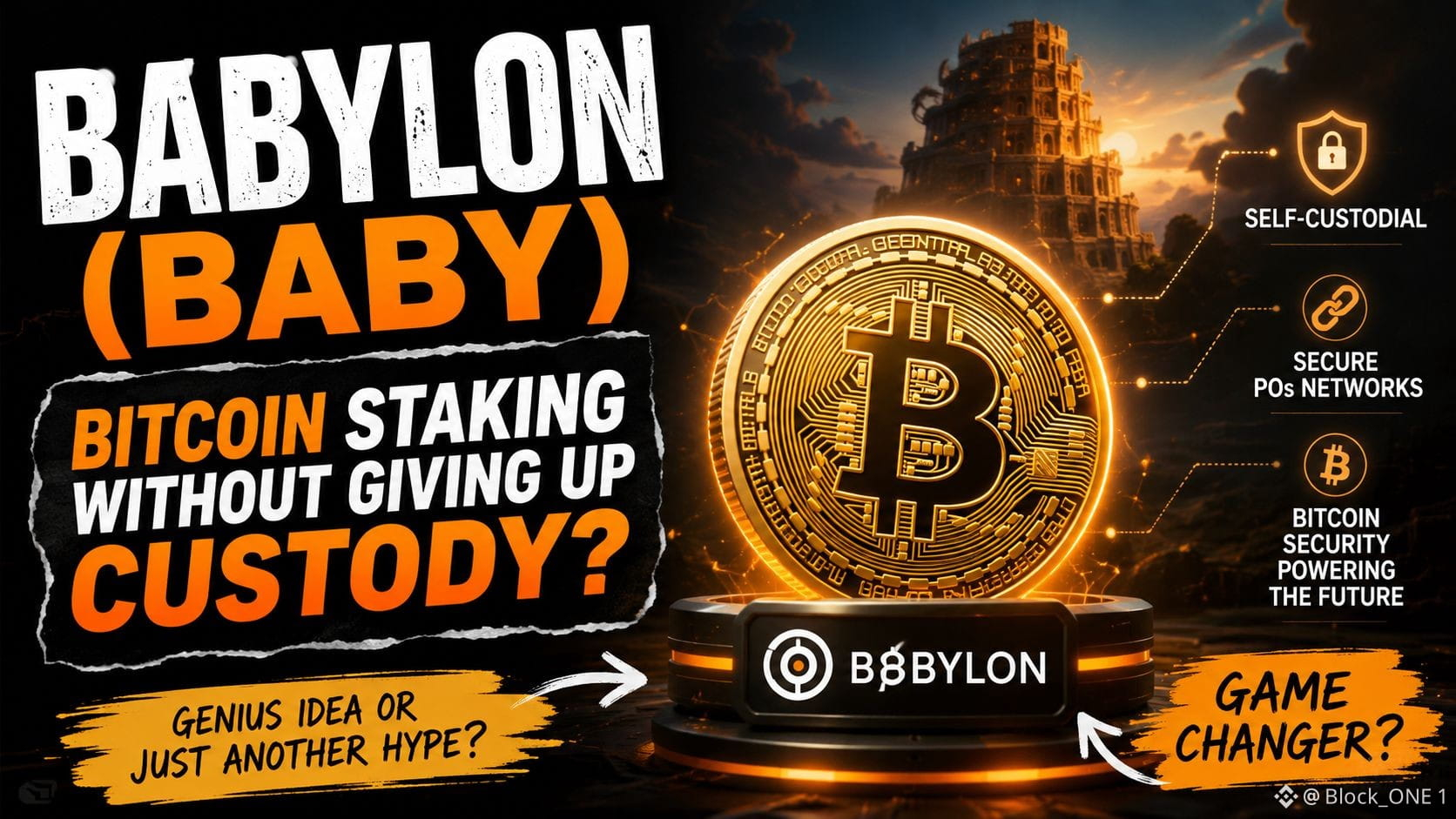
@babylonlabs_io I keep looking at the crypto market with a little more patience than I used to. After seeing so many cycles, I've stopped believing every new headline that says a project is about to change everything. One month it's AI, the next it's memes, then it's another infrastructure story. The narratives keep rotating, the excitement keeps returning, and somehow the promises always sound familiar. That's probably why Babylon (BABY) didn't catch my attention immediately. It felt like another name in a very long list.
The more I read, though, the more I realized it wasn't trying to reinvent Bitcoin. It was asking a simpler question: what if Bitcoin could help secure other blockchain networks without people giving up control of their coins? That idea feels easier to understand than a lot of crypto marketing. Most Bitcoin holders value ownership above everything else, so keeping custody while still putting those assets to work makes practical sense on paper.
Still, I've watched enough good ideas struggle once they meet reality. Building something is one thing. Convincing people to trust it, integrate it, and use it consistently is something else entirely. Crypto loves moving at full speed, but the outside world doesn't. Developers need time, institutions move carefully, and users rarely change habits overnight.
I'm interested in Babylon because it seems to start with a real problem instead of chasing the latest trend. That doesn't guarantee success, and it certainly doesn't mean adoption is inevitable. Execution has always been where ambitious ideas are tested. Maybe Babylon becomes an important piece of the ecosystem, or maybe it quietly blends into the background like so many projects before it. Either way, I appreciate seeing an idea that feels focused on solving something real instead of simply creating another story for the market to chase.
@babylonlabs_io
$BABY
#baby
@BabylonLabs_io I keep looking at the crypto market with a little more patience than I used to. After seeing so many cycles, I've stopped believing every new headline that says a project is about to change everything. One month it's AI, the next it's memes, then it's another infrastructure story. The narratives keep rotating, the excitement keeps returning, and somehow the promises always sound familiar. That's probably why Babylon (BABY) didn't catch my attention immediately. It felt like another name in a very long list.
The more I read, though, the more I realized it wasn't trying to reinvent Bitcoin. It was asking a simpler question: what if Bitcoin could help secure other blockchain networks without people giving up control of their coins? That idea feels easier to understand than a lot of crypto marketing. Most Bitcoin holders value ownership above everything else, so keeping custody while still putting those assets to work makes practical sense on paper.
Still, I've watched enough good ideas struggle once they meet reality. Building something is one thing. Convincing people to trust it, integrate it, and use it consistently is something else entirely. Crypto loves moving at full speed, but the outside world doesn't. Developers need time, institutions move carefully, and users rarely change habits overnight.
I'm interested in Babylon because it seems to start with a real problem instead of chasing the latest trend. That doesn't guarantee success, and it certainly doesn't mean adoption is inevitable. Execution has always been where ambitious ideas are tested. Maybe Babylon becomes an important piece of the ecosystem, or maybe it quietly blends into the background like so many projects before it. Either way, I appreciate seeing an idea that feels focused on solving something real instead of simply creating another story for the market to chase.
@BabylonLabs_io
$BABY
#baby
The more I read, though, the more I realized it wasn't trying to reinvent Bitcoin. It was asking a simpler question: what if Bitcoin could help secure other blockchain networks without people giving up control of their coins? That idea feels easier to understand than a lot of crypto marketing. Most Bitcoin holders value ownership above everything else, so keeping custody while still putting those assets to work makes practical sense on paper.
Still, I've watched enough good ideas struggle once they meet reality. Building something is one thing. Convincing people to trust it, integrate it, and use it consistently is something else entirely. Crypto loves moving at full speed, but the outside world doesn't. Developers need time, institutions move carefully, and users rarely change habits overnight.
I'm interested in Babylon because it seems to start with a real problem instead of chasing the latest trend. That doesn't guarantee success, and it certainly doesn't mean adoption is inevitable. Execution has always been where ambitious ideas are tested. Maybe Babylon becomes an important piece of the ecosystem, or maybe it quietly blends into the background like so many projects before it. Either way, I appreciate seeing an idea that feels focused on solving something real instead of simply creating another story for the market to chase.
@BabylonLabs_io
$BABY
#baby
7
4
111
·
--
Haussier
$UP continues to show strength with buyers defending higher levels.
Support: 0.2980 – 0.3020
Resistance: 0.3200 – 0.3350
Next Target: 0.3500
📈 A clean breakout could attract fresh buying.
{alpha}(560x000008d2175f9aeaddb2430c26f8a6f73c5a0000)
#FOMCWatching #US30YearYieldClimbsToNear5.23% #SenatorsReachClarityActEthicsCompromise #WTIAndBrentOilRiseOver6% #MetaFalls10%OnEarningsMiss
$UP continues to show strength with buyers defending higher levels.
Support: 0.2980 – 0.3020
Resistance: 0.3200 – 0.3350
Next Target: 0.3500
📈 A clean breakout could attract fresh buying.
#FOMCWatching #US30YearYieldClimbsToNear5.23% #SenatorsReachClarityActEthicsCompromise #WTIAndBrentOilRiseOver6% #MetaFalls10%OnEarningsMiss
Support: 0.2980 – 0.3020
Resistance: 0.3200 – 0.3350
Next Target: 0.3500
📈 A clean breakout could attract fresh buying.
#FOMCWatching #US30YearYieldClimbsToNear5.23% #SenatorsReachClarityActEthicsCompromise #WTIAndBrentOilRiseOver6% #MetaFalls10%OnEarningsMiss
121
·
--
Baissier
$QAIT is under heavy selling pressure. Wait for confirmation before chasing.
Support: 0.00500 – 0.00515
Resistance: 0.00570 – 0.00610
Next Target: 0.00650 (if recovery starts)
{alpha}(560x4d41a5d412f4ef44a35b9f53b06db65ede249493)
#FOMCWatching #US30YearYieldClimbsToNear5.23% #USLaunchesFreshStrikesOnIRGC #USCourtRejectsCFTCWisconsinInjunctionBid #WTIAndBrentOilRiseOver6%
$QAIT is under heavy selling pressure. Wait for confirmation before chasing.
Support: 0.00500 – 0.00515
Resistance: 0.00570 – 0.00610
Next Target: 0.00650 (if recovery starts)
#FOMCWatching #US30YearYieldClimbsToNear5.23% #USLaunchesFreshStrikesOnIRGC #USCourtRejectsCFTCWisconsinInjunctionBid #WTIAndBrentOilRiseOver6%
Support: 0.00500 – 0.00515
Resistance: 0.00570 – 0.00610
Next Target: 0.00650 (if recovery starts)
#FOMCWatching #US30YearYieldClimbsToNear5.23% #USLaunchesFreshStrikesOnIRGC #USCourtRejectsCFTCWisconsinInjunctionBid #WTIAndBrentOilRiseOver6%
466
·
--
$quq is pulling back but still has recovery potential.
Support: 0.00230
Resistance: 0.00255 – 0.00270
Next Target: 0.00300
{alpha}(560x4fa7c69a7b69f8bc48233024d546bc299d6b03bf)
#FOMCWatching #US30YearYieldClimbsToNear5.23% #SenatorsReachClarityActEthicsCompromise #USCourtRejectsCFTCWisconsinInjunctionBid #MetaFalls10%OnEarningsMiss
$quq is pulling back but still has recovery potential.
Support: 0.00230
Resistance: 0.00255 – 0.00270
Next Target: 0.00300
#FOMCWatching #US30YearYieldClimbsToNear5.23% #SenatorsReachClarityActEthicsCompromise #USCourtRejectsCFTCWisconsinInjunctionBid #MetaFalls10%OnEarningsMiss
Support: 0.00230
Resistance: 0.00255 – 0.00270
Next Target: 0.00300
#FOMCWatching #US30YearYieldClimbsToNear5.23% #SenatorsReachClarityActEthicsCompromise #USCourtRejectsCFTCWisconsinInjunctionBid #MetaFalls10%OnEarningsMiss
1
1
302
·
--
Baissier
$ON is testing key support after a sharp decline.
Support: 0.2400 – 0.2450
Resistance: 0.2600 – 0.2750
Next Target: 0.2900
{future}(ONUSDT)
#FOMCWatching #KoreanStocksReboundOnSamsungResults #USLaunchesFreshStrikesOnIRGC #SenatorsReachClarityActEthicsCompromise #USCourtRejectsCFTCWisconsinInjunctionBid
$ON is testing key support after a sharp decline.
Support: 0.2400 – 0.2450
Resistance: 0.2600 – 0.2750
Next Target: 0.2900
#FOMCWatching #KoreanStocksReboundOnSamsungResults #USLaunchesFreshStrikesOnIRGC #SenatorsReachClarityActEthicsCompromise #USCourtRejectsCFTCWisconsinInjunctionBid
Support: 0.2400 – 0.2450
Resistance: 0.2600 – 0.2750
Next Target: 0.2900
#FOMCWatching #KoreanStocksReboundOnSamsungResults #USLaunchesFreshStrikesOnIRGC #SenatorsReachClarityActEthicsCompromise #USCourtRejectsCFTCWisconsinInjunctionBid
272
·
--
Haussier
$AEON is gaining momentum with buyers stepping in.
Support: 0.1080 – 0.1100
Resistance: 0.1160 – 0.1220
Next Target: 0.1300
🚀 A breakout above resistance could accelerate the move.
{alpha}(560x277add739c6e0477616948357af9e79fe1ec9b80)
#FOMCWatching #US30YearYieldClimbsToNear5.23% #SenatorsReachClarityActEthicsCompromise #USCourtRejectsCFTCWisconsinInjunctionBid #MetaFalls10%OnEarningsMiss
$AEON is gaining momentum with buyers stepping in.
Support: 0.1080 – 0.1100
Resistance: 0.1160 – 0.1220
Next Target: 0.1300
🚀 A breakout above resistance could accelerate the move.
#FOMCWatching #US30YearYieldClimbsToNear5.23% #SenatorsReachClarityActEthicsCompromise #USCourtRejectsCFTCWisconsinInjunctionBid #MetaFalls10%OnEarningsMiss
Support: 0.1080 – 0.1100
Resistance: 0.1160 – 0.1220
Next Target: 0.1300
🚀 A breakout above resistance could accelerate the move.
#FOMCWatching #US30YearYieldClimbsToNear5.23% #SenatorsReachClarityActEthicsCompromise #USCourtRejectsCFTCWisconsinInjunctionBid #MetaFalls10%OnEarningsMiss
351
·
--
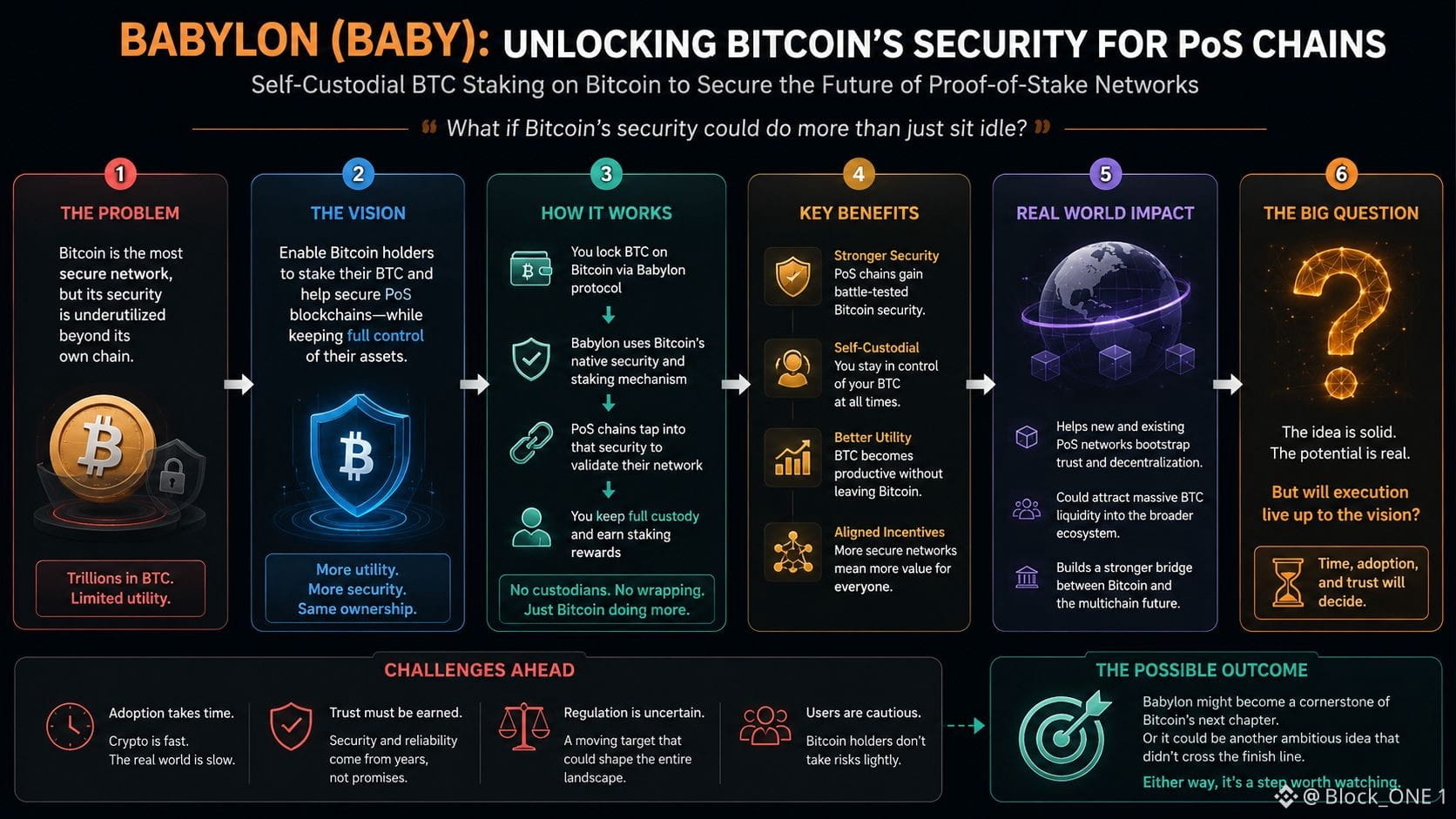
@babylonlabs_io I keep reminding myself that crypto has a habit of making every new narrative sound like the final piece of the puzzle. I've watched DeFi, NFTs, AI, memes, and countless Layer 1 stories explode with excitement before fading into the background. That's why I didn't pay much attention when Babylon (BABY) first appeared. I assumed it was another project trying to ride the next wave.
But the more I looked into it, the more I realized it wasn't chasing attention as much as it was asking an interesting question: what if Bitcoin's security could actually do more than just sit idle?
That caught my attention because Bitcoin has always been treated as digital gold, not something actively contributing to the security of other ecosystems. If Babylon can make self-custodial BTC staking practical while keeping Bitcoin in the owner's control, it could open an entirely different conversation about how Bitcoin fits into the broader crypto landscape.
Still, this is where reality begins. A good idea doesn't automatically become a successful network. Adoption is slow, trust takes years to build, and crypto users have become much harder to convince than they were a few cycles ago.
I'm interested, but I'm not convinced yet. Maybe Babylon becomes an important piece of crypto infrastructure. Maybe it joins the long list of ambitious ideas that couldn't bridge the gap between vision and execution. Time—not hype—will decide.
@babylonlabs_io
$BABY
#baby
@BabylonLabs_io I keep reminding myself that crypto has a habit of making every new narrative sound like the final piece of the puzzle. I've watched DeFi, NFTs, AI, memes, and countless Layer 1 stories explode with excitement before fading into the background. That's why I didn't pay much attention when Babylon (BABY) first appeared. I assumed it was another project trying to ride the next wave.
But the more I looked into it, the more I realized it wasn't chasing attention as much as it was asking an interesting question: what if Bitcoin's security could actually do more than just sit idle?
That caught my attention because Bitcoin has always been treated as digital gold, not something actively contributing to the security of other ecosystems. If Babylon can make self-custodial BTC staking practical while keeping Bitcoin in the owner's control, it could open an entirely different conversation about how Bitcoin fits into the broader crypto landscape.
Still, this is where reality begins. A good idea doesn't automatically become a successful network. Adoption is slow, trust takes years to build, and crypto users have become much harder to convince than they were a few cycles ago.
I'm interested, but I'm not convinced yet. Maybe Babylon becomes an important piece of crypto infrastructure. Maybe it joins the long list of ambitious ideas that couldn't bridge the gap between vision and execution. Time—not hype—will decide.
@BabylonLabs_io
$BABY
#baby
But the more I looked into it, the more I realized it wasn't chasing attention as much as it was asking an interesting question: what if Bitcoin's security could actually do more than just sit idle?
That caught my attention because Bitcoin has always been treated as digital gold, not something actively contributing to the security of other ecosystems. If Babylon can make self-custodial BTC staking practical while keeping Bitcoin in the owner's control, it could open an entirely different conversation about how Bitcoin fits into the broader crypto landscape.
Still, this is where reality begins. A good idea doesn't automatically become a successful network. Adoption is slow, trust takes years to build, and crypto users have become much harder to convince than they were a few cycles ago.
I'm interested, but I'm not convinced yet. Maybe Babylon becomes an important piece of crypto infrastructure. Maybe it joins the long list of ambitious ideas that couldn't bridge the gap between vision and execution. Time—not hype—will decide.
@BabylonLabs_io
$BABY
#baby
5
5
80
·
--
Haussier
$AEON is waking up!
$AEON is showing impressive strength with a +22.17% surge. Bulls are in control, and momentum is building.
📍 Current Price: $0.1071
🟢 Support: $0.100 – $0.103
🔴 Resistance: $0.115 – $0.120
🎯 Next Targets: $0.125 → $0.140
NoEmog: Strong bullish momentum. Watch for a breakout above $0.120.
{alpha}(560x277add739c6e0477616948357af9e79fe1ec9b80)
#FordRaises2026Outlook #USInterceptsIranianMissileAttackOnBases #DowRisesOver500Points #SheinDisclosesFTCProbeInHKIPOFiling #KOSPITriggersSidecarOnTechSelloff
$AEON is waking up!
$AEON is showing impressive strength with a +22.17% surge. Bulls are in control, and momentum is building.
📍 Current Price: $0.1071
🟢 Support: $0.100 – $0.103
🔴 Resistance: $0.115 – $0.120
🎯 Next Targets: $0.125 → $0.140
NoEmog: Strong bullish momentum. Watch for a breakout above $0.120.
#FordRaises2026Outlook #USInterceptsIranianMissileAttackOnBases #DowRisesOver500Points #SheinDisclosesFTCProbeInHKIPOFiling #KOSPITriggersSidecarOnTechSelloff
$AEON is showing impressive strength with a +22.17% surge. Bulls are in control, and momentum is building.
📍 Current Price: $0.1071
🟢 Support: $0.100 – $0.103
🔴 Resistance: $0.115 – $0.120
🎯 Next Targets: $0.125 → $0.140
NoEmog: Strong bullish momentum. Watch for a breakout above $0.120.
#FordRaises2026Outlook #USInterceptsIranianMissileAttackOnBases #DowRisesOver500Points #SheinDisclosesFTCProbeInHKIPOFiling #KOSPITriggersSidecarOnTechSelloff
1
3
641
·
--
Haussier
$ON is on fire!
A massive +36.42% rally has put $ON in the spotlight.
📍 Current Price: $0.2871
🟢 Support: $0.265 – $0.275
🔴 Resistance: $0.300 – $0.320
🎯 Next Targets: $0.340 → $0.380
NoEmog: Momentum remains bullish while holding above support.
{future}(ONUSDT)
#FordRaises2026Outlook #TrumpPlansBansOnChineseRobotsAndInverters #DowRisesOver500Points #SheinDisclosesFTCProbeInHKIPOFiling #MorganStanleySolanaETFBeginsTrading
$ON is on fire!
A massive +36.42% rally has put $ON in the spotlight.
📍 Current Price: $0.2871
🟢 Support: $0.265 – $0.275
🔴 Resistance: $0.300 – $0.320
🎯 Next Targets: $0.340 → $0.380
NoEmog: Momentum remains bullish while holding above support.
#FordRaises2026Outlook #TrumpPlansBansOnChineseRobotsAndInverters #DowRisesOver500Points #SheinDisclosesFTCProbeInHKIPOFiling #MorganStanleySolanaETFBeginsTrading
A massive +36.42% rally has put $ON in the spotlight.
📍 Current Price: $0.2871
🟢 Support: $0.265 – $0.275
🔴 Resistance: $0.300 – $0.320
🎯 Next Targets: $0.340 → $0.380
NoEmog: Momentum remains bullish while holding above support.
#FordRaises2026Outlook #TrumpPlansBansOnChineseRobotsAndInverters #DowRisesOver500Points #SheinDisclosesFTCProbeInHKIPOFiling #MorganStanleySolanaETFBeginsTrading
1
125
·
--
Haussier
$BTW is gaining serious traction!
$BTW continues to attract buyers with a +28.11% jump.
📍 Current Price: $0.1048
🟢 Support: $0.098 – $0.101
🔴 Resistance: $0.110 – $0.118
🎯 Next Targets: $0.125 → $0.140
NoEmog: Bullish continuation possible if resistance breaks.
{future}(BTWUSDT)
#FordRaises2026Outlook #TrumpPlansBansOnChineseRobotsAndInverters #SheinDisclosesFTCProbeInHKIPOFiling #MorganStanleySolanaETFBeginsTrading #KOSPITriggersSidecarOnTechSelloff
$BTW is gaining serious traction!
$BTW continues to attract buyers with a +28.11% jump.
📍 Current Price: $0.1048
🟢 Support: $0.098 – $0.101
🔴 Resistance: $0.110 – $0.118
🎯 Next Targets: $0.125 → $0.140
NoEmog: Bullish continuation possible if resistance breaks.
#FordRaises2026Outlook #TrumpPlansBansOnChineseRobotsAndInverters #SheinDisclosesFTCProbeInHKIPOFiling #MorganStanleySolanaETFBeginsTrading #KOSPITriggersSidecarOnTechSelloff
$BTW continues to attract buyers with a +28.11% jump.
📍 Current Price: $0.1048
🟢 Support: $0.098 – $0.101
🔴 Resistance: $0.110 – $0.118
🎯 Next Targets: $0.125 → $0.140
NoEmog: Bullish continuation possible if resistance breaks.
#FordRaises2026Outlook #TrumpPlansBansOnChineseRobotsAndInverters #SheinDisclosesFTCProbeInHKIPOFiling #MorganStanleySolanaETFBeginsTrading #KOSPITriggersSidecarOnTechSelloff
113
·
--
Haussier
$BEAT is beating the market!
A strong +19.35% move keeps BEAT on traders' watchlists.
📍 Current Price: $3.631
🟢 Support: $3.40 – $3.50
🔴 Resistance: $3.80 – $4.00
🎯 Next Targets: $4.20 → $4.60
NoEmog: Holding above $3.50 keeps the uptrend intact
{future}(BEATUSDT)
#FordRaises2026Outlook #USInterceptsIranianMissileAttackOnBases #SheinDisclosesFTCProbeInHKIPOFiling #MorganStanleySolanaETFBeginsTrading #KOSPITriggersSidecarOnTechSelloff
$BEAT is beating the market!
A strong +19.35% move keeps BEAT on traders' watchlists.
📍 Current Price: $3.631
🟢 Support: $3.40 – $3.50
🔴 Resistance: $3.80 – $4.00
🎯 Next Targets: $4.20 → $4.60
NoEmog: Holding above $3.50 keeps the uptrend intact
#FordRaises2026Outlook #USInterceptsIranianMissileAttackOnBases #SheinDisclosesFTCProbeInHKIPOFiling #MorganStanleySolanaETFBeginsTrading #KOSPITriggersSidecarOnTechSelloff
A strong +19.35% move keeps BEAT on traders' watchlists.
📍 Current Price: $3.631
🟢 Support: $3.40 – $3.50
🔴 Resistance: $3.80 – $4.00
🎯 Next Targets: $4.20 → $4.60
NoEmog: Holding above $3.50 keeps the uptrend intact
#FordRaises2026Outlook #USInterceptsIranianMissileAttackOnBases #SheinDisclosesFTCProbeInHKIPOFiling #MorganStanleySolanaETFBeginsTrading #KOSPITriggersSidecarOnTechSelloff
165
·
--
Haussier
$UB is quietly building momentum!
$UB has climbed +17.45%, hinting at more upside if buyers stay active.
📍 Current Price: $0.1377
🟢 Support: $0.130 – $0.133
🔴 Resistance: $0.145 – $0.155
🎯 Next Targets: $0.165 → $0.180
NoEmog: A close above $0.155 could trigger the next leg higher.
{future}(UBUSDT)
#FordRaises2026Outlook #TrumpPlansBansOnChineseRobotsAndInverters #USInterceptsIranianMissileAttackOnBases #DowRisesOver500Points #SheinDisclosesFTCProbeInHKIPOFiling
$UB is quietly building momentum!
$UB has climbed +17.45%, hinting at more upside if buyers stay active.
📍 Current Price: $0.1377
🟢 Support: $0.130 – $0.133
🔴 Resistance: $0.145 – $0.155
🎯 Next Targets: $0.165 → $0.180
NoEmog: A close above $0.155 could trigger the next leg higher.
#FordRaises2026Outlook #TrumpPlansBansOnChineseRobotsAndInverters #USInterceptsIranianMissileAttackOnBases #DowRisesOver500Points #SheinDisclosesFTCProbeInHKIPOFiling
$UB has climbed +17.45%, hinting at more upside if buyers stay active.
📍 Current Price: $0.1377
🟢 Support: $0.130 – $0.133
🔴 Resistance: $0.145 – $0.155
🎯 Next Targets: $0.165 → $0.180
NoEmog: A close above $0.155 could trigger the next leg higher.
#FordRaises2026Outlook #TrumpPlansBansOnChineseRobotsAndInverters #USInterceptsIranianMissileAttackOnBases #DowRisesOver500Points #SheinDisclosesFTCProbeInHKIPOFiling
146
·
--
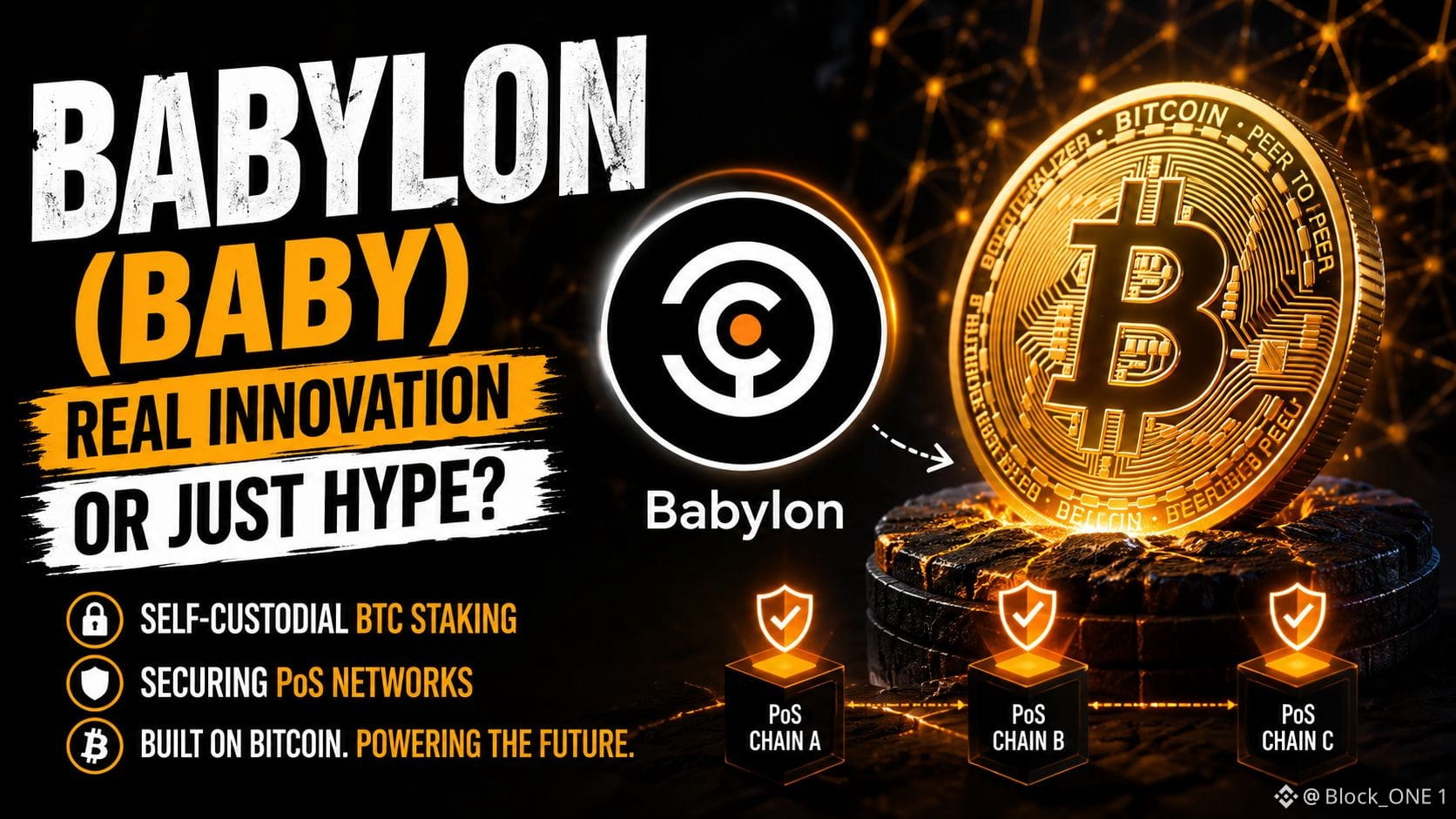
@babylonlabs_io I keep asking myself the same question whenever a new crypto narrative starts gaining attention: is this solving a real problem, or is it just another story the market wants to believe? That's exactly where I was with Babylon (BABY).
At first glance, I almost ignored it. I've seen too many projects promise to revolutionize crypto, only to disappear when the excitement fades. But the more I looked into Babylon, the more I realized it's trying to tackle something that actually matters.
Bitcoin is the biggest asset in crypto, yet most of it just sits idle. Babylon's idea is surprisingly simple—let Bitcoin contribute to securing Proof-of-Stake networks while holders keep custody of their BTC. On paper, that feels more practical than chasing another flashy trend.
Of course, having a good idea is the easy part. Getting people to trust it, adopt it, and integrate it across different ecosystems is where the real challenge begins. Crypto moves at lightning speed, but trust and infrastructure don't.
I'm not saying Babylon is guaranteed to succeed. The market has taught me to be careful with certainty. But I do think it's refreshing to see a project focused on improving how existing value can be used instead of inventing another temporary narrative.
Maybe it becomes an important piece of crypto infrastructure. Maybe it doesn't. Either way, it's one of the few projects that made me stop scrolling and actually think.
@babylonlabs_io $BABY #baby
@BabylonLabs_io I keep asking myself the same question whenever a new crypto narrative starts gaining attention: is this solving a real problem, or is it just another story the market wants to believe? That's exactly where I was with Babylon (BABY).
At first glance, I almost ignored it. I've seen too many projects promise to revolutionize crypto, only to disappear when the excitement fades. But the more I looked into Babylon, the more I realized it's trying to tackle something that actually matters.
Bitcoin is the biggest asset in crypto, yet most of it just sits idle. Babylon's idea is surprisingly simple—let Bitcoin contribute to securing Proof-of-Stake networks while holders keep custody of their BTC. On paper, that feels more practical than chasing another flashy trend.
Of course, having a good idea is the easy part. Getting people to trust it, adopt it, and integrate it across different ecosystems is where the real challenge begins. Crypto moves at lightning speed, but trust and infrastructure don't.
I'm not saying Babylon is guaranteed to succeed. The market has taught me to be careful with certainty. But I do think it's refreshing to see a project focused on improving how existing value can be used instead of inventing another temporary narrative.
Maybe it becomes an important piece of crypto infrastructure. Maybe it doesn't. Either way, it's one of the few projects that made me stop scrolling and actually think.
@BabylonLabs_io $BABY #baby
At first glance, I almost ignored it. I've seen too many projects promise to revolutionize crypto, only to disappear when the excitement fades. But the more I looked into Babylon, the more I realized it's trying to tackle something that actually matters.
Bitcoin is the biggest asset in crypto, yet most of it just sits idle. Babylon's idea is surprisingly simple—let Bitcoin contribute to securing Proof-of-Stake networks while holders keep custody of their BTC. On paper, that feels more practical than chasing another flashy trend.
Of course, having a good idea is the easy part. Getting people to trust it, adopt it, and integrate it across different ecosystems is where the real challenge begins. Crypto moves at lightning speed, but trust and infrastructure don't.
I'm not saying Babylon is guaranteed to succeed. The market has taught me to be careful with certainty. But I do think it's refreshing to see a project focused on improving how existing value can be used instead of inventing another temporary narrative.
Maybe it becomes an important piece of crypto infrastructure. Maybe it doesn't. Either way, it's one of the few projects that made me stop scrolling and actually think.
@BabylonLabs_io $BABY #baby
1
40
·
--
Haussier
$ONDO has exploded with strong momentum, gaining nearly 38%. Buyers remain in control, but watch for profit-taking near key resistance.
📊 Support: $0.1580 – $0.1620
🚧 Resistance: $0.1720 – $0.1800
🎯 Next Targets: $0.1850 ➜ $0.1950 ➜ $0.2100
⚠️ A clean breakout above $0.1800 could trigger another bullish rally
{spot}(ONDOUSDT)
#OilDropsAbout6% #BrentCrudeFallsAbout6% #CXMTStarMarketIPORaises57.9BYuan #WTICrudeFuturesFall8% #KOSPITurnsLowerAsChipSharesWeigh
$ONDO has exploded with strong momentum, gaining nearly 38%. Buyers remain in control, but watch for profit-taking near key resistance.
📊 Support: $0.1580 – $0.1620
🚧 Resistance: $0.1720 – $0.1800
🎯 Next Targets: $0.1850 ➜ $0.1950 ➜ $0.2100
⚠️ A clean breakout above $0.1800 could trigger another bullish rally
#OilDropsAbout6% #BrentCrudeFallsAbout6% #CXMTStarMarketIPORaises57.9BYuan #WTICrudeFuturesFall8% #KOSPITurnsLowerAsChipSharesWeigh
📊 Support: $0.1580 – $0.1620
🚧 Resistance: $0.1720 – $0.1800
🎯 Next Targets: $0.1850 ➜ $0.1950 ➜ $0.2100
⚠️ A clean breakout above $0.1800 could trigger another bullish rally
#OilDropsAbout6% #BrentCrudeFallsAbout6% #CXMTStarMarketIPORaises57.9BYuan #WTICrudeFuturesFall8% #KOSPITurnsLowerAsChipSharesWeigh
63
·
--
Haussier
$BTW is showing aggressive buying pressure with over 35% gains.
📊 Support: $0.0920 – $0.0950
🚧 Resistance: $0.1000 – $0.1050
🎯 Next Targets: $0.1100 ➜ $0.1200 ➜ $0.1350
⚡ Hold above support and bulls may continue the trend.
{future}(BTWUSDT)
#OilDropsAbout6% #BrentCrudeFallsAbout6% #AIFearsSink10SP500StocksOver40% #CXMTStarMarketIPORaises57.9BYuan #WTICrudeFuturesFall8%
$BTW is showing aggressive buying pressure with over 35% gains.
📊 Support: $0.0920 – $0.0950
🚧 Resistance: $0.1000 – $0.1050
🎯 Next Targets: $0.1100 ➜ $0.1200 ➜ $0.1350
⚡ Hold above support and bulls may continue the trend.
#OilDropsAbout6% #BrentCrudeFallsAbout6% #AIFearsSink10SP500StocksOver40% #CXMTStarMarketIPORaises57.9BYuan #WTICrudeFuturesFall8%
📊 Support: $0.0920 – $0.0950
🚧 Resistance: $0.1000 – $0.1050
🎯 Next Targets: $0.1100 ➜ $0.1200 ➜ $0.1350
⚡ Hold above support and bulls may continue the trend.
#OilDropsAbout6% #BrentCrudeFallsAbout6% #AIFearsSink10SP500StocksOver40% #CXMTStarMarketIPORaises57.9BYuan #WTICrudeFuturesFall8%
145
·
--
Haussier
$AKE has surged almost 35%, attracting strong market attention.
📊 Support: $0.00400 – $0.00415
🚧 Resistance: $0.00450 – $0.00480
🎯 Next Targets: $0.00520 ➜ $0.00580 ➜ $0.00650
🚀 A breakout above resistance could ignite another explosive move.
{future}(AKEUSDT)
#OilDropsAbout6% #BrentCrudeFallsAbout6% #CXMTStarMarketIPORaises57.9BYuan #WTICrudeFuturesFall8% #WTICrudeFuturesFall8%
$AKE has surged almost 35%, attracting strong market attention.
📊 Support: $0.00400 – $0.00415
🚧 Resistance: $0.00450 – $0.00480
🎯 Next Targets: $0.00520 ➜ $0.00580 ➜ $0.00650
🚀 A breakout above resistance could ignite another explosive move.
#OilDropsAbout6% #BrentCrudeFallsAbout6% #CXMTStarMarketIPORaises57.9BYuan #WTICrudeFuturesFall8% #WTICrudeFuturesFall8%
📊 Support: $0.00400 – $0.00415
🚧 Resistance: $0.00450 – $0.00480
🎯 Next Targets: $0.00520 ➜ $0.00580 ➜ $0.00650
🚀 A breakout above resistance could ignite another explosive move.
#OilDropsAbout6% #BrentCrudeFallsAbout6% #CXMTStarMarketIPORaises57.9BYuan #WTICrudeFuturesFall8% #WTICrudeFuturesFall8%
210
·
--
Haussier
$NIL continues its impressive climb with more than 32% gains.
📊 Support: $0.0445 – $0.0460
🚧 Resistance: $0.0495 – $0.0520
🎯 Next Targets: $0.0550 ➜ $0.0600 ➜ $0.0680
📈 Maintaining support keeps the bullish structure intact.
{spot}(NILUSDT)
#OilDropsAbout6% #BrentCrudeFallsAbout6% #AIFearsSink10SP500StocksOver40% #CXMTStarMarketIPORaises57.9BYuan #WTICrudeFuturesFall8%
$NIL continues its impressive climb with more than 32% gains.
📊 Support: $0.0445 – $0.0460
🚧 Resistance: $0.0495 – $0.0520
🎯 Next Targets: $0.0550 ➜ $0.0600 ➜ $0.0680
📈 Maintaining support keeps the bullish structure intact.
#OilDropsAbout6% #BrentCrudeFallsAbout6% #AIFearsSink10SP500StocksOver40% #CXMTStarMarketIPORaises57.9BYuan #WTICrudeFuturesFall8%
📊 Support: $0.0445 – $0.0460
🚧 Resistance: $0.0495 – $0.0520
🎯 Next Targets: $0.0550 ➜ $0.0600 ➜ $0.0680
📈 Maintaining support keeps the bullish structure intact.
#OilDropsAbout6% #BrentCrudeFallsAbout6% #AIFearsSink10SP500StocksOver40% #CXMTStarMarketIPORaises57.9BYuan #WTICrudeFuturesFall8%
107
·
--
Haussier
$TAG has posted a solid 30% rally and remains one to watch.
📊 Support: $0.00128 – $0.00133
🚧 Resistance: $0.00142 – $0.00150
🎯 Next Targets: $0.00160 ➜ $0.00180 ➜ $0.00200
💎 A decisive breakout above $0.00150 could accelerate the next bullish wave.
{future}(TAGUSDT)
#OilDropsAbout6% CrudeBrieflyFallsBelow$90#BrentCrudeFallsAbout6% #AIFearsSink10SP500StocksOver40% #CXMTStarMarketIPORaises57.9BYuan #WTICrudeFuturesFall8%
$TAG has posted a solid 30% rally and remains one to watch.
📊 Support: $0.00128 – $0.00133
🚧 Resistance: $0.00142 – $0.00150
🎯 Next Targets: $0.00160 ➜ $0.00180 ➜ $0.00200
💎 A decisive breakout above $0.00150 could accelerate the next bullish wave.
#OilDropsAbout6% CrudeBrieflyFallsBelow$90#BrentCrudeFallsAbout6% #AIFearsSink10SP500StocksOver40% #CXMTStarMarketIPORaises57.9BYuan #WTICrudeFuturesFall8%
📊 Support: $0.00128 – $0.00133
🚧 Resistance: $0.00142 – $0.00150
🎯 Next Targets: $0.00160 ➜ $0.00180 ➜ $0.00200
💎 A decisive breakout above $0.00150 could accelerate the next bullish wave.
#OilDropsAbout6% CrudeBrieflyFallsBelow$90#BrentCrudeFallsAbout6% #AIFearsSink10SP500StocksOver40% #CXMTStarMarketIPORaises57.9BYuan #WTICrudeFuturesFall8%
1
140
·
--
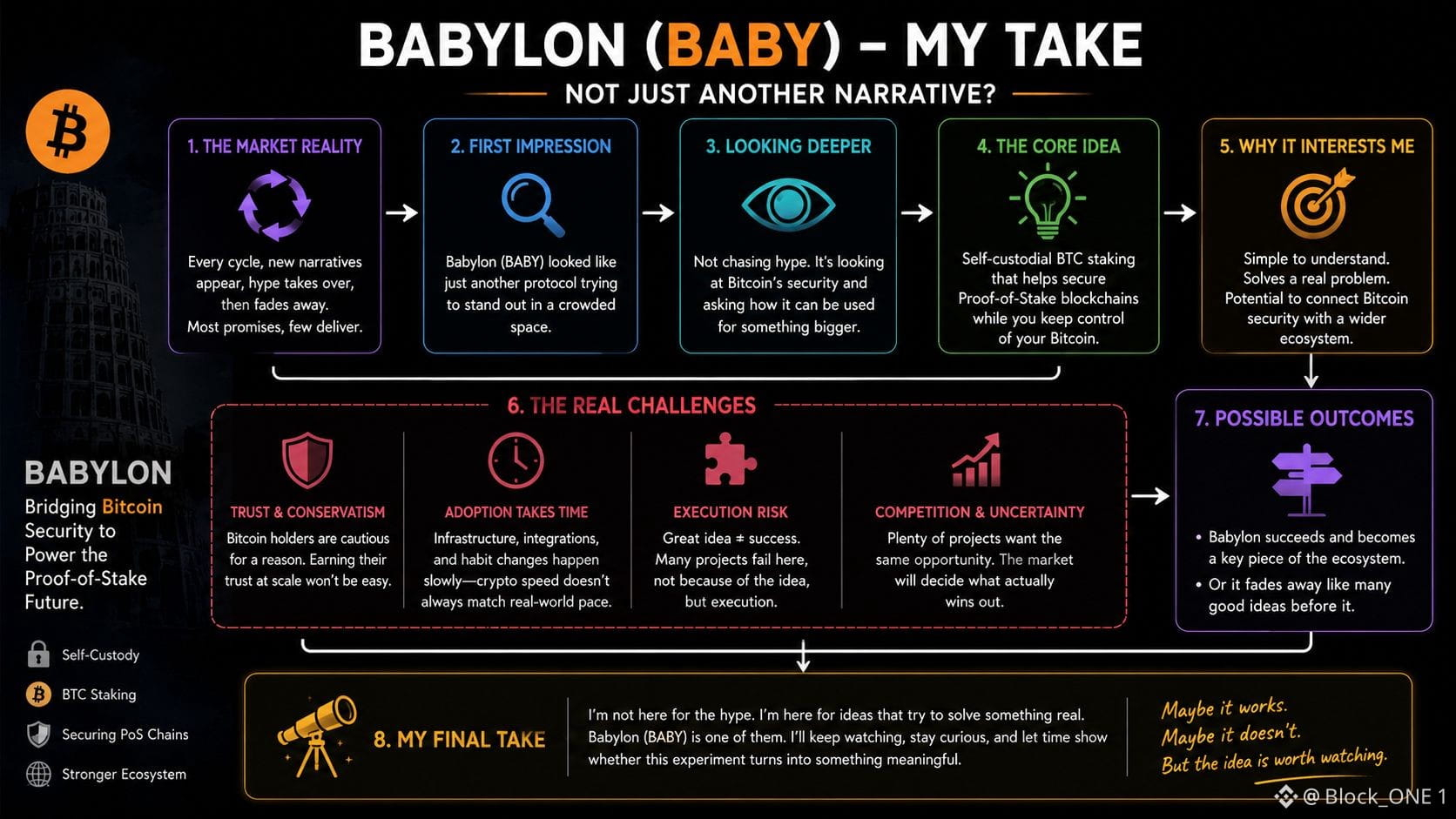
@babylonlabs_io I keep looking at crypto through a different lens now. After years of watching the market, I've realized that the biggest gains in attention often come long before the biggest gains in utility. Narratives appear overnight, dominate every timeline, and then quietly disappear when reality catches up. That's why I didn't expect much when I first came across Babylon (BABY).
At first, it looked like another protocol wrapped in a compelling story. But the more I explored it, the more I felt it was trying to tackle a genuine problem rather than invent a new buzzword. The idea of allowing Bitcoin holders to contribute to the security of Proof-of-Stake networks while keeping custody of their BTC feels surprisingly practical. It doesn't ask Bitcoin to become something else—it simply asks whether its security can be useful beyond its own chain.
Still, I think execution is where this story will either become meaningful or fade into the background. Building infrastructure is one thing; earning trust, attracting developers, and creating lasting adoption is another. Crypto moves at incredible speed, while real-world integration usually happens much slower.
I'm not calling Babylon the next breakthrough. I'm simply saying it's one of the few recent projects that made me stop scrolling and think. Maybe it succeeds, maybe it doesn't. But in a market crowded with recycled narratives, I find real value in ideas that try to solve actual problems instead of just selling another dream.
@babylonlabs_io $BABY #baby
@BabylonLabs_io I keep looking at crypto through a different lens now. After years of watching the market, I've realized that the biggest gains in attention often come long before the biggest gains in utility. Narratives appear overnight, dominate every timeline, and then quietly disappear when reality catches up. That's why I didn't expect much when I first came across Babylon (BABY).
At first, it looked like another protocol wrapped in a compelling story. But the more I explored it, the more I felt it was trying to tackle a genuine problem rather than invent a new buzzword. The idea of allowing Bitcoin holders to contribute to the security of Proof-of-Stake networks while keeping custody of their BTC feels surprisingly practical. It doesn't ask Bitcoin to become something else—it simply asks whether its security can be useful beyond its own chain.
Still, I think execution is where this story will either become meaningful or fade into the background. Building infrastructure is one thing; earning trust, attracting developers, and creating lasting adoption is another. Crypto moves at incredible speed, while real-world integration usually happens much slower.
I'm not calling Babylon the next breakthrough. I'm simply saying it's one of the few recent projects that made me stop scrolling and think. Maybe it succeeds, maybe it doesn't. But in a market crowded with recycled narratives, I find real value in ideas that try to solve actual problems instead of just selling another dream.
@BabylonLabs_io $BABY #baby
At first, it looked like another protocol wrapped in a compelling story. But the more I explored it, the more I felt it was trying to tackle a genuine problem rather than invent a new buzzword. The idea of allowing Bitcoin holders to contribute to the security of Proof-of-Stake networks while keeping custody of their BTC feels surprisingly practical. It doesn't ask Bitcoin to become something else—it simply asks whether its security can be useful beyond its own chain.
Still, I think execution is where this story will either become meaningful or fade into the background. Building infrastructure is one thing; earning trust, attracting developers, and creating lasting adoption is another. Crypto moves at incredible speed, while real-world integration usually happens much slower.
I'm not calling Babylon the next breakthrough. I'm simply saying it's one of the few recent projects that made me stop scrolling and think. Maybe it succeeds, maybe it doesn't. But in a market crowded with recycled narratives, I find real value in ideas that try to solve actual problems instead of just selling another dream.
@BabylonLabs_io $BABY #baby
1
1
105
·
--
@babylonlabs_io I've been watching crypto long enough to know that the loudest narrative usually isn't the one that lasts. Every cycle introduces a new "game changer," timelines explode with excitement, and for a few weeks it feels like nothing else matters. Then the attention fades, capital rotates, and another headline takes over. That's why I rarely judge a project by the noise surrounding it anymore. I prefer to ask a simple question: does it solve a real problem?
Babylon (BABY) caught my attention because it doesn't start with another flashy promise. Instead, it looks at Bitcoin—the most secure network in crypto—and asks whether that security can do more than just sit untouched in wallets. The idea of self-custodial BTC staking, where users keep control of their Bitcoin while helping secure Proof-of-Stake blockchains, feels different from the usual race to invent another token narrative.
That said, ideas are cheap in crypto. Execution is expensive. Building reliable infrastructure, earning trust, and convincing conservative Bitcoin holders to participate is a much bigger challenge than publishing a whitepaper. Crypto moves at incredible speed, but real adoption rarely follows that timeline.
I'm not calling Babylon the next breakthrough, and I'm not dismissing it either. I see a project trying to connect Bitcoin's security with a broader ecosystem instead of creating hype for the sake of hype. Whether that vision becomes reality depends on adoption, consistency, and time—not market excitement.
For now, I'm simply watching. In a market overflowing with recycled narratives, Babylon feels less like another trend and more like an experiment worth following. Maybe it succeeds. Maybe it doesn't. But at least it's asking a question that actually matters.
$EUL
{future}(EULUSDT)
$DEXE
{future}(DEXEUSDT)
@babylonlabs_io $BABY #baby
@BabylonLabs_io I've been watching crypto long enough to know that the loudest narrative usually isn't the one that lasts. Every cycle introduces a new "game changer," timelines explode with excitement, and for a few weeks it feels like nothing else matters. Then the attention fades, capital rotates, and another headline takes over. That's why I rarely judge a project by the noise surrounding it anymore. I prefer to ask a simple question: does it solve a real problem?
Babylon (BABY) caught my attention because it doesn't start with another flashy promise. Instead, it looks at Bitcoin—the most secure network in crypto—and asks whether that security can do more than just sit untouched in wallets. The idea of self-custodial BTC staking, where users keep control of their Bitcoin while helping secure Proof-of-Stake blockchains, feels different from the usual race to invent another token narrative.
That said, ideas are cheap in crypto. Execution is expensive. Building reliable infrastructure, earning trust, and convincing conservative Bitcoin holders to participate is a much bigger challenge than publishing a whitepaper. Crypto moves at incredible speed, but real adoption rarely follows that timeline.
I'm not calling Babylon the next breakthrough, and I'm not dismissing it either. I see a project trying to connect Bitcoin's security with a broader ecosystem instead of creating hype for the sake of hype. Whether that vision becomes reality depends on adoption, consistency, and time—not market excitement.
For now, I'm simply watching. In a market overflowing with recycled narratives, Babylon feels less like another trend and more like an experiment worth following. Maybe it succeeds. Maybe it doesn't. But at least it's asking a question that actually matters.
$EUL
$DEXE
@BabylonLabs_io $BABY #baby
Babylon (BABY) caught my attention because it doesn't start with another flashy promise. Instead, it looks at Bitcoin—the most secure network in crypto—and asks whether that security can do more than just sit untouched in wallets. The idea of self-custodial BTC staking, where users keep control of their Bitcoin while helping secure Proof-of-Stake blockchains, feels different from the usual race to invent another token narrative.
That said, ideas are cheap in crypto. Execution is expensive. Building reliable infrastructure, earning trust, and convincing conservative Bitcoin holders to participate is a much bigger challenge than publishing a whitepaper. Crypto moves at incredible speed, but real adoption rarely follows that timeline.
I'm not calling Babylon the next breakthrough, and I'm not dismissing it either. I see a project trying to connect Bitcoin's security with a broader ecosystem instead of creating hype for the sake of hype. Whether that vision becomes reality depends on adoption, consistency, and time—not market excitement.
For now, I'm simply watching. In a market overflowing with recycled narratives, Babylon feels less like another trend and more like an experiment worth following. Maybe it succeeds. Maybe it doesn't. But at least it's asking a question that actually matters.
$EUL
$DEXE
@BabylonLabs_io $BABY #baby
🚀 Bullish
66%
🤔 Watching
17%
😴 Just Hype
17%
6 Votes • Vote fermé
3
2
436
Connectez-vous pour découvrir plus de contenu
Rejoignez la communauté mondiale des adeptes de cryptomonnaies sur Binance Square
⚡️ Suviez les dernières informations importantes sur les cryptomonnaies.
💬 Jugé digne de confiance par la plus grande plateforme d’échange de cryptomonnaies au monde.
👍 Découvrez les connaissances que partagent les créateurs vérifiés.
Adresse e-mail/Nº de téléphone
Sujets d’actualité
SECHaltsCryptoETFReviewsAmidFundingLapse
878 vues
62 mentions
#SECHaltsCryptoETFReviewsAmidFundingLapse
SEC Halts Crypto ETF Reviews Amid Funding Lapse
The U.S. Securities and Exchange Commission (SEC) has reportedly paused certain cryptocurrency ETF review activities amid a government funding lapse.
This development has created uncertainty in the crypto market, particularly for investors and companies waiting for regulatory decisions on crypto-related exchange-traded funds (ETFs).
Impact on the Crypto Market
The delay could affect the approval timeline of pending crypto ETF applications. Investors are closely monitoring the situation as regulatory clarity remains an important factor in the growth of the digital asset industry.
Although the pause does not necessarily mean that crypto ETF applications will be rejected, it highlights how government funding disruptions can influence financial regulatory processes.
What Happens Next?
Market participants will be watching for updates on government funding and the SEC's ability to resume normal operations.
Crypto ETFs remain an important topic for institutional adoption, market development, and investor confidence.
Conclusion: The temporary halt highlights the importance of regulatory stability for the future of cryptocurrency investments.
#Crypto #Bitcoin #ETF #SEC #CryptoNews #Blockchain #Binance
King2112
·0 mentions J’aime
·10 vues
ZcashETFPostsFirstWeeklyOutflow$93.6M
53,690 vues
163 mentions
GreekPoliceBustCryptoScamRingArrest17
154,001 vues
1,089 mentions