

shakir Hussain 110
4.2k Publications

shakir Hussain 110
Signaler
Bloquer l’utilisateur
Ouvert au trading
Trade régulièrement
10.5 mois
438 Suivis
11.3K+ Abonnés
2K J’aime
Publications
Portefeuille
Tous
Citations
Direct
The interesting part of this CPI isn’t whether inflation is simply “hot” or “cool.”
It’s what the number does to the Fed’s room to stay patient.
A strong jobs report already gives policymakers a reason to tolerate less inflation. That means a CPI print that looks only slightly hotter can carry a much bigger policy signal than the headline suggests. The market may start pricing not just “higher inflation,” but fewer options for the Fed to justify an easier stance.
That creates an unusual setup: the same CPI number can matter differently when the labor market is still resilient.
So I’m less interested in the first five-minute move and more interested in whether rate expectations actually reprice after the volatility fades.
If CPI reinforces the labor-market strength, the dollar and yields could become the cleaner signal than stocks or crypto.
My implication: watch the Fed repricing, not the CPI headline.
$BTC #CPIWatch $ETH $DN
The interesting part of this CPI isn’t whether inflation is simply “hot” or “cool.”
It’s what the number does to the Fed’s room to stay patient.
A strong jobs report already gives policymakers a reason to tolerate less inflation. That means a CPI print that looks only slightly hotter can carry a much bigger policy signal than the headline suggests. The market may start pricing not just “higher inflation,” but fewer options for the Fed to justify an easier stance.
That creates an unusual setup: the same CPI number can matter differently when the labor market is still resilient.
So I’m less interested in the first five-minute move and more interested in whether rate expectations actually reprice after the volatility fades.
If CPI reinforces the labor-market strength, the dollar and yields could become the cleaner signal than stocks or crypto.
My implication: watch the Fed repricing, not the CPI headline.
$BTC #CPIWatch $ETH $DN
It’s what the number does to the Fed’s room to stay patient.
A strong jobs report already gives policymakers a reason to tolerate less inflation. That means a CPI print that looks only slightly hotter can carry a much bigger policy signal than the headline suggests. The market may start pricing not just “higher inflation,” but fewer options for the Fed to justify an easier stance.
That creates an unusual setup: the same CPI number can matter differently when the labor market is still resilient.
So I’m less interested in the first five-minute move and more interested in whether rate expectations actually reprice after the volatility fades.
If CPI reinforces the labor-market strength, the dollar and yields could become the cleaner signal than stocks or crypto.
My implication: watch the Fed repricing, not the CPI headline.
$BTC #CPIWatch $ETH $DN

1
1
188
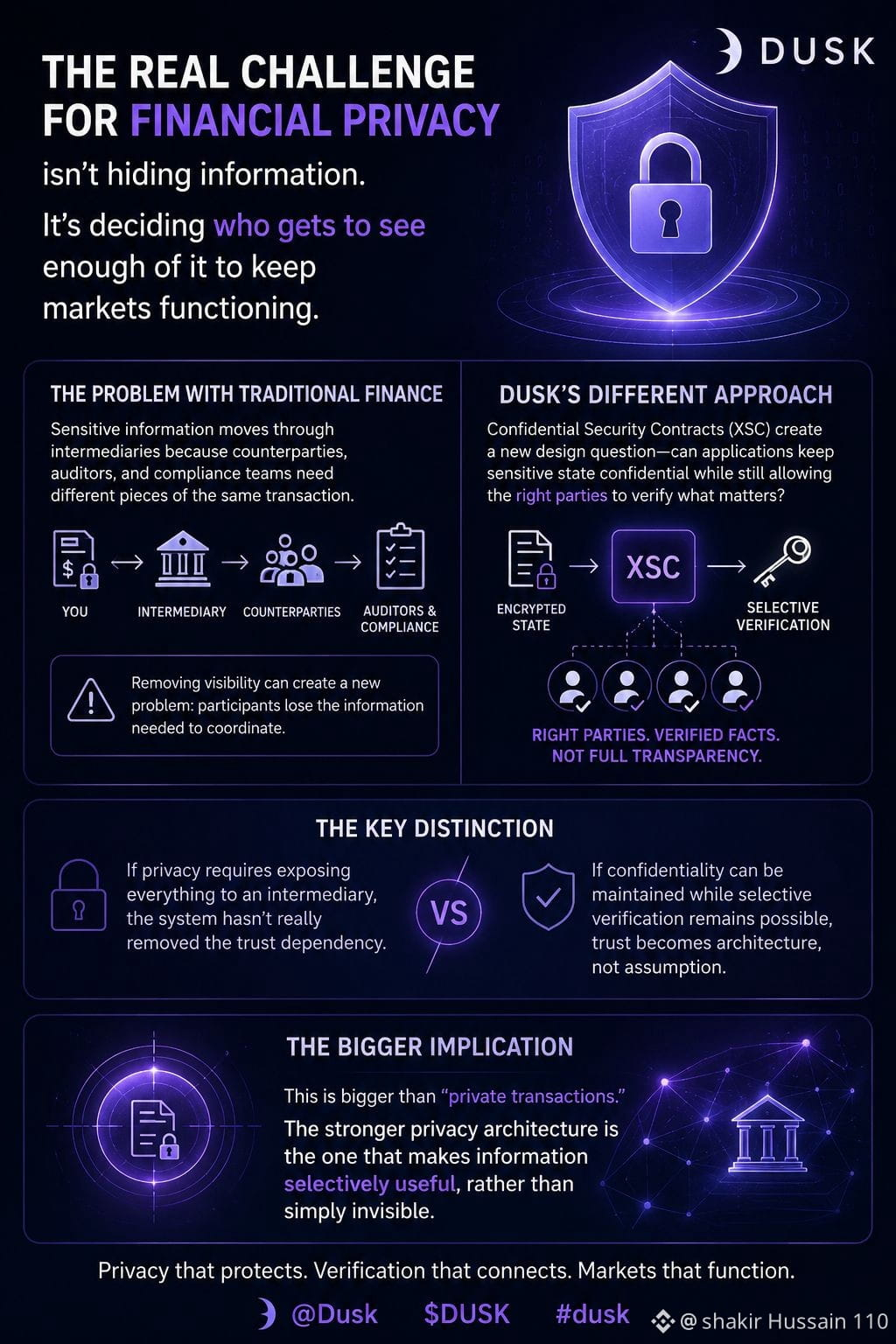
The real challenge for financial privacy isn't hiding information. It's deciding who gets to see enough of it to keep markets functioning.
That's where I think Dusk's architecture becomes interesting.
In traditional finance, sensitive information often moves through intermediaries because counterparties, auditors, and compliance teams need different pieces of the same transaction. Simply removing visibility can therefore create a new problem: participants may protect their privacy but lose the information needed to coordinate.
Dusk's Confidential Security Contract (XSC) approach creates a different design question—can financial applications keep sensitive state confidential while still allowing the right parties to verify what actually matters?
That distinction is important.
If privacy requires exposing everything to an intermediary, the system hasn't really removed the trust dependency. But if confidentiality can be maintained while selective verification remains possible, financial applications can reduce unnecessary information exposure without sacrificing coordination.
The implication is bigger than "private transactions."
The stronger privacy architecture is the one that makes information selectively useful, rather than simply invisible.
@Dusk_Foundation #dusk $DUSK
The real challenge for financial privacy isn't hiding information. It's deciding who gets to see enough of it to keep markets functioning.
That's where I think Dusk's architecture becomes interesting.
In traditional finance, sensitive information often moves through intermediaries because counterparties, auditors, and compliance teams need different pieces of the same transaction. Simply removing visibility can therefore create a new problem: participants may protect their privacy but lose the information needed to coordinate.
Dusk's Confidential Security Contract (XSC) approach creates a different design question—can financial applications keep sensitive state confidential while still allowing the right parties to verify what actually matters?
That distinction is important.
If privacy requires exposing everything to an intermediary, the system hasn't really removed the trust dependency. But if confidentiality can be maintained while selective verification remains possible, financial applications can reduce unnecessary information exposure without sacrificing coordination.
The implication is bigger than "private transactions."
The stronger privacy architecture is the one that makes information selectively useful, rather than simply invisible.
@Dusk #dusk $DUSK
That's where I think Dusk's architecture becomes interesting.
In traditional finance, sensitive information often moves through intermediaries because counterparties, auditors, and compliance teams need different pieces of the same transaction. Simply removing visibility can therefore create a new problem: participants may protect their privacy but lose the information needed to coordinate.
Dusk's Confidential Security Contract (XSC) approach creates a different design question—can financial applications keep sensitive state confidential while still allowing the right parties to verify what actually matters?
That distinction is important.
If privacy requires exposing everything to an intermediary, the system hasn't really removed the trust dependency. But if confidentiality can be maintained while selective verification remains possible, financial applications can reduce unnecessary information exposure without sacrificing coordination.
The implication is bigger than "private transactions."
The stronger privacy architecture is the one that makes information selectively useful, rather than simply invisible.
@Dusk #dusk $DUSK
101
Privacy becomes much harder to manage when financial applications need to interact with each other.
That is the part of Dusk I find more interesting than simply hiding transaction details.
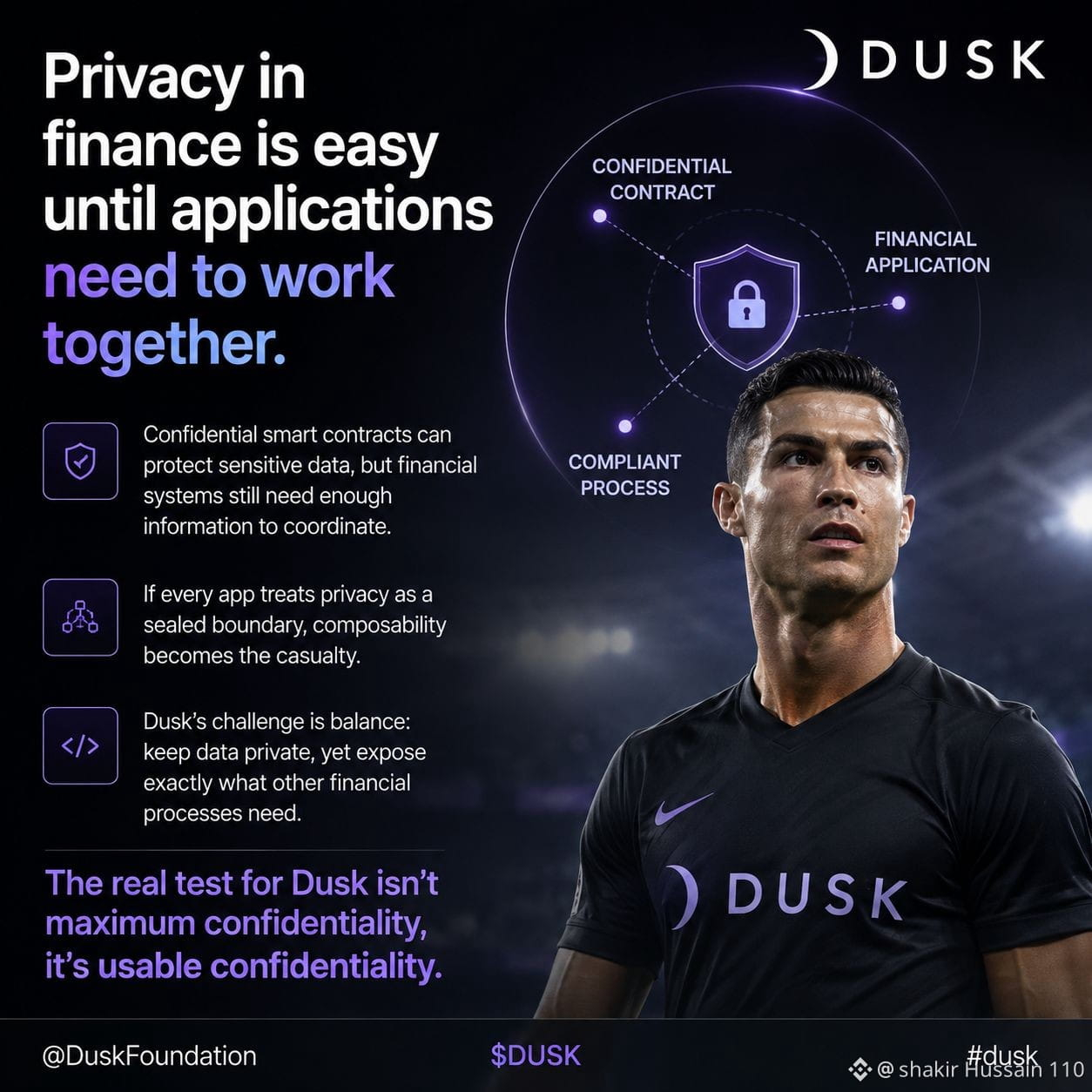
Confidential smart contracts can protect sensitive information, but financial systems still need enough information to coordinate between contracts, counterparties, and compliance processes. If every application treats privacy as a sealed boundary, composability can become the casualty.
That creates a real design tension for Dusk: confidentiality has value only if it doesn't make useful financial coordination impossible.
The interesting question is therefore not whether Dusk can keep financial data private. It is whether its Confidential Security Contract (XSC) model can let applications preserve sensitive information while still exposing exactly the information another financial process needs to operate.
If that balance works, privacy stops being a wall around financial activity and becomes a controlled layer between participants.
That could be the more important test for Dusk: not maximum confidentiality, but usable confidentiality.
@Dusk_Foundation #dusk $DUSK $P $GPS
Privacy becomes much harder to manage when financial applications need to interact with each other.
That is the part of Dusk I find more interesting than simply hiding transaction details.
Confidential smart contracts can protect sensitive information, but financial systems still need enough information to coordinate between contracts, counterparties, and compliance processes. If every application treats privacy as a sealed boundary, composability can become the casualty.
That creates a real design tension for Dusk: confidentiality has value only if it doesn't make useful financial coordination impossible.
The interesting question is therefore not whether Dusk can keep financial data private. It is whether its Confidential Security Contract (XSC) model can let applications preserve sensitive information while still exposing exactly the information another financial process needs to operate.
If that balance works, privacy stops being a wall around financial activity and becomes a controlled layer between participants.
That could be the more important test for Dusk: not maximum confidentiality, but usable confidentiality.
@Dusk #dusk $DUSK $P $GPS
That is the part of Dusk I find more interesting than simply hiding transaction details.
Confidential smart contracts can protect sensitive information, but financial systems still need enough information to coordinate between contracts, counterparties, and compliance processes. If every application treats privacy as a sealed boundary, composability can become the casualty.
That creates a real design tension for Dusk: confidentiality has value only if it doesn't make useful financial coordination impossible.
The interesting question is therefore not whether Dusk can keep financial data private. It is whether its Confidential Security Contract (XSC) model can let applications preserve sensitive information while still exposing exactly the information another financial process needs to operate.
If that balance works, privacy stops being a wall around financial activity and becomes a controlled layer between participants.
That could be the more important test for Dusk: not maximum confidentiality, but usable confidentiality.
@Dusk #dusk $DUSK $P $GPS
4
2
715
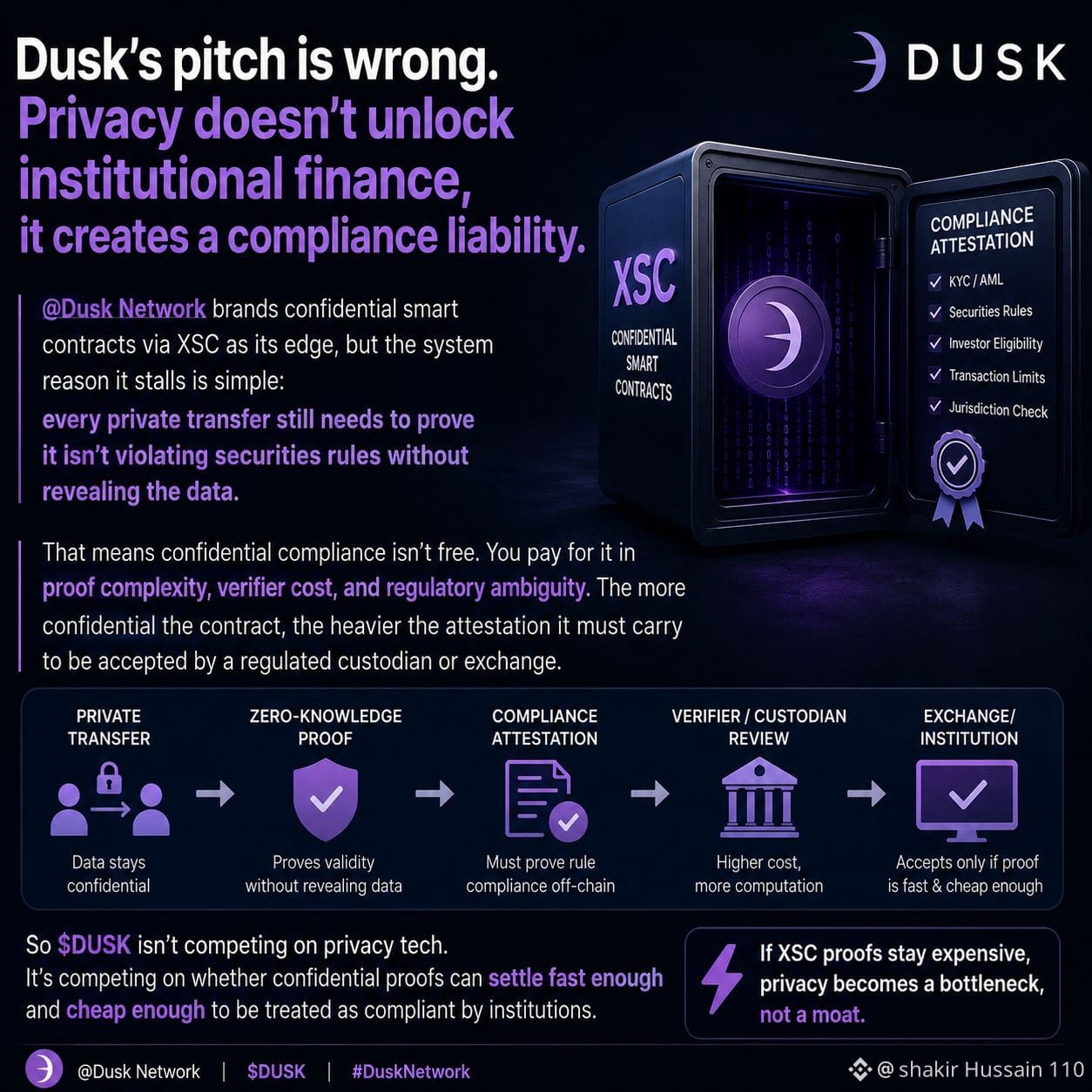
Dusk's pitch is wrong. Privacy doesn't unlock institutional finance, it creates a compliance liability.
@Dusk_Foundation Network brands confidential smart contracts via XSC as its edge, but the system reason it stalls is simple: every private transfer still needs to prove it isn't violating securities rules without revealing the data.
That means confidential compliance isn't free. You pay for it in proof complexity, verifier cost, and regulatory ambiguity. The more confidential the contract, the heavier the attestation it must carry to be accepted by a regulated custodian or exchange.
So isn't competing on privacy tech. It's competing on whether confidential proofs can settle fast enough and cheap enough to be treated as compliant by institutions.
If XSC proofs stay expensive, privacy becomes a bottleneck, not a moat.
#dusk $DUSK $H $WAL
Dusk's pitch is wrong. Privacy doesn't unlock institutional finance, it creates a compliance liability.
@Dusk Network brands confidential smart contracts via XSC as its edge, but the system reason it stalls is simple: every private transfer still needs to prove it isn't violating securities rules without revealing the data.
That means confidential compliance isn't free. You pay for it in proof complexity, verifier cost, and regulatory ambiguity. The more confidential the contract, the heavier the attestation it must carry to be accepted by a regulated custodian or exchange.
So isn't competing on privacy tech. It's competing on whether confidential proofs can settle fast enough and cheap enough to be treated as compliant by institutions.
If XSC proofs stay expensive, privacy becomes a bottleneck, not a moat.
#dusk $DUSK $H $WAL
@Dusk Network brands confidential smart contracts via XSC as its edge, but the system reason it stalls is simple: every private transfer still needs to prove it isn't violating securities rules without revealing the data.
That means confidential compliance isn't free. You pay for it in proof complexity, verifier cost, and regulatory ambiguity. The more confidential the contract, the heavier the attestation it must carry to be accepted by a regulated custodian or exchange.
So isn't competing on privacy tech. It's competing on whether confidential proofs can settle fast enough and cheap enough to be treated as compliant by institutions.
If XSC proofs stay expensive, privacy becomes a bottleneck, not a moat.
#dusk $DUSK $H $WAL
283
Everyone assumes privacy is the feature for institutions. For Dusk, it's the constraint.
One claim: @Dusk_Foundation will eventually be forced to centralize compliance arbitration because permissionless privacy is economically misaligned with regulated finance.
Reason: The Confidential Security Contract (XSC) standard makes privacy default, which creates a hidden incentive to optimize for obfuscated volume. Institutions don't care about private volume, they care about auditable signal density - who is compliant, who can be disclosed to whom, under what condition. You can't have fully permissionless confidential contracts and institutional-grade selective disclosure without someone becoming the arbiter of what is a valid disclosure proof.
Implication: If Dusk solves this with a whitelisted set of compliance attesters, it stops being a privacy L1 and becomes a permissioned privacy gateway - which is actually its only path to real financial adoption.
#dusk $DUSK $AAPL.US $AAPLB
Everyone assumes privacy is the feature for institutions. For Dusk, it's the constraint.
One claim: @Dusk will eventually be forced to centralize compliance arbitration because permissionless privacy is economically misaligned with regulated finance.
Reason: The Confidential Security Contract (XSC) standard makes privacy default, which creates a hidden incentive to optimize for obfuscated volume. Institutions don't care about private volume, they care about auditable signal density - who is compliant, who can be disclosed to whom, under what condition. You can't have fully permissionless confidential contracts and institutional-grade selective disclosure without someone becoming the arbiter of what is a valid disclosure proof.
Implication: If Dusk solves this with a whitelisted set of compliance attesters, it stops being a privacy L1 and becomes a permissioned privacy gateway - which is actually its only path to real financial adoption.
#dusk $DUSK $AAPL.US $AAPLB
One claim: @Dusk will eventually be forced to centralize compliance arbitration because permissionless privacy is economically misaligned with regulated finance.
Reason: The Confidential Security Contract (XSC) standard makes privacy default, which creates a hidden incentive to optimize for obfuscated volume. Institutions don't care about private volume, they care about auditable signal density - who is compliant, who can be disclosed to whom, under what condition. You can't have fully permissionless confidential contracts and institutional-grade selective disclosure without someone becoming the arbiter of what is a valid disclosure proof.
Implication: If Dusk solves this with a whitelisted set of compliance attesters, it stops being a privacy L1 and becomes a permissioned privacy gateway - which is actually its only path to real financial adoption.
#dusk $DUSK $AAPL.US $AAPLB
1
136
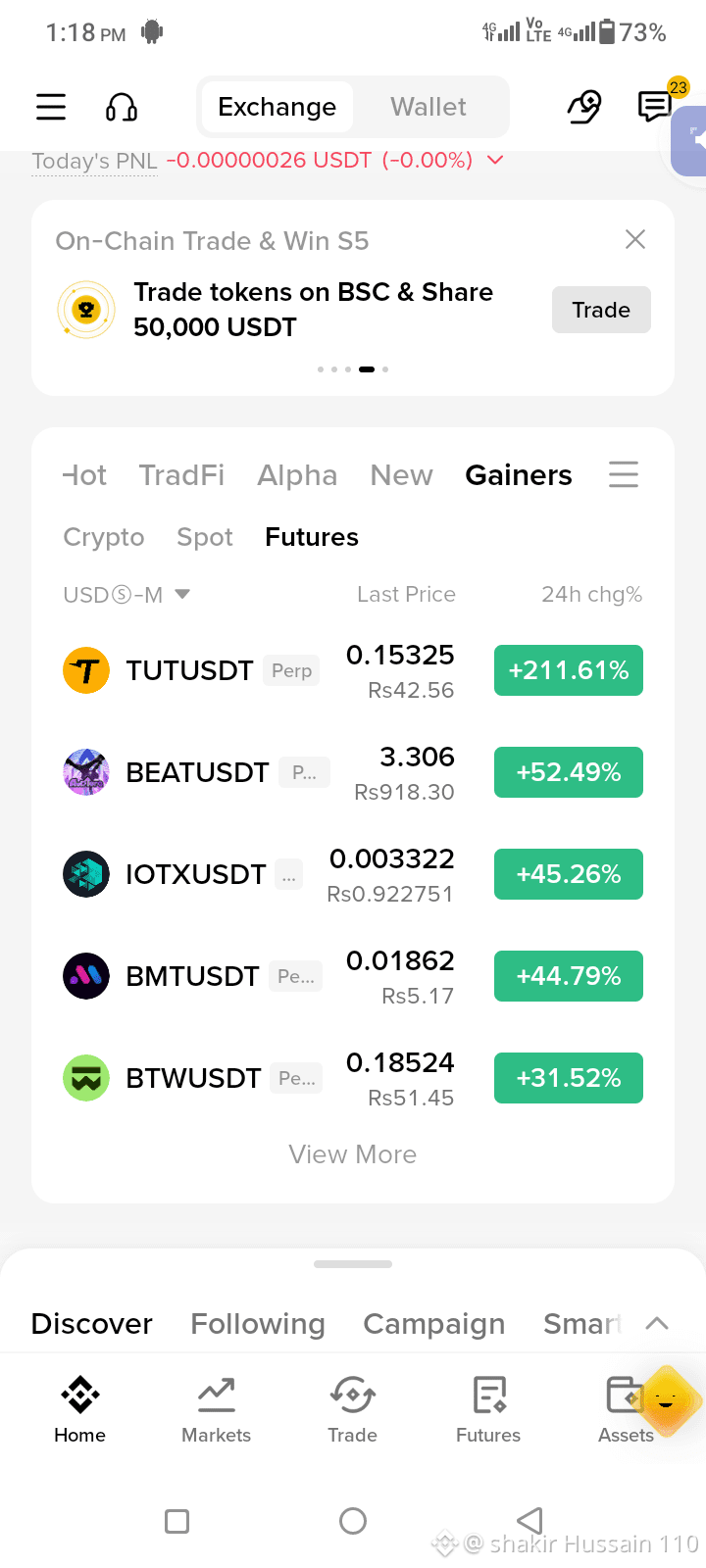
$BEAT The crypto charts are on fire today. TUTUSDT pulls off a mega +211.61% move to reach 0.15325 USDT (Rs 42.56). Not far behind, BEATUSDT climbs to 3.306 USDT (Rs 918.30) with +52.49%, $IOTX USDT skyrockets +45.26% to 0.003322 USDT (Rs 0.922751), $BMT USDT hits 0.01862 USDT (Rs 5.17) at +44.79%, and BTWUSDT caps it off with a strong +31.52% gain at 0.18524 USDT (Rs 51.45). Momentum is strictly upward.#BIP110ForkSignalingExpectedThisWeekend #VIXFallsToJanuaryLow #BIP110SoftForkAttemptBegins #SouthKoreaProposesLooseningCryptoShareholderRules #VIXFallsToJanuaryLow
$BEAT The crypto charts are on fire today. TUTUSDT pulls off a mega +211.61% move to reach 0.15325 USDT (Rs 42.56). Not far behind, BEATUSDT climbs to 3.306 USDT (Rs 918.30) with +52.49%, $IOTX USDT skyrockets +45.26% to 0.003322 USDT (Rs 0.922751), $BMT USDT hits 0.01862 USDT (Rs 5.17) at +44.79%, and BTWUSDT caps it off with a strong +31.52% gain at 0.18524 USDT (Rs 51.45). Momentum is strictly upward.#BIP110ForkSignalingExpectedThisWeekend #VIXFallsToJanuaryLow #BIP110SoftForkAttemptBegins #SouthKoreaProposesLooseningCryptoShareholderRules #VIXFallsToJanuaryLow

208
$LOW.US Massive action unfolding across these five tickers:
$TUT USDT Perp: 0.15325 USDT | Rs 42.56 | Up +211.61%
BEATUSDT Perp: 3.306 USDT | Rs 918.30 | Up +52.49%
IOTXUSDT: 0.003322 USDT | Rs 0.922751 | Up +45.26%
BMTUSDT Perp: 0.01862 USDT | Rs 5.17 | Up +44.79%
BTWUSDT Perp: 0.18524 USDT | Rs 51.45 | Up +31.52%#ThuneFilesClarityActClotureMotion #VIXFallsToJanuaryLow #BIP110ForkSignalingExpectedThisWeekend #BTCPayServerExploitDrainsLightningNodes #SouthKoreaProposesLooseningCryptoShareholderRules
$LOW.US Massive action unfolding across these five tickers:
$TUT USDT Perp: 0.15325 USDT | Rs 42.56 | Up +211.61%
BEATUSDT Perp: 3.306 USDT | Rs 918.30 | Up +52.49%
IOTXUSDT: 0.003322 USDT | Rs 0.922751 | Up +45.26%
BMTUSDT Perp: 0.01862 USDT | Rs 5.17 | Up +44.79%
BTWUSDT Perp: 0.18524 USDT | Rs 51.45 | Up +31.52%#ThuneFilesClarityActClotureMotion #VIXFallsToJanuaryLow #BIP110ForkSignalingExpectedThisWeekend #BTCPayServerExploitDrainsLightningNodes #SouthKoreaProposesLooseningCryptoShareholderRules
$TUT USDT Perp: 0.15325 USDT | Rs 42.56 | Up +211.61%
BEATUSDT Perp: 3.306 USDT | Rs 918.30 | Up +52.49%
IOTXUSDT: 0.003322 USDT | Rs 0.922751 | Up +45.26%
BMTUSDT Perp: 0.01862 USDT | Rs 5.17 | Up +44.79%
BTWUSDT Perp: 0.18524 USDT | Rs 51.45 | Up +31.52%#ThuneFilesClarityActClotureMotion #VIXFallsToJanuaryLow #BIP110ForkSignalingExpectedThisWeekend #BTCPayServerExploitDrainsLightningNodes #SouthKoreaProposesLooseningCryptoShareholderRules

278
$BTG Pure green energy on the charts today. TUTUSDT leads the pack with a phenomenal +211.61% spike at 0.15325 USDT (Rs 42.56). BEATUSDT roars past 3.306 USDT (Rs 918.30) with a +52.49% jump. IOTXUSDT gains +45.26% (0.003322 USDT / Rs 0.922751), BMTUSDT pushes +44.79% (0.01862 USDT / Rs 5.17), and $BTW USDT advances +31.52% (0.18524 USDT / Rs 51.45). Do not blink or you will miss the next breakout.#ThuneFilesClarityActClotureMotion #BIP110ForkSignalingExpectedThisWeekend #BTCPayServerExploitDrainsLightningNodes #SenateReadiesSeptemberCLARITYActVote #SouthKoreaProposesLooseningCryptoShareholderRules
$BTG Pure green energy on the charts today. TUTUSDT leads the pack with a phenomenal +211.61% spike at 0.15325 USDT (Rs 42.56). BEATUSDT roars past 3.306 USDT (Rs 918.30) with a +52.49% jump. IOTXUSDT gains +45.26% (0.003322 USDT / Rs 0.922751), BMTUSDT pushes +44.79% (0.01862 USDT / Rs 5.17), and $BTW USDT advances +31.52% (0.18524 USDT / Rs 51.45). Do not blink or you will miss the next breakout.#ThuneFilesClarityActClotureMotion #BIP110ForkSignalingExpectedThisWeekend #BTCPayServerExploitDrainsLightningNodes #SenateReadiesSeptemberCLARITYActVote #SouthKoreaProposesLooseningCryptoShareholderRules

353
$NVDA.US Unstoppable rally alert. TUTUSDT Perp is obliterating the market with an insane +211.61% surge, hitting 0.15325 USDT (Rs 42.56). Meanwhile, the altcoin market is firing on all cylinders: BEATUSDT up +52.49% (3.306 USDT / Rs 918.30), IOTXUSDT up +45.26% (0.003322 USDT / Rs 0.922751), BMTUSDT up +44.79% (0.01862 USDT / Rs 5.17), and BTWUSDT locked in at +31.52% (0.18524 $USDT / Rs 51.45).#ThuneFilesClarityActClotureMotion #BIP110SoftForkAttemptBegins #SouthKoreaProposesLooseningCryptoShareholderRules #BTCPayServerExploitDrainsLightningNodes #BIP110ForkSignalingExpectedThisWeekend
$NVDA.US Unstoppable rally alert. TUTUSDT Perp is obliterating the market with an insane +211.61% surge, hitting 0.15325 USDT (Rs 42.56). Meanwhile, the altcoin market is firing on all cylinders: BEATUSDT up +52.49% (3.306 USDT / Rs 918.30), IOTXUSDT up +45.26% (0.003322 USDT / Rs 0.922751), BMTUSDT up +44.79% (0.01862 USDT / Rs 5.17), and BTWUSDT locked in at +31.52% (0.18524 $USDT / Rs 51.45).#ThuneFilesClarityActClotureMotion #BIP110SoftForkAttemptBegins #SouthKoreaProposesLooseningCryptoShareholderRules #BTCPayServerExploitDrainsLightningNodes #BIP110ForkSignalingExpectedThisWeekend
225
$TUT Perp explodes with a staggering +211.61% gain, sitting at 0.15325 USDT (Rs 42.56). BEATUSDT Perp follows strong with +52.49% at 3.306 USDT (Rs 918.30). IOTXUSDT pumps +45.26% to 0.003322 USDT (Rs 0.922751). BMTUSDT Perp surges +44.79% to 0.01862 USDT (Rs 5.17), while BTWUSDT Perp holds solid ground with +31.52% at 0.18524 USDT (Rs 51.45). Green candles across the board#BIP110ForkSignalingExpectedThisWeekend #ThuneFilesClarityActClotureMotion #SouthKoreaProposesLooseningCryptoShareholderRules #SenateReadiesSeptemberCLARITYActVote .
$TUT Perp explodes with a staggering +211.61% gain, sitting at 0.15325 USDT (Rs 42.56). BEATUSDT Perp follows strong with +52.49% at 3.306 USDT (Rs 918.30). IOTXUSDT pumps +45.26% to 0.003322 USDT (Rs 0.922751). BMTUSDT Perp surges +44.79% to 0.01862 USDT (Rs 5.17), while BTWUSDT Perp holds solid ground with +31.52% at 0.18524 USDT (Rs 51.45). Green candles across the board#BIP110ForkSignalingExpectedThisWeekend #ThuneFilesClarityActClotureMotion #SouthKoreaProposesLooseningCryptoShareholderRules #SenateReadiesSeptemberCLARITYActVote .
413
$NVDA.US DT Perp
ACEUSDT Par Zabardast Breakout!
Crypto market mein dhoom machi hui hai. ACEUSDT Perp ne ek hi jhatke mein +76.30% ka massive pump maara hai.
Pair: ACEUSDT Perp
Current Price: 0.12701 USDT (PKR 35.23)
24h Gain: +76.30%#KospiFalls4.58% #ColdcardExploitFundsSentToMixers #DowFalls464Points #JapanRegulatorsUrgeCryptoWithdrawalLimits #DowFalls464Points
$NVDA.US DT Perp
ACEUSDT Par Zabardast Breakout!
Crypto market mein dhoom machi hui hai. ACEUSDT Perp ne ek hi jhatke mein +76.30% ka massive pump maara hai.
Pair: ACEUSDT Perp
Current Price: 0.12701 USDT (PKR 35.23)
24h Gain: +76.30%#KospiFalls4.58% #ColdcardExploitFundsSentToMixers #DowFalls464Points #JapanRegulatorsUrgeCryptoWithdrawalLimits #DowFalls464Points
ACEUSDT Par Zabardast Breakout!
Crypto market mein dhoom machi hui hai. ACEUSDT Perp ne ek hi jhatke mein +76.30% ka massive pump maara hai.
Pair: ACEUSDT Perp
Current Price: 0.12701 USDT (PKR 35.23)
24h Gain: +76.30%#KospiFalls4.58% #ColdcardExploitFundsSentToMixers #DowFalls464Points #JapanRegulatorsUrgeCryptoWithdrawalLimits #DowFalls464Points
87
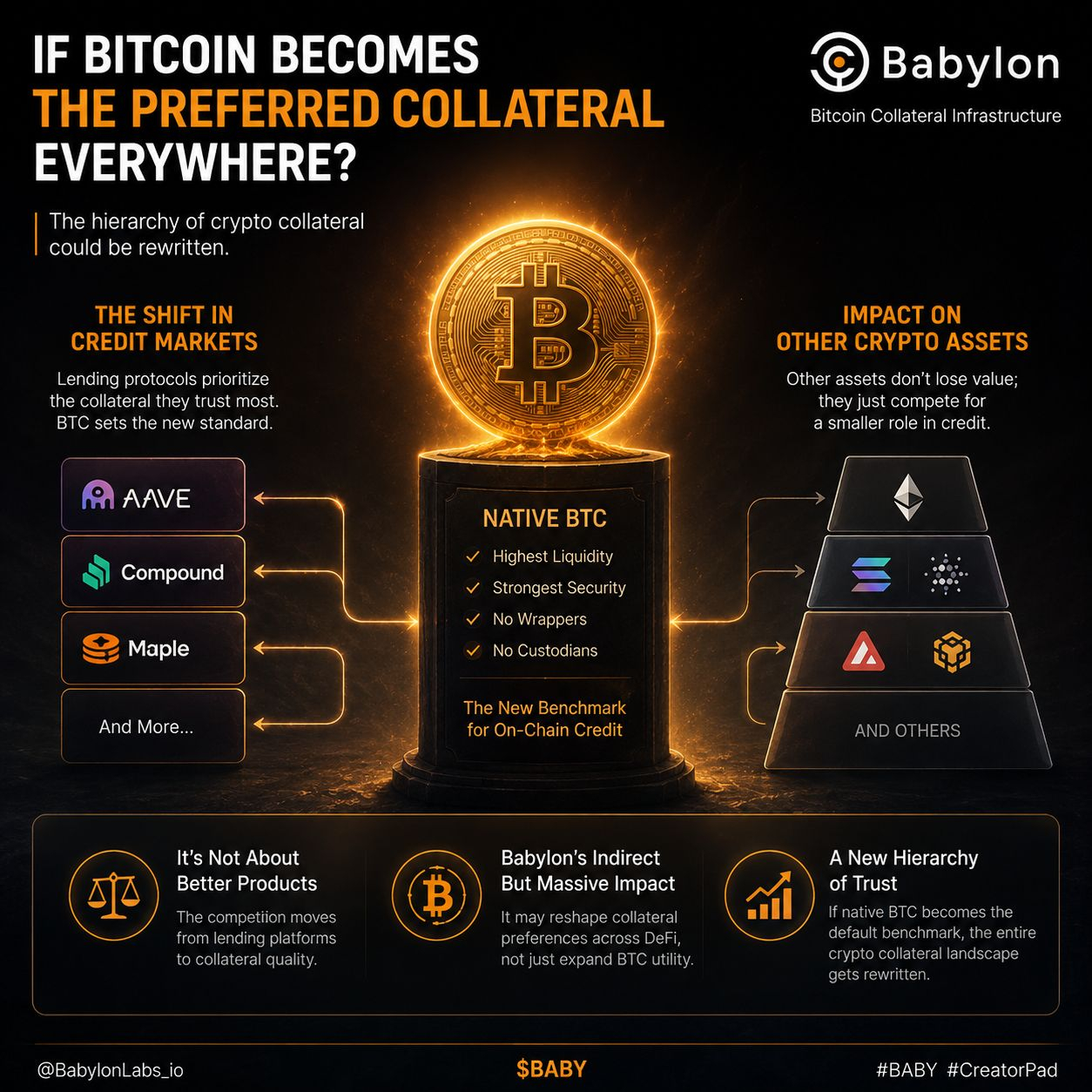
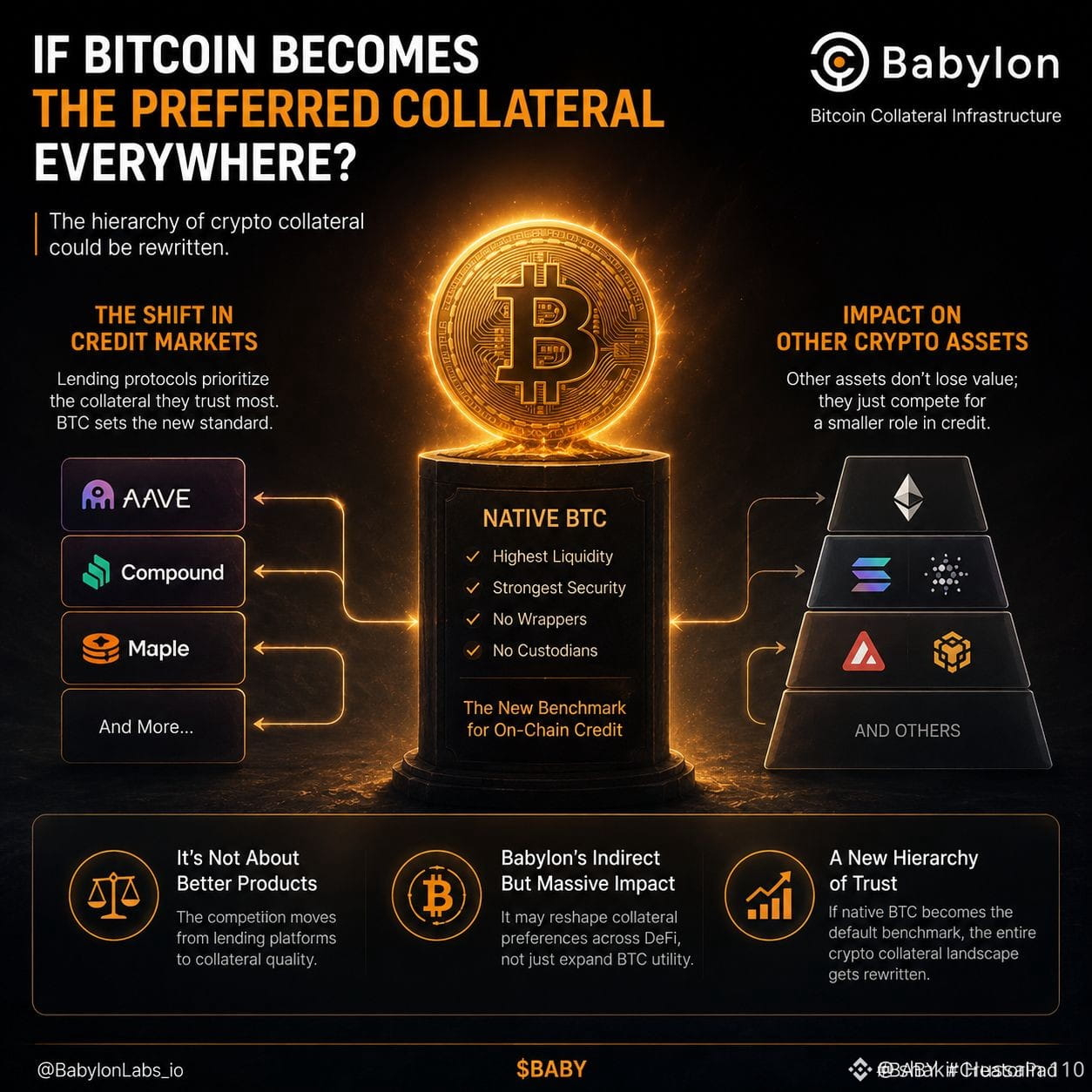
One question keeps coming to mind when I look at Babylon: what happens if Bitcoin becomes the preferred collateral everywhere?
At first, that sounds like the ideal outcome. But it also changes how capital flows across crypto.
If more lending protocols begin prioritizing native BTC-backed collateral through Babylon, other crypto assets may find themselves competing for a smaller role in credit markets. That isn't because they're less valuable—it’s because Bitcoin's stability and liquidity create a higher benchmark for collateral quality.
This is a structural shift, not a feature comparison.
Collateral markets reward the assets that lenders trust the most. If Bitcoin increasingly occupies that position without wrappers or custodians, the competition moves away from "Which protocol has the best lending product?" to "Which asset deserves to back the financial system?"
That's why I think Babylon's biggest impact could be indirect. It may reshape collateral preferences across DeFi rather than simply expanding Bitcoin's utility.
If native BTC becomes the default benchmark for on-chain credit, the real winners won't just be borrowing platforms. The entire hierarchy of crypto collateral could be rewritten.
@babylonlabs_io #baby $BABY $AMZNB $MSFTB
One question keeps coming to mind when I look at Babylon: what happens if Bitcoin becomes the preferred collateral everywhere?
At first, that sounds like the ideal outcome. But it also changes how capital flows across crypto.
If more lending protocols begin prioritizing native BTC-backed collateral through Babylon, other crypto assets may find themselves competing for a smaller role in credit markets. That isn't because they're less valuable—it’s because Bitcoin's stability and liquidity create a higher benchmark for collateral quality.
This is a structural shift, not a feature comparison.
Collateral markets reward the assets that lenders trust the most. If Bitcoin increasingly occupies that position without wrappers or custodians, the competition moves away from "Which protocol has the best lending product?" to "Which asset deserves to back the financial system?"
That's why I think Babylon's biggest impact could be indirect. It may reshape collateral preferences across DeFi rather than simply expanding Bitcoin's utility.
If native BTC becomes the default benchmark for on-chain credit, the real winners won't just be borrowing platforms. The entire hierarchy of crypto collateral could be rewritten.
@BabylonLabs_io #baby $BABY $AMZNB $MSFTB
At first, that sounds like the ideal outcome. But it also changes how capital flows across crypto.
If more lending protocols begin prioritizing native BTC-backed collateral through Babylon, other crypto assets may find themselves competing for a smaller role in credit markets. That isn't because they're less valuable—it’s because Bitcoin's stability and liquidity create a higher benchmark for collateral quality.
This is a structural shift, not a feature comparison.
Collateral markets reward the assets that lenders trust the most. If Bitcoin increasingly occupies that position without wrappers or custodians, the competition moves away from "Which protocol has the best lending product?" to "Which asset deserves to back the financial system?"
That's why I think Babylon's biggest impact could be indirect. It may reshape collateral preferences across DeFi rather than simply expanding Bitcoin's utility.
If native BTC becomes the default benchmark for on-chain credit, the real winners won't just be borrowing platforms. The entire hierarchy of crypto collateral could be rewritten.
@BabylonLabs_io #baby $BABY $AMZNB $MSFTB
4
115
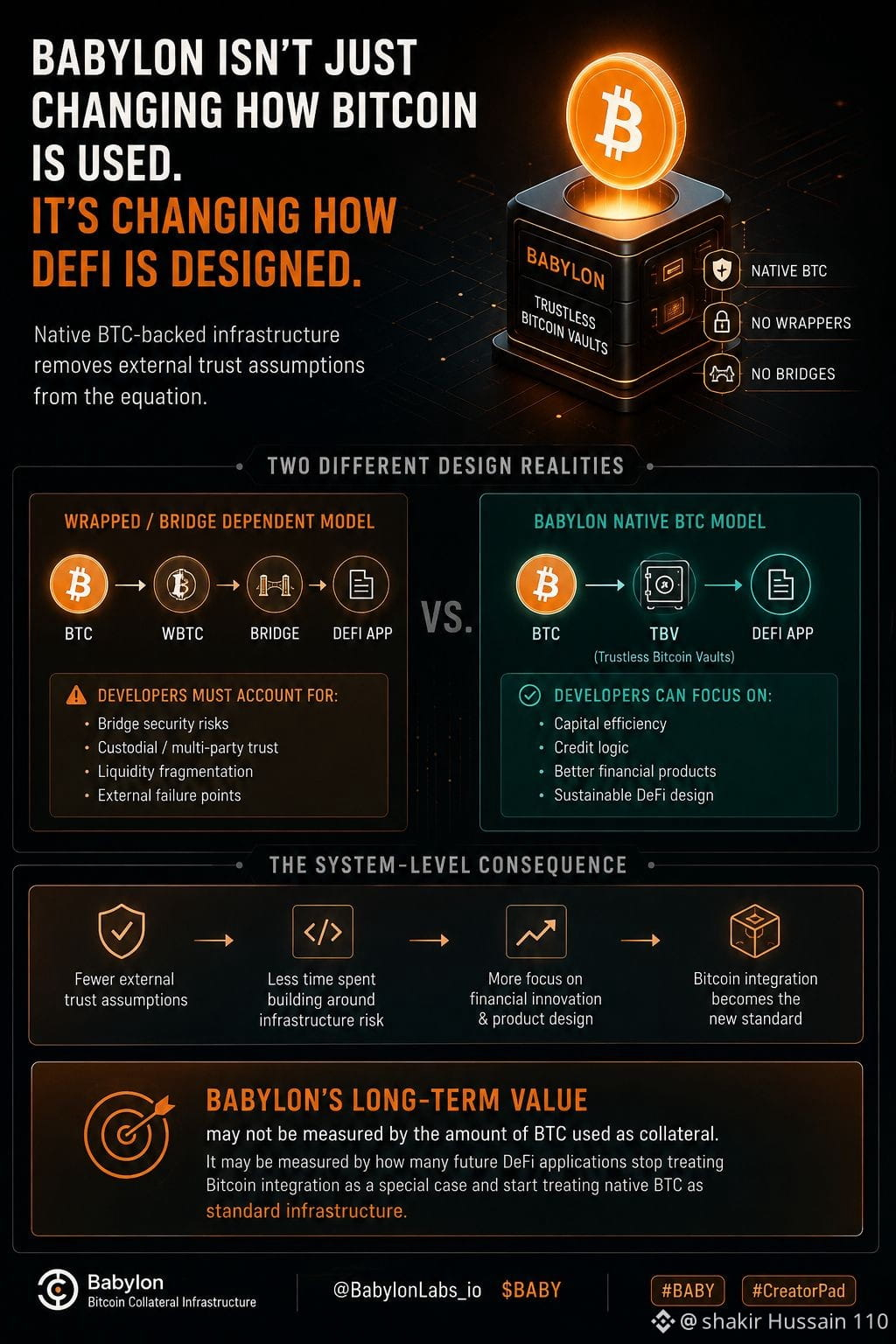
One thing I think the market underestimates about Babylon is that native BTC-backed infrastructure doesn't just change how Bitcoin is used—it changes how DeFi protocols plan for the future.
When collateral depends on wrapped assets or bridges, developers must constantly account for external trust assumptions. But if Bitcoin can participate through Trustless Bitcoin Vaults while remaining native, those assumptions begin to disappear from protocol design.
That has a system-level consequence.
Instead of building around interoperability risks, protocols can focus on capital efficiency and credit logic. Over time, this shifts engineering effort away from protecting against external infrastructure and toward improving financial products themselves.
The long-term value of Babylon may not be measured by the amount of BTC used as collateral. It may be measured by how many future DeFi applications stop treating Bitcoin integration as a special case and start treating native BTC as standard infrastructure.
If that transition happens, Babylon's biggest contribution won't be another lending primitive—it will be changing the baseline assumptions developers use when designing Bitcoin-native finance.
@babylonlabs_io #baby $BABY $P
{alpha}(560x810df4c7daf4ee06ae7c621d0680e73a505c9a06)
$X
{alpha}(560x0510101ec6c49d24ed911f0011e22a0d697ee776)
{future}(BABYUSDT)
One thing I think the market underestimates about Babylon is that native BTC-backed infrastructure doesn't just change how Bitcoin is used—it changes how DeFi protocols plan for the future.
When collateral depends on wrapped assets or bridges, developers must constantly account for external trust assumptions. But if Bitcoin can participate through Trustless Bitcoin Vaults while remaining native, those assumptions begin to disappear from protocol design.
That has a system-level consequence.
Instead of building around interoperability risks, protocols can focus on capital efficiency and credit logic. Over time, this shifts engineering effort away from protecting against external infrastructure and toward improving financial products themselves.
The long-term value of Babylon may not be measured by the amount of BTC used as collateral. It may be measured by how many future DeFi applications stop treating Bitcoin integration as a special case and start treating native BTC as standard infrastructure.
If that transition happens, Babylon's biggest contribution won't be another lending primitive—it will be changing the baseline assumptions developers use when designing Bitcoin-native finance.
@BabylonLabs_io #baby $BABY $P
$X
When collateral depends on wrapped assets or bridges, developers must constantly account for external trust assumptions. But if Bitcoin can participate through Trustless Bitcoin Vaults while remaining native, those assumptions begin to disappear from protocol design.
That has a system-level consequence.
Instead of building around interoperability risks, protocols can focus on capital efficiency and credit logic. Over time, this shifts engineering effort away from protecting against external infrastructure and toward improving financial products themselves.
The long-term value of Babylon may not be measured by the amount of BTC used as collateral. It may be measured by how many future DeFi applications stop treating Bitcoin integration as a special case and start treating native BTC as standard infrastructure.
If that transition happens, Babylon's biggest contribution won't be another lending primitive—it will be changing the baseline assumptions developers use when designing Bitcoin-native finance.
@BabylonLabs_io #baby $BABY $P
$X
6
4
548
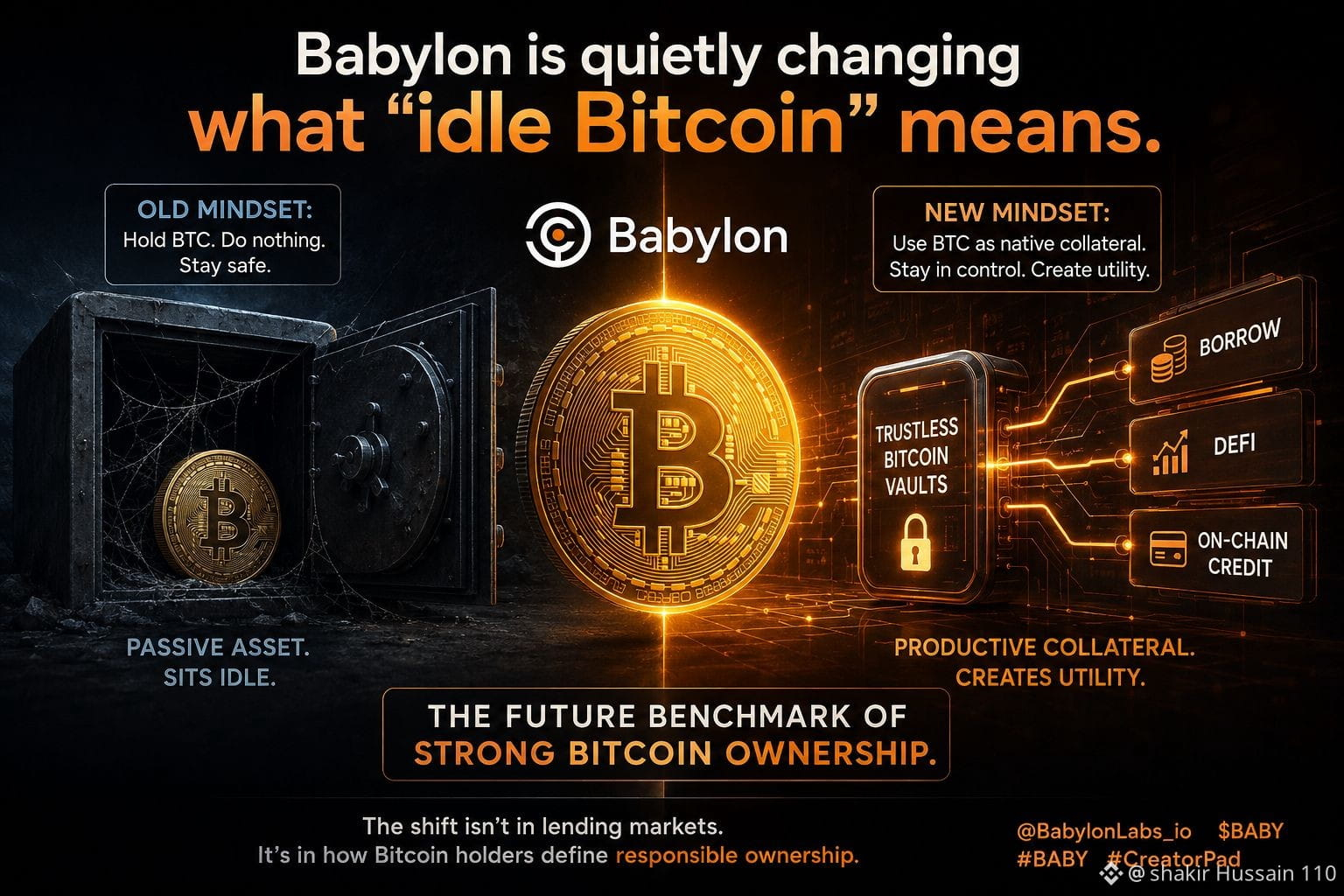
I think Babylon is quietly changing what "idle Bitcoin" means.
For years, keeping BTC untouched was considered the safest and most rational choice. But if native Bitcoin-backed borrowing becomes reliable through Trustless Bitcoin Vaults, the definition of a strong Bitcoin position starts to change.
The interesting part isn't the ability to borrow. It's the new benchmark it creates.
Once Bitcoin can remain on the Bitcoin network while simultaneously supporting on-chain credit, simply holding BTC without putting it to work may no longer be viewed as the default economic strategy. That creates a subtle competitive pressure—not between protocols, but between two philosophies of Bitcoin ownership.
One side will continue treating BTC as an asset that should remain completely passive. The other will increasingly see it as collateral that can generate utility without sacrificing self-custody.
Whichever philosophy proves more resilient will influence how future BTCFi products are designed. If productive collateral becomes the norm, the biggest shift won't be in lending markets—it will be in how Bitcoin holders define responsible ownership.
That's the outcome I'm watching far more closely than borrowing volumes or TVL.
@babylonlabs_io #baby $BABY $H
{alpha}(10xe76c5b78f93909d34404e9eb4c1f19e7582a5de1)
$BANK
{future}(BANKUSDT)
{future}(BABYUSDT)
I think Babylon is quietly changing what "idle Bitcoin" means.
For years, keeping BTC untouched was considered the safest and most rational choice. But if native Bitcoin-backed borrowing becomes reliable through Trustless Bitcoin Vaults, the definition of a strong Bitcoin position starts to change.
The interesting part isn't the ability to borrow. It's the new benchmark it creates.
Once Bitcoin can remain on the Bitcoin network while simultaneously supporting on-chain credit, simply holding BTC without putting it to work may no longer be viewed as the default economic strategy. That creates a subtle competitive pressure—not between protocols, but between two philosophies of Bitcoin ownership.
One side will continue treating BTC as an asset that should remain completely passive. The other will increasingly see it as collateral that can generate utility without sacrificing self-custody.
Whichever philosophy proves more resilient will influence how future BTCFi products are designed. If productive collateral becomes the norm, the biggest shift won't be in lending markets—it will be in how Bitcoin holders define responsible ownership.
That's the outcome I'm watching far more closely than borrowing volumes or TVL.
@BabylonLabs_io #baby $BABY $H
$BANK
For years, keeping BTC untouched was considered the safest and most rational choice. But if native Bitcoin-backed borrowing becomes reliable through Trustless Bitcoin Vaults, the definition of a strong Bitcoin position starts to change.
The interesting part isn't the ability to borrow. It's the new benchmark it creates.
Once Bitcoin can remain on the Bitcoin network while simultaneously supporting on-chain credit, simply holding BTC without putting it to work may no longer be viewed as the default economic strategy. That creates a subtle competitive pressure—not between protocols, but between two philosophies of Bitcoin ownership.
One side will continue treating BTC as an asset that should remain completely passive. The other will increasingly see it as collateral that can generate utility without sacrificing self-custody.
Whichever philosophy proves more resilient will influence how future BTCFi products are designed. If productive collateral becomes the norm, the biggest shift won't be in lending markets—it will be in how Bitcoin holders define responsible ownership.
That's the outcome I'm watching far more closely than borrowing volumes or TVL.
@BabylonLabs_io #baby $BABY $H
$BANK
4
212
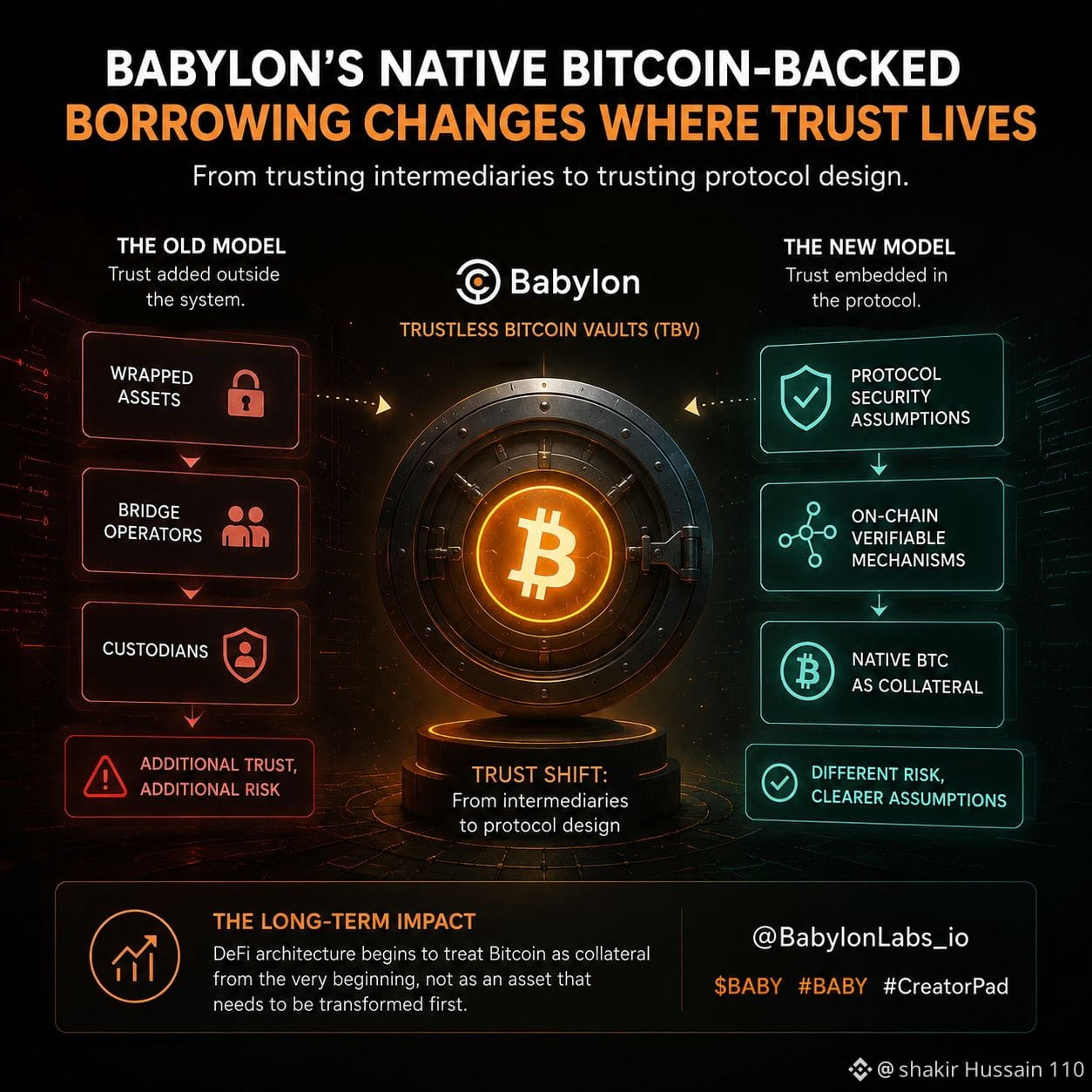
The most interesting part of Babylon's native Bitcoin-backed borrowing isn't that it lets BTC access credit without wrappers or bridges.
It's that it changes where trust has to exist.
For years, Bitcoin-backed lending has depended on adding trust somewhere else—wrapped assets, bridge operators, or custodians. Those extra layers became part of the risk model whether users acknowledged them or not.
Babylon's Trustless Bitcoin Vaults (TBV) shift the challenge away from outsourced trust and toward protocol design. That doesn't eliminate risk, but it changes the type of risk users are evaluating. Instead of asking whether an intermediary can be trusted, the question becomes whether the protocol's security assumptions remain reliable as adoption grows.
That's a meaningful change because infrastructure shapes behavior. If native BTC-backed borrowing becomes practical enough, developers may begin designing lending products that assume Bitcoin can participate directly instead of being transformed first.
The long-term impact isn't just more borrowing against BTC. It's a gradual shift in how DeFi architectures treat Bitcoin as collateral from the very beginning.
@babylonlabs_io #creatorpad #baby $BABY $US $UP
{alpha}(560x000008d2175f9aeaddb2430c26f8a6f73c5a0000)
{future}(USUSDT)
{future}(BABYUSDT)
The most interesting part of Babylon's native Bitcoin-backed borrowing isn't that it lets BTC access credit without wrappers or bridges.
It's that it changes where trust has to exist.
For years, Bitcoin-backed lending has depended on adding trust somewhere else—wrapped assets, bridge operators, or custodians. Those extra layers became part of the risk model whether users acknowledged them or not.
Babylon's Trustless Bitcoin Vaults (TBV) shift the challenge away from outsourced trust and toward protocol design. That doesn't eliminate risk, but it changes the type of risk users are evaluating. Instead of asking whether an intermediary can be trusted, the question becomes whether the protocol's security assumptions remain reliable as adoption grows.
That's a meaningful change because infrastructure shapes behavior. If native BTC-backed borrowing becomes practical enough, developers may begin designing lending products that assume Bitcoin can participate directly instead of being transformed first.
The long-term impact isn't just more borrowing against BTC. It's a gradual shift in how DeFi architectures treat Bitcoin as collateral from the very beginning.
@BabylonLabs_io #creatorpad #baby $BABY $US $UP
It's that it changes where trust has to exist.
For years, Bitcoin-backed lending has depended on adding trust somewhere else—wrapped assets, bridge operators, or custodians. Those extra layers became part of the risk model whether users acknowledged them or not.
Babylon's Trustless Bitcoin Vaults (TBV) shift the challenge away from outsourced trust and toward protocol design. That doesn't eliminate risk, but it changes the type of risk users are evaluating. Instead of asking whether an intermediary can be trusted, the question becomes whether the protocol's security assumptions remain reliable as adoption grows.
That's a meaningful change because infrastructure shapes behavior. If native BTC-backed borrowing becomes practical enough, developers may begin designing lending products that assume Bitcoin can participate directly instead of being transformed first.
The long-term impact isn't just more borrowing against BTC. It's a gradual shift in how DeFi architectures treat Bitcoin as collateral from the very beginning.
@BabylonLabs_io #creatorpad #baby $BABY $US $UP
3
110
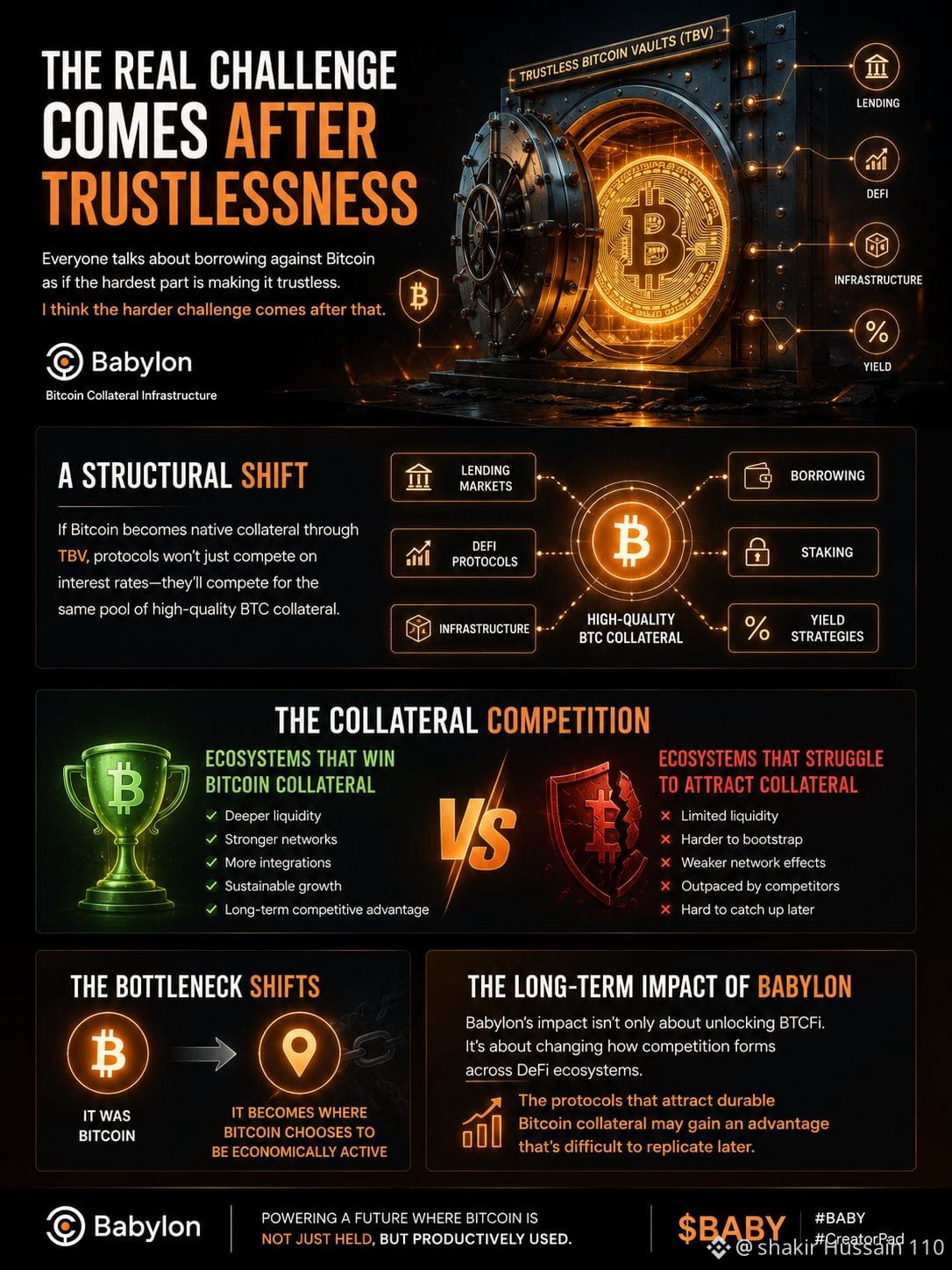
Everyone talks about borrowing against Bitcoin as if the hardest part is making it trustless. I think the harder challenge comes after that.
If Bitcoin becomes native collateral through Trustless Bitcoin Vaults (TBV), protocols won't just compete on interest rates—they'll compete for the same pool of high-quality BTC collateral.
That's a structural shift.
The more lending markets, DeFi protocols, and infrastructure integrate Babylon's Bitcoin collateral model, the more valuable reliable BTC collateral becomes. Over time, access to collateral could become a competitive advantage rather than a commodity. Networks with deeper collateral relationships may attract more liquidity, while smaller ecosystems struggle to bootstrap despite having sound technology.
In other words, the bottleneck may stop being Bitcoin itself and become where Bitcoin chooses to be economically active.
That's why I think Babylon's long-term impact isn't only about unlocking BTCFi. It's about changing how competition forms across DeFi ecosystems. The protocols that attract durable Bitcoin collateral may gain an advantage that's difficult to replicate later.
@babylonlabs_io #creatorpad #baby $BABY $MSFTB $ESP
{future}(ESPUSDT)
{future}(BABYUSDT)
{spot}(MSFTBUSDT)
Everyone talks about borrowing against Bitcoin as if the hardest part is making it trustless. I think the harder challenge comes after that.
If Bitcoin becomes native collateral through Trustless Bitcoin Vaults (TBV), protocols won't just compete on interest rates—they'll compete for the same pool of high-quality BTC collateral.
That's a structural shift.
The more lending markets, DeFi protocols, and infrastructure integrate Babylon's Bitcoin collateral model, the more valuable reliable BTC collateral becomes. Over time, access to collateral could become a competitive advantage rather than a commodity. Networks with deeper collateral relationships may attract more liquidity, while smaller ecosystems struggle to bootstrap despite having sound technology.
In other words, the bottleneck may stop being Bitcoin itself and become where Bitcoin chooses to be economically active.
That's why I think Babylon's long-term impact isn't only about unlocking BTCFi. It's about changing how competition forms across DeFi ecosystems. The protocols that attract durable Bitcoin collateral may gain an advantage that's difficult to replicate later.
@BabylonLabs_io #creatorpad #baby $BABY $MSFTB $ESP
If Bitcoin becomes native collateral through Trustless Bitcoin Vaults (TBV), protocols won't just compete on interest rates—they'll compete for the same pool of high-quality BTC collateral.
That's a structural shift.
The more lending markets, DeFi protocols, and infrastructure integrate Babylon's Bitcoin collateral model, the more valuable reliable BTC collateral becomes. Over time, access to collateral could become a competitive advantage rather than a commodity. Networks with deeper collateral relationships may attract more liquidity, while smaller ecosystems struggle to bootstrap despite having sound technology.
In other words, the bottleneck may stop being Bitcoin itself and become where Bitcoin chooses to be economically active.
That's why I think Babylon's long-term impact isn't only about unlocking BTCFi. It's about changing how competition forms across DeFi ecosystems. The protocols that attract durable Bitcoin collateral may gain an advantage that's difficult to replicate later.
@BabylonLabs_io #creatorpad #baby $BABY $MSFTB $ESP
3
1
156
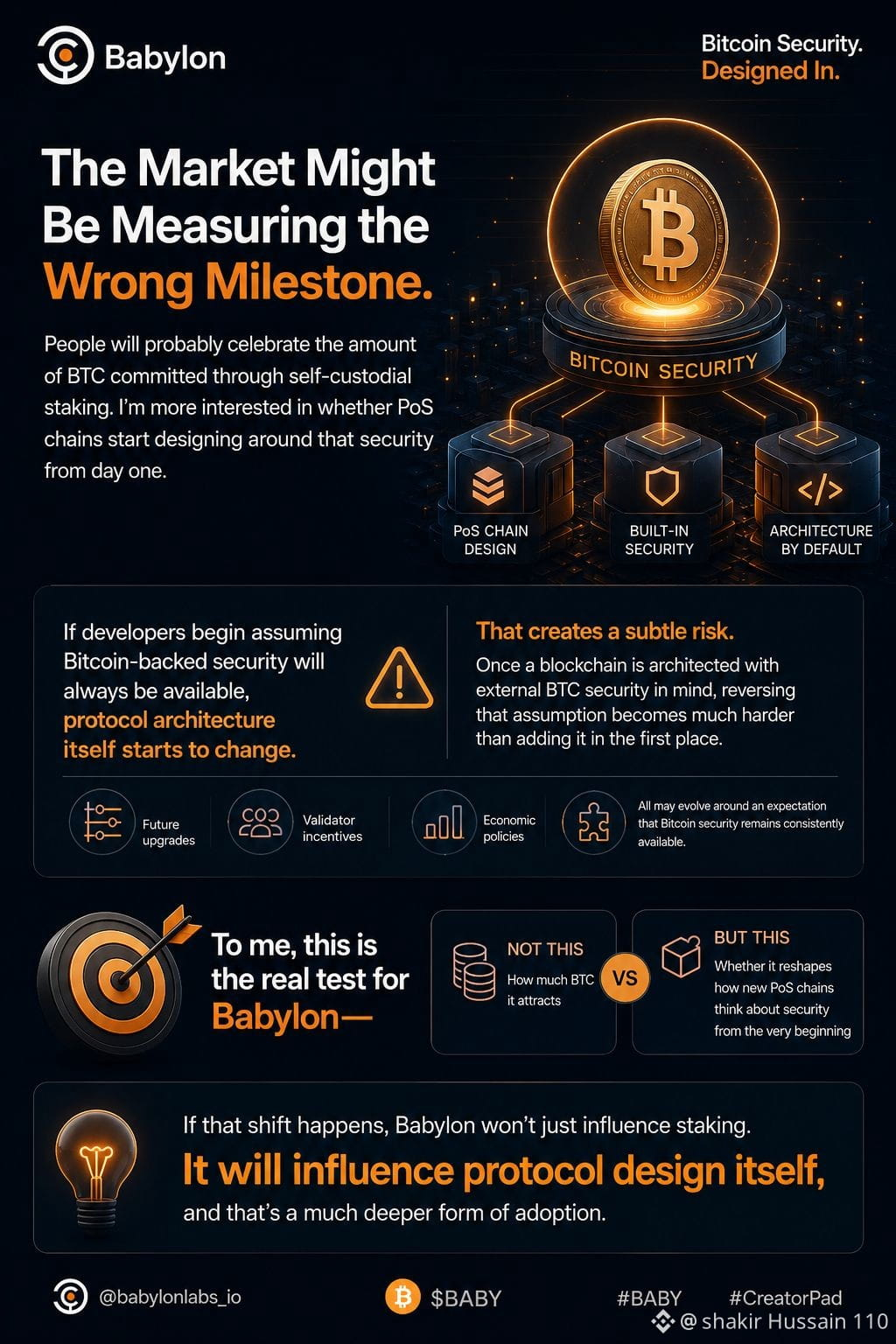
I think the market is measuring the wrong milestone for Babylon.
People will probably celebrate the amount of BTC committed through self-custodial staking. I'm more interested in whether PoS chains start designing around that security from day one.
That's a very different signal.
If developers begin assuming Bitcoin-backed security will always be available, protocol architecture itself starts to change. Security stops being an optimization added later and becomes a dependency built into the network's design decisions.
That creates a subtle risk. Once a blockchain is architected with external BTC security in mind, reversing that assumption becomes much harder than adding it in the first place. Future upgrades, validator incentives, and economic policies may all evolve around an expectation that Bitcoin security remains consistently available.
To me, this is the real test for Babylon—not how much BTC it attracts, but whether it quietly reshapes how new PoS blockchains think about building security from the very beginning.
If that shift happens, Babylon won't just influence staking. It will influence protocol design itself, and that's a much deeper form of adoption.
@babylonlabs_io #creatorpad #baby $BABY $RIF $RE
I think the market is measuring the wrong milestone for Babylon.
People will probably celebrate the amount of BTC committed through self-custodial staking. I'm more interested in whether PoS chains start designing around that security from day one.
That's a very different signal.
If developers begin assuming Bitcoin-backed security will always be available, protocol architecture itself starts to change. Security stops being an optimization added later and becomes a dependency built into the network's design decisions.
That creates a subtle risk. Once a blockchain is architected with external BTC security in mind, reversing that assumption becomes much harder than adding it in the first place. Future upgrades, validator incentives, and economic policies may all evolve around an expectation that Bitcoin security remains consistently available.
To me, this is the real test for Babylon—not how much BTC it attracts, but whether it quietly reshapes how new PoS blockchains think about building security from the very beginning.
If that shift happens, Babylon won't just influence staking. It will influence protocol design itself, and that's a much deeper form of adoption.
@BabylonLabs_io #creatorpad #baby $BABY $RIF $RE
People will probably celebrate the amount of BTC committed through self-custodial staking. I'm more interested in whether PoS chains start designing around that security from day one.
That's a very different signal.
If developers begin assuming Bitcoin-backed security will always be available, protocol architecture itself starts to change. Security stops being an optimization added later and becomes a dependency built into the network's design decisions.
That creates a subtle risk. Once a blockchain is architected with external BTC security in mind, reversing that assumption becomes much harder than adding it in the first place. Future upgrades, validator incentives, and economic policies may all evolve around an expectation that Bitcoin security remains consistently available.
To me, this is the real test for Babylon—not how much BTC it attracts, but whether it quietly reshapes how new PoS blockchains think about building security from the very beginning.
If that shift happens, Babylon won't just influence staking. It will influence protocol design itself, and that's a much deeper form of adoption.
@BabylonLabs_io #creatorpad #baby $BABY $RIF $RE
4
1
134
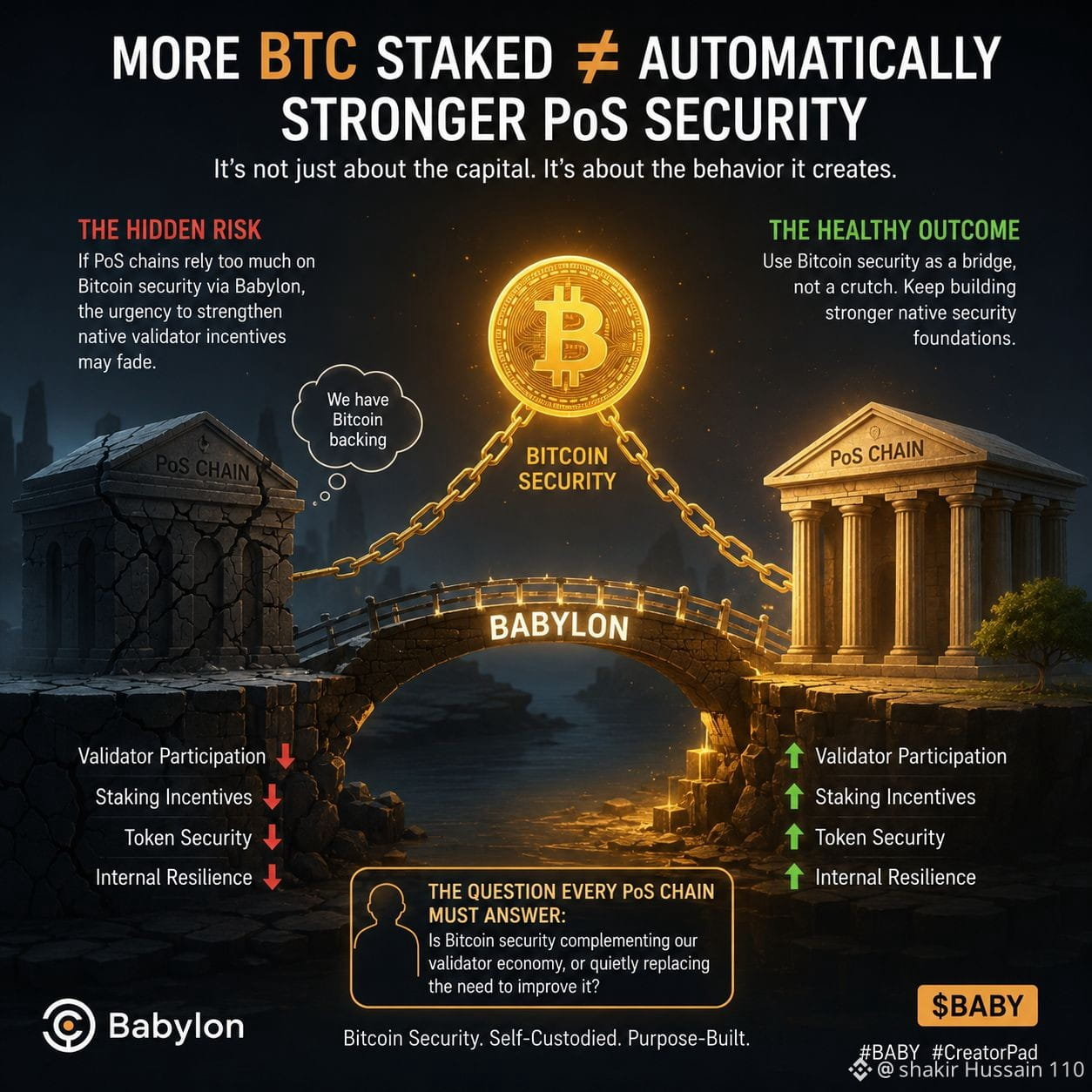
One assumption keeps showing up in discussions around Babylon: that more BTC participating in staking automatically means stronger PoS security.
I think that's incomplete.
Security isn't determined only by the amount of capital available. It's also determined by how that capital shapes protocol behavior. If PoS chains know they can increasingly rely on Bitcoin-backed security through Babylon, the pressure to strengthen their own validator participation, staking incentives, and token-based security models may gradually weaken.
That's a system-level trade-off that isn't obvious at first. External BTC security can make networks more resilient, but it can also reduce the urgency to solve structural weaknesses in their native economic design. The more dependable the external layer becomes, the easier it is to postpone difficult decisions about improving internal security incentives.
This isn't a criticism of Babylon. It's a question every integrating PoS ecosystem will eventually have to answer: Is Bitcoin security complementing our validator economy, or quietly replacing the need to improve it?
If Babylon succeeds, the healthiest outcome won't be PoS chains depending on Bitcoin forever. It will be using Bitcoin security as a bridge while continuing to build stronger native security foundations of their own.
@babylonlabs_io #creatorpad #baby $BABY $EWZ $H
{future}(HUSDT)
{future}(BABYUSDT)
{future}(EWZUSDT)
One assumption keeps showing up in discussions around Babylon: that more BTC participating in staking automatically means stronger PoS security.
I think that's incomplete.
Security isn't determined only by the amount of capital available. It's also determined by how that capital shapes protocol behavior. If PoS chains know they can increasingly rely on Bitcoin-backed security through Babylon, the pressure to strengthen their own validator participation, staking incentives, and token-based security models may gradually weaken.
That's a system-level trade-off that isn't obvious at first. External BTC security can make networks more resilient, but it can also reduce the urgency to solve structural weaknesses in their native economic design. The more dependable the external layer becomes, the easier it is to postpone difficult decisions about improving internal security incentives.
This isn't a criticism of Babylon. It's a question every integrating PoS ecosystem will eventually have to answer: Is Bitcoin security complementing our validator economy, or quietly replacing the need to improve it?
If Babylon succeeds, the healthiest outcome won't be PoS chains depending on Bitcoin forever. It will be using Bitcoin security as a bridge while continuing to build stronger native security foundations of their own.
@BabylonLabs_io #creatorpad #baby $BABY $EWZ $H
I think that's incomplete.
Security isn't determined only by the amount of capital available. It's also determined by how that capital shapes protocol behavior. If PoS chains know they can increasingly rely on Bitcoin-backed security through Babylon, the pressure to strengthen their own validator participation, staking incentives, and token-based security models may gradually weaken.
That's a system-level trade-off that isn't obvious at first. External BTC security can make networks more resilient, but it can also reduce the urgency to solve structural weaknesses in their native economic design. The more dependable the external layer becomes, the easier it is to postpone difficult decisions about improving internal security incentives.
This isn't a criticism of Babylon. It's a question every integrating PoS ecosystem will eventually have to answer: Is Bitcoin security complementing our validator economy, or quietly replacing the need to improve it?
If Babylon succeeds, the healthiest outcome won't be PoS chains depending on Bitcoin forever. It will be using Bitcoin security as a bridge while continuing to build stronger native security foundations of their own.
@BabylonLabs_io #creatorpad #baby $BABY $EWZ $H
4
3
202
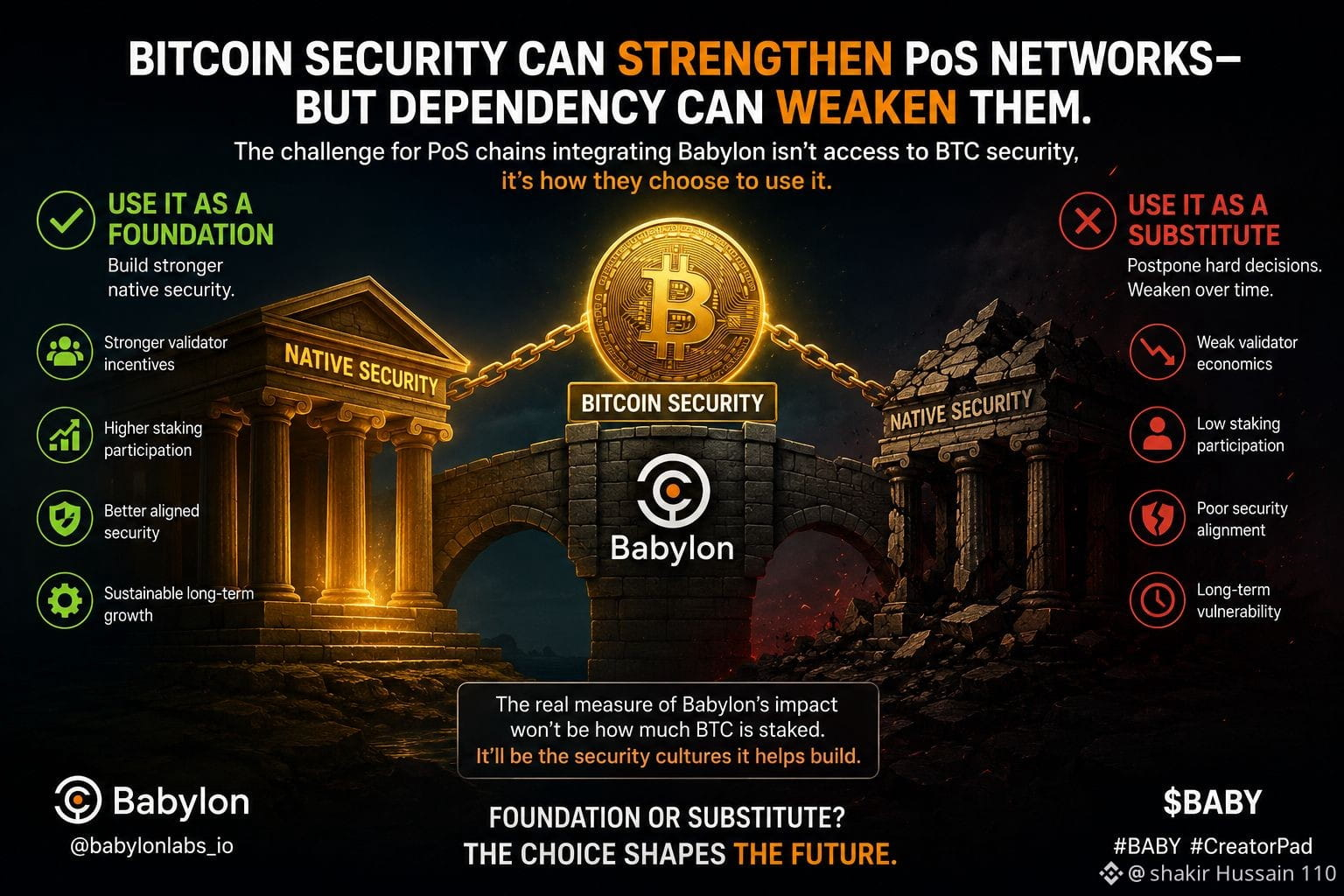
Everyone assumes that adding Bitcoin security to PoS networks is an unquestionable upgrade. I'm not convinced it's that simple.
The more I think about Babylon, the more I see a different long-term tension.
If PoS blockchains increasingly rely on self-custodial BTC staking for their security budget, they may gradually weaken the incentive to improve their own native economic security. Validator incentives, staking participation, and token-aligned security are supposed to evolve with the network. External BTC security can strengthen resilience, but it can also make difficult decisions about native security economics easier to postpone.
That's a subtle risk because dependency rarely appears overnight. It develops as protocols optimize for the strongest available security source instead of continuously refining their own. Over time, the question shifts from "How do we build a stronger validator economy?" to "How much external BTC security can we access?"
I don't see this as a flaw in Babylon itself. I see it as the governance challenge every integrating PoS chain will eventually face.
The real measure of Babylon's impact won't be how much BTC is staked. It'll be whether PoS ecosystems use Bitcoin security as a foundation to improve their own security models—or as a substitute for building them.
@babylonlabs_io #creatorpad #baby $BABY $R2 $NB
{alpha}(560xc2bd425a63800731e3ae42b6596bdd783299fcb1)
{future}(BABYUSDT)
{alpha}(560x223a20e1b83aa3832e78d4b7b132df022e739222)
Everyone assumes that adding Bitcoin security to PoS networks is an unquestionable upgrade. I'm not convinced it's that simple.
The more I think about Babylon, the more I see a different long-term tension.
If PoS blockchains increasingly rely on self-custodial BTC staking for their security budget, they may gradually weaken the incentive to improve their own native economic security. Validator incentives, staking participation, and token-aligned security are supposed to evolve with the network. External BTC security can strengthen resilience, but it can also make difficult decisions about native security economics easier to postpone.
That's a subtle risk because dependency rarely appears overnight. It develops as protocols optimize for the strongest available security source instead of continuously refining their own. Over time, the question shifts from "How do we build a stronger validator economy?" to "How much external BTC security can we access?"
I don't see this as a flaw in Babylon itself. I see it as the governance challenge every integrating PoS chain will eventually face.
The real measure of Babylon's impact won't be how much BTC is staked. It'll be whether PoS ecosystems use Bitcoin security as a foundation to improve their own security models—or as a substitute for building them.
@BabylonLabs_io #creatorpad #baby $BABY $R2 $NB
The more I think about Babylon, the more I see a different long-term tension.
If PoS blockchains increasingly rely on self-custodial BTC staking for their security budget, they may gradually weaken the incentive to improve their own native economic security. Validator incentives, staking participation, and token-aligned security are supposed to evolve with the network. External BTC security can strengthen resilience, but it can also make difficult decisions about native security economics easier to postpone.
That's a subtle risk because dependency rarely appears overnight. It develops as protocols optimize for the strongest available security source instead of continuously refining their own. Over time, the question shifts from "How do we build a stronger validator economy?" to "How much external BTC security can we access?"
I don't see this as a flaw in Babylon itself. I see it as the governance challenge every integrating PoS chain will eventually face.
The real measure of Babylon's impact won't be how much BTC is staked. It'll be whether PoS ecosystems use Bitcoin security as a foundation to improve their own security models—or as a substitute for building them.
@BabylonLabs_io #creatorpad #baby $BABY $R2 $NB
4
2
637
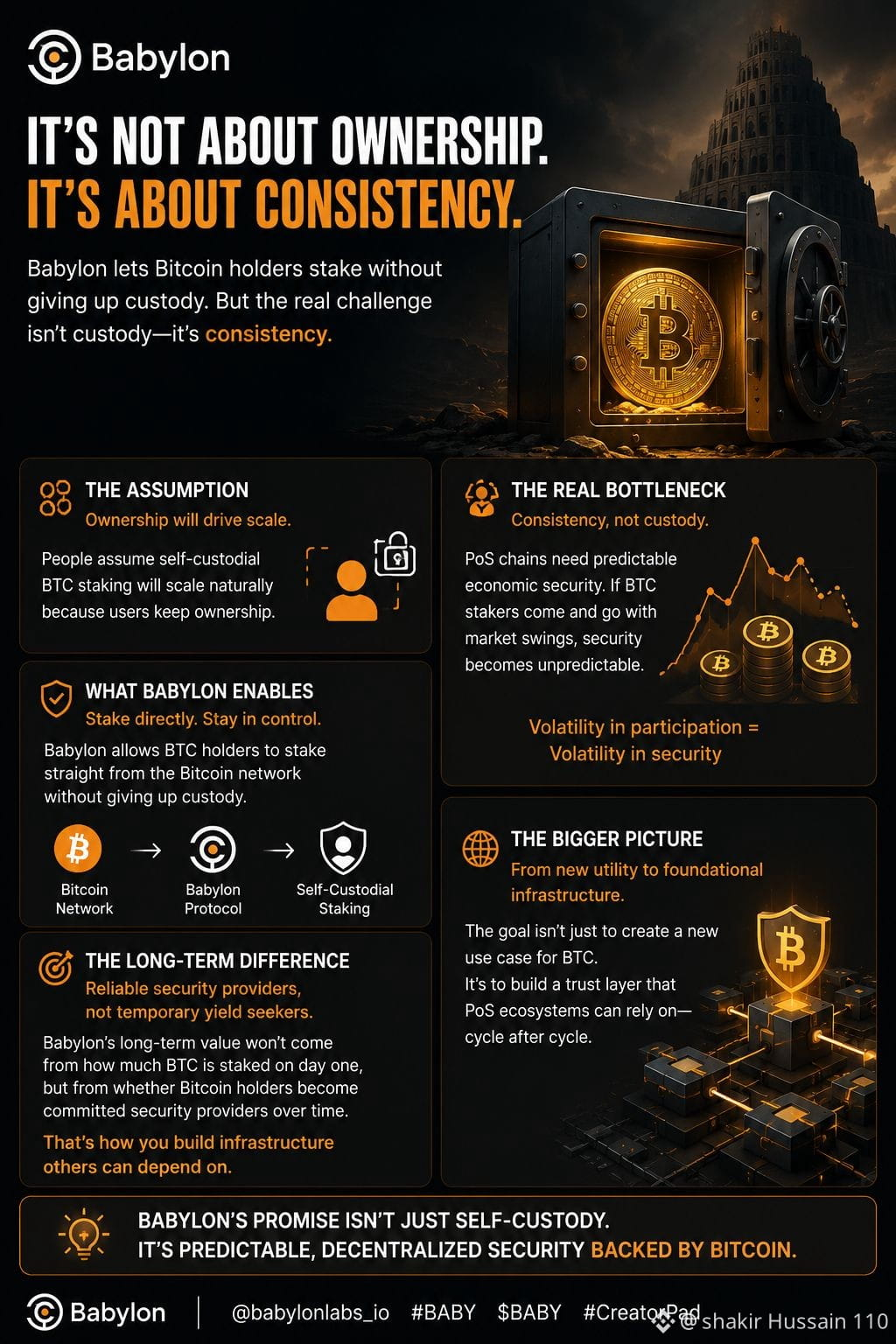
There's one assumption I think people are making too quickly about Babylon: that self-custodial BTC staking will scale naturally because it preserves Bitcoin ownership.
I don't think ownership is the bottleneck. Consistency is.
PoS blockchains depend on predictable economic security. That means they need BTC stakers who remain committed over time, not just during favorable market conditions. Babylon can let users stake directly from the Bitcoin network without giving up custody, but it can't force long-term participation.
If staking activity rises and falls with every BTC price swing, the security budget supporting PoS ecosystems becomes less predictable. That's a coordination challenge, not a custody challenge.
To me, Babylon's long-term value won't be determined by how much BTC is staked on day one. It will be determined by whether self-custodial Bitcoin holders become reliable security providers instead of temporary participants chasing yield.
That's the difference between creating a new Bitcoin utility and creating infrastructure that other blockchains can confidently depend on.
@babylonlabs_io #BABY $BABY #creatorpad #baby $BTC
{future}(BTCUSDT)
$XPL
{future}(XPLUSDT)
{future}(BABYUSDT)
There's one assumption I think people are making too quickly about Babylon: that self-custodial BTC staking will scale naturally because it preserves Bitcoin ownership.
I don't think ownership is the bottleneck. Consistency is.
PoS blockchains depend on predictable economic security. That means they need BTC stakers who remain committed over time, not just during favorable market conditions. Babylon can let users stake directly from the Bitcoin network without giving up custody, but it can't force long-term participation.
If staking activity rises and falls with every BTC price swing, the security budget supporting PoS ecosystems becomes less predictable. That's a coordination challenge, not a custody challenge.
To me, Babylon's long-term value won't be determined by how much BTC is staked on day one. It will be determined by whether self-custodial Bitcoin holders become reliable security providers instead of temporary participants chasing yield.
That's the difference between creating a new Bitcoin utility and creating infrastructure that other blockchains can confidently depend on.
@BabylonLabs_io #BABY $BABY #creatorpad #baby $BTC
$XPL
I don't think ownership is the bottleneck. Consistency is.
PoS blockchains depend on predictable economic security. That means they need BTC stakers who remain committed over time, not just during favorable market conditions. Babylon can let users stake directly from the Bitcoin network without giving up custody, but it can't force long-term participation.
If staking activity rises and falls with every BTC price swing, the security budget supporting PoS ecosystems becomes less predictable. That's a coordination challenge, not a custody challenge.
To me, Babylon's long-term value won't be determined by how much BTC is staked on day one. It will be determined by whether self-custodial Bitcoin holders become reliable security providers instead of temporary participants chasing yield.
That's the difference between creating a new Bitcoin utility and creating infrastructure that other blockchains can confidently depend on.
@BabylonLabs_io #BABY $BABY #creatorpad #baby $BTC
$XPL
5
2
165
Connectez-vous pour découvrir plus de contenu
Rejoignez la communauté mondiale des adeptes de cryptomonnaies sur Binance Square
⚡️ Suviez les dernières informations importantes sur les cryptomonnaies.
💬 Jugé digne de confiance par la plus grande plateforme d’échange de cryptomonnaies au monde.
👍 Découvrez les connaissances que partagent les créateurs vérifiés.
Adresse e-mail/Nº de téléphone
Sujets d’actualité
BitcoinClears$85200
7,994 vues
185 mentions
We got the move, and $BTC is standing exactly where we were before the data. That’s what actual patience for a trade looks like.
The data came in mixed but with some important numbers. ADP Non-Farm Employment Change came at 90K vs 73K forecast, while Core PCE came in at 0.2% vs 0.3% expected. Final GDP was also stronger at 2.2% vs 1.5% forecast, while Personal Spending came in at 0.9% vs 0.8% expected. At the same time, Personal Income missed at 0.2% vs 0.5% forecast.
BTC initially surged to $85,600 and is now back where it needs to be. I’m still looking toward the lower ranges at $82,759 and the $80,000 liquidity, because the overhead liquidity is done and dusted.
We had a live session during the data, and during that session we saw the market at $83,800, then $85,600, and then back toward $83,000 and we still didn’t enter a trade.
That’s what patience is.
We can’t force an entry when the market has no clear direction. The same range is still in focus, and we’ll wait for the market to give us the setup.
Let me know, guys, how was the session? And should we have more regular sessions with our respected members so we can have proper discussions regarding the market?
#BitcoinClears$85200 #AltcoinSeasonIndexHoldsAbove60For5Days #USADPAdds90000JobsInSeptember #BitcoinSlipsBelow$84000 #SECToClarifyOnChainFundraisingRules
Crypto_LUX
·24 mentions J’aime
·14.5k vues
AltcoinSeasonIndexHoldsAbove60For5Days
42,108 vues
1,016 mentions
USADPAdds90000JobsInSeptember
19,185 vues
575 mentions