

OUTLAWszn
952 Publications

OUTLAWszn
Signaler
Bloquer l’utilisateur
BP-9FA84B2EB21E
Ouvert au trading
Trade régulièrement
4.1 an(s)
60 Suivis
3.4K+ Abonnés
2.3K+ J’aime
Publications
Portefeuille
Tous
Citations
·
--
每次买卖都向比特币奖励池注入资金。只需持有b-money,BTC就会自动进入您的钱包——无需质押、无需领取、无需锁定期
CA (BSC):
0xf49725118cb0707b8706ffffe895f3ab16da7777
领取地址: 0x367C44a37B162305e62543A4b027b3260e149FD1
每次买卖都向比特币奖励池注入资金。只需持有b-money,BTC就会自动进入您的钱包——无需质押、无需领取、无需锁定期
CA (BSC):
0xf49725118cb0707b8706ffffe895f3ab16da7777
领取地址: 0x367C44a37B162305e62543A4b027b3260e149FD1
CA (BSC):
0xf49725118cb0707b8706ffffe895f3ab16da7777
领取地址: 0x367C44a37B162305e62543A4b027b3260e149FD1
91
·
--
最近看到一个很有意思的基础设施协议 @BNPaid ,正在把多链项目的营销预算直接打通进币安广场——让优质内容的创作者真正拿到链上结算激励。
打通多链预算与币安广场,把流量真正沉淀为生态流动性。
这才是创作者经济该有的样子。
协议合约:0x11dC0Fd5e2C9A4407fdb15aA6871501Ba9307777
创作者链上接收:0x367C44a37B162305e62543A4b027b3260e149FD1
最近看到一个很有意思的基础设施协议 @BNPaid ,正在把多链项目的营销预算直接打通进币安广场——让优质内容的创作者真正拿到链上结算激励。
打通多链预算与币安广场,把流量真正沉淀为生态流动性。
这才是创作者经济该有的样子。
协议合约:0x11dC0Fd5e2C9A4407fdb15aA6871501Ba9307777
创作者链上接收:0x367C44a37B162305e62543A4b027b3260e149FD1
打通多链预算与币安广场,把流量真正沉淀为生态流动性。
这才是创作者经济该有的样子。
协议合约:0x11dC0Fd5e2C9A4407fdb15aA6871501Ba9307777
创作者链上接收:0x367C44a37B162305e62543A4b027b3260e149FD1
1
113
·
--
Recently discovered an interesting infrastructure protocol, @BNPaid. It directly routes multi-chain projects’ marketing budgets into Binance Square, so that creators of high-quality content can genuinely receive on-chain settlement incentives.
Connect multi-chain budgets with Binance Square, so that traffic truly converts into liquidity within the ecosystem.
This is what the creator economy should look like.
Protocol contract address: 0x11dC0Fd5e2C9A4407fdb15aA6871501Ba9307777
Creator on-chain receiving address: 0x367c44a37b162305e62543a4b027b3260e149fd1
Recently discovered an interesting infrastructure protocol, @BNPaid. It directly routes multi-chain projects’ marketing budgets into Binance Square, so that creators of high-quality content can genuinely receive on-chain settlement incentives.
Connect multi-chain budgets with Binance Square, so that traffic truly converts into liquidity within the ecosystem.
This is what the creator economy should look like.
Protocol contract address: 0x11dC0Fd5e2C9A4407fdb15aA6871501Ba9307777
Creator on-chain receiving address: 0x367c44a37b162305e62543a4b027b3260e149fd1
Connect multi-chain budgets with Binance Square, so that traffic truly converts into liquidity within the ecosystem.
This is what the creator economy should look like.
Protocol contract address: 0x11dC0Fd5e2C9A4407fdb15aA6871501Ba9307777
Creator on-chain receiving address: 0x367c44a37b162305e62543a4b027b3260e149fd1
1
135
·
--
最近看到一个很有意思的基础设施协议 @BNPaid ,正在把多链项目的营销预算直接打通进币安广场——让优质内容的创作者真正拿到链上结算激励。
打通多链预算与币安广场,把流量真正沉淀为生态流动性。
这才是创作者经济该有的样子。
协议合约:0x11dC0Fd5e2C9A4407fdb15aA6871501Ba9307777
创作者链上接收:0x367C44a37B162305e62543A4b027b3260e149FD1
最近看到一个很有意思的基础设施协议 @BNPaid ,正在把多链项目的营销预算直接打通进币安广场——让优质内容的创作者真正拿到链上结算激励。
打通多链预算与币安广场,把流量真正沉淀为生态流动性。
这才是创作者经济该有的样子。
协议合约:0x11dC0Fd5e2C9A4407fdb15aA6871501Ba9307777
创作者链上接收:0x367C44a37B162305e62543A4b027b3260e149FD1
打通多链预算与币安广场,把流量真正沉淀为生态流动性。
这才是创作者经济该有的样子。
协议合约:0x11dC0Fd5e2C9A4407fdb15aA6871501Ba9307777
创作者链上接收:0x367C44a37B162305e62543A4b027b3260e149FD1
90
·
--
BNPAID BOUNTY IS LIVE
Post on Binance Square and you can claim a BNPaid bounty.
Website: https://bnbpaid.tech
CA (BSC):
0x11dC0Fd5e2C9A4407fdb15aA6871501Ba9307777
Payout address: 0x367c44a37b162305e62543a4b027b3260e149fd1
BNPAID BOUNTY IS LIVE
Post on Binance Square and you can claim a BNPaid bounty.
Website: https://bnbpaid.tech
CA (BSC):
0x11dC0Fd5e2C9A4407fdb15aA6871501Ba9307777
Payout address: 0x367c44a37b162305e62543a4b027b3260e149fd1
Post on Binance Square and you can claim a BNPaid bounty.
Website: https://bnbpaid.tech
CA (BSC):
0x11dC0Fd5e2C9A4407fdb15aA6871501Ba9307777
Payout address: 0x367c44a37b162305e62543a4b027b3260e149fd1
1
94
·
--
Haussier
$BERA 1h Setup Still Favors Buyers Above Key Support
LIMIT ORDER
$BERA LONG BUY
ENTRY: 0.1663–0.1656
TP1: 0.1722
TP2: 0.1746
TP3: 0.1805
SL: Beyond the last swing low
Market Outlook (1h)
$BERA 1h structure favors a bullish counter-trend bounce, aligned with the daily timeframe and BTC while the weekly structure remains bearish. The preferred long entry is a dip into 0.1663–0.1656 after a liquidity sweep, confirmed by a bullish engulfing candle, pin bar, or lower timeframe market structure shift. Upside targets are 0.1722, 0.1746, and 0.1805 if continuation holds.
{future}(BERAUSDT)
$BERA 1h Setup Still Favors Buyers Above Key Support
LIMIT ORDER
$BERA LONG BUY
ENTRY: 0.1663–0.1656
TP1: 0.1722
TP2: 0.1746
TP3: 0.1805
SL: Beyond the last swing low
Market Outlook (1h)
$BERA 1h structure favors a bullish counter-trend bounce, aligned with the daily timeframe and BTC while the weekly structure remains bearish. The preferred long entry is a dip into 0.1663–0.1656 after a liquidity sweep, confirmed by a bullish engulfing candle, pin bar, or lower timeframe market structure shift. Upside targets are 0.1722, 0.1746, and 0.1805 if continuation holds.
LIMIT ORDER
$BERA LONG BUY
ENTRY: 0.1663–0.1656
TP1: 0.1722
TP2: 0.1746
TP3: 0.1805
SL: Beyond the last swing low
Market Outlook (1h)
$BERA 1h structure favors a bullish counter-trend bounce, aligned with the daily timeframe and BTC while the weekly structure remains bearish. The preferred long entry is a dip into 0.1663–0.1656 after a liquidity sweep, confirmed by a bullish engulfing candle, pin bar, or lower timeframe market structure shift. Upside targets are 0.1722, 0.1746, and 0.1805 if continuation holds.
1
1
543
·
--
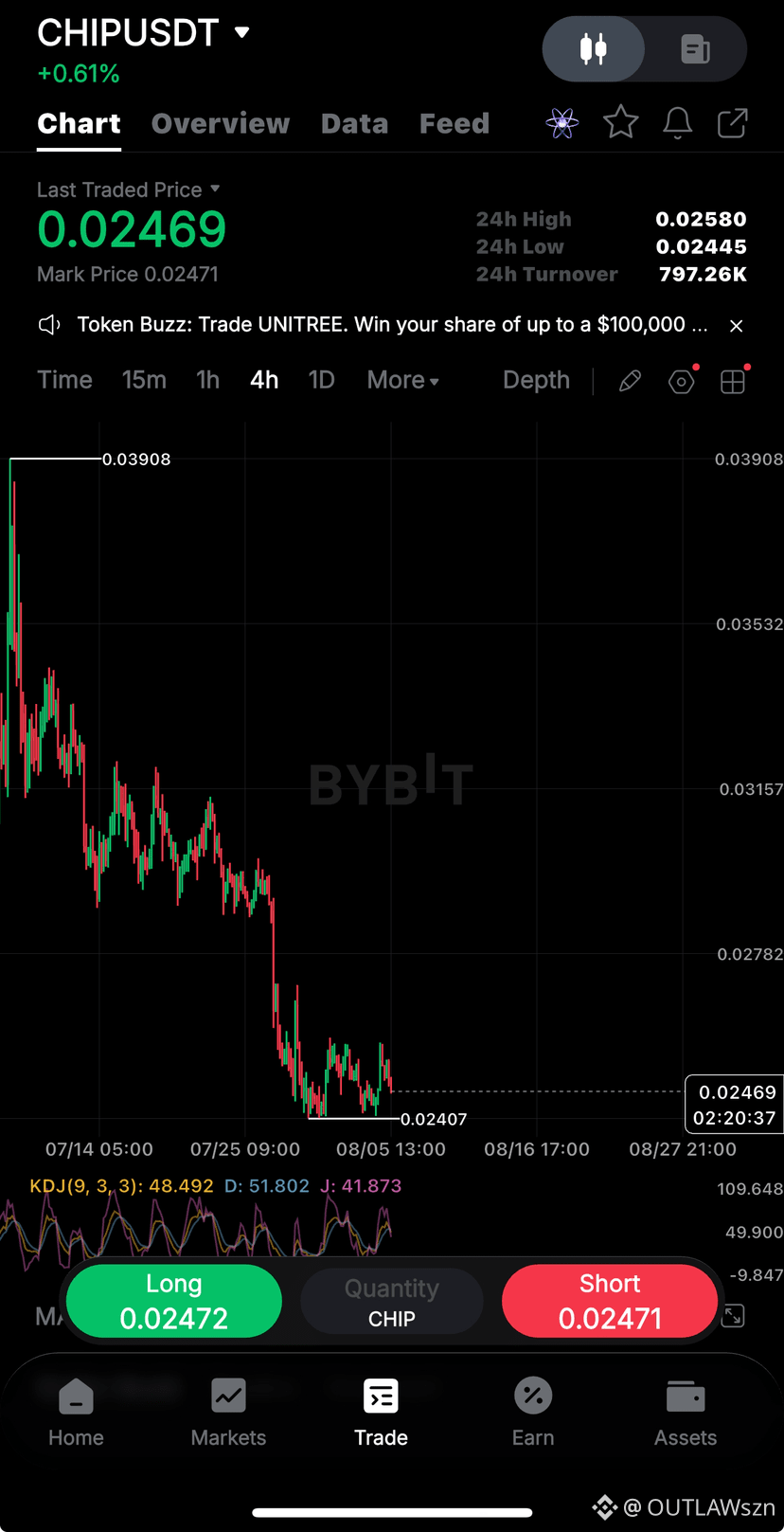
$CHIP is sitting at a critical 4H support zone. While the broader trend remains bearish, buyers have a chance to trigger a relief rally if 0.02410 continues to hold.
$CHIP - LONG
Trade Plan:
* Entry: 0.02410 - 0.02416 (on bullish confirmation)
* SL: Below 0.02410 or the most recent swing low
* TP1: 0.02498
* TP2: 0.02595
* TP3: 0.02641
* Extended Target: 0.02680 if bullish momentum strengthens
Why this setup?
The current outlook is LONG with 76% confidence. Although the higher timeframe trend remains bearish, price is consolidating around the 0.02410 to 0.02416 demand zone, where buyers have an opportunity to defend support and trigger a corrective bounce.
$CHIP is sitting at a critical 4H support zone. While the broader trend remains bearish, buyers have a chance to trigger a relief rally if 0.02410 continues to hold.
$CHIP - LONG
Trade Plan:
* Entry: 0.02410 - 0.02416 (on bullish confirmation)
* SL: Below 0.02410 or the most recent swing low
* TP1: 0.02498
* TP2: 0.02595
* TP3: 0.02641
* Extended Target: 0.02680 if bullish momentum strengthens
Why this setup?
The current outlook is LONG with 76% confidence. Although the higher timeframe trend remains bearish, price is consolidating around the 0.02410 to 0.02416 demand zone, where buyers have an opportunity to defend support and trigger a corrective bounce.
$CHIP - LONG
Trade Plan:
* Entry: 0.02410 - 0.02416 (on bullish confirmation)
* SL: Below 0.02410 or the most recent swing low
* TP1: 0.02498
* TP2: 0.02595
* TP3: 0.02641
* Extended Target: 0.02680 if bullish momentum strengthens
Why this setup?
The current outlook is LONG with 76% confidence. Although the higher timeframe trend remains bearish, price is consolidating around the 0.02410 to 0.02416 demand zone, where buyers have an opportunity to defend support and trigger a corrective bounce.
606
·
--
Haussier
$ADA continues to hold a constructive 1H structure, with buyers defending key demand. As long as support remains intact, pullbacks offer a favorable opportunity to position for another leg higher.
$ADA - LONG
Trade Plan:
* Entry: 0.19220 - 0.18960 (on bullish confirmation)
* SL: Below 0.18960 or the most recent swing low
* TP1: 0.19850
* TP2: 0.20020
* TP3: 0.20590
Why this setup?
$ADA current outlook is LONG with 82% confidence. The 1H trend remains bullish, with price continuing to respect the 0.19220 to 0.18960 demand zone. Instead of chasing price higher, the preferred approach is to wait for a controlled pullback into support before looking for confirmation that buyers are stepping back in.
{future}(ADAUSDT)
$ADA continues to hold a constructive 1H structure, with buyers defending key demand. As long as support remains intact, pullbacks offer a favorable opportunity to position for another leg higher.
$ADA - LONG
Trade Plan:
* Entry: 0.19220 - 0.18960 (on bullish confirmation)
* SL: Below 0.18960 or the most recent swing low
* TP1: 0.19850
* TP2: 0.20020
* TP3: 0.20590
Why this setup?
$ADA current outlook is LONG with 82% confidence. The 1H trend remains bullish, with price continuing to respect the 0.19220 to 0.18960 demand zone. Instead of chasing price higher, the preferred approach is to wait for a controlled pullback into support before looking for confirmation that buyers are stepping back in.
$ADA - LONG
Trade Plan:
* Entry: 0.19220 - 0.18960 (on bullish confirmation)
* SL: Below 0.18960 or the most recent swing low
* TP1: 0.19850
* TP2: 0.20020
* TP3: 0.20590
Why this setup?
$ADA current outlook is LONG with 82% confidence. The 1H trend remains bullish, with price continuing to respect the 0.19220 to 0.18960 demand zone. Instead of chasing price higher, the preferred approach is to wait for a controlled pullback into support before looking for confirmation that buyers are stepping back in.
325
·
--
Haussier
$RAVE is holding above a key 4H support zone, keeping the broader structure in favor of buyers. As long as 0.274 remains intact, pullbacks continue to offer the highest-probability long opportunities.
$RAVE - LONG
Trade Plan:
* Entry: 0.27400 - 0.27600 (on bullish confirmation)
* SL: Below 0.27400
* TP1: 0.29100
* TP2: 0.29500
* TP3: 0.29700
* Extended Target: 0.33000 if bullish momentum expands
Why this setup?
The current outlook is LONG with 82% confidence. The 4H trend remains constructive while 0.27400 continues to hold as the primary support level. Rather than chasing strength, the preferred strategy is to wait for either a liquidity sweep into the 0.27400 to 0.27600 demand zone or a confirmed breakout and successful retest above 0.29100.
The highest-conviction confirmation signals include a bullish engulfing candle, pin bar, manipulation wick below support followed by an immediate reclaim, bullish order block reclaim, or a lower timeframe break of market structure. These patterns suggest buyers are defending demand and increase the probability of continuation.
$RAVE first upside objective is 0.29100, followed by 0.29500, where partial profit-taking is reasonable. A decisive break above those resistance levels would expose 0.29700, while sustained buying momentum could extend the move toward 0.33000. Scaling out at each target while trailing the remaining position allows participation if the trend accelerates.
{future}(RAVEUSDT)
$RAVE is holding above a key 4H support zone, keeping the broader structure in favor of buyers. As long as 0.274 remains intact, pullbacks continue to offer the highest-probability long opportunities.
$RAVE - LONG
Trade Plan:
* Entry: 0.27400 - 0.27600 (on bullish confirmation)
* SL: Below 0.27400
* TP1: 0.29100
* TP2: 0.29500
* TP3: 0.29700
* Extended Target: 0.33000 if bullish momentum expands
Why this setup?
The current outlook is LONG with 82% confidence. The 4H trend remains constructive while 0.27400 continues to hold as the primary support level. Rather than chasing strength, the preferred strategy is to wait for either a liquidity sweep into the 0.27400 to 0.27600 demand zone or a confirmed breakout and successful retest above 0.29100.
The highest-conviction confirmation signals include a bullish engulfing candle, pin bar, manipulation wick below support followed by an immediate reclaim, bullish order block reclaim, or a lower timeframe break of market structure. These patterns suggest buyers are defending demand and increase the probability of continuation.
$RAVE first upside objective is 0.29100, followed by 0.29500, where partial profit-taking is reasonable. A decisive break above those resistance levels would expose 0.29700, while sustained buying momentum could extend the move toward 0.33000. Scaling out at each target while trailing the remaining position allows participation if the trend accelerates.
$RAVE - LONG
Trade Plan:
* Entry: 0.27400 - 0.27600 (on bullish confirmation)
* SL: Below 0.27400
* TP1: 0.29100
* TP2: 0.29500
* TP3: 0.29700
* Extended Target: 0.33000 if bullish momentum expands
Why this setup?
The current outlook is LONG with 82% confidence. The 4H trend remains constructive while 0.27400 continues to hold as the primary support level. Rather than chasing strength, the preferred strategy is to wait for either a liquidity sweep into the 0.27400 to 0.27600 demand zone or a confirmed breakout and successful retest above 0.29100.
The highest-conviction confirmation signals include a bullish engulfing candle, pin bar, manipulation wick below support followed by an immediate reclaim, bullish order block reclaim, or a lower timeframe break of market structure. These patterns suggest buyers are defending demand and increase the probability of continuation.
$RAVE first upside objective is 0.29100, followed by 0.29500, where partial profit-taking is reasonable. A decisive break above those resistance levels would expose 0.29700, while sustained buying momentum could extend the move toward 0.33000. Scaling out at each target while trailing the remaining position allows participation if the trend accelerates.
667
·
--
Haussier
$XAN looks extended after its recent rally, making a healthy pullback into support the higher-probability setup before buyers attempt another push higher. Patience for confirmation is key.
$XAN - LONG
Trade Plan:
* Entry: 0.01298 - 0.01250 (on bullish confirmation)
* SL: Below 0.01188
* TP1: 0.01420
* TP2: 0.01519
* TP3: 0.01599
Why this setup?
The current outlook is LONG with 79% confidence. Although the short-term expectation is for a pullback, the broader 1H structure remains constructive. Rather than chasing the rally, the preferred strategy is to let price retrace into the 0.01298 to 0.01250 fair value gap and support cluster before looking for evidence that buyers are stepping back in.
The highest-conviction confirmation signals include a bullish engulfing candle, pin bar, liquidity sweep with an immediate reclaim, quasimodo pattern, or a lower timeframe break of market structure. These signals indicate the pullback may be complete and increase the probability of continuation.
$XAN first upside objective is 0.01420, which marks the nearest resistance and an ideal area for partial profit-taking. A sustained breakout above that level would expose 0.01519, with 0.01599 acting as the next major upside target if momentum remains strong. Scaling out at each resistance while trailing the remaining position provides a balanced trade management approach.
{future}(XANUSDT)
$XAN looks extended after its recent rally, making a healthy pullback into support the higher-probability setup before buyers attempt another push higher. Patience for confirmation is key.
$XAN - LONG
Trade Plan:
* Entry: 0.01298 - 0.01250 (on bullish confirmation)
* SL: Below 0.01188
* TP1: 0.01420
* TP2: 0.01519
* TP3: 0.01599
Why this setup?
The current outlook is LONG with 79% confidence. Although the short-term expectation is for a pullback, the broader 1H structure remains constructive. Rather than chasing the rally, the preferred strategy is to let price retrace into the 0.01298 to 0.01250 fair value gap and support cluster before looking for evidence that buyers are stepping back in.
The highest-conviction confirmation signals include a bullish engulfing candle, pin bar, liquidity sweep with an immediate reclaim, quasimodo pattern, or a lower timeframe break of market structure. These signals indicate the pullback may be complete and increase the probability of continuation.
$XAN first upside objective is 0.01420, which marks the nearest resistance and an ideal area for partial profit-taking. A sustained breakout above that level would expose 0.01519, with 0.01599 acting as the next major upside target if momentum remains strong. Scaling out at each resistance while trailing the remaining position provides a balanced trade management approach.
$XAN - LONG
Trade Plan:
* Entry: 0.01298 - 0.01250 (on bullish confirmation)
* SL: Below 0.01188
* TP1: 0.01420
* TP2: 0.01519
* TP3: 0.01599
Why this setup?
The current outlook is LONG with 79% confidence. Although the short-term expectation is for a pullback, the broader 1H structure remains constructive. Rather than chasing the rally, the preferred strategy is to let price retrace into the 0.01298 to 0.01250 fair value gap and support cluster before looking for evidence that buyers are stepping back in.
The highest-conviction confirmation signals include a bullish engulfing candle, pin bar, liquidity sweep with an immediate reclaim, quasimodo pattern, or a lower timeframe break of market structure. These signals indicate the pullback may be complete and increase the probability of continuation.
$XAN first upside objective is 0.01420, which marks the nearest resistance and an ideal area for partial profit-taking. A sustained breakout above that level would expose 0.01519, with 0.01599 acting as the next major upside target if momentum remains strong. Scaling out at each resistance while trailing the remaining position provides a balanced trade management approach.
197
·
--
Haussier
$VANRY is attempting to build a base on the 15M, with buyers defending the recent swing low. As long as support holds, the setup favors a tactical bounce rather than trend continuation lower.
$VANRY - LONG
Trade Plan:
* Entry: 0.005048 - 0.004964 (on bullish confirmation)
* SL: Below 0.004854
* TP1: 0.005256
* TP2: 0.005412
* TP3: Trail above 0.005412 if bullish momentum strengthens
Why this setup?
The current outlook is LONG with 78% confidence. The 15M structure suggests buyers are attempting to defend the 0.004964 support area after price reacted from the recent low. This favors a short-term recovery, provided demand continues to absorb selling pressure.
The preferred entry is either on a successful reclaim of 0.005048 with strong momentum or after a liquidity sweep below 0.004964 followed by an immediate rejection. The highest-conviction confirmation signals include a bullish engulfing candle, pin bar, or a lower timeframe break of market structure from the 0.004964 to 0.004854 demand zone.
$VANRY first upside objective is 0.005256, which aligns with the nearest supply and fair value gap. If buyers maintain control, the move could extend toward 0.005412. A strong breakout above that resistance would justify trailing the remaining position in anticipation of further upside.
The bullish thesis is invalidated by a decisive close below 0.004854 with expanding selling volume. That would signal a failure of the current demand zone and shift the short-term bias back to SHORT, exposing 0.004508 as the next downside objective.
{future}(VANRYUSDT)
$VANRY is attempting to build a base on the 15M, with buyers defending the recent swing low. As long as support holds, the setup favors a tactical bounce rather than trend continuation lower.
$VANRY - LONG
Trade Plan:
* Entry: 0.005048 - 0.004964 (on bullish confirmation)
* SL: Below 0.004854
* TP1: 0.005256
* TP2: 0.005412
* TP3: Trail above 0.005412 if bullish momentum strengthens
Why this setup?
The current outlook is LONG with 78% confidence. The 15M structure suggests buyers are attempting to defend the 0.004964 support area after price reacted from the recent low. This favors a short-term recovery, provided demand continues to absorb selling pressure.
The preferred entry is either on a successful reclaim of 0.005048 with strong momentum or after a liquidity sweep below 0.004964 followed by an immediate rejection. The highest-conviction confirmation signals include a bullish engulfing candle, pin bar, or a lower timeframe break of market structure from the 0.004964 to 0.004854 demand zone.
$VANRY first upside objective is 0.005256, which aligns with the nearest supply and fair value gap. If buyers maintain control, the move could extend toward 0.005412. A strong breakout above that resistance would justify trailing the remaining position in anticipation of further upside.
The bullish thesis is invalidated by a decisive close below 0.004854 with expanding selling volume. That would signal a failure of the current demand zone and shift the short-term bias back to SHORT, exposing 0.004508 as the next downside objective.
$VANRY - LONG
Trade Plan:
* Entry: 0.005048 - 0.004964 (on bullish confirmation)
* SL: Below 0.004854
* TP1: 0.005256
* TP2: 0.005412
* TP3: Trail above 0.005412 if bullish momentum strengthens
Why this setup?
The current outlook is LONG with 78% confidence. The 15M structure suggests buyers are attempting to defend the 0.004964 support area after price reacted from the recent low. This favors a short-term recovery, provided demand continues to absorb selling pressure.
The preferred entry is either on a successful reclaim of 0.005048 with strong momentum or after a liquidity sweep below 0.004964 followed by an immediate rejection. The highest-conviction confirmation signals include a bullish engulfing candle, pin bar, or a lower timeframe break of market structure from the 0.004964 to 0.004854 demand zone.
$VANRY first upside objective is 0.005256, which aligns with the nearest supply and fair value gap. If buyers maintain control, the move could extend toward 0.005412. A strong breakout above that resistance would justify trailing the remaining position in anticipation of further upside.
The bullish thesis is invalidated by a decisive close below 0.004854 with expanding selling volume. That would signal a failure of the current demand zone and shift the short-term bias back to SHORT, exposing 0.004508 as the next downside objective.
192
·
--
Baissier
$JCT remains under firm selling pressure on the 1H, with momentum and market structure continuing to favor the bears. Until resistance is reclaimed, rallies are more likely to be opportunities to sell than buy.
$JCT - SHORT
Trade Plan:
* Entry: 0.0041130 - 0.0042210 (after bearish confirmation)
* SL: Above the most recent swing high or above 0.0042210
* TP1: 0.0040105
* TP2: 0.0039679
* TP3: Trail below 0.0039679 if bearish momentum accelerates
Why this setup?
The current outlook is SHORT with 84% confidence. The 1H trend remains decisively bearish, with momentum indicators and price structure aligned to the downside. Rather than entering after an extended decline, the preferred strategy is to wait for a relief rally into the 0.0041130 to 0.0042210 resistance zone and look for confirmation that sellers are defending it.
$JCT strongest confirmation signals include a bearish engulfing candle, rejection wick, lower timeframe break of market structure, or the formation of a lower high after testing resistance. These signals improve the probability that the downtrend is ready to continue.
The first downside objective is 0.0040105, which marks the nearest demand zone and a logical area to secure partial profits. If selling pressure remains strong, the move could extend toward 0.0039679. A decisive break below that support could justify trailing the remaining position for further downside.
{future}(JCTUSDT)
$JCT remains under firm selling pressure on the 1H, with momentum and market structure continuing to favor the bears. Until resistance is reclaimed, rallies are more likely to be opportunities to sell than buy.
$JCT - SHORT
Trade Plan:
* Entry: 0.0041130 - 0.0042210 (after bearish confirmation)
* SL: Above the most recent swing high or above 0.0042210
* TP1: 0.0040105
* TP2: 0.0039679
* TP3: Trail below 0.0039679 if bearish momentum accelerates
Why this setup?
The current outlook is SHORT with 84% confidence. The 1H trend remains decisively bearish, with momentum indicators and price structure aligned to the downside. Rather than entering after an extended decline, the preferred strategy is to wait for a relief rally into the 0.0041130 to 0.0042210 resistance zone and look for confirmation that sellers are defending it.
$JCT strongest confirmation signals include a bearish engulfing candle, rejection wick, lower timeframe break of market structure, or the formation of a lower high after testing resistance. These signals improve the probability that the downtrend is ready to continue.
The first downside objective is 0.0040105, which marks the nearest demand zone and a logical area to secure partial profits. If selling pressure remains strong, the move could extend toward 0.0039679. A decisive break below that support could justify trailing the remaining position for further downside.
$JCT - SHORT
Trade Plan:
* Entry: 0.0041130 - 0.0042210 (after bearish confirmation)
* SL: Above the most recent swing high or above 0.0042210
* TP1: 0.0040105
* TP2: 0.0039679
* TP3: Trail below 0.0039679 if bearish momentum accelerates
Why this setup?
The current outlook is SHORT with 84% confidence. The 1H trend remains decisively bearish, with momentum indicators and price structure aligned to the downside. Rather than entering after an extended decline, the preferred strategy is to wait for a relief rally into the 0.0041130 to 0.0042210 resistance zone and look for confirmation that sellers are defending it.
$JCT strongest confirmation signals include a bearish engulfing candle, rejection wick, lower timeframe break of market structure, or the formation of a lower high after testing resistance. These signals improve the probability that the downtrend is ready to continue.
The first downside objective is 0.0040105, which marks the nearest demand zone and a logical area to secure partial profits. If selling pressure remains strong, the move could extend toward 0.0039679. A decisive break below that support could justify trailing the remaining position for further downside.
156
·
--
Baissier
$SPCX is showing signs of continued weakness on the 1H, with market structure favoring sellers. Unless buyers reclaim key resistance, the path of least resistance remains to the downside.
$SPCX - SHORT
Trade Plan:
* Entry: 124.98 - 126.43 (after bearish confirmation)
* SL: Above 128.45 or the most recent swing high
* TP1: 122.07
* TP2: 116.05
* TP3: Trail below 116.05 if bearish momentum strengthens
Why this setup?
The current outlook is SHORT with 81% confidence. The 1H structure continues to print lower highs, while momentum and trend indicators remain aligned in favor of sellers. Rather than chasing the decline, the preferred strategy is to wait for either a relief rally into resistance or a confirmed breakdown below support before entering.
The highest-conviction setup comes from a rejection around the 124.98 to 126.43 area, confirmed by a bearish engulfing candle, rejection wick, or a lower timeframe break of market structure. A decisive break below 124.98 followed by a failed retest would also strengthen the bearish case.
$SPCX first downside objective is 122.07, where short-term buyers may attempt to defend. If selling pressure continues to build, the move could extend toward 116.05, making it the next major target. Scaling out at key support levels while trailing the remaining position provides flexibility if momentum accelerates.
The bearish thesis is invalidated by a decisive 1H close above 128.45 supported by strong buying volume and a sequence of higher highs and higher lows. That would shift the bias to LONG and bring 129.52 and 137.78 into focus as the next upside objectives.
{future}(SPCXUSDT)
$SPCX is showing signs of continued weakness on the 1H, with market structure favoring sellers. Unless buyers reclaim key resistance, the path of least resistance remains to the downside.
$SPCX - SHORT
Trade Plan:
* Entry: 124.98 - 126.43 (after bearish confirmation)
* SL: Above 128.45 or the most recent swing high
* TP1: 122.07
* TP2: 116.05
* TP3: Trail below 116.05 if bearish momentum strengthens
Why this setup?
The current outlook is SHORT with 81% confidence. The 1H structure continues to print lower highs, while momentum and trend indicators remain aligned in favor of sellers. Rather than chasing the decline, the preferred strategy is to wait for either a relief rally into resistance or a confirmed breakdown below support before entering.
The highest-conviction setup comes from a rejection around the 124.98 to 126.43 area, confirmed by a bearish engulfing candle, rejection wick, or a lower timeframe break of market structure. A decisive break below 124.98 followed by a failed retest would also strengthen the bearish case.
$SPCX first downside objective is 122.07, where short-term buyers may attempt to defend. If selling pressure continues to build, the move could extend toward 116.05, making it the next major target. Scaling out at key support levels while trailing the remaining position provides flexibility if momentum accelerates.
The bearish thesis is invalidated by a decisive 1H close above 128.45 supported by strong buying volume and a sequence of higher highs and higher lows. That would shift the bias to LONG and bring 129.52 and 137.78 into focus as the next upside objectives.
$SPCX - SHORT
Trade Plan:
* Entry: 124.98 - 126.43 (after bearish confirmation)
* SL: Above 128.45 or the most recent swing high
* TP1: 122.07
* TP2: 116.05
* TP3: Trail below 116.05 if bearish momentum strengthens
Why this setup?
The current outlook is SHORT with 81% confidence. The 1H structure continues to print lower highs, while momentum and trend indicators remain aligned in favor of sellers. Rather than chasing the decline, the preferred strategy is to wait for either a relief rally into resistance or a confirmed breakdown below support before entering.
The highest-conviction setup comes from a rejection around the 124.98 to 126.43 area, confirmed by a bearish engulfing candle, rejection wick, or a lower timeframe break of market structure. A decisive break below 124.98 followed by a failed retest would also strengthen the bearish case.
$SPCX first downside objective is 122.07, where short-term buyers may attempt to defend. If selling pressure continues to build, the move could extend toward 116.05, making it the next major target. Scaling out at key support levels while trailing the remaining position provides flexibility if momentum accelerates.
The bearish thesis is invalidated by a decisive 1H close above 128.45 supported by strong buying volume and a sequence of higher highs and higher lows. That would shift the bias to LONG and bring 129.52 and 137.78 into focus as the next upside objectives.
226
·
--
Haussier
$BANK remains in a powerful uptrend on the 12H, but chasing a parabolic move rarely offers the best risk-to-reward. The higher-probability setup is to wait for a healthy pullback into demand before looking for continuation.
$BANK - LONG
Trade Plan:
* Entry: 0.18660 - 0.21080 (primary demand) or 0.12760 - 0.16300 (deep pullback)
* SL: Below the most recent swing low or below 0.12760, depending on entry
* TP1: 0.27100
* TP2: Trail above 0.27100 if momentum remains strong
* TP3: Hold a runner for further upside if the trend continues to expand
Why this setup?
The current outlook is LONG with 84% confidence. The 12H trend remains firmly bullish, supported by strong momentum and a sequence of higher highs and higher lows. However, the recent parabolic advance increases the likelihood of a retracement or period of consolidation before the next impulsive move.
$BANK preferred strategy is to let price retrace into the 0.18660 to 0.21080 imbalance zone, where buyers may look to defend the trend. If selling pressure deepens, the 0.12760 to 0.16300 demand zone becomes the next high-probability accumulation area. Confirmation should come from a bullish engulfing candle, strong rejection wick, liquidity sweep followed by an immediate reclaim, or a lower timeframe break of market structure.
The initial upside objective is 0.27100, where partial profit-taking is prudent. A decisive break above that level with expanding volume would support trailing the remaining position for additional gains as the trend develops.
{future}(BANKUSDT)
$BANK remains in a powerful uptrend on the 12H, but chasing a parabolic move rarely offers the best risk-to-reward. The higher-probability setup is to wait for a healthy pullback into demand before looking for continuation.
$BANK - LONG
Trade Plan:
* Entry: 0.18660 - 0.21080 (primary demand) or 0.12760 - 0.16300 (deep pullback)
* SL: Below the most recent swing low or below 0.12760, depending on entry
* TP1: 0.27100
* TP2: Trail above 0.27100 if momentum remains strong
* TP3: Hold a runner for further upside if the trend continues to expand
Why this setup?
The current outlook is LONG with 84% confidence. The 12H trend remains firmly bullish, supported by strong momentum and a sequence of higher highs and higher lows. However, the recent parabolic advance increases the likelihood of a retracement or period of consolidation before the next impulsive move.
$BANK preferred strategy is to let price retrace into the 0.18660 to 0.21080 imbalance zone, where buyers may look to defend the trend. If selling pressure deepens, the 0.12760 to 0.16300 demand zone becomes the next high-probability accumulation area. Confirmation should come from a bullish engulfing candle, strong rejection wick, liquidity sweep followed by an immediate reclaim, or a lower timeframe break of market structure.
The initial upside objective is 0.27100, where partial profit-taking is prudent. A decisive break above that level with expanding volume would support trailing the remaining position for additional gains as the trend develops.
$BANK - LONG
Trade Plan:
* Entry: 0.18660 - 0.21080 (primary demand) or 0.12760 - 0.16300 (deep pullback)
* SL: Below the most recent swing low or below 0.12760, depending on entry
* TP1: 0.27100
* TP2: Trail above 0.27100 if momentum remains strong
* TP3: Hold a runner for further upside if the trend continues to expand
Why this setup?
The current outlook is LONG with 84% confidence. The 12H trend remains firmly bullish, supported by strong momentum and a sequence of higher highs and higher lows. However, the recent parabolic advance increases the likelihood of a retracement or period of consolidation before the next impulsive move.
$BANK preferred strategy is to let price retrace into the 0.18660 to 0.21080 imbalance zone, where buyers may look to defend the trend. If selling pressure deepens, the 0.12760 to 0.16300 demand zone becomes the next high-probability accumulation area. Confirmation should come from a bullish engulfing candle, strong rejection wick, liquidity sweep followed by an immediate reclaim, or a lower timeframe break of market structure.
The initial upside objective is 0.27100, where partial profit-taking is prudent. A decisive break above that level with expanding volume would support trailing the remaining position for additional gains as the trend develops.
298
·
--
Baissier
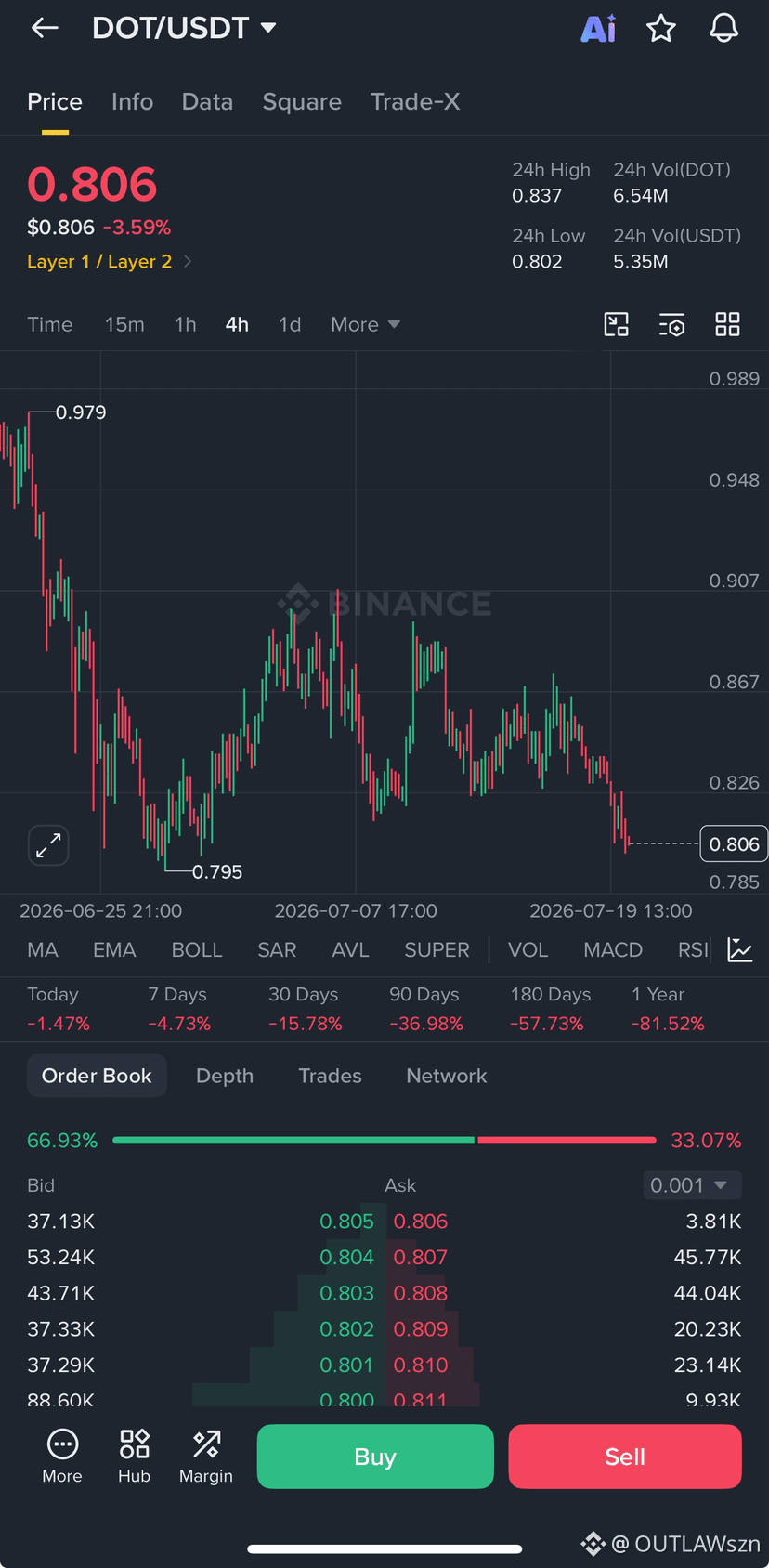
$DOT continues to trade within a bearish 1H structure, with sellers maintaining control below key resistance. Until buyers reclaim higher levels, relief rallies are more likely to be selling opportunities than trend reversals.
$DOT - SHORT
Trade Plan:
* Entry: 0.81500 - 0.82500 (after bearish confirmation)
* SL: Above 0.82500 or the most recent swing high
* TP1: 0.80000
* TP2: 0.79500
* TP3: Trail below 0.79500 if bearish momentum accelerates
Why this setup?
The current outlook is SHORT with 82% confidence. The 1H trend remains bearish, with momentum and market structure favoring sellers. The preferred approach is to wait for a relief rally into the 0.81500 to 0.82500 resistance zone and look for confirmation before entering.
$DOT highest-conviction signals include a bearish engulfing candle, rejection wick, lower timeframe break of market structure, or a failed breakout above 0.82100 that quickly reverses. These patterns suggest sellers are defending resistance and improve the probability of continuation toward lower support.
{future}(DOTUSDT)
$DOT continues to trade within a bearish 1H structure, with sellers maintaining control below key resistance. Until buyers reclaim higher levels, relief rallies are more likely to be selling opportunities than trend reversals.
$DOT - SHORT
Trade Plan:
* Entry: 0.81500 - 0.82500 (after bearish confirmation)
* SL: Above 0.82500 or the most recent swing high
* TP1: 0.80000
* TP2: 0.79500
* TP3: Trail below 0.79500 if bearish momentum accelerates
Why this setup?
The current outlook is SHORT with 82% confidence. The 1H trend remains bearish, with momentum and market structure favoring sellers. The preferred approach is to wait for a relief rally into the 0.81500 to 0.82500 resistance zone and look for confirmation before entering.
$DOT highest-conviction signals include a bearish engulfing candle, rejection wick, lower timeframe break of market structure, or a failed breakout above 0.82100 that quickly reverses. These patterns suggest sellers are defending resistance and improve the probability of continuation toward lower support.
$DOT - SHORT
Trade Plan:
* Entry: 0.81500 - 0.82500 (after bearish confirmation)
* SL: Above 0.82500 or the most recent swing high
* TP1: 0.80000
* TP2: 0.79500
* TP3: Trail below 0.79500 if bearish momentum accelerates
Why this setup?
The current outlook is SHORT with 82% confidence. The 1H trend remains bearish, with momentum and market structure favoring sellers. The preferred approach is to wait for a relief rally into the 0.81500 to 0.82500 resistance zone and look for confirmation before entering.
$DOT highest-conviction signals include a bearish engulfing candle, rejection wick, lower timeframe break of market structure, or a failed breakout above 0.82100 that quickly reverses. These patterns suggest sellers are defending resistance and improve the probability of continuation toward lower support.
1
162
·
--
Haussier
$VELVET is showing signs of short-term strength on the 15M, with buyers attempting to build momentum above a key intraday support. A confirmed retest could set up the next move higher.
$VELVET - LONG
Trade Plan:
* Entry: 0.52120 - 0.51741 (on bullish confirmation)
* SL: Below 0.50275
* TP1: 0.53083
* TP2: 0.53967
* TP3: 0.55544
Why this setup?
The current outlook is LONG with 79% confidence. The 15M structure favors buyers as long as price remains above the key support zone. The preferred strategy is to wait for either a successful retest of 0.52120 as support or a liquidity sweep into the 0.51741 to 0.50821 demand area followed by a decisive bullish reaction.
The strongest confirmation signals include a bullish engulfing candle, pin bar, strong rejection wick, or a lower timeframe break of market structure supported by increasing volume. These patterns indicate that buyers are defending demand and increase the probability of continuation.
$VELVET first upside objective is 0.53083, where partial profit-taking is reasonable. If bullish momentum continues, the next resistance levels come in at 0.53967 and 0.55544. Scaling out at each target while trailing the remaining position provides flexibility if the trend extends.
The bullish thesis is invalidated by a decisive close below 0.50275 or by a failed reclaim of 0.52120 after a liquidity sweep. Either scenario would suggest buyers have lost control and shift the short-term outlook back in favor of sellers.
{future}(VELVETUSDT)
$VELVET is showing signs of short-term strength on the 15M, with buyers attempting to build momentum above a key intraday support. A confirmed retest could set up the next move higher.
$VELVET - LONG
Trade Plan:
* Entry: 0.52120 - 0.51741 (on bullish confirmation)
* SL: Below 0.50275
* TP1: 0.53083
* TP2: 0.53967
* TP3: 0.55544
Why this setup?
The current outlook is LONG with 79% confidence. The 15M structure favors buyers as long as price remains above the key support zone. The preferred strategy is to wait for either a successful retest of 0.52120 as support or a liquidity sweep into the 0.51741 to 0.50821 demand area followed by a decisive bullish reaction.
The strongest confirmation signals include a bullish engulfing candle, pin bar, strong rejection wick, or a lower timeframe break of market structure supported by increasing volume. These patterns indicate that buyers are defending demand and increase the probability of continuation.
$VELVET first upside objective is 0.53083, where partial profit-taking is reasonable. If bullish momentum continues, the next resistance levels come in at 0.53967 and 0.55544. Scaling out at each target while trailing the remaining position provides flexibility if the trend extends.
The bullish thesis is invalidated by a decisive close below 0.50275 or by a failed reclaim of 0.52120 after a liquidity sweep. Either scenario would suggest buyers have lost control and shift the short-term outlook back in favor of sellers.
$VELVET - LONG
Trade Plan:
* Entry: 0.52120 - 0.51741 (on bullish confirmation)
* SL: Below 0.50275
* TP1: 0.53083
* TP2: 0.53967
* TP3: 0.55544
Why this setup?
The current outlook is LONG with 79% confidence. The 15M structure favors buyers as long as price remains above the key support zone. The preferred strategy is to wait for either a successful retest of 0.52120 as support or a liquidity sweep into the 0.51741 to 0.50821 demand area followed by a decisive bullish reaction.
The strongest confirmation signals include a bullish engulfing candle, pin bar, strong rejection wick, or a lower timeframe break of market structure supported by increasing volume. These patterns indicate that buyers are defending demand and increase the probability of continuation.
$VELVET first upside objective is 0.53083, where partial profit-taking is reasonable. If bullish momentum continues, the next resistance levels come in at 0.53967 and 0.55544. Scaling out at each target while trailing the remaining position provides flexibility if the trend extends.
The bullish thesis is invalidated by a decisive close below 0.50275 or by a failed reclaim of 0.52120 after a liquidity sweep. Either scenario would suggest buyers have lost control and shift the short-term outlook back in favor of sellers.
368
·
--
Baissier
$VVV is trading beneath a well-defined 1H supply zone, with repeated failures to reclaim resistance keeping sellers in control. Until that changes, rallies continue to favor short setups.
$VVV - SHORT
Trade Plan:
* Entry: 11.58 - 11.59 (after bearish confirmation)
* SL: Above 11.77
* TP1: 11.26
* TP2: 11.10
* TP3: 10.55
* Extended Target: 10.31 if bearish momentum accelerates
Why this setup?
The current outlook is SHORT with 82% confidence. The 1H market structure remains bearish, with price repeatedly rejecting the 11.58 to 11.59 supply zone while momentum indicators continue to favor sellers. Rather than chasing weakness, the preferred approach is to wait for a relief rally into resistance or a confirmed breakdown below support.
The strongest confirmation signals include a bearish engulfing candle, rejection wick, lower timeframe break of market structure, or a break and successful retest below 11.25. These patterns indicate that sellers are defending resistance and increase the probability of continuation lower.
$VVV first downside objective is 11.26, followed by 11.10, where short-term buying interest may emerge. If bearish momentum remains intact, the move could extend toward 10.55, with 10.31 serving as the next major support and final downside objective. Scaling out at each target while trailing the remainder provides a disciplined way to manage the position.
{future}(VVVUSDT)
$VVV is trading beneath a well-defined 1H supply zone, with repeated failures to reclaim resistance keeping sellers in control. Until that changes, rallies continue to favor short setups.
$VVV - SHORT
Trade Plan:
* Entry: 11.58 - 11.59 (after bearish confirmation)
* SL: Above 11.77
* TP1: 11.26
* TP2: 11.10
* TP3: 10.55
* Extended Target: 10.31 if bearish momentum accelerates
Why this setup?
The current outlook is SHORT with 82% confidence. The 1H market structure remains bearish, with price repeatedly rejecting the 11.58 to 11.59 supply zone while momentum indicators continue to favor sellers. Rather than chasing weakness, the preferred approach is to wait for a relief rally into resistance or a confirmed breakdown below support.
The strongest confirmation signals include a bearish engulfing candle, rejection wick, lower timeframe break of market structure, or a break and successful retest below 11.25. These patterns indicate that sellers are defending resistance and increase the probability of continuation lower.
$VVV first downside objective is 11.26, followed by 11.10, where short-term buying interest may emerge. If bearish momentum remains intact, the move could extend toward 10.55, with 10.31 serving as the next major support and final downside objective. Scaling out at each target while trailing the remainder provides a disciplined way to manage the position.
$VVV - SHORT
Trade Plan:
* Entry: 11.58 - 11.59 (after bearish confirmation)
* SL: Above 11.77
* TP1: 11.26
* TP2: 11.10
* TP3: 10.55
* Extended Target: 10.31 if bearish momentum accelerates
Why this setup?
The current outlook is SHORT with 82% confidence. The 1H market structure remains bearish, with price repeatedly rejecting the 11.58 to 11.59 supply zone while momentum indicators continue to favor sellers. Rather than chasing weakness, the preferred approach is to wait for a relief rally into resistance or a confirmed breakdown below support.
The strongest confirmation signals include a bearish engulfing candle, rejection wick, lower timeframe break of market structure, or a break and successful retest below 11.25. These patterns indicate that sellers are defending resistance and increase the probability of continuation lower.
$VVV first downside objective is 11.26, followed by 11.10, where short-term buying interest may emerge. If bearish momentum remains intact, the move could extend toward 10.55, with 10.31 serving as the next major support and final downside objective. Scaling out at each target while trailing the remainder provides a disciplined way to manage the position.
1
191
·
--
Baissier
$PYTH is trading beneath a key 4H supply zone, keeping the short-term advantage with sellers. Until resistance is reclaimed, rallies are more likely to be opportunities to sell than the start of a sustained recovery.
$PYTH - SHORT
Trade Plan:
* Entry: 0.04930 - 0.05000 (after bearish confirmation)
* SL: Above 0.05060 or the most recent swing high
* TP1: 0.04552
* TP2: 0.04306
* TP3: 0.04109
Why this setup?
The current outlook is SHORT with 81% confidence. The 4H structure remains bearish, with price trading below the recent swing high at 0.05242 while failing to establish higher highs. The preferred strategy is to wait for a relief rally into the 0.04930 to 0.05000 supply zone and look for confirmation before entering.
The strongest confirmation signals include a bearish engulfing candle, rejection wick, liquidity sweep above resistance followed by a lower timeframe break of market structure, or a decisive close below 0.04800 with expanding volume. These patterns improve the probability that sellers are resuming control.
The first downside objective is 0.04552, where short-term demand may produce a reaction. If bearish momentum persists, the move could extend toward 0.04306, with 0.04109 acting as the next major support and final target for the setup.
$PYTH bearish thesis is invalidated by a decisive 4H close above 0.05060 supported by strong buying volume. That would shift the short-term bias to LONG, opening the door for a move toward 0.05242 and potentially 0.05884. A strong bullish reversal from 0.04552 would also warrant watching for a tactical countertrend bounce.
{future}(PYTHUSDT)
$PYTH is trading beneath a key 4H supply zone, keeping the short-term advantage with sellers. Until resistance is reclaimed, rallies are more likely to be opportunities to sell than the start of a sustained recovery.
$PYTH - SHORT
Trade Plan:
* Entry: 0.04930 - 0.05000 (after bearish confirmation)
* SL: Above 0.05060 or the most recent swing high
* TP1: 0.04552
* TP2: 0.04306
* TP3: 0.04109
Why this setup?
The current outlook is SHORT with 81% confidence. The 4H structure remains bearish, with price trading below the recent swing high at 0.05242 while failing to establish higher highs. The preferred strategy is to wait for a relief rally into the 0.04930 to 0.05000 supply zone and look for confirmation before entering.
The strongest confirmation signals include a bearish engulfing candle, rejection wick, liquidity sweep above resistance followed by a lower timeframe break of market structure, or a decisive close below 0.04800 with expanding volume. These patterns improve the probability that sellers are resuming control.
The first downside objective is 0.04552, where short-term demand may produce a reaction. If bearish momentum persists, the move could extend toward 0.04306, with 0.04109 acting as the next major support and final target for the setup.
$PYTH bearish thesis is invalidated by a decisive 4H close above 0.05060 supported by strong buying volume. That would shift the short-term bias to LONG, opening the door for a move toward 0.05242 and potentially 0.05884. A strong bullish reversal from 0.04552 would also warrant watching for a tactical countertrend bounce.
$PYTH - SHORT
Trade Plan:
* Entry: 0.04930 - 0.05000 (after bearish confirmation)
* SL: Above 0.05060 or the most recent swing high
* TP1: 0.04552
* TP2: 0.04306
* TP3: 0.04109
Why this setup?
The current outlook is SHORT with 81% confidence. The 4H structure remains bearish, with price trading below the recent swing high at 0.05242 while failing to establish higher highs. The preferred strategy is to wait for a relief rally into the 0.04930 to 0.05000 supply zone and look for confirmation before entering.
The strongest confirmation signals include a bearish engulfing candle, rejection wick, liquidity sweep above resistance followed by a lower timeframe break of market structure, or a decisive close below 0.04800 with expanding volume. These patterns improve the probability that sellers are resuming control.
The first downside objective is 0.04552, where short-term demand may produce a reaction. If bearish momentum persists, the move could extend toward 0.04306, with 0.04109 acting as the next major support and final target for the setup.
$PYTH bearish thesis is invalidated by a decisive 4H close above 0.05060 supported by strong buying volume. That would shift the short-term bias to LONG, opening the door for a move toward 0.05242 and potentially 0.05884. A strong bullish reversal from 0.04552 would also warrant watching for a tactical countertrend bounce.
147
·
--
Haussier
$WLD has reclaimed a key intraday level, putting buyers back in control on the 1H. If the pullback holds, the setup favors continuation into higher resistance.
$WLD - LONG
Trade Plan:
* Entry: 0.38280 - 0.38400 (after bullish confirmation)
* SL: Below 0.37110
* TP1: 0.39290
* TP2: 0.39670
* TP3: 0.40550
* Extended Target: 0.42200 if bullish momentum accelerates
Why this setup?
The current outlook is LONG with 82% confidence. The 1H market structure has improved after reclaiming 0.38280 and moving back above equilibrium, signaling that buyers are regaining short-term control. Rather than chasing the breakout, the preferred approach is to wait for a controlled retracement into the 0.38280 to 0.38400 demand zone.
The strongest confirmation signals include a bullish engulfing candle, strong rejection wick, liquidity sweep below the local low followed by an immediate reclaim, or a lower timeframe break of market structure. These patterns increase the probability that the pullback is complete and the uptrend is ready to resume.
$WLD first upside objective is 0.39290, followed by 0.39670, where partial profit-taking is reasonable. A decisive break above 0.39670 with expanding volume would open the path toward 0.40550, while sustained bullish momentum could extend the move to 0.42200.
The bullish thesis is invalidated by a decisive close back below 0.38280, with a break beneath 0.37110 confirming a bearish shift in market structure. That would suggest buyers have lost control and invalidate the current long setup.
{future}(WLDUSDT)
$WLD has reclaimed a key intraday level, putting buyers back in control on the 1H. If the pullback holds, the setup favors continuation into higher resistance.
$WLD - LONG
Trade Plan:
* Entry: 0.38280 - 0.38400 (after bullish confirmation)
* SL: Below 0.37110
* TP1: 0.39290
* TP2: 0.39670
* TP3: 0.40550
* Extended Target: 0.42200 if bullish momentum accelerates
Why this setup?
The current outlook is LONG with 82% confidence. The 1H market structure has improved after reclaiming 0.38280 and moving back above equilibrium, signaling that buyers are regaining short-term control. Rather than chasing the breakout, the preferred approach is to wait for a controlled retracement into the 0.38280 to 0.38400 demand zone.
The strongest confirmation signals include a bullish engulfing candle, strong rejection wick, liquidity sweep below the local low followed by an immediate reclaim, or a lower timeframe break of market structure. These patterns increase the probability that the pullback is complete and the uptrend is ready to resume.
$WLD first upside objective is 0.39290, followed by 0.39670, where partial profit-taking is reasonable. A decisive break above 0.39670 with expanding volume would open the path toward 0.40550, while sustained bullish momentum could extend the move to 0.42200.
The bullish thesis is invalidated by a decisive close back below 0.38280, with a break beneath 0.37110 confirming a bearish shift in market structure. That would suggest buyers have lost control and invalidate the current long setup.
$WLD - LONG
Trade Plan:
* Entry: 0.38280 - 0.38400 (after bullish confirmation)
* SL: Below 0.37110
* TP1: 0.39290
* TP2: 0.39670
* TP3: 0.40550
* Extended Target: 0.42200 if bullish momentum accelerates
Why this setup?
The current outlook is LONG with 82% confidence. The 1H market structure has improved after reclaiming 0.38280 and moving back above equilibrium, signaling that buyers are regaining short-term control. Rather than chasing the breakout, the preferred approach is to wait for a controlled retracement into the 0.38280 to 0.38400 demand zone.
The strongest confirmation signals include a bullish engulfing candle, strong rejection wick, liquidity sweep below the local low followed by an immediate reclaim, or a lower timeframe break of market structure. These patterns increase the probability that the pullback is complete and the uptrend is ready to resume.
$WLD first upside objective is 0.39290, followed by 0.39670, where partial profit-taking is reasonable. A decisive break above 0.39670 with expanding volume would open the path toward 0.40550, while sustained bullish momentum could extend the move to 0.42200.
The bullish thesis is invalidated by a decisive close back below 0.38280, with a break beneath 0.37110 confirming a bearish shift in market structure. That would suggest buyers have lost control and invalidate the current long setup.
2
641
Connectez-vous pour découvrir plus de contenu
Rejoignez la communauté mondiale des adeptes de cryptomonnaies sur Binance Square
⚡️ Suviez les dernières informations importantes sur les cryptomonnaies.
💬 Jugé digne de confiance par la plus grande plateforme d’échange de cryptomonnaies au monde.
👍 Découvrez les connaissances que partagent les créateurs vérifiés.
Adresse e-mail/Nº de téléphone
Sujets d’actualité
UKFCAOpensCryptoFirmAuthorization
445 vues
40 mentions
#UKFCAOpensCryptoFirmAuthorization
Discussion:
🇬🇧 The UK FCA’s crypto authorisation gateway opened on 30 September 2026, giving crypto firms a formal route to apply for permission under the UK’s upcoming regulatory framework. The application window runs until 28 February 2027, while the new regime is scheduled to take effect on 25 October 2027.
The framework covers activities such as crypto trading platforms, safeguarding, dealing and arranging, qualifying stablecoin issuance, and staking. Existing registrations do not automatically convert into the new authorisation.
The key discussion is whether clearer FCA oversight can improve consumer protection and market standards while still leaving room for crypto innovation and competition. The FCA says the new regime is intended to strengthen standards and support sustainable growth.
Short Binance-style post:
🇬🇧 UK FCA OPENS CRYPTO AUTHORIZATION
A major step toward the UK’s new crypto regulatory framework. With applications now open, exchanges, custodians and other crypto firms face a clearer path toward formal authorisation.
🔎 Regulation + innovation will be the key balance to watch.
#UKFCAOpensCryptoFirmAuthorization #Crypto #Binance
PALASH5
·0 mentions J’aime
·19 vues
JapanMOFStudyGroupOnTokenizedGovtBonds
934 vues
86 mentions
QNTRises287%
19,062 vues
372 mentions