

MUGEN9
81 Publications

MUGEN9
Signaler
Bloquer l’utilisateur
Binance enthusiast since 2018 | Sharing crypto discoveries, Binance campaigns, rewards, and community updates 🚀
Ouvert au trading
Trade occasionnellement
8.3 an(s)
27 Suivis
32 Abonnés
96 J’aime
Publications
Portefeuille
Tous
Citations
PINNED
·
--
9 years ago, Binance started with a vision.
Today, it connects millions of users worldwide and continues to make crypto more accessible for everyone.
My favorite part of this journey is seeing how education, innovation, and community have grown together.
Happy 9th Anniversary, Binance! 🟡
What was your first Binance experience?
Since when did you start Binance?
#BinanceTurns9 #BNB #crypto #Binance
9 years ago, Binance started with a vision.
Today, it connects millions of users worldwide and continues to make crypto more accessible for everyone.
My favorite part of this journey is seeing how education, innovation, and community have grown together.
Happy 9th Anniversary, Binance! 🟡
What was your first Binance experience?
Since when did you start Binance?
#BinanceTurns9 #BNB #crypto #Binance
Today, it connects millions of users worldwide and continues to make crypto more accessible for everyone.
My favorite part of this journey is seeing how education, innovation, and community have grown together.
Happy 9th Anniversary, Binance! 🟡
What was your first Binance experience?
Since when did you start Binance?
#BinanceTurns9 #BNB #crypto #Binance
2017
0%
2018
100%
2019
0%
2020-2026
0%
1 Votes • Vote fermé
1
124
PINNED
·
--
New to crypto?
Before chasing profits, learn these 3 things:
• Risk management
• Position sizing
• Long-term patience
The best investors don't focus on making money fast—they focus on staying in the game.
What's the most important lesson crypto has taught you?
$BTC $BNB #CryptoEducation💡🚀 #BinanceSquare
New to crypto?
Before chasing profits, learn these 3 things:
• Risk management
• Position sizing
• Long-term patience
The best investors don't focus on making money fast—they focus on staying in the game.
What's the most important lesson crypto has taught you?
$BTC $BNB #CryptoEducation💡🚀 #BinanceSquare
Before chasing profits, learn these 3 things:
• Risk management
• Position sizing
• Long-term patience
The best investors don't focus on making money fast—they focus on staying in the game.
What's the most important lesson crypto has taught you?
$BTC $BNB #CryptoEducation💡🚀 #BinanceSquare
1
100
·
--
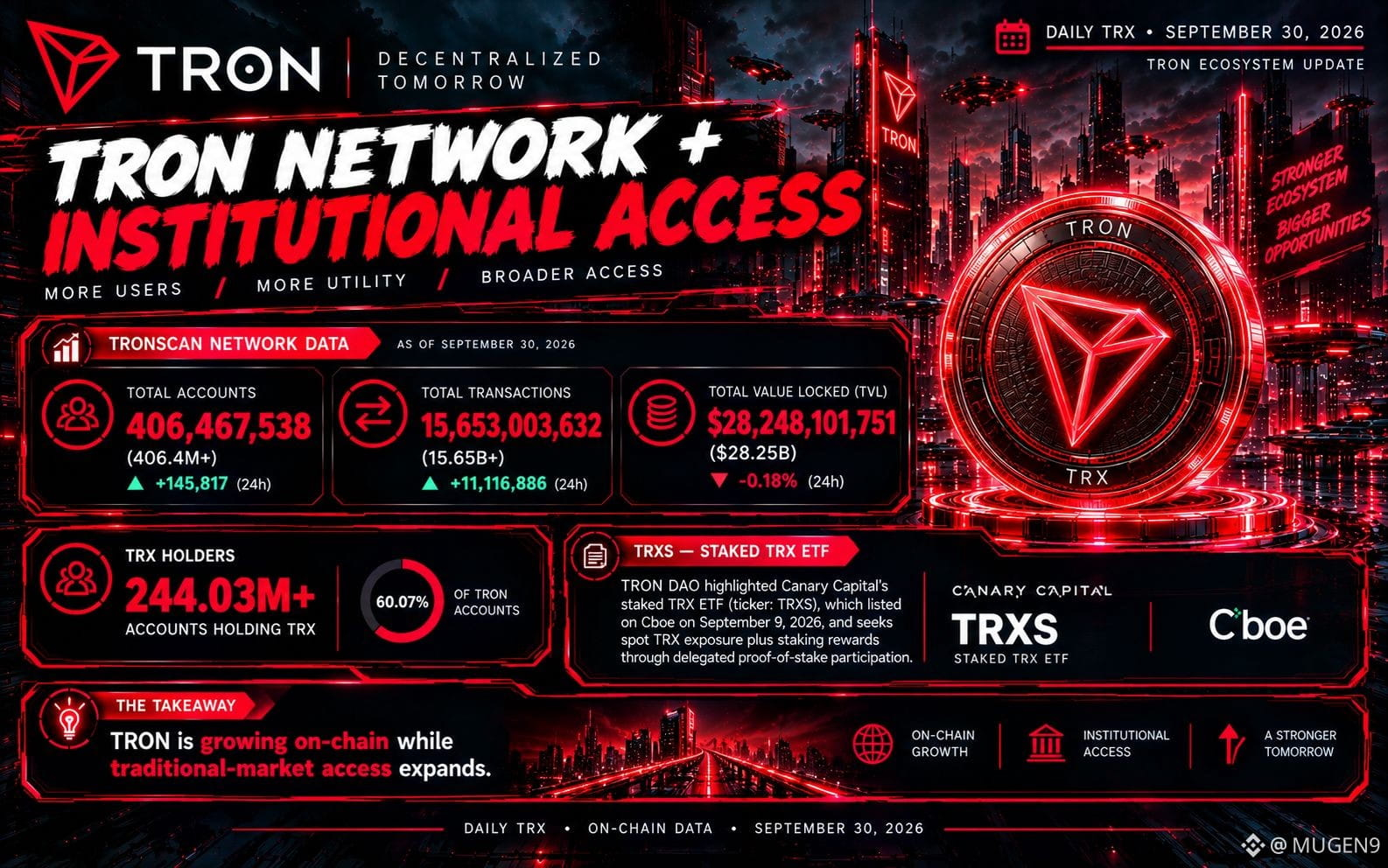
TRON is growing on-chain while access to TRX continues expanding.
Latest TRONSCAN data:
• 406.4M+ accounts
• 15.65B+ transactions
• 244M+ TRX holders
• $28.25B TVL
Around 60% of TRON accounts now hold TRX.
And in traditional markets, the TRXS Staked TRX ETF is giving investors a new way to gain spot TRX exposure while participating in TRON staking.
Different pieces, same bigger picture:
More network activity. More TRX holders. Broader access.
@TRONDAO
#TRX #TRON #Crypto #Blockchain
TRON is growing on-chain while access to TRX continues expanding.
Latest TRONSCAN data:
• 406.4M+ accounts
• 15.65B+ transactions
• 244M+ TRX holders
• $28.25B TVL
Around 60% of TRON accounts now hold TRX.
And in traditional markets, the TRXS Staked TRX ETF is giving investors a new way to gain spot TRX exposure while participating in TRON staking.
Different pieces, same bigger picture:
More network activity. More TRX holders. Broader access.
@TRON DAO
#TRX #TRON #Crypto #Blockchain
Latest TRONSCAN data:
• 406.4M+ accounts
• 15.65B+ transactions
• 244M+ TRX holders
• $28.25B TVL
Around 60% of TRON accounts now hold TRX.
And in traditional markets, the TRXS Staked TRX ETF is giving investors a new way to gain spot TRX exposure while participating in TRON staking.
Different pieces, same bigger picture:
More network activity. More TRX holders. Broader access.
@TRON DAO
#TRX #TRON #Crypto #Blockchain
29
·
--
Haussier
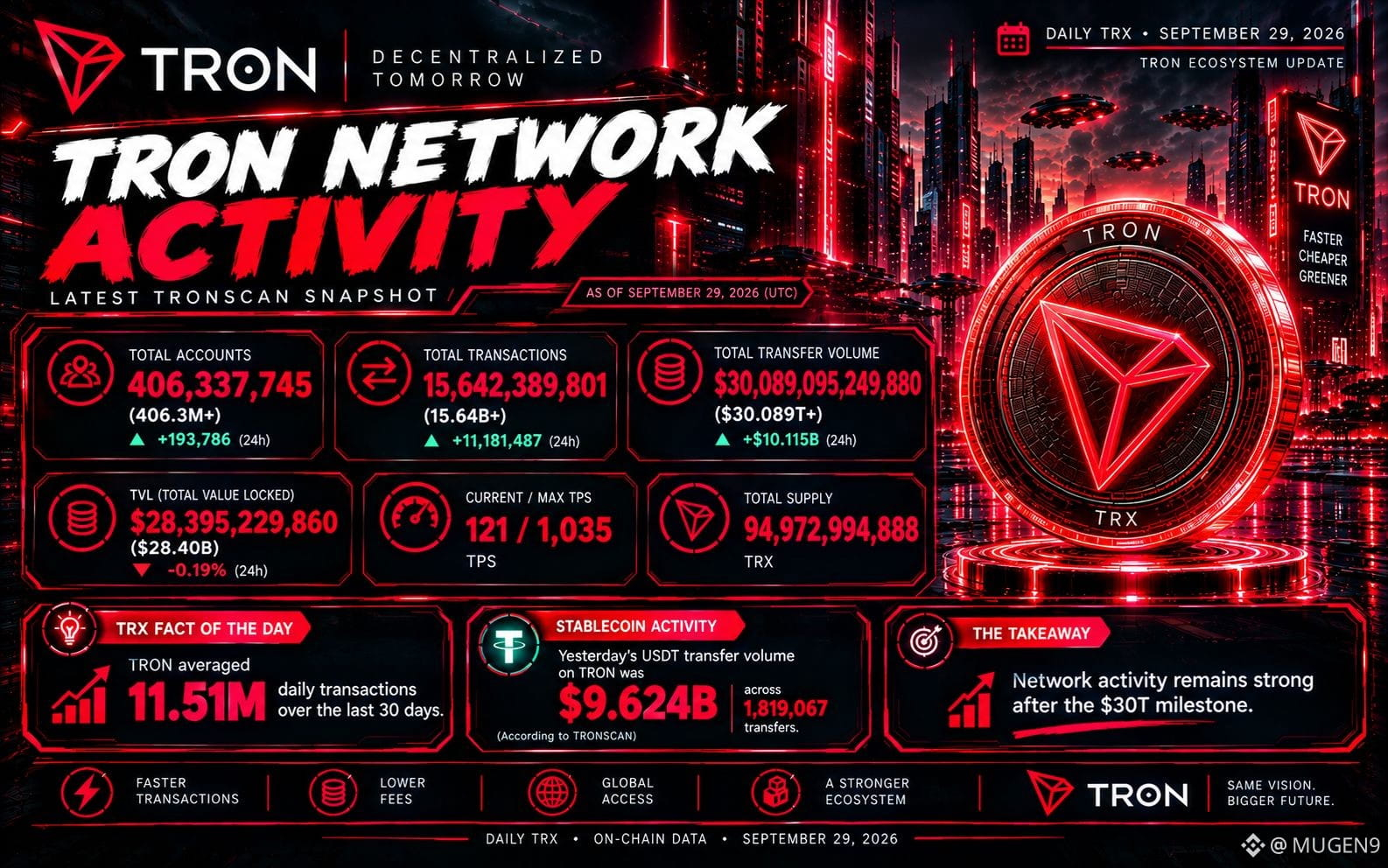
TRON’s network activity keeps moving.
Latest TRONSCAN data:
• 406.3M+ accounts
• 15.64B+ transactions
• $30.08T+ transfer volume
• $28.4B TVL
• +11.18M transactions in 24H
And stablecoins remain a major part of the network.
Yesterday alone, USDT on TRON recorded roughly $9.62B in transfer volume across 1.82M+ transfers.
The $30T milestone was only one checkpoint.
Now watch the activity behind the number.
@TRONDAO
#TRX #TRON #Crypto #Blockchain
TRON’s network activity keeps moving.
Latest TRONSCAN data:
• 406.3M+ accounts
• 15.64B+ transactions
• $30.08T+ transfer volume
• $28.4B TVL
• +11.18M transactions in 24H
And stablecoins remain a major part of the network.
Yesterday alone, USDT on TRON recorded roughly $9.62B in transfer volume across 1.82M+ transfers.
The $30T milestone was only one checkpoint.
Now watch the activity behind the number.
@TRON DAO
#TRX #TRON #Crypto #Blockchain
Latest TRONSCAN data:
• 406.3M+ accounts
• 15.64B+ transactions
• $30.08T+ transfer volume
• $28.4B TVL
• +11.18M transactions in 24H
And stablecoins remain a major part of the network.
Yesterday alone, USDT on TRON recorded roughly $9.62B in transfer volume across 1.82M+ transfers.
The $30T milestone was only one checkpoint.
Now watch the activity behind the number.
@TRON DAO
#TRX #TRON #Crypto #Blockchain
1
86
·
--
Haussier
Today’s TRX data is worth watching.
According to TRONSCAN, on September 25:
🔥 2.08M TRX burned
⚡ 3.92M TRX generated
📈 +1.84M TRX net increase
TRON has also burned 16.92B+ TRX cumulatively through network resources and fees.
The takeaway? TRX supply isn't simply deflationary every day. It depends on the balance between generation and burn activity.
Watch the network. Watch the supply.
@TRONDAO
#TRX #TRON #Crypto #Blockchain
Today’s TRX data is worth watching.
According to TRONSCAN, on September 25:
🔥 2.08M TRX burned
⚡ 3.92M TRX generated
📈 +1.84M TRX net increase
TRON has also burned 16.92B+ TRX cumulatively through network resources and fees.
The takeaway? TRX supply isn't simply deflationary every day. It depends on the balance between generation and burn activity.
Watch the network. Watch the supply.
@TRON DAO
#TRX #TRON #Crypto #Blockchain
According to TRONSCAN, on September 25:
🔥 2.08M TRX burned
⚡ 3.92M TRX generated
📈 +1.84M TRX net increase
TRON has also burned 16.92B+ TRX cumulatively through network resources and fees.
The takeaway? TRX supply isn't simply deflationary every day. It depends on the balance between generation and burn activity.
Watch the network. Watch the supply.
@TRON DAO
#TRX #TRON #Crypto #Blockchain
1
68
·
--
Haussier
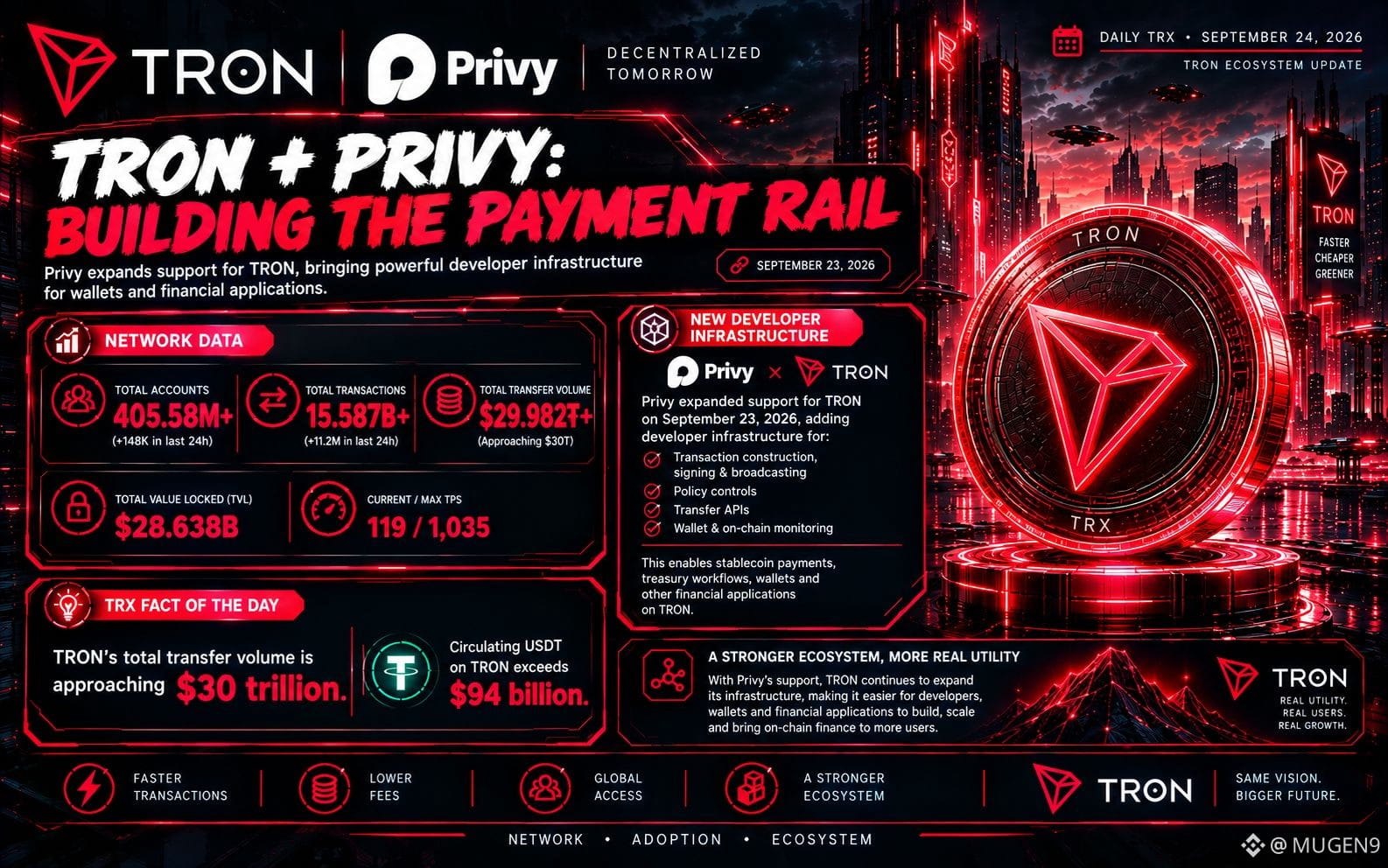
TRON is building more infrastructure around real-world payments.
Privy has expanded its support for TRON, giving developers tools for wallets, transaction signing, transfers, policy controls and on-chain monitoring.
That opens the door for more stablecoin payment apps, treasury workflows and financial products to be built on TRON.
And the network is already operating at scale:
405.6M+ accounts
15.59B+ transactions
$29.98T+ transfer volume
TRON is getting closer to the $30T milestone.
More infrastructure. More builders. More utility.
Follow the network, not just the price.
#TRX #TRON #Crypto #Blockchain
TRON is building more infrastructure around real-world payments.
Privy has expanded its support for TRON, giving developers tools for wallets, transaction signing, transfers, policy controls and on-chain monitoring.
That opens the door for more stablecoin payment apps, treasury workflows and financial products to be built on TRON.
And the network is already operating at scale:
405.6M+ accounts
15.59B+ transactions
$29.98T+ transfer volume
TRON is getting closer to the $30T milestone.
More infrastructure. More builders. More utility.
Follow the network, not just the price.
#TRX #TRON #Crypto #Blockchain
Privy has expanded its support for TRON, giving developers tools for wallets, transaction signing, transfers, policy controls and on-chain monitoring.
That opens the door for more stablecoin payment apps, treasury workflows and financial products to be built on TRON.
And the network is already operating at scale:
405.6M+ accounts
15.59B+ transactions
$29.98T+ transfer volume
TRON is getting closer to the $30T milestone.
More infrastructure. More builders. More utility.
Follow the network, not just the price.
#TRX #TRON #Crypto #Blockchain
1
63
·
--
Haussier
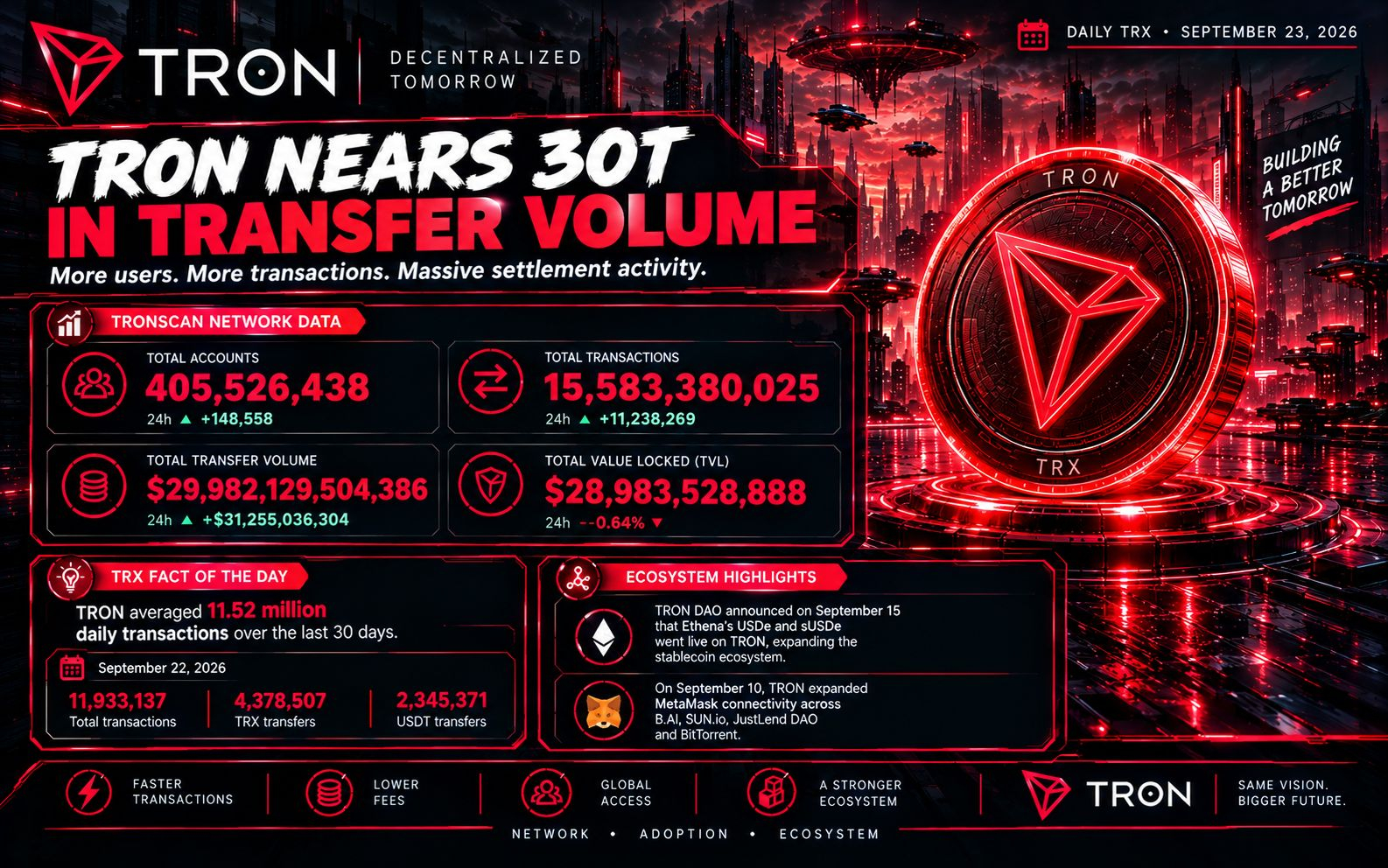
TRON is getting close to a massive network milestone.
TRONSCAN now shows 405.5M+ accounts, 15.58B+ transactions, and almost $30 TRILLION in cumulative transfer volume.
The network is also averaging around 11.52M transactions per day over the last 30 days.
And the activity isn't just TRX transfers — USDT continues to represent a major part of TRON's daily on-chain activity.
$30T is getting closer.
@TRONDAO
#TRX #TRON #Crypto #Blockchain
TRON is getting close to a massive network milestone.
TRONSCAN now shows 405.5M+ accounts, 15.58B+ transactions, and almost $30 TRILLION in cumulative transfer volume.
The network is also averaging around 11.52M transactions per day over the last 30 days.
And the activity isn't just TRX transfers — USDT continues to represent a major part of TRON's daily on-chain activity.
$30T is getting closer.
@TRON DAO
#TRX #TRON #Crypto #Blockchain
TRONSCAN now shows 405.5M+ accounts, 15.58B+ transactions, and almost $30 TRILLION in cumulative transfer volume.
The network is also averaging around 11.52M transactions per day over the last 30 days.
And the activity isn't just TRX transfers — USDT continues to represent a major part of TRON's daily on-chain activity.
$30T is getting closer.
@TRON DAO
#TRX #TRON #Crypto #Blockchain
1
87
·
--
Haussier
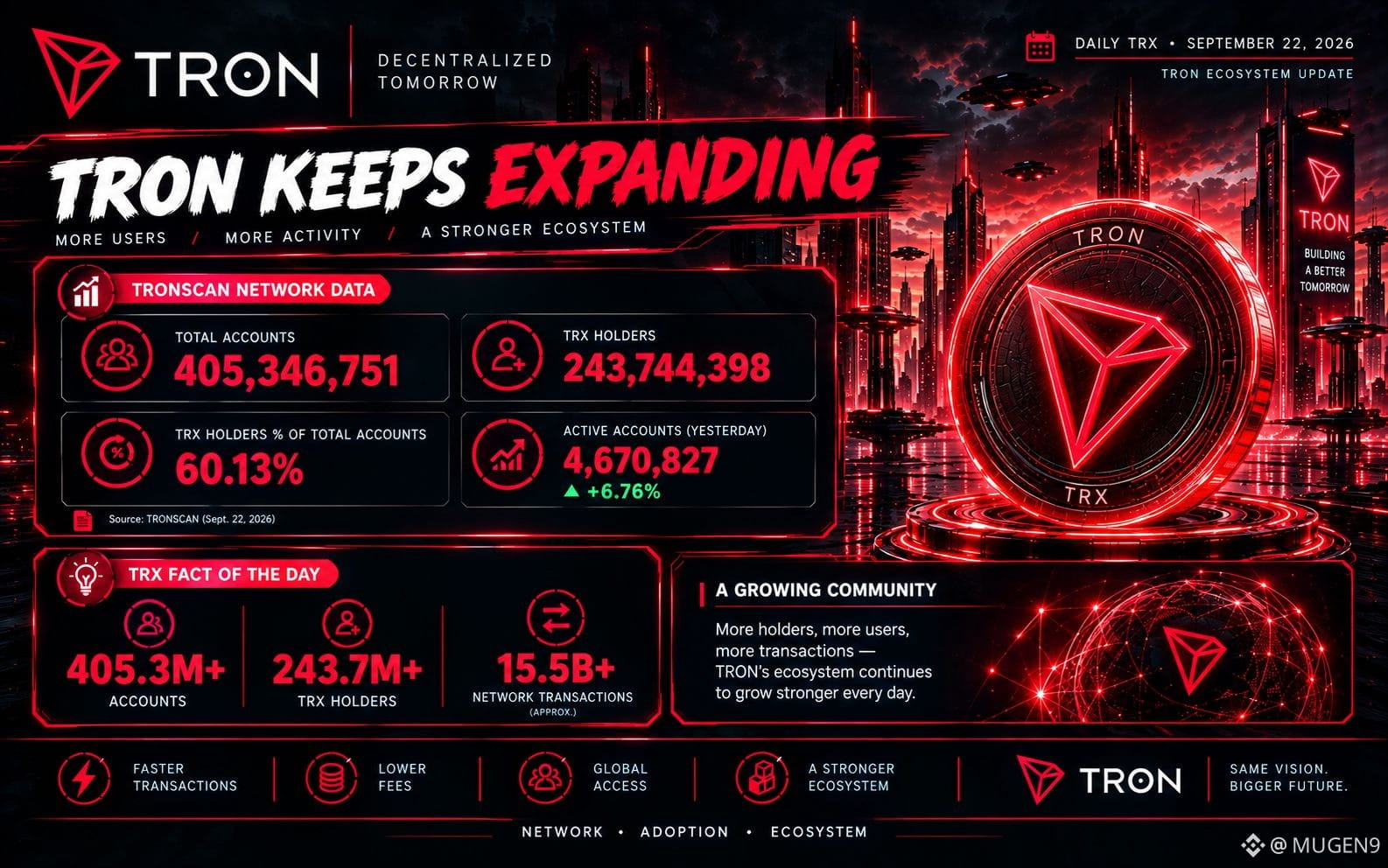
TRON keeps expanding.
TRONSCAN currently shows 405.35M+ total accounts, with 243.74M+ accounts holding TRX.
That means roughly 60.13% of all TRON accounts hold TRX.
Even more interesting: TRON recorded 4.67M+ active accounts yesterday, showing continued on-chain activity.
More users. More holders. More network activity.
Follow the network, not just the price.
@TRONDAO
#TRX #TRON #Crypto #Blockchain
TRON keeps expanding.
TRONSCAN currently shows 405.35M+ total accounts, with 243.74M+ accounts holding TRX.
That means roughly 60.13% of all TRON accounts hold TRX.
Even more interesting: TRON recorded 4.67M+ active accounts yesterday, showing continued on-chain activity.
More users. More holders. More network activity.
Follow the network, not just the price.
@TRON DAO
#TRX #TRON #Crypto #Blockchain
TRONSCAN currently shows 405.35M+ total accounts, with 243.74M+ accounts holding TRX.
That means roughly 60.13% of all TRON accounts hold TRX.
Even more interesting: TRON recorded 4.67M+ active accounts yesterday, showing continued on-chain activity.
More users. More holders. More network activity.
Follow the network, not just the price.
@TRON DAO
#TRX #TRON #Crypto #Blockchain
1
111
·
--
Haussier
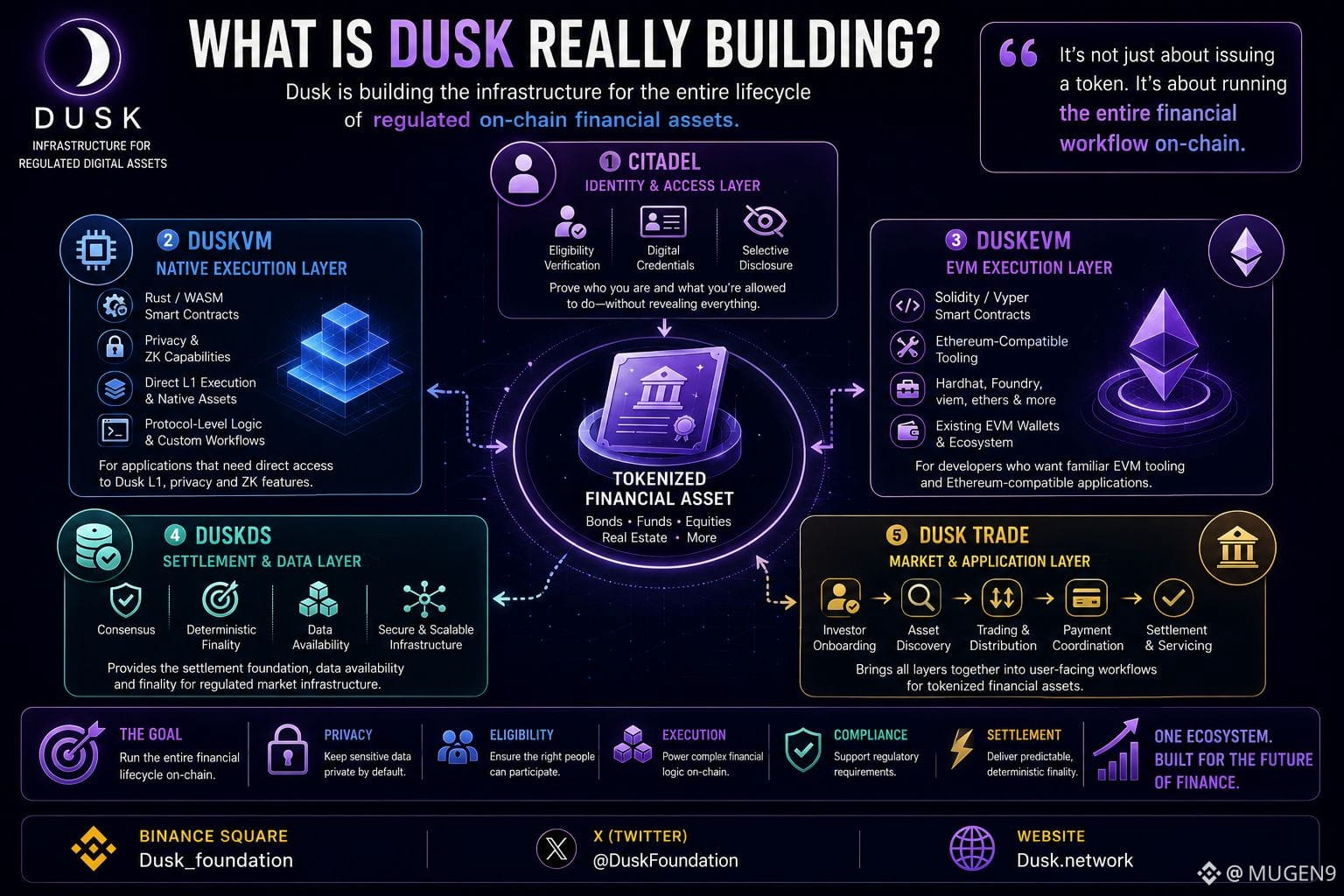
SO… WHAT IS DUSK REALLY BUILDING?
After looking at privacy, selective disclosure, confidential smart contracts, settlement, tokenized assets, identity and developer infrastructure, I think the bigger picture becomes clearer.
Dusk isn't simply trying to put another type of asset on a blockchain.
It's building infrastructure around the entire financial workflow.
Think about a tokenized security:
1️⃣ An investor needs to prove eligibility.
2️⃣ The asset needs rules controlling who can hold or transfer it.
3️⃣ Sensitive information may need to remain private.
4️⃣ Smart contracts need to execute the financial logic.
5️⃣ The asset and payment need predictable settlement.
6️⃣ Developers need practical ways to build applications around all of this.
That's where the different pieces of Dusk fit together.
Citadel handles identity and selective disclosure.
DuskVM provides native Rust/WASM smart-contract execution.
DuskEVM gives developers an Ethereum-compatible environment.
DuskDS provides consensus, settlement and data availability.
And Dusk Trade brings these capabilities into user-facing workflows for tokenized financial assets.
The interesting part isn't any single component.
It's how they work together.
The bigger question for me is no longer:
“Can financial assets be tokenized?”
It's:
“Can the entire financial lifecycle actually run on-chain while respecting privacy, eligibility and regulatory requirements?”
That's the experiment I'm watching.
What part of this infrastructure do you think matters most?
#dusk $DUSK @Dusk_Foundation
SO… WHAT IS DUSK REALLY BUILDING?
After looking at privacy, selective disclosure, confidential smart contracts, settlement, tokenized assets, identity and developer infrastructure, I think the bigger picture becomes clearer.
Dusk isn't simply trying to put another type of asset on a blockchain.
It's building infrastructure around the entire financial workflow.
Think about a tokenized security:
1️⃣ An investor needs to prove eligibility.
2️⃣ The asset needs rules controlling who can hold or transfer it.
3️⃣ Sensitive information may need to remain private.
4️⃣ Smart contracts need to execute the financial logic.
5️⃣ The asset and payment need predictable settlement.
6️⃣ Developers need practical ways to build applications around all of this.
That's where the different pieces of Dusk fit together.
Citadel handles identity and selective disclosure.
DuskVM provides native Rust/WASM smart-contract execution.
DuskEVM gives developers an Ethereum-compatible environment.
DuskDS provides consensus, settlement and data availability.
And Dusk Trade brings these capabilities into user-facing workflows for tokenized financial assets.
The interesting part isn't any single component.
It's how they work together.
The bigger question for me is no longer:
“Can financial assets be tokenized?”
It's:
“Can the entire financial lifecycle actually run on-chain while respecting privacy, eligibility and regulatory requirements?”
That's the experiment I'm watching.
What part of this infrastructure do you think matters most?
#dusk $DUSK @Dusk
After looking at privacy, selective disclosure, confidential smart contracts, settlement, tokenized assets, identity and developer infrastructure, I think the bigger picture becomes clearer.
Dusk isn't simply trying to put another type of asset on a blockchain.
It's building infrastructure around the entire financial workflow.
Think about a tokenized security:
1️⃣ An investor needs to prove eligibility.
2️⃣ The asset needs rules controlling who can hold or transfer it.
3️⃣ Sensitive information may need to remain private.
4️⃣ Smart contracts need to execute the financial logic.
5️⃣ The asset and payment need predictable settlement.
6️⃣ Developers need practical ways to build applications around all of this.
That's where the different pieces of Dusk fit together.
Citadel handles identity and selective disclosure.
DuskVM provides native Rust/WASM smart-contract execution.
DuskEVM gives developers an Ethereum-compatible environment.
DuskDS provides consensus, settlement and data availability.
And Dusk Trade brings these capabilities into user-facing workflows for tokenized financial assets.
The interesting part isn't any single component.
It's how they work together.
The bigger question for me is no longer:
“Can financial assets be tokenized?”
It's:
“Can the entire financial lifecycle actually run on-chain while respecting privacy, eligibility and regulatory requirements?”
That's the experiment I'm watching.
What part of this infrastructure do you think matters most?
#dusk $DUSK @Dusk
1
88
·
--
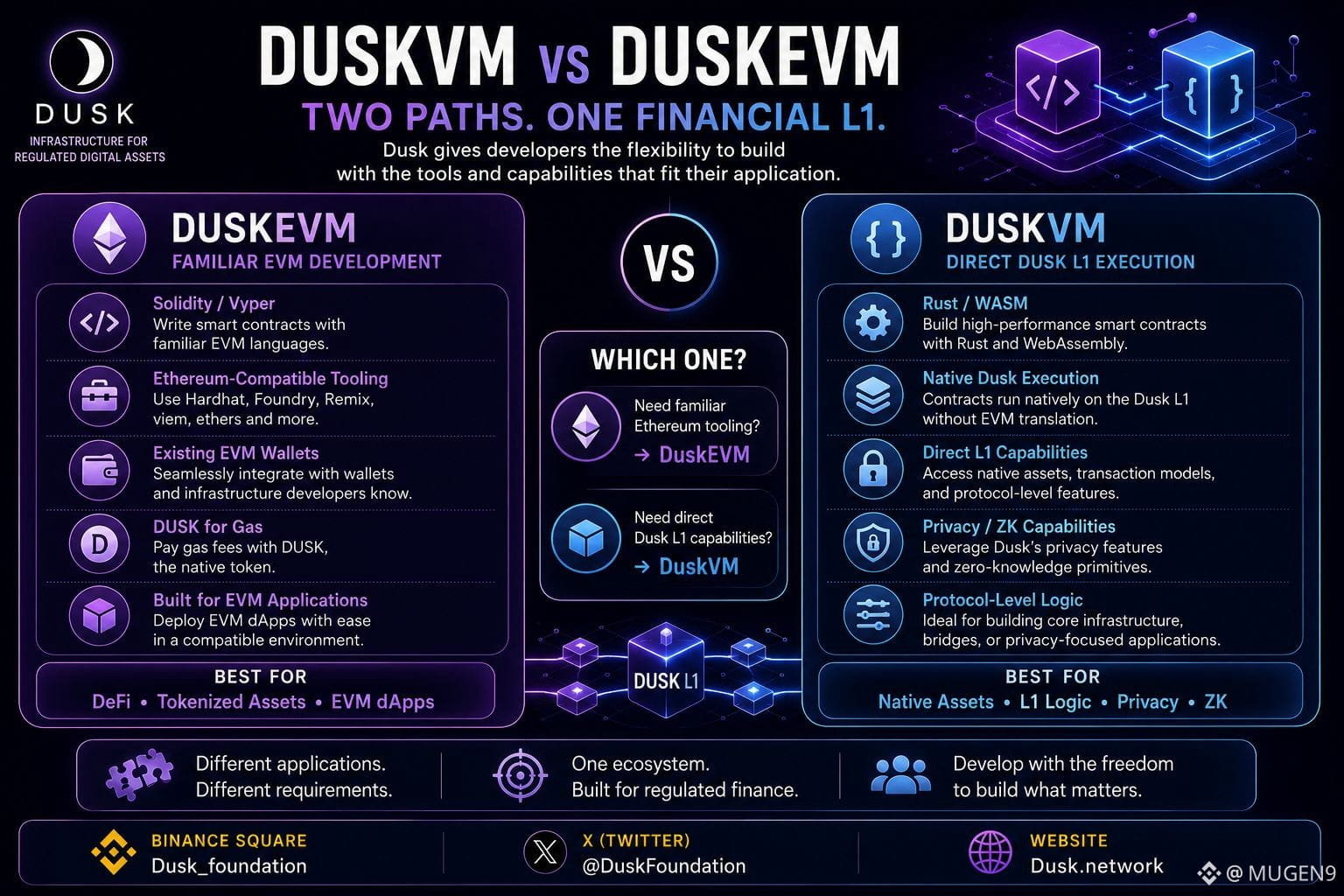
WHY DOES DUSK HAVE TWO SMART-CONTRACT PATHS?
At first, having both DuskEVM and DuskVM might sound unnecessarily complicated.
But developers don't all need the same environment.
DuskEVM is designed for applications that want the familiar Ethereum ecosystem.
Developers can use Solidity or Vyper alongside tools such as Hardhat, Foundry, viem and ethers, while DUSK serves as the native gas token.
Then there's DuskVM.
It's built for Rust/WASM contracts that execute directly on the Dusk L1, making it the option for applications that need closer access to Dusk's native assets, transaction models, privacy or zero-knowledge capabilities.
So the simple version is:
🟣 DuskEVM = EVM compatibility + familiar tooling
🔵 DuskVM = direct L1 execution + native Dusk capabilities
It's less about choosing which one is “better” and more about choosing the right tool for the application.
For developers building financial applications, having both paths could make the ecosystem more flexible.
If you were building on Dusk, which would you choose?
EVM compatibility or native L1 capabilities?
#dusk $DUSK @Dusk_Foundation
WHY DOES DUSK HAVE TWO SMART-CONTRACT PATHS?
At first, having both DuskEVM and DuskVM might sound unnecessarily complicated.
But developers don't all need the same environment.
DuskEVM is designed for applications that want the familiar Ethereum ecosystem.
Developers can use Solidity or Vyper alongside tools such as Hardhat, Foundry, viem and ethers, while DUSK serves as the native gas token.
Then there's DuskVM.
It's built for Rust/WASM contracts that execute directly on the Dusk L1, making it the option for applications that need closer access to Dusk's native assets, transaction models, privacy or zero-knowledge capabilities.
So the simple version is:
🟣 DuskEVM = EVM compatibility + familiar tooling
🔵 DuskVM = direct L1 execution + native Dusk capabilities
It's less about choosing which one is “better” and more about choosing the right tool for the application.
For developers building financial applications, having both paths could make the ecosystem more flexible.
If you were building on Dusk, which would you choose?
EVM compatibility or native L1 capabilities?
#dusk $DUSK @Dusk
At first, having both DuskEVM and DuskVM might sound unnecessarily complicated.
But developers don't all need the same environment.
DuskEVM is designed for applications that want the familiar Ethereum ecosystem.
Developers can use Solidity or Vyper alongside tools such as Hardhat, Foundry, viem and ethers, while DUSK serves as the native gas token.
Then there's DuskVM.
It's built for Rust/WASM contracts that execute directly on the Dusk L1, making it the option for applications that need closer access to Dusk's native assets, transaction models, privacy or zero-knowledge capabilities.
So the simple version is:
🟣 DuskEVM = EVM compatibility + familiar tooling
🔵 DuskVM = direct L1 execution + native Dusk capabilities
It's less about choosing which one is “better” and more about choosing the right tool for the application.
For developers building financial applications, having both paths could make the ecosystem more flexible.
If you were building on Dusk, which would you choose?
EVM compatibility or native L1 capabilities?
#dusk $DUSK @Dusk
1
81
·
--
Haussier
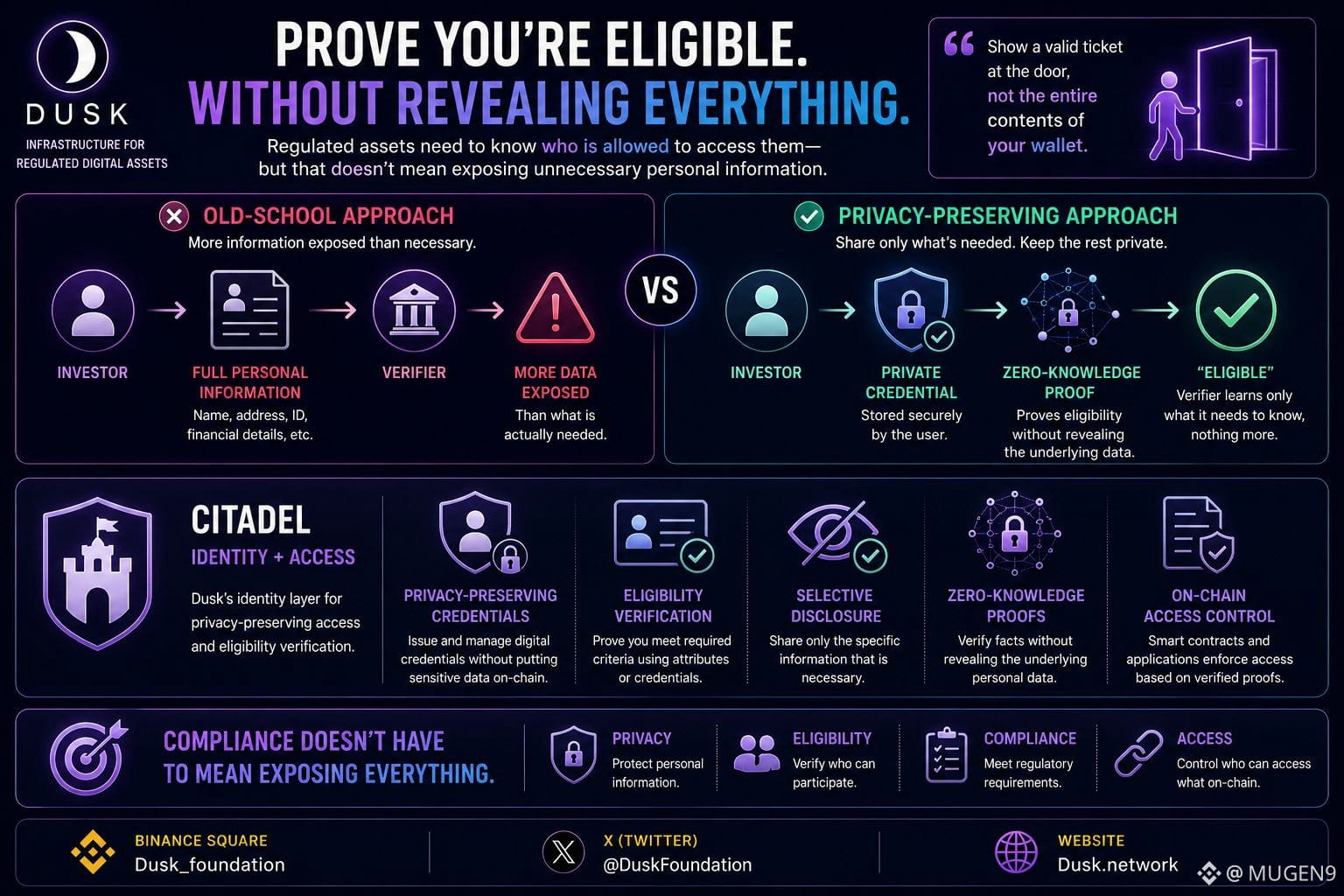
WHO SHOULD BE ALLOWED TO BUY A TOKENIZED ASSET?
This sounds simple until you put regulated finance on-chain.
Imagine a tokenized security that can only be held by eligible investors.
The network needs to know that a participant meets certain requirements—but does it really need to expose that person's entire identity to everyone?
This is where privacy-preserving identity becomes interesting.
Dusk's Citadel identity layer is designed around credentials and selective disclosure.
Instead of putting sensitive personal information directly on-chain, a user can prove that they hold a valid credential or meet a required attribute without revealing unnecessary details.
Think of it like showing a valid ticket at the door without handing the entire contents of your wallet to the security guard.
For regulated assets, that distinction could be important.
You can have:
🔐 Privacy
✅ Eligibility checks
📋 Compliance requirements
🧩 On-chain access controls
without making every participant's personal information public.
To me, this is one of the more interesting pieces of bringing regulated finance on-chain.
Would you rather prove “I'm eligible” or reveal “everything about me”?
#dusk $DUSK @Dusk_Foundation
WHO SHOULD BE ALLOWED TO BUY A TOKENIZED ASSET?
This sounds simple until you put regulated finance on-chain.
Imagine a tokenized security that can only be held by eligible investors.
The network needs to know that a participant meets certain requirements—but does it really need to expose that person's entire identity to everyone?
This is where privacy-preserving identity becomes interesting.
Dusk's Citadel identity layer is designed around credentials and selective disclosure.
Instead of putting sensitive personal information directly on-chain, a user can prove that they hold a valid credential or meet a required attribute without revealing unnecessary details.
Think of it like showing a valid ticket at the door without handing the entire contents of your wallet to the security guard.
For regulated assets, that distinction could be important.
You can have:
🔐 Privacy
✅ Eligibility checks
📋 Compliance requirements
🧩 On-chain access controls
without making every participant's personal information public.
To me, this is one of the more interesting pieces of bringing regulated finance on-chain.
Would you rather prove “I'm eligible” or reveal “everything about me”?
#dusk $DUSK @Dusk
This sounds simple until you put regulated finance on-chain.
Imagine a tokenized security that can only be held by eligible investors.
The network needs to know that a participant meets certain requirements—but does it really need to expose that person's entire identity to everyone?
This is where privacy-preserving identity becomes interesting.
Dusk's Citadel identity layer is designed around credentials and selective disclosure.
Instead of putting sensitive personal information directly on-chain, a user can prove that they hold a valid credential or meet a required attribute without revealing unnecessary details.
Think of it like showing a valid ticket at the door without handing the entire contents of your wallet to the security guard.
For regulated assets, that distinction could be important.
You can have:
🔐 Privacy
✅ Eligibility checks
📋 Compliance requirements
🧩 On-chain access controls
without making every participant's personal information public.
To me, this is one of the more interesting pieces of bringing regulated finance on-chain.
Would you rather prove “I'm eligible” or reveal “everything about me”?
#dusk $DUSK @Dusk
1
74
·
--
Haussier
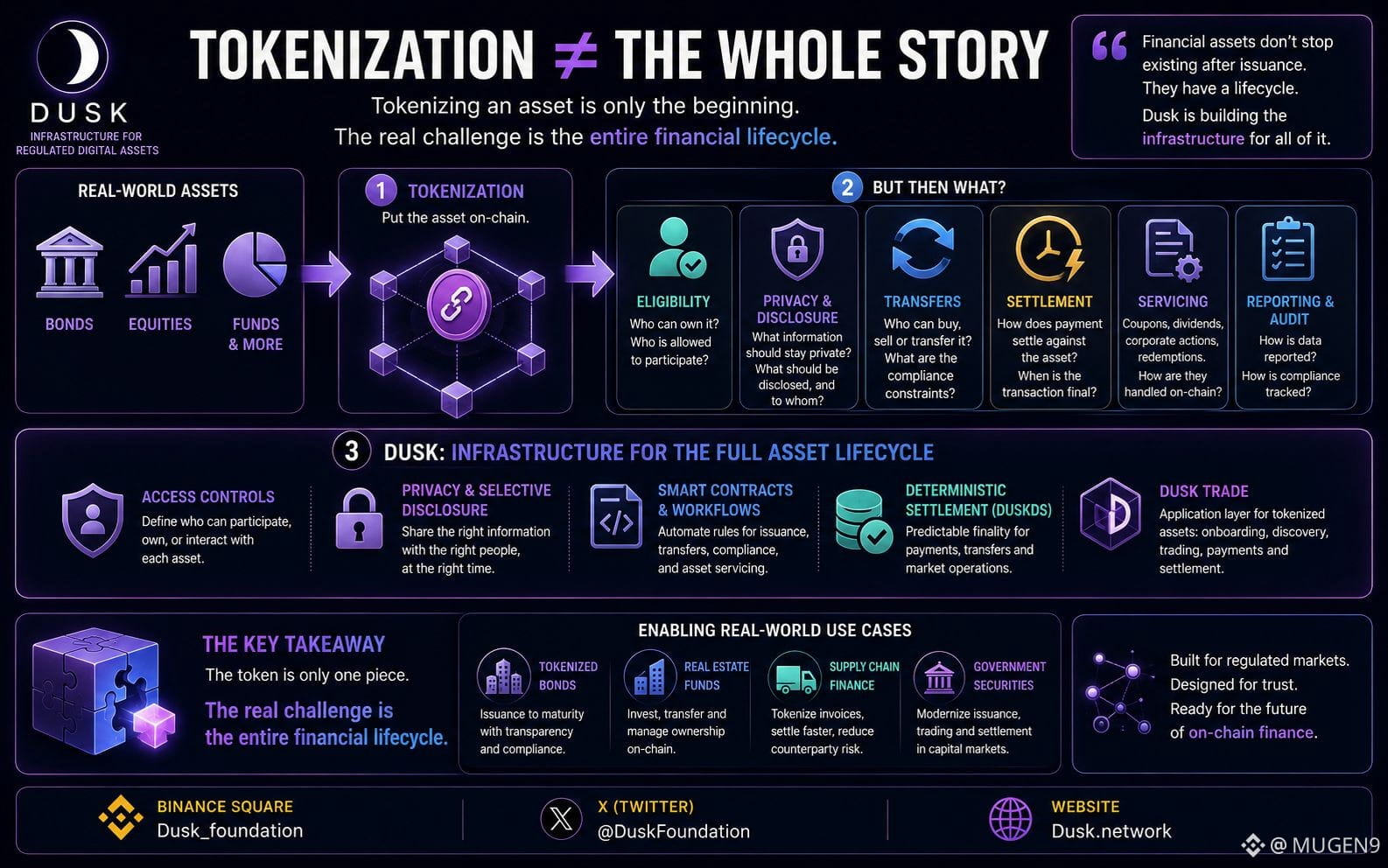
TOKENIZING AN ASSET IS ONLY THE BEGINNING.
A lot of RWA conversations make tokenization sound simple:
“Take a real-world asset → put it on blockchain → done.”
But financial assets don't work that way.
Imagine tokenizing a bond.
You still need to answer:
Who can buy it?
Who can hold it?
Who can transfer it?
What information should remain private?
How does payment settle against the asset?
What happens when the asset needs servicing or reporting?
That's where the infrastructure becomes more interesting than the token itself.
Dusk is designed around these complete regulated-asset workflows, combining access controls, privacy with selective disclosure, smart-contract execution and deterministic settlement.
Dusk Trade is also being built as an application layer for tokenized financial assets, covering workflows such as investor onboarding, asset discovery, buying, selling, payment coordination and settlement.
So maybe the bigger question isn't:
“Can we tokenize this asset?”
It's:
“Can we actually run its financial lifecycle on-chain?”
That's the part I'm watching.
What do you think is the hardest part of bringing RWAs on-chain?
#dusk $DUSK @Dusk_Foundation
TOKENIZING AN ASSET IS ONLY THE BEGINNING.
A lot of RWA conversations make tokenization sound simple:
“Take a real-world asset → put it on blockchain → done.”
But financial assets don't work that way.
Imagine tokenizing a bond.
You still need to answer:
Who can buy it?
Who can hold it?
Who can transfer it?
What information should remain private?
How does payment settle against the asset?
What happens when the asset needs servicing or reporting?
That's where the infrastructure becomes more interesting than the token itself.
Dusk is designed around these complete regulated-asset workflows, combining access controls, privacy with selective disclosure, smart-contract execution and deterministic settlement.
Dusk Trade is also being built as an application layer for tokenized financial assets, covering workflows such as investor onboarding, asset discovery, buying, selling, payment coordination and settlement.
So maybe the bigger question isn't:
“Can we tokenize this asset?”
It's:
“Can we actually run its financial lifecycle on-chain?”
That's the part I'm watching.
What do you think is the hardest part of bringing RWAs on-chain?
#dusk $DUSK @Dusk
A lot of RWA conversations make tokenization sound simple:
“Take a real-world asset → put it on blockchain → done.”
But financial assets don't work that way.
Imagine tokenizing a bond.
You still need to answer:
Who can buy it?
Who can hold it?
Who can transfer it?
What information should remain private?
How does payment settle against the asset?
What happens when the asset needs servicing or reporting?
That's where the infrastructure becomes more interesting than the token itself.
Dusk is designed around these complete regulated-asset workflows, combining access controls, privacy with selective disclosure, smart-contract execution and deterministic settlement.
Dusk Trade is also being built as an application layer for tokenized financial assets, covering workflows such as investor onboarding, asset discovery, buying, selling, payment coordination and settlement.
So maybe the bigger question isn't:
“Can we tokenize this asset?”
It's:
“Can we actually run its financial lifecycle on-chain?”
That's the part I'm watching.
What do you think is the hardest part of bringing RWAs on-chain?
#dusk $DUSK @Dusk
1
101
·
--
Haussier
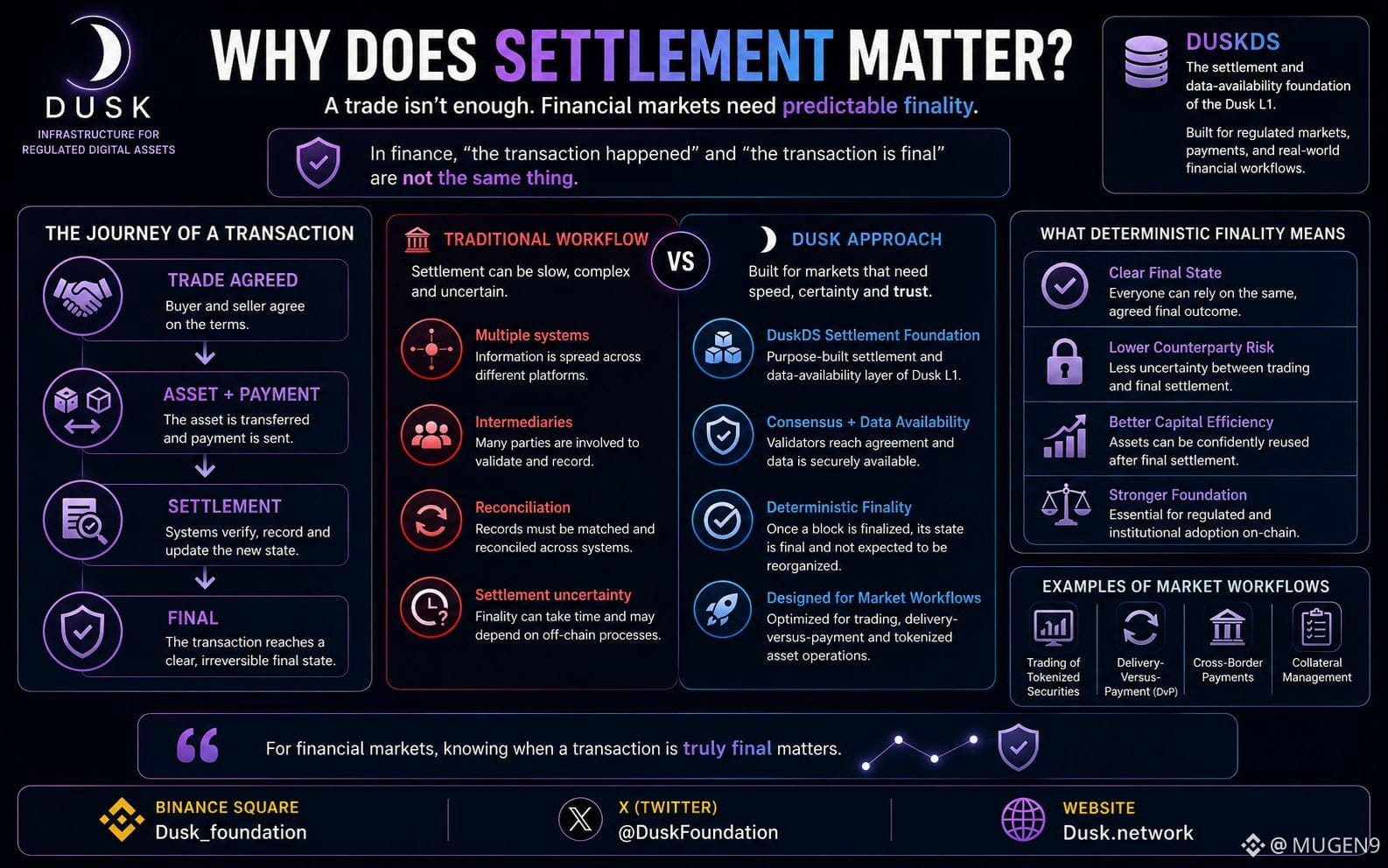
WHY DOES SETTLEMENT MATTER SO MUCH IN FINANCE?
Yesterday, we asked what matters most for on-chain financial markets.
Today, let's talk about one of the less flashy—but extremely important—pieces: settlement.
Imagine buying a tokenized bond.
The trade happens, but when is the transaction actually final?
In traditional markets, settlement can involve multiple systems, intermediaries and reconciliation steps.
For on-chain markets, the goal is different: the asset and payment workflow should be able to reach a clear, predictable final state.
This is where Dusk's settlement layer comes in.
DuskDS provides the consensus, data availability and settlement foundation of the Dusk L1. Dusk describes its consensus design as providing deterministic finality, meaning that once a block is finalized, its state is not expected to be reorganized under normal operation.
That matters for financial applications because “the transaction happened” and “the transaction is final” are not necessarily the same thing.
For tokenized assets, predictable finality can make workflows such as trading and delivery-versus-payment easier to coordinate.
So here's my question:
Would you prioritize faster settlement, stronger privacy, or easier compliance when building the financial markets of the future?
{spot}(DUSKUSDT)
#dusk $DUSK @Dusk_Foundation
WHY DOES SETTLEMENT MATTER SO MUCH IN FINANCE?
Yesterday, we asked what matters most for on-chain financial markets.
Today, let's talk about one of the less flashy—but extremely important—pieces: settlement.
Imagine buying a tokenized bond.
The trade happens, but when is the transaction actually final?
In traditional markets, settlement can involve multiple systems, intermediaries and reconciliation steps.
For on-chain markets, the goal is different: the asset and payment workflow should be able to reach a clear, predictable final state.
This is where Dusk's settlement layer comes in.
DuskDS provides the consensus, data availability and settlement foundation of the Dusk L1. Dusk describes its consensus design as providing deterministic finality, meaning that once a block is finalized, its state is not expected to be reorganized under normal operation.
That matters for financial applications because “the transaction happened” and “the transaction is final” are not necessarily the same thing.
For tokenized assets, predictable finality can make workflows such as trading and delivery-versus-payment easier to coordinate.
So here's my question:
Would you prioritize faster settlement, stronger privacy, or easier compliance when building the financial markets of the future?
#dusk $DUSK @Dusk
Yesterday, we asked what matters most for on-chain financial markets.
Today, let's talk about one of the less flashy—but extremely important—pieces: settlement.
Imagine buying a tokenized bond.
The trade happens, but when is the transaction actually final?
In traditional markets, settlement can involve multiple systems, intermediaries and reconciliation steps.
For on-chain markets, the goal is different: the asset and payment workflow should be able to reach a clear, predictable final state.
This is where Dusk's settlement layer comes in.
DuskDS provides the consensus, data availability and settlement foundation of the Dusk L1. Dusk describes its consensus design as providing deterministic finality, meaning that once a block is finalized, its state is not expected to be reorganized under normal operation.
That matters for financial applications because “the transaction happened” and “the transaction is final” are not necessarily the same thing.
For tokenized assets, predictable finality can make workflows such as trading and delivery-versus-payment easier to coordinate.
So here's my question:
Would you prioritize faster settlement, stronger privacy, or easier compliance when building the financial markets of the future?
#dusk $DUSK @Dusk
1
94
·
--
Haussier
Tokenizing an asset is only one part of the equation.
If financial markets are going on-chain, what would matter MOST before you would actually trust the infrastructure?
Dusk is building around several of these requirements, including privacy, access controls, deterministic settlement and EVM-compatible development.
What's your pick?
Vote below 👇
#dusk $DUSK @Dusk_Foundation
Tokenizing an asset is only one part of the equation.
If financial markets are going on-chain, what would matter MOST before you would actually trust the infrastructure?
Dusk is building around several of these requirements, including privacy, access controls, deterministic settlement and EVM-compatible development.
What's your pick?
Vote below 👇
#dusk $DUSK @Dusk
If financial markets are going on-chain, what would matter MOST before you would actually trust the infrastructure?
Dusk is building around several of these requirements, including privacy, access controls, deterministic settlement and EVM-compatible development.
What's your pick?
Vote below 👇
#dusk $DUSK @Dusk
🔐 PRIVACY
100%
🪪 COMPLIANCE
0%
⚡ SETTLEMENT
0%
🛠️ COMPATIBILITY
0%
1 Votes • Vote fermé
1
69
·
--
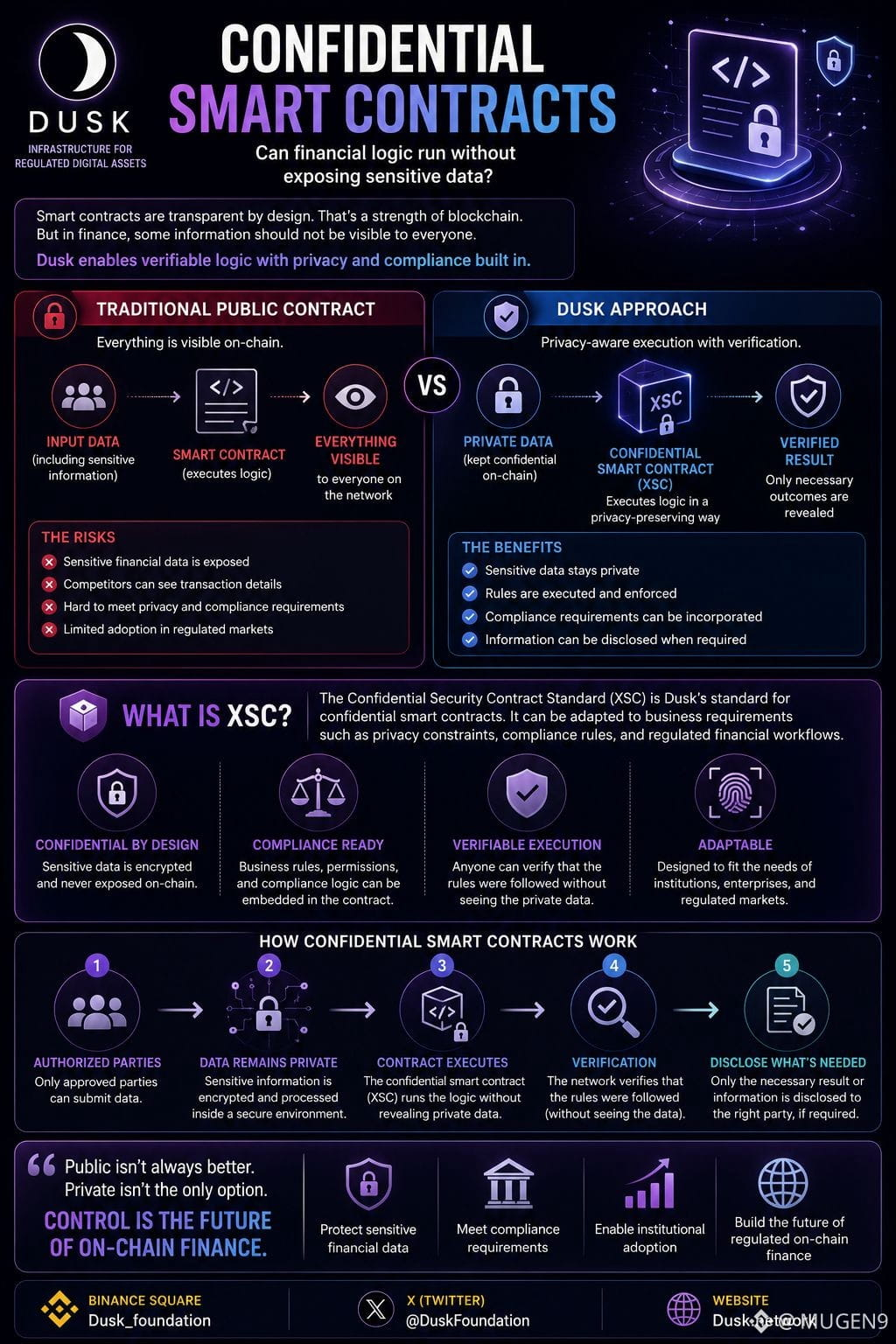
WHAT IF A SMART CONTRACT DIDN’T HAVE TO REVEAL EVERYTHING IT PROCESSES?
Most people think of smart contracts as transparent by default.
That transparency is useful.
But imagine you're dealing with financial markets.
A trade, asset transfer, or compliance process could involve information that shouldn't be exposed to everyone on a public network.
So the interesting question becomes:
Can blockchain logic remain verifiable without making sensitive financial information completely public?
This is where confidential smart contracts become interesting.
Dusk includes the Confidential Security Contract Standard (XSC), a standard designed for confidential smart contracts that can be adapted to business requirements such as privacy constraints and compliance rules.
Dusk also supports zero-knowledge technology and privacy-aware execution on its L1. The goal isn't simply to make everything invisible.
It's about giving financial applications more control over what information is exposed while still allowing the underlying rules to be enforced.
That's a very different idea from:
“Make everything public.”
And also different from:
“Hide everything.”
The bigger idea is programmable finance where privacy and compliance can exist together.
Would you trust a financial smart contract more if you could verify that its rules were followed without seeing every piece of sensitive data?
#dusk $DUSK @Dusk_Foundation
WHAT IF A SMART CONTRACT DIDN’T HAVE TO REVEAL EVERYTHING IT PROCESSES?
Most people think of smart contracts as transparent by default.
That transparency is useful.
But imagine you're dealing with financial markets.
A trade, asset transfer, or compliance process could involve information that shouldn't be exposed to everyone on a public network.
So the interesting question becomes:
Can blockchain logic remain verifiable without making sensitive financial information completely public?
This is where confidential smart contracts become interesting.
Dusk includes the Confidential Security Contract Standard (XSC), a standard designed for confidential smart contracts that can be adapted to business requirements such as privacy constraints and compliance rules.
Dusk also supports zero-knowledge technology and privacy-aware execution on its L1. The goal isn't simply to make everything invisible.
It's about giving financial applications more control over what information is exposed while still allowing the underlying rules to be enforced.
That's a very different idea from:
“Make everything public.”
And also different from:
“Hide everything.”
The bigger idea is programmable finance where privacy and compliance can exist together.
Would you trust a financial smart contract more if you could verify that its rules were followed without seeing every piece of sensitive data?
#dusk $DUSK @Dusk
Most people think of smart contracts as transparent by default.
That transparency is useful.
But imagine you're dealing with financial markets.
A trade, asset transfer, or compliance process could involve information that shouldn't be exposed to everyone on a public network.
So the interesting question becomes:
Can blockchain logic remain verifiable without making sensitive financial information completely public?
This is where confidential smart contracts become interesting.
Dusk includes the Confidential Security Contract Standard (XSC), a standard designed for confidential smart contracts that can be adapted to business requirements such as privacy constraints and compliance rules.
Dusk also supports zero-knowledge technology and privacy-aware execution on its L1. The goal isn't simply to make everything invisible.
It's about giving financial applications more control over what information is exposed while still allowing the underlying rules to be enforced.
That's a very different idea from:
“Make everything public.”
And also different from:
“Hide everything.”
The bigger idea is programmable finance where privacy and compliance can exist together.
Would you trust a financial smart contract more if you could verify that its rules were followed without seeing every piece of sensitive data?
#dusk $DUSK @Dusk
1
78
·
--
Haussier
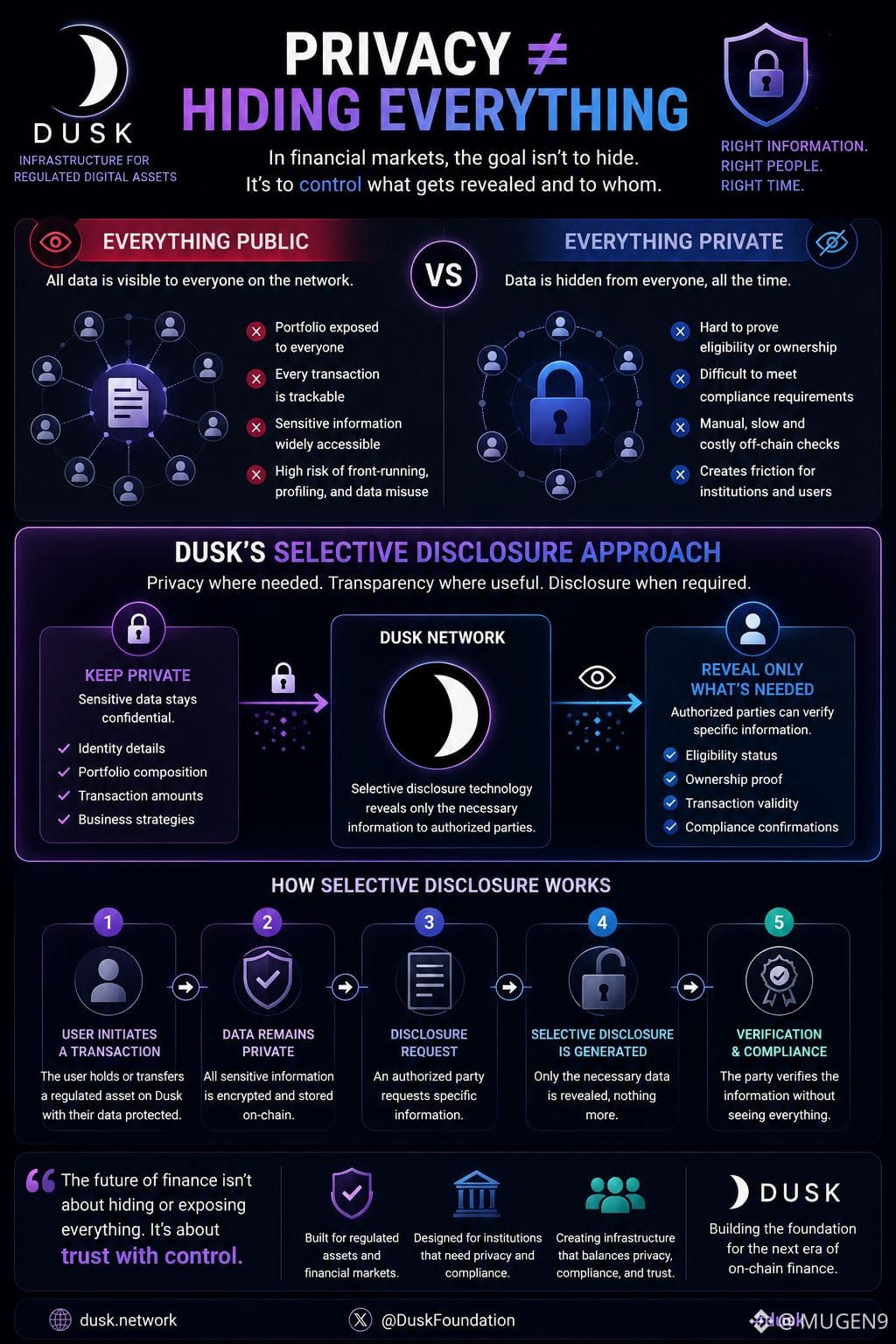
PRIVACY DOESN’T MEAN HIDING EVERYTHING.
One thing I find interesting about blockchain finance is that privacy and transparency don't necessarily have to be opposites.
Imagine you're investing in a regulated asset.
You may need to prove that you're eligible to hold it, but that doesn't mean everyone on the network needs to see your identity, portfolio, or transaction history.
That's where selective disclosure becomes interesting.
Instead of making everything public or hiding everything completely, the idea is to reveal the right information to the right party when it's actually required.
Dusk is building around this concept.
Its architecture supports public transaction flows as well as shielded transfers, while selective disclosure can allow authorized parties to verify specific information when needed. Dusk's documentation describes this as privacy where needed, transparency where useful, and controlled disclosure when required.
For regulated financial markets, that distinction could matter a lot.
Privacy isn't necessarily about hiding from everyone.
Sometimes it's about having control over who gets to see what.
Would you rather have:
A) Everything public
B) Everything private
C) Privacy with selective disclosure
I'm curious what the community thinks.
@Dusk_Foundation $DUSK #dusk
PRIVACY DOESN’T MEAN HIDING EVERYTHING.
One thing I find interesting about blockchain finance is that privacy and transparency don't necessarily have to be opposites.
Imagine you're investing in a regulated asset.
You may need to prove that you're eligible to hold it, but that doesn't mean everyone on the network needs to see your identity, portfolio, or transaction history.
That's where selective disclosure becomes interesting.
Instead of making everything public or hiding everything completely, the idea is to reveal the right information to the right party when it's actually required.
Dusk is building around this concept.
Its architecture supports public transaction flows as well as shielded transfers, while selective disclosure can allow authorized parties to verify specific information when needed. Dusk's documentation describes this as privacy where needed, transparency where useful, and controlled disclosure when required.
For regulated financial markets, that distinction could matter a lot.
Privacy isn't necessarily about hiding from everyone.
Sometimes it's about having control over who gets to see what.
Would you rather have:
A) Everything public
B) Everything private
C) Privacy with selective disclosure
I'm curious what the community thinks.
@Dusk $DUSK #dusk
One thing I find interesting about blockchain finance is that privacy and transparency don't necessarily have to be opposites.
Imagine you're investing in a regulated asset.
You may need to prove that you're eligible to hold it, but that doesn't mean everyone on the network needs to see your identity, portfolio, or transaction history.
That's where selective disclosure becomes interesting.
Instead of making everything public or hiding everything completely, the idea is to reveal the right information to the right party when it's actually required.
Dusk is building around this concept.
Its architecture supports public transaction flows as well as shielded transfers, while selective disclosure can allow authorized parties to verify specific information when needed. Dusk's documentation describes this as privacy where needed, transparency where useful, and controlled disclosure when required.
For regulated financial markets, that distinction could matter a lot.
Privacy isn't necessarily about hiding from everyone.
Sometimes it's about having control over who gets to see what.
Would you rather have:
A) Everything public
B) Everything private
C) Privacy with selective disclosure
I'm curious what the community thinks.
@Dusk $DUSK #dusk
1
69
·
--
Haussier
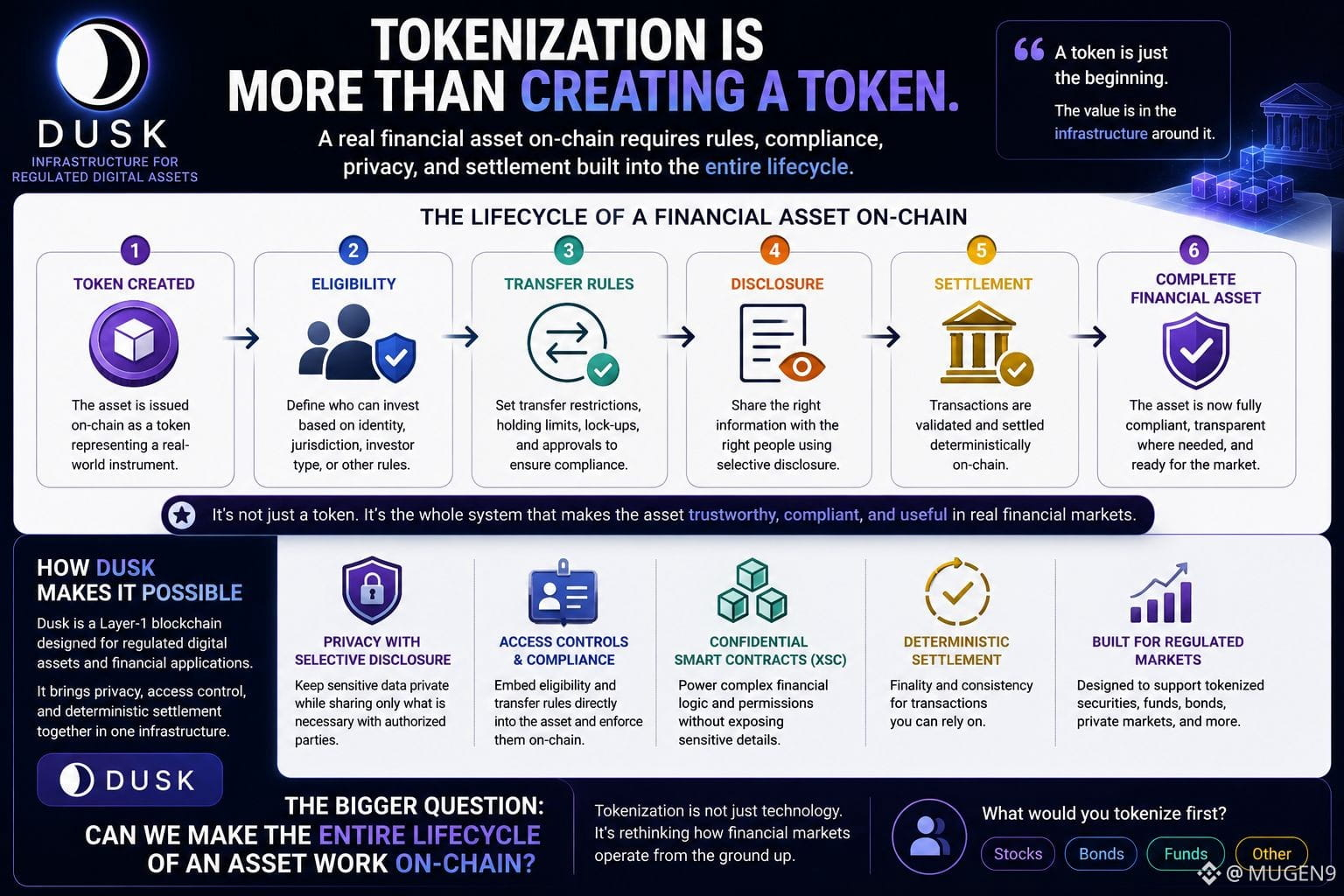
A TOKEN IS EASY. BUILDING A REAL FINANCIAL ASSET ON-CHAIN IS THE HARD PART.
It’s easy to look at tokenization and think:
“Just put the asset on a blockchain.”
But what happens after the token is created?
A real financial asset may need rules around:
• Who is eligible to buy it?
• Who can hold or transfer it?
• What information should be visible?
• What needs to be disclosed to regulators?
• How are transactions settled?
• What happens when the asset has corporate actions or other lifecycle events?
That’s where things get much more interesting.
Dusk is building infrastructure for regulated digital assets where these requirements can become part of the on-chain workflow instead of being handled entirely through disconnected systems.
Its architecture combines access controls, privacy with selective disclosure, and deterministic settlement for financial workflows. 1
So maybe the bigger question isn't:
“Can we tokenize an asset?”
It’s:
“Can we make the entire lifecycle of that asset work on-chain?”
That’s the part of tokenization I’m watching most closely.
What would you tokenize first: stocks, bonds, funds, or something else?
@Dusk_Foundation $DUSK #dusk
A TOKEN IS EASY. BUILDING A REAL FINANCIAL ASSET ON-CHAIN IS THE HARD PART.
It’s easy to look at tokenization and think:
“Just put the asset on a blockchain.”
But what happens after the token is created?
A real financial asset may need rules around:
• Who is eligible to buy it?
• Who can hold or transfer it?
• What information should be visible?
• What needs to be disclosed to regulators?
• How are transactions settled?
• What happens when the asset has corporate actions or other lifecycle events?
That’s where things get much more interesting.
Dusk is building infrastructure for regulated digital assets where these requirements can become part of the on-chain workflow instead of being handled entirely through disconnected systems.
Its architecture combines access controls, privacy with selective disclosure, and deterministic settlement for financial workflows. 1
So maybe the bigger question isn't:
“Can we tokenize an asset?”
It’s:
“Can we make the entire lifecycle of that asset work on-chain?”
That’s the part of tokenization I’m watching most closely.
What would you tokenize first: stocks, bonds, funds, or something else?
@Dusk $DUSK #dusk
It’s easy to look at tokenization and think:
“Just put the asset on a blockchain.”
But what happens after the token is created?
A real financial asset may need rules around:
• Who is eligible to buy it?
• Who can hold or transfer it?
• What information should be visible?
• What needs to be disclosed to regulators?
• How are transactions settled?
• What happens when the asset has corporate actions or other lifecycle events?
That’s where things get much more interesting.
Dusk is building infrastructure for regulated digital assets where these requirements can become part of the on-chain workflow instead of being handled entirely through disconnected systems.
Its architecture combines access controls, privacy with selective disclosure, and deterministic settlement for financial workflows. 1
So maybe the bigger question isn't:
“Can we tokenize an asset?”
It’s:
“Can we make the entire lifecycle of that asset work on-chain?”
That’s the part of tokenization I’m watching most closely.
What would you tokenize first: stocks, bonds, funds, or something else?
@Dusk $DUSK #dusk
1
82
·
--
Haussier
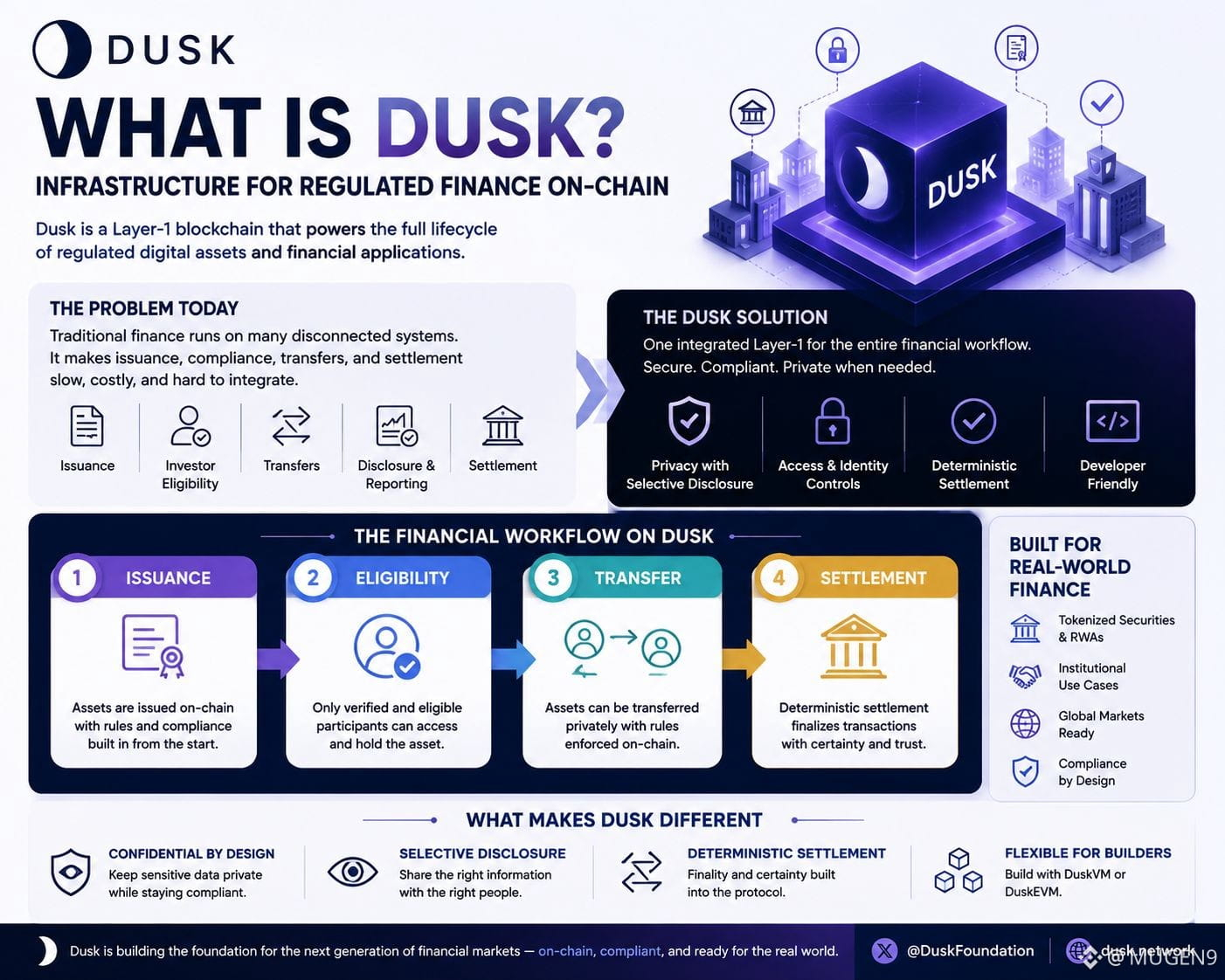
DUSK EXPLAINED: WHAT IS IT ACTUALLY BUILDING?
If you're new to Dusk, here's the simplest way I understand it:
Dusk is a Layer-1 blockchain designed for regulated digital assets and financial applications.
Instead of focusing only on moving tokens around, Dusk is trying to provide infrastructure for the wider financial workflow.
Think about everything that happens around an asset:
• Who is allowed to hold it?
• How can it be transferred?
• What information needs to be disclosed?
• How does settlement happen?
• How can these rules work directly on-chain?
Dusk is designed to bring these pieces together on shared blockchain infrastructure.
It supports regulated asset workflows, access controls, privacy with selective disclosure, and deterministic settlement. Developers can also build using DuskEVM or Dusk's native execution environment.
For me, the interesting part isn't simply "another Layer-1."
It's the idea of building blockchain infrastructure around the actual requirements of financial markets.
💬 If you could put one traditional financial product on-chain first, what would you choose?
Stocks, bonds, funds, or something else?
@Dusk_Foundation $DUSK #dusk
DUSK EXPLAINED: WHAT IS IT ACTUALLY BUILDING?
If you're new to Dusk, here's the simplest way I understand it:
Dusk is a Layer-1 blockchain designed for regulated digital assets and financial applications.
Instead of focusing only on moving tokens around, Dusk is trying to provide infrastructure for the wider financial workflow.
Think about everything that happens around an asset:
• Who is allowed to hold it?
• How can it be transferred?
• What information needs to be disclosed?
• How does settlement happen?
• How can these rules work directly on-chain?
Dusk is designed to bring these pieces together on shared blockchain infrastructure.
It supports regulated asset workflows, access controls, privacy with selective disclosure, and deterministic settlement. Developers can also build using DuskEVM or Dusk's native execution environment.
For me, the interesting part isn't simply "another Layer-1."
It's the idea of building blockchain infrastructure around the actual requirements of financial markets.
💬 If you could put one traditional financial product on-chain first, what would you choose?
Stocks, bonds, funds, or something else?
@Dusk $DUSK #dusk
If you're new to Dusk, here's the simplest way I understand it:
Dusk is a Layer-1 blockchain designed for regulated digital assets and financial applications.
Instead of focusing only on moving tokens around, Dusk is trying to provide infrastructure for the wider financial workflow.
Think about everything that happens around an asset:
• Who is allowed to hold it?
• How can it be transferred?
• What information needs to be disclosed?
• How does settlement happen?
• How can these rules work directly on-chain?
Dusk is designed to bring these pieces together on shared blockchain infrastructure.
It supports regulated asset workflows, access controls, privacy with selective disclosure, and deterministic settlement. Developers can also build using DuskEVM or Dusk's native execution environment.
For me, the interesting part isn't simply "another Layer-1."
It's the idea of building blockchain infrastructure around the actual requirements of financial markets.
💬 If you could put one traditional financial product on-chain first, what would you choose?
Stocks, bonds, funds, or something else?
@Dusk $DUSK #dusk
1
102
·
--
Haussier
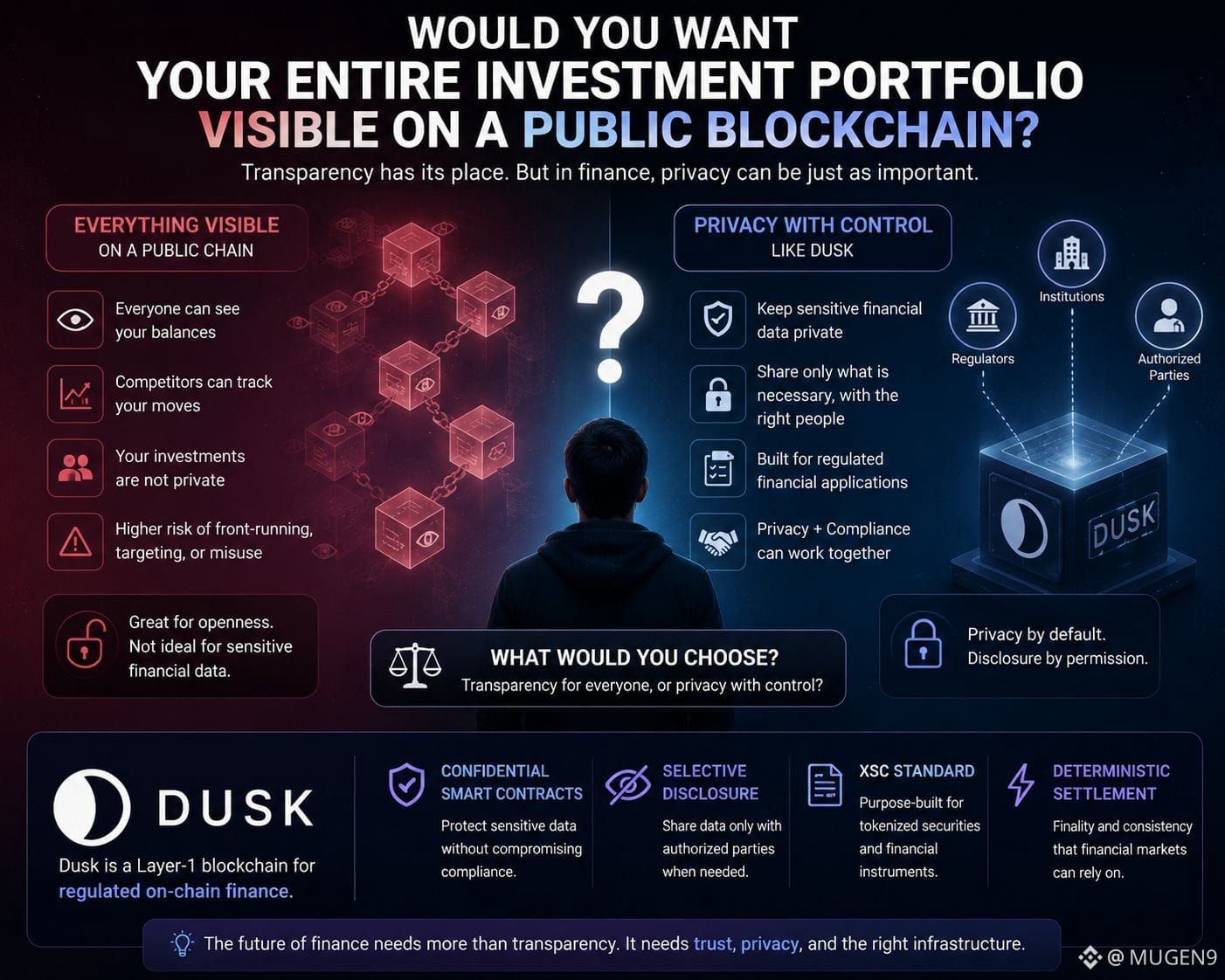
WOULD YOU WANT YOUR ENTIRE INVESTMENT PORTFOLIO VISIBLE ON A PUBLIC BLOCKCHAIN?
Imagine buying stocks, bonds, or other financial assets on-chain.
Everything sounds great until you realize that your balance, transactions, and investment activity could potentially become visible to everyone.
Transparency is valuable in blockchain. But when we're talking about financial markets, privacy can be just as important.
An investor may not want their entire portfolio exposed. A company may not want competitors tracking its financial movements. And regulated institutions may need to prove certain information without revealing everything.
That's what makes Dusk interesting to me.
Dusk is building Layer-1 infrastructure for regulated on-chain finance, with privacy and selective disclosure designed into the system. The idea isn't simply to hide everything, but to control what information is visible and who can access it when disclosure is required.
That creates an interesting balance:
Transparency when it's useful.
Privacy when it's necessary.
Disclosure when it's authorized.
So here's the question:
Would you rather have complete transparency on-chain, or privacy with controlled disclosure?
@Dusk_Foundation $DUSK #Dusk
WOULD YOU WANT YOUR ENTIRE INVESTMENT PORTFOLIO VISIBLE ON A PUBLIC BLOCKCHAIN?
Imagine buying stocks, bonds, or other financial assets on-chain.
Everything sounds great until you realize that your balance, transactions, and investment activity could potentially become visible to everyone.
Transparency is valuable in blockchain. But when we're talking about financial markets, privacy can be just as important.
An investor may not want their entire portfolio exposed. A company may not want competitors tracking its financial movements. And regulated institutions may need to prove certain information without revealing everything.
That's what makes Dusk interesting to me.
Dusk is building Layer-1 infrastructure for regulated on-chain finance, with privacy and selective disclosure designed into the system. The idea isn't simply to hide everything, but to control what information is visible and who can access it when disclosure is required.
That creates an interesting balance:
Transparency when it's useful.
Privacy when it's necessary.
Disclosure when it's authorized.
So here's the question:
Would you rather have complete transparency on-chain, or privacy with controlled disclosure?
@Dusk $DUSK #Dusk
Imagine buying stocks, bonds, or other financial assets on-chain.
Everything sounds great until you realize that your balance, transactions, and investment activity could potentially become visible to everyone.
Transparency is valuable in blockchain. But when we're talking about financial markets, privacy can be just as important.
An investor may not want their entire portfolio exposed. A company may not want competitors tracking its financial movements. And regulated institutions may need to prove certain information without revealing everything.
That's what makes Dusk interesting to me.
Dusk is building Layer-1 infrastructure for regulated on-chain finance, with privacy and selective disclosure designed into the system. The idea isn't simply to hide everything, but to control what information is visible and who can access it when disclosure is required.
That creates an interesting balance:
Transparency when it's useful.
Privacy when it's necessary.
Disclosure when it's authorized.
So here's the question:
Would you rather have complete transparency on-chain, or privacy with controlled disclosure?
@Dusk $DUSK #Dusk
1
90
·
--
Haussier
Which area of the Bitcoin ecosystem do you think deserves the most innovation over the next 5 years?
🛠 Better developer tools
📚 Better education for new users
🌍 More real-world adoption
⚙ Better infrastructure
Bitcoin has come a long way, but there's still plenty of room to grow beyond price discussions.
Different people have different priorities. Some believe better education will bring the next wave of adoption, while others think infrastructure or developer tools will shape Bitcoin's future.
I'm curious where the community stands.
🗳️ Cast your vote and tell us why you chose your answer in the comments!
@babylonlabs_io
$BABY #baby
Which area of the Bitcoin ecosystem do you think deserves the most innovation over the next 5 years?
🛠 Better developer tools
📚 Better education for new users
🌍 More real-world adoption
⚙ Better infrastructure
Bitcoin has come a long way, but there's still plenty of room to grow beyond price discussions.
Different people have different priorities. Some believe better education will bring the next wave of adoption, while others think infrastructure or developer tools will shape Bitcoin's future.
I'm curious where the community stands.
🗳️ Cast your vote and tell us why you chose your answer in the comments!
@BabylonLabs_io
$BABY #baby
🛠 Better developer tools
📚 Better education for new users
🌍 More real-world adoption
⚙ Better infrastructure
Bitcoin has come a long way, but there's still plenty of room to grow beyond price discussions.
Different people have different priorities. Some believe better education will bring the next wave of adoption, while others think infrastructure or developer tools will shape Bitcoin's future.
I'm curious where the community stands.
🗳️ Cast your vote and tell us why you chose your answer in the comments!
@BabylonLabs_io
$BABY #baby
🛠 Better developer tools
0%
Better education for new users
0%
🌍 More real-world adoption
100%
⚙ Better infrastructure
0%
1 Votes • Vote fermé
1
19
Connectez-vous pour découvrir plus de contenu
Rejoignez la communauté mondiale des adeptes de cryptomonnaies sur Binance Square
⚡️ Suviez les dernières informations importantes sur les cryptomonnaies.
💬 Jugé digne de confiance par la plus grande plateforme d’échange de cryptomonnaies au monde.
👍 Découvrez les connaissances que partagent les créateurs vérifiés.
Adresse e-mail/Nº de téléphone