

MEDUSA_WEB3
126 Publications

MEDUSA_WEB3
Signaler
Bloquer l’utilisateur
BP-DF242FE92D19
22 Suivis
30 Abonnés
91 J’aime
Publications
·
--
SAFEPAL X1 JUST GOT EASIER TO UNLOCK ON STON. FI
One cross chain swap, 2,000 Spendable Miles, and one completed mission. These are now the requirements to unlock the SafePal X1 in STON .fi’s Flight Deals campaign, after the previous $200 eligible cross chain swap volume requirement was removed.
For STON. fi users participating in One Swap. Across Chains, the updated requirements are:
• Complete the SafePal crew mission
• Make at least one eligible cross chain swap
• Hold 2,000 Spendable Miles
The SafePal X1 is a non custodial hardware wallet that keeps private keys offline and signs transactions through the device. SafePal supports asset management across more than 200 blockchains through its app.
The SafePal X1 will be shipped after the campaign ends. Flight Deals update every Tuesday, so participants can check for new rewards and missions as they become available.
JOIN THE CAMPAIGN AND EXPLORE THE SAFEPAL X1 REWARD:
https://cross-chain.ston.fi/
SAFEPAL X1 JUST GOT EASIER TO UNLOCK ON STON. FI
One cross chain swap, 2,000 Spendable Miles, and one completed mission. These are now the requirements to unlock the SafePal X1 in STON .fi’s Flight Deals campaign, after the previous $200 eligible cross chain swap volume requirement was removed.
For STON. fi users participating in One Swap. Across Chains, the updated requirements are:
• Complete the SafePal crew mission
• Make at least one eligible cross chain swap
• Hold 2,000 Spendable Miles
The SafePal X1 is a non custodial hardware wallet that keeps private keys offline and signs transactions through the device. SafePal supports asset management across more than 200 blockchains through its app.
The SafePal X1 will be shipped after the campaign ends. Flight Deals update every Tuesday, so participants can check for new rewards and missions as they become available.
JOIN THE CAMPAIGN AND EXPLORE THE SAFEPAL X1 REWARD:
https://cross-chain.ston.fi/
One cross chain swap, 2,000 Spendable Miles, and one completed mission. These are now the requirements to unlock the SafePal X1 in STON .fi’s Flight Deals campaign, after the previous $200 eligible cross chain swap volume requirement was removed.
For STON. fi users participating in One Swap. Across Chains, the updated requirements are:
• Complete the SafePal crew mission
• Make at least one eligible cross chain swap
• Hold 2,000 Spendable Miles
The SafePal X1 is a non custodial hardware wallet that keeps private keys offline and signs transactions through the device. SafePal supports asset management across more than 200 blockchains through its app.
The SafePal X1 will be shipped after the campaign ends. Flight Deals update every Tuesday, so participants can check for new rewards and missions as they become available.
JOIN THE CAMPAIGN AND EXPLORE THE SAFEPAL X1 REWARD:
https://cross-chain.ston.fi/
59
·
--
Haussier
WHAT IS A DEX?
A token swap can look simple on the screen, but several concepts determine what happens behind it. Liquidity, APY, impermanent loss and price impact can all affect how users interact with a decentralized exchange.
For anyone learning DeFi, understanding these terms before swapping or providing liquidity is useful. That is the purpose of STON.fi’s new educational project, “What is DEX”.
START WITH THE BASICS
“What is DEX” explains how decentralized exchanges work, how users make swaps and what liquidity providers do.
These concepts are directly relevant to platforms such as STON.fi, where users can swap supported assets and provide liquidity to pools. Learning the basics makes it easier to understand the information shown when using a DEX.
MULTI CHAIN AND CROSS CHAIN
The project also explains the difference between multi chain and cross chain DEXs.
This is particularly relevant as users interact with assets across different blockchain networks. STON.fi has expanded its cross chain functionality through Omniston, so understanding how cross chain swaps differ from regular swaps can help users understand the process better.
UNDERSTAND THE NUMBERS
“What is DEX” also covers three important concepts: APY, impermanent loss and price impact.
The project includes live calculators that let users explore these metrics themselves. You can use them to understand how estimated rewards work, how providing liquidity can expose you to impermanent loss and how the size of a swap can affect its execution price.
TAKE THE QUIZ
After exploring the material, users can take a short quiz to check their understanding. The quiz is also connected to STON.fi’s “One Swap. Across Chains” campaign, where completed answers may be relevant to a participant’s miles balance.
The project provides educational information, not financial advice. Users should still research assets, pools and transaction conditions before using real funds.
🔗 Explore “What is DEX” and take the quiz: https://whatisdex.com/?task=dex-quiz
WHAT IS A DEX?
A token swap can look simple on the screen, but several concepts determine what happens behind it. Liquidity, APY, impermanent loss and price impact can all affect how users interact with a decentralized exchange.
For anyone learning DeFi, understanding these terms before swapping or providing liquidity is useful. That is the purpose of STON.fi’s new educational project, “What is DEX”.
START WITH THE BASICS
“What is DEX” explains how decentralized exchanges work, how users make swaps and what liquidity providers do.
These concepts are directly relevant to platforms such as STON.fi, where users can swap supported assets and provide liquidity to pools. Learning the basics makes it easier to understand the information shown when using a DEX.
MULTI CHAIN AND CROSS CHAIN
The project also explains the difference between multi chain and cross chain DEXs.
This is particularly relevant as users interact with assets across different blockchain networks. STON.fi has expanded its cross chain functionality through Omniston, so understanding how cross chain swaps differ from regular swaps can help users understand the process better.
UNDERSTAND THE NUMBERS
“What is DEX” also covers three important concepts: APY, impermanent loss and price impact.
The project includes live calculators that let users explore these metrics themselves. You can use them to understand how estimated rewards work, how providing liquidity can expose you to impermanent loss and how the size of a swap can affect its execution price.
TAKE THE QUIZ
After exploring the material, users can take a short quiz to check their understanding. The quiz is also connected to STON.fi’s “One Swap. Across Chains” campaign, where completed answers may be relevant to a participant’s miles balance.
The project provides educational information, not financial advice. Users should still research assets, pools and transaction conditions before using real funds.
🔗 Explore “What is DEX” and take the quiz: https://whatisdex.com/?task=dex-quiz
A token swap can look simple on the screen, but several concepts determine what happens behind it. Liquidity, APY, impermanent loss and price impact can all affect how users interact with a decentralized exchange.
For anyone learning DeFi, understanding these terms before swapping or providing liquidity is useful. That is the purpose of STON.fi’s new educational project, “What is DEX”.
START WITH THE BASICS
“What is DEX” explains how decentralized exchanges work, how users make swaps and what liquidity providers do.
These concepts are directly relevant to platforms such as STON.fi, where users can swap supported assets and provide liquidity to pools. Learning the basics makes it easier to understand the information shown when using a DEX.
MULTI CHAIN AND CROSS CHAIN
The project also explains the difference between multi chain and cross chain DEXs.
This is particularly relevant as users interact with assets across different blockchain networks. STON.fi has expanded its cross chain functionality through Omniston, so understanding how cross chain swaps differ from regular swaps can help users understand the process better.
UNDERSTAND THE NUMBERS
“What is DEX” also covers three important concepts: APY, impermanent loss and price impact.
The project includes live calculators that let users explore these metrics themselves. You can use them to understand how estimated rewards work, how providing liquidity can expose you to impermanent loss and how the size of a swap can affect its execution price.
TAKE THE QUIZ
After exploring the material, users can take a short quiz to check their understanding. The quiz is also connected to STON.fi’s “One Swap. Across Chains” campaign, where completed answers may be relevant to a participant’s miles balance.
The project provides educational information, not financial advice. Users should still research assets, pools and transaction conditions before using real funds.
🔗 Explore “What is DEX” and take the quiz: https://whatisdex.com/?task=dex-quiz
68
·
--
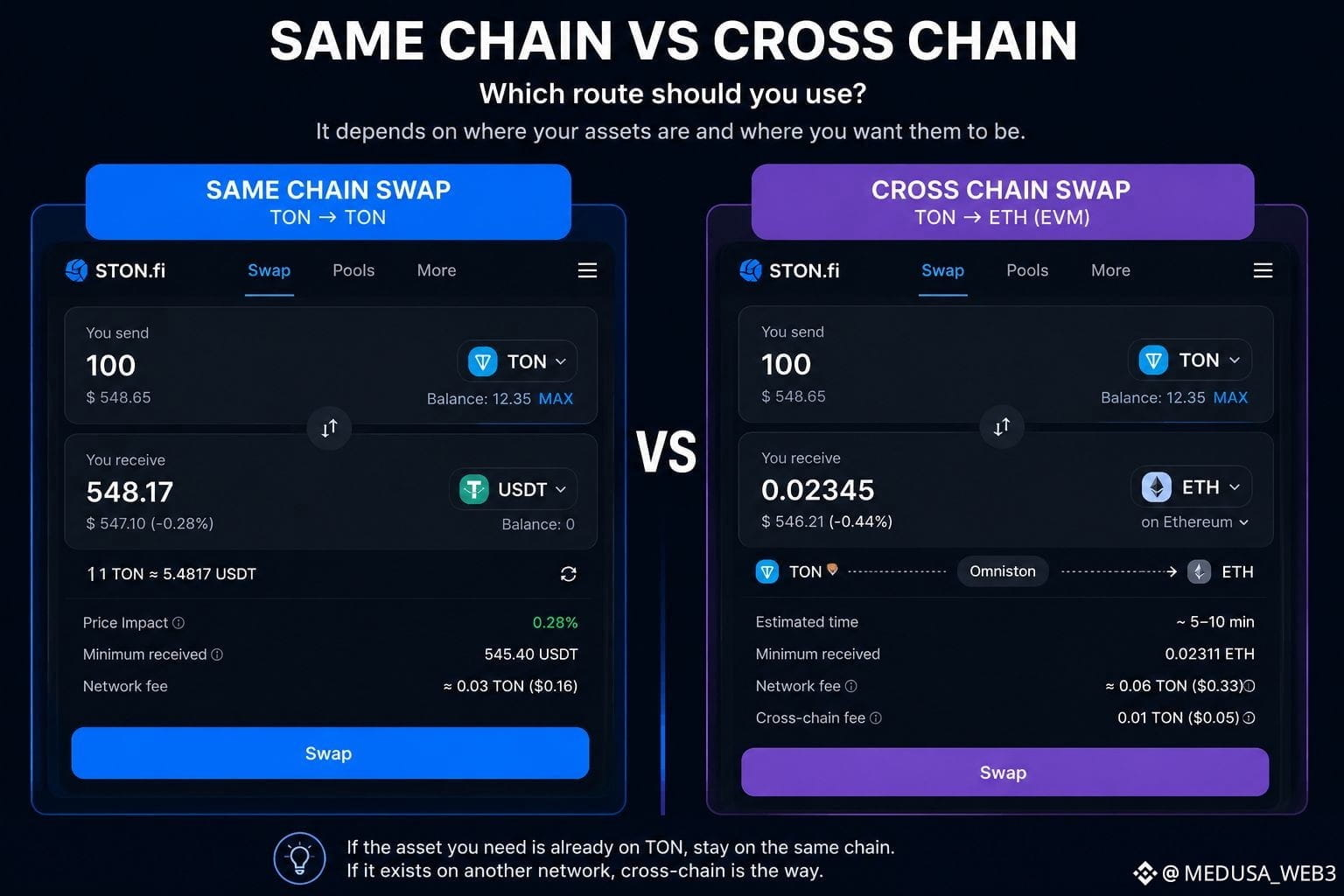
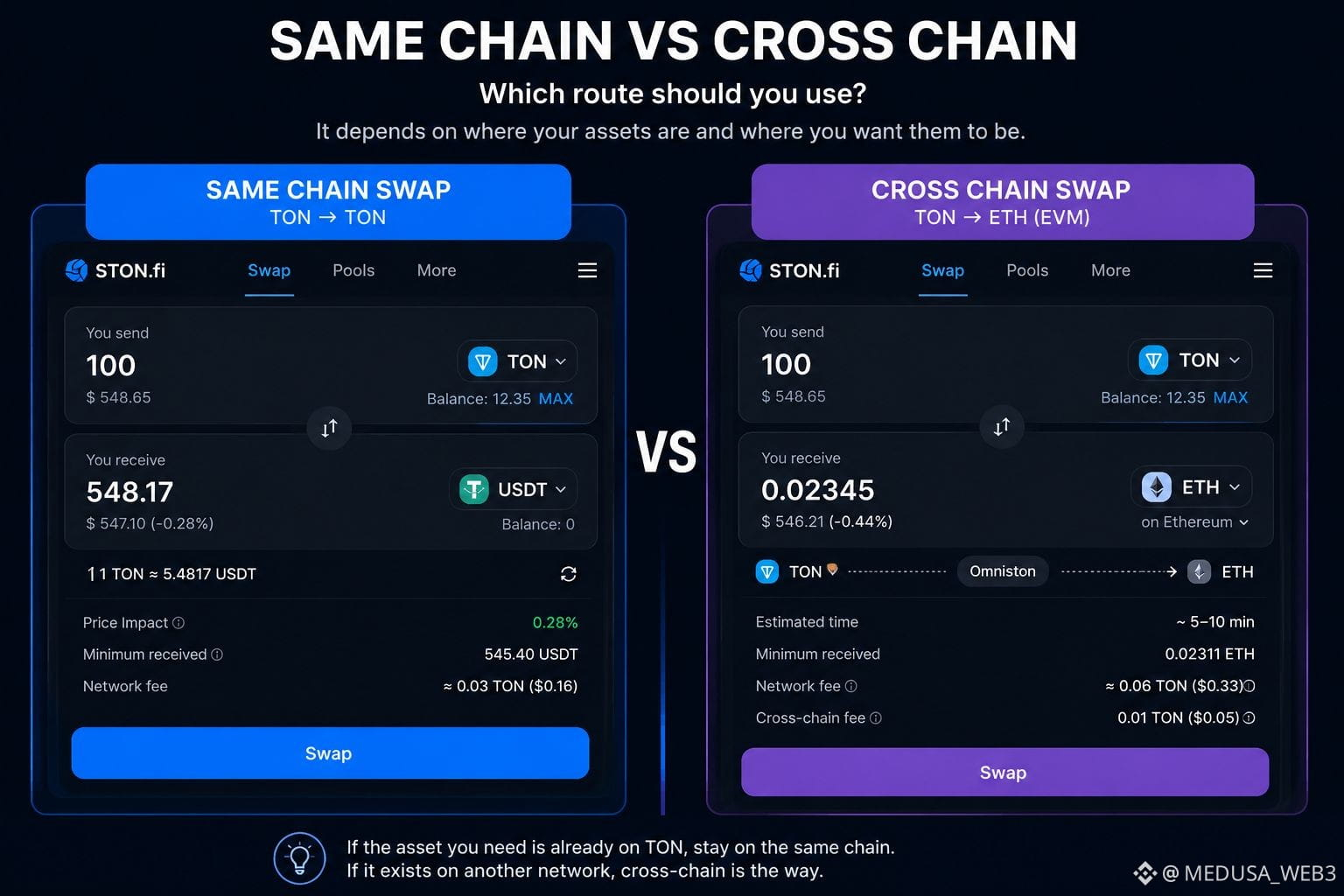
SAME CHAIN OR CROSS CHAIN, WHICH ROUTE SHOULD YOU USE?
If both tokens you want already exist on TON, adding another network to the process may not be necessary. If the asset you need exists on another network, the situation changes.
The first question should therefore be simple: where does the asset you actually want live?
A same chain swap keeps the transaction within one blockchain. You select the asset you have, select the asset you want and execute the swap using available liquidity on that network.
A cross chain swap is different. It is useful when the source asset and destination asset are on different networks.
For example, if you hold an asset on TON but need an asset native to an EVM network, moving value across networks becomes part of the transaction.
Cross chain execution introduces additional considerations. You need to check the destination network, address format, gas requirements and expected amount received.
This does not mean cross chain is always better or worse.
It means the correct route depends on where your assets are and where you need them to end up.
There is also a practical reason to avoid unnecessary steps. Every additional transaction can introduce another fee, another confirmation and another point where something can go wrong.
So before choosing a route, ask two questions.
Is the asset I want already available on my current network?
If not, which destination network actually contains the asset I need?
Choose the simplest route that accomplishes the actual goal.
"Choose your swap route on
Official Site: https://app.ston.fi
SAME CHAIN OR CROSS CHAIN, WHICH ROUTE SHOULD YOU USE?
If both tokens you want already exist on TON, adding another network to the process may not be necessary. If the asset you need exists on another network, the situation changes.
The first question should therefore be simple: where does the asset you actually want live?
A same chain swap keeps the transaction within one blockchain. You select the asset you have, select the asset you want and execute the swap using available liquidity on that network.
A cross chain swap is different. It is useful when the source asset and destination asset are on different networks.
For example, if you hold an asset on TON but need an asset native to an EVM network, moving value across networks becomes part of the transaction.
Cross chain execution introduces additional considerations. You need to check the destination network, address format, gas requirements and expected amount received.
This does not mean cross chain is always better or worse.
It means the correct route depends on where your assets are and where you need them to end up.
There is also a practical reason to avoid unnecessary steps. Every additional transaction can introduce another fee, another confirmation and another point where something can go wrong.
So before choosing a route, ask two questions.
Is the asset I want already available on my current network?
If not, which destination network actually contains the asset I need?
Choose the simplest route that accomplishes the actual goal.
"Choose your swap route on
Official Site: https://app.ston.fi
If both tokens you want already exist on TON, adding another network to the process may not be necessary. If the asset you need exists on another network, the situation changes.
The first question should therefore be simple: where does the asset you actually want live?
A same chain swap keeps the transaction within one blockchain. You select the asset you have, select the asset you want and execute the swap using available liquidity on that network.
A cross chain swap is different. It is useful when the source asset and destination asset are on different networks.
For example, if you hold an asset on TON but need an asset native to an EVM network, moving value across networks becomes part of the transaction.
Cross chain execution introduces additional considerations. You need to check the destination network, address format, gas requirements and expected amount received.
This does not mean cross chain is always better or worse.
It means the correct route depends on where your assets are and where you need them to end up.
There is also a practical reason to avoid unnecessary steps. Every additional transaction can introduce another fee, another confirmation and another point where something can go wrong.
So before choosing a route, ask two questions.
Is the asset I want already available on my current network?
If not, which destination network actually contains the asset I need?
Choose the simplest route that accomplishes the actual goal.
"Choose your swap route on
Official Site: https://app.ston.fi
13
·
--
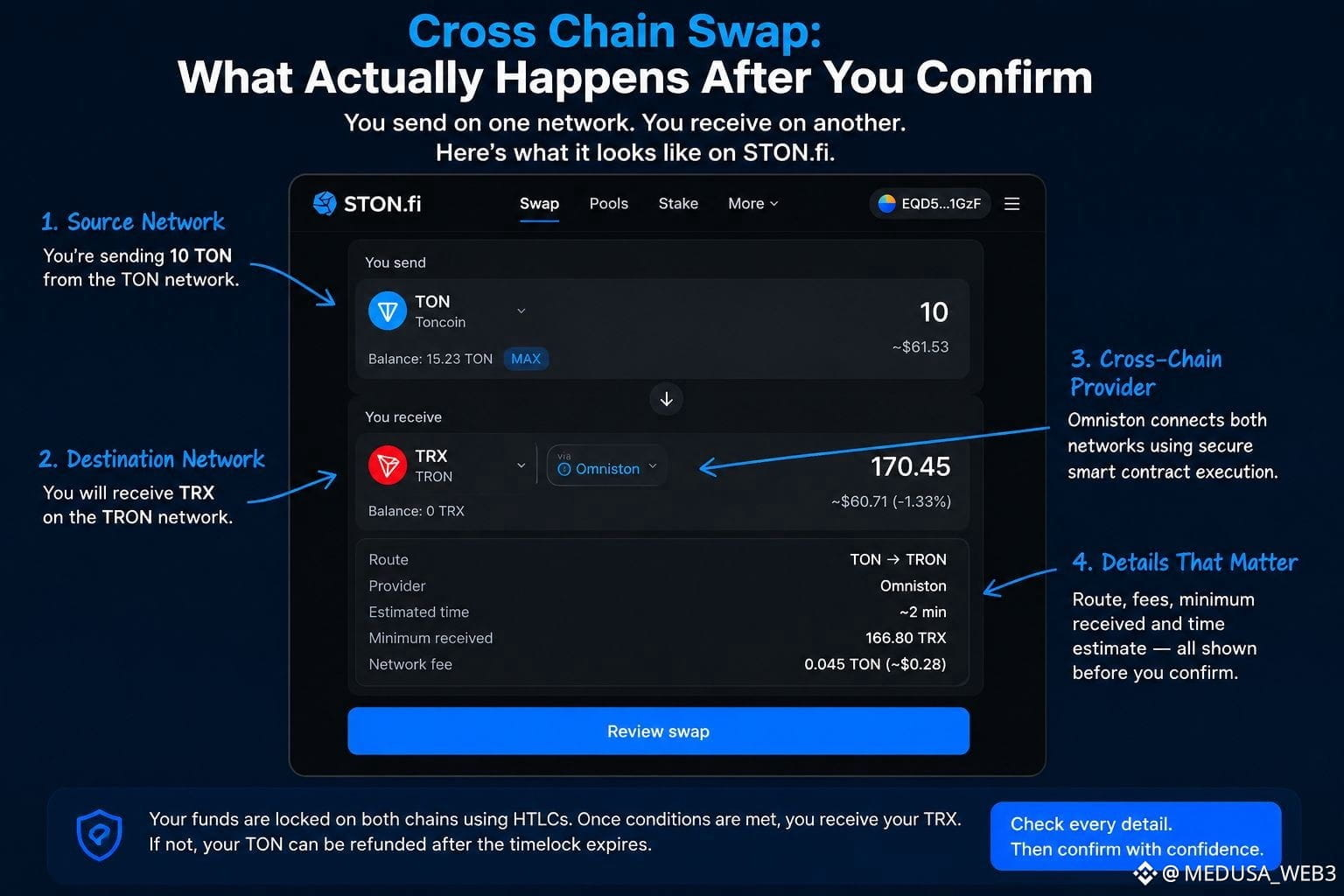
CROSS CHAIN SWAPS, WHAT ACTUALLY HAPPENS AFTER YOU CONFIRM
A cross chain swap involves two networks, two assets and several on chain actions. Unlike a normal same chain swap, the destination asset exists on another blockchain.
So what happens after you press confirm?
STON.fi's cross chain model uses Omniston and smart contract based execution involving liquidity providers called resolvers. The source asset is locked on the originating network while the corresponding destination asset is locked on the other network.
The two sides are connected using Hashed Timelock Contracts, commonly called HTLCs.
The important part is that neither side simply hands funds to a central custodian.
Once the required conditions are satisfied, a cryptographic secret allows the destination asset to be released. The resolver can then claim the source asset using the same mechanism
What happens if the process does not complete?
The timelock provides a refund path. If the required secret is not revealed within the specified period, the locked source funds can become refundable.
There is also a practical detail users should remember, TON and EVM networks use different address formats. A TON address and an EVM address should never be treated as interchangeable.
Before starting a cross chain swap, verify the destination network, destination address, token, expected amount and available gas.
Cross chain trading becomes much easier to understand once you stop viewing it as one transaction and start viewing it as coordinated execution across two networks.
Check every field before confirming.
"Try a cross chain swap on STON.fi"
𝐎𝐟𝐟𝐢𝐜𝐢𝐚𝐥 𝐑𝐞𝐬𝐨𝐮𝐫𝐜𝐞𝐬:
Official Site: https://app.ston.fi
CROSS CHAIN SWAPS, WHAT ACTUALLY HAPPENS AFTER YOU CONFIRM
A cross chain swap involves two networks, two assets and several on chain actions. Unlike a normal same chain swap, the destination asset exists on another blockchain.
So what happens after you press confirm?
STON.fi's cross chain model uses Omniston and smart contract based execution involving liquidity providers called resolvers. The source asset is locked on the originating network while the corresponding destination asset is locked on the other network.
The two sides are connected using Hashed Timelock Contracts, commonly called HTLCs.
The important part is that neither side simply hands funds to a central custodian.
Once the required conditions are satisfied, a cryptographic secret allows the destination asset to be released. The resolver can then claim the source asset using the same mechanism
What happens if the process does not complete?
The timelock provides a refund path. If the required secret is not revealed within the specified period, the locked source funds can become refundable.
There is also a practical detail users should remember, TON and EVM networks use different address formats. A TON address and an EVM address should never be treated as interchangeable.
Before starting a cross chain swap, verify the destination network, destination address, token, expected amount and available gas.
Cross chain trading becomes much easier to understand once you stop viewing it as one transaction and start viewing it as coordinated execution across two networks.
Check every field before confirming.
"Try a cross chain swap on STON.fi"
𝐎𝐟𝐟𝐢𝐜𝐢𝐚𝐥 𝐑𝐞𝐬𝐨𝐮𝐫𝐜𝐞𝐬:
Official Site: https://app.ston.fi
A cross chain swap involves two networks, two assets and several on chain actions. Unlike a normal same chain swap, the destination asset exists on another blockchain.
So what happens after you press confirm?
STON.fi's cross chain model uses Omniston and smart contract based execution involving liquidity providers called resolvers. The source asset is locked on the originating network while the corresponding destination asset is locked on the other network.
The two sides are connected using Hashed Timelock Contracts, commonly called HTLCs.
The important part is that neither side simply hands funds to a central custodian.
Once the required conditions are satisfied, a cryptographic secret allows the destination asset to be released. The resolver can then claim the source asset using the same mechanism
What happens if the process does not complete?
The timelock provides a refund path. If the required secret is not revealed within the specified period, the locked source funds can become refundable.
There is also a practical detail users should remember, TON and EVM networks use different address formats. A TON address and an EVM address should never be treated as interchangeable.
Before starting a cross chain swap, verify the destination network, destination address, token, expected amount and available gas.
Cross chain trading becomes much easier to understand once you stop viewing it as one transaction and start viewing it as coordinated execution across two networks.
Check every field before confirming.
"Try a cross chain swap on STON.fi"
𝐎𝐟𝐟𝐢𝐜𝐢𝐚𝐥 𝐑𝐞𝐬𝐨𝐮𝐫𝐜𝐞𝐬:
Official Site: https://app.ston.fi
3
·
--
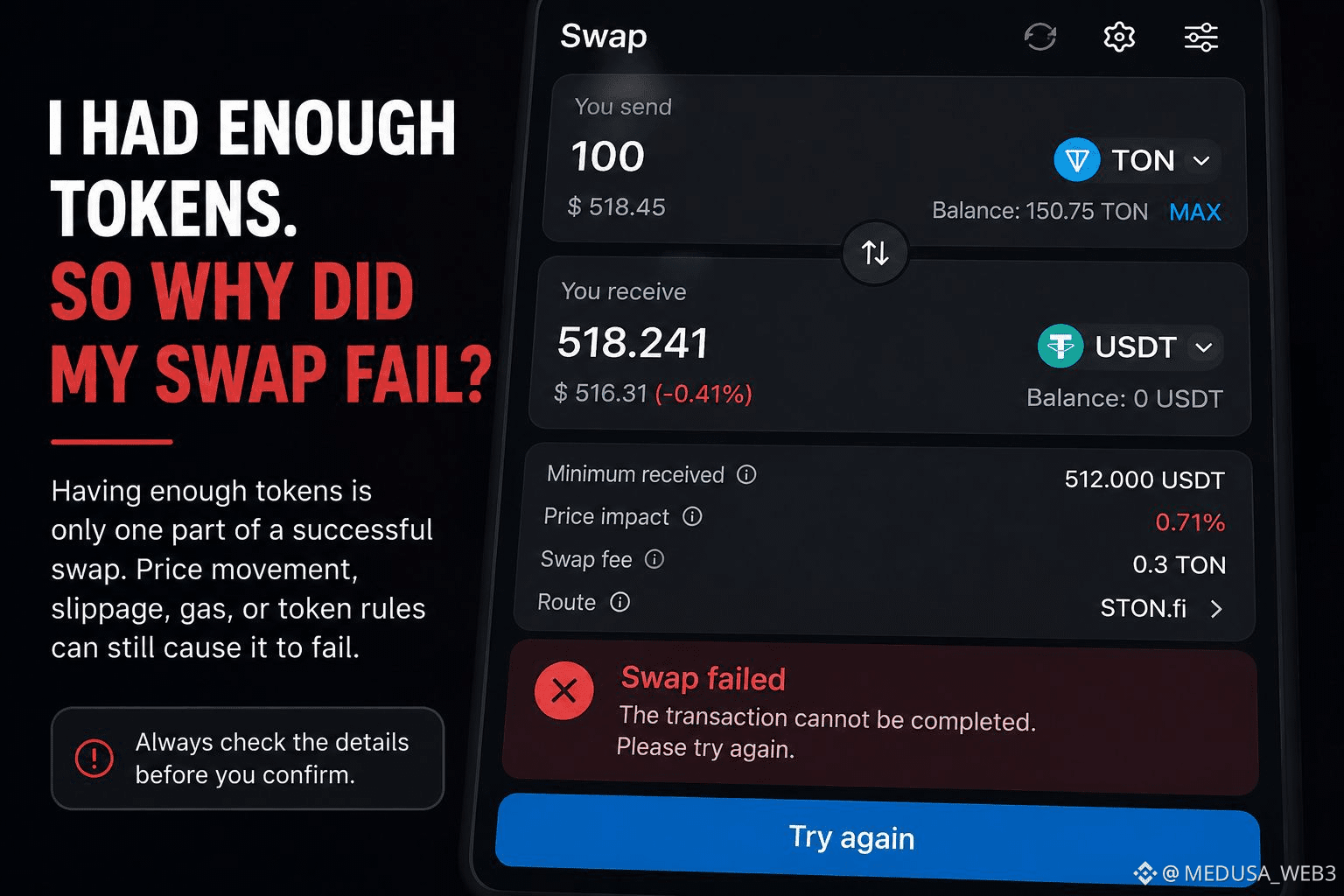
WHY A SWAP CAN FAIL EVEN WHEN YOU HAVE ENOUGH TOKENS
You can have enough tokens in your wallet and still see a swap fail. Having the required asset is only one part of a successful transaction.
There are several other conditions involved.
One common reason is price movement. If the executable price moves beyond the permitted range before settlement, the transaction may no longer satisfy the conditions of the swap.
Network conditions can also matter. During periods of congestion, transactions may take longer to process. A quote that was valid when you started may no longer be suitable when execution finally happens.
There is also the issue of gas.
Your wallet needs enough of the network's native asset to pay for the transaction. Having 1,000 USDT does not help if your wallet does not have enough TON to execute a TON transaction.
Token behaviour can create another problem. Some tokens apply transfer deductions or other restrictions that affect how a swap settles.
This is why checking only your token balance is not enough.
Before confirming, check the amount you will receive, the price impact, the minimum received figure and whether your wallet has enough native network gas.
If the swap fails, do not immediately assume that the platform took your tokens. Check the transaction status and the reason for failure first.
A successful swap depends on more than having enough of the asset you want to trade.
Check the whole transaction before you confirm it.
"Make your next swap on STON.fi"
𝐎𝐟𝐟𝐢𝐜𝐢𝐚𝐥 𝐑𝐞𝐬𝐨𝐮𝐫𝐜𝐞𝐬:
Official Site: https://app.ston.fi
WHY A SWAP CAN FAIL EVEN WHEN YOU HAVE ENOUGH TOKENS
You can have enough tokens in your wallet and still see a swap fail. Having the required asset is only one part of a successful transaction.
There are several other conditions involved.
One common reason is price movement. If the executable price moves beyond the permitted range before settlement, the transaction may no longer satisfy the conditions of the swap.
Network conditions can also matter. During periods of congestion, transactions may take longer to process. A quote that was valid when you started may no longer be suitable when execution finally happens.
There is also the issue of gas.
Your wallet needs enough of the network's native asset to pay for the transaction. Having 1,000 USDT does not help if your wallet does not have enough TON to execute a TON transaction.
Token behaviour can create another problem. Some tokens apply transfer deductions or other restrictions that affect how a swap settles.
This is why checking only your token balance is not enough.
Before confirming, check the amount you will receive, the price impact, the minimum received figure and whether your wallet has enough native network gas.
If the swap fails, do not immediately assume that the platform took your tokens. Check the transaction status and the reason for failure first.
A successful swap depends on more than having enough of the asset you want to trade.
Check the whole transaction before you confirm it.
"Make your next swap on STON.fi"
𝐎𝐟𝐟𝐢𝐜𝐢𝐚𝐥 𝐑𝐞𝐬𝐨𝐮𝐫𝐜𝐞𝐬:
Official Site: https://app.ston.fi
You can have enough tokens in your wallet and still see a swap fail. Having the required asset is only one part of a successful transaction.
There are several other conditions involved.
One common reason is price movement. If the executable price moves beyond the permitted range before settlement, the transaction may no longer satisfy the conditions of the swap.
Network conditions can also matter. During periods of congestion, transactions may take longer to process. A quote that was valid when you started may no longer be suitable when execution finally happens.
There is also the issue of gas.
Your wallet needs enough of the network's native asset to pay for the transaction. Having 1,000 USDT does not help if your wallet does not have enough TON to execute a TON transaction.
Token behaviour can create another problem. Some tokens apply transfer deductions or other restrictions that affect how a swap settles.
This is why checking only your token balance is not enough.
Before confirming, check the amount you will receive, the price impact, the minimum received figure and whether your wallet has enough native network gas.
If the swap fails, do not immediately assume that the platform took your tokens. Check the transaction status and the reason for failure first.
A successful swap depends on more than having enough of the asset you want to trade.
Check the whole transaction before you confirm it.
"Make your next swap on STON.fi"
𝐎𝐟𝐟𝐢𝐜𝐢𝐚𝐥 𝐑𝐞𝐬𝐨𝐮𝐫𝐜𝐞𝐬:
Official Site: https://app.ston.fi
34
·
--
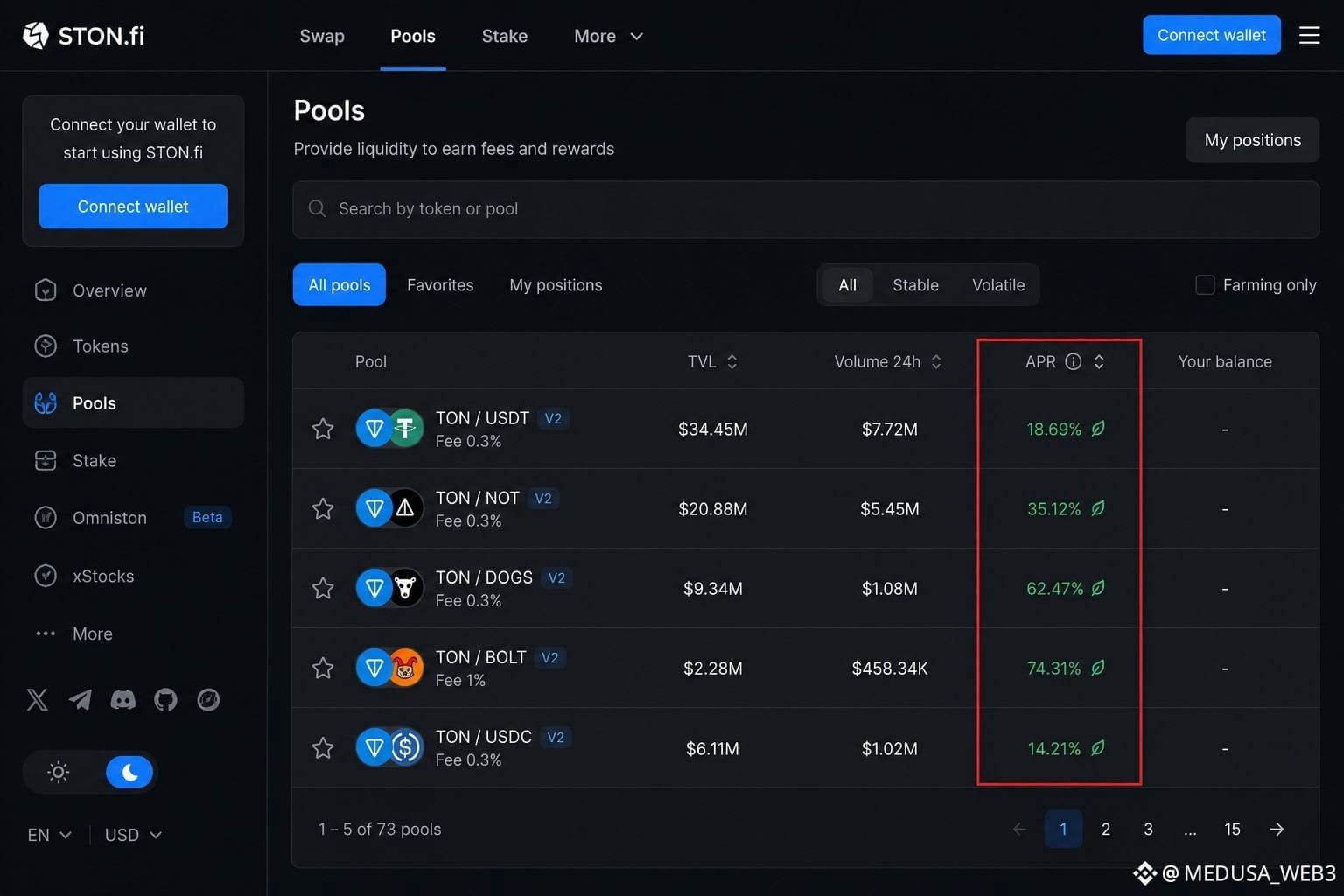
WHY STON.FI POOL APR CAN CHANGE FROM ONE DAY TO ANOTHER
Pools change, it's normal. Yesterday you checked a pool and saw one APR. Today you open the same pool and the number has changed. Did something go wrong with your position?
Not necessarily.
Pool APR can change because the conditions used to calculate the displayed rate can change.
Trading activity is one factor. More trading can generate more fees for liquidity providers. Lower activity can reduce fee generation.
Farming incentives can also affect the displayed return. If a farming campaign changes or ends, the reward component can change with it.
STON.fi's liquidity guide specifically recommends checking pool conditions regularly because rates, trading volume and incentive programs can change over time.
This is why a pool showing 30 percent APR today should not be interpreted as a fixed 30 percent rate for the entire year.
Your position may remain active while the conditions around it change.
For a liquidity provider, this means checking the pool periodically is part of managing the position.
Look at the current APR, trading activity, farming status and any campaign dates rather than relying on a number you saw when you first deposited.
The important question is not “What was the APR when I entered?”
It is “What are the current conditions now?”
Check the current pool information on https://app.ston.fi/pools
WHY STON.FI POOL APR CAN CHANGE FROM ONE DAY TO ANOTHER
Pools change, it's normal. Yesterday you checked a pool and saw one APR. Today you open the same pool and the number has changed. Did something go wrong with your position?
Not necessarily.
Pool APR can change because the conditions used to calculate the displayed rate can change.
Trading activity is one factor. More trading can generate more fees for liquidity providers. Lower activity can reduce fee generation.
Farming incentives can also affect the displayed return. If a farming campaign changes or ends, the reward component can change with it.
STON.fi's liquidity guide specifically recommends checking pool conditions regularly because rates, trading volume and incentive programs can change over time.
This is why a pool showing 30 percent APR today should not be interpreted as a fixed 30 percent rate for the entire year.
Your position may remain active while the conditions around it change.
For a liquidity provider, this means checking the pool periodically is part of managing the position.
Look at the current APR, trading activity, farming status and any campaign dates rather than relying on a number you saw when you first deposited.
The important question is not “What was the APR when I entered?”
It is “What are the current conditions now?”
Check the current pool information on https://app.ston.fi/pools
Pools change, it's normal. Yesterday you checked a pool and saw one APR. Today you open the same pool and the number has changed. Did something go wrong with your position?
Not necessarily.
Pool APR can change because the conditions used to calculate the displayed rate can change.
Trading activity is one factor. More trading can generate more fees for liquidity providers. Lower activity can reduce fee generation.
Farming incentives can also affect the displayed return. If a farming campaign changes or ends, the reward component can change with it.
STON.fi's liquidity guide specifically recommends checking pool conditions regularly because rates, trading volume and incentive programs can change over time.
This is why a pool showing 30 percent APR today should not be interpreted as a fixed 30 percent rate for the entire year.
Your position may remain active while the conditions around it change.
For a liquidity provider, this means checking the pool periodically is part of managing the position.
Look at the current APR, trading activity, farming status and any campaign dates rather than relying on a number you saw when you first deposited.
The important question is not “What was the APR when I entered?”
It is “What are the current conditions now?”
Check the current pool information on https://app.ston.fi/pools
283
·
--
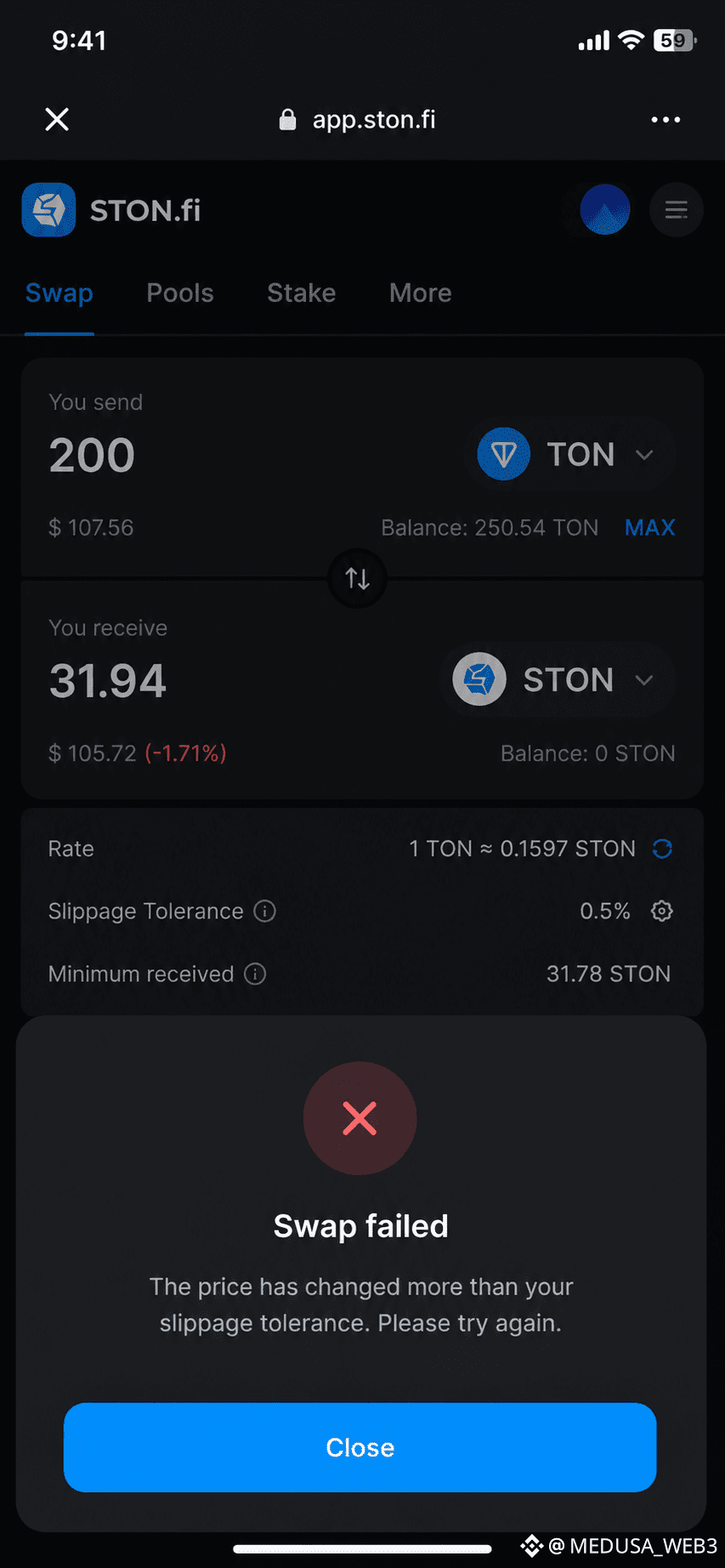
WHY YOUR SWAP GAVE YOU LESS THAN EXPECTED, AND HOW TO FIX IT
A trader submits a swap expecting one output amount, then watches the confirmed transaction settle for a slightly different amount, and assumes something went wrong. Two separate mechanics explain nearly every case like this, and they are not the same thing.
Price impact is the direct effect of your own trade size on the pool's pricing. Since STON.fi's pools use an automated formula rather than an order book, a larger trade relative to the pool's liquidity moves the price further before the trade completes. This is predictable and shown to you before you confirm a swap.
Slippage is different. It is the gap between the price quoted when you submitted the swap and the price actually available by the time the transaction confirms on chain, caused by other trades happening in between. Slippage tolerance is the setting that controls how much of that gap you will accept before the transaction cancels automatically rather than executing at a worse rate.
Setting tolerance too low causes failed transactions during normal market activity, since even small price movement between submission and confirmation exceeds the limit. Setting it too high risks accepting a materially worse rate than expected, particularly on pools with thinner liquidity. Checking a pool's TVL before a large swap gives a sense of how much price impact to expect before slippage even becomes a factor.
Preview price impact before you confirm any swap: https://blog.ston.fi/all-you-need-to-know-about-price-impact-on-decentralized-exchanges/
WHY YOUR SWAP GAVE YOU LESS THAN EXPECTED, AND HOW TO FIX IT
A trader submits a swap expecting one output amount, then watches the confirmed transaction settle for a slightly different amount, and assumes something went wrong. Two separate mechanics explain nearly every case like this, and they are not the same thing.
Price impact is the direct effect of your own trade size on the pool's pricing. Since STON.fi's pools use an automated formula rather than an order book, a larger trade relative to the pool's liquidity moves the price further before the trade completes. This is predictable and shown to you before you confirm a swap.
Slippage is different. It is the gap between the price quoted when you submitted the swap and the price actually available by the time the transaction confirms on chain, caused by other trades happening in between. Slippage tolerance is the setting that controls how much of that gap you will accept before the transaction cancels automatically rather than executing at a worse rate.
Setting tolerance too low causes failed transactions during normal market activity, since even small price movement between submission and confirmation exceeds the limit. Setting it too high risks accepting a materially worse rate than expected, particularly on pools with thinner liquidity. Checking a pool's TVL before a large swap gives a sense of how much price impact to expect before slippage even becomes a factor.
Preview price impact before you confirm any swap: https://blog.ston.fi/all-you-need-to-know-about-price-impact-on-decentralized-exchanges/
A trader submits a swap expecting one output amount, then watches the confirmed transaction settle for a slightly different amount, and assumes something went wrong. Two separate mechanics explain nearly every case like this, and they are not the same thing.
Price impact is the direct effect of your own trade size on the pool's pricing. Since STON.fi's pools use an automated formula rather than an order book, a larger trade relative to the pool's liquidity moves the price further before the trade completes. This is predictable and shown to you before you confirm a swap.
Slippage is different. It is the gap between the price quoted when you submitted the swap and the price actually available by the time the transaction confirms on chain, caused by other trades happening in between. Slippage tolerance is the setting that controls how much of that gap you will accept before the transaction cancels automatically rather than executing at a worse rate.
Setting tolerance too low causes failed transactions during normal market activity, since even small price movement between submission and confirmation exceeds the limit. Setting it too high risks accepting a materially worse rate than expected, particularly on pools with thinner liquidity. Checking a pool's TVL before a large swap gives a sense of how much price impact to expect before slippage even becomes a factor.
Preview price impact before you confirm any swap: https://blog.ston.fi/all-you-need-to-know-about-price-impact-on-decentralized-exchanges/
45
·
--
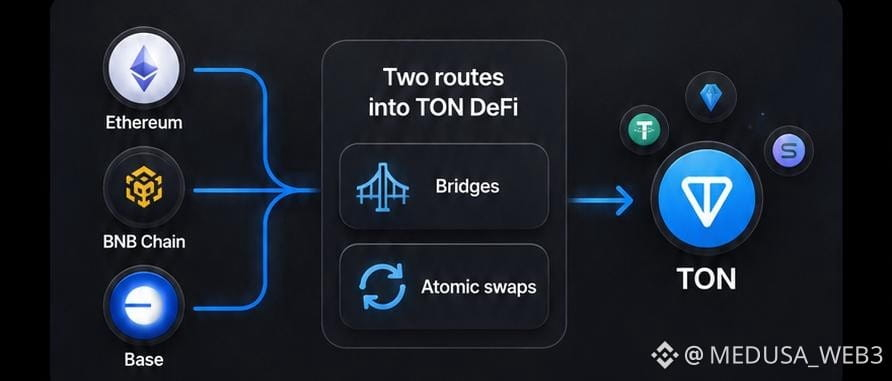
TWO WAYS TO MOVE FUNDS FROM ETHEREUM, BNB CHAIN, AND BASE INTO TON DEFI
In August 2026, STON.fi published a breakdown of how traders actually get assets from Ethereum, BNB Chain, or Base into TON DeFi. There are only two routes, and they behave very differently once funds leave the source chain.
A bridge locks or burns the original asset and mints a wrapped version on the destination chain. That wrapped token depends on the bridge staying solvent and secure for as long as it is held. An atomic swap, by contrast, settles through a resolver using a hash time locked contract. Either both sides of the trade complete, or the whole swap reverts and funds return to the sender. Nothing sits wrapped, and nothing is left in a pending state.
STON.fi's cross chain flow uses the second model through Omniston, its liquidity execution layer. A trader on Base holding USDC can swap directly into TON assets without a separate bridge step, a wrapped token, or a manual claimtransaction.
For anyone comparing routes into TON, the practical difference is custody. A bridge asset carries the bridge's risk indefinitely. An atomic swap either finishes or it does not happen at all.
Try a cross chain swap yourself and see the route before you commit: app.ston.fi/swap
TWO WAYS TO MOVE FUNDS FROM ETHEREUM, BNB CHAIN, AND BASE INTO TON DEFI
In August 2026, STON.fi published a breakdown of how traders actually get assets from Ethereum, BNB Chain, or Base into TON DeFi. There are only two routes, and they behave very differently once funds leave the source chain.
A bridge locks or burns the original asset and mints a wrapped version on the destination chain. That wrapped token depends on the bridge staying solvent and secure for as long as it is held. An atomic swap, by contrast, settles through a resolver using a hash time locked contract. Either both sides of the trade complete, or the whole swap reverts and funds return to the sender. Nothing sits wrapped, and nothing is left in a pending state.
STON.fi's cross chain flow uses the second model through Omniston, its liquidity execution layer. A trader on Base holding USDC can swap directly into TON assets without a separate bridge step, a wrapped token, or a manual claimtransaction.
For anyone comparing routes into TON, the practical difference is custody. A bridge asset carries the bridge's risk indefinitely. An atomic swap either finishes or it does not happen at all.
Try a cross chain swap yourself and see the route before you commit: app.ston.fi/swap
In August 2026, STON.fi published a breakdown of how traders actually get assets from Ethereum, BNB Chain, or Base into TON DeFi. There are only two routes, and they behave very differently once funds leave the source chain.
A bridge locks or burns the original asset and mints a wrapped version on the destination chain. That wrapped token depends on the bridge staying solvent and secure for as long as it is held. An atomic swap, by contrast, settles through a resolver using a hash time locked contract. Either both sides of the trade complete, or the whole swap reverts and funds return to the sender. Nothing sits wrapped, and nothing is left in a pending state.
STON.fi's cross chain flow uses the second model through Omniston, its liquidity execution layer. A trader on Base holding USDC can swap directly into TON assets without a separate bridge step, a wrapped token, or a manual claimtransaction.
For anyone comparing routes into TON, the practical difference is custody. A bridge asset carries the bridge's risk indefinitely. An atomic swap either finishes or it does not happen at all.
Try a cross chain swap yourself and see the route before you commit: app.ston.fi/swap
39
·
--
Haussier
CROSS CHAIN DEFI RISKS ON STON.FI AND OMNISTON
I almost moved funds to another blockchain because I found a better opportunity. Before confirming the swap, I paused and asked whether getting there would cost more than I expected. That is a question every cross chain user should ask because the route matters just as much as the destination.
Many DeFi opportunities exist on different blockchains. A traditional bridge locks assets on one chain before creating a wrapped version on another. This adds extra steps, more fees and another layer that users depend on before they can use their funds.
How Omniston Works Differently
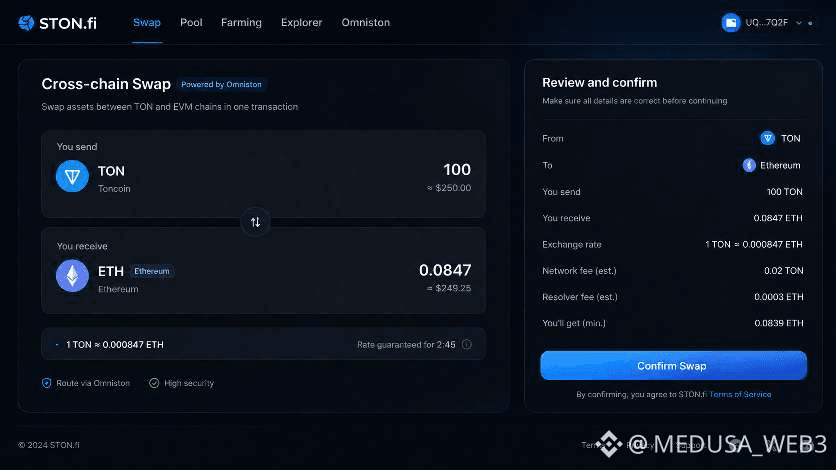
STON.fi uses Omniston for supported cross chain swaps between TON and selected EVM networks. Instead of a shared bridge contract, Omniston uses paired Hashed Timelock Contracts and professional resolvers. I request a quote, approve it and receive the native asset on the destination chain without handling a separate bridge transaction.
What Users Should Know
Bridge routes can involve several fees and longer waiting times while assets move across chains. Omniston removes the shared bridge layer from the process. If execution cannot be completed, the protocol follows its settlement rules instead of leaving the transaction in an uncertain state. The quoted price is also the price that executes, making the result more predictable.
Final Thoughts
Cross chain access is not only about reaching another blockchain. It is also about understanding how your assets get there. Knowing the difference between bridge based transfers and Omniston helps users make better decisions before confirming a swap.
Learn more and try cross chain swaps on STON.fi: app.ston.fi/swap?mode=cross-ch...
𝐎𝐟𝐟𝐢𝐜𝐢𝐚𝐥 𝐑𝐞𝐬𝐨𝐮𝐫𝐜𝐞𝐬:
Official Site: ston.fi
CROSS CHAIN DEFI RISKS ON STON.FI AND OMNISTON
I almost moved funds to another blockchain because I found a better opportunity. Before confirming the swap, I paused and asked whether getting there would cost more than I expected. That is a question every cross chain user should ask because the route matters just as much as the destination.
Many DeFi opportunities exist on different blockchains. A traditional bridge locks assets on one chain before creating a wrapped version on another. This adds extra steps, more fees and another layer that users depend on before they can use their funds.
How Omniston Works Differently
STON.fi uses Omniston for supported cross chain swaps between TON and selected EVM networks. Instead of a shared bridge contract, Omniston uses paired Hashed Timelock Contracts and professional resolvers. I request a quote, approve it and receive the native asset on the destination chain without handling a separate bridge transaction.
What Users Should Know
Bridge routes can involve several fees and longer waiting times while assets move across chains. Omniston removes the shared bridge layer from the process. If execution cannot be completed, the protocol follows its settlement rules instead of leaving the transaction in an uncertain state. The quoted price is also the price that executes, making the result more predictable.
Final Thoughts
Cross chain access is not only about reaching another blockchain. It is also about understanding how your assets get there. Knowing the difference between bridge based transfers and Omniston helps users make better decisions before confirming a swap.
Learn more and try cross chain swaps on STON.fi: app.ston.fi/swap?mode=cross-ch...
𝐎𝐟𝐟𝐢𝐜𝐢𝐚𝐥 𝐑𝐞𝐬𝐨𝐮𝐫𝐜𝐞𝐬:
Official Site: ston.fi
I almost moved funds to another blockchain because I found a better opportunity. Before confirming the swap, I paused and asked whether getting there would cost more than I expected. That is a question every cross chain user should ask because the route matters just as much as the destination.
Many DeFi opportunities exist on different blockchains. A traditional bridge locks assets on one chain before creating a wrapped version on another. This adds extra steps, more fees and another layer that users depend on before they can use their funds.
How Omniston Works Differently
STON.fi uses Omniston for supported cross chain swaps between TON and selected EVM networks. Instead of a shared bridge contract, Omniston uses paired Hashed Timelock Contracts and professional resolvers. I request a quote, approve it and receive the native asset on the destination chain without handling a separate bridge transaction.
What Users Should Know
Bridge routes can involve several fees and longer waiting times while assets move across chains. Omniston removes the shared bridge layer from the process. If execution cannot be completed, the protocol follows its settlement rules instead of leaving the transaction in an uncertain state. The quoted price is also the price that executes, making the result more predictable.
Final Thoughts
Cross chain access is not only about reaching another blockchain. It is also about understanding how your assets get there. Knowing the difference between bridge based transfers and Omniston helps users make better decisions before confirming a swap.
Learn more and try cross chain swaps on STON.fi: app.ston.fi/swap?mode=cross-ch...
𝐎𝐟𝐟𝐢𝐜𝐢𝐚𝐥 𝐑𝐞𝐬𝐨𝐮𝐫𝐜𝐞𝐬:
Official Site: ston.fi
51
·
--
MINIMUM RECEIVED, THE NUMBER YOU SHOULD CHECK BEFORE SWAPPING
Imagine your swap shows that you should receive 500 tokens. You confirm the transaction, but the market moves before settlement. What protects you from receiving substantially less?
The answer is the minimum received amount.
A swap does not always settle at exactly the number shown when you first open the transaction. Market prices can change between the quote and execution.
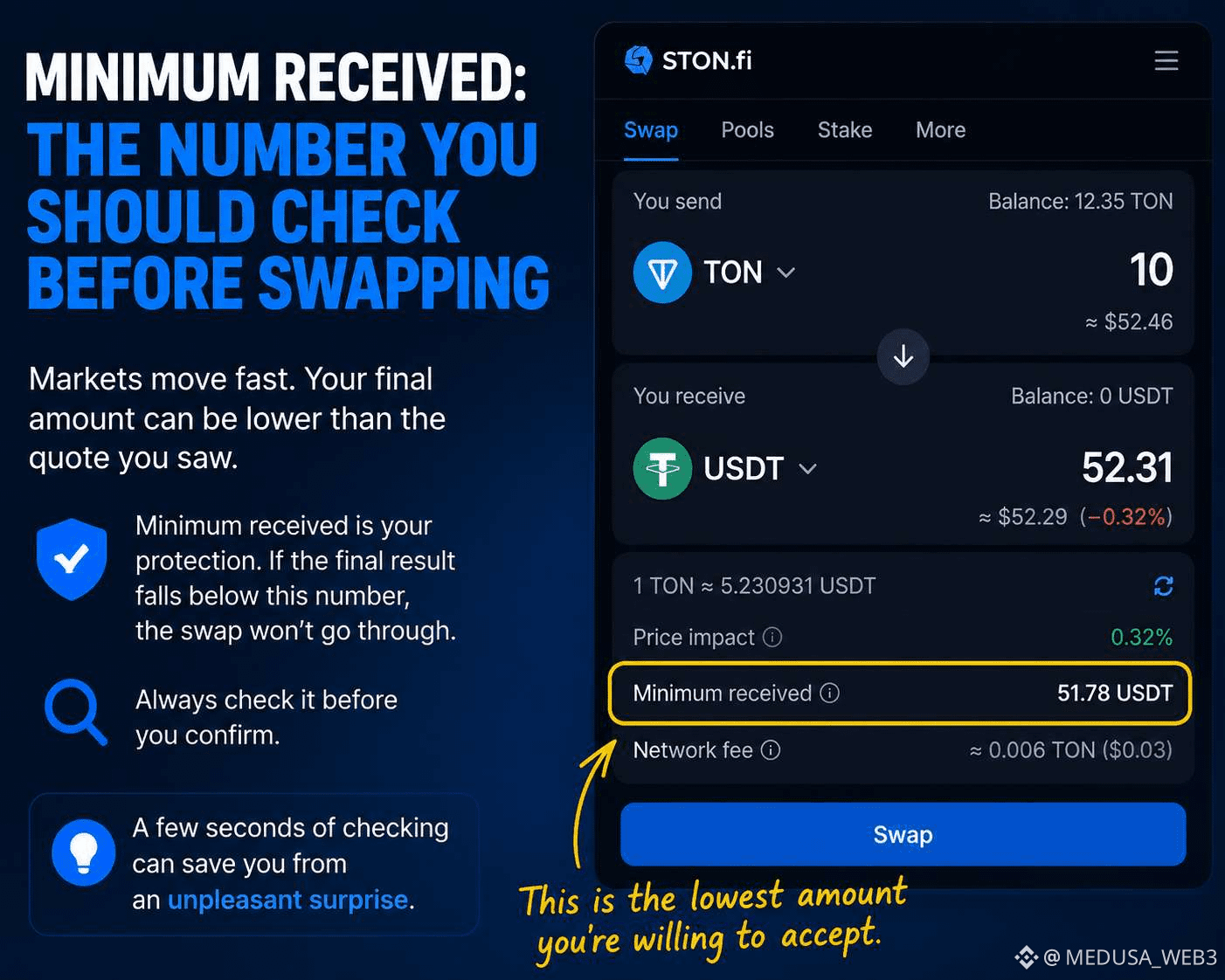
Minimum received establishes the lowest amount you are willing to accept.
For example, if your transaction allows a minimum received amount of 495 tokens, the swap should not complete if the executable result falls below that threshold. Instead, the transaction can fail rather than giving you an unacceptable result.
This is particularly important during volatile markets, when prices can change quickly.
It is also useful to understand what minimum received does not protect you from. It does not make a bad price good. It simply establishes a floor for the amount you will accept.
That means you should still inspect the quote before confirming.
Look at the amount you will receive. Check the price impact. Check the minimum received. Then decide whether the transaction still makes sense.
A few seconds of checking these figures can prevent an unpleasant surprise after settlement.
Before your next swap, do not look only at the token you are sending. Look carefully at the token you are actually going to receive.
"Review your swap details on STON.fi"
𝐎𝐟𝐟𝐢𝐜𝐢𝐚𝐥 𝐑𝐞𝐬𝐨𝐮𝐫𝐜𝐞𝐬:
Official Site: app.ston.fi
MINIMUM RECEIVED, THE NUMBER YOU SHOULD CHECK BEFORE SWAPPING
Imagine your swap shows that you should receive 500 tokens. You confirm the transaction, but the market moves before settlement. What protects you from receiving substantially less?
The answer is the minimum received amount.
A swap does not always settle at exactly the number shown when you first open the transaction. Market prices can change between the quote and execution.
Minimum received establishes the lowest amount you are willing to accept.
For example, if your transaction allows a minimum received amount of 495 tokens, the swap should not complete if the executable result falls below that threshold. Instead, the transaction can fail rather than giving you an unacceptable result.
This is particularly important during volatile markets, when prices can change quickly.
It is also useful to understand what minimum received does not protect you from. It does not make a bad price good. It simply establishes a floor for the amount you will accept.
That means you should still inspect the quote before confirming.
Look at the amount you will receive. Check the price impact. Check the minimum received. Then decide whether the transaction still makes sense.
A few seconds of checking these figures can prevent an unpleasant surprise after settlement.
Before your next swap, do not look only at the token you are sending. Look carefully at the token you are actually going to receive.
"Review your swap details on STON.fi"
𝐎𝐟𝐟𝐢𝐜𝐢𝐚𝐥 𝐑𝐞𝐬𝐨𝐮𝐫𝐜𝐞𝐬:
Official Site: app.ston.fi
Imagine your swap shows that you should receive 500 tokens. You confirm the transaction, but the market moves before settlement. What protects you from receiving substantially less?
The answer is the minimum received amount.
A swap does not always settle at exactly the number shown when you first open the transaction. Market prices can change between the quote and execution.
Minimum received establishes the lowest amount you are willing to accept.
For example, if your transaction allows a minimum received amount of 495 tokens, the swap should not complete if the executable result falls below that threshold. Instead, the transaction can fail rather than giving you an unacceptable result.
This is particularly important during volatile markets, when prices can change quickly.
It is also useful to understand what minimum received does not protect you from. It does not make a bad price good. It simply establishes a floor for the amount you will accept.
That means you should still inspect the quote before confirming.
Look at the amount you will receive. Check the price impact. Check the minimum received. Then decide whether the transaction still makes sense.
A few seconds of checking these figures can prevent an unpleasant surprise after settlement.
Before your next swap, do not look only at the token you are sending. Look carefully at the token you are actually going to receive.
"Review your swap details on STON.fi"
𝐎𝐟𝐟𝐢𝐜𝐢𝐚𝐥 𝐑𝐞𝐬𝐨𝐮𝐫𝐜𝐞𝐬:
Official Site: app.ston.fi
78
·
--
OMNISTON AND CROSS DEX ROUTING, WHY ONE SWAP CAN USE MULTIPLE LIQUIDITY SOURCES
TON has multiple decentralized exchanges, each with its own liquidity. That creates a practical problem for traders: the best available execution may not always be sitting inside one pool.
This is where aggregation becomes useful.
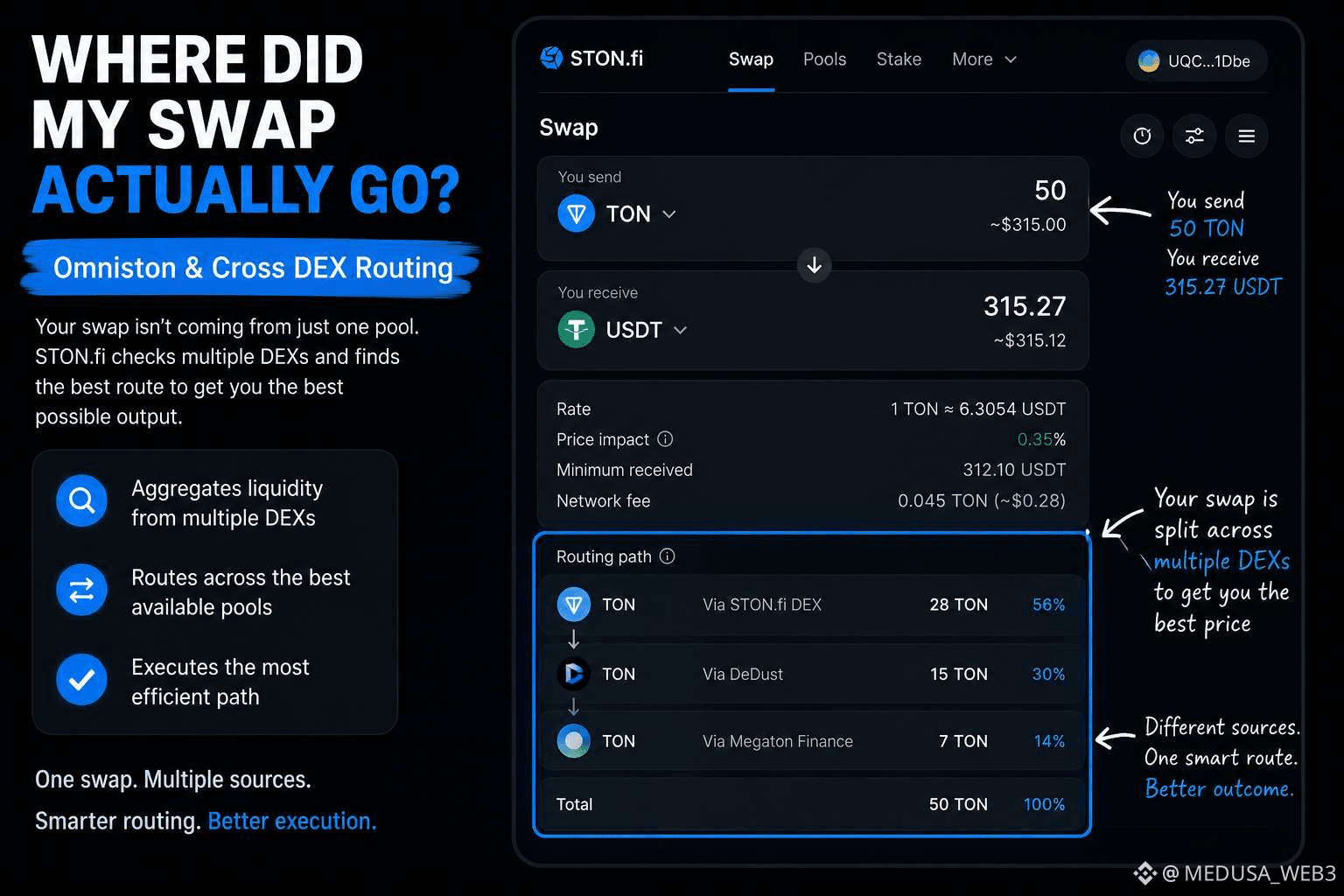
Omniston can source quotes from multiple liquidity sources and route swaps across connected decentralized exchanges. Instead of requiring the user to manually check each venue, the routing layer can compare available execution options.
Consider a simple example.
Exchange A may have the best rate for a small trade, while Exchange B may have deeper liquidity for a larger transaction. Looking at only one exchange could mean accepting an inferior route.
Cross DEX routing changes the process by making multiple liquidity sources available to the execution system.
It can also chain swaps across decentralized exchanges within one transaction when the route requires it.
The important point is that aggregation does not remove market risk. A user still needs to check the quoted output, price impact and other transaction details before confirming.
It simply addresses a structural problem: liquidity is distributed across different venues.
For the user, the practical benefit is less manual comparison.
You choose the tokens and amount. The routing system searches connected liquidity sources and determines an execution path.
That makes liquidity aggregation less about adding another feature to a swap and more about reducing the work required to find an appropriate route.
The next time you swap on TON, pay attention to the route rather than looking only at the token pair.
𝐎𝐟𝐟𝐢𝐜𝐢𝐚𝐥 𝐑𝐞𝐬𝐨𝐮𝐫𝐜𝐞𝐬:
Official Site: app.ston.fi
Technical Documentation: docs.ston.fi
OMNISTON AND CROSS DEX ROUTING, WHY ONE SWAP CAN USE MULTIPLE LIQUIDITY SOURCES
TON has multiple decentralized exchanges, each with its own liquidity. That creates a practical problem for traders: the best available execution may not always be sitting inside one pool.
This is where aggregation becomes useful.
Omniston can source quotes from multiple liquidity sources and route swaps across connected decentralized exchanges. Instead of requiring the user to manually check each venue, the routing layer can compare available execution options.
Consider a simple example.
Exchange A may have the best rate for a small trade, while Exchange B may have deeper liquidity for a larger transaction. Looking at only one exchange could mean accepting an inferior route.
Cross DEX routing changes the process by making multiple liquidity sources available to the execution system.
It can also chain swaps across decentralized exchanges within one transaction when the route requires it.
The important point is that aggregation does not remove market risk. A user still needs to check the quoted output, price impact and other transaction details before confirming.
It simply addresses a structural problem: liquidity is distributed across different venues.
For the user, the practical benefit is less manual comparison.
You choose the tokens and amount. The routing system searches connected liquidity sources and determines an execution path.
That makes liquidity aggregation less about adding another feature to a swap and more about reducing the work required to find an appropriate route.
The next time you swap on TON, pay attention to the route rather than looking only at the token pair.
𝐎𝐟𝐟𝐢𝐜𝐢𝐚𝐥 𝐑𝐞𝐬𝐨𝐮𝐫𝐜𝐞𝐬:
Official Site: app.ston.fi
Technical Documentation: docs.ston.fi
TON has multiple decentralized exchanges, each with its own liquidity. That creates a practical problem for traders: the best available execution may not always be sitting inside one pool.
This is where aggregation becomes useful.
Omniston can source quotes from multiple liquidity sources and route swaps across connected decentralized exchanges. Instead of requiring the user to manually check each venue, the routing layer can compare available execution options.
Consider a simple example.
Exchange A may have the best rate for a small trade, while Exchange B may have deeper liquidity for a larger transaction. Looking at only one exchange could mean accepting an inferior route.
Cross DEX routing changes the process by making multiple liquidity sources available to the execution system.
It can also chain swaps across decentralized exchanges within one transaction when the route requires it.
The important point is that aggregation does not remove market risk. A user still needs to check the quoted output, price impact and other transaction details before confirming.
It simply addresses a structural problem: liquidity is distributed across different venues.
For the user, the practical benefit is less manual comparison.
You choose the tokens and amount. The routing system searches connected liquidity sources and determines an execution path.
That makes liquidity aggregation less about adding another feature to a swap and more about reducing the work required to find an appropriate route.
The next time you swap on TON, pay attention to the route rather than looking only at the token pair.
𝐎𝐟𝐟𝐢𝐜𝐢𝐚𝐥 𝐑𝐞𝐬𝐨𝐮𝐫𝐜𝐞𝐬:
Official Site: app.ston.fi
Technical Documentation: docs.ston.fi
63
·
--
Haussier
HOW TON TRADING FITS INTO MOONPAY TRADE
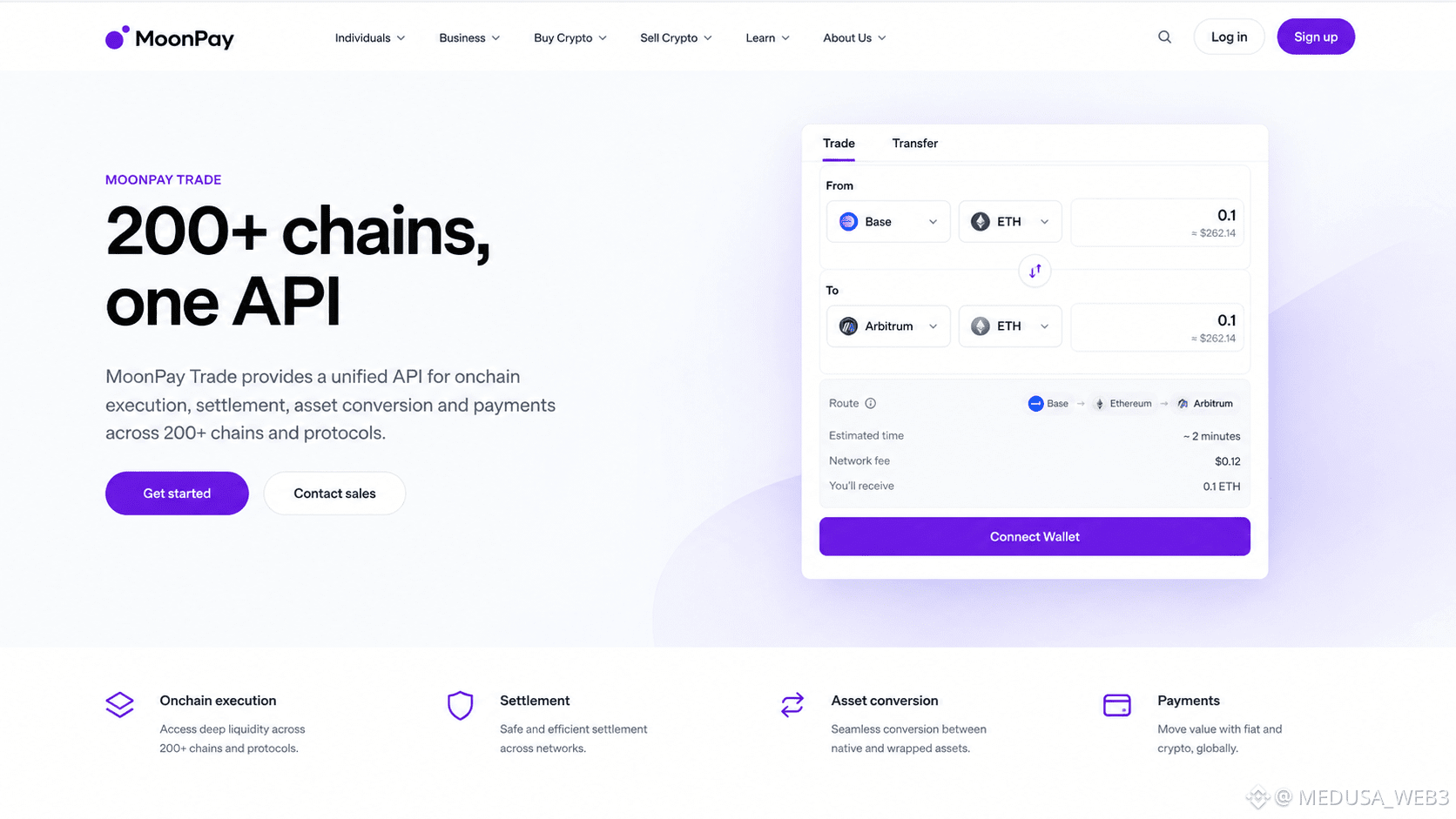
MoonPay Trade supports more than 200 chains and protocols through a unified API covering onchain execution, settlement, asset conversion, and payments. The integration with STON.fi’s Omniston adds intrachain TON trading to this infrastructure.
The important distinction is what each system provides.
MoonPay Trade is designed as an infrastructure layer for applications that need to interact with multiple blockchain networks. It provides access to execution, settlement, asset conversion, and payment functionality through one integration.
Omniston contributes intrachain TON trading within that infrastructure.
STON.fi announced that Omniston has been integrated into MoonPay Trade’s aggregator. This allows applications and wallets using MoonPay Trade to provide access to TON assets through their existing integration, without having to build separate TON trading infrastructure.
Keeper is one example mentioned in the announcement. Its integration with MoonPay Trade can make TON assets available within its existing trading experience.
The significance of the integration is therefore technical and practical. MoonPay Trade provides the broader infrastructure for interacting with more than 200 chains and protocols, while Omniston provides the TON trading capability within that environment.
For applications supporting multiple networks, this means TON can be accessed through an existing infrastructure layer rather than requiring a completely separate implementation.
Read the full announcement and learn more about the integration:
https://blog.ston.fi/omniston-opens-ton-access-through-moonpay-trade/
HOW TON TRADING FITS INTO MOONPAY TRADE
MoonPay Trade supports more than 200 chains and protocols through a unified API covering onchain execution, settlement, asset conversion, and payments. The integration with STON.fi’s Omniston adds intrachain TON trading to this infrastructure.
The important distinction is what each system provides.
MoonPay Trade is designed as an infrastructure layer for applications that need to interact with multiple blockchain networks. It provides access to execution, settlement, asset conversion, and payment functionality through one integration.
Omniston contributes intrachain TON trading within that infrastructure.
STON.fi announced that Omniston has been integrated into MoonPay Trade’s aggregator. This allows applications and wallets using MoonPay Trade to provide access to TON assets through their existing integration, without having to build separate TON trading infrastructure.
Keeper is one example mentioned in the announcement. Its integration with MoonPay Trade can make TON assets available within its existing trading experience.
The significance of the integration is therefore technical and practical. MoonPay Trade provides the broader infrastructure for interacting with more than 200 chains and protocols, while Omniston provides the TON trading capability within that environment.
For applications supporting multiple networks, this means TON can be accessed through an existing infrastructure layer rather than requiring a completely separate implementation.
Read the full announcement and learn more about the integration:
https://blog.ston.fi/omniston-opens-ton-access-through-moonpay-trade/
MoonPay Trade supports more than 200 chains and protocols through a unified API covering onchain execution, settlement, asset conversion, and payments. The integration with STON.fi’s Omniston adds intrachain TON trading to this infrastructure.
The important distinction is what each system provides.
MoonPay Trade is designed as an infrastructure layer for applications that need to interact with multiple blockchain networks. It provides access to execution, settlement, asset conversion, and payment functionality through one integration.
Omniston contributes intrachain TON trading within that infrastructure.
STON.fi announced that Omniston has been integrated into MoonPay Trade’s aggregator. This allows applications and wallets using MoonPay Trade to provide access to TON assets through their existing integration, without having to build separate TON trading infrastructure.
Keeper is one example mentioned in the announcement. Its integration with MoonPay Trade can make TON assets available within its existing trading experience.
The significance of the integration is therefore technical and practical. MoonPay Trade provides the broader infrastructure for interacting with more than 200 chains and protocols, while Omniston provides the TON trading capability within that environment.
For applications supporting multiple networks, this means TON can be accessed through an existing infrastructure layer rather than requiring a completely separate implementation.
Read the full announcement and learn more about the integration:
https://blog.ston.fi/omniston-opens-ton-access-through-moonpay-trade/
67
·
--
CROSS CHAIN SWAPS ON STON.FI
TRON has built a strong position around stablecoin activity, particularly USDT, while TON has developed its own DeFi ecosystem through products such as STON.fi. That makes the relationship between different networks worth understanding, especially for users moving stablecoin liquidity across ecosystems.
TRON is particularly relevant because its network activity is heavily associated with USDT. STON.fi’s recent cross chain developments take a different approach, allowing users to move assets between TON and supported EVM networks through Omniston.
The important distinction is that these are different parts of the cross chain landscape.
TRON is a network where stablecoin activity is a major use case. STON.fi is a decentralized exchange built around TON, while Omniston is STON.fi’s cross chain execution layer. Current Omniston routes include Ethereum, Base, BNB Chain and Polygon.
This is where cross chain infrastructure becomes important.
STON.fi's Omniston model uses a resolver based system with Hashed Timelock Contracts. Instead of creating a wrapped representation of the destination asset, the user can receive the native asset on supported destination networks. If the required conditions are not completed, the timelock mechanism provides a refund path.
TRON currently sits outside those listed Omniston Phase 1 destinations, so it would be inaccurate to describe STON.fi as providing a direct TRON route through Omniston.
TRON is particularly associated with high stablecoin activity and USDT transfers. TON provides access to its native DeFi ecosystem, including STON.fi. Ethereum, Base, BNB Chain and Polygon provide the current EVM destinations supported by Omniston.
The practical lesson is simple: before moving stablecoins, check the source network, destination network, available route, fees and the asset you will actually receive.
If you use STON.fi, check the available routes directly in the app before confirming a transaction.
Explore the available swaps on STON.fi: https://app.ston.fi/
CROSS CHAIN SWAPS ON STON.FI
TRON has built a strong position around stablecoin activity, particularly USDT, while TON has developed its own DeFi ecosystem through products such as STON.fi. That makes the relationship between different networks worth understanding, especially for users moving stablecoin liquidity across ecosystems.
TRON is particularly relevant because its network activity is heavily associated with USDT. STON.fi’s recent cross chain developments take a different approach, allowing users to move assets between TON and supported EVM networks through Omniston.
The important distinction is that these are different parts of the cross chain landscape.
TRON is a network where stablecoin activity is a major use case. STON.fi is a decentralized exchange built around TON, while Omniston is STON.fi’s cross chain execution layer. Current Omniston routes include Ethereum, Base, BNB Chain and Polygon.
This is where cross chain infrastructure becomes important.
STON.fi's Omniston model uses a resolver based system with Hashed Timelock Contracts. Instead of creating a wrapped representation of the destination asset, the user can receive the native asset on supported destination networks. If the required conditions are not completed, the timelock mechanism provides a refund path.
TRON currently sits outside those listed Omniston Phase 1 destinations, so it would be inaccurate to describe STON.fi as providing a direct TRON route through Omniston.
TRON is particularly associated with high stablecoin activity and USDT transfers. TON provides access to its native DeFi ecosystem, including STON.fi. Ethereum, Base, BNB Chain and Polygon provide the current EVM destinations supported by Omniston.
The practical lesson is simple: before moving stablecoins, check the source network, destination network, available route, fees and the asset you will actually receive.
If you use STON.fi, check the available routes directly in the app before confirming a transaction.
Explore the available swaps on STON.fi: https://app.ston.fi/
TRON has built a strong position around stablecoin activity, particularly USDT, while TON has developed its own DeFi ecosystem through products such as STON.fi. That makes the relationship between different networks worth understanding, especially for users moving stablecoin liquidity across ecosystems.
TRON is particularly relevant because its network activity is heavily associated with USDT. STON.fi’s recent cross chain developments take a different approach, allowing users to move assets between TON and supported EVM networks through Omniston.
The important distinction is that these are different parts of the cross chain landscape.
TRON is a network where stablecoin activity is a major use case. STON.fi is a decentralized exchange built around TON, while Omniston is STON.fi’s cross chain execution layer. Current Omniston routes include Ethereum, Base, BNB Chain and Polygon.
This is where cross chain infrastructure becomes important.
STON.fi's Omniston model uses a resolver based system with Hashed Timelock Contracts. Instead of creating a wrapped representation of the destination asset, the user can receive the native asset on supported destination networks. If the required conditions are not completed, the timelock mechanism provides a refund path.
TRON currently sits outside those listed Omniston Phase 1 destinations, so it would be inaccurate to describe STON.fi as providing a direct TRON route through Omniston.
TRON is particularly associated with high stablecoin activity and USDT transfers. TON provides access to its native DeFi ecosystem, including STON.fi. Ethereum, Base, BNB Chain and Polygon provide the current EVM destinations supported by Omniston.
The practical lesson is simple: before moving stablecoins, check the source network, destination network, available route, fees and the asset you will actually receive.
If you use STON.fi, check the available routes directly in the app before confirming a transaction.
Explore the available swaps on STON.fi: https://app.ston.fi/
55
·
--
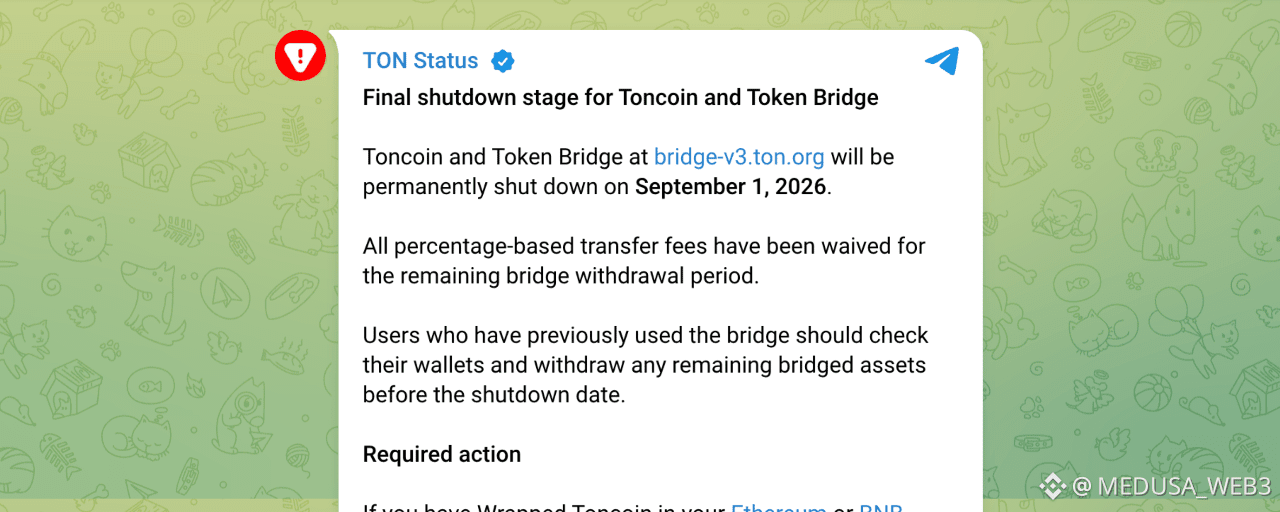
THE TON BRIDGE SHUTDOWN AND WHAT USERS SHOULD KNOW
On September 1, 2026, the TON Bridge was shut down. For users who still move assets between TON and other networks, this changes which routes are available and makes it important to understand the alternatives.
STON.fi has expanded its cross chain infrastructure through Omniston, which supports cross chain swaps involving TON and several other networks. Its current supported networks include TRON, Ethereum, Base, BNB Chain, Polygon, Arbitrum, Avalanche and Robinhood.
This matters because a bridge and a cross chain swap are not necessarily the same thing.
With a traditional bridge, users generally move an asset from one network to another through a dedicated bridging mechanism. STON.fi’s cross chain flow works differently. You select the asset and destination network, review the quoted amount and fees, then confirm the transaction through your wallet. STON.fi describes Omniston as the execution layer handling the cross chain settlement.
For example, STON.fi currently provides a TON to Base cross chain swap flow. The process involves connecting the required wallets, selecting the asset and destination network, entering the amount, reviewing the transaction details and confirming the swap.
There are still important checks before confirming any cross chain transaction. Verify the destination network, asset, amount and wallet address. Address formats can also differ between networks, so sending an asset to the wrong destination should be avoided.
The key point is simple: the shutdown of one bridge does not mean cross chain activity has stopped. Users should check which routes are currently available and choose the method that matches the network and asset they need.
Check the current https://app.ston.fi
THE TON BRIDGE SHUTDOWN AND WHAT USERS SHOULD KNOW
On September 1, 2026, the TON Bridge was shut down. For users who still move assets between TON and other networks, this changes which routes are available and makes it important to understand the alternatives.
STON.fi has expanded its cross chain infrastructure through Omniston, which supports cross chain swaps involving TON and several other networks. Its current supported networks include TRON, Ethereum, Base, BNB Chain, Polygon, Arbitrum, Avalanche and Robinhood.
This matters because a bridge and a cross chain swap are not necessarily the same thing.
With a traditional bridge, users generally move an asset from one network to another through a dedicated bridging mechanism. STON.fi’s cross chain flow works differently. You select the asset and destination network, review the quoted amount and fees, then confirm the transaction through your wallet. STON.fi describes Omniston as the execution layer handling the cross chain settlement.
For example, STON.fi currently provides a TON to Base cross chain swap flow. The process involves connecting the required wallets, selecting the asset and destination network, entering the amount, reviewing the transaction details and confirming the swap.
There are still important checks before confirming any cross chain transaction. Verify the destination network, asset, amount and wallet address. Address formats can also differ between networks, so sending an asset to the wrong destination should be avoided.
The key point is simple: the shutdown of one bridge does not mean cross chain activity has stopped. Users should check which routes are currently available and choose the method that matches the network and asset they need.
Check the current https://app.ston.fi
On September 1, 2026, the TON Bridge was shut down. For users who still move assets between TON and other networks, this changes which routes are available and makes it important to understand the alternatives.
STON.fi has expanded its cross chain infrastructure through Omniston, which supports cross chain swaps involving TON and several other networks. Its current supported networks include TRON, Ethereum, Base, BNB Chain, Polygon, Arbitrum, Avalanche and Robinhood.
This matters because a bridge and a cross chain swap are not necessarily the same thing.
With a traditional bridge, users generally move an asset from one network to another through a dedicated bridging mechanism. STON.fi’s cross chain flow works differently. You select the asset and destination network, review the quoted amount and fees, then confirm the transaction through your wallet. STON.fi describes Omniston as the execution layer handling the cross chain settlement.
For example, STON.fi currently provides a TON to Base cross chain swap flow. The process involves connecting the required wallets, selecting the asset and destination network, entering the amount, reviewing the transaction details and confirming the swap.
There are still important checks before confirming any cross chain transaction. Verify the destination network, asset, amount and wallet address. Address formats can also differ between networks, so sending an asset to the wrong destination should be avoided.
The key point is simple: the shutdown of one bridge does not mean cross chain activity has stopped. Users should check which routes are currently available and choose the method that matches the network and asset they need.
Check the current https://app.ston.fi
76
·
--
Haussier
SAME CHAIN OR CROSS CHAIN, WHICH ROUTE SHOULD YOU USE?
If both tokens you want already exist on TON, adding another network to the process may not be necessary. If the asset you need exists on another network, the situation changes.
The first question should therefore be simple: where does the asset you actually want live?
A same chain swap keeps the transaction within one blockchain. You select the asset you have, select the asset you want and execute the swap using available liquidity on that network.
A cross chain swap is different. It is useful when the source asset and destination asset are on different networks.
For example, if you hold an asset on TON but need an asset native to an EVM network, moving value across networks becomes part of the transaction.
Cross chain execution introduces additional considerations. You need to check the destination network, address format, gas requirements and expected amount received.
This does not mean cross chain is always better or worse.
It means the correct route depends on where your assets are and where you need them to end up.
There is also a practical reason to avoid unnecessary steps. Every additional transaction can introduce another fee, another confirmation and another point where something can go wrong.
So before choosing a route, ask two questions.
Is the asset I want already available on my current network?
If not, which destination network actually contains the asset I need?
Choose the simplest route that accomplishes the actual goal.
"Choose your swap route on
Official Site: https://app.ston.fi
Technical Documentation: https://docs.ston.fi
Analytics Dashboard: https://dune.com/stonfi
SAME CHAIN OR CROSS CHAIN, WHICH ROUTE SHOULD YOU USE?
If both tokens you want already exist on TON, adding another network to the process may not be necessary. If the asset you need exists on another network, the situation changes.
The first question should therefore be simple: where does the asset you actually want live?
A same chain swap keeps the transaction within one blockchain. You select the asset you have, select the asset you want and execute the swap using available liquidity on that network.
A cross chain swap is different. It is useful when the source asset and destination asset are on different networks.
For example, if you hold an asset on TON but need an asset native to an EVM network, moving value across networks becomes part of the transaction.
Cross chain execution introduces additional considerations. You need to check the destination network, address format, gas requirements and expected amount received.
This does not mean cross chain is always better or worse.
It means the correct route depends on where your assets are and where you need them to end up.
There is also a practical reason to avoid unnecessary steps. Every additional transaction can introduce another fee, another confirmation and another point where something can go wrong.
So before choosing a route, ask two questions.
Is the asset I want already available on my current network?
If not, which destination network actually contains the asset I need?
Choose the simplest route that accomplishes the actual goal.
"Choose your swap route on
Official Site: https://app.ston.fi
Technical Documentation: https://docs.ston.fi
Analytics Dashboard: https://dune.com/stonfi
If both tokens you want already exist on TON, adding another network to the process may not be necessary. If the asset you need exists on another network, the situation changes.
The first question should therefore be simple: where does the asset you actually want live?
A same chain swap keeps the transaction within one blockchain. You select the asset you have, select the asset you want and execute the swap using available liquidity on that network.
A cross chain swap is different. It is useful when the source asset and destination asset are on different networks.
For example, if you hold an asset on TON but need an asset native to an EVM network, moving value across networks becomes part of the transaction.
Cross chain execution introduces additional considerations. You need to check the destination network, address format, gas requirements and expected amount received.
This does not mean cross chain is always better or worse.
It means the correct route depends on where your assets are and where you need them to end up.
There is also a practical reason to avoid unnecessary steps. Every additional transaction can introduce another fee, another confirmation and another point where something can go wrong.
So before choosing a route, ask two questions.
Is the asset I want already available on my current network?
If not, which destination network actually contains the asset I need?
Choose the simplest route that accomplishes the actual goal.
"Choose your swap route on
Official Site: https://app.ston.fi
Technical Documentation: https://docs.ston.fi
Analytics Dashboard: https://dune.com/stonfi
72
·
--
Haussier
THE REAL COST OF A CROSS CHAIN SWAP
A cross chain transaction can look inexpensive when you check only one fee. The actual cost can contain several different components.
Consider a user moving assets from one network to another and then converting them into the desired token. The user may encounter origin network gas, a cross chain provider fee, destination network gas, a swap fee and the effect of price impact or slippage.
That is why the displayed transaction fee is not always the complete economic cost.
Gas is the first layer. You need the native asset of the relevant network to execute blockchain actions.
Then there may be a cross chain execution fee depending on the route and service being used.
If the destination asset is not the exact asset you want, another swap may be necessary. That introduces another trading cost and another execution consideration.
Finally, there is the exchange rate itself.
A route can have reasonable fees but still produce a poor result if the price impact is high. Conversely, a slightly higher explicit fee can sometimes be less important than receiving a materially better execution price.
The practical approach is to look at the entire route instead of one number.
Before confirming, check the amount being sent, estimated gas, fees, the destination asset and the amount you will receive.
The cheapest visible fee does not automatically mean the cheapest transaction.
Compare the complete outcome before you approve the swap.
"Review cross chain swaps on STON.fi"
𝐎𝐟𝐟𝐢𝐜𝐢𝐚𝐥 𝐑𝐞𝐬𝐨𝐮𝐫𝐜𝐞𝐬:
Official Site: https://app.ston.fi
Technical Documentation: https://docs.ston.fi
Analytics Dashboard: https://dune.com/stonfi
THE REAL COST OF A CROSS CHAIN SWAP
A cross chain transaction can look inexpensive when you check only one fee. The actual cost can contain several different components.
Consider a user moving assets from one network to another and then converting them into the desired token. The user may encounter origin network gas, a cross chain provider fee, destination network gas, a swap fee and the effect of price impact or slippage.
That is why the displayed transaction fee is not always the complete economic cost.
Gas is the first layer. You need the native asset of the relevant network to execute blockchain actions.
Then there may be a cross chain execution fee depending on the route and service being used.
If the destination asset is not the exact asset you want, another swap may be necessary. That introduces another trading cost and another execution consideration.
Finally, there is the exchange rate itself.
A route can have reasonable fees but still produce a poor result if the price impact is high. Conversely, a slightly higher explicit fee can sometimes be less important than receiving a materially better execution price.
The practical approach is to look at the entire route instead of one number.
Before confirming, check the amount being sent, estimated gas, fees, the destination asset and the amount you will receive.
The cheapest visible fee does not automatically mean the cheapest transaction.
Compare the complete outcome before you approve the swap.
"Review cross chain swaps on STON.fi"
𝐎𝐟𝐟𝐢𝐜𝐢𝐚𝐥 𝐑𝐞𝐬𝐨𝐮𝐫𝐜𝐞𝐬:
Official Site: https://app.ston.fi
Technical Documentation: https://docs.ston.fi
Analytics Dashboard: https://dune.com/stonfi
A cross chain transaction can look inexpensive when you check only one fee. The actual cost can contain several different components.
Consider a user moving assets from one network to another and then converting them into the desired token. The user may encounter origin network gas, a cross chain provider fee, destination network gas, a swap fee and the effect of price impact or slippage.
That is why the displayed transaction fee is not always the complete economic cost.
Gas is the first layer. You need the native asset of the relevant network to execute blockchain actions.
Then there may be a cross chain execution fee depending on the route and service being used.
If the destination asset is not the exact asset you want, another swap may be necessary. That introduces another trading cost and another execution consideration.
Finally, there is the exchange rate itself.
A route can have reasonable fees but still produce a poor result if the price impact is high. Conversely, a slightly higher explicit fee can sometimes be less important than receiving a materially better execution price.
The practical approach is to look at the entire route instead of one number.
Before confirming, check the amount being sent, estimated gas, fees, the destination asset and the amount you will receive.
The cheapest visible fee does not automatically mean the cheapest transaction.
Compare the complete outcome before you approve the swap.
"Review cross chain swaps on STON.fi"
𝐎𝐟𝐟𝐢𝐜𝐢𝐚𝐥 𝐑𝐞𝐬𝐨𝐮𝐫𝐜𝐞𝐬:
Official Site: https://app.ston.fi
Technical Documentation: https://docs.ston.fi
Analytics Dashboard: https://dune.com/stonfi
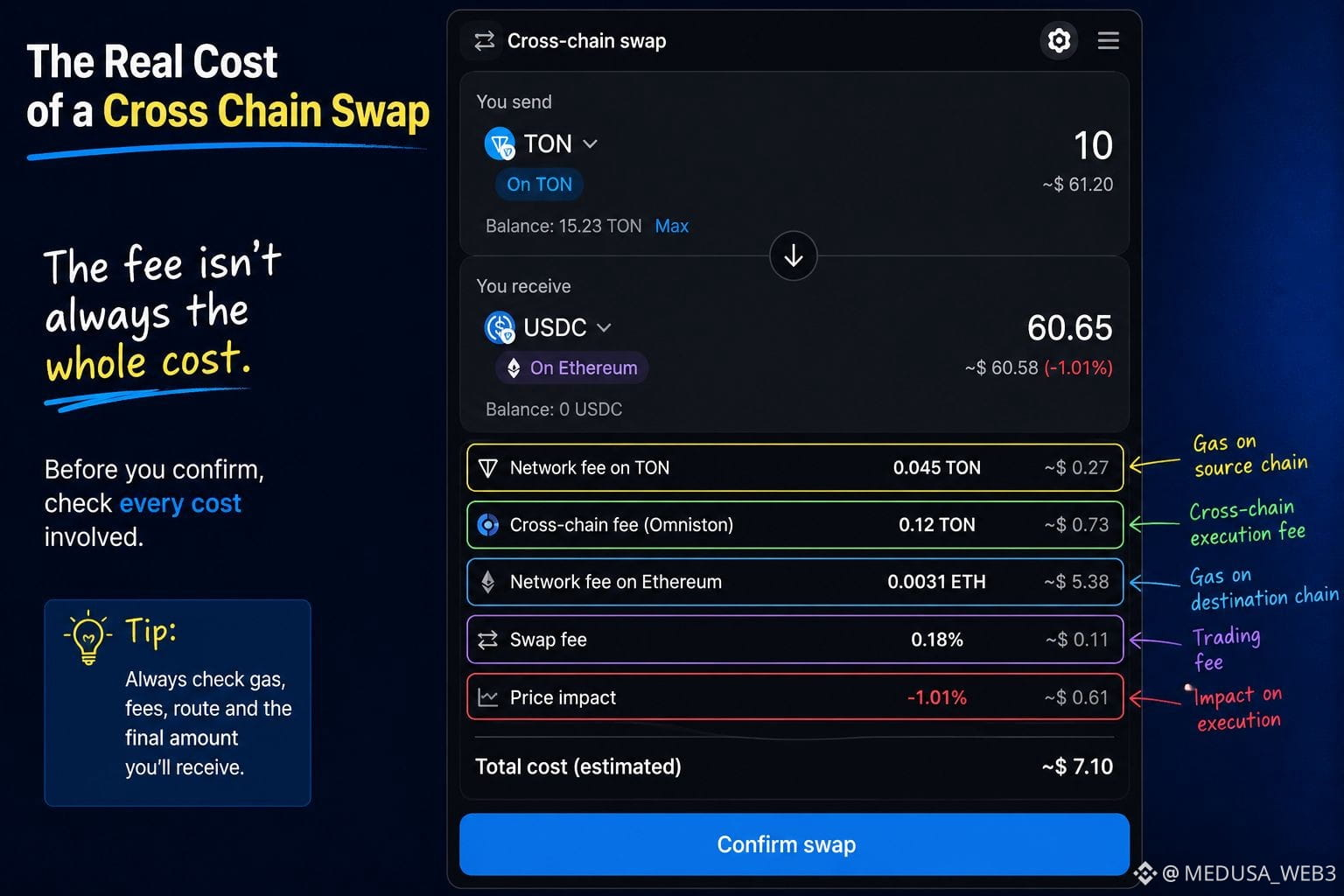
57
·
--
CROSS CHAIN SWAPS, WHAT ACTUALLY HAPPENS AFTER YOU CONFIRM
A cross chain swap involves two networks, two assets and several on chain actions. Unlike a normal same chain swap, the destination asset exists on another blockchain.
So what happens after you press confirm?
STON.fi's cross chain model uses Omniston and smart contract based execution involving liquidity providers called resolvers. The source asset is locked on the originating network while the corresponding destination asset is locked on the other network.
The two sides are connected using Hashed Timelock Contracts, commonly called HTLCs.
The important part is that neither side simply hands funds to a central custodian.
Once the required conditions are satisfied, a cryptographic secret allows the destination asset to be released. The resolver can then claim the source asset using the same mechanism.
What happens if the process does not complete?
The timelock provides a refund path. If the required secret is not revealed within the specified period, the locked source funds can become refundable.
There is also a practical detail users should remember: TON and EVM networks use different address formats. A TON address and an EVM address should never be treated as interchangeable.
Before starting a cross chain swap, verify the destination network, destination address, token, expected amount and available gas.
Cross chain trading becomes much easier to understand once you stop viewing it as one transaction and start viewing it as coordinated execution across two networks.
Check every field before confirming.
"Try a cross chain swap on STON.fi"
𝐎𝐟𝐟𝐢𝐜𝐢𝐚𝐥 𝐑𝐞𝐬𝐨𝐮𝐫𝐜𝐞𝐬:
Official Site: https://app.ston.fi
Follow for News: https://x.com/ston_fi
Community Chat: https://t.me/ston_fi
CROSS CHAIN SWAPS, WHAT ACTUALLY HAPPENS AFTER YOU CONFIRM
A cross chain swap involves two networks, two assets and several on chain actions. Unlike a normal same chain swap, the destination asset exists on another blockchain.
So what happens after you press confirm?
STON.fi's cross chain model uses Omniston and smart contract based execution involving liquidity providers called resolvers. The source asset is locked on the originating network while the corresponding destination asset is locked on the other network.
The two sides are connected using Hashed Timelock Contracts, commonly called HTLCs.
The important part is that neither side simply hands funds to a central custodian.
Once the required conditions are satisfied, a cryptographic secret allows the destination asset to be released. The resolver can then claim the source asset using the same mechanism.
What happens if the process does not complete?
The timelock provides a refund path. If the required secret is not revealed within the specified period, the locked source funds can become refundable.
There is also a practical detail users should remember: TON and EVM networks use different address formats. A TON address and an EVM address should never be treated as interchangeable.
Before starting a cross chain swap, verify the destination network, destination address, token, expected amount and available gas.
Cross chain trading becomes much easier to understand once you stop viewing it as one transaction and start viewing it as coordinated execution across two networks.
Check every field before confirming.
"Try a cross chain swap on STON.fi"
𝐎𝐟𝐟𝐢𝐜𝐢𝐚𝐥 𝐑𝐞𝐬𝐨𝐮𝐫𝐜𝐞𝐬:
Official Site: https://app.ston.fi
Follow for News: https://x.com/ston_fi
Community Chat: https://t.me/ston_fi
A cross chain swap involves two networks, two assets and several on chain actions. Unlike a normal same chain swap, the destination asset exists on another blockchain.
So what happens after you press confirm?
STON.fi's cross chain model uses Omniston and smart contract based execution involving liquidity providers called resolvers. The source asset is locked on the originating network while the corresponding destination asset is locked on the other network.
The two sides are connected using Hashed Timelock Contracts, commonly called HTLCs.
The important part is that neither side simply hands funds to a central custodian.
Once the required conditions are satisfied, a cryptographic secret allows the destination asset to be released. The resolver can then claim the source asset using the same mechanism.
What happens if the process does not complete?
The timelock provides a refund path. If the required secret is not revealed within the specified period, the locked source funds can become refundable.
There is also a practical detail users should remember: TON and EVM networks use different address formats. A TON address and an EVM address should never be treated as interchangeable.
Before starting a cross chain swap, verify the destination network, destination address, token, expected amount and available gas.
Cross chain trading becomes much easier to understand once you stop viewing it as one transaction and start viewing it as coordinated execution across two networks.
Check every field before confirming.
"Try a cross chain swap on STON.fi"
𝐎𝐟𝐟𝐢𝐜𝐢𝐚𝐥 𝐑𝐞𝐬𝐨𝐮𝐫𝐜𝐞𝐬:
Official Site: https://app.ston.fi
Follow for News: https://x.com/ston_fi
Community Chat: https://t.me/ston_fi
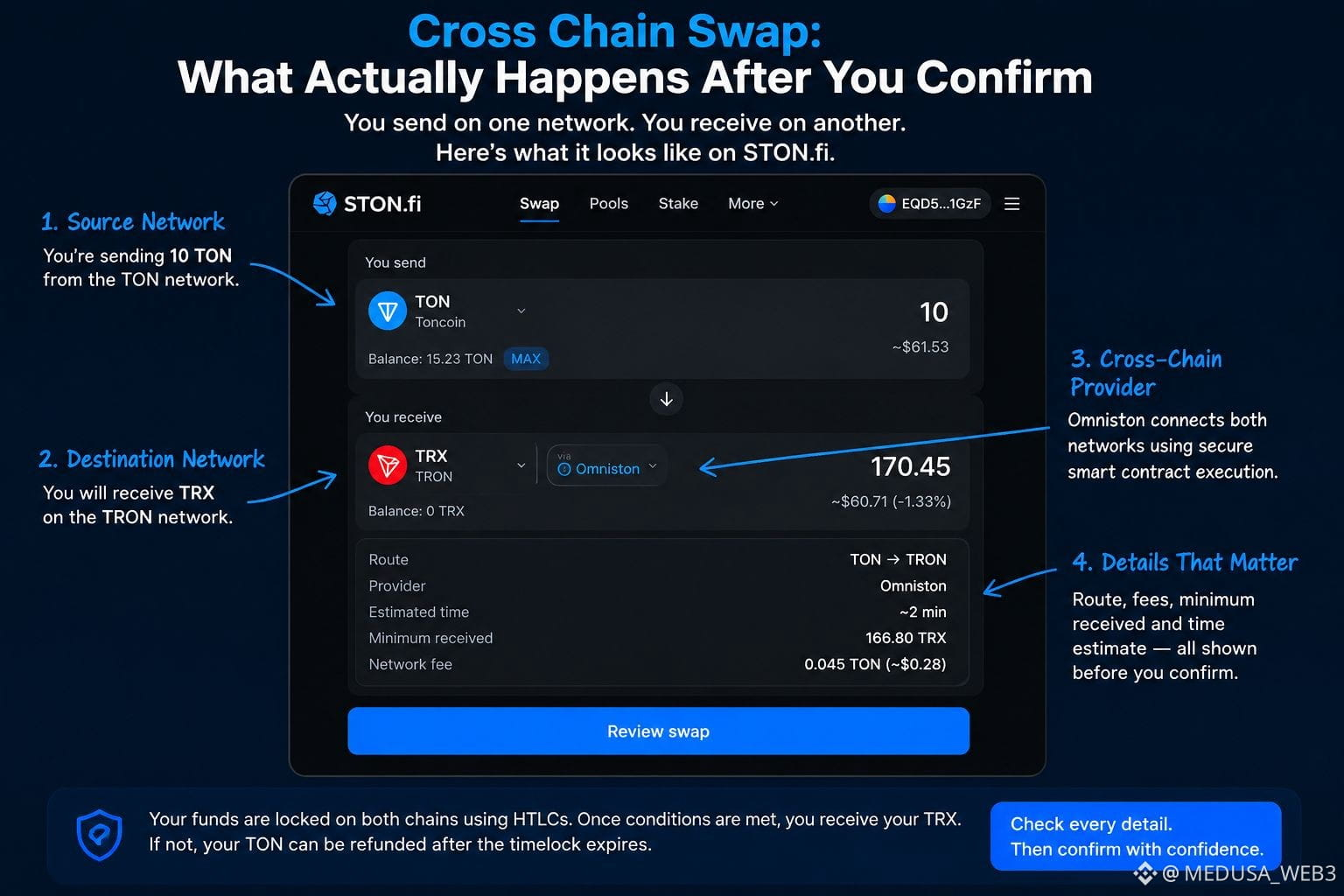
91
·
--
Haussier
TAX TOKENS, WHY YOU MAY RECEIVE LESS THAN THE QUOTE
You swap 10,000 tokens and expect close to 10,000 to arrive. Instead, the amount received is lower even though the price did not move dramatically.
One possible explanation is a fee on transfer token.
These tokens deduct a percentage whenever the token is transferred. The deduction is determined by the token contract and can be directed according to the token's rules.
This creates an extra layer that users need to understand.
A normal swap already involves network costs, trading fees and the effects of price impact. A fee on transfer token can introduce another deduction when the token itself moves.
Imagine a token with a 5 percent transfer deduction. If a transaction would normally deliver 10,000 tokens, the token contract could result in roughly 9,500 tokens reaching the recipient, depending on the specific implementation.
That deduction is not the same thing as price impact.
This is why telling someone to simply increase slippage is not always a good explanation. The user first needs to understand what the token contract actually does and whether the route supports that behaviour.
There is another concern: some tokens can impose severe restrictions on selling. A token may appear tradable when buying but create problems when users attempt to sell.
Before swapping an unfamiliar token, verify the token and understand its transfer mechanics. Do not judge a token only by its displayed price or trading volume.
The amount that reaches your wallet depends on more than the number shown before you press Swap.
"Check your token swap on STON.fi"
𝐎𝐟𝐟𝐢𝐜𝐢𝐚𝐥 𝐑𝐞𝐬𝐨𝐮𝐫𝐜𝐞𝐬:
Official Site: https://app.ston.fi
Technical Documentation: https://docs.ston.fi
Community Chat: https://t.me/ston_fi
#PopularTopic
TAX TOKENS, WHY YOU MAY RECEIVE LESS THAN THE QUOTE
You swap 10,000 tokens and expect close to 10,000 to arrive. Instead, the amount received is lower even though the price did not move dramatically.
One possible explanation is a fee on transfer token.
These tokens deduct a percentage whenever the token is transferred. The deduction is determined by the token contract and can be directed according to the token's rules.
This creates an extra layer that users need to understand.
A normal swap already involves network costs, trading fees and the effects of price impact. A fee on transfer token can introduce another deduction when the token itself moves.
Imagine a token with a 5 percent transfer deduction. If a transaction would normally deliver 10,000 tokens, the token contract could result in roughly 9,500 tokens reaching the recipient, depending on the specific implementation.
That deduction is not the same thing as price impact.
This is why telling someone to simply increase slippage is not always a good explanation. The user first needs to understand what the token contract actually does and whether the route supports that behaviour.
There is another concern: some tokens can impose severe restrictions on selling. A token may appear tradable when buying but create problems when users attempt to sell.
Before swapping an unfamiliar token, verify the token and understand its transfer mechanics. Do not judge a token only by its displayed price or trading volume.
The amount that reaches your wallet depends on more than the number shown before you press Swap.
"Check your token swap on STON.fi"
𝐎𝐟𝐟𝐢𝐜𝐢𝐚𝐥 𝐑𝐞𝐬𝐨𝐮𝐫𝐜𝐞𝐬:
Official Site: https://app.ston.fi
Technical Documentation: https://docs.ston.fi
Community Chat: https://t.me/ston_fi
#PopularTopic
You swap 10,000 tokens and expect close to 10,000 to arrive. Instead, the amount received is lower even though the price did not move dramatically.
One possible explanation is a fee on transfer token.
These tokens deduct a percentage whenever the token is transferred. The deduction is determined by the token contract and can be directed according to the token's rules.
This creates an extra layer that users need to understand.
A normal swap already involves network costs, trading fees and the effects of price impact. A fee on transfer token can introduce another deduction when the token itself moves.
Imagine a token with a 5 percent transfer deduction. If a transaction would normally deliver 10,000 tokens, the token contract could result in roughly 9,500 tokens reaching the recipient, depending on the specific implementation.
That deduction is not the same thing as price impact.
This is why telling someone to simply increase slippage is not always a good explanation. The user first needs to understand what the token contract actually does and whether the route supports that behaviour.
There is another concern: some tokens can impose severe restrictions on selling. A token may appear tradable when buying but create problems when users attempt to sell.
Before swapping an unfamiliar token, verify the token and understand its transfer mechanics. Do not judge a token only by its displayed price or trading volume.
The amount that reaches your wallet depends on more than the number shown before you press Swap.
"Check your token swap on STON.fi"
𝐎𝐟𝐟𝐢𝐜𝐢𝐚𝐥 𝐑𝐞𝐬𝐨𝐮𝐫𝐜𝐞𝐬:
Official Site: https://app.ston.fi
Technical Documentation: https://docs.ston.fi
Community Chat: https://t.me/ston_fi
#PopularTopic
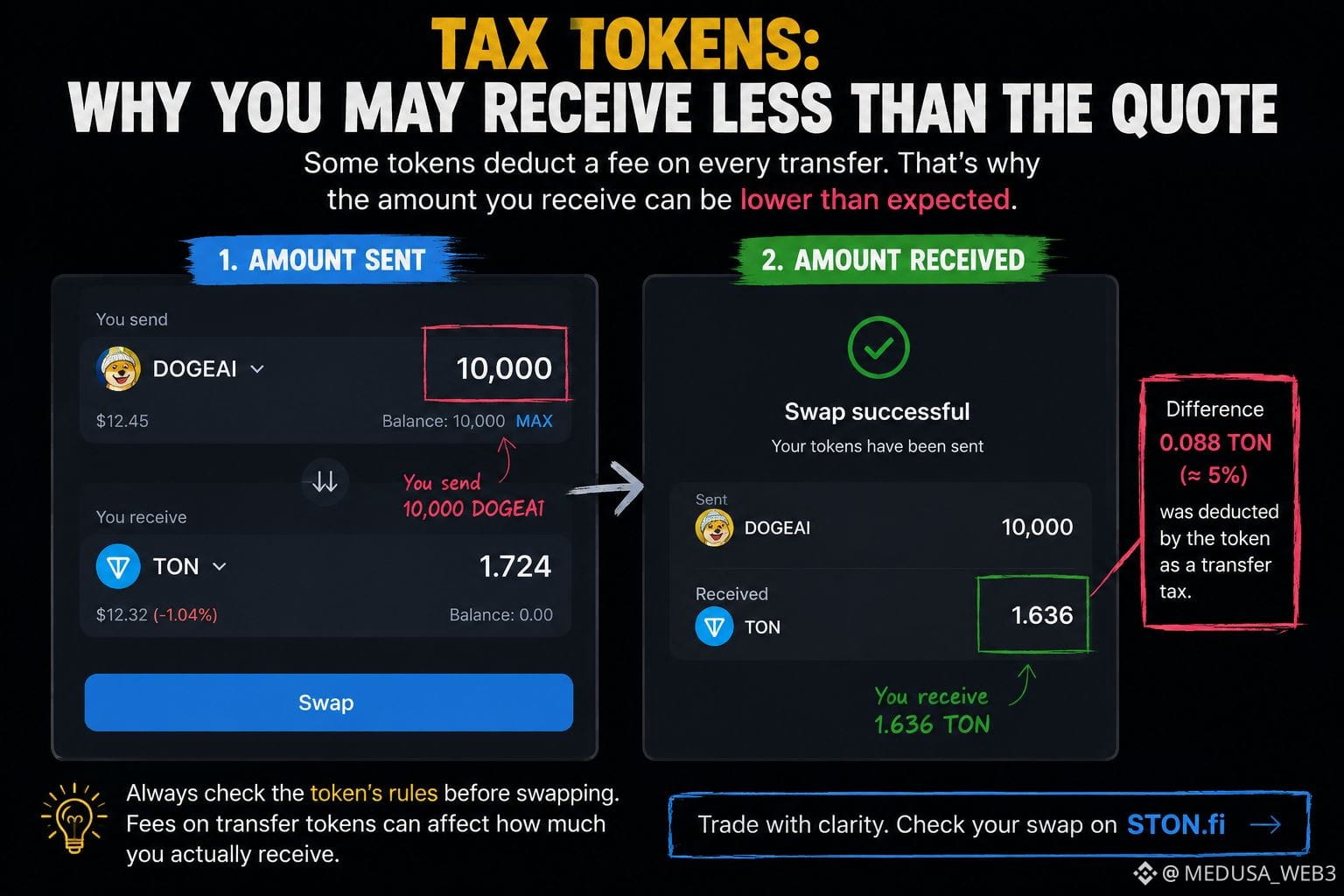
4
·
--
WHY YOUR TON SWAP CAN STAY PENDING
A transaction that remains pending for a few moments can make a user wonder whether something has gone wrong. On TON, there is an important detail to understand: contract actions can be processed across several blocks rather than appearing as one instant event.
That means pending does not automatically mean failed.
During periods of heavy network activity, transaction processing can also take longer. STON.fi has previously documented periods where extreme demand caused transaction delays lasting hours, showing how network conditions can affect user experience.
There is another reason to remain patient.
A swap involves blockchain messages and smart contract execution. The interface may need to wait for the relevant on chain actions to be processed before the final status can be displayed.
So what should you do when a swap is pending?
First, check the transaction status instead of immediately sending another transaction. Repeating the action can create unnecessary confusion.
Second, check whether the network is experiencing unusual congestion.
Third, give the blockchain time to process the existing transaction before assuming that your funds have disappeared.
A pending transaction and a failed transaction are different states.
The important lesson is simple: do not treat a delay as an automatic loss of funds. Check the transaction status and allow the network to finish processing.
If you are using STON.fi, start with the transaction details before taking another action.
"Open STON.fi"
𝐎𝐟𝐟𝐢𝐜𝐢𝐚𝐥 𝐑𝐞𝐬𝐨𝐮𝐫𝐜𝐞𝐬:
Official Site: https://app.ston.fi
Technical Documentation: https://docs.ston.fi
Community Chat: https://t.me/ston_fi
WHY YOUR TON SWAP CAN STAY PENDING
A transaction that remains pending for a few moments can make a user wonder whether something has gone wrong. On TON, there is an important detail to understand: contract actions can be processed across several blocks rather than appearing as one instant event.
That means pending does not automatically mean failed.
During periods of heavy network activity, transaction processing can also take longer. STON.fi has previously documented periods where extreme demand caused transaction delays lasting hours, showing how network conditions can affect user experience.
There is another reason to remain patient.
A swap involves blockchain messages and smart contract execution. The interface may need to wait for the relevant on chain actions to be processed before the final status can be displayed.
So what should you do when a swap is pending?
First, check the transaction status instead of immediately sending another transaction. Repeating the action can create unnecessary confusion.
Second, check whether the network is experiencing unusual congestion.
Third, give the blockchain time to process the existing transaction before assuming that your funds have disappeared.
A pending transaction and a failed transaction are different states.
The important lesson is simple: do not treat a delay as an automatic loss of funds. Check the transaction status and allow the network to finish processing.
If you are using STON.fi, start with the transaction details before taking another action.
"Open STON.fi"
𝐎𝐟𝐟𝐢𝐜𝐢𝐚𝐥 𝐑𝐞𝐬𝐨𝐮𝐫𝐜𝐞𝐬:
Official Site: https://app.ston.fi
Technical Documentation: https://docs.ston.fi
Community Chat: https://t.me/ston_fi
A transaction that remains pending for a few moments can make a user wonder whether something has gone wrong. On TON, there is an important detail to understand: contract actions can be processed across several blocks rather than appearing as one instant event.
That means pending does not automatically mean failed.
During periods of heavy network activity, transaction processing can also take longer. STON.fi has previously documented periods where extreme demand caused transaction delays lasting hours, showing how network conditions can affect user experience.
There is another reason to remain patient.
A swap involves blockchain messages and smart contract execution. The interface may need to wait for the relevant on chain actions to be processed before the final status can be displayed.
So what should you do when a swap is pending?
First, check the transaction status instead of immediately sending another transaction. Repeating the action can create unnecessary confusion.
Second, check whether the network is experiencing unusual congestion.
Third, give the blockchain time to process the existing transaction before assuming that your funds have disappeared.
A pending transaction and a failed transaction are different states.
The important lesson is simple: do not treat a delay as an automatic loss of funds. Check the transaction status and allow the network to finish processing.
If you are using STON.fi, start with the transaction details before taking another action.
"Open STON.fi"
𝐎𝐟𝐟𝐢𝐜𝐢𝐚𝐥 𝐑𝐞𝐬𝐨𝐮𝐫𝐜𝐞𝐬:
Official Site: https://app.ston.fi
Technical Documentation: https://docs.ston.fi
Community Chat: https://t.me/ston_fi
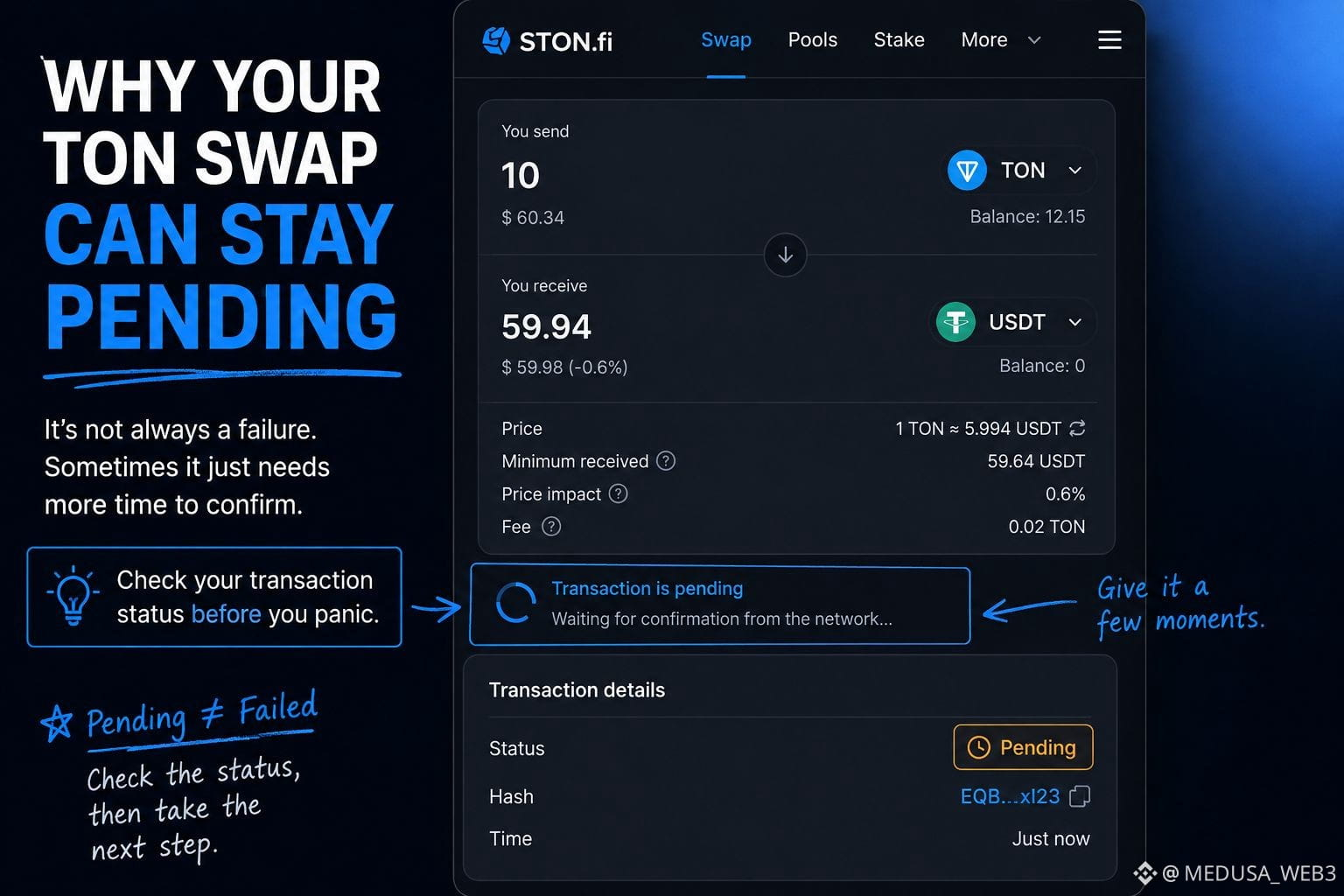
13
·
--
Haussier
WHY A SWAP CAN FAIL EVEN WHEN YOU HAVE ENOUGH TOKENS
You can have enough tokens in your wallet and still see a swap fail. Having the required asset is only one part of a successful transaction.
There are several other conditions involved.
One common reason is price movement. If the executable price moves beyond the permitted range before settlement, the transaction may no longer satisfy the conditions of the swap.
Network conditions can also matter. During periods of congestion, transactions may take longer to process. A quote that was valid when you started may no longer be suitable when execution finally happens.
There is also the issue of gas.
Your wallet needs enough of the network's native asset to pay for the transaction. Having 1,000 USDT does not help if your wallet does not have enough TON to execute a TON transaction.
Token behaviour can create another problem. Some tokens apply transfer deductions or other restrictions that affect how a swap settles.
This is why checking only your token balance is not enough.
Before confirming, check the amount you will receive, the price impact, the minimum received figure and whether your wallet has enough native network gas.
If the swap fails, do not immediately assume that the platform took your tokens. Check the transaction status and the reason for failure first.
A successful swap depends on more than having enough of the asset you want to trade.
Check the whole transaction before you confirm it.
"Make your next swap on STON.fi"
𝐎𝐟𝐟𝐢𝐜𝐢𝐚𝐥 𝐑𝐞𝐬𝐨𝐮𝐫𝐜𝐞𝐬:
Official Site: https://app.ston.fi
Technical Documentation: https://docs.ston.fi
Community Chat: https://t.me/ston_fi
WHY A SWAP CAN FAIL EVEN WHEN YOU HAVE ENOUGH TOKENS
You can have enough tokens in your wallet and still see a swap fail. Having the required asset is only one part of a successful transaction.
There are several other conditions involved.
One common reason is price movement. If the executable price moves beyond the permitted range before settlement, the transaction may no longer satisfy the conditions of the swap.
Network conditions can also matter. During periods of congestion, transactions may take longer to process. A quote that was valid when you started may no longer be suitable when execution finally happens.
There is also the issue of gas.
Your wallet needs enough of the network's native asset to pay for the transaction. Having 1,000 USDT does not help if your wallet does not have enough TON to execute a TON transaction.
Token behaviour can create another problem. Some tokens apply transfer deductions or other restrictions that affect how a swap settles.
This is why checking only your token balance is not enough.
Before confirming, check the amount you will receive, the price impact, the minimum received figure and whether your wallet has enough native network gas.
If the swap fails, do not immediately assume that the platform took your tokens. Check the transaction status and the reason for failure first.
A successful swap depends on more than having enough of the asset you want to trade.
Check the whole transaction before you confirm it.
"Make your next swap on STON.fi"
𝐎𝐟𝐟𝐢𝐜𝐢𝐚𝐥 𝐑𝐞𝐬𝐨𝐮𝐫𝐜𝐞𝐬:
Official Site: https://app.ston.fi
Technical Documentation: https://docs.ston.fi
Community Chat: https://t.me/ston_fi
You can have enough tokens in your wallet and still see a swap fail. Having the required asset is only one part of a successful transaction.
There are several other conditions involved.
One common reason is price movement. If the executable price moves beyond the permitted range before settlement, the transaction may no longer satisfy the conditions of the swap.
Network conditions can also matter. During periods of congestion, transactions may take longer to process. A quote that was valid when you started may no longer be suitable when execution finally happens.
There is also the issue of gas.
Your wallet needs enough of the network's native asset to pay for the transaction. Having 1,000 USDT does not help if your wallet does not have enough TON to execute a TON transaction.
Token behaviour can create another problem. Some tokens apply transfer deductions or other restrictions that affect how a swap settles.
This is why checking only your token balance is not enough.
Before confirming, check the amount you will receive, the price impact, the minimum received figure and whether your wallet has enough native network gas.
If the swap fails, do not immediately assume that the platform took your tokens. Check the transaction status and the reason for failure first.
A successful swap depends on more than having enough of the asset you want to trade.
Check the whole transaction before you confirm it.
"Make your next swap on STON.fi"
𝐎𝐟𝐟𝐢𝐜𝐢𝐚𝐥 𝐑𝐞𝐬𝐨𝐮𝐫𝐜𝐞𝐬:
Official Site: https://app.ston.fi
Technical Documentation: https://docs.ston.fi
Community Chat: https://t.me/ston_fi
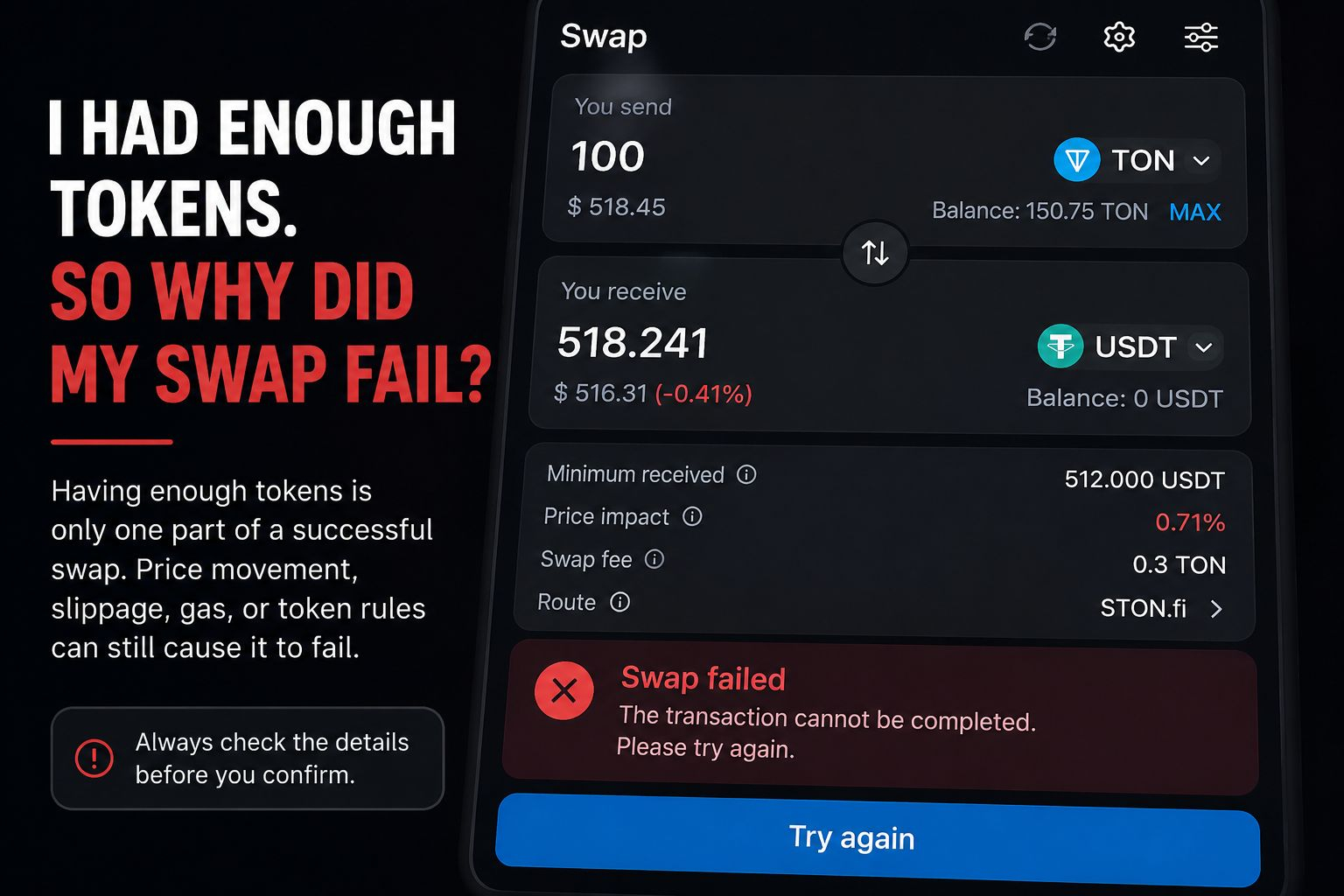
15
Connectez-vous pour découvrir plus de contenu
Rejoignez la communauté mondiale des adeptes de cryptomonnaies sur Binance Square
⚡️ Suviez les dernières informations importantes sur les cryptomonnaies.
💬 Jugé digne de confiance par la plus grande plateforme d’échange de cryptomonnaies au monde.
👍 Découvrez les connaissances que partagent les créateurs vérifiés.
Adresse e-mail/Nº de téléphone
Sujets d’actualité
CerebrasSinksNearly20%OnReportNvidiaToPowerOpenAI
218 vues
26 mentions
#CerebrasSinksNearly20%OnReportNvidiaToPowerOpenAI
Cerebras Systems shares fell nearly 20% following reports that Nvidia could provide power infrastructure and technology to OpenAI. The news raised concerns among investors about Cerebras’ position in the rapidly growing artificial intelligence hardware market. Nvidia is already a major supplier of AI chips and infrastructure, while Cerebras has developed specialized systems designed to accelerate AI workloads. The reported partnership with OpenAI could strengthen Nvidia’s role in supporting large-scale AI computing. Investors are now watching closely for further details about the agreement and its potential impact on competition, demand, and future growth across the AI semiconductor industry. The development highlights the intense competition.
Maryam Larey VgQY
·0 mentions J’aime
·3 vues
SECProposesCryptoCustodyRules
11,716 vues
173 mentions
SECApproves3xLongCryptoCommodityETPs
12,950 vues
186 mentions