

ISMAIL Crypto 加油
1.7k Publications

ISMAIL Crypto 加油
Signaler
Bloquer l’utilisateur
Crypto enthusiast 📈 Learning, analyzing, improving every day.💖
Trade fréquemment
1.4 an(s)
209 Suivis
10.3K+ Abonnés
1.3K+ J’aime
Publications
Tous
Citations
Vidéos
Direct

Trading sur 30 j de 255.6 USDT en $BEAT
Today buy tomorrow rich 🤑
$BEAT
{alpha}(560xcf3232b85b43bca90e51d38cc06cc8bb8c8a3e36)
$BTC
Today buy tomorrow rich 🤑
$BEAT
$BTC
$BEAT
$BTC
1
564
·
--
Haussier
$SNDKB Up now 😅
don't miss everyone 🤗👇👇👇
$SNDKB
{spot}(SNDKBUSDT)
$OP
$SNDKB Up now 😅
don't miss everyone 🤗👇👇👇
$SNDKB
$OP
don't miss everyone 🤗👇👇👇
$SNDKB
$OP
222
$DGAI 🔥🔥🔥Now 🫵👇🙇
{alpha}(560x10d4183389e99233db3cc981c43443ebd28ebd5e)
$OPG
$DGAI 🔥🔥🔥Now 🫵👇🙇
$OPG
$OPG

4
690
$DEBIT 🔥🔥 buy and hold 🔥🔥 👇👇👇
$BTC
$DEBIT 🔥🔥 buy and hold 🔥🔥 👇👇👇
$BTC
$BTC
412
$DEBIT New but very strong coin 🪙👇👇
$DEBIT New but very strong coin 🪙👇👇
1
378
#fedratewatch
#FedRateWatch — Is This the Start of a New Hiking Cycle?
The September FOMC meeting (Sept 15-16) has flipped from "will they cut" to "will they hike" in just a few weeks. August core CPI came in hot, and CME FedWatch now prices roughly 90% odds of a 25bp hike to 3.75%-4.00% — the first hike since 2023. Fed Chair Warsh's hawkish Jackson Hole tone, sticky inflation, and Iran-driven energy costs pushed the bar down for action. I don't see this as one-and-done — Barclays and BNP Paribas are already penciling in follow-through hikes into December and beyond, so the dot plot released alongside this decision matters as much as the headline move.
Market impact: BTC has been resilient near $80K on strong ETF inflows, but it's more liquidity-sensitive than gold — a hawkish surprise could hit it harder short-term, though some argue the hike is more about anchoring yields than real tightening, which could limit downside. Gold faces headwind from higher real yields but geopolitical demand cushions it. Tech stocks are the most rate-sensitive of the three, given valuation compression risk.
My plan: trimming leverage into the decision, keeping core BTC spot position, and watching the dot plot for December signal before adding back risk.
#FedRateWatch #FOMC #BTC
#fedratewatch
#FedRateWatch — Is This the Start of a New Hiking Cycle?
The September FOMC meeting (Sept 15-16) has flipped from "will they cut" to "will they hike" in just a few weeks. August core CPI came in hot, and CME FedWatch now prices roughly 90% odds of a 25bp hike to 3.75%-4.00% — the first hike since 2023. Fed Chair Warsh's hawkish Jackson Hole tone, sticky inflation, and Iran-driven energy costs pushed the bar down for action. I don't see this as one-and-done — Barclays and BNP Paribas are already penciling in follow-through hikes into December and beyond, so the dot plot released alongside this decision matters as much as the headline move.
Market impact: BTC has been resilient near $80K on strong ETF inflows, but it's more liquidity-sensitive than gold — a hawkish surprise could hit it harder short-term, though some argue the hike is more about anchoring yields than real tightening, which could limit downside. Gold faces headwind from higher real yields but geopolitical demand cushions it. Tech stocks are the most rate-sensitive of the three, given valuation compression risk.
My plan: trimming leverage into the decision, keeping core BTC spot position, and watching the dot plot for December signal before adding back risk.
#FedRateWatch #FOMC #BTC
#FedRateWatch — Is This the Start of a New Hiking Cycle?
The September FOMC meeting (Sept 15-16) has flipped from "will they cut" to "will they hike" in just a few weeks. August core CPI came in hot, and CME FedWatch now prices roughly 90% odds of a 25bp hike to 3.75%-4.00% — the first hike since 2023. Fed Chair Warsh's hawkish Jackson Hole tone, sticky inflation, and Iran-driven energy costs pushed the bar down for action. I don't see this as one-and-done — Barclays and BNP Paribas are already penciling in follow-through hikes into December and beyond, so the dot plot released alongside this decision matters as much as the headline move.
Market impact: BTC has been resilient near $80K on strong ETF inflows, but it's more liquidity-sensitive than gold — a hawkish surprise could hit it harder short-term, though some argue the hike is more about anchoring yields than real tightening, which could limit downside. Gold faces headwind from higher real yields but geopolitical demand cushions it. Tech stocks are the most rate-sensitive of the three, given valuation compression risk.
My plan: trimming leverage into the decision, keeping core BTC spot position, and watching the dot plot for December signal before adding back risk.
#FedRateWatch #FOMC #BTC
1
845
hello my lovely friend
trade here 🙂 👇👇👇
$ACE
$OPG
$SUI
hello my lovely friend
trade here 🙂 👇👇👇
$ACE
$OPG
$SUI
trade here 🙂 👇👇👇
$ACE
$OPG
$SUI
1
178
2
47
Follow me and earn reward 🎁🎁🎁🎁🎁🧧🧧🧧🎁🎁
$ACE
{spot}(ACEUSDT)
$TMX
Follow me and earn reward 🎁🎁🎁🎁🎁🧧🧧🧧🎁🎁
$ACE
$TMX
$ACE
$TMX

8
3
37
Hello everyone 🤗
$ACE down now 🫵👇👇👇
{spot}(ACEUSDT)
$TMX
{alpha}(560x3c2f61f2e27c865981d2e7aaf6b2cdf823030039)
Hello everyone 🤗
$ACE down now 🫵👇👇👇
$TMX
$ACE down now 🫵👇👇👇
$TMX
1
216
#dusk $DUSK @Dusk_Foundation
Was walking back home tonight, city winding down, and a thought I'd been circling all week finally settled enough to write down: what actually happens to "privacy" as a concept once real regulation catches up to crypto instead of chasing after it.
The usual read is that MiCA and the broader EU crackdown on mixers and anonymous wallets basically kills privacy-focused chains. Fair assumption if privacy only means one thing, hide everything from everyone, no exceptions. That's the definition regulators are cracking down on, and honestly, they're not wrong to.
But that's not the only version of privacy that exists. Dusk's Citadel protocol is built around a different idea entirely, prove you're compliant without revealing what you're actually doing. A wallet can show a regulator "this checks out, nothing illicit here" through a zero-knowledge proof, without exposing trade positions, deal terms, or business logic to the public or to competitors. That's not evading oversight, it's satisfying it while keeping commercial details out of public view, which is a completely different problem than what mixers were built for.
Framed that way, Dusk isn't fighting the regulatory wave, it's positioning itself as the infrastructure that survives it. While anonymity-first projects get regulated into irrelevance, a compliance-first privacy model becomes one of the few paths still open for real institutional money to touch crypto legally.
Where I get less certain is the retail side of this. A lot of people are here specifically because crypto promised freedom from exactly this kind of oversight. If Dusk's whole pitch is built around regulatory approval, does that alienate the crowd that provides early liquidity and hype, or does it just mean Dusk was never really building for that crowd in the first place?
Genuinely curious where people land on this: is compliant privacy the only realistic future for institutional Web3, or is there still room for something closer to the old, uncompromising version of crypto privacy?
$ACE
{spot}(ACEUSDT)
#dusk $DUSK @Dusk
Was walking back home tonight, city winding down, and a thought I'd been circling all week finally settled enough to write down: what actually happens to "privacy" as a concept once real regulation catches up to crypto instead of chasing after it.
The usual read is that MiCA and the broader EU crackdown on mixers and anonymous wallets basically kills privacy-focused chains. Fair assumption if privacy only means one thing, hide everything from everyone, no exceptions. That's the definition regulators are cracking down on, and honestly, they're not wrong to.
But that's not the only version of privacy that exists. Dusk's Citadel protocol is built around a different idea entirely, prove you're compliant without revealing what you're actually doing. A wallet can show a regulator "this checks out, nothing illicit here" through a zero-knowledge proof, without exposing trade positions, deal terms, or business logic to the public or to competitors. That's not evading oversight, it's satisfying it while keeping commercial details out of public view, which is a completely different problem than what mixers were built for.
Framed that way, Dusk isn't fighting the regulatory wave, it's positioning itself as the infrastructure that survives it. While anonymity-first projects get regulated into irrelevance, a compliance-first privacy model becomes one of the few paths still open for real institutional money to touch crypto legally.
Where I get less certain is the retail side of this. A lot of people are here specifically because crypto promised freedom from exactly this kind of oversight. If Dusk's whole pitch is built around regulatory approval, does that alienate the crowd that provides early liquidity and hype, or does it just mean Dusk was never really building for that crowd in the first place?
Genuinely curious where people land on this: is compliant privacy the only realistic future for institutional Web3, or is there still room for something closer to the old, uncompromising version of crypto privacy?
$ACE
Was walking back home tonight, city winding down, and a thought I'd been circling all week finally settled enough to write down: what actually happens to "privacy" as a concept once real regulation catches up to crypto instead of chasing after it.
The usual read is that MiCA and the broader EU crackdown on mixers and anonymous wallets basically kills privacy-focused chains. Fair assumption if privacy only means one thing, hide everything from everyone, no exceptions. That's the definition regulators are cracking down on, and honestly, they're not wrong to.
But that's not the only version of privacy that exists. Dusk's Citadel protocol is built around a different idea entirely, prove you're compliant without revealing what you're actually doing. A wallet can show a regulator "this checks out, nothing illicit here" through a zero-knowledge proof, without exposing trade positions, deal terms, or business logic to the public or to competitors. That's not evading oversight, it's satisfying it while keeping commercial details out of public view, which is a completely different problem than what mixers were built for.
Framed that way, Dusk isn't fighting the regulatory wave, it's positioning itself as the infrastructure that survives it. While anonymity-first projects get regulated into irrelevance, a compliance-first privacy model becomes one of the few paths still open for real institutional money to touch crypto legally.
Where I get less certain is the retail side of this. A lot of people are here specifically because crypto promised freedom from exactly this kind of oversight. If Dusk's whole pitch is built around regulatory approval, does that alienate the crowd that provides early liquidity and hype, or does it just mean Dusk was never really building for that crowd in the first place?
Genuinely curious where people land on this: is compliant privacy the only realistic future for institutional Web3, or is there still room for something closer to the old, uncompromising version of crypto privacy?
$ACE
2
1
267
#dusk $DUSK @Dusk_Foundation
Something kept sitting with me after work today, so I sat down and actually went through Dusk's public communications properly, away from the noise, instead of skimming for a headline.
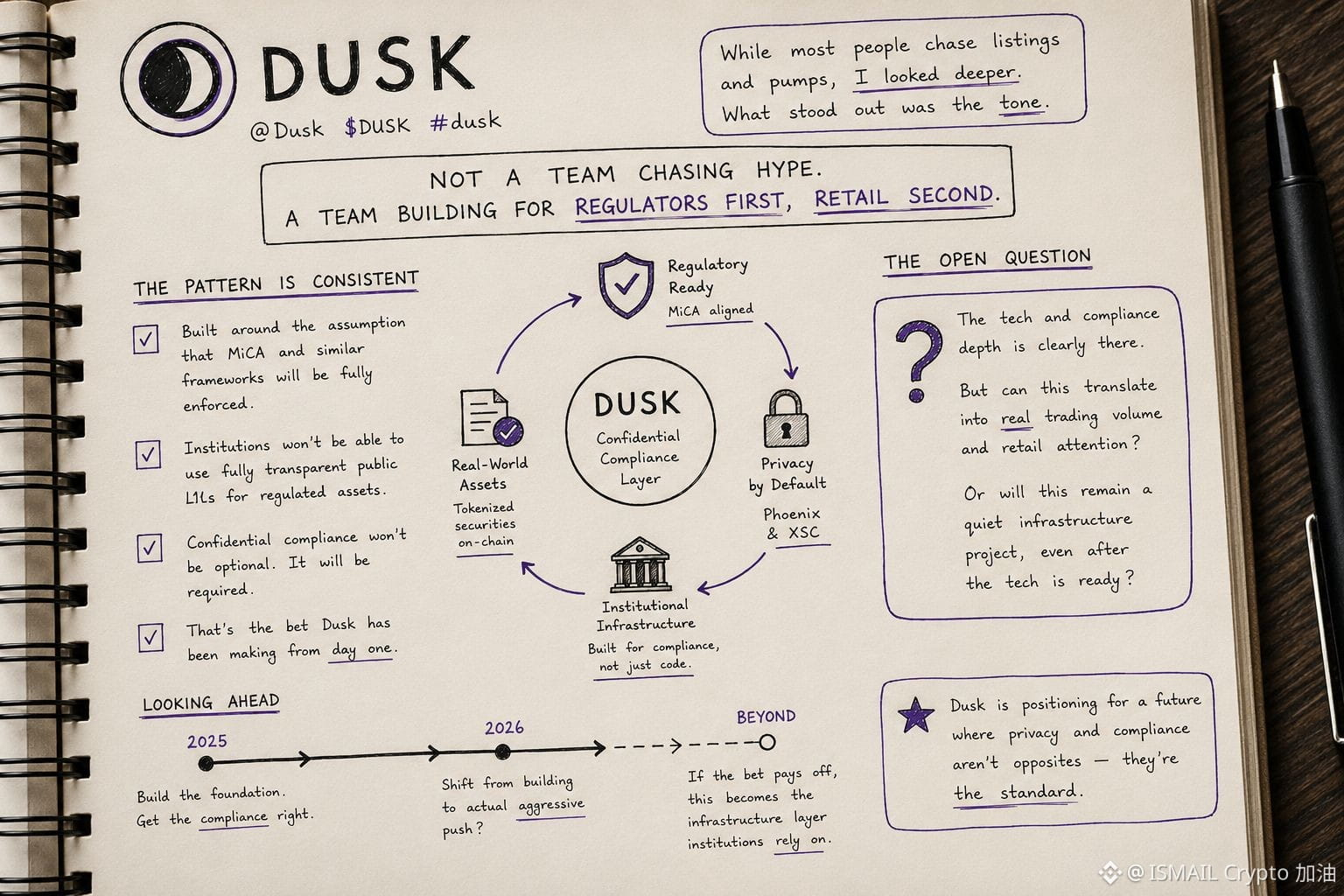
While most people scanning these things are hunting for listing news or a short-term pump signal, what stood out to me was the tone. It doesn't read like a team chasing hype. It reads like a team building for regulators first, retail second.
The pattern is consistent, not one-off. Dusk keeps positioning itself around the assumption that once frameworks like MiCA are fully enforced across Europe, institutions simply won't have the option of using a fully transparent public L1 for regulated assets. They'll need confidential compliance baked in, not bolted on. That's the bet Dusk has been making from day one.
What I can't tell yet is whether that same discipline extends to the go-to-market side. The engineering and compliance depth is obviously there. Whether the team can translate that into real trading volume and retail attention, or whether this stays a "quiet infrastructure project" long after the tech is ready, is the open question for me.
Curious if others think 2026 is the year that shifts from pure building to actual aggressive push, or if that's just not how this team operates.
$DUSK
{spot}(DUSKUSDT)
$DEXE
{spot}(DEXEUSDT)
#dusk $DUSK @Dusk
Something kept sitting with me after work today, so I sat down and actually went through Dusk's public communications properly, away from the noise, instead of skimming for a headline.
While most people scanning these things are hunting for listing news or a short-term pump signal, what stood out to me was the tone. It doesn't read like a team chasing hype. It reads like a team building for regulators first, retail second.
The pattern is consistent, not one-off. Dusk keeps positioning itself around the assumption that once frameworks like MiCA are fully enforced across Europe, institutions simply won't have the option of using a fully transparent public L1 for regulated assets. They'll need confidential compliance baked in, not bolted on. That's the bet Dusk has been making from day one.
What I can't tell yet is whether that same discipline extends to the go-to-market side. The engineering and compliance depth is obviously there. Whether the team can translate that into real trading volume and retail attention, or whether this stays a "quiet infrastructure project" long after the tech is ready, is the open question for me.
Curious if others think 2026 is the year that shifts from pure building to actual aggressive push, or if that's just not how this team operates.
$DUSK
$DEXE
Something kept sitting with me after work today, so I sat down and actually went through Dusk's public communications properly, away from the noise, instead of skimming for a headline.
While most people scanning these things are hunting for listing news or a short-term pump signal, what stood out to me was the tone. It doesn't read like a team chasing hype. It reads like a team building for regulators first, retail second.
The pattern is consistent, not one-off. Dusk keeps positioning itself around the assumption that once frameworks like MiCA are fully enforced across Europe, institutions simply won't have the option of using a fully transparent public L1 for regulated assets. They'll need confidential compliance baked in, not bolted on. That's the bet Dusk has been making from day one.
What I can't tell yet is whether that same discipline extends to the go-to-market side. The engineering and compliance depth is obviously there. Whether the team can translate that into real trading volume and retail attention, or whether this stays a "quiet infrastructure project" long after the tech is ready, is the open question for me.
Curious if others think 2026 is the year that shifts from pure building to actual aggressive push, or if that's just not how this team operates.
$DUSK
$DEXE
1
286
#dusk $DUSK @Dusk_Foundation
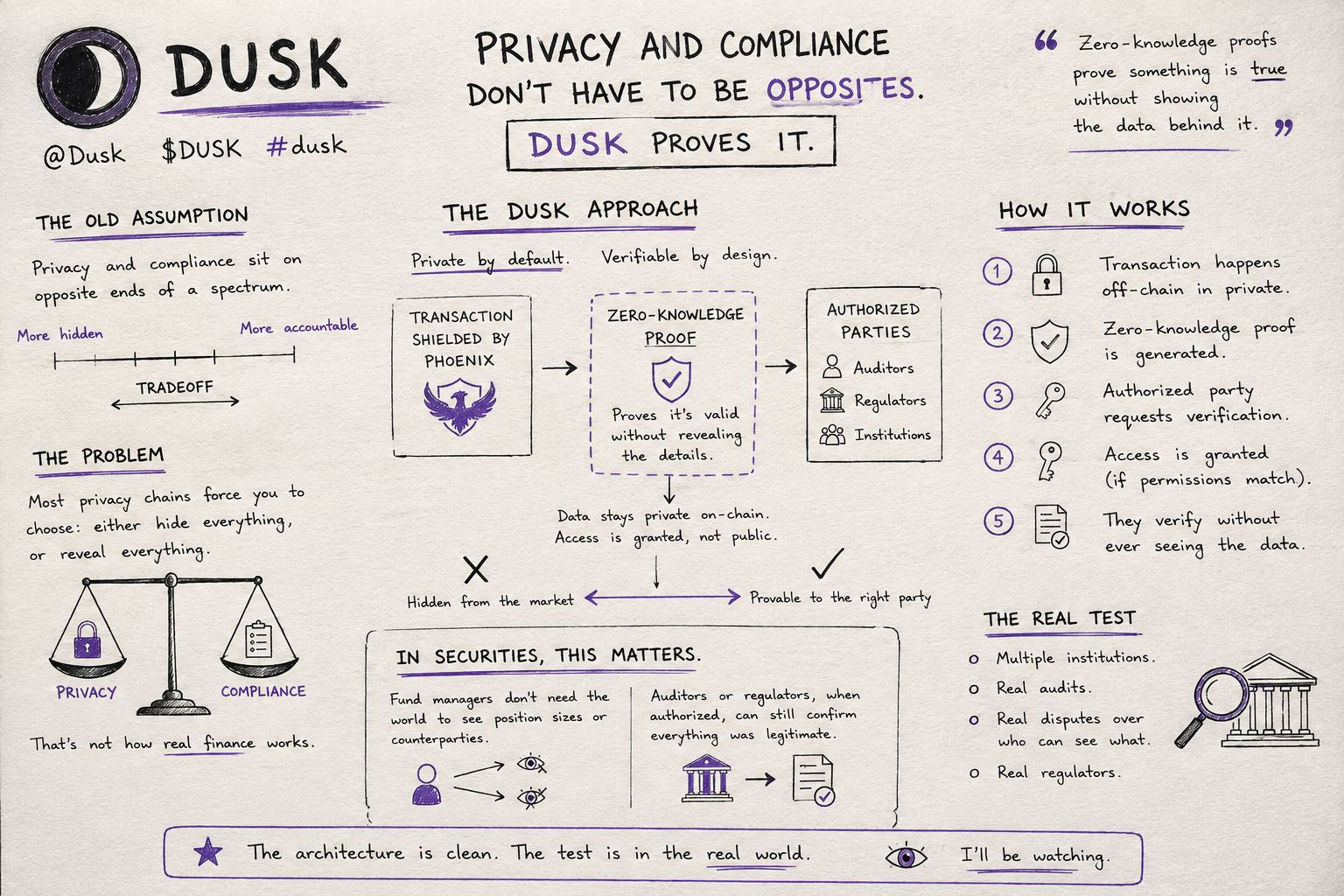
I used to assume privacy and compliance basically sit on opposite ends of a spectrum. More hidden meant less accountable, that was the tradeoff I took for granted with any privacy-focused chain.
Looking closer at how Dusk actually structures this, that framing doesn't quite hold. It's not offering one setting of "private" or "public." Transactions can be shielded through Phoenix, but the system still allows specific, authorized parties to verify what happened, without that information ever becoming visible to the wider network. The zero-knowledge proof isn't just hiding data, it's proving something is true without showing the data behind it. That's a different problem than simple concealment.
Thinking about this in a securities context makes it click. A fund manager settling a transaction doesn't need the general public seeing position sizes or counterparties. But an auditor or regulator, if there's a legitimate reason, still needs a way to confirm the transaction was legitimate. A blockchain that can't separate "hidden from the market" from "provable to the right party" isn't really solving finance's actual privacy problem, it's just picking one extreme over the other.
What I keep coming back to is that this only means something once it's tested against real friction, multiple institutions, real audits, real disputes over who was authorized to see what. The architecture reads cleanly in the docs. Whether the access model holds up once actual money and actual regulators are involved is the part I want to watch play out.
@Dusk_Foundation $DUSK $OPG
{spot}(OPGUSDT)
{future}(OUSDT)
#dusk $DUSK @Dusk
I used to assume privacy and compliance basically sit on opposite ends of a spectrum. More hidden meant less accountable, that was the tradeoff I took for granted with any privacy-focused chain.
Looking closer at how Dusk actually structures this, that framing doesn't quite hold. It's not offering one setting of "private" or "public." Transactions can be shielded through Phoenix, but the system still allows specific, authorized parties to verify what happened, without that information ever becoming visible to the wider network. The zero-knowledge proof isn't just hiding data, it's proving something is true without showing the data behind it. That's a different problem than simple concealment.
Thinking about this in a securities context makes it click. A fund manager settling a transaction doesn't need the general public seeing position sizes or counterparties. But an auditor or regulator, if there's a legitimate reason, still needs a way to confirm the transaction was legitimate. A blockchain that can't separate "hidden from the market" from "provable to the right party" isn't really solving finance's actual privacy problem, it's just picking one extreme over the other.
What I keep coming back to is that this only means something once it's tested against real friction, multiple institutions, real audits, real disputes over who was authorized to see what. The architecture reads cleanly in the docs. Whether the access model holds up once actual money and actual regulators are involved is the part I want to watch play out.
@Dusk $DUSK $OPG
I used to assume privacy and compliance basically sit on opposite ends of a spectrum. More hidden meant less accountable, that was the tradeoff I took for granted with any privacy-focused chain.
Looking closer at how Dusk actually structures this, that framing doesn't quite hold. It's not offering one setting of "private" or "public." Transactions can be shielded through Phoenix, but the system still allows specific, authorized parties to verify what happened, without that information ever becoming visible to the wider network. The zero-knowledge proof isn't just hiding data, it's proving something is true without showing the data behind it. That's a different problem than simple concealment.
Thinking about this in a securities context makes it click. A fund manager settling a transaction doesn't need the general public seeing position sizes or counterparties. But an auditor or regulator, if there's a legitimate reason, still needs a way to confirm the transaction was legitimate. A blockchain that can't separate "hidden from the market" from "provable to the right party" isn't really solving finance's actual privacy problem, it's just picking one extreme over the other.
What I keep coming back to is that this only means something once it's tested against real friction, multiple institutions, real audits, real disputes over who was authorized to see what. The architecture reads cleanly in the docs. Whether the access model holds up once actual money and actual regulators are involved is the part I want to watch play out.
@Dusk $DUSK $OPG
6
4
281
Connectez-vous pour découvrir plus de contenu
Rejoignez la communauté mondiale des adeptes de cryptomonnaies sur Binance Square
⚡️ Suviez les dernières informations importantes sur les cryptomonnaies.
💬 Jugé digne de confiance par la plus grande plateforme d’échange de cryptomonnaies au monde.
👍 Découvrez les connaissances que partagent les créateurs vérifiés.
Adresse e-mail/Nº de téléphone
Sujets d’actualité
SKoreaFSCConsidersVirtualAssetMarketMaker
0 vues
13 mentions
#ChinaIndustrialProfitGrowthSlowsFourthMonth
📉 China Industrial Profit Growth Slows for the Fourth Month
China’s industrial profit growth is showing signs of cooling as weaker domestic demand and softer pricing pressure manufacturers.
The trend is important for global markets because China is a major driver of industrial activity, commodities and trade. Traders will be watching upcoming economic data for signs of stabilization or further slowdown.
🌏 Key focus: China economy • Manufacturing • Global markets • Crypto sentiment
#China #ChinaEconomy #IndustrialProfits #CryptoMarket #Binance #Bitcoin #MarketUpdate
#SKoreaFSCConsidersVirtualAssetMarketMaker #ChinaIndustrialProfitGrowthSlowsFourthMonth #BitwiseFilesFinalNEARSpotETFProspectus $NVDAB $AAPLB $NVDA.US
Naurang Khan 7
·0 mentions J’aime
·12 vues
ChinaIndustrialProfitGrowthSlowsFourthMonth
831 vues
56 mentions
BitwiseFilesFinalNEARSpotETFProspectus
99,641 vues
1,526 mentions