
Nimzy 786
6.5k Publications

Nimzy 786
Ouvert au trading
Trade régulièrement
1.2 an(s)
712 Suivis
12.6K+ Abonnés
12.6K+ J’aime
Publications
Portefeuille
Tous
Direct
#dusk $DUSK @Dusk
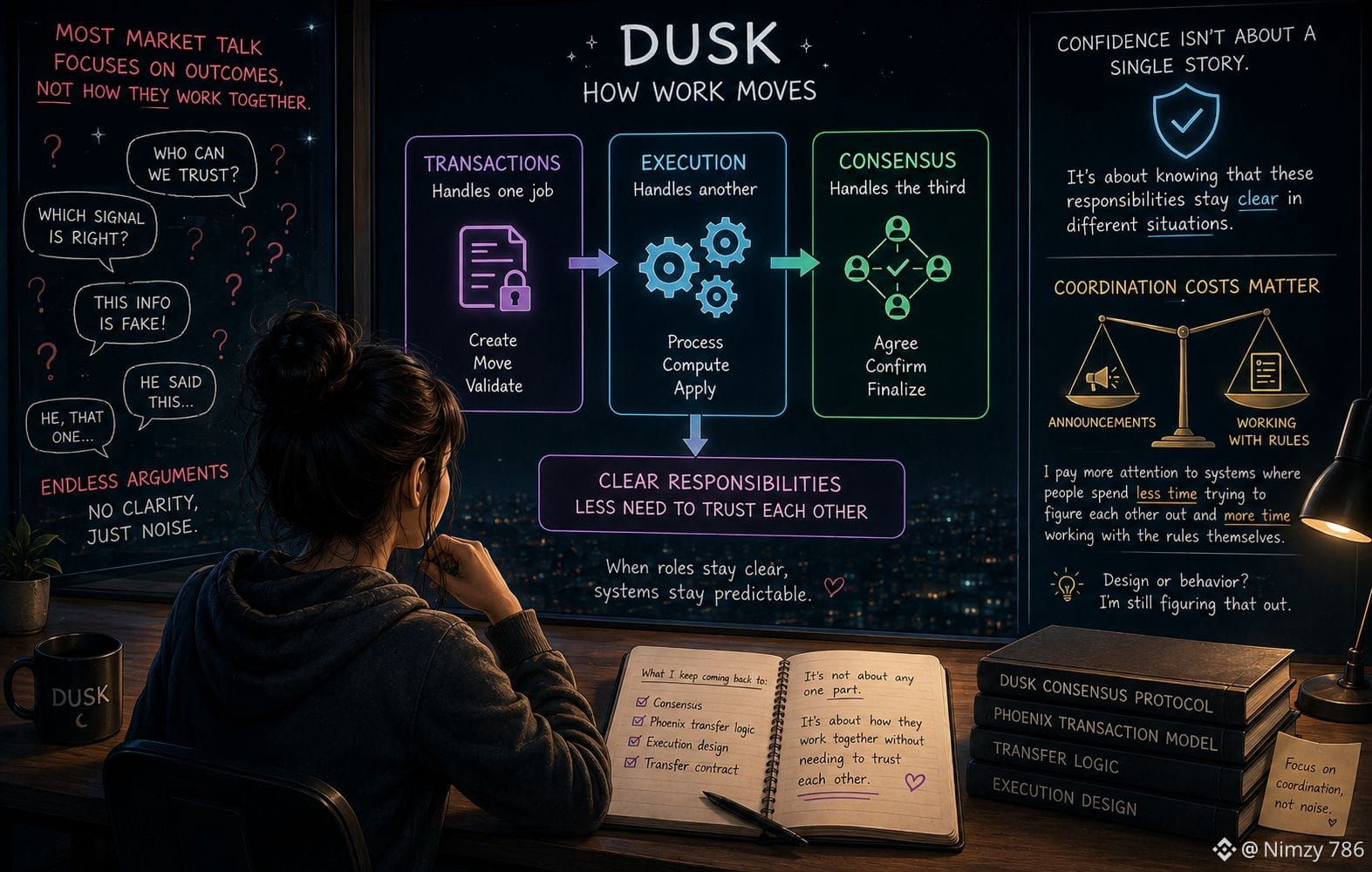
I found myself spending time watching how work moves through Dusk than listening to the usual market talk and that changed what I focused on.While going through parts of the consensus, Phoenix transfer logic and execution design I kept coming to the same idea. Most market conversations are about results. People really rely on how many different parts can work together without always having to trust each other.@Dusk
What caught my attention wasn't any one part. The cool thing was how responsibilities stayed focused. Transactions do one thing execution does another and consensus does a third. That feels normal until I think about how often crypto debates turn into fights about who should trust which signal.As I watched Dusk sentiment during times it seemed like confidence was less about a single story and more about whether people thought those responsibilities stayed clear in different situations.
That thought made me look more at coordination costs of announcements. The systems that keep me interested the most are the ones where people spend time trying to figure each other out and more time working with the rules themselves.I still don't know how much of that is from the design and how much is, from what people do and that difference feels worth thinking about.
$DUSK
I found myself spending time watching how work moves through Dusk than listening to the usual market talk and that changed what I focused on.While going through parts of the consensus, Phoenix transfer logic and execution design I kept coming to the same idea. Most market conversations are about results. People really rely on how many different parts can work together without always having to trust each other.@Dusk
What caught my attention wasn't any one part. The cool thing was how responsibilities stayed focused. Transactions do one thing execution does another and consensus does a third. That feels normal until I think about how often crypto debates turn into fights about who should trust which signal.As I watched Dusk sentiment during times it seemed like confidence was less about a single story and more about whether people thought those responsibilities stayed clear in different situations.
That thought made me look more at coordination costs of announcements. The systems that keep me interested the most are the ones where people spend time trying to figure each other out and more time working with the rules themselves.I still don't know how much of that is from the design and how much is, from what people do and that difference feels worth thinking about.
$DUSK
#dusk $DUSK @Dusk
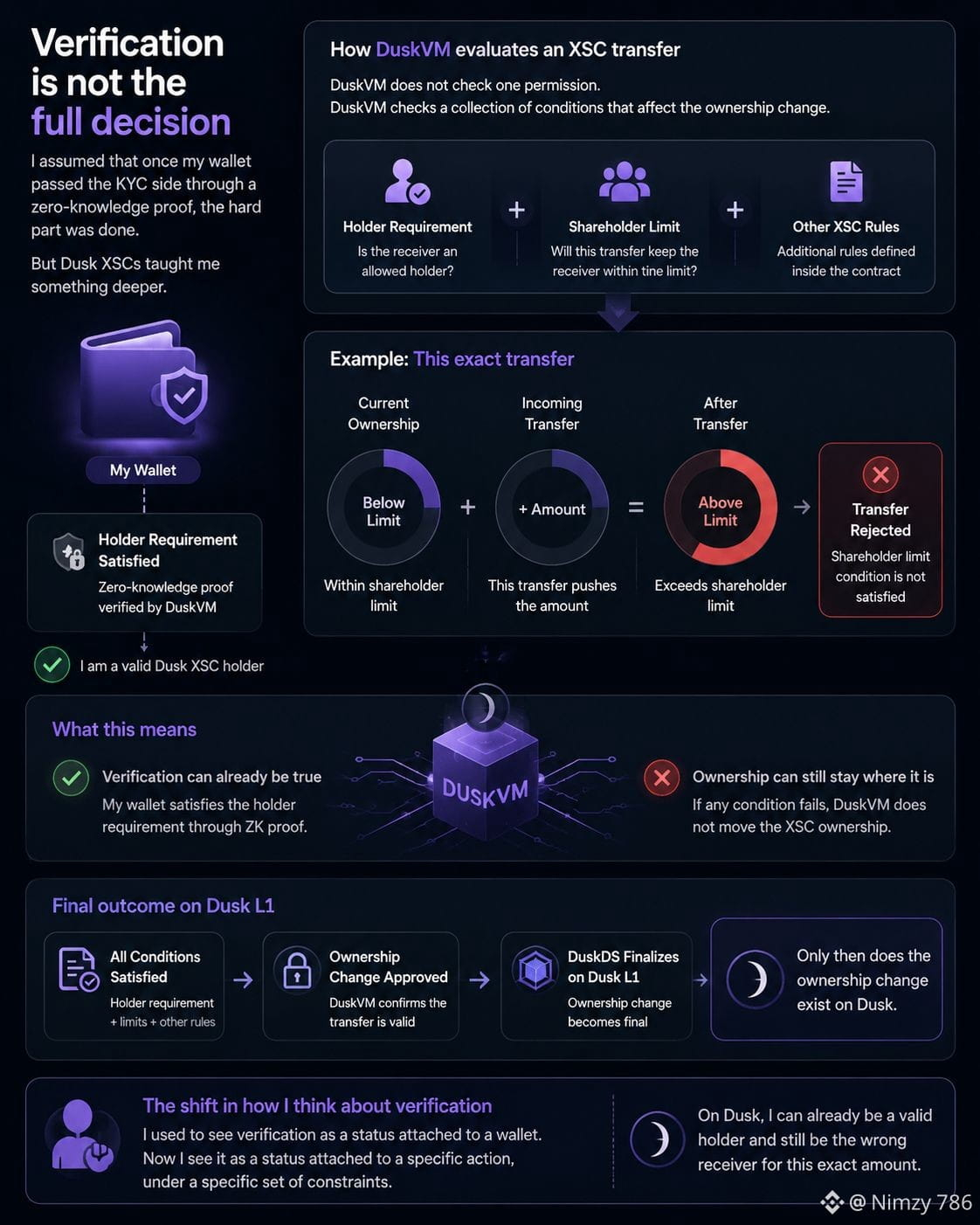
I spent time than I expected untangling a detail around Dusk XSCs because I treated verification as if it settled the entire decision.
In my mind the hard part was already done. My wallet had satisfied the holder requirement through a zero‑knowledge proof so I assumed the path from there was simple. The more I followed the logic, the less complete that assumption felt.@Dusk
What tripped me up was realizing that DuskVM does not evaluate one permission. DuskVM evaluates a collection of conditions that affect the ownership change.
My wallet can qualify as a holder and still fail the transfer. The holder requirement answers one question. The shareholder limit answers another. Passing the first does not soften the second.
That changed how I think about verification on Dusk. I used to view verification on Dusk as a status attached to a wallet. Now verification on Dusk feels like a status attached to a specific action, under a specific set of constraints.
Even some of the DUSK discussions make more sense through that lens. Verification can already be true while ownership remains where it is.
$DUSK
I spent time than I expected untangling a detail around Dusk XSCs because I treated verification as if it settled the entire decision.
In my mind the hard part was already done. My wallet had satisfied the holder requirement through a zero‑knowledge proof so I assumed the path from there was simple. The more I followed the logic, the less complete that assumption felt.@Dusk
What tripped me up was realizing that DuskVM does not evaluate one permission. DuskVM evaluates a collection of conditions that affect the ownership change.
My wallet can qualify as a holder and still fail the transfer. The holder requirement answers one question. The shareholder limit answers another. Passing the first does not soften the second.
That changed how I think about verification on Dusk. I used to view verification on Dusk as a status attached to a wallet. Now verification on Dusk feels like a status attached to a specific action, under a specific set of constraints.
Even some of the DUSK discussions make more sense through that lens. Verification can already be true while ownership remains where it is.
$DUSK

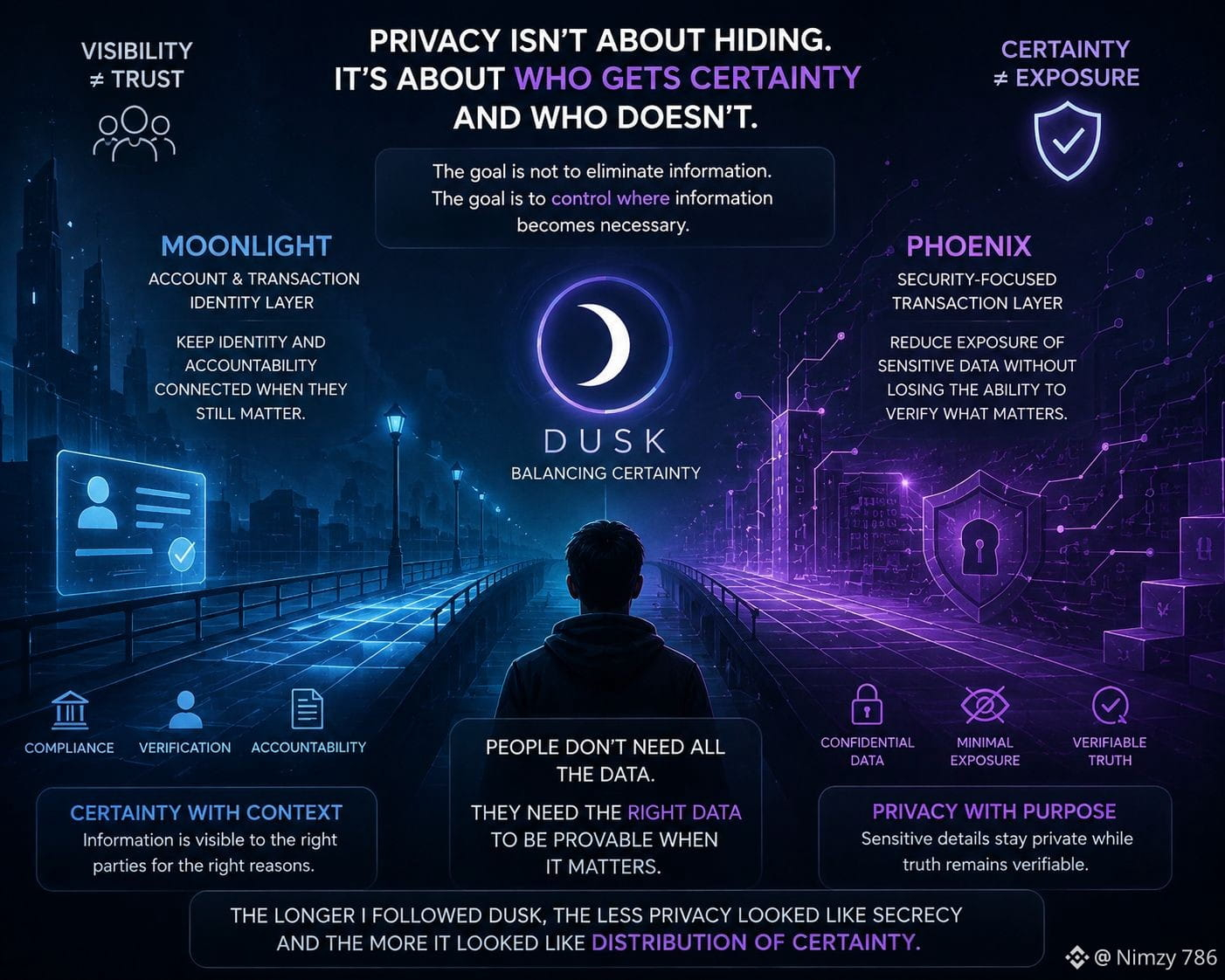
I came to Dusk thinking that privacy was about hiding certain bits of data.. After spending some time around the network I started thinking more about who actually gets to be sure of things and who is left in the dark.
In talks about the market people act like visibility and trust are the exact same thing. They think if everyone can see every move then everyone will feel confident. Dusk made me realize that this way of thinking might be wrong.
As I watched the activity on the network I kept thinking about the difference between Moonlight and Phoenix. Moonlight does not feel like a privacy tool to me. Instead Moonlight feels like a way to keep identity and accountability tied together when those things still matter. Phoenix looks at the problem from a different side. Phoenix works to hide transaction details so they are not exposed but Phoenix still lets you verify the things that actually need to be verified.
That difference changed my view on uncertainty. I realized the goal is not to get rid of information. The true goal is to decide where information becomes necessary.
I saw this pattern in how people felt about the coin during the quiet times. People did not seem to care much about how much data was out there. Instead people cared about whether the right data could be proven when it was actually needed.
The time I spent following Dusk the more I realized that privacy is not, about secrecy. To me privacy looks like a careful way to hand out certainty.#dusk @Dusk $DUSK
In talks about the market people act like visibility and trust are the exact same thing. They think if everyone can see every move then everyone will feel confident. Dusk made me realize that this way of thinking might be wrong.
As I watched the activity on the network I kept thinking about the difference between Moonlight and Phoenix. Moonlight does not feel like a privacy tool to me. Instead Moonlight feels like a way to keep identity and accountability tied together when those things still matter. Phoenix looks at the problem from a different side. Phoenix works to hide transaction details so they are not exposed but Phoenix still lets you verify the things that actually need to be verified.
That difference changed my view on uncertainty. I realized the goal is not to get rid of information. The true goal is to decide where information becomes necessary.
I saw this pattern in how people felt about the coin during the quiet times. People did not seem to care much about how much data was out there. Instead people cared about whether the right data could be proven when it was actually needed.
The time I spent following Dusk the more I realized that privacy is not, about secrecy. To me privacy looks like a careful way to hand out certainty.#dusk @Dusk $DUSK
Vérifié
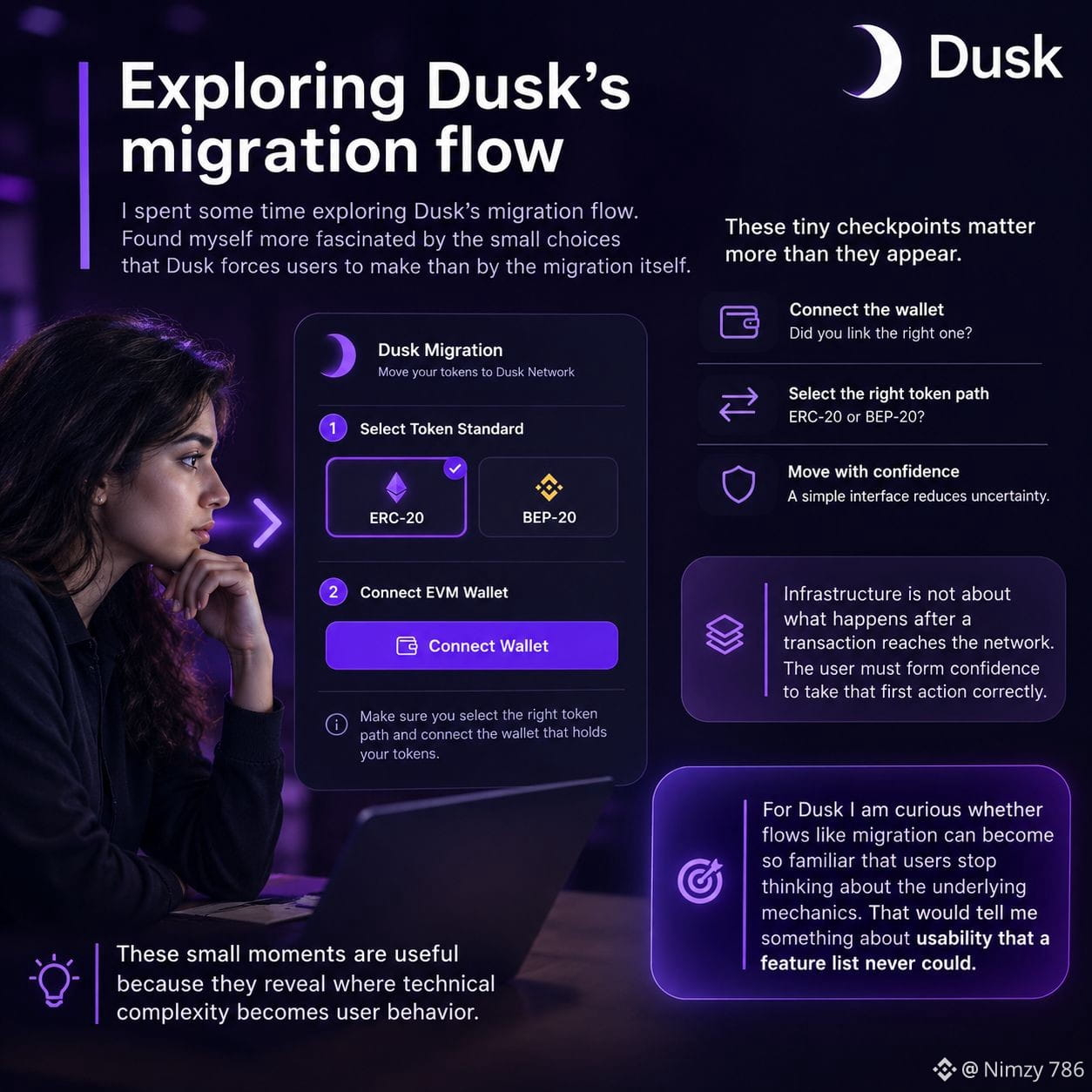
I spent some time exploring Dusks migration flow. Found myself more fascinated by the small choices that Dusk forces users to make than by the migration itself.The process begins when Dusk asks the user to choose whether the tokens are ERC-20 or BEP-20 and then to connect the EVM wallet that actually holds them. That may sound routine. Dusk believes that these tiny checkpoints matter more than they appear.@Dusk
When I move assets between environments I usually think about one thing: did I connect the wallet and select the right token path? A simple interface can reduce uncertainty while a confusing interface can make even a straightforward migration feel risky.
That made me look at Dusk participation differently. Infrastructure is not about what happens after a transaction reaches the network. The user must form confidence to take that first action correctly.
I find these small moments useful because they reveal where technical complexity becomes user behavior.
For Dusk I am curious whether flows like migration can become so familiar that users stop thinking about the underlying mechanics. That would tell me something, about usability that a feature list never could.
#dusk @Dusk $DUSK
$LAB
$RE
When I move assets between environments I usually think about one thing: did I connect the wallet and select the right token path? A simple interface can reduce uncertainty while a confusing interface can make even a straightforward migration feel risky.
That made me look at Dusk participation differently. Infrastructure is not about what happens after a transaction reaches the network. The user must form confidence to take that first action correctly.
I find these small moments useful because they reveal where technical complexity becomes user behavior.
For Dusk I am curious whether flows like migration can become so familiar that users stop thinking about the underlying mechanics. That would tell me something, about usability that a feature list never could.
#dusk @Dusk $DUSK
$LAB
$RE
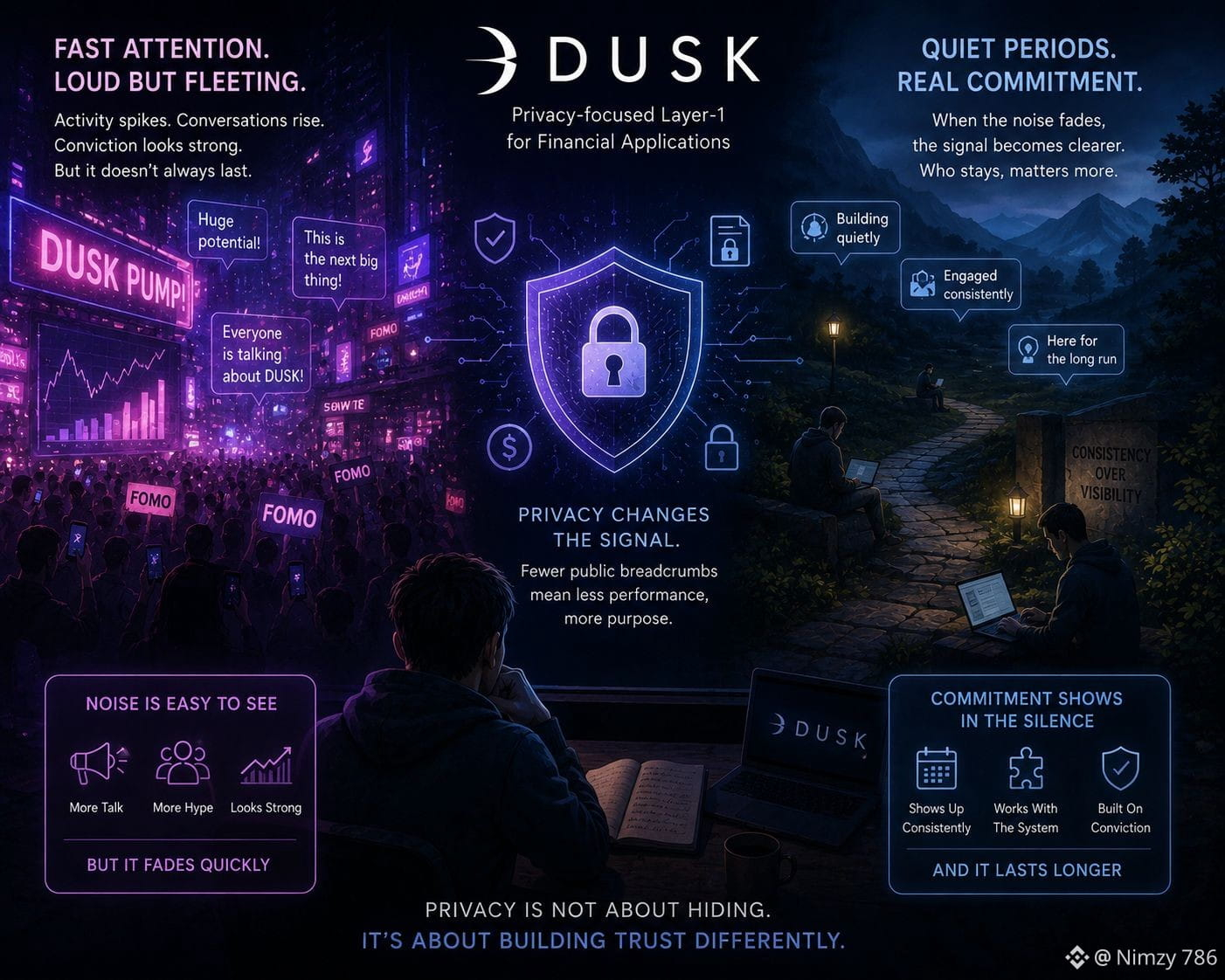
I found myself spending more time studying who stayed involved with DUSK during quiet periods than who appeared when attention briefly returned.@Dusk
Fast moving markets usually make participation look bigger than it really is. Activity rises, conversations increase, and conviction seems stronger than it was a week earlier. After following DUSK for a while, I became more interested in what happened after those moments passed.
What stood out was how a privacy-focused network changes the signals people use to judge commitment. When financial activity and contract logic are designed around confidentiality, there are fewer public breadcrumbs for people to follow. That makes participation feel less performative and a little harder to measure from the outside.
Because of that, I found myself paying attention to consistency instead of visibility. The participants who remained engaged were often not the ones generating the most noise. They were simply still there when attention moved elsewhere.
Even some of the shifts around the DUSK coin seemed to reflect this dynamic. Conviction appeared to build less through constant exposure and more through repeated interaction with the same system over time.
The longer I watched that pattern repeat, the less certain I became that visibility is the best way to understand commitment in a network built around privacy.
#dusk @Dusk $DUSK
$RE
$LAB
Fast moving markets usually make participation look bigger than it really is. Activity rises, conversations increase, and conviction seems stronger than it was a week earlier. After following DUSK for a while, I became more interested in what happened after those moments passed.
What stood out was how a privacy-focused network changes the signals people use to judge commitment. When financial activity and contract logic are designed around confidentiality, there are fewer public breadcrumbs for people to follow. That makes participation feel less performative and a little harder to measure from the outside.
Because of that, I found myself paying attention to consistency instead of visibility. The participants who remained engaged were often not the ones generating the most noise. They were simply still there when attention moved elsewhere.
Even some of the shifts around the DUSK coin seemed to reflect this dynamic. Conviction appeared to build less through constant exposure and more through repeated interaction with the same system over time.
The longer I watched that pattern repeat, the less certain I became that visibility is the best way to understand commitment in a network built around privacy.
#dusk @Dusk $DUSK
$RE
$LAB
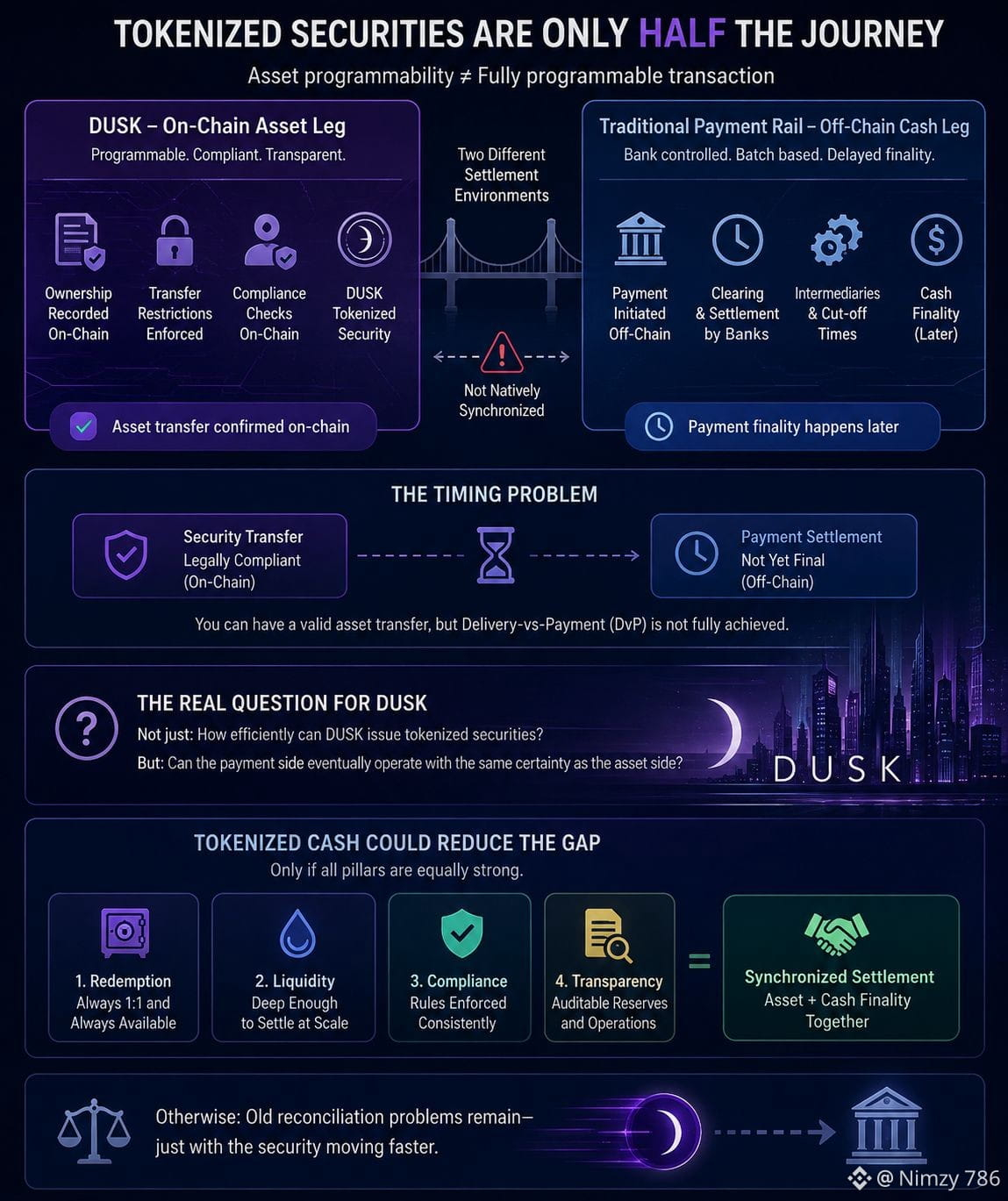
#dusk DUSK makes the asset leg of tokenized securities more programmable, but that does not automatically make the whole transaction programmable.
That distinction is easy to miss.
If ownership, transfer restrictions and compliance checks live on-chain while the cash payment remains tied to a bank rail, the transaction still crosses two settlement environments. The blockchain can confirm the security transfer, but the buyer and seller may still be waiting for the payment system to reach its own final state.
That creates a timing problem.
You can have a legally compliant asset transfer without having fully synchronized delivery-versus-payment.
For me, the bigger question around DUSK is therefore not simply how efficiently it can issue tokenized securities. It is whether the payment side can eventually operate with the same certainty as the asset side.
Tokenized cash could reduce that gap, but only if redemption, liquidity and compliance rules are equally reliable.
Otherwise, some of the old reconciliation problem remains — just with the security moving faster.@Dusk Foundation #dusk @Dusk #dusk $DUSK
$RE
$LAB
That distinction is easy to miss.
If ownership, transfer restrictions and compliance checks live on-chain while the cash payment remains tied to a bank rail, the transaction still crosses two settlement environments. The blockchain can confirm the security transfer, but the buyer and seller may still be waiting for the payment system to reach its own final state.
That creates a timing problem.
You can have a legally compliant asset transfer without having fully synchronized delivery-versus-payment.
For me, the bigger question around DUSK is therefore not simply how efficiently it can issue tokenized securities. It is whether the payment side can eventually operate with the same certainty as the asset side.
Tokenized cash could reduce that gap, but only if redemption, liquidity and compliance rules are equally reliable.
Otherwise, some of the old reconciliation problem remains — just with the security moving faster.@Dusk Foundation #dusk @Dusk #dusk $DUSK
$RE
$LAB
·
--
🎙️ 🚀Торгуємо DUSK на Binance Live ловимо тренд 🚀🚀та аналізуємо об'єми.
Fin
53 min 58 sec
629
2
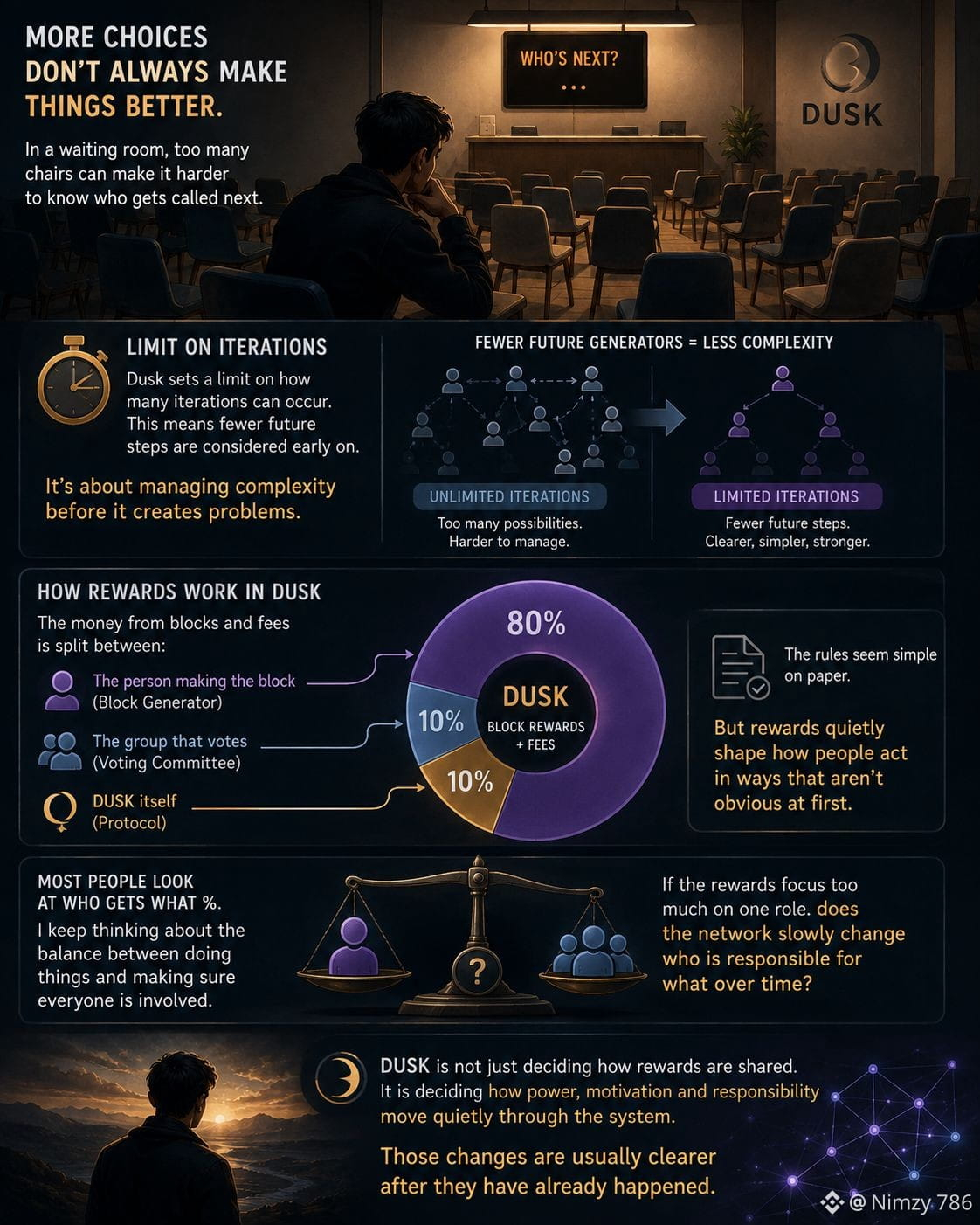
I was in a waiting room today. The odd thing is that putting chairs in does not always make things better. Sometimes having many choices just makes it harder to know who gets called next. @Dusk
That idea stuck with me while I was reading about Dusk. Dusk sets a limit on how times something can happen which means fewer future steps are considered early on. At first it seems like a technical thing.. Deep down it's really about managing complexity before it starts causing problems in the system.
The way rewards work adds another layer. In Dusk the money from blocks and fees is split between the person making the block the group that votes and Dusk itself. The rules seem simple on paper. Rewards have a way of changing how people act in ways that are not obvious at first.
Most people will look at who gets what percentage. I keep thinking about the balance between doing things and making sure everyone is involved. If the rewards focus much on one role does the network slowly change who is responsible for what, over time?
Maybe that is the part. Dusk is not just deciding how rewards are shared. It is deciding how power, motivation and responsibility move quietly through the system.. Those changes are usually clearer after they have already happened.
#dusk @Dusk $DUSK
$SOXSB
That idea stuck with me while I was reading about Dusk. Dusk sets a limit on how times something can happen which means fewer future steps are considered early on. At first it seems like a technical thing.. Deep down it's really about managing complexity before it starts causing problems in the system.
The way rewards work adds another layer. In Dusk the money from blocks and fees is split between the person making the block the group that votes and Dusk itself. The rules seem simple on paper. Rewards have a way of changing how people act in ways that are not obvious at first.
Most people will look at who gets what percentage. I keep thinking about the balance between doing things and making sure everyone is involved. If the rewards focus much on one role does the network slowly change who is responsible for what, over time?
Maybe that is the part. Dusk is not just deciding how rewards are shared. It is deciding how power, motivation and responsibility move quietly through the system.. Those changes are usually clearer after they have already happened.
#dusk @Dusk $DUSK
$SOXSB
Vérifié
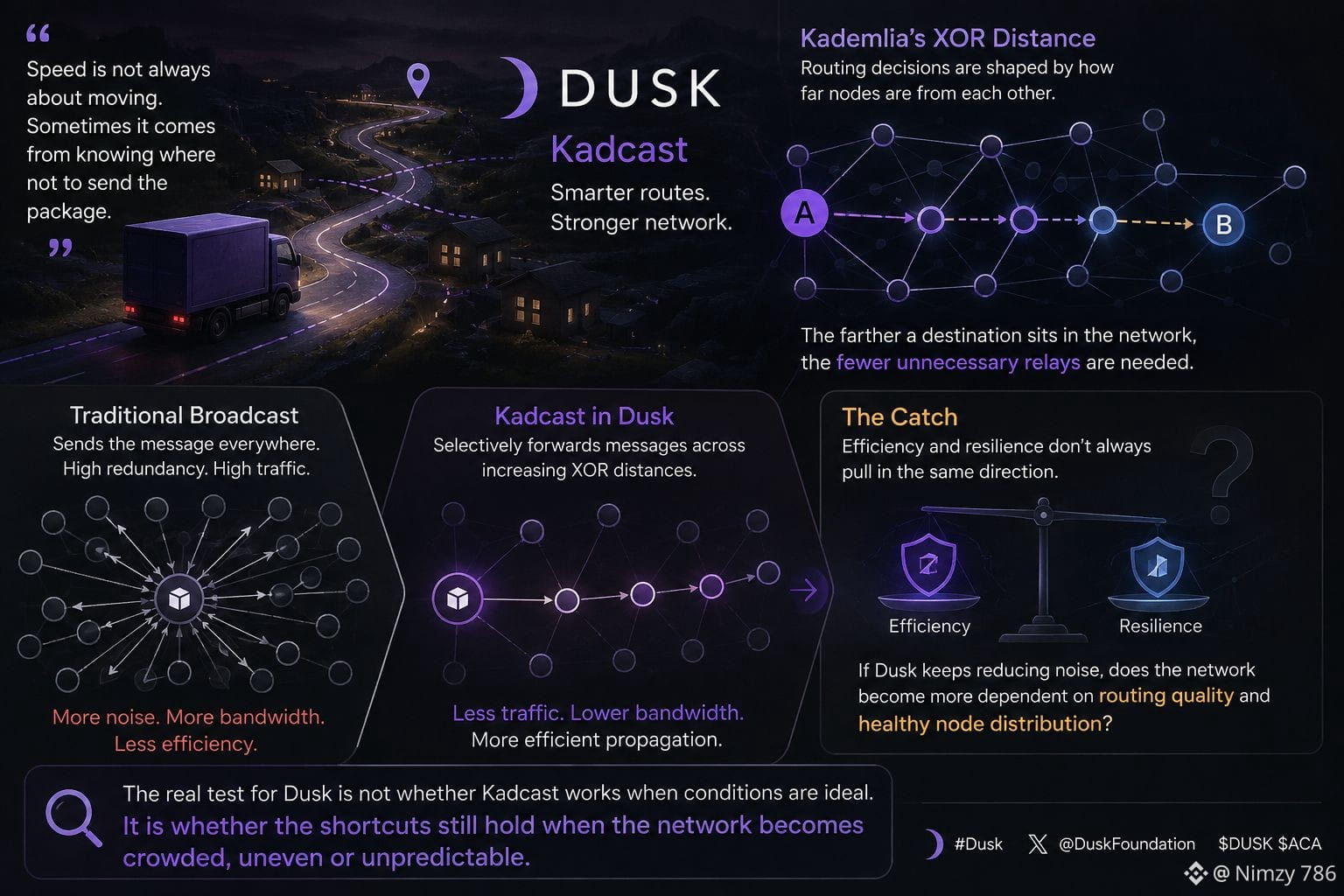
I was watching how a package moves through a delivery network. The strange thing is that speed is not always about moving. Sometimes it comes from knowing where not to send the package.
That thought came back while reading about Kadcast in Dusk. Most people see message propagation as a networking detail. I do not think that is correct. Dusk relies on Kademlias XOR distance, where routing decisions are shaped by how nodes are from each other in the Dusk network. The away a destination sits in the Dusk network the fewer unnecessary relays are needed in Dusk.
What interests me is the pressure this creates beneath the surface of Dusk. Traditional broadcast methods often solve reliability by sending the message everywhere in the network. Dusk takes a path. Kadcast in Dusk selectively forwards messages across increasing XOR distances in Dusk reducing traffic and bandwidth consumption in the Dusk network.@Dusk
The catch is that efficiency and resilience do not always pull in the direction in Dusk. If Dusk keeps reducing noise in the Dusk network does the Dusk network become more dependent on routing quality and healthy node distribution in Dusk? That is the part I rarely see discussed about Dusk.
Maybe the real test for Dusk is not whether Kadcast works when conditions are ideal, in the Dusk network. It is whether the shortcuts still hold when the Dusk network becomes crowded, uneven or unpredictable. #Dusk @Dusk $DUSK
$ACE
$XOS.US
That thought came back while reading about Kadcast in Dusk. Most people see message propagation as a networking detail. I do not think that is correct. Dusk relies on Kademlias XOR distance, where routing decisions are shaped by how nodes are from each other in the Dusk network. The away a destination sits in the Dusk network the fewer unnecessary relays are needed in Dusk.
What interests me is the pressure this creates beneath the surface of Dusk. Traditional broadcast methods often solve reliability by sending the message everywhere in the network. Dusk takes a path. Kadcast in Dusk selectively forwards messages across increasing XOR distances in Dusk reducing traffic and bandwidth consumption in the Dusk network.@Dusk
The catch is that efficiency and resilience do not always pull in the direction in Dusk. If Dusk keeps reducing noise in the Dusk network does the Dusk network become more dependent on routing quality and healthy node distribution in Dusk? That is the part I rarely see discussed about Dusk.
Maybe the real test for Dusk is not whether Kadcast works when conditions are ideal, in the Dusk network. It is whether the shortcuts still hold when the Dusk network becomes crowded, uneven or unpredictable. #Dusk @Dusk $DUSK
$ACE
$XOS.US
Vérifié
I was looking at a waiting room ticket the day. What most people notice is the number on it.. Hardly anyone thinks about when that number was given to them. The thing is, the timing of when you get a number can change who gets helped first.
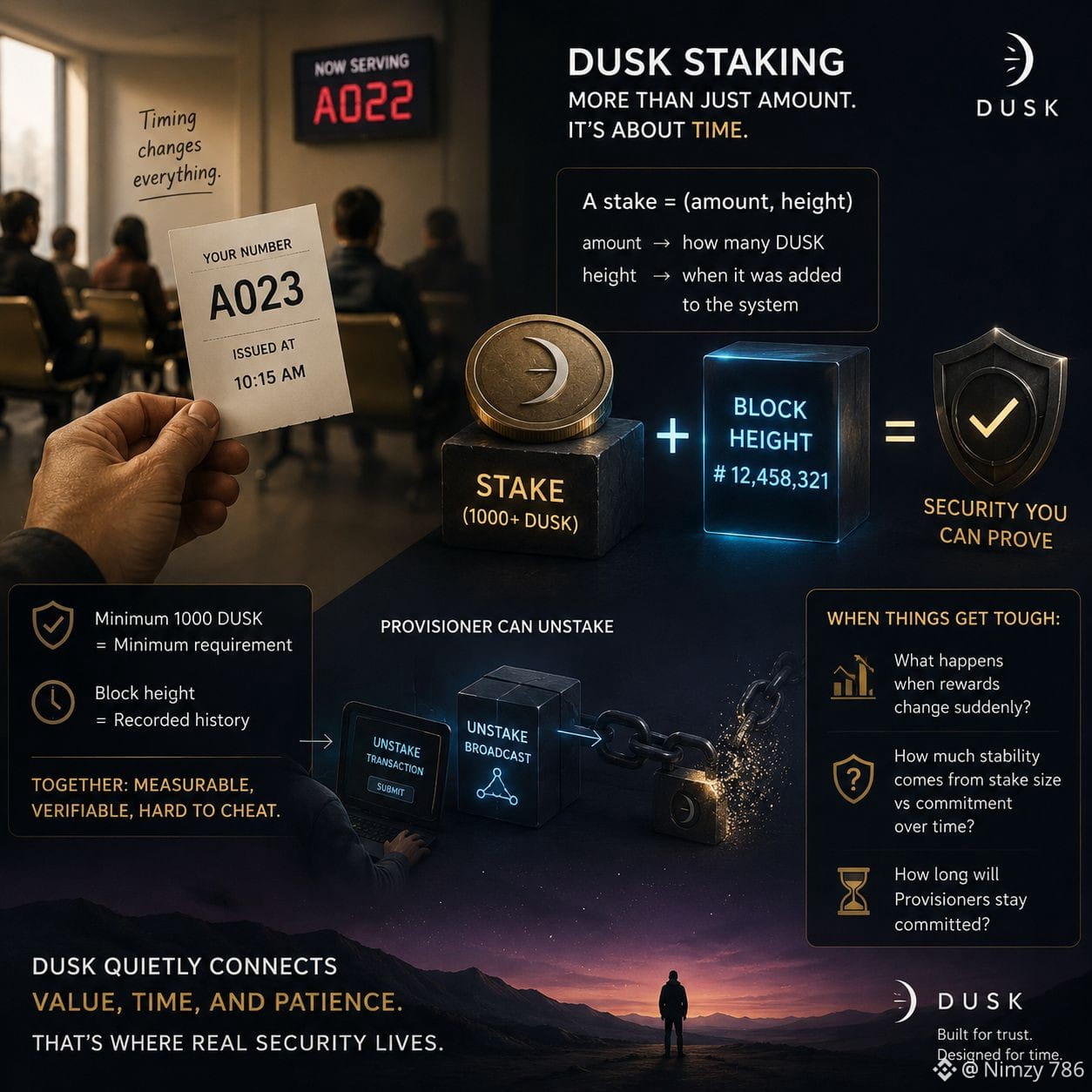
This made me think about how Dusk works with stakes. A stake is not about how many DUSK you have. It is two things: how many DUSK you have and at what point you added them to the system. At first it seems like the amount of DUSK is the important thing. When you added them seems like a detail.. I do not think that is true.@Dusk
The thing that is not immediately clear is that security is not about being committed. It is about being able to prove that you are committed. Dusk does not just care about how many DUSK're being used to stake. It cares about when those DUSK were added to the network. The rule that you need least 1000 DUSK creates a minimum requirement.. When those DUSK were added creates a history. Together these two things make staking more measurable and harder to cheat.
Most people will probably think about the rewards they can get or how they can participate or how they can get flexibility.. I keep wondering what happens when things get tough. If Provisioners can remove their stake by sending a transaction what happens when the rewards change suddenly? How much of the network staying stable depends on how big the stakesre how much depends on how long people are willing to keep their stakes?
Maybe the interesting thing, about Dusk is not the stakes themselves. Maybe it is the way the protocol quietly connects value, time and patience. #Dusk @Dusk $DUSK
$SNDK
This made me think about how Dusk works with stakes. A stake is not about how many DUSK you have. It is two things: how many DUSK you have and at what point you added them to the system. At first it seems like the amount of DUSK is the important thing. When you added them seems like a detail.. I do not think that is true.@Dusk
The thing that is not immediately clear is that security is not about being committed. It is about being able to prove that you are committed. Dusk does not just care about how many DUSK're being used to stake. It cares about when those DUSK were added to the network. The rule that you need least 1000 DUSK creates a minimum requirement.. When those DUSK were added creates a history. Together these two things make staking more measurable and harder to cheat.
Most people will probably think about the rewards they can get or how they can participate or how they can get flexibility.. I keep wondering what happens when things get tough. If Provisioners can remove their stake by sending a transaction what happens when the rewards change suddenly? How much of the network staying stable depends on how big the stakesre how much depends on how long people are willing to keep their stakes?
Maybe the interesting thing, about Dusk is not the stakes themselves. Maybe it is the way the protocol quietly connects value, time and patience. #Dusk @Dusk $DUSK
$SNDK
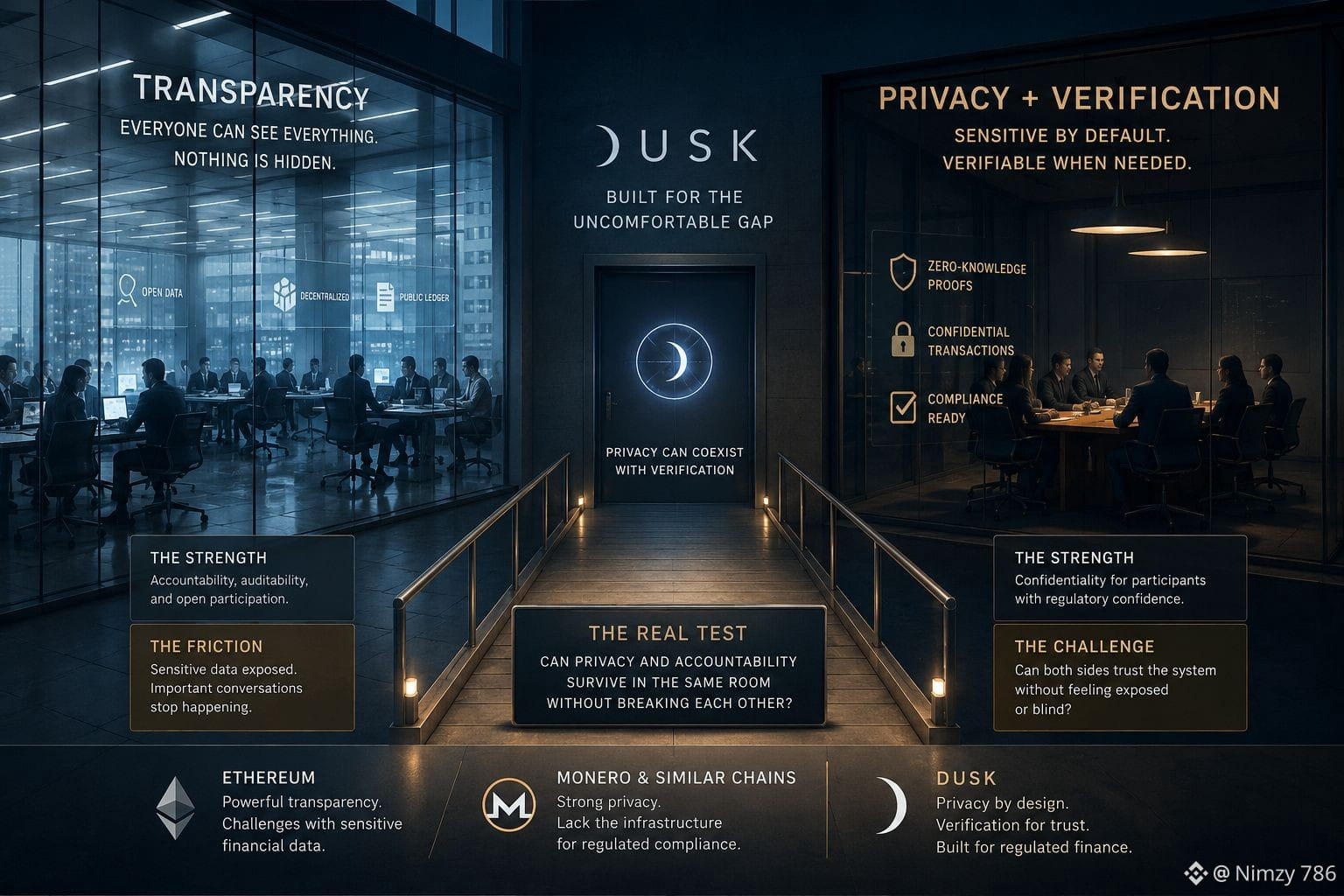
I kept thinking about a building where every office has glass walls. At first it feels efficient. Everyone can see everything. Nothing is hidden. After a while you start wondering how many important conversations simply stop happening because they are always being watched.@Dusk
That tension keeps coming to me when I compare networks built for openness with systems trying to support regulated financial activity. Ethereum proved how powerful transparency can be, Transparency alone creates friction when sensitive financial data, compliance requirements and institutional accountability start colliding with each other. Privacy-focused chains solved a problem but often by stepping away from the visibility regulators and auditors depend on.
What makes Dusk interesting to me is that it seems to sit inside that uncomfortable gap. Dusk is not asking how transactions can stay private. It is also asking how privacy can coexist with verification. That sounds simple until you realize those goals often pull in directions.
Most people notice the privacy layer first. I think the harder challenge is trust. Can Dusk provide confidentiality for participants while still giving institutions confidence that rules are being followed? Can both sides accept the system without feeling exposed or blind?
Maybe that is the test, for Dusk. Not whether privacy works, Whether privacy and accountability can survive in the same room without eventually breaking each other.
@Dusk $DUSK #dusk
That tension keeps coming to me when I compare networks built for openness with systems trying to support regulated financial activity. Ethereum proved how powerful transparency can be, Transparency alone creates friction when sensitive financial data, compliance requirements and institutional accountability start colliding with each other. Privacy-focused chains solved a problem but often by stepping away from the visibility regulators and auditors depend on.
What makes Dusk interesting to me is that it seems to sit inside that uncomfortable gap. Dusk is not asking how transactions can stay private. It is also asking how privacy can coexist with verification. That sounds simple until you realize those goals often pull in directions.
Most people notice the privacy layer first. I think the harder challenge is trust. Can Dusk provide confidentiality for participants while still giving institutions confidence that rules are being followed? Can both sides accept the system without feeling exposed or blind?
Maybe that is the test, for Dusk. Not whether privacy works, Whether privacy and accountability can survive in the same room without eventually breaking each other.
@Dusk $DUSK #dusk
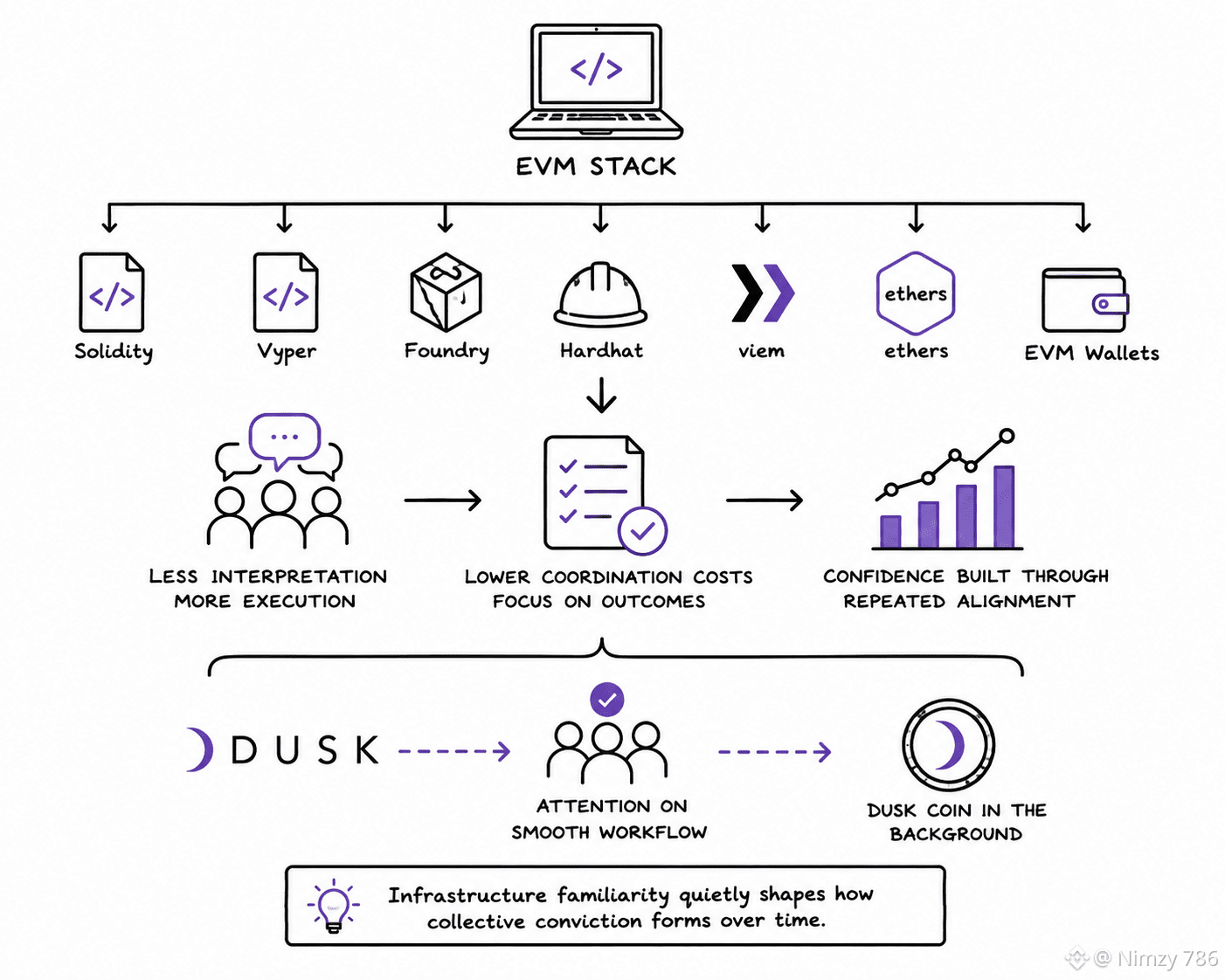
I found myself spending more time thinking about the EVM stack than the DUSK coin after working through Solidity workflows with Foundry, Hardhat, viem, ethers, and ordinary wallet interactions.@Dusk
What stood out was not the tooling itself but what happened to decision making around it. Conversations seemed to contain less interpretation and more execution. Fewer discussions were spent translating ideas into workable steps because participants were already operating inside familiar patterns.
That changed how information moved through the network. When coordination costs fell, people appeared to spend more attention evaluating outcomes instead of debating process. The interesting part was that confidence did not seem to come from promises or narratives. It formed through repeated interactions where expectations and results stayed aligned.
While following activity around DUSK, I found that attention often shifted away from the asset and toward whether work could move forward without friction. The coin still sat in the background of participation, but it was not always the center of the conversation.
The longer I followed those patterns, the more infrastructure familiarity looked less like a developer convenience and more like a subtle influence on how collective conviction forms over time.
#dusk @Dusk $DUSK
What stood out was not the tooling itself but what happened to decision making around it. Conversations seemed to contain less interpretation and more execution. Fewer discussions were spent translating ideas into workable steps because participants were already operating inside familiar patterns.
That changed how information moved through the network. When coordination costs fell, people appeared to spend more attention evaluating outcomes instead of debating process. The interesting part was that confidence did not seem to come from promises or narratives. It formed through repeated interactions where expectations and results stayed aligned.
While following activity around DUSK, I found that attention often shifted away from the asset and toward whether work could move forward without friction. The coin still sat in the background of participation, but it was not always the center of the conversation.
The longer I followed those patterns, the more infrastructure familiarity looked less like a developer convenience and more like a subtle influence on how collective conviction forms over time.
#dusk @Dusk $DUSK
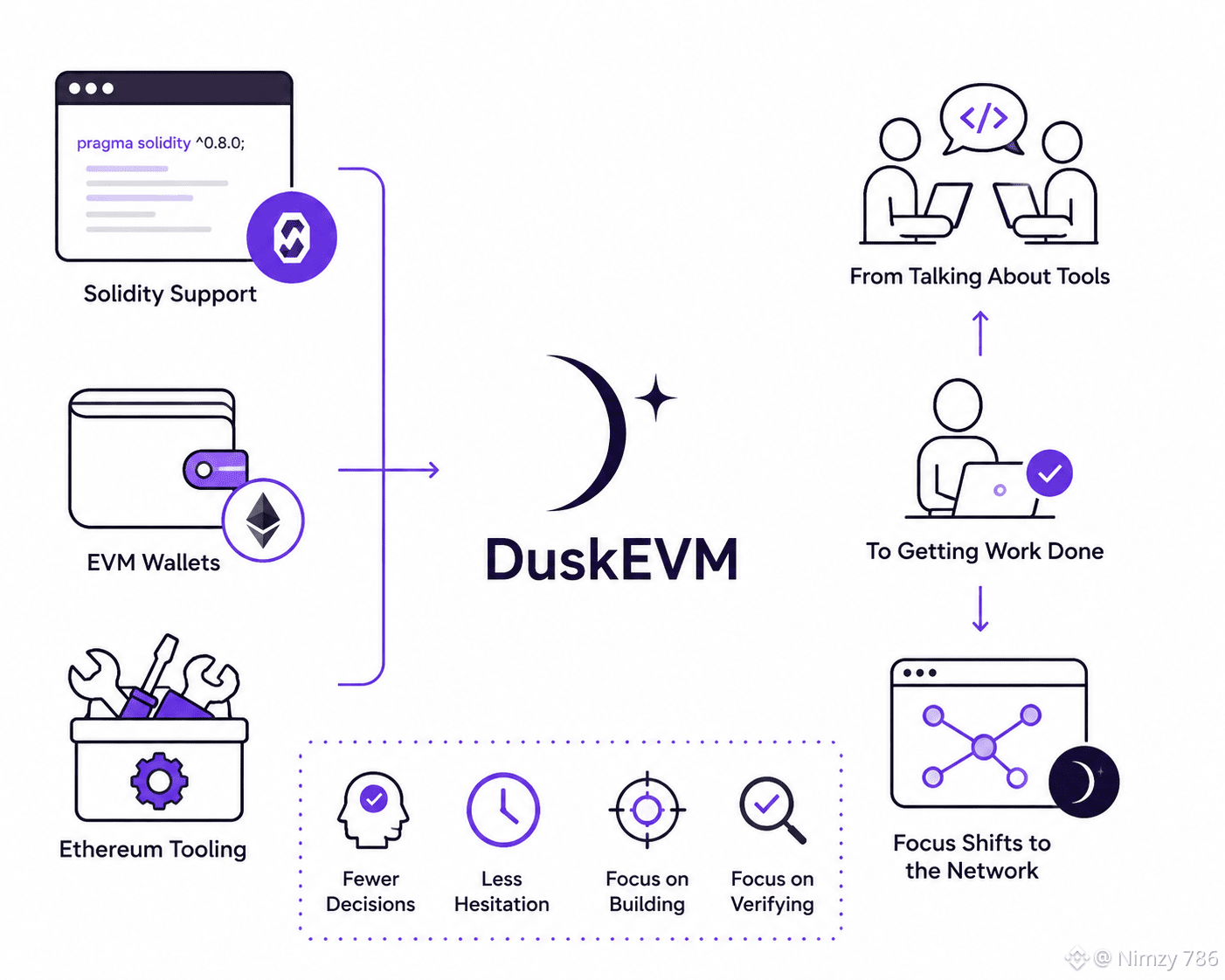
I noticed that the way developers discuss DuskEVM is really interesting. It changed my thoughts on how networks grow. When people talk about DuskEVM they do not stay focused on features for a long time.What I kept seeing was how fast people moved from talking about tools to talking about working.@Dusk Supporting Solidity and using wallets makes things easier for people. It also helps that people are used to ways of doing things. But the more I looked at how people were participating the more I thought that the real difference is else. When there are things to adjust people have to make fewer decisions.. When people have to make fewer decisions they are less likely to hesitate before contributing to DuskEVM.This small change, in how people work feels more important than it seems at first. Now people do not have to learn a new environment before they can participate in DuskEVM. Instead people can focus on what they're actually building and checking.I also thought it was interesting that when people talked more about workflows they talked less about DUSK. People stopped focusing on the coin. Started thinking about the network as a place where they could work without interruptions.The longer I watched this happen the less DuskEVM seemed like a way to make things compatible. It seemed like a way to quietly change where people focus their attention. Although I am still not sure how much of an effect this has over time I think DuskEVM is really changing how people participate.
#dusk @Dusk $DUSK
#dusk @Dusk $DUSK
I found myself paying more attention to who stayed engaged with Dusk when there was very little discussion around it, and that ended up teaching me more than the periods when attention briefly returned.In most markets, people can often signal conviction just by holding a coin. Around Dusk, I kept running into a different pattern. The stronger signal seemed to come from participants spending time understanding how confidential smart contracts change what information is visible and what remains hidden. @Dusk .That created an unusual dynamic. Conversations often moved slower because fewer assumptions could be made from surface-level activity. People appeared to spend more time evaluating the reliability of the system itself rather than reacting to whatever happened to be easiest to observe.
I also found that DUSK sentiment rarely shifted all at once. Conviction seemed to build in small pieces as participants became comfortable operating with less visible information than they were used to elsewhere.The longer I followed those participation patterns, the less privacy looked like a feature and the more it looked like a factor that quietly changes how trust forms in a network, although I am still not completely sure where that leads over time.
#dusk @Dusk $DUSK
I also found that DUSK sentiment rarely shifted all at once. Conviction seemed to build in small pieces as participants became comfortable operating with less visible information than they were used to elsewhere.The longer I followed those participation patterns, the less privacy looked like a feature and the more it looked like a factor that quietly changes how trust forms in a network, although I am still not completely sure where that leads over time.
#dusk @Dusk $DUSK
🚨 Update for $XRP holders:
The Senate’s path toward passing the CLARITY Act is becoming increasingly uncertain.
Several Democratic lawmakers have raised concerns over DeFi oversight, consumer safeguards, and ethics-related provisions, making it more difficult to secure the 60 votes needed for approval.
As a result, attention is shifting toward a potential September vote instead of the previously expected August timeline.
For $XRP , clearer crypto regulations could serve as a significant long-term catalyst, but the outcome remains far from certain.
All eyes are now on September as it could become a pivotal month for U.S. crypto regulation. 👀
#XRP #Crypto #Crypto_Jobs🎯 #Ripple $XRP
The Senate’s path toward passing the CLARITY Act is becoming increasingly uncertain.
Several Democratic lawmakers have raised concerns over DeFi oversight, consumer safeguards, and ethics-related provisions, making it more difficult to secure the 60 votes needed for approval.
As a result, attention is shifting toward a potential September vote instead of the previously expected August timeline.
For $XRP , clearer crypto regulations could serve as a significant long-term catalyst, but the outcome remains far from certain.
All eyes are now on September as it could become a pivotal month for U.S. crypto regulation. 👀
#XRP #Crypto #Crypto_Jobs🎯 #Ripple $XRP
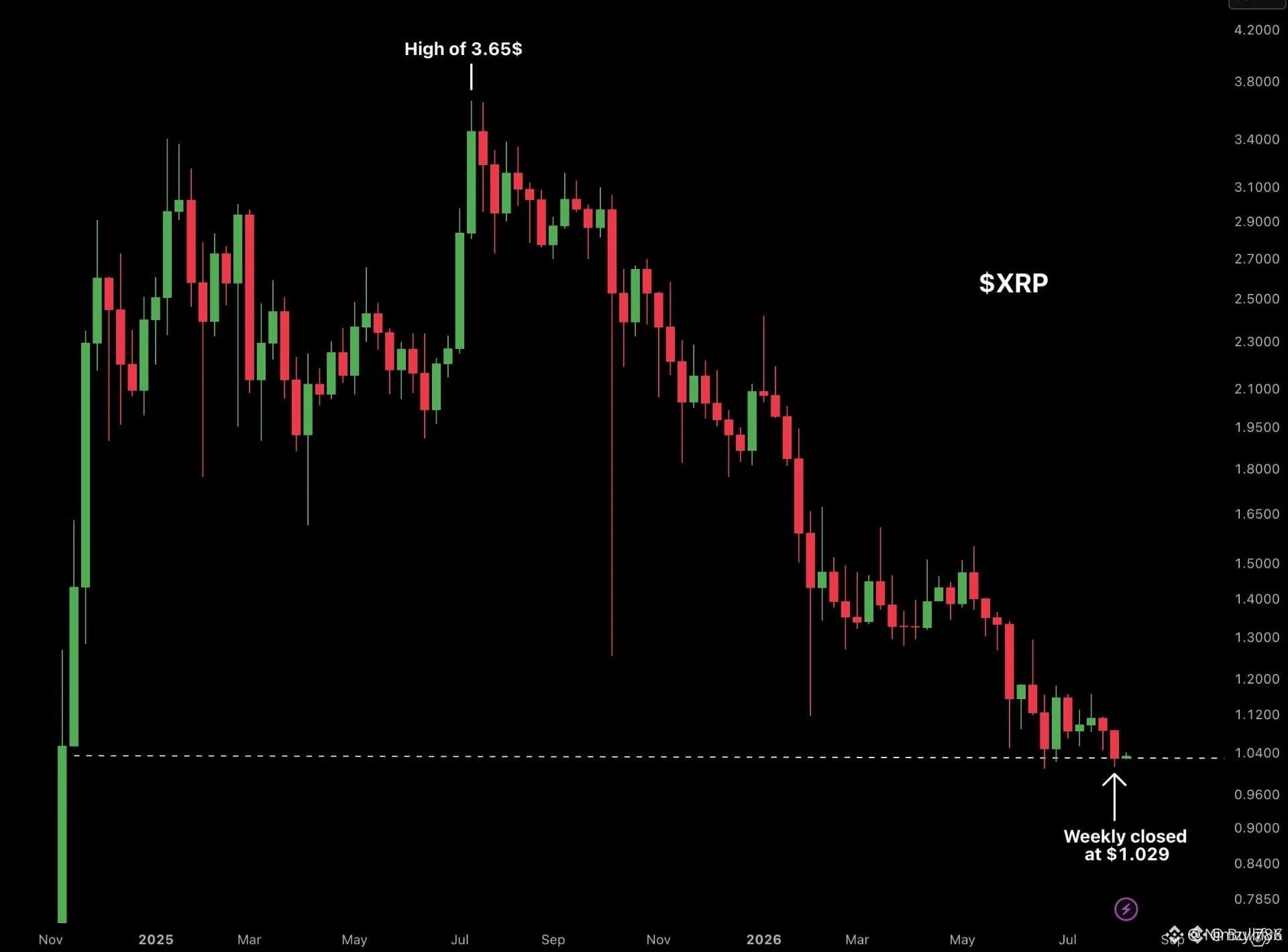
Most people are focused on the latest candle, but the bigger picture for $XRP may be more important.
The current structure is starting to resemble the setup that preceded XRP's massive 2017 breakout. Back then, a key support zone held firm before the market entered an explosive expansion phase.
My roadmap remains:
📍 $1.10 → $0.97 → $1.80
📍 $1.80 → $2.70 → $3.20
📍 $3.20 → $6.50 → $13.00
The critical factor is whether this support level can hold once again. If buyers continue defending the area and the structure remains intact, momentum could build much faster than many expect.
No guarantees in markets, but the chart is giving traders a level worth watching closely.
Keep an eye on the support. Keep an eye on the trend. 🚀
#XRP #Ripple #Crypto #Binance #Write2Earn
$XRP
The current structure is starting to resemble the setup that preceded XRP's massive 2017 breakout. Back then, a key support zone held firm before the market entered an explosive expansion phase.
My roadmap remains:
📍 $1.10 → $0.97 → $1.80
📍 $1.80 → $2.70 → $3.20
📍 $3.20 → $6.50 → $13.00
The critical factor is whether this support level can hold once again. If buyers continue defending the area and the structure remains intact, momentum could build much faster than many expect.
No guarantees in markets, but the chart is giving traders a level worth watching closely.
Keep an eye on the support. Keep an eye on the trend. 🚀
#XRP #Ripple #Crypto #Binance #Write2Earn
$XRP
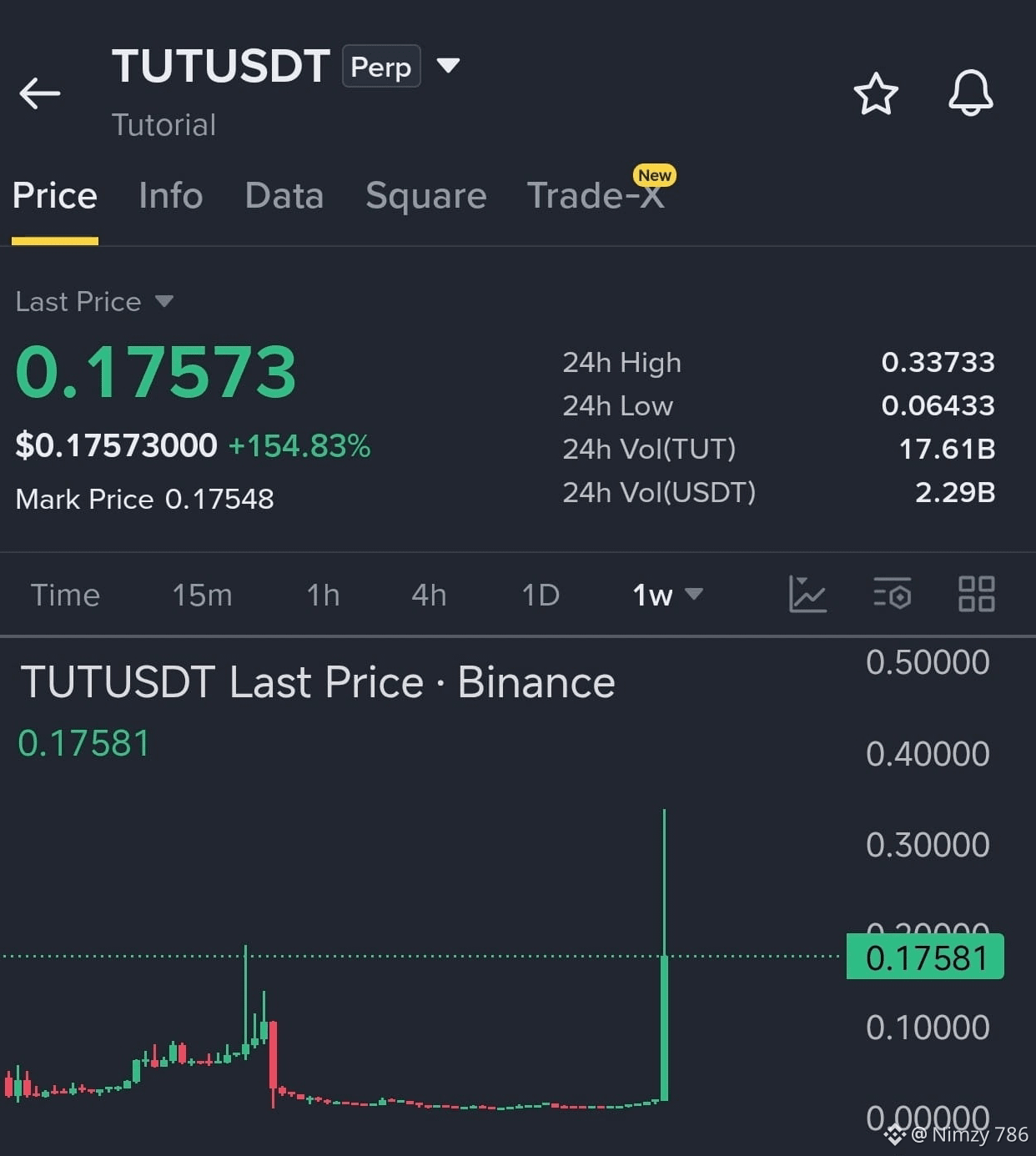
Looks like $TUT gave a lot of traders a tough lesson today — something we've seen countless times across the market.
That's exactly why I cautioned against shorting yesterday and again today.
What happens next? We'll have to wait and see.
One thing worth remembering: not every opportunity requires a trade. Sometimes the smartest move is staying on the sidelines and protecting your capital.
To everyone who got caught on the wrong side of the move, sorry for the losses. 😭$TUT
That's exactly why I cautioned against shorting yesterday and again today.
What happens next? We'll have to wait and see.
One thing worth remembering: not every opportunity requires a trade. Sometimes the smartest move is staying on the sidelines and protecting your capital.
To everyone who got caught on the wrong side of the move, sorry for the losses. 😭$TUT
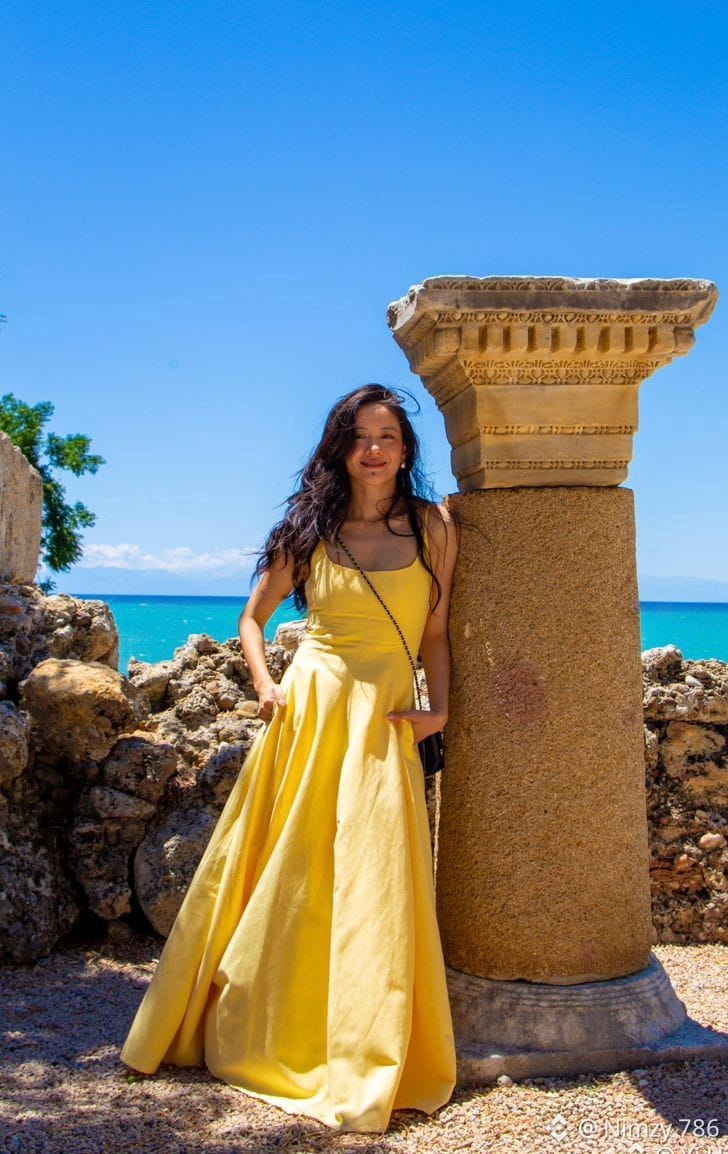
OOTD today: Binance Yellow. 💛
And before anyone asks — it's not an imperial robe. The Qing dynasty ended 114 years ago, so that chapter of history is long closed. Today, it's just a splash of yellow and a nod to the Binance vibe.
And before anyone asks — it's not an imperial robe. The Qing dynasty ended 114 years ago, so that chapter of history is long closed. Today, it's just a splash of yellow and a nod to the Binance vibe.
Connectez-vous pour découvrir plus de contenu