
airdropbuzzdotcom
3k Publications

airdropbuzzdotcom
Signaler
Bloquer l’utilisateur
Stay updated with the latest in crypto! Bringing you the best in crypto news, technical analysis, and airdrop updates.Visit airdropbuzz.com for more updates
Ouvert au trading

Détenteur pour BNB
Trade régulièrement
5.4 an(s)
32 Suivis
2.0K+ Abonnés
4.3K+ J’aime
Publications
Portefeuille
Tous
Citations
Vidéos
Voir la traduction
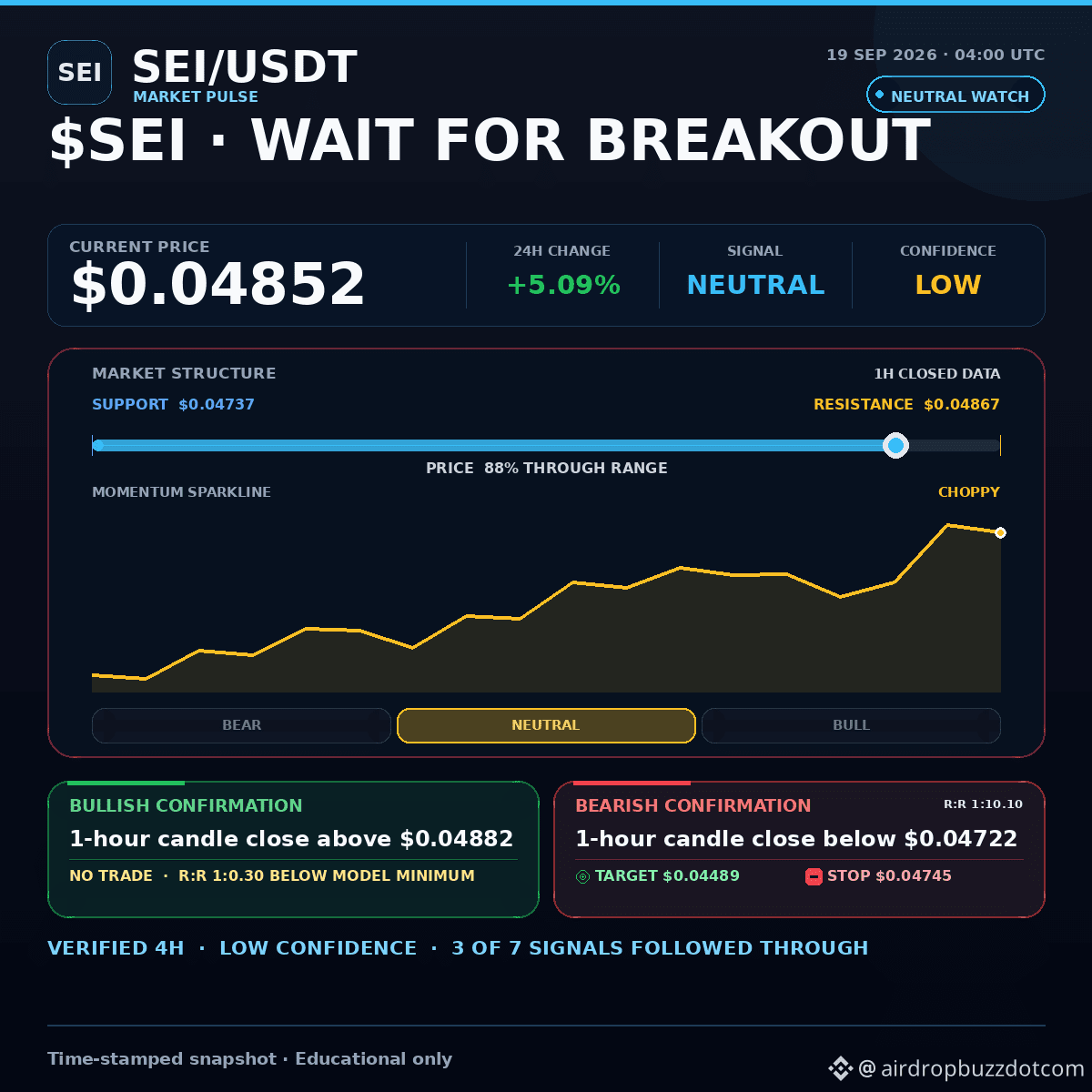
Which fires first for $SEI: the bull trigger or the bear trigger?
📊 Snapshot
• Price: $0.04852
• 24H: +5.09%
• Bias: Neutral
📈 Bull Trigger
1-hour close above $0.04882 with open interest confirmation
📉 Bear Trigger
1-hour close below $0.04722 with open interest confirmation
🎯 Signal Read
The useful signal is the first confirmed close that settles the current fight for control, not another intraday wick.
📌 Confidence
Low · Low historical confidence · 3 of 7 directional moves were favorable
Signal Quality
- OI: Flat (-0.83%)
- 4H: Bullish | 1D: Bullish (Aligned)
- ATR filter: 0.50 ATR ($0.0003021)
- Risk/reward: 1:0.30 - below minimum
Bull scenario risk plan
- Entry: $0.04882
- Stop: $0.04859
- Target: $0.04889
Trigger levels define confirmation; they do not guarantee where price will finish.
Up or down first? Reply UP or DOWN.
#SEI #Sei #CryptoTrading #MarketPulse
Educational only. Time-stamped market snapshot, not financial advice.
Which fires first for $SEI : the bull trigger or the bear trigger?
📊 Snapshot
• Price: $0.04852
• 24H: +5.09%
• Bias: Neutral
📈 Bull Trigger
1-hour close above $0.04882 with open interest confirmation
📉 Bear Trigger
1-hour close below $0.04722 with open interest confirmation
🎯 Signal Read
The useful signal is the first confirmed close that settles the current fight for control, not another intraday wick.
📌 Confidence
Low · Low historical confidence · 3 of 7 directional moves were favorable
Signal Quality
- OI: Flat (-0.83%)
- 4H: Bullish | 1D: Bullish (Aligned)
- ATR filter: 0.50 ATR ($0.0003021)
- Risk/reward: 1:0.30 - below minimum
Bull scenario risk plan
- Entry: $0.04882
- Stop: $0.04859
- Target: $0.04889
Trigger levels define confirmation; they do not guarantee where price will finish.
Up or down first? Reply UP or DOWN.
#SEI #Sei #CryptoTrading #MarketPulse
Educational only. Time-stamped market snapshot, not financial advice.
📊 Snapshot
• Price: $0.04852
• 24H: +5.09%
• Bias: Neutral
📈 Bull Trigger
1-hour close above $0.04882 with open interest confirmation
📉 Bear Trigger
1-hour close below $0.04722 with open interest confirmation
🎯 Signal Read
The useful signal is the first confirmed close that settles the current fight for control, not another intraday wick.
📌 Confidence
Low · Low historical confidence · 3 of 7 directional moves were favorable
Signal Quality
- OI: Flat (-0.83%)
- 4H: Bullish | 1D: Bullish (Aligned)
- ATR filter: 0.50 ATR ($0.0003021)
- Risk/reward: 1:0.30 - below minimum
Bull scenario risk plan
- Entry: $0.04882
- Stop: $0.04859
- Target: $0.04889
Trigger levels define confirmation; they do not guarantee where price will finish.
Up or down first? Reply UP or DOWN.
#SEI #Sei #CryptoTrading #MarketPulse
Educational only. Time-stamped market snapshot, not financial advice.
10
Voir la traduction
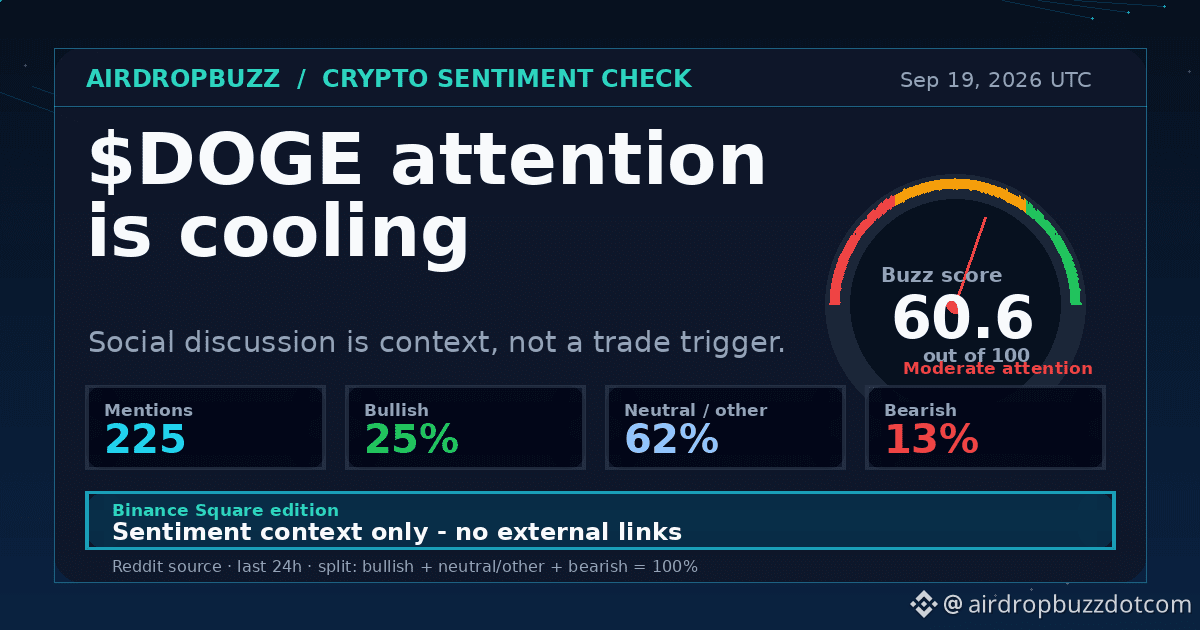
Crypto Sentiment Check: $DOGE attention is cooling.
Social crypto discussion around $DOGE is active today, and discussion is leaning more constructive than cautious. The useful read is patience: sentiment is context, but confirmation still has to come from price, volume and risk conditions.
Treat this as market context, not a trade trigger. Wait for confirmation before acting.
Educational only, not financial advice.
Crypto Sentiment Check: $DOGE attention is cooling.
Social crypto discussion around $DOGE is active today, and discussion is leaning more constructive than cautious. The useful read is patience: sentiment is context, but confirmation still has to come from price, volume and risk conditions.
Treat this as market context, not a trade trigger. Wait for confirmation before acting.
Educational only, not financial advice.
Social crypto discussion around $DOGE is active today, and discussion is leaning more constructive than cautious. The useful read is patience: sentiment is context, but confirmation still has to come from price, volume and risk conditions.
Treat this as market context, not a trade trigger. Wait for confirmation before acting.
Educational only, not financial advice.
34
Voir la traduction
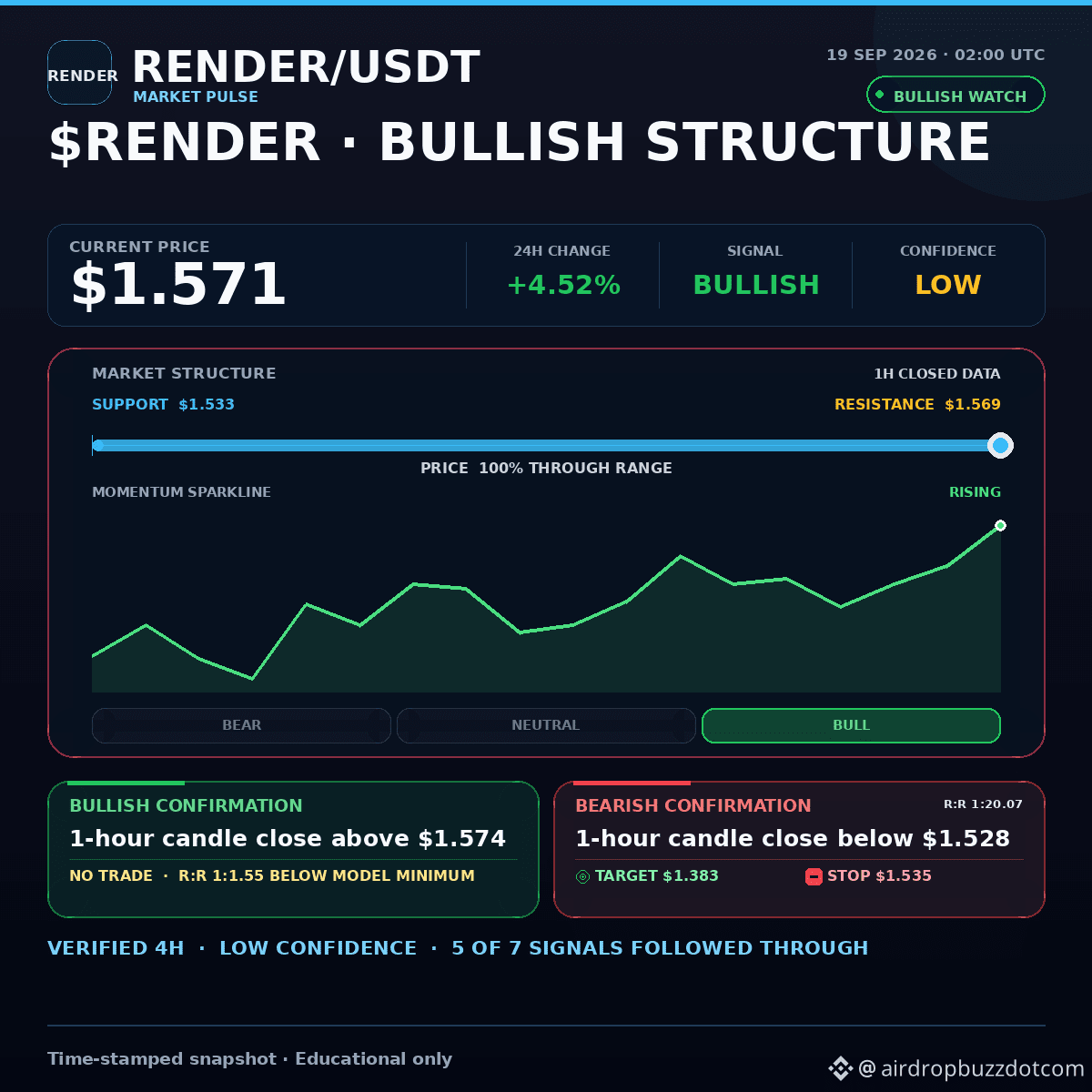
Nobody's talking about the harder $RENDER question: does confirmation support the move?
📊 Snapshot
• Price: $1.571
• 24H: +4.52%
• Bias: Bullish
📈 Bull Trigger
1-hour close above $1.574 with rising open interest
📉 Bear Trigger
1-hour close below $1.528 with rising open interest
🎯 Signal Read
The breakout attempt is visible, but the signal improves only if price gains acceptance instead of leaving a wick through resistance.
📌 Confidence
Low · Low historical confidence · 5 of 7 directional moves were favorable
Signal Quality
- OI: Flat (+0.80%)
- 4H: Bullish | 1D: Bullish (Aligned)
- ATR filter: 0.50 ATR ($0.010)
- Risk/reward: 1:1.55 - below minimum
Bull scenario risk plan
- Entry: $1.574
- Stop: $1.567
- Target: $1.585
Wait for a closed candle—trigger levels confirm conditions; they do not predict targets.
Bull or bear? Drop 🐂 or 🐻.
#RENDER #Render #CryptoTrading #MarketPulse
Educational only. Time-stamped market snapshot, not financial advice.
Nobody's talking about the harder $RENDER question: does confirmation support the move?
📊 Snapshot
• Price: $1.571
• 24H: +4.52%
• Bias: Bullish
📈 Bull Trigger
1-hour close above $1.574 with rising open interest
📉 Bear Trigger
1-hour close below $1.528 with rising open interest
🎯 Signal Read
The breakout attempt is visible, but the signal improves only if price gains acceptance instead of leaving a wick through resistance.
📌 Confidence
Low · Low historical confidence · 5 of 7 directional moves were favorable
Signal Quality
- OI: Flat (+0.80%)
- 4H: Bullish | 1D: Bullish (Aligned)
- ATR filter: 0.50 ATR ($0.010)
- Risk/reward: 1:1.55 - below minimum
Bull scenario risk plan
- Entry: $1.574
- Stop: $1.567
- Target: $1.585
Wait for a closed candle—trigger levels confirm conditions; they do not predict targets.
Bull or bear? Drop 🐂 or 🐻.
#RENDER #Render #CryptoTrading #MarketPulse
Educational only. Time-stamped market snapshot, not financial advice.
📊 Snapshot
• Price: $1.571
• 24H: +4.52%
• Bias: Bullish
📈 Bull Trigger
1-hour close above $1.574 with rising open interest
📉 Bear Trigger
1-hour close below $1.528 with rising open interest
🎯 Signal Read
The breakout attempt is visible, but the signal improves only if price gains acceptance instead of leaving a wick through resistance.
📌 Confidence
Low · Low historical confidence · 5 of 7 directional moves were favorable
Signal Quality
- OI: Flat (+0.80%)
- 4H: Bullish | 1D: Bullish (Aligned)
- ATR filter: 0.50 ATR ($0.010)
- Risk/reward: 1:1.55 - below minimum
Bull scenario risk plan
- Entry: $1.574
- Stop: $1.567
- Target: $1.585
Wait for a closed candle—trigger levels confirm conditions; they do not predict targets.
Bull or bear? Drop 🐂 or 🐻.
#RENDER #Render #CryptoTrading #MarketPulse
Educational only. Time-stamped market snapshot, not financial advice.
96
Voir la traduction
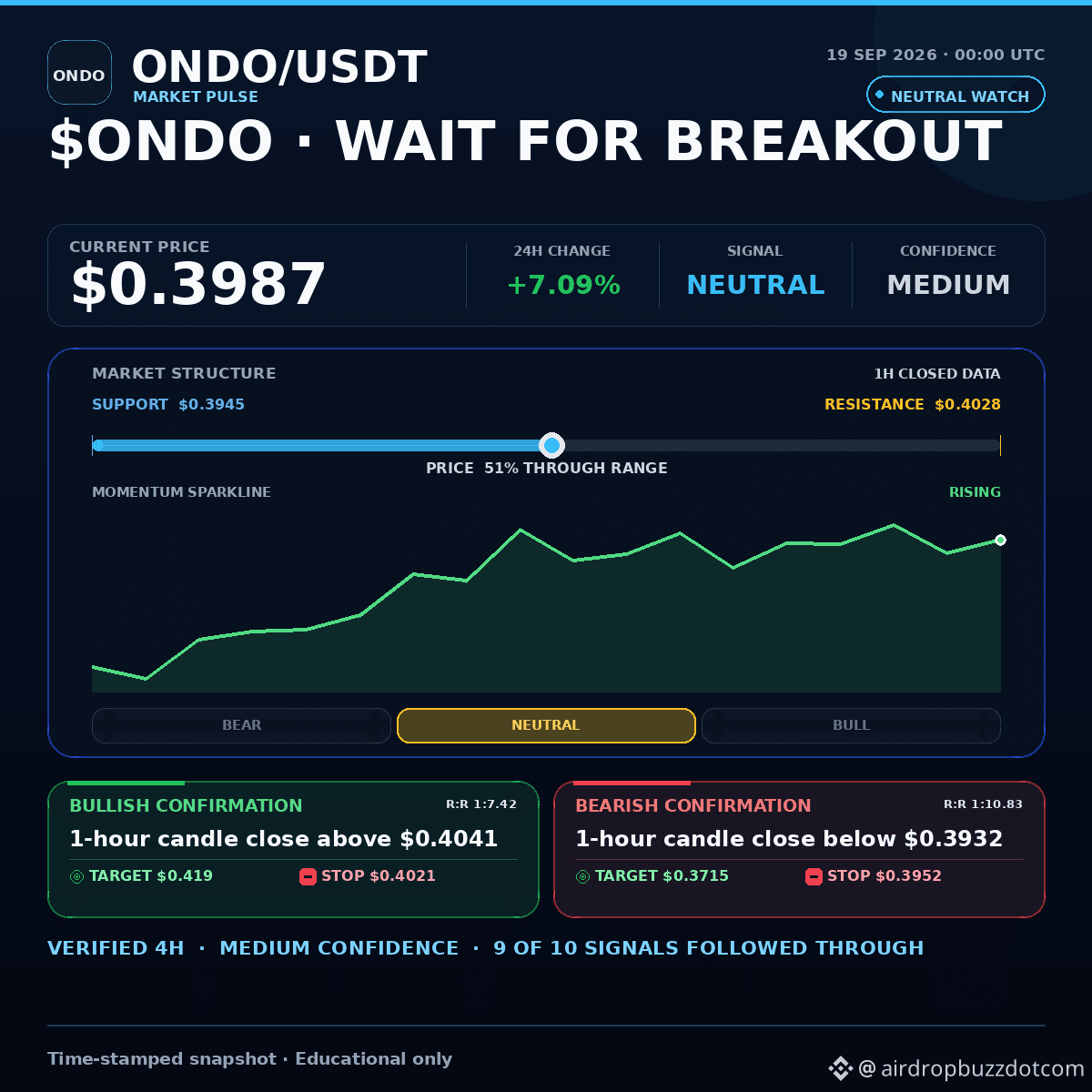
$ONDO follow-through check: 9 of 10 recent directional moves were favorable.
📊 Snapshot
• Price: $0.3987
• 24H: +7.09%
• Bias: Neutral
📈 Bull Trigger
1-hour close above $0.4041 with open interest confirmation
📉 Bear Trigger
1-hour close below $0.3932 with open interest confirmation
🎯 Signal Read
Direction is secondary until the market closes beyond a trigger with supporting participation.
📌 Confidence
Medium · Medium historical confidence · 9 of 10 directional moves were favorable
Signal Quality
- OI: Flat (+0.30%)
- 4H: Bullish | 1D: Bullish (Aligned)
- ATR filter: 0.50 ATR ($0.002621)
- Risk/reward: 1:7.42
Bull scenario risk plan
- Entry: $0.4041
- Stop: $0.4021
- Target: $0.419
Wait for a closed candle—trigger levels confirm conditions; they do not predict targets.
Bull or bear first? Drop 🐂 or 🐻.
#ONDO #Ondo #CryptoTrading #MarketPulse
Educational only. Time-stamped market snapshot, not financial advice.
$ONDO follow-through check: 9 of 10 recent directional moves were favorable.
📊 Snapshot
• Price: $0.3987
• 24H: +7.09%
• Bias: Neutral
📈 Bull Trigger
1-hour close above $0.4041 with open interest confirmation
📉 Bear Trigger
1-hour close below $0.3932 with open interest confirmation
🎯 Signal Read
Direction is secondary until the market closes beyond a trigger with supporting participation.
📌 Confidence
Medium · Medium historical confidence · 9 of 10 directional moves were favorable
Signal Quality
- OI: Flat (+0.30%)
- 4H: Bullish | 1D: Bullish (Aligned)
- ATR filter: 0.50 ATR ($0.002621)
- Risk/reward: 1:7.42
Bull scenario risk plan
- Entry: $0.4041
- Stop: $0.4021
- Target: $0.419
Wait for a closed candle—trigger levels confirm conditions; they do not predict targets.
Bull or bear first? Drop 🐂 or 🐻.
#ONDO #Ondo #CryptoTrading #MarketPulse
Educational only. Time-stamped market snapshot, not financial advice.
📊 Snapshot
• Price: $0.3987
• 24H: +7.09%
• Bias: Neutral
📈 Bull Trigger
1-hour close above $0.4041 with open interest confirmation
📉 Bear Trigger
1-hour close below $0.3932 with open interest confirmation
🎯 Signal Read
Direction is secondary until the market closes beyond a trigger with supporting participation.
📌 Confidence
Medium · Medium historical confidence · 9 of 10 directional moves were favorable
Signal Quality
- OI: Flat (+0.30%)
- 4H: Bullish | 1D: Bullish (Aligned)
- ATR filter: 0.50 ATR ($0.002621)
- Risk/reward: 1:7.42
Bull scenario risk plan
- Entry: $0.4041
- Stop: $0.4021
- Target: $0.419
Wait for a closed candle—trigger levels confirm conditions; they do not predict targets.
Bull or bear first? Drop 🐂 or 🐻.
#ONDO #Ondo #CryptoTrading #MarketPulse
Educational only. Time-stamped market snapshot, not financial advice.
77
Voir la traduction
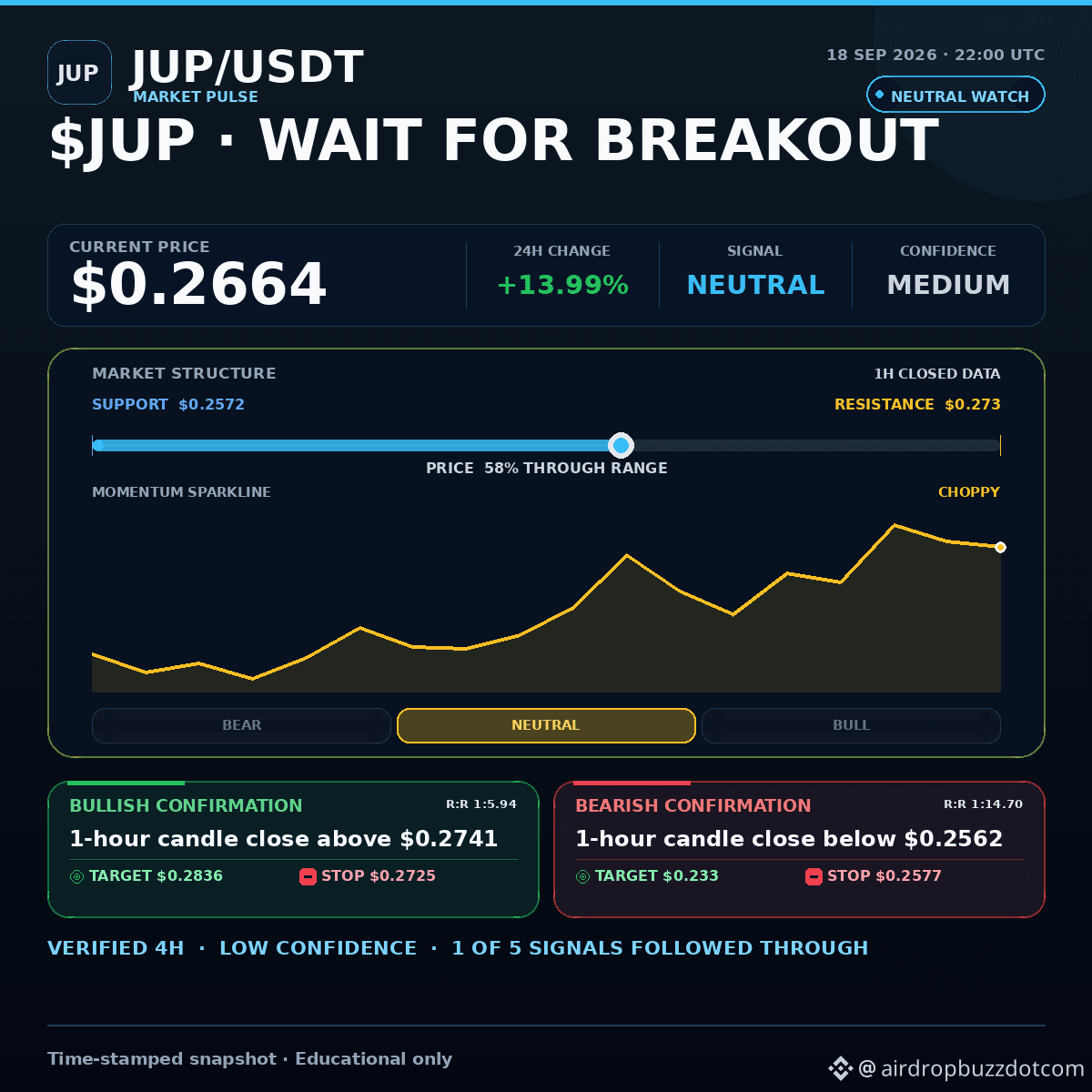
Watch the clock: the next 1H close can separate a $JUP break from a fakeout.
📊 Snapshot
• Price: $0.2664
• 24H: +13.99%
• Bias: Neutral
📈 Bull Trigger
1-hour close above $0.2741 with open interest confirmation
📉 Bear Trigger
1-hour close below $0.2562 with open interest confirmation
🎯 Signal Read
Direction is secondary until the market closes beyond a trigger with supporting participation.
📌 Confidence
Medium · Low historical confidence · 1 of 5 directional moves were favorable
Signal Quality
- OI: Flat (-0.33%)
- 4H: Bullish | 1D: Bullish (Aligned)
- ATR filter: 0.50 ATR ($0.0021)
- Risk/reward: 1:5.94
Bull scenario risk plan
- Entry: $0.2741
- Stop: $0.2725
- Target: $0.2836
Trigger levels define confirmation; they do not guarantee where price will finish.
Break or fake? Reply BREAK or FAKE.
#JUP #Jupiter #CryptoTrading #MarketPulse
Educational only. Time-stamped market snapshot, not financial advice.
Watch the clock: the next 1H close can separate a $JUP break from a fakeout.
📊 Snapshot
• Price: $0.2664
• 24H: +13.99%
• Bias: Neutral
📈 Bull Trigger
1-hour close above $0.2741 with open interest confirmation
📉 Bear Trigger
1-hour close below $0.2562 with open interest confirmation
🎯 Signal Read
Direction is secondary until the market closes beyond a trigger with supporting participation.
📌 Confidence
Medium · Low historical confidence · 1 of 5 directional moves were favorable
Signal Quality
- OI: Flat (-0.33%)
- 4H: Bullish | 1D: Bullish (Aligned)
- ATR filter: 0.50 ATR ($0.0021)
- Risk/reward: 1:5.94
Bull scenario risk plan
- Entry: $0.2741
- Stop: $0.2725
- Target: $0.2836
Trigger levels define confirmation; they do not guarantee where price will finish.
Break or fake? Reply BREAK or FAKE.
#JUP #Jupiter #CryptoTrading #MarketPulse
Educational only. Time-stamped market snapshot, not financial advice.
📊 Snapshot
• Price: $0.2664
• 24H: +13.99%
• Bias: Neutral
📈 Bull Trigger
1-hour close above $0.2741 with open interest confirmation
📉 Bear Trigger
1-hour close below $0.2562 with open interest confirmation
🎯 Signal Read
Direction is secondary until the market closes beyond a trigger with supporting participation.
📌 Confidence
Medium · Low historical confidence · 1 of 5 directional moves were favorable
Signal Quality
- OI: Flat (-0.33%)
- 4H: Bullish | 1D: Bullish (Aligned)
- ATR filter: 0.50 ATR ($0.0021)
- Risk/reward: 1:5.94
Bull scenario risk plan
- Entry: $0.2741
- Stop: $0.2725
- Target: $0.2836
Trigger levels define confirmation; they do not guarantee where price will finish.
Break or fake? Reply BREAK or FAKE.
#JUP #Jupiter #CryptoTrading #MarketPulse
Educational only. Time-stamped market snapshot, not financial advice.
10
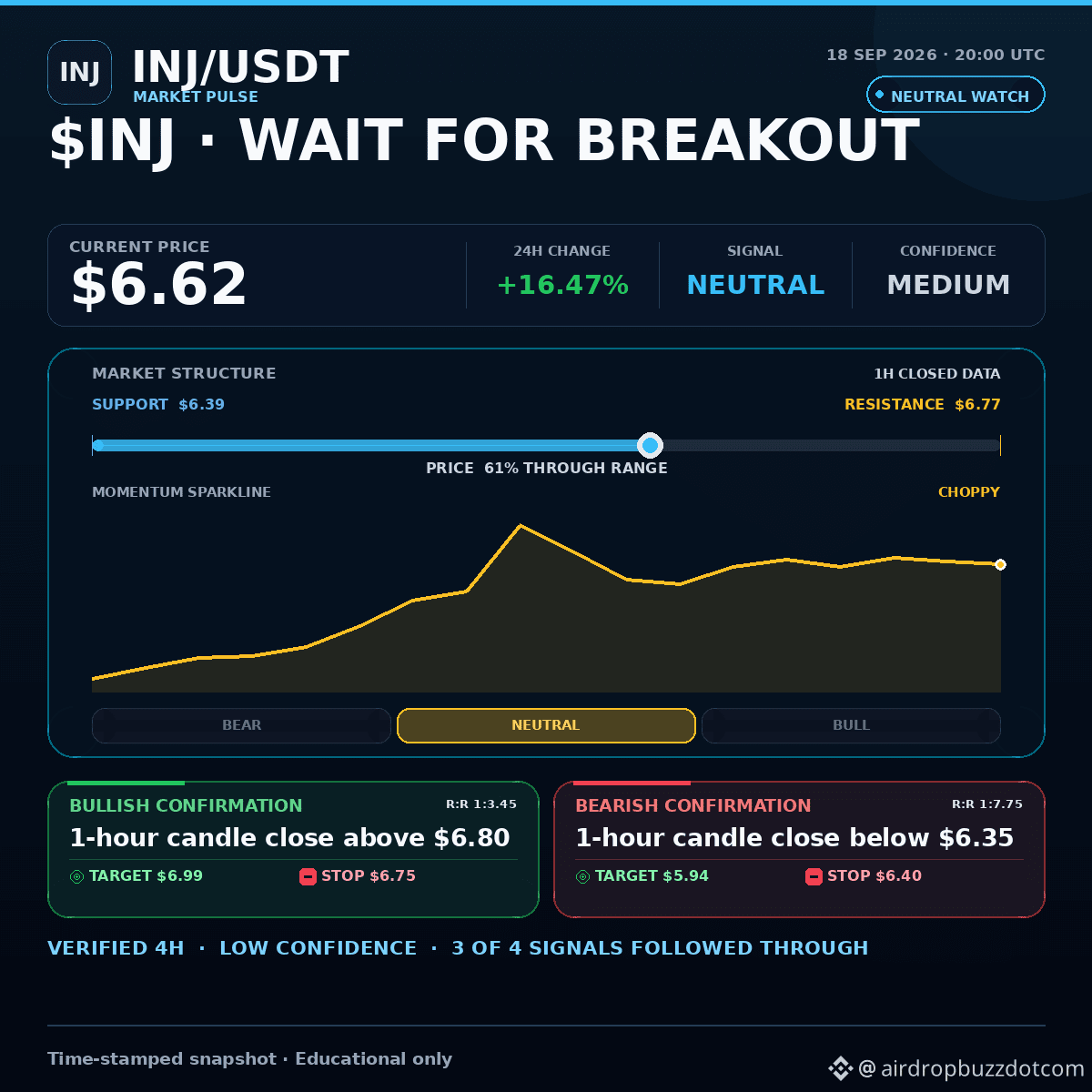
$INJ est-il sur le point de casser—ou de faire semblant à nouveau ?
📊 Aperçu
• Prix : 6,62 $
• 24H : +16,47%
• Biais : Neutre
📈 Déclencheur haussier
Clôture sur 1 heure au-dessus de 6,80 $ avec confirmation de l’intérêt ouvert
📉 Déclencheur baissier
Clôture sur 1 heure en dessous de 6,35 $ avec confirmation de l’intérêt ouvert
🎯 Lecture du signal
Le setup est suffisamment équilibré pour punir les suppositions ; attendez que le prix et la participation confirment le même côté.
📌 Confiance
Moyenne · Faible confiance historique · 3 mouvements directionnels sur 4 ont été favorables
Qualité du signal
- IO : Plat (-0,91%)
- 4H : Haussier | 1J : Haussier (Aligné)
- Filtre ATR : 0,50 ATR (0,07 $)
- Ratio risque/rendement : 1:3,45
Plan de risque pour le scénario haussier
- Entrée : 6,80 $
- Stop : 6,75 $
- Objectif : 6,99 $
Attendez une bougie clôturée—les niveaux de déclenchement confirment les conditions ; ils ne prédisent pas les objectifs.
Dans un premier temps : UP ou DOWN ? Répondez UP ou DOWN.
#INJ #Injective #CryptoTrading #MarketPulse
À but éducatif uniquement. Aperçu du marché daté, pas un conseil financier.
$INJ est-il sur le point de casser—ou de faire semblant à nouveau ?
📊 Aperçu
• Prix : 6,62 $
• 24H : +16,47%
• Biais : Neutre
📈 Déclencheur haussier
Clôture sur 1 heure au-dessus de 6,80 $ avec confirmation de l’intérêt ouvert
📉 Déclencheur baissier
Clôture sur 1 heure en dessous de 6,35 $ avec confirmation de l’intérêt ouvert
🎯 Lecture du signal
Le setup est suffisamment équilibré pour punir les suppositions ; attendez que le prix et la participation confirment le même côté.
📌 Confiance
Moyenne · Faible confiance historique · 3 mouvements directionnels sur 4 ont été favorables
Qualité du signal
- IO : Plat (-0,91%)
- 4H : Haussier | 1J : Haussier (Aligné)
- Filtre ATR : 0,50 ATR (0,07 $)
- Ratio risque/rendement : 1:3,45
Plan de risque pour le scénario haussier
- Entrée : 6,80 $
- Stop : 6,75 $
- Objectif : 6,99 $
Attendez une bougie clôturée—les niveaux de déclenchement confirment les conditions ; ils ne prédisent pas les objectifs.
Dans un premier temps : UP ou DOWN ? Répondez UP ou DOWN.
#INJ #Injective #CryptoTrading #MarketPulse
À but éducatif uniquement. Aperçu du marché daté, pas un conseil financier.
📊 Aperçu
• Prix : 6,62 $
• 24H : +16,47%
• Biais : Neutre
📈 Déclencheur haussier
Clôture sur 1 heure au-dessus de 6,80 $ avec confirmation de l’intérêt ouvert
📉 Déclencheur baissier
Clôture sur 1 heure en dessous de 6,35 $ avec confirmation de l’intérêt ouvert
🎯 Lecture du signal
Le setup est suffisamment équilibré pour punir les suppositions ; attendez que le prix et la participation confirment le même côté.
📌 Confiance
Moyenne · Faible confiance historique · 3 mouvements directionnels sur 4 ont été favorables
Qualité du signal
- IO : Plat (-0,91%)
- 4H : Haussier | 1J : Haussier (Aligné)
- Filtre ATR : 0,50 ATR (0,07 $)
- Ratio risque/rendement : 1:3,45
Plan de risque pour le scénario haussier
- Entrée : 6,80 $
- Stop : 6,75 $
- Objectif : 6,99 $
Attendez une bougie clôturée—les niveaux de déclenchement confirment les conditions ; ils ne prédisent pas les objectifs.
Dans un premier temps : UP ou DOWN ? Répondez UP ou DOWN.
#INJ #Injective #CryptoTrading #MarketPulse
À but éducatif uniquement. Aperçu du marché daté, pas un conseil financier.
20
Voir la traduction
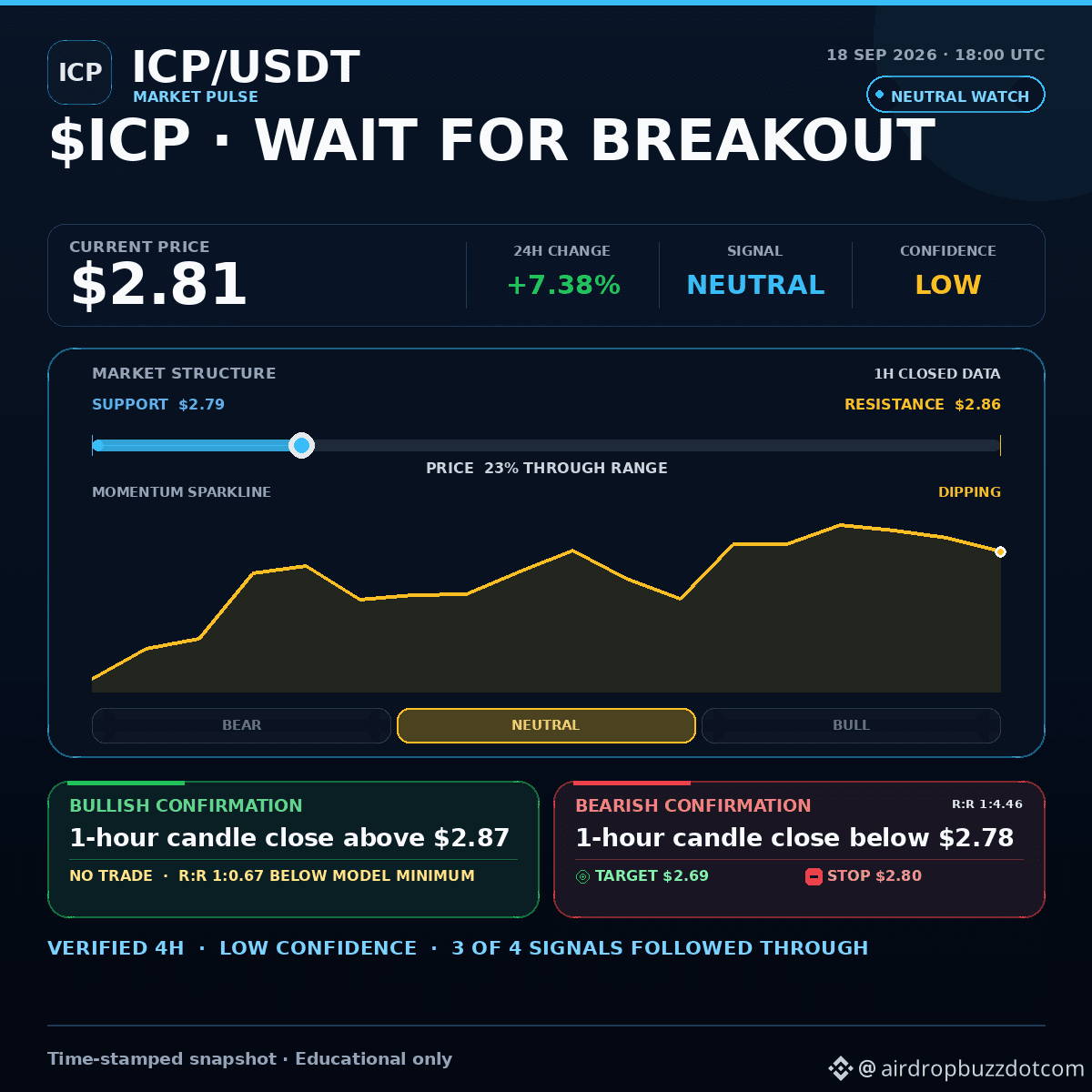
Forget the first $ICP wick—the confirmed close carries more information.
📊 Snapshot
• Price: $2.81
• 24H: +7.38%
• Bias: Neutral
📈 Bull Trigger
1-hour close above $2.87 with open interest confirmation
📉 Bear Trigger
1-hour close below $2.78 with open interest confirmation
🎯 Signal Read
Conflicting evidence keeps this conditional, so the close matters more than predicting the direction early.
📌 Confidence
Low · Low historical confidence · 3 of 4 directional moves were favorable
Signal Quality
- OI: Flat (-0.45%)
- 4H: Bullish | 1D: Neutral (Mixed)
- ATR filter: 0.50 ATR ($0.02)
- Risk/reward: 1:0.67 - below minimum
Bull scenario risk plan
- Entry: $2.87
- Stop: $2.85
- Target: $2.89
A trigger marks confirmation, not a guaranteed entry, outcome, or price destination.
Break or fake? Reply BREAK or FAKE.
#ICP #InternetComputer #CryptoTrading #MarketPulse
Educational only. Time-stamped market snapshot, not financial advice.
Forget the first $ICP wick—the confirmed close carries more information.
📊 Snapshot
• Price: $2.81
• 24H: +7.38%
• Bias: Neutral
📈 Bull Trigger
1-hour close above $2.87 with open interest confirmation
📉 Bear Trigger
1-hour close below $2.78 with open interest confirmation
🎯 Signal Read
Conflicting evidence keeps this conditional, so the close matters more than predicting the direction early.
📌 Confidence
Low · Low historical confidence · 3 of 4 directional moves were favorable
Signal Quality
- OI: Flat (-0.45%)
- 4H: Bullish | 1D: Neutral (Mixed)
- ATR filter: 0.50 ATR ($0.02)
- Risk/reward: 1:0.67 - below minimum
Bull scenario risk plan
- Entry: $2.87
- Stop: $2.85
- Target: $2.89
A trigger marks confirmation, not a guaranteed entry, outcome, or price destination.
Break or fake? Reply BREAK or FAKE.
#ICP #InternetComputer #CryptoTrading #MarketPulse
Educational only. Time-stamped market snapshot, not financial advice.
📊 Snapshot
• Price: $2.81
• 24H: +7.38%
• Bias: Neutral
📈 Bull Trigger
1-hour close above $2.87 with open interest confirmation
📉 Bear Trigger
1-hour close below $2.78 with open interest confirmation
🎯 Signal Read
Conflicting evidence keeps this conditional, so the close matters more than predicting the direction early.
📌 Confidence
Low · Low historical confidence · 3 of 4 directional moves were favorable
Signal Quality
- OI: Flat (-0.45%)
- 4H: Bullish | 1D: Neutral (Mixed)
- ATR filter: 0.50 ATR ($0.02)
- Risk/reward: 1:0.67 - below minimum
Bull scenario risk plan
- Entry: $2.87
- Stop: $2.85
- Target: $2.89
A trigger marks confirmation, not a guaranteed entry, outcome, or price destination.
Break or fake? Reply BREAK or FAKE.
#ICP #InternetComputer #CryptoTrading #MarketPulse
Educational only. Time-stamped market snapshot, not financial advice.
14
Voir la traduction
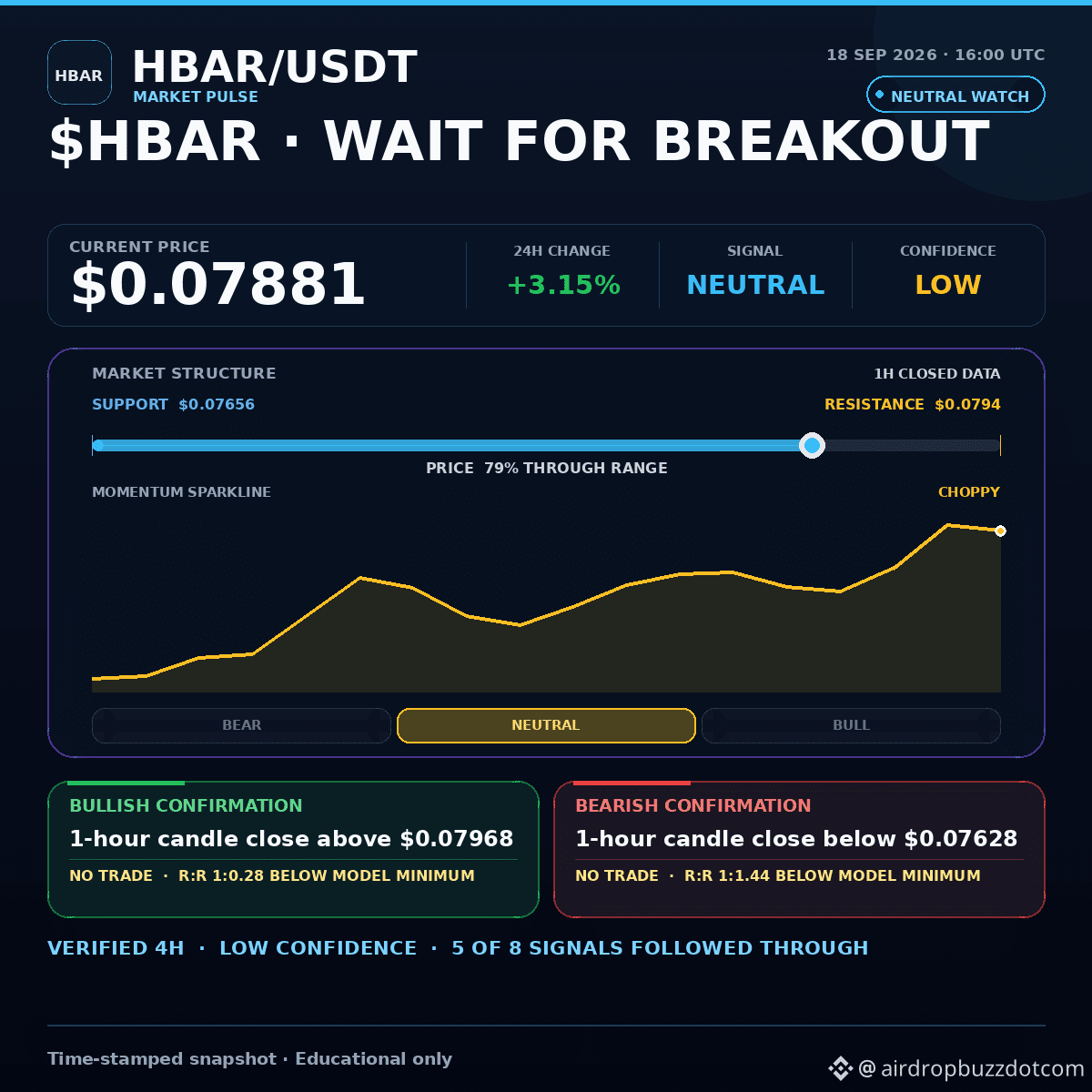
One 1H close can change the $HBAR read. The wick alone cannot.
📊 Snapshot
• Price: $0.07881
• 24H: +3.15%
• Bias: Neutral
📈 Bull Trigger
1-hour close above $0.07968 with open interest confirmation
📉 Bear Trigger
1-hour close below $0.07628 with open interest confirmation
🎯 Signal Read
The setup is balanced enough to punish guesses; wait for price and participation to confirm the same side.
📌 Confidence
Low · Low historical confidence · 5 of 8 directional moves were favorable
Signal Quality
- OI: Flat (-1.19%)
- 4H: Bullish | 1D: Bearish (Conflict)
- ATR filter: 0.50 ATR ($0.0005636)
- Risk/reward: 1:0.28 - below minimum
Bull scenario risk plan
- Entry: $0.07968
- Stop: $0.07926
- Target: $0.0798
A trigger marks confirmation, not a guaranteed entry, outcome, or price destination.
Bull or bear first? Drop 🐂 or 🐻.
#HBAR #Hedera #CryptoTrading #MarketPulse
Educational only. Time-stamped market snapshot, not financial advice.
One 1H close can change the $HBAR read. The wick alone cannot.
📊 Snapshot
• Price: $0.07881
• 24H: +3.15%
• Bias: Neutral
📈 Bull Trigger
1-hour close above $0.07968 with open interest confirmation
📉 Bear Trigger
1-hour close below $0.07628 with open interest confirmation
🎯 Signal Read
The setup is balanced enough to punish guesses; wait for price and participation to confirm the same side.
📌 Confidence
Low · Low historical confidence · 5 of 8 directional moves were favorable
Signal Quality
- OI: Flat (-1.19%)
- 4H: Bullish | 1D: Bearish (Conflict)
- ATR filter: 0.50 ATR ($0.0005636)
- Risk/reward: 1:0.28 - below minimum
Bull scenario risk plan
- Entry: $0.07968
- Stop: $0.07926
- Target: $0.0798
A trigger marks confirmation, not a guaranteed entry, outcome, or price destination.
Bull or bear first? Drop 🐂 or 🐻.
#HBAR #Hedera #CryptoTrading #MarketPulse
Educational only. Time-stamped market snapshot, not financial advice.
📊 Snapshot
• Price: $0.07881
• 24H: +3.15%
• Bias: Neutral
📈 Bull Trigger
1-hour close above $0.07968 with open interest confirmation
📉 Bear Trigger
1-hour close below $0.07628 with open interest confirmation
🎯 Signal Read
The setup is balanced enough to punish guesses; wait for price and participation to confirm the same side.
📌 Confidence
Low · Low historical confidence · 5 of 8 directional moves were favorable
Signal Quality
- OI: Flat (-1.19%)
- 4H: Bullish | 1D: Bearish (Conflict)
- ATR filter: 0.50 ATR ($0.0005636)
- Risk/reward: 1:0.28 - below minimum
Bull scenario risk plan
- Entry: $0.07968
- Stop: $0.07926
- Target: $0.0798
A trigger marks confirmation, not a guaranteed entry, outcome, or price destination.
Bull or bear first? Drop 🐂 or 🐻.
#HBAR #Hedera #CryptoTrading #MarketPulse
Educational only. Time-stamped market snapshot, not financial advice.
18
Article
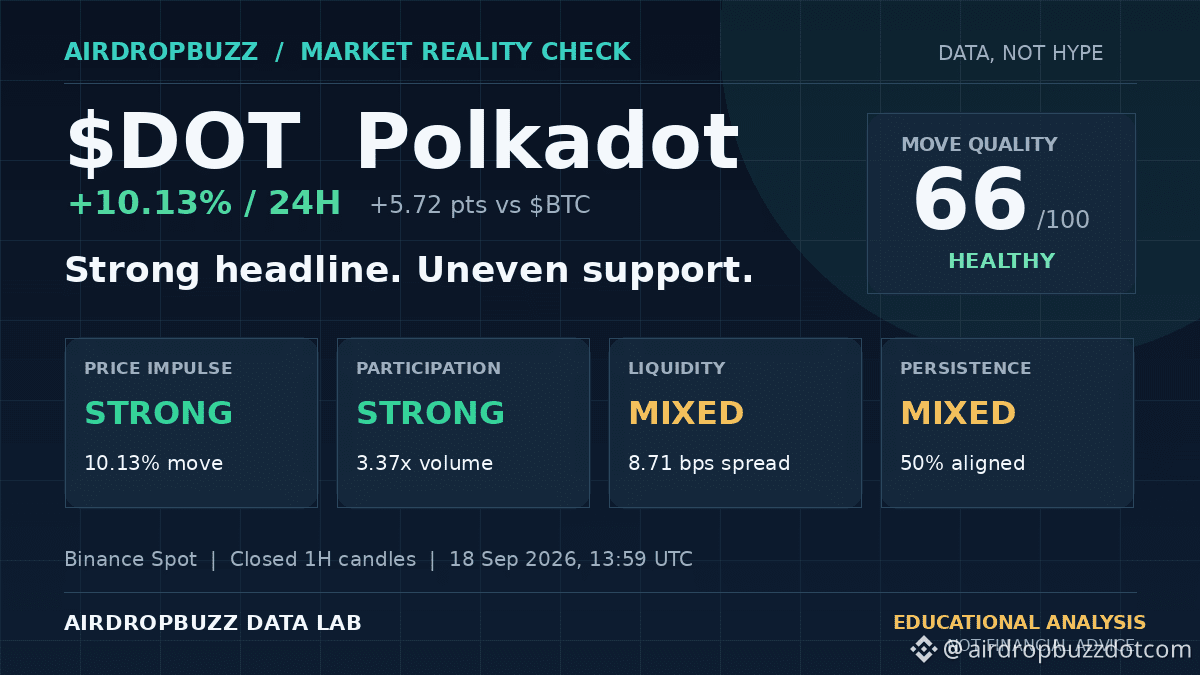
$DOT A Bougé +10,13 % - Mais Le Flux Agressif Ne Confirme Pas$DOT a progressé de 10,13 % sur les 24 dernières bougies horaires clôturées et a surperformé $BTC de 5,72 points de pourcentage. Le titre est facile à voir. La question plus utile est de savoir si le volume, le flux, la persistance et la liquidité le confirment ensemble.
LA LECTURE RAPIDE
Gros titre. Support inégal. Le score de qualité du mouvement est de 66/100, classé comme Sain.
VÉRIFICATION DE LA PARTICIPATION
Le volume d’ordres récents par heure est de 3,37 fois sa base, ce qui est bien au-dessus de sa référence horaire récente. Le nombre de transactions est de 4,29 fois la base ; la participation est donc nettement supérieure à sa référence horaire récente. Pendant le même échantillon de six heures, les achats de preneurs représentaient 42,9 % du volume d’ordres ; les vendeurs représentaient une nette majorité du flux agressif.
$DOT A Bougé +10,13 % - Mais Le Flux Agressif Ne Confirme Pas
$DOT a progressé de 10,13 % sur les 24 dernières bougies horaires clôturées et a surperformé $BTC de 5,72 points de pourcentage. Le titre est facile à voir. La question plus utile est de savoir si le volume, le flux, la persistance et la liquidité le confirment ensemble.
LA LECTURE RAPIDE
Gros titre. Support inégal. Le score de qualité du mouvement est de 66/100, classé comme Sain.
VÉRIFICATION DE LA PARTICIPATION
Le volume d’ordres récents par heure est de 3,37 fois sa base, ce qui est bien au-dessus de sa référence horaire récente. Le nombre de transactions est de 4,29 fois la base ; la participation est donc nettement supérieure à sa référence horaire récente. Pendant le même échantillon de six heures, les achats de preneurs représentaient 42,9 % du volume d’ordres ; les vendeurs représentaient une nette majorité du flux agressif.
LA LECTURE RAPIDE
Gros titre. Support inégal. Le score de qualité du mouvement est de 66/100, classé comme Sain.
VÉRIFICATION DE LA PARTICIPATION
Le volume d’ordres récents par heure est de 3,37 fois sa base, ce qui est bien au-dessus de sa référence horaire récente. Le nombre de transactions est de 4,29 fois la base ; la participation est donc nettement supérieure à sa référence horaire récente. Pendant le même échantillon de six heures, les achats de preneurs représentaient 42,9 % du volume d’ordres ; les vendeurs représentaient une nette majorité du flux agressif.
172
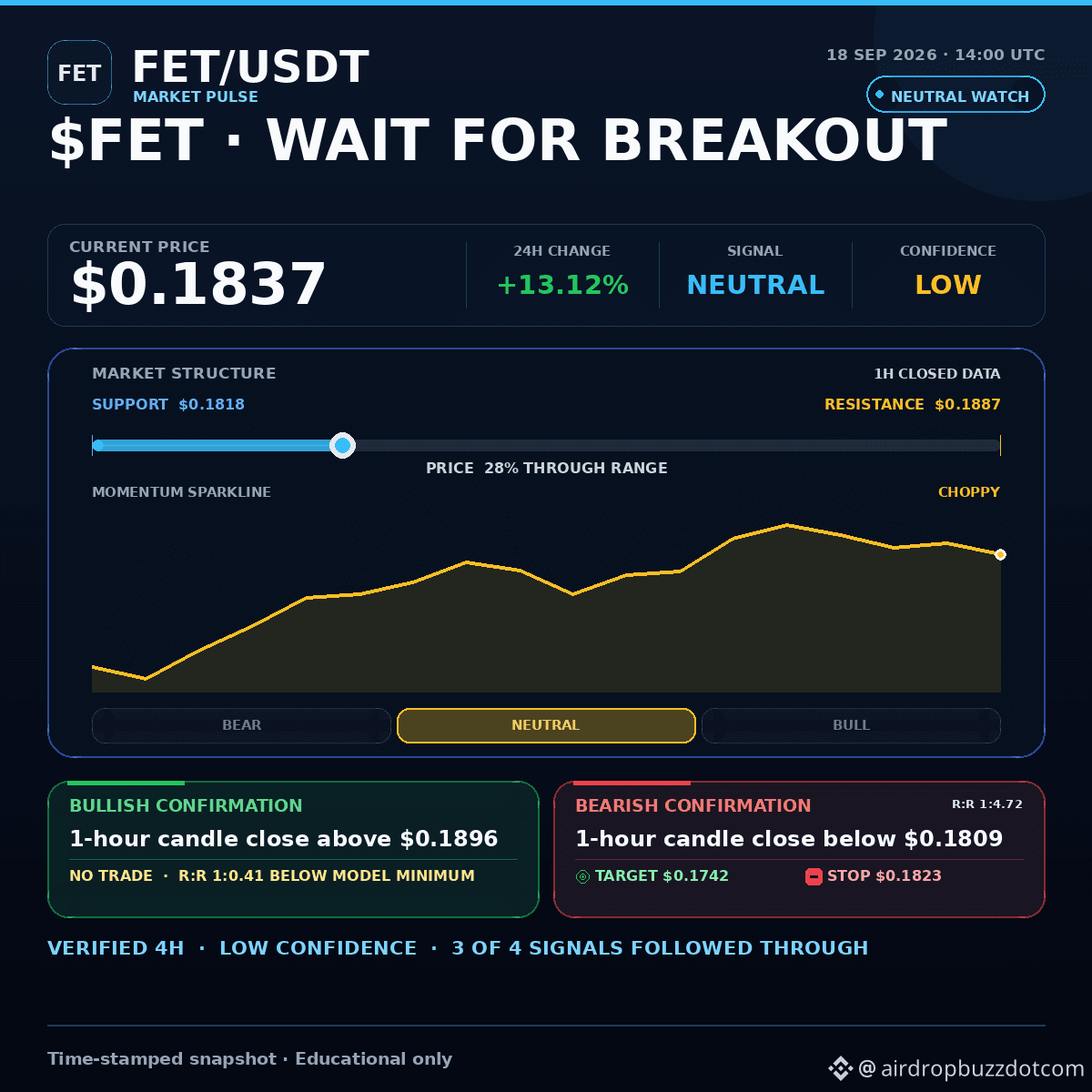
Le prix peut attirer l’attention, mais le $FET sample indique que 3 des 4 mouvements directionnels récents étaient favorables.
📊 Aperçu
• Prix : 0,1837 $
• 24 h : +13,12 %
• Biais : Neutre
📈 Déclencheur haussier
Clôture sur 1 heure au-dessus de 0,1896 $ avec confirmation par l’intérêt ouvert
📉 Déclencheur baissier
Clôture sur 1 heure en dessous de 0,1809 $ avec confirmation par l’intérêt ouvert
🎯 Lecture du signal
Les deux déclencheurs restent possibles, mais seul un franchissement confirmé transforme le bruit actuel en lecture directionnelle.
📌 Confiance
Faible · Confiance historique faible · 3 sur 4 des mouvements directionnels étaient favorables
Qualité du signal
- Intérêt ouvert (OI) : Plat (+0,64 %)
- 4H : Haussier | 1J : Haussier (Aligné)
- Filtre ATR : 0,50 ATR (0,001857 $)
- Ratio risque/rendement : 1:0,41 - en dessous du minimum
Plan de risque du scénario haussier
- Entrée : 0,1896 $
- Stop : 0,1882 $
- Objectif : 0,1902 $
Les niveaux de déclenchement définissent la confirmation ; ils ne garantissent pas où le prix finira.
Bull ou bear en premier ? Réagissez 🐂 ou 🐻.
#FET #ArtificialSuperintelligenceAlliance #CryptoTrading #MarketPulse
Uniquement à des fins éducatives. Aperçu du marché horodaté, pas un conseil financier.
Le prix peut attirer l’attention, mais le $FET sample indique que 3 des 4 mouvements directionnels récents étaient favorables.
📊 Aperçu
• Prix : 0,1837 $
• 24 h : +13,12 %
• Biais : Neutre
📈 Déclencheur haussier
Clôture sur 1 heure au-dessus de 0,1896 $ avec confirmation par l’intérêt ouvert
📉 Déclencheur baissier
Clôture sur 1 heure en dessous de 0,1809 $ avec confirmation par l’intérêt ouvert
🎯 Lecture du signal
Les deux déclencheurs restent possibles, mais seul un franchissement confirmé transforme le bruit actuel en lecture directionnelle.
📌 Confiance
Faible · Confiance historique faible · 3 sur 4 des mouvements directionnels étaient favorables
Qualité du signal
- Intérêt ouvert (OI) : Plat (+0,64 %)
- 4H : Haussier | 1J : Haussier (Aligné)
- Filtre ATR : 0,50 ATR (0,001857 $)
- Ratio risque/rendement : 1:0,41 - en dessous du minimum
Plan de risque du scénario haussier
- Entrée : 0,1896 $
- Stop : 0,1882 $
- Objectif : 0,1902 $
Les niveaux de déclenchement définissent la confirmation ; ils ne garantissent pas où le prix finira.
Bull ou bear en premier ? Réagissez 🐂 ou 🐻.
#FET #ArtificialSuperintelligenceAlliance #CryptoTrading #MarketPulse
Uniquement à des fins éducatives. Aperçu du marché horodaté, pas un conseil financier.
📊 Aperçu
• Prix : 0,1837 $
• 24 h : +13,12 %
• Biais : Neutre
📈 Déclencheur haussier
Clôture sur 1 heure au-dessus de 0,1896 $ avec confirmation par l’intérêt ouvert
📉 Déclencheur baissier
Clôture sur 1 heure en dessous de 0,1809 $ avec confirmation par l’intérêt ouvert
🎯 Lecture du signal
Les deux déclencheurs restent possibles, mais seul un franchissement confirmé transforme le bruit actuel en lecture directionnelle.
📌 Confiance
Faible · Confiance historique faible · 3 sur 4 des mouvements directionnels étaient favorables
Qualité du signal
- Intérêt ouvert (OI) : Plat (+0,64 %)
- 4H : Haussier | 1J : Haussier (Aligné)
- Filtre ATR : 0,50 ATR (0,001857 $)
- Ratio risque/rendement : 1:0,41 - en dessous du minimum
Plan de risque du scénario haussier
- Entrée : 0,1896 $
- Stop : 0,1882 $
- Objectif : 0,1902 $
Les niveaux de déclenchement définissent la confirmation ; ils ne garantissent pas où le prix finira.
Bull ou bear en premier ? Réagissez 🐂 ou 🐻.
#FET #ArtificialSuperintelligenceAlliance #CryptoTrading #MarketPulse
Uniquement à des fins éducatives. Aperçu du marché horodaté, pas un conseil financier.
104
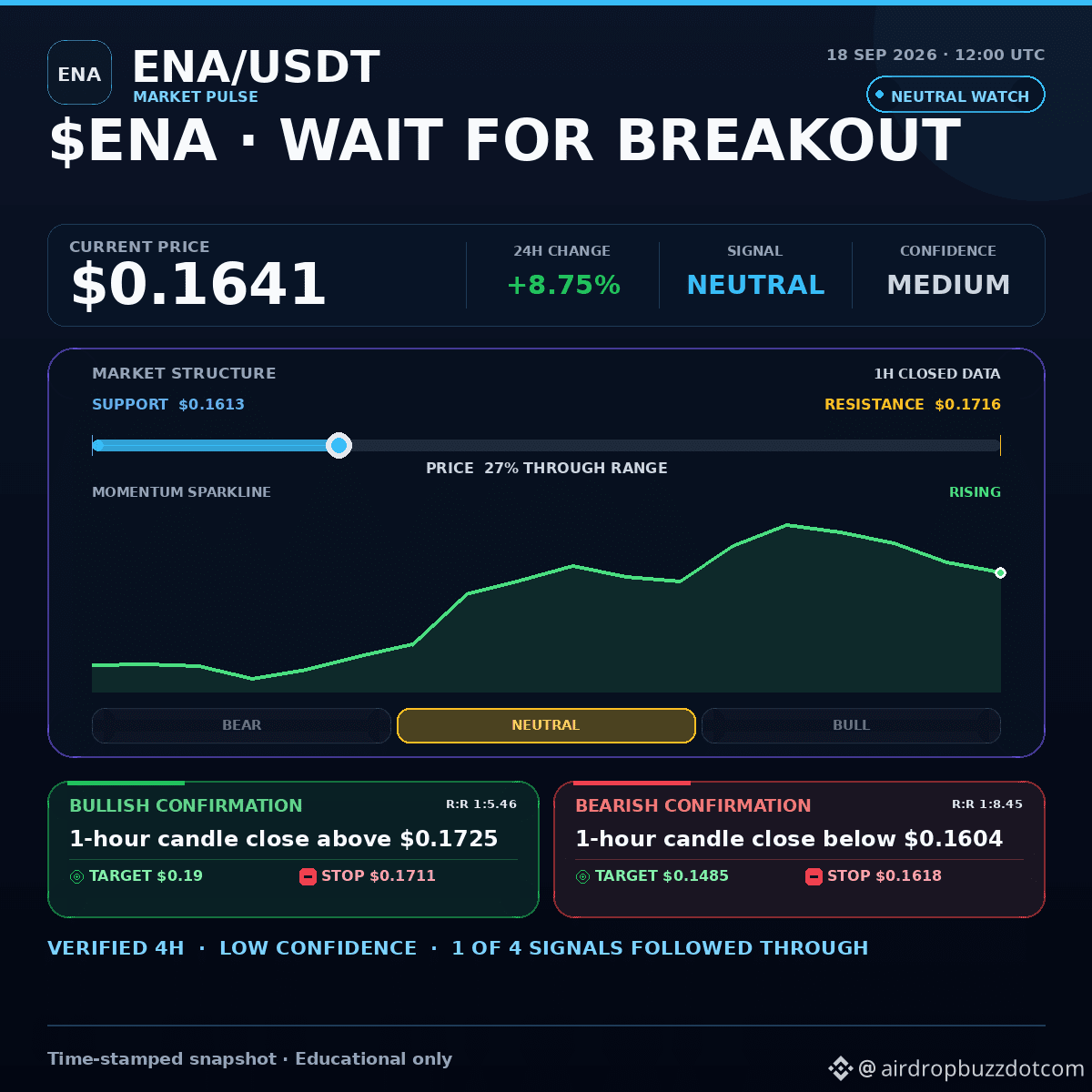
Feriez-vous confiance au premier $ENA wick — ou attendez-vous la clôture ?
📊 Aperçu
• Prix : 0,1641 $
• 24H : +8,75 %
• Biais : Neutre
📈 Déclencheur haussier
Clôture sur 1 heure au-dessus de 0,1725 $ avec confirmation de l’intérêt ouvert
📉 Déclencheur baissier
Clôture sur 1 heure en dessous de 0,1604 $ avec confirmation de l’intérêt ouvert
🎯 Lecture du signal
Le signal utile est la première clôture confirmée qui tranche le combat actuel pour le contrôle, et non une autre mèche intraday.
📌 Confiance
Moyenne · Confiance historique faible · 1 sur 4 mouvements directionnels a été favorable
Qualité du signal
- IO : Stable (+0,94 %)
- 4H : Haussier | 1J : Haussier (Aligné)
- Filtre ATR : 0,50 ATR (0,001829 $)
- Risque/rendement : 1:5,46
Plan de risque scénario haussier
- Entrée : 0,1725 $
- Stop : 0,1711 $
- Objectif : 0,19 $
Les déclencheurs confirment des conditions plutôt que des objectifs de prix, donc attendez toujours la clôture de la bougie.
Rupture ou faux mouvement ? Répondez BREAK ou FAKE.
#ENA #Ethena #CryptoTrading #MarketPulse
À but éducatif uniquement. Aperçu du marché horodaté, pas un conseil financier.
Feriez-vous confiance au premier $ENA wick — ou attendez-vous la clôture ?
📊 Aperçu
• Prix : 0,1641 $
• 24H : +8,75 %
• Biais : Neutre
📈 Déclencheur haussier
Clôture sur 1 heure au-dessus de 0,1725 $ avec confirmation de l’intérêt ouvert
📉 Déclencheur baissier
Clôture sur 1 heure en dessous de 0,1604 $ avec confirmation de l’intérêt ouvert
🎯 Lecture du signal
Le signal utile est la première clôture confirmée qui tranche le combat actuel pour le contrôle, et non une autre mèche intraday.
📌 Confiance
Moyenne · Confiance historique faible · 1 sur 4 mouvements directionnels a été favorable
Qualité du signal
- IO : Stable (+0,94 %)
- 4H : Haussier | 1J : Haussier (Aligné)
- Filtre ATR : 0,50 ATR (0,001829 $)
- Risque/rendement : 1:5,46
Plan de risque scénario haussier
- Entrée : 0,1725 $
- Stop : 0,1711 $
- Objectif : 0,19 $
Les déclencheurs confirment des conditions plutôt que des objectifs de prix, donc attendez toujours la clôture de la bougie.
Rupture ou faux mouvement ? Répondez BREAK ou FAKE.
#ENA #Ethena #CryptoTrading #MarketPulse
À but éducatif uniquement. Aperçu du marché horodaté, pas un conseil financier.
📊 Aperçu
• Prix : 0,1641 $
• 24H : +8,75 %
• Biais : Neutre
📈 Déclencheur haussier
Clôture sur 1 heure au-dessus de 0,1725 $ avec confirmation de l’intérêt ouvert
📉 Déclencheur baissier
Clôture sur 1 heure en dessous de 0,1604 $ avec confirmation de l’intérêt ouvert
🎯 Lecture du signal
Le signal utile est la première clôture confirmée qui tranche le combat actuel pour le contrôle, et non une autre mèche intraday.
📌 Confiance
Moyenne · Confiance historique faible · 1 sur 4 mouvements directionnels a été favorable
Qualité du signal
- IO : Stable (+0,94 %)
- 4H : Haussier | 1J : Haussier (Aligné)
- Filtre ATR : 0,50 ATR (0,001829 $)
- Risque/rendement : 1:5,46
Plan de risque scénario haussier
- Entrée : 0,1725 $
- Stop : 0,1711 $
- Objectif : 0,19 $
Les déclencheurs confirment des conditions plutôt que des objectifs de prix, donc attendez toujours la clôture de la bougie.
Rupture ou faux mouvement ? Répondez BREAK ou FAKE.
#ENA #Ethena #CryptoTrading #MarketPulse
À but éducatif uniquement. Aperçu du marché horodaté, pas un conseil financier.
35
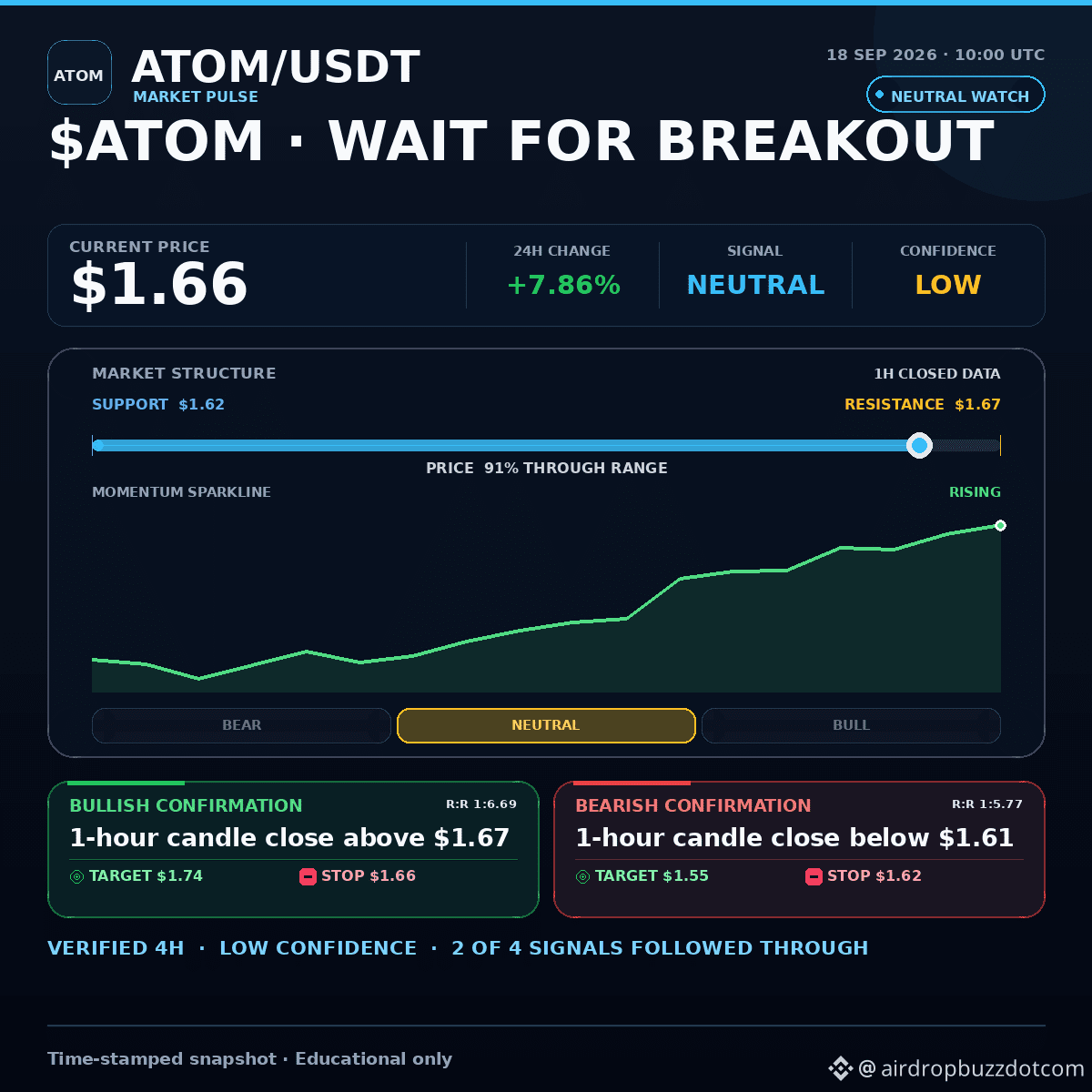
Le $ATOM setup reste en attente jusqu’à ce que la prochaine bougie 1H confirme un sens.
📊 Aperçu
• Prix : 1,66 $
• 24H : +7,86%
• Biais : Neutre
📈 Déclencheur haussier
Clôture sur 1 heure au-dessus de 1,67 $ avec confirmation de l’intérêt ouvert
📉 Déclencheur baissier
Clôture sur 1 heure en dessous de 1,61 $ avec confirmation de l’intérêt ouvert
🎯 Lecture du signal
La direction est secondaire jusqu’à ce que le marché clôture au-delà d’un déclencheur avec une participation confirmatrice.
📌 Confiance
Faible · Confiance historique faible · 2 mouvements directionnels sur 4 étaient favorables
Qualité du signal
- IO : Stable (+1,15%)
- 4H : Haussier | 1D : Baissier (Conflit)
- Filtre ATR : 0,50 ATR (0,01 $)
- Ratio risque/rendement : 1:6,69
Plan de risque scénario haussier
- Entrée : 1,67 $
- Stop : 1,66 $
- Objectif : 1,74 $
Les déclencheurs confirment les conditions plutôt que les objectifs de prix, donc attendez toujours la clôture de la bougie.
Hausse ou baisse en premier ? Répondez HAUT ou BAS.
#ATOM #Cosmos #CryptoTrading #MarketPulse
À but éducatif uniquement. Aperçu du marché horodaté, pas un conseil financier.
Le $ATOM setup reste en attente jusqu’à ce que la prochaine bougie 1H confirme un sens.
📊 Aperçu
• Prix : 1,66 $
• 24H : +7,86%
• Biais : Neutre
📈 Déclencheur haussier
Clôture sur 1 heure au-dessus de 1,67 $ avec confirmation de l’intérêt ouvert
📉 Déclencheur baissier
Clôture sur 1 heure en dessous de 1,61 $ avec confirmation de l’intérêt ouvert
🎯 Lecture du signal
La direction est secondaire jusqu’à ce que le marché clôture au-delà d’un déclencheur avec une participation confirmatrice.
📌 Confiance
Faible · Confiance historique faible · 2 mouvements directionnels sur 4 étaient favorables
Qualité du signal
- IO : Stable (+1,15%)
- 4H : Haussier | 1D : Baissier (Conflit)
- Filtre ATR : 0,50 ATR (0,01 $)
- Ratio risque/rendement : 1:6,69
Plan de risque scénario haussier
- Entrée : 1,67 $
- Stop : 1,66 $
- Objectif : 1,74 $
Les déclencheurs confirment les conditions plutôt que les objectifs de prix, donc attendez toujours la clôture de la bougie.
Hausse ou baisse en premier ? Répondez HAUT ou BAS.
#ATOM #Cosmos #CryptoTrading #MarketPulse
À but éducatif uniquement. Aperçu du marché horodaté, pas un conseil financier.
📊 Aperçu
• Prix : 1,66 $
• 24H : +7,86%
• Biais : Neutre
📈 Déclencheur haussier
Clôture sur 1 heure au-dessus de 1,67 $ avec confirmation de l’intérêt ouvert
📉 Déclencheur baissier
Clôture sur 1 heure en dessous de 1,61 $ avec confirmation de l’intérêt ouvert
🎯 Lecture du signal
La direction est secondaire jusqu’à ce que le marché clôture au-delà d’un déclencheur avec une participation confirmatrice.
📌 Confiance
Faible · Confiance historique faible · 2 mouvements directionnels sur 4 étaient favorables
Qualité du signal
- IO : Stable (+1,15%)
- 4H : Haussier | 1D : Baissier (Conflit)
- Filtre ATR : 0,50 ATR (0,01 $)
- Ratio risque/rendement : 1:6,69
Plan de risque scénario haussier
- Entrée : 1,67 $
- Stop : 1,66 $
- Objectif : 1,74 $
Les déclencheurs confirment les conditions plutôt que les objectifs de prix, donc attendez toujours la clôture de la bougie.
Hausse ou baisse en premier ? Répondez HAUT ou BAS.
#ATOM #Cosmos #CryptoTrading #MarketPulse
À but éducatif uniquement. Aperçu du marché horodaté, pas un conseil financier.
61
Article
Voir la traduction
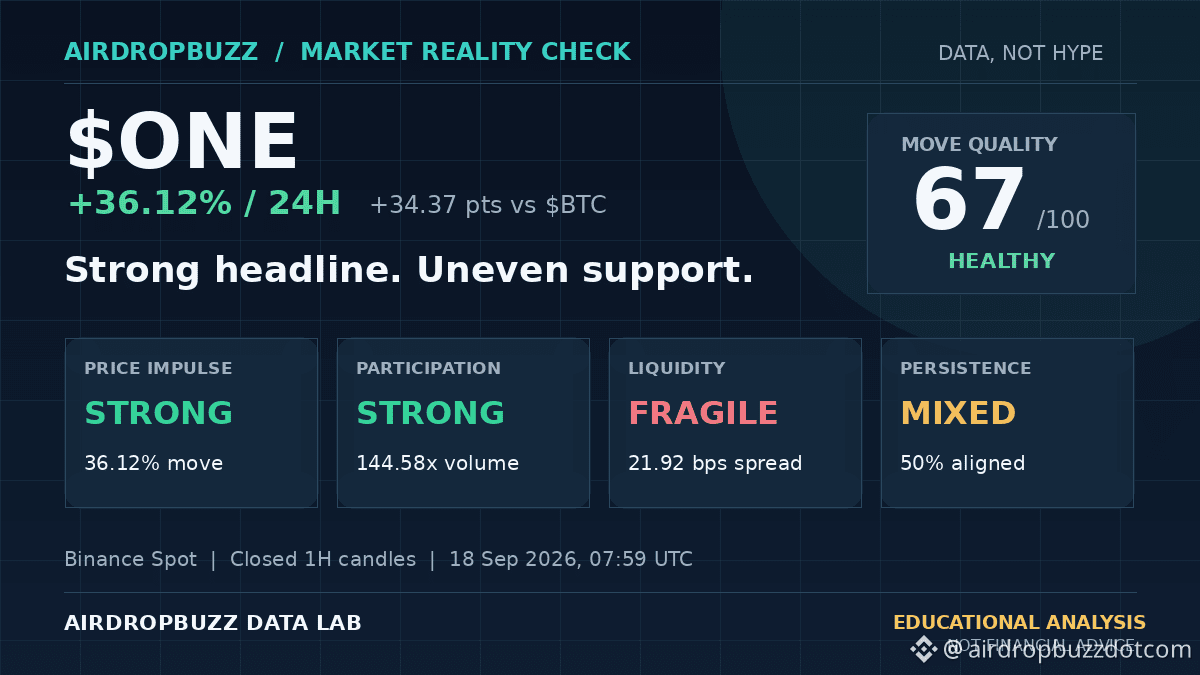
$ONE Moved +36.12% - But Liquidity Still Looks Fragile$ONE rose 36.12% over the latest 24 closed hourly candles and outperformed $BTC by 34.37 percentage points. The headline is easy to see. The more useful question is whether volume, flow, persistence and liquidity support it together.
THE QUICK READ
Strong headline. Uneven support. The Move Quality score is 67/100, classified as Healthy.
PARTICIPATION CHECK
Recent hourly quote volume is 144.58x its baseline, which is well above its recent hourly baseline. Trade count is 101.12x baseline, so participation is well above its recent hourly baseline. During the same six-hour sample, taker buys represented 50.0% of quote volume; aggressive order flow remained close to balanced.
MOVE QUALITY
The price impulse is stronger than the composite quality beneath it. Turnover can still be elevated, but weaker persistence, order-flow balance or book depth makes follow-through more dependent on fresh participation. Directional persistence was 50% across the six most recent closed hourly candles.
LIQUIDITY CHECK
The observed bid-ask spread was 21.92 basis points. Balanced visible depth within 0.5% of price was approximately $843. The move deserves extra caution because available depth or spread quality was less convincing than the headline activity.
WHAT WOULD CHANGE THIS READING?
A stronger reading would require price activity, turnover and trade breadth to remain aligned across several closed candles. A weaker reading would appear if the headline move continues while volume, trade count or balanced depth deteriorates. This framework evaluates participation quality; it is not a prediction of the next candle.
BOTTOM LINE
Strong headline. Uneven support. Which would you need to see improve first here: volume, trade breadth or order-book depth?
$ONE $BTC #MarketStructure #CryptoEducation
Method: AirdropBuzz Data Lab Reality Check v1.0.0 compares price impulse with volume, trade breadth, taker flow, persistence and visible liquidity using fixed rules.
Data: Binance Spot closed 1H candles, 24H ticker and order-book snapshot at 2026-09-18 07:59 UTC. Educational analysis only; not financial advice.
$ONE Moved +36.12% - But Liquidity Still Looks Fragile
$ONE rose 36.12% over the latest 24 closed hourly candles and outperformed $BTC by 34.37 percentage points. The headline is easy to see. The more useful question is whether volume, flow, persistence and liquidity support it together.
THE QUICK READ
Strong headline. Uneven support. The Move Quality score is 67/100, classified as Healthy.
PARTICIPATION CHECK
Recent hourly quote volume is 144.58x its baseline, which is well above its recent hourly baseline. Trade count is 101.12x baseline, so participation is well above its recent hourly baseline. During the same six-hour sample, taker buys represented 50.0% of quote volume; aggressive order flow remained close to balanced.
MOVE QUALITY
The price impulse is stronger than the composite quality beneath it. Turnover can still be elevated, but weaker persistence, order-flow balance or book depth makes follow-through more dependent on fresh participation. Directional persistence was 50% across the six most recent closed hourly candles.
LIQUIDITY CHECK
The observed bid-ask spread was 21.92 basis points. Balanced visible depth within 0.5% of price was approximately $843. The move deserves extra caution because available depth or spread quality was less convincing than the headline activity.
WHAT WOULD CHANGE THIS READING?
A stronger reading would require price activity, turnover and trade breadth to remain aligned across several closed candles. A weaker reading would appear if the headline move continues while volume, trade count or balanced depth deteriorates. This framework evaluates participation quality; it is not a prediction of the next candle.
BOTTOM LINE
Strong headline. Uneven support. Which would you need to see improve first here: volume, trade breadth or order-book depth?
$ONE $BTC #MarketStructure #CryptoEducation
Method: AirdropBuzz Data Lab Reality Check v1.0.0 compares price impulse with volume, trade breadth, taker flow, persistence and visible liquidity using fixed rules.
Data: Binance Spot closed 1H candles, 24H ticker and order-book snapshot at 2026-09-18 07:59 UTC. Educational analysis only; not financial advice.
THE QUICK READ
Strong headline. Uneven support. The Move Quality score is 67/100, classified as Healthy.
PARTICIPATION CHECK
Recent hourly quote volume is 144.58x its baseline, which is well above its recent hourly baseline. Trade count is 101.12x baseline, so participation is well above its recent hourly baseline. During the same six-hour sample, taker buys represented 50.0% of quote volume; aggressive order flow remained close to balanced.
MOVE QUALITY
The price impulse is stronger than the composite quality beneath it. Turnover can still be elevated, but weaker persistence, order-flow balance or book depth makes follow-through more dependent on fresh participation. Directional persistence was 50% across the six most recent closed hourly candles.
LIQUIDITY CHECK
The observed bid-ask spread was 21.92 basis points. Balanced visible depth within 0.5% of price was approximately $843. The move deserves extra caution because available depth or spread quality was less convincing than the headline activity.
WHAT WOULD CHANGE THIS READING?
A stronger reading would require price activity, turnover and trade breadth to remain aligned across several closed candles. A weaker reading would appear if the headline move continues while volume, trade count or balanced depth deteriorates. This framework evaluates participation quality; it is not a prediction of the next candle.
BOTTOM LINE
Strong headline. Uneven support. Which would you need to see improve first here: volume, trade breadth or order-book depth?
$ONE $BTC #MarketStructure #CryptoEducation
Method: AirdropBuzz Data Lab Reality Check v1.0.0 compares price impulse with volume, trade breadth, taker flow, persistence and visible liquidity using fixed rules.
Data: Binance Spot closed 1H candles, 24H ticker and order-book snapshot at 2026-09-18 07:59 UTC. Educational analysis only; not financial advice.
5
Voir la traduction
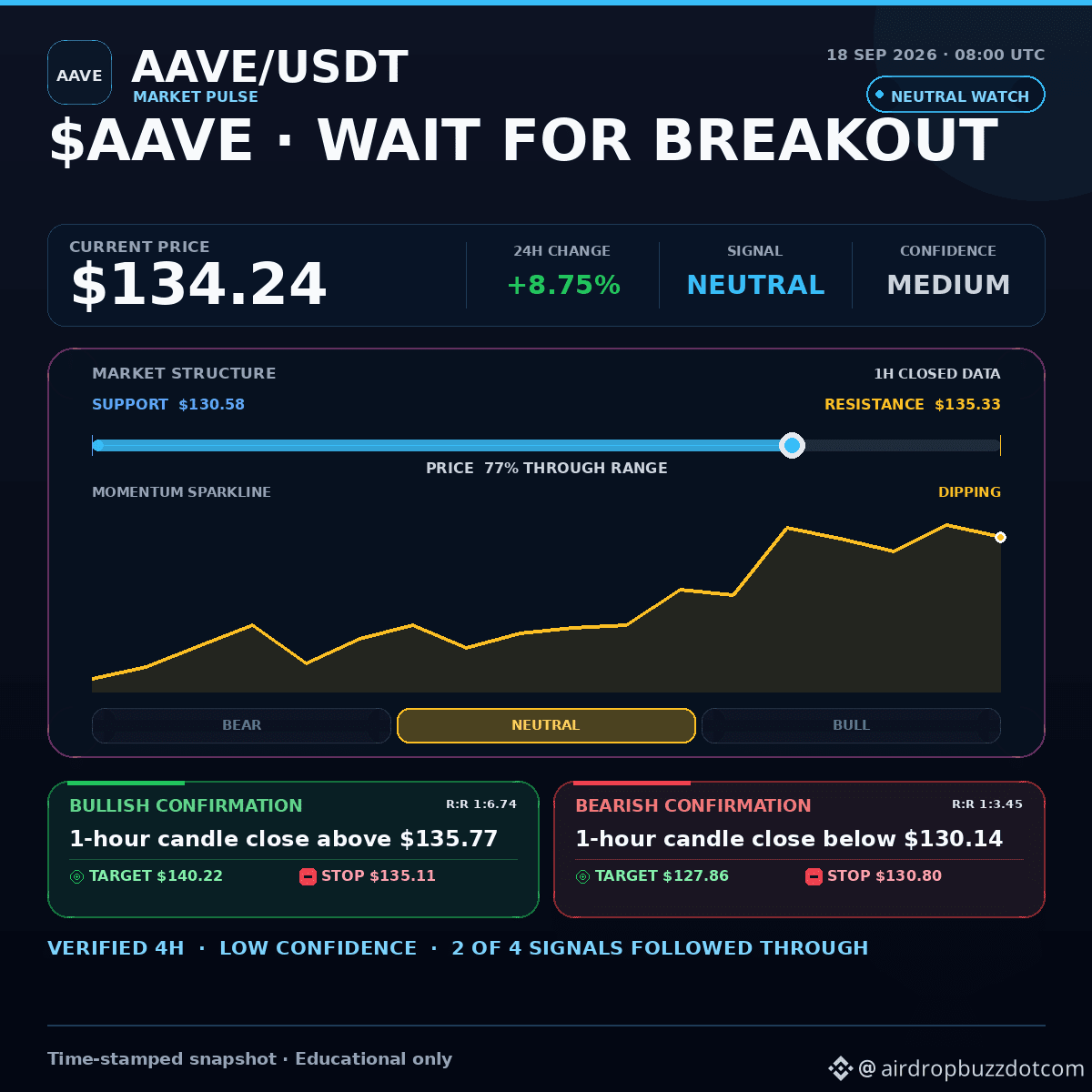
The number that matters for $AAVE: 2 of 4 recent directional moves finished favorably.
📊 Snapshot
• Price: $134.24
• 24H: +8.75%
• Bias: Neutral
📈 Bull Trigger
1-hour close above $135.77 with open interest confirmation
📉 Bear Trigger
1-hour close below $130.14 with open interest confirmation
🎯 Signal Read
The useful signal is the first confirmed close that settles the current fight for control, not another intraday wick.
📌 Confidence
Medium · Low historical confidence · 2 of 4 directional moves were favorable
Signal Quality
- OI: Flat (-0.14%)
- 4H: Bullish | 1D: Bullish (Aligned)
- ATR filter: 0.50 ATR ($0.88)
- Risk/reward: 1:6.74
Bull scenario risk plan
- Entry: $135.77
- Stop: $135.11
- Target: $140.22
Wait for a closed candle—trigger levels confirm conditions; they do not predict targets.
Bull or bear first? Drop 🐂 or 🐻.
#AAVE #Aave #CryptoTrading #MarketPulse
Educational only. Time-stamped market snapshot, not financial advice.
The number that matters for $AAVE : 2 of 4 recent directional moves finished favorably.
📊 Snapshot
• Price: $134.24
• 24H: +8.75%
• Bias: Neutral
📈 Bull Trigger
1-hour close above $135.77 with open interest confirmation
📉 Bear Trigger
1-hour close below $130.14 with open interest confirmation
🎯 Signal Read
The useful signal is the first confirmed close that settles the current fight for control, not another intraday wick.
📌 Confidence
Medium · Low historical confidence · 2 of 4 directional moves were favorable
Signal Quality
- OI: Flat (-0.14%)
- 4H: Bullish | 1D: Bullish (Aligned)
- ATR filter: 0.50 ATR ($0.88)
- Risk/reward: 1:6.74
Bull scenario risk plan
- Entry: $135.77
- Stop: $135.11
- Target: $140.22
Wait for a closed candle—trigger levels confirm conditions; they do not predict targets.
Bull or bear first? Drop 🐂 or 🐻.
#AAVE #Aave #CryptoTrading #MarketPulse
Educational only. Time-stamped market snapshot, not financial advice.
📊 Snapshot
• Price: $134.24
• 24H: +8.75%
• Bias: Neutral
📈 Bull Trigger
1-hour close above $135.77 with open interest confirmation
📉 Bear Trigger
1-hour close below $130.14 with open interest confirmation
🎯 Signal Read
The useful signal is the first confirmed close that settles the current fight for control, not another intraday wick.
📌 Confidence
Medium · Low historical confidence · 2 of 4 directional moves were favorable
Signal Quality
- OI: Flat (-0.14%)
- 4H: Bullish | 1D: Bullish (Aligned)
- ATR filter: 0.50 ATR ($0.88)
- Risk/reward: 1:6.74
Bull scenario risk plan
- Entry: $135.77
- Stop: $135.11
- Target: $140.22
Wait for a closed candle—trigger levels confirm conditions; they do not predict targets.
Bull or bear first? Drop 🐂 or 🐻.
#AAVE #Aave #CryptoTrading #MarketPulse
Educational only. Time-stamped market snapshot, not financial advice.
9
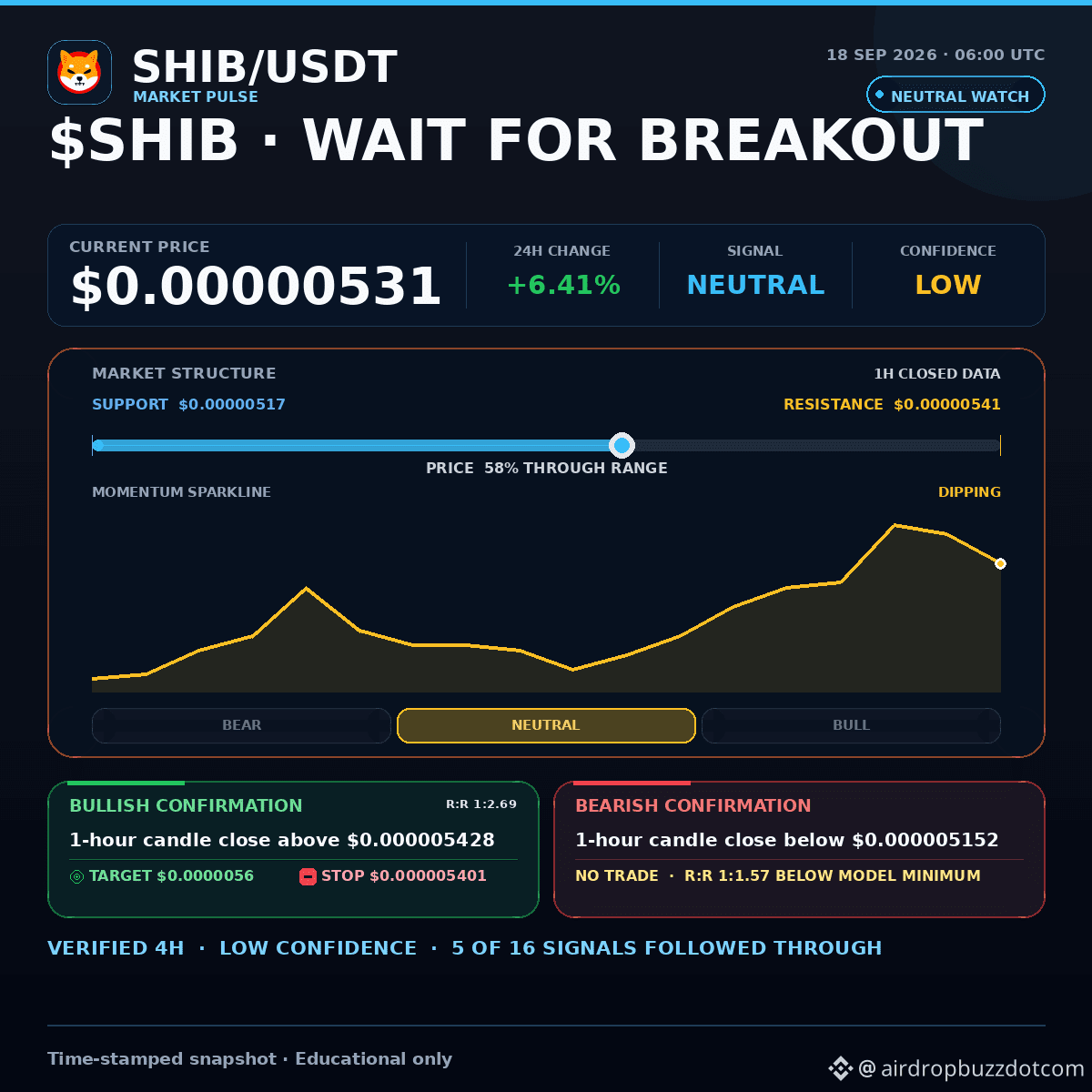
Piège haussier ou réel $SHIB confirmation?
📊 Instantané
• Prix : 0,00000531 $
• 24H : +6,41 %
• Biais : Neutre
📈 Déclencheur haussier
Clôture sur 1 heure au-dessus de 0,000005428 avec confirmation de l’intérêt ouvert
📉 Déclencheur baissier
Clôture sur 1 heure en dessous de 0,000005152 avec confirmation de l’intérêt ouvert
🎯 Lecture du signal
Le setup est suffisamment équilibré pour punir les suppositions ; attendez que le prix et la participation confirment le même côté.
📌 Confiance
Faible · Faible confiance historique · 5 sur 16 mouvements directionnels ont été favorables
Qualité du signal
- 4H : Haussier | 1D : Baissier (Conflit)
- Filtre ATR : 0,50 ATR (0,0000000357 $)
- Ratio risque/rendement : 1 : 2,69
Plan de risque du scénario haussier
- Entrée : 0,000005428
- Stop : 0,000005401
- Objectif : 0,0000056
Les déclencheurs confirment les conditions plutôt que les objectifs de prix ; attendez donc toujours la clôture de la bougie.
Cassure ou faux ? Répondez BREAK ou FAKE.
#SHIB #ShibaInu #CryptoTrading #MarketPulse
À but éducatif uniquement. Instantané du marché horodaté, pas un conseil financier.
Piège haussier ou réel $SHIB confirmation?
📊 Instantané
• Prix : 0,00000531 $
• 24H : +6,41 %
• Biais : Neutre
📈 Déclencheur haussier
Clôture sur 1 heure au-dessus de 0,000005428 avec confirmation de l’intérêt ouvert
📉 Déclencheur baissier
Clôture sur 1 heure en dessous de 0,000005152 avec confirmation de l’intérêt ouvert
🎯 Lecture du signal
Le setup est suffisamment équilibré pour punir les suppositions ; attendez que le prix et la participation confirment le même côté.
📌 Confiance
Faible · Faible confiance historique · 5 sur 16 mouvements directionnels ont été favorables
Qualité du signal
- 4H : Haussier | 1D : Baissier (Conflit)
- Filtre ATR : 0,50 ATR (0,0000000357 $)
- Ratio risque/rendement : 1 : 2,69
Plan de risque du scénario haussier
- Entrée : 0,000005428
- Stop : 0,000005401
- Objectif : 0,0000056
Les déclencheurs confirment les conditions plutôt que les objectifs de prix ; attendez donc toujours la clôture de la bougie.
Cassure ou faux ? Répondez BREAK ou FAKE.
#SHIB #ShibaInu #CryptoTrading #MarketPulse
À but éducatif uniquement. Instantané du marché horodaté, pas un conseil financier.
📊 Instantané
• Prix : 0,00000531 $
• 24H : +6,41 %
• Biais : Neutre
📈 Déclencheur haussier
Clôture sur 1 heure au-dessus de 0,000005428 avec confirmation de l’intérêt ouvert
📉 Déclencheur baissier
Clôture sur 1 heure en dessous de 0,000005152 avec confirmation de l’intérêt ouvert
🎯 Lecture du signal
Le setup est suffisamment équilibré pour punir les suppositions ; attendez que le prix et la participation confirment le même côté.
📌 Confiance
Faible · Faible confiance historique · 5 sur 16 mouvements directionnels ont été favorables
Qualité du signal
- 4H : Haussier | 1D : Baissier (Conflit)
- Filtre ATR : 0,50 ATR (0,0000000357 $)
- Ratio risque/rendement : 1 : 2,69
Plan de risque du scénario haussier
- Entrée : 0,000005428
- Stop : 0,000005401
- Objectif : 0,0000056
Les déclencheurs confirment les conditions plutôt que les objectifs de prix ; attendez donc toujours la clôture de la bougie.
Cassure ou faux ? Répondez BREAK ou FAKE.
#SHIB #ShibaInu #CryptoTrading #MarketPulse
À but éducatif uniquement. Instantané du marché horodaté, pas un conseil financier.
28
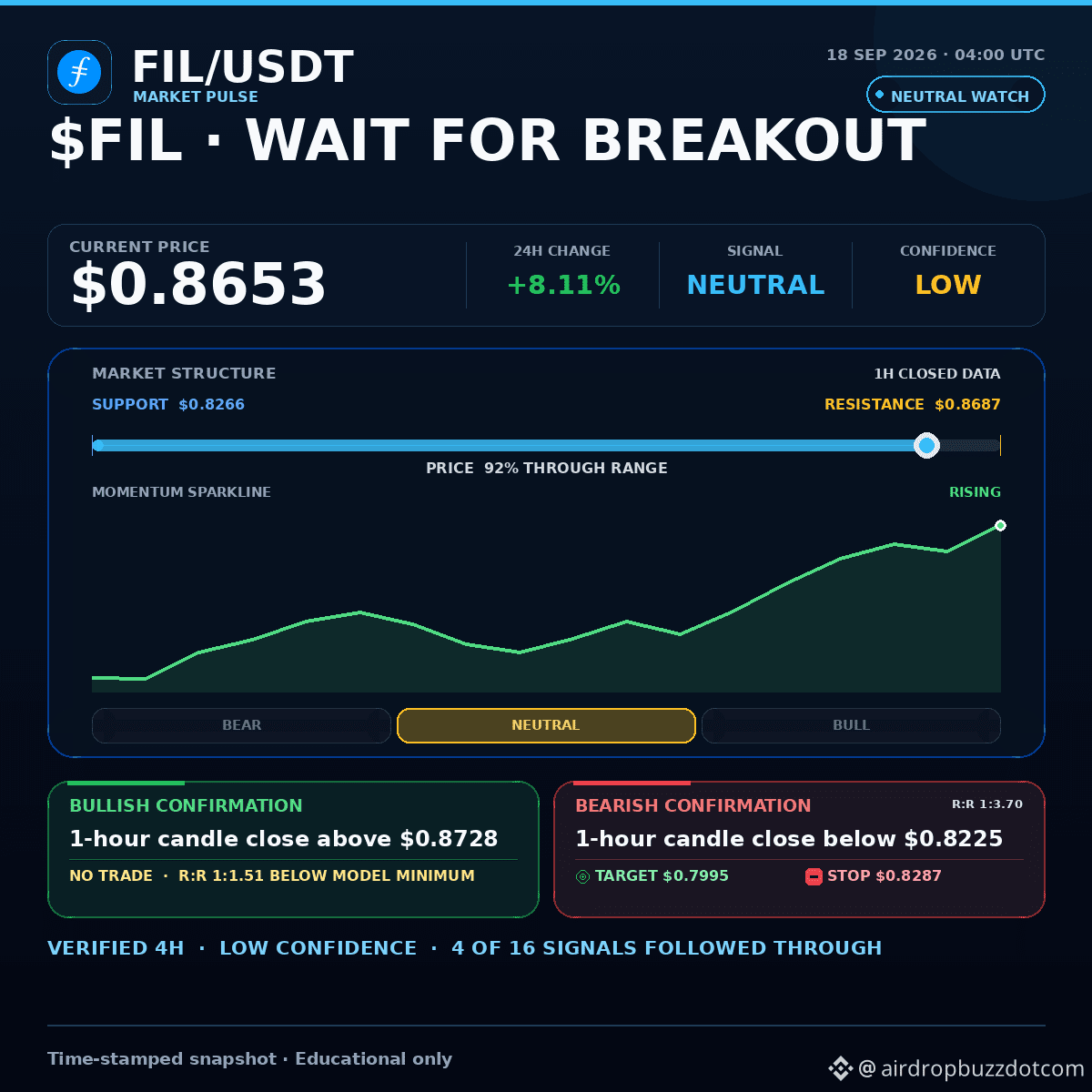
Pas besoin de deviner tôt — la prochaine clôture sur 1H est le point de décision $FIL .
📊 Aperçu
• Prix : 0,8653 $
• 24H : +8,11 %
• Biais : Neutre
📈 Déclencheur haussier
Clôture sur 1 heure au-dessus de 0,8728 $ avec confirmation de l’intérêt ouvert
📉 Déclencheur baissier
Clôture sur 1 heure sous 0,8225 $ avec confirmation de l’intérêt ouvert
🎯 Lecture du signal
Aucun des deux scénarios n’est exploitable sur le seul mouvement ; la confirmation détermine quel camp a pris l’avantage.
📌 Confiance
Faible · Faible confiance historique · 4 sur 16 mouvements directionnels ont été favorables
Qualité du signal
- IO : Plat (+0,71 %)
- 4H : Haussier | 1J : Haussier (Aligné)
- Filtre ATR : 0,50 ATR (0,008221 $)
- Ratio risque/rendement : 1:1,51 — en dessous du minimum
Plan de risque pour le scénario haussier
- Entrée : 0,8728 $
- Stop : 0,8666 $
- Objectif : 0,8822 $
Un déclencheur marque une confirmation, pas une entrée garantie, un résultat, ni une destination de prix.
Rupture ou faux ? Répondez BREAK ou FAKE.
#FIL #Filecoin #CryptoTrading #MarketPulse
À titre éducatif uniquement. Aperçu du marché horodaté, pas un conseil financier.
Pas besoin de deviner tôt — la prochaine clôture sur 1H est le point de décision $FIL .
📊 Aperçu
• Prix : 0,8653 $
• 24H : +8,11 %
• Biais : Neutre
📈 Déclencheur haussier
Clôture sur 1 heure au-dessus de 0,8728 $ avec confirmation de l’intérêt ouvert
📉 Déclencheur baissier
Clôture sur 1 heure sous 0,8225 $ avec confirmation de l’intérêt ouvert
🎯 Lecture du signal
Aucun des deux scénarios n’est exploitable sur le seul mouvement ; la confirmation détermine quel camp a pris l’avantage.
📌 Confiance
Faible · Faible confiance historique · 4 sur 16 mouvements directionnels ont été favorables
Qualité du signal
- IO : Plat (+0,71 %)
- 4H : Haussier | 1J : Haussier (Aligné)
- Filtre ATR : 0,50 ATR (0,008221 $)
- Ratio risque/rendement : 1:1,51 — en dessous du minimum
Plan de risque pour le scénario haussier
- Entrée : 0,8728 $
- Stop : 0,8666 $
- Objectif : 0,8822 $
Un déclencheur marque une confirmation, pas une entrée garantie, un résultat, ni une destination de prix.
Rupture ou faux ? Répondez BREAK ou FAKE.
#FIL #Filecoin #CryptoTrading #MarketPulse
À titre éducatif uniquement. Aperçu du marché horodaté, pas un conseil financier.
📊 Aperçu
• Prix : 0,8653 $
• 24H : +8,11 %
• Biais : Neutre
📈 Déclencheur haussier
Clôture sur 1 heure au-dessus de 0,8728 $ avec confirmation de l’intérêt ouvert
📉 Déclencheur baissier
Clôture sur 1 heure sous 0,8225 $ avec confirmation de l’intérêt ouvert
🎯 Lecture du signal
Aucun des deux scénarios n’est exploitable sur le seul mouvement ; la confirmation détermine quel camp a pris l’avantage.
📌 Confiance
Faible · Faible confiance historique · 4 sur 16 mouvements directionnels ont été favorables
Qualité du signal
- IO : Plat (+0,71 %)
- 4H : Haussier | 1J : Haussier (Aligné)
- Filtre ATR : 0,50 ATR (0,008221 $)
- Ratio risque/rendement : 1:1,51 — en dessous du minimum
Plan de risque pour le scénario haussier
- Entrée : 0,8728 $
- Stop : 0,8666 $
- Objectif : 0,8822 $
Un déclencheur marque une confirmation, pas une entrée garantie, un résultat, ni une destination de prix.
Rupture ou faux ? Répondez BREAK ou FAKE.
#FIL #Filecoin #CryptoTrading #MarketPulse
À titre éducatif uniquement. Aperçu du marché horodaté, pas un conseil financier.
36
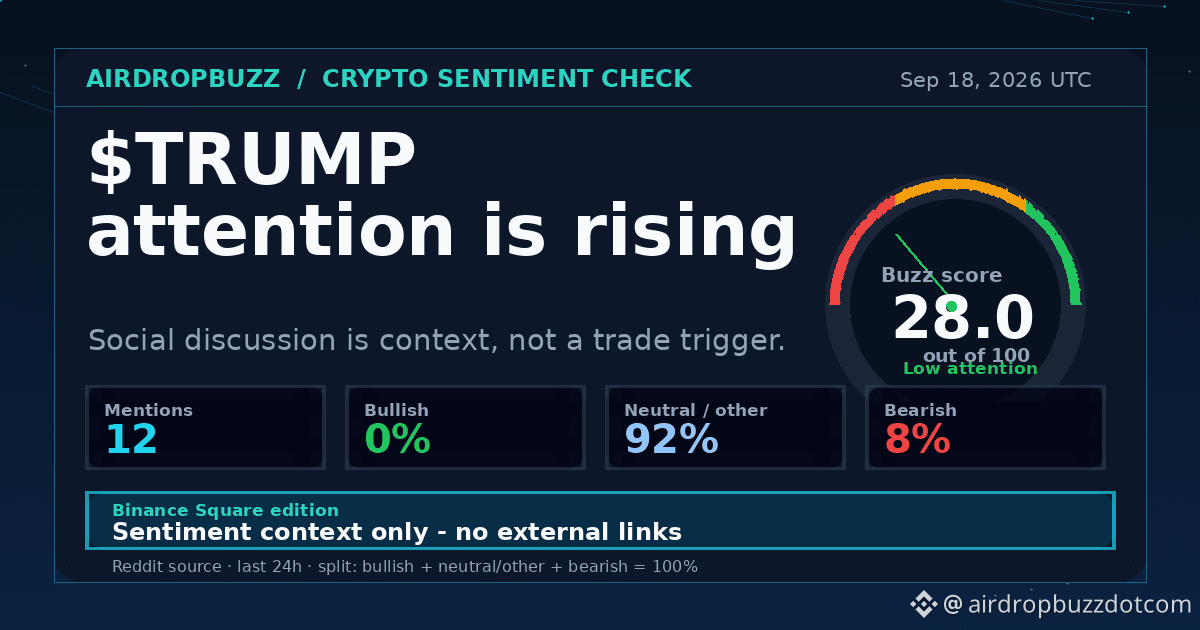
Vérification du sentiment crypto : $TRUMP suscite de plus en plus d’attention.
La discussion crypto sur les réseaux sociaux autour de $TRUMP est active aujourd’hui, et elle penche davantage vers la prudence que vers la construction. L’essentiel à retenir n’est pas de courir après le bruit, mais d’observer si le prix, le volume et le financement commencent à confirmer l’attention du public.
À considérer comme un contexte de marché, et non comme un déclencheur de transaction. Attendez une confirmation avant d’agir.
À des fins éducatives uniquement, et non constitue un conseil financier.
Vérification du sentiment crypto : $TRUMP suscite de plus en plus d’attention.
La discussion crypto sur les réseaux sociaux autour de $TRUMP est active aujourd’hui, et elle penche davantage vers la prudence que vers la construction. L’essentiel à retenir n’est pas de courir après le bruit, mais d’observer si le prix, le volume et le financement commencent à confirmer l’attention du public.
À considérer comme un contexte de marché, et non comme un déclencheur de transaction. Attendez une confirmation avant d’agir.
À des fins éducatives uniquement, et non constitue un conseil financier.
La discussion crypto sur les réseaux sociaux autour de $TRUMP est active aujourd’hui, et elle penche davantage vers la prudence que vers la construction. L’essentiel à retenir n’est pas de courir après le bruit, mais d’observer si le prix, le volume et le financement commencent à confirmer l’attention du public.
À considérer comme un contexte de marché, et non comme un déclencheur de transaction. Attendez une confirmation avant d’agir.
À des fins éducatives uniquement, et non constitue un conseil financier.
36
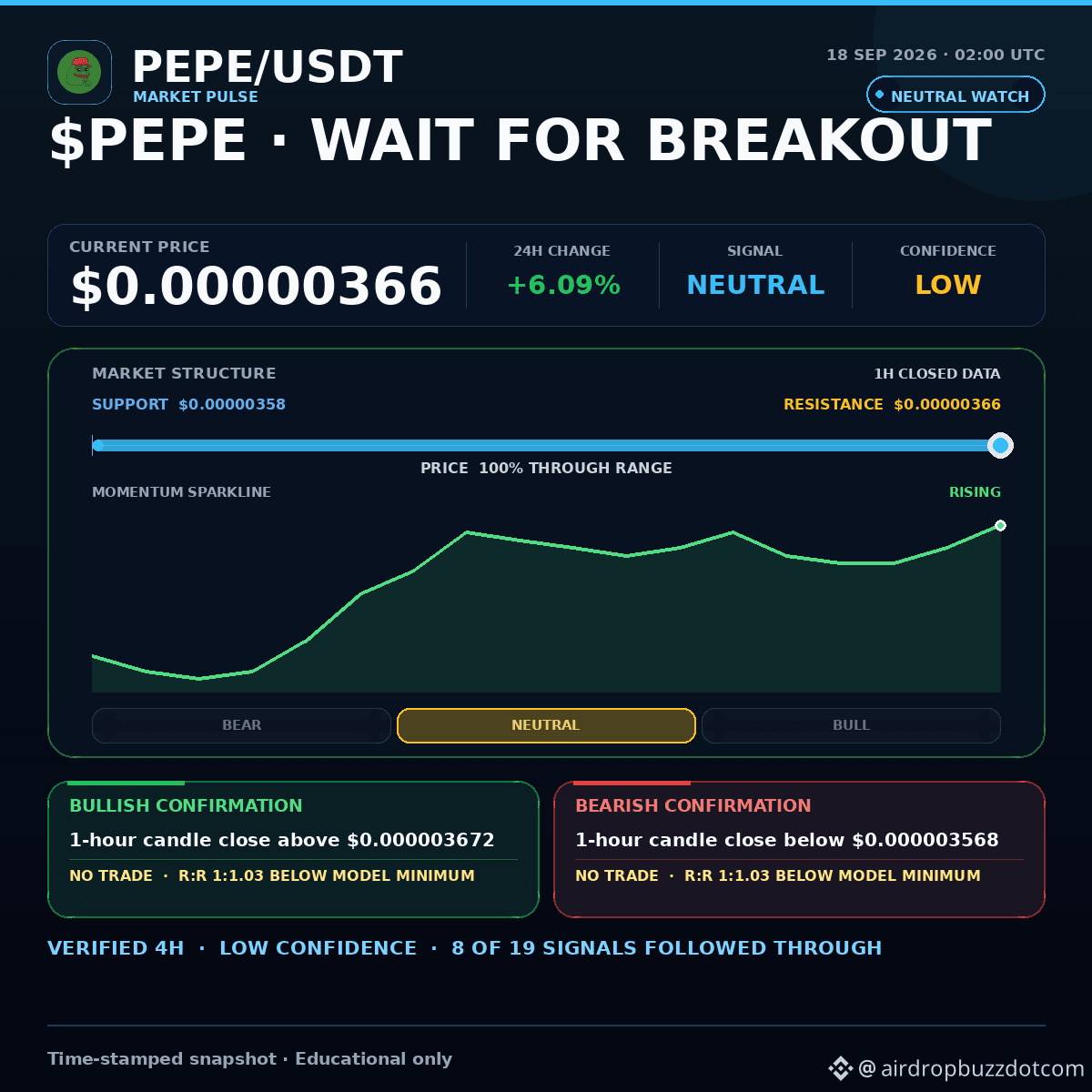
Le mouvement de prix à $PEPE est évident. La qualité du signal est la partie à surveiller.
📊 Aperçu
• Prix : 0,00000366 $
• 24 h : +6,09 %
• Biais : Neutre
📈 Déclencheur haussier
Clôture sur 1 heure au-dessus de 0,000003672 $ avec confirmation par l’intérêt ouvert
📉 Déclencheur baissier
Clôture sur 1 heure en dessous de 0,000003568 $ avec confirmation par l’intérêt ouvert
🎯 Lecture du signal
Les deux déclencheurs restent possibles, mais seul un franchissement confirmé transforme le bruit actuel en lecture directionnelle.
📌 Confiance
Faible · Confiance historique faible · 8 sur 19 mouvements directionnels ont été favorables
Qualité du signal
- 4H : Haussier | 1D : Haussier (Aligné)
- Filtre ATR : 0,50 ATR (0,0000000236 $)
- Ratio risque/rendement : 1:1,03 - sous le minimum
Plan de risque du scénario haussier
- Entrée : 0,000003672 $
- Stop : 0,000003654 $
- Objectif : 0,0000037 $
Utilisez la confirmation à la bougie clôturée, car ces niveaux définissent des conditions, pas des prévisions de prix futures.
Haut ou bas en premier ? Répondez UP ou DOWN.
#PEPE #Pepe #CryptoTrading #MarketPulse
À but éducatif uniquement. Aperçu du marché daté, pas un conseil financier.
Le mouvement de prix à $PEPE est évident. La qualité du signal est la partie à surveiller.
📊 Aperçu
• Prix : 0,00000366 $
• 24 h : +6,09 %
• Biais : Neutre
📈 Déclencheur haussier
Clôture sur 1 heure au-dessus de 0,000003672 $ avec confirmation par l’intérêt ouvert
📉 Déclencheur baissier
Clôture sur 1 heure en dessous de 0,000003568 $ avec confirmation par l’intérêt ouvert
🎯 Lecture du signal
Les deux déclencheurs restent possibles, mais seul un franchissement confirmé transforme le bruit actuel en lecture directionnelle.
📌 Confiance
Faible · Confiance historique faible · 8 sur 19 mouvements directionnels ont été favorables
Qualité du signal
- 4H : Haussier | 1D : Haussier (Aligné)
- Filtre ATR : 0,50 ATR (0,0000000236 $)
- Ratio risque/rendement : 1:1,03 - sous le minimum
Plan de risque du scénario haussier
- Entrée : 0,000003672 $
- Stop : 0,000003654 $
- Objectif : 0,0000037 $
Utilisez la confirmation à la bougie clôturée, car ces niveaux définissent des conditions, pas des prévisions de prix futures.
Haut ou bas en premier ? Répondez UP ou DOWN.
#PEPE #Pepe #CryptoTrading #MarketPulse
À but éducatif uniquement. Aperçu du marché daté, pas un conseil financier.
📊 Aperçu
• Prix : 0,00000366 $
• 24 h : +6,09 %
• Biais : Neutre
📈 Déclencheur haussier
Clôture sur 1 heure au-dessus de 0,000003672 $ avec confirmation par l’intérêt ouvert
📉 Déclencheur baissier
Clôture sur 1 heure en dessous de 0,000003568 $ avec confirmation par l’intérêt ouvert
🎯 Lecture du signal
Les deux déclencheurs restent possibles, mais seul un franchissement confirmé transforme le bruit actuel en lecture directionnelle.
📌 Confiance
Faible · Confiance historique faible · 8 sur 19 mouvements directionnels ont été favorables
Qualité du signal
- 4H : Haussier | 1D : Haussier (Aligné)
- Filtre ATR : 0,50 ATR (0,0000000236 $)
- Ratio risque/rendement : 1:1,03 - sous le minimum
Plan de risque du scénario haussier
- Entrée : 0,000003672 $
- Stop : 0,000003654 $
- Objectif : 0,0000037 $
Utilisez la confirmation à la bougie clôturée, car ces niveaux définissent des conditions, pas des prévisions de prix futures.
Haut ou bas en premier ? Répondez UP ou DOWN.
#PEPE #Pepe #CryptoTrading #MarketPulse
À but éducatif uniquement. Aperçu du marché daté, pas un conseil financier.
76
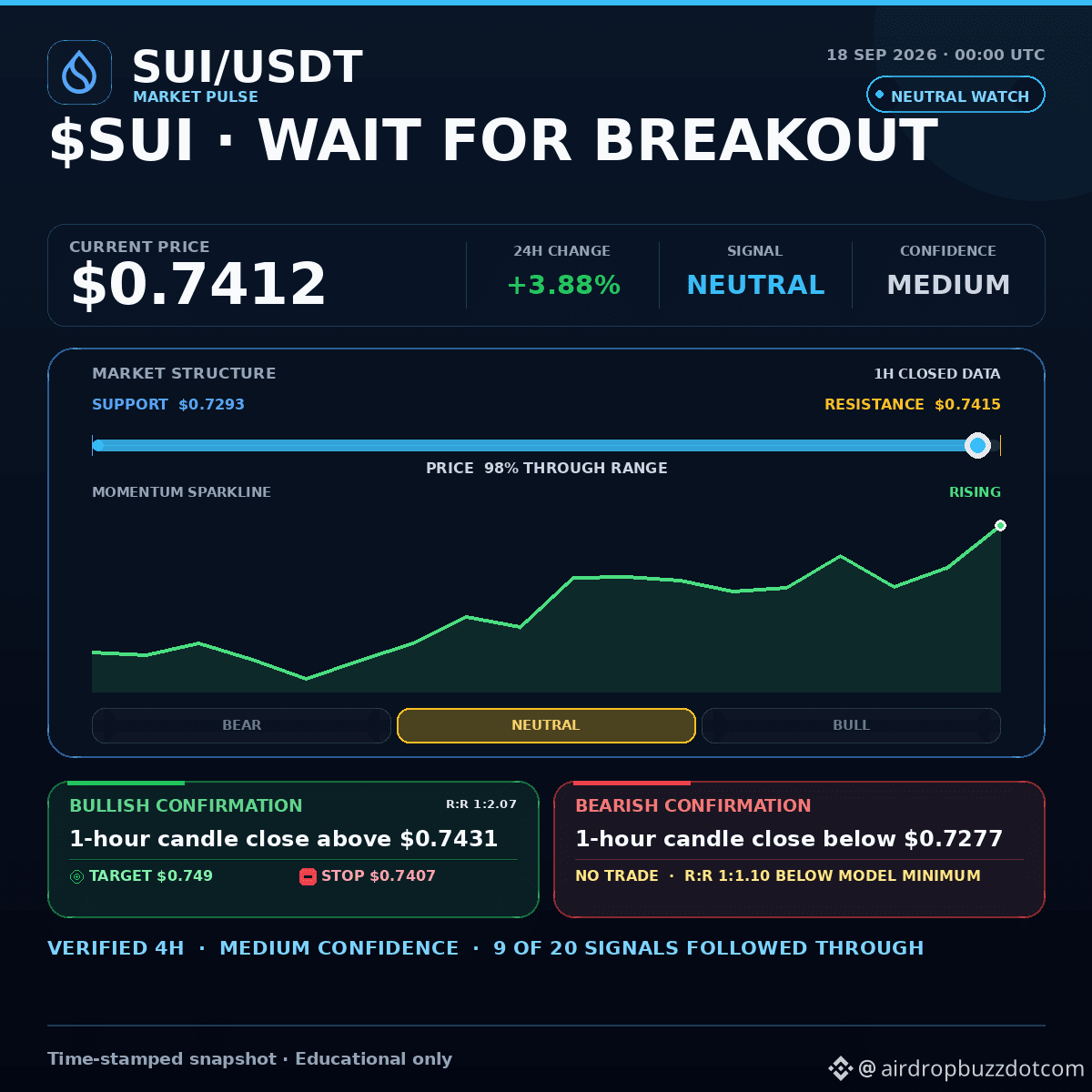
$SUI follow-through vérification : 9 des 20 mouvements directionnels récents étaient favorables.
📊 Aperçu
• Prix : 0,7412 $
• 24H : +3,88 %
• Biais : Neutre
📈 Déclencheur haussier
Clôture sur 1 heure au-dessus de 0,7431 $ avec confirmation de l’intérêt ouvert
📉 Déclencheur baissier
Clôture sur 1 heure en dessous de 0,7277 $ avec confirmation de l’intérêt ouvert
🎯 Lecture du signal
La direction est secondaire jusqu’à ce que le marché clôture au-delà d’un déclencheur, avec une participation de soutien.
📌 Confiance
Moyenne · Confiance historique moyenne · 9 des 20 mouvements directionnels étaient favorables
Qualité du signal
- Intérêt ouvert (OI) : Plat (+0,50 %)
- 4H : Haussier | 1J : Haussier (Aligné)
- Filtre ATR : 0,50 ATR (0,003164 $)
- Ratio risque/rendement : 1:2,07
Plan de risque du scénario haussier
- Entrée : 0,7431 $
- Stop : 0,7407 $
- Objectif : 0,749 $
Un déclencheur marque une confirmation, pas une entrée garantie, un résultat ou une destination de prix.
Haussier ou baissier en premier ? Tapez 🐂 ou 🐻.
#SUI #Sui #CryptoTrading #MarketPulse
À but éducatif uniquement. Aperçu du marché horodaté, pas un conseil financier.
$SUI follow-through vérification : 9 des 20 mouvements directionnels récents étaient favorables.
📊 Aperçu
• Prix : 0,7412 $
• 24H : +3,88 %
• Biais : Neutre
📈 Déclencheur haussier
Clôture sur 1 heure au-dessus de 0,7431 $ avec confirmation de l’intérêt ouvert
📉 Déclencheur baissier
Clôture sur 1 heure en dessous de 0,7277 $ avec confirmation de l’intérêt ouvert
🎯 Lecture du signal
La direction est secondaire jusqu’à ce que le marché clôture au-delà d’un déclencheur, avec une participation de soutien.
📌 Confiance
Moyenne · Confiance historique moyenne · 9 des 20 mouvements directionnels étaient favorables
Qualité du signal
- Intérêt ouvert (OI) : Plat (+0,50 %)
- 4H : Haussier | 1J : Haussier (Aligné)
- Filtre ATR : 0,50 ATR (0,003164 $)
- Ratio risque/rendement : 1:2,07
Plan de risque du scénario haussier
- Entrée : 0,7431 $
- Stop : 0,7407 $
- Objectif : 0,749 $
Un déclencheur marque une confirmation, pas une entrée garantie, un résultat ou une destination de prix.
Haussier ou baissier en premier ? Tapez 🐂 ou 🐻.
#SUI #Sui #CryptoTrading #MarketPulse
À but éducatif uniquement. Aperçu du marché horodaté, pas un conseil financier.
📊 Aperçu
• Prix : 0,7412 $
• 24H : +3,88 %
• Biais : Neutre
📈 Déclencheur haussier
Clôture sur 1 heure au-dessus de 0,7431 $ avec confirmation de l’intérêt ouvert
📉 Déclencheur baissier
Clôture sur 1 heure en dessous de 0,7277 $ avec confirmation de l’intérêt ouvert
🎯 Lecture du signal
La direction est secondaire jusqu’à ce que le marché clôture au-delà d’un déclencheur, avec une participation de soutien.
📌 Confiance
Moyenne · Confiance historique moyenne · 9 des 20 mouvements directionnels étaient favorables
Qualité du signal
- Intérêt ouvert (OI) : Plat (+0,50 %)
- 4H : Haussier | 1J : Haussier (Aligné)
- Filtre ATR : 0,50 ATR (0,003164 $)
- Ratio risque/rendement : 1:2,07
Plan de risque du scénario haussier
- Entrée : 0,7431 $
- Stop : 0,7407 $
- Objectif : 0,749 $
Un déclencheur marque une confirmation, pas une entrée garantie, un résultat ou une destination de prix.
Haussier ou baissier en premier ? Tapez 🐂 ou 🐻.
#SUI #Sui #CryptoTrading #MarketPulse
À but éducatif uniquement. Aperçu du marché horodaté, pas un conseil financier.
88
Voir la traduction
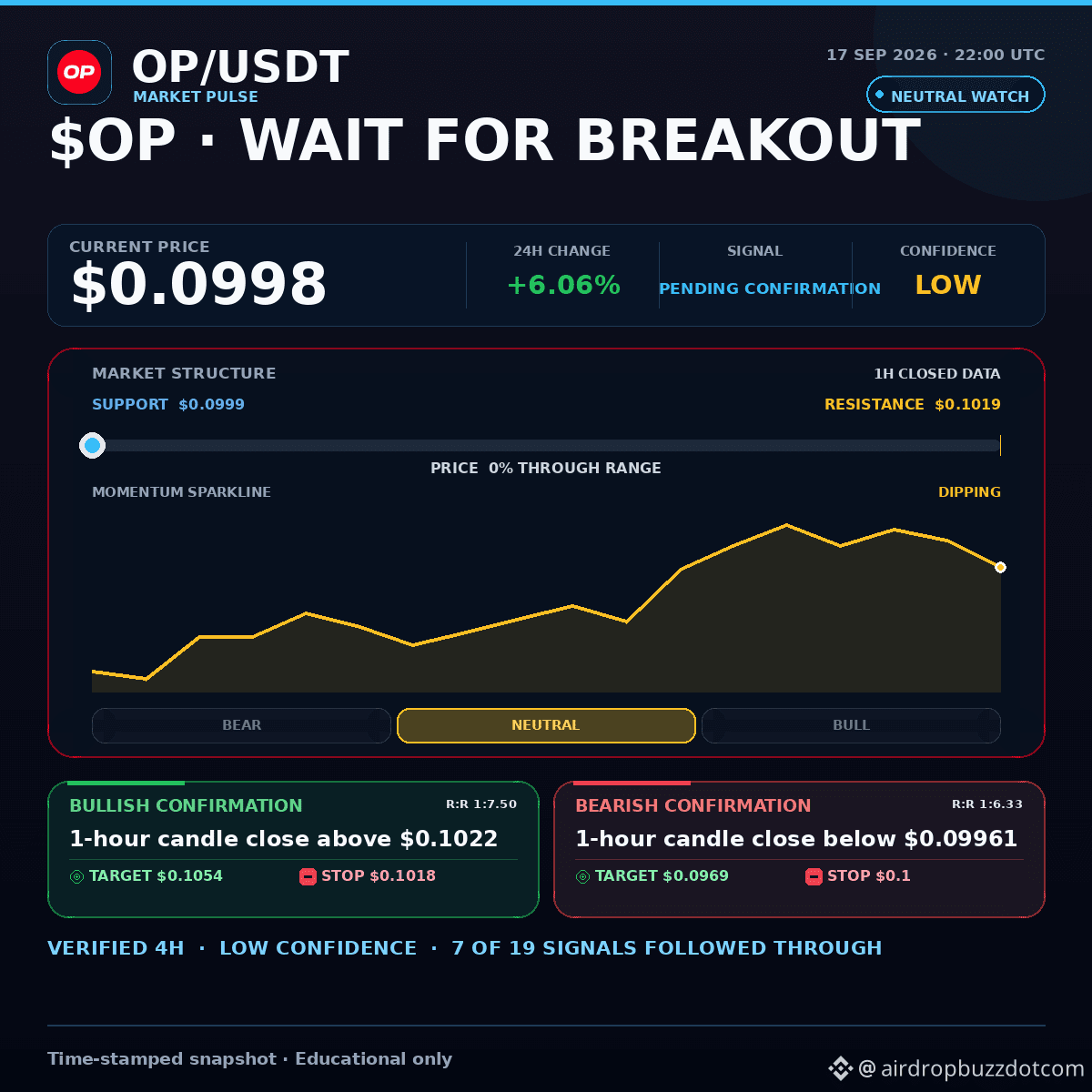
Which fires first for $OP: the bull trigger or the bear trigger?
📊 Snapshot
• Price: $0.0998
• 24H: +6.06%
• Bias: Pending Confirmation
📈 Bull Trigger
1-hour close above $0.1022 with open interest confirmation
📉 Bear Trigger
1-hour close below $0.09961 with open interest confirmation
🎯 Signal Read
Neither scenario is actionable on movement alone; confirmation decides which side has earned the edge.
📌 Confidence
Low · Low historical confidence · 7 of 19 directional moves were favorable
Signal Quality
- OI: Flat (-0.27%)
- 4H: Bullish | 1D: Bearish (Conflict)
- ATR filter: 0.50 ATR ($0.0005714)
- Risk/reward: 1:7.50
Bull scenario risk plan
- Entry: $0.1022
- Stop: $0.1018
- Target: $0.1054
Trigger levels define confirmation; they do not guarantee where price will finish.
Break or fake? Reply BREAK or FAKE.
#OP #Optimism #CryptoTrading #MarketPulse
Educational only. Time-stamped market snapshot, not financial advice.
Which fires first for $OP : the bull trigger or the bear trigger?
📊 Snapshot
• Price: $0.0998
• 24H: +6.06%
• Bias: Pending Confirmation
📈 Bull Trigger
1-hour close above $0.1022 with open interest confirmation
📉 Bear Trigger
1-hour close below $0.09961 with open interest confirmation
🎯 Signal Read
Neither scenario is actionable on movement alone; confirmation decides which side has earned the edge.
📌 Confidence
Low · Low historical confidence · 7 of 19 directional moves were favorable
Signal Quality
- OI: Flat (-0.27%)
- 4H: Bullish | 1D: Bearish (Conflict)
- ATR filter: 0.50 ATR ($0.0005714)
- Risk/reward: 1:7.50
Bull scenario risk plan
- Entry: $0.1022
- Stop: $0.1018
- Target: $0.1054
Trigger levels define confirmation; they do not guarantee where price will finish.
Break or fake? Reply BREAK or FAKE.
#OP #Optimism #CryptoTrading #MarketPulse
Educational only. Time-stamped market snapshot, not financial advice.
📊 Snapshot
• Price: $0.0998
• 24H: +6.06%
• Bias: Pending Confirmation
📈 Bull Trigger
1-hour close above $0.1022 with open interest confirmation
📉 Bear Trigger
1-hour close below $0.09961 with open interest confirmation
🎯 Signal Read
Neither scenario is actionable on movement alone; confirmation decides which side has earned the edge.
📌 Confidence
Low · Low historical confidence · 7 of 19 directional moves were favorable
Signal Quality
- OI: Flat (-0.27%)
- 4H: Bullish | 1D: Bearish (Conflict)
- ATR filter: 0.50 ATR ($0.0005714)
- Risk/reward: 1:7.50
Bull scenario risk plan
- Entry: $0.1022
- Stop: $0.1018
- Target: $0.1054
Trigger levels define confirmation; they do not guarantee where price will finish.
Break or fake? Reply BREAK or FAKE.
#OP #Optimism #CryptoTrading #MarketPulse
Educational only. Time-stamped market snapshot, not financial advice.
83
Connectez-vous pour découvrir plus de contenu
Rejoignez la communauté mondiale des adeptes de cryptomonnaies sur Binance Square
⚡️ Suviez les dernières informations importantes sur les cryptomonnaies.
💬 Jugé digne de confiance par la plus grande plateforme d’échange de cryptomonnaies au monde.
👍 Découvrez les connaissances que partagent les créateurs vérifiés.
Adresse e-mail/Nº de téléphone
Sujets d’actualité
BTCBreaks80K
133,594 vues
2,106 mentions
#btcbreaks80k $BTC
Bitcoin bondit au-delà de 80 000 $ — en hausse de 5,88% aujourd’hui
Le Bitcoin a bondi, s’échangeant à 80 846 $ après un démarrage à 76 355 $, atteignant un plus haut intraday de 81 238 $ — son meilleur niveau depuis le 4 septembre. C’est un net rallye de soulagement, qui récupère une partie des pertes d’une période difficile durant laquelle le BTC était descendu jusqu’à 75 000 $ il y a quelques jours.
Ce qui le propulse : la hausse des taux de la Fed s’est accompagnée d’un graphique en points indiquant que les taux pourraient tomber à seulement 4,1% d’ici fin 2027 — un signal que le cycle de resserrement touche probablement à sa fin. À cela s’ajoutent 159,5 M$ d’entrées nettes fraîches dans les ETF, ainsi qu’un yen plus faible, ce qui a stimulé l’appétit pour le risque dans l’ensemble.
Le mouvement a durement frappé les positions vendeuses : plus de 445 millions de dollars de liquidations sur l’ensemble du marché, dont 230 M$+ rien que sur les shorts en Bitcoin — un classique short squeeze qui amplifie la hausse.
Attention : les analystes soulignent que le mouvement a été rapide, et que le BTC a rejeté la zone 80 000–81 000 $ avant ce cycle. 76 000 $ reste le niveau clé si l’élan faiblit.
$BTC #Bitcoin
#BTCPriceAlert
Top Hatter 09
·3 mentions J’aime
·8.9k vues
SOLJumpsAbout10%
2,541 vues
108 mentions
EthereumReclaims$2600
330 vues
26 mentions