

Crypto-First21
15.2k Publications

Crypto-First21
 Compte Square Vérifié+
Signaler
Bloquer l’utilisateur
x : crypto_first21
Trade fréquemment
3 an(s)
238 Suivis
91.9K+ Abonnés
74.0K+ J’aime
Publications
Tous
Citations
Vidéos
PINNED
Hacker Moves $83M in Stolen XRP as The Exchange Works Through Fallout
The fallout of $387.5 million breach is still unfolding.
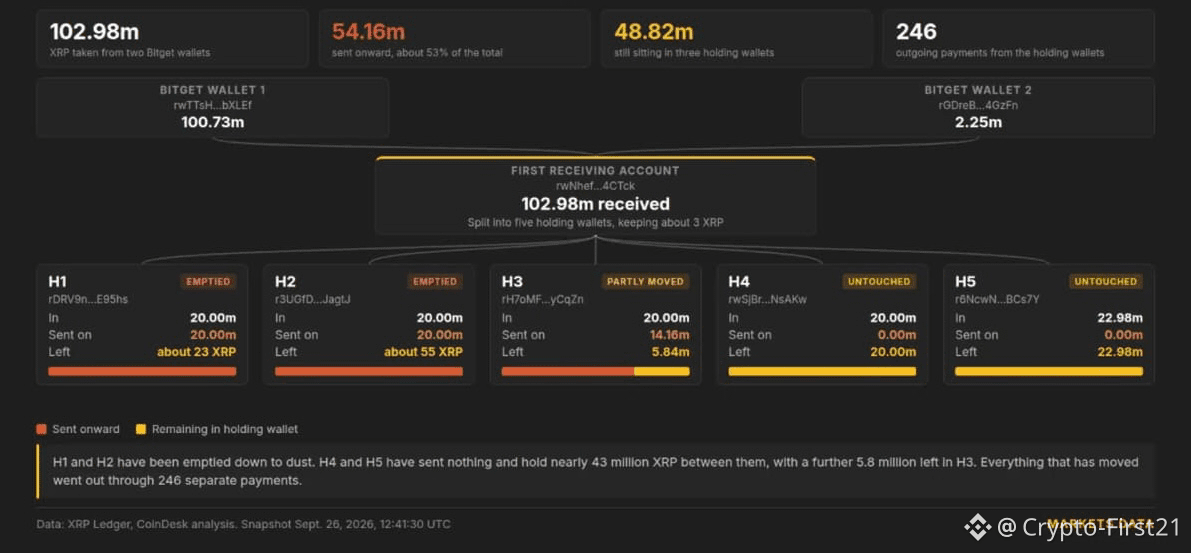
The attacker has reportedly moved around $83 million worth of stolen $XRP from three holding wallets, while roughly $75 million remains in wallets that cannot be frozen under XRP Ledger rules.
Exchanges can blacklist accounts receiving the stolen funds, but the attacker’s wallets themselves can’t be blocked. Meanwhile, Circle and Tether have frozen about $320,000 in related stablecoins.
the exchange says its protection fund will fully cover the losses and that customer balances remain unaffected. Withdrawals are expected to resume gradually between Sept. 28 and Oct. 2.
The focus now shifts from the hack itself to how much of the stolen funds can actually be tracked, frozen, or recovered. 🚨💰
What are you thoughts on it 👀?
#cryptofirst21 $RARE
Hacker Moves $83M in Stolen XRP as The Exchange Works Through Fallout
The fallout of $387.5 million breach is still unfolding.
The attacker has reportedly moved around $83 million worth of stolen $XRP from three holding wallets, while roughly $75 million remains in wallets that cannot be frozen under XRP Ledger rules.
Exchanges can blacklist accounts receiving the stolen funds, but the attacker’s wallets themselves can’t be blocked. Meanwhile, Circle and Tether have frozen about $320,000 in related stablecoins.
the exchange says its protection fund will fully cover the losses and that customer balances remain unaffected. Withdrawals are expected to resume gradually between Sept. 28 and Oct. 2.
The focus now shifts from the hack itself to how much of the stolen funds can actually be tracked, frozen, or recovered. 🚨💰
What are you thoughts on it 👀?
#cryptofirst21 $RARE
The fallout of $387.5 million breach is still unfolding.
The attacker has reportedly moved around $83 million worth of stolen $XRP from three holding wallets, while roughly $75 million remains in wallets that cannot be frozen under XRP Ledger rules.
Exchanges can blacklist accounts receiving the stolen funds, but the attacker’s wallets themselves can’t be blocked. Meanwhile, Circle and Tether have frozen about $320,000 in related stablecoins.
the exchange says its protection fund will fully cover the losses and that customer balances remain unaffected. Withdrawals are expected to resume gradually between Sept. 28 and Oct. 2.
The focus now shifts from the hack itself to how much of the stolen funds can actually be tracked, frozen, or recovered. 🚨💰
What are you thoughts on it 👀?
#cryptofirst21 $RARE
22
10
96
110.1k
Robinhood Chain Rug Pull Network Allegedly Cashed Out $18.4M Across 53 Token Launches 👀
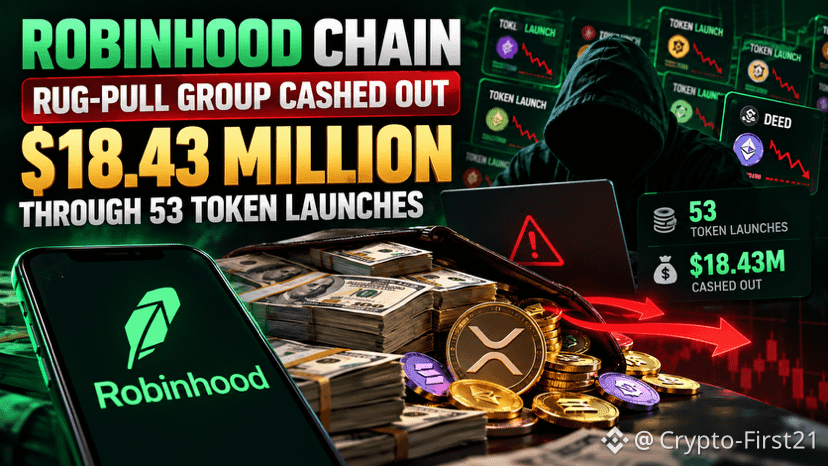
A suspected rug pull network on the Robinhood chain has reportedly extracted around $18.43 million from at least 53 token launches over the past two months.
The group appears to be linked to a series of coordinated token deployments and cash outs, with the real figure potentially even higher.
Interestingly, the $DEED.ETF token that sparked the investigation wasn’t among the group’s top 10 most profitable exits, suggesting the operation may be much larger than initially thought.
Another reminder that on chain activity can reveal patterns long before they become obvious to the wider market. 📉🔍
#cryptofirst21 $RHEA $QNT
Robinhood Chain Rug Pull Network Allegedly Cashed Out $18.4M Across 53 Token Launches 👀
A suspected rug pull network on the Robinhood chain has reportedly extracted around $18.43 million from at least 53 token launches over the past two months.
The group appears to be linked to a series of coordinated token deployments and cash outs, with the real figure potentially even higher.
Interestingly, the $DEED.ETF token that sparked the investigation wasn’t among the group’s top 10 most profitable exits, suggesting the operation may be much larger than initially thought.
Another reminder that on chain activity can reveal patterns long before they become obvious to the wider market. 📉🔍
#cryptofirst21 $RHEA $QNT
A suspected rug pull network on the Robinhood chain has reportedly extracted around $18.43 million from at least 53 token launches over the past two months.
The group appears to be linked to a series of coordinated token deployments and cash outs, with the real figure potentially even higher.
Interestingly, the $DEED.ETF token that sparked the investigation wasn’t among the group’s top 10 most profitable exits, suggesting the operation may be much larger than initially thought.
Another reminder that on chain activity can reveal patterns long before they become obvious to the wider market. 📉🔍
#cryptofirst21 $RHEA $QNT
3
2.8k
Breaking News : Leading Exchange Confirms $351.6M Hot Wallet Hack, User Funds Remain Protected 😳
Exchange has confirmed a security breach affecting part of its hot wallet infrastructure, with estimated losses of approximately $351.6 million.
The exchange says cold wallets remain secure and user funds are fully covered by its $464 million User Protection Fund. Withdrawals have been temporarily suspended while a security review is underway, though deposits and trading remain operational.
It stated that abnormal addresses have been identified and reported, with law enforcement and blockchain security firms now involved in the investigation. Updates are expected as the review progresses.
Whats going on 👀
#cryptofirst21 $XAI
Breaking News : Leading Exchange Confirms $351.6M Hot Wallet Hack, User Funds Remain Protected 😳
Exchange has confirmed a security breach affecting part of its hot wallet infrastructure, with estimated losses of approximately $351.6 million.
The exchange says cold wallets remain secure and user funds are fully covered by its $464 million User Protection Fund. Withdrawals have been temporarily suspended while a security review is underway, though deposits and trading remain operational.
It stated that abnormal addresses have been identified and reported, with law enforcement and blockchain security firms now involved in the investigation. Updates are expected as the review progresses.
Whats going on 👀
#cryptofirst21 $XAI
Exchange has confirmed a security breach affecting part of its hot wallet infrastructure, with estimated losses of approximately $351.6 million.
The exchange says cold wallets remain secure and user funds are fully covered by its $464 million User Protection Fund. Withdrawals have been temporarily suspended while a security review is underway, though deposits and trading remain operational.
It stated that abnormal addresses have been identified and reported, with law enforcement and blockchain security firms now involved in the investigation. Updates are expected as the review progresses.
Whats going on 👀
#cryptofirst21 $XAI
2
5
4.2k
Vérifié
The dollar is on a roll 👀
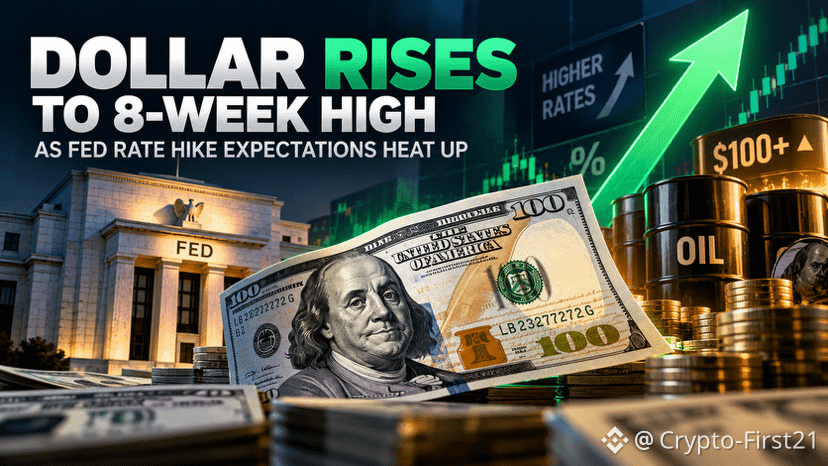
Markets are increasingly betting the Fed isn’t done hiking rates, pushing the U.S. dollar to its highest level since late July.
With oil back above $100 and rate cut hopes fading, traders are starting to price in a higher for longer environment.
For now, the dollar keeps winning. 💵📈
#cryptofirst21 $NIL
The dollar is on a roll 👀
Markets are increasingly betting the Fed isn’t done hiking rates, pushing the U.S. dollar to its highest level since late July.
With oil back above $100 and rate cut hopes fading, traders are starting to price in a higher for longer environment.
For now, the dollar keeps winning. 💵📈
#cryptofirst21 $NIL
Markets are increasingly betting the Fed isn’t done hiking rates, pushing the U.S. dollar to its highest level since late July.
With oil back above $100 and rate cut hopes fading, traders are starting to price in a higher for longer environment.
For now, the dollar keeps winning. 💵📈
#cryptofirst21 $NIL
4
4.5k
Vérifié
not gonna lie, this is a pretty big move 👏
Binance just dropped $100 million to buy a stake in Circle, picking up 1.237 million shares at $80.84 each. The shares are locked for up to 2 years, so this isn’t some quick flip trade.
But the more interesting part is what came with it.
Binance and Circle have renewed and expanded their partnership for another 5 years. Binance will keep pushing USDC across its platform, while Circle will pay monthly incentives based on how much USDC users hold on Binance.
Feels like both sides are doubling down on USDC adoption. Binance gets exposure to Circle, Circle gets deeper distribution, and USDC gets a stronger position in the stablecoin race.
Sometimes the biggest signals aren’t new token launches, they’re the deals happening behind the scenes. 👀
#cryptofirst21 $MUBARAK
not gonna lie, this is a pretty big move 👏
Binance just dropped $100 million to buy a stake in Circle, picking up 1.237 million shares at $80.84 each. The shares are locked for up to 2 years, so this isn’t some quick flip trade.
But the more interesting part is what came with it.
Binance and Circle have renewed and expanded their partnership for another 5 years. Binance will keep pushing USDC across its platform, while Circle will pay monthly incentives based on how much USDC users hold on Binance.
Feels like both sides are doubling down on USDC adoption. Binance gets exposure to Circle, Circle gets deeper distribution, and USDC gets a stronger position in the stablecoin race.
Sometimes the biggest signals aren’t new token launches, they’re the deals happening behind the scenes. 👀
#cryptofirst21 $MUBARAK
Binance just dropped $100 million to buy a stake in Circle, picking up 1.237 million shares at $80.84 each. The shares are locked for up to 2 years, so this isn’t some quick flip trade.
But the more interesting part is what came with it.
Binance and Circle have renewed and expanded their partnership for another 5 years. Binance will keep pushing USDC across its platform, while Circle will pay monthly incentives based on how much USDC users hold on Binance.
Feels like both sides are doubling down on USDC adoption. Binance gets exposure to Circle, Circle gets deeper distribution, and USDC gets a stronger position in the stablecoin race.
Sometimes the biggest signals aren’t new token launches, they’re the deals happening behind the scenes. 👀
#cryptofirst21 $MUBARAK
1
3
447
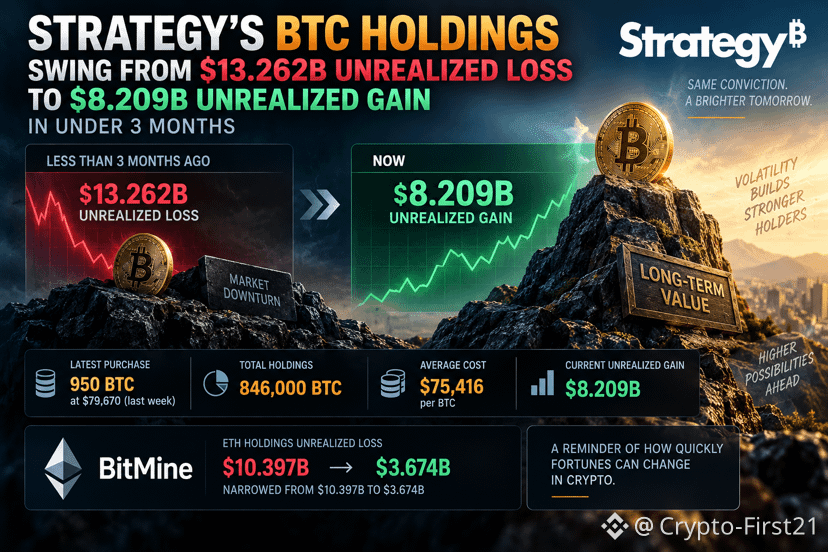
Strategy’s Bitcoin Position Swings $21.5B in Less Than 3 Months
Sooo… the company bought another 950 BTC last week at an average price of $79,670. It now holds 846,000 BTC with an average acquisition cost of $75,416.
• Total holdings: 846,000 BTC
• Average cost: $75,416 per BTC
• Current unrealized gain: $8.21B
Less than three months ago, the same position was sitting on an unrealized loss of $13.26B.
That marks a swing of roughly $21.47B in paper profits as Bitcoin recovered.
Hmm… well BitMine’s ETH position also improved significantly, reducing its unrealized loss from $10.4B to $3.67B over the same period.
A reminder of how quickly fortunes can change when balance sheets become heavily tied to crypto prices.
$FORM $PHA #cryptofirst21
Strategy’s Bitcoin Position Swings $21.5B in Less Than 3 Months
Sooo… the company bought another 950 BTC last week at an average price of $79,670. It now holds 846,000 BTC with an average acquisition cost of $75,416.
• Total holdings: 846,000 BTC
• Average cost: $75,416 per BTC
• Current unrealized gain: $8.21B
Less than three months ago, the same position was sitting on an unrealized loss of $13.26B.
That marks a swing of roughly $21.47B in paper profits as Bitcoin recovered.
Hmm… well BitMine’s ETH position also improved significantly, reducing its unrealized loss from $10.4B to $3.67B over the same period.
A reminder of how quickly fortunes can change when balance sheets become heavily tied to crypto prices.
$FORM $PHA #cryptofirst21
Sooo… the company bought another 950 BTC last week at an average price of $79,670. It now holds 846,000 BTC with an average acquisition cost of $75,416.
• Total holdings: 846,000 BTC
• Average cost: $75,416 per BTC
• Current unrealized gain: $8.21B
Less than three months ago, the same position was sitting on an unrealized loss of $13.26B.
That marks a swing of roughly $21.47B in paper profits as Bitcoin recovered.
Hmm… well BitMine’s ETH position also improved significantly, reducing its unrealized loss from $10.4B to $3.67B over the same period.
A reminder of how quickly fortunes can change when balance sheets become heavily tied to crypto prices.
$FORM $PHA #cryptofirst21
3
591
Vérifié
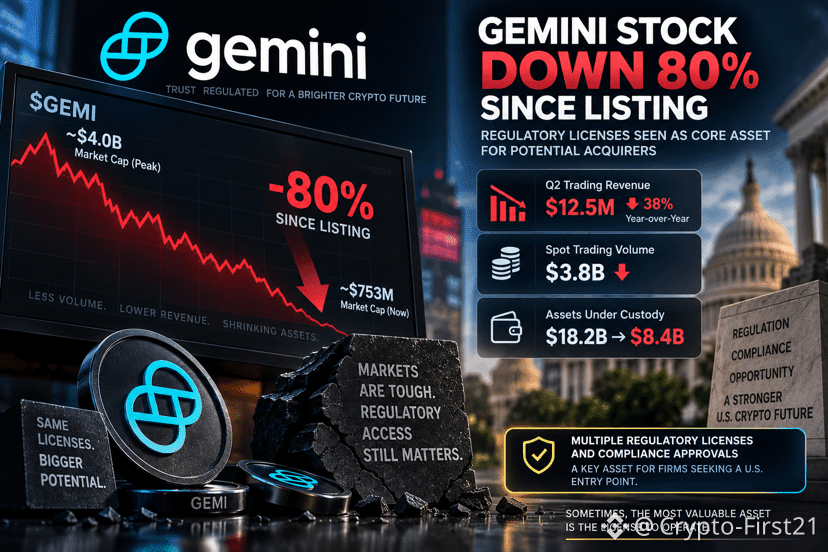
Gemini Down 80% Since Listing But One Asset Still Matters 🙄
Gemini Space Station $GEMI.US has lost around 80% of its value since going public, with its market cap falling from nearly $4B to about $753M.
The business has slowed across the board:
• Q2 trading revenue down 38% YoY to $12.5M
• Spot volume dropped to $3.8B
• Assets under custody fell from $18.2B to $8.4B
Hmm.. Yet the real value may not be the exchange itself.
I think Gemini still holds multiple regulatory licenses and compliance approvals, making it a potential acquisition target for firms looking for a faster path into the U.S. crypto market.
Btw In crypto, licenses can sometimes be worth more than volume.
Gemini Down 80% Since Listing But One Asset Still Matters 🙄
Gemini Space Station $GEMI.US has lost around 80% of its value since going public, with its market cap falling from nearly $4B to about $753M.
The business has slowed across the board:
• Q2 trading revenue down 38% YoY to $12.5M
• Spot volume dropped to $3.8B
• Assets under custody fell from $18.2B to $8.4B
Hmm.. Yet the real value may not be the exchange itself.
I think Gemini still holds multiple regulatory licenses and compliance approvals, making it a potential acquisition target for firms looking for a faster path into the U.S. crypto market.
Btw In crypto, licenses can sometimes be worth more than volume.
Gemini Space Station $GEMI.US has lost around 80% of its value since going public, with its market cap falling from nearly $4B to about $753M.
The business has slowed across the board:
• Q2 trading revenue down 38% YoY to $12.5M
• Spot volume dropped to $3.8B
• Assets under custody fell from $18.2B to $8.4B
Hmm.. Yet the real value may not be the exchange itself.
I think Gemini still holds multiple regulatory licenses and compliance approvals, making it a potential acquisition target for firms looking for a faster path into the U.S. crypto market.
Btw In crypto, licenses can sometimes be worth more than volume.
GEMIUS-1,89%
6
1.4k
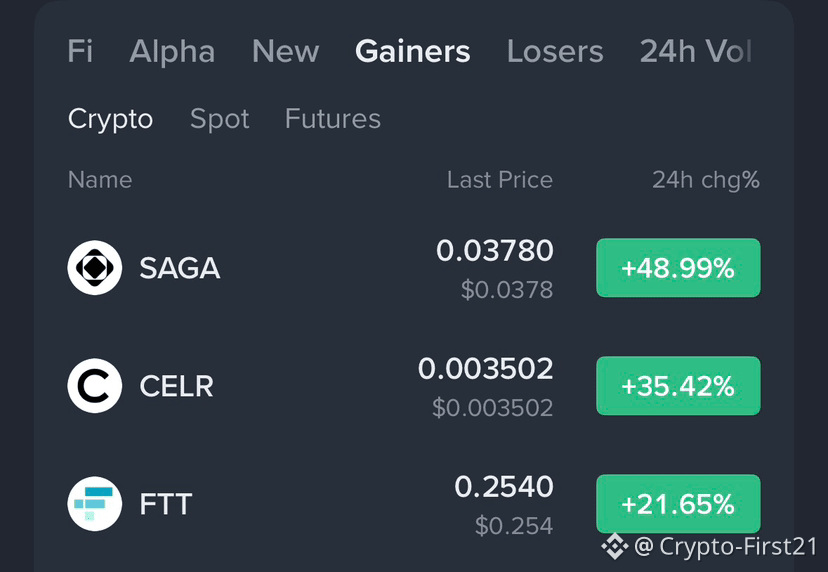
Hmm.. If your portfolio doesn't own any of these three today, don't worry.
Neither did mine. 🤝
$SAGA +49%
$CELR +35%
$FTT +21%
#cryptofirst21
Hmm.. If your portfolio doesn't own any of these three today, don't worry.
Neither did mine. 🤝
$SAGA +49%
$CELR +35%
$FTT +21%
#cryptofirst21
Neither did mine. 🤝
$SAGA +49%
$CELR +35%
$FTT +21%
#cryptofirst21
1
2
1.8k
U.S. Ready for Iran Talks, Tehran Sets Conditions
Iranian sources say Qatar and Pakistan have informed Tehran that the U.S. is ready for serious negotiations and a potential agreement.
Iran says it can resume the Islamabad Memorandum within days if Washington returns to its commitments and provides credible guarantees against future attacks.
Tehran also wants hostilities halted, restrictions lifted, and oil exports restored before formal talks on its nuclear program and sanctions relief begin.
The development signals a possible diplomatic opening after months of heightened tensions.
$AKE $ONE #cryptofirst21
U.S. Ready for Iran Talks, Tehran Sets Conditions
Iranian sources say Qatar and Pakistan have informed Tehran that the U.S. is ready for serious negotiations and a potential agreement.
Iran says it can resume the Islamabad Memorandum within days if Washington returns to its commitments and provides credible guarantees against future attacks.
Tehran also wants hostilities halted, restrictions lifted, and oil exports restored before formal talks on its nuclear program and sanctions relief begin.
The development signals a possible diplomatic opening after months of heightened tensions.
$AKE $ONE #cryptofirst21
Iranian sources say Qatar and Pakistan have informed Tehran that the U.S. is ready for serious negotiations and a potential agreement.
Iran says it can resume the Islamabad Memorandum within days if Washington returns to its commitments and provides credible guarantees against future attacks.
Tehran also wants hostilities halted, restrictions lifted, and oil exports restored before formal talks on its nuclear program and sanctions relief begin.
The development signals a possible diplomatic opening after months of heightened tensions.
$AKE $ONE #cryptofirst21

5
1.2k
Trump Says Iran Wants a Deal as He Weighs Next Steps
U.S. President Donald Trump said Iran is seeking an agreement with the United States as he continues to consider whether to take further action against Tehran.
According to Trump, Iran is currently interested in reaching an agreement, but he emphasized that any deal would need to meet U.S. expectations.
"If it's not the right agreement, then I won't even consider it," Trump said, adding that he believes Iran is facing significant economic and military pressure.
The remarks suggest diplomacy remains under consideration, though no final decision on future U.S. actions has been announced.
btw whats up with $G and $AKE today👀
#BOJHikesRatesTo31YearHigh #cryprofirst21
Trump Says Iran Wants a Deal as He Weighs Next Steps
U.S. President Donald Trump said Iran is seeking an agreement with the United States as he continues to consider whether to take further action against Tehran.
According to Trump, Iran is currently interested in reaching an agreement, but he emphasized that any deal would need to meet U.S. expectations.
"If it's not the right agreement, then I won't even consider it," Trump said, adding that he believes Iran is facing significant economic and military pressure.
The remarks suggest diplomacy remains under consideration, though no final decision on future U.S. actions has been announced.
btw whats up with $G and $AKE today👀
#BOJHikesRatesTo31YearHigh #cryprofirst21
U.S. President Donald Trump said Iran is seeking an agreement with the United States as he continues to consider whether to take further action against Tehran.
According to Trump, Iran is currently interested in reaching an agreement, but he emphasized that any deal would need to meet U.S. expectations.
"If it's not the right agreement, then I won't even consider it," Trump said, adding that he believes Iran is facing significant economic and military pressure.
The remarks suggest diplomacy remains under consideration, though no final decision on future U.S. actions has been announced.
btw whats up with $G and $AKE today👀
#BOJHikesRatesTo31YearHigh #cryprofirst21

2
1
5
957
Vérifié
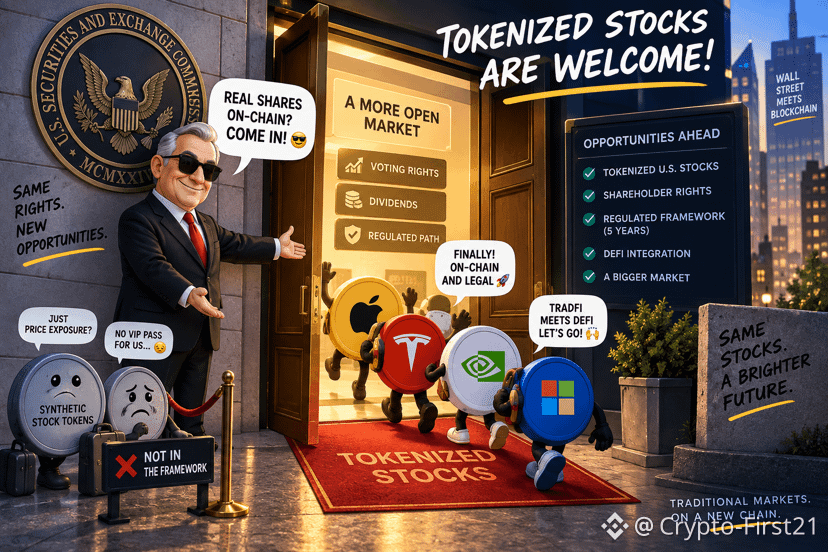
SEC: "Tokenized stocks are welcome."
Crypto: "Wait... we're allowed in now?" 👀
$APM and $ONE watching silently..
For years, Wall Street and crypto have been standing on opposite sides of the room pretending not to notice each other.
Now the SEC just opened a door for tokenized U.S. stocks, giving projects a clearer path to put real shares on chain while keeping shareholder rights intact.
The catch?
If your token is just pretending to be a stock and only tracks the price, don't expect a VIP pass. 🚫
Meanwhile, DeFi protocols are probably refreshing their group chats every 5 seconds.
Looks like the "stocks on blockchain" narrative just got a lot more real.
2026 plot twist: Your stock portfolio and your crypto wallet might end up living in the same place. 🍿📈🔗
#cryptofirst21
SEC: "Tokenized stocks are welcome."
Crypto: "Wait... we're allowed in now?" 👀
$APM and $ONE watching silently..
For years, Wall Street and crypto have been standing on opposite sides of the room pretending not to notice each other.
Now the SEC just opened a door for tokenized U.S. stocks, giving projects a clearer path to put real shares on chain while keeping shareholder rights intact.
The catch?
If your token is just pretending to be a stock and only tracks the price, don't expect a VIP pass. 🚫
Meanwhile, DeFi protocols are probably refreshing their group chats every 5 seconds.
Looks like the "stocks on blockchain" narrative just got a lot more real.
2026 plot twist: Your stock portfolio and your crypto wallet might end up living in the same place. 🍿📈🔗
#cryptofirst21
Crypto: "Wait... we're allowed in now?" 👀
$APM and $ONE watching silently..
For years, Wall Street and crypto have been standing on opposite sides of the room pretending not to notice each other.
Now the SEC just opened a door for tokenized U.S. stocks, giving projects a clearer path to put real shares on chain while keeping shareholder rights intact.
The catch?
If your token is just pretending to be a stock and only tracks the price, don't expect a VIP pass. 🚫
Meanwhile, DeFi protocols are probably refreshing their group chats every 5 seconds.
Looks like the "stocks on blockchain" narrative just got a lot more real.
2026 plot twist: Your stock portfolio and your crypto wallet might end up living in the same place. 🍿📈🔗
#cryptofirst21
1
2
1.8k
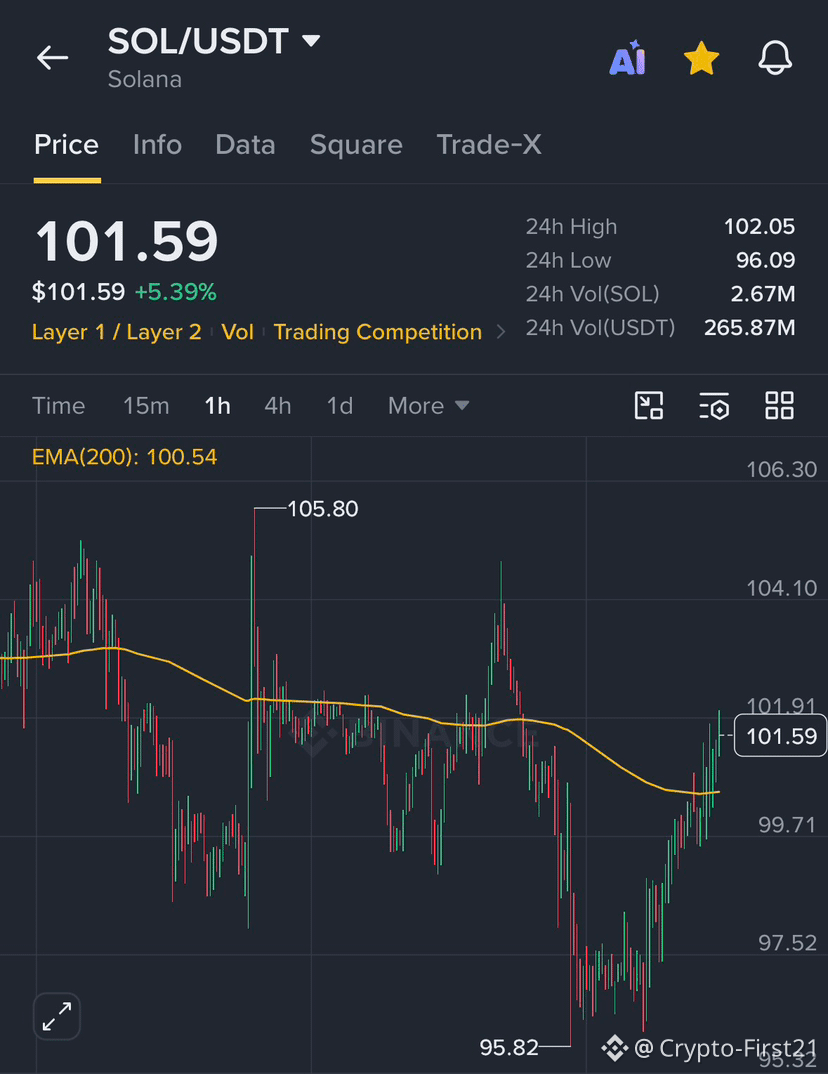
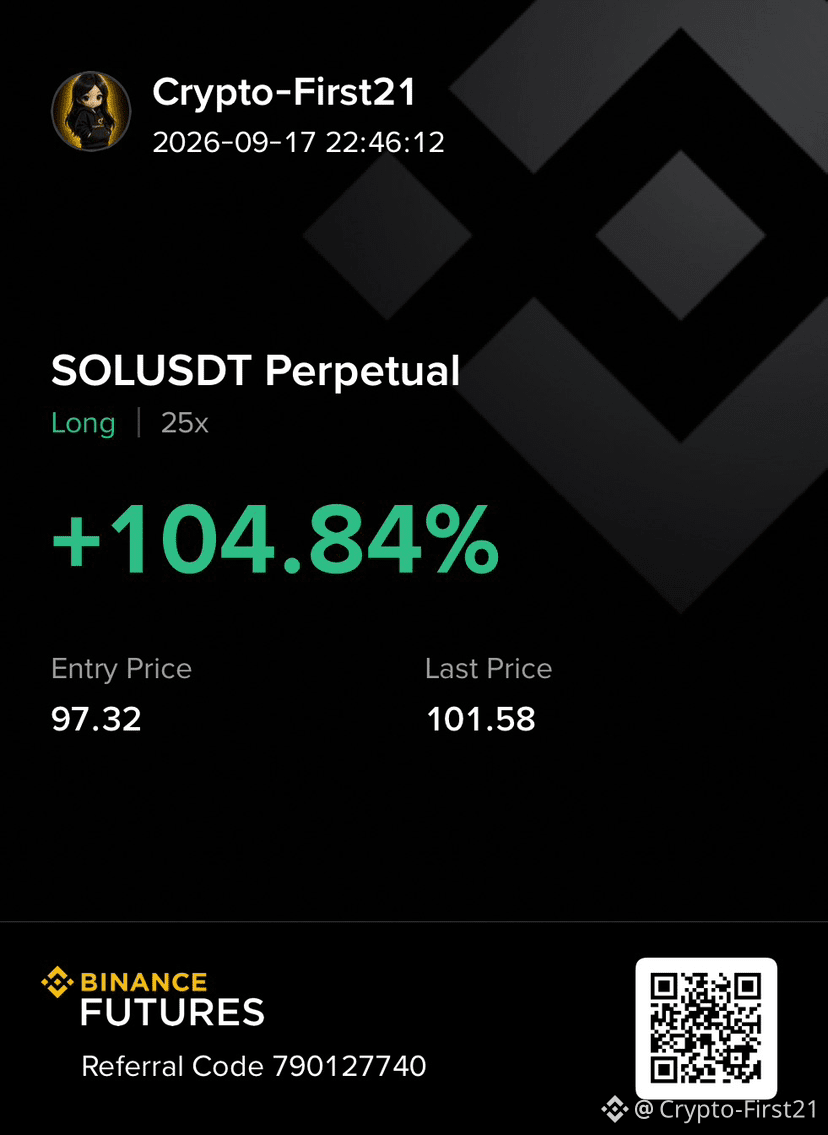
$SOL is finally showing some life, but it cant compete $ONE and $AVA 👀
Hmm..sol took a strong bounce from 95.82. So the Levels I’m watching:
• Support: 100.5 → 99.7
• Resistance: 102 → 104.1 → 105.8
My take is that the Momentum is slowly shifting bullish, but SOL still needs to clear 102 with conviction. If that happens, a move toward 104–106 wouldn’t surprise me.
#cryptofirst21
$SOL is finally showing some life, but it cant compete $ONE and $AVA 👀
Hmm..sol took a strong bounce from 95.82. So the Levels I’m watching:
• Support: 100.5 → 99.7
• Resistance: 102 → 104.1 → 105.8
My take is that the Momentum is slowly shifting bullish, but SOL still needs to clear 102 with conviction. If that happens, a move toward 104–106 wouldn’t surprise me.
#cryptofirst21
Hmm..sol took a strong bounce from 95.82. So the Levels I’m watching:
• Support: 100.5 → 99.7
• Resistance: 102 → 104.1 → 105.8
My take is that the Momentum is slowly shifting bullish, but SOL still needs to clear 102 with conviction. If that happens, a move toward 104–106 wouldn’t surprise me.
#cryptofirst21
4
920
Vérifié
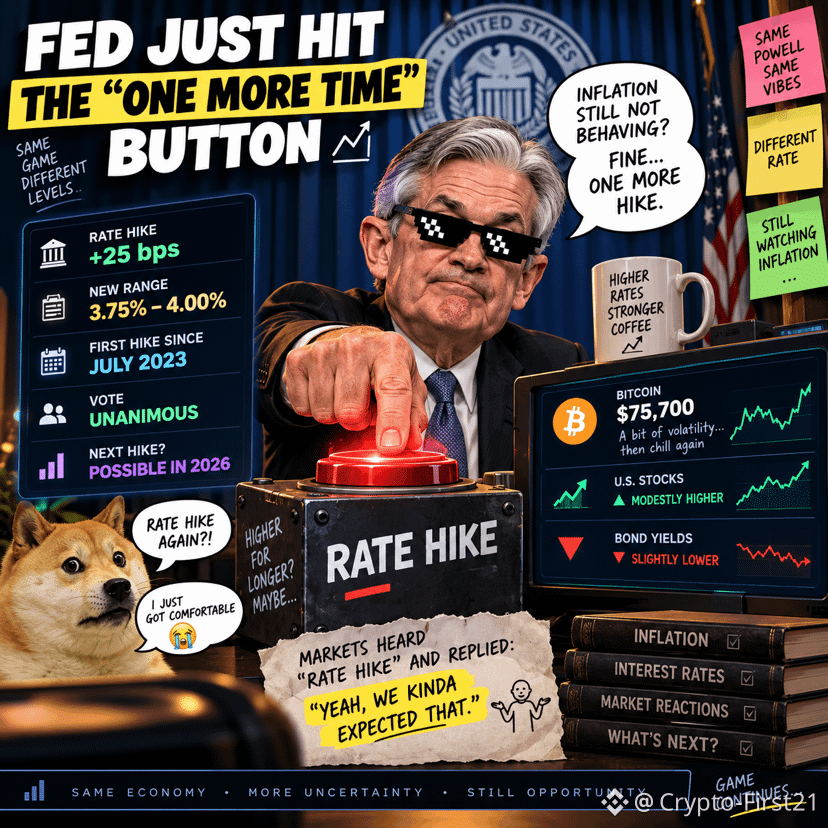
Fed Just Hit the "One More Time" Button 📈😅
Lol… The Fed finally did it.🙈
After more than 3 years of sitting on the sidelines, it raised interest rates by 25 basis points, pushing the benchmark rate to 3.75%–4.00%.
The move was about as surprising as seeing traders post "last chance to buy under $80k" for the 47th time this year. 😭
Even better, the Fed's latest projections hint that another hike could still be on the menu in 2026.
Bitcoin did its usual routine, a quick panic, a quick recovery, and then pretending nothing happened. 👀
Meanwhile, stocks stayed green and bond yields dipped slightly.
But what about $SYN and $LSK
Translation: the market heard "rate hike" and replied, "yeah, we kinda expected that."
Inflation is still the Fed's main boss battle, and apparently the game isn't over yet.
#cryptofirst21
Fed Just Hit the "One More Time" Button 📈😅
Lol… The Fed finally did it.🙈
After more than 3 years of sitting on the sidelines, it raised interest rates by 25 basis points, pushing the benchmark rate to 3.75%–4.00%.
The move was about as surprising as seeing traders post "last chance to buy under $80k" for the 47th time this year. 😭
Even better, the Fed's latest projections hint that another hike could still be on the menu in 2026.
Bitcoin did its usual routine, a quick panic, a quick recovery, and then pretending nothing happened. 👀
Meanwhile, stocks stayed green and bond yields dipped slightly.
But what about $SYN and $LSK
Translation: the market heard "rate hike" and replied, "yeah, we kinda expected that."
Inflation is still the Fed's main boss battle, and apparently the game isn't over yet.
#cryptofirst21
Lol… The Fed finally did it.🙈
After more than 3 years of sitting on the sidelines, it raised interest rates by 25 basis points, pushing the benchmark rate to 3.75%–4.00%.
The move was about as surprising as seeing traders post "last chance to buy under $80k" for the 47th time this year. 😭
Even better, the Fed's latest projections hint that another hike could still be on the menu in 2026.
Bitcoin did its usual routine, a quick panic, a quick recovery, and then pretending nothing happened. 👀
Meanwhile, stocks stayed green and bond yields dipped slightly.
But what about $SYN and $LSK
Translation: the market heard "rate hike" and replied, "yeah, we kinda expected that."
Inflation is still the Fed's main boss battle, and apparently the game isn't over yet.
#cryptofirst21
15
4.8k
Vérifié
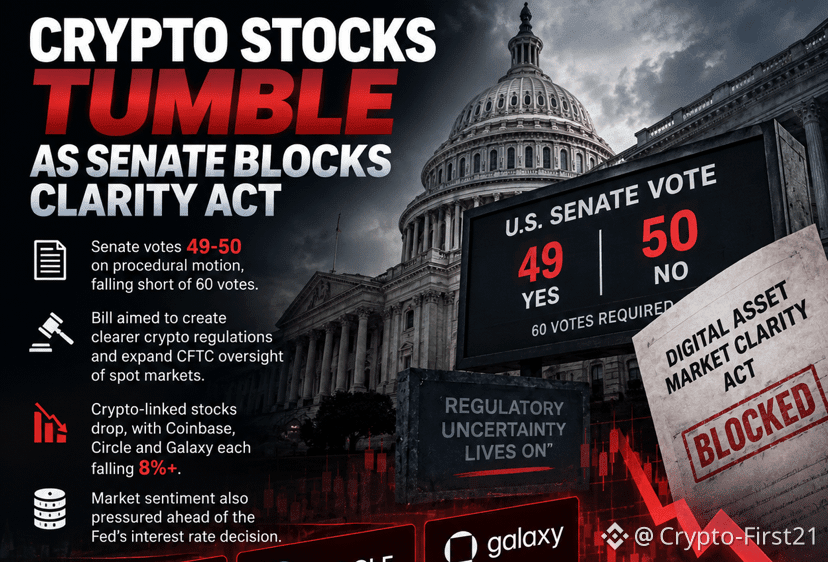
Crypto Stocks Tumble as Senate Blocks Clarity Act
What just happened? 😱
Crypto linked stocks dropped sharply after the U.S. Senate failed to advance the Digital Asset Market Clarity Act in a 49-50 vote, falling short of the 60 votes required.
So…… The bill aimed to create clearer crypto regulations and expand CFTC oversight of spot markets. Following the setback, shares saw heavy selling as regulatory uncertainty returned to focus.
With the Fed decision also approaching, investors moved into risk off mode, adding further pressure across crypto related markets. 📉 still $AIN and $AKE Market is in full boom !!
#BessentEndorsesFinalClarityActDraft
Crypto Stocks Tumble as Senate Blocks Clarity Act
What just happened? 😱
Crypto linked stocks dropped sharply after the U.S. Senate failed to advance the Digital Asset Market Clarity Act in a 49-50 vote, falling short of the 60 votes required.
So…… The bill aimed to create clearer crypto regulations and expand CFTC oversight of spot markets. Following the setback, shares saw heavy selling as regulatory uncertainty returned to focus.
With the Fed decision also approaching, investors moved into risk off mode, adding further pressure across crypto related markets. 📉 still $AIN and $AKE Market is in full boom !!
#BessentEndorsesFinalClarityActDraft
What just happened? 😱
Crypto linked stocks dropped sharply after the U.S. Senate failed to advance the Digital Asset Market Clarity Act in a 49-50 vote, falling short of the 60 votes required.
So…… The bill aimed to create clearer crypto regulations and expand CFTC oversight of spot markets. Following the setback, shares saw heavy selling as regulatory uncertainty returned to focus.
With the Fed decision also approaching, investors moved into risk off mode, adding further pressure across crypto related markets. 📉 still $AIN and $AKE Market is in full boom !!
#BessentEndorsesFinalClarityActDraft
3
18
10k
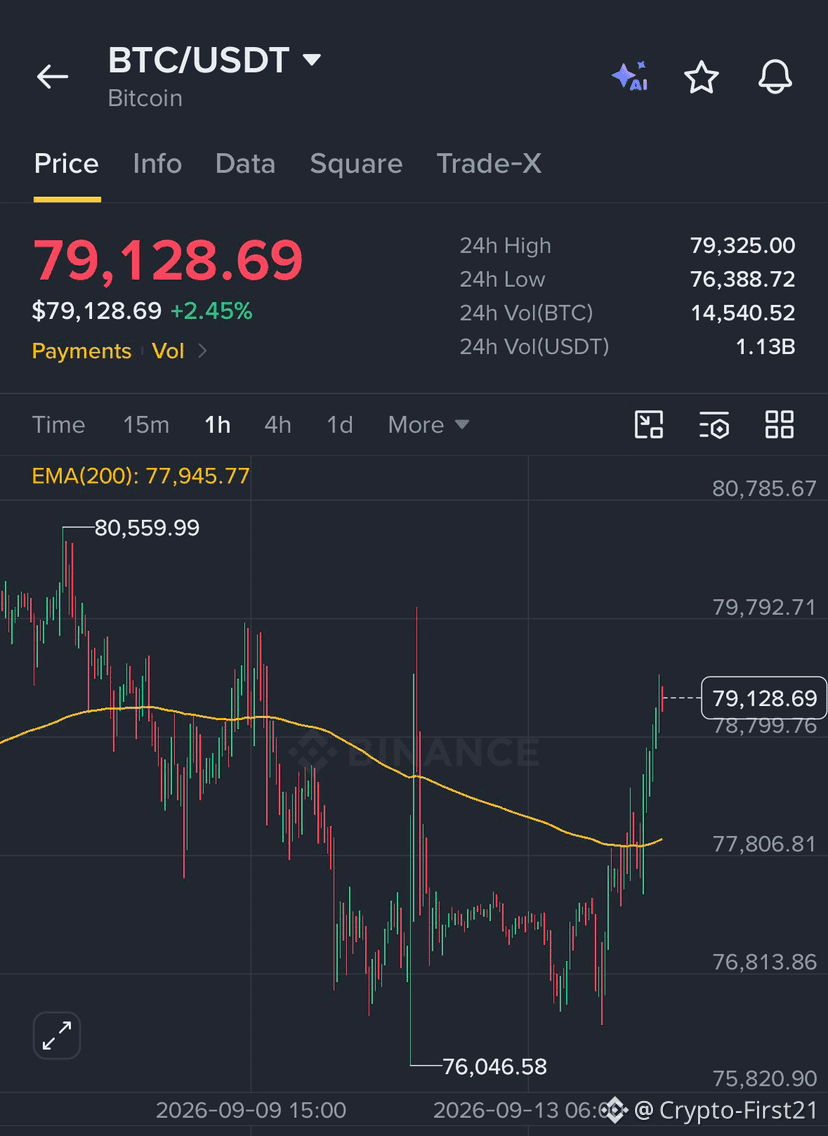
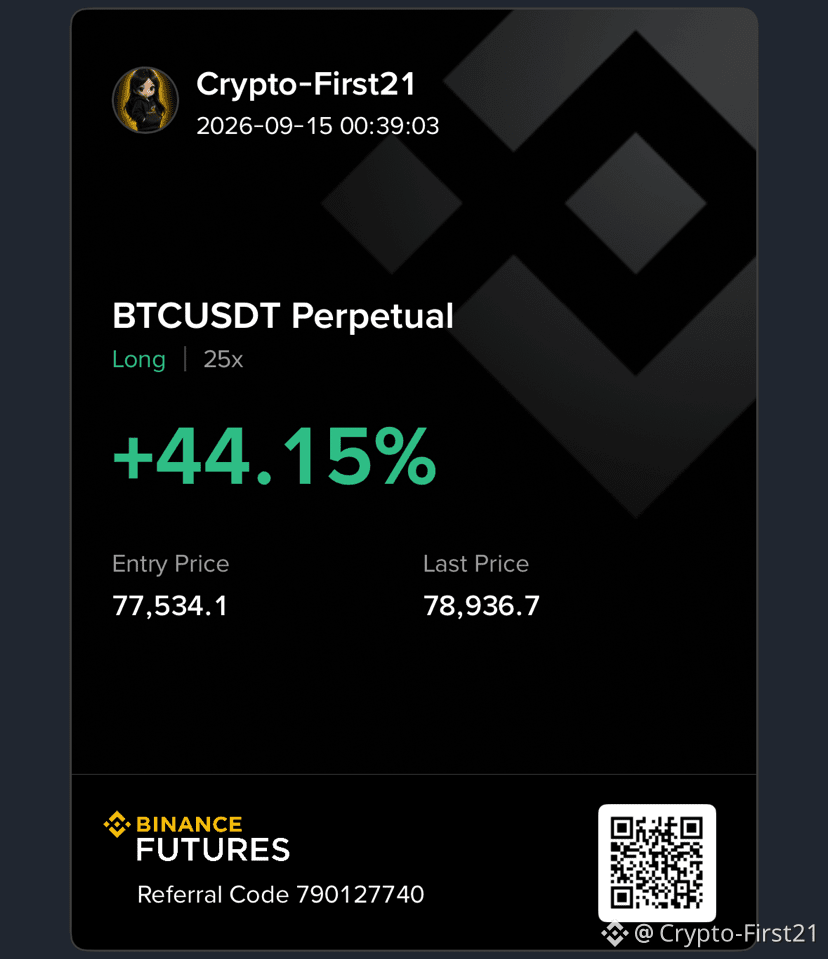
Hmm… finally take a long not on $AIN BUT on $BTC .
It works.
No liquidation.
No stop hunt.
No emotional damage.
green candles 🤝📈
+44% and still refusing to close because greed has entered the chat. 🚀
#cryptofirst21 #BitcoinHoldsAbove$77000
Hmm… finally take a long not on $AIN BUT on $BTC .
It works.
No liquidation.
No stop hunt.
No emotional damage.
green candles 🤝📈
+44% and still refusing to close because greed has entered the chat. 🚀
#cryptofirst21 #BitcoinHoldsAbove$77000
It works.
No liquidation.
No stop hunt.
No emotional damage.
green candles 🤝📈
+44% and still refusing to close because greed has entered the chat. 🚀
#cryptofirst21 #BitcoinHoldsAbove$77000
2
5
1k
Oh my … LSK didn't just join the party, it bought the whole venue. 🤯
$LSK exploded +276.71%, leaving the rest of the gainers fighting for second place.
LSK is running a marathon while everyone else is still tying their shoes. 😆
#cryptofirst21
Oh my … LSK didn't just join the party, it bought the whole venue. 🤯
$LSK exploded +276.71%, leaving the rest of the gainers fighting for second place.
LSK is running a marathon while everyone else is still tying their shoes. 😆
#cryptofirst21
$LSK exploded +276.71%, leaving the rest of the gainers fighting for second place.
LSK is running a marathon while everyone else is still tying their shoes. 😆
#cryptofirst21
2
9
2.3k
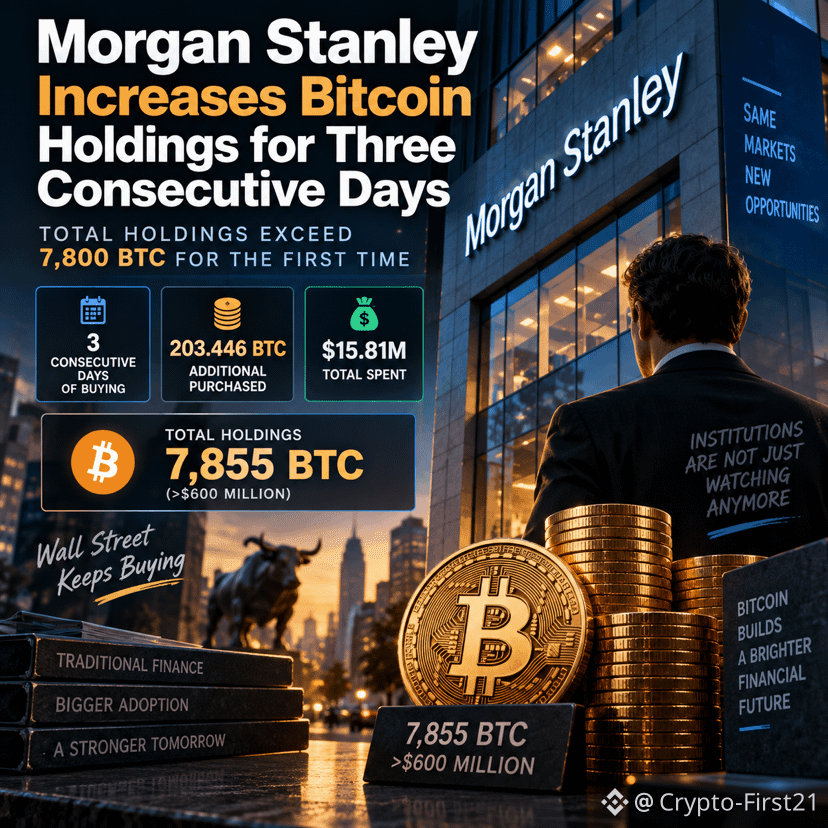
Wall Street Just Crossed a New Bitcoin Milestone 🚀
Morgan Stanley has been quietly stacking Bitcoin for three straight days.
The banking giant purchased an additional 203.446 BTC through its spot Bitcoin ETF (MSBT), spending roughly $15.81 million in the process.
The latest buys pushed Morgan Stanley's total Bitcoin holdings above 7,800 BTC for the first time, reaching 7,855 $BTC , worth more than $600 million at current prices.
While many institutions are still debating Bitcoin exposure, Morgan Stanley appears to be doing what Wall Street does best: accumulating.
Three consecutive days of buying.
7,855 BTC on the books.
$600M+ in Bitcoin.
The suits keep buying while the market keeps watching. 👀₿📈
$LSK #cryptofirst21
Wall Street Just Crossed a New Bitcoin Milestone 🚀
Morgan Stanley has been quietly stacking Bitcoin for three straight days.
The banking giant purchased an additional 203.446 BTC through its spot Bitcoin ETF (MSBT), spending roughly $15.81 million in the process.
The latest buys pushed Morgan Stanley's total Bitcoin holdings above 7,800 BTC for the first time, reaching 7,855 $BTC , worth more than $600 million at current prices.
While many institutions are still debating Bitcoin exposure, Morgan Stanley appears to be doing what Wall Street does best: accumulating.
Three consecutive days of buying.
7,855 BTC on the books.
$600M+ in Bitcoin.
The suits keep buying while the market keeps watching. 👀₿📈
$LSK #cryptofirst21
Morgan Stanley has been quietly stacking Bitcoin for three straight days.
The banking giant purchased an additional 203.446 BTC through its spot Bitcoin ETF (MSBT), spending roughly $15.81 million in the process.
The latest buys pushed Morgan Stanley's total Bitcoin holdings above 7,800 BTC for the first time, reaching 7,855 $BTC , worth more than $600 million at current prices.
While many institutions are still debating Bitcoin exposure, Morgan Stanley appears to be doing what Wall Street does best: accumulating.
Three consecutive days of buying.
7,855 BTC on the books.
$600M+ in Bitcoin.
The suits keep buying while the market keeps watching. 👀₿📈
$LSK #cryptofirst21
5
514
while everyone is busy 👀 watching majors, these are quietly printing:
$MET +25.69%
$TFUEL +24.28%
$牛来 +20.56%
the gainers tab never sleeps 🔥
which one are you watching ?
#cryptofirst21
while everyone is busy 👀 watching majors, these are quietly printing:
$MET +25.69%
$TFUEL +24.28%
$牛来 +20.56%
the gainers tab never sleeps 🔥
which one are you watching ?
#cryptofirst21
$MET +25.69%
$TFUEL +24.28%
$牛来 +20.56%
the gainers tab never sleeps 🔥
which one are you watching ?
#cryptofirst21
MET
19%
TFUEL
5%
牛来
76%
88 Votes • Vote fermé
3
3.6k
Why I'm Cautiously Bullish Ahead of CPI
With nonfarm payrolls beating expectations and inflation data looming, the market's at a crucial crossroads.
Here's my take on what's coming:
Strong jobs numbers suggest the economy's resilience, but that's exactly why CPI matters now. If inflation persists despite a robust job market, the Fed faces pressure to keep rates higher for longer or even hike again. If CPI cools, we might finally see the rate cuts everyone's been anticipating.
My Thesis: Cautiously Bullish
I'm leaning bullish on risk assets ahead of the report. Here's why:
1. Markets are pricing in the downside– Most of the hawkish scenario is already baked into current prices. Any CPI surprise that's even slightly cooler than expectations could trigger a relief rally.
2. Gold as insurance – I'm holding a modest gold position as a hedge. If inflation remains sticky and rates stay elevated, gold provides portfolio protection. If rates fall, gold benefits from the broader market bounce.
3. The Fed's credibility– Powell's been clear about data dependency. A single good CPI print won't reverse their stance, but it opens the door for more measured policy ahead.
The Risk
Hot CPI data = continuation of the rate hold regime and potential weakness in growth stocks. That's why diversification matters.
Trading isn't about being right, it's about being prepared for multiple scenarios. Position accordingly.
What's your read?
#CPIWatch #cryptofirst21
$GAIB $CNPY
Why I'm Cautiously Bullish Ahead of CPI
With nonfarm payrolls beating expectations and inflation data looming, the market's at a crucial crossroads.
Here's my take on what's coming:
Strong jobs numbers suggest the economy's resilience, but that's exactly why CPI matters now. If inflation persists despite a robust job market, the Fed faces pressure to keep rates higher for longer or even hike again. If CPI cools, we might finally see the rate cuts everyone's been anticipating.
My Thesis: Cautiously Bullish
I'm leaning bullish on risk assets ahead of the report. Here's why:
1. Markets are pricing in the downside– Most of the hawkish scenario is already baked into current prices. Any CPI surprise that's even slightly cooler than expectations could trigger a relief rally.
2. Gold as insurance – I'm holding a modest gold position as a hedge. If inflation remains sticky and rates stay elevated, gold provides portfolio protection. If rates fall, gold benefits from the broader market bounce.
3. The Fed's credibility– Powell's been clear about data dependency. A single good CPI print won't reverse their stance, but it opens the door for more measured policy ahead.
The Risk
Hot CPI data = continuation of the rate hold regime and potential weakness in growth stocks. That's why diversification matters.
Trading isn't about being right, it's about being prepared for multiple scenarios. Position accordingly.
What's your read?
#CPIWatch #cryptofirst21
$GAIB $CNPY
With nonfarm payrolls beating expectations and inflation data looming, the market's at a crucial crossroads.
Here's my take on what's coming:
Strong jobs numbers suggest the economy's resilience, but that's exactly why CPI matters now. If inflation persists despite a robust job market, the Fed faces pressure to keep rates higher for longer or even hike again. If CPI cools, we might finally see the rate cuts everyone's been anticipating.
My Thesis: Cautiously Bullish
I'm leaning bullish on risk assets ahead of the report. Here's why:
1. Markets are pricing in the downside– Most of the hawkish scenario is already baked into current prices. Any CPI surprise that's even slightly cooler than expectations could trigger a relief rally.
2. Gold as insurance – I'm holding a modest gold position as a hedge. If inflation remains sticky and rates stay elevated, gold provides portfolio protection. If rates fall, gold benefits from the broader market bounce.
3. The Fed's credibility– Powell's been clear about data dependency. A single good CPI print won't reverse their stance, but it opens the door for more measured policy ahead.
The Risk
Hot CPI data = continuation of the rate hold regime and potential weakness in growth stocks. That's why diversification matters.
Trading isn't about being right, it's about being prepared for multiple scenarios. Position accordingly.
What's your read?
#CPIWatch #cryptofirst21
$GAIB $CNPY

1
8
732
The bulls didn't knock today.
They kicked the door open.
🐂 $牛来 +52.33%
⚡ $VTHO +42.66%
🚀 $SAGA +32.70%
If green candles were a sport, these three would be on the podium collecting medals right now. 🏅😆
#cryptofirst21 #AppleDebutsFoldablePhone
The bulls didn't knock today.
They kicked the door open.
🐂 $牛来 +52.33%
⚡ $VTHO +42.66%
🚀 $SAGA +32.70%
If green candles were a sport, these three would be on the podium collecting medals right now. 🏅😆
#cryptofirst21 #AppleDebutsFoldablePhone
They kicked the door open.
🐂 $牛来 +52.33%
⚡ $VTHO +42.66%
🚀 $SAGA +32.70%
If green candles were a sport, these three would be on the podium collecting medals right now. 🏅😆
#cryptofirst21 #AppleDebutsFoldablePhone

7
2.6k
Connectez-vous pour découvrir plus de contenu
Rejoignez la communauté mondiale des adeptes de cryptomonnaies sur Binance Square
⚡️ Suviez les dernières informations importantes sur les cryptomonnaies.
💬 Jugé digne de confiance par la plus grande plateforme d’échange de cryptomonnaies au monde.
👍 Découvrez les connaissances que partagent les créateurs vérifiés.
Adresse e-mail/Nº de téléphone
Sujets d’actualité
BTCFallsBelow$83000
331 vues
36 mentions
🚀 *BTC/USDT — LONG*
💎 75X Cross
📍 *Entry:* 83000 – 82400
🎯 *TP:* 83600 • 84200 • 84800 • 85400
🛑 *SL:* 81388
⚠️ *Risk:* Max 3–5% per trade.
$BTC
jinifer
·2 mentions J’aime
·704 vues
FedProposesPaymentStablecoinRules
7,413 vues
206 mentions
ChinaMayLetAlibabaByteDanceBuyNvidiaChips
10,242 vues
288 mentions