

Coinpedia Fintech News
46.1k Publications

Coinpedia Fintech News
 Binance Square Vérifié
Signaler
Bloquer l’utilisateur
Your Trusted Source of Crypto News & Analysis. Explore Crypto Events, Markets, Companies, Academy & Product Reviews by Experts.
1 Suivis
166.4K+ Abonnés
208.4K+ J’aime
Publications
U.S. Treasury Withdraws Crypto Wallet Rules in Major Self-Custody ShiftThe U.S. Treasury has withdrawn two long-pending proposals covering self-custody crypto wallets and crypto mixing services. The decision ends years of uncertainty that had faced strong opposition from parts of the crypto industry.
This also marks a major change in how U.S. regulators plan to approach digital asset rules under the Trump administration.
Treasury Withdraws Two Crypto Proposals
On October 5, 2026, the Treasury’s Financial Crimes Enforcement Network (FinCEN) announced the withdrawal, saying it would take no further action on the proposals.
The first proposal was introduced in December 2020. It would have required banks and money services businesses to keep records for certain transactions involving unhosted wallets above $3,000 and report transactions above $10,000.
The proposal also required financial institutions to collect and verify information about customers and counterparties involved in certain transactions with private wallets.
Treasury also withdrew a separate proposal covering convertible virtual currency (CVC) mixing services, introduced in 2023 under Section 311 of the USA PATRIOT Act.
That proposal sought to classify transactions involving CVC mixers as a class of primary money laundering concern. It would have required financial institutions to collect and report information linked to transactions involving these privacy-focused services.
Industry Welcomes Treasury Decision
The move has received support from crypto industry groups that had opposed the proposals.
The Digital Chamber said the withdrawal removes regulatory pressure around self-custodial wallets.
FinCEN said the decision fits the administration’s effort to make digital asset regulations “fit-for-purpose.”
The Treasury’s decision now leaves the crypto industry without the two proposed reporting frameworks, while existing AML and financial rules remain in place.
What Happens to Self-Custody Next?
Under the withdrawn proposals, regulated financial institutions would have faced additional requirements when customers moved crypto to private wallets.
With the proposals withdrawn, the reference material states that there is no new federal requirement forcing banks or exchanges to identify the owner of a self-hosted wallet simply because a customer sends funds there.
U.S. Treasury Withdraws Crypto Wallet Rules in Major Self-Custody Shift
The U.S. Treasury has withdrawn two long-pending proposals covering self-custody crypto wallets and crypto mixing services. The decision ends years of uncertainty that had faced strong opposition from parts of the crypto industry.
This also marks a major change in how U.S. regulators plan to approach digital asset rules under the Trump administration.
Treasury Withdraws Two Crypto Proposals
On October 5, 2026, the Treasury’s Financial Crimes Enforcement Network (FinCEN) announced the withdrawal, saying it would take no further action on the proposals.
The first proposal was introduced in December 2020. It would have required banks and money services businesses to keep records for certain transactions involving unhosted wallets above $3,000 and report transactions above $10,000.
The proposal also required financial institutions to collect and verify information about customers and counterparties involved in certain transactions with private wallets.
Treasury also withdrew a separate proposal covering convertible virtual currency (CVC) mixing services, introduced in 2023 under Section 311 of the USA PATRIOT Act.
That proposal sought to classify transactions involving CVC mixers as a class of primary money laundering concern. It would have required financial institutions to collect and report information linked to transactions involving these privacy-focused services.
Industry Welcomes Treasury Decision
The move has received support from crypto industry groups that had opposed the proposals.
The Digital Chamber said the withdrawal removes regulatory pressure around self-custodial wallets.
FinCEN said the decision fits the administration’s effort to make digital asset regulations “fit-for-purpose.”
The Treasury’s decision now leaves the crypto industry without the two proposed reporting frameworks, while existing AML and financial rules remain in place.
What Happens to Self-Custody Next?
Under the withdrawn proposals, regulated financial institutions would have faced additional requirements when customers moved crypto to private wallets.
With the proposals withdrawn, the reference material states that there is no new federal requirement forcing banks or exchanges to identify the owner of a self-hosted wallet simply because a customer sends funds there.
This also marks a major change in how U.S. regulators plan to approach digital asset rules under the Trump administration.
Treasury Withdraws Two Crypto Proposals
On October 5, 2026, the Treasury’s Financial Crimes Enforcement Network (FinCEN) announced the withdrawal, saying it would take no further action on the proposals.
The first proposal was introduced in December 2020. It would have required banks and money services businesses to keep records for certain transactions involving unhosted wallets above $3,000 and report transactions above $10,000.
The proposal also required financial institutions to collect and verify information about customers and counterparties involved in certain transactions with private wallets.
Treasury also withdrew a separate proposal covering convertible virtual currency (CVC) mixing services, introduced in 2023 under Section 311 of the USA PATRIOT Act.
That proposal sought to classify transactions involving CVC mixers as a class of primary money laundering concern. It would have required financial institutions to collect and report information linked to transactions involving these privacy-focused services.
Industry Welcomes Treasury Decision
The move has received support from crypto industry groups that had opposed the proposals.
The Digital Chamber said the withdrawal removes regulatory pressure around self-custodial wallets.
FinCEN said the decision fits the administration’s effort to make digital asset regulations “fit-for-purpose.”
The Treasury’s decision now leaves the crypto industry without the two proposed reporting frameworks, while existing AML and financial rules remain in place.
What Happens to Self-Custody Next?
Under the withdrawn proposals, regulated financial institutions would have faced additional requirements when customers moved crypto to private wallets.
With the proposals withdrawn, the reference material states that there is no new federal requirement forcing banks or exchanges to identify the owner of a self-hosted wallet simply because a customer sends funds there.
4
Bitcoin Treasury Accumulation Hits 3,342 BTC as Liquidity RotatesBitcoin treasury accumulation is still moving higher, with four companies adding a combined 3,342 BTC, which are nearly worth $286.31 million, during the week from September 28 to October 4th. The bigger story though, is where liquidity is moving while corporate balance sheets keep absorbing supply.
Public Treasuries Keep Adding Despite Market Rotation
Michael Saylor’s Strategy has added a stash of 334 BTC, taking its holdings to 848,000BTC. Strive Asset Management made the largest purchase this week at 2,000 BTC, lifting its reserves to 29,462 BTC, when writing.
The two more firms added, one is Metaplanet that has added 1,000 BTC bringing a cumulative count to 44,000 BTC, while Remixpoint added 8 BTC to reach 1,509 BTC’s. Together, the tracked public treasuries now hold 922,971 BTC in total which are valued to $79.07 billion from current exchange price of BTC. That’s a sizable concentration of corporate exposure that has been witnessed this week, per the data from LookOnChain on X.
Stablecoin Capital Is Leaving Ethereum Mainnet
Meanwhile, stablecoin liquidity is telling a different story. As the data suggests, the Global net stablecoin supply has expanded by $715.8 million, yet Ethereum recorded $974 million in net outflows.
But, Solana absorbed $371 million, while Tron took in $215 million. Base added $70.6 million, followed by Arc at $54.2 million and Arbitrum at $41.7 million. The observation shows that rotation doesn’t exactly scream broad-based risk appetite.
DEX Volumes Slide While Perps Stay Dominant
Moreover, the data indicates further details like the DEX spot volume has taken a toll as it fell 3.92% week over week to $59.24 billion, while perpetual volume fell 9.85% to $138.12 billion.
Hyperliquid remained the largest decentralized perpetual venue with $41.53 billion despite a 24.31% decline. Variational, Lighter and Aster also posted weekly contractions. GMX was the obvious outlier, surging 243.76% to $8.22 billion.
For now, Bitcoin treasury accumulation remains strong even as stablecoin capital rotates across chains and decentralized derivatives activity loses momentum.
Bitcoin Treasury Accumulation Hits 3,342 BTC as Liquidity Rotates
Bitcoin treasury accumulation is still moving higher, with four companies adding a combined 3,342 BTC, which are nearly worth $286.31 million, during the week from September 28 to October 4th. The bigger story though, is where liquidity is moving while corporate balance sheets keep absorbing supply.
Public Treasuries Keep Adding Despite Market Rotation
Michael Saylor’s Strategy has added a stash of 334 BTC, taking its holdings to 848,000BTC. Strive Asset Management made the largest purchase this week at 2,000 BTC, lifting its reserves to 29,462 BTC, when writing.
The two more firms added, one is Metaplanet that has added 1,000 BTC bringing a cumulative count to 44,000 BTC, while Remixpoint added 8 BTC to reach 1,509 BTC’s. Together, the tracked public treasuries now hold 922,971 BTC in total which are valued to $79.07 billion from current exchange price of BTC. That’s a sizable concentration of corporate exposure that has been witnessed this week, per the data from LookOnChain on X.
Stablecoin Capital Is Leaving Ethereum Mainnet
Meanwhile, stablecoin liquidity is telling a different story. As the data suggests, the Global net stablecoin supply has expanded by $715.8 million, yet Ethereum recorded $974 million in net outflows.
But, Solana absorbed $371 million, while Tron took in $215 million. Base added $70.6 million, followed by Arc at $54.2 million and Arbitrum at $41.7 million. The observation shows that rotation doesn’t exactly scream broad-based risk appetite.
DEX Volumes Slide While Perps Stay Dominant
Moreover, the data indicates further details like the DEX spot volume has taken a toll as it fell 3.92% week over week to $59.24 billion, while perpetual volume fell 9.85% to $138.12 billion.
Hyperliquid remained the largest decentralized perpetual venue with $41.53 billion despite a 24.31% decline. Variational, Lighter and Aster also posted weekly contractions. GMX was the obvious outlier, surging 243.76% to $8.22 billion.
For now, Bitcoin treasury accumulation remains strong even as stablecoin capital rotates across chains and decentralized derivatives activity loses momentum.
Public Treasuries Keep Adding Despite Market Rotation
Michael Saylor’s Strategy has added a stash of 334 BTC, taking its holdings to 848,000BTC. Strive Asset Management made the largest purchase this week at 2,000 BTC, lifting its reserves to 29,462 BTC, when writing.
The two more firms added, one is Metaplanet that has added 1,000 BTC bringing a cumulative count to 44,000 BTC, while Remixpoint added 8 BTC to reach 1,509 BTC’s. Together, the tracked public treasuries now hold 922,971 BTC in total which are valued to $79.07 billion from current exchange price of BTC. That’s a sizable concentration of corporate exposure that has been witnessed this week, per the data from LookOnChain on X.
Stablecoin Capital Is Leaving Ethereum Mainnet
Meanwhile, stablecoin liquidity is telling a different story. As the data suggests, the Global net stablecoin supply has expanded by $715.8 million, yet Ethereum recorded $974 million in net outflows.
But, Solana absorbed $371 million, while Tron took in $215 million. Base added $70.6 million, followed by Arc at $54.2 million and Arbitrum at $41.7 million. The observation shows that rotation doesn’t exactly scream broad-based risk appetite.
DEX Volumes Slide While Perps Stay Dominant
Moreover, the data indicates further details like the DEX spot volume has taken a toll as it fell 3.92% week over week to $59.24 billion, while perpetual volume fell 9.85% to $138.12 billion.
Hyperliquid remained the largest decentralized perpetual venue with $41.53 billion despite a 24.31% decline. Variational, Lighter and Aster also posted weekly contractions. GMX was the obvious outlier, surging 243.76% to $8.22 billion.
For now, Bitcoin treasury accumulation remains strong even as stablecoin capital rotates across chains and decentralized derivatives activity loses momentum.
1
97
Tom Lee Says Crypto’s Rally Is Signal: Fed Will Ease And Democrats Will Back CLARITY Act After Mi...Fundstrat’s Tom Lee says crypto is telling investors something the wider market has missed. Speaking on CNBC, he argued that digital assets and tech stocks could not be rising if tighter money was really on the way, and predicted that Democrats will swing behind the CLARITY Act once the midterms are over.
Why crypto’s strength matters
Lee said markets had been bracing for a “maximum hawkish” Federal Reserve. Traders had priced in three rate hikes, including a 75% chance of one in October.
Last week’s softer jobs report changed that picture, in his view. He pointed to tech stocks at new highs and crypto “doing so well” as evidence. These assets “can’t do well in the face of tightening monetary conditions,” Lee said, so they are anticipating easier financial conditions ahead.
His contrarian call on the CLARITY Act
Lee said AI stocks and crypto stalled ahead of the midterms because investors assumed Democrats oppose both data centres and the CLARITY Act. He takes the opposite view and expects Democrats to start supporting both after the vote.
The crypto market structure bill failed a Senate procedural vote 49 to 50 on September 15, well short of the 60 votes it needed. Lee’s forecast suggests that setback may not be final.
Midterms as a turning point
With the midterms about four weeks away, Lee called the vote a “clearing event” and a likely risk-on signal “regardless of outcome.” A Congress controlled by Democrats would mean gridlock, he said, and markets like gridlock.
Inflation, yields and the Fed
Lee expects softer inflation readings over the next six months as one-off pressures fade, with the next report due in two weeks. That would let the Fed step back from its hawkish stance and allow bond yields to settle.
He said the 10-year Treasury yield stood at 4.75% before the Jackson Hole meeting. Anything under 5% would be read as positive for risk assets, he said, and he sees a good chance of that within six months.
S&P 500 target: up to 8,400
The S&P 500 closed back above 7,700 on Friday. Lee sees as much as 9% further upside this year, which points to 8,200 to 8,400. His reasons:
Earnings are accelerating: Third-quarter profit growth is likely to come in near 30%.
Stocks have become cheaper: Estimates for 2027 earnings have risen more than 20% this year, while the index has gained less than that.
Oil is helping: High oil prices strengthen the US economy because the country is an exporter.
The risk he still sees
Lee has not ruled out a pullback. He said a “speed bump” could come between mid-October and the midterms. But with sentiment already negative and investors cautious, he is reluctant to call it with confidence.
Tom Lee Says Crypto’s Rally Is Signal: Fed Will Ease And Democrats Will Back CLARITY Act After Mi...
Fundstrat’s Tom Lee says crypto is telling investors something the wider market has missed. Speaking on CNBC, he argued that digital assets and tech stocks could not be rising if tighter money was really on the way, and predicted that Democrats will swing behind the CLARITY Act once the midterms are over.
Why crypto’s strength matters
Lee said markets had been bracing for a “maximum hawkish” Federal Reserve. Traders had priced in three rate hikes, including a 75% chance of one in October.
Last week’s softer jobs report changed that picture, in his view. He pointed to tech stocks at new highs and crypto “doing so well” as evidence. These assets “can’t do well in the face of tightening monetary conditions,” Lee said, so they are anticipating easier financial conditions ahead.
His contrarian call on the CLARITY Act
Lee said AI stocks and crypto stalled ahead of the midterms because investors assumed Democrats oppose both data centres and the CLARITY Act. He takes the opposite view and expects Democrats to start supporting both after the vote.
The crypto market structure bill failed a Senate procedural vote 49 to 50 on September 15, well short of the 60 votes it needed. Lee’s forecast suggests that setback may not be final.
Midterms as a turning point
With the midterms about four weeks away, Lee called the vote a “clearing event” and a likely risk-on signal “regardless of outcome.” A Congress controlled by Democrats would mean gridlock, he said, and markets like gridlock.
Inflation, yields and the Fed
Lee expects softer inflation readings over the next six months as one-off pressures fade, with the next report due in two weeks. That would let the Fed step back from its hawkish stance and allow bond yields to settle.
He said the 10-year Treasury yield stood at 4.75% before the Jackson Hole meeting. Anything under 5% would be read as positive for risk assets, he said, and he sees a good chance of that within six months.
S&P 500 target: up to 8,400
The S&P 500 closed back above 7,700 on Friday. Lee sees as much as 9% further upside this year, which points to 8,200 to 8,400. His reasons:
Earnings are accelerating: Third-quarter profit growth is likely to come in near 30%.
Stocks have become cheaper: Estimates for 2027 earnings have risen more than 20% this year, while the index has gained less than that.
Oil is helping: High oil prices strengthen the US economy because the country is an exporter.
The risk he still sees
Lee has not ruled out a pullback. He said a “speed bump” could come between mid-October and the midterms. But with sentiment already negative and investors cautious, he is reluctant to call it with confidence.
Why crypto’s strength matters
Lee said markets had been bracing for a “maximum hawkish” Federal Reserve. Traders had priced in three rate hikes, including a 75% chance of one in October.
Last week’s softer jobs report changed that picture, in his view. He pointed to tech stocks at new highs and crypto “doing so well” as evidence. These assets “can’t do well in the face of tightening monetary conditions,” Lee said, so they are anticipating easier financial conditions ahead.
His contrarian call on the CLARITY Act
Lee said AI stocks and crypto stalled ahead of the midterms because investors assumed Democrats oppose both data centres and the CLARITY Act. He takes the opposite view and expects Democrats to start supporting both after the vote.
The crypto market structure bill failed a Senate procedural vote 49 to 50 on September 15, well short of the 60 votes it needed. Lee’s forecast suggests that setback may not be final.
Midterms as a turning point
With the midterms about four weeks away, Lee called the vote a “clearing event” and a likely risk-on signal “regardless of outcome.” A Congress controlled by Democrats would mean gridlock, he said, and markets like gridlock.
Inflation, yields and the Fed
Lee expects softer inflation readings over the next six months as one-off pressures fade, with the next report due in two weeks. That would let the Fed step back from its hawkish stance and allow bond yields to settle.
He said the 10-year Treasury yield stood at 4.75% before the Jackson Hole meeting. Anything under 5% would be read as positive for risk assets, he said, and he sees a good chance of that within six months.
S&P 500 target: up to 8,400
The S&P 500 closed back above 7,700 on Friday. Lee sees as much as 9% further upside this year, which points to 8,200 to 8,400. His reasons:
Earnings are accelerating: Third-quarter profit growth is likely to come in near 30%.
Stocks have become cheaper: Estimates for 2027 earnings have risen more than 20% this year, while the index has gained less than that.
Oil is helping: High oil prices strengthen the US economy because the country is an exporter.
The risk he still sees
Lee has not ruled out a pullback. He said a “speed bump” could come between mid-October and the midterms. But with sentiment already negative and investors cautious, he is reluctant to call it with confidence.
48
3 Altcoins Ready to Break Out This Week – XRP, Quant (QNT) & Injective (INJ)The altcoin market is showing signs of renewed momentum, with XRP, Quant (QNT), and Injective (INJ) emerging as the three names to watch this week. Each token has a different setup, but all three are trading near key technical levels that could determine whether the next move turns into a breakout. XRP price is consolidating below a major resistance zone; QNT price is cooling after a sharp rally, while INJ price is building a higher-low structure.
With technical momentum and fresh catalysts supporting all three, the question is which altcoin has the strongest setup for a breakout this week.
XRP Price Analysis – Can XRP Break Above $1.60?
The XRP price is holding near $1.51 after weeks of consolidation, with buyers defending the $1.50 range. It continues to trade above a rising trendline, keeping the broader structure constructive; however, the $1.55 to $1.60 zone remains the key hurdle for the bulls. A breakout above $1.60 could open the way toward the $1.70 range, which is the next major resistance.
The chart shows that momentum is still building rather than fully taking over. RSI is around 57, while CMF is close to neutral at -0.01, suggesting buying pressure is yet to strengthen significantly. For XRP to confirm a breakout, bulls will need to push through $1.60 with stronger volume. Until then, XRP remains in consolidation, with the rising trendline providing major support.
Quant Price Analysis: Can Quant Break Higher After the Rally?
Quant has already delivered one of the strongest rallies among major altcoins, climbing sharply from below $100 before settling around $258. After the explosive move, the token is now consolidating near the $250 to $260 range. The daily chart shows buyers still defending the higher levels, with the next major hurdle sitting around $270 to $275.
The rising OBV also supports the breakout case, showing that buying interest is continuing to build even as the price moves sideways. Besides, the Supertrend has just flipped bullish, giving the current setup a fresh positive signal. If the QNT price can break and hold above $275, the next major target could be around $300 and beyond. However, after such a strong rally, volatility remains high, and holding above $250 would keep the bullish setup intact.
Injective Price Analysis: Can INJ Reach $10?
Injective price is building a steady recovery after finding support near the $7 range, with the daily chart showing a series of higher lows. The price is now trading around $7.56 and approaching the $8 resistance level. A sustained move above $8 would strengthen the bullish structure and bring the $8.75 and $9.80 levels into focus.
The RSI is rising along with OBV, suggesting buying interest is gradually returning rather than the move being driven by a single price spike. If INJ price clears $8 and holds above it, the next major target could be around $9.80, followed by the psychological $10 level. However, failure to break resistance could keep INJ within its current rising structure for longer.
Wrapping it Up- What’s Next for XRP, QNT & INJ Price Rally?
Among these three popular altcoins, the QNT price has the strongest momentum. Its sharp rally, bullish Supertrend flip and rising OBV suggest buyers are still active, while the price is consolidating just below the next resistance zone. Besides, Injective price offers a clear and more gradual breakout structure with higher lows, rising OBV and improving RSI. XRP, meanwhile, has a solid rising structure but needs to clear $1.55 to $1.60 and attract stronger buying volume.
Overall, the Quant price has the strongest momentum, the Injective price has the cleanest risk-reward setup, and the XRP price has the clearest breakout trigger.
3 Altcoins Ready to Break Out This Week – XRP, Quant (QNT) & Injective (INJ)
The altcoin market is showing signs of renewed momentum, with XRP, Quant (QNT), and Injective (INJ) emerging as the three names to watch this week. Each token has a different setup, but all three are trading near key technical levels that could determine whether the next move turns into a breakout. XRP price is consolidating below a major resistance zone; QNT price is cooling after a sharp rally, while INJ price is building a higher-low structure.
With technical momentum and fresh catalysts supporting all three, the question is which altcoin has the strongest setup for a breakout this week.
XRP Price Analysis – Can XRP Break Above $1.60?
The XRP price is holding near $1.51 after weeks of consolidation, with buyers defending the $1.50 range. It continues to trade above a rising trendline, keeping the broader structure constructive; however, the $1.55 to $1.60 zone remains the key hurdle for the bulls. A breakout above $1.60 could open the way toward the $1.70 range, which is the next major resistance.
The chart shows that momentum is still building rather than fully taking over. RSI is around 57, while CMF is close to neutral at -0.01, suggesting buying pressure is yet to strengthen significantly. For XRP to confirm a breakout, bulls will need to push through $1.60 with stronger volume. Until then, XRP remains in consolidation, with the rising trendline providing major support.
Quant Price Analysis: Can Quant Break Higher After the Rally?
Quant has already delivered one of the strongest rallies among major altcoins, climbing sharply from below $100 before settling around $258. After the explosive move, the token is now consolidating near the $250 to $260 range. The daily chart shows buyers still defending the higher levels, with the next major hurdle sitting around $270 to $275.
The rising OBV also supports the breakout case, showing that buying interest is continuing to build even as the price moves sideways. Besides, the Supertrend has just flipped bullish, giving the current setup a fresh positive signal. If the QNT price can break and hold above $275, the next major target could be around $300 and beyond. However, after such a strong rally, volatility remains high, and holding above $250 would keep the bullish setup intact.
Injective Price Analysis: Can INJ Reach $10?
Injective price is building a steady recovery after finding support near the $7 range, with the daily chart showing a series of higher lows. The price is now trading around $7.56 and approaching the $8 resistance level. A sustained move above $8 would strengthen the bullish structure and bring the $8.75 and $9.80 levels into focus.
The RSI is rising along with OBV, suggesting buying interest is gradually returning rather than the move being driven by a single price spike. If INJ price clears $8 and holds above it, the next major target could be around $9.80, followed by the psychological $10 level. However, failure to break resistance could keep INJ within its current rising structure for longer.
Wrapping it Up- What’s Next for XRP, QNT & INJ Price Rally?
Among these three popular altcoins, the QNT price has the strongest momentum. Its sharp rally, bullish Supertrend flip and rising OBV suggest buyers are still active, while the price is consolidating just below the next resistance zone. Besides, Injective price offers a clear and more gradual breakout structure with higher lows, rising OBV and improving RSI. XRP, meanwhile, has a solid rising structure but needs to clear $1.55 to $1.60 and attract stronger buying volume.
Overall, the Quant price has the strongest momentum, the Injective price has the cleanest risk-reward setup, and the XRP price has the clearest breakout trigger.
With technical momentum and fresh catalysts supporting all three, the question is which altcoin has the strongest setup for a breakout this week.
XRP Price Analysis – Can XRP Break Above $1.60?
The XRP price is holding near $1.51 after weeks of consolidation, with buyers defending the $1.50 range. It continues to trade above a rising trendline, keeping the broader structure constructive; however, the $1.55 to $1.60 zone remains the key hurdle for the bulls. A breakout above $1.60 could open the way toward the $1.70 range, which is the next major resistance.
The chart shows that momentum is still building rather than fully taking over. RSI is around 57, while CMF is close to neutral at -0.01, suggesting buying pressure is yet to strengthen significantly. For XRP to confirm a breakout, bulls will need to push through $1.60 with stronger volume. Until then, XRP remains in consolidation, with the rising trendline providing major support.
Quant Price Analysis: Can Quant Break Higher After the Rally?
Quant has already delivered one of the strongest rallies among major altcoins, climbing sharply from below $100 before settling around $258. After the explosive move, the token is now consolidating near the $250 to $260 range. The daily chart shows buyers still defending the higher levels, with the next major hurdle sitting around $270 to $275.
The rising OBV also supports the breakout case, showing that buying interest is continuing to build even as the price moves sideways. Besides, the Supertrend has just flipped bullish, giving the current setup a fresh positive signal. If the QNT price can break and hold above $275, the next major target could be around $300 and beyond. However, after such a strong rally, volatility remains high, and holding above $250 would keep the bullish setup intact.
Injective Price Analysis: Can INJ Reach $10?
Injective price is building a steady recovery after finding support near the $7 range, with the daily chart showing a series of higher lows. The price is now trading around $7.56 and approaching the $8 resistance level. A sustained move above $8 would strengthen the bullish structure and bring the $8.75 and $9.80 levels into focus.
The RSI is rising along with OBV, suggesting buying interest is gradually returning rather than the move being driven by a single price spike. If INJ price clears $8 and holds above it, the next major target could be around $9.80, followed by the psychological $10 level. However, failure to break resistance could keep INJ within its current rising structure for longer.
Wrapping it Up- What’s Next for XRP, QNT & INJ Price Rally?
Among these three popular altcoins, the QNT price has the strongest momentum. Its sharp rally, bullish Supertrend flip and rising OBV suggest buyers are still active, while the price is consolidating just below the next resistance zone. Besides, Injective price offers a clear and more gradual breakout structure with higher lows, rising OBV and improving RSI. XRP, meanwhile, has a solid rising structure but needs to clear $1.55 to $1.60 and attract stronger buying volume.
Overall, the Quant price has the strongest momentum, the Injective price has the cleanest risk-reward setup, and the XRP price has the clearest breakout trigger.
191
XRP Price Jumps as Korea Volume Overtakes Bitcoin – Is $2 Next?XRP price has jumped over 1.5% to near $1.51 in the past 24 hours as trading activity surges in South Korea. Its XRP/KRW pair on Upbit recorded $72.3 million in 24-hour volume, beating Bitcoin’s BTC/KRW pair.
Meanwhile, veteran trader Peter Brandt sees a possible cup pattern forming on XRP, pointing to a potential breakout.
XRP/KRW Volume Surges Above Bitcoin in Korea
The sharp rise in Korean trading activity has boosted XRP price up today. On October 5, XRP/KRW recorded $72.3 million in 24-hour volume on Upbit, a South Korean crypto exchange. This was higher than Bitcoin’s $66.4 million, showing strong demand for XRP among Korean traders.
The surge comes as the XRP Asia organization launched during Korea Blockchain Week at the Grand Hyatt. The event may have added to local interest and helped drive trading activity.
XRP ETF Inflows Add More Buying Pressure
The stronger spot activity is also being supported by continued institutional demand through U.S. spot XRP ETFs.
The funds recorded another $4.74 million in weekly net inflows, extending their positive inflow streak to 12 consecutive weeks. Bitwise led the latest inflows with $2.11 million and has now recorded more than $678.4 million in cumulative net inflows.
Peter Brandt Watches XRP for a Breakout
Meanwhile, Veteran trader Peter Brandt’s latest XRP chart shows a possible bullish reversal, with XRP forming an inverse head-and-shoulders pattern around the 1.55 area. The setup is important as XRP is now testing the pattern’s neckline, which could decide its next major move.
pic.twitter.com/UzAK96XjDR
— The Factor Report (@PeterLBrandt) October 5, 2026
The 1.55 zone is the key level. XRP needs to break and hold above this area to confirm the pattern. The setup has a left shoulder, a deeper low forming the head, and a higher right shoulder. A confirmed breakout would signal stronger buying pressure.
Brandt’s chart shows the next major resistance near $1.6572. If XRP breaks above this level, the price could target $1.70, followed by the $2.00 region.
The chart also compares the current setup with XRP’s earlier long-term breakout patterns, including the structures that preceded its major 2017 rally and late-2024 move.
What Could Impact XRP Price in the Coming Days?
A key event for XRP in the coming days will be the expected launch of two XRP Ledger updates. The Batch (V1.1) and Permission Delegation changes are expected to go live around Oct. 8–9, 2026.
These updates could make the network faster and easier to use for large transactions. They may also make the XRP Ledger more useful for banks and other big companies.
XRP Price Jumps as Korea Volume Overtakes Bitcoin – Is $2 Next?
XRP price has jumped over 1.5% to near $1.51 in the past 24 hours as trading activity surges in South Korea. Its XRP/KRW pair on Upbit recorded $72.3 million in 24-hour volume, beating Bitcoin’s BTC/KRW pair.
Meanwhile, veteran trader Peter Brandt sees a possible cup pattern forming on XRP, pointing to a potential breakout.
XRP/KRW Volume Surges Above Bitcoin in Korea
The sharp rise in Korean trading activity has boosted XRP price up today. On October 5, XRP/KRW recorded $72.3 million in 24-hour volume on Upbit, a South Korean crypto exchange. This was higher than Bitcoin’s $66.4 million, showing strong demand for XRP among Korean traders.
The surge comes as the XRP Asia organization launched during Korea Blockchain Week at the Grand Hyatt. The event may have added to local interest and helped drive trading activity.
XRP ETF Inflows Add More Buying Pressure
The stronger spot activity is also being supported by continued institutional demand through U.S. spot XRP ETFs.
The funds recorded another $4.74 million in weekly net inflows, extending their positive inflow streak to 12 consecutive weeks. Bitwise led the latest inflows with $2.11 million and has now recorded more than $678.4 million in cumulative net inflows.
Peter Brandt Watches XRP for a Breakout
Meanwhile, Veteran trader Peter Brandt’s latest XRP chart shows a possible bullish reversal, with XRP forming an inverse head-and-shoulders pattern around the 1.55 area. The setup is important as XRP is now testing the pattern’s neckline, which could decide its next major move.
pic.twitter.com/UzAK96XjDR
— The Factor Report (@PeterLBrandt) October 5, 2026
The 1.55 zone is the key level. XRP needs to break and hold above this area to confirm the pattern. The setup has a left shoulder, a deeper low forming the head, and a higher right shoulder. A confirmed breakout would signal stronger buying pressure.
Brandt’s chart shows the next major resistance near $1.6572. If XRP breaks above this level, the price could target $1.70, followed by the $2.00 region.
The chart also compares the current setup with XRP’s earlier long-term breakout patterns, including the structures that preceded its major 2017 rally and late-2024 move.
What Could Impact XRP Price in the Coming Days?
A key event for XRP in the coming days will be the expected launch of two XRP Ledger updates. The Batch (V1.1) and Permission Delegation changes are expected to go live around Oct. 8–9, 2026.
These updates could make the network faster and easier to use for large transactions. They may also make the XRP Ledger more useful for banks and other big companies.
Meanwhile, veteran trader Peter Brandt sees a possible cup pattern forming on XRP, pointing to a potential breakout.
XRP/KRW Volume Surges Above Bitcoin in Korea
The sharp rise in Korean trading activity has boosted XRP price up today. On October 5, XRP/KRW recorded $72.3 million in 24-hour volume on Upbit, a South Korean crypto exchange. This was higher than Bitcoin’s $66.4 million, showing strong demand for XRP among Korean traders.
The surge comes as the XRP Asia organization launched during Korea Blockchain Week at the Grand Hyatt. The event may have added to local interest and helped drive trading activity.
XRP ETF Inflows Add More Buying Pressure
The stronger spot activity is also being supported by continued institutional demand through U.S. spot XRP ETFs.
The funds recorded another $4.74 million in weekly net inflows, extending their positive inflow streak to 12 consecutive weeks. Bitwise led the latest inflows with $2.11 million and has now recorded more than $678.4 million in cumulative net inflows.
Peter Brandt Watches XRP for a Breakout
Meanwhile, Veteran trader Peter Brandt’s latest XRP chart shows a possible bullish reversal, with XRP forming an inverse head-and-shoulders pattern around the 1.55 area. The setup is important as XRP is now testing the pattern’s neckline, which could decide its next major move.
pic.twitter.com/UzAK96XjDR
— The Factor Report (@PeterLBrandt) October 5, 2026
The 1.55 zone is the key level. XRP needs to break and hold above this area to confirm the pattern. The setup has a left shoulder, a deeper low forming the head, and a higher right shoulder. A confirmed breakout would signal stronger buying pressure.
Brandt’s chart shows the next major resistance near $1.6572. If XRP breaks above this level, the price could target $1.70, followed by the $2.00 region.
The chart also compares the current setup with XRP’s earlier long-term breakout patterns, including the structures that preceded its major 2017 rally and late-2024 move.
What Could Impact XRP Price in the Coming Days?
A key event for XRP in the coming days will be the expected launch of two XRP Ledger updates. The Batch (V1.1) and Permission Delegation changes are expected to go live around Oct. 8–9, 2026.
These updates could make the network faster and easier to use for large transactions. They may also make the XRP Ledger more useful for banks and other big companies.
172
Can SpaceX Price Rally Extends: Morgan Stanley’s Sees $300 TargetSpaceX stock is back on investors’ radar after a sharp 7% rally pushed SPCX stock toward $160, putting a key breakout level within reach. The move comes as Morgan Stanley maintains a $300 price target, while Starship milestones and expanding AI-computing operations strengthen the long-term growth case. But the stock now faces a critical technical test near $165. A decisive break could signal a broader repricing toward $190, while another rejection would keep SPCX trapped in its recent range.
Why Morgan Stanley Sees SPCX Reaching $300
Morgan Stanley’s $300 price target is the central bullish argument for SpaceX stock, but the thesis goes beyond SpaceX’s rocket business. Analyst Adam Jonas maintains an Overweight rating and argues that SpaceX’s valuation becomes more attractive when adjusted for its expected growth. The firm estimates SpaceX at roughly 30 times 2028 estimated EV/EBIT, compared with about 16 times for other mega-cap AI companies.
$SPCX – MORGAN STANLEY: SPACEX “CHEAP AND GETTING CHEAPER”
Morgan Stanley reiterates Overweight on SpaceX with a $300 price target, arguing the stock looks cheap once its growth profile is considered.
Analyst Adam Jonas says SpaceX trades roughly 40% below mega-cap AI peers on…
— *Walter Bloomberg (@DeItaone) October 5, 2026
On a growth-adjusted EV/EBIT/G basis, however, SpaceX is estimated at around 0.3x, below the roughly 0.5x median for comparable mega-cap companies. That is the core of Morgan Stanley’s argument: SpaceX may look expensive on conventional valuation measures, but its growth profile could justify a higher multiple.
The $300 target therefore depends on SpaceX successfully scaling several businesses at once — AI computing, Starlink and launch infrastructure — rather than simply increasing rocket launches.
SpaceX Price Recovery Puts $170 in the Crosshairs
The latest Spacex price recovery has materially improved the technical structure. After falling to roughly $143.49 on September 15, SPCX recovered above $150 and then accelerated, closing at $158.96 on October 2 after trading as high as $159.84. The next important hurdle is now $165–$170.
A clean move above $165 would take SPCX beyond the immediate resistance area, while a sustained break through $170 would provide stronger confirmation that the recovery has developed into a broader breakout. Above $170, the next upside zone comes around $175–$190. On the downside, failure to hold the recovery could send the stock back toward $150, with the mid-$140s becoming relevant if that support breaks.
Starship’s Progress Adds Another Catalyst
Starship has also moved from a development story toward a more commercially relevant business. The 14th Starship flight successfully reached orbit and deployed 26 Starlink Version 3 satellites, marking the vehicle’s first orbital and revenue-generating mission. However, an engine issue shortened the flight, leaving further work ahead on reliability and reusability.
The next major test is Flight 15. Morgan Stanley has identified Starship’s development as one of the key catalysts for SPCX, particularly the planned attempt to catch the spacecraft. A successful catch would provide stronger evidence that SpaceX is progressing toward the rapid reusability required for a much higher launch cadence.
What SPCX Needs to Break $170
The next phase of the rally will require confirmation from both price action and business execution. Technically, SpaceX stock needs to clear $165 and then establish a sustained move above $170. That would shift the stock out of its recent recovery range and put $175–$190 into focus.
Fundamentally, investors will be watching:
Starship Flight 15 and progress toward spacecraft reusability
AI-computing capacity and new customer contracts
Starlink growth
Launch frequency and economics
Revenue growth from the broader SpaceX ecosystem
The stronger these catalysts become, the easier it is for investors to justify the premium valuation required for a move toward $300 and beyond.
Can SpaceX Price Rally Extends: Morgan Stanley’s Sees $300 Target
SpaceX stock is back on investors’ radar after a sharp 7% rally pushed SPCX stock toward $160, putting a key breakout level within reach. The move comes as Morgan Stanley maintains a $300 price target, while Starship milestones and expanding AI-computing operations strengthen the long-term growth case. But the stock now faces a critical technical test near $165. A decisive break could signal a broader repricing toward $190, while another rejection would keep SPCX trapped in its recent range.
Why Morgan Stanley Sees SPCX Reaching $300
Morgan Stanley’s $300 price target is the central bullish argument for SpaceX stock, but the thesis goes beyond SpaceX’s rocket business. Analyst Adam Jonas maintains an Overweight rating and argues that SpaceX’s valuation becomes more attractive when adjusted for its expected growth. The firm estimates SpaceX at roughly 30 times 2028 estimated EV/EBIT, compared with about 16 times for other mega-cap AI companies.
$SPCX – MORGAN STANLEY: SPACEX “CHEAP AND GETTING CHEAPER”
Morgan Stanley reiterates Overweight on SpaceX with a $300 price target, arguing the stock looks cheap once its growth profile is considered.
Analyst Adam Jonas says SpaceX trades roughly 40% below mega-cap AI peers on…
— *Walter Bloomberg (@DeItaone) October 5, 2026
On a growth-adjusted EV/EBIT/G basis, however, SpaceX is estimated at around 0.3x, below the roughly 0.5x median for comparable mega-cap companies. That is the core of Morgan Stanley’s argument: SpaceX may look expensive on conventional valuation measures, but its growth profile could justify a higher multiple.
The $300 target therefore depends on SpaceX successfully scaling several businesses at once — AI computing, Starlink and launch infrastructure — rather than simply increasing rocket launches.
SpaceX Price Recovery Puts $170 in the Crosshairs
The latest Spacex price recovery has materially improved the technical structure. After falling to roughly $143.49 on September 15, SPCX recovered above $150 and then accelerated, closing at $158.96 on October 2 after trading as high as $159.84. The next important hurdle is now $165–$170.
A clean move above $165 would take SPCX beyond the immediate resistance area, while a sustained break through $170 would provide stronger confirmation that the recovery has developed into a broader breakout. Above $170, the next upside zone comes around $175–$190. On the downside, failure to hold the recovery could send the stock back toward $150, with the mid-$140s becoming relevant if that support breaks.
Starship’s Progress Adds Another Catalyst
Starship has also moved from a development story toward a more commercially relevant business. The 14th Starship flight successfully reached orbit and deployed 26 Starlink Version 3 satellites, marking the vehicle’s first orbital and revenue-generating mission. However, an engine issue shortened the flight, leaving further work ahead on reliability and reusability.
The next major test is Flight 15. Morgan Stanley has identified Starship’s development as one of the key catalysts for SPCX, particularly the planned attempt to catch the spacecraft. A successful catch would provide stronger evidence that SpaceX is progressing toward the rapid reusability required for a much higher launch cadence.
What SPCX Needs to Break $170
The next phase of the rally will require confirmation from both price action and business execution. Technically, SpaceX stock needs to clear $165 and then establish a sustained move above $170. That would shift the stock out of its recent recovery range and put $175–$190 into focus.
Fundamentally, investors will be watching:
Starship Flight 15 and progress toward spacecraft reusability
AI-computing capacity and new customer contracts
Starlink growth
Launch frequency and economics
Revenue growth from the broader SpaceX ecosystem
The stronger these catalysts become, the easier it is for investors to justify the premium valuation required for a move toward $300 and beyond.
Why Morgan Stanley Sees SPCX Reaching $300
Morgan Stanley’s $300 price target is the central bullish argument for SpaceX stock, but the thesis goes beyond SpaceX’s rocket business. Analyst Adam Jonas maintains an Overweight rating and argues that SpaceX’s valuation becomes more attractive when adjusted for its expected growth. The firm estimates SpaceX at roughly 30 times 2028 estimated EV/EBIT, compared with about 16 times for other mega-cap AI companies.
$SPCX – MORGAN STANLEY: SPACEX “CHEAP AND GETTING CHEAPER”
Morgan Stanley reiterates Overweight on SpaceX with a $300 price target, arguing the stock looks cheap once its growth profile is considered.
Analyst Adam Jonas says SpaceX trades roughly 40% below mega-cap AI peers on…
— *Walter Bloomberg (@DeItaone) October 5, 2026
On a growth-adjusted EV/EBIT/G basis, however, SpaceX is estimated at around 0.3x, below the roughly 0.5x median for comparable mega-cap companies. That is the core of Morgan Stanley’s argument: SpaceX may look expensive on conventional valuation measures, but its growth profile could justify a higher multiple.
The $300 target therefore depends on SpaceX successfully scaling several businesses at once — AI computing, Starlink and launch infrastructure — rather than simply increasing rocket launches.
SpaceX Price Recovery Puts $170 in the Crosshairs
The latest Spacex price recovery has materially improved the technical structure. After falling to roughly $143.49 on September 15, SPCX recovered above $150 and then accelerated, closing at $158.96 on October 2 after trading as high as $159.84. The next important hurdle is now $165–$170.
A clean move above $165 would take SPCX beyond the immediate resistance area, while a sustained break through $170 would provide stronger confirmation that the recovery has developed into a broader breakout. Above $170, the next upside zone comes around $175–$190. On the downside, failure to hold the recovery could send the stock back toward $150, with the mid-$140s becoming relevant if that support breaks.
Starship’s Progress Adds Another Catalyst
Starship has also moved from a development story toward a more commercially relevant business. The 14th Starship flight successfully reached orbit and deployed 26 Starlink Version 3 satellites, marking the vehicle’s first orbital and revenue-generating mission. However, an engine issue shortened the flight, leaving further work ahead on reliability and reusability.
The next major test is Flight 15. Morgan Stanley has identified Starship’s development as one of the key catalysts for SPCX, particularly the planned attempt to catch the spacecraft. A successful catch would provide stronger evidence that SpaceX is progressing toward the rapid reusability required for a much higher launch cadence.
What SPCX Needs to Break $170
The next phase of the rally will require confirmation from both price action and business execution. Technically, SpaceX stock needs to clear $165 and then establish a sustained move above $170. That would shift the stock out of its recent recovery range and put $175–$190 into focus.
Fundamentally, investors will be watching:
Starship Flight 15 and progress toward spacecraft reusability
AI-computing capacity and new customer contracts
Starlink growth
Launch frequency and economics
Revenue growth from the broader SpaceX ecosystem
The stronger these catalysts become, the easier it is for investors to justify the premium valuation required for a move toward $300 and beyond.
423
Tokenized Asset Market Hits $349.2B as Ethereum DominatesThe tokenized asset market has reached $349.2 billion across 50 tracked blockchains, but the headline number hides a striking concentration problem. Ethereum and Tron alone control 80.2% of the market, leaving everyone else fighting over a much smaller slice.
Ethereum And Tron Still Control Most Capital
Ethereum leads by a wide margin with $185.8 billion and a 53.2% share. Tron follows with $94.2 billion, or 27%, putting the two networks firmly ahead of the rest.
Solana holds 5.2% at $18.2 billion, while BNB Chain accounts for 2.6%. HyperEVM, Base and Arbitrum One follow with 2%, 1.5% and 1.3%, respectively. So much for a neatly distributed multichain market.
Tokenized Assets Show Adoption Beyond Market Cap
There is, however, more happening underneath the headline valuation. The number of holders has reached 315.5 million, rising 3.3% over 30 days and 11.2% over 90 days.
DeFi activity also looks considerably healthier than the overall market-cap growth. The $28.7 billion locked in DeFi represents 8.2% of total tokenized assets, with TVL up 7.8% over 30 days and 26.7% over 90 days.
Meanwhile, the $3.5 billion in 24-hour DEX volume tells a different story. Trading volume has fallen 58.2% over 30 days and 28.4% over 90 days.
Smaller Chains Are Quietly Adding New Capital
The most interesting numbers may be coming from the smaller networks. Arc added $508.3 million over 30 days, followed by Tempo at $501 million and HyperEVM at $500.5 million. That doesn’t overturn Ethereum’s dominance. Not even close.
But it does show where fresh capital is appearing within the tokenized asset market. Ethereum remains the giant, while newer execution environments are posting notable short-term expansion.
Tokenized Asset Market Hits $349.2B as Ethereum Dominates
The tokenized asset market has reached $349.2 billion across 50 tracked blockchains, but the headline number hides a striking concentration problem. Ethereum and Tron alone control 80.2% of the market, leaving everyone else fighting over a much smaller slice.
Ethereum And Tron Still Control Most Capital
Ethereum leads by a wide margin with $185.8 billion and a 53.2% share. Tron follows with $94.2 billion, or 27%, putting the two networks firmly ahead of the rest.
Solana holds 5.2% at $18.2 billion, while BNB Chain accounts for 2.6%. HyperEVM, Base and Arbitrum One follow with 2%, 1.5% and 1.3%, respectively. So much for a neatly distributed multichain market.
Tokenized Assets Show Adoption Beyond Market Cap
There is, however, more happening underneath the headline valuation. The number of holders has reached 315.5 million, rising 3.3% over 30 days and 11.2% over 90 days.
DeFi activity also looks considerably healthier than the overall market-cap growth. The $28.7 billion locked in DeFi represents 8.2% of total tokenized assets, with TVL up 7.8% over 30 days and 26.7% over 90 days.
Meanwhile, the $3.5 billion in 24-hour DEX volume tells a different story. Trading volume has fallen 58.2% over 30 days and 28.4% over 90 days.
Smaller Chains Are Quietly Adding New Capital
The most interesting numbers may be coming from the smaller networks. Arc added $508.3 million over 30 days, followed by Tempo at $501 million and HyperEVM at $500.5 million. That doesn’t overturn Ethereum’s dominance. Not even close.
But it does show where fresh capital is appearing within the tokenized asset market. Ethereum remains the giant, while newer execution environments are posting notable short-term expansion.
Ethereum And Tron Still Control Most Capital
Ethereum leads by a wide margin with $185.8 billion and a 53.2% share. Tron follows with $94.2 billion, or 27%, putting the two networks firmly ahead of the rest.
Solana holds 5.2% at $18.2 billion, while BNB Chain accounts for 2.6%. HyperEVM, Base and Arbitrum One follow with 2%, 1.5% and 1.3%, respectively. So much for a neatly distributed multichain market.
Tokenized Assets Show Adoption Beyond Market Cap
There is, however, more happening underneath the headline valuation. The number of holders has reached 315.5 million, rising 3.3% over 30 days and 11.2% over 90 days.
DeFi activity also looks considerably healthier than the overall market-cap growth. The $28.7 billion locked in DeFi represents 8.2% of total tokenized assets, with TVL up 7.8% over 30 days and 26.7% over 90 days.
Meanwhile, the $3.5 billion in 24-hour DEX volume tells a different story. Trading volume has fallen 58.2% over 30 days and 28.4% over 90 days.
Smaller Chains Are Quietly Adding New Capital
The most interesting numbers may be coming from the smaller networks. Arc added $508.3 million over 30 days, followed by Tempo at $501 million and HyperEVM at $500.5 million. That doesn’t overturn Ethereum’s dominance. Not even close.
But it does show where fresh capital is appearing within the tokenized asset market. Ethereum remains the giant, while newer execution environments are posting notable short-term expansion.
1
307
Ethereum Glamsterdam vs Solana Alpenglow: October 2026 Protocol ComparisonEthereum activates Glamsterdam on Sepolia on October 6. Solana’s Alpenglow is live on testnet. Both upgrades rewrite consensus-layer mechanics in the same month. This report compares both changes with data.
What Is Glamsterdam
Glamsterdam is Ethereum’s next hard fork, scheduled for Q4 2026 mainnet. It combines two layer upgrades: Amsterdam (execution) and Gloas (consensus). The Ethereum Foundation confirmed the Sepolia testnet activation at epoch 353,024, slot 11,296,768, on October 6 at 13:53:36 UTC.
The upgrade is tracked under Meta EIP-7773. It includes ten EIPs across consensus and execution layers. The two headline proposals are EIP-7732 and EIP-7928. These two EIPs work as an interlocked pair.
EIP-7732: Enshrined Proposer-Builder Separation
Today, over 90% of Ethereum blocks are built by external MEV-Boost relays. The top four builders account for over 90% of all blocks (HHI score: 3,892). These relays operate entirely off-chain with no protocol accountability.
EIP-7732 writes the proposer-builder split into the consensus protocol directly. A builder becomes a staked consensus-layer actor. The proposer commits to a builder’s bid. The builder reveals the payload afterwards. A new payload timeliness committee (PTC) attests whether the data arrived on time.
ePBS also expands the data propagation window from 2 seconds to approximately 9 seconds. This allows larger blocks and more blob capacity per slot without breaching the 12-second slot deadline.
EIP-7928: Block-Level Access Lists
As shown in the chart, Ethereum’s daily gas consumption has historically grown in discrete steps alongside block gas limit increases, hovering around 215–220 billion gas per day in 2026. EIP-7928 enables three concrete execution changes to safely push this capacity higher: parallel disk reads across CPU cores, parallel transaction validation, and executionless state reconstruction for light clients. Together, these optimizations make scaling to a 200M gas limit safe on standard validator hardware.
Without EIP-7928, tripling the gas limit beyond current daily levels would impose proportionally higher sequential execution overhead per validator. Devnet-11 successfully ran 84,000 simulated validators at 200M gas without a finality failure, paving the way for the Sepolia testnet activation on October 6.
Gas Pricing Changes: EIP-8037 and EIP-8038
Glamsterdam reprices two categories of state access. EIP-8037 raises the cost of creating new state entries. EIP-8038 updates the cost of reading existing state. The repricing aligns gas costs closer to actual hardware resource usage. Application developers must test contracts against the new rules before mainnet.
Glamsterdam Activation Schedule
NetworkDateStatusNotesSepolia testnetOct 6, 2026 (13:53:36) UTCConfirmedEpoch 353,024 / Slot 11,296,768Hoodi testnetOct 27, 2026 (tentative)Not confirmedContingent on Sepolia stabilityMainnetQ4 2026 (no date)Not confirmedSeparate announcement pending
Arbitrum Sepolia operators must upgrade to Nitro v3.11.4 before October 6. Glamsterdam adds new fields to Ethereum block headers. Batches estimated before the fork and included after it may fail under the new gas rules.
Prysm 7.2.0 defaults to a 60M gas limit after activation. Validators targeting 200M must set it manually via a version 2 proposer settings file or the keymanager API. The ‘suggested-gas-limit’ flag has no effect after the Gloas fork.
What Is Alpenglow
Alpenglow is Solana’s largest protocol change since launch. It replaces TowerBFT, which is the existing consensus mechanism with a two-component system called Votor and Rotor. The upgrade passed validator governance vote (SIMD-0326) in September 2025 with 98.27% approval and 52% of staked tokens participating.
Alpenglow activated on the dedicated community test cluster and then testnet in the final week of September 2026. Mainnet activation arrives with Agave 4.3, targeted for October 2026 with no confirmed block height.
Phase 1: Votor
Under Solana’s legacy TowerBFT consensus, the network pays a heavy performance penalty: every single validator vote must be processed and submitted as a standard on-chain transaction. These consensus housekeeping votes routinely clog the ledger and consume massive amounts of block space. Academic transaction tracking from early 2024 through Q1 2026 (per the graoh) confirms that vote transactions (pink) consistently made up an average of 71.5% and up to roughly 75% of total transactions on Solana, artificially inflating throughput metrics.
Votor eliminates this structural overhead by taking vote transactions completely off-chain. Validators exchange direct BLS signature certificates peer-to-peer off-chain, submitting a single aggregate certificate of approximately 1,000 bytes to the chain per block instead of millions of individual vote transactions. This structurally frees up over 70% of current block capacity for real user transactions.
To achieve this, Votor runs two concurrent finalization paths: a fast-path condition where blocks finalize in a single voting round, and a slow-path condition where a second round completes finalization if fewer validators respond within the window. The combined target is 100 to 150 milliseconds of economic finality which implies a 99% reduction in wait time compared to the current 12.8 seconds.
Fault Tolerance: From 33% to 20+20
TowerBFT requires more than two-thirds of stake (67%) to be honest and online for consensus to proceed. A network where 34% of validators are adversarial causes TowerBFT to stall.
Votor changes the fault model. It tolerates up to 20% adversarial stake plus 20% offline stake simultaneously which means a 40% combined crash-failure resilience. The trade-off is a tighter Byzantine adversarial threshold (33% down to 20%). By tightening that threshold, Votor can finalize in a single round rather than two, which is what produces the 150ms target.
The safety proof underpinning Votor was developed by Anza in collaboration with ETH Zurich researchers. It is formally verified, not simulation-based, unlike TowerBFT’s empirical safety model.
Phase 2: Rotor
Rotor replaces Turbine, Solana’s current block data propagation protocol. Turbine uses a multi-hop tree of nodes to distribute block data across validators. Rotor replaces the tree with a single relay layer, cutting propagation hops. Rotor has no confirmed activation date and is not part of the Agave 4.3 release.
Side-by-Side Comparison
DimensionEthereum GlamsterdamSolana Alpenglow (Votor)Upgrade typeHard fork (coordinated cut-over)Feature gate (stake supermajority)Testnet dateSepolia Oct 6 (confirmed)Testnet live Sep 24-25 (confirmed)Mainnet dateQ4 2026 (no confirmed date)Agave 4.3 (tentatively October, but no clear date)Finality changeNone -by this update12.8s to 100-150ms (99% reduction)Throughput change60M to 200M gas/block (3.3x)75% block space freed from vote txnsRelay/trust change90%+ of blocks off off-chain relaysNo relay changeFault toleranceUnchanged (33% adversarial max)20% adversarial + 20% offlineSafety proof typeSimulation and empirical testingFormally verified (ETH Zurich)Fee impactETH transfers projected 71% cheaperVote fee savings approx. 0.56 SOL per epochPhase 2 scheduledHoodi testnet Oct 27 (tentative)Rotor ( no confirmed date)What it does NOT fixFinality speed. L2 trust assumptions.Raw throughput. Block propagation.
Key Differences in Approach
As per current live network data from Chainspect highlights a stark contrast in baseline economic finality: Solana currently takes 12.8 seconds to achieve full finalized status under TowerBFT, while Ethereum requires 12 minutes and 48 seconds.
Alpenglow directly addresses this gap for Solana, using Votor to collapse that 12.8-second delay down to 100–150 milliseconds in fast-path consensus conditions. It achieves this by eliminating vote transactions, which currently consume up to 75% of Solana’s block space by indirectly freeing up massive capacity for user transactions without directly raising raw transaction throughput on its own.
In contrast, Glamsterdam leaves Ethereum’s 12m 48s finality unchanged, focusing instead on scaling single-block execution capacity from 60M to 200M gas. By making blocks safer to build larger and execute in parallel, Glamsterdam delivers a 3.3x gas limit expansion to expand block space.
Ultimately, neither upgrade solves the problem the other targets: Ethereum’s multi-epoch finality remains untouched, and Solana’s core transaction engine relies on Votor for speed, not raw execution scaling. These distinct metrics illustrate how each network prioritizes its core constraint through parallel solutions, Ethereum expands block space capacity, while Solana targets sub-second settlement.
What to Watch in October
For Ethereum: Sepolia data from October 6 onward will show whether Devnet-11’s 200M gas benchmark holds under real validator conditions. The Hoodi testnet activation (tentatively October 27) is the next fixed milestone before mainnet is announced.
For Solana: Agave 4.3 has no confirmed release date. Mainnet remains on TowerBFT as of October 5. The sequence is: Agave 4.3 release, validator upgrades, feature gate activation by supermajority. No single activation block number exists to monitor in advance.
Ethereum Glamsterdam vs Solana Alpenglow: October 2026 Protocol Comparison
Ethereum activates Glamsterdam on Sepolia on October 6. Solana’s Alpenglow is live on testnet. Both upgrades rewrite consensus-layer mechanics in the same month. This report compares both changes with data.
What Is Glamsterdam
Glamsterdam is Ethereum’s next hard fork, scheduled for Q4 2026 mainnet. It combines two layer upgrades: Amsterdam (execution) and Gloas (consensus). The Ethereum Foundation confirmed the Sepolia testnet activation at epoch 353,024, slot 11,296,768, on October 6 at 13:53:36 UTC.
The upgrade is tracked under Meta EIP-7773. It includes ten EIPs across consensus and execution layers. The two headline proposals are EIP-7732 and EIP-7928. These two EIPs work as an interlocked pair.
EIP-7732: Enshrined Proposer-Builder Separation
Today, over 90% of Ethereum blocks are built by external MEV-Boost relays. The top four builders account for over 90% of all blocks (HHI score: 3,892). These relays operate entirely off-chain with no protocol accountability.
EIP-7732 writes the proposer-builder split into the consensus protocol directly. A builder becomes a staked consensus-layer actor. The proposer commits to a builder’s bid. The builder reveals the payload afterwards. A new payload timeliness committee (PTC) attests whether the data arrived on time.
ePBS also expands the data propagation window from 2 seconds to approximately 9 seconds. This allows larger blocks and more blob capacity per slot without breaching the 12-second slot deadline.
EIP-7928: Block-Level Access Lists
As shown in the chart, Ethereum’s daily gas consumption has historically grown in discrete steps alongside block gas limit increases, hovering around 215–220 billion gas per day in 2026. EIP-7928 enables three concrete execution changes to safely push this capacity higher: parallel disk reads across CPU cores, parallel transaction validation, and executionless state reconstruction for light clients. Together, these optimizations make scaling to a 200M gas limit safe on standard validator hardware.
Without EIP-7928, tripling the gas limit beyond current daily levels would impose proportionally higher sequential execution overhead per validator. Devnet-11 successfully ran 84,000 simulated validators at 200M gas without a finality failure, paving the way for the Sepolia testnet activation on October 6.
Gas Pricing Changes: EIP-8037 and EIP-8038
Glamsterdam reprices two categories of state access. EIP-8037 raises the cost of creating new state entries. EIP-8038 updates the cost of reading existing state. The repricing aligns gas costs closer to actual hardware resource usage. Application developers must test contracts against the new rules before mainnet.
Glamsterdam Activation Schedule
NetworkDateStatusNotesSepolia testnetOct 6, 2026 (13:53:36) UTCConfirmedEpoch 353,024 / Slot 11,296,768Hoodi testnetOct 27, 2026 (tentative)Not confirmedContingent on Sepolia stabilityMainnetQ4 2026 (no date)Not confirmedSeparate announcement pending
Arbitrum Sepolia operators must upgrade to Nitro v3.11.4 before October 6. Glamsterdam adds new fields to Ethereum block headers. Batches estimated before the fork and included after it may fail under the new gas rules.
Prysm 7.2.0 defaults to a 60M gas limit after activation. Validators targeting 200M must set it manually via a version 2 proposer settings file or the keymanager API. The ‘suggested-gas-limit’ flag has no effect after the Gloas fork.
What Is Alpenglow
Alpenglow is Solana’s largest protocol change since launch. It replaces TowerBFT, which is the existing consensus mechanism with a two-component system called Votor and Rotor. The upgrade passed validator governance vote (SIMD-0326) in September 2025 with 98.27% approval and 52% of staked tokens participating.
Alpenglow activated on the dedicated community test cluster and then testnet in the final week of September 2026. Mainnet activation arrives with Agave 4.3, targeted for October 2026 with no confirmed block height.
Phase 1: Votor
Under Solana’s legacy TowerBFT consensus, the network pays a heavy performance penalty: every single validator vote must be processed and submitted as a standard on-chain transaction. These consensus housekeeping votes routinely clog the ledger and consume massive amounts of block space. Academic transaction tracking from early 2024 through Q1 2026 (per the graoh) confirms that vote transactions (pink) consistently made up an average of 71.5% and up to roughly 75% of total transactions on Solana, artificially inflating throughput metrics.
Votor eliminates this structural overhead by taking vote transactions completely off-chain. Validators exchange direct BLS signature certificates peer-to-peer off-chain, submitting a single aggregate certificate of approximately 1,000 bytes to the chain per block instead of millions of individual vote transactions. This structurally frees up over 70% of current block capacity for real user transactions.
To achieve this, Votor runs two concurrent finalization paths: a fast-path condition where blocks finalize in a single voting round, and a slow-path condition where a second round completes finalization if fewer validators respond within the window. The combined target is 100 to 150 milliseconds of economic finality which implies a 99% reduction in wait time compared to the current 12.8 seconds.
Fault Tolerance: From 33% to 20+20
TowerBFT requires more than two-thirds of stake (67%) to be honest and online for consensus to proceed. A network where 34% of validators are adversarial causes TowerBFT to stall.
Votor changes the fault model. It tolerates up to 20% adversarial stake plus 20% offline stake simultaneously which means a 40% combined crash-failure resilience. The trade-off is a tighter Byzantine adversarial threshold (33% down to 20%). By tightening that threshold, Votor can finalize in a single round rather than two, which is what produces the 150ms target.
The safety proof underpinning Votor was developed by Anza in collaboration with ETH Zurich researchers. It is formally verified, not simulation-based, unlike TowerBFT’s empirical safety model.
Phase 2: Rotor
Rotor replaces Turbine, Solana’s current block data propagation protocol. Turbine uses a multi-hop tree of nodes to distribute block data across validators. Rotor replaces the tree with a single relay layer, cutting propagation hops. Rotor has no confirmed activation date and is not part of the Agave 4.3 release.
Side-by-Side Comparison
DimensionEthereum GlamsterdamSolana Alpenglow (Votor)Upgrade typeHard fork (coordinated cut-over)Feature gate (stake supermajority)Testnet dateSepolia Oct 6 (confirmed)Testnet live Sep 24-25 (confirmed)Mainnet dateQ4 2026 (no confirmed date)Agave 4.3 (tentatively October, but no clear date)Finality changeNone -by this update12.8s to 100-150ms (99% reduction)Throughput change60M to 200M gas/block (3.3x)75% block space freed from vote txnsRelay/trust change90%+ of blocks off off-chain relaysNo relay changeFault toleranceUnchanged (33% adversarial max)20% adversarial + 20% offlineSafety proof typeSimulation and empirical testingFormally verified (ETH Zurich)Fee impactETH transfers projected 71% cheaperVote fee savings approx. 0.56 SOL per epochPhase 2 scheduledHoodi testnet Oct 27 (tentative)Rotor ( no confirmed date)What it does NOT fixFinality speed. L2 trust assumptions.Raw throughput. Block propagation.
Key Differences in Approach
As per current live network data from Chainspect highlights a stark contrast in baseline economic finality: Solana currently takes 12.8 seconds to achieve full finalized status under TowerBFT, while Ethereum requires 12 minutes and 48 seconds.
Alpenglow directly addresses this gap for Solana, using Votor to collapse that 12.8-second delay down to 100–150 milliseconds in fast-path consensus conditions. It achieves this by eliminating vote transactions, which currently consume up to 75% of Solana’s block space by indirectly freeing up massive capacity for user transactions without directly raising raw transaction throughput on its own.
In contrast, Glamsterdam leaves Ethereum’s 12m 48s finality unchanged, focusing instead on scaling single-block execution capacity from 60M to 200M gas. By making blocks safer to build larger and execute in parallel, Glamsterdam delivers a 3.3x gas limit expansion to expand block space.
Ultimately, neither upgrade solves the problem the other targets: Ethereum’s multi-epoch finality remains untouched, and Solana’s core transaction engine relies on Votor for speed, not raw execution scaling. These distinct metrics illustrate how each network prioritizes its core constraint through parallel solutions, Ethereum expands block space capacity, while Solana targets sub-second settlement.
What to Watch in October
For Ethereum: Sepolia data from October 6 onward will show whether Devnet-11’s 200M gas benchmark holds under real validator conditions. The Hoodi testnet activation (tentatively October 27) is the next fixed milestone before mainnet is announced.
For Solana: Agave 4.3 has no confirmed release date. Mainnet remains on TowerBFT as of October 5. The sequence is: Agave 4.3 release, validator upgrades, feature gate activation by supermajority. No single activation block number exists to monitor in advance.
What Is Glamsterdam
Glamsterdam is Ethereum’s next hard fork, scheduled for Q4 2026 mainnet. It combines two layer upgrades: Amsterdam (execution) and Gloas (consensus). The Ethereum Foundation confirmed the Sepolia testnet activation at epoch 353,024, slot 11,296,768, on October 6 at 13:53:36 UTC.
The upgrade is tracked under Meta EIP-7773. It includes ten EIPs across consensus and execution layers. The two headline proposals are EIP-7732 and EIP-7928. These two EIPs work as an interlocked pair.
EIP-7732: Enshrined Proposer-Builder Separation
Today, over 90% of Ethereum blocks are built by external MEV-Boost relays. The top four builders account for over 90% of all blocks (HHI score: 3,892). These relays operate entirely off-chain with no protocol accountability.
EIP-7732 writes the proposer-builder split into the consensus protocol directly. A builder becomes a staked consensus-layer actor. The proposer commits to a builder’s bid. The builder reveals the payload afterwards. A new payload timeliness committee (PTC) attests whether the data arrived on time.
ePBS also expands the data propagation window from 2 seconds to approximately 9 seconds. This allows larger blocks and more blob capacity per slot without breaching the 12-second slot deadline.
EIP-7928: Block-Level Access Lists
As shown in the chart, Ethereum’s daily gas consumption has historically grown in discrete steps alongside block gas limit increases, hovering around 215–220 billion gas per day in 2026. EIP-7928 enables three concrete execution changes to safely push this capacity higher: parallel disk reads across CPU cores, parallel transaction validation, and executionless state reconstruction for light clients. Together, these optimizations make scaling to a 200M gas limit safe on standard validator hardware.
Without EIP-7928, tripling the gas limit beyond current daily levels would impose proportionally higher sequential execution overhead per validator. Devnet-11 successfully ran 84,000 simulated validators at 200M gas without a finality failure, paving the way for the Sepolia testnet activation on October 6.
Gas Pricing Changes: EIP-8037 and EIP-8038
Glamsterdam reprices two categories of state access. EIP-8037 raises the cost of creating new state entries. EIP-8038 updates the cost of reading existing state. The repricing aligns gas costs closer to actual hardware resource usage. Application developers must test contracts against the new rules before mainnet.
Glamsterdam Activation Schedule
NetworkDateStatusNotesSepolia testnetOct 6, 2026 (13:53:36) UTCConfirmedEpoch 353,024 / Slot 11,296,768Hoodi testnetOct 27, 2026 (tentative)Not confirmedContingent on Sepolia stabilityMainnetQ4 2026 (no date)Not confirmedSeparate announcement pending
Arbitrum Sepolia operators must upgrade to Nitro v3.11.4 before October 6. Glamsterdam adds new fields to Ethereum block headers. Batches estimated before the fork and included after it may fail under the new gas rules.
Prysm 7.2.0 defaults to a 60M gas limit after activation. Validators targeting 200M must set it manually via a version 2 proposer settings file or the keymanager API. The ‘suggested-gas-limit’ flag has no effect after the Gloas fork.
What Is Alpenglow
Alpenglow is Solana’s largest protocol change since launch. It replaces TowerBFT, which is the existing consensus mechanism with a two-component system called Votor and Rotor. The upgrade passed validator governance vote (SIMD-0326) in September 2025 with 98.27% approval and 52% of staked tokens participating.
Alpenglow activated on the dedicated community test cluster and then testnet in the final week of September 2026. Mainnet activation arrives with Agave 4.3, targeted for October 2026 with no confirmed block height.
Phase 1: Votor
Under Solana’s legacy TowerBFT consensus, the network pays a heavy performance penalty: every single validator vote must be processed and submitted as a standard on-chain transaction. These consensus housekeeping votes routinely clog the ledger and consume massive amounts of block space. Academic transaction tracking from early 2024 through Q1 2026 (per the graoh) confirms that vote transactions (pink) consistently made up an average of 71.5% and up to roughly 75% of total transactions on Solana, artificially inflating throughput metrics.
Votor eliminates this structural overhead by taking vote transactions completely off-chain. Validators exchange direct BLS signature certificates peer-to-peer off-chain, submitting a single aggregate certificate of approximately 1,000 bytes to the chain per block instead of millions of individual vote transactions. This structurally frees up over 70% of current block capacity for real user transactions.
To achieve this, Votor runs two concurrent finalization paths: a fast-path condition where blocks finalize in a single voting round, and a slow-path condition where a second round completes finalization if fewer validators respond within the window. The combined target is 100 to 150 milliseconds of economic finality which implies a 99% reduction in wait time compared to the current 12.8 seconds.
Fault Tolerance: From 33% to 20+20
TowerBFT requires more than two-thirds of stake (67%) to be honest and online for consensus to proceed. A network where 34% of validators are adversarial causes TowerBFT to stall.
Votor changes the fault model. It tolerates up to 20% adversarial stake plus 20% offline stake simultaneously which means a 40% combined crash-failure resilience. The trade-off is a tighter Byzantine adversarial threshold (33% down to 20%). By tightening that threshold, Votor can finalize in a single round rather than two, which is what produces the 150ms target.
The safety proof underpinning Votor was developed by Anza in collaboration with ETH Zurich researchers. It is formally verified, not simulation-based, unlike TowerBFT’s empirical safety model.
Phase 2: Rotor
Rotor replaces Turbine, Solana’s current block data propagation protocol. Turbine uses a multi-hop tree of nodes to distribute block data across validators. Rotor replaces the tree with a single relay layer, cutting propagation hops. Rotor has no confirmed activation date and is not part of the Agave 4.3 release.
Side-by-Side Comparison
DimensionEthereum GlamsterdamSolana Alpenglow (Votor)Upgrade typeHard fork (coordinated cut-over)Feature gate (stake supermajority)Testnet dateSepolia Oct 6 (confirmed)Testnet live Sep 24-25 (confirmed)Mainnet dateQ4 2026 (no confirmed date)Agave 4.3 (tentatively October, but no clear date)Finality changeNone -by this update12.8s to 100-150ms (99% reduction)Throughput change60M to 200M gas/block (3.3x)75% block space freed from vote txnsRelay/trust change90%+ of blocks off off-chain relaysNo relay changeFault toleranceUnchanged (33% adversarial max)20% adversarial + 20% offlineSafety proof typeSimulation and empirical testingFormally verified (ETH Zurich)Fee impactETH transfers projected 71% cheaperVote fee savings approx. 0.56 SOL per epochPhase 2 scheduledHoodi testnet Oct 27 (tentative)Rotor ( no confirmed date)What it does NOT fixFinality speed. L2 trust assumptions.Raw throughput. Block propagation.
Key Differences in Approach
As per current live network data from Chainspect highlights a stark contrast in baseline economic finality: Solana currently takes 12.8 seconds to achieve full finalized status under TowerBFT, while Ethereum requires 12 minutes and 48 seconds.
Alpenglow directly addresses this gap for Solana, using Votor to collapse that 12.8-second delay down to 100–150 milliseconds in fast-path consensus conditions. It achieves this by eliminating vote transactions, which currently consume up to 75% of Solana’s block space by indirectly freeing up massive capacity for user transactions without directly raising raw transaction throughput on its own.
In contrast, Glamsterdam leaves Ethereum’s 12m 48s finality unchanged, focusing instead on scaling single-block execution capacity from 60M to 200M gas. By making blocks safer to build larger and execute in parallel, Glamsterdam delivers a 3.3x gas limit expansion to expand block space.
Ultimately, neither upgrade solves the problem the other targets: Ethereum’s multi-epoch finality remains untouched, and Solana’s core transaction engine relies on Votor for speed, not raw execution scaling. These distinct metrics illustrate how each network prioritizes its core constraint through parallel solutions, Ethereum expands block space capacity, while Solana targets sub-second settlement.
What to Watch in October
For Ethereum: Sepolia data from October 6 onward will show whether Devnet-11’s 200M gas benchmark holds under real validator conditions. The Hoodi testnet activation (tentatively October 27) is the next fixed milestone before mainnet is announced.
For Solana: Agave 4.3 has no confirmed release date. Mainnet remains on TowerBFT as of October 5. The sequence is: Agave 4.3 release, validator upgrades, feature gate activation by supermajority. No single activation block number exists to monitor in advance.
232
Bitcoin Price Fails to Hold $87K: What’s Blocking the Next Rally to $90K?Bitcoin price is back above $86,000, but bulls are struggling to turn the recovery into a breakout, with repeated rejection near $87,000 keeping $90,000 out of reach. Whale-related exchange activity is rising even as ETF demand remains positive, while elevated Treasury yields, crude oil above $100 and growing derivatives positioning continue to cap upside momentum. But is rising whale activity signaling fresh selling pressure or simply stronger market participation? The latest on-chain data may provide the answer.
Whales Are Getting More Active — And That’s a Problem for Bulls
Bitcoin’s Exchange Whale Ratio has climbed toward 0.30–0.35, while transactions worth more than $100,000 remain elevated. The combination points to heavier activity from large holders as BTC approaches resistance. A higher Exchange Whale Ratio does not automatically mean whales are selling. Exchange deposits can also reflect custody movements, OTC settlement or collateral transfers.
But when the metric stays elevated while price repeatedly fails near $87K, it raises the risk that large-holder supply is becoming an obstacle to the rally. The elevated $100K+ transaction count reinforces that large participants are active. The direction of those transactions is not known, but the timing matters: more large-wallet activity is occurring while Bitcoin is struggling to make new highs. That keeps the sell-side risk elevated.
More BTC Is Reaching Exchanges as Bitcoin Struggles to Break Higher
The transfer-size data adds another bearish layer. The 10–100 BTC category has been steadily increasing its share of exchange inflows, while the 100–1,000 BTC bucket has remained relatively flat. Transfers above 1,000 BTC remain choppy rather than showing a sustained surge.
At the same time, exchange inflows and outflows continue to show heavy two-way movement. That means the data does not confirm a broad whale-distribution event. But it does show that meaningful amounts of BTC continue to move through exchanges at a time when price cannot clear resistance.
For bulls, that creates an absorption problem. If incoming supply keeps rising while spot demand remains insufficient, another rejection below $87K becomes increasingly likely.
ETF Buyers Are Back, But Leverage Could Turn Against Bitcoin
Institutional demand is giving Bitcoin a much-needed cushion. U.S. spot Bitcoin ETFs recorded $102.7 million of net inflows on October 1 and $189.9 million on October 2, following a $148.7 million outflow on September 30. The October 2 inflow marked the second consecutive positive session.
But derivatives positioning is moving higher at the same time. Bitcoin open interest increased by roughly $2.3 billion, or about 27,000 BTC, between September 30 and October 2 as price climbed toward $86,500. Funding rates also moved higher, showing growing demand for leveraged long exposure. This creates a two-sided setup.
ETF inflows can help absorb exchange supply. But if leverage continues building while spot demand fails to accelerate, another rejection could trigger long-position unwinding and amplify the downside.
High Treasury Yields and Oil Are Giving Bitcoin Another Headwind
The macro backdrop is improving in one area but remains restrictive in another. The weaker September jobs report sharply reduced expectations for an October Fed rate hike, giving risk assets some breathing room. But the 10-year Treasury yield remains around 5.26%, while oil prices remain elevated.
So while the Fed outlook has become less hawkish, Bitcoin has not yet received the kind of liquidity boost needed to overpower the supply sitting around $87K.
The $87K Breakout Bulls Need to Prove the Rally Is Real
Bitcoin needs to do more than briefly trade above $87K. A sustained move through $87K–$87.5K, backed by stronger spot demand, would be the clearest signal that buyers are finally absorbing the available supply. Market analysts are also watching $85K as near-term support, with $83K representing a deeper structural level.
The on-chain data does not prove that whales are dumping. But it does show a market where large-holder activity is elevated, meaningful BTC is moving through exchanges, and buyers have repeatedly failed to overpower resistance.
ETF inflows are helping absorb that pressure, but rising leverage means the market is also becoming more vulnerable to a sharp move if the breakout fails. For now, $87K–$87.5K is the line separating a recovery from a confirmed breakout. Until BTC clears $87K with convincing spot demand, the balance remains tilted toward sell-side pressure rather than a confirmed path to $90K.
Bitcoin Price Fails to Hold $87K: What’s Blocking the Next Rally to $90K?
Bitcoin price is back above $86,000, but bulls are struggling to turn the recovery into a breakout, with repeated rejection near $87,000 keeping $90,000 out of reach. Whale-related exchange activity is rising even as ETF demand remains positive, while elevated Treasury yields, crude oil above $100 and growing derivatives positioning continue to cap upside momentum. But is rising whale activity signaling fresh selling pressure or simply stronger market participation? The latest on-chain data may provide the answer.
Whales Are Getting More Active — And That’s a Problem for Bulls
Bitcoin’s Exchange Whale Ratio has climbed toward 0.30–0.35, while transactions worth more than $100,000 remain elevated. The combination points to heavier activity from large holders as BTC approaches resistance. A higher Exchange Whale Ratio does not automatically mean whales are selling. Exchange deposits can also reflect custody movements, OTC settlement or collateral transfers.
But when the metric stays elevated while price repeatedly fails near $87K, it raises the risk that large-holder supply is becoming an obstacle to the rally. The elevated $100K+ transaction count reinforces that large participants are active. The direction of those transactions is not known, but the timing matters: more large-wallet activity is occurring while Bitcoin is struggling to make new highs. That keeps the sell-side risk elevated.
More BTC Is Reaching Exchanges as Bitcoin Struggles to Break Higher
The transfer-size data adds another bearish layer. The 10–100 BTC category has been steadily increasing its share of exchange inflows, while the 100–1,000 BTC bucket has remained relatively flat. Transfers above 1,000 BTC remain choppy rather than showing a sustained surge.
At the same time, exchange inflows and outflows continue to show heavy two-way movement. That means the data does not confirm a broad whale-distribution event. But it does show that meaningful amounts of BTC continue to move through exchanges at a time when price cannot clear resistance.
For bulls, that creates an absorption problem. If incoming supply keeps rising while spot demand remains insufficient, another rejection below $87K becomes increasingly likely.
ETF Buyers Are Back, But Leverage Could Turn Against Bitcoin
Institutional demand is giving Bitcoin a much-needed cushion. U.S. spot Bitcoin ETFs recorded $102.7 million of net inflows on October 1 and $189.9 million on October 2, following a $148.7 million outflow on September 30. The October 2 inflow marked the second consecutive positive session.
But derivatives positioning is moving higher at the same time. Bitcoin open interest increased by roughly $2.3 billion, or about 27,000 BTC, between September 30 and October 2 as price climbed toward $86,500. Funding rates also moved higher, showing growing demand for leveraged long exposure. This creates a two-sided setup.
ETF inflows can help absorb exchange supply. But if leverage continues building while spot demand fails to accelerate, another rejection could trigger long-position unwinding and amplify the downside.
High Treasury Yields and Oil Are Giving Bitcoin Another Headwind
The macro backdrop is improving in one area but remains restrictive in another. The weaker September jobs report sharply reduced expectations for an October Fed rate hike, giving risk assets some breathing room. But the 10-year Treasury yield remains around 5.26%, while oil prices remain elevated.
So while the Fed outlook has become less hawkish, Bitcoin has not yet received the kind of liquidity boost needed to overpower the supply sitting around $87K.
The $87K Breakout Bulls Need to Prove the Rally Is Real
Bitcoin needs to do more than briefly trade above $87K. A sustained move through $87K–$87.5K, backed by stronger spot demand, would be the clearest signal that buyers are finally absorbing the available supply. Market analysts are also watching $85K as near-term support, with $83K representing a deeper structural level.
The on-chain data does not prove that whales are dumping. But it does show a market where large-holder activity is elevated, meaningful BTC is moving through exchanges, and buyers have repeatedly failed to overpower resistance.
ETF inflows are helping absorb that pressure, but rising leverage means the market is also becoming more vulnerable to a sharp move if the breakout fails. For now, $87K–$87.5K is the line separating a recovery from a confirmed breakout. Until BTC clears $87K with convincing spot demand, the balance remains tilted toward sell-side pressure rather than a confirmed path to $90K.
Whales Are Getting More Active — And That’s a Problem for Bulls
Bitcoin’s Exchange Whale Ratio has climbed toward 0.30–0.35, while transactions worth more than $100,000 remain elevated. The combination points to heavier activity from large holders as BTC approaches resistance. A higher Exchange Whale Ratio does not automatically mean whales are selling. Exchange deposits can also reflect custody movements, OTC settlement or collateral transfers.
But when the metric stays elevated while price repeatedly fails near $87K, it raises the risk that large-holder supply is becoming an obstacle to the rally. The elevated $100K+ transaction count reinforces that large participants are active. The direction of those transactions is not known, but the timing matters: more large-wallet activity is occurring while Bitcoin is struggling to make new highs. That keeps the sell-side risk elevated.
More BTC Is Reaching Exchanges as Bitcoin Struggles to Break Higher
The transfer-size data adds another bearish layer. The 10–100 BTC category has been steadily increasing its share of exchange inflows, while the 100–1,000 BTC bucket has remained relatively flat. Transfers above 1,000 BTC remain choppy rather than showing a sustained surge.
At the same time, exchange inflows and outflows continue to show heavy two-way movement. That means the data does not confirm a broad whale-distribution event. But it does show that meaningful amounts of BTC continue to move through exchanges at a time when price cannot clear resistance.
For bulls, that creates an absorption problem. If incoming supply keeps rising while spot demand remains insufficient, another rejection below $87K becomes increasingly likely.
ETF Buyers Are Back, But Leverage Could Turn Against Bitcoin
Institutional demand is giving Bitcoin a much-needed cushion. U.S. spot Bitcoin ETFs recorded $102.7 million of net inflows on October 1 and $189.9 million on October 2, following a $148.7 million outflow on September 30. The October 2 inflow marked the second consecutive positive session.
But derivatives positioning is moving higher at the same time. Bitcoin open interest increased by roughly $2.3 billion, or about 27,000 BTC, between September 30 and October 2 as price climbed toward $86,500. Funding rates also moved higher, showing growing demand for leveraged long exposure. This creates a two-sided setup.
ETF inflows can help absorb exchange supply. But if leverage continues building while spot demand fails to accelerate, another rejection could trigger long-position unwinding and amplify the downside.
High Treasury Yields and Oil Are Giving Bitcoin Another Headwind
The macro backdrop is improving in one area but remains restrictive in another. The weaker September jobs report sharply reduced expectations for an October Fed rate hike, giving risk assets some breathing room. But the 10-year Treasury yield remains around 5.26%, while oil prices remain elevated.
So while the Fed outlook has become less hawkish, Bitcoin has not yet received the kind of liquidity boost needed to overpower the supply sitting around $87K.
The $87K Breakout Bulls Need to Prove the Rally Is Real
Bitcoin needs to do more than briefly trade above $87K. A sustained move through $87K–$87.5K, backed by stronger spot demand, would be the clearest signal that buyers are finally absorbing the available supply. Market analysts are also watching $85K as near-term support, with $83K representing a deeper structural level.
The on-chain data does not prove that whales are dumping. But it does show a market where large-holder activity is elevated, meaningful BTC is moving through exchanges, and buyers have repeatedly failed to overpower resistance.
ETF inflows are helping absorb that pressure, but rising leverage means the market is also becoming more vulnerable to a sharp move if the breakout fails. For now, $87K–$87.5K is the line separating a recovery from a confirmed breakout. Until BTC clears $87K with convincing spot demand, the balance remains tilted toward sell-side pressure rather than a confirmed path to $90K.
193
Top Altcoins To Buy Now: 5 Revenue-Generating Tokens With Price Targets Up To $300Most altcoins need a fresh story every week to stay relevant. An analyst has picked five that rely on something more durable like real fees that flow back into the token through buybacks, burns or staking rewards. He set two bullish price targets for each, running through 2028.
5. NEAR Protocol: targets of $30 and $60
NEAR is building tools that let users, and increasingly AI agents, swap across blockchains without using bridges. Its “intents” fee switch went live in February 2026, and part of that fee flow now counts as protocol revenue. The NEAR Foundation reported $20 billion in cumulative volume by July.
A $30 price would beat NEAR’s previous record of $20.44 and value the project at about $42 billion. The $60 target implies $84 billion. A proposal to cut token issuance to 1.6% is under discussion but has not been approved.
4. Injective: targets of $50 and $90
Injective trades near $7.50. The network is built for on-chain markets such as perpetuals and tokenized assets. Each month it uses revenue to buy back INJ and burn it permanently, and more than 7 million tokens have been destroyed so far.
The $50 target would take INJ back near its earlier high of $52.62. The upper target of $90 would put its market value at about $10 billion.
3. Aerodrome: targets of $3.50 and $6 to $8
Aerodrome, the main exchange on the Base network, trades near $0.80. Holders who lock their tokens can vote on which pools receive rewards and earn a share of exchange revenue. As of April 2026, it had recorded $185 billion in cumulative volume and $270 million in swap fees.
At $3.50, Aerodrome would be worth about $9.1 billion. The analyst added one caution: Aerodrome has announced a merger with Velodrome, and the final terms could change the token supply.
2. Pendle: targets of $8 and $15
Pendle trades near $2.40. The protocol lets users split a yield-bearing asset into two parts and trade the future yield separately. About 80% of its fees go toward buying back PENDLE, and stakers receive distributions every two weeks.
The $8 target sits just above its previous record of $7.50. The analyst said Pendle would need about $60 million in annual revenue to justify $8 and $100 million to justify $15.
1. Hyperliquid: targets of $200 and $300
Hyperliquid trades at about $89 to $90, close to its recent high near $97. It is already the largest business on the list, with about $685 million in revenue over the past year. Part of its fees are used to buy HYPE and burn it.
The targets imply a market value of $200 billion to $300 billion. To support that, the analyst said, Hyperliquid would need about $5 billion in annual revenue, more than seven times today’s level. He called that “an enormous hurdle.”
The analyst’s main point is that a bigger business does not always mean bigger upside. Hyperliquid has the scale, but smaller names such as Aerodrome and Injective would need less growth to deliver larger percentage gains.
Top Altcoins To Buy Now: 5 Revenue-Generating Tokens With Price Targets Up To $300
Most altcoins need a fresh story every week to stay relevant. An analyst has picked five that rely on something more durable like real fees that flow back into the token through buybacks, burns or staking rewards. He set two bullish price targets for each, running through 2028.
5. NEAR Protocol: targets of $30 and $60
NEAR is building tools that let users, and increasingly AI agents, swap across blockchains without using bridges. Its “intents” fee switch went live in February 2026, and part of that fee flow now counts as protocol revenue. The NEAR Foundation reported $20 billion in cumulative volume by July.
A $30 price would beat NEAR’s previous record of $20.44 and value the project at about $42 billion. The $60 target implies $84 billion. A proposal to cut token issuance to 1.6% is under discussion but has not been approved.
4. Injective: targets of $50 and $90
Injective trades near $7.50. The network is built for on-chain markets such as perpetuals and tokenized assets. Each month it uses revenue to buy back INJ and burn it permanently, and more than 7 million tokens have been destroyed so far.
The $50 target would take INJ back near its earlier high of $52.62. The upper target of $90 would put its market value at about $10 billion.
3. Aerodrome: targets of $3.50 and $6 to $8
Aerodrome, the main exchange on the Base network, trades near $0.80. Holders who lock their tokens can vote on which pools receive rewards and earn a share of exchange revenue. As of April 2026, it had recorded $185 billion in cumulative volume and $270 million in swap fees.
At $3.50, Aerodrome would be worth about $9.1 billion. The analyst added one caution: Aerodrome has announced a merger with Velodrome, and the final terms could change the token supply.
2. Pendle: targets of $8 and $15
Pendle trades near $2.40. The protocol lets users split a yield-bearing asset into two parts and trade the future yield separately. About 80% of its fees go toward buying back PENDLE, and stakers receive distributions every two weeks.
The $8 target sits just above its previous record of $7.50. The analyst said Pendle would need about $60 million in annual revenue to justify $8 and $100 million to justify $15.
1. Hyperliquid: targets of $200 and $300
Hyperliquid trades at about $89 to $90, close to its recent high near $97. It is already the largest business on the list, with about $685 million in revenue over the past year. Part of its fees are used to buy HYPE and burn it.
The targets imply a market value of $200 billion to $300 billion. To support that, the analyst said, Hyperliquid would need about $5 billion in annual revenue, more than seven times today’s level. He called that “an enormous hurdle.”
The analyst’s main point is that a bigger business does not always mean bigger upside. Hyperliquid has the scale, but smaller names such as Aerodrome and Injective would need less growth to deliver larger percentage gains.
5. NEAR Protocol: targets of $30 and $60
NEAR is building tools that let users, and increasingly AI agents, swap across blockchains without using bridges. Its “intents” fee switch went live in February 2026, and part of that fee flow now counts as protocol revenue. The NEAR Foundation reported $20 billion in cumulative volume by July.
A $30 price would beat NEAR’s previous record of $20.44 and value the project at about $42 billion. The $60 target implies $84 billion. A proposal to cut token issuance to 1.6% is under discussion but has not been approved.
4. Injective: targets of $50 and $90
Injective trades near $7.50. The network is built for on-chain markets such as perpetuals and tokenized assets. Each month it uses revenue to buy back INJ and burn it permanently, and more than 7 million tokens have been destroyed so far.
The $50 target would take INJ back near its earlier high of $52.62. The upper target of $90 would put its market value at about $10 billion.
3. Aerodrome: targets of $3.50 and $6 to $8
Aerodrome, the main exchange on the Base network, trades near $0.80. Holders who lock their tokens can vote on which pools receive rewards and earn a share of exchange revenue. As of April 2026, it had recorded $185 billion in cumulative volume and $270 million in swap fees.
At $3.50, Aerodrome would be worth about $9.1 billion. The analyst added one caution: Aerodrome has announced a merger with Velodrome, and the final terms could change the token supply.
2. Pendle: targets of $8 and $15
Pendle trades near $2.40. The protocol lets users split a yield-bearing asset into two parts and trade the future yield separately. About 80% of its fees go toward buying back PENDLE, and stakers receive distributions every two weeks.
The $8 target sits just above its previous record of $7.50. The analyst said Pendle would need about $60 million in annual revenue to justify $8 and $100 million to justify $15.
1. Hyperliquid: targets of $200 and $300
Hyperliquid trades at about $89 to $90, close to its recent high near $97. It is already the largest business on the list, with about $685 million in revenue over the past year. Part of its fees are used to buy HYPE and burn it.
The targets imply a market value of $200 billion to $300 billion. To support that, the analyst said, Hyperliquid would need about $5 billion in annual revenue, more than seven times today’s level. He called that “an enormous hurdle.”
The analyst’s main point is that a bigger business does not always mean bigger upside. Hyperliquid has the scale, but smaller names such as Aerodrome and Injective would need less growth to deliver larger percentage gains.
1
419
Is $60,000 Bitcoin Gone Forever? Nansen CEO Alex Svanevik Says YesBitcoin bounced off $58,000 earlier this year, and Nansen CEO Alex Svanevik said at the time it would never trade below $60,000 again. With Bitcoin now at $86,090, he is standing by that call, and his reason has little to do with Bitcoin itself.
The prediction
Asked whether Bitcoin could slip back under $60,000 or whether the bear market is over, Svanevik did not hedge. “I don’t think Bitcoin’s ever going below 60K again. And I will stand by that prediction,” he said.
Bitcoin is trading at $86,090.25, up 1% over the past 24 hours and 3.6% over the week. That puts it about 43% above the floor he has drawn.
Why he thinks the floor will hold
Svanevik’s case comes down to one idea: central banks cannot stop printing money.
Higher lows on the chart: Each major Bitcoin bottom has formed above the previous one. He reads that pattern as currency debasement showing up in the price.
No way to stop it: He pointed to central banks, treasury departments and government spending worldwide. “I don’t think there’s any way to control this,” he said.
Fixed supply: Bitcoin is capped at 21 million coins, and many of those are already lost for good.
“It’s not necessarily because Bitcoin on its own is so amazing,” Svanevik said. “It’s just that fiat is the opposite of amazing.”
No year-end price target
Despite his confidence in the $60,000 floor, Svanevik refused to say where Bitcoin or Ethereum will finish 2026. Any short-term number, he said, would be made up.
He named the geopolitical situation, Treasury bills and sharply rising interest rates as reasons the next three months are hard to call. He sees all three as further signs of debasement.
The risk he is watching: AI
Svanevik flagged one threat to all markets, including crypto. He said he had seen an unverified chart circulating on X suggesting revenue growth at a leading AI company had flattened, and added that he hoped it was wrong.
If the AI trade stalls, he warned, the effects could spread across markets.
Where he is most bullish
Svanevik said tokenized stocks excite him more than short-term Bitcoin moves. He expects them to benefit layer 1 networks such as Solana, and pointed to Hyperliquid, where traders are already active in assets such as oil and other commodities.
He credited a “very pro-blockchain” SEC and CFTC in the US for making this possible. His second big theme is AI-driven “agentic” trading, an area he said Nansen is spending a lot of time on.
Is $60,000 Bitcoin Gone Forever? Nansen CEO Alex Svanevik Says Yes
Bitcoin bounced off $58,000 earlier this year, and Nansen CEO Alex Svanevik said at the time it would never trade below $60,000 again. With Bitcoin now at $86,090, he is standing by that call, and his reason has little to do with Bitcoin itself.
The prediction
Asked whether Bitcoin could slip back under $60,000 or whether the bear market is over, Svanevik did not hedge. “I don’t think Bitcoin’s ever going below 60K again. And I will stand by that prediction,” he said.
Bitcoin is trading at $86,090.25, up 1% over the past 24 hours and 3.6% over the week. That puts it about 43% above the floor he has drawn.
Why he thinks the floor will hold
Svanevik’s case comes down to one idea: central banks cannot stop printing money.
Higher lows on the chart: Each major Bitcoin bottom has formed above the previous one. He reads that pattern as currency debasement showing up in the price.
No way to stop it: He pointed to central banks, treasury departments and government spending worldwide. “I don’t think there’s any way to control this,” he said.
Fixed supply: Bitcoin is capped at 21 million coins, and many of those are already lost for good.
“It’s not necessarily because Bitcoin on its own is so amazing,” Svanevik said. “It’s just that fiat is the opposite of amazing.”
No year-end price target
Despite his confidence in the $60,000 floor, Svanevik refused to say where Bitcoin or Ethereum will finish 2026. Any short-term number, he said, would be made up.
He named the geopolitical situation, Treasury bills and sharply rising interest rates as reasons the next three months are hard to call. He sees all three as further signs of debasement.
The risk he is watching: AI
Svanevik flagged one threat to all markets, including crypto. He said he had seen an unverified chart circulating on X suggesting revenue growth at a leading AI company had flattened, and added that he hoped it was wrong.
If the AI trade stalls, he warned, the effects could spread across markets.
Where he is most bullish
Svanevik said tokenized stocks excite him more than short-term Bitcoin moves. He expects them to benefit layer 1 networks such as Solana, and pointed to Hyperliquid, where traders are already active in assets such as oil and other commodities.
He credited a “very pro-blockchain” SEC and CFTC in the US for making this possible. His second big theme is AI-driven “agentic” trading, an area he said Nansen is spending a lot of time on.
The prediction
Asked whether Bitcoin could slip back under $60,000 or whether the bear market is over, Svanevik did not hedge. “I don’t think Bitcoin’s ever going below 60K again. And I will stand by that prediction,” he said.
Bitcoin is trading at $86,090.25, up 1% over the past 24 hours and 3.6% over the week. That puts it about 43% above the floor he has drawn.
Why he thinks the floor will hold
Svanevik’s case comes down to one idea: central banks cannot stop printing money.
Higher lows on the chart: Each major Bitcoin bottom has formed above the previous one. He reads that pattern as currency debasement showing up in the price.
No way to stop it: He pointed to central banks, treasury departments and government spending worldwide. “I don’t think there’s any way to control this,” he said.
Fixed supply: Bitcoin is capped at 21 million coins, and many of those are already lost for good.
“It’s not necessarily because Bitcoin on its own is so amazing,” Svanevik said. “It’s just that fiat is the opposite of amazing.”
No year-end price target
Despite his confidence in the $60,000 floor, Svanevik refused to say where Bitcoin or Ethereum will finish 2026. Any short-term number, he said, would be made up.
He named the geopolitical situation, Treasury bills and sharply rising interest rates as reasons the next three months are hard to call. He sees all three as further signs of debasement.
The risk he is watching: AI
Svanevik flagged one threat to all markets, including crypto. He said he had seen an unverified chart circulating on X suggesting revenue growth at a leading AI company had flattened, and added that he hoped it was wrong.
If the AI trade stalls, he warned, the effects could spread across markets.
Where he is most bullish
Svanevik said tokenized stocks excite him more than short-term Bitcoin moves. He expects them to benefit layer 1 networks such as Solana, and pointed to Hyperliquid, where traders are already active in assets such as oil and other commodities.
He credited a “very pro-blockchain” SEC and CFTC in the US for making this possible. His second big theme is AI-driven “agentic” trading, an area he said Nansen is spending a lot of time on.
205
Holo Price Prediction 2026,2027-2030: When Will $HOT Reach $1?Story Highlights
The Holo price today is $
Coinpedia’s Price predictions for 2026 range from $0.00025- $0.000926
By 2030, the HOT price may reach a potential peak of about $0.01050
Holo is a peer-to-peer platform designed to host decentralised apps using Holochain, a system that works without traditional blockchain technology.
Holochain has been live for over five years and has built a steady user base, which gives the project a strong foundation. The goal is to offer faster apps at lower costs by avoiding heavy mining and complex validation processes.
Holo’s native token, HOT, is currently trading near $0.0002976, down today.
With this, let’s dive into the Holo (HOT) price prediction for 2026–2030 and explore where the token could be headed next.
Holo Price Prediction 2026
From 2026 onward, Holo is expected to move from building technology to scaling real usage. Holo is moving toward a new infrastructure model called Allograph, which will support better hosting of decentralised apps with less interference and higher performance. A key part of this is Cloud Nodes, which aim to ensure that apps are always online and reliable.
This upgrade is important because it supports a more commercial-grade hosting environment, which may attract more real-world users and builders.
Rather than sudden hype-driven rallies, progress will depend on whether developers and small-scale platforms adopt Holochain for lightweight applications.
HOT Price Technical Analysis
HOT is building a recovery base after a long downtrend, with the latest price around $0.000453 pushing toward the upper end of the recent range. The chart shows a clear base near $0.00029, followed by a series of higher lows, suggesting buyers are gradually gaining strength.
The immediate resistance is $0.000605. A strong daily close above this level would confirm a breakout from the current accumulation range and could open the path toward the larger $0.000926 resistance.
On the downside, $0.000289 remains the key structural support. Holding above this level keeps the recovery setup intact, while a break below it would weaken the pattern and could send HOT back toward its previous lows.
Daily technical data shows HOT above its major moving averages, with RSI around 63.5 and a bullish SuperTrend and Ichimoku setup. However, the rising RSI also suggests some short-term profit-taking could occur near resistance.
YearPotential Low ($)Potential Average ($)Potential High ($)Holo Price Prediction 2026$0.000256$0.000605$0.000926
Holo Price Prediction 2026 – 2030
YearPotential Low ($)Potential Average ($)Potential High ($)2026$0.000256$0.000606$0.0009262027$0.00080$0.00130$0.002472028$0.00120$0.00220$0.003802029$0.00190$0.00360$0.006202030$0.00300$0.00580$0.01050
Holo Price Prediction 2026
In 2026, attention may shift toward real-world hosting demand. If small businesses and creators begin using Holo to host apps without traditional servers, HOT could reach a yearly high near $0.000926
Holo Price Prediction 2027
By 2027, smoother onboarding and better user tools could bring more developers. If usage grows steadily, HOT may climb toward $0.00247.
Holo Price Prediction 2028
The year 2028 could favour alternative Web3 models. If blockchain congestion or fees remain an issue elsewhere, Holochain’s design may stand out, pushing HOT near $0.0038.
Holo Price Prediction 2029
In 2029, long-term value depends on whether Holo becomes a quiet backbone for the apps people use daily. If so, HOT could approach $0.0062.
Holo Price Prediction 2030
By 2030, if decentralised hosting becomes common, Holo could benefit greatly. Under strong adoption, HOT might reach $0.01, though this would require consistent growth.
What Does The Market Say?
Year202620272030Changelly$0.0009$0.0014$0.0075Traderunion$0.0012$0.0029$0.0054CoinCodex$0.0021$0.0056$0.0091
CoinPedia’s Holo (HOT) Price Prediction
After thorough analysis, CoinPedia analysts believe that 2026 could be a slow but important year for Holo (HOT). Rather than sharp rallies, HOT’s growth is expected to depend on real usage of the Holochain-based application.
Meanwhile, CoinPedia expects HOT to trade within a realistic range, with prices potentially moving between $0.000252 and $0.0013, while averaging near $0.00047.
YearPotential Low ($)Potential Average ($)Potential High ($)2026$0.000252$0.000605$0.000926
FAQs
What is the Holo price prediction for 2026?
In 2026, HOT could range between $0.000252 and $0.000926, averaging around $0.000605, depending on adoption of Holochain hosting.
Is Holo (HOT) a good long-term investment?
Holo shows long-term potential due to low-cost, high-performance hosting for DApps, but growth depends on developer adoption and real-world usage.
Can Holo (HOT) reach $0.01 by 2030?
Yes, HOT could reach $0.01 by 2030 if decentralized hosting adoption grows steadily and Holochain becomes widely used for apps.
What factors influence Holo’s price growth?
HOT’s growth relies on developer adoption, real-world app usage, infrastructure upgrades like Allograph, and the broader Web3 ecosystem trends.
Holo Price Prediction 2026,2027-2030: When Will $HOT Reach $1?
Story Highlights
The Holo price today is $
Coinpedia’s Price predictions for 2026 range from $0.00025- $0.000926
By 2030, the HOT price may reach a potential peak of about $0.01050
Holo is a peer-to-peer platform designed to host decentralised apps using Holochain, a system that works without traditional blockchain technology.
Holochain has been live for over five years and has built a steady user base, which gives the project a strong foundation. The goal is to offer faster apps at lower costs by avoiding heavy mining and complex validation processes.
Holo’s native token, HOT, is currently trading near $0.0002976, down today.
With this, let’s dive into the Holo (HOT) price prediction for 2026–2030 and explore where the token could be headed next.
Holo Price Prediction 2026
From 2026 onward, Holo is expected to move from building technology to scaling real usage. Holo is moving toward a new infrastructure model called Allograph, which will support better hosting of decentralised apps with less interference and higher performance. A key part of this is Cloud Nodes, which aim to ensure that apps are always online and reliable.
This upgrade is important because it supports a more commercial-grade hosting environment, which may attract more real-world users and builders.
Rather than sudden hype-driven rallies, progress will depend on whether developers and small-scale platforms adopt Holochain for lightweight applications.
HOT Price Technical Analysis
HOT is building a recovery base after a long downtrend, with the latest price around $0.000453 pushing toward the upper end of the recent range. The chart shows a clear base near $0.00029, followed by a series of higher lows, suggesting buyers are gradually gaining strength.
The immediate resistance is $0.000605. A strong daily close above this level would confirm a breakout from the current accumulation range and could open the path toward the larger $0.000926 resistance.
On the downside, $0.000289 remains the key structural support. Holding above this level keeps the recovery setup intact, while a break below it would weaken the pattern and could send HOT back toward its previous lows.
Daily technical data shows HOT above its major moving averages, with RSI around 63.5 and a bullish SuperTrend and Ichimoku setup. However, the rising RSI also suggests some short-term profit-taking could occur near resistance.
YearPotential Low ($)Potential Average ($)Potential High ($)Holo Price Prediction 2026$0.000256$0.000605$0.000926
Holo Price Prediction 2026 – 2030
YearPotential Low ($)Potential Average ($)Potential High ($)2026$0.000256$0.000606$0.0009262027$0.00080$0.00130$0.002472028$0.00120$0.00220$0.003802029$0.00190$0.00360$0.006202030$0.00300$0.00580$0.01050
Holo Price Prediction 2026
In 2026, attention may shift toward real-world hosting demand. If small businesses and creators begin using Holo to host apps without traditional servers, HOT could reach a yearly high near $0.000926
Holo Price Prediction 2027
By 2027, smoother onboarding and better user tools could bring more developers. If usage grows steadily, HOT may climb toward $0.00247.
Holo Price Prediction 2028
The year 2028 could favour alternative Web3 models. If blockchain congestion or fees remain an issue elsewhere, Holochain’s design may stand out, pushing HOT near $0.0038.
Holo Price Prediction 2029
In 2029, long-term value depends on whether Holo becomes a quiet backbone for the apps people use daily. If so, HOT could approach $0.0062.
Holo Price Prediction 2030
By 2030, if decentralised hosting becomes common, Holo could benefit greatly. Under strong adoption, HOT might reach $0.01, though this would require consistent growth.
What Does The Market Say?
Year202620272030Changelly$0.0009$0.0014$0.0075Traderunion$0.0012$0.0029$0.0054CoinCodex$0.0021$0.0056$0.0091
CoinPedia’s Holo (HOT) Price Prediction
After thorough analysis, CoinPedia analysts believe that 2026 could be a slow but important year for Holo (HOT). Rather than sharp rallies, HOT’s growth is expected to depend on real usage of the Holochain-based application.
Meanwhile, CoinPedia expects HOT to trade within a realistic range, with prices potentially moving between $0.000252 and $0.0013, while averaging near $0.00047.
YearPotential Low ($)Potential Average ($)Potential High ($)2026$0.000252$0.000605$0.000926
FAQs
What is the Holo price prediction for 2026?
In 2026, HOT could range between $0.000252 and $0.000926, averaging around $0.000605, depending on adoption of Holochain hosting.
Is Holo (HOT) a good long-term investment?
Holo shows long-term potential due to low-cost, high-performance hosting for DApps, but growth depends on developer adoption and real-world usage.
Can Holo (HOT) reach $0.01 by 2030?
Yes, HOT could reach $0.01 by 2030 if decentralized hosting adoption grows steadily and Holochain becomes widely used for apps.
What factors influence Holo’s price growth?
HOT’s growth relies on developer adoption, real-world app usage, infrastructure upgrades like Allograph, and the broader Web3 ecosystem trends.
The Holo price today is $
Coinpedia’s Price predictions for 2026 range from $0.00025- $0.000926
By 2030, the HOT price may reach a potential peak of about $0.01050
Holo is a peer-to-peer platform designed to host decentralised apps using Holochain, a system that works without traditional blockchain technology.
Holochain has been live for over five years and has built a steady user base, which gives the project a strong foundation. The goal is to offer faster apps at lower costs by avoiding heavy mining and complex validation processes.
Holo’s native token, HOT, is currently trading near $0.0002976, down today.
With this, let’s dive into the Holo (HOT) price prediction for 2026–2030 and explore where the token could be headed next.
Holo Price Prediction 2026
From 2026 onward, Holo is expected to move from building technology to scaling real usage. Holo is moving toward a new infrastructure model called Allograph, which will support better hosting of decentralised apps with less interference and higher performance. A key part of this is Cloud Nodes, which aim to ensure that apps are always online and reliable.
This upgrade is important because it supports a more commercial-grade hosting environment, which may attract more real-world users and builders.
Rather than sudden hype-driven rallies, progress will depend on whether developers and small-scale platforms adopt Holochain for lightweight applications.
HOT Price Technical Analysis
HOT is building a recovery base after a long downtrend, with the latest price around $0.000453 pushing toward the upper end of the recent range. The chart shows a clear base near $0.00029, followed by a series of higher lows, suggesting buyers are gradually gaining strength.
The immediate resistance is $0.000605. A strong daily close above this level would confirm a breakout from the current accumulation range and could open the path toward the larger $0.000926 resistance.
On the downside, $0.000289 remains the key structural support. Holding above this level keeps the recovery setup intact, while a break below it would weaken the pattern and could send HOT back toward its previous lows.
Daily technical data shows HOT above its major moving averages, with RSI around 63.5 and a bullish SuperTrend and Ichimoku setup. However, the rising RSI also suggests some short-term profit-taking could occur near resistance.
YearPotential Low ($)Potential Average ($)Potential High ($)Holo Price Prediction 2026$0.000256$0.000605$0.000926
Holo Price Prediction 2026 – 2030
YearPotential Low ($)Potential Average ($)Potential High ($)2026$0.000256$0.000606$0.0009262027$0.00080$0.00130$0.002472028$0.00120$0.00220$0.003802029$0.00190$0.00360$0.006202030$0.00300$0.00580$0.01050
Holo Price Prediction 2026
In 2026, attention may shift toward real-world hosting demand. If small businesses and creators begin using Holo to host apps without traditional servers, HOT could reach a yearly high near $0.000926
Holo Price Prediction 2027
By 2027, smoother onboarding and better user tools could bring more developers. If usage grows steadily, HOT may climb toward $0.00247.
Holo Price Prediction 2028
The year 2028 could favour alternative Web3 models. If blockchain congestion or fees remain an issue elsewhere, Holochain’s design may stand out, pushing HOT near $0.0038.
Holo Price Prediction 2029
In 2029, long-term value depends on whether Holo becomes a quiet backbone for the apps people use daily. If so, HOT could approach $0.0062.
Holo Price Prediction 2030
By 2030, if decentralised hosting becomes common, Holo could benefit greatly. Under strong adoption, HOT might reach $0.01, though this would require consistent growth.
What Does The Market Say?
Year202620272030Changelly$0.0009$0.0014$0.0075Traderunion$0.0012$0.0029$0.0054CoinCodex$0.0021$0.0056$0.0091
CoinPedia’s Holo (HOT) Price Prediction
After thorough analysis, CoinPedia analysts believe that 2026 could be a slow but important year for Holo (HOT). Rather than sharp rallies, HOT’s growth is expected to depend on real usage of the Holochain-based application.
Meanwhile, CoinPedia expects HOT to trade within a realistic range, with prices potentially moving between $0.000252 and $0.0013, while averaging near $0.00047.
YearPotential Low ($)Potential Average ($)Potential High ($)2026$0.000252$0.000605$0.000926
FAQs
What is the Holo price prediction for 2026?
In 2026, HOT could range between $0.000252 and $0.000926, averaging around $0.000605, depending on adoption of Holochain hosting.
Is Holo (HOT) a good long-term investment?
Holo shows long-term potential due to low-cost, high-performance hosting for DApps, but growth depends on developer adoption and real-world usage.
Can Holo (HOT) reach $0.01 by 2030?
Yes, HOT could reach $0.01 by 2030 if decentralized hosting adoption grows steadily and Holochain becomes widely used for apps.
What factors influence Holo’s price growth?
HOT’s growth relies on developer adoption, real-world app usage, infrastructure upgrades like Allograph, and the broader Web3 ecosystem trends.
143
GateToken Price Nears $11.50 Resistance After $22M Burn — Can GT Break Higher?GateToken price is approaching a key resistance zone after recovering sharply from its 2026 lows. GT has climbed back above $11 and is now pressing against the upper boundary of a long-term consolidation range. The latest move comes as Gate continues its deflationary token strategy, with another major quarterly burn completed and the token’s ecosystem expanding across Layer-2 and multi-chain infrastructure. With GT now sitting just below a key breakout level, the next move could determine whether the recovery develops into a larger uptrend.
$22 Million GT Burn Adds Fresh Deflationary Pressure
Gate completed its Q3 2026 on-chain burn, removing 1,987,321 GT worth more than $22.35 million from supply. The latest burn takes total GT permanently removed from circulation to 191,934,541 tokens, representing roughly 63.98% of the original 300 million GT supply.
$GT | Gate completed a Q3 2026 token burn of 1,987,321.2431520 GT tokens, valued at over $22.35 million. #Crypto #TokenBurn #GateIO
— PiEDawg (@PiEDawg_) October 5, 2026
The reduction in supply comes as Gate continues its broader buyback and burn strategy. Buyback Season 2 began in September, adding another mechanism for reducing available GT while the platform expands its trading and Web3 infrastructure.
GT’s supply structure is therefore becoming increasingly deflationary. The next scheduled unlock is currently set for October 26, involving 1.5 million GT, or around 0.5% of the original supply.
Gate Expands GT Utility Across Layer-2 and Arc
GT’s utility is also expanding beyond its traditional exchange-token role. Gate has integrated Arc, Circle’s blockchain, across Gate Trenches, Gate Wallet and on-chain market data. Arc-based assets can be traded directly through Gate, with a temporary zero-Gas trading feature and a 0.5% trading fee.
Gate is also positioning GT as the native asset for its broader blockchain ecosystem, including Gate Layer. The expansion gives GT exposure to additional on-chain trading, gas and ecosystem activity as Gate builds out its multi-chain infrastructure. The combination of supply reduction and expanding utility is giving the token a stronger fundamental narrative as its price approaches a major technical barrier.
GateToken Price Analysis: Can GT Break $11.50?
GT is trading around $11.15, according to the latest weekly chart, after recovering from a low near the $6–$7 region earlier in the year. Market data shows GT closing around $11.15 on October 5 after reaching an intraday high near $11.27. The weekly chart shows GT breaking above a long-running descending trendline and reclaiming the $10–$11 region. The immediate resistance sits around $11.50, matching the upper boundary of the current breakout structure.
A decisive weekly close above $11.50 would strengthen the bullish reversal and put the $13.00–$13.50 region into focus. The $13.52 level also appears as the next major upside target in the current technical setup. On the downside, $10.35–$10.50 is the key support zone. Holding this area would preserve the breakout structure, while a sustained move below it could send GT back toward the lower consolidation range.
Bottom Line
GateToken is entering a decisive phase after recovering from its long-term downtrend and reclaiming the $11 area. The latest burn strengthens the token’s deflationary profile, while Gate’s expanding Layer-2 and cross-chain ecosystem gives GT a broader utility narrative.
The $11.50 resistance is now the main trigger. A sustained breakout would confirm that the recovery is developing into a larger trend reversal and bring the $13.50 area into focus.
GateToken Price Nears $11.50 Resistance After $22M Burn — Can GT Break Higher?
GateToken price is approaching a key resistance zone after recovering sharply from its 2026 lows. GT has climbed back above $11 and is now pressing against the upper boundary of a long-term consolidation range. The latest move comes as Gate continues its deflationary token strategy, with another major quarterly burn completed and the token’s ecosystem expanding across Layer-2 and multi-chain infrastructure. With GT now sitting just below a key breakout level, the next move could determine whether the recovery develops into a larger uptrend.
$22 Million GT Burn Adds Fresh Deflationary Pressure
Gate completed its Q3 2026 on-chain burn, removing 1,987,321 GT worth more than $22.35 million from supply. The latest burn takes total GT permanently removed from circulation to 191,934,541 tokens, representing roughly 63.98% of the original 300 million GT supply.
$GT | Gate completed a Q3 2026 token burn of 1,987,321.2431520 GT tokens, valued at over $22.35 million. #Crypto #TokenBurn #GateIO
— PiEDawg (@PiEDawg_) October 5, 2026
The reduction in supply comes as Gate continues its broader buyback and burn strategy. Buyback Season 2 began in September, adding another mechanism for reducing available GT while the platform expands its trading and Web3 infrastructure.
GT’s supply structure is therefore becoming increasingly deflationary. The next scheduled unlock is currently set for October 26, involving 1.5 million GT, or around 0.5% of the original supply.
Gate Expands GT Utility Across Layer-2 and Arc
GT’s utility is also expanding beyond its traditional exchange-token role. Gate has integrated Arc, Circle’s blockchain, across Gate Trenches, Gate Wallet and on-chain market data. Arc-based assets can be traded directly through Gate, with a temporary zero-Gas trading feature and a 0.5% trading fee.
Gate is also positioning GT as the native asset for its broader blockchain ecosystem, including Gate Layer. The expansion gives GT exposure to additional on-chain trading, gas and ecosystem activity as Gate builds out its multi-chain infrastructure. The combination of supply reduction and expanding utility is giving the token a stronger fundamental narrative as its price approaches a major technical barrier.
GateToken Price Analysis: Can GT Break $11.50?
GT is trading around $11.15, according to the latest weekly chart, after recovering from a low near the $6–$7 region earlier in the year. Market data shows GT closing around $11.15 on October 5 after reaching an intraday high near $11.27. The weekly chart shows GT breaking above a long-running descending trendline and reclaiming the $10–$11 region. The immediate resistance sits around $11.50, matching the upper boundary of the current breakout structure.
A decisive weekly close above $11.50 would strengthen the bullish reversal and put the $13.00–$13.50 region into focus. The $13.52 level also appears as the next major upside target in the current technical setup. On the downside, $10.35–$10.50 is the key support zone. Holding this area would preserve the breakout structure, while a sustained move below it could send GT back toward the lower consolidation range.
Bottom Line
GateToken is entering a decisive phase after recovering from its long-term downtrend and reclaiming the $11 area. The latest burn strengthens the token’s deflationary profile, while Gate’s expanding Layer-2 and cross-chain ecosystem gives GT a broader utility narrative.
The $11.50 resistance is now the main trigger. A sustained breakout would confirm that the recovery is developing into a larger trend reversal and bring the $13.50 area into focus.
$22 Million GT Burn Adds Fresh Deflationary Pressure
Gate completed its Q3 2026 on-chain burn, removing 1,987,321 GT worth more than $22.35 million from supply. The latest burn takes total GT permanently removed from circulation to 191,934,541 tokens, representing roughly 63.98% of the original 300 million GT supply.
$GT | Gate completed a Q3 2026 token burn of 1,987,321.2431520 GT tokens, valued at over $22.35 million. #Crypto #TokenBurn #GateIO
— PiEDawg (@PiEDawg_) October 5, 2026
The reduction in supply comes as Gate continues its broader buyback and burn strategy. Buyback Season 2 began in September, adding another mechanism for reducing available GT while the platform expands its trading and Web3 infrastructure.
GT’s supply structure is therefore becoming increasingly deflationary. The next scheduled unlock is currently set for October 26, involving 1.5 million GT, or around 0.5% of the original supply.
Gate Expands GT Utility Across Layer-2 and Arc
GT’s utility is also expanding beyond its traditional exchange-token role. Gate has integrated Arc, Circle’s blockchain, across Gate Trenches, Gate Wallet and on-chain market data. Arc-based assets can be traded directly through Gate, with a temporary zero-Gas trading feature and a 0.5% trading fee.
Gate is also positioning GT as the native asset for its broader blockchain ecosystem, including Gate Layer. The expansion gives GT exposure to additional on-chain trading, gas and ecosystem activity as Gate builds out its multi-chain infrastructure. The combination of supply reduction and expanding utility is giving the token a stronger fundamental narrative as its price approaches a major technical barrier.
GateToken Price Analysis: Can GT Break $11.50?
GT is trading around $11.15, according to the latest weekly chart, after recovering from a low near the $6–$7 region earlier in the year. Market data shows GT closing around $11.15 on October 5 after reaching an intraday high near $11.27. The weekly chart shows GT breaking above a long-running descending trendline and reclaiming the $10–$11 region. The immediate resistance sits around $11.50, matching the upper boundary of the current breakout structure.
A decisive weekly close above $11.50 would strengthen the bullish reversal and put the $13.00–$13.50 region into focus. The $13.52 level also appears as the next major upside target in the current technical setup. On the downside, $10.35–$10.50 is the key support zone. Holding this area would preserve the breakout structure, while a sustained move below it could send GT back toward the lower consolidation range.
Bottom Line
GateToken is entering a decisive phase after recovering from its long-term downtrend and reclaiming the $11 area. The latest burn strengthens the token’s deflationary profile, while Gate’s expanding Layer-2 and cross-chain ecosystem gives GT a broader utility narrative.
The $11.50 resistance is now the main trigger. A sustained breakout would confirm that the recovery is developing into a larger trend reversal and bring the $13.50 area into focus.
138
Virtuals Protocol Price Prediction 2026, 2027 – 2030: Will VIRTUAL Price Hit $5?Story Highlights
The Virtuals Protocol price today is .
VIRTUAL price could reach a high of $2 in 2026.
With a potential surge, the VIRTUAL coin price may reach $34.16 by 2030.
Launched on the Ethereum chain, the Virtuals Protocol is an innovative AI project to revolutionize virtual interactions. Notably, it is at the forefront of integrating AI with virtual atmospheres. Primarily designed to facilitate seamless virtual interactions, it is a key player in the Metaverse space.
Notably, it leverages AI to enhance user experiences in virtual worlds, enabling a more engaged and interactive space. This makes this one-of-a-kind project of this segment in the ever-growing crypto-verse.
Planning on investing in this undervalued AI project? CoinPedia’s expert panel has covered the Virtuals Protocol (VIRTUAL) Price Prediction 2026, 2027-2030.
Overview
CryptocurrencyTokenPrice Market capCirculating SupplyTrading Volume All-time high$5.07 on 02nd January 2025All-time low$0.007605 on 24th January 2024
Why Is VIRTUAL’s Price Up Today?
Virtuals Protocol (VIRTUAL) has jumped 10.27% to $0.877 over the past 24 hours, far ahead of the broader crypto market’s 1.26% gain. The move comes as trading activity and social interest around the token rise, although no major coin-specific catalyst is visible in the available data.
A bullish post from crypto influencer Allice_Crypto on Oct. 5 called VIRTUAL a “strong support” and predicted a 50%+ gain. The call appears to have fueled more retail interest, with VIRTUAL’s 24-hour trading volume surging 114.81% to $170.8 million.
VIRTUAL has also outpaced Bitcoin, which gained 1.47% over the same period, showing stronger buying interest in the token.
If buying pressure continues, VIRTUAL could retest resistance near $0.95. However, losing the $0.85 support could push the price toward $0.80.
Virtual Protocol Price Prediction 2026
Virtual Protocol’s 2026 outlook depends on whether it can turn AI hype into real utility. The project is expanding its EconomyOS infrastructure, offering $400,000 in developer credits and building tools that help developers create AI applications on its network.
Virtual is also moving beyond token speculation with its Agent-to-Agent Commerce Protocol, in which AI agents can earn revenue by providing real services. Another positive sign is its strong position on Coinbase’s Base network, where it accounts for over 90% of AI-related wallet activity.
With a fixed supply of 1 billion VIRTUAL tokens, growing adoption could reduce available supply over time. If usage continues to grow, analysts believe VIRTUAL could target last year’s January high price of $4.40 by the end of 2026.
VIRTUAL Price Technical Analysis
VIRTUAL has been building a clear base between $0.51 and $0.90 after its long decline, and the latest move is pushing the token toward the upper boundary of this range. The chart shows higher lows around the $0.60 area, suggesting buyers are gradually gaining control.
The immediate hurdle is $1.1955. A strong daily close above this level would confirm a breakout from the current accumulation range and could open the path toward the major $1.9758 resistance.
On the downside, $0.5135 is the key structural support.
Current technical data shows VIRTUAL trading above its major moving averages, while MACD remains bullish. However, RSI is elevated around 74.6, meaning a short-term pullback or consolidation is possible before another breakout attempt.
YearPotential LowPotential AveragePotential High2026$0.1398$1.195$2
Wondering about the long-term price targets of ETH token? Read CoinPedia’s Ethereum Price Prediction to unfold the possible mysteries!
Virtual (VIRTUAL) Price Prediction 2026 – 2030
YearPotential Low ($)Potential Average ($)Potential High ($)2026$0.1398$1.195$22027$0.59$4.22$7.502028$1.80$6.42$15.192029$3.140$13.5$22.782030$5.220$26.50$34
VIRTUAL Price Prediction 2026
Virtuals could 77witness increased traction from expanding AI-metaverse adoption, with prices likely stabilizing around $0.139 to $2 as investor confidence grows.
Virtuals Protocol Price Forecast 2027
If AI adoption, developer activity, and real agent-driven revenue continue growing across its ecosystem, Virtuals Protocol (VIRTUAL) could reach $7.50 in 2027.
VIRTUAL Price Outlook 2028
As decentralized identity solutions evolve, Virtuals may sustain growth momentum, potentially fluctuating from $5.06 to $15.19 during the year.
Virtuals Protocol Price Prediction 2029
With wider adoption of AI avatars and virtual environments, the VIRTUAL token might jump to $22.78, driven by rising metaverse demand.
Virtuals Protocol (VIRTUAL) Price Forecast 2030
If Virtuals maintains innovation and secures global recognition, the token could achieve long-term stability near $34.16 as market maturity peaks.
Are you considering stacking the AIOZ token in your portfolio? Read our Aioz Network Price Prediction until 2030!
Market Analysis
Firm Name202620272030CoinCodex$4.08$3.32$6.96Changelly$1.90$2.35$10.27
*The aforementioned targets are the average targets set by the respective firms.
CoinPedia’s VIRTUAL Price Action 2026
With more fundamental updates and partnerships with data giants, the Virtuals Protocol crypto token could create a significant impact in the AI segment. With this, the altcoin could push its value toward a new all-time high (ATH) in this AltSeason.
Suppose the crypto market turns extremely greedy, in that case, the VIRTUAL price could reach a high of $2. However, under a bearish situation or a pump-and-dump situation, this AI project could plunge toward its annual low of $0.139.
YearPotential LowPotential AveragePotential High2026$0.1398$1.195$2
Planning on investing in the JUP crypto token before the altcoin market begins? Read CoinPedia’s Jupiter Price Prediction!
FAQs
What is the Virtual Protocol?
Virtuals Protocol is a unique blockchain-based Artificial Intelligence project that aims to restructure virtual interchanges via its AI and Metaverse protocol.
Where can I buy Virtuals Protocol?
The VIRTUAL crypto token is available for trading on major centralized cryptocurrency exchanges.
How high can the VIRTUAL price go?
Considering a bullish outlook, this altcoin could conclude the year 2026 with a potential high of $2.
Is Virtual listed on Coinbase?
Yes, the Virtuals Protocol token is listed on the Coinbase wallet for trading.
Is Virtulas Protocol a good investment?
With a potential surge, the VIRTUAL coin price may reach a maximum trading price of $34.16 by 2030.
Virtuals Protocol Price Prediction 2026, 2027 – 2030: Will VIRTUAL Price Hit $5?
Story Highlights
The Virtuals Protocol price today is .
VIRTUAL price could reach a high of $2 in 2026.
With a potential surge, the VIRTUAL coin price may reach $34.16 by 2030.
Launched on the Ethereum chain, the Virtuals Protocol is an innovative AI project to revolutionize virtual interactions. Notably, it is at the forefront of integrating AI with virtual atmospheres. Primarily designed to facilitate seamless virtual interactions, it is a key player in the Metaverse space.
Notably, it leverages AI to enhance user experiences in virtual worlds, enabling a more engaged and interactive space. This makes this one-of-a-kind project of this segment in the ever-growing crypto-verse.
Planning on investing in this undervalued AI project? CoinPedia’s expert panel has covered the Virtuals Protocol (VIRTUAL) Price Prediction 2026, 2027-2030.
Overview
CryptocurrencyTokenPrice Market capCirculating SupplyTrading Volume All-time high$5.07 on 02nd January 2025All-time low$0.007605 on 24th January 2024
Why Is VIRTUAL’s Price Up Today?
Virtuals Protocol (VIRTUAL) has jumped 10.27% to $0.877 over the past 24 hours, far ahead of the broader crypto market’s 1.26% gain. The move comes as trading activity and social interest around the token rise, although no major coin-specific catalyst is visible in the available data.
A bullish post from crypto influencer Allice_Crypto on Oct. 5 called VIRTUAL a “strong support” and predicted a 50%+ gain. The call appears to have fueled more retail interest, with VIRTUAL’s 24-hour trading volume surging 114.81% to $170.8 million.
VIRTUAL has also outpaced Bitcoin, which gained 1.47% over the same period, showing stronger buying interest in the token.
If buying pressure continues, VIRTUAL could retest resistance near $0.95. However, losing the $0.85 support could push the price toward $0.80.
Virtual Protocol Price Prediction 2026
Virtual Protocol’s 2026 outlook depends on whether it can turn AI hype into real utility. The project is expanding its EconomyOS infrastructure, offering $400,000 in developer credits and building tools that help developers create AI applications on its network.
Virtual is also moving beyond token speculation with its Agent-to-Agent Commerce Protocol, in which AI agents can earn revenue by providing real services. Another positive sign is its strong position on Coinbase’s Base network, where it accounts for over 90% of AI-related wallet activity.
With a fixed supply of 1 billion VIRTUAL tokens, growing adoption could reduce available supply over time. If usage continues to grow, analysts believe VIRTUAL could target last year’s January high price of $4.40 by the end of 2026.
VIRTUAL Price Technical Analysis
VIRTUAL has been building a clear base between $0.51 and $0.90 after its long decline, and the latest move is pushing the token toward the upper boundary of this range. The chart shows higher lows around the $0.60 area, suggesting buyers are gradually gaining control.
The immediate hurdle is $1.1955. A strong daily close above this level would confirm a breakout from the current accumulation range and could open the path toward the major $1.9758 resistance.
On the downside, $0.5135 is the key structural support.
Current technical data shows VIRTUAL trading above its major moving averages, while MACD remains bullish. However, RSI is elevated around 74.6, meaning a short-term pullback or consolidation is possible before another breakout attempt.
YearPotential LowPotential AveragePotential High2026$0.1398$1.195$2
Wondering about the long-term price targets of ETH token? Read CoinPedia’s Ethereum Price Prediction to unfold the possible mysteries!
Virtual (VIRTUAL) Price Prediction 2026 – 2030
YearPotential Low ($)Potential Average ($)Potential High ($)2026$0.1398$1.195$22027$0.59$4.22$7.502028$1.80$6.42$15.192029$3.140$13.5$22.782030$5.220$26.50$34
VIRTUAL Price Prediction 2026
Virtuals could 77witness increased traction from expanding AI-metaverse adoption, with prices likely stabilizing around $0.139 to $2 as investor confidence grows.
Virtuals Protocol Price Forecast 2027
If AI adoption, developer activity, and real agent-driven revenue continue growing across its ecosystem, Virtuals Protocol (VIRTUAL) could reach $7.50 in 2027.
VIRTUAL Price Outlook 2028
As decentralized identity solutions evolve, Virtuals may sustain growth momentum, potentially fluctuating from $5.06 to $15.19 during the year.
Virtuals Protocol Price Prediction 2029
With wider adoption of AI avatars and virtual environments, the VIRTUAL token might jump to $22.78, driven by rising metaverse demand.
Virtuals Protocol (VIRTUAL) Price Forecast 2030
If Virtuals maintains innovation and secures global recognition, the token could achieve long-term stability near $34.16 as market maturity peaks.
Are you considering stacking the AIOZ token in your portfolio? Read our Aioz Network Price Prediction until 2030!
Market Analysis
Firm Name202620272030CoinCodex$4.08$3.32$6.96Changelly$1.90$2.35$10.27
*The aforementioned targets are the average targets set by the respective firms.
CoinPedia’s VIRTUAL Price Action 2026
With more fundamental updates and partnerships with data giants, the Virtuals Protocol crypto token could create a significant impact in the AI segment. With this, the altcoin could push its value toward a new all-time high (ATH) in this AltSeason.
Suppose the crypto market turns extremely greedy, in that case, the VIRTUAL price could reach a high of $2. However, under a bearish situation or a pump-and-dump situation, this AI project could plunge toward its annual low of $0.139.
YearPotential LowPotential AveragePotential High2026$0.1398$1.195$2
Planning on investing in the JUP crypto token before the altcoin market begins? Read CoinPedia’s Jupiter Price Prediction!
FAQs
What is the Virtual Protocol?
Virtuals Protocol is a unique blockchain-based Artificial Intelligence project that aims to restructure virtual interchanges via its AI and Metaverse protocol.
Where can I buy Virtuals Protocol?
The VIRTUAL crypto token is available for trading on major centralized cryptocurrency exchanges.
How high can the VIRTUAL price go?
Considering a bullish outlook, this altcoin could conclude the year 2026 with a potential high of $2.
Is Virtual listed on Coinbase?
Yes, the Virtuals Protocol token is listed on the Coinbase wallet for trading.
Is Virtulas Protocol a good investment?
With a potential surge, the VIRTUAL coin price may reach a maximum trading price of $34.16 by 2030.
The Virtuals Protocol price today is .
VIRTUAL price could reach a high of $2 in 2026.
With a potential surge, the VIRTUAL coin price may reach $34.16 by 2030.
Launched on the Ethereum chain, the Virtuals Protocol is an innovative AI project to revolutionize virtual interactions. Notably, it is at the forefront of integrating AI with virtual atmospheres. Primarily designed to facilitate seamless virtual interactions, it is a key player in the Metaverse space.
Notably, it leverages AI to enhance user experiences in virtual worlds, enabling a more engaged and interactive space. This makes this one-of-a-kind project of this segment in the ever-growing crypto-verse.
Planning on investing in this undervalued AI project? CoinPedia’s expert panel has covered the Virtuals Protocol (VIRTUAL) Price Prediction 2026, 2027-2030.
Overview
CryptocurrencyTokenPrice Market capCirculating SupplyTrading Volume All-time high$5.07 on 02nd January 2025All-time low$0.007605 on 24th January 2024
Why Is VIRTUAL’s Price Up Today?
Virtuals Protocol (VIRTUAL) has jumped 10.27% to $0.877 over the past 24 hours, far ahead of the broader crypto market’s 1.26% gain. The move comes as trading activity and social interest around the token rise, although no major coin-specific catalyst is visible in the available data.
A bullish post from crypto influencer Allice_Crypto on Oct. 5 called VIRTUAL a “strong support” and predicted a 50%+ gain. The call appears to have fueled more retail interest, with VIRTUAL’s 24-hour trading volume surging 114.81% to $170.8 million.
VIRTUAL has also outpaced Bitcoin, which gained 1.47% over the same period, showing stronger buying interest in the token.
If buying pressure continues, VIRTUAL could retest resistance near $0.95. However, losing the $0.85 support could push the price toward $0.80.
Virtual Protocol Price Prediction 2026
Virtual Protocol’s 2026 outlook depends on whether it can turn AI hype into real utility. The project is expanding its EconomyOS infrastructure, offering $400,000 in developer credits and building tools that help developers create AI applications on its network.
Virtual is also moving beyond token speculation with its Agent-to-Agent Commerce Protocol, in which AI agents can earn revenue by providing real services. Another positive sign is its strong position on Coinbase’s Base network, where it accounts for over 90% of AI-related wallet activity.
With a fixed supply of 1 billion VIRTUAL tokens, growing adoption could reduce available supply over time. If usage continues to grow, analysts believe VIRTUAL could target last year’s January high price of $4.40 by the end of 2026.
VIRTUAL Price Technical Analysis
VIRTUAL has been building a clear base between $0.51 and $0.90 after its long decline, and the latest move is pushing the token toward the upper boundary of this range. The chart shows higher lows around the $0.60 area, suggesting buyers are gradually gaining control.
The immediate hurdle is $1.1955. A strong daily close above this level would confirm a breakout from the current accumulation range and could open the path toward the major $1.9758 resistance.
On the downside, $0.5135 is the key structural support.
Current technical data shows VIRTUAL trading above its major moving averages, while MACD remains bullish. However, RSI is elevated around 74.6, meaning a short-term pullback or consolidation is possible before another breakout attempt.
YearPotential LowPotential AveragePotential High2026$0.1398$1.195$2
Wondering about the long-term price targets of ETH token? Read CoinPedia’s Ethereum Price Prediction to unfold the possible mysteries!
Virtual (VIRTUAL) Price Prediction 2026 – 2030
YearPotential Low ($)Potential Average ($)Potential High ($)2026$0.1398$1.195$22027$0.59$4.22$7.502028$1.80$6.42$15.192029$3.140$13.5$22.782030$5.220$26.50$34
VIRTUAL Price Prediction 2026
Virtuals could 77witness increased traction from expanding AI-metaverse adoption, with prices likely stabilizing around $0.139 to $2 as investor confidence grows.
Virtuals Protocol Price Forecast 2027
If AI adoption, developer activity, and real agent-driven revenue continue growing across its ecosystem, Virtuals Protocol (VIRTUAL) could reach $7.50 in 2027.
VIRTUAL Price Outlook 2028
As decentralized identity solutions evolve, Virtuals may sustain growth momentum, potentially fluctuating from $5.06 to $15.19 during the year.
Virtuals Protocol Price Prediction 2029
With wider adoption of AI avatars and virtual environments, the VIRTUAL token might jump to $22.78, driven by rising metaverse demand.
Virtuals Protocol (VIRTUAL) Price Forecast 2030
If Virtuals maintains innovation and secures global recognition, the token could achieve long-term stability near $34.16 as market maturity peaks.
Are you considering stacking the AIOZ token in your portfolio? Read our Aioz Network Price Prediction until 2030!
Market Analysis
Firm Name202620272030CoinCodex$4.08$3.32$6.96Changelly$1.90$2.35$10.27
*The aforementioned targets are the average targets set by the respective firms.
CoinPedia’s VIRTUAL Price Action 2026
With more fundamental updates and partnerships with data giants, the Virtuals Protocol crypto token could create a significant impact in the AI segment. With this, the altcoin could push its value toward a new all-time high (ATH) in this AltSeason.
Suppose the crypto market turns extremely greedy, in that case, the VIRTUAL price could reach a high of $2. However, under a bearish situation or a pump-and-dump situation, this AI project could plunge toward its annual low of $0.139.
YearPotential LowPotential AveragePotential High2026$0.1398$1.195$2
Planning on investing in the JUP crypto token before the altcoin market begins? Read CoinPedia’s Jupiter Price Prediction!
FAQs
What is the Virtual Protocol?
Virtuals Protocol is a unique blockchain-based Artificial Intelligence project that aims to restructure virtual interchanges via its AI and Metaverse protocol.
Where can I buy Virtuals Protocol?
The VIRTUAL crypto token is available for trading on major centralized cryptocurrency exchanges.
How high can the VIRTUAL price go?
Considering a bullish outlook, this altcoin could conclude the year 2026 with a potential high of $2.
Is Virtual listed on Coinbase?
Yes, the Virtuals Protocol token is listed on the Coinbase wallet for trading.
Is Virtulas Protocol a good investment?
With a potential surge, the VIRTUAL coin price may reach a maximum trading price of $34.16 by 2030.
92
💰 USDT Leads Stablecoin Inflows
USDT recorded +$290.88M, while USDC saw the biggest outflow at -$1.04B last week.
#Crypto #Stablecoins #USDT #USDC
💰 USDT Leads Stablecoin Inflows
USDT recorded +$290.88M, while USDC saw the biggest outflow at -$1.04B last week.
#Crypto #Stablecoins #USDT #USDC
USDT recorded +$290.88M, while USDC saw the biggest outflow at -$1.04B last week.
#Crypto #Stablecoins #USDT #USDC
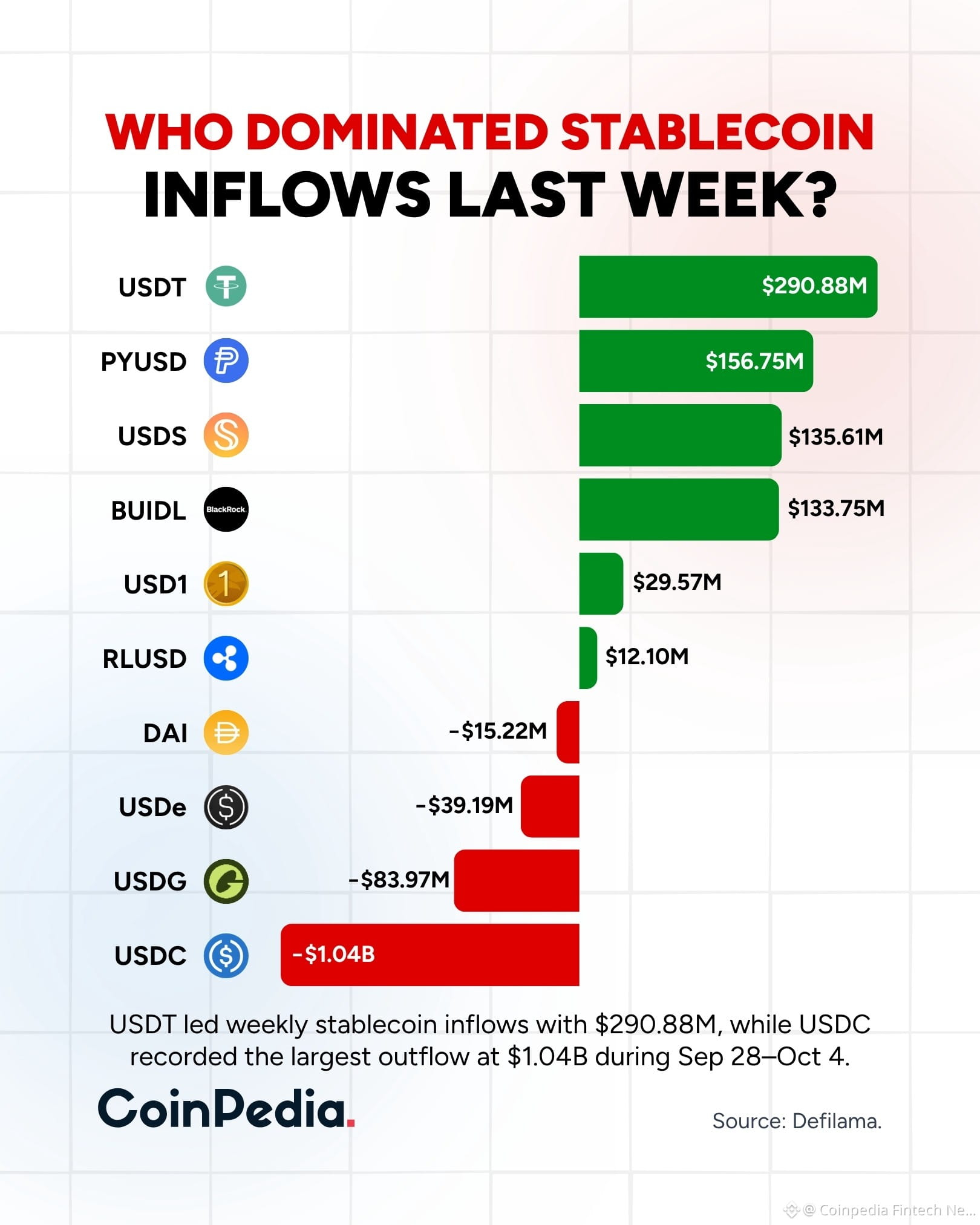
179
📈 Variational Breaks Into the Top 2
Variational recorded $19.22B in 7-day perpetual DEX volume, overtaking Lighter and Aster to secure second place.
🔹 Hyperliquid: $41.53B
🔹 Variational: $19.22B
🔹 Lighter: $13.46B
🔹 Aster: $11.12B
Variational’s 24H perp volume stands at $11.62B, signaling a sharp rise in DEX trading activity.
#Crypto #DeFi #DEX #Variational #Hyperliquid #Perpetuals
📈 Variational Breaks Into the Top 2
Variational recorded $19.22B in 7-day perpetual DEX volume, overtaking Lighter and Aster to secure second place.
🔹 Hyperliquid: $41.53B
🔹 Variational: $19.22B
🔹 Lighter: $13.46B
🔹 Aster: $11.12B
Variational’s 24H perp volume stands at $11.62B, signaling a sharp rise in DEX trading activity.
#Crypto #DeFi #DEX #Variational #Hyperliquid #Perpetuals
Variational recorded $19.22B in 7-day perpetual DEX volume, overtaking Lighter and Aster to secure second place.
🔹 Hyperliquid: $41.53B
🔹 Variational: $19.22B
🔹 Lighter: $13.46B
🔹 Aster: $11.12B
Variational’s 24H perp volume stands at $11.62B, signaling a sharp rise in DEX trading activity.
#Crypto #DeFi #DEX #Variational #Hyperliquid #Perpetuals
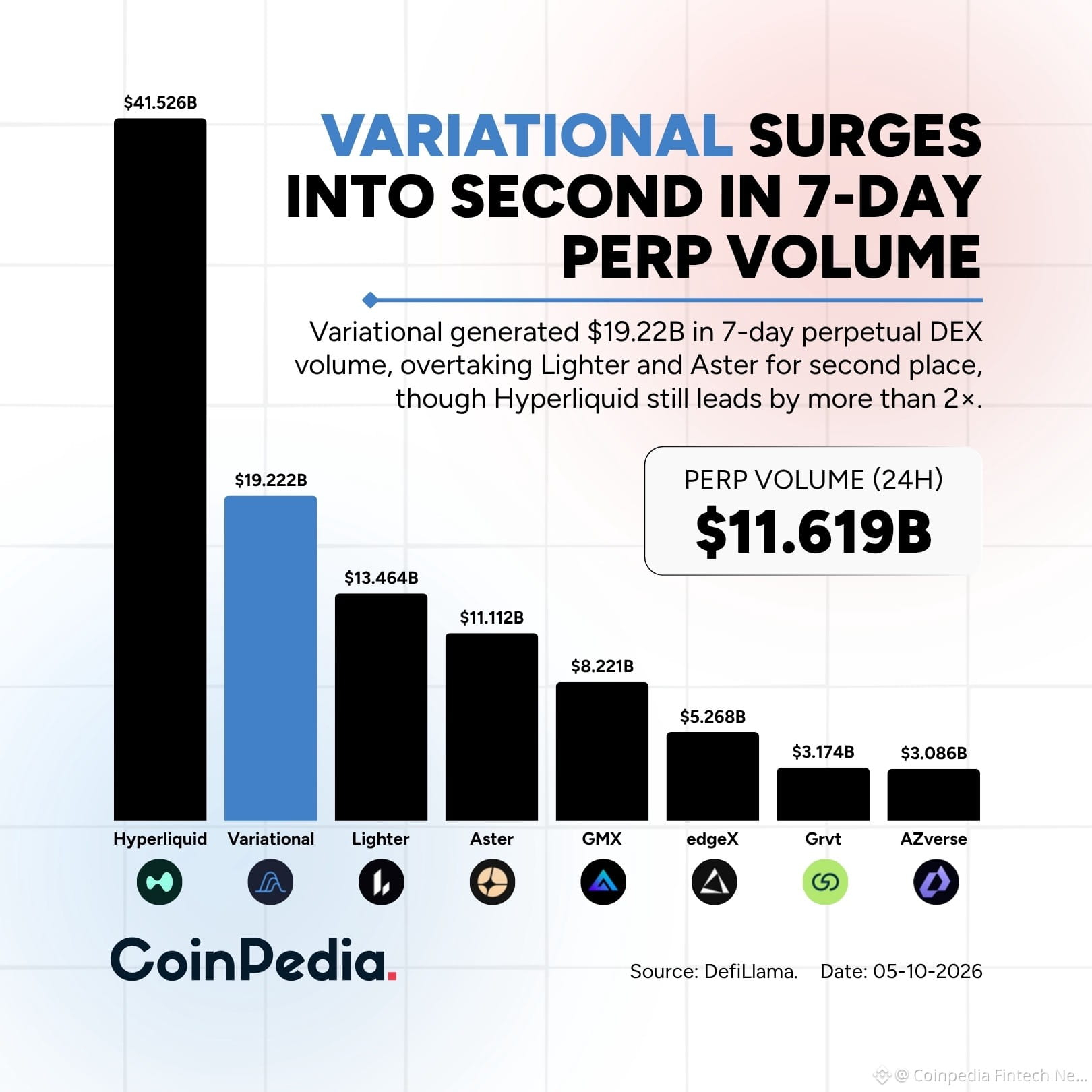
161
Tom Lee Says Ethereum Could Hit $60,000 as New Investors Enter CryptoFundstrat head of research and Bitmain chairman Tom Lee said Ethereum could reach a new all-time high this year and potentially climb to $60,000 within the next few years.
Lee made the comments in an interview with Coinage, where he discussed Ethereum’s recent price performance, institutional demand, tokenization and the broader crypto market.
Ethereum had risen about 80% from its June low near $1,500 to around $2,700 by late September, despite the Federal Reserve raising interest rates in September.
Tom Lee Expects Ethereum to Set a New High
Lee said he expects Ethereum price to break its previous record and move above $5,000 before the end of the year.
When asked whether Ethereum could reach a new all-time high this year, Lee said, “absolutely.” He also said Ethereum could reach around $60,000 within a few years. His estimate is based partly on Ethereum’s previous price cycles.
Ethereum rose from below $100 at the end of 2018 to nearly $4,900 in 2021. Lee said a similar large move following a long period of consolidation could push ETH to $60,000.
“Could Ethereum 10x above 10 to 12x above its prior highs of $5,000? I think that’s very possible,” Lee said.
He added that Ethereum could reach around $3,000 in the near term and move well above $5,000 before the end of the year.
Ethereum Rallied Despite Fed Rate Hike
The Federal Reserve raised its key interest rate by 25 basis points on September 16, bringing the target range to 3.75%-4%. The decision passed 12-0. Lee said the market’s response was important because Ethereum and other crypto assets continued to rise despite the rate increase.
Ethereum had fallen to around $1,500 in June before recovering to roughly $2,700 by late September. Lee said the move suggests the crypto market may already be entering a new bull cycle.
He also argued that the Fed could eventually move back toward a neutral policy if inflation continues to decline.
Core consumer prices rose 2.4% year over year in August, down from 2.5% in July. Lee said some of the remaining inflation could be linked to areas such as asset management fees and higher prices for flash memory used in technology products.
Based on his team’s analysis, Lee believes underlying inflation could be closer to 2%.
Institutional Money Is Moving Into Ethereum
Ethereum has also seen increased demand through US spot Ether exchange-traded funds. On September 22, US spot Ether ETFs recorded $162.2 million in inflows, marking their third consecutive day of positive flows.
BlackRock’s Ethereum fund accounted for $88.1 million, while Fidelity’s fund added $33.6 million. Lee said the current cycle could attract a broader group of investors than previous crypto cycles.
He pointed to tokenization, changes in crypto regulation and the growing use of blockchain technology by financial companies as factors that could bring more investors into the market.
According to Lee, previous crypto cycles were largely driven by specific areas such as initial coin offerings, NFTs, meme coins and stablecoins. He believes the current cycle has a wider range of potential applications.
Tokenization Could Increase Ethereum Use
Lee said financial institutions are increasingly looking at blockchain technology to tokenize assets and create new financial products.
He said companies are likely to adopt blockchain when it provides a significant improvement in operating costs, revenue generation or customer experience.
Lee pointed to tokenized stocks as one example of this trend.
The Securities and Exchange Commission issued an innovation exemption on September 17 that allows certain tokenized versions of US-listed stocks to trade on blockchain networks under the order.
The development came shortly after the Clarity Act failed to advance in the Senate after a 49-50 vote.
Lee also pointed to longer trading hours being planned by traditional financial exchanges. Nasdaq has announced plans for trading for nearly 23 hours a day, five days a week, while the New York Stock Exchange has received approval for a 22-hour trading day.
Lee said the move could bring traditional markets closer to the always-on trading model used by crypto markets.
Robinhood Builds on Ethereum
Lee also highlighted Robinhood’s decision to build its Robinhood Chain on Ethereum.
According to the information discussed in the interview, Robinhood Chain brought in $2.1 billion in tokenized assets during its first two months, while $1.5 billion was deposited into applications running on the network.
Lee said Robinhood chose Ethereum because of its security and liquidity rather than simply focusing on transaction fees.
“I think that Robinhood decided to build on Ethereum… because it’s the most secure chain and the most liquid,” Lee said.
He argued that Ethereum does not necessarily need to capture all the fees generated by applications built on top of it for ETH to gain value.
Instead, he sees Ethereum increasingly functioning as an asset that investors and companies hold while the network supports additional financial applications.
Tom Lee Says Ethereum Could Hit $60,000 as New Investors Enter Crypto
Fundstrat head of research and Bitmain chairman Tom Lee said Ethereum could reach a new all-time high this year and potentially climb to $60,000 within the next few years.
Lee made the comments in an interview with Coinage, where he discussed Ethereum’s recent price performance, institutional demand, tokenization and the broader crypto market.
Ethereum had risen about 80% from its June low near $1,500 to around $2,700 by late September, despite the Federal Reserve raising interest rates in September.
Tom Lee Expects Ethereum to Set a New High
Lee said he expects Ethereum price to break its previous record and move above $5,000 before the end of the year.
When asked whether Ethereum could reach a new all-time high this year, Lee said, “absolutely.” He also said Ethereum could reach around $60,000 within a few years. His estimate is based partly on Ethereum’s previous price cycles.
Ethereum rose from below $100 at the end of 2018 to nearly $4,900 in 2021. Lee said a similar large move following a long period of consolidation could push ETH to $60,000.
“Could Ethereum 10x above 10 to 12x above its prior highs of $5,000? I think that’s very possible,” Lee said.
He added that Ethereum could reach around $3,000 in the near term and move well above $5,000 before the end of the year.
Ethereum Rallied Despite Fed Rate Hike
The Federal Reserve raised its key interest rate by 25 basis points on September 16, bringing the target range to 3.75%-4%. The decision passed 12-0. Lee said the market’s response was important because Ethereum and other crypto assets continued to rise despite the rate increase.
Ethereum had fallen to around $1,500 in June before recovering to roughly $2,700 by late September. Lee said the move suggests the crypto market may already be entering a new bull cycle.
He also argued that the Fed could eventually move back toward a neutral policy if inflation continues to decline.
Core consumer prices rose 2.4% year over year in August, down from 2.5% in July. Lee said some of the remaining inflation could be linked to areas such as asset management fees and higher prices for flash memory used in technology products.
Based on his team’s analysis, Lee believes underlying inflation could be closer to 2%.
Institutional Money Is Moving Into Ethereum
Ethereum has also seen increased demand through US spot Ether exchange-traded funds. On September 22, US spot Ether ETFs recorded $162.2 million in inflows, marking their third consecutive day of positive flows.
BlackRock’s Ethereum fund accounted for $88.1 million, while Fidelity’s fund added $33.6 million. Lee said the current cycle could attract a broader group of investors than previous crypto cycles.
He pointed to tokenization, changes in crypto regulation and the growing use of blockchain technology by financial companies as factors that could bring more investors into the market.
According to Lee, previous crypto cycles were largely driven by specific areas such as initial coin offerings, NFTs, meme coins and stablecoins. He believes the current cycle has a wider range of potential applications.
Tokenization Could Increase Ethereum Use
Lee said financial institutions are increasingly looking at blockchain technology to tokenize assets and create new financial products.
He said companies are likely to adopt blockchain when it provides a significant improvement in operating costs, revenue generation or customer experience.
Lee pointed to tokenized stocks as one example of this trend.
The Securities and Exchange Commission issued an innovation exemption on September 17 that allows certain tokenized versions of US-listed stocks to trade on blockchain networks under the order.
The development came shortly after the Clarity Act failed to advance in the Senate after a 49-50 vote.
Lee also pointed to longer trading hours being planned by traditional financial exchanges. Nasdaq has announced plans for trading for nearly 23 hours a day, five days a week, while the New York Stock Exchange has received approval for a 22-hour trading day.
Lee said the move could bring traditional markets closer to the always-on trading model used by crypto markets.
Robinhood Builds on Ethereum
Lee also highlighted Robinhood’s decision to build its Robinhood Chain on Ethereum.
According to the information discussed in the interview, Robinhood Chain brought in $2.1 billion in tokenized assets during its first two months, while $1.5 billion was deposited into applications running on the network.
Lee said Robinhood chose Ethereum because of its security and liquidity rather than simply focusing on transaction fees.
“I think that Robinhood decided to build on Ethereum… because it’s the most secure chain and the most liquid,” Lee said.
He argued that Ethereum does not necessarily need to capture all the fees generated by applications built on top of it for ETH to gain value.
Instead, he sees Ethereum increasingly functioning as an asset that investors and companies hold while the network supports additional financial applications.
Lee made the comments in an interview with Coinage, where he discussed Ethereum’s recent price performance, institutional demand, tokenization and the broader crypto market.
Ethereum had risen about 80% from its June low near $1,500 to around $2,700 by late September, despite the Federal Reserve raising interest rates in September.
Tom Lee Expects Ethereum to Set a New High
Lee said he expects Ethereum price to break its previous record and move above $5,000 before the end of the year.
When asked whether Ethereum could reach a new all-time high this year, Lee said, “absolutely.” He also said Ethereum could reach around $60,000 within a few years. His estimate is based partly on Ethereum’s previous price cycles.
Ethereum rose from below $100 at the end of 2018 to nearly $4,900 in 2021. Lee said a similar large move following a long period of consolidation could push ETH to $60,000.
“Could Ethereum 10x above 10 to 12x above its prior highs of $5,000? I think that’s very possible,” Lee said.
He added that Ethereum could reach around $3,000 in the near term and move well above $5,000 before the end of the year.
Ethereum Rallied Despite Fed Rate Hike
The Federal Reserve raised its key interest rate by 25 basis points on September 16, bringing the target range to 3.75%-4%. The decision passed 12-0. Lee said the market’s response was important because Ethereum and other crypto assets continued to rise despite the rate increase.
Ethereum had fallen to around $1,500 in June before recovering to roughly $2,700 by late September. Lee said the move suggests the crypto market may already be entering a new bull cycle.
He also argued that the Fed could eventually move back toward a neutral policy if inflation continues to decline.
Core consumer prices rose 2.4% year over year in August, down from 2.5% in July. Lee said some of the remaining inflation could be linked to areas such as asset management fees and higher prices for flash memory used in technology products.
Based on his team’s analysis, Lee believes underlying inflation could be closer to 2%.
Institutional Money Is Moving Into Ethereum
Ethereum has also seen increased demand through US spot Ether exchange-traded funds. On September 22, US spot Ether ETFs recorded $162.2 million in inflows, marking their third consecutive day of positive flows.
BlackRock’s Ethereum fund accounted for $88.1 million, while Fidelity’s fund added $33.6 million. Lee said the current cycle could attract a broader group of investors than previous crypto cycles.
He pointed to tokenization, changes in crypto regulation and the growing use of blockchain technology by financial companies as factors that could bring more investors into the market.
According to Lee, previous crypto cycles were largely driven by specific areas such as initial coin offerings, NFTs, meme coins and stablecoins. He believes the current cycle has a wider range of potential applications.
Tokenization Could Increase Ethereum Use
Lee said financial institutions are increasingly looking at blockchain technology to tokenize assets and create new financial products.
He said companies are likely to adopt blockchain when it provides a significant improvement in operating costs, revenue generation or customer experience.
Lee pointed to tokenized stocks as one example of this trend.
The Securities and Exchange Commission issued an innovation exemption on September 17 that allows certain tokenized versions of US-listed stocks to trade on blockchain networks under the order.
The development came shortly after the Clarity Act failed to advance in the Senate after a 49-50 vote.
Lee also pointed to longer trading hours being planned by traditional financial exchanges. Nasdaq has announced plans for trading for nearly 23 hours a day, five days a week, while the New York Stock Exchange has received approval for a 22-hour trading day.
Lee said the move could bring traditional markets closer to the always-on trading model used by crypto markets.
Robinhood Builds on Ethereum
Lee also highlighted Robinhood’s decision to build its Robinhood Chain on Ethereum.
According to the information discussed in the interview, Robinhood Chain brought in $2.1 billion in tokenized assets during its first two months, while $1.5 billion was deposited into applications running on the network.
Lee said Robinhood chose Ethereum because of its security and liquidity rather than simply focusing on transaction fees.
“I think that Robinhood decided to build on Ethereum… because it’s the most secure chain and the most liquid,” Lee said.
He argued that Ethereum does not necessarily need to capture all the fees generated by applications built on top of it for ETH to gain value.
Instead, he sees Ethereum increasingly functioning as an asset that investors and companies hold while the network supports additional financial applications.
117
S&P Global Brings AAA-Style Risk Scores to DeFi’s $10B Lending MarketS&P Global Ratings has launched a AAA-style risk framework for crypto lending vaults as deposits in on-chain lending products hit a record $10 billion. The market has grown nearly sevenfold from $1.5 billion in the last two years.
Meanwhile, the new framework aims to help investors better compare risks across these growing lending products.
S&P Global Brings Risk Assessment to DeFi
S&P Global launched its new Vault Risk Assessment (VRA) on 5 October 2026 to help investors understand the risk of losing money in digital asset lending vaults.
The VRA gives each vault a score based on its risk level. AAA(v) is the highest score and means the vault has the lowest risk of losing money. Lower scores indicate higher risk.
S&P said digital asset vaults can work like managed fixed-income funds. Their strategies can either run automatically through smart contracts or be managed by human curators.
President of S&P Global Ratings Yann Le Pallec said independent risk assessments are becoming more important as digital assets gain wider use in traditional finance.
“As digital assets continue to institutionalize, the demand for independent risk assessments that bridge traditional finance and decentralized innovation is paramount.”
Six Risks Will Decide the VRA Score
To calculate the score, S&P looks at six key areas including portfolio credit quality, liquidity mismatch, curator risk, blockchain risk, protocol risk, and vault security and governance.
These factors are combined to assign a letter-based score. AAA(v) represents the lowest relative risk of an investor losing money, while lower scores indicate higher risk.
S&P said it will publish individual Vault Risk Assessments in future announcements.
James Wiemken, executive managing director and head of Global Ratings Service, said that “The VRA fills this critical gap,” referring to the complex DeFi market and differences in how projects disclose information.
Crypto Lending Vaults Grow Nearly 7x
The new framework comes as the market has expanded sharply. Deposits in on-chain lending vaults have climbed from $1.5 billion in September 2024 to $10 billion, representing nearly seven times growth in two years.
These vaults, including products built using protocols such as Morpho and Euler, allow users to pool capital into automated lending strategies.
S&P Global Brings AAA-Style Risk Scores to DeFi’s $10B Lending Market
S&P Global Ratings has launched a AAA-style risk framework for crypto lending vaults as deposits in on-chain lending products hit a record $10 billion. The market has grown nearly sevenfold from $1.5 billion in the last two years.
Meanwhile, the new framework aims to help investors better compare risks across these growing lending products.
S&P Global Brings Risk Assessment to DeFi
S&P Global launched its new Vault Risk Assessment (VRA) on 5 October 2026 to help investors understand the risk of losing money in digital asset lending vaults.
The VRA gives each vault a score based on its risk level. AAA(v) is the highest score and means the vault has the lowest risk of losing money. Lower scores indicate higher risk.
S&P said digital asset vaults can work like managed fixed-income funds. Their strategies can either run automatically through smart contracts or be managed by human curators.
President of S&P Global Ratings Yann Le Pallec said independent risk assessments are becoming more important as digital assets gain wider use in traditional finance.
“As digital assets continue to institutionalize, the demand for independent risk assessments that bridge traditional finance and decentralized innovation is paramount.”
Six Risks Will Decide the VRA Score
To calculate the score, S&P looks at six key areas including portfolio credit quality, liquidity mismatch, curator risk, blockchain risk, protocol risk, and vault security and governance.
These factors are combined to assign a letter-based score. AAA(v) represents the lowest relative risk of an investor losing money, while lower scores indicate higher risk.
S&P said it will publish individual Vault Risk Assessments in future announcements.
James Wiemken, executive managing director and head of Global Ratings Service, said that “The VRA fills this critical gap,” referring to the complex DeFi market and differences in how projects disclose information.
Crypto Lending Vaults Grow Nearly 7x
The new framework comes as the market has expanded sharply. Deposits in on-chain lending vaults have climbed from $1.5 billion in September 2024 to $10 billion, representing nearly seven times growth in two years.
These vaults, including products built using protocols such as Morpho and Euler, allow users to pool capital into automated lending strategies.
Meanwhile, the new framework aims to help investors better compare risks across these growing lending products.
S&P Global Brings Risk Assessment to DeFi
S&P Global launched its new Vault Risk Assessment (VRA) on 5 October 2026 to help investors understand the risk of losing money in digital asset lending vaults.
The VRA gives each vault a score based on its risk level. AAA(v) is the highest score and means the vault has the lowest risk of losing money. Lower scores indicate higher risk.
S&P said digital asset vaults can work like managed fixed-income funds. Their strategies can either run automatically through smart contracts or be managed by human curators.
President of S&P Global Ratings Yann Le Pallec said independent risk assessments are becoming more important as digital assets gain wider use in traditional finance.
“As digital assets continue to institutionalize, the demand for independent risk assessments that bridge traditional finance and decentralized innovation is paramount.”
Six Risks Will Decide the VRA Score
To calculate the score, S&P looks at six key areas including portfolio credit quality, liquidity mismatch, curator risk, blockchain risk, protocol risk, and vault security and governance.
These factors are combined to assign a letter-based score. AAA(v) represents the lowest relative risk of an investor losing money, while lower scores indicate higher risk.
S&P said it will publish individual Vault Risk Assessments in future announcements.
James Wiemken, executive managing director and head of Global Ratings Service, said that “The VRA fills this critical gap,” referring to the complex DeFi market and differences in how projects disclose information.
Crypto Lending Vaults Grow Nearly 7x
The new framework comes as the market has expanded sharply. Deposits in on-chain lending vaults have climbed from $1.5 billion in September 2024 to $10 billion, representing nearly seven times growth in two years.
These vaults, including products built using protocols such as Morpho and Euler, allow users to pool capital into automated lending strategies.
120
Cardano Price Eyes $0.30 as ADA Breaks Higher—Can the Rally Hold While On-Chain Data LagsThe Cardano (ADA) price is gaining momentum after breaking above the key $0.26 level, with the token now trading near $0.27. The latest move has strengthened the bullish setup as buying pressure rises and open interest recovers. In the meantime, the rising leverage and liquidations are adding volatility; on-chain activity is yet to accelerate. With ADA now approaching the next major resistance zone near $0.30, the focus is on whether the current breakout can extend further.
ADA Price Breaks Higher as $0.30 Comes Into Focus
Cardano price has moved above the $0.26 level after spending weeks consolidating between the $0.23 and $0.26 regions. The latest breakout has pushed ADA toward $0.27, with the daily chart showing a clear recovery in the broder price structure after the June low. However, the move is also supported by improving momentum indicators.
Open interest has recovered toward $300 million, while the Chainkin Money Flow (CMF) has climbed to around 0.19, suggesting stronger buying pressure. If ADA can hold above the $0.26 to $0.27 area, the next major hurdle sits around $0.30 to $0.31, which previously acted as a strong resistance zone. A sustained breakout above $0.30 could strengthen the bullish outlook, while a rejection could drag the rally below $0.26 and weaken the breakout structure. In such a case, the $0.23 to $0.24 support range will come back into focus.
Liquidations Could Fuel the Next Move Toward $0.28
The recent Cardano price rally has also been supported by a shift in derivatives positioning. ADA’s liquidation map shows a growing concentration of short positions above the current price, particularly around the $0.277 to $0.28 region. A sustained move through this zone could force bearish traders to close their positions, adding further buying pressure to the rally.
At the same time, the liquidation map shows increasing long-liquidation risk below $0.26. This makes the $0.26 to $0.28 range particularly important for ADA in the near term. A break above $0.28 could strengthen the bullish momentum and bring the $0.30 resistance zone into focus. Besides, a rejection followed by a move below $0.26 could trigger a wave of long liquidations and weaken the current breakout.
On-Chain Activity Shows Mixed Confirmation
Cardano’s on-chain activity is showing some improvement, but it has not accelerated as strongly as ADA’s price. Active addresses are currently around 14,600, remaining above much of the September baseline but well below the recent spike above 20,000. This suggests that network participation remains healthy, although the latest price rally has not yet been matched by a similar surge in user activity.
The divergence is important for the Cardano price outlook. A sustained increase in active addresses, transactions, and DeFi activity would provide stronger fundamental support for the breakout. For now, the on-chain data supports a cautiously bullish view rather than confirming a full-scale increase in network demand.
What’s Next for the Cardano (ADA) Price Rally?
Cardano’s next major move will likely depend on whether the current technical breakout receives confirmation from derivatives and on-chain activity. A sustained move above $0.28 would be the clearest near-term bullish catalyst, particularly if short liquidations increase and open interest continues to rise without signs of excessive leverage. Moreover, a recovery in active addresses, transactions, and DeFi activity could strengthen the fundamental case for a rise to $0.30.
Cardano Price Eyes $0.30 as ADA Breaks Higher—Can the Rally Hold While On-Chain Data Lags
The Cardano (ADA) price is gaining momentum after breaking above the key $0.26 level, with the token now trading near $0.27. The latest move has strengthened the bullish setup as buying pressure rises and open interest recovers. In the meantime, the rising leverage and liquidations are adding volatility; on-chain activity is yet to accelerate. With ADA now approaching the next major resistance zone near $0.30, the focus is on whether the current breakout can extend further.
ADA Price Breaks Higher as $0.30 Comes Into Focus
Cardano price has moved above the $0.26 level after spending weeks consolidating between the $0.23 and $0.26 regions. The latest breakout has pushed ADA toward $0.27, with the daily chart showing a clear recovery in the broder price structure after the June low. However, the move is also supported by improving momentum indicators.
Open interest has recovered toward $300 million, while the Chainkin Money Flow (CMF) has climbed to around 0.19, suggesting stronger buying pressure. If ADA can hold above the $0.26 to $0.27 area, the next major hurdle sits around $0.30 to $0.31, which previously acted as a strong resistance zone. A sustained breakout above $0.30 could strengthen the bullish outlook, while a rejection could drag the rally below $0.26 and weaken the breakout structure. In such a case, the $0.23 to $0.24 support range will come back into focus.
Liquidations Could Fuel the Next Move Toward $0.28
The recent Cardano price rally has also been supported by a shift in derivatives positioning. ADA’s liquidation map shows a growing concentration of short positions above the current price, particularly around the $0.277 to $0.28 region. A sustained move through this zone could force bearish traders to close their positions, adding further buying pressure to the rally.
At the same time, the liquidation map shows increasing long-liquidation risk below $0.26. This makes the $0.26 to $0.28 range particularly important for ADA in the near term. A break above $0.28 could strengthen the bullish momentum and bring the $0.30 resistance zone into focus. Besides, a rejection followed by a move below $0.26 could trigger a wave of long liquidations and weaken the current breakout.
On-Chain Activity Shows Mixed Confirmation
Cardano’s on-chain activity is showing some improvement, but it has not accelerated as strongly as ADA’s price. Active addresses are currently around 14,600, remaining above much of the September baseline but well below the recent spike above 20,000. This suggests that network participation remains healthy, although the latest price rally has not yet been matched by a similar surge in user activity.
The divergence is important for the Cardano price outlook. A sustained increase in active addresses, transactions, and DeFi activity would provide stronger fundamental support for the breakout. For now, the on-chain data supports a cautiously bullish view rather than confirming a full-scale increase in network demand.
What’s Next for the Cardano (ADA) Price Rally?
Cardano’s next major move will likely depend on whether the current technical breakout receives confirmation from derivatives and on-chain activity. A sustained move above $0.28 would be the clearest near-term bullish catalyst, particularly if short liquidations increase and open interest continues to rise without signs of excessive leverage. Moreover, a recovery in active addresses, transactions, and DeFi activity could strengthen the fundamental case for a rise to $0.30.
ADA Price Breaks Higher as $0.30 Comes Into Focus
Cardano price has moved above the $0.26 level after spending weeks consolidating between the $0.23 and $0.26 regions. The latest breakout has pushed ADA toward $0.27, with the daily chart showing a clear recovery in the broder price structure after the June low. However, the move is also supported by improving momentum indicators.
Open interest has recovered toward $300 million, while the Chainkin Money Flow (CMF) has climbed to around 0.19, suggesting stronger buying pressure. If ADA can hold above the $0.26 to $0.27 area, the next major hurdle sits around $0.30 to $0.31, which previously acted as a strong resistance zone. A sustained breakout above $0.30 could strengthen the bullish outlook, while a rejection could drag the rally below $0.26 and weaken the breakout structure. In such a case, the $0.23 to $0.24 support range will come back into focus.
Liquidations Could Fuel the Next Move Toward $0.28
The recent Cardano price rally has also been supported by a shift in derivatives positioning. ADA’s liquidation map shows a growing concentration of short positions above the current price, particularly around the $0.277 to $0.28 region. A sustained move through this zone could force bearish traders to close their positions, adding further buying pressure to the rally.
At the same time, the liquidation map shows increasing long-liquidation risk below $0.26. This makes the $0.26 to $0.28 range particularly important for ADA in the near term. A break above $0.28 could strengthen the bullish momentum and bring the $0.30 resistance zone into focus. Besides, a rejection followed by a move below $0.26 could trigger a wave of long liquidations and weaken the current breakout.
On-Chain Activity Shows Mixed Confirmation
Cardano’s on-chain activity is showing some improvement, but it has not accelerated as strongly as ADA’s price. Active addresses are currently around 14,600, remaining above much of the September baseline but well below the recent spike above 20,000. This suggests that network participation remains healthy, although the latest price rally has not yet been matched by a similar surge in user activity.
The divergence is important for the Cardano price outlook. A sustained increase in active addresses, transactions, and DeFi activity would provide stronger fundamental support for the breakout. For now, the on-chain data supports a cautiously bullish view rather than confirming a full-scale increase in network demand.
What’s Next for the Cardano (ADA) Price Rally?
Cardano’s next major move will likely depend on whether the current technical breakout receives confirmation from derivatives and on-chain activity. A sustained move above $0.28 would be the clearest near-term bullish catalyst, particularly if short liquidations increase and open interest continues to rise without signs of excessive leverage. Moreover, a recovery in active addresses, transactions, and DeFi activity could strengthen the fundamental case for a rise to $0.30.
183
ICP Price Rally Close to Key Resistance — Is the Next Move Up or Down?ICP price is entering a crucial phase after a strong recovery lifted the token from its summer lows. The rally has pushed ICP back above $3, but buyers are now approaching a resistance level that has repeatedly limited upside. At the same time, network activity is picking up, giving the recovery stronger on-chain support. ICP has also continued to record major network usage, recently surpassing 300 billion cumulative transactions. With price now close to $3.50, the next breakout or rejection could determine the direction of the next major move.
Active Addresses Rise as ICP Gains Network Participation
The latest on-chain data shows a noticeable increase in 24-hour Active Addresses, with activity accelerating toward the end of the observed period. The increase has arrived alongside ICP’s price recovery, indicating stronger participation as the token moves toward resistance. The network has also continued to generate measurable economic activity, with weekly protocol fees recently reaching about $85,000, according to recent network data.
The combination of rising activity and improving price action gives the current recovery a stronger foundation. If Active Addresses remain elevated as ICP tests $3.50, buyers could have the participation needed to challenge the resistance.
Weighted Sentiment Holds Firm as ICP Returns to Focus
Weighted Sentiment has remained broadly constructive while ICP has recovered sharply from its lower trading range. The sentiment trend has improved alongside the price structure rather than weakening into the rally. ICP has gained more than 30% over the past month, with the token recently trading in the $3.30–$3.40 area.
Recent ecosystem developments are also keeping attention on the network. ICP’s Service Nervous System recently enabled a framework for developers to transfer application control to community-run DAOs through a public decentralization swap. The improving sentiment and stronger network participation give ICP a healthier setup as it approaches the next technical hurdle.
ICP Price Analysis: Can Bulls Break $3.50?
ICP is trading around $3.30, after recovering from the $2.60–$2.80 support zone. The immediate barrier is $3.50, which sits near the latest local highs and the red resistance level on the chart. ICP has already tested this area during the recent rally, making a decisive daily close above $3.50 important for confirming another leg higher.
A successful breakout could shift attention toward the broader $4.30–$5.00 resistance zone, where the chart shows significant historical supply. On the downside, the $3.00–$3.20 area is the first region buyers need to defend after the recent recovery. A deeper correction could bring $2.60–$2.80 back into focus. Recent market data shows ICP closing around $3.34 on October 5, while the token has remained roughly 33% higher over the past month.
Final Outlook
ICP’s current setup leans cautiously bullish, with price recovery, stronger Active Addresses and constructive Weighted Sentiment moving in the same direction. The network’s continued usage and recent development activity add further support to the broader recovery.
The decisive point is now $3.50. A clean breakout would strengthen the reversal and put the $4.30–$5.00 zone into focus. Failure to clear the barrier would leave ICP vulnerable to another consolidation phase, with buyers likely watching the $3.00–$3.20 area first.
ICP Price Rally Close to Key Resistance — Is the Next Move Up or Down?
ICP price is entering a crucial phase after a strong recovery lifted the token from its summer lows. The rally has pushed ICP back above $3, but buyers are now approaching a resistance level that has repeatedly limited upside. At the same time, network activity is picking up, giving the recovery stronger on-chain support. ICP has also continued to record major network usage, recently surpassing 300 billion cumulative transactions. With price now close to $3.50, the next breakout or rejection could determine the direction of the next major move.
Active Addresses Rise as ICP Gains Network Participation
The latest on-chain data shows a noticeable increase in 24-hour Active Addresses, with activity accelerating toward the end of the observed period. The increase has arrived alongside ICP’s price recovery, indicating stronger participation as the token moves toward resistance. The network has also continued to generate measurable economic activity, with weekly protocol fees recently reaching about $85,000, according to recent network data.
The combination of rising activity and improving price action gives the current recovery a stronger foundation. If Active Addresses remain elevated as ICP tests $3.50, buyers could have the participation needed to challenge the resistance.
Weighted Sentiment Holds Firm as ICP Returns to Focus
Weighted Sentiment has remained broadly constructive while ICP has recovered sharply from its lower trading range. The sentiment trend has improved alongside the price structure rather than weakening into the rally. ICP has gained more than 30% over the past month, with the token recently trading in the $3.30–$3.40 area.
Recent ecosystem developments are also keeping attention on the network. ICP’s Service Nervous System recently enabled a framework for developers to transfer application control to community-run DAOs through a public decentralization swap. The improving sentiment and stronger network participation give ICP a healthier setup as it approaches the next technical hurdle.
ICP Price Analysis: Can Bulls Break $3.50?
ICP is trading around $3.30, after recovering from the $2.60–$2.80 support zone. The immediate barrier is $3.50, which sits near the latest local highs and the red resistance level on the chart. ICP has already tested this area during the recent rally, making a decisive daily close above $3.50 important for confirming another leg higher.
A successful breakout could shift attention toward the broader $4.30–$5.00 resistance zone, where the chart shows significant historical supply. On the downside, the $3.00–$3.20 area is the first region buyers need to defend after the recent recovery. A deeper correction could bring $2.60–$2.80 back into focus. Recent market data shows ICP closing around $3.34 on October 5, while the token has remained roughly 33% higher over the past month.
Final Outlook
ICP’s current setup leans cautiously bullish, with price recovery, stronger Active Addresses and constructive Weighted Sentiment moving in the same direction. The network’s continued usage and recent development activity add further support to the broader recovery.
The decisive point is now $3.50. A clean breakout would strengthen the reversal and put the $4.30–$5.00 zone into focus. Failure to clear the barrier would leave ICP vulnerable to another consolidation phase, with buyers likely watching the $3.00–$3.20 area first.
Active Addresses Rise as ICP Gains Network Participation
The latest on-chain data shows a noticeable increase in 24-hour Active Addresses, with activity accelerating toward the end of the observed period. The increase has arrived alongside ICP’s price recovery, indicating stronger participation as the token moves toward resistance. The network has also continued to generate measurable economic activity, with weekly protocol fees recently reaching about $85,000, according to recent network data.
The combination of rising activity and improving price action gives the current recovery a stronger foundation. If Active Addresses remain elevated as ICP tests $3.50, buyers could have the participation needed to challenge the resistance.
Weighted Sentiment Holds Firm as ICP Returns to Focus
Weighted Sentiment has remained broadly constructive while ICP has recovered sharply from its lower trading range. The sentiment trend has improved alongside the price structure rather than weakening into the rally. ICP has gained more than 30% over the past month, with the token recently trading in the $3.30–$3.40 area.
Recent ecosystem developments are also keeping attention on the network. ICP’s Service Nervous System recently enabled a framework for developers to transfer application control to community-run DAOs through a public decentralization swap. The improving sentiment and stronger network participation give ICP a healthier setup as it approaches the next technical hurdle.
ICP Price Analysis: Can Bulls Break $3.50?
ICP is trading around $3.30, after recovering from the $2.60–$2.80 support zone. The immediate barrier is $3.50, which sits near the latest local highs and the red resistance level on the chart. ICP has already tested this area during the recent rally, making a decisive daily close above $3.50 important for confirming another leg higher.
A successful breakout could shift attention toward the broader $4.30–$5.00 resistance zone, where the chart shows significant historical supply. On the downside, the $3.00–$3.20 area is the first region buyers need to defend after the recent recovery. A deeper correction could bring $2.60–$2.80 back into focus. Recent market data shows ICP closing around $3.34 on October 5, while the token has remained roughly 33% higher over the past month.
Final Outlook
ICP’s current setup leans cautiously bullish, with price recovery, stronger Active Addresses and constructive Weighted Sentiment moving in the same direction. The network’s continued usage and recent development activity add further support to the broader recovery.
The decisive point is now $3.50. A clean breakout would strengthen the reversal and put the $4.30–$5.00 zone into focus. Failure to clear the barrier would leave ICP vulnerable to another consolidation phase, with buyers likely watching the $3.00–$3.20 area first.
251
Connectez-vous pour découvrir plus de contenu
Rejoignez la communauté mondiale des adeptes de cryptomonnaies sur Binance Square
⚡️ Suviez les dernières informations importantes sur les cryptomonnaies.
💬 Jugé digne de confiance par la plus grande plateforme d’échange de cryptomonnaies au monde.
👍 Découvrez les connaissances que partagent les créateurs vérifiés.
Adresse e-mail/Nº de téléphone
Sujets d’actualité
ADAGains10%Above$0.27
3,164 vues
100 mentions
#ADAGains10%Above$0.27
$ADA IS FINALLY WAKING UP 👀
Cardano's $ADA just jumped 10% in 24 hours, pushing above $0.27 for the first time since May.
The move comes as attention builds around Cardano's RealFi ecosystem and the upcoming Dijkstra scalability upgrade.
After months of slow price action, $ADA is suddenly back on traders' radar.
#ADA #Cardano #crypto #altcoins
Albertc07
·2 mentions J’aime
·247 vues
ETHUp70%InQ3ButLiquidityFalls
42,341 vues
553 mentions
EthStakingExitQueueHits2026High
15,848 vues
467 mentions