

CforCrypto7
6.1k Publications

CforCrypto7
Signaler
Bloquer l’utilisateur
X /FB/ CMC: @RealCforCrypto
Trade régulièrement
2.1 an(s)
582 Suivis
11.9K+ Abonnés
4.1K+ J’aime
Publications
Tous
Citations
Vidéos
Direct
·
--
🚨 UK FCA WINS COURT ORDER TO RECOVER £851,400
The UK Financial Conduct Authority has secured confiscation orders against two convicted crypto-fraud offenders.
⚖️ Raymondip Bedi: £603,404.28
⚖️ Patrick Mavanga: £247,997.99
At least 65 investors lost £1.54M in the fake crypto investment scheme. The recovered funds will be returned to victims.
$ETH
{future}(BNBUSDT)
{spot}(TRXUSDT)
{future}(ETHUSDT)
#FCA #bitcoin #CryptoNewss #UK
#ukfcawinscourtordertorecover851400pounds
🚨 UK FCA WINS COURT ORDER TO RECOVER £851,400
The UK Financial Conduct Authority has secured confiscation orders against two convicted crypto-fraud offenders.
⚖️ Raymondip Bedi: £603,404.28
⚖️ Patrick Mavanga: £247,997.99
At least 65 investors lost £1.54M in the fake crypto investment scheme. The recovered funds will be returned to victims.
$ETH
#FCA #bitcoin #CryptoNewss #UK
#ukfcawinscourtordertorecover851400pounds
The UK Financial Conduct Authority has secured confiscation orders against two convicted crypto-fraud offenders.
⚖️ Raymondip Bedi: £603,404.28
⚖️ Patrick Mavanga: £247,997.99
At least 65 investors lost £1.54M in the fake crypto investment scheme. The recovered funds will be returned to victims.
$ETH
#FCA #bitcoin #CryptoNewss #UK
#ukfcawinscourtordertorecover851400pounds

198
·
--
🚨 GOLD FALLS TO $4,144
Gold dropped more than 3% today, hitting around $4,144 per ounce, its lowest level in over seven weeks.
The sell-off comes as rising oil prices fuel inflation concerns, pushing expectations for higher U.S. interest rates and lifting Treasury yields.
Markets remain focused on oil, Fed policy and geopolitical tensions.
$XAU
{future}(XAUUSDT)
$PAXG
{future}(PAXGUSDT)
{spot}(PAXGUSDT)
#GOLD #XAUUSD #markets #Fed
🚨 GOLD FALLS TO $4,144
Gold dropped more than 3% today, hitting around $4,144 per ounce, its lowest level in over seven weeks.
The sell-off comes as rising oil prices fuel inflation concerns, pushing expectations for higher U.S. interest rates and lifting Treasury yields.
Markets remain focused on oil, Fed policy and geopolitical tensions.
$XAU
$PAXG
#GOLD #XAUUSD #markets #Fed
Gold dropped more than 3% today, hitting around $4,144 per ounce, its lowest level in over seven weeks.
The sell-off comes as rising oil prices fuel inflation concerns, pushing expectations for higher U.S. interest rates and lifting Treasury yields.
Markets remain focused on oil, Fed policy and geopolitical tensions.
$XAU
$PAXG
#GOLD #XAUUSD #markets #Fed
198
·
--
guy's $ETH and $SOL both cooking on the infrastructure side 🔥
Vitalik just dropped a longer-term vision for Ethereum — way beyond just being a blockchain.
Meanwhile Solana’s Alpenglow settlement upgrade already hit the second public testnet.
Builders are not sleeping.
Real progress happening under the radar while everyone else is just watching price.
{spot}(ETHUSDT)
{spot}(SOLUSDT)
{future}(ETHUSDT)
Stay sharp.
DYOR.
guy's $ETH and $SOL both cooking on the infrastructure side 🔥
Vitalik just dropped a longer-term vision for Ethereum — way beyond just being a blockchain.
Meanwhile Solana’s Alpenglow settlement upgrade already hit the second public testnet.
Builders are not sleeping.
Real progress happening under the radar while everyone else is just watching price.
Stay sharp.
DYOR.
Vitalik just dropped a longer-term vision for Ethereum — way beyond just being a blockchain.
Meanwhile Solana’s Alpenglow settlement upgrade already hit the second public testnet.
Builders are not sleeping.
Real progress happening under the radar while everyone else is just watching price.
Stay sharp.
DYOR.
112
·
--
🚨 $2.4B WEEKLY INFLOW BITCOIN ETFS JUST FLIPPED POSITIVE
Bitcoin ETFs just recorded a $2.4 billion weekly inflow, according to The Block.
That’s the largest weekly haul since October and it officially pushed 2026 net flows back into positive territory.
Institutional Bitcoin treasury activity is still running hot too.
This isn’t just retail FOMO. Real capital is rotating back in.
Most people are still sleeping on how fast the flow picture can flip.
One strong week like this can shift the entire narrative for Q4.
I’m leaning bullish on the flow momentum, but I’m not fully convinced until we see follow-through next week.
Bullish on the inflows or still waiting for more confirmation?
$BTC $ETH $BNB
{future}(ETHUSDT)
{future}(BTCUSDT)
{spot}(BTCUSDT)
#bitcoin #ETFs #crypto #BitcoinSpotETFs$2.39BWeeklyNetInflow
🚨 $2.4B WEEKLY INFLOW BITCOIN ETFS JUST FLIPPED POSITIVE
Bitcoin ETFs just recorded a $2.4 billion weekly inflow, according to The Block.
That’s the largest weekly haul since October and it officially pushed 2026 net flows back into positive territory.
Institutional Bitcoin treasury activity is still running hot too.
This isn’t just retail FOMO. Real capital is rotating back in.
Most people are still sleeping on how fast the flow picture can flip.
One strong week like this can shift the entire narrative for Q4.
I’m leaning bullish on the flow momentum, but I’m not fully convinced until we see follow-through next week.
Bullish on the inflows or still waiting for more confirmation?
$BTC $ETH $BNB
#bitcoin #ETFs #crypto #BitcoinSpotETFs$2.39BWeeklyNetInflow
Bitcoin ETFs just recorded a $2.4 billion weekly inflow, according to The Block.
That’s the largest weekly haul since October and it officially pushed 2026 net flows back into positive territory.
Institutional Bitcoin treasury activity is still running hot too.
This isn’t just retail FOMO. Real capital is rotating back in.
Most people are still sleeping on how fast the flow picture can flip.
One strong week like this can shift the entire narrative for Q4.
I’m leaning bullish on the flow momentum, but I’m not fully convinced until we see follow-through next week.
Bullish on the inflows or still waiting for more confirmation?
$BTC $ETH $BNB
#bitcoin #ETFs #crypto #BitcoinSpotETFs$2.39BWeeklyNetInflow
307
·
--
Guys SEC just updated its crypto FAQ/guidance 🔥
CFTC did the same thing first.
But read the fine print....
It's NON BINDING. Doesn't change existing law.
Doesn't create new obligations.
Why now??
Senate failed to advance the CLARITY Act.
No law from Congress may cause regulators build their own frameworks as they go.
Clearer?
Kind of. Solid? No.
Guidance can change anytime.
No law behind it.
Bullish or just a band-aid? I don't know.
Clarity without a law is not clarity... its a suggestion 💀
what do u think? 👇️
Click here to Trade 👇️
$BTC
{future}(BTCUSDT)
$ETH
{future}(ETHUSDT)
$BNB
{future}(BNBUSDT)
#SEC #CFTC #CLARITYAct #CryptoRegulation #Binance
DYOR NFA
Guys SEC just updated its crypto FAQ/guidance 🔥
CFTC did the same thing first.
But read the fine print....
It's NON BINDING. Doesn't change existing law.
Doesn't create new obligations.
Why now??
Senate failed to advance the CLARITY Act.
No law from Congress may cause regulators build their own frameworks as they go.
Clearer?
Kind of. Solid? No.
Guidance can change anytime.
No law behind it.
Bullish or just a band-aid? I don't know.
Clarity without a law is not clarity... its a suggestion 💀
what do u think? 👇️
Click here to Trade 👇️
$BTC
$ETH
$BNB
#SEC #CFTC #CLARITYAct #CryptoRegulation #Binance
DYOR NFA
CFTC did the same thing first.
But read the fine print....
It's NON BINDING. Doesn't change existing law.
Doesn't create new obligations.
Why now??
Senate failed to advance the CLARITY Act.
No law from Congress may cause regulators build their own frameworks as they go.
Clearer?
Kind of. Solid? No.
Guidance can change anytime.
No law behind it.
Bullish or just a band-aid? I don't know.
Clarity without a law is not clarity... its a suggestion 💀
what do u think? 👇️
Click here to Trade 👇️
$BTC
$ETH
$BNB
#SEC #CFTC #CLARITYAct #CryptoRegulation #Binance
DYOR NFA
130
·
--
Bitget has begun restoring withdrawals after a $388 million exploit on Sept. 24. Bitcoin withdrawals resumed first, with ETH and USDT scheduled to return in stages.
The exchange says the vulnerability has been patched and its 5,500 BTC user protection fund will cover the losses
$ETH
$SOL
{spot}(ETHUSDT)
{spot}(BTCUSDT)
{future}(BTCUSDT)
Bitget has begun restoring withdrawals after a $388 million exploit on Sept. 24. Bitcoin withdrawals resumed first, with ETH and USDT scheduled to return in stages.
The exchange says the vulnerability has been patched and its 5,500 BTC user protection fund will cover the losses
$ETH
$SOL
The exchange says the vulnerability has been patched and its 5,500 BTC user protection fund will cover the losses
$ETH
$SOL
209
·
--
🚨 MORE GAINERS LOADING 🚀
$MUBARAK +11%
$GRT +10%
$ONE +10%
Eyes on these
{future}(ONEUSDT)
{future}(GRTUSDT)
{future}(MUBARAKUSDT)
🚨 MORE GAINERS LOADING 🚀
$MUBARAK +11%
$GRT +10%
$ONE +10%
Eyes on these
$MUBARAK +11%
$GRT +10%
$ONE +10%
Eyes on these
149
·
--
🚨 3 BEASTS PUMPING HARD 💀
$NMR +15%
$ALGO +15%
$AMCB +13%
Let’s ride 💥
{spot}(AMCBUSDT)
{future}(ALGOUSDT)
{future}(NMRUSDT)
🚨 3 BEASTS PUMPING HARD 💀
$NMR +15%
$ALGO +15%
$AMCB +13%
Let’s ride 💥
$NMR +15%
$ALGO +15%
$AMCB +13%
Let’s ride 💥
93
·
--
🚨 GUYS — TOP 3 ON FIRE 🔥
$HBAR +36%
$QNT +26%
$MARSCOIN +23%
🚨 GUYS — TOP 3 ON FIRE 🔥
$HBAR +36%
$QNT +26%
$MARSCOIN +23%
$HBAR +36%
$QNT +26%
$MARSCOIN +23%
220
·
--
🚨 CHAINLINK JUST DROPPED CCIP 2.0 LIVE NOW
Enterprise-grade cross-chain is here.
Institutions can now run their own Cross-Chain Verifiers on top of Chainlink’s default security.
Built-in compliance, faster settlement options, and full control for banks and asset issuers.
Partners already include ANZ, Fidelity, AWS, Google Cloud and more.
This is the infrastructure play for the next wave of tokenized capital.
$LINK looking strong on this news?
{spot}(LINKUSDT)
{future}(LINKUSDT)
$LINK #Chainlink #ccip2 #crypto #ChainlinkLaunchesCCIP2WithEnterpriseVerification
🚨 CHAINLINK JUST DROPPED CCIP 2.0 LIVE NOW
Enterprise-grade cross-chain is here.
Institutions can now run their own Cross-Chain Verifiers on top of Chainlink’s default security.
Built-in compliance, faster settlement options, and full control for banks and asset issuers.
Partners already include ANZ, Fidelity, AWS, Google Cloud and more.
This is the infrastructure play for the next wave of tokenized capital.
$LINK looking strong on this news?
$LINK #Chainlink #ccip2 #crypto #ChainlinkLaunchesCCIP2WithEnterpriseVerification
Enterprise-grade cross-chain is here.
Institutions can now run their own Cross-Chain Verifiers on top of Chainlink’s default security.
Built-in compliance, faster settlement options, and full control for banks and asset issuers.
Partners already include ANZ, Fidelity, AWS, Google Cloud and more.
This is the infrastructure play for the next wave of tokenized capital.
$LINK looking strong on this news?
$LINK #Chainlink #ccip2 #crypto #ChainlinkLaunchesCCIP2WithEnterpriseVerification
96
·
--
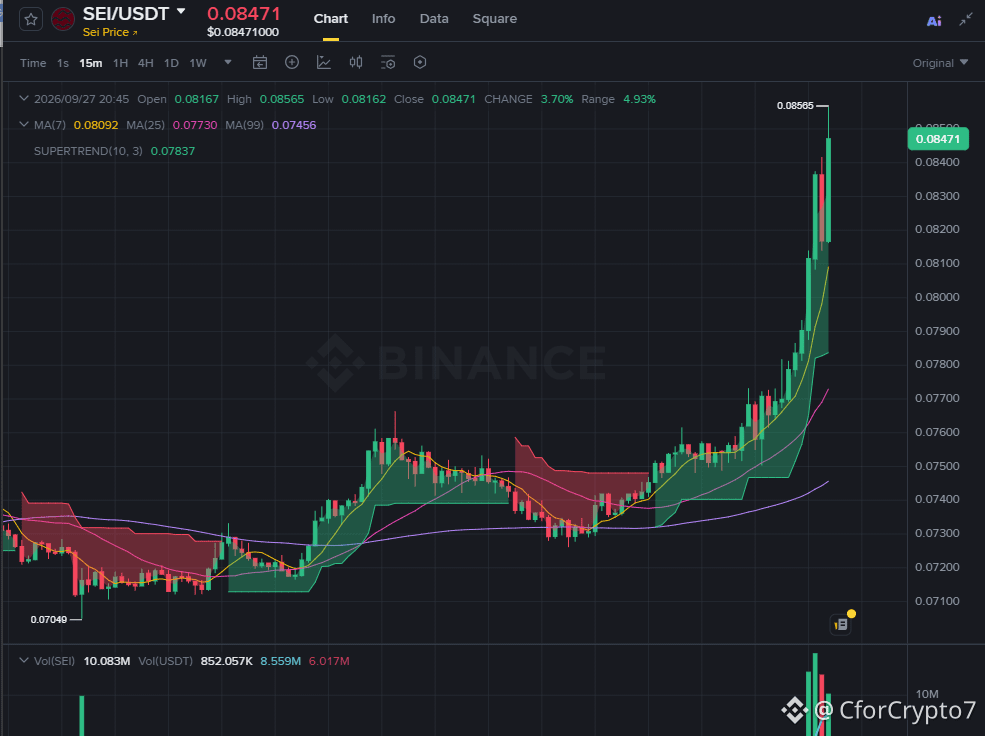
$SEI
Entry: $0.08380 – $0.08470
Stop Loss: $0.08200
TP1: $0.08600 TP2: $0.08800 TP3: $0.09000
Strong breakout with heavy volume....
trading well above the MA7, MA25 AND Supertrend.
Recent high at $0.08565 is the key resistance to clear.
Click here to Trade 👇️
$SEI
{spot}(SEIUSDT)
{future}(SEIUSDT)
$SEI
Entry: $0.08380 – $0.08470
Stop Loss: $0.08200
TP1: $0.08600 TP2: $0.08800 TP3: $0.09000
Strong breakout with heavy volume....
trading well above the MA7, MA25 AND Supertrend.
Recent high at $0.08565 is the key resistance to clear.
Click here to Trade 👇️
$SEI
Entry: $0.08380 – $0.08470
Stop Loss: $0.08200
TP1: $0.08600 TP2: $0.08800 TP3: $0.09000
Strong breakout with heavy volume....
trading well above the MA7, MA25 AND Supertrend.
Recent high at $0.08565 is the key resistance to clear.
Click here to Trade 👇️
$SEI
127
·
--
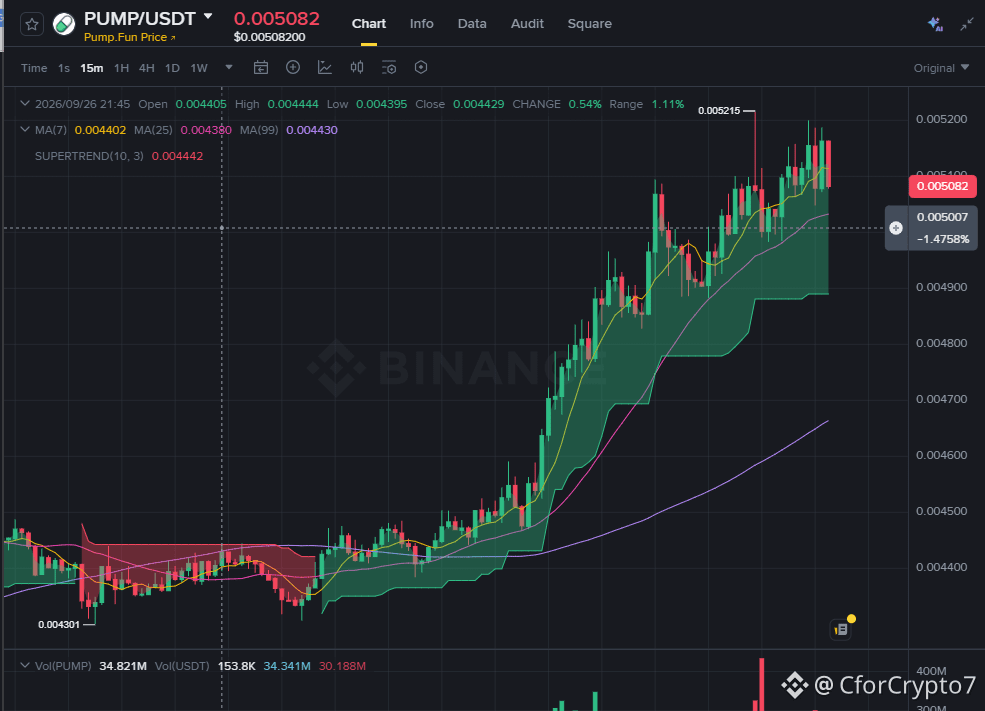
PUMP is pumping ....
Entry: $0.00500 – $0.00508
Stop Loss: $0.00488
TP1: $0.00522 TP2: $0.00540 TP3: $0.00560
Strong uptrend, above the MA7, MA25 AND Supertrend....
recent high at $0.005215 is the key breakout level to watch.
Clear that and this keeps running.
Click here to Trade 👇️
$PUMP
{spot}(PUMPUSDT)
{future}(PUMPUSDT)
PUMP is pumping ....
Entry: $0.00500 – $0.00508
Stop Loss: $0.00488
TP1: $0.00522 TP2: $0.00540 TP3: $0.00560
Strong uptrend, above the MA7, MA25 AND Supertrend....
recent high at $0.005215 is the key breakout level to watch.
Clear that and this keeps running.
Click here to Trade 👇️
$PUMP
Entry: $0.00500 – $0.00508
Stop Loss: $0.00488
TP1: $0.00522 TP2: $0.00540 TP3: $0.00560
Strong uptrend, above the MA7, MA25 AND Supertrend....
recent high at $0.005215 is the key breakout level to watch.
Clear that and this keeps running.
Click here to Trade 👇️
$PUMP
105
·
--
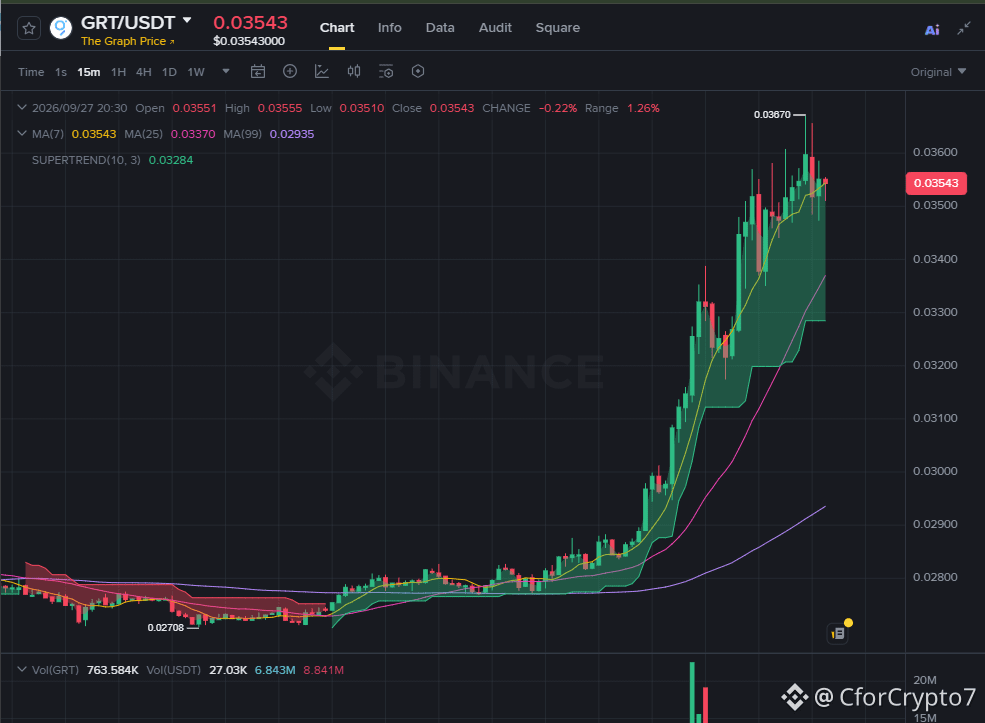
GRT is pumping
Entry: $0.03520 – $0.03550
Stop Loss: $0.03450
TP1: $0.03600 TP2: $0.03670 TP3: $0.03750
Strong breakout structure....
holding above the MA7, MA25 AND Supertrend, momentum still elevated here.
Clean setup.
Click here to Trade 👇️
$GRT
{future}(GRTUSDT)
{spot}(GRTUSDT)
GRT is pumping
Entry: $0.03520 – $0.03550
Stop Loss: $0.03450
TP1: $0.03600 TP2: $0.03670 TP3: $0.03750
Strong breakout structure....
holding above the MA7, MA25 AND Supertrend, momentum still elevated here.
Clean setup.
Click here to Trade 👇️
$GRT
Entry: $0.03520 – $0.03550
Stop Loss: $0.03450
TP1: $0.03600 TP2: $0.03670 TP3: $0.03750
Strong breakout structure....
holding above the MA7, MA25 AND Supertrend, momentum still elevated here.
Clean setup.
Click here to Trade 👇️
$GRT
112
·
--
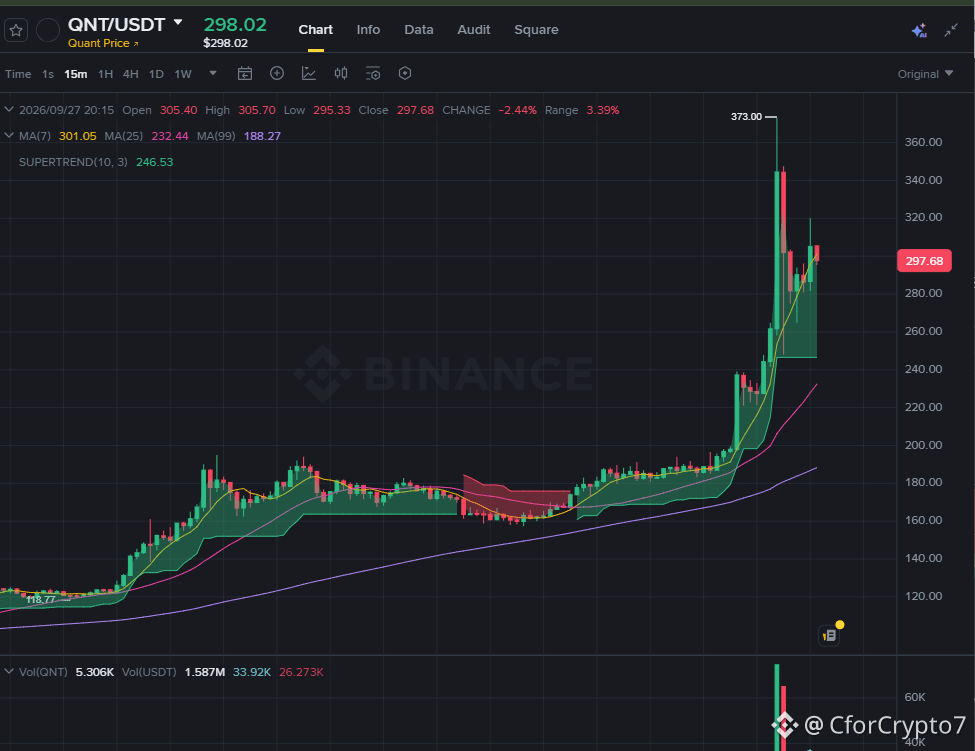
$QNT
Entry: $295 – $300
Stop Loss: $286
TP1: $310 TP2: $320 TP3: $340
Strong breakout followed by a sharp pullback....
reclaiming the short term level around $301, broader structure still elevated above the bigger MAs.
Recovery play with room to run.
Click here to Trade 👇️
$QNT
{future}(QNTUSDT)
{spot}(QNTUSDT)
$QNT
Entry: $295 – $300
Stop Loss: $286
TP1: $310 TP2: $320 TP3: $340
Strong breakout followed by a sharp pullback....
reclaiming the short term level around $301, broader structure still elevated above the bigger MAs.
Recovery play with room to run.
Click here to Trade 👇️
$QNT
Entry: $295 – $300
Stop Loss: $286
TP1: $310 TP2: $320 TP3: $340
Strong breakout followed by a sharp pullback....
reclaiming the short term level around $301, broader structure still elevated above the bigger MAs.
Recovery play with room to run.
Click here to Trade 👇️
$QNT
355
·
--
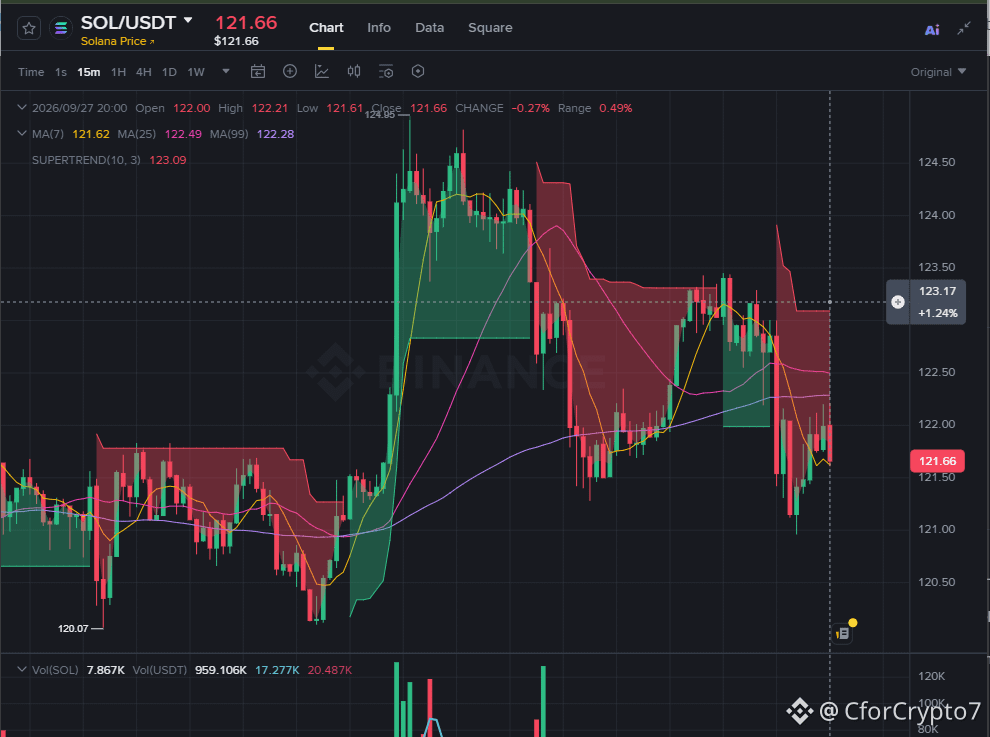
SOL
Entry: $121.50 – $121.80
Stop Loss: $120.90
TP1: $122.50 TP2: $123.20 TP3: $124.00
Bouncing off the $121.00 area, but still below the key MAs AND Supertrend at $123.09....
this is a counter-trend bounce play, not a confirmed trend flip, keep it tight.
Click here to Trade 👇️
$SOL
{spot}(SOLUSDT)
{future}(SOLUSDT)
DYOR NFA
SOL
Entry: $121.50 – $121.80
Stop Loss: $120.90
TP1: $122.50 TP2: $123.20 TP3: $124.00
Bouncing off the $121.00 area, but still below the key MAs AND Supertrend at $123.09....
this is a counter-trend bounce play, not a confirmed trend flip, keep it tight.
Click here to Trade 👇️
$SOL
DYOR NFA
Entry: $121.50 – $121.80
Stop Loss: $120.90
TP1: $122.50 TP2: $123.20 TP3: $124.00
Bouncing off the $121.00 area, but still below the key MAs AND Supertrend at $123.09....
this is a counter-trend bounce play, not a confirmed trend flip, keep it tight.
Click here to Trade 👇️
$SOL
DYOR NFA
167
·
--
🚨 MORE GAINERS LOADING 🚀
$JASMY +12%
$XVG +11%
$NOM +10%
Eyes on these 🔥
{future}(NOMUSDT)
{future}(XVGUSDT)
{future}(JASMYUSDT)
🚨 MORE GAINERS LOADING 🚀
$JASMY +12%
$XVG +11%
$NOM +10%
Eyes on these 🔥
$JASMY +12%
$XVG +11%
$NOM +10%
Eyes on these 🔥
135
·
--
🚨 3 BEASTS PUMPING HARD 💀
$PUMP +17%
$AUDIO +13%
$IMX +13%
Let’s ride 💥
{future}(IMXUSDT)
{spot}(AUDIOUSDT)
{future}(PUMPUSDT)
🚨 3 BEASTS PUMPING HARD 💀
$PUMP +17%
$AUDIO +13%
$IMX +13%
Let’s ride 💥
$PUMP +17%
$AUDIO +13%
$IMX +13%
Let’s ride 💥
1
217
·
--
🚨 GUYS — TOP 3 ON FIRE 🔥
$QNT +95%
$GRT +28%
$W +20%
{spot}(WUSDT)
{future}(GRTUSDT)
{future}(QNTUSDT)
🚨 GUYS — TOP 3 ON FIRE 🔥
$QNT +95%
$GRT +28%
$W +20%
$QNT +95%
$GRT +28%
$W +20%
123
·
--
🚨 $SOL ETFs JUST DID $188M IN ONE WEEK BIGGEST SINCE LAUNCH
U.S. spot Solana ETFs pulled in a record $188.21 million last week.
Bitwise BSOL alone took $128M almost 70% of the total. Every single fund saw inflows.
Assets are now pushing toward $2B with cumulative inflows over $1.6B.
This isn’t noise. Institutions are stacking SOL while most people are still focused on BTC and ETH.
I’m watching whether this flow momentum continues into the new week or cools off.
Bullish on the inflows or still waiting for price confirmation?
$ETH
{future}(ETHUSDT)
$BNB
{future}(BNBUSDT)
#SOLSpotETFWeeklyInflow$188M
#solanaETFs #crypto
🚨 $SOL ETFs JUST DID $188M IN ONE WEEK BIGGEST SINCE LAUNCH
U.S. spot Solana ETFs pulled in a record $188.21 million last week.
Bitwise BSOL alone took $128M almost 70% of the total. Every single fund saw inflows.
Assets are now pushing toward $2B with cumulative inflows over $1.6B.
This isn’t noise. Institutions are stacking SOL while most people are still focused on BTC and ETH.
I’m watching whether this flow momentum continues into the new week or cools off.
Bullish on the inflows or still waiting for price confirmation?
$ETH
$BNB
#SOLSpotETFWeeklyInflow$188M
#solanaETFs #crypto
U.S. spot Solana ETFs pulled in a record $188.21 million last week.
Bitwise BSOL alone took $128M almost 70% of the total. Every single fund saw inflows.
Assets are now pushing toward $2B with cumulative inflows over $1.6B.
This isn’t noise. Institutions are stacking SOL while most people are still focused on BTC and ETH.
I’m watching whether this flow momentum continues into the new week or cools off.
Bullish on the inflows or still waiting for price confirmation?
$ETH
$BNB
#SOLSpotETFWeeklyInflow$188M
#solanaETFs #crypto
391
·
--
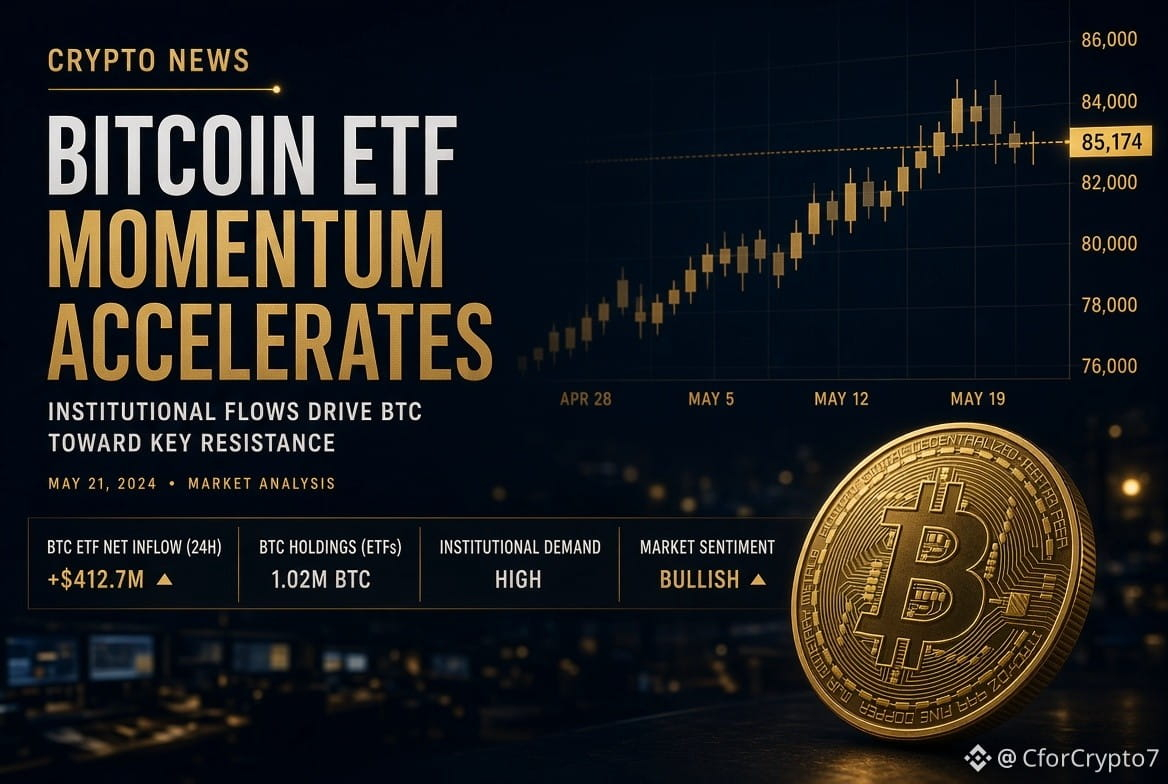
Bitcoin holds firm near $85,000 as U.S. spot ETFs deliver their strongest week since October 2025, pulling in $2.4 billion and flipping 2026 net flows positive.
Institutional demand is absorbing the pullback from $87,000 while Treasury yields stay elevated.
Ethereum trades around $2,700 with the Glamsterdam upgrade advancing, and altcoins show selective strength.
Bitget withdrawals restart today after the recent breach.
#BitcoinETFs remains the key driver this Monday flows continue to set the floor even as macro pressure lingers.
The market is watching whether $84,500 holds or sellers regain control.
$BTC $ETH
{future}(BTCUSDT)
{future}(ETHUSDT)
{spot}(ETHUSDT)
#crypto #bitcoin #BTC
Bitcoin holds firm near $85,000 as U.S. spot ETFs deliver their strongest week since October 2025, pulling in $2.4 billion and flipping 2026 net flows positive.
Institutional demand is absorbing the pullback from $87,000 while Treasury yields stay elevated.
Ethereum trades around $2,700 with the Glamsterdam upgrade advancing, and altcoins show selective strength.
Bitget withdrawals restart today after the recent breach.
#BitcoinETFs remains the key driver this Monday flows continue to set the floor even as macro pressure lingers.
The market is watching whether $84,500 holds or sellers regain control.
$BTC $ETH
#crypto #bitcoin #BTC
Institutional demand is absorbing the pullback from $87,000 while Treasury yields stay elevated.
Ethereum trades around $2,700 with the Glamsterdam upgrade advancing, and altcoins show selective strength.
Bitget withdrawals restart today after the recent breach.
#BitcoinETFs remains the key driver this Monday flows continue to set the floor even as macro pressure lingers.
The market is watching whether $84,500 holds or sellers regain control.
$BTC $ETH
#crypto #bitcoin #BTC
190
Connectez-vous pour découvrir plus de contenu
Rejoignez la communauté mondiale des adeptes de cryptomonnaies sur Binance Square
⚡️ Suviez les dernières informations importantes sur les cryptomonnaies.
💬 Jugé digne de confiance par la plus grande plateforme d’échange de cryptomonnaies au monde.
👍 Découvrez les connaissances que partagent les créateurs vérifiés.
Adresse e-mail/Nº de téléphone
Sujets d’actualité
EarningsSeason
100,077 vues
973 mentions
Earnings Season: Micron Q4 Earnings — Bullish or Bearish?
Binance Square Official
·181 mentions J’aime
·327.5k vues
ECBToTestAIAgentsInDigitalEuroPayments
1,484 vues
153 mentions
JapanFSABacksFourthStablecoinTradeSettlementPilot
3,517 vues
238 mentions