

BTC_Chopsticks
3.8k Publications
BTC_Chopsticks
Signaler
Bloquer l’utilisateur
🔥 Let's ride the crypto wave together and make those gains! 💸💰

Level 1 Creator
14 Suivis
6.4K+ Abonnés
180.7K+ J’aime
2 Badges
Publications
Tous
Citations
Vidéos
$BTDR has contracted more than $1.7B of expected A201 revenue over five years.
But the number I care about next is gross profit.
Bitdeer’s existing AI Cloud business generated $14.0M of revenue in Q2 and a $2.3M gross loss.
That’s historical, not a forecast for A201. The new Malaysia facility is different and targets Q1 2027 energization.
But it gives investors the right test:
Can Bitdeer turn contracted GPU demand into positive gross profit after hardware, depreciation and service costs?
Then comes the second test: how is the build funded?
Bitdeer expects to rely primarily on customer prepayments, operating cash flow and financing secured against contracted cash flows.
If A201 starts on time, AI Cloud turns profitable and financing doesn’t overwhelm per-share returns, the $1.7B contract value becomes much more meaningful.
Demand is now visible.
The economics still need to prove themselves.
$BTDR has contracted more than $1.7B of expected A201 revenue over five years.
But the number I care about next is gross profit.
Bitdeer’s existing AI Cloud business generated $14.0M of revenue in Q2 and a $2.3M gross loss.
That’s historical, not a forecast for A201. The new Malaysia facility is different and targets Q1 2027 energization.
But it gives investors the right test:
Can Bitdeer turn contracted GPU demand into positive gross profit after hardware, depreciation and service costs?
Then comes the second test: how is the build funded?
Bitdeer expects to rely primarily on customer prepayments, operating cash flow and financing secured against contracted cash flows.
If A201 starts on time, AI Cloud turns profitable and financing doesn’t overwhelm per-share returns, the $1.7B contract value becomes much more meaningful.
Demand is now visible.
The economics still need to prove themselves.
But the number I care about next is gross profit.
Bitdeer’s existing AI Cloud business generated $14.0M of revenue in Q2 and a $2.3M gross loss.
That’s historical, not a forecast for A201. The new Malaysia facility is different and targets Q1 2027 energization.
But it gives investors the right test:
Can Bitdeer turn contracted GPU demand into positive gross profit after hardware, depreciation and service costs?
Then comes the second test: how is the build funded?
Bitdeer expects to rely primarily on customer prepayments, operating cash flow and financing secured against contracted cash flows.
If A201 starts on time, AI Cloud turns profitable and financing doesn’t overwhelm per-share returns, the $1.7B contract value becomes much more meaningful.
Demand is now visible.
The economics still need to prove themselves.
116
OpenAI’s new Astra Ultrafast tier costs 6× Standard.
That doesn’t mean your workflow finishes 6× faster.
Tool calls, network waits and everything outside generation still consume time.
The test I’d use:
extra dollars ÷ seconds actually saved
Run the same workload at equal output quality. If the time saved isn’t worth the premium, stay on Standard.
Don’t pay for tokens/second. Pay for time actually removed.
OpenAI’s new Astra Ultrafast tier costs 6× Standard.
That doesn’t mean your workflow finishes 6× faster.
Tool calls, network waits and everything outside generation still consume time.
The test I’d use:
extra dollars ÷ seconds actually saved
Run the same workload at equal output quality. If the time saved isn’t worth the premium, stay on Standard.
Don’t pay for tokens/second. Pay for time actually removed.
That doesn’t mean your workflow finishes 6× faster.
Tool calls, network waits and everything outside generation still consume time.
The test I’d use:
extra dollars ÷ seconds actually saved
Run the same workload at equal output quality. If the time saved isn’t worth the premium, stay on Standard.
Don’t pay for tokens/second. Pay for time actually removed.
1
146
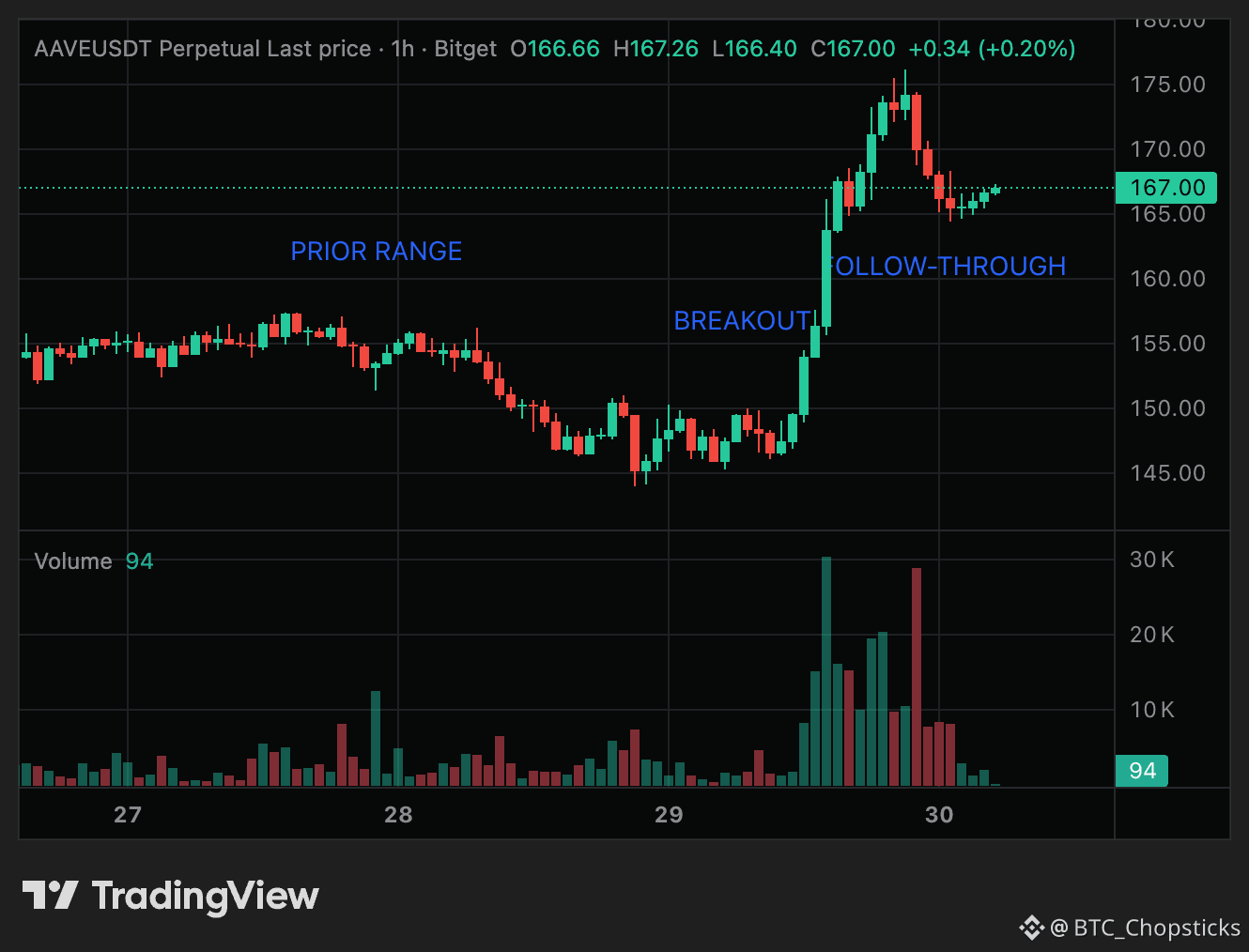
$AAVE’s breakout strengthened instead of fading.
The first observation was 1.22% beyond its prior range on 5.93× its preceding 7-day hourly median volume. One hour later: 3.92% beyond the refreshed prior-day boundary on 11.83× volume.
Over the next six hours, $AAVE gained 11.05% versus $BTC +0.37%, $ETH +1.11% and $SOL +1.33%.
The important signal wasn’t the breakout alone. It was expanding volume, acceptance above the old range and clear relative strength.
Now watch: does AAVE keep holding above the earlier range as abnormal volume normalizes?
{future}(AAVEUSDT)
$AAVE ’s breakout strengthened instead of fading.
The first observation was 1.22% beyond its prior range on 5.93× its preceding 7-day hourly median volume. One hour later: 3.92% beyond the refreshed prior-day boundary on 11.83× volume.
Over the next six hours, $AAVE gained 11.05% versus $BTC +0.37%, $ETH +1.11% and $SOL +1.33%.
The important signal wasn’t the breakout alone. It was expanding volume, acceptance above the old range and clear relative strength.
Now watch: does AAVE keep holding above the earlier range as abnormal volume normalizes?
The first observation was 1.22% beyond its prior range on 5.93× its preceding 7-day hourly median volume. One hour later: 3.92% beyond the refreshed prior-day boundary on 11.83× volume.
Over the next six hours, $AAVE gained 11.05% versus $BTC +0.37%, $ETH +1.11% and $SOL +1.33%.
The important signal wasn’t the breakout alone. It was expanding volume, acceptance above the old range and clear relative strength.
Now watch: does AAVE keep holding above the earlier range as abnormal volume normalizes?
182
Six Samsung affiliates are investing $1B in Helix.
Samsung Electronics is contributing $500M.
Helix develops AI data centers, power and network infrastructure. Samsung already sells pieces of that stack: chips, cooling, construction, data-center services and backup batteries.
That makes Helix a potential procurement channel, not an order book.
Samsung disclosed collaboration opportunities, not signed supply contracts.
The number to watch:
How much Helix procurement goes back to Samsung companies?
The $1B is the investment. The contracts will tell us whether it becomes a business opportunity.
Six Samsung affiliates are investing $1B in Helix.
Samsung Electronics is contributing $500M.
Helix develops AI data centers, power and network infrastructure. Samsung already sells pieces of that stack: chips, cooling, construction, data-center services and backup batteries.
That makes Helix a potential procurement channel, not an order book.
Samsung disclosed collaboration opportunities, not signed supply contracts.
The number to watch:
How much Helix procurement goes back to Samsung companies?
The $1B is the investment. The contracts will tell us whether it becomes a business opportunity.
Samsung Electronics is contributing $500M.
Helix develops AI data centers, power and network infrastructure. Samsung already sells pieces of that stack: chips, cooling, construction, data-center services and backup batteries.
That makes Helix a potential procurement channel, not an order book.
Samsung disclosed collaboration opportunities, not signed supply contracts.
The number to watch:
How much Helix procurement goes back to Samsung companies?
The $1B is the investment. The contracts will tell us whether it becomes a business opportunity.
165
$NVDA is turning AI-agent safety into infrastructure.
OpenShell enforces runtime policy around autonomous agents. Sentry adds an independent watchdog running on BlueField-4 DPUs.
The investment question isn't whether enterprises want safer agents.
It's whether agent governance becomes another reason to buy more of the NVIDIA stack.
There's an important caveat: OpenShell is open source and can extend to third-party Arm and Intel platforms. So software adoption alone doesn't prove NVIDIA hardware demand. NVIDIA Investor Relations
What I'd watch next:
Paid enterprise deployments + measurable Vera / BlueField attachment.
If those appear, NVIDIA may be building another infrastructure control point around agentic AI.
If OpenShell spreads without pulling NVIDIA hardware with it, the investment impact is much smaller.
Don't count consortium logos.
Count hardware attachment.
{future}(NVDAUSDT)
$NVDA is turning AI-agent safety into infrastructure.
OpenShell enforces runtime policy around autonomous agents. Sentry adds an independent watchdog running on BlueField-4 DPUs.
The investment question isn't whether enterprises want safer agents.
It's whether agent governance becomes another reason to buy more of the NVIDIA stack.
There's an important caveat: OpenShell is open source and can extend to third-party Arm and Intel platforms. So software adoption alone doesn't prove NVIDIA hardware demand. NVIDIA Investor Relations
What I'd watch next:
Paid enterprise deployments + measurable Vera / BlueField attachment.
If those appear, NVIDIA may be building another infrastructure control point around agentic AI.
If OpenShell spreads without pulling NVIDIA hardware with it, the investment impact is much smaller.
Don't count consortium logos.
Count hardware attachment.
OpenShell enforces runtime policy around autonomous agents. Sentry adds an independent watchdog running on BlueField-4 DPUs.
The investment question isn't whether enterprises want safer agents.
It's whether agent governance becomes another reason to buy more of the NVIDIA stack.
There's an important caveat: OpenShell is open source and can extend to third-party Arm and Intel platforms. So software adoption alone doesn't prove NVIDIA hardware demand. NVIDIA Investor Relations
What I'd watch next:
Paid enterprise deployments + measurable Vera / BlueField attachment.
If those appear, NVIDIA may be building another infrastructure control point around agentic AI.
If OpenShell spreads without pulling NVIDIA hardware with it, the investment impact is much smaller.
Don't count consortium logos.
Count hardware attachment.
179
About $149M was liquidated over 12 hours in a partial Binance/Bybit crypto sample. 85% were longs.
Long deleveraging is still significant, but the last hour flipped short-heavy.
Watch $BTC , $ETH and $SOL . If prices stabilize as long liquidations cool, the flush may be exhausting.
About $149M was liquidated over 12 hours in a partial Binance/Bybit crypto sample. 85% were longs.
Long deleveraging is still significant, but the last hour flipped short-heavy.
Watch $BTC , $ETH and $SOL . If prices stabilize as long liquidations cool, the flush may be exhausting.
Long deleveraging is still significant, but the last hour flipped short-heavy.
Watch $BTC , $ETH and $SOL . If prices stabilize as long liquidations cool, the flush may be exhausting.
95
$NVDA now has $235B of remaining buyback authorization through fiscal 2028.
But authorization is not capital returned.
Watch cash spent, average repurchase price and diluted shares. If NVIDIA spends heavily but diluted shares barely fall, dilution absorbed part of the buyback.
{future}(NVDAUSDT)
$NVDA now has $235B of remaining buyback authorization through fiscal 2028.
But authorization is not capital returned.
Watch cash spent, average repurchase price and diluted shares. If NVIDIA spends heavily but diluted shares barely fall, dilution absorbed part of the buyback.
But authorization is not capital returned.
Watch cash spent, average repurchase price and diluted shares. If NVIDIA spends heavily but diluted shares barely fall, dilution absorbed part of the buyback.
269
🌍 每周超1500亿美元的稳定币在TRON上流转,背后意味着什么?
TRON最初从去中心化内容分发起步,如今却逐渐成为全球数字美元的重要结算网络之一。
📊 近期数据:
💸 每周稳定币转账约1500亿–1900亿美元
🔄 每周交易接近1亿笔
💰 平均链上费用约0.07美元
⚡ 这和TRX有什么关系?
TRON交易会消耗带宽和能量。用户可质押TRX获取资源,资源不足时也可能燃烧TRX支付交易成本。
因此形成一条重要连接:
链上活动 → 资源需求 → TRX质押/燃烧
这并不代表使用量增长一定推动TRX价格上涨,但说明真实网络活动如何与TRX经济机制产生联系。
真正值得关注的,不只是1500亿+美元这个数字,而是TRON能否继续成为全球稳定币结算的重要基础设施。🌐
@justinsuntron @TRONDAO @TronDao_THA
#TRONGlobalFriends #TGF
🌍 每周超1500亿美元的稳定币在TRON上流转,背后意味着什么?
TRON最初从去中心化内容分发起步,如今却逐渐成为全球数字美元的重要结算网络之一。
📊 近期数据:
💸 每周稳定币转账约1500亿–1900亿美元
🔄 每周交易接近1亿笔
💰 平均链上费用约0.07美元
⚡ 这和TRX有什么关系?
TRON交易会消耗带宽和能量。用户可质押TRX获取资源,资源不足时也可能燃烧TRX支付交易成本。
因此形成一条重要连接:
链上活动 → 资源需求 → TRX质押/燃烧
这并不代表使用量增长一定推动TRX价格上涨,但说明真实网络活动如何与TRX经济机制产生联系。
真正值得关注的,不只是1500亿+美元这个数字,而是TRON能否继续成为全球稳定币结算的重要基础设施。🌐
@justinsuntron @TRON DAO @TronDao_THA
#TRONGlobalFriends #TGF
TRON最初从去中心化内容分发起步,如今却逐渐成为全球数字美元的重要结算网络之一。
📊 近期数据:
💸 每周稳定币转账约1500亿–1900亿美元
🔄 每周交易接近1亿笔
💰 平均链上费用约0.07美元
⚡ 这和TRX有什么关系?
TRON交易会消耗带宽和能量。用户可质押TRX获取资源,资源不足时也可能燃烧TRX支付交易成本。
因此形成一条重要连接:
链上活动 → 资源需求 → TRX质押/燃烧
这并不代表使用量增长一定推动TRX价格上涨,但说明真实网络活动如何与TRX经济机制产生联系。
真正值得关注的,不只是1500亿+美元这个数字,而是TRON能否继续成为全球稳定币结算的重要基础设施。🌐
@justinsuntron @TRON DAO @TronDao_THA
#TRONGlobalFriends #TGF
323
Nscale announced $3.36B of pre-IPO convertible financing versus over $103B of contracted value.
The contradiction: demand is contracted, but the capital bill arrives first.
For IPO buyers, the key number isn't TCV. It's how many shares those notes become. Watch the next filing.
Nscale announced $3.36B of pre-IPO convertible financing versus over $103B of contracted value.
The contradiction: demand is contracted, but the capital bill arrives first.
For IPO buyers, the key number isn't TCV. It's how many shares those notes become. Watch the next filing.
The contradiction: demand is contracted, but the capital bill arrives first.
For IPO buyers, the key number isn't TCV. It's how many shares those notes become. Watch the next filing.
143
🏠 Looks like TRON Bull has officially claimed a spot on my sofa. 😂❤️
Some swag stays in the box.
Some ends up becoming part of your everyday life.
👁️ One eye on the market
🛋️ One seat permanently reserved
🔴 Always representing TRON
I originally thought he was just going to be another piece in my TRON collection...
Now I'm starting to think I'm the guest and this is his apartment. 😂
Sometimes community isn't only about what happens online. The little things you bring home from events become memories too. ❤️
@justinsuntron @TRONDAO @TronDao_THA
#TRON #TRX #TRONGlobalFriends #TGF
🏠 Looks like TRON Bull has officially claimed a spot on my sofa. 😂❤️
Some swag stays in the box.
Some ends up becoming part of your everyday life.
👁️ One eye on the market
🛋️ One seat permanently reserved
🔴 Always representing TRON
I originally thought he was just going to be another piece in my TRON collection...
Now I'm starting to think I'm the guest and this is his apartment. 😂
Sometimes community isn't only about what happens online. The little things you bring home from events become memories too. ❤️
@justinsuntron @TRON DAO @TronDao_THA
#TRON #TRX #TRONGlobalFriends #TGF
Some swag stays in the box.
Some ends up becoming part of your everyday life.
👁️ One eye on the market
🛋️ One seat permanently reserved
🔴 Always representing TRON
I originally thought he was just going to be another piece in my TRON collection...
Now I'm starting to think I'm the guest and this is his apartment. 😂
Sometimes community isn't only about what happens online. The little things you bring home from events become memories too. ❤️
@justinsuntron @TRON DAO @TronDao_THA
#TRON #TRX #TRONGlobalFriends #TGF

223
Seven tokenized tech stocks can now be used as collateral to borrow USDC on Aave V4.
The contradiction: the aggregate launch collateral cap is only about $29M.
This proves composability, not demand.
I'd watch USDC borrowing and whether the caps increase.
If borrowing stalls despite the assets being available, tokenized stocks may still be a wrapper looking for a real use case.
{future}(AAVEUSDT)
Seven tokenized tech stocks can now be used as collateral to borrow USDC on Aave V4.
The contradiction: the aggregate launch collateral cap is only about $29M.
This proves composability, not demand.
I'd watch USDC borrowing and whether the caps increase.
If borrowing stalls despite the assets being available, tokenized stocks may still be a wrapper looking for a real use case.
The contradiction: the aggregate launch collateral cap is only about $29M.
This proves composability, not demand.
I'd watch USDC borrowing and whether the caps increase.
If borrowing stalls despite the assets being available, tokenized stocks may still be a wrapper looking for a real use case.
162
Amazon blocked Meta's Muse from shopping on Amazon.com less than two weeks after the agent launched.
That exposes a constraint in agentic commerce.
The AI agent may control the user interface, but the retailer still controls access to checkout and the customer relationship.
For $META , popularity alone doesn't prove commerce economics.
Muse needs retailers willing to let it transact, plus a way for Meta to earn money from those transactions.
For $AMZN , blocking outside agents helps preserve control over the shopping experience and customer relationship.
But there's a tradeoff.
If consumers prefer shopping through AI agents, cooperative retailers could capture demand that Amazon refuses.
I'd watch which retailers give Muse direct checkout access and whether Meta eventually reports transaction volume or commerce revenue.
AI agents can win users and still lose at the checkout.
{future}(AMZNUSDT)
{future}(METAUSDT)
Amazon blocked Meta's Muse from shopping on Amazon.com less than two weeks after the agent launched.
That exposes a constraint in agentic commerce.
The AI agent may control the user interface, but the retailer still controls access to checkout and the customer relationship.
For $META , popularity alone doesn't prove commerce economics.
Muse needs retailers willing to let it transact, plus a way for Meta to earn money from those transactions.
For $AMZN , blocking outside agents helps preserve control over the shopping experience and customer relationship.
But there's a tradeoff.
If consumers prefer shopping through AI agents, cooperative retailers could capture demand that Amazon refuses.
I'd watch which retailers give Muse direct checkout access and whether Meta eventually reports transaction volume or commerce revenue.
AI agents can win users and still lose at the checkout.
That exposes a constraint in agentic commerce.
The AI agent may control the user interface, but the retailer still controls access to checkout and the customer relationship.
For $META , popularity alone doesn't prove commerce economics.
Muse needs retailers willing to let it transact, plus a way for Meta to earn money from those transactions.
For $AMZN , blocking outside agents helps preserve control over the shopping experience and customer relationship.
But there's a tradeoff.
If consumers prefer shopping through AI agents, cooperative retailers could capture demand that Amazon refuses.
I'd watch which retailers give Muse direct checkout access and whether Meta eventually reports transaction volume or commerce revenue.
AI agents can win users and still lose at the checkout.
421
Binance invested $100M in Circle and signed a five-year deal to promote USDC.
The investment is the less important number.
Circle's filing says it will pay Binance monthly incentive fees based on qualifying USDC balances. Binance will promote USDC across its platform.
For $CRCL, that creates both opportunity and cost.
More USDC on Binance could increase USDC circulation. Circle earns most of its revenue from the reserves backing its stablecoins.
But distribution isn't free.
Circle hasn't disclosed the incentive percentage, adoption targets or expected earnings contribution.
So I wouldn't treat this as a simple $100M endorsement.
I'd watch USDC circulation, Circle's distribution costs and revenue less distribution costs.
If circulation grows faster than incentive expense, the agreement can improve Circle's economics.
If incentive fees absorb too much of the incremental reserve income, volume could rise without equivalent shareholder value.
The $100M investment gets attention.
The five-year distribution economics will determine whether $CRCL shareholders benefit.
{future}(CRCLUSDT)
Binance invested $100M in Circle and signed a five-year deal to promote USDC.
The investment is the less important number.
Circle's filing says it will pay Binance monthly incentive fees based on qualifying USDC balances. Binance will promote USDC across its platform.
For $CRCL , that creates both opportunity and cost.
More USDC on Binance could increase USDC circulation. Circle earns most of its revenue from the reserves backing its stablecoins.
But distribution isn't free.
Circle hasn't disclosed the incentive percentage, adoption targets or expected earnings contribution.
So I wouldn't treat this as a simple $100M endorsement.
I'd watch USDC circulation, Circle's distribution costs and revenue less distribution costs.
If circulation grows faster than incentive expense, the agreement can improve Circle's economics.
If incentive fees absorb too much of the incremental reserve income, volume could rise without equivalent shareholder value.
The $100M investment gets attention.
The five-year distribution economics will determine whether $CRCL shareholders benefit.
The investment is the less important number.
Circle's filing says it will pay Binance monthly incentive fees based on qualifying USDC balances. Binance will promote USDC across its platform.
For $CRCL , that creates both opportunity and cost.
More USDC on Binance could increase USDC circulation. Circle earns most of its revenue from the reserves backing its stablecoins.
But distribution isn't free.
Circle hasn't disclosed the incentive percentage, adoption targets or expected earnings contribution.
So I wouldn't treat this as a simple $100M endorsement.
I'd watch USDC circulation, Circle's distribution costs and revenue less distribution costs.
If circulation grows faster than incentive expense, the agreement can improve Circle's economics.
If incentive fees absorb too much of the incremental reserve income, volume could rise without equivalent shareholder value.
The $100M investment gets attention.
The five-year distribution economics will determine whether $CRCL shareholders benefit.
238
AI productivity could push interest rates up OR down.
The difference is whether the productivity boom is expected before it arrives.
Chicago Fed researchers modeled a 10-year productivity surge.
When an extra 1 percentage point of annual productivity growth is fully anticipated, their model implies interest rates about 50 basis points higher during the surge.
Why?
Expected future productivity makes households feel richer and pulls spending forward before all of the additional productive capacity exists.
That raises the natural rate of interest.
But when the same productivity gains arrive unexpectedly, the model produces the opposite result: lower costs and inflation push the appropriate rate down.
This is a model, not a Fed forecast.
But the investment implication is important.
The AI bull case doesn't automatically mean lower rates.
Markets can price enormous future productivity gains while today's economy still faces stronger demand, heavy investment and a higher discount rate.
That means AI companies can deliver real growth while their valuations still face pressure from rates.
AI can improve future earnings and raise today's cost of capital at the same time.
AI productivity could push interest rates up OR down.
The difference is whether the productivity boom is expected before it arrives.
Chicago Fed researchers modeled a 10-year productivity surge.
When an extra 1 percentage point of annual productivity growth is fully anticipated, their model implies interest rates about 50 basis points higher during the surge.
Why?
Expected future productivity makes households feel richer and pulls spending forward before all of the additional productive capacity exists.
That raises the natural rate of interest.
But when the same productivity gains arrive unexpectedly, the model produces the opposite result: lower costs and inflation push the appropriate rate down.
This is a model, not a Fed forecast.
But the investment implication is important.
The AI bull case doesn't automatically mean lower rates.
Markets can price enormous future productivity gains while today's economy still faces stronger demand, heavy investment and a higher discount rate.
That means AI companies can deliver real growth while their valuations still face pressure from rates.
AI can improve future earnings and raise today's cost of capital at the same time.
The difference is whether the productivity boom is expected before it arrives.
Chicago Fed researchers modeled a 10-year productivity surge.
When an extra 1 percentage point of annual productivity growth is fully anticipated, their model implies interest rates about 50 basis points higher during the surge.
Why?
Expected future productivity makes households feel richer and pulls spending forward before all of the additional productive capacity exists.
That raises the natural rate of interest.
But when the same productivity gains arrive unexpectedly, the model produces the opposite result: lower costs and inflation push the appropriate rate down.
This is a model, not a Fed forecast.
But the investment implication is important.
The AI bull case doesn't automatically mean lower rates.
Markets can price enormous future productivity gains while today's economy still faces stronger demand, heavy investment and a higher discount rate.
That means AI companies can deliver real growth while their valuations still face pressure from rates.
AI can improve future earnings and raise today's cost of capital at the same time.
315
Bitcoin broke above $85,000, but today's candle is doing two jobs.
$BTC gained more than 5% while $648M of more than $750M in crypto liquidations were shorts.
At the same time, falling oil and a broader risk-asset rebound improved the macro backdrop.
So this wasn't simply fresh buyers suddenly deciding Bitcoin was worth 5% more.
Real buying helped push the market higher, while forced short covering made the move faster.
That's why I wouldn't judge the breakout from the liquidation number alone.
The better test is what happens after the shorts are already cleared.
If Bitcoin can hold above $85K as forced buying fades, the breakout becomes more convincing.
If it quickly falls back below the breakout area, part of the move was likely positioning rather than durable demand.
The move is real.
The question is how much survives after the forced buying ends.
{future}(BTCUSDT)
Bitcoin broke above $85,000, but today's candle is doing two jobs.
$BTC gained more than 5% while $648M of more than $750M in crypto liquidations were shorts.
At the same time, falling oil and a broader risk-asset rebound improved the macro backdrop.
So this wasn't simply fresh buyers suddenly deciding Bitcoin was worth 5% more.
Real buying helped push the market higher, while forced short covering made the move faster.
That's why I wouldn't judge the breakout from the liquidation number alone.
The better test is what happens after the shorts are already cleared.
If Bitcoin can hold above $85K as forced buying fades, the breakout becomes more convincing.
If it quickly falls back below the breakout area, part of the move was likely positioning rather than durable demand.
The move is real.
The question is how much survives after the forced buying ends.
$BTC gained more than 5% while $648M of more than $750M in crypto liquidations were shorts.
At the same time, falling oil and a broader risk-asset rebound improved the macro backdrop.
So this wasn't simply fresh buyers suddenly deciding Bitcoin was worth 5% more.
Real buying helped push the market higher, while forced short covering made the move faster.
That's why I wouldn't judge the breakout from the liquidation number alone.
The better test is what happens after the shorts are already cleared.
If Bitcoin can hold above $85K as forced buying fades, the breakout becomes more convincing.
If it quickly falls back below the breakout area, part of the move was likely positioning rather than durable demand.
The move is real.
The question is how much survives after the forced buying ends.
1
3k
Vérifié
Agentic AI may turn memory capacity into the next bottleneck.
Astera Labs says its new Leo controllers are sampling with hyperscalers and have secured design wins across AI labs, hyperscalers and neoclouds.
Leo X attaches memory directly to AI fabrics for long-context and KV-cache workloads.
In Astera's stated test configuration, Leo X delivered up to 62% faster time to first token and 22% higher token throughput.
Leo 2 can also reuse DDR4 alongside DDR5, helping cloud operators expand memory without replacing every installed DIMM.
That gives $ALAB a clear path to value:
More memory tiers and pooling can require more connectivity silicon.
But design wins aren't revenue.
Customers are unnamed, and production timing, expected sales and margins remain undisclosed.
I'd watch for named deployments, volume production and Leo revenue entering guidance.
The AI memory bottleneck may not benefit only memory manufacturers.
It could also reward the companies connecting memory to compute.
{future}(ALABUSDT)
Agentic AI may turn memory capacity into the next bottleneck.
Astera Labs says its new Leo controllers are sampling with hyperscalers and have secured design wins across AI labs, hyperscalers and neoclouds.
Leo X attaches memory directly to AI fabrics for long-context and KV-cache workloads.
In Astera's stated test configuration, Leo X delivered up to 62% faster time to first token and 22% higher token throughput.
Leo 2 can also reuse DDR4 alongside DDR5, helping cloud operators expand memory without replacing every installed DIMM.
That gives $ALAB a clear path to value:
More memory tiers and pooling can require more connectivity silicon.
But design wins aren't revenue.
Customers are unnamed, and production timing, expected sales and margins remain undisclosed.
I'd watch for named deployments, volume production and Leo revenue entering guidance.
The AI memory bottleneck may not benefit only memory manufacturers.
It could also reward the companies connecting memory to compute.
Astera Labs says its new Leo controllers are sampling with hyperscalers and have secured design wins across AI labs, hyperscalers and neoclouds.
Leo X attaches memory directly to AI fabrics for long-context and KV-cache workloads.
In Astera's stated test configuration, Leo X delivered up to 62% faster time to first token and 22% higher token throughput.
Leo 2 can also reuse DDR4 alongside DDR5, helping cloud operators expand memory without replacing every installed DIMM.
That gives $ALAB a clear path to value:
More memory tiers and pooling can require more connectivity silicon.
But design wins aren't revenue.
Customers are unnamed, and production timing, expected sales and margins remain undisclosed.
I'd watch for named deployments, volume production and Leo revenue entering guidance.
The AI memory bottleneck may not benefit only memory manufacturers.
It could also reward the companies connecting memory to compute.
2.3k
CleanSpark priced $2.276B of debt at 7.875% to fund its Sandersville AI data center. That's about $179M of annual coupon interest. The site has a $6.6B, 20-year lease. For $CLSK, the test is whether project cash flow comfortably outruns financing and build costs.
CleanSpark priced $2.276B of debt at 7.875% to fund its Sandersville AI data center. That's about $179M of annual coupon interest. The site has a $6.6B, 20-year lease. For $CLSK, the test is whether project cash flow comfortably outruns financing and build costs.
201
CoreWeave upsized its new convertible-note offering from $3B to $3.7B.
The 2.875% coupon looks cheap for a company financing an enormous AI buildout.
But cheap interest doesn't eliminate equity risk.
The notes initially convert at $97.85 per share, 22.5% above the reference share price.
CoreWeave also bought capped calls intended to reduce potential dilution, but that protection has a cap.
The larger issue is the financing burden already on the business.
In Q2, CoreWeave generated $2.575B of revenue but incurred $640M of net interest expense.
The company also had approximately $104B of revenue backlog, so demand isn't the immediate p
roblem.
For $CRWVB , the investment test is whether new capacity converts backlog into revenue and cash flow faster than financing costs accumulate.
I'd watch interest expense, operating margin and how quickly deployed capacity starts producing revenue.
AI compute scarcity can justify leverage.
Shareholders still need the economics to outrun it.
{spot}(CRWVBUSDT)
CoreWeave upsized its new convertible-note offering from $3B to $3.7B.
The 2.875% coupon looks cheap for a company financing an enormous AI buildout.
But cheap interest doesn't eliminate equity risk.
The notes initially convert at $97.85 per share, 22.5% above the reference share price.
CoreWeave also bought capped calls intended to reduce potential dilution, but that protection has a cap.
The larger issue is the financing burden already on the business.
In Q2, CoreWeave generated $2.575B of revenue but incurred $640M of net interest expense.
The company also had approximately $104B of revenue backlog, so demand isn't the immediate p
roblem.
For $CRWVB , the investment test is whether new capacity converts backlog into revenue and cash flow faster than financing costs accumulate.
I'd watch interest expense, operating margin and how quickly deployed capacity starts producing revenue.
AI compute scarcity can justify leverage.
Shareholders still need the economics to outrun it.
The 2.875% coupon looks cheap for a company financing an enormous AI buildout.
But cheap interest doesn't eliminate equity risk.
The notes initially convert at $97.85 per share, 22.5% above the reference share price.
CoreWeave also bought capped calls intended to reduce potential dilution, but that protection has a cap.
The larger issue is the financing burden already on the business.
In Q2, CoreWeave generated $2.575B of revenue but incurred $640M of net interest expense.
The company also had approximately $104B of revenue backlog, so demand isn't the immediate p
roblem.
For $CRWVB , the investment test is whether new capacity converts backlog into revenue and cash flow faster than financing costs accumulate.
I'd watch interest expense, operating margin and how quickly deployed capacity starts producing revenue.
AI compute scarcity can justify leverage.
Shareholders still need the economics to outrun it.
169
Anthropic and Accenture each expect to invest at least $1B over five years in embedded AI evaluation.
But investors shouldn't read that as a $2B Accenture contract.
Anthropic says it will directly fund Accenture's work. Accenture is also committing its own capital and expertise.
No revenue, margin or payment schedule was disclosed.
For $ACN, the opportunity is to turn embedded evaluation into a new consulting business.
If frontier AI labs need outside teams working inside their development process t
o red-team models and test safeguards, Accenture could sell that capability beyond Anthropic.
The partnership is non-exclusive. Anthropic can work with other evaluators, while Accenture can serve other AI developers.
But the field is new. Standards, reporting and long-term funding models are still being developed.
So I wouldn't value $ACN from the headline commitments alone.
I'd watch whether Accenture signs other AI labs and eventually discloses bookings or recurring revenue from this work.
AI safety is starting to attract serious investment.
The test is whether Accenture can turn that investment into profitable recurring revenue.
Anthropic and Accenture each expect to invest at least $1B over five years in embedded AI evaluation.
But investors shouldn't read that as a $2B Accenture contract.
Anthropic says it will directly fund Accenture's work. Accenture is also committing its own capital and expertise.
No revenue, margin or payment schedule was disclosed.
For $ACN , the opportunity is to turn embedded evaluation into a new consulting business.
If frontier AI labs need outside teams working inside their development process t
o red-team models and test safeguards, Accenture could sell that capability beyond Anthropic.
The partnership is non-exclusive. Anthropic can work with other evaluators, while Accenture can serve other AI developers.
But the field is new. Standards, reporting and long-term funding models are still being developed.
So I wouldn't value $ACN from the headline commitments alone.
I'd watch whether Accenture signs other AI labs and eventually discloses bookings or recurring revenue from this work.
AI safety is starting to attract serious investment.
The test is whether Accenture can turn that investment into profitable recurring revenue.
But investors shouldn't read that as a $2B Accenture contract.
Anthropic says it will directly fund Accenture's work. Accenture is also committing its own capital and expertise.
No revenue, margin or payment schedule was disclosed.
For $ACN , the opportunity is to turn embedded evaluation into a new consulting business.
If frontier AI labs need outside teams working inside their development process t
o red-team models and test safeguards, Accenture could sell that capability beyond Anthropic.
The partnership is non-exclusive. Anthropic can work with other evaluators, while Accenture can serve other AI developers.
But the field is new. Standards, reporting and long-term funding models are still being developed.
So I wouldn't value $ACN from the headline commitments alone.
I'd watch whether Accenture signs other AI labs and eventually discloses bookings or recurring revenue from this work.
AI safety is starting to attract serious investment.
The test is whether Accenture can turn that investment into profitable recurring revenue.
542
Nscale reports $103.4B of active and contracted TCV.
But the company generated only $140.6M of revenue in the first half of 2026—and lost $1.02B.
That's the tension behind its proposed $NSCL IPO.
TCV isn't revenue today.
Nscale's agreements can span years and depend on infrastructure being financed, delivered and kept available.
Its Anthropic agreements alone provide for payments of up to $44.6B.
But Nscale says it has not yet obtained binding commitments for the financing required to perform those agreements.
Its largest customer also produced 52% of first-half revenue.
The upside is clear.
If Nscale finances and delivers the capacity, long-term customer commitments could turn an early-stage business into a major AI-infrastructure platform.
But prospective IPO investors are being asked to evaluate that buildout before most of the contract value becomes recognized revenue.
So I wouldn't value the proposed IPO from the $103.4B headline alone.
I'd watch the IPO valuation, financing commitments and how quickly deployed capacity converts TCV into revenue and cash flow.
Nscale has already contracted enormous demand.
The investment test is whether it can finance and deliver the infrastructure required to collect it.
Nscale reports $103.4B of active and contracted TCV.
But the company generated only $140.6M of revenue in the first half of 2026—and lost $1.02B.
That's the tension behind its proposed $NSCL IPO.
TCV isn't revenue today.
Nscale's agreements can span years and depend on infrastructure being financed, delivered and kept available.
Its Anthropic agreements alone provide for payments of up to $44.6B.
But Nscale says it has not yet obtained binding commitments for the financing required to perform those agreements.
Its largest customer also produced 52% of first-half revenue.
The upside is clear.
If Nscale finances and delivers the capacity, long-term customer commitments could turn an early-stage business into a major AI-infrastructure platform.
But prospective IPO investors are being asked to evaluate that buildout before most of the contract value becomes recognized revenue.
So I wouldn't value the proposed IPO from the $103.4B headline alone.
I'd watch the IPO valuation, financing commitments and how quickly deployed capacity converts TCV into revenue and cash flow.
Nscale has already contracted enormous demand.
The investment test is whether it can finance and deliver the infrastructure required to collect it.
But the company generated only $140.6M of revenue in the first half of 2026—and lost $1.02B.
That's the tension behind its proposed $NSCL IPO.
TCV isn't revenue today.
Nscale's agreements can span years and depend on infrastructure being financed, delivered and kept available.
Its Anthropic agreements alone provide for payments of up to $44.6B.
But Nscale says it has not yet obtained binding commitments for the financing required to perform those agreements.
Its largest customer also produced 52% of first-half revenue.
The upside is clear.
If Nscale finances and delivers the capacity, long-term customer commitments could turn an early-stage business into a major AI-infrastructure platform.
But prospective IPO investors are being asked to evaluate that buildout before most of the contract value becomes recognized revenue.
So I wouldn't value the proposed IPO from the $103.4B headline alone.
I'd watch the IPO valuation, financing commitments and how quickly deployed capacity converts TCV into revenue and cash flow.
Nscale has already contracted enormous demand.
The investment test is whether it can finance and deliver the infrastructure required to collect it.
169
Connectez-vous pour découvrir plus de contenu
Rejoignez la communauté mondiale des adeptes de cryptomonnaies sur Binance Square
⚡️ Suviez les dernières informations importantes sur les cryptomonnaies.
💬 Jugé digne de confiance par la plus grande plateforme d’échange de cryptomonnaies au monde.
👍 Découvrez les connaissances que partagent les créateurs vérifiés.
Adresse e-mail/Nº de téléphone
Sujets d’actualité
MetaMaskExitsLidoValidatorsAfterSecurityIncident
534 vues
46 mentions
#metamaskexitslidovalidatorsaftersecurityincident
🦊 MetaMask & Lido: Is the honeymoon officially over?! 💔
MetaMask just hit the "Emergency Exit" button on its Lido Ethereum validators after a security scare! 😱 While MetaMask assures everyone that wallet funds are totally safe, they aren't taking any chances with their non-custodial staking infrastructure.
🔮 What happened to Lido?
No drama on Lido's side, but MetaMask is proactively pulling its affected nodes out of the Lido protocol. The validators are exiting by October 7, 2026, and the full re-entry process could take around 45 days. Good news? If you hold stETH, you can relax—no action is needed! 🛡️
🧠 What should traders do?
Don't panic-dump your bags. Keep your funds secure, double-check your staking setups, and always monitor security updates!
Not financial advice.
Support me by using code VINHTOCDO or link: https://www.binance.com/register?ref=VINHTOCDO
👇 Click trade below to support me:
$BTC
$ETH
$LDO
#MetaMask #LidoFinance #CryptoSecurity #EthereumStaking #CryptoNews #VINHTOCDO
Vinhtocdo
·2 mentions J’aime
·54 vues
MicronBeatsEarningsLiftsGuidance
2,297 vues
70 mentions
CFTCSubmitsTwoEventContractRulesToWhiteHouse
3,285 vues
111 mentions