

Bluechip
8.8k Publications

Bluechip
 Compte Square Vérifié+
Signaler
Bloquer l’utilisateur
Trade régulièrement
5.7 an(s)
24 Suivis
67.9K+ Abonnés
95.2K+ J’aime
Publications
Tous
Citations
Vidéos
Direct
PINNED
·
--
Haussier
🚨 THE ALPHA BOARD – FOUNDERS ACCESS 🚨
After multiple requests from some followers, I’ve decided to open something private.
What I share publicly is only a fraction of the full picture.
The market is a game of liquidity, timing, and understanding.
Most people always arrive… too late.
Today, I’m officially opening The Alpha Board, a private group built for those who want to see the move before it happens, not after.
Inside, you’ll get:
• Advanced market analysis ($BTC , Stocks, macro)
• Key liquidity zones & forward scenarios
• Smart money flow breakdowns
• Clear market structure insights
• Direct access + a serious community
This is NOT a signals group.
This is where you build a real edge.
If you’re tired of:
- following the crowd
- entering too late
- not understanding why the market moves
Then this is exactly for you.
Founder one-time access: $39
Limited spots available
Scan the QR code or click on the link to join instantly
This post will be auto-deleted in 15 days
The market doesn’t reward the fastest.
It rewards the most prepared.
[The Alpha Board link](https://app.binance.com/uni-qr/group-chat-landing?channelToken=uxZ207Vrh6cPhZPhAovsaQ&type=1&entrySource=sharing_link)
#BTC #crypto #trading #smartmoney #BinanceSquare
🚨 THE ALPHA BOARD – FOUNDERS ACCESS 🚨
After multiple requests from some followers, I’ve decided to open something private.
What I share publicly is only a fraction of the full picture.
The market is a game of liquidity, timing, and understanding.
Most people always arrive… too late.
Today, I’m officially opening The Alpha Board, a private group built for those who want to see the move before it happens, not after.
Inside, you’ll get:
• Advanced market analysis ($BTC , Stocks, macro)
• Key liquidity zones & forward scenarios
• Smart money flow breakdowns
• Clear market structure insights
• Direct access + a serious community
This is NOT a signals group.
This is where you build a real edge.
If you’re tired of:
- following the crowd
- entering too late
- not understanding why the market moves
Then this is exactly for you.
Founder one-time access: $39
Limited spots available
Scan the QR code or click on the link to join instantly
This post will be auto-deleted in 15 days
The market doesn’t reward the fastest.
It rewards the most prepared.
The Alpha Board link
#BTC #crypto #trading #smartmoney #BinanceSquare
After multiple requests from some followers, I’ve decided to open something private.
What I share publicly is only a fraction of the full picture.
The market is a game of liquidity, timing, and understanding.
Most people always arrive… too late.
Today, I’m officially opening The Alpha Board, a private group built for those who want to see the move before it happens, not after.
Inside, you’ll get:
• Advanced market analysis ($BTC , Stocks, macro)
• Key liquidity zones & forward scenarios
• Smart money flow breakdowns
• Clear market structure insights
• Direct access + a serious community
This is NOT a signals group.
This is where you build a real edge.
If you’re tired of:
- following the crowd
- entering too late
- not understanding why the market moves
Then this is exactly for you.
Founder one-time access: $39
Limited spots available
Scan the QR code or click on the link to join instantly
This post will be auto-deleted in 15 days
The market doesn’t reward the fastest.
It rewards the most prepared.
The Alpha Board link
#BTC #crypto #trading #smartmoney #BinanceSquare
64
31
2.8k
PINNED
·
--
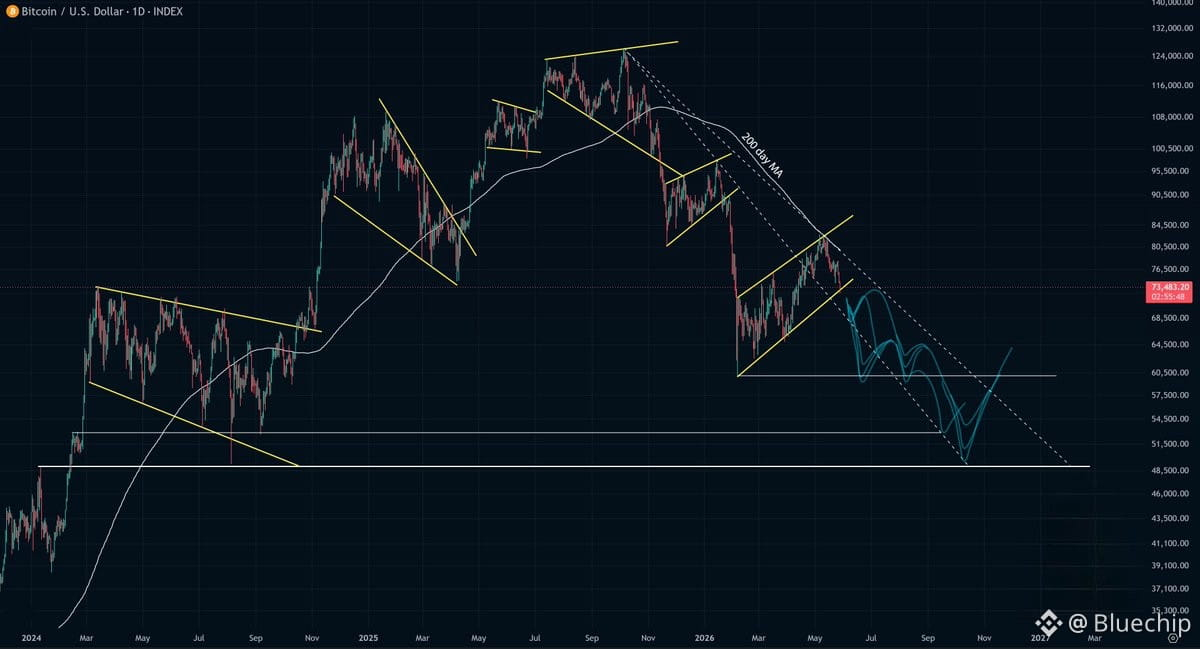
$BTC squiggles
Here's a rough visualization of how I see the most likely scenarios playing out. If you average them, you'll get a feel for the broad concept I have. I can absolutely be wrong, but it's my take on things currently.
Note that I give the diagonal (dotted) trend lines some importance in controlling the price movements as well as the horizontal support levels.
This falls in alignment with my other post on the odds I give these Bitcoin scenarios.
{future}(BTCUSDT)
$BTC squiggles
Here's a rough visualization of how I see the most likely scenarios playing out. If you average them, you'll get a feel for the broad concept I have. I can absolutely be wrong, but it's my take on things currently.
Note that I give the diagonal (dotted) trend lines some importance in controlling the price movements as well as the horizontal support levels.
This falls in alignment with my other post on the odds I give these Bitcoin scenarios.
Here's a rough visualization of how I see the most likely scenarios playing out. If you average them, you'll get a feel for the broad concept I have. I can absolutely be wrong, but it's my take on things currently.
Note that I give the diagonal (dotted) trend lines some importance in controlling the price movements as well as the horizontal support levels.
This falls in alignment with my other post on the odds I give these Bitcoin scenarios.
23
7
95
99.6k
·
--
🤯 In 3 days, we’ll mark the anniversary of one of crypto’s darkest days.
October 10, 2025.
A day many traders will never forget.
Large parts of the crypto market suffered massive losses that day, with many altcoins collapsing by 50%+ in a matter of hours.
For many, it felt like a reminder of FTX and LUNA.
Personally, I didn’t take a major hit.
But I know traders who were heavily exposed to futures…
Some lost more than $1 million that day.
And now, October 10 is coming again.
History doesn’t always repeat…
But sometimes, it rhymes.
🤯 In 3 days, we’ll mark the anniversary of one of crypto’s darkest days.
October 10, 2025.
A day many traders will never forget.
Large parts of the crypto market suffered massive losses that day, with many altcoins collapsing by 50%+ in a matter of hours.
For many, it felt like a reminder of FTX and LUNA.
Personally, I didn’t take a major hit.
But I know traders who were heavily exposed to futures…
Some lost more than $1 million that day.
And now, October 10 is coming again.
History doesn’t always repeat…
But sometimes, it rhymes.
October 10, 2025.
A day many traders will never forget.
Large parts of the crypto market suffered massive losses that day, with many altcoins collapsing by 50%+ in a matter of hours.
For many, it felt like a reminder of FTX and LUNA.
Personally, I didn’t take a major hit.
But I know traders who were heavily exposed to futures…
Some lost more than $1 million that day.
And now, October 10 is coming again.
History doesn’t always repeat…
But sometimes, it rhymes.
7
259
·
--
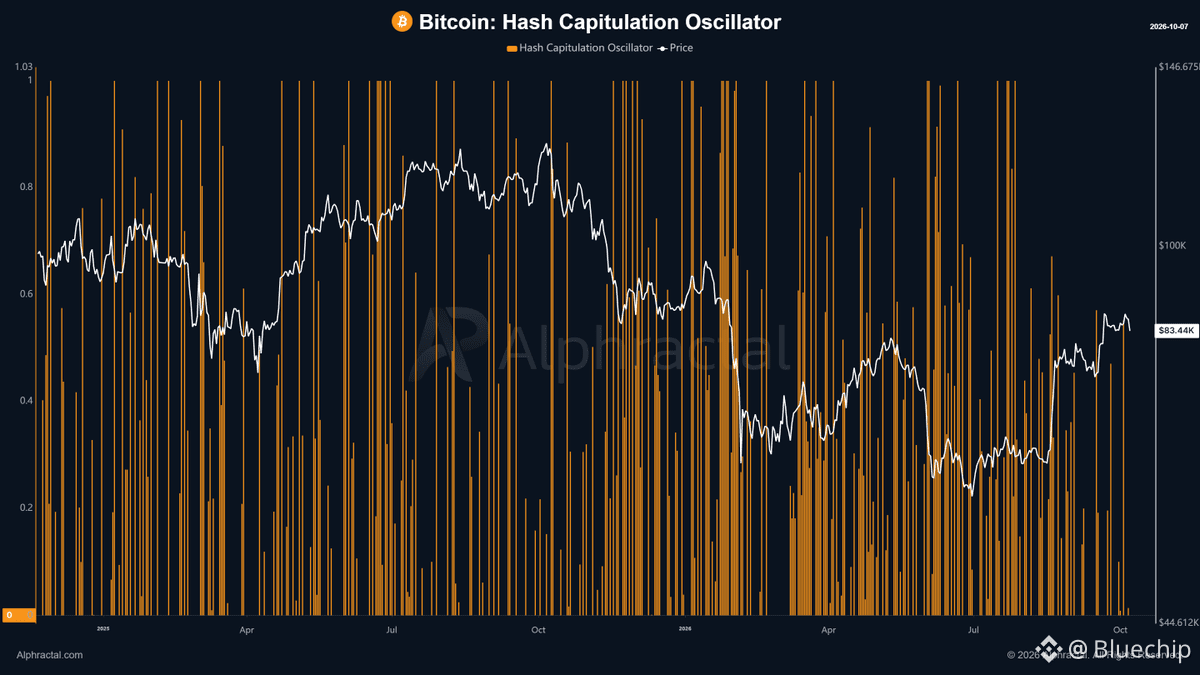
For now, Bitcoin miners are no longer going through a capitulation event.
{spot}(BTCUSDT)
For now, Bitcoin miners are no longer going through a capitulation event.
6
169
·
--
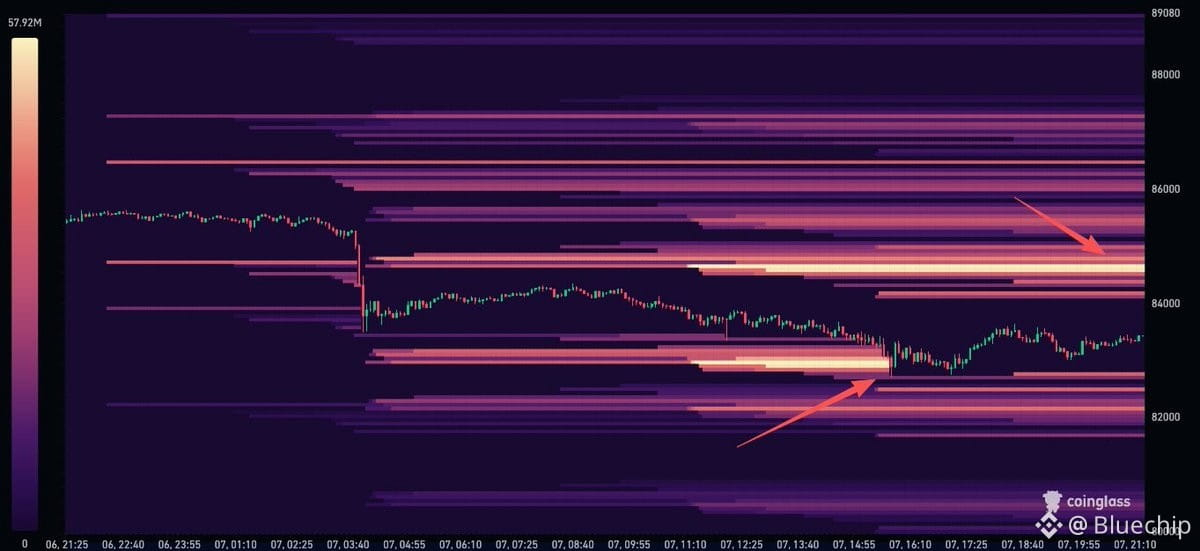
$BTC Liquidation Heatmap (24 hour)
Nice and precise:)
$84.7K is the next step
{future}(BTCUSDT)
$BTC Liquidation Heatmap (24 hour)
Nice and precise:)
$84.7K is the next step
Nice and precise:)
$84.7K is the next step
Bluechip
·
--
$82.6K✅✅✅
Perfect stop hunt.🤣
Perfect stop hunt.🤣
1
8
502
·
--
The $BTC 4-year cycle may be dead for many people.
But historically, the shortest period was 363 days, while the longest reached 406 days.
That means a lot can still happen over the next 40 days from today.
I still wouldn’t rule out the possibility of these fractals repeating. I’ll only consider this cycle truly different after another 40 days, given the historical confidence range.
So for now, I’ll wait and see...
{spot}(BTCUSDT)
The $BTC 4-year cycle may be dead for many people.
But historically, the shortest period was 363 days, while the longest reached 406 days.
That means a lot can still happen over the next 40 days from today.
I still wouldn’t rule out the possibility of these fractals repeating. I’ll only consider this cycle truly different after another 40 days, given the historical confidence range.
So for now, I’ll wait and see...
But historically, the shortest period was 363 days, while the longest reached 406 days.
That means a lot can still happen over the next 40 days from today.
I still wouldn’t rule out the possibility of these fractals repeating. I’ll only consider this cycle truly different after another 40 days, given the historical confidence range.
So for now, I’ll wait and see...
Bluechip
·
--
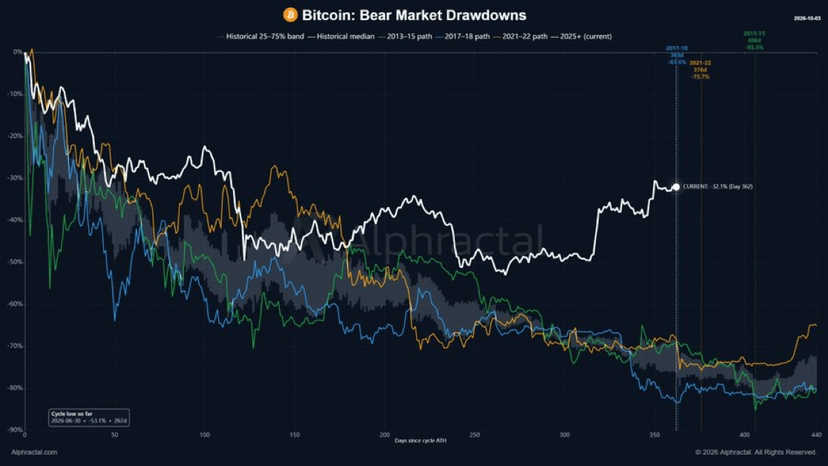
We are living through a Bitcoin bear market unlike any we have seen before.
362 days after the all time high, Bitcoin is still trading well above the historical median of previous bear market cycles.
Are we witnessing the first major structural shift in Bitcoin’s traditional cycle behavior?
Or does this chart suggest there is still room for one final leg lower?
Historically, major bear market bottoms were formed between day 364 and day 405 after the cycle ATH.
We are entering that exact window now.
By November 2026, we should have a much clearer answer.
362 days after the all time high, Bitcoin is still trading well above the historical median of previous bear market cycles.
Are we witnessing the first major structural shift in Bitcoin’s traditional cycle behavior?
Or does this chart suggest there is still room for one final leg lower?
Historically, major bear market bottoms were formed between day 364 and day 405 after the cycle ATH.
We are entering that exact window now.
By November 2026, we should have a much clearer answer.
7
292
·
--
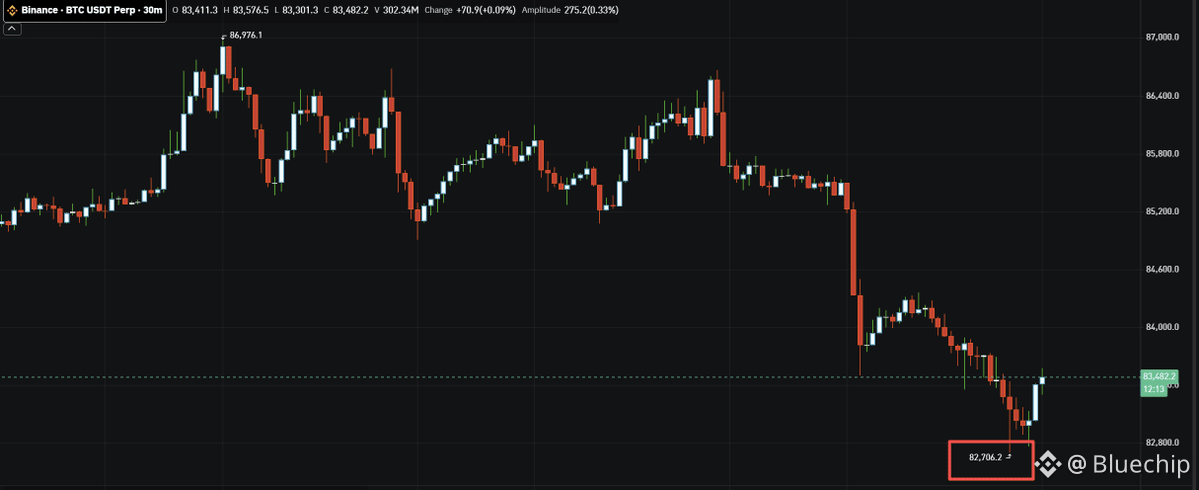
$82.6K✅✅✅
Perfect stop hunt.🤣
{future}(BTCUSDT)
$82.6K✅✅✅
Perfect stop hunt.🤣
Perfect stop hunt.🤣
Bluechip
·
--
$BTC Liquidation Heatmap (1 Week)
High leverage liquidity. 🧐
🧲$87.4K
🧲$82.6K
High leverage liquidity. 🧐
🧲$87.4K
🧲$82.6K
1
1
5
156
·
--
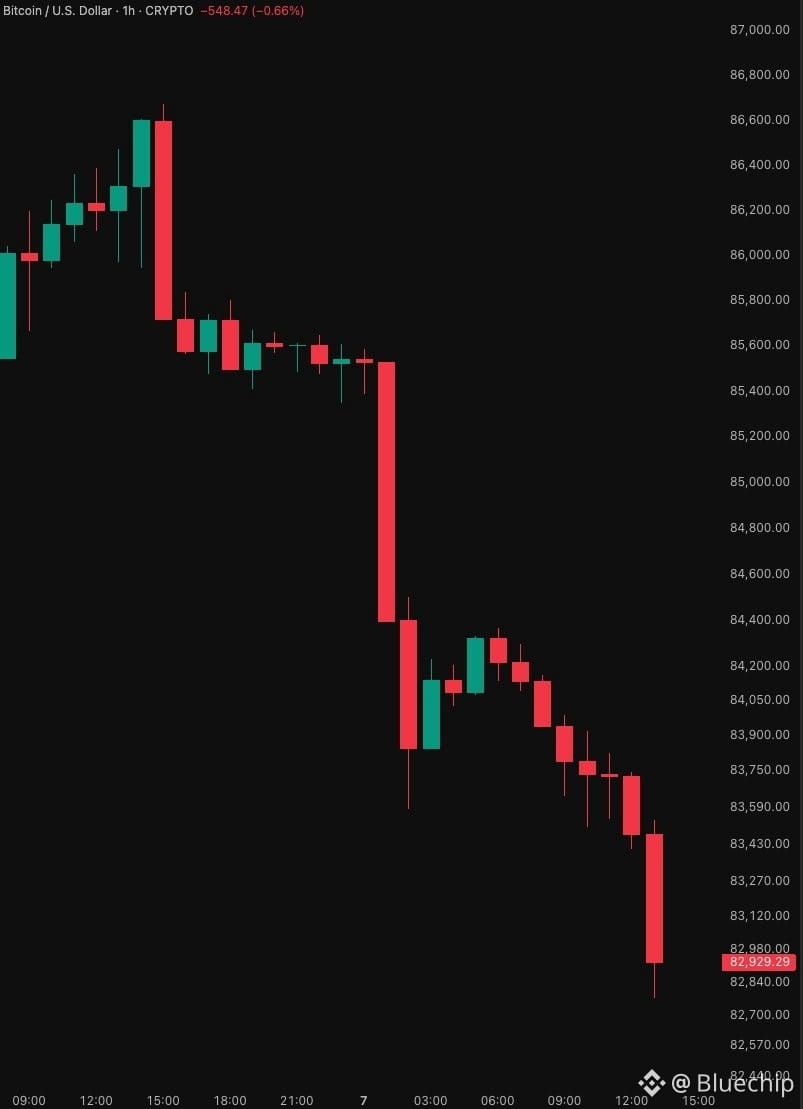
Bitcoin breaks below $83,000, ERASING all of its recent October gains.
Over $642 MILLION in long positions has been liquidated across the crypto market in the past 24 hours.
{spot}(BTCUSDT)
Bitcoin breaks below $83,000, ERASING all of its recent October gains.
Over $642 MILLION in long positions has been liquidated across the crypto market in the past 24 hours.
Over $642 MILLION in long positions has been liquidated across the crypto market in the past 24 hours.
Bluechip
·
--
$BTC
🧲$82.6K is loading
🧲$82.6K is loading
7
322
·
--
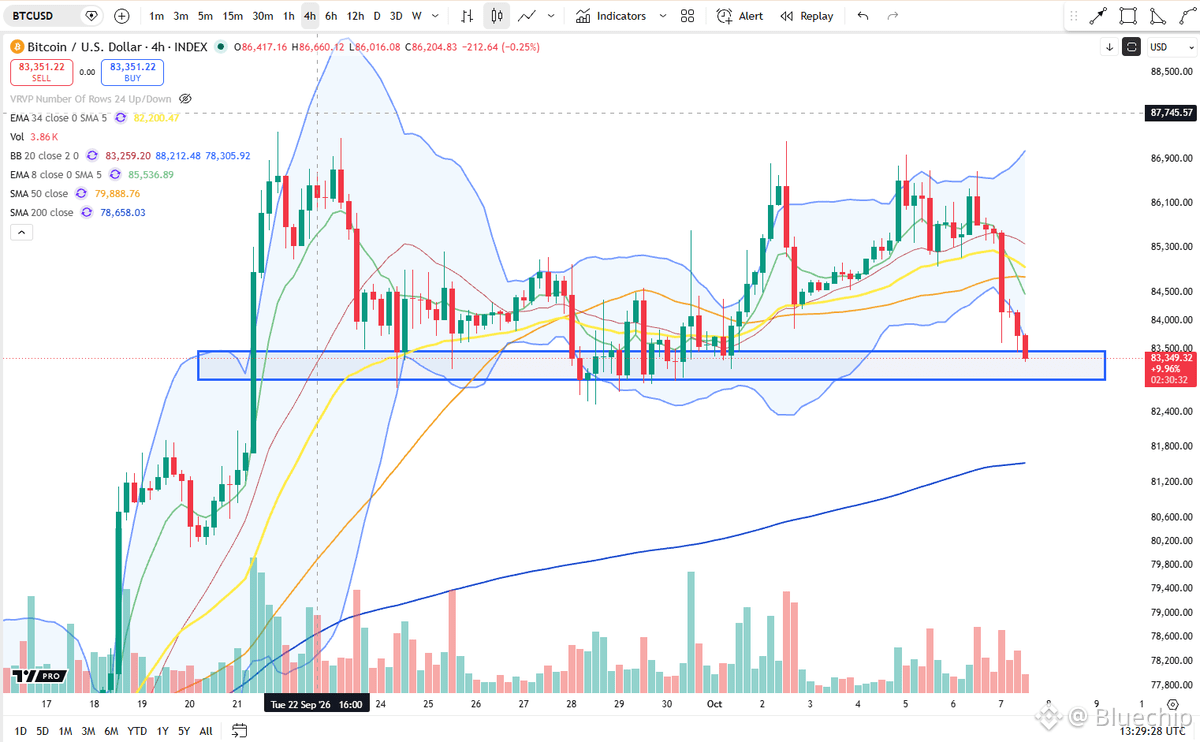
$BTC back into range low demand zone after losing rising trend
{future}(BTCUSDT)
$BTC back into range low demand zone after losing rising trend
Bluechip
·
--
$BTC quick rug here as price tags DMA 20
1H volatility
1H volatility
8
183
·
--
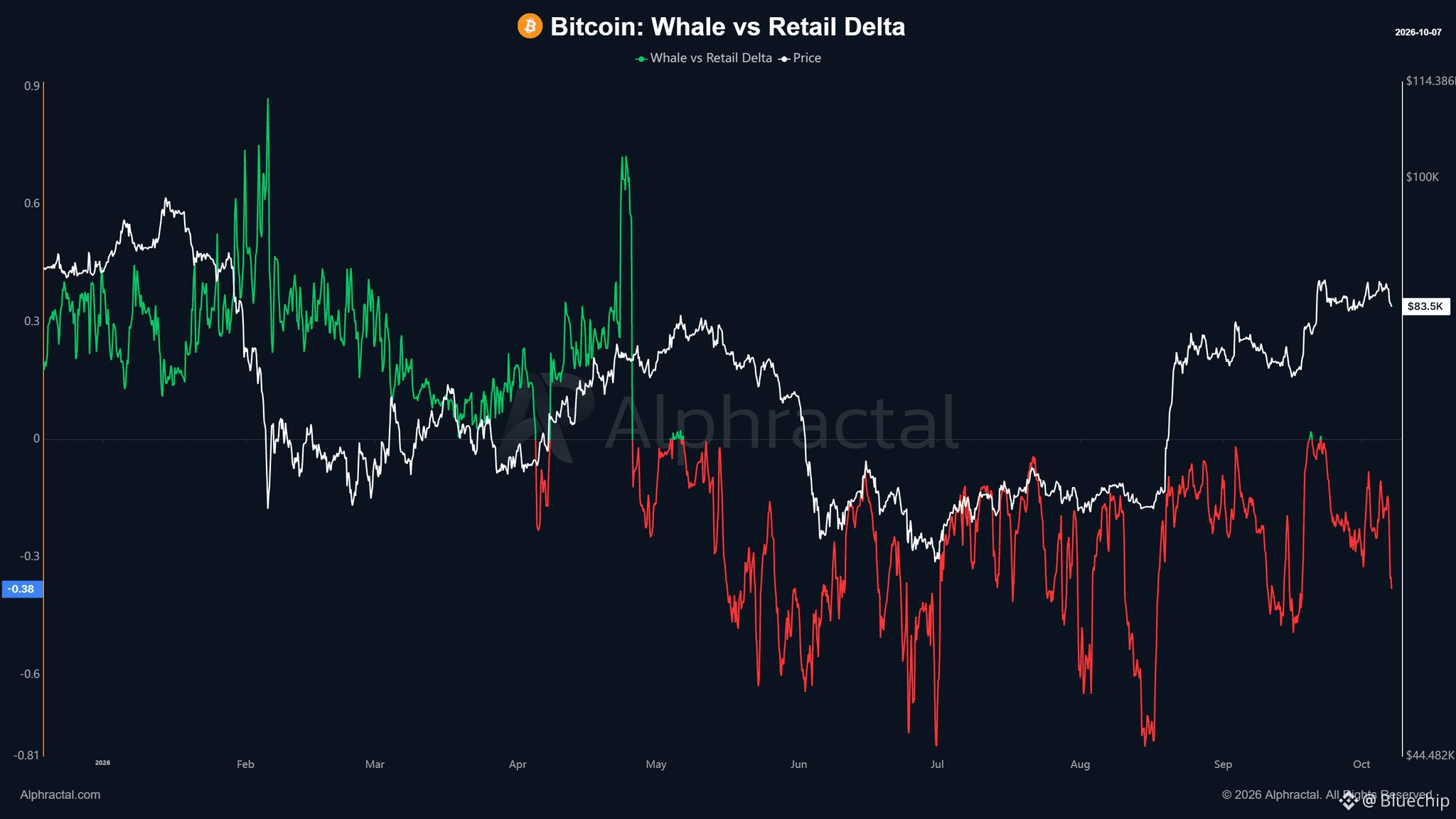
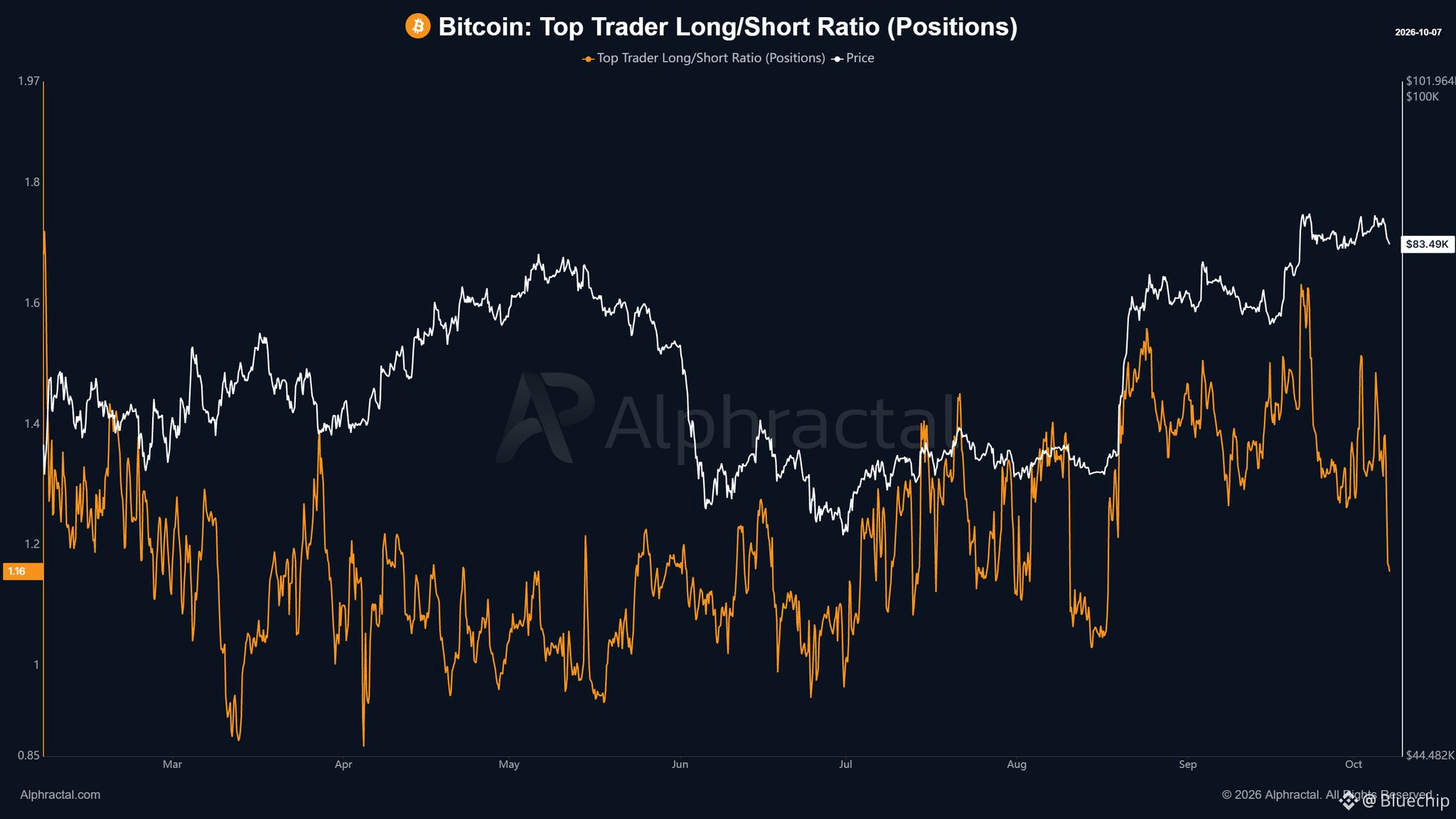
Whales are increasing their short positions, while Top Traders are also shifting back toward shorts across the largest exchanges.
Do they know something you don’t?
{spot}(BTCUSDT)
Whales are increasing their short positions, while Top Traders are also shifting back toward shorts across the largest exchanges.
Do they know something you don’t?
Do they know something you don’t?
Bluechip
·
--
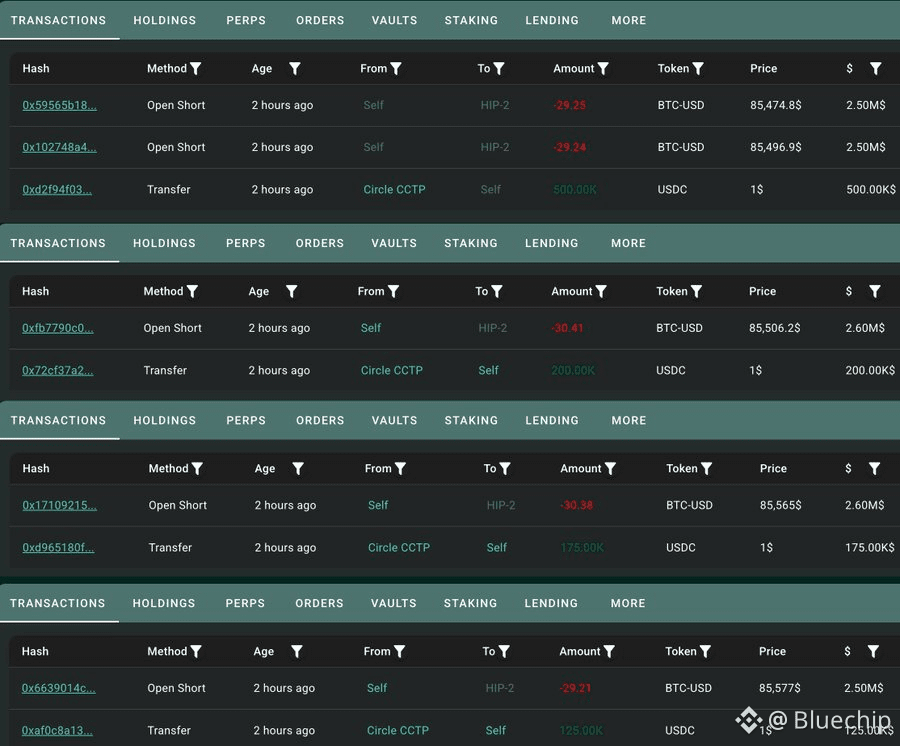
Bitcoin has dropped below $84,000.
Just before the market dropped, 4 newly created wallets deposited 1M
$USDC into #Hyperliquid and opened 40x shorts on 148.49 $BTC ($12.5M).
Insiders?
Just before the market dropped, 4 newly created wallets deposited 1M
$USDC into #Hyperliquid and opened 40x shorts on 148.49 $BTC ($12.5M).
Insiders?
8
359
·
--
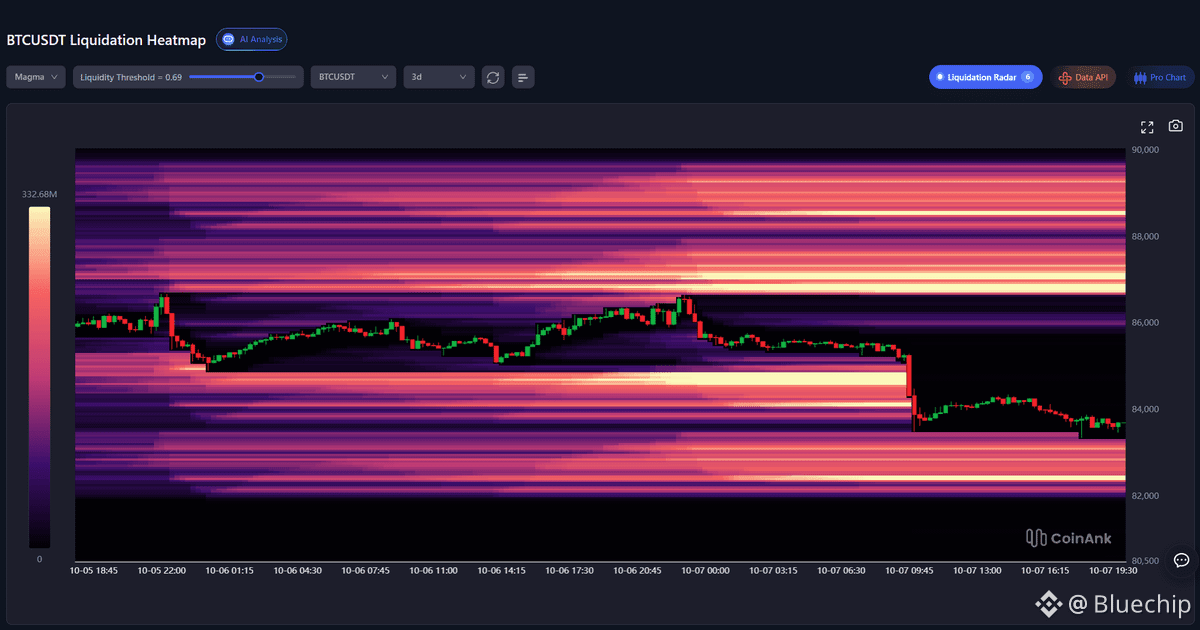
$BTC JUST SLICED THE $85K BAND. $83K IS NEXT.
3-day liquidation heatmap.
Price fell out of the $86k range, broke the bright cluster around $84,800 – $85,200, and is now sitting near $83,800. The next high-intensity pocket is right underneath, around $82,800 – $83,200.
Overhead, the short book is still stacked. Bright bands sit near $87,000 – $87,500, with more density toward $88,500.
They already ran the mid-range. Next test is the $83k magnet.
{future}(BTCUSDT)
$BTC JUST SLICED THE $85K BAND. $83K IS NEXT.
3-day liquidation heatmap.
Price fell out of the $86k range, broke the bright cluster around $84,800 – $85,200, and is now sitting near $83,800. The next high-intensity pocket is right underneath, around $82,800 – $83,200.
Overhead, the short book is still stacked. Bright bands sit near $87,000 – $87,500, with more density toward $88,500.
They already ran the mid-range. Next test is the $83k magnet.
3-day liquidation heatmap.
Price fell out of the $86k range, broke the bright cluster around $84,800 – $85,200, and is now sitting near $83,800. The next high-intensity pocket is right underneath, around $82,800 – $83,200.
Overhead, the short book is still stacked. Bright bands sit near $87,000 – $87,500, with more density toward $88,500.
They already ran the mid-range. Next test is the $83k magnet.
9
862
·
--
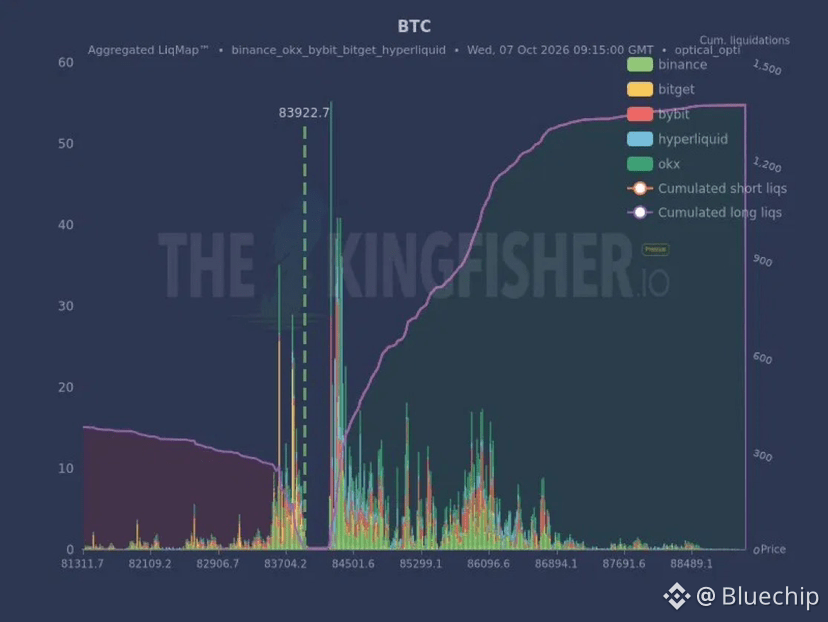
$BTC shorts above price outweigh longs below roughly 3 to 1.
The largest cluster on the map sits just over 84.3K, with a second wall at 85.8K -> 86.5K. Below, the nearest real pocket is 83.6K -> 83.8K and it thins out fast after that.
Path of least resistance looks up. 🎣
{future}(BTCUSDT)
$BTC shorts above price outweigh longs below roughly 3 to 1.
The largest cluster on the map sits just over 84.3K, with a second wall at 85.8K -> 86.5K. Below, the nearest real pocket is 83.6K -> 83.8K and it thins out fast after that.
Path of least resistance looks up. 🎣
The largest cluster on the map sits just over 84.3K, with a second wall at 85.8K -> 86.5K. Below, the nearest real pocket is 83.6K -> 83.8K and it thins out fast after that.
Path of least resistance looks up. 🎣
10
232
·
--
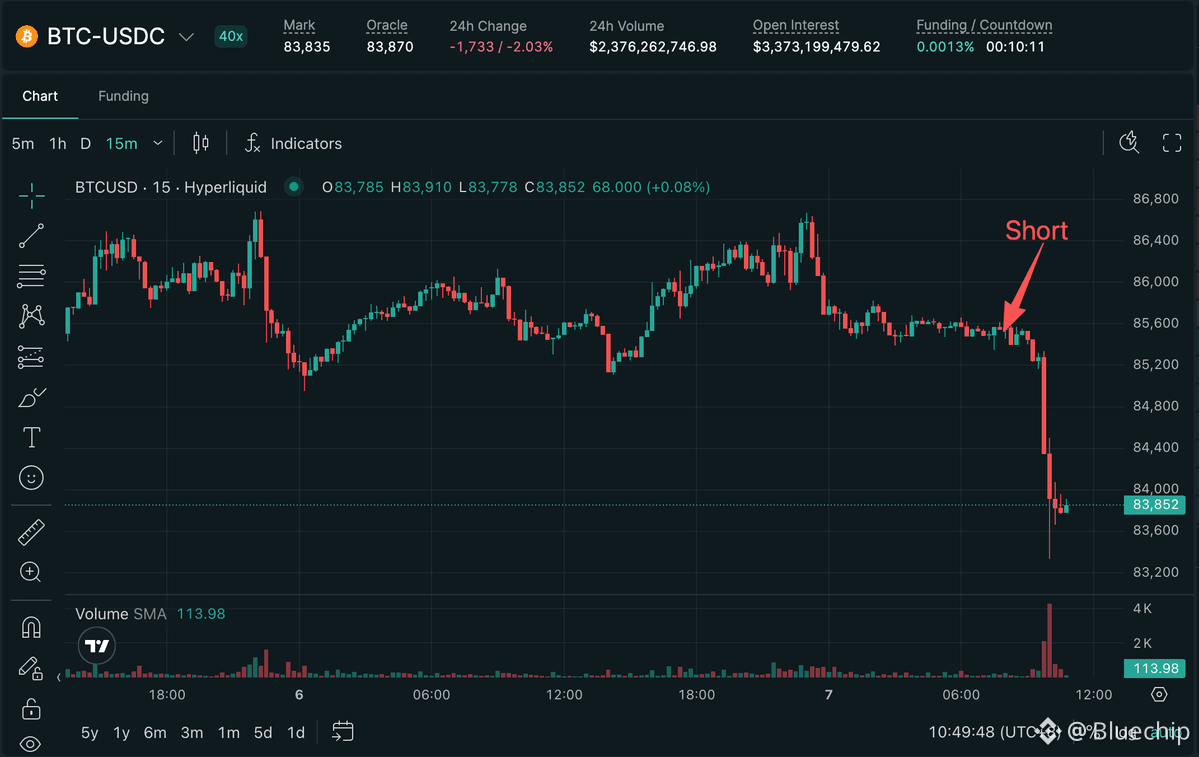
Bitcoin has dropped below $84,000.
Just before the market dropped, 4 newly created wallets deposited 1M
$USDC into #Hyperliquid and opened 40x shorts on 148.49 $BTC ($12.5M).
Insiders?
{future}(BTCUSDT)
Bitcoin has dropped below $84,000.
Just before the market dropped, 4 newly created wallets deposited 1M
$USDC into #Hyperliquid and opened 40x shorts on 148.49 $BTC ($12.5M).
Insiders?
Just before the market dropped, 4 newly created wallets deposited 1M
$USDC into #Hyperliquid and opened 40x shorts on 148.49 $BTC ($12.5M).
Insiders?
3
2
8
1.7k
·
--
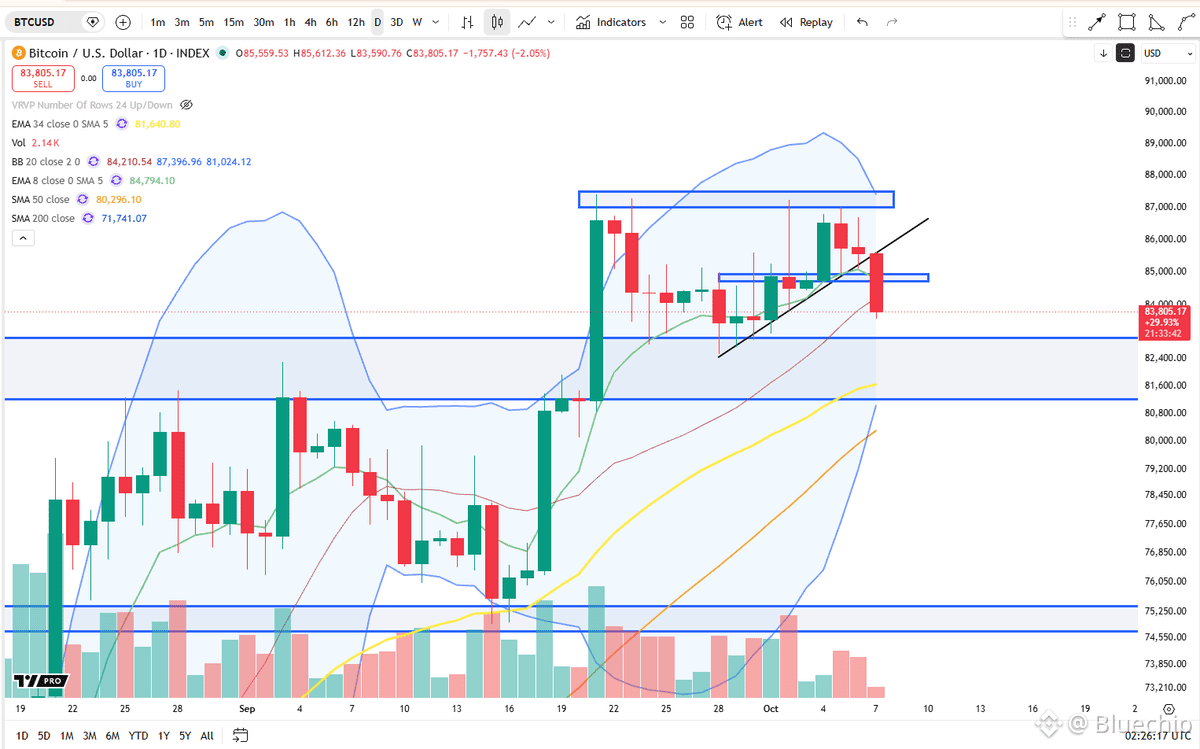
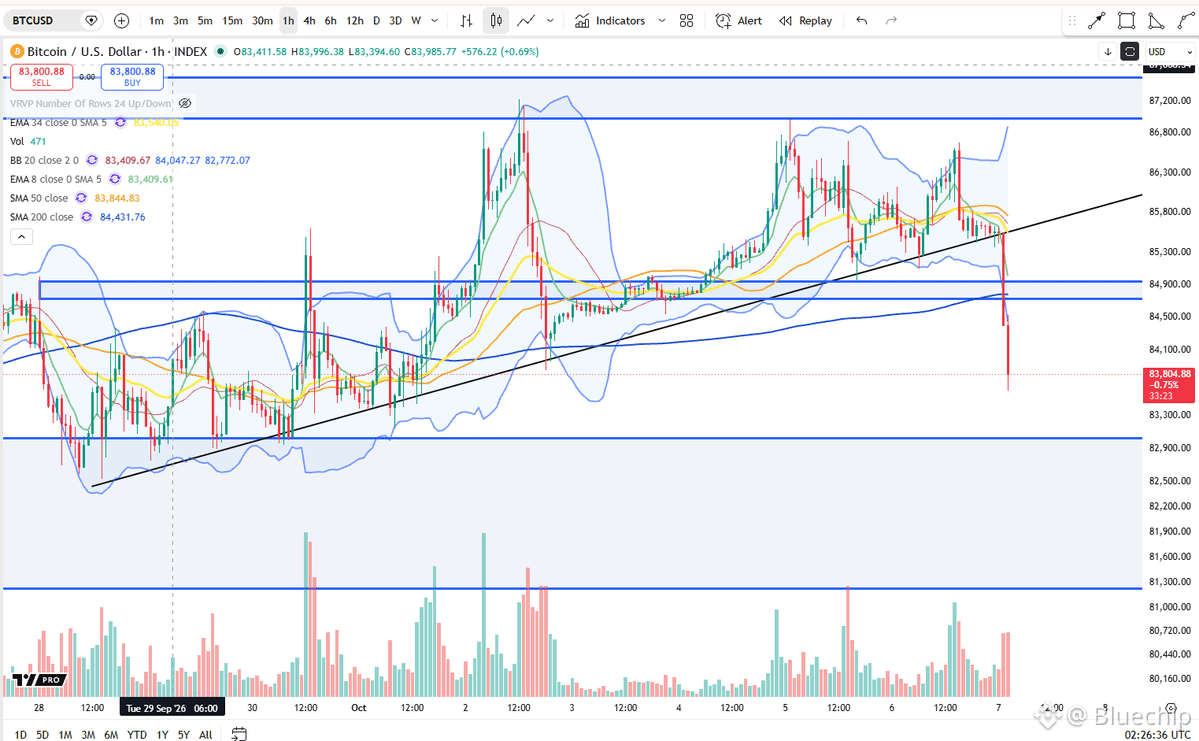
$BTC quick rug here as price tags DMA 20
1H volatility
{future}(BTCUSDT)
$BTC quick rug here as price tags DMA 20
1H volatility
1H volatility
1
7
701
·
--
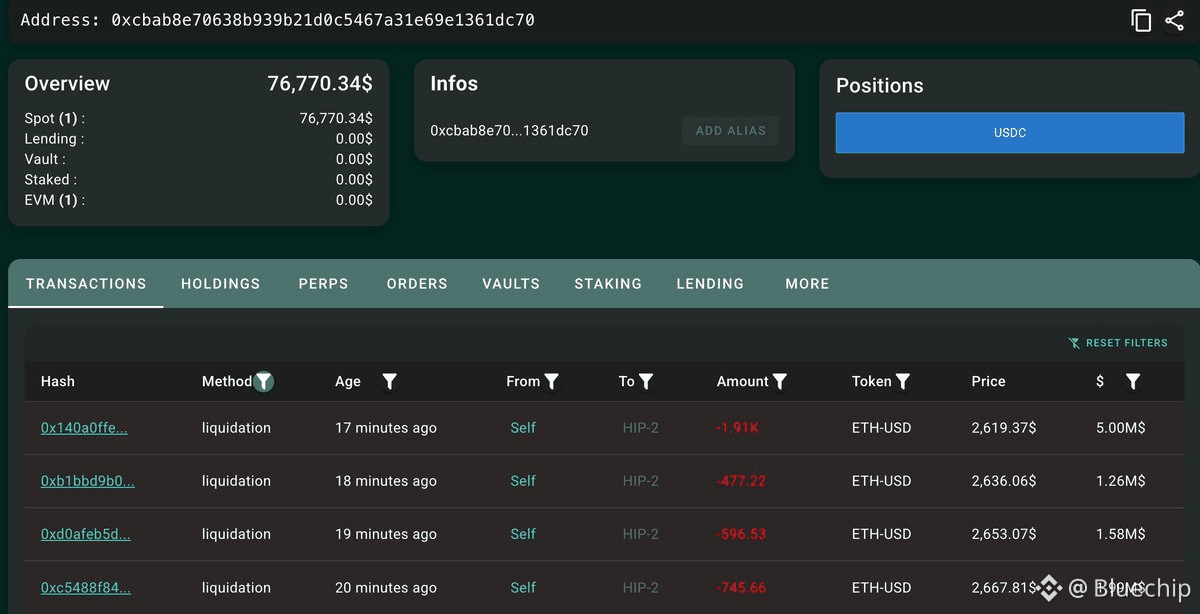
ETH just dropped below $2,600.
Trader 0xcbab got fully liquidated on his 3,728 $ETH ($9.85M) long in just 3 minutes. 🥶
{future}(ETHUSDT)
ETH just dropped below $2,600.
Trader 0xcbab got fully liquidated on his 3,728 $ETH ($9.85M) long in just 3 minutes. 🥶
Trader 0xcbab got fully liquidated on his 3,728 $ETH ($9.85M) long in just 3 minutes. 🥶
1
13
2.2k
·
--
$BTC
🧲$82.6K is loading
{future}(BTCUSDT)
$BTC
🧲$82.6K is loading
🧲$82.6K is loading
Bluechip
·
--
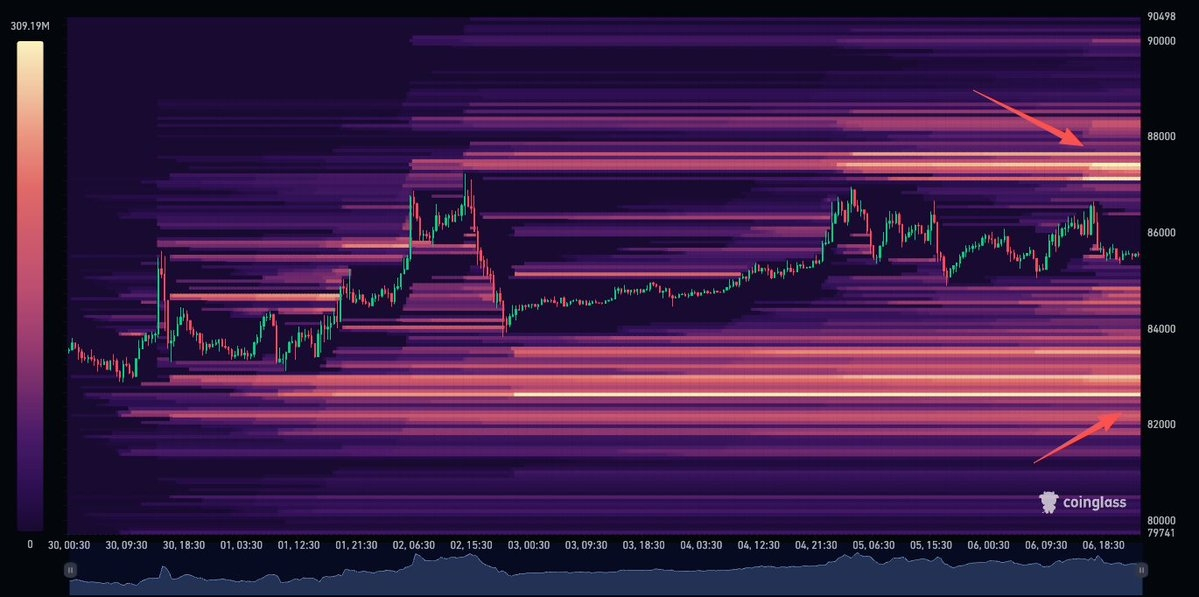
$BTC Liquidation Heatmap (1 Week)
High leverage liquidity. 🧐
🧲$87.4K
🧲$82.6K
High leverage liquidity. 🧐
🧲$87.4K
🧲$82.6K
1
10
895
·
--
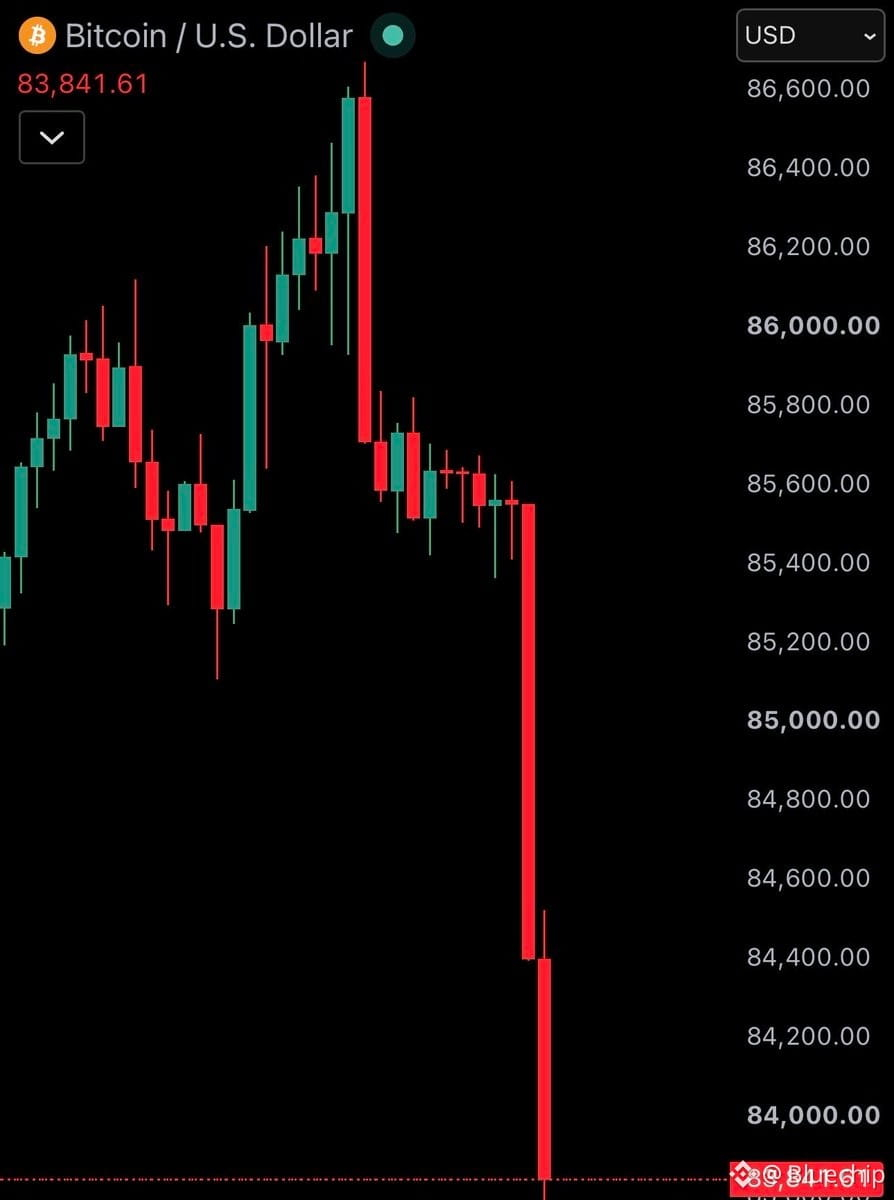
🚨 The October 10 scenario looks like it’s repeating…
But this time, it’s happening earlier and with less intensity at least for now.
Bitcoin crashed -$1600 in just 15 minutes, dropping below $84,000.
Over $400 million in longs were liquidated over the same period.
{future}(BTCUSDT)
🚨 The October 10 scenario looks like it’s repeating…
But this time, it’s happening earlier and with less intensity at least for now.
Bitcoin crashed -$1600 in just 15 minutes, dropping below $84,000.
Over $400 million in longs were liquidated over the same period.
But this time, it’s happening earlier and with less intensity at least for now.
Bitcoin crashed -$1600 in just 15 minutes, dropping below $84,000.
Over $400 million in longs were liquidated over the same period.
17
5
43
54.9k
·
--
🚨 Could China trigger the next crypto super cycle? 🇨🇳🔥
The former chairman of UBS says crypto could enter a major “super cycle” if China embraces digital assets again.
Hong Kong may be testing how this technology can be implemented.
If Beijing changes its stance, the impact could be massive:
🇨🇳 China
🇭🇰 Hong Kong
🌏 Asia
Asia is waking up.
But this remains a scenario, not a confirmed policy shift.
If China returns to crypto, the global market could look very different.
Something to think about.
$BTC
🚨 Could China trigger the next crypto super cycle? 🇨🇳🔥
The former chairman of UBS says crypto could enter a major “super cycle” if China embraces digital assets again.
Hong Kong may be testing how this technology can be implemented.
If Beijing changes its stance, the impact could be massive:
🇨🇳 China
🇭🇰 Hong Kong
🌏 Asia
Asia is waking up.
But this remains a scenario, not a confirmed policy shift.
If China returns to crypto, the global market could look very different.
Something to think about.
$BTC
The former chairman of UBS says crypto could enter a major “super cycle” if China embraces digital assets again.
Hong Kong may be testing how this technology can be implemented.
If Beijing changes its stance, the impact could be massive:
🇨🇳 China
🇭🇰 Hong Kong
🌏 Asia
Asia is waking up.
But this remains a scenario, not a confirmed policy shift.
If China returns to crypto, the global market could look very different.
Something to think about.
$BTC
8
1.1k
·
--
Vérifié
This might be one of the most interesting $XRP developments I’ve seen lately.
Ripple President Monica Long says Ripple is running credit-related pilots targeting activation in 2027.
The interesting part?
XRP could sit inside lending pools as collateral backing payment financing.
That is VERY different from the normal XRP payments argument.
In a payment:
XRP may only be held for seconds.
As collateral:
XRP could potentially remain committed for weeks or months while a loan exists.
That creates a completely different type of utility.
Still early.
We don’t know the eventual pool sizes, lenders or how much XRP would actually need to be sourced from the market.
But this is exactly the kind of development I want to watch:
utility that could require XRP to remain economically committed, rather than simply pass through.
{future}(XRPUSDT)
This might be one of the most interesting $XRP developments I’ve seen lately.
Ripple President Monica Long says Ripple is running credit-related pilots targeting activation in 2027.
The interesting part?
XRP could sit inside lending pools as collateral backing payment financing.
That is VERY different from the normal XRP payments argument.
In a payment:
XRP may only be held for seconds.
As collateral:
XRP could potentially remain committed for weeks or months while a loan exists.
That creates a completely different type of utility.
Still early.
We don’t know the eventual pool sizes, lenders or how much XRP would actually need to be sourced from the market.
But this is exactly the kind of development I want to watch:
utility that could require XRP to remain economically committed, rather than simply pass through.
Ripple President Monica Long says Ripple is running credit-related pilots targeting activation in 2027.
The interesting part?
XRP could sit inside lending pools as collateral backing payment financing.
That is VERY different from the normal XRP payments argument.
In a payment:
XRP may only be held for seconds.
As collateral:
XRP could potentially remain committed for weeks or months while a loan exists.
That creates a completely different type of utility.
Still early.
We don’t know the eventual pool sizes, lenders or how much XRP would actually need to be sourced from the market.
But this is exactly the kind of development I want to watch:
utility that could require XRP to remain economically committed, rather than simply pass through.

11
1.8k
·
--
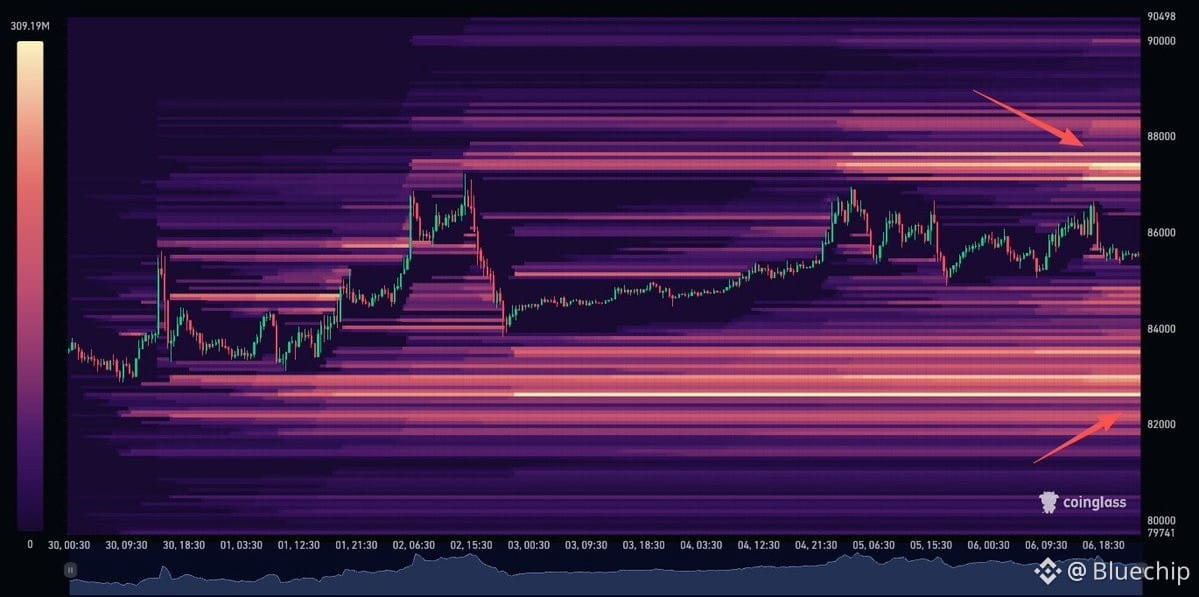
$BTC Liquidation Heatmap (1 Week)
High leverage liquidity. 🧐
🧲$87.4K
🧲$82.6K
{future}(BTCUSDT)
$BTC Liquidation Heatmap (1 Week)
High leverage liquidity. 🧐
🧲$87.4K
🧲$82.6K
High leverage liquidity. 🧐
🧲$87.4K
🧲$82.6K
2
8
382
Connectez-vous pour découvrir plus de contenu
Rejoignez la communauté mondiale des adeptes de cryptomonnaies sur Binance Square
⚡️ Suviez les dernières informations importantes sur les cryptomonnaies.
💬 Jugé digne de confiance par la plus grande plateforme d’échange de cryptomonnaies au monde.
👍 Découvrez les connaissances que partagent les créateurs vérifiés.
Adresse e-mail/Nº de téléphone
Sujets d’actualité
FedMinutesFocusOnOctoberPause
172,198 vues
1,318 mentions
🚨 HIGH ALERT ‼️ PLEASE DON’T TRADE BLINDLY FOR THE NEXT HOUR 🚨
Guys, we have FOMC Minutes coming in less than 1 hour.
And after the kind of volatility we already saw today, I really don’t want anyone opening random high-leverage positions just before this release.
The biggest reaction I’m watching will be in Gold (XAU), Silver (XAG), BTC and ETH. Then coins like SOL and other highly leveraged mid/low-cap alts can exaggerate whatever move BTC makes.
Gold and Silver are especially sensitive tonight because the market is already reacting to the US dollar + Treasury yields, and both metals have been under heavy pressure ahead of the Fed minutes.
Briefly speaking
📉Hawkish Fed Minutes → Dollar/yields can push higher → pressure on BTC, crypto, Gold & silver
📈Dovish Fed Minutes → Dollar/yields can cool → BTC, Gold, Silver and risk assets can bounce hard.
And please remember the first candle can be a trap. We can get a pump, immediate dump, liquidations on both sides, and then the real direction.
So for now, protect your positions, reduce unnecessary leverage and don’t FOMO into the first move.
Tonight I’m watching $XAU , $XAG and $BTC first. These will tell us very quickly how the market is reading the Fed.
I will Update you guys on time
Follow @Panda Traders and Turn on Your notifications right now
#FedMinutesFocusOnOctoberPause
Panda Traders
·19 mentions J’aime
·4k vues
BinanceLaunchesBinanceIntelligence
1.1M vues
6,524 mentions
EvernorthDelaysNasdaqDebutToOct12
14,342 vues
301 mentions