Binance Square

Bit Gurly

image
Créateur vérifié
Belive it, manifest it!
Ouvert au trading
Détenteur pour WOO
Détenteur pour WOO
Trade régulièrement
4.4 an(s)
100 Suivis
68.1K+ Abonnés
63.3K+ J’aime
8.5K+ Partagé(s)
Publications
Portefeuille
PINNED
·
--
Haussier
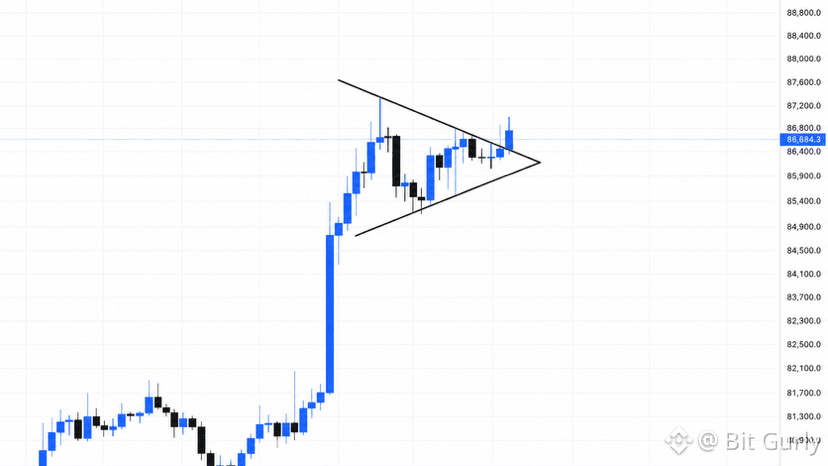
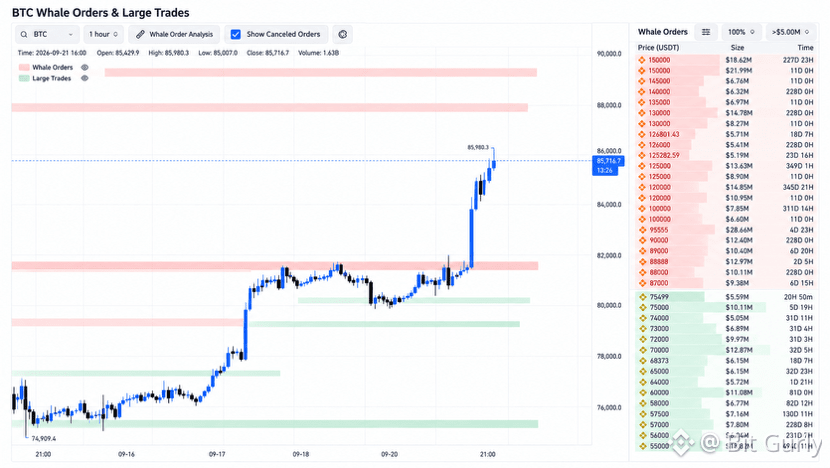
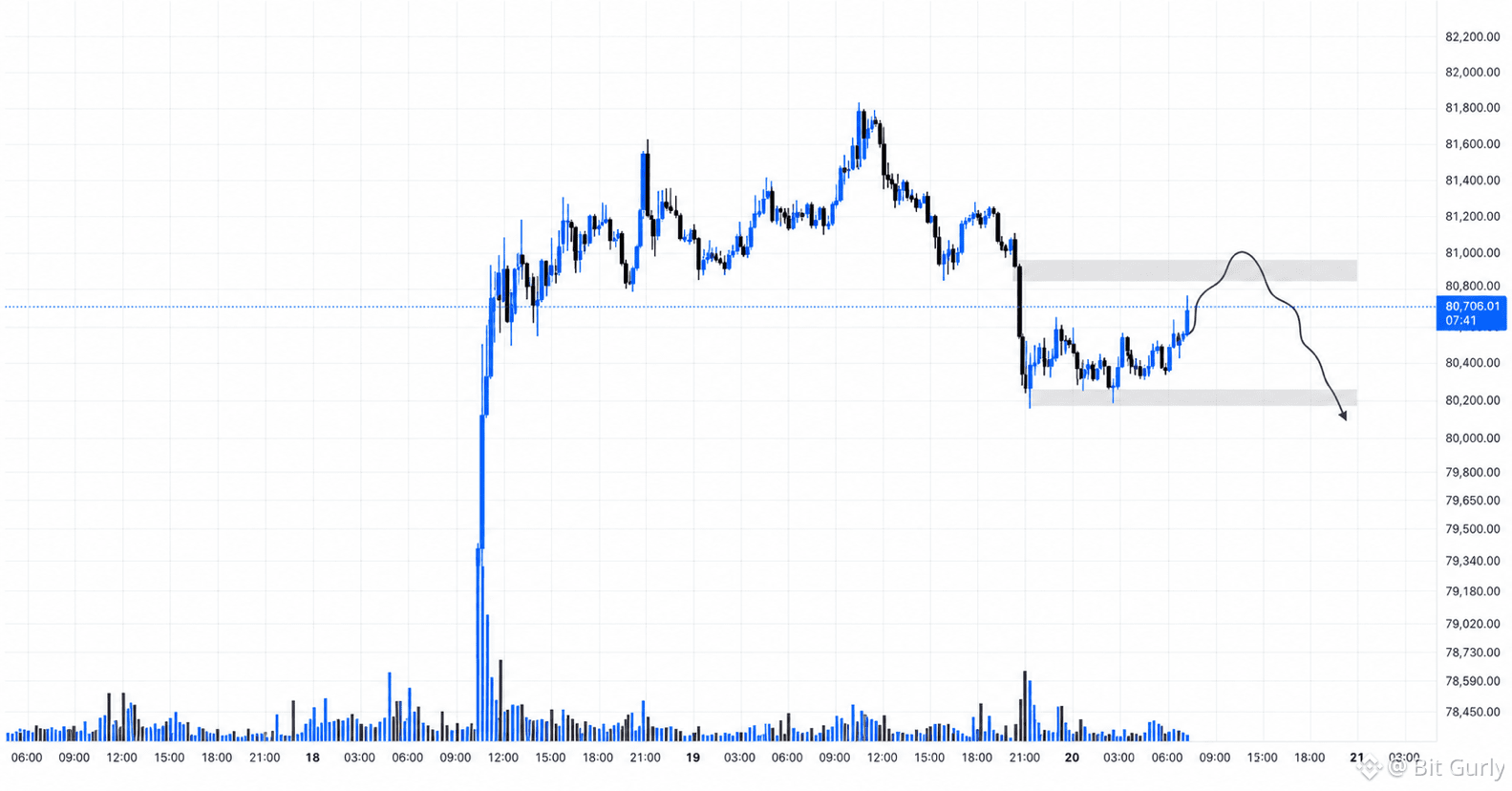
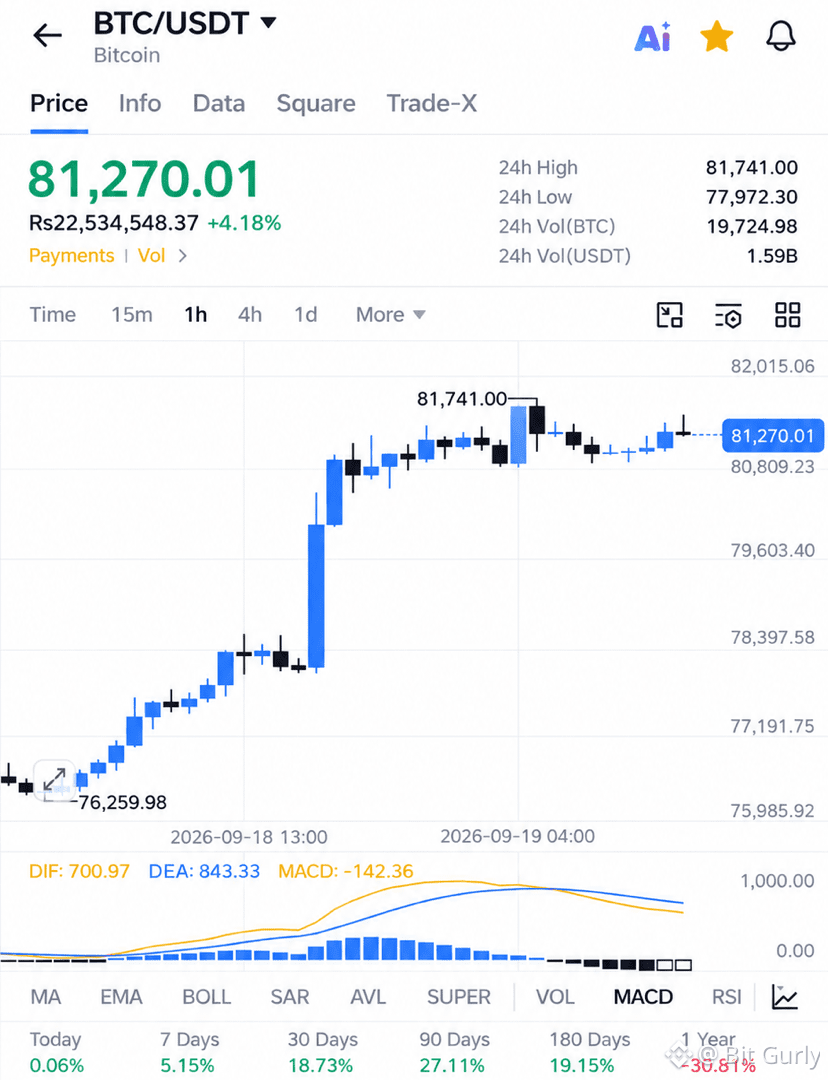
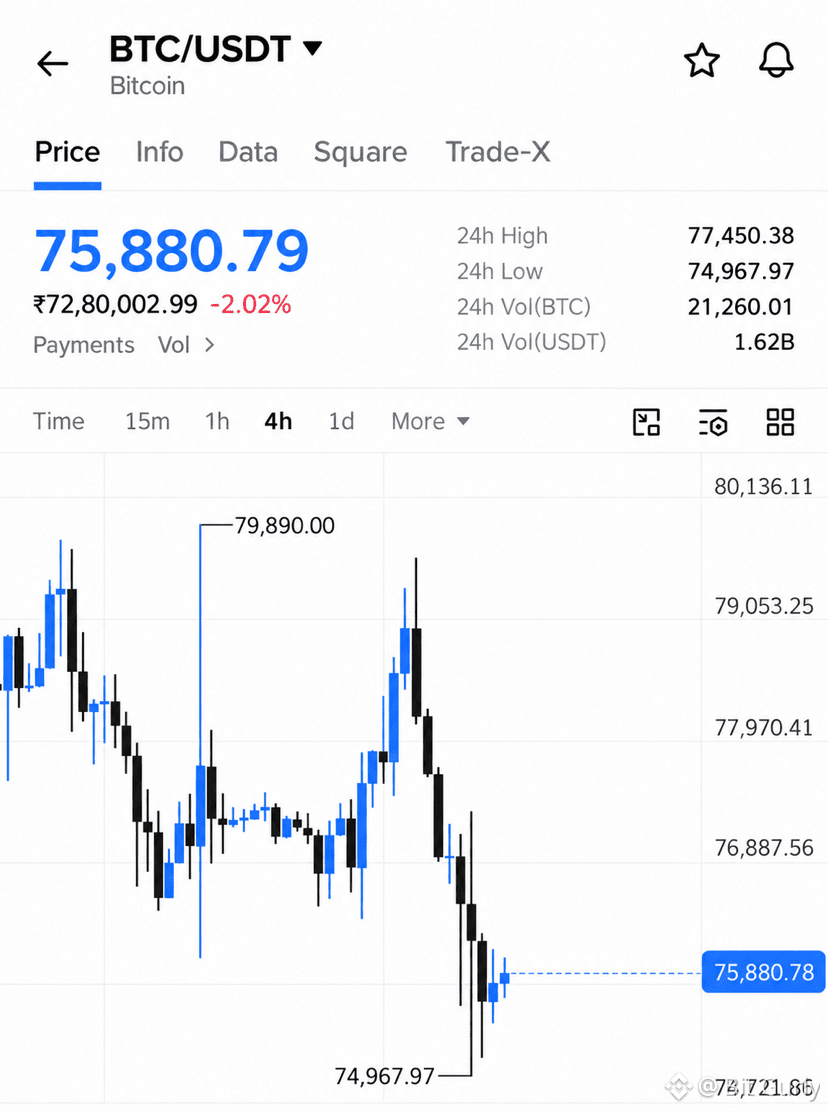
$BTC doesn’t just correct. It resets positioning. If you look at past cycles, especially around midterm years , the drawdowns weren’t random. They were structural cleanups of excess leverage, weak conviction, and late positioning. 2014 → ~70% 2018 → ~80% 2022 → ~65% Each time, the move wasn’t just price going down. It was the market forcing participants out. Now look at 2026. So far, BTC is down ~33%. That’s not a full reset. That’s compression. What’s different this time is not just price, it’s structure. Back then, most of the market was retail-driven with fragmented liquidity. Now, you have: * ETF flows influencing spot demand * More structured derivatives markets * Larger players managing entries instead of chasing momentum That changes ‘how’ drawdowns happen, not ‘if’they happen. A shallow correction like -30% doesn’t fully clear positioning. It usually leaves: * Late longs still hoping * Liquidity sitting below obvious levels * Market structure unresolved And markets don’t like unfinished business. Technically, what stands out is how BTC is reacting around this key zone (previous cycle resistance turned support). We’ve tapped it, bounced slightly, but haven’t seen a decisive reclaim with strength. That’s not confirmation. That’s hesitation. In previous cycles, the real bottom formed when: * Panic replaced hope * Liquidity below got swept aggressively * Structure broke clean before rebuilding We haven’t seen that level of displacement yet. If anything, this looks like a controlled distribution phase: price holding just enough to keep participants engaged, while liquidity builds below. So the question isn’t ‘if’ BTC goes lower, it’s whether the market has fully cleaned out positioning. Right now, it doesn’t feel like it. One more move down, not because history repeats blindly, but because the structure still looks incomplete. And when structure is incomplete, price tends to finish the job. {spot}(BTCUSDT) #bitcoin #BTC #USNFPExceededExpectations #AnthropicBansOpenClawFromClaude
$BTC doesn’t just correct. It resets positioning.

If you look at past cycles, especially around midterm years , the drawdowns weren’t random. They were structural cleanups of excess leverage, weak conviction, and late positioning.

2014 → ~70%
2018 → ~80%
2022 → ~65%

Each time, the move wasn’t just price going down. It was the market forcing participants out.

Now look at 2026.

So far, BTC is down ~33%.
That’s not a full reset. That’s compression.

What’s different this time is not just price, it’s structure.

Back then, most of the market was retail-driven with fragmented liquidity.
Now, you have:

* ETF flows influencing spot demand
* More structured derivatives markets
* Larger players managing entries instead of chasing momentum

That changes ‘how’ drawdowns happen, not ‘if’they happen.

A shallow correction like -30% doesn’t fully clear positioning.
It usually leaves:

* Late longs still hoping
* Liquidity sitting below obvious levels
* Market structure unresolved

And markets don’t like unfinished business.

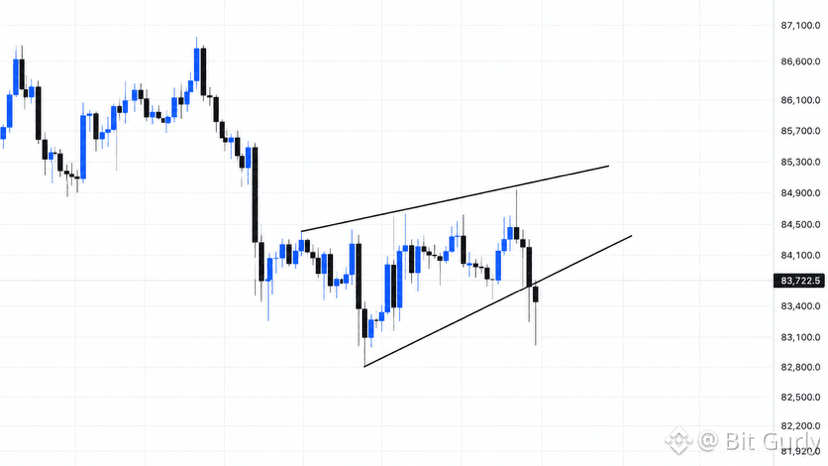
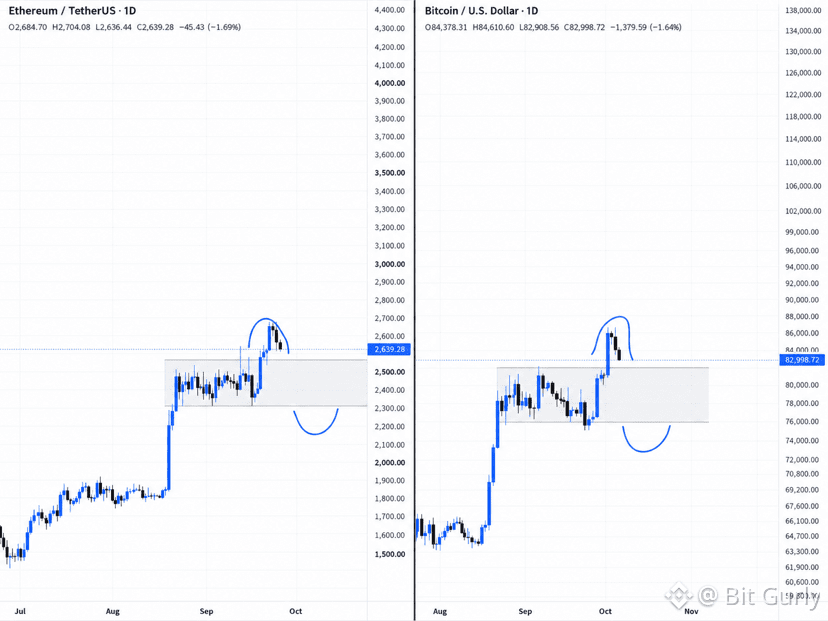
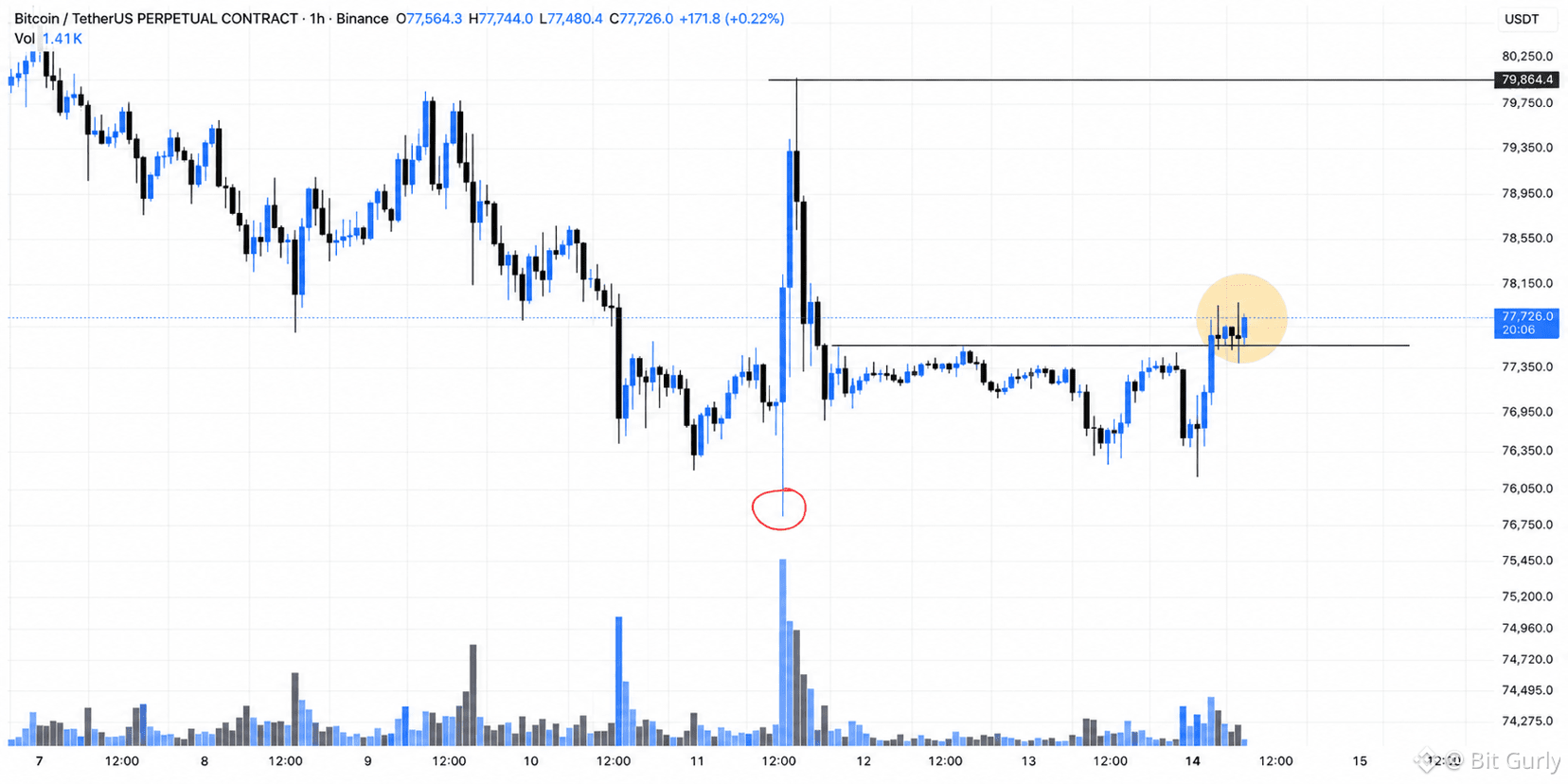
Technically, what stands out is how BTC is reacting around this key zone (previous cycle resistance turned support).
We’ve tapped it, bounced slightly, but haven’t seen a decisive reclaim with strength.

That’s not confirmation. That’s hesitation.

In previous cycles, the real bottom formed when:

* Panic replaced hope
* Liquidity below got swept aggressively
* Structure broke clean before rebuilding

We haven’t seen that level of displacement yet.

If anything, this looks like a controlled distribution phase:
price holding just enough to keep participants engaged, while liquidity builds below.

So the question isn’t ‘if’ BTC goes lower,
it’s whether the market has fully cleaned out positioning.

Right now, it doesn’t feel like it.

One more move down, not because history repeats blindly,
but because the structure still looks incomplete.

And when structure is incomplete, price tends to finish the job.

#bitcoin #BTC #USNFPExceededExpectations #AnthropicBansOpenClawFromClaude
·
--
Haussier
$PIXEL {spot}(PIXELUSDT) I used to think Pixels grew because it kept rewarding activity. More quests, more campaigns, more reasons to log in. Then I noticed something that changed how I see it. Some players in Pixels seem to get stronger without needing constant incentives, while others can chase every reward and still disappear fast. Same activity on the surface. Very different value underneath. That made me think Pixels may not be trying to pay everyone equally anymore. It may be learning who is worth backing. That’s the anchor. Events stop looking like simple content once you see it that way. They become moments where players reveal themselves. Who only appears when rewards are high. Who stays after they cool off. Who naturally moves into another game. Who responds more to progress than payouts. Then Stacked looks different too. Not just missions and rewards. More like the place those signals turn into decisions: Who should be reactivated. Who deserves stronger incentives. Where rewards are being wasted. Most projects still buy short-term activity. Pixels might be trying to underwrite long-term users. That’s a much harder game. But if they get it right, they won’t need to outspend everyone. They’ll just need to understand users better than everyone else. #pixel @pixels
$PIXEL
I used to think Pixels grew because it kept rewarding activity.

More quests, more campaigns, more reasons to log in.

Then I noticed something that changed how I see it.

Some players in Pixels seem to get stronger without needing constant incentives, while others can chase every reward and still disappear fast.

Same activity on the surface.

Very different value underneath.

That made me think Pixels may not be trying to pay everyone equally anymore.

It may be learning who is worth backing.

That’s the anchor.

Events stop looking like simple content once you see it that way.

They become moments where players reveal themselves.

Who only appears when rewards are high.

Who stays after they cool off.

Who naturally moves into another game.

Who responds more to progress than payouts.

Then Stacked looks different too.

Not just missions and rewards.

More like the place those signals turn into decisions:

Who should be reactivated.

Who deserves stronger incentives.

Where rewards are being wasted.

Most projects still buy short-term activity.

Pixels might be trying to underwrite long-term users.

That’s a much harder game.

But if they get it right, they won’t need to outspend everyone.

They’ll just need to understand users better than everyone else.

#pixel @Pixels
Article
Most Games Pay Everyone… Pixels Is Learning Who Matters$PIXEL {spot}(PIXELUSDT) I used to think Pixels needed bigger rewards to grow. That’s the usual logic in gaming. If activity slows, increase incentives. If users leave, run campaigns. If numbers weaken, distribute more value and hope momentum returns. For a while, it works. Then the same problem always shows up. You attract people who came for rewards, not for the system. Real players get mixed with short-term extractors. Budgets get burned. Activity looks healthy on paper while the economy underneath gets weaker. I started noticing Pixels may be moving in the opposite direction. Not asking how to pay more. Asking how to pay smarter. That’s a much stronger question. Most game economies still treat rewards like giveaways. Pixels feels closer to treating them like investments. That means the goal isn’t to reward every visible action. The goal is to identify which behavior actually strengthens the ecosystem. Two players can complete the same task. One returns next week, joins loops naturally, participates socially, moves across games, and adds long-term value. The other appears only when incentives are high, farms every available edge, then disappears. Same action. Very different economic result. Most systems still pay both equally. That’s expensive blindness. This is where the Pixels stack starts making more sense. The Events system is not just tracking clicks and completions. It is collecting signals over time. Who stays when rewards cool off.
Who only appears during campaigns.
Who becomes more active after small incentives.
Who needs constant spending to remain visible.
Who improves other players’ activity simply by being around. Those patterns matter more than one task completion ever will. That’s the anchor. Pixels may be turning rewards from broad payouts into selective capital deployment. Then Stacked looks different too. From the outside it can look like quests, missions, points. But if the system is reading behavior quality first, then Stacked becomes the place incentives get deployed after filtering. That’s a major shift. Rewards stop being automatic. They become conditional on expected value. Not “who clicked fastest.” More like: “Where does spending here create something durable?” This is where AI actually becomes useful. Not writing dialogue.
Not replacing gameplay.
Not making louder marketing claims. Useful for pattern recognition at scale. A human team can notice trends. It cannot continuously score thousands of signals across players, timing windows, games, reward sizes, churn risk, and farming behavior. A learning system can. That means Pixels can improve the quality of reward decisions over time, not just the quantity of rewards distributed. And that compounds. It also scales across more than one game. A player who looks average in one title may show strong long-term value across multiple environments. Another who farms one loop often repeats that pattern elsewhere. So each connected game can improve the system’s ability to judge where incentives belong. One game learns. The whole network gets sharper. That is much harder to copy than token branding or prettier quest systems. There are risks. Over-filtering can feel unfair. Weak transparency can feel random. Misreading real players as low value would hurt trust. So the challenge is balance. Selective enough to protect the economy. Open enough to let new value emerge. That’s difficult. But it’s the right difficulty. What changed my view on Pixels was simple. I stopped asking how much it rewards. I started asking how intelligently it withholds. That question explains more about durable game economies than most charts ever will. The old model was: pay widely
celebrate spikes
repair damage later Pixels seems to be testing a better one: observe behavior
identify quality
deploy incentives carefully
compound stronger users over time If that works, the story won’t be that Pixels gave bigger rewards. It’ll be that Pixels learned growth is not about paying everyone. It’s about knowing who actually builds the system. #pixel @pixels

Most Games Pay Everyone… Pixels Is Learning Who Matters

$PIXEL
I used to think Pixels needed bigger rewards to grow.
That’s the usual logic in gaming. If activity slows, increase incentives. If users leave, run campaigns. If numbers weaken, distribute more value and hope momentum returns.
For a while, it works.
Then the same problem always shows up.
You attract people who came for rewards, not for the system. Real players get mixed with short-term extractors. Budgets get burned. Activity looks healthy on paper while the economy underneath gets weaker.
I started noticing Pixels may be moving in the opposite direction.
Not asking how to pay more.
Asking how to pay smarter.
That’s a much stronger question.
Most game economies still treat rewards like giveaways.
Pixels feels closer to treating them like investments.
That means the goal isn’t to reward every visible action. The goal is to identify which behavior actually strengthens the ecosystem.
Two players can complete the same task.
One returns next week, joins loops naturally, participates socially, moves across games, and adds long-term value.
The other appears only when incentives are high, farms every available edge, then disappears.
Same action.
Very different economic result.
Most systems still pay both equally.
That’s expensive blindness.
This is where the Pixels stack starts making more sense.
The Events system is not just tracking clicks and completions. It is collecting signals over time.
Who stays when rewards cool off.
Who only appears during campaigns.
Who becomes more active after small incentives.
Who needs constant spending to remain visible.
Who improves other players’ activity simply by being around.
Those patterns matter more than one task completion ever will.
That’s the anchor.
Pixels may be turning rewards from broad payouts into selective capital deployment.
Then Stacked looks different too.
From the outside it can look like quests, missions, points.
But if the system is reading behavior quality first, then Stacked becomes the place incentives get deployed after filtering.

That’s a major shift.
Rewards stop being automatic.
They become conditional on expected value.
Not “who clicked fastest.”
More like:
“Where does spending here create something durable?”
This is where AI actually becomes useful.
Not writing dialogue.
Not replacing gameplay.
Not making louder marketing claims.
Useful for pattern recognition at scale.
A human team can notice trends. It cannot continuously score thousands of signals across players, timing windows, games, reward sizes, churn risk, and farming behavior.
A learning system can.
That means Pixels can improve the quality of reward decisions over time, not just the quantity of rewards distributed.
And that compounds.
It also scales across more than one game.
A player who looks average in one title may show strong long-term value across multiple environments.
Another who farms one loop often repeats that pattern elsewhere.
So each connected game can improve the system’s ability to judge where incentives belong.
One game learns.
The whole network gets sharper.
That is much harder to copy than token branding or prettier quest systems.
There are risks.
Over-filtering can feel unfair. Weak transparency can feel random. Misreading real players as low value would hurt trust.
So the challenge is balance.
Selective enough to protect the economy.
Open enough to let new value emerge.
That’s difficult.
But it’s the right difficulty.
What changed my view on Pixels was simple.
I stopped asking how much it rewards.
I started asking how intelligently it withholds.
That question explains more about durable game economies than most charts ever will.
The old model was:
pay widely
celebrate spikes
repair damage later
Pixels seems to be testing a better one:
observe behavior
identify quality
deploy incentives carefully
compound stronger users over time
If that works, the story won’t be that Pixels gave bigger rewards.
It’ll be that Pixels learned growth is not about paying everyone.
It’s about knowing who actually builds the system.

#pixel @pixels
·
--
Haussier
$PIXEL {future}(PIXELUSDT) Games are temporary. Systems last. I didn’t realize that until Pixels started changing things. New mechanics, new loops, different pacing — normally that breaks players. In most games, when the surface updates, your position resets. What worked yesterday stops working. You’re forced to catch up or quietly fall off. But that didn’t happen to me here. I was playing the same game, yet it didn’t feel like I was starting from zero. That’s when it clicked for me. What I’m actually interacting with isn’t just the game. There’s a persistent layer underneath that doesn’t reset when the surface evolves. Every action I take gets structured into behavioral patterns — not just what I did, but my timing, consistency, progression style, and rhythm over time. That understanding doesn’t belong to any single game loop. It lives outside it. That’s the anchor. So when the game changes, the system doesn’t need to relearn me. It already knows where I sit. Instead of wiping my context, it smoothly adjusts my position inside the new loop — how much to push me, where to route value, and what actually moves me forward without breaking my momentum. That’s why it doesn’t feel like disruption. It feels like continuation. Most games tie your entire identity and progress to the current build. Pixels separates the two. The game can evolve. My behavioral position doesn’t disappear. And that’s why the game feels temporary… …but the system doesn’t. #pixel @pixels
$PIXEL
Games are temporary. Systems last.
I didn’t realize that until Pixels started changing things.

New mechanics, new loops, different pacing — normally that breaks players. In most games, when the surface updates, your position resets. What worked yesterday stops working.

You’re forced to catch up or quietly fall off.

But that didn’t happen to me here.

I was playing the same game, yet it didn’t feel like I was starting from zero. That’s when it clicked for me.

What I’m actually interacting with isn’t just the game. There’s a persistent layer underneath that doesn’t reset when the surface evolves.

Every action I take gets structured into behavioral patterns — not just what I did, but my timing, consistency, progression style, and rhythm over time. That understanding doesn’t belong to any single game loop. It lives outside it.

That’s the anchor.

So when the game changes, the system doesn’t need to relearn me. It already knows where I sit.

Instead of wiping my context, it smoothly adjusts my position inside the new loop — how much to push me, where to route value, and what actually moves me forward without breaking my momentum.

That’s why it doesn’t feel like disruption.

It feels like continuation.

Most games tie your entire identity and progress to the current build. Pixels separates the two. The game can evolve. My behavioral position doesn’t disappear.

And that’s why the game feels temporary…
…but the system doesn’t.

#pixel @Pixels
Article
I Switched Games in Pixels… It Didn’t Treat Me as New$PIXEL {spot}(PIXELUSDT) I didn’t think cross-game mattered when I first saw Pixels expanding beyond one game. It sounded like the usual pitch. More titles, shared rewards, bigger ecosystem. I’ve seen that before. Most of the time it breaks down quickly. Players don’t carry behavior across games. Studios don’t share data meaningfully. Rewards get duplicated, inflated, and lose direction. So I assumed this would follow the same path. But something felt different when I started moving between games connected to Pixels. My behavior wasn’t resetting. Not just progress — behavior. That’s where the shift actually is. Not in “multi-game”, but in what happens to your behavior once you leave a single game boundary. Most gaming ecosystems treat each game as its own closed loop. You farm, progress, earn rewards. Then you move to another game and start over. Even if the token is shared, the system behind it isn’t. There’s no continuity of understanding. Each game sees you as a new player. Pixels doesn’t do that. The moment you interact with another game connected to its system, your behavior isn’t interpreted from scratch. It’s already being read through something that exists outside any single game. That “something” is the actual product. The Events layer is where it begins, but calling it an event system is misleading. It’s not just tracking what you do inside one game. It’s structuring behavior in a way that can exist independently of the game itself. That’s the difference. Instead of “player completed task in Game A”, the system records behavior in a generalized form. Timing, repetition, engagement patterns, progression style — all detached from a specific game environment. Once behavior is structured like that, it becomes portable. Not portable as data you export. Portable as something the system can understand no matter where you act next. That’s where the cross-game advantage actually comes from. Not shared rewards. Not shared tokens. Shared interpretation of behavior. You can feel it when switching contexts. You don’t get treated like a new player entering a fresh loop. You get placed somewhere. Sometimes you get pulled forward quickly. Sometimes you’re slowed down. Sometimes rewards feel like they’re filling gaps instead of just pushing progression. That doesn’t come from the game itself. It comes from a layer that already has context on you. This is where most ecosystems fail. They try to connect games through assets or tokens, but ignore the harder part connecting behavior. Without that, every new game becomes a fresh economy that needs to bootstrap itself again. Rewards have to be inflated to attract users. Engagement becomes shallow because there’s no prior context. Pixels avoids that by not resetting interpretation. Every new game plugged into the system inherits a baseline understanding of players. Not perfect, but enough to avoid starting from zero. This changes how rewards work at a deeper level. In a single game, rewards are used to shape behavior locally. In a cross-game system like this, rewards become tools to shape behavior across environments. That’s a much harder problem. Because now you’re not just asking, “What keeps this player active here?” You’re asking, “Where should this player be active next, and how do we move them there without breaking the loop?” That’s not something a static system can solve. This is where the routing layer becomes important again. $PIXEL isn’t just distributed based on actions inside one game. It’s allocated based on where value creates the most impact across the system. That includes deciding when not to reward. That part is important. Because cross-game systems usually over-reward to push movement. That creates farming behavior and drains the economy. Pixels doesn’t push movement blindly. It adjusts incentives based on how your behavior is likely to evolve. You start to notice it in small ways. You finish a loop in one game and instead of being over-rewarded there, something nudges you toward another activity. Not aggressively. Not as a forced quest. Just enough to shift your direction. That’s not event design. That’s allocation across environments. The underlying requirement for this to work is data continuity. Not just storing actions, but maintaining a consistent structure of behavior over time. This is where the Events API becomes more than infrastructure. It acts as a shared behavioral layer across all connected games. Every game feeds into it. Every game reads from it. That’s what allows decisions to stay consistent even when contexts change. This also creates something most projects don’t have. Accumulated behavioral advantage. Every interaction adds to a growing dataset that improves how the system allocates rewards. New games don’t start from zero because they inherit that accumulated context. New players don’t stay unknown for long because their behavior is quickly mapped against existing patterns. Over time, this compounds. This is why copying the surface doesn’t replicate the system. Another project can launch multiple games. They can even share a token. But without a unified behavioral layer, each game still operates independently. Rewards remain local. Decisions remain isolated. Pixels integrates both. There’s also a structural balance that keeps this from collapsing. All behavioral evaluation and decision-making happens off-chain. But reward distribution and token movement happen on-chain. That separation allows the system to adapt quickly while keeping economic outputs verifiable. It’s the same pattern, but here it becomes more critical because decisions are being made across multiple environments. What emerges from this isn’t just a multi-game ecosystem. It’s a coordinated system where behavior is continuously observed, interpreted, and redirected across games. That’s the real mechanism. Not expansion. Coordination. Stacked fits into this as the surface layer again, but its role becomes clearer here. It’s not just exposing events. It’s acting as the interface through which cross-game behavior is influenced. Studios don’t need to fully understand each player from scratch. They operate within a system that already has context. This changes how new games onboard as well. Instead of launching into an empty ecosystem and trying to attract users with heavy incentives, they plug into an existing behavioral network. Players arrive with context. Rewards can be targeted from the start. Engagement doesn’t need to be forced. It also changes how the economy stabilizes. Instead of each game inflating its own rewards to compete for attention, the system can distribute incentives where they are most effective overall. That reduces unnecessary emission and improves long-term sustainability. But this isn’t perfect yet. You can still feel rough edges. Sometimes transitions don’t align well. Sometimes incentives feel slightly off. That’s expected. Because this system improves through continuous operation, not predefined logic. Every cross-game interaction adds more data. Every allocation refines future decisions. What Pixels has built here is not just a network of games. It’s a shared decision layer that operates across them. Behavior doesn’t reset. Context doesn’t disappear. Value is not distributed per game. It is routed across the system. That’s the advantage. Not more games. Not bigger rewards. A system that remembers how players behave and uses that memory no matter where they go next. #pixel @pixels

I Switched Games in Pixels… It Didn’t Treat Me as New

$PIXEL

I didn’t think cross-game mattered when I first saw Pixels expanding beyond one game.
It sounded like the usual pitch. More titles, shared rewards, bigger ecosystem. I’ve seen that before. Most of the time it breaks down quickly. Players don’t carry behavior across games. Studios don’t share data meaningfully. Rewards get duplicated, inflated, and lose direction.
So I assumed this would follow the same path.

But something felt different when I started moving between games connected to Pixels.
My behavior wasn’t resetting.
Not just progress — behavior.
That’s where the shift actually is. Not in “multi-game”, but in what happens to your behavior once you leave a single game boundary.
Most gaming ecosystems treat each game as its own closed loop.
You farm, progress, earn rewards.
Then you move to another game and start over.
Even if the token is shared, the system behind it isn’t.
There’s no continuity of understanding.
Each game sees you as a new player.
Pixels doesn’t do that.
The moment you interact with another game connected to its system, your behavior isn’t interpreted from scratch. It’s already being read through something that exists outside any single game.
That “something” is the actual product.
The Events layer is where it begins, but calling it an event system is misleading.
It’s not just tracking what you do inside one game.
It’s structuring behavior in a way that can exist independently of the game itself.
That’s the difference.

Instead of “player completed task in Game A”, the system records behavior in a generalized form. Timing, repetition, engagement patterns, progression style — all detached from a specific game environment.
Once behavior is structured like that, it becomes portable.
Not portable as data you export.
Portable as something the system can understand no matter where you act next.
That’s where the cross-game advantage actually comes from.
Not shared rewards.
Not shared tokens.
Shared interpretation of behavior.
You can feel it when switching contexts.
You don’t get treated like a new player entering a fresh loop.
You get placed somewhere.
Sometimes you get pulled forward quickly.
Sometimes you’re slowed down.
Sometimes rewards feel like they’re filling gaps instead of just pushing progression.
That doesn’t come from the game itself.

It comes from a layer that already has context on you.
This is where most ecosystems fail.
They try to connect games through assets or tokens, but ignore the harder part connecting behavior.
Without that, every new game becomes a fresh economy that needs to bootstrap itself again. Rewards have to be inflated to attract users. Engagement becomes shallow because there’s no prior context.
Pixels avoids that by not resetting interpretation.
Every new game plugged into the system inherits a baseline understanding of players.
Not perfect, but enough to avoid starting from zero.
This changes how rewards work at a deeper level.
In a single game, rewards are used to shape behavior locally.
In a cross-game system like this, rewards become tools to shape behavior across environments.
That’s a much harder problem.
Because now you’re not just asking, “What keeps this player active here?”
You’re asking, “Where should this player be active next, and how do we move them there without breaking the loop?”
That’s not something a static system can solve.
This is where the routing layer becomes important again.
$PIXEL isn’t just distributed based on actions inside one game.
It’s allocated based on where value creates the most impact across the system.
That includes deciding when not to reward.
That part is important.
Because cross-game systems usually over-reward to push movement.
That creates farming behavior and drains the economy.
Pixels doesn’t push movement blindly.
It adjusts incentives based on how your behavior is likely to evolve.
You start to notice it in small ways.
You finish a loop in one game and instead of being over-rewarded there, something nudges you toward another activity.
Not aggressively.
Not as a forced quest.
Just enough to shift your direction.
That’s not event design.
That’s allocation across environments.
The underlying requirement for this to work is data continuity.
Not just storing actions, but maintaining a consistent structure of behavior over time.
This is where the Events API becomes more than infrastructure.
It acts as a shared behavioral layer across all connected games.
Every game feeds into it.
Every game reads from it.
That’s what allows decisions to stay consistent even when contexts change.
This also creates something most projects don’t have.
Accumulated behavioral advantage.
Every interaction adds to a growing dataset that improves how the system allocates rewards.
New games don’t start from zero because they inherit that accumulated context.
New players don’t stay unknown for long because their behavior is quickly mapped against existing patterns.
Over time, this compounds.
This is why copying the surface doesn’t replicate the system.
Another project can launch multiple games.
They can even share a token.
But without a unified behavioral layer, each game still operates independently.
Rewards remain local.
Decisions remain isolated.
Pixels integrates both.
There’s also a structural balance that keeps this from collapsing.

All behavioral evaluation and decision-making happens off-chain.
But reward distribution and token movement happen on-chain.
That separation allows the system to adapt quickly while keeping economic outputs verifiable.
It’s the same pattern, but here it becomes more critical because decisions are being made across multiple environments.
What emerges from this isn’t just a multi-game ecosystem.
It’s a coordinated system where behavior is continuously observed, interpreted, and redirected across games.
That’s the real mechanism.
Not expansion.
Coordination.
Stacked fits into this as the surface layer again, but its role becomes clearer here.
It’s not just exposing events.
It’s acting as the interface through which cross-game behavior is influenced.
Studios don’t need to fully understand each player from scratch.
They operate within a system that already has context.
This changes how new games onboard as well.
Instead of launching into an empty ecosystem and trying to attract users with heavy incentives, they plug into an existing behavioral network.
Players arrive with context.
Rewards can be targeted from the start.
Engagement doesn’t need to be forced.
It also changes how the economy stabilizes.
Instead of each game inflating its own rewards to compete for attention, the system can distribute incentives where they are most effective overall.
That reduces unnecessary emission and improves long-term sustainability.
But this isn’t perfect yet.
You can still feel rough edges.
Sometimes transitions don’t align well.
Sometimes incentives feel slightly off.
That’s expected.
Because this system improves through continuous operation, not predefined logic.
Every cross-game interaction adds more data.
Every allocation refines future decisions.
What Pixels has built here is not just a network of games.
It’s a shared decision layer that operates across them.
Behavior doesn’t reset.
Context doesn’t disappear.
Value is not distributed per game.
It is routed across the system.
That’s the advantage.
Not more games.
Not bigger rewards.
A system that remembers how players behave
and uses that memory no matter where they go next.

#pixel @pixels
·
--
Haussier
Three charts. Same pattern. Different timing. Quiet base → slow lift → sudden vertical move RSI pushed into extremes Volume expands only *after* price already ran That’s not random. That’s momentum getting crowded. Now look closely: ENSO → already hit rejection near highs, first signs of sellers stepping in MASK → straight vertical expansion, no structure, most aggressive move ORCA → pushed in legs, not one candle, still strong but less chaotic This is where most people misread the move they think strength = safety but here strength usually means positioning is already heavy. What phase are these charts in right now? #EthereumFoundationUnstakes$48.9MillionWorthofETH #ShootingIncidentAtWhiteHouseCorrespondentsDinner #TetherFreezes$344MUSDTatUSLawEnforcementRequest #CanTheDeFiIndustryRecoverQuicklyFromAaveExploit? #BalancerAttackerResurfacesAfter5Months
Three charts. Same pattern. Different timing.

Quiet base → slow lift → sudden vertical move
RSI pushed into extremes
Volume expands only *after* price already ran

That’s not random. That’s momentum getting crowded.

Now look closely:

ENSO → already hit rejection near highs, first signs of sellers stepping in
MASK → straight vertical expansion, no structure, most aggressive move
ORCA → pushed in legs, not one candle, still strong but less chaotic

This is where most people misread the move
they think strength = safety
but here strength usually means positioning is already heavy.

What phase are these charts in right now?

#EthereumFoundationUnstakes$48.9MillionWorthofETH #ShootingIncidentAtWhiteHouseCorrespondentsDinner #TetherFreezes$344MUSDTatUSLawEnforcementRequest #CanTheDeFiIndustryRecoverQuicklyFromAaveExploit? #BalancerAttackerResurfacesAfter5Months
A) Early breakout
37%
B) Expansion phase
22%
C) Late move)
16%
D) Exit liquidity
25%
32 votes • Vote fermé
·
--
Haussier
$PIXEL {spot}(PIXELUSDT) Most games lose players slowly. Not because rewards are bad. Because **players run out of meaningful decisions**. That’s the part I didn’t notice until I looked at **Pixels** more closely. Inside Pixels, progression isn’t just about what you do. It’s about **what choices the system still leaves open for you**. At first, everything feels flexible. Multiple loops, different paths, room to experiment. Then something subtle happens. Certain paths start closing. Not visibly. Just less rewarding. Less surfaced. Less relevant. That’s **Stacked inside Pixels narrowing your decision space**. event → path → usage → constraint → redirection The system tracks not just behavior, but **how many viable choices remain around it**. If too many players converge on the same path, it doesn’t just reduce rewards. It makes that path **less central to the experience**. So players don’t just chase rewards. They get pushed to **explore alternative routes**. That’s the mechanism. Pixels isn’t only managing incentives. It’s managing **how much freedom each behavior is allowed to keep**. And that changes everything. Because once decision space is controlled, players don’t just optimize one loop. They keep moving. And that’s how the system avoids getting solved too early. #pixel | @pixels
$PIXEL

Most games lose players slowly.

Not because rewards are bad.
Because **players run out of meaningful decisions**.

That’s the part I didn’t notice until I looked at **Pixels** more closely.

Inside Pixels, progression isn’t just about what you do.
It’s about **what choices the system still leaves open for you**.

At first, everything feels flexible. Multiple loops, different paths, room to experiment.

Then something subtle happens.

Certain paths start closing.

Not visibly. Just less rewarding. Less surfaced. Less relevant.

That’s **Stacked inside Pixels narrowing your decision space**.

event → path → usage → constraint → redirection

The system tracks not just behavior, but **how many viable choices remain around it**.

If too many players converge on the same path, it doesn’t just reduce rewards.

It makes that path **less central to the experience**.

So players don’t just chase rewards.

They get pushed to **explore alternative routes**.

That’s the mechanism.

Pixels isn’t only managing incentives.
It’s managing **how much freedom each behavior is allowed to keep**.

And that changes everything.

Because once decision space is controlled, players don’t just optimize one loop.

They keep moving.

And that’s how the system avoids getting solved too early.

#pixel | @Pixels
Article
Pixels Is Replacing LiveOps With a Decision EngineMost studios don’t fail at building games. They fail at keeping players after the first few days. You see the same pattern every time. Strong launch, good numbers, then the curve bends. Players stop returning, rewards lose meaning, and the team starts manually patching things—tweaking drop rates, forcing events, trying to guess what might work next. I didn’t fully understand what Pixels was doing with Stacked until I looked at it from that angle. This isn’t a feature. It’s a replacement for how LiveOps is usually run. Inside Pixels, Stacked doesn’t sit on top of the game.
It sits between player behavior and reward distribution. Once a studio integrates the SDK, actions stop being just gameplay. They become structured signals. A player farms, trades, logs in, leaves, comes back. Each action enters a pipeline: event → classification → cohort → mission → reward That loop is the core. And what matters is not that it exists—but that it decides what moves forward. Most systems reward whatever happens. Stacked doesn’t. It filters. Two players can complete the same task. One gets a follow-up mission.
The other gets nothing. Not randomly. Because Pixels isn’t rewarding activity. It’s allocating behavior. That’s the shift. When a studio launches with Stacked, they’re not deploying a fixed reward system. They’re deploying a decision engine. Instead of “do X, get Y,” the system starts asking: Who is this player?
What stage are they in?
What behavior is missing?
What behavior is already overproduced? And that last part is where most economies break. In typical GameFi, if a loop works, it scales uncontrollably. More players find it → more extraction → rewards inflate → pressure builds. I didn’t catch this at first inside Pixels, but Stacked interrupts that cycle quietly. When a loop becomes too efficient, it doesn’t get amplified. It gets compressed. Reward weight drops.
Mission frequency shifts.
Incentives move somewhere else. So instead of one loop dominating, the system redistributes attention. Not by forcing players. By changing where value is accessible. That’s also why the multi-reward structure matters more than it looks. Studios using Stacked inside Pixels aren’t locked into one token. They have: • points (to test behavior safely) • stable rewards (for direct value) • ecosystem tokens like $PIXEL (for alignment) Each one serves a different role. And the system decides which to deploy based on context. A new player might only see points.
An engaged player starts seeing token rewards.
A high-value cohort gets payouts tied to deeper actions. That’s not random design. That’s precision. Before this, LiveOps meant manual control. Plan event → launch → wait → adjust later. Stacked compresses that into a continuous loop: observe → test → adjust → redeploy And it doesn’t stop. Inside Pixels, this loop keeps running whether the studio intervenes or not. That’s where the system starts building something most games never reach. Memory. Not just stored data. Recognized patterns. Which players churn after specific actions.
Which rewards actually bring them back.
Which loops collapse when scaled.
Which ones sustain. That memory feeds back into decisions automatically. So the system improves without needing constant redesign. At that point, Stacked stops feeling like a tool. It becomes infrastructure. Something that sits under multiple games, carrying learnings across them. What works in one title inside Pixels doesn’t get copied blindly. It gets translated into new incentive logic elsewhere. That’s why the rollout is controlled. You can’t scale something like this on noise. If the system doesn’t understand the loops, the signals become useless. So Pixels starts where it has clarity. Its own games. Known behavior. Predictable patterns. That way, every adjustment actually teaches the system something real. And that brings it back to the bigger shift. Studios stop asking: “What content should we add?” They start asking: Where is engagement dropping?
Which cohort is close to leaving?
Which behavior is under-incentivized?
Which loop is extracting too much? And instead of rewriting the game, they adjust the incentive layer around it. So when people look at Stacked and think “better rewards,” they’re missing it. What Pixels is actually building is a system that decides: Which behaviors are worth amplifying
Which ones need to slow down
And where value should exist at all That’s not something you notice in one session. But over time, it changes how the entire economy behaves. And that’s the difference between a game that spikes… and one that actually holds. #pixel @pixels $PIXEL {spot}(PIXELUSDT)

Pixels Is Replacing LiveOps With a Decision Engine

Most studios don’t fail at building games.
They fail at keeping players after the first few days.
You see the same pattern every time. Strong launch, good numbers, then the curve bends. Players stop returning, rewards lose meaning, and the team starts manually patching things—tweaking drop rates, forcing events, trying to guess what might work next.
I didn’t fully understand what Pixels was doing with Stacked until I looked at it from that angle.

This isn’t a feature.
It’s a replacement for how LiveOps is usually run.
Inside Pixels, Stacked doesn’t sit on top of the game.
It sits between player behavior and reward distribution.
Once a studio integrates the SDK, actions stop being just gameplay.
They become structured signals.
A player farms, trades, logs in, leaves, comes back.
Each action enters a pipeline:
event → classification → cohort → mission → reward
That loop is the core.
And what matters is not that it exists—but that it decides what moves forward.
Most systems reward whatever happens.
Stacked doesn’t.
It filters.

Two players can complete the same task.
One gets a follow-up mission.
The other gets nothing.
Not randomly.
Because Pixels isn’t rewarding activity. It’s allocating behavior.
That’s the shift.
When a studio launches with Stacked, they’re not deploying a fixed reward system.
They’re deploying a decision engine.
Instead of “do X, get Y,” the system starts asking:
Who is this player?
What stage are they in?
What behavior is missing?
What behavior is already overproduced?
And that last part is where most economies break.
In typical GameFi, if a loop works, it scales uncontrollably.
More players find it → more extraction → rewards inflate → pressure builds.
I didn’t catch this at first inside Pixels, but Stacked interrupts that cycle quietly.
When a loop becomes too efficient, it doesn’t get amplified.
It gets compressed.
Reward weight drops.
Mission frequency shifts.
Incentives move somewhere else.
So instead of one loop dominating, the system redistributes attention.
Not by forcing players.
By changing where value is accessible.

That’s also why the multi-reward structure matters more than it looks.
Studios using Stacked inside Pixels aren’t locked into one token.
They have:
• points (to test behavior safely)
• stable rewards (for direct value)
• ecosystem tokens like $PIXEL (for alignment)
Each one serves a different role.
And the system decides which to deploy based on context.
A new player might only see points.
An engaged player starts seeing token rewards.
A high-value cohort gets payouts tied to deeper actions.
That’s not random design.
That’s precision.
Before this, LiveOps meant manual control.
Plan event → launch → wait → adjust later.
Stacked compresses that into a continuous loop:
observe → test → adjust → redeploy
And it doesn’t stop.
Inside Pixels, this loop keeps running whether the studio intervenes or not.
That’s where the system starts building something most games never reach.
Memory.
Not just stored data.
Recognized patterns.

Which players churn after specific actions.
Which rewards actually bring them back.
Which loops collapse when scaled.
Which ones sustain.
That memory feeds back into decisions automatically.
So the system improves without needing constant redesign.
At that point, Stacked stops feeling like a tool.
It becomes infrastructure.
Something that sits under multiple games, carrying learnings across them.
What works in one title inside Pixels doesn’t get copied blindly.
It gets translated into new incentive logic elsewhere.
That’s why the rollout is controlled.
You can’t scale something like this on noise.
If the system doesn’t understand the loops, the signals become useless.
So Pixels starts where it has clarity.
Its own games.
Known behavior.
Predictable patterns.
That way, every adjustment actually teaches the system something real.
And that brings it back to the bigger shift.
Studios stop asking:
“What content should we add?”
They start asking:
Where is engagement dropping?
Which cohort is close to leaving?
Which behavior is under-incentivized?
Which loop is extracting too much?
And instead of rewriting the game, they adjust the incentive layer around it.
So when people look at Stacked and think “better rewards,” they’re missing it.
What Pixels is actually building is a system that decides:
Which behaviors are worth amplifying
Which ones need to slow down
And where value should exist at all
That’s not something you notice in one session.

But over time, it changes how the entire economy behaves.
And that’s the difference between a game that spikes…
and one that actually holds.
#pixel @Pixels $PIXEL
·
--
Haussier
$PIXEL {spot}(PIXELUSDT) I used to think Pixels was optimizing rewards. Then I noticed something small that didn’t make sense. I was active. Completing loops. Doing what the system asks. But the outcomes weren’t consistent. Same effort… different results. That’s when it clicked. Pixels isn’t just reacting to what you do. It’s tracking **how often you repeat it**. Inside Stacked, behavior isn’t treated equally over time. event → repetition → saturation → adjustment → reward At first, the system leans in. You repeat a loop, it reinforces it. Missions show up, rewards feel aligned. But keep repeating the same thing too cleanly, too predictably… and the system starts pulling back. Less visibility. Lower reward intensity. Different missions. Not because you’re doing it wrong. Because Stacked is trying to prevent one behavior from dominating the economy. That’s the part most people miss. Pixels isn’t only filtering *what* gets rewarded. It’s regulating **how much of it is allowed to scale**. If one loop becomes too efficient, it doesn’t just grow. It gets compressed. That’s how the system protects itself from turning into a farm. And it explains why some players feel like progress suddenly slows down. They didn’t hit a wall. They hit a **saturation threshold**. Once you see that, Pixels feels different. It’s not just a game rewarding effort. It’s a system constantly adjusting to make sure no single behavior can drain everything around it. #pixel | @pixels
$PIXEL
I used to think Pixels was optimizing rewards.

Then I noticed something small that didn’t make sense.

I was active. Completing loops. Doing what the system asks.
But the outcomes weren’t consistent. Same effort… different results.

That’s when it clicked.

Pixels isn’t just reacting to what you do.
It’s tracking **how often you repeat it**.

Inside Stacked, behavior isn’t treated equally over time.

event → repetition → saturation → adjustment → reward

At first, the system leans in.
You repeat a loop, it reinforces it. Missions show up, rewards feel aligned.

But keep repeating the same thing too cleanly, too predictably…

and the system starts pulling back.

Less visibility.
Lower reward intensity.
Different missions.

Not because you’re doing it wrong.

Because Stacked is trying to prevent one behavior from dominating the economy.

That’s the part most people miss.

Pixels isn’t only filtering *what* gets rewarded.
It’s regulating **how much of it is allowed to scale**.

If one loop becomes too efficient, it doesn’t just grow.

It gets compressed.

That’s how the system protects itself from turning into a farm.

And it explains why some players feel like progress suddenly slows down.

They didn’t hit a wall.

They hit a **saturation threshold**.

Once you see that, Pixels feels different.

It’s not just a game rewarding effort.

It’s a system constantly adjusting to make sure no single behavior can drain everything around it.

#pixel | @Pixels
The Real Test Was Never Rewards, It Was Profitability, and Pixels Reached It”$PIXEL {spot}(PIXELUSDT) Most reward systems look perfect until real players touch them. I’ve seen too many of them on paper. Clean loops, balanced emissions, sustainable incentives. Everything works until real players show up and start pulling the system in directions it wasn’t designed for. So when I read the Stacked announcement, I wasn’t looking for features. I was looking for one thing: did this system survive contact with reality? That’s where the profitability claim changes everything. Not because profitability means it’s solved. It doesn’t.
But because it proves something harder—that the system didn’t collapse under its own incentives. And that’s rare. Most GameFi systems don’t fail immediately. They look fine in the beginning. Activity grows, rewards feel meaningful, users come in. The problem shows up later. Rewards get farmed.
Bots optimize faster than humans.
Players extract value without feeding the system back. And eventually, the economy starts paying out more than it can justify. That’s where things break. Not at the feature level.
At the incentive layer. Which is exactly where Stacked is positioned. The mistake most people make is reading Stacked from the player side. Missions, streaks, rewards, cross-game progression. That’s what’s visible. But that’s not where the credibility comes from. The real system sits underneath. Every action inside the game becomes an event. That event doesn’t just get logged—it gets evaluated. Who performed it?
What kind of player are they?
What is the system trying to optimize right now? From there, the system decides what to do next. Some behaviors get turned into missions.
Some get rewarded immediately.
Some get ignored. That decision follows a loop that keeps adjusting: event → classification → cohort → mission → reward → outcome → feedback Stacked isn’t rewarding activity. It’s auditing whether activity deserves to be paid. And the important part is not the loop itself. It’s that the loop is tied to actual outcomes. That’s where profitability enters the picture. If a system like this is running and the game is still profitable, it means something very specific happened. Rewards didn’t just create activity.
They created activity that justified their own cost. That’s a different standard. Because in most systems, rewards are disconnected from outcomes. You can see how many players completed a mission.
But you don’t know if that mission created anything that lasts. Did it improve retention?
Did it lead to real spending?
Did it deepen engagement? Or did it just generate temporary activity that disappears the moment rewards stop? Stacked forces that connection. Every payout has to prove itself. If it doesn’t create something durable, it gets adjusted or removed. That’s what “return on reward spend” actually means in practice. This is also why the rollout looks the way it does. If your system depends on measuring outcomes accurately, you can’t scale it blindly. Because scale hides mistakes. You get more data, but less clarity on what’s actually working. Starting with Pixels, Pixel Dungeons, Sleepagotchi, and Chubkins isn’t about being cautious. It’s about maintaining control. These are environments where the team already understands the loops. They know where players drop off.
They know how rewards get exploited.
They know what real engagement looks like. So when Stacked runs inside these games, every adjustment produces a clear signal. Not just that something worked. But why it worked and where it breaks next. That kind of feedback is what turns a reward system into something that can actually learn. The multi-reward design supports this in a way that’s easy to overlook. Most systems rely on a single token to do everything. Reward players.
Attract attention.
Provide liquidity.
Signal long-term value. That creates a constant conflict. Increase rewards, and you create sell pressure.
Reduce rewards, and engagement drops. You end up balancing one asset against itself. Stacked removes that constraint. Different reward types serve different roles. Stable assets can represent immediate value.
Native tokens can tie into the ecosystem.
Points can be used to test behavior without creating external pressure. This separation gives the system more control. It can reward behavior without automatically turning every payout into the same economic consequence. That’s critical if you want rewards to stay sustainable. When you put all of this together, the profitability claim starts to mean something more concrete. It’s not just a signal that the game made money. It’s evidence that the incentive system didn’t spiral out of control while running at scale. That rewards didn’t outpace value creation. That the system was able to filter behavior, allocate incentives, and adjust fast enough to stay balanced. And that’s the part that changes the credibility of the pitch. Because most GameFi projects are still speaking in potential. If this works, it will be sustainable.
If adoption grows, the economy will stabilize. Stacked is saying something different. This system already ran inside a live environment, with real players, real incentives, and real pressure—and it didn’t break. That doesn’t make it perfect. But it makes it real. If you step back, the shift becomes clearer. The conversation is no longer about how to design rewards. It’s about how to control them. Which behaviors deserve to be funded.
Which ones look active but don’t create value.
Which incentives actually lead to something that lasts. That’s a harder problem than it sounds. Because once rewards are treated as capital, not giveaways, every decision becomes more constrained. You can’t reward everything. You have to choose. That’s why profitability matters here. Not as an endpoint. But as proof that the system made those choices and survived them. That it didn’t try to pay for everything. That it filtered, adjusted, and allocated incentives in a way the economy could sustain. So when I read Stacked now, I don’t see a reward system being introduced. I see a system that already proved it can operate under pressure—and is now being packaged for broader use. And that’s a very different kind of pitch. Not “this might work.” But “this has already been forced to work.” In GameFi, profitability isn’t success. It’s proof the system didn’t break. #Pixel | @pixels

The Real Test Was Never Rewards, It Was Profitability, and Pixels Reached It”

$PIXEL
Most reward systems look perfect until real players touch them.
I’ve seen too many of them on paper. Clean loops, balanced emissions, sustainable incentives. Everything works until real players show up and start pulling the system in directions it wasn’t designed for.
So when I read the Stacked announcement, I wasn’t looking for features.
I was looking for one thing: did this system survive contact with reality?
That’s where the profitability claim changes everything.
Not because profitability means it’s solved. It doesn’t.
But because it proves something harder—that the system didn’t collapse under its own incentives.
And that’s rare.
Most GameFi systems don’t fail immediately.
They look fine in the beginning. Activity grows, rewards feel meaningful, users come in. The problem shows up later.
Rewards get farmed.
Bots optimize faster than humans.
Players extract value without feeding the system back.
And eventually, the economy starts paying out more than it can justify.
That’s where things break.
Not at the feature level.
At the incentive layer.
Which is exactly where Stacked is positioned.
The mistake most people make is reading Stacked from the player side.

Missions, streaks, rewards, cross-game progression. That’s what’s visible.
But that’s not where the credibility comes from.
The real system sits underneath.
Every action inside the game becomes an event. That event doesn’t just get logged—it gets evaluated.
Who performed it?
What kind of player are they?
What is the system trying to optimize right now?
From there, the system decides what to do next.
Some behaviors get turned into missions.
Some get rewarded immediately.
Some get ignored.
That decision follows a loop that keeps adjusting:
event → classification → cohort → mission → reward → outcome → feedback
Stacked isn’t rewarding activity. It’s auditing whether activity deserves to be paid.
And the important part is not the loop itself.
It’s that the loop is tied to actual outcomes.
That’s where profitability enters the picture.
If a system like this is running and the game is still profitable, it means something very specific happened.
Rewards didn’t just create activity.
They created activity that justified their own cost.
That’s a different standard.

Because in most systems, rewards are disconnected from outcomes.
You can see how many players completed a mission.
But you don’t know if that mission created anything that lasts.
Did it improve retention?
Did it lead to real spending?
Did it deepen engagement?
Or did it just generate temporary activity that disappears the moment rewards stop?
Stacked forces that connection.
Every payout has to prove itself.
If it doesn’t create something durable, it gets adjusted or removed.
That’s what “return on reward spend” actually means in practice.
This is also why the rollout looks the way it does.
If your system depends on measuring outcomes accurately, you can’t scale it blindly.
Because scale hides mistakes.
You get more data, but less clarity on what’s actually working.
Starting with Pixels, Pixel Dungeons, Sleepagotchi, and Chubkins isn’t about being cautious.
It’s about maintaining control.
These are environments where the team already understands the loops.
They know where players drop off.
They know how rewards get exploited.
They know what real engagement looks like.
So when Stacked runs inside these games, every adjustment produces a clear signal.
Not just that something worked.
But why it worked and where it breaks next.
That kind of feedback is what turns a reward system into something that can actually learn.
The multi-reward design supports this in a way that’s easy to overlook.
Most systems rely on a single token to do everything.
Reward players.
Attract attention.
Provide liquidity.
Signal long-term value.
That creates a constant conflict.
Increase rewards, and you create sell pressure.
Reduce rewards, and engagement drops.
You end up balancing one asset against itself.
Stacked removes that constraint.
Different reward types serve different roles.
Stable assets can represent immediate value.
Native tokens can tie into the ecosystem.
Points can be used to test behavior without creating external pressure.
This separation gives the system more control.
It can reward behavior without automatically turning every payout into the same economic consequence.
That’s critical if you want rewards to stay sustainable.
When you put all of this together, the profitability claim starts to mean something more concrete.
It’s not just a signal that the game made money.
It’s evidence that the incentive system didn’t spiral out of control while running at scale.

That rewards didn’t outpace value creation.
That the system was able to filter behavior, allocate incentives, and adjust fast enough to stay balanced.
And that’s the part that changes the credibility of the pitch.
Because most GameFi projects are still speaking in potential.
If this works, it will be sustainable.
If adoption grows, the economy will stabilize.
Stacked is saying something different.
This system already ran inside a live environment, with real players, real incentives, and real pressure—and it didn’t break.
That doesn’t make it perfect.
But it makes it real.
If you step back, the shift becomes clearer.
The conversation is no longer about how to design rewards.
It’s about how to control them.
Which behaviors deserve to be funded.
Which ones look active but don’t create value.
Which incentives actually lead to something that lasts.
That’s a harder problem than it sounds.
Because once rewards are treated as capital, not giveaways, every decision becomes more constrained.
You can’t reward everything.
You have to choose.
That’s why profitability matters here.
Not as an endpoint.
But as proof that the system made those choices and survived them.
That it didn’t try to pay for everything.
That it filtered, adjusted, and allocated incentives in a way the economy could sustain.
So when I read Stacked now, I don’t see a reward system being introduced.
I see a system that already proved it can operate under pressure—and is now being packaged for broader use.
And that’s a very different kind of pitch.

Not “this might work.”
But “this has already been forced to work.”
In GameFi, profitability isn’t success. It’s proof the system didn’t break.

#Pixel | @pixels
·
--
Haussier
This isn’t random green. Look at the board closely… it’s not just one narrative moving. You’ve got: • KAT +70% → aggressive momentum, late-stage attention • MOVR / GLMR ~40% → same ecosystem, capital rotating • Mid caps (STO, ZBT, ALLO) quietly following • Even older names like LUNC, ENJ, DYDX catching bids That’s not a single pump. That’s liquidity spreading out after finding direction. And when that happens, the easy move is usually already gone. Now it becomes a selection game. 👉 Do you chase strength?
👉 Or rotate into what hasn’t moved yet? I’m watching one of these more closely than the others. Because when everything turns green at once…
that’s usually where mistakes start getting expensive. From this board right now: $KAT {spot}(KATUSDT) $MOVR {spot}(MOVRUSDT) $GLMR {spot}(GLMRUSDT)
This isn’t random green.
Look at the board closely… it’s not just one narrative moving.
You’ve got:
• KAT +70% → aggressive momentum, late-stage attention
• MOVR / GLMR ~40% → same ecosystem, capital rotating
• Mid caps (STO, ZBT, ALLO) quietly following
• Even older names like LUNC, ENJ, DYDX catching bids
That’s not a single pump.
That’s liquidity spreading out after finding direction.
And when that happens, the easy move is usually already gone.
Now it becomes a selection game.
👉 Do you chase strength?
👉 Or rotate into what hasn’t moved yet?

I’m watching one of these more closely than the others.
Because when everything turns green at once…
that’s usually where mistakes start getting expensive.

From this board right now:

$KAT
$MOVR
$GLMR
KAT → momentum still not done
70%
MOVR / GLMR → ecosystem contin
15%
Mid caps → next wave rotation
10%
None → distribution phase star
5%
20 votes • Vote fermé
·
--
Baissier
·
--
Haussier
$PIXEL {spot}(PIXELUSDT) Most play-to-earn games didn’t collapse because players left. They collapsed because the system paid everyone the same. Bots farmed faster. Real players got diluted. And the game had no way to tell the difference. That’s where Pixels changed direction. Instead of pushing more rewards, it started filtering behavior. Stacked sits right in that layer. Every action isn’t just tracked—it’s judged. Are you looping back into the game? Or just extracting and disappearing? That changes what the system does next. Some players see missions that pull them deeper. Others get nothing worth farming. Same game. Different treatment. And that’s the part most people miss. This isn’t a reward system. It’s a selection system. Because once rewards depend on behavior that actually sustains the economy, bots stop being the default winners. And when bots stop winning… the game doesn’t need to fight its own players anymore. $PIXEL | @pixels | #pixel
$PIXEL
Most play-to-earn games didn’t collapse because players left.

They collapsed because the system paid everyone the same.

Bots farmed faster. Real players got diluted.

And the game had no way to tell the difference.

That’s where Pixels changed direction.

Instead of pushing more rewards, it started filtering behavior.

Stacked sits right in that layer.

Every action isn’t just tracked—it’s judged.

Are you looping back into the game?

Or just extracting and disappearing?

That changes what the system does next.

Some players see missions that pull them deeper.

Others get nothing worth farming.

Same game. Different treatment.

And that’s the part most people miss.

This isn’t a reward system.

It’s a selection system.

Because once rewards depend on behavior that actually sustains the economy, bots stop being the default winners.

And when bots stop winning…

the game doesn’t need to fight its own players anymore.

$PIXEL | @Pixels | #pixel
Article
Pixels Isn’t Designing Missions Anymore, It’s Pricing BehaviorI used to treat missions in Pixels like small tasks you clear on the side. Something to do while you’re already playing. Complete, collect, move on. That stopped making sense the moment I noticed two players doing the same mission and getting very different outcomes—not just in rewards, but in what they did next. One stayed in the loop. The other disappeared after cashing out. Same task. Same reward surface. Completely different result. That’s when it hit me that missions in Pixels aren’t really tasks anymore. They’re decisions. And not simple ones. Every mission is quietly answering a harder question: how much is this behavior worth, for this player, right now, inside this system. Once you see that, the whole thing stops looking like a quest board. It starts looking like pricing infrastructure. Stacked is where that shift becomes visible. From the outside, it still feels familiar. You open one place, see missions, build streaks, earn across titles, and move rewards out. That part is intentionally simple. Underneath, it’s doing something else entirely. Every action you take—harvesting, trading, crafting, logging in at a certain time, coming back after a break—is being tracked as an event. Not just recorded, but structured in a way that can be acted on. That event data feeds into targeting logic, which decides who should see which missions. Then reward logic sits on top of that, deciding what form the payout should take and how much of it is justified. And that’s before you even get to fraud controls, attribution, and testing. So instead of a fixed mission system, you end up with something closer to a loop: players generate behavior → behavior becomes events → events are filtered into cohorts → cohorts receive missions → missions produce new behavior → system measures what actually changed → reward logic adjusts again That loop keeps running. The important part is that nothing inside it is fixed. Missions are not written once and deployed. They are constantly repositioned based on what the system is learning about player behavior. This is where most older systems break. They assume missions create behavior. So they design content first, attach rewards, and hope engagement follows. When it doesn’t, they increase rewards or add more missions. Pixels seems to be doing the reverse. It starts from behavior that already exists, then decides whether it’s worth reinforcing. That changes how value moves through the system. Instead of spending rewards to generate activity, the system is trying to identify which activity deserves to be paid for at all. And that’s where the idea of return on reward spend becomes real, not just a phrase. If a mission brings players back but they leave right after collecting, that spend didn’t produce anything durable. If a mission pushes players into loops where they spend, interact, or stay longer, then it starts to justify itself. Over time, the system begins to separate noise from signal. And once that separation starts, missions stop being content and start becoming capital allocation. That’s also why the slow rollout isn’t a weakness. It’s actually necessary. When you’re dealing with a system that reacts to behavior this quickly, scaling too early hides what’s actually happening. You get activity, but you don’t know why. And if you don’t know why, you can’t correct anything when it breaks. Starting with internal titles like Pixels, Pixel Dungeons, Sleepagotchi, and Chubkins gives the team something most projects don’t have: a controlled environment where they understand the loops deeply. They know where players drop off. They know which mechanics get abused. They know where rewards inflate behavior that doesn’t last. So when Stacked runs inside those environments, every result is easier to interpret. They’re not guessing what changed—they’re measuring against known patterns. That’s how you turn experimentation into actual learning instead of just more data. Another layer that doesn’t get enough attention is the reward mix. In older systems, one token tries to do everything. It rewards players, attracts attention, holds speculative value, and supports liquidity. That usually works early, then breaks under pressure. Here, different reward types carry different meanings. A stable reward like USDC feels final. It’s closer to cash. When a system pays in something stable, it’s making a strong statement: this behavior is worth real value right now. A native token like $PIXEL does something else. It ties the reward back into the ecosystem. It can encourage longer-term participation, interaction across systems, or alignment with the project’s growth. Points sit somewhere in between. They’re flexible. They can be used to test behaviors without immediately turning everything into liquid value. Once you have these options, you’re no longer forced to treat every mission the same way. You can reward high-value behaviors with stable payouts, experimental behaviors with points, and ecosystem-aligned actions with tokens. That reduces the pressure on any single asset and gives the system more control over how value flows. It also changes sell pressure dynamics in a very practical way. Not every reward needs to become immediate exit liquidity. Some can stay inside the system longer, some can be tested without market impact, and some can be paid out where it actually makes sense. That’s where the idea of mission design becoming a science starts to feel real. Because now you’re not just designing tasks. You’re tuning variables: reward type
reward size
timing
target cohort
frequency
expected behavioral change Each mission becomes a small experiment with a measurable outcome. And over time, those experiments stack into something more valuable than any single loop. They build memory. Not memory in the player sense, but system memory. The system starts to “remember” what works for which type of player, under which conditions, at which stage of their lifecycle. It learns how new users behave differently from returning ones. It learns which incentives pull players deeper and which ones just extract value without building anything. That memory doesn’t stay inside one game. Once Stacked connects multiple titles, it starts moving across them. A player who behaves a certain way in Pixels might be targeted differently in Pixel Dungeons. A retention pattern seen in Sleepagotchi might influence how missions are structured in Chubkins. That’s when the project stops being a single game. It becomes an ecosystem that shares behavioral intelligence. And that’s also where things get more serious. Because at that point, the challenge isn’t just building fun loops. It’s making sure the system doesn’t become too optimized for its own metrics. If every mission is perfectly tuned for retention or spend, you risk creating something that feels mechanical instead of engaging. Players don’t experience systems as equations. They experience them as choices, friction, and reward. So there’s always a balance. Too loose, and rewards get wasted.
Too tight, and the system starts to feel engineered instead of alive. Pixels seems to be sitting right in the middle of that tension right now. It has enough data to start treating missions as economic decisions, but it still has to translate those decisions into something players actually want to engage with. That’s not an easy layer to build. But it’s also what makes this direction more interesting than just another game update. Because if this works, missions stop being repetitive tasks entirely. They become a way for the system to continuously negotiate value with its own players. And that’s probably the clearest way to read Pixels now. Not as a farming game with a token.
Not even as a LiveOps-driven game. But as a system that is slowly turning player behavior into something measurable, comparable, and allocatable—then using that to decide where value should go next. #pixel | @pixels | $PIXEL {spot}(PIXELUSDT)

Pixels Isn’t Designing Missions Anymore, It’s Pricing Behavior

I used to treat missions in Pixels like small tasks you clear on the side. Something to do while you’re already playing. Complete, collect, move on.
That stopped making sense the moment I noticed two players doing the same mission and getting very different outcomes—not just in rewards, but in what they did next.
One stayed in the loop. The other disappeared after cashing out.
Same task. Same reward surface. Completely different result.
That’s when it hit me that missions in Pixels aren’t really tasks anymore. They’re decisions. And not simple ones.
Every mission is quietly answering a harder question: how much is this behavior worth, for this player, right now, inside this system.
Once you see that, the whole thing stops looking like a quest board.
It starts looking like pricing infrastructure.
Stacked is where that shift becomes visible.

From the outside, it still feels familiar. You open one place, see missions, build streaks, earn across titles, and move rewards out. That part is intentionally simple.
Underneath, it’s doing something else entirely.
Every action you take—harvesting, trading, crafting, logging in at a certain time, coming back after a break—is being tracked as an event. Not just recorded, but structured in a way that can be acted on. That event data feeds into targeting logic, which decides who should see which missions. Then reward logic sits on top of that, deciding what form the payout should take and how much of it is justified.
And that’s before you even get to fraud controls, attribution, and testing.
So instead of a fixed mission system, you end up with something closer to a loop:
players generate behavior → behavior becomes events → events are filtered into cohorts → cohorts receive missions → missions produce new behavior → system measures what actually changed → reward logic adjusts again
That loop keeps running.
The important part is that nothing inside it is fixed.
Missions are not written once and deployed. They are constantly repositioned based on what the system is learning about player behavior.
This is where most older systems break.
They assume missions create behavior. So they design content first, attach rewards, and hope engagement follows. When it doesn’t, they increase rewards or add more missions.
Pixels seems to be doing the reverse.
It starts from behavior that already exists, then decides whether it’s worth reinforcing.
That changes how value moves through the system.
Instead of spending rewards to generate activity, the system is trying to identify which activity deserves to be paid for at all. And that’s where the idea of return on reward spend becomes real, not just a phrase.
If a mission brings players back but they leave right after collecting, that spend didn’t produce anything durable. If a mission pushes players into loops where they spend, interact, or stay longer, then it starts to justify itself.
Over time, the system begins to separate noise from signal.
And once that separation starts, missions stop being content and start becoming capital allocation.
That’s also why the slow rollout isn’t a weakness.
It’s actually necessary.
When you’re dealing with a system that reacts to behavior this quickly, scaling too early hides what’s actually happening. You get activity, but you don’t know why. And if you don’t know why, you can’t correct anything when it breaks.
Starting with internal titles like Pixels, Pixel Dungeons, Sleepagotchi, and Chubkins gives the team something most projects don’t have: a controlled environment where they understand the loops deeply.
They know where players drop off. They know which mechanics get abused. They know where rewards inflate behavior that doesn’t last.
So when Stacked runs inside those environments, every result is easier to interpret. They’re not guessing what changed—they’re measuring against known patterns.
That’s how you turn experimentation into actual learning instead of just more data.
Another layer that doesn’t get enough attention is the reward mix.
In older systems, one token tries to do everything. It rewards players, attracts attention, holds speculative value, and supports liquidity. That usually works early, then breaks under pressure.
Here, different reward types carry different meanings.
A stable reward like USDC feels final. It’s closer to cash. When a system pays in something stable, it’s making a strong statement: this behavior is worth real value right now.
A native token like $PIXEL does something else. It ties the reward back into the ecosystem. It can encourage longer-term participation, interaction across systems, or alignment with the project’s growth.
Points sit somewhere in between. They’re flexible. They can be used to test behaviors without immediately turning everything into liquid value.
Once you have these options, you’re no longer forced to treat every mission the same way.
You can reward high-value behaviors with stable payouts, experimental behaviors with points, and ecosystem-aligned actions with tokens. That reduces the pressure on any single asset and gives the system more control over how value flows.
It also changes sell pressure dynamics in a very practical way.
Not every reward needs to become immediate exit liquidity. Some can stay inside the system longer, some can be tested without market impact, and some can be paid out where it actually makes sense.
That’s where the idea of mission design becoming a science starts to feel real.
Because now you’re not just designing tasks. You’re tuning variables:
reward type
reward size
timing
target cohort
frequency
expected behavioral change
Each mission becomes a small experiment with a measurable outcome.
And over time, those experiments stack into something more valuable than any single loop.
They build memory.
Not memory in the player sense, but system memory.

The system starts to “remember” what works for which type of player, under which conditions, at which stage of their lifecycle. It learns how new users behave differently from returning ones. It learns which incentives pull players deeper and which ones just extract value without building anything.
That memory doesn’t stay inside one game.
Once Stacked connects multiple titles, it starts moving across them.
A player who behaves a certain way in Pixels might be targeted differently in Pixel Dungeons. A retention pattern seen in Sleepagotchi might influence how missions are structured in Chubkins.
That’s when the project stops being a single game.
It becomes an ecosystem that shares behavioral intelligence.
And that’s also where things get more serious.
Because at that point, the challenge isn’t just building fun loops. It’s making sure the system doesn’t become too optimized for its own metrics.
If every mission is perfectly tuned for retention or spend, you risk creating something that feels mechanical instead of engaging. Players don’t experience systems as equations. They experience them as choices, friction, and reward.
So there’s always a balance.
Too loose, and rewards get wasted.
Too tight, and the system starts to feel engineered instead of alive.
Pixels seems to be sitting right in the middle of that tension right now.
It has enough data to start treating missions as economic decisions, but it still has to translate those decisions into something players actually want to engage with.
That’s not an easy layer to build.
But it’s also what makes this direction more interesting than just another game update.
Because if this works, missions stop being repetitive tasks entirely.

They become a way for the system to continuously negotiate value with its own players.
And that’s probably the clearest way to read Pixels now.
Not as a farming game with a token.
Not even as a LiveOps-driven game.
But as a system that is slowly turning player behavior into something measurable, comparable, and allocatable—then using that to decide where value should go next.

#pixel | @Pixels | $PIXEL
·
--
Baissier
BITCOIN MAY BE ONE BREAKOUT AWAY FROM FORCING THE ENTIRE SHORT MARKET TO UNWIND. Bitcoin has reclaimed $78,000 for the first time since mid-January and is now pushing into one of the most important levels on the chart. Why this matters: Funding rates are still negative across major exchanges, which means many traders are still positioned for downside. At the same time, spot demand is improving and ETF flows have turned positive again after weeks of outflows. That creates a dangerous setup for shorts. If real buying continues while the market is leaning bearish, short sellers may be forced to cover into strength, adding even more fuel to the move. But there is one major level to watch: $80,000. Glassnode says this is where many recent buyers return to profit, which historically increases sell pressure as traders look to exit near breakeven. They also noted short-term holder realized profits just hit $4.4 million per hour, nearly 3x the level that marked prior local tops this year. So the setup is clear: Above $78K = momentum improving. Above $80K = potential squeeze zone. Failure at $80K = likely resistance and pullback. Bitcoin is no longer in freefall. Now the market decides if this is the start of a breakout or just another rally into resistance. $BTC {spot}(BTCUSDT) #CHIPPricePump #JustinSunSuesWorldLibertyFinancial #KelpDAOExploitFreeze
BITCOIN MAY BE ONE BREAKOUT AWAY FROM FORCING THE ENTIRE SHORT MARKET TO UNWIND.

Bitcoin has reclaimed $78,000 for the first time since mid-January and is now pushing into one of the most important levels on the chart.

Why this matters:

Funding rates are still negative across major exchanges, which means many traders are still positioned for downside.

At the same time, spot demand is improving and ETF flows have turned positive again after weeks of outflows.

That creates a dangerous setup for shorts.

If real buying continues while the market is leaning bearish, short sellers may be forced to cover into strength, adding even more fuel to the move.

But there is one major level to watch:

$80,000.

Glassnode says this is where many recent buyers return to profit, which historically increases sell pressure as traders look to exit near breakeven.

They also noted short-term holder realized profits just hit $4.4 million per hour, nearly 3x the level that marked prior local tops this year.

So the setup is clear:

Above $78K = momentum improving.
Above $80K = potential squeeze zone.
Failure at $80K = likely resistance and pullback.

Bitcoin is no longer in freefall.

Now the market decides if this is the start of a breakout or just another rally into resistance.

$BTC
#CHIPPricePump #JustinSunSuesWorldLibertyFinancial #KelpDAOExploitFreeze
·
--
Haussier
$PIXEL {spot}(PIXELUSDT) I used to think high activity meant the game was working. Players online, missions completed, rewards claimed… it looked healthy. But after a while, it starts to feel hollow. Because a lot of that activity doesn’t go anywhere. That’s what stood out to me in the Stacked shift from Pixels. The problem isn’t that players aren’t doing enough. It’s that the system keeps paying for things that don’t build anything. Clicking, grinding, farming — all of it gets rewarded the same way, even when it leads to quick exit instead of deeper engagement. And once you fund that at scale, the system slowly works against itself. What feels different here is where the decision happens. This only works because Pixels already saw these patterns inside its own loops — where activity looked strong, but value never stayed. Stacked doesn’t start from missions. It sits above the loop. Behavior flows in, decisions come out. Player behavior → tracked → compared → grouped → and then something gets cut. Not everything moves forward. That’s the mechanism. The real shift isn’t better rewards. It’s the system learning what not to pay for. And you don’t notice it directly. You just stop seeing certain rewards. That’s where constraint shows up. There isn’t infinite budget. Funding one type of activity means ignoring another. That’s also why rewards are splitting across types, and why the rollout stays controlled. Because once you stop treating activity as value… you stop paying for noise. And that’s when a reward system stops inflating numbers… and starts building something that actually lasts. #pixel | @pixels
$PIXEL
I used to think high activity meant the game was working.

Players online, missions completed, rewards claimed… it looked healthy.

But after a while, it starts to feel hollow.

Because a lot of that activity doesn’t go anywhere.

That’s what stood out to me in the Stacked shift from Pixels.

The problem isn’t that players aren’t doing enough.

It’s that the system keeps paying for things that don’t build anything.

Clicking, grinding, farming — all of it gets rewarded the same way, even when it leads to quick exit instead of deeper engagement.

And once you fund that at scale, the system slowly works against itself.

What feels different here is where the decision happens.

This only works because Pixels already saw these patterns inside its own loops — where activity looked strong, but value never stayed.

Stacked doesn’t start from missions.

It sits above the loop.

Behavior flows in, decisions come out.

Player behavior → tracked → compared → grouped → and then something gets cut.

Not everything moves forward.

That’s the mechanism.

The real shift isn’t better rewards.

It’s the system learning what not to pay for.

And you don’t notice it directly.

You just stop seeing certain rewards.

That’s where constraint shows up.

There isn’t infinite budget.

Funding one type of activity means ignoring another.

That’s also why rewards are splitting across types, and why the rollout stays controlled.

Because once you stop treating activity as value…
you stop paying for noise.

And that’s when a reward system stops inflating numbers…

and starts building something that actually lasts.

#pixel | @Pixels
Article
Why Pixels Might Stop Treating You Like a New Player$PIXEL {spot}(PIXELUSDT) I didn’t think identity mattered this much in a game. You play, you earn, you move on. Each game is its own loop. What you did in one place doesn’t really follow you anywhere else. That’s how most systems are built. But the more I looked at the Stacked direction from Pixels, the more it felt like that assumption is starting to break. Because once identity starts carrying behavior across games, rewards stop being generic. They become selective. And that changes how the whole system operates. At the surface, nothing dramatic shifts. You still open an app, see missions, complete tasks, earn rewards. It looks like a cleaner version of what already exists. But underneath, the starting point is different. The system isn’t looking at you as a new player each time. It already has context. What you did in one loop doesn’t reset when you enter another. It becomes part of how you’re evaluated everywhere else. That’s where this gets interesting. Because identity here isn’t just a profile. It’s accumulated behavior. If someone spends time building in one game, experimenting with upgrades, staying through low-reward periods, that pattern doesn’t disappear when they switch to something like a dungeon loop. The system can recognize that they’re not just there for quick extraction. At the same time, someone who shows up only during high payout windows, completes the easiest paths, and leaves right after creates a completely different signal. In a normal system, both players might complete the same mission and get the same reward. Here, that assumption starts to break. Because once behavior is tracked across contexts, the system can start deciding differently. Not just what mission to show. But whether that mission should even exist for that player. That’s where the mechanism shifts. Player actions → recorded across games → grouped into patterns → identity forms → reward logic adapts That identity isn’t static. It’s constantly being updated based on how someone behaves under changing incentives. And that’s what allows rewards to become predictive instead of reactive. Instead of waiting to see what happens after a payout, the system can start anticipating outcomes based on past patterns. A player who has historically reinvested into the game might get incentives that push them deeper into progression. A player who tends to extract quickly might see tighter rewards, or fewer opportunities that allow easy exit. That’s not about fairness anymore. It’s about allocation. And that only works because the system sits above multiple loops. Stacked isn’t tied to one game. It connects Pixel Dungeons, Sleepagotchi, Chubkins — different environments where players behave differently. That variation is what makes the identity layer meaningful. Because if everything happened in one loop, behavior would be easier to game. Across multiple loops, patterns become harder to fake. That’s where the system starts building something closer to memory. Not just what you did. But how you behave when conditions change. Do you stay when rewards drop?
Do you move when a new loop opens?
Do you explore or repeat the easiest path? Those signals accumulate. And over time, they define how the system treats you. That’s a much stronger lever than any single reward tweak. Because now incentives don’t just respond to actions. They respond to identity. And once that happens, the role of rewards changes again. They stop being universal. They become contextual. Not every player sees the same path.
Not every action leads to the same payout. And more importantly, not every behavior gets funded. That’s where constraint comes in. Because identity without constraint doesn’t do much. The system still has to decide where the budget goes. If a certain pattern leads to retention, deeper engagement, or real in-game spend, it gets reinforced. If another pattern consistently leads to extraction, it gets deprioritized. That decision isn’t visible as a single moment. It shows up gradually. Certain rewards stop appearing.
Certain loops become less profitable.
Certain behaviors stop scaling. And that’s where identity turns into control. Not in an obvious way. But in how the system shapes what is worth doing over time. That’s also why the LiveOps layer matters. Event tracking, targeting, reward logic, fraud controls, testing, attribution — all of these feed into how identity is interpreted. If the system misreads a pattern, it can allocate rewards in the wrong direction. And because identity carries across games, that mistake spreads. So the system has to be trained carefully. That’s why the rollout is controlled. Starting with internal titles isn’t just about safety. It’s about having clean data. Pixels already understands the loops inside its own games. It knows where incentives leak, where players churn, where activity looks strong but doesn’t translate into anything meaningful. That context allows identity to be built on real signals instead of noise. As more games get connected, the system becomes more powerful. But also more sensitive. Because now identity is not just shaping one loop. It’s shaping the entire ecosystem. And that’s where the token design starts to make more sense. If identity drives reward allocation, a single token can’t handle every role efficiently. Different behaviors need different types of incentives. Points can shape progression without creating immediate sell pressure.
Stable rewards can provide predictable value.
And $PIXEL can move toward a role tied to staking and long-term positioning instead of constant payout. That separation only works because identity provides context. Without it, rewards would still be blind. But with it, they can be targeted. That’s what makes this feel like infrastructure. Not because it connects games. But because it connects behavior across them. And once that layer is in place, something changes. The system stops treating players as isolated participants. It starts treating them as evolving inputs. That’s a subtle shift. But it’s a powerful one. Because now the question isn’t just “what should we reward?” It’s “who are we building the system around?” And once you start answering that with data instead of assumptions, the economy starts to behave differently. Rewards stop being the center. Identity does. And everything else adjusts around it. #pixel | @pixels

Why Pixels Might Stop Treating You Like a New Player

$PIXEL

I didn’t think identity mattered this much in a game.
You play, you earn, you move on. Each game is its own loop. What you did in one place doesn’t really follow you anywhere else.
That’s how most systems are built.
But the more I looked at the Stacked direction from Pixels, the more it felt like that assumption is starting to break.
Because once identity starts carrying behavior across games, rewards stop being generic.
They become selective.
And that changes how the whole system operates.
At the surface, nothing dramatic shifts. You still open an app, see missions, complete tasks, earn rewards. It looks like a cleaner version of what already exists.

But underneath, the starting point is different.
The system isn’t looking at you as a new player each time.
It already has context.
What you did in one loop doesn’t reset when you enter another. It becomes part of how you’re evaluated everywhere else.
That’s where this gets interesting.
Because identity here isn’t just a profile.
It’s accumulated behavior.
If someone spends time building in one game, experimenting with upgrades, staying through low-reward periods, that pattern doesn’t disappear when they switch to something like a dungeon loop. The system can recognize that they’re not just there for quick extraction.
At the same time, someone who shows up only during high payout windows, completes the easiest paths, and leaves right after creates a completely different signal.
In a normal system, both players might complete the same mission and get the same reward.
Here, that assumption starts to break.
Because once behavior is tracked across contexts, the system can start deciding differently.
Not just what mission to show.
But whether that mission should even exist for that player.
That’s where the mechanism shifts.

Player actions → recorded across games → grouped into patterns → identity forms → reward logic adapts
That identity isn’t static.
It’s constantly being updated based on how someone behaves under changing incentives.
And that’s what allows rewards to become predictive instead of reactive.
Instead of waiting to see what happens after a payout, the system can start anticipating outcomes based on past patterns.
A player who has historically reinvested into the game might get incentives that push them deeper into progression.
A player who tends to extract quickly might see tighter rewards, or fewer opportunities that allow easy exit.
That’s not about fairness anymore.
It’s about allocation.
And that only works because the system sits above multiple loops.
Stacked isn’t tied to one game.
It connects Pixel Dungeons, Sleepagotchi, Chubkins — different environments where players behave differently.
That variation is what makes the identity layer meaningful.
Because if everything happened in one loop, behavior would be easier to game.
Across multiple loops, patterns become harder to fake.
That’s where the system starts building something closer to memory.
Not just what you did.
But how you behave when conditions change.
Do you stay when rewards drop?
Do you move when a new loop opens?
Do you explore or repeat the easiest path?
Those signals accumulate.

And over time, they define how the system treats you.
That’s a much stronger lever than any single reward tweak.
Because now incentives don’t just respond to actions.
They respond to identity.
And once that happens, the role of rewards changes again.
They stop being universal.
They become contextual.
Not every player sees the same path.
Not every action leads to the same payout.
And more importantly, not every behavior gets funded.
That’s where constraint comes in.
Because identity without constraint doesn’t do much.
The system still has to decide where the budget goes.
If a certain pattern leads to retention, deeper engagement, or real in-game spend, it gets reinforced.
If another pattern consistently leads to extraction, it gets deprioritized.
That decision isn’t visible as a single moment.
It shows up gradually.
Certain rewards stop appearing.
Certain loops become less profitable.
Certain behaviors stop scaling.
And that’s where identity turns into control.
Not in an obvious way.
But in how the system shapes what is worth doing over time.
That’s also why the LiveOps layer matters.
Event tracking, targeting, reward logic, fraud controls, testing, attribution — all of these feed into how identity is interpreted.
If the system misreads a pattern, it can allocate rewards in the wrong direction.
And because identity carries across games, that mistake spreads.
So the system has to be trained carefully.
That’s why the rollout is controlled.
Starting with internal titles isn’t just about safety.
It’s about having clean data.
Pixels already understands the loops inside its own games. It knows where incentives leak, where players churn, where activity looks strong but doesn’t translate into anything meaningful.
That context allows identity to be built on real signals instead of noise.
As more games get connected, the system becomes more powerful.
But also more sensitive.
Because now identity is not just shaping one loop.
It’s shaping the entire ecosystem.
And that’s where the token design starts to make more sense.
If identity drives reward allocation, a single token can’t handle every role efficiently.
Different behaviors need different types of incentives.
Points can shape progression without creating immediate sell pressure.
Stable rewards can provide predictable value.
And $PIXEL can move toward a role tied to staking and long-term positioning instead of constant payout.
That separation only works because identity provides context.
Without it, rewards would still be blind.
But with it, they can be targeted.
That’s what makes this feel like infrastructure.
Not because it connects games.
But because it connects behavior across them.
And once that layer is in place, something changes.
The system stops treating players as isolated participants.
It starts treating them as evolving inputs.
That’s a subtle shift.
But it’s a powerful one.
Because now the question isn’t just “what should we reward?”
It’s “who are we building the system around?”
And once you start answering that with data instead of assumptions, the economy starts to behave differently.
Rewards stop being the center.
Identity does.
And everything else adjusts around it.

#pixel | @pixels
·
--
Haussier
Most people are watching the chart. The smarter ones are watching positioning. Right now, $75K isn’t just a level — it’s a belief zone. Prediction markets are heavily skewed toward upside, but that’s exactly where risk builds. If $75K holds, sentiment stays bid and continuation is easy. If it breaks, the unwind won’t be slow — it’ll be aggressive. Crowd conviction is high. That’s strength… until it isn’t. Watch the level. Not the noise. $BTC {spot}(BTCUSDT) #JustinSunSuesWorldLibertyFinancial #KelpDAOExploitFreeze #JointEscapeHatchforAaveETHLenders
Most people are watching the chart.

The smarter ones are watching positioning.

Right now, $75K isn’t just a level — it’s a belief zone.

Prediction markets are heavily skewed toward upside, but that’s exactly where risk builds.

If $75K holds, sentiment stays bid and continuation is easy.

If it breaks, the unwind won’t be slow — it’ll be aggressive.

Crowd conviction is high.

That’s strength… until it isn’t.

Watch the level.

Not the noise.

$BTC
#JustinSunSuesWorldLibertyFinancial #KelpDAOExploitFreeze #JointEscapeHatchforAaveETHLenders
·
--
Haussier
$PIXEL {future}(PIXELUSDT) Most people are still judging the interface. Missions, rewards, a nicer app… it looks like iteration. But that’s not where the shift is. What stood out to me is that Pixels didn’t build Stacked as a tool first. It built a game, watched it break, and only kept what survived real usage. That’s why this feels different from typical “infra” pitches. Stacked doesn’t start from tasks. It starts from signals. Player behavior → segmented into cohorts → reward decisions get made before missions even show up. Who should see what. Which reward type fits. Whether that behavior is worth funding again. And that decision layer sits above everything. Targeting, fraud filters, testing loops, attribution… even the AI part isn’t cosmetic. It’s there to decide where the budget actually goes. That’s the mechanism. Rewards aren’t automatic anymore. They’re allocated under constraint. Not every action gets paid. The system chooses what to fund. That’s why this isn’t just emissions getting smarter. It’s incentive control being turned into infrastructure. And once you see that… Stacked doesn’t look like a rewards app. It looks like the system deciding how the economy should behave. #pixel | @pixels
$PIXEL
Most people are still judging the interface.

Missions, rewards, a nicer app… it looks like iteration.

But that’s not where the shift is.

What stood out to me is that Pixels didn’t build Stacked as a tool first. It built a game, watched it break, and only kept what survived real usage.

That’s why this feels different from typical “infra” pitches.

Stacked doesn’t start from tasks.

It starts from signals.

Player behavior → segmented into cohorts → reward decisions get made before missions even show up.

Who should see what.
Which reward type fits.
Whether that behavior is worth funding again.

And that decision layer sits above everything.

Targeting, fraud filters, testing loops, attribution… even the AI part isn’t cosmetic. It’s there to decide where the budget actually goes.

That’s the mechanism.

Rewards aren’t automatic anymore.
They’re allocated under constraint.

Not every action gets paid.
The system chooses what to fund.

That’s why this isn’t just emissions getting smarter.

It’s incentive control being turned into infrastructure.

And once you see that…

Stacked doesn’t look like a rewards app.

It looks like the system deciding how the economy should behave.

#pixel | @Pixels
Connectez-vous pour découvrir d’autres contenus
Rejoignez la communauté mondiale des adeptes de cryptomonnaies sur Binance Square
⚡️ Suviez les dernières informations importantes sur les cryptomonnaies.
💬 Jugé digne de confiance par la plus grande plateforme d’échange de cryptomonnaies au monde.
👍 Découvrez les connaissances que partagent les créateurs vérifiés.
Adresse e-mail/Nº de téléphone
Plan du site
Préférences en matière de cookies
CGU de la plateforme