
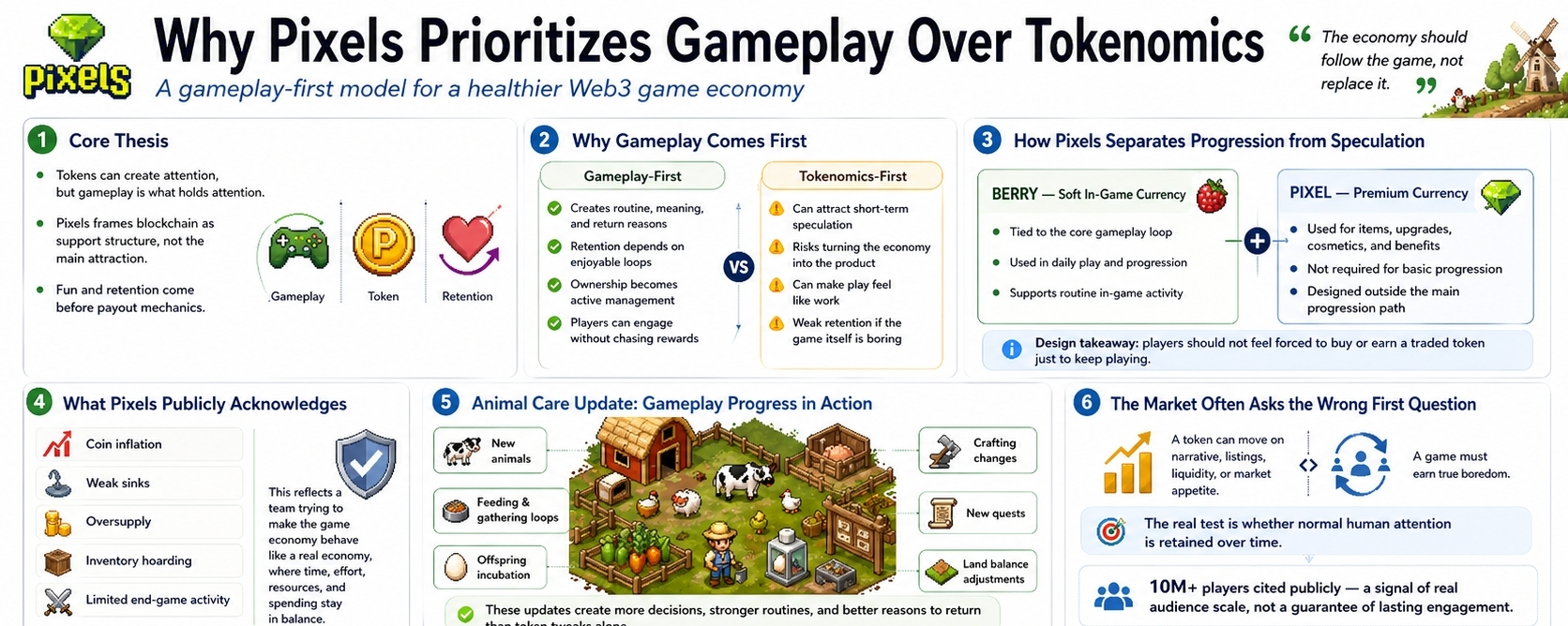

@Pixels I opened Pixels after midnight with a chipped mug beside my keyboard and the soft click of my mouse filling the room. I wasn’t looking for a price chart. I was watching small routines: crops, animals, tasks, timers, land. I cared because the game seemed to be asking a harder question than most crypto games ask: can play matter before payout does?
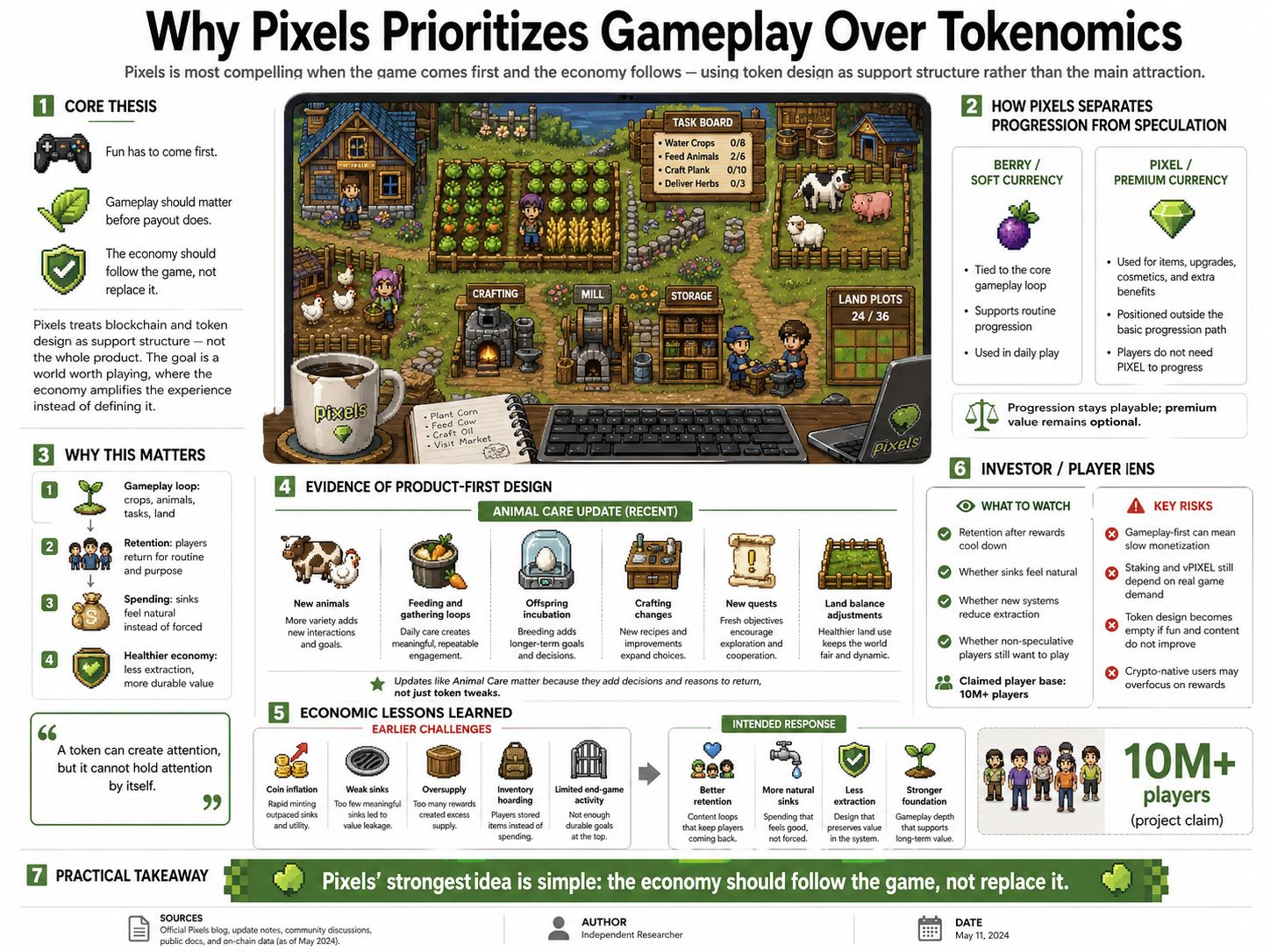
I think Pixels prioritizes gameplay over tokenomics because it has already seen what happens when a game lets the economy become the product. A token can create attention, but I don’t think it can hold attention by itself. Pixels’ own recent framing is unusually direct about this. Its whitepaper says the game needs an intrinsic reason for people to spend time inside it, and that fun has to come first, even while blockchain adds new possibilities. That matters to me because it treats token design as support structure, not as the main attraction.
I see that choice most clearly in how Pixels separates progression from speculation. The older docs describe BERRY as a soft in-game currency tied to the core loop, something players use to move through daily gameplay. PIXEL, by contrast, is described as a premium currency used for items, upgrades, cosmetics, and other benefits outside the basic progression path, with the docs explicitly saying players do not need it to progress. I read that as a practical design decision. If a player feels forced to buy or earn a traded token just to keep playing, the game starts feeling like work with extra steps.
That doesn’t mean tokenomics is unimportant. I think the sharper point is that Pixels seems to understand tokenomics can damage a game when it gets ahead of content. The project’s newer materials acknowledge problems in the core loop, including coin inflation, weak sinks, oversupply, inventory hoarding, and limited end-game activity. I respect that admission because it is not the language of a project pretending everything is solved. It is the language of a team trying to make a game economy behave like an economy, where time, effort, resources, and spending have to remain in tension.
The recent Animal Care update is a good example of progress I can actually understand without staring at token emissions. It added new animals, feeding and gathering loops, offspring incubation, crafting changes, new quests, and land balance adjustments. My read is that this kind of update matters more than a token tweak in the short run. It gives players more decisions to make. It creates reasons to return. It turns ownership into management rather than a static asset sitting in a wallet.
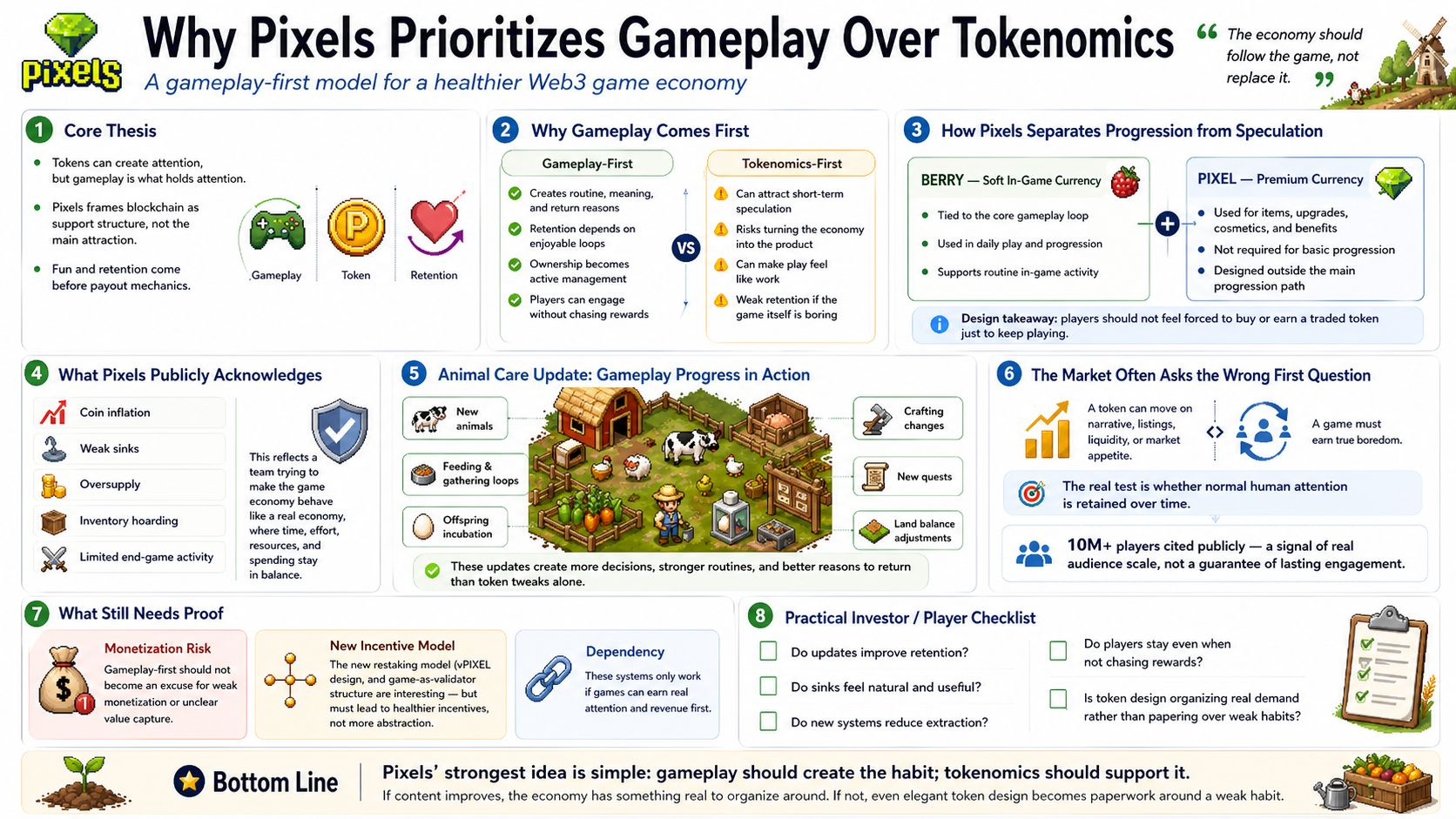
I also think the market often misreads projects like Pixels by asking whether the token can move before asking whether the game can retain normal human attention. A tradable token can rise on narrative, listings, liquidity, or general market appetite. A game has to survive boredom. It has to make routine feel meaningful without making routine feel exploitative. Pixels’ public site leans into farming, building, collaboration, land ownership, and a player base it says has passed 10 million players. I don’t treat that number as a guarantee of durable engagement, but I do treat it as evidence that the project has had a real audience to learn from.
The risk is that gameplay-first can become an excuse for slow monetization or unclear value capture. I still need to see whether the newer staking model, vPIXEL design, and game-as-validator structure can create healthier incentives rather than another layer of financial abstraction. Pixels says staking lets players support individual games, rewards are tied to game performance, and vPIXEL is designed as a spend-only token backed one-to-one by PIXEL. That is interesting business logic, but it still depends on games earning attention and revenue in the first place.
So my practical view is cautious. I would not judge Pixels only by token supply, staking headlines, or short-term price action. I would watch whether updates improve retention, whether sinks feel natural, whether new systems reduce extraction, and whether players who are not chasing rewards still find reasons to play. If those pieces improve, tokenomics has something real to organize around. If they don’t, even elegant token design becomes paperwork around a weak habit. For me, Pixels’ strongest idea is simple: the economy should follow the game, not replace it.
@Pixels #pixel $PIXEL $AIOT $DAM
